PART 2: I Found a Dog Duct-Taped to a Tree in the Middle of Nowhere—What Happened After I Cut Her Free Changed Everything
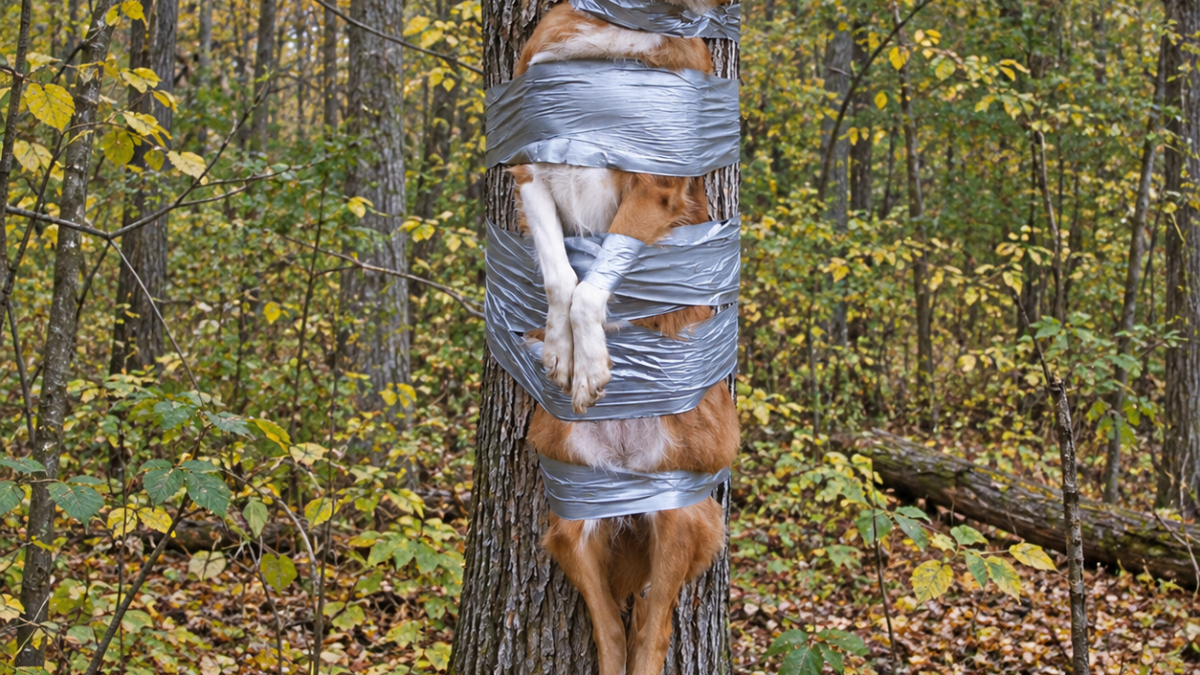
PART 2
I put Luna on the passenger seat and immediately changed my mind.
She was too weak to keep herself upright.
So I laid her across my lap, started the truck, and called the nearest veterinary clinic again.
Dr. Mara Ellis answered this time.
“Pavel?”
“We’re moving.”
“How responsive is she?”
“Eyes open. She’s shaking.”
“Good.”
“Good?”
“Shivering means her body is still trying to regulate temperature. Keep her wrapped, but don’t overheat her.”
I looked at Luna.
“She’s extremely thin.”
“Can she lift her head?”
“Barely.”
“Any bleeding?”
“Some raw skin where the tape was.”
“Breathing?”
“Fast.”
“Drive carefully. I’ll be ready.”
The clinic was twenty-two minutes away.
I made it in eighteen.
Mara was already waiting outside with a technician and a rolling stretcher.
The second she saw Luna, the professional calm disappeared from her face.
“Jesus.”
“That bad?”
“Inside. Now.”
They carried Luna away.
I followed until Mara turned and put a hand against my chest.
“Give us room.”
“I found her.”
“I know.”
“She knows me.”
“Pavel.”
Something in her voice stopped me.
“If you want her to live, let us work.”
So I stood in the hallway.
There are few things worse than being useful one moment and completely useless the next.
Through the small window in the treatment-room door, I saw people moving around Luna.
IV line.
Blankets.
Blood-pressure cuff.
Someone shaving a patch of fur.
Mara examining her gums.
Another technician preparing syringes.
I noticed blood on my own hands.
Not much.
Tiny streaks from where adhesive had pulled Luna’s skin.
I went to the bathroom and washed them.
The water turned pink.
I stared at it going down the drain.
Someone had done that deliberately.
That thought would not leave me.
Not a trap.
Not an accident.
Not a dog caught in garbage.
A person had taken wide industrial tape and wound it around a living animal again and again.
They’d had time to stop.
After the first loop.
The second.
The fifth.
The tenth.
They hadn’t.
Forty minutes later, Mara came into the hallway.
“She’s stable for the moment.”
“For the moment?”
“She’s severely dehydrated. Her blood sugar is low. She’s underweight, and circulation around some of the compressed areas is compromised.”
“Will she live?”
“I don’t know.”
I hated the answer.
Mara saw that.
“She has a chance.”
“How long was she out there?”
Mara exhaled.
“Based on dehydration, stomach contents, muscle condition… I’d estimate three to four days.”
I stared at her.
“Four days?”
“Possibly.”
“In that position?”
“Yes.”
“No water?”
“The rain may have saved her.”
I remembered Luna licking droplets from her nose.
My stomach tightened.
“If the storm hadn’t happened?”
Mara didn’t answer.
She didn’t need to.
I sat beside the wall.
“Can I see her?”
“In a little while.”
“The tag says Luna.”
Mara looked at me.
“A name tag?”
I handed it to her.
“Anything on the back?”
“There was something, but it’s scratched.”
She examined it under the light.
The back had clearly once held a phone number.
Someone had scraped it with something sharp until most of the digits were unreadable.
“That’s deliberate,” I said.
“Looks like it.”
“Can you scan her?”
“For a microchip?”
I nodded.
Mara turned immediately.
Two minutes later, she came back holding a scanner.
“She has one.”
My pulse jumped.
“Registered?”
“We’ll find out.”
It took another fifteen minutes.
Then Mara returned with a piece of paper.
“Luna is registered to a woman named Elena Brooks.”
“Local?”
“Neighboring county.”
“Call her.”
“I already did.”
“And?”
“No answer.”
“Try again.”
“Pavel.”
“Somebody is probably looking for this dog.”
“I know.”
“Then keep trying.”
She studied me for a moment.
“I’ve called twice and left an emergency message.”
I nodded.
“Good.”
The county animal-control officer arrived before Elena called back.
His name was Daniel Price.
I’d met him a few times through forestry work.
Daniel had spent twenty years dealing with neglected horses, chained dogs, illegal breeders, and people who always seemed to believe cruelty became acceptable if they called it “discipline.”
He photographed my jacket.
The tag.
The tape fragments I’d placed in a clean evidence bag from my truck kit.
Then he asked me to take him back to the tree.
“I want to stay here.”
“I understand.”
“What if she dies?”
“Then you’ll wish we’d preserved the scene properly.”
That hurt because it was true.
I looked through the treatment-room window.
Luna lay beneath warmed blankets.
“I’ll follow you.”
The forest looked different when we returned.
Angrier somehow.
Daniel photographed the pine from every angle.
The cut tape still clung to the bark.
The rain had destroyed most tracks.
Still, we found tire impressions near the old quarry turnoff.
Large truck.
Aggressive tread.
Not mine.
Daniel crouched beside them.
“Could be dozens of vehicles.”
“Nobody comes down here.”
“You did.”
“Because the main road washed out.”
“So maybe someone else did.”
“Before the storm?”
He looked at me.
“That’s the problem.”
The tracks were partially softened by rain.
They had been there before the worst of the storm.
Daniel found something else near the tree.
A cigarette butt.
Then another.
He bagged both.
“You think the person stood here smoking while doing it?”
“I think cigarettes exist in forests.”
“You always this cheerful?”
“Evidence doesn’t become useful because we hate somebody.”
I looked at the tape around the pine.
“I already hate them.”
“I know.”
We returned to the clinic after noon.
Luna was still alive.
That was the first victory.
Then Elena Brooks called.
Mara put the phone on speaker in her office.
A woman’s frightened voice filled the room.
“You said you found Luna?”
Mara looked at me.
“Yes.”
“Is she alive?”
“Yes, but she’s in critical condition.”
The sound Elena made was half sob, half breath.
“I’ve been looking everywhere.”
“When did she disappear?” Daniel asked.
“Four days ago.”
Exactly.
“Was she loose?”
“No.”
“Did she escape from your yard?”
“No.”
A pause.
Then Elena said something that changed everything.
“Adrian took her.”
Daniel sat straighter.
“Who’s Adrian?”
“My ex-boyfriend.”
“How do you know he took Luna?”
“Because he told me he did.”
My hands tightened.
“What exactly did he say?” Daniel asked.
Elena hesitated.
“He said if I left him, I’d lose more than the relationship.”
“Did he mention the dog?”
“Yes.”
Her voice cracked.
“Luna was my father’s dog.”
“Your father’s?”
“He adopted her for me before he died last year. Adrian knew what she meant to me.”
Daniel glanced at me.
Elena continued.
“When I finally moved out, Luna stayed with my sister for two weeks because Adrian knew where my new apartment was. Four nights ago, somebody opened my sister’s backyard gate.”
“Was the lock forced?”
“It was cut.”
“And Adrian admitted taking her?”
“He sent me a message.”
“Do you still have it?”
“Yes.”
“What does it say?”
Elena breathed shakily.
“‘You wanted to take everything from me. Now you know how it feels.'”
My jaw tightened.
Daniel remained calm.
“Anything after that?”
“I asked where Luna was.”
“And?”
“He replied, ‘Maybe you should’ve thought about that before you left.'”
I closed my eyes.
Mara looked sick.
Daniel said, “Elena, don’t delete anything. Screenshot the entire conversation, but also preserve the original messages.”
“I already gave them to the police.”
“When?”
“The morning Luna disappeared.”
“What happened?”
“They spoke to Adrian. He said he didn’t have her.”
“And then?”
“They said there wasn’t enough proof.”
Silence filled the office.
Finally Elena asked:
“What did he do to her?”
Nobody wanted to answer.
Mara did.
“She was found restrained to a tree.”
“What do you mean restrained?”
I stared at the floor.
Mara said softly:
“With duct tape.”
Nothing came from the phone.
Then a sound so broken that I still remember it years later.
“No.”
Mara closed her eyes.
“No, no, no…”
“Elena—”
“I should’ve gone back.”
“This is not because you left,” Mara said firmly.
“He knew.”
Elena was crying now.
“He knew she was the only thing my dad left me.”
Daniel leaned toward the phone.
“Elena, listen carefully. You leaving did not make him do this. He made a choice.”
I looked at Daniel.
That was the first time I saw the man beneath the uniform.
Elena arrived three hours later.
She came through the clinic doors almost running.
Thirty-two years old.
Dark hair pulled into a careless knot.
No makeup.
Red eyes.
She looked around wildly.
“Where is she?”
Mara intercepted her.
“She’s stable, but she’s weak. You need to stay calm.”
“I need to see her.”
“You will.”
“Please.”
Mara led her to the recovery area.
I stayed back.
This wasn’t my moment.
Luna lay beneath a blanket with an IV attached to one front leg.
Elena stopped several feet from the enclosure.
Her hand flew to her mouth.
“Luna?”
One ear moved.
That was all.
Elena took another step.
“Baby?”
Luna’s eyes opened.
Her head lifted.
A tiny whine came from her throat.
Elena collapsed to her knees.
“Oh, baby.”
Luna tried to stand.
She couldn’t.
Her legs gave out.
Elena started crying so hard Mara had to steady her.
“I’m sorry. I’m so sorry.”
Luna dragged herself forward anyway.
One paw.
Then another.
Until her nose reached Elena’s fingers through the opening in the enclosure.
Everyone in that room stopped moving.
Even Daniel.
Elena pressed her forehead against the metal edge.
“I found you.”
I looked away.
Because suddenly the room was too private.
I went outside.
Ten minutes later, Elena joined me.
“You’re Pavel?”
I nodded.
She hugged me before I could respond.
I am not a man who enjoys being hugged by strangers.
That day, I let her.
“Thank you.”
“You don’t owe me anything.”
“She’d be dead.”
“We don’t know that.”
“Yes, we do.”
Her grip tightened.
“You stopped.”
I didn’t know what to say.
So I said the truth.
“I heard her.”
“A lot of people would’ve kept driving.”
“Maybe.”
“You didn’t.”
We stood there awkwardly afterward.
Then she asked:
“Did she suffer?”
I could have lied.
I wanted to.
But lies don’t make pain disappear.
“Yes.”
Elena looked down.
“But she was still fighting when I found her.”
“How?”
“The rain.”
She looked up.
“What?”
“Water ran down the tree. She licked the drops.”
Elena covered her face.
I regretted telling her.
Then she whispered:
“My dad used to say she was too stubborn to die.”
I almost smiled.
“He may have been right.”
The investigation moved quickly after that.
Daniel returned to the forest with detectives.
They collected the tape.
Cigarette butts.
Tire impressions.
The tag.
They requested surveillance footage from roads around the quarry.
One camera belonged to an old sand-and-gravel business two miles away.
Another sat outside a gas station on Route 16.
For two days, there was nothing.
Then Daniel called.
“Do you know what Adrian Mercer drives?”
“No.”
“Black Ford F-250. Lifted. Off-road tires.”
I knew where this was going.
“Tell me.”
“We have a black F-250 passing the gravel-yard camera at 1:43 a.m. the night Luna disappeared.”
“Heading toward the quarry?”
“Yes.”
“And leaving?”
“2:19.”
“Plate?”
“Unreadable.”
“Then how do you know it’s his?”
“I didn’t say we know.”
“Daniel.”
“There’s a broken left taillight.”
“So?”
“Adrian’s truck has a broken left taillight.”
I felt satisfaction rise.
Daniel immediately killed it.
“There are thousands of black F-250s.”
“With broken left taillights?”
“Enough.”
“You’re impossible.”
“That’s why cases survive court.”
Police interviewed Adrian again.
He denied everything.
He claimed he had been home asleep.
Then he said his truck had been parked outside.
Then he suggested someone might have borrowed it.
Then he refused to say who.
That wasn’t proof.
But it was movement.
Luna remained hospitalized for six days.
On day two, her kidneys showed signs of stress from dehydration.
On day three, she developed swelling beneath an area where the tape had compressed tissue.
On day four, she finally ate without assistance.
Mara called me while I was working.
“Your forest dog is eating.”
“She’s Elena’s dog.”
“Then why have you called seven times today?”
“I’ve called twice.”
“Five.”
“You’re exaggerating.”
“I have caller ID.”
“How much did she eat?”
Mara laughed.
“Half a bowl.”
“Good.”
“She’s also trying to bite the IV line.”
“Very good.”
“That’s not medically desirable.”
“It’s emotionally desirable.”
By day five, Luna could stand.
By day six, she walked twelve steps.
Everyone applauded.
Luna looked offended by the attention.
When she left the clinic, Elena carried her outside wrapped in a red blanket.
I met them near the door.
“You ready to go home?” I asked.
Luna licked my wrist.
Elena smiled.
“I think she remembers you.”
“I smell like pine trees.”
“You smell like truck diesel.”
“That too.”
But Luna wasn’t going back to Elena’s apartment.
Not yet.
Adrian knew where she lived.
Elena had obtained a temporary protective order, but a sheet of paper doesn’t make every frightened person feel protected.
Her sister’s yard no longer felt safe either.
Daniel suggested a confidential foster placement until the investigation advanced.
Elena hated the idea.
“I just got her back.”
“I know,” he said.
“You’re asking me to give her away again.”
“Temporarily.”
“To strangers.”
That’s when everyone looked at me.
I noticed.
“No.”
Mara smiled.
“I didn’t say anything.”
“Your face did.”
Elena wiped her eyes.
“Pavel…”
“I work ten-hour days.”
“I can pay for food.”
“That’s not the problem.”
“My house is small.”
“So is mine.”
“I’ve never owned a dog.”
“Luna already likes you.”
I pointed at Daniel.
“You stay out of this.”
He lifted both hands.
“I haven’t spoken.”
I looked down.
Luna was sitting beside my boot.
She leaned against my leg.
Traitor.
I sighed.
“Two weeks.”
Elena’s face changed.
“Really?”
“Two.”
It became three months.
The first night Luna stayed with me, I prepared a bed beside the fireplace.
She wouldn’t use it.
I put a blanket next to my couch.
She wouldn’t use that either.
Instead she followed me from room to room.
Kitchen.
Hallway.
Bedroom.
Back to the kitchen.
Always three feet behind me.
If I closed a door, she panicked.
If tape ripped from a cardboard package, she flattened herself against the floor.
The first time it happened, I was sealing a box.
Rrrrip.
Luna screamed.
Not barked.
Screamed.
She ran into the corner and tried to climb through the wall.
I dropped the tape.
“Luna.”
She shook so violently her tags rattled.
I sat on the floor ten feet away.
I didn’t touch her.
For nearly fifteen minutes, I just talked.
“You’re home.”
Her eyes stayed fixed on the roll of tape.
“Nobody’s tying you.”
She lowered herself.
“Nobody gets to do that again.”
Eventually she crawled toward me.
I hid every roll of tape in the house after that.
Elena visited almost every day.
The first few visits, Luna wouldn’t let her leave.
She stood at the door whining after Elena walked out.
Those evenings were hard.
“She thinks I’m abandoning her again,” Elena said once.
“No.”
“How do you know?”
“Because dogs don’t tell stories the way we do.”
Elena looked at me.
“Meaning?”
“She knows you’re here now. She knows I’m here now. That’s enough for today.”
“You’re a philosopher?”
“I’m a forester.”
“Same thing?”
“Trees don’t argue.”
“Neither do dogs.”
“You haven’t met Luna.”
Luna barked from the kitchen.
Elena laughed.
It was the first time I heard her laugh.
Meanwhile, Adrian became louder.
Someone leaked that he was being investigated.
He posted online before police released his name.
He claimed Elena was using Luna to “destroy his life.”
He said the dog had always been badly behaved.
He said she had escaped before.
He accused animal-control officers of harassment.
Then he posted something that caught Daniel’s attention.
**I never went near that quarry. Anybody can drive down that road.**
The problem was simple.
No public report had identified the quarry.
News stories had only said Luna was found “in a remote forested area.”
Daniel called me.
“Did you tell anyone the exact location?”
“No.”
“Elena?”
“Ask her.”
“I did.”
“And?”
“No.”
“Forestry employees?”
“Only my supervisor.”
“We’ve interviewed him.”
I smiled.
“You sound pleased.”
“I don’t get pleased.”
“You’re pleased.”
“I’m interested.”
Adrian deleted the post less than an hour later.
Daniel already had screenshots.
Then Adrian made a bigger mistake.
He came to my house.
It was just after seven one evening.
Luna was asleep near the fireplace when headlights crossed my front windows.
A black pickup stopped at the end of my driveway.
I stood.
Luna’s head snapped up.
The truck door opened.
She went rigid.
Every hair along her back rose.
I had never heard her growl before.
That night, I did.
Low.
Terrified.
I looked through the window.
A man in his thirties walked toward the house.
Tall.
Work boots.
Dark jacket.
I knew his face from social media.
Adrian.
I locked the door.
Then I called Daniel.
“He’s here.”
“Who?”
“Adrian.”
“Do not go outside.”
“I wasn’t planning to.”
“Lock everything. I’m sending a deputy.”
Adrian knocked.
Three slow knocks.
Luna backed away.
He knocked again.
“Pavel?”
I said nothing.
“I know you’re in there.”
Luna began trembling.
That told me more than any photograph could have.
Adrian called through the door.
“I just want to talk.”
I picked up my phone and started recording video from inside.
“Leave.”
He laughed.
“Come on, man.”
“You’re on camera.”
That was a lie.
At the time, I hadn’t installed cameras.
But it worked.
His expression changed.
“I didn’t come to cause trouble.”
“Then leave.”
“You don’t know Elena.”
“I know Luna.”
“That’s not your dog.”
“No.”
“Then stay out of it.”
There it was.
The sentence every coward eventually uses.
Stay out of it.
I looked down at Luna.
Her body was pressed against my leg.
I answered through the door.
“You taped a living animal to a tree.”
“You can’t prove that.”
Silence.
I almost stopped breathing.
He realized what he’d said.
Not “I didn’t.”
Not “That’s crazy.”
You can’t prove that.
I kept my voice level.
“I didn’t accuse you.”
Another silence.
Then:
“Everybody is accusing me.”
“Go home, Adrian.”
“You think you’re some hero because you found a dog?”
“No.”
“Elena is manipulating you.”
“Leave.”
“She did the same thing to me.”
Police lights appeared at the end of the road.
Adrian saw them.
He walked back toward his truck.
Before getting inside, he turned.
“This isn’t over.”
A deputy heard that.
Adrian later claimed he meant the legal dispute wasn’t over.
Maybe.
But it gave Elena grounds to strengthen the protective order.
And it gave me reason to install cameras the next morning.
The case still wasn’t ready.
That frustrated me more than anything.
I had heard him.
Luna had reacted to him.
His truck matched the camera footage.
He knew the quarry location.
He had threatened Elena.
Yet Daniel kept saying the same thing.
“We need more.”
“More than what?”
“Something connecting him physically to the restraint.”
“The tape.”
“Common product.”
“The cigarettes.”
“Lab hasn’t finished.”
“His truck.”
“Circumstantial.”
“The messages.”
“Strong, but they don’t explicitly say he harmed Luna.”
I slammed my coffee cup down.
“What would be enough?”
Daniel looked at me.
“Enough that he doesn’t walk away.”
That shut me up.
Two weeks later, the cigarette results came back.
One had insufficient DNA.
The other produced a usable profile.
It matched Adrian.
I called Daniel when I heard.
“Now?”
“Better.”
“Better?”
“His attorney will say he visits the quarry.”
“He publicly said he’d never been there.”
“I know.”
“So he lied.”
“Yes.”
“You’re enjoying this.”
“A little.”
But the best evidence came from a place none of us expected.
A trail camera.
An eighty-year-old man named Harold Finch owned forty acres bordering the old quarry.
He used wildlife cameras to watch deer.
One camera hadn’t been checked since autumn because the access path was muddy.
When Harold finally retrieved the memory card, he saw a news report about Luna.
He called the sheriff.
The footage was grainy.
Black and white.
But clear enough.
1:51 a.m.
A black truck drove along the service trail.
1:57.
The truck stopped near the pines.
2:04.
A man walked into frame carrying something.
Not a box.
A dog.
Her legs hung over his arms.
A white stripe was visible on the face.
2:11.
The man returned alone.
At 2:17, the truck drove away.
The license plate wasn’t visible.
The face wasn’t clear enough for positive identification.
But the truck had a broken left taillight.
And the man’s jacket carried a rectangular reflective patch across one shoulder.
Daniel got a warrant.
Adrian’s work jacket had the same patch.
His truck tires matched the tread pattern photographed near the site.
Inside the truck, investigators found reddish dog hairs.
Adrian’s lawyer argued Luna had ridden in the vehicle before.
True.
They also found a partially used roll of the same brand and width of industrial duct tape.
Again, common.
Then the lab analyzed adhesive residue taken from Luna’s fur.
Manufacturing trace markers were consistent with the roll seized from Adrian’s truck.
Not absolutely unique.
But together?
Truck.
Timeline.
Cigarette DNA.
Messages.
Knowledge of location.
Trail camera.
Tape.
Lies.
It was becoming difficult to explain.
Adrian was arrested on a Friday morning.
Elena called me.
“They got him.”
I sat at my kitchen table.
Luna was chewing a rubber ball under my chair.
“I heard.”
“I thought I’d feel better.”
“You don’t?”
“I feel sick.”
“That sounds normal.”
“You’re terrible at comfort.”
“I work with trees.”
“They’re probably grateful.”
Then she went quiet.
“Pavel?”
“Yeah?”
“Thank you for not doing what I wanted to do.”
I understood immediately.
For weeks, Elena had talked about confronting him.
Once she said she wanted Adrian to feel exactly what Luna had felt.
Tied.
Helpless.
Afraid.
She didn’t truly mean it.
She meant she wanted the universe to be fair.
But pain rarely speaks carefully.
“You would’ve regretted it,” I said.
“I know.”
“Now he has to answer for what he did.”
“Is that enough?”
I looked at Luna.
“No.”
Elena was silent.
“Nothing makes four days against that tree disappear,” I continued. “Nothing makes what he did to you disappear either.”
“So what does enough look like?”
“I don’t know.”
That was the truth.
I would learn later.
After Adrian’s arrest, things got uglier before they improved.
His family defended him publicly.
His brother posted that Elena was “crazy.”
Friends claimed Luna had been aggressive.
Someone said I’d planted the cigarette butt.
Another person claimed I was secretly dating Elena and had invented the whole story.
That one almost made me laugh.
Almost.
Then someone spray-painted **LIAR** across my garage door.
That didn’t make me laugh.
My cameras recorded two people in hooded sweatshirts.
Faces hidden.
No identification.
Daniel wanted me to stay elsewhere temporarily.
“No.”
“Pavel.”
“This is my house.”
“They want a reaction.”
“They’re getting paint remover.”
“You’re not funny.”
“I’m a little funny.”
Luna stood in the doorway behind me.
Daniel looked at her.
“How does she do when you’re away?”
“Badly.”
“Then take her somewhere.”
“Where?”
“Elena’s new apartment is secure.”
I looked at him.
“How do you know about Elena’s new apartment?”
“I’m animal control. We coordinate placement safety.”
“That sounded suspiciously rehearsed.”
“Take the dog somewhere safe.”
So Luna and I stayed with Elena for two nights.
Her apartment was tiny.
One bedroom.
Second floor.
Three locks.
No yard.
Luna didn’t care.
She climbed onto Elena’s couch and fell asleep upside down.
“You spoiled her,” Elena said.
“I did not.”
“She used to know ‘off.'”
“She still knows it.”
“Then why is she on the couch?”
“She disagrees with the policy.”
Elena laughed.
Later that night, we sat in the kitchen while Luna slept.
Elena told me more about Adrian.
They had dated almost three years.
At first, he had been charming.
Helpful.
Protective.
Then protective became controlling.
Who was she texting?
Why was she late?
Why did she need to see her sister?
Why did she need her own money?
He never hit her.
Not until near the end.
Before that, he broke objects.
Punched walls.
Threatened.
Apologized.
Bought flowers.
Promised.
Repeated.
Luna hated him when he yelled.
“She’d stand between us,” Elena said.
“That’s why he hated her.”
“Maybe.”
“No. I’m sure.”
Elena looked toward the couch.
“My dad gave me Luna when she was eight weeks old. He was sick already. He said I’d need somebody stubborn enough to keep me moving.”
“How old was she when he died?”
“Ten months.”
“And now?”
“Eighteen months.”
Still almost a puppy.
I imagined her taped to the pine.
I had to push the image away.
Elena watched my face.
“You see it too, don’t you?”
“What?”
“The tree.”
I nodded.
“Every time I close my eyes.”
“Me too.”
“We should stop letting him own that picture.”
She frowned.
“What do you mean?”
“He gets the tree.”
I pointed toward Luna asleep on the couch.
“We get that.”
Elena stared for several seconds.
Then she nodded.
The criminal case took months.
During that time, Luna healed.
Physically first.
The skin beneath her fur recovered.
Her weight returned.
She developed muscle in her legs.
Her coat became thick and glossy.
The mental scars took longer.
Gray tape terrified her.
Men wearing Adrian’s brand of work jacket frightened her.
Pickup trucks sometimes made her freeze.
But she learned.
A behaviorist helped.
Mara taught us how to avoid reinforcing panic while still giving Luna safety.
Slow exposure.
Choice.
Distance.
No force.
The first breakthrough happened accidentally.
I was repairing a broken tool handle in my garage.
I needed tape.
For months I’d used only red electrical tape around Luna.
That day, without thinking, I grabbed a roll of gray duct tape.
Rrrrip.
I froze.
Luna stood in the doorway.
Her ears went back.
But she didn’t run.
I placed the roll on the floor.
Then stepped away.
She stared.
I sat down.
Five minutes passed.
Ten.
Finally Luna approached.
She sniffed the tape.
Backed away.
Came forward again.
Then picked up the roll in her mouth and carried it outside.
I burst out laughing.
She dropped it in a mud puddle.
“Good dog.”
She wagged her tail.
When Elena heard, she cried.
Not because Luna was afraid.
Because for the first time, Luna had touched the thing that terrified her and decided what happened to it.
That mattered.
The trial began eight months after I found her.
By then, Luna had technically returned to Elena.
Technically.
In reality, she spent half her week with me.
Elena’s new apartment allowed dogs, and Adrian was prohibited from contacting her.
Still, when Elena worked late, Luna came to my house.
When I went into the forest, Luna sometimes joined me.
We had an arrangement.
I called it shared custody.
Elena called it proof I’d become a dog person.
“I am not a dog person.”
“You keep treats in your truck.”
“For emergencies.”
“You bought her a raincoat.”
“It was raining.”
“You have a framed photograph of her.”
“That was a gift.”
“You framed the gift.”
I stopped arguing.
The prosecution called Elena first.
She testified about Adrian’s threats.
About Luna disappearing.
About the messages.
The defense attorney tried to suggest their breakup had been hostile and Elena wanted revenge.
She surprised everyone.
“Of course I was angry.”
“Very angry?”
“Yes.”
“Angry enough to blame Mr. Mercer for something he didn’t do?”
“No.”
“But you wanted him punished.”
“I wanted Luna found.”
“And afterward?”
Elena looked at Adrian.
“I wanted to hurt him.”
The defense attorney paused.
That wasn’t the answer he’d expected.
“You wanted to hurt my client?”
“Yes.”
The prosecutor started to rise.
Elena continued.
“For about three days.”
The judge allowed her to finish.
“I imagined every horrible thing I wanted him to feel. Then Luna came home from the hospital.”
She looked toward the jury.
“She was scared of tape. Scared of trucks. Scared of doors closing. I realized I could spend the rest of my life thinking about making him suffer, or I could spend it making sure she felt safe.”
The defense attorney said:
“So your anger affected your judgment.”
“No.”
“How can you say that?”
“Because I’m telling you the part that makes me look bad.”
The courtroom went silent.
Elena continued.
“If I wanted to lie, I’d tell you I never hated him. I did. Some days I still do. But hatred isn’t evidence.”
I almost smiled.
Daniel had taught her well.
Then came the trail-camera video.
The courtroom screen showed the black truck entering the forest.
The figure carrying Luna.
The figure returning alone.
Elena looked down.
Adrian didn’t.
He stared at the screen.
No expression.
That bothered me more than anger would have.
Mara testified about Luna’s condition.
“How dehydrated was she?” the prosecutor asked.
“Severely.”
“Could she have survived another twenty-four hours?”
Mara paused.
“In my opinion, probably not.”
“Another twelve?”
“Possibly not.”
“Was the restraint capable of causing injury?”
“Yes.”
“Did it?”
“Yes.”
She explained pressure injuries.
Skin inflammation.
Circulation loss.
Muscle weakness.
Psychological trauma.
Then the prosecutor asked:
“Was this consistent with accidentally becoming entangled in tape?”
Mara almost looked insulted.
“No.”
“Could a dog wrap herself to a tree in this manner?”
“No.”
“Why not?”
“There were multiple circumferential layers securing the animal’s torso directly to the trunk. This required deliberate external application.”
In other words:
Someone did it.
Then I testified.
I expected the defense attorney to attack me.
Instead, he tried to make me emotional.
It almost worked.
“Mr. Novak, you considered Luna helpless when you found her?”
“Yes.”
“You became attached to her?”
“Yes.”
“You were angry?”
“Yes.”
“Would you say furious?”
“Yes.”
“Did you tell Officer Price you hated whoever did it?”
“I did.”
“So you formed an emotional conclusion before knowing the facts.”
“I formed the conclusion that whoever taped a dog to a tree was cruel.”
A few jurors shifted.
The lawyer continued.
“Did you assume that person was my client?”
“No.”
“When did you first suspect him?”
“After Elena explained her messages.”
“So based entirely on something his former girlfriend said.”
“No.”
“What else?”
“His truck.”
“Which you didn’t identify until afterward.”
“Correct.”
“The cigarette?”
“Afterward.”
“His public knowledge of the quarry?”
“Afterward.”
“The camera?”
“Afterward.”
The lawyer spread his hands.
“So each new fact confirmed a suspicion you already held.”
I understood his strategy.
Confirmation bias.
Make me look like a man searching for evidence against someone I’d already decided was guilty.
I thought carefully.
“No.”
“No?”
“Each new fact made me more willing to let people trained to investigate do their job.”
The lawyer smiled.
“But you wanted Mr. Mercer convicted.”
“Eventually.”
“Eventually?”
“When enough evidence existed.”
“Who decides what’s enough?”
“The jury.”
That ended that line.
Then he tried something else.
“Mr. Novak, did you ever threaten my client?”
“No.”
“Did you tell people you wanted revenge?”
I thought.
“Probably.”
“Probably?”
“I was angry.”
“So yes?”
“Yes.”
The lawyer turned toward the jury.
“You wanted revenge.”
“At first.”
“And now?”
I looked at Adrian.
For months, I’d imagined that moment.
I expected my heart to race.
It didn’t.
“Now I want consequences.”
“What’s the difference?”
The lawyer asked it sarcastically.
I answered seriously.
“Revenge would’ve been me taking him into the woods and making him feel what Luna felt.”
The courtroom became utterly still.
The judge watched me closely.
I continued.
“I never did that.”
“No.”
“I didn’t damage his truck.”
“No.”
“I didn’t threaten his family.”
“No.”
“I didn’t touch him.”
“No.”
“What I did was cut a dog free, call the police, preserve evidence, and testify.”
I looked at the jury.
“That’s the difference.”
The defense attorney changed subjects.
The strongest moment of the trial didn’t come from me.
It came from Adrian himself.
Against his lawyer’s apparent preference, he testified.
He claimed he had gone near the quarry because he sometimes dumped construction debris there.
That explained his cigarette.
His truck.
The tire tracks.
He claimed Luna had been in his truck weeks earlier, explaining the fur.
He claimed he owned the tape for work.
Then the prosecutor asked:
“Why did you tell police you had never visited the quarry?”
“I was confused.”
“Why did you write publicly that you had never gone near it?”
“I didn’t want people twisting things.”
“You lied so people wouldn’t think you were lying?”
His attorney objected.
Sustained.
The prosecutor moved on.
“You testified that Ms. Brooks falsely accused you because she was angry after the breakup.”
“Yes.”
“You told investigators Luna was aggressive.”
“She could be.”
“Did you like Luna?”
“Not particularly.”
“Why?”
“She barked.”
“At you?”
“Sometimes.”
“Did she ever bite you?”
“No.”
“Attack you?”
“No.”
“Damage your property?”
“She chewed things.”
“What?”
“A shoe once.”
The prosecutor paused.
“You disliked an eighteen-month-old dog because she chewed a shoe?”
Adrian’s face reddened.
“That’s not what I said.”
“Did you send Ms. Brooks the message, ‘You wanted to take everything from me. Now you know how it feels’?”
“Yes.”
“What did you mean?”
“Personal stuff.”
“What personal stuff?”
“Our relationship.”
“The message was sent forty minutes after Luna disappeared.”
“Coincidence.”
“And when Ms. Brooks asked where Luna was, you replied, ‘Maybe you should’ve thought about that before you left.'”
“I was angry.”
“Why mention her leaving in response to a question about the missing dog?”
Adrian looked at his lawyer.
No help came.
“I don’t remember.”
The prosecutor walked back to her table.
Then she picked up a photograph.
It showed the pine.
Gray tape still wrapped around it.
“Mr. Mercer, had you ever seen this photograph before the news reports?”
“No.”
“You’d never seen that tree?”
“No.”
“Never stood beside it?”
“No.”
“Never taped Luna to it?”
“No.”
“Never left her there?”
“No.”
Then came the last piece.
The prosecutor displayed a still frame from Harold’s trail camera.
The man carrying Luna.
The image was enlarged.
On his right wrist was a bright reflective band.
Adrian looked at it.
The prosecutor asked:
“Do you recognize the object on that man’s wrist?”
“No.”
She held up another photograph.
Taken from Adrian’s public construction-company page two days before Luna disappeared.
Adrian standing beside a concrete mixer.
On his wrist was the same reflective safety band.
Not similar.
The same unusual model, with a damaged black stripe through the center.
The prosecution had recovered it from his garage.
His attorney objected to the significance.
But the jurors were looking.
So was Adrian.
For the first time, he looked afraid.
The jury deliberated nearly seven hours.
I spent most of that time outside.
Elena sat beside me on a courthouse bench.
Daniel drank terrible vending-machine coffee.
Mara kept checking her phone.
“Who’s with Luna?” I asked.
“My technician.”
“Which one?”
“Grace.”
“She gives too many treats.”
Mara looked at me.
“You’re nervous about a criminal verdict, and your concern is Luna’s caloric intake?”
“Correct.”
Elena laughed.
Then her phone rang.
Her face changed.
“That’s the prosecutor.”
She answered.
Listened.
Then covered her mouth.
“Guilty.”
Nobody moved for a second.
“On what?” Daniel asked.
Elena listened.
“Animal cruelty.”
Her voice shook.
“Theft.”
Another pause.
“Violation of the protective order… criminal mischief…”
She lowered the phone.
“Guilty.”
Mara hugged her.
Daniel shook my hand.
I sat down.
Again, I expected triumph.
It didn’t come.
Instead, I remembered the tree.
I could smell wet pine.
Hear the scissors cutting tape.
See Luna licking rainwater from her nose.
Elena sat beside me.
“Why don’t I feel happy?”
“Because this isn’t a happy story.”
She looked at me.
“Then what was all this for?”
I thought about it.
“So the story doesn’t happen again.”
The sentencing hearing came several weeks later.
Elena read a victim-impact statement.
She didn’t shout.
That made it stronger.
“You wanted to punish me for leaving you,” she told Adrian. “So you used the one living thing you knew I loved without reservation.”
Adrian stared at the table.
“You thought hurting Luna would prove you still had power over me.”
Her hands trembled, but her voice didn’t.
“But you lost that power the moment a stranger stopped his truck.”
I looked down.
Elena continued.
“You left her where nobody was supposed to find her.”
She looked toward me.
“But somebody heard her.”
Then back at Adrian.
“You counted on silence.”
A pause.
“You were wrong.”
The judge imposed a prison sentence.
Not as long as some people wanted.
Longer than Adrian expected.
He was ordered to pay restitution for Luna’s veterinary and behavioral-care costs.
He was prohibited from owning or possessing animals for years after release.
The protective order protecting Elena was extended.
His contracting company also lost a major county project after officials reviewed unrelated safety and dumping violations uncovered during the investigation.
That part mattered because Adrian had repeatedly bragged online that nobody could touch his business.
He was wrong about that too.
His truck was eventually sold.
His business folded.
His name became associated not with construction projects, but with one image:
a dog against a pine tree.
Some people called that poetic justice.
Maybe.
But the part that satisfied me most came months later.
The county had seized a small amount of restitution money.
Local businesses added donations.
The veterinary clinic contributed.
Harold Finch, the eighty-year-old man whose trail camera had helped break the case, donated five acres near the edge of town.
Together, they created a temporary foster program for pets belonging to people escaping abusive homes.
Elena helped design it.
Because she understood something most of us hadn’t considered.
Some people don’t leave dangerous relationships because they can’t take their pets.
Shelters don’t always accept animals.
Abusers know that.
Animals become leverage.
If you leave, I’ll hurt the dog.
If you call police, the cat disappears.
If you don’t come back, you’ll never see them again.
Luna had been used exactly that way.
Elena wanted to make that harder for the next person.
The program was called Safe Paws Haven.
No dramatic name.
No memorial.
Just a secure place where animals could stay while their people found safety.
The first resident was a twelve-year-old terrier named Gus whose owner arrived at midnight with one suitcase.
The second was a shepherd named Ruby.
The third was a cat who hid behind a washing machine for three days.
Then came rabbits.
Birds.
An elderly Labrador.
A tiny Chihuahua who hated everyone except a woman named Denise.
Luna became the unofficial mascot.
At first, I thought that was ridiculous.
Then I watched her greet a terrified dog arriving after dark.
Luna didn’t rush forward.
She simply sat nearby.
Waited.
The other dog eventually approached.
Elena started crying.
“What?”
“Look at her.”
“I’m looking.”
“She knows.”
I didn’t argue.
Maybe she did.
Two years passed.
Luna changed.
She stopped flinching when boxes were opened.
She could hear tape ripping without panicking.
She loved riding in my forestry truck, which surprised all of us.
The first time I invited her up, she stared at the open door.
Then at me.
“Your choice.”
I never pulled her.
Never lifted her unless necessary.
Choice mattered to Luna.
She sniffed the step.
Placed one paw up.
Then another.
Climbed inside.
I drove exactly three hundred yards.
Stopped.
Gave her a treat.
Returned.
The next week, we went half a mile.
Eventually Luna rode beside me through the same forest where I’d found her.
Not to the tree.
Not yet.
I wasn’t sure she needed that.
Humans like returning to places.
We like symbols.
Animals may be smarter.
They live more in what is than what was.
But one October morning, nearly three years after the rescue, Elena asked if I would take her.
“Take who?”
“Luna.”
“Where?”
“The pine.”
I frowned.
“Why?”
“I don’t know.”
“That’s not a good reason.”
“I want to see it.”
“That’s about you, not Luna.”
“I know.”
That answer surprised me.
Elena looked toward Luna asleep near my porch.
“I’ve never been there.”
“You don’t need to.”
“Maybe I do.”
So we went.
Luna came too.
The old service road had been cleared since the investigation.
The county installed a locked gate to stop illegal dumping.
We parked and walked.
The forest was quiet.
Sunlight moved through the pines.
When we reached the tree, Elena stopped.
I knew which one immediately.
The scars were still there.
Not dramatic.
Small places where tape adhesive and cutting had damaged the bark.
I hadn’t seen the pine since the trial.
Elena approached slowly.
“This is it?”
“Yes.”
She touched the trunk.
Luna sniffed the ground.
No panic.
No trembling.
She wandered toward a bush.
Then found something disgusting to investigate.
Elena laughed through tears.
“She doesn’t care.”
“I told you.”
“I’ve thought about this tree every day.”
“Luna hasn’t.”
“How do you know?”
“Look at her.”
Luna was rolling in pine needles.
Elena sat at the base of another tree.
“I hate him.”
“I know.”
“I hate that he gets to exist in my memories.”
“He doesn’t have to.”
“Easy for you.”
“No.”
She looked at me.
“I remember her eyes.”
That silenced her.
I continued.
“I remember cutting the tape. I remember wondering if she’d die in my truck. I remember the blood on my hands.”
I touched the old pine.
“I hate what happened here too.”
“So how do you stop?”
“You don’t.”
She frowned.
“You put something bigger beside it.”
“What?”
I pointed at Luna.
“This.”
Luna had found a stick twice the length of her body.
She tried to carry it between two narrow trees.
The stick caught.
She backed up.
Tried again.
Caught again.
She growled at the forest.
Elena laughed.
I did too.
Luna eventually rotated the stick and walked through.
Smart dog.
“She won,” Elena said.
“Against two trees.”
“Still counts.”
Elena walked toward her.
I stayed beside the pine another moment.
For three years, that tree had meant one thing.
Cruelty.
That day, I noticed something else.
New bark had grown over parts of the damage.
Not erasing it.
Growing around it.
Trees don’t heal the way animals do.
They compartmentalize damage.
They seal injury behind new growth and continue upward.
Maybe people aren’t entirely different.
When we returned to the parking area, Elena opened her car door.
Luna looked at her.
Then at my forestry truck.
Then at Elena again.
“Don’t you dare,” Elena said.
Luna walked toward my truck.
I laughed.
“She’s made her choice.”
“She’s going home with me.”
Luna sat beside my passenger door.
“Evidence suggests otherwise.”
Elena crossed her arms.
“You created this monster.”
“I rescued this monster.”
“You feed her bacon.”
“Occasionally.”
“Every Saturday.”
“Saturday bacon is culturally important.”
“To whom?”
“Foresters.”
“You’re impossible.”
Eventually Luna went home with Elena.
But every Saturday morning, she waited beside Elena’s door.
Because Saturday was forest day.
And possibly because of bacon.
I never confirmed which.
Safe Paws Haven grew.
It didn’t become huge.
That was intentional.
Twenty animal spaces.
Secure kennels.
A fenced exercise yard.
Two rooms for cats.
A small isolation area.
Cameras.
Restricted access.
No public listing of owners’ locations.
Mara provided veterinary oversight.
Daniel joined the board after retiring.
Harold visited with birdseed in his pockets and pretended not to enjoy the attention.
I repaired fences.
Built shelves.
Fixed doors.
Forester work.
Useful things.
Elena eventually became the program director.
Five years after Luna’s rescue, a reporter came to write an anniversary article.
I didn’t want to participate.
Elena forced me.
“He wants to interview the man who found her.”
“He can interview the tree.”
“The tree refuses comment.”
“Smart.”
The reporter asked me the question everyone always asked.
“Did you ever imagine one rescue would lead to all this?”
“No.”
“What were you thinking when you found her?”
“That I needed better scissors.”
He laughed.
“I’m serious.”
“So am I.”
“What did you feel?”
I looked toward Luna.
She was older now.
Five years older.
Still fast.
Still stubborn.
A little white had started appearing around her muzzle.
“I felt angry.”
“At the person who did it?”
“Yes.”
“Did getting a conviction make the anger go away?”
“No.”
“Then what did?”
I thought for a while.
“Work.”
He looked confused.
“What kind?”
“Helping her recover. Helping Elena. Building this place. Taking the next call.”
“Not justice?”
“Justice mattered.”
I nodded toward Luna.
“But if all we’d done was punish one man, we’d still only have one punished man.”
I gestured toward the facility behind us.
“We built something he can’t undo.”
The reporter wrote that line down.
I wished he hadn’t.
People started quoting it.
Elena printed it and hung it in the office just to annoy me.
Years later, Luna finally became an old dog.
Not ancient.
But slower.
Her hips bothered her in winter.
She no longer jumped into my truck.
I lifted her.
By then she trusted me enough not to mind.
One cold November morning, I drove the forestry road again.
Not because of Luna.
Work.
A storm had taken down trees.
The old quarry road was now properly gated and marked.
As I passed the turnoff, Luna lifted her head from the passenger seat.
I slowed.
“Want to go?”
Her tail moved once.
I drove through the authorized gate.
We stopped near the pine.
Snow had begun falling.
Nothing like the storm years earlier.
Soft flakes.
Quiet.
Luna climbed down carefully.
I walked beside her.
No leash.
She didn’t need one anymore.
At the tree, she sniffed the bark.
Then looked at me.
I sat down on a fallen log.
“You know, you made a lot of trouble.”
Tail wag.
“I was having a peaceful life.”
Another wag.
“Then you showed up taped to forestry property.”
She stepped closer.
“Technically, that’s a violation.”
Luna rested her head on my knee.
I scratched behind her ears.
For a few minutes, snow landed on her rust-colored coat.
I thought about the first day.
She had been so thin.
So thirsty.
So defeated.
Yet somewhere inside her, enough life remained to make one sound.
Barely louder than a breath.
That was all she’d been able to do.
But it was enough.
Enough for me to stop.
Enough for a veterinarian to fight for her.
Enough for Elena to find her again.
Enough for investigators to keep digging.
Enough for a jury to see what happened.
Enough for a frightened woman to understand that leaving an abusive man had not made her responsible for his cruelty.
Enough for a community to create a place where other people wouldn’t have to choose between saving themselves and saving their animals.
People sometimes told me I saved Luna.
I always corrected them.
“I cut the tape.”
That’s all.
The rest belonged to many people.
The vet who stayed awake with her.
The owner who kept searching.
The officer who refused to rush a weak case.
The old man who checked a forgotten trail camera.
The lab technicians.
The prosecutor.
The foster volunteers.
The donors.
Even Luna herself.
Especially Luna.
The person who taped her to that tree wanted silence.
No witnesses.
No barking.
No road traffic.
No chance of rescue.
He chose a place he believed nobody would visit.
He almost succeeded.
But cruelty has a weakness.
It assumes nobody else will care enough to interrupt it.
Sometimes that’s true.
Sometimes people look away.
Sometimes they say it isn’t their problem.
Sometimes they keep driving.
But sometimes a road washes out.
A navigation system chooses the wrong detour.
A truck hits a pothole.
And a man hears a sound he could easily ignore.
I looked down at Luna.
Her eyes were half closed.
Peaceful.
No fear.
No tape.
No tree holding her prisoner.
“Ready?”
She stood slowly.
We walked back toward the truck.
Halfway there, Luna stopped.
She turned toward the forest.
For one second, I wondered if she remembered.
Then a squirrel ran across the trail.
Luna lunged after it.
“Luna!”
She ignored me.
Old or not, some things never changed.
I laughed and followed.
That was when I finally understood what the satisfying ending had been all along.
It wasn’t Adrian losing his business.
It wasn’t seeing him convicted.
It wasn’t restitution.
It wasn’t watching the same man who told Elena she had no power stand silently while a judge told him exactly what his choices had cost.
Those things mattered.
But revenge ends with the person who hurt you.
Healing goes farther.
The real ending was an old rust-colored dog running through snow in a forest where someone had once decided she was disposable.
The real ending was Elena helping another terrified woman hide her cat from a violent husband.
The real ending was a kennel door closing safely at Safe Paws Haven.
The real ending was every animal that slept there without being used as a threat.
The real ending was Luna growing old.
That was the punishment Adrian could never undo.
He had tried to reduce her final days to a strip of gray tape around a pine tree.
Instead, she got years.
Thousands of mornings.
Warm rooms.
Long walks.
Saturday bacon.
Car rides.
People who knew her name.
People who came when she cried.
And one day, long after most people in town had stopped saying Adrian’s name at all, I sat beside Elena outside Safe Paws Haven while Luna slept between us in the sun.
Elena looked down at her.
“Do you remember what you told me at the courthouse?”
“I say many intelligent things.”
“You said the point was making sure it didn’t happen again.”
I nodded.
She looked toward the kennels.
A woman was leaving through the side gate.
She carried a small backpack.
Her elderly spaniel would stay with us while she moved into protected housing.
“I think we’re getting close,” Elena said.
“No.”
She looked at me.
“No?”
“It will happen again somewhere.”
Her smile faded.
I continued.
“But next time, maybe somebody stops.”
She looked at Luna.
“Like you did.”
“Like anyone can.”
The old dog woke.
She stretched.
Then placed one paw on my boot.
I rubbed her head.
There was still a tiny patch on her chest where the fur grew in a slightly different direction.
You had to know where to look.
It was one of the places the tape had been tightest.
Scars don’t always disappear.
Sometimes the best outcome is that they stop being the most important thing about you.
Luna’s scar was no longer the first thing anyone saw.
They saw the white stripe on her face.
Her ridiculous ears.
Her stubbornness.
Her love of truck rides.
Her obsession with bacon.
They saw a dog.
Not a victim.
That was enough for me.
Maybe more than enough.
Because the man who had abandoned her wanted Luna’s story to end against that tree.
Instead, that was only where her real life began.
And every time she ran toward me with her tail high and her eyes bright, I remembered the sound that had made me stop my truck all those years ago.
Not a bark.
Not a howl.
Just one weak breath from somewhere beyond the pines.
A sound almost too small to matter.
Almost.
But I heard it.
And that changed everything.








