PART 2: I Found a Cat Tied to a Roadside Pole—Then I Learned Who Was Supposed to Be Caring for Her
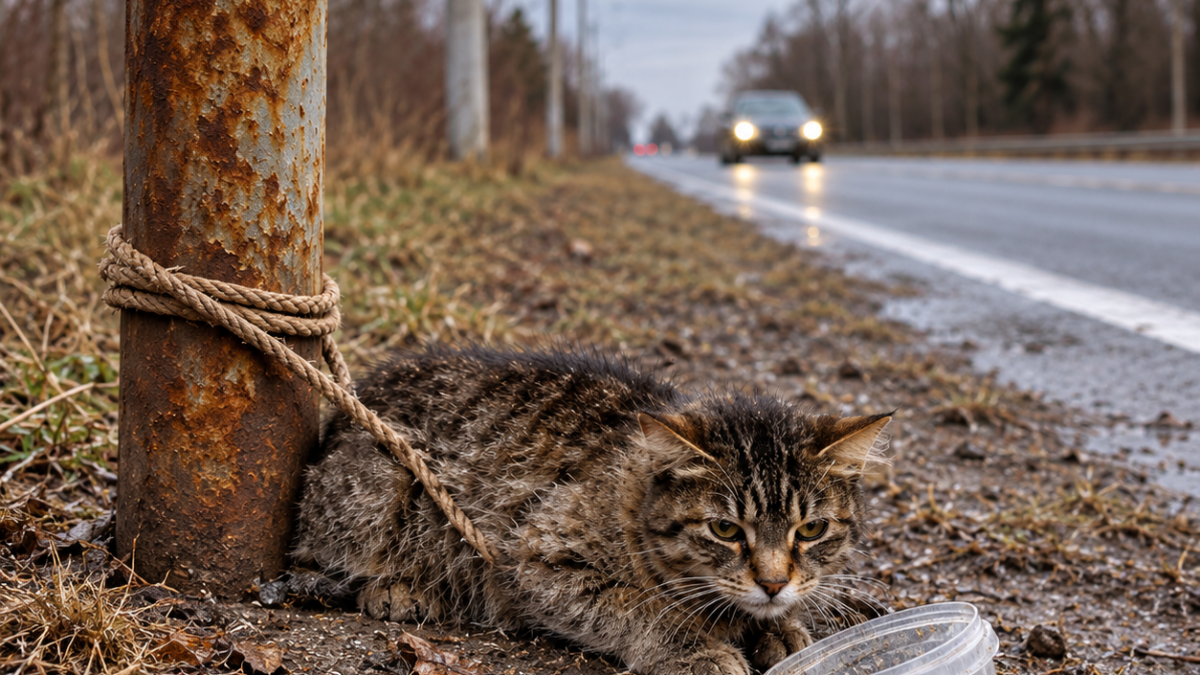
PART 2
I looked from the veterinarian to the technician.
“What does that mean?”
Dr. Rebecca Lane removed her gloves slowly.
“It means we need to make a phone call before I tell you anything else.”
“Why?”
“Because the registered owner is an elderly woman named Margaret Ellis.”
I waited.
“And?”
“And the missing report came from a rehabilitation center.”
That stopped me.
“A rehabilitation center?”
Rebecca nodded.
“She apparently suffered a stroke three weeks ago.”
I looked at the cat again.
She was sitting beneath a thin hospital blanket while fluids ran through a catheter in one front leg.
“She reported her cat missing from rehab?”
“According to the microchip company, yes.”
“How?”
“The note says a social worker assisted her.”
I leaned against the counter.
“So who had the cat?”
“That’s what we need to find out.”
The gray cat lifted her head at the sound of our voices.
The technician looked at the registration.
“Her name is Lucy.”
I repeated it quietly.
“Lucy.”
The cat’s ears moved.
I tried again.
“Lucy?”
Her head turned toward me.
There was no doubt.
That was her name.
For some reason, hearing it made the whole thing worse.
She stopped being a roadside cat.
She became Lucy.
Somebody had fed her.
Somebody had named her.
Somebody had taken her to a veterinarian and paid for a microchip.
And somebody else had tied her to a pole.
Rebecca picked up the phone.
“We’re calling animal control too.”
“Is that necessary?”
She looked at the abrasion around Lucy’s neck.
“Yes.”
I nodded.
“Good.”
While we waited, Lucy received warmed fluids and small portions of wet food.
She ate cautiously at first.
Then faster.
The technician had to remove the bowl.
“Slow down.”
Lucy stared at her with enormous green eyes.
The technician smiled.
“Don’t manipulate me.”
Lucy meowed.
“That is exactly manipulation.”
I almost smiled.
Then Rebecca returned.
“The rehabilitation center confirmed Margaret is there.”
“Did you talk to her?”
“Not yet. Her social worker is bringing her the phone.”
I looked at Lucy.
“What happens when she hears?”
Rebecca didn’t answer.
We all knew there was no gentle way to explain it.
Five minutes later, the phone rang.
Rebecca answered.
“Mrs. Ellis?”
She listened.
“Yes, ma’am. My name is Dr. Lane.”
Another pause.
“Yes.”
Rebecca’s face softened.
“We found Lucy.”
Even from several feet away, I heard a sound through the phone.
A woman crying.
Lucy looked up sharply.
Rebecca put the call on speaker after getting permission.
A thin elderly voice filled the room.
“Lucy?”
The cat froze.
Every muscle.
Every whisker.
“Lucy, baby?”
Lucy stood.
She turned toward the phone.
Then she made a sound unlike any I had heard from her.
Not a normal meow.
A long, broken cry.
Margaret started sobbing.
“Oh, my baby.”
Lucy pulled against the IV line.
Rebecca caught her gently.
“Easy.”
The voice continued.
“I thought she was dead. I thought he lost her.”
Rebecca looked at me.
There it was.
He.
“Mrs. Ellis,” she said carefully, “who was caring for Lucy?”
“My son.”
My jaw tightened.
“His name?”
“Daniel.”
Margaret’s breathing became uneven.
“He said she ran away.”
Rebecca pulled a chair closer to the table and placed the phone near Lucy.
“When did he tell you that?”
“Two days ago.”
I looked at the technician.
Lucy had probably been tied out overnight.
Maybe longer.
“Mrs. Ellis,” Rebecca continued, “do you know whether Daniel was keeping Lucy at your home?”
“He said he was.”
“Do you know if he had any difficulty caring for her?”
“No.”
Margaret’s voice sharpened despite its weakness.
“He promised me.”
Lucy walked toward the phone as far as the IV allowed.
She pressed her face against Rebecca’s hand.
Margaret heard her purring.
“Oh, sweetheart.”
For the next several minutes, nobody asked questions.
We simply let an old woman talk to her cat through a phone.
It should have felt ridiculous.
It didn’t.
Margaret told Lucy she was sorry.
Told her she was coming home.
Told her not to be afraid.
Lucy purred.
Then Margaret said something that made the room silent.
“Daniel said you scratched him.”
Rebecca glanced up.
“When?”
“Before she disappeared.”
“What happened?”
“He said she attacked him when he tried to put her in a carrier.”
I remembered trying to touch the rope.
Lucy’s panic.
“What carrier?” I asked before realizing I wasn’t officially part of the conversation.
Margaret heard me.
“Who is that?”
Rebecca looked at me.
“This is Viktor. He found Lucy.”
Silence.
Then Margaret said, “You found my girl?”
“Yes, ma’am.”
“Where?”
I looked at Rebecca.
She nodded.
“Beside Route 14.”
“Route 14?”
“Yes.”
“That’s miles from my house.”
“I know.”
“Was she walking?”
I couldn’t answer that honestly without telling her everything.
Rebecca stepped in.
“She’s safe now.”
Margaret was quiet.
Then she asked the exact question I had been hoping she wouldn’t.
“Was she hurt?”
Rebecca pulled the phone closer.
“She’s dehydrated and underweight. Her neck is irritated from—”
She stopped.
Too late.
“From what?”
Rebecca looked at me.
I looked at Lucy.
Margaret asked again.
“From what?”
Rebecca answered.
“A rope.”
Silence.
Not the crying silence from before.
A different silence.
The kind that feels like a door closing.
“My son tied her?”
“We don’t know yet.”
Margaret did.
I could hear it in her breathing.
“He tied her.”
“Mrs. Ellis—”
“He didn’t lose her.”
Her voice broke.
“He tied her somewhere.”
Rebecca said gently, “Animal control is investigating.”
Margaret began crying again.
This time Lucy stopped purring.
She stared at the phone.
The call ended a few minutes later because Margaret’s nurse became concerned about her blood pressure.
Before hanging up, Margaret said one thing to me.
“Please don’t leave her alone.”
I looked at Lucy.
“I won’t.”
I had no idea what I had just promised.
Animal control arrived within an hour.
Officer Carla Mendoza was short, direct, and completely unimpressed by emotional assumptions.
I respected her almost immediately.
She photographed Lucy.
The collar.
The remaining piece of rope.
The abrasions.
Then she asked me to take her to where I had found Lucy.
“I’m working.”
Carla looked at my uniform.
“You called your boss?”
“No.”
“Call.”
Apparently that was not a suggestion.
My dispatcher, Frank, answered.
“Where are you?”
“At a veterinary clinic.”
There was a pause.
“Are you injured?”
“No.”
“The truck?”
“Fine.”
“Then why are you at a vet?”
I explained.
Frank was quiet.
“You found a cat.”
“Tied to a pole.”
“You’re three hours late because of a cat.”
“Yes.”
Another silence.
Then he sighed.
“Send me the location.”
“Why?”
“I’m covering your afternoon load.”
That surprised me.
“You don’t have to.”
“I know.”
“Frank—”
“Go show the officer where you found the damn cat.”
He hung up.
Carla smiled.
“Tough boss?”
“Pretends to be.”
We drove to Route 14.
The fog was gone.
In daylight, the place looked even more exposed.
The pole stood fifteen feet from the traffic lane.
No houses nearby.
No businesses.
Just weeds, ditch, road.
The empty bowl was still there.
Carla photographed everything.
The ground.
The scrape marks.
The knot around the pole where the cut rope remained.
She crouched.
“Whoever tied this knew how to make a knot.”
“That tell you anything?”
“It tells me they didn’t accidentally drop the rope.”
Fair enough.
We searched the shoulder.
Twenty yards down, Carla found tire impressions in a muddy pull-off.
Not enough for a clear identification.
Then I noticed something red under wet leaves.
A receipt.
Gas station.
Time stamp: 11:43 p.m.
Previous night.
Carla bagged it.
“What does that prove?”
“Nothing by itself.”
The gas station was four miles away.
“Cameras?”
“Probably.”
We drove there.
The manager wasn’t thrilled about helping until Carla showed identification.
Security footage from the previous night showed customers.
Pickup trucks.
Cars.
Then, at 11:37 p.m., a dark blue sedan pulled in.
The driver bought something inside.
We couldn’t see his face clearly from the checkout camera because of a baseball cap.
Carla froze the frame.
The receipt time matched.
The sedan left westbound toward the place where Lucy was found.
“Can you read the plate?”
“Not yet.”
The manager switched cameras.
A second angle caught the rear.
Blurry.
But usable.
Carla took down the partial plate.
“You think it’s Daniel?”
“I don’t think anything until I check.”
I did.
I thought plenty.
But Carla was right.
Thinking was easy.
Proving mattered.
Back at the clinic, Lucy had finished another meal.
She was asleep.
Curled into a ball.
The raw skin around her neck had been cleaned.
Rebecca said her bloodwork showed dehydration and mild anemia but no organ damage.
“She was lucky.”
I stared at Lucy.
“No.”
Rebecca looked at me.
“She survived.”
“She was tied beside highway traffic overnight.”
“Then somebody stopped.”
I knew what she meant.
Still.
Luck felt too generous a word.
Carla called that evening.
“The sedan is registered to Daniel Ellis.”
I closed my eyes.
There it was.
“Margaret’s son.”
“Yes.”
“What did he say?”
“We haven’t spoken to him yet.”
“You’re going there?”
“Yes.”
“Can I come?”
“No.”
Fair.
“What happens to Lucy?”
“She stays under veterinary care until we resolve custody.”
“Margaret owns her.”
“Yes.”
“But Margaret’s in rehab.”
“Yes.”
“She asked me not to leave her alone.”
Carla paused.
“That wasn’t legally binding.”
“I know.”
I looked through the glass.
Lucy had woken and was staring at me.
“What if I foster her?”
Carla didn’t answer immediately.
“You own pets?”
“No.”
“Cat experience?”
“No.”
“Home?”
“Yes.”
“Other animals?”
“No.”
“Work schedule?”
“Bad.”
She laughed.
“That is the first honest foster application I’ve heard today.”
“I drive local routes most days.”
“You also drive freight overnight sometimes.”
“Yes.”
“Who covers the cat?”
“I’ll figure it out.”
That was apparently my first mistake.
Anyone who has ever adopted an animal knows “I’ll figure it out” becomes a very expensive sentence.
The next morning, Carla called again.
Daniel Ellis denied abandoning Lucy.
He claimed she escaped from his car while he was transporting her.
I almost admired the stupidity.
“Where?”
“Route 14.”
“At the exact pole she was tied to?”
“He says he stopped after she scratched him and she jumped out.”
“The rope?”
“He says he knows nothing about it.”
“Gas station footage?”
“He admits that’s his car.”
“So he expects you to believe Lucy jumped out, found rope, tied herself to a pole, and overturned a bowl?”
“Viktor.”
“What?”
“I didn’t say I believed him.”
“What now?”
“We look for better evidence.”
They found it.
A house across a side road had a security camera facing part of Route 14.
The image quality was poor.
But at 11:49 p.m., Daniel’s sedan pulled onto the shoulder.
A man got out.
Opened the rear door.
Lifted something.
Walked toward the pole.
Stayed there approximately two minutes.
Returned alone.
Drove away.
No cat ran across the road.
No dramatic escape.
No ambiguity.
When Carla confronted Daniel with the footage, his story changed.
He admitted tying Lucy.
Then claimed he intended to return in the morning.
“Why?” I asked when Carla updated me.
She sighed.
“He says Lucy was destroying his apartment.”
“But Lucy belonged at Margaret’s house.”
“Daniel moved her to his apartment after Margaret’s stroke.”
“Why not leave her at Margaret’s?”
“House is being prepared for sale.”
That surprised me.
“Margaret knows?”
“Yes. She may not be able to return home independently.”
I looked at Lucy.
“So Daniel had her.”
“Yes.”
“He didn’t want her.”
“Essentially.”
“Why not surrender her?”
“He says he called a shelter and they told him they were full.”
“One shelter?”
“Apparently.”
“So he tied her to a pole.”
“He says he was overwhelmed.”
I laughed bitterly.
“That word does a lot of work.”
Carla didn’t disagree.
Daniel’s full explanation came later through his statement.
He was forty-six.
Divorced.
Worked two jobs.
His mother’s stroke had thrown responsibility onto him suddenly.
Hospital decisions.
Rehabilitation paperwork.
Bills.
House maintenance.
Then Lucy.
Lucy cried at night.
Scratched furniture.
Knocked things down.
Daniel resented her.
Not because she had done anything unusual.
Because she became one more responsibility.
The night he abandoned her, she knocked over a lamp.
He lost his temper.
Put her in the car.
Drove around.
Called one shelter.
Closed.
Called another.
No answer.
Then instead of going home and trying again the next day, he bought a bottle of water and cigarettes at the gas station.
Drove to Route 14.
Tied Lucy to the pole.
Put the empty bowl beside her.
Poured some water into it.
And left.
By morning, the bowl had overturned.
He planned to tell Margaret Lucy escaped.
Maybe he believed someone would find her.
Maybe he simply needed to believe that about himself.
I never knew.
What I knew was this:
He drove away.
Lucy stayed.
For almost fourteen hours.
Carla estimated that based on the footage and when I found her.
Fourteen hours tied beside traffic.
Cold night.
Fog.
No shelter.
No reliable water.
By the time I understood that, my promise to Margaret no longer felt accidental.
I wanted Lucy away from Daniel.
So did Margaret.
When Carla spoke with her, Margaret gave written authorization allowing temporary placement with me once Lucy was medically cleared.
I visited Margaret at the rehabilitation center.
I was nervous.
More nervous than I had been walking into accident scenes.
Her room was small.
Flowers on the windowsill.
Family photographs.
A walker beside the bed.
Margaret herself looked fragile.
White hair.
Thin hands.
But her eyes were sharp.
“You’re taller than I thought.”
That was the first thing she said.
I laughed.
“You’re different from what I expected too.”
“What did you expect?”
“I don’t know.”
“A helpless old woman?”
“No.”
“Good answer.”
I liked her immediately.
On the table beside her bed was a framed photograph of Lucy.
Healthy.
Shiny gray coat.
Sitting beside Margaret in a chair.
“She was my husband’s cat first,” Margaret said.
“How long?”
“Nine years.”
Lucy was older than I thought.
“She looks young.”
“She’s vain.”
I smiled.
“Your husband?”
“Dead four years.”
“I’m sorry.”
Margaret touched the frame.
“Lucy slept on his side of the bed for six months afterward.”
I sat quietly.
“I don’t know if I can go home,” she continued.
“They’re deciding?”
“The doctors say I need more help.”
“Assisted living?”
“Probably.”
“Can Lucy go?”
“Some places allow cats.”
“But?”
Margaret looked out the window.
“The one my insurance and savings can afford doesn’t.”
There it was.
The real reason she had asked me not to leave Lucy alone.
Not because she expected to reclaim her the next morning.
Because she already feared she couldn’t.
“I can keep her until you know.”
Margaret looked at me.
“You work.”
“So do most people.”
“You drive trucks.”
“Yes.”
“Cats don’t like trucks.”
“Good. She doesn’t have to drive.”
Margaret smiled.
Then her face changed.
“My son says you’re trying to steal her.”
I almost stood up.
“What?”
“He called me.”
“When?”
“Last night.”
“Why is he allowed to call you?”
“He’s my son.”
Fair point.
“What did he say?”
“That this has been blown out of proportion. That he left Lucy somewhere safe because he was desperate.”
I felt my jaw tighten.
“Route 14 is not safe.”
“I know.”
“He tied her beside traffic.”
“I know.”
“He lied to you.”
Margaret’s eyes filled.
“I know.”
That last one stopped me.
Daniel was not just a stranger who abandoned a cat.
He was her son.
People online could hate him cleanly.
Margaret couldn’t.
Love makes consequences messier.
“He apologized,” she said.
“To you?”
“Yes.”
“To Lucy?”
She looked at me.
“I asked him the same thing.”
“What did he say?”
“He got angry.”
I leaned back.
“That’s an answer.”
Margaret wiped her eyes.
“I raised him better.”
I had no useful response.
Eventually, I said, “You don’t own every choice your adult son makes.”
She smiled sadly.
“You sound like the therapist.”
“Probably charge more.”
That got a small laugh.
Then she reached across the bed and took my hand.
“If I can’t take Lucy back, would you keep her?”
I froze.
“That’s a big question.”
“Yes.”
“I’ve never owned a cat.”
“You stopped for one.”
“That doesn’t qualify me.”
“It qualifies you more than you think.”
I looked at the photograph.
Lucy staring into the camera like she owned the furniture.
“What if she hates my house?”
“Then she’ll tell you.”
“How?”
Margaret smiled.
“You’ll know.”
Lucy came home with me four days later.
I had prepared.
Or thought I had.
Food.
Litter.
Bowls.
A cat bed.
Scratching post.
Carrier.
Toy mouse.
Two blankets.
Everything.
Lucy ignored all of it.
She walked into my house, inspected the kitchen, disappeared under my bed, and remained there for seven hours.
I called Rebecca.
“She hasn’t come out.”
“How long?”
“Seven hours.”
“Good.”
“How is that good?”
“She found a safe space.”
“She hasn’t eaten.”
“She will.”
“What if she doesn’t?”
“Viktor.”
“Yes?”
“Stop staring under the bed.”
“I’m not.”
“You’re absolutely staring under the bed.”
I looked away from the floor.
“Fine.”
At eleven that night, I heard movement.
I stayed in the living room.
Lucy walked down the hallway.
Stopped.
Saw me.
Almost retreated.
I looked at the television instead of her.
She walked toward the food.
Ate.
Drank.
Used the litter box.
Then disappeared again.
Progress.
The second night, she stayed in the doorway.
Third, she entered the living room.
Fourth, she sat beneath a chair.
On the fifth evening, I fell asleep on the couch.
When I woke, Lucy was sitting on my chest.
I nearly had a heart attack.
She stared down at me.
“Can I help you?”
Purr.
“You weigh more than you look.”
Purr.
I moved one hand slowly.
Lucy did not flinch.
I scratched behind her ear.
Her eyes closed.
That was the first time she fully relaxed around me.
It changed something.
Not dramatically.
There was no music.
No sudden realization.
Just a cat trusting me enough to close her eyes.
After what had been done to her, that felt important.
My coworkers learned about Lucy quickly.
Frank started calling her “the roadside princess.”
“She’s not a princess.”
“You bought her a forty-dollar bed.”
“She sleeps on a cardboard box.”
“So you bought the wrong throne.”
I sent him a photograph.
Lucy was indeed sleeping inside a box from an auto-parts shipment.
He replied:
FORTY DOLLARS WELL SPENT.
The harder men at the freight yard pretended not to care.
They cared.
Raymond, who had once stitched his own finger shut with fishing line because he didn’t want to leave a route, brought cat treats.
“For your animal.”
“You bought salmon flavor.”
“Only kind they had.”
There were seventeen kinds in the store.
I said nothing.
Tom, who complained about everything from diesel prices to daylight saving time, built Lucy a wooden window platform.
“It was scrap.”
“It’s sanded.”
“Safety.”
“You stained it.”
“Weather protection.”
“It’s indoors.”
Tom walked away.
Lucy loved the platform.
I sent him a photo.
He never responded.
The next day he asked, “She use it?”
“Every morning.”
“Good.”
That was it.
The title of the story, if anyone had written one then, might have been about hardened truckers turning into fools over a gray cat.
But the reality was quieter.
Men who spent their careers driving through storms would stop by my truck and ask:
“How’s Lucy?”
Not me.
Lucy.
Margaret improved slowly.
I visited every Sunday.
Sometimes I brought Lucy.
The first visit nearly destroyed everyone in the rehabilitation wing.
I carried Lucy in a secure carrier.
Margaret was waiting in the common room.
The moment Lucy heard her voice, she began meowing.
I opened the carrier.
Lucy walked directly into Margaret’s lap.
Margaret folded around her.
Neither moved for a long time.
A retired construction worker sitting nearby wiped his eyes and pretended allergies were bothering him.
A former police officer across the room turned his wheelchair toward the window.
Margaret whispered into Lucy’s fur.
“I’m sorry.”
Lucy purred.
“You waited for me.”
Purr.
“You always were better than people.”
I glanced toward the retired police officer.
He said, “She’s not wrong.”
After that, Lucy visited twice a month.
Something unexpected happened.
Other residents started waiting for her.
Margaret’s roommate, Ruth, had dementia.
She rarely remembered my name.
She always remembered Lucy.
“Gray girl,” she called her.
A man named Charles, who had barely spoken since his wife died, let Lucy sleep beside him while he watched baseball.
The nurses noticed.
People talked more on Lucy days.
A physical therapist joked that they needed to put her on payroll.
Margaret became proud.
“That’s my cat.”
Every time she said it, I felt relieved.
Because Lucy was still hers.
Legally.
Emotionally.
Historically.
I was only holding part of her life.
Daniel’s case moved forward.
He was charged with animal abandonment and cruelty under state law.
The video evidence made denial difficult.
He eventually accepted a plea.
Probation.
Fines.
Community service.
Restriction on owning animals for several years.
Mandatory counseling related to anger and caregiver stress.
Some people thought it was too little.
Maybe it was.
But the part that mattered most to Margaret could not be ordered by a judge.
Daniel had to face his mother.
Their first meeting after the charges happened without me.
Margaret told me about it later.
“He apologized.”
“For leaving Lucy?”
“Yes.”
“Did you believe him?”
She thought.
“I believe he’s sorry his life exploded.”
That was sharp.
“Not the same thing.”
“No.”
“Did he blame stress?”
“Yes.”
“What did you say?”
Margaret smiled slightly.
“I told him stress explains why good people do bad things. It doesn’t make the bad thing good.”
I liked that.
“Then?”
“He cried.”
I didn’t expect that.
“And?”
“I cried too.”
“Are you forgiving him?”
Margaret looked toward the window.
“He’s my son.”
“That isn’t what I asked.”
“No.”
She sighed.
“I don’t know yet.”
Fair.
Healing is not a switch.
The internet prefers redemption or condemnation.
Real families live in between.
A month later, Daniel asked to see Lucy.
Margaret wanted my opinion.
“My opinion isn’t important.”
“You have her.”
“You own her.”
“Viktor.”
I thought about it.
“Neutral place.”
“Here?”
“Yes.”
“And if Lucy is afraid?”
“It ends.”
Margaret agreed.
Daniel arrived on a Sunday afternoon.
I recognized him immediately from the gas-station footage even though the image had been grainy.
He looked ordinary.
That bothered me.
Part of me had expected a monster.
Monsters are easier.
Daniel was just a tired middle-aged man in a brown jacket holding his keys too tightly.
He saw me.
“You’re Viktor.”
“Yes.”
“Thank you for taking care of her.”
I said nothing.
He looked uncomfortable.
Good.
Margaret sat in a wheelchair with Lucy on her lap.
Daniel approached.
Lucy saw him.
Her body stiffened.
I noticed.
So did Margaret.
Daniel stopped.
“Hey, Luce.”
Lucy’s ears flattened.
He took another step.
I moved between them.
“Stop.”
His face hardened.
“She knows me.”
“That’s why I said stop.”
“I’m not going to hurt her.”
“I didn’t say you were.”
“Then move.”
“No.”
Margaret’s voice cut through the room.
“Daniel.”
He turned.
“Sit down.”
He sat.
His face went red.
Margaret stroked Lucy.
“You wanted to see her. Look.”
Daniel looked.
For the first time, his expression changed completely.
His eyes filled.
“I’m sorry.”
Lucy stayed against Margaret.
Daniel leaned forward.
“I know that doesn’t mean anything to you.”
His voice broke.
“But I’m sorry.”
Lucy watched him.
He did not reach for her.
Good.
“I was angry,” he continued. “At everything. The hospital. The house. Work. You.”
Margaret flinched.
Daniel saw it.
“I know.”
He covered his face.
“I was angry you got sick.”
There it was.
Not rational.
Not fair.
But real.
“You needed me, and I didn’t want to be needed.”
Margaret said nothing.
Daniel continued.
“Lucy kept crying at my apartment. Every time she cried, I thought about you. About Dad. About everything I was losing.”
His hands shook.
“And I hated her for it.”
My anger shifted.
Not disappeared.
Shifted.
He looked at Lucy.
“She didn’t do anything.”
“No,” Margaret said.
“I know.”
“Now.”
“Yes.”
Margaret’s hand tightened around Lucy.
“What did you think would happen after you left her?”
Daniel stared at the floor.
“I told myself someone would find her.”
“You didn’t know.”
“No.”
“You drove away.”
“Yes.”
“You told me she ran away.”
“Yes.”
Margaret began crying.
“So while I was lying in that bed thinking she was lost and scared, you knew exactly where you had left her.”
Daniel cried too.
“Yes.”
The room stayed silent.
Nobody rescued him from the moment.
He deserved to sit in it.
Finally, Margaret said, “I love you.”
Daniel looked up.
“But I don’t trust you.”
His face collapsed.
“That’s the consequence you need to understand.”
He nodded.
Margaret looked at Lucy.
“Trust is slower to return than love.”
I remembered Lucy under my bed.
Five nights before she slept on my chest.
Margaret was right.
Daniel did not touch Lucy that day.
He left after forty minutes.
Months later, he returned.
Then again.
Always with Margaret’s permission.
At first, Lucy avoided him.
Then tolerated him.
Eventually, one afternoon, she smelled his hand.
That was all.
Daniel cried anyway.
I didn’t.
At least not where he could see.
Margaret never returned to her old house.
The assisted-living facility became permanent.
They did not allow resident-owned animals.
We appealed.
No exception.
That meant a decision.
Margaret and I both knew it.
She called me into her room one afternoon.
Paperwork sat on the table.
“What’s this?”
“Lucy’s microchip transfer.”
My chest tightened.
“No.”
“Yes.”
“We can keep things the way they are.”
“No.”
“She visits.”
“I know.”
“You’re still her owner.”
Margaret smiled.
“On paper.”
“That matters.”
“Not to Lucy.”
I looked away.
“She waits for your truck.”
I looked back.
Margaret laughed.
“Tom showed me the video.”
Of course he had.
Every evening when my pickup came down the street, Lucy jumped onto the window platform.
She recognized the engine.
Margaret had seen it.
“She loves you.”
“She loves you.”
“Yes.”
Margaret reached for my hand.
“That’s why I can do this.”
I looked at the transfer form.
“Are you sure?”
“No.”
Honest.
“I’m sure I can’t take care of her the way she needs.”
“That isn’t your fault.”
“I know.”
“I can keep bringing her.”
“You will.”
“That sounds like an order.”
“It is.”
We signed.
Lucy became legally mine.
I hated how much that moved me.
The first thing I did afterward was take her to see Margaret.
“You’re ridiculous,” Margaret said.
“I promised.”
“You were here yesterday.”
“Contractual obligation.”
Lucy climbed onto her lap.
For almost three years, that became our rhythm.
My house.
Margaret’s facility.
Freight yard stories.
Window platform.
Sunday visits.
Daniel slowly repaired his relationship with Margaret.
Not perfectly.
There were arguments.
Missed calls.
Therapy appointments he almost skipped.
Then attended.
Trust grew in inches.
He never asked to take Lucy again.
That mattered.
Eventually, Lucy allowed him to pet her.
The first time happened while Margaret was sleeping.
Daniel sat beside her bed.
Lucy was on the windowsill.
He lowered his hand.
Waited.
Lucy approached.
Smelled him.
Then rubbed her cheek once against his knuckle.
Daniel froze.
He looked at me.
“Did that happen?”
“Yes.”
“Should I pet her?”
“Don’t ruin it.”
He laughed quietly.
Lucy walked away.
Daniel wiped his eyes.
“That was enough.”
“Yes.”
It was.
Margaret died two winters later.
She was eighty-four.
It happened peacefully at the facility.
Daniel called me.
Not the nurse.
Daniel.
“She’s gone.”
I sat on my couch.
Lucy was asleep beside me.
“I’m sorry.”
“Can you bring Lucy?”
“Yes.”
I didn’t ask why.
The staff allowed us into Margaret’s room before the funeral home arrived.
Lucy walked across the bed.
Smelled Margaret’s hand.
Then her face.
She sat beside her.
For almost ten minutes.
No crying.
No panic.
She simply stayed.
Daniel stood near the wall.
“I thought she’d understand.”
“Maybe she does.”
“Do cats know?”
“I don’t know.”
Lucy curled beside Margaret’s hip.
The same way she had in the old photographs.
Daniel began crying.
I put one hand on his shoulder.
I surprised myself.
A few years earlier, I would have gladly watched him suffer.
Now suffering was simply suffering.
That did not erase what he had done.
It meant he had become more than the worst thing he did.
Like Lucy had become more than the worst thing done to her.
At Margaret’s funeral, Daniel spoke.
He didn’t mention the abandonment publicly.
That wasn’t the place.
But afterward, he found me.
“My mother left something for you.”
He handed me an envelope.
Inside was a photograph.
Margaret sitting in her old house with Lucy on her lap.
On the back, she had written:
For Viktor — You stopped when the rest of the road didn’t. Take care of our girl.
I had to sit down.
Daniel waited.
“She forgave me,” he said quietly.
I looked at him.
“Did she tell you?”
“Yes.”
“That doesn’t mean she forgot.”
“I know.”
“You shouldn’t either.”
“I won’t.”
I believed him.
Lucy lived another five years.
By then she was fourteen.
Then fifteen.
Gray cat turning gray in new places around the muzzle.
Arthritis.
Kidney changes.
Dental problems.
Ordinary old-cat things.
She still waited at the window.
Still visited the freight yard occasionally.
Still made men who claimed to hate cats carry treats in their pockets.
Frank retired.
At his retirement party, Lucy sat on the office copier.
Someone asked why a cat was there.
Frank looked offended.
“She has seniority.”
Tom built her a second platform for my bedroom.
Raymond bought her a heated bed.
This from a man who once said indoor pets were “furniture with medical bills.”
I reminded him.
He denied it.
Lucy developed a habit of sleeping on my work jacket.
Every morning I had to remove cat hair before leaving.
Eventually I stopped trying.
One of the younger drivers asked, “You always covered in gray fur?”
“Yes.”
“Why?”
“Management.”
He thought I was joking.
At sixteen, Lucy’s kidney disease became serious.
I knew where the road led.
Rebecca was still her veterinarian.
Older now.
So was I.
She showed me the lab work.
“We can manage this.”
“For how long?”
“I can’t promise.”
“Months?”
“Maybe more.”
“Years?”
“Possible, but I wouldn’t plan around it.”
I appreciated the honesty.
Lucy started fluids.
Special diet.
Medication.
She remained herself.
That was the measure.
Not the numbers.
She ate.
Watched birds.
Greeted me.
Complained loudly if dinner was late.
Visited Daniel sometimes.
Yes.
Daniel.
Years after Margaret’s death, he and I had settled into a strange relationship.
Not friendship exactly.
Something built from shared responsibility.
He never owned another pet.
He volunteered twice a month at the same county shelter he once claimed had no room.
Not because a court required it anymore.
Because he kept going after probation ended.
One afternoon he told me:
“The first six months, I hated it.”
“Why continue?”
“Because every abandoned animal made me remember Lucy.”
“That sounds miserable.”
“It was.”
“And now?”
He watched an older dog being walked outside.
“Now I know leaving them isn’t the end of your responsibility.”
I didn’t say anything.
Some lessons sound obvious only after someone pays dearly for learning them.
Lucy was seventeen when the last winter came.
She had become thin again.
Not roadside thin.
Age thin.
Her bones more visible.
Steps slower.
Her hearing faded.
But she still recognized my truck.
That amazed me.
One January evening, snow began falling while I was driving home.
I turned onto my street.
There she was.
A gray silhouette in the window.
Waiting.
I parked.
By the time I entered, Lucy had climbed down and was sitting by the door.
“You’re supposed to be sleeping.”
Meow.
“You’re old.”
Louder meow.
“Yes, I’m old too.”
I lifted her carefully.
She rested her head beneath my chin.
The next morning she refused breakfast.
By evening, water too.
I knew.
Still, I called Rebecca.
Tests confirmed what I feared.
Her kidneys were failing.
We hospitalized her overnight.
Fluids helped a little.
Not enough.
Rebecca sat beside me.
“We can keep treating.”
“What does that give her?”
“Possibly several days. Maybe a little longer.”
“Comfortable?”
She paused.
“Not consistently.”
I stared through the glass.
Lucy was curled in a blanket.
“Can I take her home?”
“Yes.”
I called Daniel.
He came that evening.
Lucy was on Margaret’s old blanket, the one Daniel had found when cleaning out her apartment after she died.
He sat on the floor.
“Hey, Luce.”
Her ears moved.
Daniel laughed softly.
“You still know me.”
He held out his hand.
Lucy smelled it.
Then placed one paw over his fingers.
Daniel broke.
Not dramatic crying.
Quiet.
Shoulders shaking.
“I’m sorry,” he whispered.
I almost told him he had apologized enough.
Then I realized this apology was not for me.
Maybe not even for Lucy.
It was for the man he had been.
He stroked her head.
“You should’ve hated me.”
Lucy purred weakly.
Cats do not understand human guilt.
Maybe that is one of their gifts.
The next morning, Rebecca came to my house.
Snow covered the yard.
The road beyond my window was quiet.
No traffic.
No fog.
No pole.
Lucy lay in my lap.
Daniel sat nearby.
Frank came too.
So did Tom.
I hadn’t invited them.
They showed up anyway.
Three men who had spent decades acting unimpressed by almost everything stood in my living room trying not to cry over an old gray cat.
Tom placed one hand on Lucy’s back.
“You liked that platform.”
Lucy’s tail moved.
He stepped away quickly and cleared his throat.
Frank said, “Roadside princess.”
I looked at him.
“She hated that name.”
“No, she didn’t.”
“She ignored you.”
“That’s basically love from a cat.”
Daniel laughed through tears.
Rebecca gave Lucy a sedative.
Her body relaxed.
I stroked the place beneath her collar where the rope had once rubbed her skin raw.
There was no scar anymore.
Not one I could feel.
“Remember that pole?” I whispered.
Her eyes stayed half-open.
“Probably not.”
I hoped not.
I looked around the room.
At Daniel.
Frank.
Tom.
Rebecca.
Men and women whose lives had intersected because one frightened cat had been left beside a highway.
I thought about Margaret.
Her phone call.
Her voice.
“Lucy, baby?”
I wished she were there.
Maybe, in whatever way memory counts, she was.
Rebecca asked quietly, “Ready?”
“No.”
She waited.
I swallowed.
“Yes.”
Lucy died with her head resting against my hand.
Nobody spoke.
For a long time.
Then Tom turned toward the window.
Frank sat down heavily.
Daniel covered his face.
These men had seen wrecks.
Deaths.
Factory accidents.
Years of hard roads.
Yet an old gray cat had reduced the room to silence.
I understood why.
Strength does not make grief smaller.
Sometimes strength only teaches people how long they can hide it.
We buried none of her ashes beside Route 14.
People assumed I would.
I didn’t want her final connection to be the place she had been abandoned.
Instead, I kept some ashes in a small wooden box Tom built.
Daniel took a small portion to Margaret’s grave.
He asked me first.
I said yes.
He placed them beneath the soil beside her headstone.
The rest stayed at my house.
On the window platform.
Where Lucy had waited for my truck.
Months passed.
The freight yard felt different.
Drivers still asked about her.
Then caught themselves.
“Where’s—”
Silence.
They knew.
One afternoon, Raymond walked into the dispatch office carrying a gray kitten.
I stared.
“No.”
He looked offended.
“I didn’t say anything.”
“No.”
“Found him behind the warehouse.”
“Call the shelter.”
“Already did.”
“Good.”
“They’re full.”
I closed my eyes.
Raymond smiled.
“Funny how that happens.”
“This is not funny.”
The kitten climbed up Raymond’s jacket.
“You want to hold him?”
“No.”
The kitten meowed.
“No.”
Raymond held him out.
I took him.
Purely because Raymond was holding him incorrectly.
That was my story.
The kitten weighed almost nothing.
He looked at me.
No rope.
No fear.
Just curiosity.
I handed him back.
“I’m not adopting another cat.”
“Of course.”
“Don’t say it like that.”
“Like what?”
“Like Rebecca.”
Raymond laughed.
The kitten eventually went to one of our mechanics, a twenty-four-year-old named Luis.
Good kid.
Small apartment.
Too many houseplants until I made him check which were toxic.
I became annoying.
Rebecca said that meant I had become a cat person.
I denied it.
The evidence was overwhelming.
A year after Lucy died, Route 14 was repaved.
The county replaced several old roadside poles.
The one where I found her disappeared.
I noticed immediately.
Pulled over.
Stood on the shoulder.
Nothing remained.
No rope.
No empty bowl.
No scrape marks.
Just grass.
Cars passed.
Most drivers never looked at me.
Why would they?
I thought about the morning I had stopped.
I had nearly kept driving.
That truth mattered.
People liked to tell the story as if I instantly recognized a suffering animal and became some kind of hero.
I didn’t.
I saw a gray shape.
I passed it.
Then something in me said look again.
That was all.
One second.
One decision.
Brake.
Reverse.
Walk back.
I stood there until a truck blasted its horn.
I laughed.
Then went home.
Inside, the house was quiet.
On my refrigerator was the photograph Margaret had given me.
Her in the chair.
Lucy in her lap.
Beside it was another picture.
Lucy years later on Tom’s wooden window platform, waiting for me.
The rope had been less than four feet long.
That fact used to haunt me.
Four feet.
That was the world someone gave her that night.
Pole.
Dirt.
Empty bowl.
Traffic.
Years later, her world had expanded into more homes and hearts than any of us could have predicted.
Margaret.
Me.
The freight yard.
The rehabilitation residents.
Even Daniel, eventually.
A few weeks after my visit to Route 14, I found Daniel sitting beside Margaret’s grave.
I hadn’t known he would be there.
He looked up.
“Hey.”
“Hey.”
I saw fresh flowers.
Gray stone.
Lucy’s name was not on it.
But I knew some of her ashes were beneath the soil.
Daniel moved aside.
I sat.
After a while, he said, “Do you still hate me?”
I thought about the question.
“No.”
He nodded.
“Did you?”
“Yes.”
“Fair.”
We sat quietly.
“I hated myself too,” he said.
“That’s not always useful.”
“No.”
He looked at his mother’s name.
“But sometimes it gets you started.”
“Started where?”
“Toward becoming somebody you can live with.”
That sounded like therapy language.
I told him.
He laughed.
“Probably.”
Then he pulled something from his pocket.
The original piece of rope.
Not all of it.
A short section Carla had eventually returned after the case closed.
My face tightened.
“Why do you have that?”
“They gave evidence back years ago.”
“You kept it?”
“Yes.”
“Why?”
He looked at it.
“To remind myself.”
I shook my head.
“Throw it away.”
Daniel frowned.
“I thought you’d say I should remember.”
“You remember.”
“I do.”
“You don’t need to punish yourself with rope forever.”
He stared at me.
“That sounds like forgiveness.”
“No.”
I stood.
“It sounds like garbage belongs in the garbage.”
Daniel laughed.
Then, after a moment, he walked to the trash can near the cemetery entrance.
He dropped the rope inside.
We watched it disappear.
Neither of us made a speech.
We didn’t need one.
On my way home, I stopped at the grocery store.
In the pet aisle, I caught myself reaching for the salmon treats Lucy liked.
My hand stopped.
For a second, grief hit as sharply as the first week.
Then I smiled.
I bought them anyway.
Luis’s cat liked salmon.
The next morning, I took the bag to work.
Luis looked confused.
“What’s this?”
“Management supplies.”
“What?”
“Just give them to your cat.”
He opened the bag.
“These are expensive.”
“I know.”
“Why?”
I shrugged.
“Roadside princess had standards.”
Luis had no idea what I meant.
That was fine.
Not every story needs to stay alive in every person.
Sometimes it only needs to change the people who were there.
Years later, when I finally retired from driving, Frank—already retired himself—came to the small party at the depot.
Tom came.
Raymond.
Luis.
Rebecca.
Even Daniel.
Someone had placed a framed photograph on the table.
Lucy.
Sitting on the dashboard of my parked truck during one of the rare times I let her visit the yard.
Gray fur.
Green eyes.
Expression of complete authority.
Below the photograph, Tom had attached a tiny engraved metal plate.
LUCY
THE ONLY DISPATCHER VIKTOR EVER OBEYED
I laughed so hard I nearly dropped my coffee.
“You idiots.”
Tom shrugged.
“Accurate.”
Daniel stood beside the photograph.
“She looks happy.”
“She was.”
He nodded.
“Good.”
Later, when everyone left, I carried the frame home.
I placed it beside Margaret’s photograph.
Two lives connected by one cat.
Then I sat by the window.
For years, I had watched Lucy wait there.
First nervously.
Then confidently.
Eventually old and sleepy.
That empty space still pulled at my eyes sometimes.
But grief changes shape.
At first, absence is all you see.
Later, memory begins taking up some of that space.
I no longer pictured Lucy tied to the pole first.
That image had finally lost its power.
Now, when I thought of her, I saw the day Margaret called her name through the veterinarian’s phone.
Lucy standing despite the IV.
Ears forward.
Whole body suddenly alive.
Or I saw her asleep on Tom’s platform.
Or riding in my arms through the rehab hallway while people called, “Gray girl!”
Or sitting by the door when I came home.
That was the life that mattered.
One cold morning, years after retirement, I drove past the old stretch of Route 14.
Fog lay across the asphalt.
Almost exactly like that first morning.
Traffic moved quickly.
I slowed.
Not because I saw anything.
Habit.
I looked toward the place where the pole had stood.
Empty grass.
For half a second, I could almost see her there.
Small.
Gray.
Waiting.
Then the image shifted in my mind.
Lucy in my window.
Warm.
Safe.
Watching for me.
I drove on.
I drove on.
For a long time after Lucy died, I thought that was where her story ended.
I was wrong.
Not because something miraculous happened. She did not somehow return, and I never became one of those people who claimed to see signs in every bird landing on a fence or every gray shadow moving through the yard.
What happened was quieter than that.
Lucy kept changing people after she was gone.
I noticed it first with Daniel.
About six months after my retirement party, he called me one afternoon.
“I need your opinion on something.”
“That usually means you already made a bad decision.”
He laughed.
“Probably.”
“What is it?”
“I’ve been volunteering at the county shelter.”
“I know.”
“I’m thinking about fostering.”
I didn’t answer.
He noticed.
“Viktor?”
“I’m here.”
“You think it’s a bad idea.”
“I think it depends on why you’re doing it.”
Silence.
Then he said, “Because I owe something.”
“That’s the wrong reason.”
“I thought you’d say that.”
“You can’t use an animal to punish yourself.”
“I’m not.”
“That’s exactly what you’re describing.”
He exhaled into the phone.
“So what’s the right reason?”
“Wanting to help the animal.”
“I do.”
“Then start there.”
The shelter had an older orange cat named Morris.
Eleven years old.
Diabetic.
His previous owner had died, and no family member wanted the responsibility.
Daniel began fostering him two weeks later.
He called me the first night.
“He’s under the washing machine.”
“Good.”
“How is that good?”
I laughed.
“That’s exactly what I asked Rebecca when Lucy hid under my bed.”
“He hasn’t eaten.”
“He will.”
“He hissed at me.”
“Also good.”
“How?”
“Means he has enough energy to complain.”
There was a pause.
“You sound annoyingly experienced.”
“I learned from professionals.”
Morris stayed beneath the washing machine for most of the first day.
On the third day, he came into Daniel’s living room.
By the end of the first week, he slept on Daniel’s couch.
By the end of the month, the foster arrangement had become suspiciously permanent.
I stopped by one afternoon.
Morris sat in the middle of the coffee table like he had paid for the house.
Daniel pointed at him.
“He’s not staying.”
Morris began washing one paw.
“Of course not.”
“The shelter is looking for an adopter.”
“Good.”
“I’m only fostering.”
“Absolutely.”
“He needs insulin twice a day.”
“You already learned how.”
“That’s because somebody had to.”
Morris jumped down and rubbed against Daniel’s leg.
I looked at him.
Daniel sighed.
“Don’t.”
“I didn’t say anything.”
“You’re thinking loudly.”
Two months later, he adopted Morris.
I never told him I was proud of him.
I didn’t need to.
He knew.
More importantly, he stopped framing what he did as repayment.
That mattered.
For years after Lucy’s abandonment, Daniel had lived as though every decent act needed to erase the worst one.
It couldn’t.
Nothing could erase Route 14.
Morris didn’t erase it.
Neither did volunteering.
Neither did counseling.
What changed was that Daniel eventually stopped trying to rewrite the past and started behaving differently in the present.
I think Margaret would have understood that.
Maybe she understood it before any of us.
A year later, Daniel invited me to dinner.
Morris sat beside his chair.
On the wall behind him hung a framed photograph of Margaret holding Lucy.
I recognized it immediately.
“You copied mine.”
“My mother had another.”
Daniel glanced at the photograph.
“I used to avoid looking at pictures of Lucy.”
“Why?”
“You know why.”
“Yes.”
“But after Morris came, I stopped.”
He fed the cat a tiny piece of chicken.
“Morris doesn’t know anything about what I did.”
“No.”
“He only knows whether I show up now.”
I looked at him.
“That’s probably enough.”
Daniel nodded.
“Yeah.”
After dinner, I walked toward my truck.
He followed me outside.
“Viktor.”
I turned.
“I never thanked you.”
“For what?”
“For not letting my mother lose Lucy twice.”
I looked away.
The streetlights had come on.
“You don’t owe me thanks.”
“I know.”
“Then stop trying to make every sentence into an apology.”
Daniel smiled.
“Working on it.”
“Good.”
I drove home.
My house had changed after Lucy died.
Not physically.
Her platform was still beside the window.
The small wooden box with her ashes was still there.
Margaret’s photograph still hung beside the one from the freight yard.
But the house no longer felt like it was waiting for someone who wasn’t coming back.
That took time.
The first year, every silence belonged to Lucy.
By the second, silence became silence again.
I learned that forgetting and healing are completely different things.
I never forgot the sound of her collar tag against the food bowl.
Or the exact weight of her when I first lifted her from beside the road.
Or how warm she felt when she slept against my ribs.
But those memories stopped hurting every time they arrived.
Sometimes they even made me laugh.
Especially the bad habits.
Lucy used to knock pens off my desk while maintaining direct eye contact.
She once stole an entire slice of turkey from Frank’s sandwich.
Another time she climbed into Tom’s toolbox and refused to leave.
Tom carried the entire toolbox to my office because he was afraid lifting her would “damage morale.”
These were the memories that returned more often than the rope.
That felt like winning something.
Not against death.
You don’t beat death.
Against the idea that the worst moment gets to define everything afterward.
One spring morning, I was drinking coffee when someone knocked.
It was Luis.
He stood on my porch holding a pet carrier.
“No.”
He laughed.
“I haven’t said anything.”
“I know this pattern.”
“It’s not what you think.”
“Good.”
He placed the carrier down.
Inside was his cat, the gray kitten Raymond had found years earlier.
Not a kitten anymore.
A huge six-year-old tomcat named Bruno.
Bruno stared at me with yellow eyes.
“What happened?”
“Nothing. I need a favor.”
“How long?”
“Four days.”
“Why?”
“My sister’s wedding. Out of state. Boarding place canceled.”
I looked at Bruno.
He looked back.
“I’m retired, not a kennel.”
“You’ve got experience.”
“With one cat.”
“That’s more than zero.”
I sighed.
“Four days.”
“Four.”
Bruno stayed.
He hated me for approximately three hours.
Then discovered Lucy’s old window platform.
He climbed onto it.
I froze.
For years, no other cat had touched that spot.
Not because I protected it.
There simply hadn’t been another cat.
Bruno circled twice and lay down.
My first reaction surprised me.
I wanted him off.
Not violently.
Just an instinctive tightening in my chest.
That’s Lucy’s place.
The thought came so quickly it embarrassed me.
Bruno had no idea.
He stretched out in the sunlight.
I stood there with my coffee.
Then I heard Margaret’s voice in my memory.
Not some mystical message.
Just something she had once said when we talked about moving Lucy between homes.
“Cats care about where they are safe, Viktor. Humans are the ones who turn furniture into history.”
I let Bruno sleep.
That afternoon, he stayed there for three hours.
The next day too.
When Luis picked him up, I found myself staring at the empty platform.
It didn’t feel violated.
It felt useful again.
That distinction stayed with me.
A month later, I donated Lucy’s unused carrier to a small rescue.
Then some blankets.
Then her unopened medication.
Slowly.
Never all at once.
The platform remained.
So did the photographs.
You don’t need to remove every object to prove you’ve moved forward.
Sometimes keeping something is not refusal.
Sometimes it’s simply keeping something.
My old freight company changed too.
Frank’s replacement, a woman named Danielle Perez, started a small employee fund for emergency veterinary care.
I discovered it by accident.
I went to the yard to visit and saw a jar near dispatch.
LUCY FUND — EMERGENCY PET ASSISTANCE
I stared.
Danielle walked up.
“You weren’t supposed to see that yet.”
“What is this?”
“Exactly what it says.”
“Why Lucy?”
She smiled.
“Ask the drivers.”
Apparently, after I retired, several employees began putting a few dollars aside whenever a coworker had an unexpected vet bill.
A dog hit by a car.
A cat needing surgery.
One driver’s parrot with some bizarre digestive problem nobody wanted explained twice.
The informal collection became organized.
Then the company matched a small amount each year.
I touched the edge of the jar.
“You could’ve called it something else.”
“Everybody voted.”
“Everybody?”
“Almost.”
“Who voted no?”
“Tom.”
That sounded right.
“Why?”
“He wanted ‘Roadside Princess Fund.’”
I laughed so loudly two drivers turned around.
Danielle continued.
“We overruled him.”
“Good.”
The fund paid its first major bill that winter for a young warehouse worker named Kevin whose dog needed emergency surgery after swallowing part of a towel.
I never met the dog.
I didn’t need to.
When Kevin sent a thank-you note to the yard, he included a picture.
Healthy black Lab.
Ridiculous smile.
I kept a copy.
Lucy had never met Kevin.
Never met his dog.
Still, some small part of the help reached them because a group of truck drivers once fell in love with a gray cat who had been tied to a pole.
That mattered to me more than any plaque could have.
Rebecca retired from veterinary practice not long after I did.
We had lunch on her last week.
“You realize,” she said, “you were one of my most annoying clients.”
“I didn’t own Lucy when I first met you.”
“You became annoying immediately.”
“I asked reasonable questions.”
“You asked if dehydration could return in the next twenty minutes.”
“Could it?”
She stared.
“That is exactly what I mean.”
We laughed.
Then she grew quieter.
“You know, I kept her first intake photo.”
“Why?”
“Teaching.”
“What do you teach with it?”
“Not the abuse part.”
She took out her phone.
The photograph appeared.
Lucy on the treatment table.
Thin.
Dirty.
Eyes huge.
Rope still attached to the collar.
I hadn’t seen that image in years.
My stomach tightened.
Rebecca swiped.
Another photograph.
Lucy three years later.
Healthy.
Sitting on my lap during a clinic visit.
“That,” Rebecca said, “is what I show new technicians.”
“Before and after?”
“More than that.”
She pointed to the first.
“This animal looks shut down.”
Then the second.
“This animal owns you.”
“She did not own me.”
Rebecca laughed.
“Viktor.”
“Fine.”
Her expression softened.
“I tell them medical treatment matters. Fluids matter. Antibiotics matter. Nutrition matters.”
She paused.
“But safety matters too.”
I looked at the pictures.
“You think she changed that much because of me?”
“No.”
The answer surprised me.
“Good.”
“Because of everyone.”
Rebecca counted with her fingers.
“You stopped. The clinic treated her. Carla investigated. Margaret trusted you. Your coworkers socialized her. The rehab residents loved her. Even Daniel eventually did the work of becoming someone she could be around again.”
She put the phone down.
“People like simple rescue stories. One hero. One victim. One villain.”
I thought about Daniel.
“And real life?”
“Messier.”
“Always.”
Rebecca nodded.
“But sometimes better.”
Years went by.
I turned seventy-five.
Then seventy-eight.
My driving days felt like another lifetime.
I stopped traveling far.
My knees hurt.
My hearing got worse.
My daughter wanted me to move closer to her.
I refused for two years.
Then one morning I slipped on my porch steps.
Nothing broke.
My pride suffered.
My daughter arrived forty-eight hours later.
“This house has stairs.”
“I noticed.”
“You live alone.”
“I’ve noticed that too.”
“Dad.”
That tone had worked on me since she was sixteen.
Eventually, I agreed to move into a smaller single-story home near her.
Packing took weeks.
Every box seemed to contain some forgotten piece of another version of me.
Logbooks.
Old work gloves.
Photographs from the freight yard.
Receipts from truck repairs.
Margaret’s letter.
Lucy’s veterinary records.
Then I found the original empty plastic bowl from Route 14.
I had forgotten I kept it.
Cheap blue plastic.
Scratched.
Faded.
I sat on the floor holding it.
Why had I saved that?
Maybe evidence at first.
Then memory.
But looking at it now, I felt nothing useful.
Only the old anger.
I carried it to the trash.
My daughter saw me.
“What’s that?”
“Something that stayed too long.”
I dropped it in.
Then I went back inside and carefully packed Lucy’s window photograph.
That came with me.
So did Margaret’s picture.
The wooden box.
Tom’s engraved retirement frame.
Not the bowl.
Not the rope.
Those things belonged to what was done to Lucy.
I wanted to carry what Lucy became.
My new house had a wide front window.
The first thing I unpacked was her photograph.
I placed it there.
My daughter smiled.
“Good spot.”
“Best one.”
About a year later, she talked me into volunteering one morning a week at a senior-living center near her home.
“You need people.”
“I had people for forty years. Most of them annoyed me.”
“Exactly. You’re qualified.”
The center had a therapy-animal program.
Dogs mostly.
One rabbit.
Then, on my third week, a volunteer arrived carrying a large gray cat.
I stopped walking.
Not Lucy.
Of course not.
Male.
Fluffy.
White patch on his chest.
His name was Winston.
The volunteer noticed my expression.
“You okay?”
“Yeah.”
Winston looked at me.
Then climbed directly into my lap.
No hesitation.
I laughed.
“You have terrible judgment.”
He kneaded my leg.
An elderly woman across the room said, “He picked you.”
I looked down.
“I’ve been through this before.”
After that, Winston sat with me most Thursdays.
His owner eventually heard Lucy’s story.
One afternoon she asked, “Does it make you sad when he sits with you?”
“No.”
That answer surprised both of us.
“Not anymore.”
Winston didn’t remind me that Lucy was gone.
He reminded me Lucy had existed.
There was a difference.
Daniel visited me once in my new home.
He was older too.
Morris had died the previous year.
Diabetes complications.
He brought a photograph.
Morris lying across Daniel’s chest.
“Looks familiar,” I said.
“Apparently I’m furniture.”
“How’d you handle it?”
“Badly.”
“Correct answer.”
He smiled.
Then looked at Lucy’s photograph by the window.
“I still think about Route 14.”
“So do I.”
“Less?”
“Yes.”
“Me too.”
Daniel sat quietly.
“I used to think if I did enough good things, maybe one day I could say I wasn’t the man who tied her there.”
I waited.
“Then Morris died.”
He looked at the photograph in his hands.
“And I realized I’m still that man.”
I said nothing.
“But I’m also the man who stayed up every four hours when Morris got sick. And the man who volunteers. And the son who eventually stopped lying to his mother.”
He looked at me.
“I don’t get to delete one version because I prefer another.”
“No.”
“But I don’t have to stop at the worst version either.”
I nodded.
“That took you long enough.”
Daniel laughed.
“Yeah.”
Before leaving, he stood beside Lucy’s picture.
“Mom would’ve liked this house.”
“She would’ve complained the kitchen is too small.”
“Definitely.”
We shook hands.
At the door, Daniel paused.
“You know something?”
“What?”
“If you hadn’t stopped…”
“Don’t.”
He looked confused.
“I spent years thinking that sentence.”
So had I.
If I hadn’t stopped.
If another car had hit her.
If the night had been colder.
If Lucy had pulled hard enough against the rope to injure herself.
If.
If.
If.
There was no end to it.
“I did stop,” I said.
Daniel nodded.
“Yeah.”
“That’s enough.”
After he left, I sat beside the window.
Outside, cars passed on the neighborhood street.
Slowly.
Nothing like Route 14.
I looked at Lucy’s photograph.
She was sitting upright on Tom’s wooden platform.
Eyes half closed.
Sun across her face.
Completely relaxed.
That was the image that had won.
Not because the pole stopped existing.
Not because Daniel’s choice became less terrible.
But because one terrible night eventually became a small fraction of a much longer life.
Lucy had spent fourteen hours tied beside that road.
She spent years afterward being loved.
The numbers mattered.
Years beat hours.
Warmth beat cold.
A full bowl beat an empty one.
A window beat a pole.
One evening, not long before my eightieth birthday, my granddaughter helped me organize old photographs on a tablet.
She had heard about Lucy many times.
Still, she asked questions like children always do.
“Was she your favorite cat?”
“She was my only cat.”
“What about Winston?”
“Not mine.”
“So yes.”
I smiled.
“Yes.”
She swiped through pictures.
Lucy at the clinic.
Lucy with Margaret.
Lucy at the freight yard.
Lucy sitting on paperwork.
Lucy asleep on my jacket.
Then she reached the photograph from the day I found her.
I almost told her to keep going.
Instead, I let her look.
“She looks scared.”
“She was.”
“Who tied her?”
“Someone who made a very bad decision.”
“Did he go to jail?”
“No.”
She frowned.
“Why not?”
“Life doesn’t always work like that.”
“What happened to him?”
“He changed.”
My granddaughter thought about that.
“Did Lucy forgive him?”
That question made me smile.
“I don’t know if cats think about forgiveness.”
“What do they think about?”
“Food, mostly.”
She laughed.
Then became serious again.
“But she let him pet her?”
“Eventually.”
“So maybe.”
“Maybe.”
She swiped to the next photograph.
Older Lucy asleep beside Margaret.
My granddaughter pointed.
“I like this one.”
“So do I.”
“Can I print it?”
“Why?”
“For my room.”
That surprised me.
“You never met her.”
“I know.”
“Then why?”
She shrugged.
“Because you love her.”
Children make some things embarrassingly simple.
We printed it.
A week later, I saw it on her bedroom shelf.
Not the roadside picture.
Not the rope.
Lucy asleep beside Margaret.
Exactly right.
Near the end of my eightieth birthday dinner, my family brought out a cake.
There were too many candles.
I complained.
My daughter ignored me.
Then my granddaughter handed me a small package.
Inside was a new frame.
Two photographs side by side.
On the left, Margaret holding Lucy at the rehabilitation center.
On the right, me holding Lucy years later on my porch.
Between them, engraved in small letters:
OUR GIRL
I could not speak for several seconds.
My daughter looked worried.
“Dad?”
“I’m fine.”
My granddaughter smiled.
“I thought you both shared her.”
I ran my thumb across the words.
Our girl.
Margaret would have loved it.
I placed the frame beside the window.
That night, after everyone left, I sat alone.
Not lonely.
Alone.
There is a difference.
I watched headlights pass outside.
For a while, I thought about Route 14.
The fog.
The pole.
The overturned bowl.
The moment Lucy touched her forehead to my knee after I cut the rope.
I used to remember that as the moment I rescued her.
Age changed my understanding.
That was only the moment I untied her.
Rescue came afterward.
Every meal.
Every clinic visit.
Every Sunday with Margaret.
Every time my coworkers pretended they weren’t carrying cat treats.
Every time Daniel returned and sat patiently without forcing Lucy to trust him.
Every ordinary evening she watched for my truck.
That was rescue.
A life built slowly enough that fear stopped being the center of it.
Outside, a car passed.
Then another.
I looked at the photographs.
Margaret.
Lucy.
Me.
Three lives that should probably never have crossed, connected because one gray cat had been left where somebody assumed she would become someone else’s problem.
She did become someone else’s problem.
Mine.
Frank’s.
Tom’s.
Rebecca’s.
The rehabilitation center’s.
Eventually Daniel’s again in a different way.
And none of us regretted it.
Before going to bed, I touched the corner of Lucy’s frame.
“Night, roadside princess.”
I could almost hear Frank laughing at me for finally using the name.
Then I turned off the lamp.
The window went dark.
The photograph remained there, faintly visible in the streetlight.
Lucy was no longer waiting beside a road.
In my memory, she never would again.
She was waiting at the window.
Safe.
Home.
And whenever I thought of her after that, that was where I found her.
[END OF STORY]








