PART 2: I Cut the Chain Off a Pit Bull Who’d Been Tied to One Tree for Eight Years—What He Did Instead of Running Broke Me
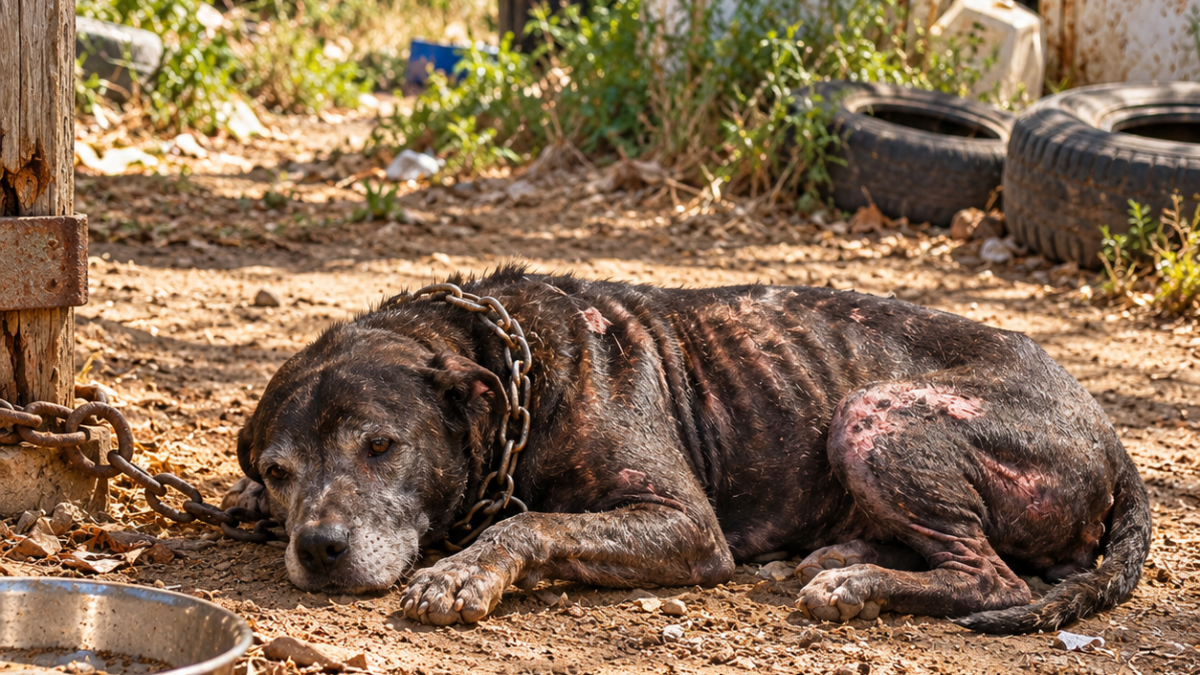
PART 2
The girl disappeared behind the fence before I could speak to her.
At the time, I barely registered it.
Cypress had just placed nearly the full weight of his head in my lap, and I was trying to remain functional while everything I had been trained to keep compartmentalized came apart at once.
I had seen neglect before.
Starving dogs.
Untreated wounds.
Animals left inside filthy houses.
But there was something different about Cypress.
Maybe it was the chain lying useless in the dirt.
Maybe it was the circular trench.
Maybe it was the fact that he had every reason to run from humans and instead pressed himself closer to one.
I put both hands around his face.
“You’re okay.”
The words came out broken.
Cypress licked my chin.
That finished me.
I turned my face away because I was crying too hard to see properly.
Dr. Herrera, the veterinarian assisting us, gave me a minute.
He was kneeling near Cypress’s neck with a camera, documenting the collar before transport.
“You good?”
“No.”
“That’s probably the correct answer.”
I laughed once through the tears.
“I’m supposed to be professional.”
“You are being professional.”
“I’m crying on the dog.”
“He doesn’t seem offended.”
Cypress leaned harder against me.
Dr. Herrera looked at him.
Then at the chain.
“I’ve been doing field cruelty work almost seventeen years.”
I wiped my face.
“And?”
“I’ve seen dogs drag people to the truck when the chain comes off.”
“Meaning?”
“Freedom hits them like an explosion.”
He pointed toward Cypress.
“This one didn’t even look at the gate.”
I looked down.
Cypress’s eyes were closed.
“He came to you.”
I didn’t know what to say.
Dr. Herrera did.
“Remember that.”
I did.
I still do.
Getting Cypress into the truck took time.
Not because he resisted.
Because he did not understand the distance.
My vehicle was parked perhaps forty feet from the tree.
Cypress followed me eight or nine feet.
Then stopped.
I encouraged him.
“Come on.”
He looked toward the tree.
Then down.
I stepped farther.
He followed another three feet.
Stopped.
The chain was no longer attached.
But his body behaved as if it were.
“It’s okay.”
I backed farther away.
“Come on, buddy.”
Cypress took another step.
His head jerked slightly backward.
There was nothing there.
No chain.
Still he froze.
Dr. Herrera saw it too.
“He’s anticipating the stop.”
That sentence hurt.
The chain had disappeared from his neck.
It was still inside his nervous system.
I returned to him.
“Okay.”
I scratched his chest.
“We’ll do this differently.”
We walked in small pieces.
Five feet.
Stop.
Praise.
Five feet.
Stop.
Cypress kept glancing behind him.
Not because he wanted the tree.
Because he seemed unable to understand why the world continued.
When we reached twenty feet, he became visibly nervous.
The farthest point in his entire remembered life had apparently already passed behind him.
I wanted to scream.
Instead, I stayed calm.
“Good boy.”
Step.
“Good boy.”
Step.
By the time we reached my truck, I was crying again.
Cypress looked inside.
The loading step might as well have been a mountain.
His back legs were weak.
His muscles had developed around years of restricted movement.
Dr. Herrera helped me support his hips.
Cypress climbed in.
He immediately turned around, searching.
For the chain?
The tree?
The boundary?
I don’t know.
Then he saw me.
Settled.
I closed the door.
On the passenger-side floor lay the broken section of chain I had collected as evidence.
I hated looking at it.
Yet I couldn’t stop.
The owner had given Cypress no proper name.
We learned that almost immediately.
His paperwork, such as it existed, listed only:
Dog. Male. Black.
I drove away from that property with Cypress behind me and said names out loud.
“Bear?”
Nothing.
“Shadow?”
Nothing.
“Tex?”
He sneezed.
“That bad?”
Then we passed a line of cypress trees near a creek.
I looked in the mirror.
“How about Cypress?”
His ears moved.
“Cypress.”
Tail thump.
Done.
“You’re Cypress.”
For the first time in eight years, maybe the first time ever, the dog had something that belonged only to him.
A name.
I called Linda after pulling onto the shoulder of the highway.
I intended to give her a professional update.
I managed three words.
“Linda, I…”
Then I started crying.
Hard.
Not tasteful movie tears.
Ugly crying.
Couldn’t breathe properly.
Couldn’t get a sentence out.
Linda said nothing.
That was one of the best things anyone ever did for me.
She didn’t say, “Calm down.”
She didn’t say, “You need to toughen up.”
She didn’t tell me to get myself together.
She simply stayed on the phone.
After several minutes, I heard her ask:
“Dog secure?”
“Yes.”
“Driving?”
“No.”
“Good.”
Then silence again.
Eventually I said:
“He sat in my lap.”
“I know.”
“You don’t know.”
“No.”
Her voice softened.
“But I know cases like this.”
I looked through the rear window.
Cypress was lying on a blanket in the transport compartment.
“He spent his whole life chained there.”
“How long?”
“Neighbor says years. We still need statements.”
“Okay.”
“His collar is inside his neck.”
“I’m sorry.”
“And when I cut the chain…”
My voice failed again.
Linda waited.
“He didn’t run.”
“What did he do?”
“He came to me.”
Silence.
Then Linda breathed out slowly.
“That’ll stay with you.”
“I don’t think I can do this job.”
There it was.
The thought I had been afraid to admit.
I had worked too hard to get hired.
Too hard to be taken seriously.
Now one dog had exposed the truth.
I wasn’t numb enough.
Linda answered immediately.
“Good.”
I stared at the phone.
“What?”
“If this stops hurting, quit.”
“That doesn’t make sense.”
“It will.”
She continued.
“You don’t survive cruelty work by feeling nothing, Sloane.”
“Then how?”
“You learn where to put it.”
I looked at Cypress.
“At the moment, I have nowhere.”
“Yes, you do.”
“Where?”
“In the next thing that dog needs.”
That became my rule.
When anger became too large, find the next thing the animal needed.
Not revenge.
Not rage.
Not fantasies about what should happen to the owner.
Water.
Medicine.
Evidence.
Food.
Safe housing.
Documentation.
The next useful thing.
Cypress needed surgery.
So I drove.
At the shelter clinic, staff gathered around his intake cage.
I hated that too.
A cage after a chain.
But there was no other safe medical space.
We made it as different as possible.
Clean bedding.
Water.
Food in controlled portions.
Quiet.
No chain.
Cypress stared at the open kennel door for almost a minute before entering.
I stood inside.
He followed me.
When I tried stepping out, he followed.
I stopped.
He stopped.
“You can’t come everywhere with me.”
His tail moved.
One technician smiled.
“Looks like you’ve been selected.”
“I didn’t apply.”
“Too bad.”
We had to sedate Cypress to remove the embedded collar.
When the leather finally came away, the wound beneath was worse than it had looked outside.
Raw tissue.
Infection.
Scarring.
Years of friction.
Dr. Herrera placed the old collar into an evidence bag.
I stared at it.
“How long would that take?”
“To get this bad?”
“Yes.”
He looked at me.
“Long enough that nobody can credibly call it sudden.”
Good.
I wanted that in writing.
He saw my expression.
“It’ll be in the report.”
Cypress needed antibiotics, wound management, deworming, vaccinations once stable, nutritional rehabilitation, and evaluation of his joints and muscles.
He had pressure sores.
Old scars.
One healed rib fracture.
That discovery made everyone quiet.
“How old?” I asked.
“Could have happened years ago.”
“From what?”
“Impossible to say.”
I wrote it down anyway.
Everything.
Because by then, this was not only rescue.
It was evidence.
The owner had dismissed him as “the dog.”
The court would get a much more complete description.
The next day, I returned to the neighboring property to speak with the teenage girl.
Her name was Maddison Bell.
Fourteen.
Small for her age.
Long brown hair.
She opened the door with her mother beside her.
When she saw my uniform, she looked terrified.
“Is he okay?”
First question.
Not:
Am I in trouble?
Not:
Did you tell the neighbor I called?
“Cypress is stable.”
Her face changed.
“Cypress?”
“That’s what I named him.”
She smiled for the first time.
“He has a name?”
The simplicity of that question hurt.
“He does now.”
Maddison looked down.
“Good.”
Her mother invited me inside.
I began recording a formal statement.
“How long have you known the dog next door?”
Maddison thought.
“Since I was six.”
“Eight years?”
She nodded.
“He was little then.”
“How little?”
She held her hands perhaps a foot apart.
“Like this.”
A puppy.
Ten weeks old, according to another neighbor.
Maybe twelve.
Somewhere around there.
“Was he already chained?”
“Yes.”
“Always?”
She nodded.
I had to keep my face neutral.
“Did you ever see him off the chain?”
“No.”
“Not once?”
“No.”
Her mother looked sick.
“I didn’t know it had been that long.”
Maddison whispered:
“I did.”
Her mother reached for her hand.
“Sweetheart…”
Maddison pulled away.
Not angrily.
Ashamed.
“I should’ve told somebody.”
“You were six.”
“I got older.”
“You were still a child.”
“I knew it was wrong.”
Her eyes filled.
“I knew.”
I put the pen down.
“Maddison.”
She looked at me.
“You called.”
“After eight years.”
“You called.”
She cried.
Her mother put an arm around her.
“I used to feed him.”
That interested me.
“How?”
“When Mr. Raines wasn’t home, I threw food over the fence.”
“What kind?”
“Whatever I could take.”
“Can you remember examples?”
She nodded.
“Toast. Hot dogs. Chicken nuggets. Sometimes my lunch.”
“How often?”
“Whenever I could.”
Her mother stared at her.
“Your lunch?”
Maddison wiped her face.
“I told you I wasn’t hungry.”
Her mother started crying too.
I looked down because suddenly I couldn’t handle either of them.
Maddison continued.
“Sometimes he didn’t have food for days.”
“Could you see his bowl?”
“Yes.”
“Water?”
“Sometimes empty.”
“Did you ever refill it?”
“I couldn’t reach.”
Then she told me about the nights.
Her bedroom window faced the yard.
Every evening, she whispered through the screen.
“Goodnight, puppy.”
Then later:
“Goodnight, buddy.”
She never knew his name because nobody called him anything.
She said sometimes Cypress lifted his head when he heard her voice.
Sometimes his tail moved.
“I thought maybe he knew me.”
“He probably did.”
She looked at me.
“Really?”
“Yes.”
I had no scientific way to prove it.
But I believed it.
“What made you call now?”
Maddison’s answer became one of the most important pieces of the entire case.
“My birthday.”
“You turned fourteen?”
“Last week.”
“And?”
“Mom said I was old enough to trust myself when something felt wrong.”
Her mother covered her mouth.
Maddison continued.
“I couldn’t sleep that night.”
“Why?”
“I kept thinking if he died out there, I’d know I waited too long.”
My throat tightened.
“So you called the next morning.”
She nodded.
“Yes.”
“You saved him.”
Maddison shook her head immediately.
“No.”
“Yes.”
“I just called.”
“That call put me at the property.”
I leaned closer.
“Without it, I don’t know when we would’ve known.”
She cried again.
This time she let her mother hold her.
I gave her the truth.
“You were a child watching an adult do something wrong. The responsibility was never yours.”
She whispered:
“But I knew.”
“And when you were ready, you acted.”
I had learned that from Linda.
Don’t lie to people about guilt.
Put it where it belongs.
The responsibility belonged to the man who had chained Cypress.
Not the girl who threw chicken nuggets over a fence.
The owner’s name was Vernon Raines.
Sixty years old.
He returned to his property that evening and called our office furious.
“You stole my dog.”
Our supervisor transferred the call to me because I was the seizing officer.
“No, sir. Cypress was seized pursuant to emergency cruelty authority.”
“Who the hell is Cypress?”
I paused.
“The dog.”
Silence.
“Oh.”
That tiny exchange told me more than I wanted to know.
“You named it?”
“Him.”
“Whatever.”
I gripped my pen harder.
“He is receiving medical treatment.”
“He didn’t need treatment.”
“The leather collar was embedded in his neck.”
“That dog always had skin problems.”
“The water was contaminated.”
“I filled it.”
“The shelter had partially collapsed.”
“He had shade.”
“The veterinary report documents malnutrition, infection, pressure injuries, and—”
“You people exaggerate everything.”
I stopped.
Linda had taught me never to argue emotionally when documentation could do the work.
“Mr. Raines, these matters will be addressed through the investigation and any resulting proceedings.”
He laughed.
“Over a dog?”
I remember that sentence exactly.
Over a dog.
I looked through the clinic window.
Cypress was asleep beneath a clean blanket.
“Yes.”
My voice stayed level.
“Over a dog.”
Raines hung up.
That night, I wanted consequences so badly I could taste them.
I wanted him to stand inside that twelve-foot circle.
I wanted him to feel Texas heat.
Mosquitoes.
Mud.
Thirst.
I wanted twelve feet to become his entire world.
I was ashamed of those thoughts later.
Linda wasn’t.
When I admitted them, she said:
“Thoughts aren’t actions.”
“I want him punished.”
“You should.”
“I mean really punished.”
“That’s why courts exist.”
I stared at her.
“That sounds optimistic.”
“No.”
She took a sip of terrible shelter coffee.
“It sounds procedural.”
Classic Linda.
“What if he gets away with it?”
“Then we keep improving the evidence.”
“What if it still isn’t enough?”
She looked toward Cypress’s kennel.
“Then the dog is still off the chain.”
I said nothing.
“That is the first victory.”
She was right.
I just wasn’t ready for that to be enough.
Cypress’s first week after surgery was difficult.
He trusted people almost immediately.
Movement was harder.
The shelter yard was fenced, maybe sixty feet across.
The first time we brought him outside, he stepped through the gate.
Walked twelve feet.
Stopped.
I marked the distance later.
Twelve feet.
Almost exactly.
He stood there panting.
“Come on.”
He wouldn’t.
I moved another six feet.
Cypress remained frozen.
His eyes went toward the kennel building.
Then the fence.
Then me.
I crouched.
“No chain.”
Nothing.
I walked back.
He leaned against my legs.
I sat on the grass.
Within seconds, he sat too.
“You can go anywhere in here.”
Cypress licked my wrist.
“That isn’t what I said.”
The behavior team explained that freedom itself could be overwhelming.
For eight years, Cypress had lived inside a mathematically consistent boundary.
Twelve feet from the tree.
Every direction.
His brain had mapped the world to that radius.
To him, crossing beyond it could feel wrong.
Unsafe.
Impossible.
So we didn’t drag him.
We expanded the world gradually.
Thirteen feet.
Fourteen.
Fifteen.
Treat.
Praise.
Back.
The next day:
Eighteen.
Then twenty.
The process looked ridiculous to anyone who didn’t understand.
A sixty-pound pit bull being celebrated for walking across a lawn.
But every foot represented territory that had been forbidden for most of his life.
One afternoon, he reached thirty feet.
A volunteer named Rosa started crying.
Cypress immediately walked toward her.
She laughed.
“No, no, I’m happy.”
He pushed his head into her leg.
Rosa scratched him.
“He hates tears.”
“No.”
I smiled.
“He thinks crying means lap time.”
Cypress agreed by attempting to climb into her lap.
He had absolutely no concept of his size.
That was another discovery.
The tennis ball happened twenty-six days after rescue.
I remember because I wrote it in my notebook.
Day 26: Cypress chased something.
The shelter yard contained a bucket of donated toys.
Cypress ignored them.
Ropes probably meant nothing good.
Balls had no context.
Squeaky toys startled him.
Then one morning, another dog in the adjacent yard chased a tennis ball.
Cypress watched.
Ball thrown.
Dog runs.
Ball returns.
Again.
Cypress stood at the fence fascinated.
I picked up a second tennis ball.
“You want to try?”
He looked at me.
I tossed it maybe ten feet.
The ball bounced.
Cypress flinched.
Then stared.
The ball stopped.
He walked toward it.
Sniffed.
Looked back.
“Good.”
He touched it with his nose.
It rolled.
Cypress jumped backward.
Rosa laughed.
“Brave boy.”
Second attempt.
I rolled it instead of throwing.
Cypress followed.
Three steps.
Five.
Then something clicked.
He lunged after it.
Awkwardly.
His back legs didn’t coordinate perfectly.
But he ran.
Maybe eight feet.
Then ten.
He caught the ball badly, mostly with his chest.
It bounced away.
Cypress spun.
Chased again.
I heard Rosa gasp behind me.
Another staff member stopped cleaning kennels.
Then another came outside.
Within a minute, half the shelter seemed to be watching.
Cypress got the ball into his mouth.
Turned.
Stood there.
Tail wagging.
Hard.
Rosa covered her mouth.
“Oh my God.”
I couldn’t speak.
Eight years.
Twelve feet.
Now he had crossed half a yard because a yellow ball rolled away.
“Bring it here!”
Cypress had no idea what fetch meant.
He ran in the opposite direction.
Everyone started laughing.
That was better than crying.
He ran until he reached the fence.
Then back toward us.
Then past.
He wasn’t good at it.
He was magnificent.
Later, Linda found me sitting in my truck.
Crying.
Again.
She leaned against the door.
“You cry a lot.”
“Apparently.”
“Good.”
“I thought this job was supposed to toughen me up.”
“It is.”
“This does not feel tougher.”
Linda shrugged.
“Maybe you misunderstood tough.”
The next milestone came with grass.
Cypress had technically lived around grass.
But not inside his circle.
His twelve-foot world had become dirt long before.
A volunteer took him into a larger exercise pasture once his neck had healed enough.
The grass was deep.
Soft.
Cypress stepped into it carefully.
Sniffed.
Then walked faster.
Something touched his belly.
He jumped.
We laughed.
He sniffed harder.
Then, without warning, he dropped one shoulder and rolled.
Back.
Side.
Back again.
Four paws in the air.
The most ordinary dog behavior in existence.
Rosa started sobbing.
I felt my own face collapse.
“Oh, come on.”
Cypress rolled harder.
Grass stuck to his coat.
He sneezed.
Then rolled again.
One of the kennel assistants whispered:
“He never had room.”
That was why everyone was crying.
Not because rolling in grass was extraordinary.
Because it should never have been extraordinary.
Someone had stolen the ordinary from him.
Now he was taking it back.
Maddison came to see him after the prosecutor approved limited contact relevant to the case.
She had been asking for weeks.
I warned her:
“He may not recognize you.”
“I know.”
“You have never interacted face-to-face?”
“No.”
“Only through the fence?”
“Yes.”
“We can’t promise anything.”
“I know.”
She looked terrified.
I brought Cypress into the meet-and-greet room.
Maddison waited with her mother.
Cypress entered beside me.
At first, he barely looked at them.
He sniffed the floor.
Chair.
Wall.
Maddison’s shoes.
She started crying quietly.
“It’s okay,” I told her.
She nodded.
Then she whispered:
“Hey, buddy.”
Cypress froze.
Not stiff with fear.
Still.
His head lifted.
Maddison covered her mouth.
“Goodnight, buddy.”
The phrase.
The same phrase she had whispered through her screen for years.
Cypress turned.
His tail moved.
Once.
Then again.
Faster.
Maddison lowered herself to the floor.
Cypress walked toward her.
Three steps.
Then six.
Then suddenly he ran.
Not elegantly.
Not carefully.
Ran.
Maddison barely opened her arms before sixty pounds of dog climbed halfway into her lap.
She collapsed backward laughing and crying.
“Cypress!”
He licked her face.
Neck.
Hair.
Everywhere.
Maddison grabbed him.
“You remember me.”
Cypress whined.
A sound I had never heard from him.
His tail struck the floor like a drum.
Her mother started crying.
I turned away.
Not because I was professional.
Because I wasn’t.
When I looked back, Maddison had both arms around Cypress.
Her forehead against his.
“I’m sorry.”
I stepped closer.
“No.”
She didn’t hear me.
“I’m sorry I waited.”
Cypress licked her nose.
I crouched.
“Maddison.”
She looked at me.
“Stop apologizing to him for what an adult did.”
She cried harder.
“He doesn’t blame you.”
“How do you know?”
I pointed at the dog sprawled over her legs.
“Educated guess.”
She laughed.
Then Cypress did something remarkable.
He lay down beside her.
Head in her lap.
The exact position he had chosen with me the moment the chain broke.
Connection before everything else.
That was Cypress.
Maddison’s family asked about adoption two days later.
I should have expected it.
I didn’t.
Her mother, Rachel, called.
“What would we need?”
“For what?”
“To adopt Cypress.”
I sat down.
“You understand he’s still evidence in an active cruelty case.”
“Yes.”
“So he’s not available yet.”
“I understand.”
“He may have long-term medical needs.”
“We understand.”
“Behavioral adjustment.”
“Yes.”
“Large-breed restrictions depending on insurance.”
“I already called.”
That stopped me.
“You called your insurer?”
“This morning.”
I smiled.
“What did they say?”
“We’re changing companies.”
I laughed.
“Okay.”
Rachel continued.
“Maddison has loved this dog since she was six.”
I looked through the kennel window.
Cypress was asleep with one paw touching the fence.
“I know.”
“And honestly…”
She paused.
“I think I owe him something too.”
“You didn’t abuse him.”
“No.”
“But?”
“I lived next door.”
There it was again.
Guilt spreading into everyone except the person responsible.
“I didn’t know the extent of it.”
Rachel’s voice trembled.
“But I knew there was a chained dog.”
“You cannot take responsibility for everything your neighbor does.”
“I know.”
“Do you?”
Silence.
I softened.
“If your family adopts Cypress, do it because you want his future.”
“Not because we feel guilty.”
“Exactly.”
She answered immediately.
“We want his future.”
Good answer.
The application went in.
Meanwhile, Vernon Raines had hired a lawyer.
Suddenly, the dog he had called “the dog” mattered.
Not emotionally.
Legally.
His attorney challenged the seizure.
Claimed Cypress had adequate shelter.
Claimed the dog was thin because of age.
Claimed the collar injury was recent.
Claimed neighbors were exaggerating.
Claimed Animal Control had entered improperly.
Everything became procedure.
Photographs mattered.
Timestamped records mattered.
Body-camera footage mattered.
Dr. Herrera’s report mattered.
Maddison’s observations mattered.
Other neighbors began speaking.
One man said he had heard Cypress crying during freezing weather.
A woman recalled seeing his water bowl empty repeatedly.
Another remembered offering to take the dog years earlier.
Raines had refused.
“Why?” the prosecutor asked.
The woman shrugged.
“He said the dog was useful where he was.”
“For what?”
“He said keeping people off the property.”
A chained guard dog.
Except Cypress had never shown us aggression.
Another neighbor remembered Cypress as a puppy.
“Friendly.”
“How long was he chained?”
“Always.”
“Always?”
“I never saw him loose.”
The case became larger than one embedded collar.
It became a history.
Eight years of small decisions.
Leave the dog tied.
Don’t replace the collar.
Don’t fix the shelter.
Don’t clean the water.
Don’t seek medical care.
Don’t look too closely.
Cruelty isn’t always one explosive act.
Sometimes it is repetition.
A person choosing not to care tomorrow.
Then tomorrow.
Then tomorrow.
Until eight years pass.
That was the part that made me angriest.
Raines didn’t need to wake every morning deciding to torture Cypress.
He only had to wake every morning and decide not to change anything.
The seizure hearing occurred six weeks after rescue.
Cypress remained in shelter custody.
Raines wanted him returned.
That possibility terrified me.
I knew the evidence was strong.
Still, legal outcomes never feel guaranteed when an animal cannot speak.
I sat outside the courtroom with Linda.
My knee wouldn’t stop bouncing.
“Stop.”
“I can’t.”
“You look guilty.”
“I didn’t do anything.”
“Exactly.”
She handed me coffee.
I didn’t drink it.
Inside, photographs were entered.
The chain.
The trench.
The bowl.
The shelter.
Cypress’s neck.
The collar after removal.
His body condition.
Medical records.
Then my body-camera footage.
I hated watching it.
There I was.
Young.
Voice shaking despite my attempts to sound official.
There was Cypress under the tree.
Raines’s attorney argued that the dog had shade.
The prosecutor paused the footage on the partially collapsed doghouse.
“Would you describe that as adequate weather protection?”
The lawyer objected.
The judge overruled.
Dr. Herrera testified.
Embedded collar consistent with prolonged pressure and untreated injury.
Malnutrition.
Skin infection.
Muscle weakness.
Parasites.
Chronic confinement signs.
Then Maddison testified.
I wished she didn’t have to.
But she had insisted.
Fourteen years old.
Hands clasped tightly in front of her.
The prosecutor asked:
“How long have you seen the dog at that tree?”
“Since I was six.”
“Did you ever see him off the chain?”
“No.”
“Did you provide food?”
“Yes.”
“Why?”
“Because sometimes he didn’t have any.”
Raines looked toward her.
For the first time, she looked back.
Not defiant.
Not angry.
Just steady.
The prosecutor asked:
“What made you finally call?”
Maddison swallowed.
“I turned fourteen.”
“What changed at fourteen?”
“My mom told me if something felt wrong, I was old enough to trust myself.”
The courtroom went silent.
“And did something feel wrong?”
“Yes.”
“How long?”
Maddison’s eyes filled.
“Eight years.”
I looked down.
Linda squeezed my arm under the table.
The judge upheld the seizure.
Cypress would not return to Raines.
I exhaled so hard my chest hurt.
But the criminal cruelty charges were still pending.
Raines walked past us outside.
His attorney beside him.
For one second, he stopped.
“You happy now?”
I looked at him.
Every angry sentence I had rehearsed came back.
I wanted to tell him what Cypress looked like playing.
I wanted to describe the grass.
The tennis ball.
Maddison.
I wanted to ask how a person watches a collar disappear into a dog’s neck.
Instead, I remembered Linda.
Next useful thing.
I answered:
“Cypress is safe.”
Raines stared.
“That wasn’t what I asked.”
“It’s what matters.”
He left.
Linda looked at me.
“Good.”
“What?”
“You didn’t give him anything.”
I understood.
Anger had wanted a confrontation.
Cypress needed something better.
A future.
Once legal custody transferred fully to the county, Maddison’s family moved to the front of the adoption process.
There were concerns.
Cypress had never lived indoors.
Never climbed stairs.
Never heard a dishwasher.
Never experienced televisions, vacuum cleaners, doorbells, ceiling fans, slick floors, thunderstorms from inside a house.
Freedom did not automatically equal preparedness.
The behavior team began household exposure.
The first ceiling fan almost ended him.
Cypress entered the training room.
Looked up.
Saw moving blades.
Dropped flat.
I turned the fan off.
He stared at it for five full minutes.
“It’s dead.”
Tail uncertain.
“The monster is dead.”
Rosa laughed.
Next day, fan on low.
Treats.
No forcing.
Third day, less fear.
By week two, Cypress ignored it.
The vacuum cleaner was worse.
He barked.
The first real bark I heard from him.
I nearly celebrated.
Then realized he was terrified.
We worked slowly.
Sound at distance.
Treat.
Closer.
Treat.
Eventually he learned vacuums were annoying but not dangerous.
Stairs confused him.
Why would the ground suddenly become vertical?
He put two paws on the first step.
Stared at the rest.
Refused.
Maddison practiced with him during visits.
One step.
Chicken.
Another.
Chicken.
On the day he reached the top, Maddison screamed.
Cypress ran back down because the scream frightened him.
We had to start over.
She felt terrible.
I laughed so hard I cried.
“Maybe quieter celebration.”
“Sorry.”
Cypress wagged.
The collar scar healed slowly.
Fur never fully grew over one section.
For months, people noticed it.
“What happened?”
Sometimes I hated the question.
Because Cypress was becoming more than what happened to him.
He had preferences.
He loved peanut butter.
Hated rain.
Loved trucks, oddly enough.
Disliked thunder.
Preferred women initially, though he eventually adored Rachel’s husband too.
He was terrified of ropes.
Loved soft blankets.
Refused hard floors when a bed existed.
He discovered couches.
This created a political crisis at Maddison’s house before adoption was even final.
Rachel said:
“No dogs on furniture.”
Maddison said nothing.
Her father, Ben, said:
“Absolutely.”
During the first home trial, Cypress looked at the couch.
Then at everyone.
He put one paw up.
Rachel said:
“No.”
Cypress removed it.
Good boy.
Five minutes later, Ben sat on the couch.
Cypress walked over.
Put his head in Ben’s lap.
Then one paw.
Then chest.
Then entire body.
Ben said nothing.
Rachel returned from the kitchen.
“Ben.”
“He did it gradually.”
“Get him down.”
Cypress closed his eyes.
Ben looked at his wife.
“He’s asleep.”
“You are weak.”
“Yes.”
The furniture rule died before sunset.
Cypress had been denied softness for eight years.
Nobody truly had the heart to deny him a couch.
The adoption became official three months after the seizure.
I barely slept the night before.
Ridiculous.
I had released dozens of animals to adopters.
This was different.
Cypress had become attached to me.
I had become attached to him in ways I tried not to examine too closely.
I had even considered adopting him.
Linda was the one who stopped me from doing something selfish.
“You work twelve-hour emergency shifts.”
“I know.”
“You live in a small rental.”
“I know.”
“You have a senior cat who hates dogs.”
“I know.”
“Maddison’s family has a fenced acre.”
“I know.”
“Her school is ten minutes away.”
“I know.”
“She has loved that dog half her life.”
“I know.”
Linda stared.
“So?”
“I hate you.”
“Excellent.”
She was right.
Rescuers sometimes confuse being important at the beginning with needing to remain important forever.
My job was not to become Cypress’s entire life.
My job was to make sure he got one.
On adoption day, Maddison arrived wearing a shirt covered in black dog hair despite not yet owning him.
“How?”
“We’ve been visiting.”
“Fair.”
Cypress heard her before he saw her.
“Hey, buddy.”
His head shot up.
Then he ran.
Full speed.
Not elegant.
But strong now.
Across the meet-and-greet room.
Straight into Maddison.
She went down laughing.
“Cypress!”
He covered her face in kisses.
Rachel cried.
Ben pretended something was in his eye.
I signed forms.
Medical history.
Behavior notes.
Long-term joint concerns.
Nutrition.
Scar management.
Fear triggers.
No chaining.
I almost laughed at that last one.
There was no universe in which that family would ever chain him.
Still, paperwork mattered.
Maddison held his new collar.
Soft nylon.
Loose enough to fit two fingers beneath it.
Blue.
A metal tag hung from the ring.
CYPRESS BELL
Not “Dog.”
Not evidence number.
A full name.
I stared at it longer than necessary.
Maddison noticed.
“You okay?”
“No.”
She smiled.
“Good.”
Apparently everyone had learned from Linda.
I knelt beside Cypress.
He pushed his head toward me.
“Listen.”
Tail wag.
“These people are taking you home.”
He licked my mouth.
“Disgusting.”
More licking.
“You remember the tree?”
His ears moved.
“I hope you don’t.”
I put my forehead against his.
“But remember this.”
My voice cracked.
“You get to keep going.”
Cypress leaned into me.
I closed my eyes.
Then Maddison called him.
“Come on, Cypress.”
He turned immediately.
Went to her.
For one second, that hurt.
Then it felt exactly right.
He walked out of the shelter beside the girl who had whispered goodnight through a window for eight years.
No chain.
No twelve-foot radius.
No looking back at a tree.
He climbed into the back seat.
Maddison sat beside him.
Before the car left, she rolled down the window.
“I’ll send pictures.”
“You better.”
“Every birthday.”
“His or yours?”
She smiled.
“Both.”
They drove away.
Linda stood beside me.
“You crying?”
“No.”
“Liar.”
“Go away.”
She laughed.
The first night in his new home, Cypress would not sleep on the orthopedic bed.
It was enormous.
Expensive.
Maddison had saved birthday money for it.
He sniffed it.
Walked away.
Slept beside her bedroom door.
The next night, same.
Third night, she dragged the bed closer.
Cypress slept with two paws on it.
By the end of the week, entire body.
A month later, he refused to share it with anyone.
Progress.
The house presented other surprises.
Glass doors.
Cypress tried walking through one.
Only once.
The refrigerator ice maker.
Terrifying.
The washing machine.
Suspicious.
Toaster.
Enemy.
Bathtub.
War crime.
But he adapted.
What amazed me most were the updates from outside.
Maddison sent a video the second week.
Cypress stood at the edge of their backyard.
No leash.
Fenced acre.
He stared.
Then walked.
Kept walking.
Twenty feet.
Thirty.
Forty.
He looked back at Maddison.
She said:
“Go.”
Cypress ran.
Not after a ball.
Not toward a person.
Just ran.
Across the yard.
Looped around a tree.
Crossed the grass.
Back again.
I watched the video three times.
On the fourth, I cried.
Of course.
Linda saw me at work.
“What now?”
I showed her.
She watched.
Cypress disappeared from one side of the frame.
Reappeared.
Ran toward Maddison.
Linda handed the phone back.
“That’s why you stay.”
I nodded.
That was why.
The pond happened that summer.
Ben had a friend with rural property and a small private pond.
They brought Cypress.
Nobody knew whether he could swim.
He stepped into shallow water.
Backed out.
Entered again.
Then Maddison waded waist-deep.
“Come on.”
Cypress followed.
Water reached his chest.
Then his feet lost the bottom.
For half a second, panic.
Then instinct.
He paddled.
Badly.
Splashing like he was trying to punch the water.
Maddison laughed.
Cypress reached her.
Then turned.
Swam back.
Next attempt was smoother.
By the end of the afternoon, he was retrieving a floating toy.
A dog once limited to twelve feet now swimming across open water.
The symbolism was so obvious it would have annoyed me if it hadn’t been real.
Maddison sent the video with one sentence:
He doesn’t know where the boundary is anymore.
I saved that one.
The criminal case against Vernon Raines took longer.
Months.
Continuances.
Attorney scheduling.
Motions.
Every delay frustrated me.
Cypress was already safe, but I still wanted the law to say clearly:
This was wrong.
Eventually, Raines entered a plea rather than going through a full trial.
I won’t pretend the outcome matched every angry fantasy I had.
Real legal consequences rarely feel proportional to suffering.
He faced cruelty penalties, fines, probation conditions, and restrictions involving animal ownership.
The court also ordered reimbursement toward Cypress’s veterinary care.
What mattered most to me was the restriction.
No more dogs chained behind that house.
No replacement animal placed beneath the tree.
That was the revenge I could live with.
Not Raines suffering.
Another dog never becoming Cypress.
After the hearing, Maddison was there with her mother.
She looked older somehow.
Not physically.
Stronger.
Raines walked past us.
He did not speak to her.
Good.
Outside, Maddison asked:
“Is that it?”
“For the case?”
“Yes.”
“Mostly.”
“He just gets to go home?”
I understood her disappointment.
“He does.”
“That isn’t fair.”
“No.”
I decided not to lie.
“It isn’t.”
She stared at the courthouse steps.
“He had Cypress for eight years.”
“Yes.”
“And he gets probation?”
“Yes.”
“That’s stupid.”
“Maybe.”
She looked at me.
“Then what was the point?”
I thought carefully.
“The point was getting Cypress out.”
She listened.
“The point was making sure the evidence followed the owner into court.”
I continued.
“The point was making it harder for him to do it again.”
She looked unsatisfied.
Good.
Fourteen-year-olds should be unsatisfied with imperfect justice.
Then I asked:
“Where is Cypress right now?”
“At home.”
“Doing what?”
“Probably on the couch.”
“Exactly.”
Her mouth twitched.
“He’s not supposed to be on the couch.”
“Sure.”
She smiled.
I touched her shoulder.
“That doesn’t make eight years okay.”
“I know.”
“But the person who hurt him doesn’t get to control the rest of his life.”
That helped.
It helped me too.
The old property eventually changed.
Raines moved away after a couple of years.
Someone else bought the land.
The broken appliances disappeared.
The fence was repaired.
The collapsed doghouse was removed.
And the tree?
The pine died.
I found that out because Maddison sent me a photograph.
It had been cut down.
Only a stump remained.
I stared at the image.
For years, I had imagined that tree as Cypress’s prison.
But trees don’t chain dogs.
People do.
Cutting it down didn’t feel like victory.
The empty circle of dirt around it did.
Grass had begun returning.
Thin green shoots.
After eight years of nothing.
I sent Maddison:
Looks different.
She replied:
Good.
That was enough.
Cypress’s first birthday after adoption wasn’t his actual birthday.
Nobody knew that.
Maddison chose the date of his seizure.
Freedom day.
I thought that was better anyway.
Every year, she sent a photo.
First year:
Cypress wearing a ridiculous blue birthday hat, eyes miserable, cake made from dog-safe ingredients in front of him.
Second:
Swimming.
Third:
Sleeping upside down on the couch.
Fourth:
Gray beginning around his mouth.
Fifth:
Maddison in graduation robes, Cypress beside her wearing a matching bow tie.
That photograph destroyed me.
The girl who called at fourteen was graduating high school.
The dog she had watched from her bedroom window was still there.
Safe.
She called me that night.
“I got into Texas A&M.”
“Seriously?”
“Yes.”
“Congratulations.”
“I want to study animal science.”
I laughed.
“Of course you do.”
“What does that mean?”
“You spent eight years feeding a chained dog through a fence.”
“Fair.”
She paused.
“I don’t know if I want veterinary school yet.”
“You don’t need to know.”
“I might work rescue.”
“That pays terribly.”
She laughed.
“You’re inspiring.”
“I’m honest.”
Then her voice softened.
“Would you still be doing Animal Control if it weren’t for Cypress?”
I looked around my office.
I had been promoted by then.
Not dramatically.
Senior field officer.
More experience.
More scars.
More cases I wished I could forget.
“No.”
Silence.
“Really?”
“I almost quit that night.”
“Why?”
“Because I thought caring that much meant I wasn’t built for it.”
“And?”
“I was wrong.”
She was quiet.
Then:
“Good.”
Linda retired after twenty-seven years.
At her retirement dinner, people told stories.
Mostly inappropriate ones.
Animal Control produces bizarre memories.
Raccoons inside bathrooms.
Goats on roofs.
One emu incident nobody could explain.
Then Linda stood to speak.
She hated speeches.
“You all know I don’t like this.”
Everyone laughed.
She talked briefly about burnout.
About young officers.
About the danger of becoming cynical.
Then she looked directly at me.
“There’s one thing I tell rookies.”
I already knew.
“If it stops hurting, quit.”
My eyes filled immediately.
Linda smiled.
“Sloane called me from the highway years ago. Couldn’t speak.”
People looked at me.
I shook my head.
“Don’t.”
Linda continued.
“She thought crying meant she wasn’t tough enough.”
More laughter.
“She cries all the time.”
“Linda.”
“Still.”
The room laughed.
Then Linda became serious.
“But she stayed.”
She looked around.
“That matters.”
After dinner, she gave me a small box.
Inside was a framed photograph.
Cypress in the shelter yard.
Tennis ball in his mouth.
Grass beneath him.
Written on the back:
THE NEXT USEFUL THING.
I cried.
Obviously.
Linda hugged me.
“You’re impossible.”
“You trained me.”
“Unfortunately.”
Years passed.
Cypress aged.
His hips developed arthritis, likely worsened by years of restricted movement and poor early care.
Maddison adjusted everything.
Ramps.
Rugs.
Joint medication.
Orthopedic bed upgraded to something more expensive than my first mattress.
He swam less.
Walked slower.
But still slept indoors.
Still leaned into people.
Still greeted visitors like they might secretly be carrying peanut butter.
One birthday photo showed him with an almost white muzzle.
Caption:
Twelve feet? Never heard of it.
He was lying in the middle of an enormous field.
I stared at it for a long time.
That was the revenge.
I had spent years learning that.
Cruelty wants to define an animal by what happened to him.
Cypress refused.
The chain became historical information.
Not identity.
Maddison once told me:
“I forget sometimes.”
“Forget what?”
“That he lived there.”
I understood exactly.
At first, every time I looked at Cypress I saw the tree.
Later, I saw Cypress.
Just Cypress.
Dog.
Ridiculous sleeper.
Bad swimmer turned decent swimmer.
Professional couch thief.
Friend.
Family.
That is what recovery should do.
Not erase scars.
Put them in proportion.
When Cypress was around thirteen, Maddison called me one evening.
Her voice was wrong.
I knew before she said anything.
“He’s not eating.”
I sat down.
“How long?”
“Since yesterday.”
“Vet?”
“This afternoon.”
“What did they say?”
“Kidneys.”
I closed my eyes.
Old dog.
Old body.
Years we had never expected him to receive.
“How bad?”
“They’re trying medication.”
“Okay.”
“Sloane…”
Her voice cracked.
“I can’t lose him.”
I thought of fourteen-year-old Maddison.
Chicken nuggets over a fence.
Goodnight through the screen.
“You’re not losing him tonight.”
“How do you know?”
“I don’t.”
Honesty again.
“What do I do?”
“Next useful thing.”
Silence.
Then a small laugh through tears.
“You sound like Linda.”
“Terrifying.”
“What’s the next useful thing?”
“What did the vet say?”
“Fluids. Medication. Offer food. Keep him comfortable.”
“Then that’s tonight.”
“What about tomorrow?”
“Tomorrow gets its own list.”
Cypress improved.
For several months.
Then declined again.
Old age is not cruelty.
That distinction mattered.
His weakening body did not mean anyone had failed him.
It meant he had lived long enough to become old.
For Cypress, that was an extraordinary victory.
The final time I visited him, Maddison had finished college.
She was living nearby while applying to veterinary programs.
Cypress was gray.
Thin again, but not from neglect.
Age.
He lay on the giant bed beside her room.
Exactly where the original story said he belonged.
When I entered, he lifted his head.
For one painful second, I wondered whether he remembered me.
Then his tail moved.
Once.
Just once.
Exactly like the first day.
I dropped to my knees.
“Hey, buddy.”
Cypress tried standing.
“Don’t.”
He ignored me.
Of course.
He came forward slowly.
Pressed his head into my lap.
The same position.
I completely lost it.
Thirteen years older in my own life.
More experienced.
Senior officer.
Countless cruelty cases.
And there I was on the floor crying into a pit bull’s neck again.
Maddison sat beside us.
“He remembers.”
“Yes.”
Cypress licked my chin.
Weakly.
“Still disgusting.”
Maddison laughed.
I touched the scar on his neck.
Barely visible beneath gray fur.
“Look at you.”
Cypress closed his eyes.
“You got old.”
That sentence wrecked me.
Because I remembered the property.
The chain.
The infection.
The man who called him “the dog.”
Nothing in that yard promised an old age.
Yet here he was.
Old.
Loved.
Soft bed.
Girl beside him.
Safe.
“You did good.”
His tail tapped.
I looked at Maddison.
“So did you.”
She shook her head.
“We both know he would’ve died if you hadn’t come.”
“And I wouldn’t have come if you hadn’t called.”
We had argued this circle for years.
Neither of us won.
Maybe rescue is usually like that.
Not one hero.
A chain of people doing the next useful thing.
A child notices.
A mother listens.
A dispatcher assigns.
An officer drives.
A vet treats.
A shelter houses.
An adopter commits.
No single moment saves a life.
They add together.
Cypress died several weeks later.
At home.
On his bed.
Maddison and her parents with him.
Their veterinarian came to the house.
Maddison called me afterward.
Neither of us spoke for nearly a minute.
Then she said:
“He wasn’t scared.”
I closed my eyes.
“Good.”
“He ate peanut butter.”
“Of course.”
“Ben gave him way too much.”
“Also correct.”
She laughed once.
Then cried.
“He put his head in my lap.”
I couldn’t speak.
“Sloane?”
“I’m here.”
“He did exactly what he did with you.”
That was Cypress’s language.
Head in lap.
Trust.
Connection.
The dog who had once been denied touch had chosen closeness at both ends of freedom.
When the chain came off.
When life ended.
I stayed on the phone with Maddison the way Linda had stayed on the phone with me.
Quietly.
Full circle.
When she could finally speak, she said:
“Thirteen years.”
“Yeah.”
“He was supposed to have twelve feet.”
I swallowed.
“He got thirteen years.”
That became the sentence I kept.
Not eight years chained.
Thirteen years after freedom.
His suffering deserved to be remembered.
But so did the life afterward.
Especially that.
Maddison scattered part of Cypress’s ashes near the pond where he learned to swim.
The rest she kept.
She did not take them to the old tree.
I asked why.
“That place already got enough of him.”
Perfect answer.
The property where Cypress had spent eight years eventually looked completely different.
New family.
New fence.
Children.
No chained dogs.
The pine stump rotted away.
Grass covered the old circle.
Nothing marked it.
I was glad.
Cruelty does not deserve monuments.
Cypress’s life did.
His photograph hangs in our Animal Control office.
Not the intake photograph.
Not the embedded collar.
Those stay in records.
The public photo is him running across the shelter yard with that first tennis ball.
Under it is a small plaque:
CYPRESS
Freedom is more than removing the chain.
New officers ask about him.
I tell the story.
Not to make them cry.
Though they usually do.
I tell it because cruelty work creates dangerous habits.
You start seeing case numbers.
Addresses.
Violations.
Evidence.
Owners.
Kennels.
That bureaucracy is necessary.
But behind every report is an animal experiencing one actual life.
Cypress taught me never to forget that.
He also taught me that rescue does not end when the immediate suffering ends.
Cutting the chain was dramatic.
Rehabilitation was quieter.
Teaching him distance.
Grass.
Balls.
Stairs.
Fans.
Vacuum cleaners.
Water.
Couches.
A home.
Those were the real rescue.
Freedom is not a bolt cutter.
Freedom is learning that when you walk fifteen feet, nothing jerks you backward.
Twenty feet.
Thirty.
An acre.
A pond.
A lifetime.
Years later, I was training a rookie officer.
Twenty-two.
Nervous.
Trying far too hard to look unaffected.
Basically me.
We responded to a neglect case involving several dogs in outdoor pens.
Conditions were bad.
Not Cypress-level.
Still bad.
Afterward, the rookie sat in the passenger seat silent.
I waited.
Then she said:
“How do you do this?”
I almost laughed.
“What?”
“See this all the time.”
“You don’t get used to it.”
She looked at me.
“That’s not reassuring.”
“It shouldn’t be.”
She stared out the window.
“I cried in the bathroom.”
“Good.”
Her eyebrows rose.
I smiled.
“If it stops hurting, quit.”
She stared.
“Who told you that?”
“A woman smarter than me.”
Then I told her about Cypress.
Eight years.
One tree.
Twelve-foot chain.
Girl next door.
Bolt cutters.
Head in my lap.
By the end, she was crying again.
“So that’s supposed to make me feel better?”
“No.”
I started the truck.
“It’s supposed to remind you what happens after the worst part.”
We drove back to the shelter.
One of the dogs seized that afternoon eventually recovered.
Three months later, my rookie sent me a photograph of him leaving with an adoptive family.
Caption:
Next useful thing.
I smiled.
Linda would have loved that.
Maddison eventually got into veterinary school.
When she called me, she screamed so loudly I had to hold the phone away.
“You’re going?”
“Yes!”
“Where?”
She told me.
I cried.
Naturally.
“You’re ridiculous,” she said.
“Look who taught you.”
Before classes began, she visited our office.
She stood beneath Cypress’s photograph.
“He looks young.”
“He was.”
“Not really.”
“No.”
But compared with the gray dog who died peacefully years later, he was.
She touched the plaque.
“Do you think people understand this?”
“Freedom is more than removing the chain?”
“Yes.”
“Some do.”
“And the others?”
“We keep teaching them.”
Maddison smiled.
She had become the adult her six-year-old self needed.
That may be Cypress’s longest legacy.
A little girl watched a dog suffer and felt powerless.
Then she called.
Years later, she devoted her life to animals.
Cruelty had tried to make one child feel helpless.
Instead, it helped create a veterinarian.
Not because the suffering was good.
Never because of that.
Because Maddison chose what to do with what she had witnessed.
That matters.
Sometimes people ask whether Cypress forgave Vernon Raines.
I hate the question.
Not because it is cruel.
Because I don’t know whether forgiveness is even the right concept.
Dogs are not moral philosophers.
Cypress did not sit beneath that tree planning revenge.
He did not leave the property carrying hatred.
He carried fear.
Physical damage.
Learned limitations.
Then gradually those things loosened.
Maybe that is better than forgiveness.
He simply built a life where his former owner no longer mattered.
That is the kind of revenge I understand now.
Not returning pain.
Removing the abuser from the center of the story.
Vernon Raines became a legal file.
A conviction record.
A former owner.
Cypress became somebody’s family.
Years later, if you had asked Cypress to choose between thinking about Raines and swimming after a floating toy, I’m pretty sure I know what he would choose.
The pond.
Every time.
That is victory.
I still have the broken chain.
Not at home.
Evidence procedures eventually allowed part of it to be released for training use.
It sits in a clear case in our office.
Heavy.
Rusted.
Ugly.
New officers sometimes pick it up.
They’re surprised by the weight.
Twelve feet of logging chain is heavier than you imagine.
I always tell them:
“Now imagine wearing it for eight years.”
Then I show them the second object.
A tennis ball.
Old.
Faded.
The first one Cypress ever chased.
Rosa saved it.
When she retired, she gave it to me.
Chain on one side.
Ball on the other.
That is the entire story.
What was done to him.
What he got back.
I would choose the ball every time.
On the anniversary of his rescue one year, Maddison and I returned to the general area.
Not the private property.
The road nearby.
She was older now.
Nearly finished with school.
We stood beside my truck.
Texas heat.
Cicadas.
Dust.
Almost exactly like the original afternoon.
“Do you remember?”
“Every second.”
She looked toward where her childhood house had once been.
Her family had moved years earlier.
“I used to watch him from that window.”
“I know.”
“I really thought he would die there.”
“So did I when I saw him.”
She looked surprised.
“You never told me.”
“I didn’t know how sick he was yet.”
“But you thought it.”
“Yes.”
She became quiet.
Then:
“Was I really the reason you got dispatched?”
“Yes.”
“No exaggeration?”
“No.”
“What if I hadn’t called?”
I hated hypothetical questions like that.
“I don’t know.”
“He could’ve died.”
“Yes.”
Maddison looked down.
“I spent years thinking I waited too long.”
“You were a child.”
“I know that now.”
Good.
She smiled faintly.
“But I also know calling mattered.”
“It did.”
She looked at me.
“That’s what I tell people now.”
“What?”
“If you see something, call.”
I smiled.
“Good.”
“Even if you’re wrong.”
“Yes.”
“Let somebody check.”
“Yes.”
She nodded.
“Cypress would like that.”
Maybe.
Or maybe Cypress would have preferred peanut butter.
Both could be true.
The hardest lesson Cypress taught me was that kindness does not need to erase anger.
For years, I thought good rescuers were supposed to be pure.
Compassionate.
Patient.
Professional.
Never furious.
That is nonsense.
There are cases that should make you angry.
A dog chained for eight years should make you angry.
A collar grown into skin should make you angry.
A child secretly feeding an animal because adults failed should make you angry.
The question is what anger becomes.
If it becomes reckless confrontation, it can damage cases.
If it becomes hatred that consumes you, the abuser takes something from you too.
If it becomes evidence collection, policy, follow-through, education, prosecution, better rescue practices?
Then anger works.
Cypress taught me to turn rage into the next useful thing.
That may be why I’m still in the job.
Today, when people see my uniform, they sometimes say:
“I could never do what you do.”
I understand.
Some days I’m not sure I can either.
There are animals we cannot save.
Cases that arrive too late.
Owners who disappear.
Evidence that doesn’t reach the threshold people hope for.
There are nights when I drive home angry at the whole species.
Then I walk into our office.
I see Cypress.
Black coat shining.
Tennis ball in his mouth.
Grass beneath all four feet.
And I remember the day he got his name.
The day twelve feet became thirteen.
Then twenty.
Then a yard.
Then a home.
Then a pond.
Then years.
I remember Maddison whispering:
“Goodnight, buddy.”
I remember Cypress recognizing her voice.
I remember him running across the room.
I remember the courtroom.
The adoption collar.
The birthday photographs.
The gray muzzle.
The final phone call.
I remember all of it.
But there is one memory that never changes.
The broken chain falls into the dirt.
Metal hits ground.
Cypress looks at it.
The gate is open.
Nothing holds him.
He could run anywhere.
After eight years, the entire world is suddenly larger than twelve feet.
And what does he choose first?
Not escape.
Not distance.
Not revenge.
He walks toward me.
Slowly.
Sits against my boots.
Lowers his head into my lap.
And trusts.
People call that forgiveness.
Maybe.
I call it proof that Vernon Raines never managed to destroy the best thing inside that dog.
He could restrict Cypress’s body.
Neglect his health.
Reduce his world to dirt.
Fail to give him a name.
But he could not teach Cypress that love was impossible.
That part survived.
Hidden.
Waiting.
Just like Maddison waited behind the neighboring fence.
Just like I happened to arrive when the call came.
Just like the chain waited for bolt cutters.
When I think about Cypress now, I don’t picture him under that tree.
I refuse to give that image the final word.
I picture a pond.
Maddison standing waist-deep in the water.
A black dog splashing toward her with absolutely terrible swimming technique.
No chain.
No circle in the dirt.
No fixed radius.
He reaches her.
Turns.
Swims back toward shore.
Then runs across the grass because he can.
That is Cypress.
Not the dog who spent eight years chained to a tree.
The dog who spent the rest of his life discovering how far he was allowed to go.
And somewhere along the way, he taught me the same thing.








