PART 2: I Came Home After 8 Months Offshore—and Found 4 HOA Houses Sitting on My Family Farm
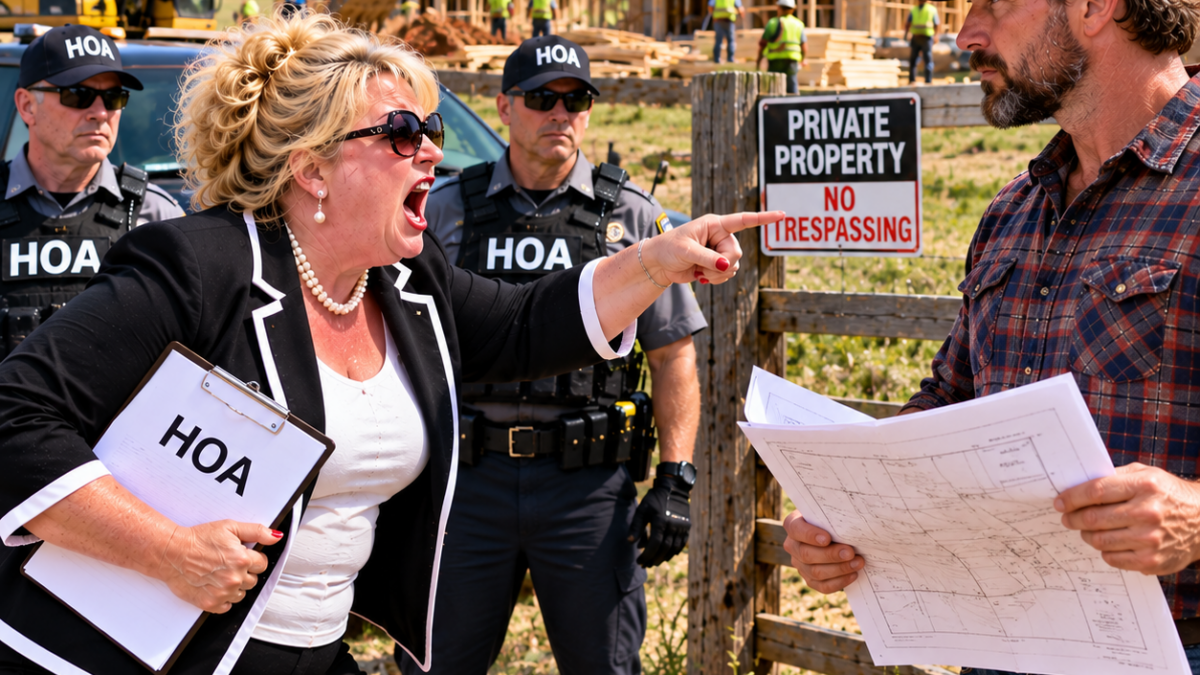
PART 2
I looked at him for so long that the smile finally shifted.
Barely.
But I saw it.
Fifty thousand dollars.
He had said it like he was offering me a generous settlement after an unfortunate paperwork problem.
I thought about my grandfather standing in a freezer room at four in the morning, twenty-six years old, hands cracked from cold, putting away money for land.
I thought about the pecan trees.
The farmhouse porch.
The old cattle tank where my cousins and I used to swim even after Grandma told us not to.
Then I looked at Jack’s polished desk.
“Who authorized the HOA to sell property titled in my name?”
He opened both hands.
“That’s all addressed in the documents.”
“Who?”
“County planning.”
“Planning commissions regulate development. They don’t normally transfer private title.”
His eyes narrowed slightly.
“You’ve done some research.”
“I’ve owned land longer than Willowbrook has existed.”
“That doesn’t make you a land-use lawyer.”
“No.”
I leaned forward.
“But I can read a deed.”
Jack’s jaw moved.
I stood.
He pushed the folder toward me again.
“Take this.”
I did.
Not because I believed him.
Because anything he willingly handed me could matter later.
As I reached the door, he said:
“Mr. Gomez.”
I turned.
His expression had changed.
No community-leader smile now.
“Be realistic.”
“About?”
“Four families live there.”
“I noticed.”
“Utilities are installed. Mortgages are recorded. Infrastructure is complete.”
“Also noticed.”
“Unwinding this will cost everyone.”
“That sounds like something you should’ve considered before building.”
His fingers tightened around the edge of the desk.
“We acted on approvals.”
“Then you’ll have no problem showing a judge.”
He sighed as if I were disappointing him.
“Legal fights take years.”
“Sometimes.”
“They cost money.”
“So do oil rigs.”
That irritated him.
Good.
Then I remembered my own rule.
Don’t argue before you know what you’re arguing about.
I nodded once.
“Have a good afternoon, Jack.”
His voice followed me into the hallway.
“The offer won’t remain open indefinitely.”
I kept walking.
***
I checked into a motel twenty minutes away.
Not because I had nowhere else.
The old farmhouse still existed on the eastern side of the property.
Thank God.
But I was not walking back into land occupied by four confused families until I understood what was happening.
I set Jack’s folder on the motel desk.
Then opened my laptop.
The first question was simple.
**Who owns the forty-seven acres?**
County clerk records answered in less than thirty minutes.
Me.
**THOMAS GOMEZ.**
Recorded fifteen years earlier after Grandpa’s estate closed.
No deed conveying the acreage to Willowbrook.
No deed to Jack Howard.
No deed to a development company.
No transfer.
No gift.
No foreclosure.
No tax sale.
No condemnation judgment.
Nothing.
My name remained in the chain of title.
I checked the property-tax account.
That was stranger.
Taxes on the original parcel had been marked paid.
By an account I did not recognize.
Willowbrook Development Fund.
Someone had paid taxes on my land while I was offshore.
That did not make them the owner.
But it showed planning.
I leaned back in the motel chair.
Jack had not made an innocent mistake last week.
This had been underway before I left.
***
Then I found the four building permits.
The source version of this story had a city councilman casually “signing building permits.”
That didn’t make sense.
Real building permits are generally processed through building or development departments, not issued personally by whichever politician happens to like a project.
What I found was subtler.
The permits listed Willowbrook Estates Development LLC as the applicant and **Willowbrook Estates HOA** as the represented property-interest holder.
The applications included an affidavit claiming the applicant was authorized by the owner.
Owner authorization attachment:
Missing from the public copy.
Planning approval referenced:
**Resolution 24-118.**
I downloaded it.
Resolution 24-118 approved an expansion plat for Willowbrook’s development area, subject to proof of ownership and title clearance.
That was important.
The county had not transferred my land.
It had approved a proposed plat **if** the developer could prove control of the property.
Jack had taken a conditional planning approval and described it to me as authority to absorb abandoned land.
Those were not remotely the same thing.
I kept digging.
A name appeared repeatedly in correspondence:
**Councilman Richard “Rick” Davenport.**
He served on the city’s development oversight committee and had advocated publicly for Willowbrook expansion.
Emails attached to meeting packets showed him urging staff to “expedite Phase Two due to housing demand.”
That was not necessarily improper.
Elected officials advocate for projects all the time.
Then I found Hill Country Construction LLC.
General contractor for all four homes.
Corporate filing:
Rick Davenport owned fifteen percent through an investment entity.
That was different.
I wrote the connection down without jumping to conclusions.
Public official.
Private construction interest.
Project he supported.
Possible conflict.
Need documents.
***
The home sales totaled just under eight hundred thousand dollars.
$186,000.
$194,500.
$201,000.
$217,000.
I searched property records.
Each buyer had a deed describing a residential lot carved from my original acreage.
Grantor:
**Willowbrook Estates Development LLC.**
The deeds had been signed by Jack Howard as managing officer.
That stopped me.
He wasn’t merely HOA president.
He was also the manager of a development entity using the Willowbrook name.
I searched the LLC.
Formed fourteen months earlier.
Members not fully visible in the public filing.
Registered mailing address:
The HOA office.
Treasurer on certain financing records:
**Brenda Howard.**
Jack’s wife.
Then the Development Fund.
Opened around the same period.
The source story called it an HOA account.
The records were messier.
Some money moved through the development LLC.
Some through a special HOA capital-improvement account.
That overlap would later matter.
At two in the morning, I finally opened Jack’s folder.
Inside:
Copies of notices supposedly mailed to me.
Proposed annexation resolutions.
A property-abandonment assessment.
Photographs of overgrown pasture.
Meeting minutes.
A legal opinion.
And the $50,000 “goodwill” settlement agreement.
The legal opinion was unsigned.
No letterhead.
No lawyer name.
Just three pages concluding that Willowbrook had equitable development rights because the property was “effectively abandoned.”
I read it twice.
Then laughed.
You cannot acquire forty-seven acres because the grass got tall.
***
The notices bothered me more.
Three letters.
One regular mail.
One certified.
One “final property incorporation notice.”
All addressed to my farmhouse.
During the eight months I had been offshore.
But nobody lived there to sign.
The certified-mail page contained a signature.
**T. Gomez.**
I stared.
I had been in the Gulf the date it was supposedly signed.
I pulled my employment records.
Rig manifests.
Helicopter transport logs.
Time sheets.
On the date someone signed my name in Texas, I was more than three hundred miles offshore.
That was not ambiguous.
I photographed the document.
Then stopped touching the folder.
This had just moved from absurd to potentially criminal.
***
The next morning, I called Denise Wood.
A coworker’s family had used her in an easement dispute.
She answered herself.
I gave her the short version.
“Forty-seven acres?”
“Yes.”
“Still deeded to you?”
“Yes.”
“Four houses?”
“Yes.”
“Occupied?”
“Yes.”
“How long?”
“About five months.”
“Did you sign anything before leaving?”
“No.”
“Power of attorney?”
“No.”
“Option?”
“No.”
“Development agreement?”
“No.”
“Any possibility your taxes were delinquent?”
“No.”
“HOA membership?”
“No.”
She became quiet.
“What exactly did Jack Howard give you?”
“A folder.”
“Bring it.”
“When?”
“Now would be nice.”
***
Denise’s office occupied a low brick building near the courthouse.
She was in her late forties, hair pulled back, reading glasses hanging from a chain she probably hated.
She did not react dramatically.
That reassured me.
I laid everything out.
Deed.
Permits.
Plat resolution.
Development LLC.
Sales.
Tax payments.
Jack’s folder.
The signed certified notice.
She stopped at that.
“You were offshore this day?”
“I can prove it.”
“Good proof?”
“Employer manifest, payroll record, helicopter log.”
She nodded.
Then:
“Do not call this forgery yet.”
“Someone signed my name.”
“I see that.”
“Who wasn’t me.”
“I believe you.”
“But?”
“But we establish who signed and how the document was used before accusing specific people.”
Fine.
She reviewed the legal opinion.
“Garbage.”
“Technical term?”
“Very.”
Then the permits.
Then Rick Davenport.
Then Hill Country Construction.
She removed her glasses.
“Thomas, this is not a normal boundary dispute.”
“What is it?”
“At minimum, we have a serious title problem involving people who sold real estate they did not own.”
“Fraud?”
“Potentially.”
“Forgery?”
“Potentially.”
“Conspiracy?”
“Slow down.”
I leaned back.
She continued.
“Our first priority is freezing further changes.”
“How?”
“Quiet-title suit. Declaratory relief. Temporary injunctive relief if needed. Lis pendens so everybody understands title is disputed.”
“What about the families?”
“We don’t throw anyone out tomorrow.”
“I don’t want them thrown out.”
“Good.”
“They’re victims.”
“Probably.”
“Definitely.”
Denise looked at me.
“You don’t know that yet.”
I hated how often lawyers were right in annoying ways.
“Fine.”
“Second, we notify title insurers.”
That caught me.
“Each home has title insurance?”
“Almost certainly if financed.”
“So what happens?”
“They panic.”
“Good?”
“For protecting innocent buyers, potentially very good.”
“What about Jack?”
“From now on, you do not speak to Jack without me.”
“He’ll contact me.”
“Then give him my card.”
“He’s going to think I’m afraid.”
“Let him.”
Denise gathered the folder.
“People like Jack often become most useful when they believe they still control the room.”
***
We filed the quiet-title action within forty-eight hours.
That surprised Jack.
What surprised him more was the lis pendens.
A notice of pending litigation tied to the property.
It didn’t decide ownership.
But it warned the world that title was disputed.
Banks noticed.
Title companies noticed.
The four families noticed.
By noon the next day, my phone rang from an unknown number.
The man who had been washing his truck.
“Is this Thomas?”
“Yes.”
“This is David Chen.”
His tone was different now.
No laughter.
“My mortgage company called.”
“I’m sorry.”
“They said there’s a title lawsuit.”
“Yes.”
“Are you trying to take my house?”
“No.”
Silence.
“Then what are you doing?”
“Trying to establish who actually owned the land when Jack sold it.”
“He told us you’re a scammer.”
“I know.”
“He says your deed was superseded.”
“Ask him to show you the recorded conveyance.”
“What?”
“The deed where I transferred forty-seven acres to Willowbrook.”
More silence.
“I saw title paperwork.”
“I’m sure you did.”
“You think our title company screwed up?”
“I think somebody gave them documents that made the transaction appear valid. I don’t know yet who knew what.”
David’s voice softened.
“I have two kids.”
“I saw the bike.”
“What?”
“The first day.”
He exhaled.
“Look, man, I don’t care about Jack Howard. I care about my family.”
“So do I.”
“That’s easy for you to say. You own forty-seven acres.”
“And somebody built your house on it without asking me.”
Neither of us spoke.
Finally:
“What happens to us?”
“I don’t know yet.”
That was the only honest answer.
“I’m trying to make sure you don’t pay for what somebody else did.”
“Why should I trust you?”
“You shouldn’t.”
He sounded surprised.
I continued.
“Trust documents.”
That ended the call.
***
Jack launched his counterattack the next morning.
Email to Willowbrook residents:
**URGENT COMMUNITY NOTICE — FRAUDULENT OWNERSHIP CLAIM**
He described me as someone attempting to exploit “outdated family records” to attack innocent homeowners.
Said Willowbrook had relied on county approvals.
Said the HOA would “defend every family from this predatory claim.”
Predatory.
My grandfather would have enjoyed that word.
Denise told me not to respond.
Then a cease-and-desist letter arrived from the HOA’s attorney.
Defamation.
Interference with contracts.
Harassment.
Demand that I cease contacting residents.
I had contacted one.
David called me.
Denise read the letter and raised one eyebrow.
“Useful.”
“How?”
“They are committing their position to writing.”
“Can we respond?”
“Yes.”
“Can the response say they built four houses on land they didn’t own?”
“It can say ownership is disputed and county records show your unbroken deed.”
“Less satisfying.”
“More useful.”
She sent a three-page response.
No drama.
No insults.
Just attachments.
My deed.
No transfer.
Rig records contradicting the signature.
Request for preservation of all emails, texts, contracts, permit files, title records, financial transactions, and communications with Rick Davenport.
The cease-and-desist letters stopped.
***
Then Hector Medina found me.
Or more accurately, I found him.
Several old neighbors said the same thing.
“Talk to Hector.”
Hector was seventy-eight.
Lived a quarter mile east.
Had been there since 1962.
When I knocked, he looked at me for three seconds.
“Gomez boy.”
“Thomas.”
“You took your time.”
Fair.
He poured iced tea.
We sat on his porch.
“I saw the trucks.”
“When?”
“Week after you left.”
“Why didn’t you call?”
“Didn’t have your number.”
“Jack?”
“I called him.”
“What did he say?”
“County-approved project.”
“Did you believe him?”
“For about two days.”
“What changed?”
“Survey stakes.”
He explained that he knew our old boundaries.
His father and Grandpa had replaced a corner marker together decades earlier.
The survey crew had pushed past where Willowbrook’s original property ended.
Hector confronted them.
They produced maps.
He photographed the maps.
Then started recording the road with his security cameras.
“How much?”
He smiled.
“Six months.”
My chair scraped.
“You have six months of construction footage?”
“Most days.”
“Why?”
“Because people lie.”
Grandpa and Hector had apparently attended the same school of life.
He gave me a USB drive.
“I kept waiting for somebody from your family.”
I swallowed.
“Thank you.”
Hector looked toward my farm.
“They thought empty meant unowned.”
“No.”
“They knew better.”
“You sure?”
He looked at me.
“Watch June third.”
***
Denise and I watched June third together.
Hector’s camera covered the access road.
Timestamp 10:17 a.m.
Jack Howard’s SUV.
Rick Davenport’s truck.
Hill Country Construction superintendent.
They stood near the old boundary for twenty minutes.
No audio.
Then another vehicle.
County survey technician.
Maps spread across a hood.
At 10:42, Rick pointed toward my property.
At 10:47, the technician left.
Jack and Rick remained.
At 11:03, a bulldozer crossed the old fence line.
That alone did not prove crime.
Then Hector produced a second video.
Phone recording.
He had walked down the road.
Audio.
Hector:
“That’s Gomez land.”
Jack:
“It’s being incorporated.”
Hector:
“Thomas sell?”
Jack:
“We handled it.”
“Who signed?”
“Hector, go home.”
Then Rick:
“The approvals are done.”
Hector:
“Approvals don’t make you owner.”
Long pause.
Jack:
“We have authority.”
Hector:
“Show deed.”
Video ended after Jack threatened to call the sheriff for interference.
Denise replayed it.
“Useful.”
“That word again.”
“It’s my favorite.”
“He knew Hector challenged title before construction.”
“Yes.”
“So good-faith mistake gets weaker.”
“Yes.”
“Can we go criminal now?”
“We can make a referral.”
“Will they act?”
“Unknown.”
“Do it.”
***
We sent a carefully organized package to the district attorney.
No grand accusations.
Facts.
Deed.
No conveyance.
Questioned signature.
Permits.
Corporate links.
Sales proceeds.
Hector footage.
Jack’s written claims.
Rick Davenport’s financial interest.
The district attorney opened a review.
That was all we were told initially.
Then something changed.
Rick Davenport announced publicly that he had “temporarily recused himself from development matters involving Willowbrook.”
No one had accused him publicly yet.
That told Denise investigators had contacted someone.
Jack also became quieter.
Too quiet.
***
The four families retained their own counsel.
That was good.
It meant they had someone explaining this wasn’t me versus them.
Title insurers sent reservation-of-rights letters.
Mortgage servicers asked questions.
One family, the Parkers, panicked and wanted to move.
Another, David Chen’s family, stayed.
The third, the Moraleses, stopped landscaping because they didn’t know if they would keep the house.
The fourth, the Bakers, hired a lawyer who initially came after me aggressively.
At a case-management conference, their lawyer said:
“My clients are bona fide purchasers.”
Denise answered:
“Which may create claims against sellers and insurers. It does not retroactively give the seller title it never had.”
The lawyer looked at me.
“This man wants people removed.”
I spoke before Denise could stop me.
“No.”
Everyone turned.
“I want my title recognized.”
“Then what happens to the homes?”
“We find a solution after we establish who committed the fraud.”
Denise touched my sleeve.
My cue to stop.
Later:
“Never surprise your lawyer.”
“I told the truth.”
“Still.”
“Sorry.”
“You’re not.”
“No.”
She sighed.
***
The farmhouse became my temporary base.
I moved back despite Phase Two.
The house stood about seven hundred yards from the nearest new home.
Jack had apparently planned to demolish it after Phase Two was stabilized.
That detail came from a development rendering.
My farmhouse was replaced on the conceptual map with:
**COMMUNITY GREEN / FUTURE AMENITY.**
They were going to turn my home into a picnic area.
I pinned the rendering above the kitchen table.
Not for motivation.
For evidence.
Mostly.
At night, lights from the four houses glowed across what used to be pasture.
It was disorienting.
Children played where Grandpa once kept goats.
A basketball hoop stood near the place where we buried my first dog, Rusty.
That hurt.
Nobody in those homes knew.
How could they?
One evening, David Chen walked over.
No truck hose this time.
Two beers.
He held one out.
I took it.
We sat on the porch.
“I owe you an apology.”
“For laughing?”
“Yeah.”
“You thought I was insane.”
“I did.”
“Reasonable.”
He looked toward his house.
“Our title company says your deed is real.”
“So is yours.”
“How can both be real?”
“Yours is a real deed from someone who may not have owned what he conveyed.”
“That makes me feel fantastic.”
“Sorry.”
He drank.
“My wife wants to sue everyone.”
“Also reasonable.”
“You really won’t throw us out?”
“I’m not promising an outcome before the court rules.”
“That sounds lawyerly.”
“I work on oil rigs.”
“Could’ve fooled me.”
I smiled.
He stared toward the field.
“Why didn’t you sell?”
“To Jack?”
“Before all this.”
“Nobody asked.”
“He says they sent letters.”
“They sent some.”
“You ignored them?”
“I was offshore.”
“What about certified?”
I looked at him.
“Someone signed my name while I was in the Gulf.”
His beer stopped halfway up.
“What?”
I told him.
He set the bottle down.
“Okay.”
“What?”
“I was trying to leave room for Jack being an idiot.”
“Still could be in some parts.”
“He sold me a house.”
“Yes.”
“On land with a forged signature.”
“Potentially forged.”
“Man, you and your lawyer words.”
“Keeping me out of trouble.”
David rubbed his face.
“My daughter picked her bedroom color.”
“I’m not taking her bedroom away if I can prevent it.”
He looked at me.
“Why?”
That question bothered me.
“Because she didn’t steal my land.”
Simple.
He nodded.
We finished the beers.
That was the beginning of an alliance neither of us planned.
***
Discovery started producing records.
Once litigation was active, Denise could request documents.
The defendants fought.
We fought back.
Court ordered production.
Emails arrived.
Thousands.
Most boring.
Landscaping.
Budgets.
Invoices.
Then:
Jack to Brenda, fourteen months before I returned:
**Gomez parcel is key. No response from owner. Davenport says we can move if title package is clean enough.**
Brenda:
**What about deed?**
Jack:
**Counsel working angle.**
Another:
Rick to Jack:
**Planning will approve plat if ownership representation is included. Staff won’t independently litigate title.**
Jack:
**Understood.**
Then:
Jack:
**We have abandonment affidavit route.**
Denise stared at that email.
“What is an abandonment affidavit route?”
We found the document.
An affidavit signed by Jack stating that the parcel had been “unoccupied, unmanaged, and effectively abandoned” and that Willowbrook possessed contractual development rights.
No attached contract.
No deed.
It had been notarized.
By Carol Howard.
Jack’s sister.
That did not itself transfer title.
But it helped create a package that looked formal enough to move through offices where nobody scrutinized ownership deeply.
The more documents we reviewed, the clearer the scheme became.
Nobody had discovered a magical law letting HOAs take abandoned farms.
They had simply built a stack of official-looking paperwork and relied on each person downstream assuming someone upstream had verified the basics.
A clerk saw planning approval.
Planning saw an ownership affidavit.
Contractor saw permits.
Title company saw development documents.
Buyer saw title commitment.
Everyone saw someone else’s confidence.
Nobody went back to the county deed and asked:
Who owns the original forty-seven acres?
***
Then we found the certified-mail return.
Original scan.
Signature:
**T. Gomez.**
Metadata from the HOA document system showed it had been uploaded by Brenda Howard.
That did not prove she signed it.
We subpoenaed postal records.
The tracking number had a problem.
The certified item was never delivered to my farmhouse.
It had been marked undeliverable.
A second image—the one with my signature—did not come from USPS records at all.
It was an internal Willowbrook PDF.
Someone had created evidence of delivery.
That was the point Denise stopped calling fraud “potential.”
“We have enough for our civil case.”
“Criminal?”
“Prosecutors decide.”
“Who created the PDF?”
“Not proven.”
“Brenda uploaded it.”
“Uploaded, not necessarily fabricated.”
I hated precision.
Then Brenda’s lawyer contacted the district attorney.
She wanted to cooperate.
***
I did not attend her interview.
I learned the substance later through court records and Denise.
Brenda claimed Jack controlled the project.
She managed accounts and uploaded documents at his direction.
She admitted knowing my deed had never been formally transferred before construction started.
That mattered.
She said Jack believed Rick could “solve the title issue” through development approvals.
Rick allegedly told them title could be “cleaned up on the back end.”
That phrase appeared in a text.
**Clean it up on the back end.**
Brenda also admitted the development fund had been created months before construction because Phase Two was planned well before they claimed they discovered my “abandoned” land.
So much for accidental incorporation.
The united front broke.
***
Rick Davenport had his own problems.
Investigators obtained records showing his investment company owned fifteen percent of Hill Country Construction.
The company earned hundreds of thousands from the Phase Two contract.
Did Rick personally issue building permits?
No.
That was not how the process worked.
But he had used his position to push staff for expedited approval while failing to properly disclose the full extent of his financial interest.
Emails showed him calling the planning director.
Texting Jack.
Discussing construction timing.
Then, worse:
Rick to Jack:
**Need dirt moving before Gomez gets back. Once vertical construction is up, equities favor families.**
I read that line three times.
They expected me to return.
They believed completed houses would make judges reluctant to disturb the development.
They were using innocent families as legal insulation.
That made me angrier than stealing the land.
They had deliberately put people between me and my property.
Families with children.
Mortgages.
Furniture.
Lives.
Then planned to say:
**Look how cruel Thomas would be to undo this.**
Denise saw my face.
“Don’t do anything.”
“What could I do?”
“You have truck keys.”
“Very funny.”
“Not joking.”
I walked outside.
Stood beside my pickup for ten minutes.
Then came back.
She was right.
Again.
***
Jack requested settlement.
Denise did not call it mediation with evidentiary traps.
Mediation is ordinarily confidential and protected.
We were not going to pretend statements made there could simply become courtroom confessions.
Instead, the parties scheduled a formal deposition in the civil case.
Jack under oath.
Court reporter.
Attorneys present.
Discoverable testimony.
That was where things got ugly.
Denise prepared for three days.
“You’re going after him?”
“I’m asking questions.”
“You’ve been smiling for twelve hours.”
“I enjoy organized questions.”
I believed her.
***
Jack arrived in an expensive suit.
New lawyer.
Older man named Franklin Graves.
Competent.
Calm.
No nervous junior associate this time.
I sat behind Denise.
Jack took the oath.
Name.
Position.
Roles.
HOA president.
Manager of Willowbrook Estates Development LLC.
Authority to sign contracts.
Then Denise started.
“Mr. Howard, did Willowbrook Estates Development LLC sell four residential properties in Phase Two?”
“Yes.”
“Did you sign those deeds?”
“Yes.”
“Did you sign the purchase contracts?”
“Yes.”
“Did the entity receive proceeds?”
“Yes.”
“Approximately how much?”
“I don’t recall exact amount.”
“More than seven hundred thousand?”
“Likely.”
“Less than one million?”
“Yes.”
“Were those homes built on land originally described in the Thomas Gomez deed?”
Graves objected to form.
Jack answered:
“According to current allegations.”
Denise slid the survey.
“Do you dispute this legal description overlays Mr. Gomez’s recorded parcel?”
Jack looked at Graves.
Graves:
“You can answer if you know.”
“Yes.”
“Did Mr. Gomez ever sign a deed conveying that property to your HOA?”
“I relied on counsel.”
“That wasn’t my question.”
“No.”
The room became very quiet.
“Did he sign a deed conveying it to the development LLC?”
“No.”
“Purchase agreement?”
“No.”
“Option agreement?”
“No.”
“Easement allowing residential development?”
“No.”
“Power of attorney?”
“No.”
“Then what document did you believe allowed your company to sell his land?”
Jack shifted.
“County approvals.”
“County approvals transfer private title?”
“I’m not a lawyer.”
“You told Mr. Gomez they did.”
“I told him the project had been lawfully approved.”
“Do you remember offering him fifty thousand dollars?”
“Yes.”
“Why compensate someone who had no ownership?”
Graves objected.
Jack’s jaw tightened.
“Goodwill.”
“For what?”
“Disruption.”
“Disruption caused by building four houses on land you believed he did not own?”
Jack’s face reddened.
Graves asked for a break.
Denise agreed.
Afterward, she moved to the financial records.
“Who created the Development Fund?”
“My wife handled administration.”
“Who instructed her?”
“I don’t recall.”
Email.
**Brenda, open Phase Two fund this week. Need clean separation before Gomez parcel moves. — Jack**
He read it.
No answer.
Then the certified-mail document.
“Did you know USPS marked the mailing undeliverable?”
“No.”
“Did you ever tell anyone Thomas Gomez signed a receipt?”
“I relied on administrative staff.”
“Did you review this PDF before giving it to Mr. Gomez?”
“Yes.”
“Did you tell him your attempts to contact him had been successful?”
“I said we tried.”
“Did you know he had been offshore?”
“No.”
“Did you ever check?”
“No.”
Then Hector’s video transcript.
**Show deed.**
**We have authority.**
Denise:
“Why didn’t you show Hector the deed?”
“I wasn’t obligated to.”
“Because you didn’t have one?”
Graves:
“Objection.”
Jack:
“We had legal authority.”
Denise leaned back.
“What legal authority allowed you to convey title?”
Jack looked at her.
Then me.
For one second, the practiced mask dropped.
“He left.”
Denise waited.
Jack continued.
“The property sat there doing nothing.”
Graves touched his arm.
“Jack.”
But Jack was angry now.
“Forty-seven acres of weeds and a falling-down house while families needed housing.”
“Mr. Howard—”
“I built value there.”
Denise’s voice remained quiet.
“On land you didn’t own.”
Jack looked directly at me.
“He abandoned it.”
I spoke before I should.
“I worked offshore.”
Graves:
“Counsel, control your client.”
Denise didn’t look at me.
“Thomas, outside.”
I left.
That was my punishment.
I missed the next twenty minutes of the deposition.
Deservedly.
Later Denise told me Jack had calmed down.
But the transcript had what we needed.
Not a confession to criminal intent.
Something more useful for quiet title:
He admitted no deed.
No option.
No conveyance.
He admitted sales.
He admitted proceeds.
He admitted the theory rested on “abandonment” and county approvals rather than a recorded transfer.
His own testimony closed many escape routes.
***
The district attorney expanded the criminal investigation.
Then federal agents entered because of Rick Davenport.
Public corruption.
Potential honest-services issues.
Financial conflicts.
Possible false statements.
I became a witness.
Not the investigator.
That was important.
Two FBI agents met me in Denise’s office.
They did not call Jack a criminal.
Did not promise indictments.
They asked questions.
When did I leave?
Who knew?
How public was my work schedule?
Did Jack know I worked rotations?
Had I received calls?
Emails?
Letters?
Who had access to the farmhouse mailbox?
Did I authorize tax payments?
Had Grandpa ever signed anything?
Four hours.
Then they took copies.
Hector separately provided originals.
They interviewed county staff.
Title agents.
Contractors.
Buyers.
Everybody.
The case stopped belonging to me.
That was both reassuring and frustrating.
***
Jack kept acting like HOA president.
That lasted another month.
Then homeowners forced a special meeting.
I did not attend.
David did.
He called afterward.
“You should’ve come.”
“Why?”
“Jack got booed.”
“Not enough reason.”
“He called you an opportunist.”
“That’s funny.”
“He said you’ve been waiting fifteen years to monetize the land.”
“I didn’t build the houses.”
“I know.”
“Did anyone believe him?”
“Some.”
That bothered me.
David heard it.
“Thomas.”
“What?”
“You can’t control everyone.”
“I know.”
“Do you?”
Apparently nobody thought I did.
***
The quiet-title hearing came three months after I returned.
Judge Patricia Hernandez.
Small courtroom.
No dramatic television setting.
Fluorescent light.
Wood panels.
People coughing.
Denise organized exhibits.
My deed.
Tax records.
Survey.
No conveyance.
Jack’s deposition.
Planning resolution’s condition requiring title control.
Four downstream deeds.
Defendants’ records.
The issue before the judge was narrower than the criminal scandal.
Who owned the underlying land?
Jack’s lawyer argued equitable reliance.
Government approvals.
Substantial investment.
Innocent third-party purchasers.
Complex equities.
He did not argue Jack had a deed.
Because he couldn’t.
Judge Hernandez asked:
“Counsel, point me to the instrument by which Mr. Gomez conveyed title.”
Graves paused.
“There is no traditional conveyance, Your Honor.”
“Nontraditional?”
“The defendants relied on annexation and development authority—”
“Annexation does not transfer private ownership.”
“No, Your Honor, but—”
“The court is asking about title.”
Silence.
That was the whole case compressed into ten seconds.
After recess, Judge Hernandez ruled.
My ownership had never been lawfully transferred.
The development entities had no valid root conveyance from me.
The competing claims were subordinate to my title.
She ordered additional proceedings to address improvements, purchasers, equitable claims, and insurance issues.
That distinction mattered.
I had won ownership.
We had not magically erased the four houses.
Outside, reporters waited.
I said nothing.
David Chen did.
He stood beside his lawyer and said:
“We’re glad the ownership question is clear. Now we want solutions for the families who were deceived.”
Exactly.
***
Jack left through another door.
I never saw his face that day.
I expected triumph.
Instead, I felt sick.
Because now the four families’ fear became real.
Legally, their houses stood on my land.
Structures built by trespassers can create complicated remedies.
The buyers had title-insurance claims.
Claims against Willowbrook.
Claims against the development LLC.
Possible equitable rights.
Nobody would solve this by driving a bulldozer through a living room.
Still, technically, the land was mine.
And what I did next mattered.
***
Denise and I spent three weeks modeling options.
Option one:
Force removal or negotiate surrender.
Legally aggressive.
Morally terrible.
Financially chaotic.
Option two:
Sell the entire developed section to a receiver or title insurer, keep remaining acreage.
Option three:
Create four lawful lots and convey them directly to the families through settlements funded by insurers and restitution.
I chose three.
But not at the price they had paid Jack.
The source version of the story had me charging them the same purchase price, which would have meant they effectively paid twice unless restitution magically covered everything.
I wasn’t doing that.
Their title insurers and claims against the fraudulent sellers existed for exactly this reason.
My proposal:
The four families keep possession.
A licensed survey creates legal lots around their homes.
Title insurers fund negotiated lot conveyances to me based on fair land value—not full home prices, because I did not build or finance those houses.
Their existing purchase claims remain against Willowbrook and the development entities.
I retain the balance of my acreage, including farmhouse, creek, pecan grove, and family burial area.
No homeowner personally pays me a second purchase price out of pocket.
Denise read it.
“You’re leaving money on the table.”
“I didn’t build their houses.”
“You could claim value of improvements.”
“I don’t want it.”
“You understand some defendants may argue your recovery should reflect enhanced land value.”
“Take it from Jack.”
She smiled.
“We’ll try.”
***
We met all four families at a community center.
David and his wife, Mei.
The Bakers.
The Moraleses.
The Parkers.
Eight adults.
Fear in every face.
I started badly.
“I’m not here to take your homes.”
Mrs. Parker started crying immediately.
I stopped.
David said:
“Let him finish.”
I showed the proposed map.
Four residential lots.
Road-access easement.
Utility easements.
Remaining farm preserved.
Their lawyer asked:
“What does Mr. Gomez expect the families to pay?”
“Nothing personally beyond what insurance and settlement structures resolve.”
Everyone looked confused.
I explained.
“You already paid once.”
Mr. Baker stared at me.
“You could make us leave.”
“Maybe after years of litigation.”
“You won title.”
“To land.”
“And houses are on it.”
“Yes.”
“Why not take them?”
That question made me angry.
Not at him.
At Jack.
Because this was exactly what he had built the scheme around.
The assumption that legal power automatically becomes cruelty.
“Because your kids didn’t forge my signature.”
Nobody spoke.
Mrs. Morales covered her mouth.
I continued.
“I want my farm back. I don’t want your bedrooms.”
David looked down.
That meeting changed everything.
The families stopped seeing me as the threat.
From that day forward, we had the same enemy.
Fraud.
***
Criminal subpoenas hit next.
Jack.
Brenda.
Rick.
Hill Country Construction.
Development accounts.
Law office files.
Title materials.
Then Brenda entered a cooperation agreement.
Her testimony exposed more.
Jack had known my offshore schedule because an old neighbor casually mentioned it at a community barbecue.
“Thomas is gone most of the year on rotations now.”
Jack wrote it down.
Planning accelerated.
He believed eight months would be enough to establish physical realities nobody would want to reverse.
Brenda said she raised concerns.
Not enough to stop.
She still opened accounts.
Processed payments.
Uploaded false documents.
Her cooperation reduced her exposure.
It did not erase it.
Their marriage collapsed before the case finished.
I did not enjoy that.
I also did not feel sorry.
Some consequences are private versions of public betrayal.
***
Rick Davenport resigned from his council seat before being removed.
Federal filings later showed he had failed to disclose his full financial interest in Hill Country Construction while communicating with staff about Phase Two.
He claimed his ownership was passive.
Prosecutors had emails suggesting otherwise.
One email:
**Need crews on Gomez tract before October.**
Another:
**Once houses close, reversal becomes politically impossible.**
That was the sentence everyone quoted.
Politically impossible.
Not legally.
They had mistaken human sympathy for permission to steal.
They assumed no judge would dare disrupt families.
They were right about sympathy.
Wrong about what it protected.
The families were protected through settlements.
Jack was not.
***
Hector became everyone’s favorite witness.
Federal agents loved him because he saved original footage.
No editing.
No narration.
No social-media posting.
Just timestamps.
He kept logs of camera maintenance.
Even the hard-drive serial numbers.
I visited one afternoon.
“You’re seventy-eight and somehow better at chain of custody than most contractors.”
“What’s chain of custody?”
I stared.
He laughed for five minutes.
“Old man can still fool you.”
“Apparently.”
He sipped tea.
“Your grandfather would’ve bulldozed those houses.”
“No, he wouldn’t.”
“He would’ve threatened to.”
“That I believe.”
Hector’s smile faded.
“He loved that field.”
“I know.”
“You keeping it?”
“Most of it.”
He nodded.
“Good.”
“Four lots stay.”
“I know.”
“You okay with that?”
“Not my land.”
Fair.
Then:
“Kids didn’t do it.”
Exactly.
***
Jack’s lawyers tried to negotiate a global plea and civil settlement.
The numbers were large.
Assets frozen.
Insurance fights.
Development LLC effectively dead.
HOA under pressure.
Jack offered restitution in exchange for reduced charges.
I had no control over criminal sentencing.
Victims don’t choose charges.
That was healthy.
The district attorney consulted us.
Federal prosecutors handled Rick separately.
My civil recovery involved multiple sources:
Development assets.
Title insurers.
Jack and Brenda’s recoverable property.
Construction bonds.
Potential professional-liability policies.
The point was not to bankrupt every homeowner in Willowbrook.
It was to route loss toward people and entities responsible for creating it.
Slow.
Complicated.
Far less emotionally simple than:
**I took it all back.**
But much more satisfying when it worked.
***
The homeowner settlements closed first.
Surveyors carved four legal residential lots from the western edge.
Road became a recorded access easement rather than a road pretending my farm no longer existed.
The ugly **WILLOWBROOK ESTATES — PHASE 2** sign came down.
The road received a county-approved name.
**Gomez Farm Lane.**
I did not choose that.
David and the other families petitioned for it.
When I saw the sign, I nearly made them change it.
Then Hector said:
“Let them.”
So I did.
The white concrete wall came down along the southern pasture.
Not all of it.
Sections serving the four homes stayed.
But my old boundary line was restored.
Jorge—not the blacksmith from another story, just a local carpenter named Jorge Ruiz—helped me rebuild Grandpa’s wooden gate from old photographs.
We used mesquite posts and a simple cross brace.
Nothing automatic.
Nothing fancy.
At the top:
**GOMEZ FARM — 1964**
I cried when it went up.
Quietly.
Hector pretended not to notice.
***
The criminal case against Jack ended in a plea.
Fraud-related counts.
Forgery-related conduct tied to documents used in the scheme.
Conspiracy.
Exact legal labels changed during negotiations.
He received a multi-year state prison sentence.
Five years was the headline number.
Eligibility and actual release depended on state rules and credits.
He was ordered to pay restitution jointly with other responsible parties to the extent imposed.
At sentencing, he finally spoke.
I expected apology.
Instead:
“I made a mistake trying to improve land that was being wasted.”
Denise’s hand closed around my wrist before I stood.
Good lawyer.
The judge looked at Jack.
“Mr. Howard, the problem is not that you improved land.”
Jack stared.
“The problem is that you decided another person’s ownership became optional because you believed your plan was better.”
That was better than anything I could have said.
Jack sat down.
No apology.
Fine.
I no longer needed one.
***
Brenda received probation after cooperation, restitution obligations, community service, and restrictions under settlement agreements preventing her from holding financial roles in the reorganized HOA.
Some residents thought she escaped.
Maybe.
But her testimony exposed the mechanism.
Her marriage ended.
Her reputation disappeared.
She moved after the cases concluded.
I never saw her again.
***
Rick Davenport pleaded guilty in the federal case.
Public-corruption-related conduct and financial conflicts.
Eighteen months in federal custody under the plea arrangement.
He resigned permanently from public office.
Hill Country Construction paid penalties and civil amounts; other owners fought to keep the company alive.
The city adopted stronger conflict-disclosure procedures.
Development staff now required independent title confirmation before accepting certain ownership affidavits for major projects.
One scandal.
Several boring forms changed.
That’s how institutions learn.
Paperwork because people proved why it was necessary.
***
The HOA attorney was investigated too.
The source story made him knowingly part of the conspiracy.
The actual documents supported something less dramatic.
He had drafted the cease-and-desist based largely on representations from Jack and HOA management.
However, evidence showed he had also produced an earlier memo warning that annexation and planning approval did not substitute for deeded title.
That made the later aggressive letter difficult to explain.
The State Bar investigated.
He entered a disciplinary resolution that included suspension.
Not because lawyers are criminally liable whenever a client lies.
Because lawyers cannot ignore facts they know and use legal threats to perpetuate conduct they understand lacks lawful basis.
Denise summarized it better:
“Being a lawyer for bad people isn’t misconduct.”
“What is?”
“Helping them do bad things after you know they’re bad.”
Reasonable line.
***
Willowbrook Estates went through a special election.
New board.
Independent management company.
Annual audits.
Conflict disclosures.
The Development Fund dissolved.
Residents demanded documents that had once bored them.
Budgets became packed meetings.
For about six months everybody behaved like forensic accountants.
Then normal life returned.
Pool.
Landscaping.
Parking.
Somebody complained about a basketball hoop.
Civilization survived.
***
I returned offshore eventually.
That surprised people.
“After all this, you’re leaving the farm again?” David asked.
“For work.”
“What if somebody builds six houses?”
“Hector.”
Hector, sitting nearby:
“I charge now.”
We laughed.
But the security changed.
Cameras.
Gate sensors.
Mail forwarding.
A property manager for periods I was away.
David had my number.
So did the other families.
The farm wasn’t abandoned.
It never had been.
But now absence could not be weaponized as easily.
***
The first rotation after the cases ended was hard.
Helicopter lifting from shore.
Texas shrinking behind us.
I kept checking cameras.
Farmhouse porch.
Gate.
Creek.
Gomez Farm Lane.
David mowing.
Kids biking.
Hector’s truck occasionally appearing because he still believed surveillance required physical inspection.
One night, three hundred miles offshore, my phone received a message.
David.
Photo.
The four families standing beside the new wooden farm gate.
Hector in the middle.
Handwritten cardboard sign:
**NO NEW HOUSES TODAY.**
I laughed so loudly my bunkmate thought something was wrong.
Nothing was wrong.
For once.
***
Six months later, I came home at sunrise.
Same road.
Same turn.
Different entrance.
Grandpa’s style gate.
Pecan trees.
Farmhouse roof repaired.
Four houses still visible in the distance.
They no longer looked like invaders.
That surprised me.
At first, every roof had felt like evidence of theft.
Over time, people replaced the meaning.
David.
Mei.
Their kids.
The Parkers.
Moraleses.
Bakers.
They didn’t choose where Jack built.
They chose what happened after.
That mattered.
I parked beside the farmhouse.
Walked to the old oak tree.
Grandma’s ashes had been scattered there.
Rusty, my first dog, was buried twenty yards away.
Construction crews had missed the spot by maybe thirty feet.
For months that near miss haunted me.
Now I put a small stone marker there.
Nothing dramatic.
**RUSTY**
Grandpa would’ve made fun of me.
I did it anyway.
***
David hosted a barbecue a month later.
All four families.
Hector.
Denise, surprisingly.
She brought store-bought cookies and apologized for them before anyone asked.
Kids ran through sprinklers.
David handed me a beer.
Then raised his own.
“You know, Thomas, you’d make a terrible HOA president.”
“Why?”
“You care who owns things.”
Everyone laughed.
Denise said:
“Low bar.”
Hector:
“Not anymore.”
We ate under a shade tree.
For the first time, nobody talked about litigation for almost an hour.
Then Mrs. Parker asked:
“Do you regret letting us stay?”
I answered without thinking.
“No.”
She looked down.
“I would.”
That surprised me.
“If somebody built on my family land?”
“Yes.”
She looked toward her house.
“I don’t know if I’d be able to separate the house from the people.”
“I couldn’t at first.”
“What changed?”
“You became people.”
Her eyes filled.
I immediately regretted how that sounded.
“I mean—”
She laughed through tears.
“I know what you mean.”
Good.
***
Jack once accused me of abandoning the farm.
For a while, that accusation stuck in my head.
Maybe because part of me feared he was right.
I worked offshore.
Visited less.
Let the grass grow.
I wasn’t Grandpa.
But ownership isn’t measured by how many nights you sleep on the soil.
And love isn’t invalid because work takes you away.
Still, the whole thing changed my priorities.
I reduced my rotations.
Not dramatically.
I still needed income.
But I stopped volunteering for every extension.
Started saying no.
Spent more time at the farmhouse.
Repaired things.
Learned Grandpa’s old irrigation system.
Planted pecan saplings where two original trees had died during construction.
Hector supervised.
By supervised, I mean criticized.
“Too shallow.”
“It’s three feet.”
“Tree knows better.”
“How?”
“Roots.”
No arguing with that.
***
The recovered civil money did not make me rich.
People online would probably imagine an eight-figure judgment.
No.
Lawyers.
Insurers.
Receivers.
Secured lenders.
Victims.
Multiple defendants.
Assets that looked large until divided among claims.
I recovered meaningful damages.
Legal fees.
Value tied to land use.
Damage to fencing, pasture, and access.
Settlement consideration for the four conveyed lots.
But I did not walk away with a mansion.
I already had the thing I wanted.
The farm.
Most of it.
Clean title.
No fake development claim.
No Jack.
That was enough.
***
Years later, one of David’s daughters asked me a question at another barbecue.
She was maybe eleven by then.
“Mr. Thomas?”
“What?”
“Did you own our house?”
Her mother froze.
I looked at David.
He gave me the expression of a father who desperately wanted someone else to answer.
“I owned the ground underneath where it was built.”
“So Dad stole it?”
“No.”
“Grandpa Jack?”
David nearly choked.
“He is not your grandfather,” Mei said.
The girl looked confused.
“Mr. Jack.”
I smiled.
“Your parents bought a house from people who told them they had the right to sell it.”
“But they didn’t.”
“Correct.”
“So you could’ve made us leave?”
Technically complicated.
I simplified.
“We figured out a way your family could stay and I could keep the rest of the farm.”
She thought.
“Good.”
“Glad you approve.”
Then she ran away.
Children have an efficient relationship with legal history.
***
Hector lived to eighty-four.
He never stopped recording.
Cloud storage became his religion.
When he finally passed, his nephew gave me the original USB drive.
The one with six months of construction footage.
“He wanted you to have it.”
I held it.
Tiny piece of plastic.
It had helped crack open an eight-hundred-thousand-dollar development fraud.
“Did he leave instructions?”
His nephew laughed.
“One.”
“What?”
“Don’t delete anything.”
Of course.
We held Hector’s memorial at his property.
Half the neighborhood came.
Even people from Willowbrook Phase One who had barely known him.
David spoke.
Called Hector “the camera nobody asked for and everybody needed.”
Perfect.
I placed the USB in a fireproof safe with Grandpa’s deed.
Two generations of land protection.
One paper.
One video.
***
Denise eventually retired.
Before she did, she gave me a framed copy of the final quiet-title judgment.
I stared at it.
“Why would I hang this?”
“Because you’re sentimental.”
“I work offshore.”
“Same thing with more steel.”
I hung it in Grandpa’s old office.
Beside a photograph of him standing at the original gate.
In the photo, he was maybe fifty.
Hat.
Work shirt.
One boot on the lower rail.
Behind him:
Open pasture.
No houses.
No asphalt.
No wall.
For a while, I looked at that image and wished I could restore everything exactly.
Then I realized restoration isn’t rewind.
Four families lived there now.
Children had grown.
Trees they planted were taller.
Gomez Farm Lane existed.
The land carried a new layer of history whether I liked it or not.
The goal wasn’t to pretend Jack never touched it.
The goal was to make sure his theft did not become the final definition of it.
***
Ten years after I first returned from the Gulf and found Phase Two, I stood on the farmhouse porch at sunrise.
The new pecans were finally tall enough to cast real shade.
David’s oldest daughter was preparing for college.
Hector was gone.
Denise was retired.
Rick Davenport’s name had disappeared from local politics.
Jack had served his sentence and, according to one article I accidentally saw, moved somewhere outside the county after release.
I did not search further.
I no longer needed updates on his life.
That surprised me most.
For years, every consequence mattered.
Every hearing.
Every filing.
Every motion.
Then one day he became irrelevant.
That was probably the cleanest victory.
***
I walked to the gate.
Mesquite posts weathered gray.
Metal latch.
Wood carved with:
**GOMEZ FARM — 1964**
I ran my fingers across the letters.
Grandpa bought the land because he wanted something nobody could fire him from.
That was what Dad once told me.
He had spent twenty years clocking in under other men.
The farm was the place where his labor belonged to him.
Jack Howard looked at that same land and saw underused acreage.
Rick saw a project.
Hill Country Construction saw invoices.
Buyers saw homes.
I saw inheritance.
None of those perspectives magically created ownership.
Ownership came from law.
History.
Documents.
Boundaries.
Consent.
The part Jack never understood was the simplest.
Wanting someone else’s property to be more useful does not make it yours.
Neither does improving it.
Neither does spending money.
Neither does getting friends to approve permits.
Neither does building fast enough that reversal becomes emotionally painful.
Those things create complications.
They do not create permission.
***
David walked up behind me.
Coffee in each hand.
“You’re being dramatic at the gate again.”
“I’m reflecting.”
“Worse.”
He handed me coffee.
We watched his street.
Four homes.
Morning lights.
Someone starting a truck.
A kid carrying a backpack.
Normal.
“Remember the first day?” he asked.
“You laughed at me.”
“You looked insane.”
“I had just found your house on my farm.”
“Fair.”
He sipped.
“I was scared of you.”
“I know.”
“Jack told us you were going to bulldoze everything.”
“I know.”
“I believed him.”
“I know.”
David looked at me.
“Why weren’t you angrier at us?”
“I was.”
“You hid it.”
“Mostly.”
“Why?”
I thought about the first time I saw the bicycle in his garage.
“Because I knew what it felt like to come home and discover the ground under your life wasn’t what you thought.”
He looked toward his house.
“Yeah.”
We stood there quietly.
Then he said:
“We’re lucky.”
“So am I.”
“How?”
I looked across forty-seven acres—minus the four lawful residential lots now cut from the western edge, because precision still mattered.
“You could’ve been terrible neighbors.”
David laughed.
“Give us time.”
***
I still work offshore occasionally.
Shorter rotations.
Different role.
Every time I come home, the GPS announces:
**You have arrived.**
The first time after the fraud, that sentence felt like a joke.
Nothing looked familiar.
Now it does.
Red dirt where it should be.
Farm gate.
Pecan trees.
Farmhouse.
Four homes.
Gomez Farm Lane.
Not the property Grandpa knew exactly.
Not the nightmare Jack created either.
Something that survived both.
***
I keep the original deed in a fireproof safe.
Beside Hector’s USB.
Beside one of the fake certified-mail pages with my forged-looking signature.
Beside Jack’s $50,000 goodwill offer.
I considered throwing that offer away.
Then I kept it.
Not because I need to remember the anger.
Because the number makes me laugh now.
Fifty thousand dollars.
For forty-seven acres.
For my grandfather’s life’s work.
For four unauthorized home sites.
For silence.
Jack thought the problem could be purchased cheaply because he believed I would see the completed houses and decide resistance was impossible.
He was almost right about one thing.
Taking everything back exactly as it had been was impossible.
Concrete had been poured.
Families moved in.
History changed.
But ownership wasn’t about reversing time.
It was about restoring choice.
I got to decide which land I kept.
Which lots I conveyed.
Which roads crossed the property.
Which easements existed.
No HOA president.
No councilman.
No development company.
Me.
The actual owner.
That was what I took back.
***
One spring morning, I replaced a section of fence near the creek.
No contractor.
Just me.
Post-hole digger.
Cedar rails.
Bad back afterward.
Grandpa would have approved.
David’s daughter—now home from college—walked past.
“Need help?”
“You know fencing?”
“No.”
“Perfect.”
She held posts while I set them.
At one point she asked:
“Was the old fence here before our house?”
“Long before.”
“Did Grandpa Gomez build it?”
“My grandfather, yes.”
She thought about that.
“Feels weird.”
“What?”
“That our house happened because somebody stole his land.”
I rested both hands on the post.
“You didn’t.”
“I know.”
“Your parents didn’t.”
“I know.”
“Then don’t inherit guilt that belongs to someone else.”
She looked at me.
“That sounds like therapy.”
“Don’t insult me.”
She laughed.
We finished the section before lunch.
Another layer.
Old boundary.
New neighbor.
Same land.
***
That night, I sat on the porch alone.
No courtroom.
No lawyers.
No reporters.
No dramatic revenge.
Just frogs near the creek.
Wind in pecan leaves.
Distant porch lights from the four houses that once made me feel like my family had been erased.
They didn’t anymore.
Jack Howard had tried to bury my grandfather’s farm beneath asphalt, permits, signatures, walls, and paperwork.
For a while, it looked like he had succeeded.
But he misunderstood something.
A lie can become expensive.
It can become complicated.
It can even become physically enormous.
Four houses enormous.
That still doesn’t make it true.
The deed stayed where it had always been.
The records stayed.
Hector’s cameras kept watching.
The families eventually listened.
A lawyer asked the right questions.
A judge looked past everything they had built and asked the only question that mattered:
**Where is the conveyance?**
There wasn’t one.
That empty space in the paperwork brought the whole scheme down.
***
I raised my coffee toward the dark field.
Grandpa used to do that when he sat outside alone.
Not a toast.
Just habit.
“I got it back,” I said quietly.
Then corrected myself.
“Most of it.”
I could almost hear him complaining about the four lots.
Then asking whether the kids were good neighbors.
Then pretending he never asked.
I smiled.
The farm was no longer exactly his.
It wasn’t supposed to be.
It was mine now.
Mine to protect.
Mine to change.
Mine to share.
Mine to refuse to sell.
And if someday I decided to sell every last acre, that would not mean Jack had won.
Because there is a difference between losing property and choosing what happens to it.
That difference was the entire fight.
I finished my coffee.
Locked the farmhouse.
Walked down to the mesquite gate.
The carved letters caught the porch light.
**GOMEZ FARM — 1964**
Beyond it, four legal houses stood quietly along the western road.
No Willowbrook Phase Two sign.
No fake claim.
No one telling me I was confused.
I closed the gate behind me.
The latch clicked.
And for the first time since the afternoon I came home from the Gulf and found strangers living on my family land, nothing about that sound felt like something being taken.
It sounded like ownership.
[END OF STORY]








