PART 2: I Agreed to Foster the Pitbull Nobody Wanted for Two Weeks—Then His Adopter Knocked on My Door
PART 2
The next morning, Diesel was back in the closet.
For about ten seconds, I wondered whether I had imagined the whole thing.
Then I saw one of my sneakers lying in the hallway.
It had originally been beside the closet wall.
Diesel had apparently carried it out during the night.
He hadn’t chewed it.
He had simply moved it.
I picked it up.
“Was this you?”
Two gray eyes watched me from behind my hanging shirts.
No response.
“Strong defense.”
His tail made one slow movement against the floor.
That became our rhythm.
At first, progress was measured in feet.
Diesel would come three feet out of the closet while I made dinner.
Then five.
Then all the way to the bedroom doorway.
If I turned toward him too quickly, he retreated.
If something fell in the kitchen, he disappeared.
The first time I dropped a metal pan, I heard his nails scrambling against the bedroom floor before the pan even stopped ringing.
I found him pressed against the closet wall.
His entire body shook.
I sat on the bedroom floor.
“I’m sorry.”
He stared at me.
“It was a pan.”
Nothing.
“Very dangerous cookware.”
His ears shifted slightly.
I stayed there until his breathing slowed.
That evening, I called Megan.
“I think somebody hit him.”
She was quiet.
“What makes you say that?”
“The way he reacts.”
“We don’t know his history.”
“He acts like every noise means something is coming.”
“That can happen from prolonged stress too.”
“So nobody knows?”
“No.”
Animal control had found no microchip and no useful identification. The chain around the pole had been cheap hardware-store chain secured with a padlock. The abandoned tire shop had been empty for years, and a nearby business camera didn’t cover the back lot.
Diesel had simply appeared there.
No explanation.
No owner looking for him.
No history we could trust.
Only the dog in front of me.
Megan said, “Don’t make yourself crazy trying to reconstruct what happened.”
“Easy for you to say.”
“I’ve done this a long time. Sometimes we never find out.”
“How do you help them if you don’t know?”
“You respond to the dog you have, not the story you imagine.”
I wrote that down later.
Not because it sounded profound.
Because I needed the reminder.
The dog I had was scared of doorways.
So we worked on doorways.
The first problem was my apartment building’s main entrance.
The door was heavy and closed automatically with a metallic thud.
Diesel hated it.
Every walk required ten minutes of negotiation.
He would approach.
Freeze.
Back away.
Look at me.
The first few days, I pulled lightly on the leash.
That made things worse.
His body dropped lower, and his paws locked against the floor.
I stopped.
“All right.”
He looked at me.
“We have nowhere important to be.”
We stood there.
Eventually, Diesel stepped forward.
One paw.
Then another.
I held the door completely open.
He rushed through.
Outside, he immediately shook himself.
I started giving him tiny pieces of chicken every time we crossed the doorway calmly.
Within several days, he hesitated less.
Within two weeks, he walked through beside me.
That sounds small.
It wasn’t.
I began understanding that courage can look ridiculous from the outside.
Sometimes courage is walking through a door everyone else uses without thinking.
The first real tail wag happened because I was careless.
I was making chicken after work.
Diesel was standing halfway between the bedroom and kitchen, pretending not to watch me.
A piece fell.
He moved faster than I had ever seen him move.
Chicken disappeared.
Then his tail wagged.
Not one uncertain tap.
A real wag.
I laughed.
“There you are.”
Diesel froze, apparently concerned that enthusiasm itself might have been against the rules.
I lowered my voice.
“It’s okay.”
His tail started again.
That was the first glimpse I got of the dog hiding beneath the shutdown.
And once he started appearing, he came out in pieces.
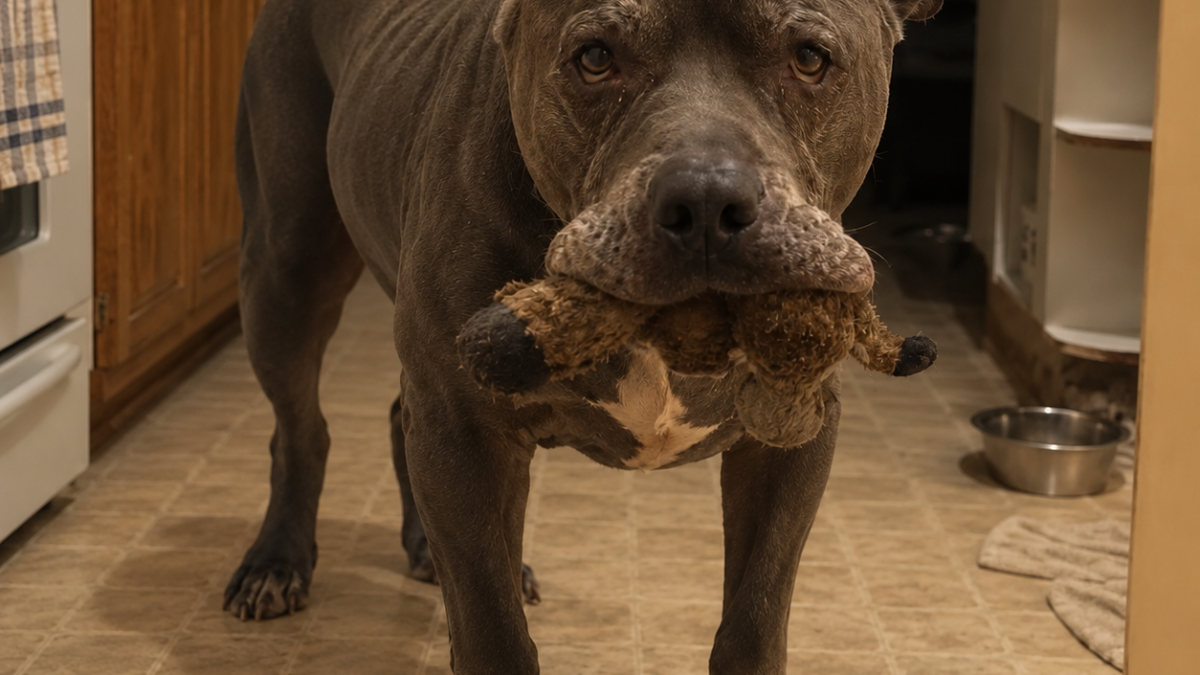
Diesel loved soft toys.
That surprised me.
I had assumed a dog with his jaw strength would destroy anything stuffed in seconds.
The first toy he chose was a faded blue elephant I had bought from a discount bin.
He carried it by one ear.
Everywhere.
Bedroom.
Kitchen.
Hallway.
Sometimes outside until I stopped allowing that after he dropped it in a puddle.
He never tore it open.
Instead, he groomed it.
I would sit on the couch watching a seventy-pound pitbull delicately nibble lint from a stuffed elephant’s ear.
“You know you have a reputation to maintain.”
Diesel ignored me.
The first time he rested his head against my knee happened on day six.
I was sitting on the floor answering work emails.
He approached from behind me.
I saw him in the reflection of my laptop screen.
One step.
Another.
Then his heavy head touched my leg.
I stopped typing.
Three seconds.
Maybe four.
Then I shifted slightly.
Diesel startled and moved away.
I didn’t follow him.
Five minutes later, he came back.
That time, he stayed longer.
By the end of the first week, he had started sleeping in the living room.
Not on the expensive dog bed.
Naturally.
Beside it.
I moved the blanket.
He moved away from the blanket.
I put the blanket back.
Diesel lay beside it.
“Fantastic.”
He looked at me.
“I spent forty dollars on that bed.”
Tail wag.
“Mocking me is unnecessary.”
The first problem with another person happened in the hallway.
My neighbor, Greg, lived two doors down.
He was carrying groceries when Diesel and I came around the corner.
Greg stopped.
Diesel stopped.
I tightened the leash without thinking.
That was a mistake.
Diesel felt it and immediately became more anxious.
Greg looked at him.
“Pitbull?”
“Mix, probably.”
“He friendly?”
“I’m still learning.”
Greg moved closer to the wall.
“My cousin got bit by one.”
There it was.
The kind of story I had heard my whole life.
I felt defensive on Diesel’s behalf before realizing the irony.
A week earlier, I had been Greg.
“I’ll give you space.”
We backed up.
Greg passed.
Diesel never barked.
Never lunged.
He just watched.
Afterward, I realized my hands were sweating.
Not because Diesel had done anything.
Because I had spent the whole encounter waiting for him to prove everyone right.
That bothered me.
At home, I sat beside him.
“Sorry.”
Diesel licked my wrist.
He had no idea what I meant.
Maybe that was good.
Dogs do not care about the categories humans invent for them.
They care about what happens next.
The next person Diesel met was my friend Lauren.
I prepared her like she was entering a wildlife enclosure.
“Don’t reach over his head.”
“Okay.”
“Don’t stare at him.”
“Okay.”
“Let him approach.”
“Okay.”
“Don’t make sudden—”
“Do you want me to come inside or not?”
“Yes.”
Lauren entered.
Diesel disappeared into the bedroom.
We sat in the living room.
Twenty minutes later, his head appeared around the corner.
Lauren ignored him.
Five minutes after that, he approached.
Smelled her shoe.
Retreated.
Returned.
Smelled her hand.
Then, completely without warning, he picked up his stuffed elephant and placed it on her foot.
Lauren looked at me.
“What does this mean?”
“I have no idea.”
“Can I touch him?”
“Wait.”
Diesel pushed the elephant toward her.
Lauren picked it up.
He wagged.
She tossed it about three feet.
Diesel stared at her as if she had misunderstood the assignment.
Apparently the elephant was not for throwing.
Lauren picked it up again.
“Sorry.”
Diesel took it from her gently.
That was their friendship established.
After she left, Lauren texted me.
**That is the least dangerous dangerous dog I’ve ever met.**
I replied:
**He judged your elephant handling.**
By day eight, Diesel had started following me around.
Not constantly.
But enough that I noticed.
If I went to the kitchen, he appeared in the doorway.
Laundry room?
Diesel.
Bathroom?
Diesel waiting outside.
I tripped over him twice.
“You cannot become emotionally dependent on my ankles.”
Tail.
I was becoming emotionally dependent on his presence.
I did not admit that.
Not even to myself.
Especially not to Megan.
Because the rule remained clear.
Two weeks.
Maybe three.
I was fostering.
Fosters leave.
That was the job.
Megan called around day ten.
“How is he?”
“Better.”
“How much better?”
“He comes out of the closet.”
“Good.”
“He likes chicken.”
“Groundbreaking.”
“He met Lauren.”
“How’d that go?”
“He gave her his elephant.”
Megan went quiet.
“What?”
“Nothing.”
“What?”
“That’s attachment behavior.”
“No, it isn’t.”
“Okay.”
“What does ‘okay’ mean?”
“It means okay.”
I should have ended the call.
Instead, I said, “Have you had applications?”
Another pause.
“A few inquiries.”
My stomach tightened unexpectedly.
“Good.”
“You sound thrilled.”
“I am.”
“You don’t.”
“I’m at work.”
That was technically true.
Diesel was under my desk because I had started bringing him to the small office on Saturdays when no one else was there.
“He needs a permanent home,” I said.
“Yes.”
“With space.”
“Maybe.”
“A yard.”
“Not necessarily.”
“Someone experienced.”
“That can help.”
“Definitely someone experienced.”
Megan asked, “Are you trying to convince me or yourself?”
I hung up on her.
Not dramatically.
I said goodbye first.
Still, I resented the question.
That afternoon, Diesel did something that made everything worse.
I developed a migraine.
The kind that begins behind one eye and slowly turns light itself into an attack.
I went home early, closed the curtains, took medication, and lay on the couch.
Diesel paced.
Normally he gave me space when I lay down.
That day he approached.
Smelled my face.
Whined.
“I’m fine.”
He didn’t believe me.
He climbed halfway onto the couch.
Halfway was all that fit comfortably.
Then he placed his head on my chest.
Seventy pounds of anxiety apparently considered himself medical equipment.
I put one hand against his neck.
His breathing slowed.
Mine did too.
For almost two hours, he stayed there.
Every time I moved, he lifted his head.
“You’re terrible at personal boundaries.”
His tail tapped once.
That night, after the migraine faded, I sat in the kitchen looking at him.
Something had changed.
I knew it.
I simply refused to name it.
The next afternoon, we went to a quiet park.
Diesel had begun enjoying walks as long as there weren’t too many people.
He especially liked watching squirrels.
Not chasing them.
Watching.
Like a retired detective convinced they were involved in something.
We were near a bench when a little girl, maybe six, dropped one of her mittens.
It landed a few feet from Diesel.
The girl turned back.
Her mother saw Diesel first.
She immediately grabbed her daughter’s shoulder.
“Wait.”
The word came out sharp.
Diesel flinched.
I shortened the leash.
The mother looked at me.
“Can you move him?”
“Sure.”
Before I could, Diesel picked up the mitten.
My stomach dropped.
Not because he had done anything wrong.
Because I knew what it looked like.
The mother’s body stiffened.
“Diesel.”
He turned toward me.
Then he walked toward the girl.
Slowly.
Mitten held between his front teeth.
His tail wagged.
I held the leash loose enough not to increase tension.
“Drop.”
Diesel had learned that one quickly because of the number of socks he stole.
He placed the mitten on the grass.
The little girl smiled.
“Thank you.”
Her mother still looked uncertain.
“That’s hers,” I said.
“I see.”
Diesel sat.
The little girl asked, “Can I pet him?”
Her mother answered before I could.
“No.”
The child’s face fell.
I wasn’t offended.
A parent had every right to be cautious around a dog she didn’t know.
“Maybe another time,” I said.
We moved away.
Then I heard the mother call.
“Wait.”
I turned.
She looked embarrassed.
“Can she… maybe pet his back?”
I considered Diesel.
Loose body.
Soft eyes.
No stress signs I could see.
“If he comes to her.”
I showed the girl how to stand sideways and let Diesel approach.
He smelled her mitten.
Then her hand.
She stroked his shoulder once.
Diesel’s tail wagged harder.
The mother watched.
“I’m sorry,” she said.
“You don’t need to apologize.”
“I assumed.”
“So did I.”
She looked at me.
That was all we said.
It was enough.
Walking home, I kept thinking about those words.
So did I.
Diesel had spent his life being judged by people who saw his head before his eyes.
And I had done exactly the same thing.
The difference was that I had been given enough time to discover I was wrong.
By the second week, Diesel had developed a morning routine.
My alarm went off.
He stood beside the bed.
I got dressed.
He followed me to the kitchen.
Breakfast.
Walk.
Then, just before I left for work, he would stand in front of me.
Every morning.
I still don’t know how it started.
He would lower his head slightly, and if I crouched, he pressed his forehead against my chest.
No licking.
No jumping.
Just pressure.
Five seconds.
Sometimes ten.
Then he stepped away.
Lauren called it a hug.
I told her not to anthropomorphize.
Then I started waking up ten minutes earlier so I never had to rush through it.
On Thursday of the second week, Megan called.
Her voice was different.
Too cheerful.
“I have good news.”
I already disliked it.
“What?”
“We found Diesel an adopter.”
Silence.
“Hello?”
“I’m here.”
“They’re excellent.”
“Who?”
“A couple named Mark and Jennifer. Late forties. Own their house. Fenced yard. They had a pit mix for eleven years.”
“That sounds good.”
“It’s very good.”
“Where?”
“About forty minutes away.”
“They have other dogs?”
“No.”
“Cats?”
“No.”
“Kids?”
“Their children are grown.”
“Work schedule?”
“Mark works from home three days a week.”
“What do they know about Diesel?”
“Everything we know.”
“Doorways?”
“Yes.”
“Storms?”
“Yes.”
“Noise sensitivity?”
“Yes.”
“Closet?”
Megan paused.
“The closet?”
“Never mind.”
She softened.
“They’re willing to move slowly.”
“That’s good.”
“They’d like to pick him up Sunday.”
Sunday.
Three days away.
I looked down.
Diesel was sleeping across my feet.
His cheek rested on one sneaker.
“When do they meet him?”
“They can meet Saturday first if you want.”
“If I want?”
“You’re his foster.”
Right.
Foster.
Temporary.
I heard myself say, “Sunday is fine.”
After the call, I stayed at the kitchen table for almost twenty minutes.
Diesel woke.
Stretched.
Walked over.
Pressed his head under my hand.
“Congratulations.”
He wagged.
“You’re getting a yard.”
More wagging.
“Experienced people.”
Diesel sat.
“A house.”
He looked at me.
“You’re supposed to be excited.”
He leaned against my leg.
I went to the bathroom and cried.
That embarrassed me.
Not because men or women or anyone else shouldn’t cry over dogs.
Because I had created the situation myself.
I had agreed to foster.
The entire point was to let Diesel go.
I wasn’t losing him.
I was succeeding.
So why did success feel like being punched in the chest?
Friday, I washed his favorite blanket.
Then regretted washing it because it no longer smelled like my apartment.
I slept with it that night like an idiot.
Saturday, I bought a new bag of his food and wrote feeding instructions.
Then rewrote them because the first version sounded too vague.
I listed his commands.
His fears.
His preferred walking route.
The fact that he didn’t like metal bowls touching the wall.
The fact that thunder made him try to climb onto furniture.
The fact that he preferred his elephant to every other toy.
The fact that if he froze in a doorway, pulling made it worse.
The fact that chicken worked better than almost anything.
Lauren came over and found me writing page four.
“You’re making a manual.”
“I’m being responsible.”
“You listed the way he likes his blanket folded.”
“He paws at it otherwise.”
Lauren sat across from me.
“You could keep him.”
“No.”
“Why?”
“My apartment.”
“He lives here.”
“My hours.”
“He manages.”
“I wasn’t planning on a dog.”
“No one asked about your childhood vision board.”
I glared.
“Helpful.”
She looked toward Diesel.
He was asleep beside the couch.
“Do you want him to go?”
“That isn’t the question.”
“It’s the only question you keep refusing to answer.”
“He deserves the best home.”
“Yes.”
“What if that isn’t me?”
Lauren’s expression softened.
“Then letting him go is love too.”
That made me angry because it was fair.
“And if it is me?”
“Then stop pretending the two-week deadline is some kind of law.”
I didn’t sleep much Saturday night.
Diesel did.
At some point, he moved from his usual place outside my bedroom into the room.
I woke around three and found him lying beside the bed.
Not the closet.
He hadn’t slept inside the closet in nearly a week.
I watched him breathe.
Then I looked toward the dark closet doorway.
That space had seemed enormous when he first arrived.
A bunker.
A refuge.
Now it was only a closet again.
Sunday morning came too quickly.
I packed his things.
Food.
Medication for the healing pressure sores.
Leash.
Harness.
Blanket.
Elephant.
The elephant almost broke me.
Diesel watched me put it in a bag.
Then he took it back out.
“Come on.”
He carried it to the living room.
I retrieved it.
He took it out again.
By the third time, I sat on the floor.
“You win.”
Diesel lay beside me with the elephant between his paws.
At eleven, the doorbell rang.
Diesel’s entire body changed.
No barking.
No growling.
He stood abruptly.
Then backed into me.
The doorbell rang again.
His body shook.
“Easy.”
I crouched.
Diesel pushed behind my legs.
Not toward the closet.
Behind me.
His forehead pressed into the back of my knee.
I could feel the tremors through my jeans.
That was the moment.
Not later.
Not after I opened the door.
Right then.
I understood what he thought was happening.
Maybe I was projecting.
Maybe he was only reacting to strangers.
But everything in his body said the same thing I had seen at the shelter:
Please don’t make me go.
I put one hand on his shoulder.
“I’m here.”
The shaking continued.
I opened the door.
Mark and Jennifer stood in the hallway.
They looked kind.
That made it harder.
Jennifer held a new leash.
Mark carried a bag from a pet store.
“Hi,” Jennifer said. “You must be Diesel’s foster.”
I looked down.
Diesel was half hidden behind me.
Jennifer immediately stopped approaching.
“Oh, sweetheart.”
Good instincts.
She crouched sideways.
“Hi, Diesel.”
He didn’t move.
Mark smiled gently.
“We’ve heard a lot about you.”
Diesel pressed harder against my legs.
Jennifer looked at me.
“We can take our time.”
That should have reassured me.
Instead, I heard myself say:
“I’m sorry.”
Both of them looked up.
I swallowed.
“He’s not available anymore.”
Silence.
Mark blinked.
“Oh.”
Jennifer looked from me to Diesel.
Then something in her expression changed.
Understanding.
“You’re adopting him.”
I looked down at the dog trembling against me.
“Yes.”
The word came out before my brain had fully caught up.
“Yes, I am.”
I crouched.
Diesel immediately pushed his blocky head against my chest.
“He’s already home.”
Jennifer smiled.
Not annoyed.
Not angry.
Almost relieved.
“I had a feeling.”
“You did?”
“Megan warned us this might happen.”
I stared at her.
“Megan did what?”
Mark laughed.
“She said, and I quote, ‘Don’t buy the personalized collar until you’re in the car with the dog.’”
I was going to kill Megan.
Jennifer stood.
“We’re disappointed.”
“I’m really sorry.”
“But I’d rather lose an adoption because a foster became permanent than because something went wrong.”
Mark held up the pet-store bag.
“We brought treats.”
I looked at Diesel.
His shaking had started to slow.
Jennifer handed me the bag.
“Keep them.”
“You don’t have to.”
“We already bought them.”
She looked at Diesel.
“Congratulations, big guy.”
His tail moved once.
Then again.
Mark laughed.
“Well, that seems settled.”
They left ten minutes later.
I closed the door.
Diesel stood beside me.
The apartment became quiet.
I looked at him.
“What have you done?”
Tail wag.
“I had plans.”
Diesel sat.
“I had freedom.”
He yawned.
“I had clean furniture.”
He walked to the couch.
Climbed onto it.
Turned three times.
Lay down.
I called Megan.
She answered immediately.
“How did it go?”
“You knew.”
“I suspected.”
“You told them.”
“I prepared them.”
“You manipulated this entire situation.”
“I placed a dog in a foster home.”
“Temporarily.”
“Apparently not.”
I tried to sound angry.
Failed.
Megan asked, “Are you sure?”
That mattered.
The joking stopped.
I looked at Diesel.
He was watching me from the couch.
Not shaking.
Not hiding.
Just watching.
“Yes.”
“Because you can still change your mind. Don’t adopt from guilt.”
“I’m not.”
“Don’t adopt because he panicked at the door.”
“I know.”
“Don’t adopt because you think no one else can care for him.”
“I know.”
“Then why?”
Diesel climbed off the couch and came to me.
He pressed his forehead against my chest.
There was my answer.
“Because I want him here tomorrow.”
Megan was quiet.
“And the day after?”
“Yes.”
“Next year?”
I put one hand around Diesel’s neck.
“Yes.”
“Then fill out the paperwork.”
I adopted him officially three days later.
The shelter employee changed the microchip information.
My name.
My address.
My phone number.
I stared at the screen longer than necessary.
“Something wrong?” she asked.
“No.”
Diesel sat against my leg.
The employee smiled.
“Foster fail?”
“I hate that phrase.”
“You’ll get used to it.”
I didn’t.
But I became one.
Permanent life with Diesel was not magically easy because I loved him.
That is one thing rescue stories sometimes leave out.
Love did not erase trauma.
It did not instantly make him comfortable with loud noises.
It did not fix my schedule.
It did not make my apartment larger.
It did not stop people from judging him.
We had work to do.
The first thunderstorm after his adoption was brutal.
The storm started around midnight.
One crack of thunder hit close enough to shake the windows.
Diesel shot off his bed.
He ran directly into my bedroom.
For one second, he headed toward the closet.
Then stopped.
He looked at me.
Another thunderclap.
Diesel attempted to climb onto my bed.
Seventy pounds landed partly on my ribs.
“Ow.”
He crawled higher.
“Diesel, I need those organs.”
He pressed his head beneath my chin.
The dog everyone imagined as fearless shook against me until the storm passed.
I held him.
The next morning, my back hurt and there was drool on my pillow.
I bought him a thunder shirt.
He looked ridiculous.
It helped.
We worked with a trainer named Natalie who specialized in fearful dogs.
She came to my apartment.
Diesel hid behind me.
Natalie said, “Good.”
“How is hiding good?”
“He chose a person instead of a closet.”
I looked down.
I had not thought of it that way.
She taught me to watch body language.
Lip licking.
Yawning.
Turning away.
Whale eye.
Weight shift.
Things I had previously missed because I thought fear always looked like shaking.
“People wait for growling,” Natalie said.
“Isn’t that the warning?”
“It’s a warning. It’s not always the first one.”
“So what do I do?”
“Listen earlier.”
That lesson extended beyond Diesel.
The more I watched him, the less interested I became in labels.
Fearful.
Aggressive.
Dominant.
Stubborn.
People use words because words feel efficient.
Dogs are not efficient.
Diesel could be afraid of a cardboard box on Tuesday and ignore the same box Wednesday.
He trusted Lauren but hated one particular hat she wore.
He adored the mail carrier but barked at a decorative snowman.
He loved children who moved slowly.
He disliked skateboards.
He feared thunder.
He had no concern whatsoever about vacuum cleaners, which seemed unfair given everything else.
He was an individual.
That should not have been a revelation.
For me, it was.
Greg, the neighbor who had told me his cousin was bitten by a pitbull, remained cautious.
I never pressured him.
Months passed.
Then one evening, I found Greg sitting on the front steps.
His car wouldn’t start.
I offered jumper cables.
Diesel was with me.
Greg looked at him.
“Can he stay over there?”
“Sure.”
I put Diesel inside my car with the windows partly down while we worked.
After the engine started, Greg glanced toward him.
“He always that quiet?”
“Mostly.”
“He doesn’t bark at people?”
“Sometimes.”
Greg nodded.
A few weeks later, he passed us in the hallway.
Instead of pressing against the wall, he stopped.
“What’s his name again?”
“Diesel.”
“Hey, Diesel.”
Diesel wagged.
Greg took one step closer.
“Can I…”
“You can let him smell your hand.”
Greg did.
Diesel sniffed.
Then leaned against his leg.
Greg froze.
“He’s touching me.”
“Yes.”
“Why?”
“He does that.”
Greg scratched his shoulder once.
The following Christmas, Greg gave Diesel a bag of treats.
“Don’t make a thing out of it,” he said.
I didn’t.
Much.
The woman from the park and her daughter appeared in our lives again too.
Her name was Marissa.
Her daughter was Lily.
We ran into them several times.
Lily always asked permission before touching Diesel.
Marissa gradually stopped looking nervous.
One afternoon, she sat beside me while Lily threw a ball for him.
“My brother still thinks I’m crazy for letting her near him.”
I watched Diesel return the ball, then refuse to release it because he enjoyed making Lily negotiate.
“What do you think?”
Marissa smiled.
“I think I was afraid of a dog I hadn’t met.”
I understood that better than she knew.
There were bad moments too.
Once, an unleashed dog rushed us from across a parking lot.
Diesel froze.
I stepped between them and shouted for the owner.
The loose dog barked in Diesel’s face.
Diesel finally barked back.
One deep bark.
The owner ran over and grabbed his dog.
Then looked at Diesel.
“Control your pitbull.”
For several seconds, I couldn’t speak.
“Mine is leashed.”
“He looked aggressive.”
“Your dog ran fifty feet to get in his face.”
The man rolled his eyes.
“Whatever.”
I wanted to argue.
Diesel wanted to leave.
So I left.
That was harder than fighting.
But Natalie had taught me something important.
Protecting Diesel did not always mean proving a point.
Sometimes it meant removing him from people who had already decided what happened.
At home, he drank water and fell asleep.
I remained angry for hours.
Diesel was over it in five minutes.
Another lesson.
The following year, my lease came up for renewal.
The property management company had changed.
A new form required listing pets by breed and weight.
I wrote:
**Diesel — pitbull mix — 74 lbs.**
Two days later, the office called.
“We need to discuss your dog.”
My stomach dropped.
“Why?”
“Our insurer has breed restrictions.”
There it was.
I had heard about those policies.
Now they were in my living room.
Diesel had lived there peacefully for more than a year.
No complaints.
No bite history.
No property damage beyond one baseboard corner during a thunderstorm.
None of that mattered to a checklist.
I appealed.
Provided training records.
Veterinary records.
A letter from the rescue.
A letter from Natalie.
The answer remained no.
I had sixty days.
I sat on the floor beside Diesel.
“Well, congratulations.”
He looked at me.
“You got us evicted.”
Tail wag.
“Technically the insurance company did.”
He placed the elephant on my lap.
I found another apartment.
Ground floor.
Slightly larger.
Small fenced patio.
More expensive.
Diesel loved it.
The first day, he walked through every room.
Then chose the bedroom closet.
I almost laughed.
He stood inside for thirty seconds.
Smelled the walls.
Walked back out.
Never slept there.
That felt like closure I hadn’t known I needed.
Years passed.
Diesel became part of the architecture of my life.
My work changed.
Friends married.
People moved.
My hair collected gray strands.
Diesel’s face collected white ones.
The scars on his elbows faded beneath healthy fur.
His old folded ear stayed folded.
He carried the same stuffed elephant until it became so fragile that I performed multiple amateur surgeries on it with blue thread.
By year four, the elephant had one original leg, half an ear, and very little dignity.
Diesel loved it more than ever.
He never became a social butterfly.
I didn’t need him to.
He liked people he knew.
Ignored most strangers.
Loved Lily.
Loved Lauren.
Tolerated Greg, who had become oddly invested in buying him expensive treats.
He still watched doorways when he entered unfamiliar buildings.
But he walked through them.
That mattered.
One summer afternoon, something fell from the tree in our apartment courtyard.
A tiny bird.
Barely feathered.
Diesel saw it before I did.
He approached.
I immediately said, “Leave it.”
He stopped.
Then he started whining.
Not excited whining.
Distressed.
He looked at me.
Then at the bird.
Then back at me.
The baby bird opened its mouth.
Diesel cried.
Actually cried.
“You’re supposed to be terrifying.”
He whined louder.
I kept him inside while I contacted a wildlife rehabilitator and located the nest.
For the entire hour, Diesel stood at the glass door staring at the place where the bird had fallen.
When I finally returned the chick safely to the nest with guidance from the rehabilitator, Diesel watched from inside.
Only then did he lie down.
I told Megan.
She laughed for nearly a full minute.
“This is the dog nobody wanted to foster?”
“Apparently.”
“Dangerous?”
“Emotionally.”
At some point, the rescue asked if they could use Diesel’s story when recruiting foster homes for older bully-breed dogs.
I hesitated.
Not because I was ashamed.
Because I didn’t want Diesel turned into an argument.
He wasn’t proof that every pitbull was harmless.
No individual dog could prove something that broad.
He was proof of something simpler.
You cannot know an individual animal entirely from a label.
I agreed on one condition.
“Tell the truth.”
Megan asked, “Which part?”
“The fear. The work. The trainer. The apartment problem. All of it.”
“No fairy tale?”
“No.”
So they told his story honestly.
He had trauma.
He required patience.
He needed management.
He was strong.
He was gentle.
He was afraid of thunderstorms.
He adored a stuffed elephant.
He had never bitten anyone.
He had needed someone to meet the dog in front of them instead of the stereotype already in their head.
A few months later, Megan called me.
“You caused a problem.”
“What now?”
“A woman saw Diesel’s story and applied to foster a pit mix.”
“That’s not a problem.”
“She foster failed.”
I laughed.
“Good.”
“She blames you.”
“Fair.”
By the sixth year, Diesel was an old man.
The veterinarian estimated he was thirteen.
His hips stiffened.
We started joint supplements, then anti-inflammatory medication when needed.
Walks became slower.
Lily, now a teenager, stopped throwing the ball far because Diesel still believed he was young enough to sprint even when his legs disagreed.
His muzzle turned almost completely white.
His blocky head somehow looked even larger as the muscles around his temples softened with age.
He slept more.
Snored louder.
Much louder.
The couch became his.
I was permitted to use whatever space remained.
He still followed me to the kitchen.
Still waited outside the bathroom.
Still pressed his forehead to my chest before I left for work.
That ritual never disappeared.
Some mornings it lasted only two seconds because his legs were stiff.
I always waited.
I no longer rushed.
One afternoon, I had another migraine.
Worse than usual.
I came home, closed the curtains, and lay on the couch.
Diesel was asleep across the room.
I didn’t call him.
He woke anyway.
Slowly, he stood.
His hips took a moment.
Then he crossed the room.
He could no longer climb easily onto the couch, so I had built a small padded step.
He used it.
Turned.
Lowered himself beside me.
Then rested his head on my chest exactly as he had years earlier.
I put my hand over the white fur around his muzzle.
“You remember?”
His eyes closed.
Maybe he remembered.
Maybe he simply knew me.
That was enough.
People still reacted to him.
Not everyone.
But enough.
A man once crossed the street when he saw us coming.
Another person pulled a small dog behind her legs.
A father lifted his toddler.
I no longer became angry every time.
People had experiences I didn’t know.
Fears I couldn’t see.
Caution was not cruelty.
What bothered me was certainty.
The certainty that they knew Diesel without meeting him.
I used to have that certainty too.
That fact kept me humble.
Sometimes people surprised me.
One morning, an older man stopped us.
“Beautiful pit.”
“Thanks.”
“May I say hello?”
I checked Diesel.
Relaxed.
Tail loose.
“Sure.”
The man crouched sideways.
Diesel approached.
He scratched beneath Diesel’s chin.
“I had one for fifteen years.”
“What was his name?”
“Roscoe.”
The man smiled.
“Biggest coward I ever met.”
I laughed.
“Thunderstorms?”
“Plastic bags.”
Diesel leaned against him.
For a minute, two strangers stood on a sidewalk discussing dogs everyone else had considered intimidating.
Then we went our separate ways.
Those moments felt more useful than arguments.
The strangest part of six years with Diesel was how completely my original fear had faded.
Sometimes I remembered picking him up from the shelter and felt embarrassed by my own thoughts.
Strong jaws.
Aggressive breed.
Unpredictable.
As if I had been reading a warning label instead of meeting an animal.
I had expected Diesel to prove whether pitbulls were good or bad.
That was the wrong question from the beginning.
Diesel was Diesel.
Fearful.
Affectionate.
Powerful.
Sensitive.
Stubborn about rain.
Patient with children.
Suspicious of balloons.
Gentle with toys.
Terrible at giving people personal space during illness.
Brave enough to leave a closet one night and sleep outside a bedroom door.
That was who he was.
Not a headline.
Not a breed debate.
A dog.
One evening, almost exactly six years after the Sunday I nearly gave him away, I found the old adoption bag in the back of a storage closet.
I had forgotten it existed.
Inside were copies of his original foster papers.
Medication instructions.
The shelter intake photograph.
And a handwritten note Megan had given me the day I picked him up.
I unfolded it.
**Temporary foster: 14–21 days.**
I laughed.
Diesel lifted his head from the couch.
“Remember this?”
He did not.
I sat beside him.
The old intake photograph showed a much thinner dog.
Gray face.
White chest.
Scared eyes.
I looked at Diesel now.
White muzzle.
Healthy weight.
One paw stretched across the couch cushion.
The repaired elephant tucked under his chin.
The contrast hurt in a good way.
I found another paper.
My original foster application.
One question read:
**Are you willing to adopt your foster animal if no suitable placement is found?**
I had checked:
**NO.**
In capital letters.
Apparently I had felt strongly about it.
I showed Diesel.
“This is embarrassing.”
He yawned.
“I was very clear.”
Diesel put one paw on the paper.
“Yes, I see your opinion.”
He shifted closer.
The couch cushion sank beneath him.
Outside, someone walked a dog past the window.
Diesel watched for a second.
Then put his head back down.
I thought about Mark and Jennifer, the couple who had once arrived expecting to take him home.
Megan had stayed in touch with them.
They later adopted another pitbull from the rescue, a brindle female named Ruby.
I had seen pictures.
Big yard.
Dog bed near a fireplace.
Happy ending.
Just not Diesel’s ending.
That mattered to me.
No one had lost for me to keep him.
Another dog got the home they had prepared.
Diesel kept the home he had chosen.
Sometimes I wondered what would have happened if I had forced myself to follow the original plan.
Mark and Jennifer probably would have loved him.
He probably would have adapted eventually.
He might have had a wonderful life.
That was important to admit.
I wasn’t the only human capable of saving Diesel.
Love becomes unhealthy when we turn ourselves into the only possible answer.
I kept him because I wanted the responsibility, and because his needs fit the life I was willing to build.
Not because no one else could.
That distinction took me years to understand.
Diesel shifted in his sleep.
His paws moved.
Dreaming.
Six years earlier, when he first slept beside me, his whole body used to twitch violently.
Sometimes he woke himself.
Sometimes he woke me.
The dreams gradually changed.
Or at least his body did.
Now his legs moved gently, as though he were running somewhere.
No whimpering.
No shaking.
Just sleep.
I rubbed his shoulder.
He opened one eye.
“Sorry.”
The eye closed.
I left my hand there.
The scarred ear.
The white muzzle.
The huge square head strangers noticed first.
There had been a time when I saw those features and thought danger.
Now they meant home.
That night, a storm rolled in.
Rain struck the windows.
A low rumble sounded far away.
Diesel lifted his head.
I looked at him.
“You heard it.”
Another rumble.
His ears lowered.
Even after six years, storms still frightened him.
Some things heal.
Some things simply become manageable.
I opened my arms.
“Come on.”
Diesel stood slowly.
Used the little step.
Climbed half into my lap despite being far too large.
He pressed his head beneath my chin.
I wrapped one arm around him.
Thunder cracked.
His body tensed.
Then relaxed against me.
“Still scary?”
His breathing was fast.
I rubbed his chest.
“You know the routine.”
Rain continued.
The apartment lights flickered.
Diesel stayed.
He wasn’t the dog shaking alone in a shelter kennel anymore.
He wasn’t the dog chained behind a tire shop.
He wasn’t the dog hiding behind my shoes.
He was afraid.
But he was afraid somewhere safe.
There is a difference.
Eventually the storm moved farther away.
Diesel’s breathing slowed.
Then the snoring started.
Loud.
Ridiculous.
I reached for the bowl of popcorn on the table.
His eyes opened immediately.
“Absolutely not.”
His nose moved.
“You have your own treats.”
Stare.
“This is mine.”
Stronger stare.
I ate one piece.
Diesel sighed dramatically.
“You survived abandonment, dehydration, prejudice, thunderstorms, and six years with me. You can survive not getting popcorn.”
He placed one paw on my leg.
I gave him a tiny piece.
I am weak.
Megan has said so repeatedly.
Later that evening, I found myself looking at his old foster paperwork again.
Two weeks.
Maybe three.
That was the agreement.
I had believed I was making room for a dog until someone better came along.
What I hadn’t understood was that Diesel was making room too.
First enough room to leave the closet.
Then enough to sleep outside my door.
Enough to lean against my knee.
Enough to trust Lauren with the elephant.
Enough to approach a child.
Enough to press himself against me when strangers came to take him away.
Trust had never arrived all at once.
It came in tiny installments.
I think that is why losing my assumptions took time too.
No dramatic revelation turned me into a different person.
I simply spent day after day with the dog I had been taught to fear.
And eventually the stereotype became impossible to maintain in the presence of reality.
Before bed, Diesel slowly got off the couch.
He picked up the stuffed elephant.
Still gentle after all those years.
He followed me down the hallway.
The bedroom closet door was open.
Diesel paused near it.
For a second, I saw the frightened dog from that first night.
Curled behind the shoes.
Trying to become smaller than his own body.
Diesel glanced inside.
Then kept walking.
He climbed onto his bed beside mine, turned twice, and lowered himself with an old-dog sigh.
I switched off the light.
A few seconds later, his tail tapped the floor once.
The exact sound I had heard on the fourth night.
Soft.
Almost nothing.
Back then, one tail tap had felt like a miracle.
Now it was simply part of home.
I reached down and rested my hand on his head.
“Good night, Diesel.”
He sighed.
Six years earlier, I thought I was temporarily sheltering a dangerous dog nobody wanted.
I had been wrong about almost every important word in that sentence.
He wasn’t dangerous.
He wasn’t unwanted.
And he was never temporary.
And he was never temporary.
For a long time after that, I thought the hardest part of loving Diesel had already happened.
I thought getting him out of the closet had been the challenge.
Teaching him that doors didn’t always slam behind him.
Showing him that raised voices weren’t automatically followed by pain.
Helping him understand that when I left for work, I would eventually come back.
I thought once a frightened dog finally trusted you, the rest was easy.
I was wrong.
Trust was only the beginning.
The harder part was realizing that loving an animal meant eventually watching time begin to take back everything you had fought so hard to give him.
The first sign was small.
Diesel stopped jumping onto the couch.
For years, he had launched himself onto it without hesitation, usually taking up three cushions even though there were only two available.
Then one evening, he stood beside the couch and stared at it.
I was eating dinner.
“What?”
He looked at me.
Then at the couch.
Then back at me.
“Seriously?”
His tail moved once.
I got up and helped lift his back end.
The moment he was settled, he sighed as if this had been my responsibility all along.
I laughed.
“You could at least pretend to be grateful.”
He put his head on my leg.
That became the new routine.
A week later, I bought a padded ramp.
Diesel refused to use it.
Of course.
I put chicken along the ramp.
He ate the first piece.
Then stepped around the entire thing and stared at me.
“You understand exactly what I’m trying to do.”
Tail wag.
“You’re being difficult on purpose.”
He looked at the chicken.
Eventually, with enough bribery, he learned.
The ramp became normal.
Then rugs went down across the hardwood because his back feet occasionally slipped.
Then a raised water bowl.
Then shorter walks.
Nothing dramatic.
Just small accommodations appearing around the apartment until one day I realized my entire home had quietly reorganized itself around an aging dog.
I didn’t mind.
Diesel had reorganized much more than my furniture.
He had changed the way I noticed animals.
Before him, I saw breeds.
Sizes.
Warnings.
Now I saw posture.
Eyes.
Distance.
Fear.
Curiosity.
The dog behind the label.
That became obvious when Megan called one afternoon.
“Do you remember Mark and Jennifer?”
“The couple who almost stole my dog?”
“They did not steal your dog.”
“They arrived with a leash.”
“Because they were supposed to adopt him.”
“Details.”
She laughed.
“They lost Ruby.”
I sat straighter.
“The brindle dog?”
“Yes.”
“What happened?”
“Cancer.”
I looked at Diesel sleeping beside the patio door.
“How old?”
“Eleven.”
“That’s not fair.”
“No.”
Megan paused.
“They’re fostering again.”
I smiled despite myself.
“Another pit?”
“Older female. Eleven years old. Arthritis. Nobody wanted to take her.”
“Sounds familiar.”
“Exactly.”
A few months later, I met them at a rescue fundraiser.
Mark recognized me immediately.
“There’s the guy who stole our dog.”
I stared at him.
Jennifer started laughing.
“You’ve been waiting six years to say that.”
“Absolutely.”
Diesel was with me.
Older now.
White face.
Slow walk.
Mark crouched.
Diesel smelled his hand.
Then leaned against him.
Mark looked up.
“Well, great. Now I’m offended all over again.”
Jennifer scratched Diesel’s chest.
“He looks happy.”
“He is.”
“You made the right call.”
I glanced at her.
“You really think so?”
“I did then too.”
She nodded toward a senior brown pit mix lying beneath their table.
“That’s Mabel.”
Mabel looked at Diesel.
Diesel looked at Mabel.
Neither cared enough to move.
“Love at first sight,” Mark said.
Senior dogs have no time for nonsense.
We spent most of the afternoon talking.
Not about breeds.
Not about rescue philosophy.
Mostly medication schedules, joint supplements, and the strange amount of money people willingly spend on orthopedic dog beds.
Before leaving, Jennifer said something I remembered later.
“Old dogs are dangerous.”
I raised an eyebrow.
“Dangerous?”
“They break your heart in advance.”
She looked down at Mabel.
“You start grieving while they’re still standing beside you.”
At the time, I thought she was being overly sentimental.
Two years later, I understood exactly what she meant.
Diesel started having trouble getting up in the mornings.
Not every morning.
At first, only after cold nights.
He would push his front half up, then pause before his hips followed.
The veterinarian diagnosed arthritis.
Expected at his age.
Medication helped.
So did weight management.
Diesel considered weight management a human-rights violation.
I measured his food.
He stared at the cup.
“That is the correct amount.”
Stare.
“You are not starving.”
He walked to the cabinet containing treats.
“No.”
He looked at the cabinet.
Then me.
“No.”
He sat.
“This is emotional blackmail.”
Tail.
I gave him half a treat.
Failure.
But aging continued anyway.
One winter morning, we were walking our usual route when Diesel stopped.
Not because of fear.
Not because of a doorway.
He simply stopped.
I turned.
“You okay?”
He looked back toward home.
That scared me.
Diesel had always loved walks.
Even during his fearful years, once we got outside, he wanted to explore.
Now he turned around.
So we went home.
The next day, he walked farther.
The day after that, less.
I learned to let him choose.
If he reached the end of the block and turned, that was enough.
If he wanted the park, we went.
If all he wanted was to stand beneath the tree outside our building and smell the air for ten minutes, that counted as a walk too.
The goal had changed.
Exercise mattered.
But enjoyment mattered more.
Lily understood before I did.
She was seventeen by then.
She visited one afternoon and found Diesel sleeping near the patio door.
“He’s really old.”
I bristled automatically.
“He’s fine.”
She looked at me.
I hated that look.
Gentle.
Understanding.
The look people use when they know you’re lying mostly to yourself.
“I know,” she said.
Diesel woke when he heard her voice.
His tail started thumping.
Lily sat on the floor.
“Hey, buddy.”
He struggled to stand.
She immediately moved closer.
“You don’t have to.”
Diesel stood anyway.
Walked toward her.
Pressed his forehead against her chest.
Lily wrapped both arms around his neck.
That had once been our goodbye ritual.
Now he did it with a few people he trusted deeply.
She started crying.
I looked away.
“What?”
“He remembers me.”
“Of course he remembers you.”
“I was six.”
“You fed him half your grilled cheese every time your mother looked away.”
“That probably helped.”
Diesel sat beside her.
Lily stroked his white muzzle.
“Mom used to be terrified of him.”
“I remember.”
“She tells everybody now that Diesel taught her not to judge dogs.”
I smiled.
“He taught me first.”
Lily looked surprised.
“You were scared of him?”
“Very.”
“Seriously?”
“I almost said no to fostering him because he was a pitbull.”
She looked down at Diesel.
“He was scared of you too.”
“That’s the funny part.”
Maybe not funny.
But true.
We had met carrying fear toward each other.
Only one of us had been given a stereotype to justify it.
Diesel had simply been afraid because people had hurt him.
I had been afraid because other people told me what he might be.
I thought about that more as he aged.
Especially when strangers still crossed the street.
I no longer wanted to correct everyone.
I knew caution around unfamiliar dogs was reasonable.
But sometimes someone would stop.
See the gray face.
Ask politely.
“Can I pet him?”
If Diesel seemed comfortable, I said yes.
He usually leaned into their legs.
One afternoon, a man in work boots stopped us.
“Old pit?”
“Very.”
The man crouched.
“My girl looked just like him.”
“What was her name?”
“Sadie.”
“When did you lose her?”
“Three years.”
He scratched Diesel’s shoulder.
“Still miss her.”
Diesel rested his head against the man’s knee.
For a few seconds, the man said nothing.
Then he stood.
“Thanks.”
I understood.
Diesel had become something he never could have been when I first met him.
Safe enough to hold other people’s grief.
That felt enormous.
The health problems started piling up slowly.
First arthritis.
Then a benign fatty lump near his ribs.
Then dental work.
Then one morning the veterinarian heard a heart murmur.
I felt the floor move beneath me.
“Heart murmur?”
“Low grade.”
“What does low grade mean?”
“It means we monitor.”
“Medication?”
“Not yet.”
“Heart failure?”
“No.”
“Could it become heart failure?”
The veterinarian smiled gently.
“You’re doing the thing.”
“What thing?”
“Jumping twelve steps ahead.”
I stopped.
Diesel was sitting beside me, trying to lick the metal exam table.
“What do I do now?”
“Today?”
“Yes.”
“Go home.”
“That’s it?”
“Feed him dinner. Take his walk. Let him be a dog.”
That advice became more important every year.
Because once you know time is limited, there is a temptation to turn every day into preparation for losing them.
You watch breathing.
Count steps.
Study appetite.
Examine gums.
Research symptoms at two in the morning until every normal behavior becomes evidence of catastrophe.
I did all of it.
Then one evening, I caught myself staring at Diesel while he slept.
Not enjoying him.
Monitoring him.
He opened one eye.
I realized how unfair that was.
He was still here.
I was already grieving a dog who was alive beside me.
Jennifer had been right.
Old dogs break your heart in advance if you let them.
So I tried to stop.
Not stop caring.
Stop rehearsing the ending.
We went to the park.
Short visits.
Diesel no longer chased anything.
He liked sitting under a tree watching people.
Sometimes Lily joined us.
Sometimes Lauren.
Greg occasionally came down with coffee.
Yes.
Greg.
The neighbor who once moved against the wall when we passed.
He had become one of Diesel’s favorite people.
One afternoon he sat beside us and fed Diesel tiny pieces of chicken.
“You know,” Greg said, “I used to think you were crazy bringing him into the building.”
“I know.”
“I was afraid he’d hurt somebody.”
“I know.”
Greg looked at Diesel.
“He never did.”
“No.”
“Meanwhile, my sister’s twelve-pound terrier bit the mailman.”
I laughed.
Diesel looked up at the mention of mail.
“Don’t get smug.”
Greg scratched behind his folded ear.
“I’m going to miss this dog.”
The words landed harder than Greg intended.
Diesel was still alive.
But Greg had said it naturally.
Because everyone could see.
We were approaching something.
A few months later, Diesel stopped eating breakfast.
Not completely.
Just one morning.
He sniffed the bowl and walked away.
I panicked.
By noon, he ate chicken.
By evening, normal food.
The next day, breakfast again.
I told myself it was nothing.
Then it happened twice the following week.
Bloodwork showed kidney values beginning to rise.
“Early disease,” the veterinarian said.
“Can we treat it?”
“Manage it.”
Different word.
I hated it.
Diet change.
More water.
Monitoring.
Diesel hated the prescription food.
Naturally.
We tried three brands.
He rejected all three with the dedication of a restaurant critic.
Finally we found one he tolerated if I mixed in a spoonful of wet food.
Life stabilized again.
For almost another year.
Diesel was probably fifteen when his body began losing the argument.
No one knew his exact age.
That seemed appropriate.
He had entered my life without a history.
He would leave with one we had built ourselves.
His back legs weakened.
I bought a support harness.
He accepted it after trying to eat one strap.
We added another ramp.
Then a bed in the living room because walking to the bedroom at night became difficult.
The first evening he slept there, I lasted approximately twenty minutes.
Then I dragged a blanket onto the floor beside him.
At two in the morning, I woke with my neck bent at an impossible angle.
Diesel’s head was resting against my shoulder.
“You realize you have three orthopedic beds.”
He snored.
“This is ridiculous.”
Still snoring.
I stayed.
That became our arrangement during his final months.
Some nights bedroom.
Some nights living room.
Wherever Diesel wanted to sleep, I slept nearby.
Not because he demanded it.
Because I did.
Megan visited.
She hadn’t seen him in several months.
The moment she walked in, Diesel tried to stand.
His legs slipped.
She dropped to the floor.
“No, no, stay.”
His tail hammered the bed.
Megan’s face collapsed.
“Oh, Diesel.”
She hugged him carefully.
I went to the kitchen.
Not to give them privacy.
Because I was about to cry.
Megan found me a few minutes later.
“He looks good.”
“He looks old.”
“Both can be true.”
I stared at the sink.
“How do you know?”
“Know what?”
“When it’s time.”
She didn’t answer immediately.
“I usually ask three things.”
“What?”
“Is he comfortable most of the day? Does he still enjoy things? Are the bad days starting to outnumber the good?”
“He still eats.”
“Good.”
“He likes seeing people.”
“Good.”
“He still wants his elephant.”
“Very good.”
I looked toward the living room.
Diesel had somehow dragged the mangled elephant beneath his chin.
“So not yet.”
Megan shook her head.
“Not from what I see.”
I exhaled.
Then she added, “But promise me you won’t make him prove how much pain he can tolerate just because you’re scared.”
I looked at her.
“That’s harsh.”
“I know.”
It was also exactly what I needed to hear.
Diesel had spent enough of his life enduring things.
He didn’t owe me endurance at the end.
That winter was cold.
His arthritis worsened despite medication.
We stopped walking farther than the courtyard.
Lily came home from college for Christmas.
She brought Diesel a new stuffed elephant.
He smelled it.
Then looked toward his old one.
Lily laughed.
“Rejected.”
“He’s loyal.”
The old elephant had barely survived fifteen surgeries.
Lily placed the new one beside it.
Diesel eventually used it as a pillow.
Progress.
On Christmas morning, he sat beside us while we opened presents.
Greg came down.
Lauren brought food.
Marissa and Lily stopped by.
At one point I looked around my living room and realized nearly every person there had met because of Diesel.
Not directly in every case.
But he had become a center point.
The dog nobody wanted to foster.
The supposedly intimidating dog.
The temporary problem.
He had built a community without doing anything more complicated than trusting people one at a time.
The end came in early spring.
No dramatic emergency.
No accident.
Just a morning when Diesel could not stand.
I found him awake on his bed.
He tried when he saw me.
Front legs up.
Back legs failed.
He fell.
His eyes met mine.
I helped him with the harness.
He stood for maybe thirty seconds.
Then sank again.
He refused breakfast.
Even chicken.
That was when I knew.
I called the veterinarian.
She came to the apartment in the afternoon.
Diesel liked her, which helped.
She examined him on his bed.
Listened to his heart.
Checked his joints.
His gums.
His breathing.
Then we sat at the kitchen table.
“He’s tired.”
“I know.”
“We can adjust pain medication again.”
“Will that get him walking?”
“Probably not.”
“Eating?”
“Maybe temporarily.”
“Comfort?”
“Some.”
I looked toward the living room.
Diesel was asleep.
His elephant under one paw.
“What would you do?”
The veterinarian sighed.
“I can’t make that decision for you.”
“I know.”
“But if he were mine?”
I waited.
“I’d rather choose a peaceful day now than wait for a crisis tonight.”
The sentence hurt.
Because I knew she was right.
I called Megan.
Then Lauren.
Then Lily.
I didn’t call everyone.
Diesel didn’t need a parade.
He needed calm.
Lily arrived first.
She knelt beside him.
“Hey, old man.”
His tail moved.
Barely.
She cried immediately.
Diesel lifted his head and pressed his forehead against her chest.
The same gesture.
After all those years.
She hugged him.
“You remember me.”
Of course he did.
Lauren came next.
She brought nothing.
Good.
She sat beside Diesel and placed the old elephant between his paws.
“You still owe me an apology for judging my throwing technique.”
Diesel sighed.
Greg stood in the doorway for a long time before entering.
He wiped his face.
“I’m not doing this.”
I looked at him.
“You came downstairs.”
“That was my mistake.”
Diesel wagged.
Greg sat on the floor.
“I was wrong about you, buddy.”
Diesel licked his hand.
Greg cried harder.
Eventually everyone left except me.
That was intentional.
The veterinarian returned in the evening.
I opened the patio door.
Warm air came inside.
Diesel liked sitting there when the weather was good.
I helped him onto his bed near the doorway.
He could smell grass.
Hear birds.
The apartment was quiet.
I sat beside him.
The closet door in my bedroom was open down the hall.
I could see part of it from where I sat.
For some reason, I kept looking at that doorway.
The first night.
Diesel hiding behind shoes.
The fourth night.
Diesel sleeping outside my room.
Sunday.
Diesel shaking behind my legs.
Six years becoming seven.
Seven becoming eight.
A whole life built from tiny decisions.
The veterinarian prepared the sedative.
“Ready?”
“No.”
She waited.
I stroked Diesel’s head.
His eyes were open.
Calm.
I bent close.
“You remember when I said two weeks?”
His tail moved once.
“You really ruined that plan.”
Another tiny movement.
I laughed through tears.
“You ruined a lot of things.”
My furniture.
My schedule.
My idea of myself.
My certainty about dogs like him.
My belief that temporary relationships stay temporary simply because we label them that way.
Diesel rested his forehead against my chest one last time.
I wrapped both arms around him.
“There it is.”
The goodbye hug.
Same as every morning.
Except this time I wasn’t leaving.
The sedative went in.
Diesel relaxed slowly.
His breathing softened.
I kept one hand over his chest.
The veterinarian waited.
I whispered, “You don’t have to be scared anymore.”
I realized as I said it that Diesel had not been scared for a long time.
Not in the way he once was.
Thunderstorms, yes.
Balloons, definitely.
Occasional doorways.
But not people he loved.
Not home.
Not me.
That was enough.
I nodded.
The final medication entered the line.
Diesel exhaled.
His body became completely still.
His head remained against my arm.
The apartment had never been so quiet.
I sat there a long time.
Then I looked toward the hallway.
The bedroom closet waited open.
Empty.
For the first time since Diesel came home, I understood what that closet really represented.
Not where he had started.
How far he had traveled.
A dog entered it because he believed hiding was the safest thing he could do.
Years later, he left this world in the middle of the living room, beside an open door, with his whole body exposed and his head in the arms of someone he trusted.
There was no safer ending I could have given him.
A week later, I finally cleaned beneath the couch.
I found hair.
Three tennis balls.
One ancient treat.
And a piece of blue fabric.
Part of the elephant’s original ear.
I sat on the floor holding it.
Then I laughed.
Actually laughed.
Not because I wasn’t grieving.
Because Diesel had somehow left evidence of himself everywhere.
Greg knocked later that afternoon.
He held a small wooden box.
“What’s that?”
“My cousin makes these.”
He handed it over.
Inside was a simple engraved plate:
DIESEL
ALREADY HOME
I couldn’t speak.
Greg stared at the wall.
“I remembered what you said when those people came to adopt him.”
“You weren’t there.”
“Lauren told me.”
“Of course she did.”
Greg cleared his throat.
“Thought maybe you’d want it.”
I placed the box near the patio door.
Beside Diesel’s collar.
Not his old shelter photograph.
Not a picture of him chained behind the tire shop.
I chose a photo Lily had taken years later.
Diesel asleep on my couch.
White muzzle beginning.
Elephant beneath his chin.
Completely unguarded.
That was the dog I wanted remembered.
Not the dog people feared.
Not the dog someone abandoned.
Not even the dog I rescued.
Diesel.
Just Diesel.
Months later, Megan called.
“I have a problem.”
“No.”
“You don’t even know what it is.”
“I know you.”
She laughed.
“There’s an older pit mix.”
“No.”
“Ten years old.”
“Megan.”
“Quiet.”
“No.”
“Scared of men.”
“I’m hanging up.”
“Temporary foster.”
I looked at Diesel’s wooden box.
Then toward the bedroom closet.
I could almost hear Megan smiling.
“Two weeks,” she said.
I laughed.
“Absolutely not.”
She waited.
I sighed.
“What color?”
[END OF STORY]








