PART 2: HOA Tried to Turn My Beachfront Property Into Their Public Access Trail—Then Their Own Records Exposed Why They Needed My Land
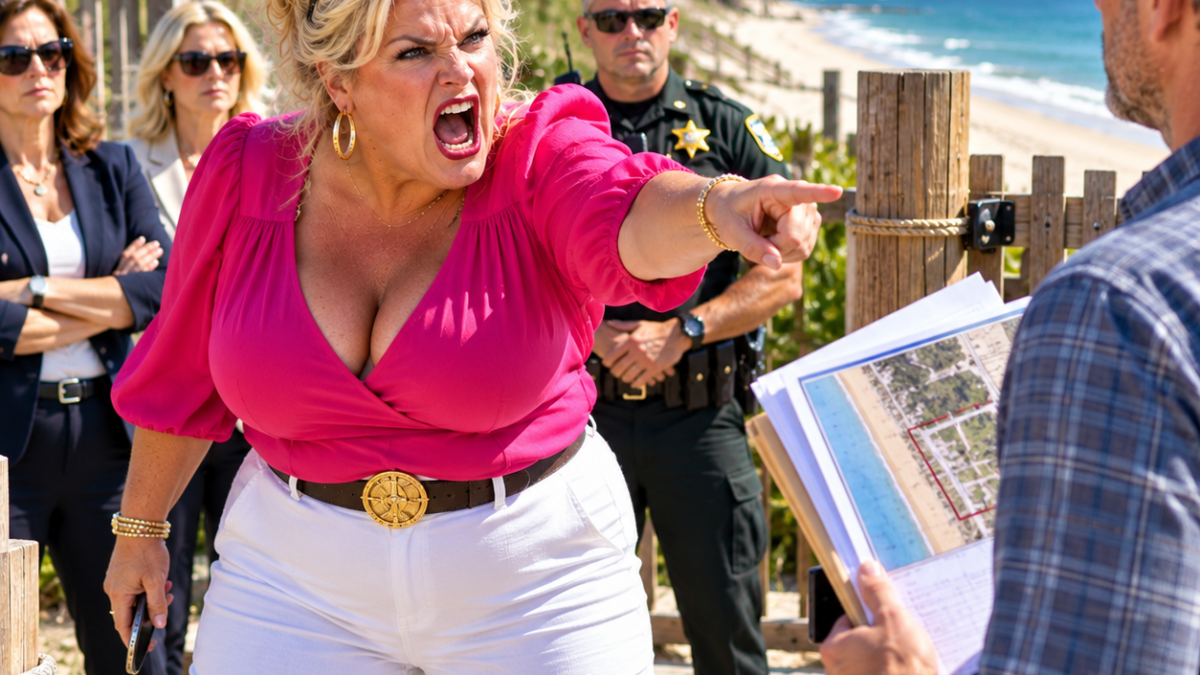
PART 2
Her smile disappeared.
She turned and walked back to the Lexus.
I told the crew to keep working.
At the time, I honestly thought that would be the end of it.
An HOA president complains.
I show the deed.
She talks to a lawyer.
Lawyer tells her she has no authority.
Everybody moves on.
Instead, the next morning, orange spray paint appeared along the edge of my lot.
A straight line.
Beginning at the road.
Running toward the dunes.
At the start of it was a wooden stake.
Attached to the stake:
**FUTURE ACCESS PATH — SEABREEZE SHORES HOA**
I stood there holding my coffee while the wind lifted the corner of the paper.
No permit number.
No county seal.
No surveyor information.
Nothing.
I pulled the stake out.
Tossed it into my truck.
Photographed every spray mark.
Two days later, I arrived to find a chain stretched across my driveway.
A laminated sign hung from it.
**CEASE CONSTRUCTION UNTIL PUBLIC ACCESS DISPUTE IS RESOLVED**
Signed:
**Priscilla Marlo, HOA President**
My crew wasn’t there.
I called the foreman.
“You guys coming?”
“We were there.”
“What happened?”
“Some lady said the site was under legal stop-work.”
“Was there a county inspector?”
“No.”
“Sheriff?”
“No.”
“Building department?”
“No.”
“Then why’d you leave?”
There was a pause.
“Boss, she had paperwork. Said we could get cited if we continued.”
I closed my eyes.
“How many guys?”
“Six.”
“How much did we lose?”
“Day and a half already.”
“Come back Monday.”
“I’ll have to move another job.”
“I know.”
That delay cost me four working days and a rescheduling premium.
That was the moment Priscilla stopped being annoying and became expensive.
I called the sheriff.
Deputy Collier arrived forty minutes later.
He examined the chain.
Read the notice.
Then looked at me.
“HOA owns this?”
“No.”
“You in the HOA?”
“No.”
“Any recorded easement?”
“No.”
“County stop-work order?”
“No.”
He shook his head.
“They can’t close your property.”
“Can you cut it?”
“It’s your chain now as far as I’m concerned.”
We cut it.
He photographed everything for the report.
“This is probably civil unless someone keeps physically interfering.”
“She already caused a work stoppage.”
“Document the loss.”
“I will.”
He handed me a case number.
“And Mr. Zayn?”
“Yeah?”
“If they put another chain up, call us before cutting it.”
“Why?”
“Because the second time gets more interesting.”
That night, I started digging.
Seabreeze Shores had lost its primary beach-access route five years earlier after a major storm chewed away part of the public trail and damaged a small boardwalk.
The county refused to rebuild it where the HOA wanted.
Too much erosion.
Too much dune impact.
Too much money.
Instead of accepting that, the board began looking for alternate routes.
Private lots.
Vacant parcels.
Unoccupied strips.
Historical paths.
Anything that could be turned into access through pressure.
I found an old county complaint involving a retired veteran named Hal Mercer who had owned land two streets over.
Seabreeze Shores claimed residents had historically crossed a corner of his parcel.
He fought for almost a year.
Then sold below market.
The buyer granted a narrow easement to a company connected to the subdivision.
That got my attention.
I called Marcus Reed.
Marcus had handled property matters for me before.
Quiet man.
No theatrics.
If you walked into his office angry, he made you wait until you could talk like a person.
I put the HOA demand on his desk.
He read it once.
“Prescriptive easement.”
“They haven’t officially used those words yet.”
“They will.”
“What do they have?”
“Maybe nothing.”
“Maybe?”
He looked at me.
“Never say nothing until you’ve checked.”
We checked.
No recorded easement.
No pending legal action.
No county dedication.
No public right-of-way.
No recorded access covenant.
The deed from the county was clean.
Marcus leaned back.
“They’re fishing.”
“So I build?”
“You build.”
“And if they keep interfering?”
“Document.”
“Already doing that.”
“More.”
That afternoon, I installed cameras.
One facing the old shortcut.
One facing the rear section of the site.
One covering the drive.
Motion activated.
Cloud backup.
Visible enough that nobody could claim surprise.
They paid for themselves in less than forty-eight hours.
Friday morning, my foreman called at 7:32.
“We’ve got a problem.”
“What now?”
“Equipment.”
“What about it?”
“Get down here.”
I drove straight over.
Orange paint covered one side of the backhoe.
The portable toilet lay on its side.
Two stacked bundles of lumber had been pulled apart.
Nothing catastrophic.
Enough to delay us.
We reviewed the cameras.
2:03 a.m.
Three teenagers entered from the Seabreeze side.
Backpacks.
Hoodies.
One shook a spray can.
Another pushed against the portable toilet until it tipped.
The third filmed everything on his phone.
They were laughing.
Seventeen years old, maybe younger.
I gave the footage to Deputy Collier.
He paused on one frame.
“I know that kid.”
“Good.”
“Mother’s on your HOA board.”
That was when I learned Dana Dorsey’s name.
She arrived at the sheriff’s office angry.
Not at her son.
At me.
“These are children.”
“One of your children damaged commercial equipment.”
“It was harmless.”
“My construction site isn’t a playground.”
“You really want to ruin a kid’s life over spray paint?”
“No. I want people to stop coming onto land they’ve been told is private.”
She stared at me.
“You brought this on yourself.”
Deputy Collier looked up.
“Ma’am.”
“What?”
“You might want to stop talking.”
She did.
Barely.
Marcus filed for an injunction.
We had the chain.
The signs.
The spray paint.
The cameras.
The trespassing.
The judge issued an order prohibiting Seabreeze Shores HOA and anyone acting on its behalf from entering, altering, posting signage on, or otherwise interfering with my property pending the dispute.
I thought the court order would force rational behavior.
Then the county code letter arrived.
**COASTAL VEGETATION PRESERVATION REVIEW**
Construction temporarily flagged.
Anonymous complaint.
Allegation:
Protected dune vegetation removal.
I drove to county offices.
The clerk handed me the file.
“Complaint includes aerial photographs.”
“Drone?”
“Looks like.”
The photos were clear.
They showed brush removed near the construction footprint.
Whoever submitted them had circled areas in red.
Protected vegetation destroyed.
That was the accusation.
Except I knew the plant.
Ice plant.
Invasive.
The county itself encouraged removal in some management areas.
The coastal inspector, Darren Shaw, came out the following morning.
He crouched beside what remained.
Broke off a section.
Looked at it.
Then at me.
“Ice plant.”
“I know.”
He smiled.
“You want me to pretend this is complicated?”
“Please don’t.”
He photographed it.
“This complaint’s garbage.”
“Can you put that in writing?”
“I intend to.”
He looked toward the nearest houses.
“Someone really wants your project stopped.”
“They’ve been trying.”
“Keep your paperwork.”
“I do.”
“You engineers always do.”
He wasn’t wrong.
The complaint was closed.
One week later, my cameras caught Priscilla standing near the public street with a laser range finder.
Measuring.
Setback from the road.
Setback from the dune.
Distance from construction to the old shortcut.
I watched the footage three times.
The next afternoon, I saw her parked nearby.
I walked over.
“Lose something?”
She didn’t look up.
“Verifying setback compliance.”
“You’re not county code.”
“Someone has to protect neighborhood standards.”
“This isn’t your neighborhood.”
“You keep saying that.”
“Because you keep forgetting.”
She gestured toward the street.
“I’m on public property.”
“You are.”
I raised my phone.
“And now you’re being recorded from public property.”
Her eyes narrowed.
“Is that supposed to intimidate me?”
“No.”
I moved closer.
“The county also knows about the anonymous drone complaint.”
A pause.
One blink.
Tiny.
But there.
“You think you’re clever.”
“I think I know ice plant when I see it.”
Her mouth tightened.
“We’ll see what the environmental board says.”
“They already did.”
“Historical society.”
“About what?”
“Generational access.”
“There is no easement.”
“The media may see it differently.”
That was the first time she said the quiet part out loud.
Law wasn’t enough.
So she would try shame.
She wanted the story to become:
Rich outsider buys beachfront property and blocks families from ocean.
Not:
Private landowner refuses to donate property because HOA lost a different trail.
I understood immediately.
If public pressure got loud enough, maybe the county would negotiate.
Maybe politicians would panic.
Maybe I would sell an easement simply to stop being hated.
Marcus agreed.
“Expect social-media posts.”
“They’ve probably started.”
“They have.”
He turned his monitor.
A local neighborhood group.
**SAVE OUR BEACH ACCESS**
A photograph of my construction site.
Caption:
**Developer blocks historic community path.**
Developer.
I laughed.
“One house makes me a developer?”
“People like simple villains.”
“What do we do?”
“Facts.”
That weekend, I invited several neighbors who lived outside Seabreeze Shores.
Lee Jackson owned the surf shop near the highway.
Maria Torres lived on the adjacent street.
Two other property owners came.
We grilled burgers beside a construction trailer.
No speeches.
Just conversation.
Lee listened to the story.
Then almost dropped his beer.
“They pulled this with Hal.”
“The retired veteran?”
“You know?”
“I found the county case.”
Lee shook his head.
“They made his life hell.”
“How?”
“Complaints. Code calls. Trash near his fence. People walking through anyway.”
“He sold.”
“Cheap.”
Maria nodded.
“They wanted this area for a boardwalk years ago.”
“Did they have approval?”
“No.”
“Plans?”
“Concept sketches.”
“Permits?”
“No.”
“What did they tell residents?”
“That expansion was coming.”
I looked toward Seabreeze Shores.
“Would either of you put that in a statement?”
Lee answered immediately.
“Yes.”
Maria too.
Marcus drafted affidavits.
We filed an ethics complaint regarding improper attempts to influence code enforcement.
Added the drone issue.
Added witness statements.
Added Priscilla’s unauthorized measurements.
Then the real shift came from the sheriff’s department.
Deputy Collier called.
“We executed a warrant on a drone.”
“Whose?”
“Registered to a board member.”
“Dana?”
“Not personally.”
“What did you find?”
“Video.”
“My property?”
“Three properties.”
“So?”
“One includes a minor sunbathing in a fenced backyard.”
I stopped.
“Did they know?”
“Family’s been notified.”
“What happens now?”
“Parents want charges.”
The drone had not been used merely to photograph environmental conditions.
It had repeatedly flown over private yards.
Windows.
Patios.
Pools.
Property lines.
Suddenly the issue wasn’t beach access.
It was surveillance.
Two Seabreeze board members resigned by Monday.
A third retained counsel.
Priscilla called an emergency community meeting.
I went.
Fifty people packed the clubhouse.
At the front was a giant rendering.
Boardwalk.
Benches.
Native landscaping.
A wooden beach gate.
The path ran directly through my property.
Priscilla stood beside it.
“This has always been about preserving what generations of Seabreeze families have enjoyed.”
People murmured.
“Our beach access should not disappear simply because one person purchases land that has historically served the broader community.”
She never said my name.
Didn’t have to.
Then she opened questions.
I raised my hand.
She ignored me.
I kept it up.
Eventually the room noticed.
Someone turned.
Then another.
Priscilla had to acknowledge me.
“Yes?”
I stood.
“Tobias Zayn.”
Silence.
“Owner of the lot shown behind you.”
She stiffened.
I carried a folder.
“My property has no easement.”
I held up the deed.
“No public right-of-way.”
Another document.
“No historical access agreement.”
Another.
“The court has already ordered this HOA not to enter or alter my property.”
I looked around.
“What I do have is footage of trespassing, vandalism, unauthorized surveying, drone surveillance, false environmental complaints, and a chain illegally placed across my construction entrance.”
Priscilla interrupted.
“That is an inflammatory misrepresentation.”
“No.”
I held up the injunction.
“This is a court order.”
The room went completely quiet.
I looked back at the rendering.
“You want public beach access?”
A few people nodded.
“Petition the county.”
Priscilla said, “They refused.”
“Then petition again. Buy property. Negotiate an easement. Restore your old route.”
I turned toward her.
“But I am not your solution.”
Her face hardened.
“And I am not your victim.”
Nobody applauded.
I was grateful.
It wasn’t theater.
People stared.
Then a man in the second row stood.
“You told us the easement already existed.”
Priscilla said, “Historically—”
“That’s not what you said.”
Another woman spoke.
“You said the county recognized it.”
Priscilla reached for the microphone.
“Please, one at a time.”
A man near the door walked out.
Then another.
Within ten minutes, people were leaving.
Not cheering me.
Just withdrawing belief.
That was worse for Priscilla.
Authority survives anger more easily than disbelief.
By the end of that week, Seabreeze Shores issued a formal retraction of its legal access claim.
County code closed the vegetation complaint.
My crew returned.
Foundation cured.
Walls went up.
Roof trusses arrived.
For three weeks, peace.
Then County Inspector Saul Gentry came to the site.
Routine stormwater review.
At least that’s what the paperwork said.
He walked the perimeter.
Checked silt fencing.
Looked at drainage controls.
Then stopped near the southeast corner.
“You guys cut this?”
He pointed at a shallow natural channel.
“No.”
“Sure?”
“It predates grading.”
He crouched.
“I got a complaint that this is a graywater diversion trench toward the dunes.”
I laughed once.
“Of course you did.”
He showed me the photos.
The angles made it look deeper than it was.
Captions claimed recent excavation.
“They’re doctored,” I said.
“You have site photos?”
“Every day.”
We went to the trailer.
I laid out dated progress images.
Survey records.
Drainage plan.
Preconstruction photographs.
Saul compared them.
“This channel is already here.”
“Yes.”
“And your surveyor noted it.”
“Yes.”
He closed his folder.
“I’ll clear it.”
“Thank you.”
He hesitated.
“Off record?”
“Sure.”
“Somebody is working very hard to shut you down.”
“I know.”
That night, I reviewed camera footage.
12:41 a.m.
A man in a blue windbreaker entered from the Seabreeze side.
Ten minutes near the drainage channel.
Camera.
Flashlight.
No physical changes.
Then he left.
I zoomed.
Shoulder patch.
**SEABREEZE MAINTENANCE**
Marcus added it to the file.
Three mornings later, my foreman called before sunrise.
His voice scared me more than the words.
“You need to get here.”
“What happened?”
“Somebody hit the site.”
“With what?”
“Diesel.”
I was there twenty minutes later.
The smell reached the road.
Two five-gallon containers had been emptied across a pallet of insulation and into exposed subfloor sections.
The vapor hung heavy.
Fire marshal arrived.
Then hazmat.
Work stopped immediately.
Material ruined.
Some timber saturated badly enough that sections had to be removed.
Two weeks minimum delay.
Maybe more.
My hands were shaking when I opened the camera archive.
11:58 p.m.
Figure in a hoodie.
Plastic container.
Climbed temporary fencing.
Stayed eleven minutes.
Returned to a silver SUV.
Rear window.
Seabreeze Shores decal.
Sheriff traced the plate.
Lance Dorsey.
Dana’s husband.
He was arrested two days later.
Investigators searched his house.
They found the clothing.
Fuel container.
And a folder.
That folder changed the case.
Inside were property maps.
Names.
Notes.
Several lots circled.
A heading:
**SOFT TARGETS — COMMUNITY NECESSITY**
My property was first.
Beside it:
**Primary access opportunity. Resistive owner. Public-pressure strategy active.**
Other properties had notes too.
Widow.
Out-of-state owner.
Older couple.
Rental.
Vacant.
Low legal-response probability.
I stared at photocopies at Marcus’s office.
“They profiled owners.”
“Yes.”
“For what?”
“Acquisition or access.”
“Community necessity?”
“That’s their phrase.”
The state attorney’s office got involved.
Subpoenas went out.
Priscilla.
Dana.
Other board members.
The HOA stopped holding meetings.
Website went dark.
Clubhouse locked.
Then Greg Lindell came forward.
Former board member.
Resigned two months earlier.
He brought emails.
Audio.
A recorded Zoom meeting.
Marcus and I listened in his office.
Priscilla’s voice came through the laptop.
“We need to establish usage patterns before the owner completes construction.”
A man asked, “Legally?”
“Legality follows public expectation.”
Greg’s voice:
“That’s not how easements work.”
Priscilla:
“It’s how politics works.”
Another board member:
“What’s the objective?”
“Community access.”
Greg:
“Through privately owned land?”
Priscilla paused.
“We make it look like restoration, not acquisition.”
Then came the line that made Marcus stop the recording.
“We just need him framed as the aggressor. Once public sentiment turns, the county will have to act.”
Marcus looked at me.
“Well.”
“What?”
“She just explained the entire strategy.”
Drone flights.
Environmental complaints.
Social pressure.
Historical language.
Staged events.
Fake corridor markers.
Even the teenagers mattered now.
Maybe they acted independently.
Maybe they didn’t.
But the pattern around them was no longer accidental.
The district attorney announced conspiracy and false-filing charges against Priscilla and Dana.
Lance’s criminal property charge became more serious because of the diesel contamination and fire risk.
The court placed Seabreeze Shores under temporary receivership.
Retired municipal judge Clara Wexley became administrator.
By then, my construction site looked wounded.
Removed subfloor.
Wrapped materials.
Hazmat markings.
Delays.
Insurance adjusters.
Invoices.
The ocean was twenty yards away, beautiful as ever, which somehow made the whole situation more infuriating.
I had bought the lot because I wanted to build one home.
Not fight a corporation.
Not expose an HOA.
Not become a symbol.
One house.
One porch.
One view.
Some nights I stood inside the unfinished framing and wondered if I should sell when the case ended.
Then Lee started showing up with bottled water for the crew.
Maria brought sandwiches.
A neighbor I barely knew helped clean debris after the contaminated material came out.
People from Seabreeze began stopping to apologize.
Not everyone.
Enough.
Maria started a petition for a forensic audit of HOA finances.
Three hundred signatures in five days.
Judge Wexley held a town hall.
The clubhouse was full again, but this time Priscilla wasn’t at the front.
Clara stood there.
Gray hair.
No-nonsense voice.
“Seabreeze Shores HOA has engaged in activities beyond the authority granted by its charter.”
No speech.
No performance.
Just facts.
“A full forensic audit is underway. All discretionary expenditures have been frozen.”
Someone asked, “Can Priscilla return?”
“No.”
“Ever?”
“She is barred from HOA governance pending criminal disposition, and state regulators are seeking permanent restrictions.”
A woman asked, “What happens to dues?”
“Essential services continue under receiver supervision.”
Another voice:
“Are we bankrupt?”
“Not yet.”
That answer caused more fear than anything else.
Later, Marcus called.
“DA wants victim-impact material.”
“For sentencing?”
“And civil posture.”
I stood near the dunes.
Crew had just left.
“What do you want to do?”
“I want my losses.”
“Legal fees?”
“Yes.”
“Construction delay?”
“Yes.”
“Contamination?”
“Yes.”
“Emotional distress?”
I stared at the half-built house.
“Yes.”
“You sound unsure.”
“I don’t like that phrase.”
“Why?”
“Sounds like I’m asking to be paid for being angry.”
“You’re asking to be compensated for a coordinated campaign that interfered with your property and construction.”
“File it.”
“I already started.”
“One more thing.”
“What?”
“I want governance reform.”
“Civil case can’t redesign the entire state.”
“I mean Seabreeze.”
“That we can negotiate.”
“No secret meetings.”
“Okay.”
“Public vendor disclosures.”
“Okay.”
“No using dues for private investigators.”
“That one should be easy.”
“No land-access project without verified property authority.”
Marcus chuckled.
“You really are an engineer.”
“What does that mean?”
“You’re writing specifications.”
“Someone should have.”
Two weeks into the audit, Clara called me to the county annex.
Small meeting.
Three interim homeowners.
Marcus.
Clara.
A retired IRS agent named Harold.
He had spreadsheets.
Color coded.
Not a good sign.
Clara opened with:
“We found eighty thousand dollars.”
“Missing?”
“Redirected.”
Harold tapped columns.
“Shell landscaping contracts. Consulting fees. Environmental design.”
“Real vendors?”
“No.”
One company shared a mailing address with Priscilla’s sister.
Another existed for nine months.
A third had no employees.
Clara said, “Funds moved out of reserves into private accounts.”
I stared.
“Why were they so obsessed with my lot if they were already stealing money?”
Harold looked directly at me.
“Distraction.”
I leaned back.
“What?”
“The access campaign consumed homeowners.”
He flipped a page.
“Meeting agendas changed. Legal spending increased. Residents argued about beach rights. Meanwhile, the reserve transfers accelerated.”
Marcus said quietly, “Smoke screen.”
Harold nodded.
“Exactly.”
Suddenly the intensity made sense differently.
Priscilla wasn’t only trying to gain beach access.
She needed conflict.
A loud public fight.
Something residents cared about.
Something emotional enough to dominate meetings.
Beach access was perfect.
While everybody argued about tradition, she moved money.
Clara said, “They got sloppy because they assumed nobody would push past the surface issue.”
I thought of the first day.
Sun hat.
Clipboard.
Public access.
Maybe Priscilla expected me to cave quickly.
When I didn’t, the distraction became dangerous.
The state attorney expanded charges.
Wire fraud.
Embezzlement.
Conspiracy.
Dana implicated.
Treasurer investigated.
Elliot, the communications board member, disappeared one day before warrants were served.
Picked up in Savannah.
No dramatic chase.
Motel.
Cheap luggage.
Bad plan.
Priscilla was arrested.
Dana too.
Lance remained in custody.
Their mugshots spread across local news.
Residents who once defended the board filed complaints.
Several joined a class action.
I kept mine separate.
Marcus amended damages.
Economic loss.
Legal costs.
Property damage.
Construction delay.
Cleanup.
Statutory penalties.
Court hearing came quickly.
Priscilla sat behind her lawyer.
Dana avoided looking at me.
Lance looked exhausted.
Their attorney tried to argue the board acted in the community’s perceived interest.
The judge interrupted.
“You funded false complaints using misappropriated association money.”
Silence.
“You coordinated intrusion onto private property after an injunction.”
He tried to answer.
She held up a hand.
“You damaged a construction project.”
Another pause.
“And you used an access dispute to conceal financial misconduct.”
She removed her glasses.
“I am struggling to identify the public interest in any of that.”
Marcus didn’t smile.
I almost did.
The judgment in my civil case came to just over $120,000 in combined restitution, compensable losses, costs, and penalties.
I stared at the number.
It looked large.
It didn’t feel like victory.
A number doesn’t give back months.
It doesn’t remove diesel from memory.
It doesn’t regrow trust.
Still, it mattered.
My crew got paid.
Cleanup costs covered.
Legal bills reimbursed.
Damage acknowledged.
Lance accepted a plea involving the site sabotage and testified against others.
His sentence included incarceration and lengthy probation.
Dana entered a separate agreement.
Priscilla’s financial-crime case carried its own consequences.
The HOA couldn’t survive.
Insurance denied coverage for intentional fraud.
Reserves were depleted.
Legal obligations mounted.
The interim board voted to dissolve Seabreeze Shores HOA within sixty days.
Public maintenance responsibilities transferred to the county where feasible.
Private owners assumed individual responsibilities where appropriate.
The clubhouse was sold.
A local entrepreneur bought it.
Six months later, it became a surf school.
I laughed the first time I saw the sign.
The place where Priscilla once presented my land as a public beach corridor now rented beginner boards to tourists.
History has a sense of humor.
When crews removed the old HOA signs, I watched from my finished porch.
One worker held up a blue metal sign.
**SEABREEZE SHORES — PRIVATE COMMUNITY**
“You want this?”
“No.”
“Scrap?”
“Absolutely.”
He tossed it into the truck.
Maria stopped by the following weekend.
She brought a framed aerial photograph.
My lot before construction.
Ocean.
Brush.
The worn shortcut visible.
At the bottom she had written:
**YOURS**
I stared at it.
“No ‘No Trespassing’?”
“I thought about it.”
“Too aggressive?”
“You’ve had enough signs.”
She was right.
I hung it in the entryway.
Maria started a voluntary neighborhood newsletter.
No board.
No dues.
No enforcement.
Just announcements.
Lost dogs.
Beach cleanup.
Storm preparation.
Local businesses.
The first issue featured a native dune restoration project on county-owned land.
Exactly where a public project belonged.
Lee organized volunteers from the surf shop.
I joined for one Saturday.
Priscilla would have hated that.
Not because I hated public access.
Not because I hated community.
Because I insisted those things happen legally.
That distinction was lost during the fight.
It became obvious afterward.
The house took almost nine months longer than planned.
Cost more.
Tested every part of me.
But eventually, the final inspection passed.
Move-in day was quiet.
No ribbon.
No social-media post.
Marcus arrived carrying champagne and an envelope.
“Settlement.”
I opened it.
Looked at the check.
Set it aside.
He leaned against the new kitchen island.
“After everything, that’s your reaction?”
“I already know the number.”
“You could pretend.”
“I’m tired.”
He laughed.
We walked onto the deck.
Ocean spread across the horizon.
The old shortcut had disappeared under new fencing and restored vegetation.
“Now what?” Marcus asked.
I looked at the water.
“Now I live.”
He nodded.
That should have been the final scene.
Except the audit kept going.
Months later, Clara sent me a copy of the final investigative report.
I almost didn’t open it.
Then one section caught my eye.
**Strategic Access Initiative**
Priscilla’s board had formally budgeted for it.
Private investigator.
Drone equipment.
Legal consultation.
Community messaging.
Signage.
Printed materials.
Even supposed “historical-use research.”
All paid with homeowner dues.
The irony was hard to miss.
People who thought they were paying for roads and landscaping were funding a campaign to manufacture rights over my property.
There was one final email.
Priscilla to Dana.
**Zayn is the ideal distraction. Keep the community focused on the beach. Do not discuss reserves until access is resolved.**
I read it three times.
Ideal distraction.
That was what I had been.
Not just an obstacle.
A shield.
I called Clara.
“You saw this?”
“Yes.”
“So from the beginning?”
“We can’t prove the exact beginning.”
“But early.”
“Yes.”
“Beach access was cover.”
“Partly.”
I leaned against the kitchen counter.
“I spent months thinking they wanted the land.”
“They did.”
“And they also wanted everybody looking at me.”
“Yes.”
That hurt differently.
Priscilla had deliberately made me hated so residents wouldn’t watch her accounts.
She needed a villain.
I happened to own the right lot.
A few former Seabreeze homeowners came over after the final report became public.
One woman named Jennifer stood on my porch with her husband.
“I owe you an apology.”
“For what?”
“I posted things about you.”
“I probably saw them.”
“I called you greedy.”
“I definitely saw that one.”
Her face reddened.
“We believed the HOA.”
“I know.”
“We thought you were taking something away.”
I looked toward the old trail.
“I was.”
She seemed surprised.
“Access.”
I continued.
“But it was access nobody owned.”
She nodded.
“We should’ve checked.”
“Yes.”
I wasn’t going to lie to make her feel better.
Then I added, “So should the board.”
Her husband said, “We let them do our thinking.”
“That happens.”
Jennifer looked at the ocean.
“You hate us?”
“No.”
“Really?”
“I was angry.”
“And now?”
“I’m tired of being angry.”
That was true.
Anger had kept me alert.
It also kept the HOA in my head long after they lost legal power.
I didn’t want Priscilla living rent-free in a house she had tried to stop me from building.
So I started letting go.
Not forgetting.
Letting go.
The cameras stayed.
Construction documentation stayed.
Deed stayed.
But I stopped checking motion alerts every hour.
I stopped photographing every unfamiliar car.
I stopped expecting someone to appear with a clipboard.
The first time a delivery driver accidentally walked toward the old path, I simply waved him back.
No adrenaline.
Progress.
The class-action case ended later.
Several homeowners recovered portions of misappropriated assessments.
Some of Priscilla’s personal assets were liquidated toward restitution.
Dana’s financial role became clearer.
Elliot cooperated.
The old treasurer lost professional licenses.
Nobody got everything back.
Fraud never returns life exactly to zero.
But homeowners received records.
Truth.
Control over what happened next.
That mattered.
The county built a new public beach-access route farther north two years later.
Ironically, I supported it.
A reporter called.
“Aren’t you the guy who fought public beach access?”
“No.”
“That was the whole story.”
“I fought public access through private land.”
“So you support this project?”
“It’s county-owned land.”
“Yes.”
“Then build it.”
She seemed disappointed.
Conflict is easier to sell than nuance.
The new walkway opened with dune protections, parking, showers, and accessibility features.
Maria cut the ribbon because she chaired the volunteer restoration group.
Lee brought surfboards.
Families used it.
Nobody crossed my lot.
Problem solved.
Turns out beach access didn’t require stealing mine.
Just proper planning.
A year after that, I stood on my deck during a storm.
Not a hurricane.
Just a hard coastal storm.
Wind drove rain sideways.
Waves hammered the shoreline.
The house shook a little.
Engineering held.
I thought about the old trail.
The storm that destroyed Seabreeze’s previous access.
That was where everything began.
A piece of infrastructure failed.
County wouldn’t replace it in the same place.
HOA leadership faced an expensive problem.
Instead of solving it honestly, Priscilla found a shortcut.
Literally.
Through other people’s land.
Maybe at first she thought it was temporary.
Maybe she told herself owners would cooperate.
Maybe every bad decision felt reasonable when isolated.
Then money started disappearing.
Then lies became useful.
Then anyone resisting became an enemy.
Corruption rarely announces itself.
It grows through decisions people keep justifying.
That frightened me more than cartoon villains.
Priscilla was not a monster from birth.
She was a person who kept choosing the next dishonest step because going backward meant admitting the previous one.
By the time she reached my lot, she couldn’t afford truth.
I could.
That was the difference.
Years later, I met Hal Mercer.
The retired veteran.
Lee arranged it.
Hal had moved inland.
Smaller house.
No HOA.
He came to the surf shop and asked if I was Tobias.
“Yes.”
He held out his hand.
“You’re the beach guy.”
“Apparently.”
We sat outside.
He told me what happened to his property.
Seabreeze started with access requests.
Then notices.
Then complaints.
Drainage.
Fence.
Vegetation.
Parking.
He fought.
His wife got sick.
He stopped fighting.
“They knew.”
“What?”
“That I was distracted.”
He looked toward the beach.
“I sold for less than I should have.”
“I’m sorry.”
“Don’t be.”
“You lost land.”
“I chose my wife.”
Same answer I had heard in other HOA stories.
Real life competes with property fights.
Most people don’t have endless energy.
Hal stirred his coffee.
“You did what I couldn’t.”
“No.”
He looked at me.
“You had different circumstances.”
I continued.
“I had time. Experience. A lawyer. Cameras. No sick spouse.”
That mattered.
I didn’t want to build a hero story where I was simply tougher.
Sometimes people don’t surrender because they’re weak.
They surrender because something else matters more.
Hal smiled.
“You sound like my therapist.”
“Sorry.”
“Don’t be. She’s expensive.”
He laughed.
Before leaving, he gave me one piece of advice.
“Don’t let winning make you think you were invincible.”
I remembered that.
Because there were moments I got lucky.
The teenagers were caught on camera.
The drone had records.
The diesel saboteur used a vehicle with a community sticker.
Greg saved the Zoom recording.
The shell-company addresses were traceable.
Priscilla wrote too much down.
If even half those things went differently, the fight could have dragged years longer.
I was prepared.
But preparation and luck often travel together.
I eventually removed two of the temporary cameras.
Kept three.
Enough.
The old construction trailer left.
Orange fencing gone.
Temporary storage gone.
The lot stopped looking like a battlefield.
Native vegetation filled back in.
The dunes recovered.
Turtles nested one spring near the protected zone.
I called county wildlife officials.
They marked the area.
For weeks, I avoided that part of the beach.
A neighbor joked online:
**Tobias finally surrendered beach access—to turtles.**
I laughed.
That version I could live with.
Maria’s newsletter printed it.
Then kids from the neighborhood came to watch hatchlings one evening under wildlife guidance.
I stood farther back.
No property fight.
No HOA.
Just people quietly watching tiny turtles cross sand.
One little boy asked:
“Is this your beach?”
I said, “This part of the land is mine.”
“Are the turtles yours?”
“No.”
He thought.
“Good.”
“Why good?”
“You’d have too many.”
Fair.
Years passed.
Seabreeze Shores as an HOA disappeared from memory faster than I expected.
People still called the neighborhood Seabreeze.
But there was no board.
No violation letters.
No fines.
A voluntary residents’ group formed.
No property authority.
They organized hurricane prep and beach cleanups.
Maria ran communications.
Lee became the unofficial weather guy because surfers apparently believe they understand meteorology.
They asked me once to join.
I declined.
Then attended half their events anyway.
Contradiction again.
I discovered I liked neighbors when they weren’t trying to govern my deck furniture.
One summer evening, Jennifer—the woman who had apologized years earlier—brought over a casserole.
“Why?”
“Storm season.”
“That doesn’t explain casserole.”
“Neighborhood thing.”
“I’m not in the neighborhood group.”
“You live next to us.”
That was enough.
Community without coercion.
I could live with that.
Marcus retired eventually.
At his retirement dinner, he introduced me as “the client who turned a beach-path disagreement into a criminal conspiracy case.”
I objected.
“You did that.”
“No. Your HOA did.”
“Not my HOA.”
“Still saying that?”
“Until death.”
He laughed.
Before retiring, he helped me update the property documents one last time.
Survey monuments checked.
Title confirmed.
Coastal protections recorded.
No easements.
No access rights.
Everything clear.
“You’re paranoid,” he said.
“You taught me.”
“I taught you to document.”
“Same thing.”
He handed me the final binder.
“Keep this somewhere dry.”
“Beach house.”
“Excellent choice.”
When I got home, I placed it in the office.
Beside Maria’s framed aerial photograph.
**YOURS**
I no longer looked at that word as territorial.
It meant responsibility too.
If the dunes eroded, my problem.
If invasive plants returned, my responsibility.
If the fence failed, I fixed it.
Ownership isn’t simply the power to exclude.
It is the burden of maintaining what you claim.
Priscilla wanted control without ownership.
Benefits without responsibility.
That was always the flaw.
She wanted my path to be public when residents needed access, but she wanted me responsible when storms damaged it.
She wanted the HOA to claim tradition without buying the land.
She wanted residents to finance her campaigns without seeing the books.
She wanted authority separated from accountability.
That never lasts.
Eventually somebody asks for the paperwork.
The final time I saw Priscilla was years later.
Not dramatic.
No confrontation.
I was at a grocery store.
Produce section.
She stood near the apples.
Older.
Hair different.
No sunglasses.
No clipboard.
For a moment, I wasn’t even sure it was her.
Then she looked at me.
Recognition.
We stood maybe fifteen feet apart.
Neither moved.
I wondered if she would approach.
Apologize.
Blame me.
Say something.
She didn’t.
I didn’t either.
After a few seconds, she looked away.
Picked up a bag of oranges.
Walked toward checkout.
That was it.
I drove home strangely unsettled.
For years, Priscilla had occupied such a large space in the story.
Court files.
Meetings.
Videos.
Emails.
Headlines.
Then suddenly she was just a woman buying fruit.
Consequences had happened.
Time had happened too.
I realized I didn’t want anything else from her.
No apology.
No explanation.
Nothing.
That might have been the cleanest victory.
Indifference.
The following morning, I made coffee and sat on the deck.
A couple walked along the county beach below.
Far from my fence.
New public access route working exactly as intended.
Surfers farther out.
Sun coming up.
No one crossed my property.
No one needed to.
My house stood where Priscilla’s map once showed a community pathway.
Not because I stole access.
Because I refused to surrender land somebody else thought was easier to take than to buy.
I walked down toward the dune fence.
The old shortcut had completely disappeared.
Vegetation covered it.
You wouldn’t know it existed unless somebody told you.
That felt right.
Some paths deserve to vanish.
I stopped at the boundary marker.
Small metal survey cap.
Nothing impressive.
Most people would walk past without seeing it.
That little marker had mattered more than every clipboard, meeting, drone, sign, post, and fake complaint Priscilla ever produced.
Facts are often boring to look at.
They remain facts anyway.
I bent down.
Brushed sand away.
Survey number still visible.
Then I walked back toward the house.
The ocean was loud that morning.
Wind stronger than usual.
I could smell salt through the open doors.
Inside the entryway hung Maria’s photograph.
YOURS.
In the office sat Marcus’s binder.
In a drawer lay the first fake cease-construction notice.
I had considered throwing it away.
Kept it instead.
Not because I was angry.
Because I wanted to remember how absurd the first step looked.
A laminated sign.
A chain.
A woman insisting a shortcut was a legal right.
Nothing about it suggested felony fraud.
Nothing suggested sabotage.
Nothing suggested stolen reserves.
Nothing suggested drones, shell companies, or a conspiracy.
That was why small abuses mattered.
They test resistance.
If the chain had worked, maybe there would have been no need for anything else.
I might have paused construction.
Signed access.
Moved the house footprint.
Accepted a settlement.
Priscilla would have learned pressure worked.
Instead, I cut the chain with a deputy standing beside me.
That was the first no.
Everything after it grew from there.
Years later, Lee asked if I ever wished I had simply granted a narrow easement.
We were sitting outside his surf shop.
“No.”
“Never?”
“Not once.”
“Even knowing what happened?”
“Especially knowing.”
“But people use the new path now.”
“Exactly.”
He smiled.
“So you weren’t against access.”
“I was against theft.”
He raised his coffee.
“That should’ve been the headline.”
It should have.
But “Property Owner Opposes Theft” doesn’t get many clicks.
The story people remember is simpler.
HOA tried to take beach access.
Homeowner fought back.
HOA collapsed.
Truth is messier.
Residents genuinely needed beach access.
Priscilla genuinely wanted to solve that problem.
Then she used the problem to justify wrongdoing.
Then used wrongdoing to conceal worse wrongdoing.
By the end, the original need became almost irrelevant.
That happens when people stop asking whether the method is legitimate simply because the goal sounds good.
A public beach path can be a good thing.
Taking private land without authority isn’t.
Community access can be valuable.
Sabotage isn’t.
Environmental protection matters.
Fake environmental complaints don’t.
HOA reserves should serve homeowners.
Shell companies don’t.
Every good-sounding objective still requires honest methods.
That was what Seabreeze lost.
Not just money.
Trust in process.
Rebuilding that took years.
But it did rebuild.
Maria’s volunteer group negotiated with the county.
The public route improved.
Drainage repaired.
Native grasses restored.
Storm signage standardized.
People learned they could cooperate without inventing authority.
I helped occasionally.
Not because I forgot.
Because I remembered accurately.
One afternoon, a young couple stopped by while I was replacing a deck board.
They had bought Hal Mercer’s old property.
The woman introduced herself.
“We heard you know something about the access history.”
“A little.”
“Our title shows an easement.”
“Different parcel.”
“Legitimate?”
“Check with a lawyer.”
She smiled.
“We did.”
“Good.”
“It is.”
“Then use it.”
Her husband laughed.
“You’re not angry?”
“Why would I be?”
“Beach access.”
I pointed toward my boundary.
“Not mine.”
He nodded.
That conversation would have been impossible years earlier.
Everything had become specific.
This easement valid.
That claim invalid.
This land private.
That route public.
No slogans.
No generalized entitlement.
Just records.
Specificity saved a lot of arguments.
As I got older, the house became easier to enjoy.
I worked less.
Spent more mornings on the deck.
Watched storms.
Watched surfers.
Watched seasonal tourists arrive and leave.
Built a small outdoor shower.
Planted more native shrubs.
Once, I even put a bench near the roadside edge of my lot where neighbors could sit without entering the protected dune area.
Lee saw it.
“You’re becoming soft.”
“Leave.”
“It’s a community bench.”
“It’s my bench.”
“Public?”
“No.”
“Can I sit?”
“Ask.”
He laughed.
“Can I?”
“Yes.”
He sat.
That was the entire point.
Not exclusion.
Consent.
The word had followed me all the way from property law into ordinary life.
A decade after the first chain appeared, Maria organized an anniversary beach cleanup.
She didn’t call it that.
I did.
People collected plastic.
Fishing line.
Broken toys.
Storm debris.
At lunch, someone found a rusted metal fragment near the dunes.
Part of an old Seabreeze Shores sign.
Only two letters remained.
**HO**
Lee held it up.
“Historic artifact.”
“Trash.”
“Museum.”
“Dumpster.”
Maria took it.
“Recycling.”
Democracy.
They recycled it.
That evening, I sat alone outside.
The house behind me.
Ocean ahead.
I remembered standing on raw concrete watching Priscilla tell me common knowledge outweighed a deed.
I remembered the chain.
The backhoe paint.
The drone photos.
Lance pouring diesel.
Greg’s recording.
Clara’s audit.
The courtroom.
The settlement.
The clubhouse becoming a surf school.
So much noise.
Now only waves.
I understood something I couldn’t have understood during the fight.
Winning wasn’t when the judge ordered restitution.
It wasn’t when Priscilla was arrested.
It wasn’t when the HOA dissolved.
Winning was when I stopped organizing my life around what they might do next.
The house became a house.
The beach became a beach.
A motion alert was just a raccoon.
A county letter was usually taxes.
A white Lexus passing on the road was just a car.
Fear unlearned itself slowly.
So did anger.
On move-in day, Marcus had asked me, “What now?”
I told him:
“Now I live.”
Years later, I finally understood what that required.
Not one victory.
Hundreds of ordinary days after it.
Coffee.
Repairs.
Neighbors.
Storms.
Bills.
Sunrise.
Nothing dramatic.
Exactly the life Priscilla’s campaign had interrupted.
That ordinary life became the ending I valued most.
One late afternoon, I walked the boundary after a storm.
The survey markers were fine.
Fence intact.
Dunes stable.
County path crowded farther north.
Nobody on my shortcut because there was no shortcut anymore.
Only vegetation.
I stopped at the spot where Priscilla had first pointed.
“You can’t block the access path.”
I could still hear her voice.
So certain.
I looked at the restored brush.
At my house.
At the ocean.
Then smiled.
The path had never been hers.
Neither had the lot.
Neither had the story she tried to tell about me.
She lost all three because eventually the paperwork, the cameras, the witnesses, and her own records made the truth impossible to bury.
I had bought a beachfront lot to build one home.
They turned it into a war over ownership, access, and control.
I didn’t win because I shouted louder.
I won because every time they produced another accusation, I produced something better.
A deed.
A survey.
A photograph.
A court order.
A timestamp.
A bank record.
A witness.
A fact.
Their story became more complicated every week.
Mine stayed the same.
I owned the land.
There was no easement.
Everything else grew from that.
The sun dropped lower.
I walked back toward the porch.
Inside, Maria’s aerial photograph caught the evening light.
At the bottom:
**YOURS**
I stood looking at it.
Then looked through the window at the ocean beyond my deck.
I no longer needed the word as reassurance.
I knew.
The county knew.
The neighborhood knew.
Even Priscilla knew.
I turned off the kitchen light, stepped onto the deck, and sat down.
Down the coast, families walked toward the public access boardwalk.
Children carried towels.
Surfers balanced boards on their heads.
Nobody came through my lot.
Nobody needed to.
For the first time in a very long time, everything was exactly where it belonged.
The public path on public land.
My house on mine.
And the lie that once threatened both was gone.
The public path stayed on public land.
My house stayed on mine.
And for the first time since construction began, I could stand on my deck without wondering who was going to show up next with a clipboard, a complaint, or a completely invented version of the law.
That should have felt ordinary.
Instead, ordinary felt luxurious.
For months, every sound from the road had made me look up. Every unfamiliar vehicle made me wonder whether another inspector had been sent because of some anonymous complaint. Every email notification made my stomach tighten before I opened it.
Those habits didn’t disappear the day the HOA dissolved.
They faded slowly.
The first month after moving in, I still checked the security cameras before bed.
Driveway.
Rear fence.
Dune line.
Street.
Nothing.
The next night, I checked again.
Nothing.
A week later, the only thing I caught was a raccoon dragging an empty plastic flowerpot across the patio at three in the morning.
I watched the recording twice.
Then laughed.
That was the kind of criminal activity I could live with.
By the end of the summer, Seabreeze Shores had changed almost beyond recognition.
Not physically.
Most of the same houses were there.
The same palms bent toward the coast.
The same narrow streets curved between stucco homes and weathered cottages.
But the neighborhood no longer felt like a place where someone was constantly watching for violations.
There were no patrols.
No threatening letters taped to doors.
No monthly newsletter listing prohibited paint colors or acceptable trash-can storage times.
People still had disagreements.
Of course they did.
One resident complained that a neighbor’s boat trailer blocked too much of the street.
Another wanted the county to trim trees near a stop sign.
Someone else was furious because a dog kept digging under a shared fence.
But those problems became what they should have been.
Neighbor problems.
Not opportunities for a board to manufacture authority.
Maria’s little community newsletter became unexpectedly popular.
She called it The Shoreline Note.
No politics.
No enforcement.
No gossip.
She printed weather updates, lost-and-found notices, county meeting dates, volunteer cleanup schedules, and occasionally one of Lee’s unnecessarily dramatic surf forecasts.
Lee insisted his forecasts were scientific.
Maria insisted he once predicted “perfect glass” on a morning when the wind nearly knocked over three garbage cans.
Their argument lasted months.
It became one of those neighborhood jokes that never needed resolving.
I liked that.
People were learning how to disagree without trying to punish one another.
The new public beach-access route farther north helped more than anything.
The county finally approved a proper boardwalk over land it actually owned.
It had a small parking area, outdoor showers, bicycle racks, and a raised wooden path designed to protect the dunes.
When construction started, I drove past one afternoon and stopped.
Workers were setting posts.
Survey flags marked the corridor.
Everything permitted.
Everything documented.
Everything exactly where it belonged.
A county engineer recognized me.
“You’re Tobias, right?”
“That depends.”
He laughed.
“I worked on the access study.”
“Then yes.”
He pointed toward the boardwalk.
“Think this solves the neighborhood problem?”
“It solves the access problem.”
“Difference?”
“Neighborhoods always find new problems.”
He nodded.
“Fair.”
I walked the route with him.
Wide enough for wheelchairs.
Gentle slope.
Dune fencing.
Interpretive signs.
Emergency access at the road.
It was better than anything Priscilla had ever proposed through my property.
That bothered me in a strange way.
Not because I was jealous.
Because all of the destruction had been unnecessary.
They could have done this years earlier.
Apply.
Study.
Fund.
Build.
Instead, they tried to take the shortcut.
Literally and legally.
That single decision had cost people jobs, money, reputations, relationships, and years of peace.
I stood at the end of the unfinished boardwalk looking toward the ocean.
The engineer said, “You okay?”
“Yeah.”
“You look angry.”
“I’m thinking about how easy this could’ve been.”
He understood.
“Usually is.”
When the new access opened, Maria asked whether I wanted to attend the ribbon cutting.
“No.”
“You should.”
“Why?”
“Because this whole mess started over access.”
“Exactly why I don’t need to stand next to a ribbon.”
She showed up at my house the morning of the ceremony anyway.
“You’re coming.”
“No.”
“I brought coffee.”
I looked at the cup.
“That’s manipulation.”
“Effective manipulation.”
I went.
The county commissioner said a few words.
The coastal engineer explained dune protection.
A child cut the ribbon with oversized scissors.
Then families walked down the new path carrying umbrellas, towels, surfboards, coolers.
No one crossed my land.
No one needed to.
Lee leaned toward me.
“Feel stupid yet?”
“For what?”
“Fighting public access.”
“I never fought public access.”
“I know.”
“Then why would I feel stupid?”
“Because I enjoy annoying you.”
I stared at him.
“Your shop sells overpriced flip-flops.”
He looked offended.
“They’re premium sandals.”
Normal conversation.
Normal irritation.
I had missed it.
A few weeks after the boardwalk opened, I received a letter from an elderly couple who used to live in Seabreeze Shores.
Ray and Linda Patterson.
I didn’t know them.
They had sold their home three years before I bought my lot.
The letter was handwritten.
Ray explained that they had once received a $450 “special coastal access assessment” supposedly used to maintain the old beach route.
They paid it.
So did dozens of others.
After reading about the fraud investigation, he requested old financial records.
The money had never gone to beach maintenance.
Some of it had been routed through one of the shell vendors uncovered by Judge Wexley’s audit.
At the bottom of the letter, Ray wrote:
We spent years thinking you were the man who took the beach from us. Turns out the people telling us that were the ones taking from everyone.
I sat at the kitchen island reading that sentence more than once.
Then I filed the letter with the other records.
Not because I needed more proof.
Because it reminded me how efficiently a false story can divide people who have never even met.
Priscilla needed Seabreeze residents angry at me.
If they were angry at me, they weren’t asking her where the money went.
If I saw them only as entitled trespassers, I wasn’t going to ask why so many sincerely believed they had rights through my land.
The lie worked in both directions.
That was clever.
Ugly, but clever.
The barbecue with Lee and Maria had cracked it open.
The community meeting finished the job.
Once people compared what they had been told, the story stopped holding together.
That realization stayed with me long after the legal cases closed.
So did something Hal Mercer told me later.
Hal visited again the following winter.
He had been back in the area for a medical appointment and called Lee, who called me.
We met at my house.
Hal walked slowly now, using a cane.
He stood at the front windows looking toward the ocean.
“You built a nice place.”
“Eventually.”
“How long?”
“Too long.”
“Worth it?”
I thought.
“Yes.”
He nodded.
“My wife would’ve liked this view.”
We sat on the deck.
He had lost her two years earlier.
Cancer.
Same illness that had made him abandon his fight with Seabreeze.
“I used to think I was weak for selling,” he said.
“You weren’t.”
“I felt like I let them win.”
“You chose your wife.”
“I know that now.”
He looked toward the new public boardwalk in the distance.
“They finally built it.”
“Yeah.”
“They could have done that before.”
“Yeah.”
He laughed bitterly.
“All that just because people wanted the shortest walk to the water.”
“It became more than that.”
“It always does.”
Hal took a long breath.
“Don’t make the mistake I did.”
“What mistake?”
“Thinking about them after they’re gone.”
I looked at him.
“For years after I moved, I still argued with that HOA in my head.”
I knew exactly what he meant.
“You replay conversations.”
“All of them.”
“Think of better answers afterward.”
“Every time.”
We laughed.
Then Hal’s face softened.
“Eventually I realized they still owned part of my life because I kept giving it to them.”
That sentence stayed with me.
After he left, I walked through the house.
My house.
Every room finished.
Walls painted.
Furniture placed.
No temporary construction lights.
No plywood.
No exposed studs smelling like diesel.
Yet somehow, part of my brain still thought of it as the property dispute.
Hal was right.
The fight had ended legally before it ended inside me.
So I made a decision.
I went to the office.
Opened the fireproof cabinet.
Pulled out the box holding all the secondary evidence.
Duplicate screenshots.
Old social-media posts.
Copies of anonymous complaints.
Printed emails I already had digitally.
Photographs I no longer needed.
I kept originals required for legal records.
Everything else?
Shredded.
One stack at a time.
The sound was strangely satisfying.
Not revenge.
Release.
When Maria came by later, she saw three bags of shredded paper.
“What happened?”
“Cleaning.”
“Looks violent.”
“It was therapeutic.”
“You finally getting rid of HOA files?”
“Duplicates.”
“Progress.”
“I kept the important ones.”
“Of course you did.”
“I’m still an engineer.”
“Exactly.”
That spring, I made the first change to the house that had nothing to do with construction plans.
I built a small outdoor table from reclaimed cypress.
No permit needed.
No architectural approval.
No committee.
Just a table.
Lee came over while I was sanding it.
“What’s that?”
“Table.”
“Looks like a bench.”
“It’s upside down.”
“Oh.”
He watched for a minute.
“Need help?”
“No.”
He helped anyway.
By sunset, we had it on the deck.
Crooked in one corner because Lee insisted he understood joinery.
He did not.
I left it that way.
Every time I saw the slight twist, I remembered that some imperfections were better than projects designed by committees.
The neighborhood kept moving forward.
Maria’s dune restoration group expanded.
The county gave them permission to replant damaged areas beside the new public access.
They installed fencing and educational markers.
One Saturday, she asked me to help.
I showed up in work boots.
Lee handed me a shovel.
“You know how to use one?”
“I’m a civil engineer.”
“So no?”
I nearly hit him with it.
We planted native grasses for hours.
Families from Seabreeze volunteered.
Kids carried small plants.
Nobody asked who owned what because the county maps were clear and permission had been arranged.
That was the piece Priscilla had never understood.
Rules aren’t inherently oppression.
Boundaries aren’t hostility.
Permits aren’t obstacles.
Used honestly, they prevent conflict.
What made her system abusive wasn’t that rules existed.
It was that she treated rules as tools that changed depending on what she wanted.
A fake stop-work sign when she wanted leverage.
An environmental complaint when she wanted delay.
Historical tradition when she wanted access.
Public sentiment when law failed.
There was always another justification.
The goal never changed.
Control.
Years passed.
Storms came.
One tropical system pushed enough water toward the dunes that I spent half the night watching the weather station.
When daylight came, part of my fence was buried in sand.
The house was fine.
The new county boardwalk suffered minor damage but stayed intact.
Public access reopened after inspection.
My property needed cleanup.
The next morning, three Seabreeze residents showed up.
Maria.
Jennifer.
A man named Chris I barely knew.
Gloves.
Shovels.
I stepped outside.
“What are you doing?”
“Helping.”
“I didn’t ask.”
Maria smiled.
“Too late.”
For four hours, we moved debris.
They never stepped into the protected dune area without me telling them where it was safe.
Nobody assumed.
That small detail meant more than they probably realized.
Afterward we drank coffee on the deck.
Chris looked toward the ocean.
“My wife and I almost moved after the HOA scandal.”
“Why didn’t you?”
“House prices dipped.”
“Financially trapped?”
“Partly.”
He smiled.
“Then things got better.”
“Funny what happens when no one sends fines for trash cans.”
He laughed.
“I got fined once because mine was visible from the road at 8:02.”
“What time was the rule?”
“Eight.”
“Two minutes.”
“Twenty-five dollars.”
“Worth every penny.”
He shook his head.
“I paid it too.”
“That’s why systems like that keep going.”
His smile faded.
“I know.”
I regretted how it sounded.
“I’m not blaming you.”
“I blamed myself.”
“You had a life.”
“Yeah.”
That lesson kept repeating.
People comply because fighting has a cost.
Money.
Time.
Stress.
Attention.
Priscilla built a system around the assumption that most people would decide resistance cost more than surrender.
Most did.
Until the costs of surrender became visible.
Eventually, the state released its final report on the Seabreeze fraud case.
It was dry.
Hundreds of pages.
Transactions.
Dates.
Violations.
Recommendations.
Nothing dramatic.
The local paper summarized it in three paragraphs.
I read the full thing.
One section documented how the board had spent association funds on private surveillance equipment and outside research intended to support access claims over properties it did not own.
Another detailed the reserve-fund theft.
Another explained how fake vendors masked transfers.
Near the end was a recommendation:
Community associations should not assert access rights over non-association property without independent title verification.
I laughed.
Marcus had already retired, but I emailed him.
Apparently the official lesson is “read the deed.”
He replied:
I charged you thousands to learn that.
I wrote back:
Refund?
No response.
Typical lawyer.
By then, the money from my settlement had mostly disappeared into ordinary life.
I used part of it to pay off overruns from construction.
Part repaired storm damage.
Part went into savings.
I donated a portion to the county volunteer rescue unit after they helped during one storm.
Nothing cinematic.
No sports car.
No revenge purchase.
People sometimes assume winning a settlement feels like a prize.
It doesn’t.
Mostly it turns past damage into numbers.
I would have preferred the damage never happened.
But restitution mattered because without financial consequences, institutions learn the wrong lesson.
Priscilla had gambled that pressure was cheap.
The final judgments made it expensive.
That mattered.
Years later, I ran into Dana Dorsey.
Not Priscilla.
Dana.
Her son had been one of the teenagers caught vandalizing the equipment.
She approached me outside a hardware store.
“Tobias?”
I almost didn’t recognize her.
“Dana.”
She looked uncomfortable.
“I’ve wanted to say something.”
“You don’t have to.”
“I know.”
She took a breath.
“My son finished college.”
“Good.”
“He works construction now.”
That surprised me.
“Really?”
“Project management.”
I laughed.
She did too.
“He remembers what happened.”
“I’m sure.”
“He says getting arrested scared him straight.”
“The charges got resolved through juvenile court.”
“I know.”
“He still calls it getting arrested.”
Fair enough.
Dana looked down.
“I blamed you.”
“For reporting it?”
“For everything.”
“I know.”
“I was protecting my son.”
“I understand.”
“No.”
She shook her head.
“I was protecting myself.”
That surprised me.
“If he was wrong, then maybe the board was wrong. If the board was wrong, I had to look at what I had signed.”
She swallowed.
“I didn’t want to.”
I didn’t know what to say.
Eventually I said, “That probably wasn’t easy.”
“It wasn’t.”
She looked toward the parking lot.
“I’m sorry.”
This time, I believed it.
“Thank you.”
That was all.
No friendship.
No dramatic reconciliation.
Just two people standing beside bags of concrete mix and garden tools, closing one small piece of the past.
I drove home feeling lighter.
Not because I needed Dana’s apology.
Because I realized I could hear it without wanting to punish her.
That was progress too.
The house aged.
Paint weathered.
Deck boards needed resealing.
Salt got into everything.
Beachfront ownership is ninety percent repairing things the ocean resents.
Lee reminded me of that often.
“You fought this hard for corrosion?”
“Apparently.”
“You could’ve bought inland.”
“Then I’d have to visit you for the beach.”
“True. Better here.”
We sat on the crooked cypress table one evening watching surfers.
The county boardwalk was busy.
Families walking up and down.
Nobody using my property.
Lee pointed toward the restored brush where the old shortcut had been.
“Hard to believe people walked through there.”
“You can barely see it.”
“Good.”
“You miss it?”
“The shortcut?”
“Yeah.”
He thought.
“No.”
“Even though you used it?”
“Sometimes.”
“You?”
“Before I owned the property?”
“Yeah.”
I admitted it.
Once, years before buying the lot, I had walked that same informal trail without knowing it was private.
Lee grinned.
“So you’re a trespasser.”
“Former.”
“Hypocrite.”
“Uninformed.”
“Same thing when it’s you?”
“Exactly.”
We laughed.
That little confession mattered.
Most people who used the shortcut were not criminals.
They were doing what everyone else did.
No fence.
No sign.
No owner present.
Years of habit.
The wrongdoing began when Priscilla learned the legal truth and tried to override it deliberately.
That distinction kept the story from becoming too simple.
Not every person crossing the land was an enemy.
Not every HOA resident was entitled.
Not every board member knew the full scheme.
But once the truth became clear, choices mattered.
Greg resigned and brought evidence.
Others doubled down.
Residents questioned.
Priscilla retaliated.
Those choices defined people more than their original mistakes.
One fall evening, I received a message from Greg.
He had moved away.
He wrote:
Saw a photo of the new boardwalk. Looks good. Glad something useful came out of the disaster.
I replied:
You helped stop it.
He answered:
I helped late.
I stared at that.
Then wrote:
Late is still before never.
He never responded.
Didn’t need to.
By the tenth anniversary of buying the lot, Maria insisted on bringing over dinner.
“Not a celebration.”
“Then why are you here?”
“Because you cook terribly.”
True.
She brought Lee.
Jennifer came.
Chris.
A few others.
No speeches.
No HOA jokes for almost twenty minutes.
Then Lee ruined it.
“To Tobias, who successfully defended private property and still lets us use his bathroom during beach cleanups.”
“Leave.”
Maria raised her glass.
“To no more clipboards.”
I considered.
“Acceptable.”
We ate on the deck.
The public access lights glowed faintly farther north.
Waves rolled in.
People talked about jobs, children, storms, repairs.
Nobody talked about Priscilla.
Eventually, that became the biggest sign of success.
She was no longer central.
For years, every neighborhood conversation revolved around what she had done.
Then months passed without her name.
New residents didn’t know it.
Children didn’t care.
Life replaced scandal.
After everyone left, I stayed outside.
The crooked table had been repaired twice.
Still crooked.
I liked it that way.
I walked to the property edge.
The restored vegetation had grown thick.
The old shortcut was gone completely.
If I hadn’t known where it was, I couldn’t have found it.
I remembered Priscilla standing there years earlier.
“This trail has been used for two decades.”
At the time, that sentence sounded powerful.
History.
Tradition.
Generations.
Now the physical trail itself had vanished.
Habit is not permanence.
That was another lesson.
People say “we’ve always done it this way” as if time creates entitlement.
Sometimes it creates nothing more than a rut in the sand.
Wind can erase that.
So can truth.
The next morning, I found footprints near the public side of the dune fence.
Not on my property.
Someone had stopped at the line.
Turned.
Gone back.
I don’t know who.
Probably meaningless.
But I stood there smiling.
Once, the boundary had been something Priscilla tried to blur.
Now nobody needed an argument.
The fence existed.
The survey existed.
The public route existed.
Everything worked because everyone finally knew where one right ended and another began.
I went back inside.
Made coffee.
Opened the sliding door.
Ocean air filled the room.
No chain across the driveway.
No cease-construction sign.
No anonymous code notice.
No drone.
No diesel smell.
Just salt, wind, and the house I had nearly spent years fighting to finish.
I sat at the kitchen island where Marcus had once dropped the settlement envelope.
The check was long gone.
The lawsuits were closed.
The defendants had served or completed their sentences and obligations.
The old HOA was dissolved.
The clubhouse was now full of beginner surfers learning how to stand on foam boards.
The county path carried families to the beach without crossing anyone’s private land.
The system that once insisted my property was necessary had discovered that it wasn’t.
That might have been the most important truth of all.
People often claim they “need” something when what they really mean is that taking yours would be easier than building their own.
The county built its own.
The neighborhood adapted.
The world continued.
My refusal had not destroyed public beach access.
It had forced the people responsible to solve it honestly.
I finished my coffee.
Walked outside.
Below me, a father and daughter were coming down the public boardwalk with surfboards.
The girl fell in the sand.
Got up laughing.
They continued toward the water.
Neither looked toward my lot.
Why would they?
They had their path.
I had mine.
The ocean belonged to neither of us.
That felt like the right ending.
Not me standing behind a fence celebrating exclusion.
Not the community forcing me to surrender what was mine.
Two paths.
Two rights.
Both respected.
I leaned against the deck rail and watched the horizon brighten.
For years, I thought winning meant proving Priscilla wrong.
Eventually I understood that proving her wrong was only the beginning.
The real victory was building something better after the lie collapsed.
A legal public path.
A restored dune.
A neighborhood without manufactured authority.
A home no longer defined by conflict.
And a life where the loudest thing outside my window was finally the ocean again.








