PART 2: HOA Tried to Triple Our Fees for 12 Fences—Then Their Zoom Meeting Fell Apart in Front of 31 Homes
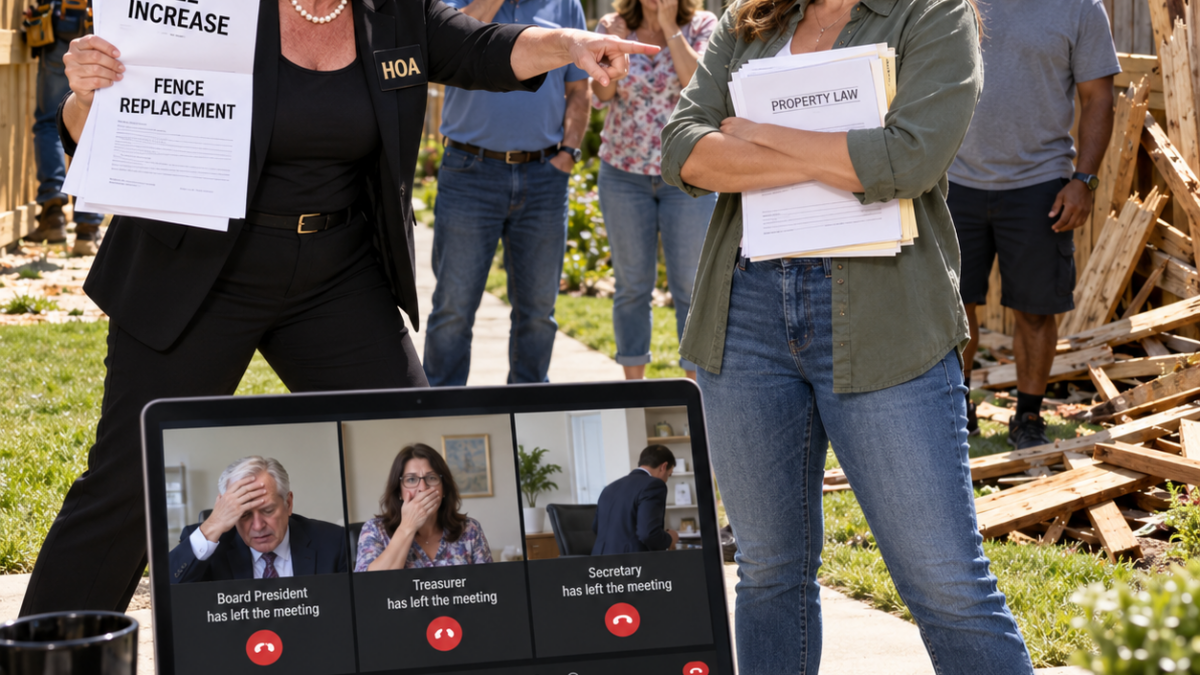
I joined our HOA’s annual Zoom meeting with a bowl of popcorn and absolutely no intention of speaking, but twenty minutes later I was staring at a budget that would triple every family’s annual dues from $900 to $2,700 so twelve selected homes could get brand-new fences while thirty-three other homeowners paid the bill and waited years for theirs.
The numbers bothered me enough, but what made my hand move toward the unmute button was the map on the treasurer’s screen, because three of those twelve “priority” properties belonged to board members—and when I asked whether they had obtained competing bids, the president suddenly looked like I had accused him of something far worse than bad arithmetic.
By the time an elderly homeowner held up a $640 receipt for the temporary fence she had been forced to buy after the HOA refused to repair its own collapsing property, I realized the meeting was not really about fences anymore, and the next three hours would expose just how much power five people had been exercising because everyone else was too tired to challenge the math.
My name is Dana Mercer, and I live with my husband, Mike, in Cedarwood Estates, a twenty-five-year-old neighborhood of forty-five large homes arranged around four quiet cul-de-sacs.
It is the kind of place where neighbors wave while collecting mail, complain about dog waste through email, and somehow turn discussions about landscaping into constitutional conventions.
Cedarwood’s rules have accumulated over the years like rings inside a tree.
Every restriction has a story.
Every amendment exists because somebody once did something strange enough that thirty people decided it could never happen again.
One of those old arrangements concerned fences.
Homeowners owned and maintained the side fences.
The HOA owned every rear fence.
That had probably seemed sensible when Cedarwood was new.
Twenty-five years later, those cedar fences were gray, leaning, warped, and collapsing one storm at a time.
The week before the annual meeting, an email arrived containing the proposed budget and a “community fence modernization initiative.”
I almost deleted it.
Then one line stopped me.
**Proposed annual dues: $2,700 per household.**
Current dues were $900.
I called Mike into the kitchen.
“Read this.”
He looked over my shoulder.
Then immediately said, “No.”
“You haven’t even finished.”
“I know your face.”
“What face?”
“The one where somebody’s spreadsheet has offended you personally.”
I work in billing and revenue administration.
Numbers are what I do all day.
“I’m just attending the meeting.”
Mike stared at me.
“Please don’t.”
“Why?”
“Because you say ‘just attending’ the way other people say ‘I’m only going to look at puppies.’”
At seven that evening, I made popcorn and joined thirty-one households on Zoom.
It took Harold Whitcomb, our eighty-one-year-old HOA president, eleven minutes to find the unmute button.
The vice president, Walt Peterson, apparently thought volume could solve technology, so every time someone told him they couldn’t hear, he leaned closer to his microphone and shouted.
Finally, Bev Carver, the treasurer, shared her screen.
“Phase One,” she announced.
A neighborhood map appeared.
Twelve rear fences were highlighted.
Ridgeline Road.
Pond Path.
Not forty-five properties.
Not even all twenty-eight rear fences that were in poor condition.
Twelve.
Then the budget appeared.
1,180 feet of vinyl fencing at $58 per foot.
$68,440.
Removal and hauling: $8,260.
Design and project management: $4,500.
Total: $81,200.
I opened a notepad.
Forty-five homes paying $900 generated $40,500 annually.
Forty-five homes paying $2,700 generated $121,500.
That was an $81,000 annual increase.
For an $81,200 project.
One-time project.
Permanent-looking increase.
Then I studied the highlighted map again.
Three names jumped out at me.
Harold.
Bev.
Walt.
All board members.
All receiving new vinyl fences.
My popcorn stopped halfway to my mouth.
Across the meeting, Carla Benton unmuted.
Her rear fence had collapsed in August.
“Why isn’t mine included?”
Harold barely looked at the screen.
“Phase Two.”
“When?”
“Possibly 2031.”
Carla held a receipt toward her webcam.
“I paid $640 for temporary panels so my dog wouldn’t escape because the HOA told me repairs weren’t available.”
Nobody answered.
Behind her, the HOA-owned fence leaned so badly it looked like one strong wind could finish the job.
I clicked **Unmute**.
“Excuse me. Did the board collect competitive bids?”
Silence.
Then Bev said:
“We received one proposal from a very qualified contractor.”
Walt smiled.
“My nephew Kyle.”
And at that exact moment, the meeting stopped being entertainment.
PART 2
I looked at Mike.
Mike looked at me.
Neither of us said anything for about three seconds.
Then he whispered, “Do not make that face.”
“What face?”
“The billing face.”
“I don’t have a billing face.”
“You absolutely do.”
On my laptop, thirty-one little Zoom squares were suddenly very still.
Some people had muted themselves.
Others hadn’t.
In one square, a man was visibly eating cereal straight from the box.
In another, a golden retriever wandered behind its owner and knocked over a lamp.
But no one was talking.
I leaned closer to my microphone.
“Walt, did you say the contractor is your nephew?”
Walt adjusted his glasses.
“Professional contractor.”
“That wasn’t my question.”
Harold jumped in.
“Dana, this is a reputable company.”
“I’m not saying it isn’t.”
“Then what are you saying?”
“I’m asking whether the board sought competing bids.”
Bev cleared her throat.
“We selected a contractor we trust.”
“That still doesn’t answer the question.”
Harold’s expression hardened.
For years, I had seen him at neighborhood picnics, holiday events, garage sales.
He was the kind of man who wore a Cedarwood Estates polo shirt to events where nobody else remembered Cedarwood Estates had polo shirts.
He had been president for as long as I could remember.
Maybe twelve years.
Maybe longer.
Nobody ran against him because nobody wanted the job.
Now he leaned toward the camera.
“Young lady, this board has seventy years of combined service.”
Mike covered his mouth.
I muted myself.
“What?” I whispered.
“He called you young lady.”
“Stop.”
“You’re forty-two.”
“That isn’t the point.”
“It’s a little the point.”
I unmuted again.
“I respect the years of service. I’m asking about procurement.”
Harold blinked.
“Procurement?”
“Bids.”
“We told you. Kyle’s company.”
“One bid.”
“A qualified bid.”
“Can we see the scope?”
Bev looked toward something off-camera.
The shared screen suddenly disappeared.
Then returned.
Then disappeared again.
“Sorry,” she said. “I clicked something.”
The chat started moving.
**JAMES R.: Is the $58/ft materials only or installed?**
**CARLA B.: Why only 12 homes?**
**GWEN T.: Is $2,700 temporary?**
**MARK P.: How long is Phase 1?**
**TOM S.: Do we have reserve money?**
Harold seemed to notice the chat for the first time.
“Please stop typing while the board is speaking.”
Naturally, everybody typed more.
I pulled up a browser window.
I had already been curious after seeing the budget packet the previous week.
That afternoon, before the meeting, I had called two fence companies.
Not because I expected a scandal.
Because sixty-eight thousand dollars for 1,180 feet sounded high.
One contractor had quoted roughly $17 per foot for basic cedar repair work.
Another estimated $15 to $16 depending on post replacement.
Neither quote was final without inspection.
But both suggested something important.
The HOA didn’t necessarily need expensive vinyl.
It needed the cedar fences fixed.
I clicked **Share Screen**.
Harold said, “Wait. What are you doing?”
“Showing everyone the estimates I got today.”
“You cannot take over the presentation.”
“I’m not.”
My screen appeared.
I had created a simple spreadsheet.
Twenty-eight rear fences in poor condition.
Approximate total footage: 2,640 feet.
Estimated cedar replacement/repair rate: $16 per foot.
Estimated total:
$42,240.
Somebody unmuted accidentally and said:
“Oh, you have got to be kidding me.”
I continued.
“For approximately half the cost of Phase One, we may be able to repair or replace all twenty-eight problem fences instead of twelve.”
Harold stood so quickly his camera tilted upward.
For several seconds, the entire meeting looked at his ceiling fan.
Then his face reappeared.
Much too close.
His nose nearly filled the screen.
“This is not a professional proposal.”
“I agree.”
He seemed surprised.
“It’s a preliminary market comparison.”
“You don’t know fence construction.”
“No.”
“Then why are you challenging the board?”
“Because I know arithmetic.”
Mike made a choking sound beside me.
I ignored him.
Harold said:
“We are replacing cedar with vinyl to modernize the neighborhood.”
“Who approved vinyl?”
“The board.”
“When?”
“In planning discussions.”
“Was there a vote?”
Walt leaned forward.
“Dana, you’re getting lost in technicalities.”
“Votes aren’t technicalities.”
“They are when everybody agrees.”
Carla unmuted.
“I didn’t agree.”
Harold said:
“You’re not on the board.”
Carla stared at him.
“That’s exactly the problem.”
Her husband Gwen—his name was actually Glen, though everyone in the source call jokingly mislabeled him at first—leaned into the frame beside her.
“We pay dues.”
Harold said:
“And board members volunteer.”
Carla held up her $640 receipt.
“I volunteered six hundred forty dollars because your fence fell on my yard.”
The chat exploded again.
**REIMBURSE HER.**
**Why was she denied?**
**Who owns the rear fence?**
**HOA DOES.**
Bev took off her red glasses.
She looked exhausted.
“I have spent twenty-two years serving this community without compensation.”
Nobody said anything.
Her voice softened.
“Twenty-two years.”
I suddenly felt bad for her.
Not enough to stop asking questions.
But enough to understand there was something emotionally bigger happening.
Bev wasn’t only defending a budget.
She was defending twenty-two years of believing her work deserved trust.
“I appreciate that,” I said.
She looked at me.
“Do you?”
“Yes.”
“Because it doesn’t feel like it.”
“I can appreciate service and still ask where $81,000 goes.”
Her eyes filled.
Harold said:
“Dana, you’re attacking volunteers.”
“No. I’m asking for documentation.”
“There is no difference in tone.”
“There is a huge difference in substance.”
Mike whispered:
“This is going badly.”
I muted.
“For them or me?”
“Yes.”
I unmuted again.
“Is the dues increase permanent?”
Bev looked toward Harold.
That was the first answer.
Then she said:
“The proposal does not currently include a sunset provision.”
“So yes.”
“It could be reviewed later.”
“But the budget collects $81,000 more every year.”
“Yes.”
“For a one-time $81,200 project.”
“Phase One is one-time.”
“What is the extra money used for after Phase One?”
Silence.
Walt said:
“Future phases.”
“Which you said might not happen until 2031.”
“That timeline is preliminary.”
“So homeowners pay an additional $1,800 every year starting now for a phase that may happen years later.”
Harold slammed something on his desk.
“Enough.”
The screen shook.
“We have maintained this neighborhood for twenty-five years.”
James Reynolds unmuted.
“Harold, that’s not an answer.”
Harold clicked around his screen.
James disappeared.
Muted.
“Did you just mute him?” Carla asked.
“I’m restoring order.”
Then Carla disappeared.
Muted.
Then Gwen.
Muted.
Then me.
Harold looked satisfied.
Except he had also muted himself.
For several seconds, Harold moved his mouth furiously while absolutely no sound came through.
The chat became chaos.
**HAROLD YOU MUTED YOURSELF**
**WE CAN’T HEAR YOU**
**THIS IS AMAZING**
**Please record this**
**Is this legal?**
Mike leaned back on the couch.
“This is the greatest thing I’ve ever seen.”
“Stop enjoying it.”
“You made popcorn.”
“I didn’t know democracy would collapse.”
Walt apparently decided Harold needed help.
He picked up a rotten fence board and held it to the camera.
“This,” Walt shouted, “is what we are dealing with.”
The board was gray, cracked, and soft near one end.
He waved it.
“Twenty-five years!”
He shook it harder.
“This is why vinyl—”
Half the board broke free.
It flew out of frame.
Something crashed.
A woman’s voice shouted from another room:
“Walt!”
He turned.
“Sorry!”
Then faced the camera again.
“I am done.”
Everyone stopped typing.
Walt’s face was red.
“I have given twelve years to this board.”
“Walt,” Harold said, finally having unmuted himself.
“No.”
Walt pointed toward the screen.
“I don’t need this.”
“Calm down.”
“I resign.”
Bev gasped.
“Walt.”
“Effective immediately.”
Then he tried to leave Zoom.
He clicked something.
Nothing happened.
He clicked again.
His background disappeared.
Then he was upside down.
Then his microphone turned off.
Then his microphone returned.
“Why won’t this stupid thing—”
He opened what looked like Zoom settings.
Every resident watched.
Mike was crying with laughter.
“Don’t,” I whispered.
“I can’t help it.”
Walt finally disappeared from the meeting.
His square went black.
Bev stared at the empty square.
Then removed her red glasses.
She dabbed her eyes with a tissue.
“Twenty-two years.”
Her voice barely rose above a whisper.
“This is how people thank you.”
I felt the room change.
Not physically.
Emotionally.
We had been laughing.
Now we weren’t.
I said:
“Bev, nobody is saying your service didn’t matter.”
“You’re saying I can’t be trusted.”
“I’m saying this budget shouldn’t be approved without bids and a fair plan.”
She shook her head.
“You don’t know what it takes.”
“Then explain it to us.”
“We’ve spent years listening to complaints.”
“I believe you.”
“People complain their fences look terrible.”
“Yes.”
“People complain property values will fall.”
“Yes.”
“People complain dues are too high.”
“Yes.”
“And every time we try to solve something, people tell us we’re doing it wrong.”
That was real.
I could hear it.
Years of resentment.
Maybe twenty-two years of it.
I softened my voice.
“Then let us help.”
Bev looked at me.
“You don’t mean that.”
“I do.”
“No, you want to criticize.”
“I’m offering the spreadsheet.”
Mike whispered:
“Very romantic.”
I kicked his foot.
Bev laughed despite herself.
Then she started crying again.
“I quit.”
“Bev—”
“I’m serious.”
She closed the laptop.
Her square disappeared.
Now Harold looked panicked.
Two resignations.
Ron Pappas, the fifth board member, had said almost nothing for three hours.
He was eighty.
Tiny on his camera because he sat too far away.
He suddenly lifted a piece of paper.
“I have something.”
Harold said:
“Ron, please don’t.”
Ron adjusted his hearing aids.
“What?”
“Nothing.”
Ron read.
“I am eighty years old, and I do not have to take this.”
He looked proud of the sentence.
Then he slammed his laptop closed.
His Zoom connection did not end.
The camera apparently remained active.
His square became a perfectly framed view of a ceiling fan.
It rotated slowly.
Peacefully.
For the remaining meeting, Ron’s ceiling fan was the calmest board member in Cedarwood Estates.
Mike stared at me.
“Three.”
“Yes.”
“Three board members just quit.”
“Yes.”
“Because you asked for bids.”
“I didn’t make them quit.”
“No, but you definitely touched the first domino.”
Harold looked around his remaining screen.
Only he and Gloria, the secretary, remained from the five-person board.
No quorum.
Harold tried to keep going.
“We will proceed with the budget.”
Gloria finally spoke.
“We can’t.”
“We absolutely can.”
“There’s no quorum.”
“The resignations aren’t effective until accepted.”
“By whom?”
“The board.”
“There is no board.”
Harold stared.
Gloria looked tired.
“Harold.”
“What?”
“We have to adjourn.”
His jaw worked.
“This meeting is adjourned.”
Nobody moved.
He shouted:
“Meeting adjourned!”
Still nothing.
Carla said:
“You have to end Zoom.”
“I know that.”
He clicked something.
Nothing.
“Harold,” Gloria said.
“I know.”
Mike buried his face in a pillow.
The meeting ended three minutes later.
Total time:
Three hours and seven minutes.
I closed the laptop.
The living room became completely silent.
Mike looked at the empty popcorn bowl.
Then at me.
“You owe me new entertainment standards.”
“I feel terrible.”
He blinked.
“What?”
“They were upset.”
“They tried to triple our dues.”
“I know.”
“They were giving themselves fences.”
“I know.”
“They got caught with one bid from Walt’s nephew.”
“I know.”
“And you feel bad?”
“Bev was crying.”
Mike sat beside me.
“You didn’t insult her.”
“No.”
“You asked questions.”
“Yes.”
“Then you’re allowed to feel bad without deciding you were wrong.”
That was annoyingly reasonable.
I leaned against him.
“You know what I keep thinking about?”
“What?”
“Carla’s fence.”
“Why?”
“She paid $640 because the HOA fence collapsed.”
“Yes.”
“They denied reimbursement.”
“Yes.”
“Then proposed spending $81,200 partly on board members’ fences.”
“Yes.”
“That is so backwards.”
Mike smiled.
“There’s the billing face.”
The next morning, I had fourteen emails and nine text messages.
Every one asked some version of:
**Dana, will you run?**
I ignored them until breakfast.
Mike poured coffee.
“You’re thinking about it.”
“No.”
“You paused.”
“I’m thinking about the question.”
“That counts.”
“I have a job.”
“Yes.”
“I have you.”
“Unfortunately.”
“I have no desire to spend evenings discussing cedar.”
“Strong argument.”
“I don’t like conflict.”
Mike stared at me.
“What?”
“You joined an HOA Zoom meeting and dismantled a $121,500 budget with a spreadsheet.”
“I asked questions.”
“You asked questions in a tone that made three retirees resign.”
“That was not intentional.”
“I know.”
He slid the coffee toward me.
“Reasons not to run: three-hour meetings, angry emails, no pay, possible lawsuits, Walt bringing lumber to meetings.”
I smiled.
“All fair.”
“Reasons to run?”
I thought about Carla.
The receipt.
Her dog.
The fence leaning behind her.
“The numbers were wrong.”
Mike sighed.
“Of course.”
“Somebody has to read them.”
“There it is.”
“I’m not saying yes.”
“You’re not saying no.”
That afternoon, Carla called.
“Cul-de-sac meeting.”
“When?”
“Saturday.”
“Why?”
“Because Harold sent an email saying the board will be reconstructed by appointment.”
I sat up.
“What?”
“He says the remaining officers can fill vacancies.”
“Do the bylaws allow that without quorum?”
“No idea.”
“Send me the email.”
Five minutes later, I had it.
Harold wrote that “continuity of governance” required immediate appointments and that the fence budget remained “essentially approved.”
Essentially.
I hated essentially.
It was a word people used when facts were inconvenient.
I called Carla.
“We need the bylaws.”
“Already printed.”
“Of course you did.”
“I learned from you.”
Saturday morning, Carla and I taped a flyer to mailboxes.
**NEIGHBOR MEETING — 4:00 P.M.
CUL-DE-SAC
BRING A CHAIR**
Twenty-two homeowners came.
Some brought folding chairs.
One brought lemonade.
Walt came but sat at the very back with his arms crossed.
Bev did not attend.
Harold didn’t either.
I handed out one sheet.
Old dues:
$900.
Proposed:
$2,700.
Current annual revenue:
$40,500.
Proposed:
$121,500.
Increase:
$81,000.
Phase One:
$81,200.
Homes receiving Phase One fences:
12.
Homes paying:
45.
Then my alternative estimate.
Repair all twenty-eight failing rear fences.
Projected cost:
About $42,240 before formal bids.
Carla stood beside her temporary panels.
“I want one thing clear.”
Everyone looked.
“I don’t need vinyl.”
She kicked one panel lightly.
“I need my dog not to escape.”
People laughed.
Then she held up the $640 receipt.
“And I’d like this back.”
That got applause.
James Reynolds asked:
“What do the bylaws say about a special meeting?”
I opened my binder.
“Twenty percent of households can call one.”
“How many?”
“Nine.”
Someone laughed.
“We have twenty-two sitting here.”
By sunset, we had twenty-five signatures.
Within forty-eight hours:
Thirty-one.
I delivered the petition to Gloria.
She looked at the list.
Then at me.
“You really did this.”
“Residents did.”
“Harold is going to be furious.”
“I know.”
Gloria sighed.
“He’s not a bad man.”
“I don’t think he is.”
That surprised her.
“You don’t?”
“No.”
“After the meeting?”
“He made bad decisions.”
“Different thing?”
“Sometimes.”
She looked toward Harold’s house at the end of the street.
“He built half the volunteer systems here.”
“What do you mean?”
“Architectural committee. Pond cleanup. Snow response before the city improved service.”
I hadn’t known that.
“He’s eighty-one.”
“I know.”
“He thinks if he steps away, everything he built falls apart.”
I looked at the petition.
“That might be part of the problem.”
Gloria nodded.
“I know.”
The evening before the special meeting notice went out, my doorbell rang.
Harold stood on the porch.
No polo shirt.
No binder.
He held a casserole dish.
For a second I wondered if this was some obscure HOA intimidation strategy involving baked pasta.
“Harold?”
“My daughter made too much.”
“Oh.”
He held it out.
“I thought you and Mike might want some.”
Mike appeared behind me.
“I definitely want some.”
I took it.
“Come in.”
Harold shook his head.
“Just a minute.”
He looked smaller in person than he did on Zoom.
His shoulders had rounded with age.
He stared toward the backyard.
“My fence is one of the twelve.”
“I know.”
“People keep saying that like I picked myself.”
“Did you?”
He looked at me.
“No.”
“Who did?”
“Walt and Kyle drove the roads.”
That wasn’t ideal either.
“My fence faces Ridgeline.”
“Yes.”
“People complain.”
“I believe you.”
“Every resale tour sees it.”
“I understand.”
“We’ve had residents email pictures.”
“Okay.”
Harold rubbed the casserole lid with one thumb.
“I didn’t ask for vinyl because I wanted something fancy.”
“Why vinyl?”
“Twenty-five years.”
“Meaning?”
“I didn’t want to do cedar again in ten or fifteen.”
“That makes sense.”
He looked almost relieved.
“But,” I continued, “your fence would cost roughly $6,800 under the proposal.”
His relief vanished.
“And thirty-three homes that get nothing in Phase One would pay an extra $1,800 each year.”
Harold looked down.
“I know.”
“Do you?”
“Yes.”
“Then why push it?”
He took a long breath.
“Because once people see their own fence needs work, everyone wants to be first.”
“So you chose visibility.”
“Yes.”
“Road-facing fences.”
“Yes.”
“Which happened to include yours, Bev’s, and Walt’s.”
His face reddened.
“It looked terrible.”
“I’m sure it did.”
“You think I stole something.”
“No.”
He looked at me.
“I think the process failed.”
That landed differently.
Harold nodded slowly.
Then said:
“I should have gotten bids.”
“Yes.”
“I should have disclosed Walt’s nephew.”
“Yes.”
“I should not have tried to mute everybody.”
I smiled.
“That was not your strongest technological moment.”
He almost laughed.
Then his eyes became wet.
“I’ve lived here since the beginning.”
“I know.”
“My wife and I were the seventh family.”
“What was it like?”
“Dirt.”
He smiled.
“No trees. Pond smelled awful. Everybody complained.”
“And you volunteered.”
“Because someone had to.”
The phrase hit me.
Same one I had used to Mike.
Somebody has to read the numbers.
Harold had once thought somebody had to build the structure.
Maybe that was why stepping aside felt like losing ownership over twenty-five years of his life.
I said gently:
“Harold, I’m not trying to erase what you did.”
He looked toward me.
“But service doesn’t mean nobody can question a budget.”
“I know.”
“You can be right for twenty years and still be wrong about one project.”
He nodded.
“I know.”
We stood there in silence.
Then he said:
“If residents cancel the increase, the fences still need fixing.”
“Yes.”
“You actually think forty-two thousand can do it?”
“I think we need real bids.”
“Three?”
“At least.”
He smiled faintly.
“You’re going to run for treasurer.”
“I haven’t said that.”
“You will.”
“Why does everybody keep deciding things for me?”
“HOA tradition.”
I laughed.
He started walking away.
“Harold?”
He turned.
“Thank you for the casserole.”
He shrugged.
“Keep the dish.”
Mike called from inside:
“Absolutely.”
The special meeting filled the clubhouse.
Forty-one of forty-five homes participated either in person or through valid proxy.
The room was more crowded than any HOA event I had ever attended.
Even Walt came.
Suspenders.
Folded arms.
Looking like he expected trial.
Bev sat in the rear.
Red glasses.
Ruthless expression.
I wondered whether she hated me.
Gloria called the meeting to order because Harold had temporarily stepped aside from presiding.
Four motions were on the agenda.
First:
Cancel the $2,700 dues proposal.
Second:
Require at least three competitive bids for major contracts.
Third:
Adopt a conflict-of-interest disclosure policy.
Fourth:
Replace the vinyl Phase One project with a community-wide repair plan using reserve funds plus a modest temporary dues adjustment.
Before the first vote, Walt stood.
“My nephew is licensed.”
Nobody argued.
“He does good work.”
“I believe you,” I said.
He looked suspicious.
“Then why is everybody acting like he’s crooked?”
“I don’t think Kyle is crooked.”
“Then what’s the issue?”
“That he was the only bidder.”
“That doesn’t make him bad.”
“No.”
“It makes the process bad?”
“Yes.”
Walt stared.
Then sat.
First motion.
Thirty-eight yes.
Three no.
The dues would not rise to $2,700.
Second.
Thirty-nine yes.
Two no.
Three-bid policy.
Third.
Conflict-of-interest policy.
Gloria read the language:
Any director with a familial, business, or financial relationship to a proposed vendor had to disclose it and abstain from vendor selection.
Hands rose.
Walt’s hand went up.
Then he froze.
Looked at the paper.
Looked at his own hand.
“Wait.”
The room burst into laughter.
Even Walt laughed.
“All right,” he grumbled. “Fine.”
Forty-one votes.
Unanimous.
Then the repair plan.
I stood at the whiteboard.
“Here is what I recommend.”
Old annual dues:
$900.
Proposed new dues:
$1,150.
Annual revenue:
$51,750.
Increase over current revenue:
$11,250.
Reserve contribution available immediately:
$20,000.
Expected project budget over two years:
Enough to complete repair without a permanent threefold increase.
A man named Pete asked:
“Why increase at all?”
“Because the fences are HOA property.”
“So use reserves.”
“If we drain reserves and the pond pump fails next year, what do we do?”
He crossed his arms.
“Special assessment.”
“Exactly.”
Pete looked annoyed.
“You’re very unpleasant with numbers.”
“I do this professionally.”
A few people laughed.
I continued.
“The point is not zero cost. The point is proportional cost.”
Carla raised her receipt.
“And reimbursement?”
I smiled.
“That needs separate approval.”
She looked offended.
“You promised nothing.”
“I promised numbers.”
The repair motion passed.
Thirty-eight to three.
Then Harold raised his hand.
Everybody looked.
He stood slowly.
“I want to say something.”
The room quieted.
“I was wrong.”
No one moved.
Harold continued.
“Not about the fences needing repair.”
He looked toward me.
“But about how we chose them.”
He turned toward the residents.
“I thought experience meant I knew what the community needed.”
His voice weakened slightly.
“Sometimes experience just means you’ve been doing something long enough to stop noticing when you’ve stopped asking.”
That hit the room hard.
Bev looked down.
Walt rubbed his hands together.
Harold continued.
“I support the new plan.”
Carla began clapping.
Then James.
Then others.
Not cheering.
Something warmer.
Respect without surrendering the argument.
That mattered.
Three contractors inspected Cedarwood the following week.
Kyle’s company came first.
He was younger than I expected.
Thirty-something.
Professional.
Embarrassed.
“I didn’t know Uncle Walt told people I was already selected.”
I looked at him.
“You sent a proposal.”
“Yes.”
“Did you know it was the only one?”
“No.”
“Did you price vinyl because the board requested vinyl?”
“Yes.”
“Any reason cedar can’t be repaired?”
“Not all of it.”
He opened his tablet.
“Some posts are gone. About sixty percent of the boards could be replaced without full reconstruction.”
That was useful.
He submitted a new proposal.
$17 per foot equivalent average.
Then another contractor:
$16.25.
Then Cedar Valley Fence.
Family business.
Owner named Luis Ramirez.
He walked the entire perimeter with his daughter, who handled estimates.
They proposed targeted post replacement plus full cedar renewal where necessary.
$39,600.
I read the number twice.
$2,640 below our working budget.
I called Carla.
“You sitting down?”
“Why?”
“Thirty-nine six.”
She screamed.
Mike walked into my office.
“Good news?”
“Apparently.”
Cedar Valley won.
Kyle attended the vote.
When Luis was selected, Kyle shook his hand.
“Good bid.”
No drama.
No accusation.
Just professional competition.
I respected him for that.
Walt said afterward:
“He’s a good kid.”
“I know.”
“I told you.”
“Yes.”
“You made it sound like—”
“I never said anything about Kyle.”
Walt grumbled.
“I know.”
Then:
“Still annoying.”
Carla’s fence was first.
Not because she was loud.
Because it had already collapsed and created a safety issue.
Crew arrived at seven.
By sunset, her backyard had a straight cedar fence for the first time in years.
No temporary plastic panels.
No leaning posts.
Her dog ran along it, confused that the neighborhood had suddenly developed boundaries again.
Carla stood beside me.
“I forgot what this looked like.”
“A fence?”
“A yard that doesn’t look temporary.”
The board also reviewed her $640 reimbursement.
Harold spoke first.
“Pay it.”
Passed unanimously.
When Carla received the check, she hugged it to her chest.
“Six hundred forty dollars.”
Mike said:
“You’re acting like you won the lottery.”
“I did.”
She pointed toward the old panels stacked beside the garage.
“Those ugly things have haunted me since August.”
The next month, Cedarwood held elections.
I ran for treasurer.
I told myself I only did it because Bev had officially declined to return.
Mike did not believe me.
“You like fixing broken systems.”
“No.”
“You literally reorganize our grocery receipts.”
“That is unrelated.”
“You color-code utilities.”
“Efficiency.”
“Dana.”
“Fine.”
Election night was shorter than the Zoom disaster.
Mercifully.
I won.
When Gloria announced it, Mike leaned toward me.
“You said somebody has to read the numbers.”
“I remember.”
“I’m holding you to it.”
From the back row, Harold started clapping.
Slowly.
Then louder.
I looked at him.
He smiled.
Bev was sitting beside him.
She clapped too.
Afterward she approached me.
For a second, I prepared for something difficult.
Instead, she handed me a flash drive.
“Twenty-two years of budgets.”
My stomach dropped.
“All of them?”
“Yes.”
“How organized?”
She smiled for the first time around me.
“Very.”
“Thank God.”
“You thought I was incompetent?”
“No.”
“You did.”
“I thought the process was wrong.”
She nodded.
“Fair.”
Then she lowered her voice.
“I hated you for about three days.”
“I assumed.”
“Then I looked at the numbers.”
“And?”
She sighed.
“The increase was too much.”
I smiled.
“Thank you.”
“Don’t enjoy that.”
“I’m trying not to.”
She looked toward Harold.
“We got tired.”
“What do you mean?”
“Same people doing everything for years.”
“That’s part of what went wrong?”
“Yes.”
“When everybody trusts you, eventually you stop showing your work.”
That sentence became my rule as treasurer.
Show the work.
Every budget packet included assumptions.
Every major contract included bids.
Every reserve transfer had a plain-English explanation.
People complained the packets were too long.
Then they complained if I shortened them.
HOA service, I discovered, is mostly learning that residents want complete transparency in no more than one page.
My first board meeting lasted four hours.
Mike waited up.
“How was it?”
“Terrible.”
“You love it.”
“I absolutely do not.”
“What happened?”
“Forty-three minutes discussing mailbox posts.”
He laughed.
“You saved the neighborhood from authoritarian cedar fences so you could debate mailbox posts.”
“I made mistakes.”
A week later, Walt appeared in my driveway.
Toolbox.
Suspenders.
No greeting.
“My nephew isn’t doing the fence contract.”
“I know.”
“But somebody should check the posts.”
“What posts?”
“The old ones before they pour new concrete.”
“Walt, Cedar Valley knows how to install fences.”
“I know that.”
“Then why are you here?”
He stared at me like I was slow.
“I have tools.”
That apparently answered everything.
For four hours, Walt walked the repair route with Luis’s crew.
He measured.
Checked.
Complained.
Made jokes.
At lunchtime, Luis handed him a sandwich.
By the end of the day, Walt had helped replace two rotten support braces for free.
I found him tightening a temporary clamp.
“You know the contractor is being paid.”
“I’m aware.”
“You’re doing unpaid labor.”
“I was on the board twelve years.”
“That doesn’t explain it.”
He looked toward the repaired fence.
“I like fixing things.”
There it was.
Not power.
Not nepotism.
A man who liked solving practical problems and had become too comfortable believing his preferred solution was automatically the right one.
I said:
“You know, vinyl would’ve been easier.”
He glared.
“Don’t start.”
Nobody mentioned plastic again.
The fence project took four months.
Not every fence needed full replacement.
Some required posts.
Some boards.
Some gates.
A few needed complete rebuilding.
Final cost came in slightly below $39,600 because Cedar Valley salvaged usable lumber in several areas.
Every one of the twenty-eight failing rear fences was repaired.
Twenty-eight.
Not twelve.
Carla sent me a photograph of her dog asleep beside the new fence.
Caption:
**Still contained. Democracy works.**
I forwarded it to Mike.
He replied:
**Put it in the annual report.**
I did.
Not the joke.
The photo.
My first full budget year taught me something uncomfortable.
The old board hadn’t been wrong about everything.
Insurance costs were rising.
Pond maintenance cost more than residents understood.
Tree removal was expensive.
Drainage repairs were overdue.
If I had entered the board convinced every increase was corruption, I would have failed.
At one meeting, Pete—the same man who opposed the modest dues increase—stood.
“You said we’d save money.”
“We did.”
“Then why are dues still $1,150?”
“Because Cedarwood costs money.”
The room laughed.
Pete didn’t.
“Why not bring them back to nine hundred?”
I pulled up the budget.
“Because nine hundred was already too low.”
He stared.
“What?”
That surprised everyone.
I continued.
“The previous board kept dues artificially flat for six years.”
Harold shifted in the back row.
I looked toward him.
He nodded.
I explained.
“They deferred fence repairs. Reduced reserve contributions. Delayed pond work.”
Pete said:
“So the board was wrong either way?”
“No.”
“Sounds like it.”
“They were trying to avoid increases.”
“Isn’t that good?”
“Not if avoiding an increase creates a bigger bill later.”
Silence.
That was a harder story to tell.
Lorna-style villains are easy.
Real governance is not.
Harold hadn’t tried to triple dues because he wanted a luxury fence.
At least not only that.
He had inherited years of deferred maintenance, then overcorrected with a bad project and a terrible process.
Understanding that did not make the original proposal fair.
It made the people more human.
One night after a meeting, Harold stayed behind.
“You see it now.”
“What?”
“Why we got tired.”
I smiled.
“A little.”
“Everybody wants low dues.”
“Yes.”
“Perfect fences.”
“Yes.”
“No assessments.”
“Yes.”
“Full reserves.”
“Yes.”
“Immediate repairs.”
“Yes.”
“All at the same time.”
“Yes.”
He laughed.
“Good luck.”
“You could come back.”
“No.”
That answer was immediate.
“I sleep now.”
“Fair.”
He leaned on the back of a chair.
“I’m proud of you.”
That caught me off guard.
“Why?”
“You showed the work.”
I thought about Bev’s phrase.
Show the work.
“Thank you.”
Harold looked toward the repaired fence visible through the clubhouse window.
“You know what I was really afraid of?”
“What?”
“Being remembered as the old man who let the neighborhood fall apart.”
That explained more than any budget.
“You won’t be.”
“How do you know?”
“Because the neighborhood didn’t fall apart.”
He smiled.
“And because everybody will remember the Zoom meeting.”
He groaned.
“I knew you’d say that.”
The recording had become neighborhood legend.
Not publicly shared.
Thankfully.
But every time somebody struggled with technology, someone would say:
“Careful or Harold will mute himself.”
Harold eventually started saying it too.
That was when I knew he had recovered.
Bev returned to help with the reserve committee six months later.
Not as treasurer.
She refused.
“I gave twenty-two years.”
“You remind us constantly.”
“Because none of you appreciate sacrifice.”
But she brought extraordinary institutional memory.
She remembered which pond pump had failed in 2014.
Which trees belonged to the HOA.
Which contractor had disappeared with a deposit in 2009.
Her records saved us thousands.
One afternoon, she and I reviewed old budgets.
I found the first year rear-fence repairs had been deferred.
2017.
“Why?”
She looked.
“Storm damage.”
“Where?”
“East cul-de-sac.”
“So fence money moved to trees.”
“Yes.”
2018.
Deferred again.
“Insurance.”
2019.
“Pond.”
2020.
“Pandemic uncertainty.”
2021.
“Roof.”
2022.
“Inflation.”
2023.
“Harold said next year.”
By the time “next year” arrived, twenty-eight fences were failing.
I leaned back.
“This is how $40,000 problems become $80,000 proposals.”
Bev nodded.
“Nobody wakes up planning that.”
That became another lesson.
Financial disasters are often built from reasonable delays.
Not greed.
Not corruption.
Just one “next year” after another.
We changed the reserve policy.
Every major asset received a lifecycle schedule.
Fence.
Pond.
Clubhouse roof.
Road signs.
Trees.
Playground.
Residents hated the spreadsheet.
I loved it.
Mike found me working on it at eleven one night.
“You have become everything you mocked.”
“What?”
“HOA budgeting.”
“I never mocked budgeting.”
“You made popcorn to watch old people argue.”
“That was before I knew depreciation.”
He shook his head.
“I miss who you were.”
The following spring, a storm hit Cedarwood.
Wind tore through the rear of the neighborhood.
Branches came down.
One old section of fence along Pond Path snapped.
But because the worst posts had already been replaced, damage was limited.
Three years earlier, the same storm probably would have dropped an entire line.
Carla texted:
**$39,600 WELL SPENT**
I smiled.
The modest dues increase remained for two years as promised.
At the end of year two, we reviewed it publicly.
This part mattered to me.
The original $2,700 proposal had no sunset.
I wanted residents to see what a promise looked like when followed.
Reserve targets were healthy.
Fence work complete.
No major surprise obligations.
We reduced dues from $1,150 to $1,025.
Not back to $900.
Numbers didn’t support it.
Pete complained.
Of course.
But the reduction proved something.
Temporary could actually mean temporary.
The vote passed.
Mike took me to dinner afterward.
“Celebrating?”
“Reduction.”
“Twenty-five dollars?”
“One hundred twenty-five.”
“Annual?”
“Yes.”
He stared.
“You made me put on a jacket for $125.”
“It’s symbolic.”
“Next time symbolize at home.”
Three years after the Zoom disaster, Carla invited us over.
Her dog had gotten older.
Slower.
Still safely inside the yard.
She served wine on the patio.
The cedar fence had weathered slightly.
Still straight.
She touched one board.
“I thought I was going to have to sell.”
I looked at her.
“What?”
“Back then.”
“Because of the fence?”
“Because of everything.”
She stared into her glass.
“My husband had just lost overtime. I was paying for my mother’s medications.”
I hadn’t known.
“When that $2,700 number came out, I thought: I can’t keep doing this.”
“Why didn’t you tell anyone?”
“Because I was embarrassed.”
She laughed softly.
“Everybody in Cedarwood acts like we’re fine.”
That was true.
Large houses create strange assumptions.
People see square footage and imagine endless cash.
But mortgages.
Medical bills.
Kids.
Parents.
Job losses.
$1,800 extra could be annoying to one family and devastating to another.
Carla continued.
“Then I watched you ask where the money was going.”
“I was being annoying.”
“You were.”
“Thank you.”
“But I needed somebody to be annoying.”
She smiled.
“I didn’t care about vinyl. I cared about not choosing between an HOA bill and helping my mom.”
That was the first time I fully understood the human cost hidden beneath my spreadsheet.
$81,000 wasn’t only a number.
It was grocery budgets.
Prescriptions.
College savings.
Retirement contributions.
Emergency funds.
Numbers become moral when somebody else decides how easily you can afford them.
That night, I told Mike.
He nodded.
“Still glad you joined?”
“The Zoom meeting?”
“The board.”
I thought about it.
“Yes.”
He looked shocked.
“Really?”
“Yes.”
“Should I call someone?”
“I hate parts of it.”
“That sounds healthier.”
“But somebody really does have to read the numbers.”
Mike smiled.
“Unfortunately, I married her.”
Harold turned eighty-four that year.
Cedarwood held a birthday picnic.
He complained about the fuss.
Then arrived early.
Walt brought a toolbox for no reason anyone understood.
Bev brought a cake.
Ron Pappas attended too.
Still alive.
Still opinionated.
Someone had printed a tiny photograph of a ceiling fan and taped it to his chair.
Ron stared.
“What is this?”
Everybody laughed.
He eventually understood.
“Very funny.”
Then he left the picture there all afternoon.
During the picnic, Harold pulled me aside.
“I have something for you.”
He handed me a thick binder.
Original Cedarwood meeting minutes.
Twenty-five years.
“Why me?”
“You’re the treasurer.”
“Gloria is secretary.”
“She already has copies.”
I opened the first page.
1999.
Five families.
No clubhouse.
No pond path.
Handwritten notes.
Harold’s name.
Young.
New homeowner.
Volunteer.
I looked at him.
“You really were here from the beginning.”
“Told you.”
I turned pages.
Fence policy adoption.
Snow removal.
Tree planting.
Mailbox standards.
Every absurd Cedarwood rule had indeed started as somebody trying to solve a real problem.
Harold tapped the binder.
“Don’t let people forget we were trying.”
That sentence stayed with me.
The old board had failed badly on the fence project.
But they had been trying.
That didn’t excuse the process.
It made the lesson better.
Bad governance is not always created by bad people.
Sometimes good intentions age into habits.
Habits age into entitlement.
Entitlement makes questions feel insulting.
Then nobody notices the moment service becomes control.
I promised Harold I would preserve the records.
The next annual meeting lasted one hour and twenty-six minutes.
Nobody resigned.
Nobody threw lumber.
Nobody muted anyone.
We had three bids for every major contract.
The budget packet went out twenty days early.
Residents asked questions.
We answered.
At the end, Ron Pappas raised his hand.
Everyone became nervous.
“Yes, Ron?” Gloria asked.
He leaned toward the microphone.
“I move that we adjourn.”
Somebody immediately shouted:
“Second!”
The room laughed.
Motion passed.
Afterward, Harold found me near the door.
“That was boring.”
“Perfect.”
“No yelling.”
“Perfect.”
“No resignations.”
“Exactly.”
He shook his head.
“You ruined HOA meetings.”
“You’re welcome.”
Five years after the original fence fight, I drove through Cedarwood after work.
Every rear fence had aged into the same soft cedar color.
No board-member section.
No Phase One neighborhood.
No visual line separating people who got priority from people told to wait until 2031.
Just fences.
Some children were kicking a soccer ball in Carla’s yard.
Her old dog lay near the gate.
Harold was walking slowly toward his mailbox.
He used a cane now.
I parked.
“You need help?”
“With mail?”
“With walking.”
He glared.
“I’m eighty-six, not dead.”
“Noted.”
He opened the mailbox.
Pulled out three envelopes.
Then looked toward the fences.
“You were right.”
“About what?”
“Vinyl would’ve looked terrible.”
I laughed.
“That’s your conclusion after five years?”
“Most important one.”
We walked back toward his house.
His rear fence—the fence that helped start everything—was straight.
Cedar.
Not expensive.
Not special.
Exactly like everyone else’s.
Harold touched the gate.
“Funny.”
“What?”
“All that yelling.”
“For a fence?”
“For being first.”
He shook his head.
“I thought road-facing houses deserved priority.”
“I remember.”
“Now nobody knows whose fence got fixed first.”
“That’s probably good.”
He looked at me.
“Fair usually looks boring afterward.”
That was a very Harold sentence.
I smiled.
“Yes.”
Inside my own house, Mike had dinner waiting.
“You stopped to talk to Harold.”
“How do you know?”
“You always come home twenty minutes late when you see him.”
“He admitted vinyl would’ve looked terrible.”
Mike dropped the serving spoon.
“No.”
“Yes.”
“Get it in writing.”
“I should.”
We sat down.
On the kitchen counter was the latest Cedarwood budget packet.
Mike pointed at it.
“You working tonight?”
“No.”
“You promise?”
“Yes.”
He stared.
I pushed the packet farther away.
“Tomorrow.”
“Good.”
Then he smiled.
“You remember the popcorn?”
“What?”
“That first meeting.”
“Of course.”
“You told me it was free entertainment.”
I laughed.
“Most expensive free entertainment of my life.”
“Three board resignations.”
“Don’t.”
“Harold muting himself.”
“Stop.”
“Ron’s ceiling fan.”
I started laughing.
“Okay, that was funny.”
Mike raised his glass.
“To bad math.”
I raised mine.
“To people willing to check it.”
We clinked glasses.
The fence project had never really been about cedar.
Or vinyl.
Or even $69,750.
It was about what happens when a community stops asking how decisions are made because the same people have been making them for too long.
Harold had given decades.
Bev had given twenty-two years.
Walt had volunteered twelve.
They deserved gratitude.
They did not deserve permanent immunity from questions.
And those things could both be true.
That became the most important lesson Cedarwood learned.
Not “never trust the board.”
Trust was necessary.
But trust without receipts, votes, bids, and questions becomes something else.
We kept the three-bid rule.
We kept the conflict policy.
We kept public budget explanations.
We kept reserve planning.
We kept modest dues.
And we kept something more important.
People showed up.
Not all forty-five.
Never all forty-five.
But enough.
Enough that no future board president could claim silence meant agreement.
Enough that if a $121,500 budget appeared, somebody would ask why.
Enough that the Carlas of the neighborhood didn’t have to stand alone holding a receipt while their fence collapsed behind them.
My term as treasurer eventually ended.
I chose not to run again after six years.
Mike celebrated.
“You’re free.”
“I’m still on the finance committee.”
His smile disappeared.
“What?”
“Only quarterly.”
“Dana.”
“Somebody has to—”
“No.”
I laughed.
The new treasurer was a thirty-three-year-old accountant named Priya Shah.
On her first day, I handed her the same flash drive Bev had given me years earlier.
Plus six years of my files.
Priya stared at it.
“How much is on here?”
“Everything.”
“That sounds threatening.”
“It is.”
I handed her a binder.
“Show the work.”
“What?”
“That’s the rule.”
“Whose rule?”
“Bev’s.”
Priya nodded.
I pointed toward the fence reserve schedule.
“And never defer something six years without documenting why.”
“Okay.”
“And three bids.”
“I know.”
“Conflicts disclosed.”
“I know.”
“Sunset temporary increases.”
“Dana.”
“Yes?”
“I’m an accountant.”
I smiled.
“Good.”
She pushed me toward the door.
At the final meeting of my last term, Harold attended.
Cane.
Thinner.
Still alert.
When Gloria announced the new officers, he started clapping.
The same way he had when I became treasurer.
Slowly first.
Then louder.
I looked at him.
For a second, I saw the eighty-one-year-old man whose face once filled my entire laptop screen while he tried to mute thirty angry homeowners.
Then I saw the person he became afterward.
Still stubborn.
Still proud.
But willing to admit that the community could continue without him controlling every decision.
I walked over.
“You started this.”
His eyebrows rose.
“The treasurer thing?”
“All of it.”
“That sounds accusatory.”
“It is.”
He laughed.
Then his expression softened.
“You did good.”
“So did you.”
“Not that night.”
“No.”
“Thank you for not pretending.”
“I learned from you.”
He looked confused.
“How?”
“You admitted you were wrong.”
He thought about that.
Then nodded.
“Harder than reading numbers.”
“Much.”
He squeezed my hand.
When Mike and I walked home, the evening was warm.
The repaired fences ran behind the houses in long, straight cedar lines.
No vinyl.
No priority section.
No Phase One.
No houses marked for 2031.
Everyone had paid something.
Everyone had received something.
And the community had saved roughly $69,750 a year compared with the original proposal while repairing far more than the twelve fences the first plan would have touched.
But by then, the savings no longer felt like the most important part.
The number that stayed with me was $640.
Carla’s temporary panels.
One ordinary receipt.
One homeowner paying from her own pocket because a system designed to maintain shared property had stopped seeing the people living behind the spreadsheets.
That receipt was why I unmuted.
Everything else followed.
Three board members resigning on Zoom.
Harold accidentally muting himself.
Ron’s ceiling fan.
Thirty-one signatures.
The special meeting.
Three bids.
Twenty-eight repaired fences.
The election.
Years of better budgets.
All because somebody finally asked:
**Where are the bids?**
I still have the original spreadsheet.
Sometimes I open it.
Forty-five homes.
$900.
$2,700.
$121,500.
Numbers that once made me angry enough to speak.
Now they make me smile.
Because I know what happened after them.
Cedarwood didn’t collapse when residents questioned the board.
It became stronger.
Harold didn’t disappear when he lost the presidency.
He became a neighbor again.
Bev didn’t lose twenty-two years of service because we rejected one budget.
She became the person who taught me to show the work.
Walt didn’t become a villain because he wanted his nephew to get a contract.
He became the eighty-two-year-old man who spent four hours checking fence posts for free after his nephew lost the bid.
And I didn’t become the neighborhood hero.
I became the woman who had to explain reserve depreciation at meetings while people complained that my handouts had too many columns.
That was probably healthier.
Real change usually looks less glamorous after the shouting ends.
It looks like receipts.
Meeting minutes.
Three competing bids.
A fence that stands straight through a storm.
A reimbursement check to a neighbor who should never have needed temporary panels in the first place.
And an eighty-six-year-old former HOA president touching his perfectly ordinary cedar gate and finally laughing at how badly he once wanted to be first.
That ending satisfied me more than watching anyone resign.
Because the point was never to beat Harold.
It was to fix the fences.
And eventually, we did.
Every single one.





