PART 2: HOA Tried to Shut Down My Father’s Final Auction—By Sunrise, Trucks Were Lined Up for Half a Mile
PART 2:
The attic smelled like dust, cedar, and forty years of paperwork.
My father believed throwing away government documents was a character flaw.
Tax returns from the Reagan administration.
Equipment titles.
Old insurance policies.
County correspondence.
Invoices handwritten in carbon-copy books.
Warranty cards for machines he had sold before I joined the Army.
Sarah stood at the attic ladder watching me drag down the third metal file box.
“Grandpa kept all of this?”
“Your grandfather kept receipts for spark plugs he bought in 1987.”
“Why?”
“Because someday somebody might accuse him of not buying spark plugs.”
She smiled.
“That sounds like you.”
“I learned from a professional.”
We carried everything to the kitchen table.
The cease-and-desist letter stayed in the middle like a challenge.
Sarah was twenty-one and in her third year of college. She had inherited my father’s stubbornness and her grandmother’s ability to tell when I was pretending not to worry.
“How bad is this?”
“I don’t know yet.”
“Could the auction actually be canceled?”
“They can try.”
“That wasn’t what I asked.”
I looked at her.
She had started doing that lately—refusing the military answer and waiting for the father answer.
“If they get an injunction before we establish our rights, yes. It could at least be delayed.”
Her face changed.
“And tuition?”
“We’ll handle tuition.”
“Dad.”
“Sarah.”
“Don’t do that.”
“What?”
“Make it sound like money magically appears because you say we’ll handle it.”
I leaned back.
She was right.
The auction mattered.
My retirement savings were adequate, but not infinite. Dad’s equipment represented most of the estate’s liquid value. Sarah’s final years at school, graduate plans she had been quietly considering, taxes, property maintenance—it was all tied into an orderly sale.
A delayed auction meant more than inconvenience.
It meant insurance.
Security.
Maintenance.
Depreciation.
Advertising costs.
Auction contracts.
Potential buyers making other purchases.
“Your tuition gets paid,” I said.
“How?”
“I don’t know yet.”
That answer seemed to satisfy her more.
We kept digging.
Around midnight, I found a folder labeled:
**ZONING / DEVELOPMENT — DO NOT LOSE**
“Subtle,” Sarah said.
“Family tradition.”
Inside were documents from 1988.
County zoning board minutes.
Maps.
A stamped application.
My father had successfully obtained mixed residential and light-commercial classification for the full ten acres.
Then came another set from nearly two decades later, when the developer started buying the surrounding farmland.
Letters from my father’s attorney.
Proposed development maps.
A recorded agreement regarding access.
Correspondence objecting to restrictions on the preexisting equipment business.
Then a photocopy of a county ordinance.
Section 21A.
I read it twice.
Then a third time.
The language was dry enough to cure insomnia, but the meaning was simple.
Preexisting lawful commercial uses on parcels meeting certain acreage and zoning requirements could continue despite later private land-use restrictions imposed as part of a surrounding planned development.
My father’s property fit the description almost perfectly.
Sarah watched my face.
“What?”
“I think Grandpa anticipated this.”
“How long ago?”
“Before Karen had a golf cart.”
“Is that good?”
“Potentially very good.”
“Potentially?”
“I need a lawyer.”
At eight the next morning, I called Dave Brennan.
I had met Dave only briefly over the years.
Retired corporate litigator.
Former Marine.
Lived at the end of Sycamore Court.
My father respected him, which meant a lot because Dad considered most attorneys “men who charged by the syllable.”
Dave answered with:
“Frank Miller.”
“Morning.”
“I heard Karen paid you a visit.”
News moved quickly in Whispering Pines.
“You free?”
“For you? Yes.”
“Why?”
“Your father once loaned me a generator for nine days after a hurricane and refused payment.”
“That sounds like him.”
“What did Karen do?”
“Bring coffee. I’ll show you.”
His study looked like a law library had collided with a Marine Corps museum.
I spread the documents across his desk.
Dave read silently.
He compared the zoning approval to the county ordinance.
Then the development declaration.
Then Karen’s cease-and-desist.
He read that last page twice.
A slow smile formed.
“Frank.”
“Yeah?”
“Did Karen’s lawyer write this?”
“No. Just the HOA letter.”
“Good.”
“Why good?”
“Because if she has competent counsel, somebody may stop her before she creates a better case for you.”
I sat forward.
“So this works?”
Dave tapped Section 21A.
“Assuming this copy is accurate and still operative in the form we need, your father appears to have protected the commercial use before the subdivision existed.”
“The HOA can’t stop the auction?”
“Slow down.”
He held up one hand.
“A lawyer who promises outcomes after fifteen minutes deserves to be disbarred.”
“Retired.”
“Still true.”
He walked to his computer.
“We verify the ordinance. We pull the recorded zoning history. We check the declaration language. We confirm whether your parcel is actually subject to the declaration and, if so, which provisions apply. We look for amendments.”
“How long?”
“Today.”
That was the Marine part.
We drove to the county records office.
By early afternoon, we had certified copies.
The zoning classification was valid.
The preexisting business license was documented.
The grandfather protection existed.
The county’s planning office confirmed the property retained its lawful mixed-use status.
One planner, a woman named Ellen Marlowe, pulled the parcel map onto her screen.
“You’ve got an unusual situation.”
“I’m getting that impression.”
“Whispering Pines wrapped around this tract later.”
“Can the HOA regulate the equipment business?”
She chose her words carefully.
“I don’t interpret private covenants for you. But from the county’s perspective, the equipment use and a temporary auction associated with that lawful use are permitted, subject to event, parking, noise, and traffic requirements.”
“Can I get that in writing?”
She looked at me.
“You Army?”
“Retired.”
“You all ask for letters.”
“Experience.”
She printed the zoning verification.
Then gave me the application for a one-day event permit.
I walked out holding the first piece of what would become my protection.
Dave was waiting in the hall.
“Well?”
I handed him the letter.
He read it.
Then:
“Now we verify the private side.”
Back at his house, we spent three hours on the HOA documents.
The declaration contained general residential restrictions.
But it also contained language preserving rights that could not legally be restricted under applicable governmental approvals.
That mattered.
More importantly, Karen’s Covenant 7B definition of “inoperable vehicle” was nowhere near as clean as she had pretended.
The phrase referred to vehicles being stored as abandoned or nonfunctional property.
Dad’s machines were neither.
Most had current maintenance records.
Many could start and operate.
The auction itself was directly connected to the preexisting business.
Dave sat back.
“She’s got a weak hand.”
“So we show her Section 21A.”
“Not yet.”
“Why?”
“Because I want to know whether she’s making an honest mistake or acting in bad faith.”
“How do we determine that?”
“Give her an opportunity to be reasonable.”
I laughed.
“Have you met Karen?”
“Yes.”
“Then why waste time?”
“Because judges like people who tried to solve problems before filing lawsuits.”
That was hard to argue with.
We drafted an appeal.
Professional.
Almost painfully polite.
I explained Dad’s business history.
Requested rescission of the fine.
Requested a hearing.
Proposed traffic management.
Limited auction hours.
Off-site overflow contingency.
Portable toilets.
Security.
Cleanup.
No overnight activity.
I even offered to have the auctioneer orient loudspeakers away from the subdivision.
Certified mail.
Three days later, Karen answered.
Not with a hearing date.
With four more violations.
Unapproved commercial sign.
Improper landscaping.
Industrial contamination based on old stains in the gravel equipment yard.
Exterior storage inconsistent with residential character.
Total penalties crossed five thousand dollars.
The final paragraph said no appeal would be considered until outstanding violations were corrected.
Dave read it.
“She denied you process by conditioning the hearing on compliance?”
“Apparently.”
He pointed toward the landscaping citation.
“She called your mother’s wildflowers weeds?”
“Yes.”
Dave looked personally offended.
“I hate her.”
“I thought lawyers didn’t get emotional.”
“I’m retired.”
The neighborhood stories started after that.
Big John was the one who pushed me.
“You’re not the first one she’s leaned on.”
“I know.”
“You know or you know?”
“What’s the difference?”
“The second means you talked to people.”
So I started walking.
Mrs. Gable lived three streets in.
White hair.
Petunias.
Twenty garden gnomes.
Karen had fined her five hundred dollars for excessive lawn ornamentation.
“My Harold bought those,” she told me.
Her voice lowered.
“Every trip we took, he brought one home.”
She pointed to a fisherman.
“Branson.”
Another holding a lantern.
“Gatlinburg.”
A sleeping gnome.
“Wisconsin.”
“They’re ugly,” she admitted.
“I’ve seen uglier.”
She smiled.
“Karen says they lower property values.”
“How much has she fined you?”
“Five hundred so far.”
“You appeal?”
“I tried.”
“What happened?”
“She sent another letter.”
Same pattern.
Then Mark Thompson.
Firefighter.
Two sons.
Portable basketball hoop.
Fine.
A family with a vegetable garden visible over a fence.
Fine.
A man restoring a Mustang inside his own garage.
Karen accused him of running an unlicensed automotive business because the garage door had been open while he worked.
He showed me the violation photograph.
The car was clearly inside the garage.
“You pay?”
“Eventually.”
“Why?”
“Because I work sixty hours a week. Karen has unlimited time.”
That sentence explained half her power.
Not everyone she targeted was weak.
They were busy.
Exhausted.
Raising children.
Working jobs.
Caring for parents.
Karen’s advantage was that she enjoyed the fight more than they did.
I brought the stories to Dave.
He listened.
Then said:
“Don’t turn your auction dispute into a crusade unless you’re prepared for what that does.”
“What does it do?”
“Makes settlement harder.”
“Maybe settlement isn’t the only goal.”
Dave watched me.
“You sound like your father.”
“That a compliment?”
“Not always.”
He poured coffee.
“Frank, decide something.”
“What?”
“Do you want to hold your auction or remove Karen?”
“Both.”
“Then do them in that order.”
That was good advice.
We gave the HOA one more chance.
This time I requested a temporary variance for the scheduled auction date.
No county ordinance attached.
No grandfather argument.
Nothing confrontational.
We described traffic and safety measures.
Karen apparently interpreted restraint as surrender.
Three days later, a courier delivered a ten-page letter from a city law firm.
Now the threats were formal.
Variance denied.
Fines continuing.
Auction prohibited.
Any attempt to operate, sell, or move equipment would result in immediate legal action seeking an injunction.
The HOA also threatened a lien for fines and legal fees.
Dave read the letter in silence.
Then put it down.
“There.”
“There what?”
“The case.”
“I thought we already had one.”
“We had a dispute.”
He tapped the lawyer’s signature.
“Now the association, through counsel, has formally asserted authority over a lawful preexisting commercial use after your written request gave them enough information to investigate.”
“They still don’t know about the ordinance.”
“They should know the law before threatening someone under it.”
I stared at the letter.
“What now?”
“Now we notify them.”
He drafted a response.
This one included the certified zoning documents.
County ordinance 21A.
Business license history.
Tax records.
Site maps.
The county’s written verification.
The tone stayed controlled.
**Your client lacks lawful authority to prohibit the scheduled auction insofar as the event constitutes continuation and liquidation of a protected preexisting commercial use.**
Then came the warning.
Any effort to interfere with the auction after notice of these rights could result in claims including wrongful interference with contractual and economic relations, improper lien activity, and recovery of resulting damages and fees where permitted.
We sent it.
Karen’s attorney acknowledged receipt.
No withdrawal.
No apology.
No canceled fines.
No response on the merits.
Just:
**The Association reserves all rights.**
Dave smiled.
“She’s committed.”
I called Big John.
He answered from an equipment sale in another county.
“How bad?”
“Good bad.”
“That doesn’t make sense.”
“We’re legally clear enough to move.”
Silence.
Then:
“You sure?”
“County says yes. Dave says yes. We have the permit route.”
Big John’s voice changed.
“All right.”
I heard him shout something to somebody in the background.
Then he came back.
“Frank.”
“Yeah?”
“We are no longer having an auction.”
My stomach dropped.
“What?”
“We are having an event.”
That should have worried me.
Instead, I smiled.
“What do you have in mind?”
“Your daddy spent fifty years building a reputation. Karen gave us publicity money cannot buy.”
“John.”
“Relax.”
That word never helps.
“We tell the story truthfully.”
“How?”
“The final Miller & Son legacy auction. Fifty years of equipment history. Veteran comes home to settle his father’s estate. Proceeds help his daughter finish school.”
“All true.”
“Then one line.”
“What line?”
“Local dispute resolved in favor of lawful auction proceeding as scheduled.”
I laughed.
“That’s boring.”
“That’s what keeps lawyers happy.”
“Dave will love you.”
“Dave is why I’m using the word resolved instead of telling people what I think about Karen.”
Marketing started.
Heavy-equipment forums.
Contractor mailing lists.
Farm publications.
Auction websites.
Regional Facebook groups.
VFW halls.
Equipment dealers.
Diners.
Hardware stores.
Antique machinery clubs.
Big John used an old black-and-white photograph of Dad leaning against the D8 sometime in the 1970s.
Dad was maybe thirty.
Thin.
Sunburned.
Grinning like he had personally invented diesel fuel.
Sarah saw the flyer and stopped.
“I’ve never seen that picture.”
“Found it in his office.”
“He looks like you.”
“He had more hair.”
She smiled.
Then looked at the headline.
**MILLER & SON FINAL LEGACY AUCTION — FIVE DECADES OF IRON**
Below that:
**1968 CAT D8H • LOADERS • EXCAVATORS • GRADERS • TRENCHERS • SHOP EQUIPMENT • PARTS • TOOLS**
Then a short paragraph about Dad.
About me.
About Sarah.
No cheap attack on Karen.
No name.
No HOA drama beyond a careful note that the auction would proceed lawfully after a dispute concerning land-use rights.
Ironically, that restraint made people more curious.
Within forty-eight hours, Big John called.
“You sitting?”
“No.”
“Sit.”
I sat.
“Online preregistrations passed two hundred.”
“What’s normal?”
“For this type of estate sale? Maybe eighty by now.”
“Seriously?”
“People are coming from four states.”
“Why?”
“D8.”
“Just the D8?”
“D8 and story.”
He paused.
“And your father had good equipment.”
That mattered most.
I did not want pity bidders.
Dad would have hated that.
We prepared.
The ten acres gave us room.
Two-acre pasture for parking.
Secondary field for trailers.
Separate entrance and exit.
Registration tent.
Food vendor.
Portable restrooms.
First-aid station.
Fire extinguishers.
Security.
Traffic cones.
Directional signs.
Big John’s crew mapped the equipment yard.
Sarah built spreadsheets matching each auction lot to Dad’s maintenance binders.
She scanned records and created QR-linked summaries for serious buyers.
“You’re better at this than I am,” I told her.
“That’s because I didn’t spend twenty-five years naming folders things like Final_Final_UseThis.”
“That is a secure military filing system.”
“That is chaos.”
Marcus Reed arrived the day before the auction with five men from his private security company.
All veterans.
Professional.
No tactical costumes.
No intimidation.
Navy polos.
Radios.
Clipboards.
Marcus had served with me years earlier.
He walked the field.
“Expected count?”
“Three hundred.”
Big John coughed behind me.
“Five.”
Marcus looked at him.
“Five hundred?”
“Maybe.”
Marcus looked back at me.
“You always undersell problems.”
“Occupational habit.”
He adjusted the parking plan.
More lanes.
Overflow.
Emergency access kept open.
We notified the sheriff’s department.
Deputy Sutton arrived Saturday afternoon after someone reported an illegal industrial event.
I knew who.
He stepped from his cruiser and looked around.
Tents.
Traffic lanes.
Equipment tags.
Security.
Fire extinguishers.
“What exactly are you doing here?”
“Auction tomorrow.”
“Permit?”
I handed him the county approval.
“Zoning?”
Another document.
“Commercial use?”
Certified history.
He read.
Then Section 21A.
He looked toward the D8.
Then toward Whispering Pines.
“So the subdivision grew around you?”
“Basically.”
“And this business predates it?”
“By decades.”
He read Karen’s lawyer letter.
His eyebrows rose.
“They threatened an injunction?”
“Yes.”
“They file one?”
“Not that we’ve been served with.”
He returned the papers.
“County permit is valid.”
“Thank you.”
“Our concern is public road traffic.”
“Marcus.”
Marcus stepped over with the plan.
Sutton studied it.
“You leave this lane open for emergency vehicles?”
“Yes.”
“No shoulder parking?”
“We’ll direct every vehicle onto private ground.”
“Overflow?”
“South pasture.”
Sutton nodded.
“This is better organized than the county fair.”
Marcus said:
“Lower bar than you think.”
Sutton almost smiled.
Then he looked toward the subdivision.
“I received the complaint from the HOA president.”
“I assumed.”
“I’m going to speak with her.”
“About?”
“That the sheriff’s office will not enforce private HOA covenants for her and that she should not interfere with a permitted event.”
That was better than anything I could have asked.
Twenty minutes after he drove away, Karen’s white SUV shot out of the neighborhood hard enough to throw dust.
Sarah was standing beside me.
“That went well.”
“For us.”
“Think she’ll show up tomorrow?”
“Yes.”
“You sound sure.”
“She has to.”
“Why?”
“Because if six people show up, she’ll call it proof she won.”
“And if six hundred show up?”
I looked at her.
“She’ll need to see that too.”
That evening, we sat on the porch.
The machinery cast long shadows across the yard.
For the first time in my life, every machine had a numbered auction tag.
Dad would have hated that.
Or pretended to.
Sarah held one of his maintenance binders in her lap.
“You okay?”
“No.”
“About Karen?”
“No.”
“The auction?”
“Your grandfather.”
She nodded.
That was the real part nobody online knew.
If the auction went perfectly, I would still lose something.
The equipment yard would empty.
The D8 would leave.
Dad’s service truck.
His old grader.
The excavator he bought after his biggest contract.
Every machine had a sound I recognized.
Every cab smelled different.
The auction’s success depended on strangers taking them away.
“I keep thinking I should keep one,” I said.
“Then keep one.”
“Which?”
“The one you actually want.”
“That’s the problem.”
“You don’t want a machine.”
I looked at her.
She continued.
“You want Grandpa.”
That kid was getting too smart.
I looked back toward the yard.
“You’re expensive.”
“College?”
“Therapy.”
She laughed softly.
Then leaned against me.
“At least keep his toolbox.”
“I am.”
“And the sign.”
“Definitely.”
“Then you’ll have something.”
The sun disappeared.
We sat until the machines became silhouettes.
At 5:40 the next morning, the first truck arrived.
At 5:47, the second.
By six, headlights stretched down the county road.
Marcus radioed from the entrance.
“Frank.”
“Go.”
“We need overflow now.”
“It’s six in the morning.”
“Yes.”
I walked to the road.
Pickup trucks.
Flatbeds.
Gooseneck trailers.
Contractor vans.
SUVs.
People with coffee cups leaning out windows asking where registration was.
Big John stood beside his trailer looking delighted.
“You did this.”
“No.”
He pointed toward the road.
“Your girlfriend did.”
“Karen is not my girlfriend.”
“You know what I mean.”
By seven-thirty, we had issued bidder number 318.
By eight-fifteen:
441.
At nine, Big John’s registration manager came running.
“We’re out of preprinted cards.”
“How many?”
“Five hundred.”
Big John looked at me.
“I told you.”
They switched to blank stock.
Sarah and two volunteers wrote numbers by hand.
At 9:42, a man from the auction staff held up a bidder card.
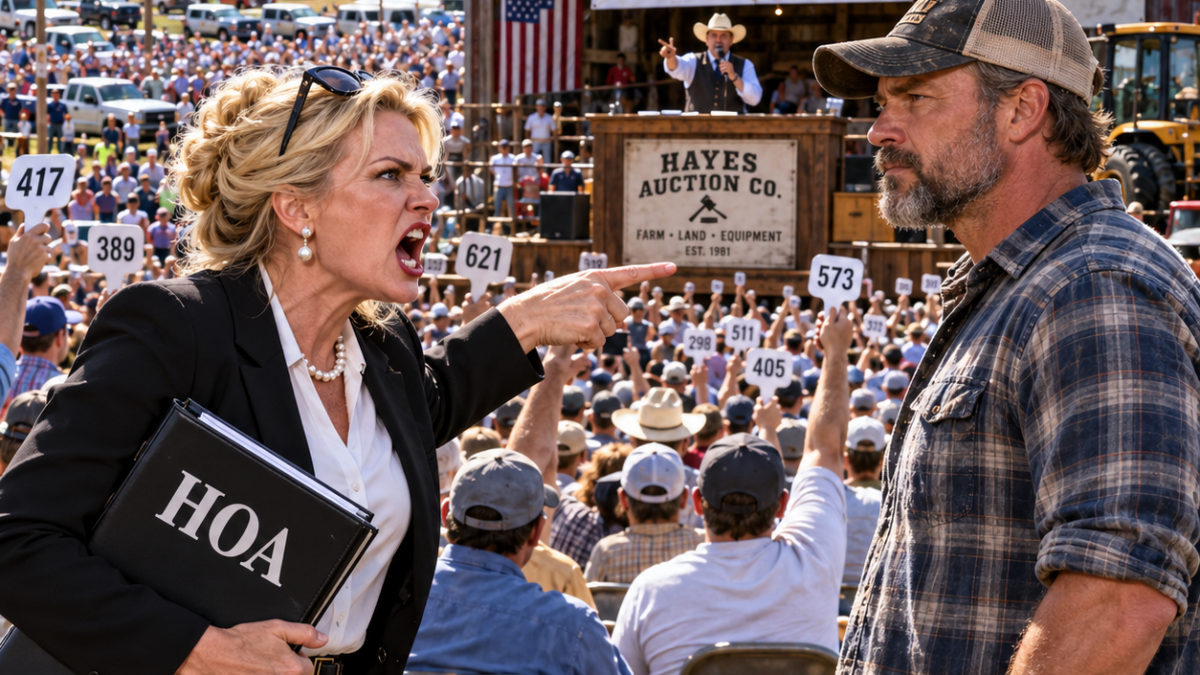
**600.**
People around the registration tent cheered.
I stared.
“Six hundred registered?”
“Six hundred registered bidders,” Big John said.
“Not spectators?”
“No.”
“How many people total?”
Marcus answered over the radio.
“More.”
“How much more?”
“Don’t ask questions you don’t need answered.”
The county road remained clear.
That was what mattered.
Later, the auction company’s final registration showed 612 bidders, with additional family members and spectators on the property.
Big John had been running auctions for thirty-two years.
He told me it was the largest registered crowd he had ever seen for a single-owner equipment estate sale in our county.
The newspaper later called it county history.
At ten sharp, Big John climbed onto the podium.
The yard settled.
He tapped the microphone.
“Morning, folks.”
Cheers.
He laughed.
“Good Lord.”
More laughter.
“My name is John Mercer. Some of you know me as Big John, and after breakfast most of you will understand why.”
The crowd laughed again.
“We are here for the final Miller & Son Equipment legacy auction.”
He looked toward me.
“Frank’s father spent more than fifty years buying, fixing, renting, maintaining, cussing at, and occasionally loving every piece of iron you see here.”
A few old contractors nodded.
“Today isn’t about junk.”
He paused.
“It’s about good machines finding their next job.”
That was exactly what Dad would have wanted.
The auction started with shop tools.
Then generators.
Attachments.
Compressors.
Trailers.
Bidding was aggressive almost immediately.
A portable welder beat estimate by forty percent.
Trenchers went high.
A backhoe I expected to sell around thirty thousand crossed forty-five.
I leaned toward Big John during a break.
“This is crazy.”
“No.”
He grinned.
“This is emotion plus scarcity plus good equipment.”
“Sounds like crazy.”
“Professional crazy.”
Then I saw Karen.
White SUV.
Three houses away.
She parked at the subdivision entrance.
Two board members stepped out with her.
All three walked toward my property line.
Karen wore a dark business suit in a field of denim, work boots, baseball caps, and sun-faded contractor shirts.
Her phone was already recording.
Marcus noticed.
“Want them stopped?”
“Not unless they cross the boundary and cause trouble.”
“Understood.”
Karen stood at the edge for almost twenty minutes.
People noticed her.
A few whispered.
One man shouted:
“Measure the bulldozer!”
Laughter.
I turned toward Marcus.
“Stop heckling if it escalates.”
He nodded.
“Already told the team.”
I did not want a mob.
I wanted an auction.
Karen apparently wanted both.
She crossed onto the property.
One board member followed.
The other stayed near the road.
Marcus moved closer but did not block her.
Big John was selling a loader.
“Thirty-eight, thirty-nine, forty, now forty-one—”
Karen approached the podium.
“Stop this!”
The loader bidding faltered.
Big John lowered his microphone.
“Ma’am, we’re conducting a sale.”
“You were ordered not to.”
“By whom?”
“The Whispering Pines Estates Homeowners Association.”
John looked toward me.
Here we go.
Karen raised her voice.
“This event is illegal.”
Somebody laughed.
She spun.
“Who did that?”
That made more people laugh.
Big John held up one hand.
“Folks, settle down.”
The crowd quieted surprisingly fast.
He looked at Karen.
“Do you have a court order?”
“I don’t need one.”
“You sure?”
“I am president of the association.”
“That wasn’t the question.”
Her face reddened.
“I have authority over this property.”
I stepped forward.
Big John gave me the microphone.
The yard became quiet.
Hundreds of faces.
Dad’s equipment behind me.
My daughter near registration.
Karen directly below the podium.
I had imagined this moment.
In the imagined version, I destroyed her verbally.
Reality made me calmer.
“Karen.”
She crossed her arms.
“You were provided with the county zoning records?”
“Our attorney disputes your interpretation.”
“Were you provided with County Ordinance 21A?”
“This property remains within Whispering Pines.”
“Were you provided with it?”
“Yes.”
“Thank you.”
I held up the certified copy.
“This property operated legally as Miller & Son Equipment decades before Whispering Pines Estates existed. The county has confirmed the use remains grandfathered.”
I held up the event permit.
“The county issued this permit.”
Then the zoning letter.
“The planning department verified the use.”
Then Karen’s attorney letter.
“And after receiving notice of the business history, the HOA threatened liens and an injunction if I held today’s sale.”
Karen pointed at me.
“You are misrepresenting everything.”
“Then show me the injunction.”
She stopped.
“Where is it?”
“You are knowingly violating covenants.”
“Do you have a judge’s order?”
Silence.
Big John leaned toward his microphone.
“Sounds like a no.”
The crowd laughed.
I turned.
“John.”
He raised both hands.
“Professional.”
Karen shouted:
“You people think this is funny?”
Nobody answered.
Her voice rose.
“This man has turned a private neighborhood matter into a circus!”
A contractor near the front called:
“We came for the D8!”
That got applause.
Karen snapped:
“Then buy your junk and leave!”
The word junk changed the mood.
Not because of me.
Because half the men and women standing there worked with machinery for a living.
Big John’s expression hardened.
Karen continued.
“You are all contributing to the destruction of this community.”
A woman near the registration tent shouted:
“He was here first!”
Karen pointed at her.
“You don’t even live here!”
“Nope!”
The woman smiled.
“That’s why I’m happy!”
Laughter rolled across the yard.
Karen lost control.
“You people are trash!”
The laughter stopped.
She looked around wildly.
“This entire event is illegal. Every one of you is trespassing. I will sue everyone involved.”
That was when Deputy Sutton appeared.
He had been stationed farther down the county road monitoring traffic.
He walked through the crowd slowly.
No urgency.
No drama.
Just uniform and authority.
“Ma’am.”
Karen turned.
“Thank God.”
That was almost funny.
She pointed toward me.
“Deputy, shut this down.”
Sutton looked at the crowd.
Then at the auction permit posted beside the registration table.
“No.”
Karen blinked.
“What?”
“This is a permitted private event.”
“The HOA has prohibited it.”
“That is a civil association matter.”
“He’s violating our rules!”
“I’m not here to enforce HOA rules.”
She stepped closer.
“I called your office yesterday.”
“Yes, ma’am. I spoke with you.”
“And I explained—”
“I also explained that you should not interfere with a lawful event.”
Karen’s mouth opened.
Sutton continued.
“You are currently on Mr. Miller’s property.”
“I have association authority.”
“Not police authority.”
He nodded toward the driveway.
“You’ve been told the event is proceeding. Mr. Miller, do you want her to leave?”
Every eye turned toward me.
I hated that.
This was the line.
Make it humiliation and the crowd would feast on it.
Make it simple and it ended.
“Yes.”
I looked at Karen.
“I’m asking you to leave my property.”
She stared at me.
“You’ll regret this.”
Sutton spoke.
“Ma’am.”
Karen looked at him.
“You can leave voluntarily, or I can escort you.”
Her two board allies backed away.
That hurt her more than anything I said.
Karen saw them moving.
“Where are you going?”
Neither answered.
For several seconds, she stood alone.
Then she turned.
People started booing.
I lifted the microphone.
“Stop.”
The crowd quieted unevenly.
“No booing.”
Someone shouted:
“She deserves it!”
“Maybe.”
I looked toward Karen’s back.
“But this is my father’s auction.”
That ended it.
She walked away in silence.
Sutton followed far enough to make sure she crossed the line.
Big John took the microphone from me.
He waited.
Then:
“Ladies and gentlemen.”
The crowd looked toward him.
“We had sixty thousand dollars on the Caterpillar before civics class started.”
Laughter exploded.
He pointed toward the D8.
“Now who’s got sixty-five?”
Hands went up.
The auction was alive again.
Sixty-five.
Seventy.
Seventy-two-five.
Seventy-five.
Two bidders remained.
One was a contractor from western North Carolina.
The other was a collector named Ray Holloway who had driven almost six hours.
At eighty thousand, the contractor hesitated.
Ray raised his card.
Eighty-two-five.
The contractor:
Eighty-five.
Ray:
Eighty-seven-five.
Big John worked them.
“Eighty-seven-five, now ninety, ninety, who says ninety—”
The contractor lifted his card.
“Ninety!”
The yard reacted.
Ray stared at the D8.
Then raised his number.
Big John pointed.
“Ninety-two!”
The contractor shook his head.
Big John gave him time.
“Sir?”
Another shake.
Big John lifted his hand.
“Ninety-two thousand once.”
I looked at Dad’s bulldozer.
“Ninety-two thousand twice.”
Orange HOA sticker still on the blade.
“Sold!”
The crowd erupted.
Ray Holloway came to me afterward.
“I’m leaving that sticker.”
“You are?”
“Absolutely.”
He held out his hand.
“I restore old Cats.”
“That one’s already restored.”
“I know.”
“Then why buy it?”
He looked toward the D8.
“My dad had a D8 when I was a kid.”
That answer was enough.
“Take care of her.”
“I will.”
Then he added:
“Your father did beautiful work.”
That nearly got me.
I nodded because speaking wasn’t an option.
The auction continued until late afternoon.
At four-thirty, Big John’s office manager brought me the preliminary sheet.
I stared.
“That’s wrong.”
“No.”
“John.”
“I checked it.”
The gross was nearly double my conservative estimate.
Not because every buyer overpaid in protest.
Many lots simply benefited from extraordinary competition.
Six hundred-plus registered bidders meant somebody almost always wanted the same machine somebody else wanted.
The county newspaper later confirmed the turnout was the largest single-owner equipment auction local reporters could document in recent county history.
Big John framed the clipping.
I did not.
By sunset, sold tags hung from nearly everything.
Sarah sat beside me on the porch.
“We did it.”
“Your grandfather did it.”
“You helped.”
“So did you.”
She held the settlement ledger.
“Tuition?”
“Covered.”
“All of it?”
“All remaining undergraduate tuition.”
Her eyes filled.
I continued.
“And if you decide graduate school makes sense, we’ll talk.”
She threw her arms around me.
For the first time that day, I let myself cry.
Not when Karen left.
Not when the D8 sold.
Not when Big John showed me the total.
Then.
Because Dad used to say the entire reason he worked was so the next generation could choose work instead of having it choose them.
Sarah could choose.
The yard emptied over the next two weeks.
Machines left one by one.
The loader.
Backhoe.
Graders.
Trailers.
Excavators.
Buyers arrived with trucks.
Engines started.
Diesel smoke lifted.
Then another piece of Dad disappeared down the road.
I kept his toolbox.
The wooden Miller & Son sign.
A small 1950s bench vise.
His grease-stained ledger from the first year of business.
And an old photograph of him standing beside the D8.
Everything else went where it could work again.
Karen’s defeat at the auction did not end the legal dispute.
If anything, it made the neighborhood finally pay attention.
Dave filed suit on my behalf after the HOA refused to rescind the improper fines and threats.
The claims centered on interference with the lawful auction, improper enforcement, and the expenses caused by their conduct.
We did not sue every board member for a million dollars.
We did not demand Karen’s house.
We asked for documented losses, fees where recoverable, invalidation of improper penalties, and additional relief supported by the facts.
Dave insisted on precision.
“Winning big feels good,” he told me. “Winning clean feels better.”
The association’s insurer appointed counsel.
That lawyer was different from Karen.
He read.
Asked questions.
Reviewed the zoning history.
Interviewed board members.
Within weeks, his tone shifted.
One afternoon Dave called.
“The insurer wants mediation.”
“Why?”
“Because their defense is expensive and the land-use issue is bad.”
“Karen?”
“Still furious.”
“Does she control settlement?”
“Not entirely.”
That was new for her.
Meanwhile, homeowners organized.
The next board meeting had more than eighty people.
Usually twelve showed up.
Karen did not.
Her chair sat empty.
Gerald, one of her allies, called the meeting to order.
Before he reached the landscaping report, Mark Thompson stood.
“Where is President Peterson?”
Gerald shuffled papers.
“She has tendered her resignation effective immediately.”
The room went quiet.
Then Mrs. Gable whispered:
“Oh.”
Not triumphant.
Almost surprised.
Mark held up a petition.
“We have signatures from more than two-thirds of association households requesting the remaining board members resign.”
Gerald went pale.
“We have not reviewed—”
Dave stood at the back.
“You can verify every signature.”
Another homeowner called:
“Resign!”
Then another.
“We’ve had enough!”
Gerald tried to continue.
Nobody let him.
Finally, he requested a five-minute recess.
The remaining directors huddled in the side room.
Ten minutes later they returned.
Gerald read from a handwritten sheet.
“In light of recent events and loss of confidence from the membership, the remaining directors hereby tender our resignations effective upon appointment of interim replacements.”
Applause filled the room.
No screaming.
No gavel throwing.
Just relief.
Dave was nominated president.
He immediately objected.
“I have spent thirty years trying to retire from people asking me legal questions.”
Mrs. Gable shouted:
“You’re already here!”
The room laughed.
He lost the vote unanimously.
His first motion recognized all lawful preexisting property uses protected under county law and required legal review before future enforcement against grandfathered parcels.
Passed.
Second:
Suspend questionable fines issued under the prior board pending review.
Passed.
Third:
Authorize settlement discussions in my case.
Passed.
Fourth:
Create a committee to rewrite vague enforcement provisions.
Passed.
Then Mrs. Gable raised her hand.
Dave sighed.
“Yes, Mrs. Gable?”
“My gnomes.”
The room laughed again.
Dave smiled.
“Your gnomes will receive due process.”
“They’re innocent.”
“We will presume that.”
The lawsuit settled a few weeks later.
The HOA canceled every fine against my property.
Reimbursed documented legal expenses and auction-related costs attributable to the interference.
Its insurer funded the principal settlement amount.
The association issued a written acknowledgment that the auction and preexisting business activity were legally protected.
No admission that Karen was an evil dictator.
No dramatic courtroom confession.
No judge pounding a gavel.
Just signatures.
Checks.
Corrected records.
Sometimes that is what winning looks like.
Karen sold her house.
I never spoke with her again.
Months later, I heard through someone else that she believed I had turned the neighborhood against her.
For a while, that irritated me.
Then Dave said:
“You didn’t turn anyone.”
“What?”
“She spent years making deposits.”
He counted on his fingers.
“Gnome fine. Basketball hoop. Garden. Mustang. Trash cans. Paint colors. Your auction.”
He closed his hand.
“You were simply the withdrawal.”
That was Dave.
Annoyingly good with words for a lawyer.
The new board audited prior enforcement.
Not everything disappeared.
Some violations had been legitimate.
A homeowner actually had abandoned a broken car on blocks for two years.
Another had built a shed directly across a utility easement.
Dave refused to overcorrect.
“We are not replacing arbitrary enforcement with no enforcement.”
That mattered.
The community gradually trusted the process because people saw that rules could exist without humiliation.
Mrs. Gable’s fines were rescinded.
Her gnomes returned.
All of them.
Mark Thompson left the basketball hoop in place until sunset one evening just because he could.
Then his sons forgot to put it away.
The next morning Dave walked past.
Mark called:
“You fining me?”
Dave looked at the hoop.
“No.”
“Why?”
“Because I’m not insane.”
By spring, the equipment yard behind my house was almost unrecognizable.
Ten acres that had spent half a century holding machines suddenly held grass.
At first, the emptiness hurt.
I woke some mornings expecting to see Dad’s service truck.
Nothing.
I would listen for engines that were no longer there.
Nothing.
The silence made his absence feel newer.
One Saturday, Sarah came home from school.
She found me sitting beside the old shop.
“You okay?”
“Yeah.”
“Lie.”
I looked at the empty yard.
“I thought selling everything would feel like finishing.”
“And?”
“It feels like erasing.”
She sat beside me.
“Grandpa wanted the auction.”
“I know.”
“He told me.”
I turned.
“When?”
“Last year.”
Dad had kept the worst details of his cancer from Sarah for as long as possible.
“What did he say?”
“That you’d try to keep too much because you’re sentimental but pretend you’re practical.”
“That sounds insulting.”
“It was affectionate.”
“Barely.”
She smiled.
“He said machines are supposed to work.”
I looked toward the empty gate.
“Yeah.”
“He said if they sit around because we’re afraid to let go, they stop being what they were built to be.”
That was exactly him.
Then Sarah said:
“And he said the land would be yours to figure out.”
I swallowed.
“He tell you what to do with it?”
“No.”
“Typical.”
“Maybe he trusted you.”
“That seems irresponsible.”
She leaned against me.
We sat there until sunset.
The following week, Ray Holloway sent me a photograph.
Dad’s D8 at a vintage equipment show.
Orange HOA violation sticker still on the blade.
Beside it, Ray had placed a little sign:
**1968 CAT D8H — MILLER & SON RESTORATION**
Nothing about Karen.
Nothing about the auction drama.
Just Dad’s name.
I printed it.
That one I framed.
Big John kept calling.
“You’re famous.”
“I’m not.”
“County auction record.”
“Your record.”
“Our record.”
“I want no part of your marketing.”
“Too late.”
The official numbers were impressive.
612 registered bidders.
Hundreds more visitors and family members.
Buyers from four states.
Nearly every major lot exceeded reserve or estimate.
Dad’s D8 brought $92,000.
The gross total nearly doubled our conservative projection.
After auction fees, taxes, estate costs, and obligations, the result was still more than enough to fully fund Sarah’s remaining college education and strengthen my retirement.
But numbers weren’t what stayed with me.
What stayed was bidder 600 being handed a handwritten card because Big John ran out.
Mrs. Gable putting cookies beside the registration table.
Marcus calmly keeping an emergency lane clear while hundreds of trucks came through.
Deputy Sutton refusing to let a private title become public authority.
Ray saying his father owned a D8.
Sarah crying when I told her tuition was covered.
Those were the parts I remembered.
Sarah graduated two years later.
When she crossed the stage, I stood before they called her name.
Probably too early.
Definitely too loud.
She found me afterward.
“You embarrassed me.”
“Good.”
“Grandpa would’ve been worse.”
“Much worse.”
She looked at the diploma.
“He paid for this.”
“He helped.”
“So did you.”
“No.”
“Dad.”
I stopped.
She had the same look she used at the kitchen table when I tried to make money sound magical.
“Okay.”
I nodded.
“We did.”
She hugged me.
We took a photograph outside the auditorium.
Later, I put it beside Dad’s D8 picture in my office.
The two photographs told the entire story better than any lawsuit.
One generation built.
The next let go.
The one after that moved forward.
Whispering Pines changed too.
Dave served two years as president and refused a third.
His retirement party from the HOA consisted of Mrs. Gable presenting him with a ceramic gnome dressed like an attorney.
The gnome carried a tiny briefcase.
Dave stared at it.
“I represented Fortune 500 companies.”
Mrs. Gable smiled.
“And now you represent him.”
Dave kept it.
Mark Thompson eventually joined the board.
He lasted nine months.
His sons thought that was hilarious.
The vegetable garden family expanded their garden and started giving away tomatoes.
The Mustang owner finished his restoration.
He drove it through the neighborhood on Sundays.
Nobody accused him of operating an auto shop.
The new board simplified the covenants.
Subjective phrases like “activities deemed inappropriate” were narrowed or removed.
Enforcement standards became specific.
Hearings occurred before serious fines.
Board votes went into recorded minutes.
Vendor spending became transparent.
Legal counsel reviewed unusual property-rights questions before threatening homeowners.
That last one was informally called the Miller Rule.
I hated the name.
Everyone else loved it.
Five years after the auction, the old equipment yard looked like a meadow.
I kept the shop.
Converted part into a woodworking space.
The faded Miller & Son Equipment sign hung inside over my bench.
I could have restored it.
I never did.
The cracked paint was Dad.
One autumn afternoon, a truck pulled into my driveway.
I walked outside.
Ray Holloway climbed down.
“Hope I’m not interrupting.”
“Everything okay with the D8?”
“Better than okay.”
He handed me an envelope.
Inside was a photograph.
Dad’s bulldozer working.
Not at a show.
Moving dirt.
I stared.
“You use it?”
“Occasionally.”
“It’s sixty years old.”
“So am I.”
Fair.
He continued.
“My grandson’s learning equipment.”
The photograph showed a teenage boy in the cab.
“He knows what it is?”
“He knows whose it was.”
That mattered more than I expected.
Ray looked toward the empty field.
“Miss it?”
“Sometimes.”
“You want it back?”
I laughed.
“No.”
“Good.”
“Why?”
“Would’ve been a long drive.”
We had coffee on the porch.
Ray told me about his father.
I told him about mine.
No HOA.
No lawsuits.
Just men and machines.
After he left, I walked into the field.
There was one spot where the D8 had sat for so many years that the soil stayed compacted longer than the rest.
Grass grew differently there.
Fainter.
Thinner.
You had to know where to look.
I stood on that patch.
Dad used to tell me land remembered everything you did to it.
At the time, I thought he meant drainage.
Compaction.
Foundations.
He was an equipment man.
Practical.
Years later, I wondered if he meant more.
The land remembered his business.
Not because the machines remained.
Because people did.
Contractors who learned on his equipment.
Farmers he helped after storms.
Customers he gave extra time to when they were broke.
A retired Marine lawyer who remembered a generator.
An auctioneer who refused to let the final sale become ordinary.
A daughter whose education came partly from fifty years of iron being converted into opportunity.
Even Whispering Pines remembered him.
Every time the board opened the governing documents and saw the section on grandfathered property uses, my father was there in a way.
Not his name.
His foresight.
Karen had seen an ugly equipment yard trapped inside her perfect subdivision.
She wanted it erased.
What she never understood was that the yard had a history longer than her authority.
You cannot issue a violation against history and expect history to disappear.
The county recognized that.
The law recognized that.
Eventually, the neighborhood recognized it too.
One evening, Sarah visited with her fiancé.
That was an adjustment.
His name was Ben.
Good kid.
Nervous around me for the first six months.
For reasons I considered healthy.
We sat on the porch overlooking the old yard.
Sarah pointed.
“We were thinking.”
Dangerous phrase.
“About?”
“The wedding.”
I waited.
She looked toward the meadow.
“We want it here.”
I stared.
“Here?”
“Grandpa’s property.”
“Why?”
She looked at me like I had asked why people breathed.
“Because this is home.”
Ben said:
“We’d keep it simple.”
“No.”
He froze.
Sarah frowned.
“No?”
“No keeping it simple.”
I stood.
“If we’re doing a wedding on this land, we’re doing it properly.”
Sarah smiled.
“There he is.”
“Parking plan.”
“Dad.”
“Tents.”
“Dad.”
“Backup weather plan.”
“Dad.”
“Emergency access.”
Ben started laughing.
I pointed at him.
“Don’t encourage her.”
The wedding happened the following spring.
Not six hundred people.
Thank God.
One hundred and twelve.
The old equipment field held white chairs instead of bulldozers.
String lights.
Tables.
Wildflowers similar to the ones Karen once cited as improper landscaping.
Mrs. Gable attended with her daughter.
Dave came.
Mark Thompson.
Big John.
Deputy Sutton, who had become a friend of Dave’s.
Marcus handled no security because Sarah explicitly prohibited me from turning the wedding into a military operation.
He came anyway.
As Sarah walked across the field toward me, I thought about the auction morning.
Trucks lined down the road.
Diesel smoke.
Bid cards.
Karen screaming.
Dad’s D8 shining in the sun.
That day had felt enormous.
Historic.
Six hundred bidders.
County headlines.
Legal victory.
But standing there waiting to walk my daughter down the aisle, I understood something.
The auction had never been the ending.
It was a bridge.
Dad’s life into Sarah’s future.
His machines into tuition.
His land from business into home.
One purpose into another.
Sarah reached me.
“You crying?”
“No.”
“You are.”
“Dust.”
“There’s grass.”
“Pollen.”
She hooked her arm through mine.
“You ready?”
I looked toward the empty field where Dad once parked a dozen machines.
Then toward Ben.
“Not remotely.”
She laughed.
“Good enough.”
We walked.
Years later, people still occasionally mentioned the auction.
Someone at the feed store would say:
“You’re the guy with six hundred bidders.”
“Apparently.”
“That HOA lady tried to stop you?”
“Yes.”
“What happened to her?”
“Moved.”
“That’s it?”
“That’s enough.”
Because it was.
Karen did not need to remain the villain in every chapter after she left.
Her power ended when people stopped lending it to her.
That was consequence enough for the story I wanted to live.
The property remained outside restrictive commercial-use enforcement because its legal status had finally been clarified.
But I never restarted Miller & Son Equipment.
I didn’t need to.
Part of the acreage stayed meadow.
Part became garden.
I planted oak trees along the far boundary.
Built a small pavilion where Sarah had married.
The old shop remained.
The Miller & Son sign stayed above my workbench.
One Saturday morning, years after everything ended, I heard an engine outside.
Deep.
Old diesel.
For one irrational second, I thought the D8 had come home.
I walked outside.
A flatbed truck was slowing near the property.
On the trailer sat an old Caterpillar.
Not ours.
Different model.
Different paint wear.
But the sound hit me square in the chest.
The driver waved and kept going.
I stood in the driveway until the sound faded.
Then I looked across the grass.
No equipment.
No bidders.
No HOA president.
No orange sticker.
Just land.
My father’s land.
My land.
Someday, maybe Sarah’s.
The place had survived every version of itself.
Farm soil.
Equipment yard.
Auction ground.
Wedding field.
Home.
I went back into the shop.
Dad’s toolbox sat beneath the bench.
I opened the top drawer.
Wrenches exactly where I kept them.
Not where he had.
That used to bother me.
It didn’t anymore.
I took out a socket wrench, closed the drawer, and looked up at the faded wooden sign.
**MILLER & SON EQUIPMENT**
The “S” had almost disappeared.
I could have repainted it.
I still didn’t.
Outside, wind moved through the grass where six hundred bidders once stood shouting numbers beneath a Carolina sky.
The noise was gone.
The machines were gone.
Dad was gone.
But nothing important had been erased.
I finally understood that.
I turned back to my workbench and started building something new.
[END OF STORY]








