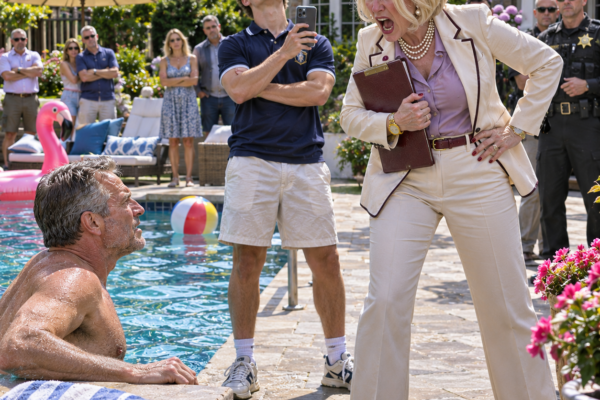
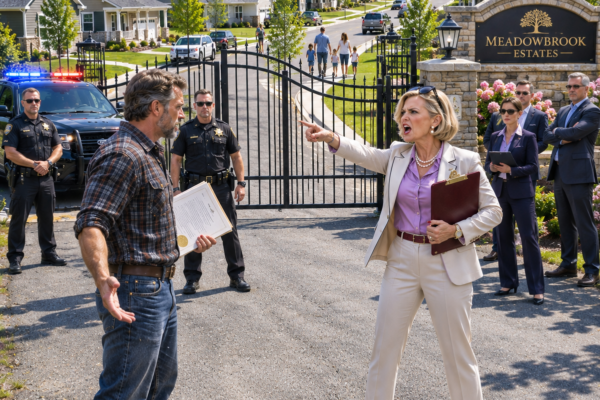
PART 2: HOA Tried to Seize My Ranch at Dawn—They Didn’t Know Federal Warrants Had Already Been Signed
PART 2
The convoy was still three miles away when one of Evelyn’s security men grabbed Ray by the shoulder.
Ray didn’t resist.
That mattered.
Everything about that morning mattered.
His hands stayed visible.
His voice remained level.
He let them pull his wrists behind him.
Let them tighten a plastic restraint around him.
And never once gave them an excuse to turn their intimidation into something worse.
Evelyn walked closer.
“There,” she said. “Perhaps now you understand that this situation has moved beyond discussion.”
Ray looked down at the zip tie.
Then at her.
“No, ma’am.”
“What?”
“I understand you’ve just made your problem significantly larger.”
Her expression tightened.
She had always hated calm people.
Anger she understood.
Fear she enjoyed.
Calm felt like disrespect.
Behind her, the yellow front-end loader moved closer to our boundary fence.
Its diesel engine growled across the pasture.
Two dump trucks waited behind it.
Evelyn pointed toward the gate.
“Remove the obstruction.”
Ray stared at her.
“That gate is on private property.”
“We dispute the boundary.”
“The county doesn’t.”
“Our surveyor does.”
“Your surveyor moved the stakes.”
Evelyn’s eyes narrowed.
“That is a defamatory accusation.”
Ray smiled faintly.
“There are cameras.”
For the first time that morning, she hesitated.
Only a fraction of a second.
Then arrogance rescued her.
“You people put cameras everywhere.”
“You people?”
“Farm employees.”
“I’ve managed this ranch twenty-six years.”
“Then you should have convinced your employer to accept reality.”
Ray glanced toward the road behind her.
“He did.”
That confused her.
“He said no.”
“That isn’t reality.”
“To him it is.”
Evelyn stepped closer.
“You know what your employer’s problem is?”
Ray waited.
“He believes ownership gives him absolute control.”
Ray actually laughed.
Evelyn’s face hardened.
“What exactly is funny?”
“You’re standing on his land saying that.”
Twenty minutes earlier, she had arrived convinced she was conducting a lawful seizure.
Her so-called emergency community protection order claimed the ranch posed an immediate threat to Ridgeline residents.
Dust.
Noise.
Road damage.
Boundary encroachment.
Livestock odors.
The same complaints she had manufactured for fourteen months were now bundled into one document with a gold foil seal.
There was no judge’s signature.
No county authority.
No statutory reference that survived even a basic search.
Just a declaration written by a private homeowners association pretending to be government.
Ray had asked one question.
“Which court issued this?”
Evelyn answered:
“The Ridgeline executive board.”
That told him everything.
Her security chief, Marcus Vale, knew better.
I could see it even through the camera.
He had worked as a private investigator before taking Ridgeline’s lucrative security contract.
He understood warrants.
Jurisdiction.
Probable cause.
He understood a homeowners board couldn’t authorize armed detention on land it did not own.
But he also understood who signed his checks.
For months, he had lived inside the gray space between aggressive private security and outright criminal conduct.
That morning Evelyn pushed him across the line.
“Secure the office,” she ordered.
Marcus hesitated.
“Evelyn.”
Her head turned sharply.
That was the first time I had ever heard him use her first name during an operation.
“We’ve contained the gate.”
“I said secure the office.”
“We don’t have authority to enter structures.”
She lowered her voice.
“You told me your team could handle this.”
“We can handle security.”
“This is security.”
“No. Entering buildings—”
“Do I need somebody else running this team?”
Marcus’s jaw tightened.
There it was.
The moment a professional decides whether a paycheck is worth becoming an accomplice.
He chose badly.
“Move,” he told two guards.
They headed toward the ranch office.
From inside the federal command vehicle, I watched.
Director Laura Evans sat across from me.
She had taken control of the task force when I formally disclosed my personal interest months earlier.
I was a witness.
Property owner.
Victim.
Not case supervisor.
That separation was deliberate.
Necessary.
And it was the reason Evelyn’s later claim that I had used federal power for personal revenge went nowhere.
Evans looked at the screen.
“If they force entry, you stay here.”
“I know.”
“Daniel.”
“I said I know.”
“You have employees zip-tied fifty yards from your barn. I understand exactly how badly you want out of this vehicle.”
I watched a guard approach the office.
“You don’t understand exactly.”
Evans nodded.
“Fair.”
One of our agents said:
“Two minutes.”
I looked at the second screen.
Task-force vehicles moving.
FBI.
U.S. Marshals Service personnel.
Financial-crimes investigators.
State support farther back.
Search teams already staging near Ridgeline’s administration building three miles east.
Everything that had taken months to prepare was converging on the exact morning Evelyn decided to invade my ranch.
People later called it coincidence.
Partly.
But not entirely.
We knew she was escalating.
We knew she had rented heavy equipment.
We knew her security contractor had expanded staffing.
We just didn’t know she would choose that Wednesday.
The warrants had been signed the previous evening.
Execution scheduled for six-thirty.
Evelyn arrived at six.
She essentially volunteered to provide a live demonstration of the behavior described in the affidavits.
One minute.
The office camera showed two guards entering.
The door had not been locked.
Ray had left it that way deliberately.
That decision had generated an argument between us.
“You want them inside?” I had asked.
“No.”
“Then lock it.”
“I want the cameras to see what they choose.”
That sounded like something I would say.
Which annoyed me.
The ranch office was small.
Wood siding.
Tin roof.
Two rooms.
Desk.
Files.
Coffee machine that looked older than some deputies I had trained.
Nothing classified.
Nothing operationally sensitive.
We had removed anything unrelated to the case.
One item remained deliberately visible on Ray’s desk.
A thick manila folder.
RIDGELINE ACCESS PROJECT.
The folder contained copies.
Not originals.
Evidence already preserved elsewhere.
Payment records investigators had lawfully obtained.
Photographs.
Email printouts.
Surveyor information.
Nothing whose destruction could damage the prosecution.
But to Evelyn, it would look terrifying.
Because much of it concerned her.
The office camera captured the guards searching.
Drawers.
Cabinets.
Then Evelyn entered.
Evans leaned toward the monitor.
“She entered voluntarily?”
“Yes.”
“No one invited her?”
“No.”
Camera one showed her approaching the desk.
She saw the folder.
Stopped.
Looked over her shoulder.
Then opened it.
I watched her face.
People often ask investigators how you can tell when a suspect recognizes incriminating evidence.
There is no magic expression.
Sometimes nothing changes.
Sometimes everything does.
Evelyn’s mouth tightened.
Her shoulders rose.
She turned the first page.
Payment ledger.
A shell company.
Surveyor payment.
Next page.
Still images from my cameras.
Ridgeline security moving boundary stakes at 2:14 a.m.
Next.
Email excerpts between her and representatives of Crestline Development.
One subject line:
NORTHERN PASTURE ACQUISITION.
Her hand began moving faster.
Then she did exactly what investigators hoped she would not do but had planned for if she did.
She closed the folder.
Put it inside her designer bag.
And walked out.
Evans said:
“That’s enough.”
The agent beside the radio transmitted one word.
“Execute.”
The first sound Evelyn heard was engines.
Not the front-end loader.
Not her SUVs.
Ours.
Vehicles emerged from two approaches along the county road.
Her contractors turned.
Marcus Vale saw them.
Even on camera, his reaction was immediate.
He knew.
A real tactical response looks different from private intimidation.
Vehicles occupied lanes with purpose.
Agents exited under coordinated commands.
Markings visible.
Weapons controlled.
No theatrical shouting.
No improvisation.
Marcus raised both hands.
“Everybody stand down!”
One of his guards looked toward Evelyn.
She screamed:
“Hold your positions!”
Marcus shouted louder.
“STAND DOWN!”
Weapons went to the ground.
The loader operator shut off his engine.
One dump truck driver opened his door and stepped out with both hands raised.
My workers remained against the fence.
Ray looked toward the road.
Then smiled.
I exited after the perimeter was secure.
Not first.
That matters too.
Movies love the image of the owner leading the charge.
Real operations have plans.
I followed the arrest team after the scene commander signaled.
Tactical vest.
Badge visible.
Duty weapon secured.
Thirty years of federal service doesn’t make you immune to emotion.
Walking onto my own ranch and seeing employees with zip ties around their wrists tested every ounce of discipline I had.
I went to them first.
Eli Carson’s wrists were red.
Tomás Alvarez had blood where the plastic edge had cut skin.
Ray looked annoyed more than injured.
I nodded toward an agent.
“Cut them.”
Trauma shears opened the ties.
Eli rubbed his hands.
“You all right?”
“Yeah.”
“Anybody hit?”
“No.”
“Threatened?”
“Depends what you call those guns.”
“We’ll get statements.”
Tomás looked past me.
“Boss.”
“Yeah?”
“Who the hell are you?”
Despite everything, I almost laughed.
My employees knew I had worked federal law enforcement.
They did not know much more.
I preferred it that way.
“Still the guy signing your checks.”
Tomás looked at the badge.
“Your retirement job is weird.”
Ray rubbed his wrist.
“Told her she picked the wrong morning.”
I looked at him.
“You enjoy that?”
“Immensely.”
Then I turned.
Evelyn stood near her SUV between two agents.
Her bag remained over her shoulder.
Her face was unreadable.
I walked toward Marcus first.
He had been separated from his team.
Hands visible.
An FBI agent stood beside him.
“Mr. Vale.”
He looked at my badge.
Then my face.
“You’re federal.”
“Yes.”
“You own this?”
“Yes.”
He closed his eyes.
“You have got to be kidding me.”
“No.”
“I was told you were a retired government employee.”
“That’s technically accurate.”
“You’re a marshal?”
“Supervisory deputy.”
His face lost more color.
I asked:
“Do you have a warrant authorizing detention of my employees?”
“No.”
“Court order?”
“No.”
“Statutory authority?”
He looked toward Evelyn.
“No.”
“Did anyone represent to you that one existed?”
“Yes.”
“Who?”
He hesitated.
The agent beside him said:
“You should consider counsel before giving a detailed statement.”
Good agent.
Marcus nodded.
“Her.”
He indicated Evelyn.
“She told us association counsel approved the operation.”
I looked at Evelyn.
She shouted:
“He’s lying!”
Nobody responded.
I asked Marcus one last question.
“Were you aware my ranch was outside Ridgeline covenants?”
His jaw worked.
“I was told the boundary was legally disputed.”
“Were you shown a court filing establishing association control?”
“No.”
I stepped back.
“Thank you.”
The investigation team handled him from there.
Then Evelyn called my name.
“Mercer!”
I turned.
Her face was red.
“You set this up.”
I walked toward her.
“No.”
“You knew we were coming.”
“I knew something was coming.”
“You left that file.”
“Yes.”
Her eyes widened.
“You entrapped me.”
“Did anyone ask you to enter the office?”
“You left the door unlocked.”
“Yes.”
“Did anyone tell me I couldn’t enter?”
I stared at her.
“It’s a privately owned ranch office.”
“I was exercising emergency authority.”
“Show me the statute.”
Her mouth tightened.
“You know exactly what the order says.”
“The one your board wrote?”
“It was legally ratified.”
“By your HOA.”
“Ridgeline has authority to protect residents.”
“Not over my land.”
“The boundary is disputed.”
“No.”
I looked toward the survey pin.
“The boundary is recorded.”
“You refused arbitration.”
“Your HOA has no power to compel arbitration with a nonmember over land it doesn’t own.”
She stepped closer.
An agent stopped her.
Evelyn pointed at my vest.
“This is abuse of office.”
“I recused myself from the investigation months ago.”
“You’re standing here armed.”
“On my ranch while federal warrants are executed by an independent team.”
Her expression shifted.
The word warrants finally landed.
“What warrants?”
Evans approached.
She carried the packet.
“Evelyn Harrow?”
Evelyn looked from her to me.
“Yes.”
“I’m Supervisory Special Agent Laura Evans. We have federal arrest and search warrants related to an ongoing financial-crimes investigation.”
Evelyn laughed.
Too loudly.
“You expect me to believe this?”
Evans held up the first page.
“You’ll receive copies through counsel.”
“This is because of him.”
“No.”
“He has been harassing our association.”
Evans remained still.
“The investigation predates today’s incident.”
Evelyn’s confidence began to fracture.
Then I asked the question I had been waiting to ask.
“What did you take from my office?”
Her hand went to the bag strap.
Instinct.
Camera captured it.
So did three agents.
“I didn’t take anything.”
“You entered.”
“For lawful inspection.”
“You opened my files.”
“Your manager possessed association records.”
“Which records?”
She stopped.
I waited.
She realized the problem.
If she named the contents, she admitted knowing what was in the folder.
“I don’t know.”
“You just said they belonged to your association.”
“I assumed.”
“Based on?”
She looked toward Evans.
“I’m done answering questions.”
Good decision.
Evans nodded.
“You have that right.”
A female agent stepped forward.
The bag was seized pursuant to the search and arrest procedures already authorized and the events just witnessed.
Evelyn protested.
Then stopped when the folder emerged.
RIDGELINE ACCESS PROJECT.
Eli whispered behind me:
“Oh, damn.”
The agent opened it.
Payment spreadsheet.
Images.
Emails.
Evelyn stared.
Then made the mistake prosecutors would later replay.
“That ledger was stolen from my office.”
Silence.
Evans looked at her.
“You recognize it?”
Evelyn realized what she had said.
“I—”
“You just identified the contents as belonging to you.”
“No.”
“Did you create those records?”
“I want my lawyer.”
“Understood.”
Evans signaled.
Handcuffs came out.
Evelyn stared at me.
“You ruined my life.”
I said nothing.
“You hear me?”
I finally answered.
“This investigation existed because of decisions you made long before today.”
“You put that folder there.”
“Yes.”
“You wanted me to steal it.”
“No.”
“What else would I do?”
That question told me more about her than any ledger.
What else would I do?
Leave it.
Call a lawyer.
Request discovery.
Seek an injunction.
Walk away.
There had been dozens of lawful choices.
She could not imagine them anymore.
Evelyn’s entire worldview had narrowed to control.
If something threatened her, take it.
If someone refused, pressure them.
If records contradicted her, alter them.
If a boundary stood in her way, move it.
If a man said no, make the cost of no unbearable.
She had spent three years succeeding.
That was the tragedy of unchecked power.
It teaches the wrong lesson right up until consequence arrives.
The cuffs closed.
Marcus Vale watched.
Then said:
“I want to cooperate.”
His attorney would negotiate the details later.
But his loyalty to Evelyn ended at the sound of steel.
A second federal team executed warrants at Ridgeline’s administrative building.
The association office sat beside a private clubhouse on manicured acreage.
Glass doors.
Stone columns.
Water feature.
Everything my ranch office was not.
Investigators seized servers.
Financial records.
Corporate files.
Backup drives.
Phones.
Computer images.
Evelyn’s private office contained locked cabinets.
One held what became known in discovery as the Ridgeline Expansion binder.
Color-coded tabs.
My northern pasture.
Crestline Development.
Land acquisition.
Legal-pressure strategy.
Security escalation.
Projected development revenue.
It was astonishing.
Not because criminals never keep records.
They do constantly.
Because Evelyn had documented ambition as though she were writing a business-school case study.
Step One: voluntary acquisition.
Step Two: regulatory pressure.
Step Three: boundary challenge.
Step Four: access restriction.
Step Five: temporary possession.
Temporary possession was highlighted.
A note beneath it read:
Once physical access is established, owner bears burden/cost of removal.
That sentence explained everything.
She never intended to win honestly.
She intended to make resistance expensive.
The association’s attorney, Rebecca Shaw, arrived during the search with her own lawyer.
Rebecca had worked quietly with investigators for months.
She provided encryption keys.
Email archives.
Billing irregularities.
Copies of altered legal drafts.
She looked exhausted when I saw her later.
“You’re Mercer?”
“Yes.”
“I’m sorry.”
“For what?”
“I drafted some of the early letters.”
“Before you knew?”
She nodded.
“I thought it was an aggressive boundary dispute.”
“When did that change?”
“When Evelyn ordered me to reference an easement that didn’t exist.”
“What did you do?”
“Refused.”
“And?”
“She rewrote it herself.”
Rebecca looked toward the Ridgeline office.
“I should have left sooner.”
“Instead you stayed long enough to preserve evidence.”
She shook her head.
“I stayed because I was afraid.”
“That doesn’t make the evidence less real.”
That was something I learned over decades.
Courage is often retroactive in memory.
People tell themselves they acted bravely.
In reality, most whistleblowers are terrified.
Most victims hesitate.
Most witnesses calculate risk.
Courage is action while those feelings exist.
Rebecca had risked her license.
Career.
Income.
Potential retaliation.
She stayed long enough to document the truth.
That mattered.
The search uncovered more than the ranch scheme.
Millions in association funds had been routed through shell companies.
Some money paid lawyers and vendors connected to legitimate Ridgeline operations.
Some did not.
Forensic accountants traced transfers into accounts associated with Evelyn.
Offshore structures.
Consulting entities.
Property deals.
Personal expenses disguised through development-related vendors.
The ranch conflict was only one branch of a much larger tree.
Residents learned that after the indictments became public.
The initial federal case charged conspiracy, fraud, money laundering, extortion-related conduct, and evidence tampering among other offenses tied to specific defendants.
The exact charges changed as defendants cooperated and prosecutors refined the case.
What did not change was the evidence.
Survey maps altered.
Notary marks forged.
Shell corporations.
Money movements.
Security directives.
My property files.
And Evelyn walking into my office and carrying out a dossier that directly documented activity she later claimed she knew nothing about.
Crestline Development panicked.
Their CEO released a statement saying rogue consultants acted without senior authorization.
Then agents recovered emails involving senior executives.
Statement revised.
Two executives obtained separate counsel.
A third cooperated.
The project collapsed.
Funding partners withdrew.
Permitting froze.
The access road disappeared from future development maps.
My northern pasture remained exactly what it had been when Evelyn first offered to buy it.
Grass.
Cattle.
Wind.
No luxury commercial corridor.
That mattered more to me than prison sentences.
Still, consequences came.
Marcus Vale pleaded to charges arising from the armed operation and provided extensive testimony.
He explained private security meetings.
Evelyn’s directives.
False claims that attorneys had approved detention.
Instructions to “create facts on the ground.”
That phrase came up repeatedly.
Create facts on the ground.
He said Evelyn used it whenever legal ownership became inconvenient.
“If we occupy the access point,” she had told him, “Mercer will have to fight to get it back.”
That was the plan.
Do something illegal first.
Make the victim pay to undo it.
It works disturbingly often.
Not everyone has lawyers.
Not everyone understands procedure.
Not everyone can afford months in court.
Evelyn thought my ranch would become another property exhausted into surrender.
She did not understand two things.
First:
I had spent a career believing procedure mattered precisely when emotion was strongest.
Second:
Someone inside her own organization still possessed a conscience.
Without Rebecca, the case would have taken longer.
Maybe much longer.
People love lone-hero versions of stories.
They are cleaner.
Less true.
I preserved evidence.
Ray kept employees safe.
Rebecca copied records.
Financial analysts followed money.
Grand jurors listened.
Prosecutors built cases.
Agents executed warrants.
Judges reviewed applications.
Witnesses testified.
My ranch hands cooperated even after being terrorized.
No one person defeated Evelyn.
Systems did.
Ironically, the same thing she had spent years trying to counterfeit.
The first time I testified before the grand jury, a prosecutor asked why I had not responded more aggressively to Ridgeline’s early harassment.
“I did respond.”
“How?”
“I documented it.”
“Why not sue immediately?”
“I considered it.”
“What stopped you?”
“I wanted to know whether the conduct was isolated.”
“And was it?”
“No.”
“What did you learn?”
“That retaliation would have treated symptoms. Evidence revealed the system.”
That line later sounded more elegant in transcripts than it felt in the room.
The truth was simpler.
I was angry.
Many nights, I wanted to drive to Evelyn’s house.
Knock.
Put every fake notice on her kitchen table.
Tell her exactly who I was.
Exactly what I knew.
Exactly what would happen if she continued.
But revealing strength too early can protect the person harming you.
Bullies adapt when they meet resistance.
Evelyn escalated because she believed I couldn’t stop her.
Every step revealed more.
That does not mean victims should always wait.
Sometimes immediate legal action is necessary.
Sometimes safety demands intervention.
In my case, surveillance, counsel, and investigators were already in place.
Patience was strategic.
It was never surrender.
Ray understood that before anyone.
A week after the raid, I found him repairing the same gate the loader had been positioned to destroy.
“Need help?”
“No.”
“That means yes.”
He handed me a post-hole bar.
We worked twenty minutes.
Then he said:
“She called yesterday.”
I stopped.
“Who?”
“Ridgeline resident.”
“About what?”
“Roosters.”
I stared.
“We don’t have roosters.”
“I know.”
“Why would they call about roosters?”
He shrugged.
“Apparently somebody online mixed our case up with another farm story.”
For the first time in days, I laughed.
Ray smiled.
“There he is.”
“What?”
“You’ve looked like you want to arrest the weather.”
We kept working.
After a while he said:
“You okay?”
“Yes.”
“Lie.”
I leaned on the tool.
“I watched them tie you up.”
“They untied me.”
“I watched them tie Eli and Tomás.”
“They’re okay.”
“That isn’t the point.”
Ray nodded.
“What is?”
“They did it because of me.”
“No.”
“Because I refused to sell.”
Ray set down the shovel.
“Daniel.”
I looked at him.
“They did it because Evelyn ordered it and grown men agreed to follow her.”
I said nothing.
“You don’t own everybody’s choices.”
I had heard versions of that sentence from therapists, supervisors, my late wife, and now a ranch manager who thought feelings were an equipment malfunction.
“Still.”
“Still nothing.”
He pushed the post into place.
“You told us months ago there was trouble.”
“Yes.”
“You gave everyone the option to leave?”
“Yes.”
“We stayed.”
“Yes.”
“Then stop trying to carry grown men like feed sacks.”
That was Ray.
I resumed digging.
Eli had a harder time.
He was twenty-eight.
Had worked for me four years.
The morning of the raid, a security contractor shoved him against a fence post hard enough to bruise ribs.
For several weeks afterward, he became jumpy when unfamiliar vehicles entered.
One evening I found him sitting on the tailgate after work.
“You heading home?”
“In a minute.”
I sat beside him.
“You sleeping?”
He shrugged.
“No.”
“You want somebody to talk to?”
“About what?”
“Getting detained at gunpoint.”
“They weren’t technically pointing guns.”
“Eli.”
He stared at the dirt.
“I froze.”
“You complied.”
“I couldn’t do anything.”
“You weren’t supposed to.”
“I’m not a coward.”
“I didn’t say you were.”
“It felt like it.”
I looked at him.
“You know how many marshals I’ve watched freeze for half a second during their first dangerous arrest?”
He looked over.
“You?”
“Absolutely.”
“Seriously?”
“First fugitive operation I ever did, a dog came through a side door and I forgot every command I had practiced.”
He smiled faintly.
“What kind of dog?”
“Beagle.”
“A beagle froze you?”
“Very aggressive beagle.”
He laughed.
Good.
Then I said:
“Fear is information. Not character.”
He stopped smiling.
“You were outnumbered. Restrained. No legal authority to resist private armed men escalating unpredictably.”
He rubbed his wrist.
“You did exactly what I wanted.”
“What if they’d hurt Ray?”
“Then the responsibility would still be theirs.”
He nodded.
“I hate that she gets in my head.”
“That changes.”
“How?”
“Time. Work. Talking. Sometimes professional help.”
“You do professional help?”
I smiled.
“I’ve spent thirty years around federal agents. Therapy may be the only reason most agencies still function.”
He laughed again.
Eli eventually saw a counselor.
So did Tomás.
Ridgeline’s insurer paid claims related to unlawful detention after civil negotiations.
I did not interfere with their settlements.
Their harm belonged to them.
They deserved independent representation.
That was important.
The new Ridgeline board formed under court scrutiny.
Evelyn’s allies disappeared quickly.
Some resigned.
Some claimed ignorance.
Some residents were furious that dues had funded misconduct.
Others were defensive.
One woman told a reporter:
“We trusted the board.”
That became the real story after the headlines faded.
Trust.
Evelyn had not built her power from nothing.
Residents gave it to her.
They voted.
Then stopped attending meetings.
Approved budgets without reading.
Let closed sessions multiply.
Accepted explanations because challenging them was inconvenient.
That did not make them responsible for her crimes.
But it explained the environment.
Systems weaken when participation becomes optional until crisis.
The interim board asked to meet me.
Five people came to the ranch office.
Different faces.
Different tone.
No luxury SUVs.
No security.
They parked outside the gate and called before entering.
Already an improvement.
Their acting president, Susan Patel, was a retired school principal.
She shook my hand.
“Mr. Mercer, we owe you an apology.”
“You didn’t do it.”
“We represent the organization that did.”
Fair.
We sat around Ray’s desk.
She brought an attorney.
I brought mine.
No surprises.
Susan said:
“The board has voted to terminate all claims against your property.”
“There should never have been claims.”
“We agree.”
“Recorded boundary acknowledgment?”
“Prepared.”
“Permanent?”
“Yes.”
“No future architectural jurisdiction?”
“Yes.”
“No covenant enforcement?”
“Yes.”
“No security activity on my land?”
“Yes.”
“And the northern pasture?”
She slid a document forward.
“Ridgeline disclaims any ownership or regulatory interest.”
My lawyer read.
Then nodded.
I signed only after revisions.
The final agreement included a perpetual recognition of existing property boundaries and prohibitions against Ridgeline attempting annexation or regulatory control without my express recorded consent or lawful government action.
Susan signed.
Then looked out toward the pasture.
“I’ve lived up there eleven years.”
“Ridgeline?”
“Yes.”
“Nice homes.”
She smiled.
“They’d better be for what we paid.”
We both laughed.
Then she became serious.
“I’m ashamed.”
“You didn’t need to come here to tell me that.”
“I know.”
“Then why did you?”
“Because Evelyn spent years teaching us to think of this ranch as a problem.”
I waited.
“Dust. Equipment. Smell. Fences.”
She looked toward the cattle.
“Then I came down here today and realized it’s just your home.”
That sentence stayed with me.
Just your home.
Luxury developments often sell isolation as status.
Gates.
Walls.
Controlled landscaping.
Uniform architecture.
Everything beyond the boundary becomes visual noise.
The ranch was visual noise.
Until consequences forced Ridgeline residents to see people.
Ray.
Eli.
Tomás.
Me.
Home.
Susan stood.
“We’re changing how we operate.”
“Good.”
“Open financials.”
“Good.”
“Recorded votes.”
“Good.”
“No family contracts without disclosure.”
“Very good.”
“Public comment.”
I smiled.
“That one you may regret.”
“I was a school principal. I’ve survived parent meetings.”
She would be fine.
The criminal proceedings lasted more than a year.
Evelyn’s attorneys attacked everything.
Conflict of interest.
Selective prosecution.
Unlawful surveillance.
Entrapment.
Political pressure.
They claimed I had manufactured the dispute.
Prosecutors produced the original purchase offer.
Her threats.
Altered survey files.
Financial records.
Emails.
My written recusal.
Task-force assignments showing other supervisors led the case.
Judicial warrants supported by evidence from Rebecca and financial investigators independent of my ranch cameras.
Then video of Evelyn entering the office.
Taking the folder.
Returning to the gate.
Claiming records were hers.
Nothing dramatic was required.
Facts were enough.
Her defense team did what defense lawyers are supposed to do.
Test the government.
Challenge evidence.
Force prosecutors to prove their case.
That process matters even when a defendant seems obviously guilty.
Especially then.
Eventually, plea agreements dismantled the conspiracy.
Marcus Vale cooperated extensively.
Several Crestline executives entered pleas.
Others faced trial exposure.
Civil asset recovery followed.
Evelyn held out longest.
Her final agreement included a substantial federal sentence.
Restitution and forfeiture provisions addressed financial crimes proven in the case.
I attended sentencing.
Not for revenge.
Closure, maybe.
Curiosity.
The courtroom was smaller than people imagine.
No dramatic music.
No cameras.
Evelyn wore navy.
Her hair was gray at the roots now.
She seemed diminished.
Not physically.
Contextually.
No board behind her.
No private security.
No folder bearing invented authority.
Just defendant.
Attorney.
Judge.
Government.
Record.
Victims submitted statements.
I nearly didn’t.
Then Eli said:
“You should.”
“What would I say?”
“The truth.”
So I wrote three pages.
Not about money.
Not about the development.
About power.
I wrote:
“When Ms. Harrow first approached me, she asked to buy land. She had every right to ask, and I had every right to decline. Everything that followed came from her refusal to accept that another person’s lawful ‘no’ had equal weight to her desire.”
I described the harassment.
The altered boundary.
The raid.
My employees.
Then I wrote:
“The most serious harm was not to me. It was teaching ordinary workers that someone with money and a title could suddenly decide they had no rights on land where they had worked for years.”
The judge read silently.
Evelyn did not look at me.
When the court imposed sentence, there were no cheers.
I felt no joy.
Mostly fatigue.
Outside, reporters waited.
I went through another exit.
Ray called.
“Well?”
“Done.”
“How long?”
“Long enough.”
“You celebrating?”
“No.”
“Good.”
“Why?”
“Fence needs fixing.”
I smiled.
“Of course it does.”
By sunset I was back at the ranch.
That sentence probably explains me better than the badge ever could.
My father bought the first section of the property after returning from Korea.
My mother kept books at the kitchen table.
They expanded slowly.
Forty acres.
Then another eighty.
Then pasture near the creek.
When Dad died, people assumed I would sell because I had a federal career.
I didn’t.
For years, Ray operated most day-to-day work while I traveled.
The ranch was never a hobby.
It was continuity.
When my wife, Anne, died twelve years before Evelyn arrived, the ranch became something else too.
A place where grief could be physical.
Fence breaks.
Fix it.
Calf sick.
Treat it.
Water line freezes.
Repair it.
Loss in the outside world offers no task list.
Land does.
That northern pasture Evelyn wanted had been Anne’s favorite part of the property.
At sunset, light hit the ridge first.
She used to drive out there with coffee.
Sit on the hood of my truck.
Do nothing.
The developer’s first offer could have changed my finances permanently.
But money was never the question.
Some land has market value.
Some has personal geography.
That pasture held a version of my life no deed could describe.
Evelyn never asked why I said no.
Maybe if she had, nothing would have changed.
I still would have refused.
But she might have remembered she was dealing with a person.
Instead, she saw an obstacle.
That was her first failure.
The raid was merely the last.
Six months after sentencing, Ridgeline invited ranch employees to a community barbecue.
Ray refused.
“Why?”
“I don’t barbecue behind gates.”
“That makes no sense.”
“Principle.”
Eli went.
Tomás went.
I went eventually because Susan called three times.
The clubhouse lawn was immaculate.
Of course.
Kids ran around.
Residents approached awkwardly.
Some apologized.
Others avoided the topic.
One older man handed me a beer.
“I complained about your tractor noise once.”
“I know.”
His face fell.
“You know?”
“County records requests are fascinating.”
He laughed nervously.
“I was an ass.”
“You wanted quiet.”
“At five in the morning.”
“Cattle don’t observe quiet hours.”
“I learned.”
We stood together.
Then he said:
“I heard somebody online says you keep roosters.”
I laughed.
“Still no roosters.”
“Shame. That’d really annoy us.”
That was how relationships changed.
Not through speeches.
Small jokes.
Ordinary contact.
Eventually Ridgeline residents began buying eggs from Tomás’s brother’s farm.
Susan organized a charity hayride using part of our access road—with permission.
Written permission.
Ray insisted.
“Make them sign.”
“It’s a hayride.”
“Still.”
I drew up a one-page agreement.
He framed it.
The heavy front gate damaged during the raid was replaced.
Not ornate.
Steel.
Simple.
Beside it we installed a small sign.
MERCER RANCH
PRIVATE WORKING PROPERTY
EST. 1963
Underneath, Ray added another.
NO HOA AUTHORITY BEYOND THIS POINT.
I made him take it down.
He put it back.
We compromised.
It stayed for one month.
People took pictures.
Then I removed it permanently.
I didn’t want the rest of my life organized around Evelyn.
That was important.
Revenge can become another form of captivity.
If every fence post reminded me of her, she still occupied the ranch.
I wanted cattle.
Work.
Anne’s pasture.
Employees who joked again.
The freedom to wake up and think about weather instead of warrants.
One summer morning, almost two years after the raid, I reached the barn at 5:05.
Ray was already there.
“You’re late.”
“I own the place.”
“Cows don’t care.”
We walked toward the east lot.
Sun just beginning.
Birds.
Dew.
Normal.
Then we heard it.
A rooster.
Loud.
Persistent.
Ray stopped.
I stopped.
Another crow.
He looked at me.
“You finally get chickens?”
“No.”
Again.
We followed the sound.
It came from the neighboring five-acre parcel south of us.
New owner.
Small coop.
Rooster standing on a fence like he personally controlled sunrise.
Ray crossed his arms.
“Ridgeline is going to love that.”
The parcel wasn’t part of Ridgeline either.
I laughed.
“What time?”
He checked his watch.
“Five eleven.”
The rooster crowed again.
Ray smiled.
“Completely legal.”
For reasons neither of us could explain, we laughed until we had to lean against the fence.
Maybe because after everything, the universe had a sense of humor.
Word reached Ridgeline.
Naturally.
A resident complained.
Susan called me.
“Daniel.”
“Yes?”
“Do you own the rooster?”
“No.”
“Are you sure?”
“Generally aware of my livestock.”
“People think this is revenge.”
“It belongs to Mr. Parker.”
“The trailer guy?”
“What trailer guy?”
“He moved onto the five-acre parcel.”
I looked toward the south boundary.
I had seen an older travel trailer there during construction.
Temporary residence.
County-permitted.
Everything legal.
Susan sighed.
“We’re getting emails.”
“About a property you don’t control?”
Silence.
Then she laughed.
“You enjoyed saying that.”
“Immensely.”
“What should I tell residents?”
“That Ridgeline has no jurisdiction.”
“I know.”
“Then tell them.”
Another pause.
“This is growth.”
“Yes.”
She laughed.
“No letters. No fines. No security.”
“Excellent.”
“Just annoyed rich people.”
“Also legal.”
That was the closest reality ever came to the title people later attached to the story online.
A trailer.
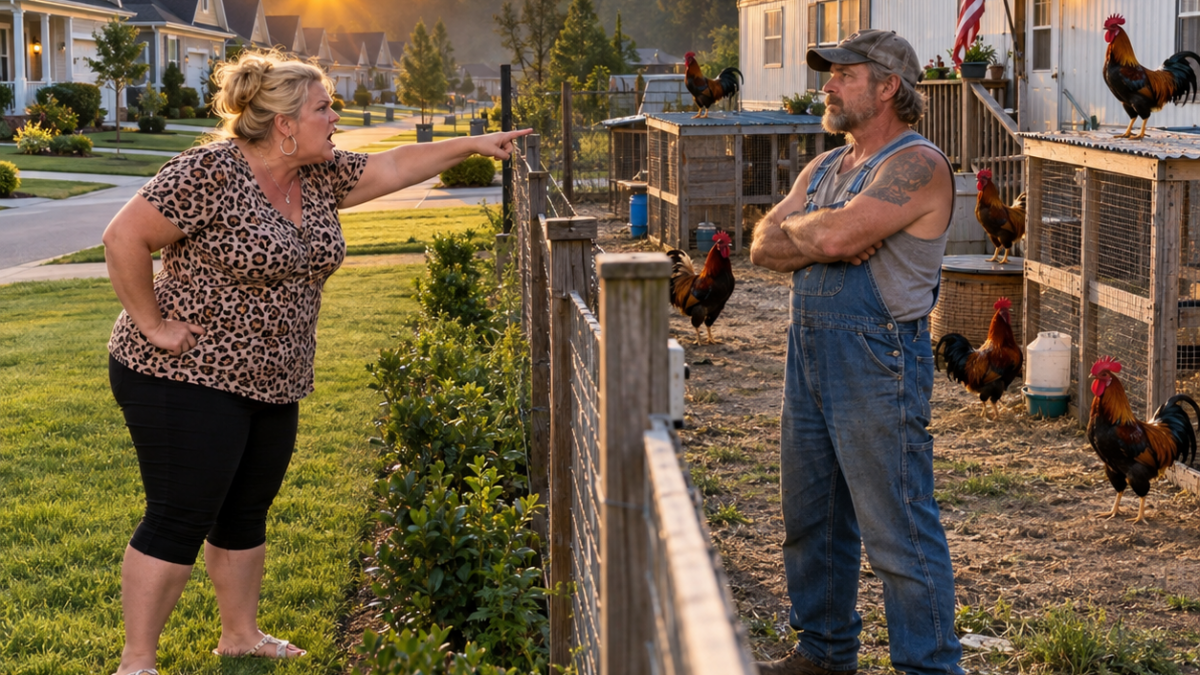
A rooster.
Five in the morning.
But it wasn’t my revenge.
And I never pretended it was.
Mr. Parker’s parcel was outside Ridgeline.
His county zoning permitted limited agricultural use.
His rooster crowed because roosters do that.
The funniest part was how well Susan’s board handled it.
They sent one email to residents.
RIDGELINE HAS NO REGULATORY AUTHORITY OVER NEIGHBORING AGRICULTURAL PARCELS. PLEASE DIRECT ANY LAWFUL NUISANCE CONCERNS TO THE APPROPRIATE COUNTY OFFICE.
That was it.
No fake emergency order.
No gold seal.
No tactical SUVs.
No moved survey stakes.
Just jurisdiction.
Law.
Reality.
I printed the email and brought it to Susan.
“Frame this.”
She read it.
“Why?”
“Proof institutions can learn.”
She smiled.
“We learned expensively.”
“The best lessons often are.”
The rooster became a neighborhood joke.
Some Ridgeline residents hated it.
Some children loved it.
One family started walking down the county road each morning hoping to see chickens.
Mr. Parker eventually built a proper farmhouse and sold the trailer.
The rooster remained.
Ray named him Federal Jurisdiction.
I objected.
Nobody listened.
At 5:07 most mornings, Federal Jurisdiction announced himself across the valley.
The cattle ignored him.
So did I.
One morning, Susan texted:
HE’S EARLY TODAY.
I replied:
FILE AN APPEAL.
She sent a laughing emoji.
That, more than Evelyn’s conviction, told me things had changed.
Ridgeline had become a neighborhood again instead of a private government fantasy.
Years passed.
Rebecca Shaw occasionally sent Christmas cards.
She left HOA law entirely.
Worked in nonprofit housing.
Eli got married.
Tomás bought acreage.
Ray threatened retirement annually and never followed through.
Susan served two board terms and stepped down.
Crestline’s abandoned development parcel was eventually acquired by a conservation partnership.
The valley remained mostly open.
My daughter, Grace, returned from Colorado more often.
She never wanted federal law enforcement.
Good.
She loved horses.
Better.
One evening we drove to Anne’s pasture.
She sat on the hood of my old truck exactly where her mother used to.
“You really would’ve turned down any amount?”
“Yes.”
“Ten million?”
“Yes.”
“Twenty?”
“Yes.”
She stared at me.
“Terrible businessman.”
“Correct.”
“Good dad, though.”
I looked at her.
“Debatable.”
She smiled.
“Mom would’ve hated Evelyn.”
“Your mother disliked bullies.”
“She also would’ve yelled at you for waiting fourteen months.”
“Almost certainly.”
We watched sunset.
No development road.
No luxury shopping center.
Grass moved in the wind.
Sometimes winning means something remains exactly where it was.
That is difficult to photograph.
No trophy.
No skyline.
No grand construction.
Just absence.
No road.
No bulldozers.
No buildings.
My no still standing years later.
Near the tenth anniversary of the first purchase offer, Ridgeline hosted an open community history project.
Susan’s successor asked whether I would contribute documents.
I gave them copies.
The original offer.
A fake violation.
County map.
Photograph of moved survey stakes.
The legitimate boundary agreement signed by the post-Evelyn board.
Not the arrest photograph.
Not the handcuffs.
Those were consequences.
The history was about decisions.
Their exhibit included one sentence:
RIDGELINE’S GOVERNANCE REFORMS FOLLOWED A PERIOD IN WHICH ASSOCIATION LEADERSHIP ASSERTED AUTHORITY BEYOND ITS LEGAL BOUNDARIES.
Dry.
Bureaucratic.
Perfect.
Institutions should remember failures without turning them into mythology.
Ray hated it.
“Should say Evelyn went nuts.”
“No.”
“Accurate.”
“Not archival language.”
“Cowards.”
At the dedication, a teenager asked me:
“Were you scared when they raided the ranch?”
“Yes.”
He looked surprised.
“But you were a marshal.”
“That doesn’t stop fear.”
“Did you know the agents were coming?”
“Yes.”
“So why scared?”
“My employees didn’t know exactly what would happen.”
He thought.
“Were you mad?”
“Very.”
“Why didn’t you go out sooner?”
“Because angry people can make dangerous situations worse.”
He looked toward the photographs.
“So what beat her?”
I expected to say evidence.
Procedure.
Law.
Instead I said:
“Boundaries.”
He frowned.
“Like property lines?”
“Those too.”
I pointed toward Ridgeline.
“Her authority had a boundary.”
Then toward the ranch.
“My rights had boundaries.”
Then toward myself.
“My anger had to have one.”
He nodded slowly.
That answer surprised me as much as him.
Evelyn’s greatest mistake wasn’t choosing the morning federal warrants were being executed.
That was spectacularly bad timing.
It wasn’t stealing the folder.
That was catastrophic.
It wasn’t trusting shell companies.
Moving survey stakes.
Hiring private security.
Forging documents.
Those were crimes and evidence.
But the first mistake came earlier.
She believed another person’s boundary was merely the starting point of negotiation.
When money failed, she used pressure.
When pressure failed, paperwork.
When paperwork failed, intimidation.
When intimidation failed, force.
At no point did she accept the most ordinary legal answer one property owner can give another.
No.
Everything afterward was just escalation.
The rooster still crowed south of the ranch years later.
Not the original one.
His descendants, according to Parker.
Ray insisted the bloodline deserved federal protection.
I told him to shut up.
At 5:03 one spring morning, I stood by the gate with coffee.
Crow.
Then another.
Lights appeared on Ridgeline balconies.
Nobody sent security.
Nobody mailed a fake order.
Nobody moved a boundary stake.
The sun rose.
Workers arrived.
Gate opened.
Another ordinary day started.
That was the ending I wanted.
Not Evelyn in handcuffs.
Not a forty-two-count indictment.
Not headlines.
Not watching an empire collapse.
Those things were consequences.
Peace was the victory.
A working ranch where the only thing invading at dawn was noise from a rooster we didn’t even own.
A neighboring development that finally understood where its authority stopped.
Employees who no longer looked over their shoulders when gray SUVs passed.
A pasture my wife loved still untouched.
A boundary nobody moved in darkness.
And one simple truth permanently recorded where no board president could rewrite it:
My land was mine.
Their homes were theirs.
The law belonged to neither of us.
It stood between us.
Exactly where it was supposed to.
The law belonged to neither of us.
It stood between us.
Exactly where it was supposed to.
For a while, I thought that was where the story ended.
I was wrong.
Not because Evelyn came back.
She didn’t.
Not because Crestline found another way to reach the valley.
They didn’t.
And not because Ridgeline suddenly returned to the old days of fake notices and security trucks idling beside my fence.
That part truly was over.
What happened afterward was quieter.
And in some ways, it mattered more.
The first real test came the following spring.
At 4:58 one morning, my phone buzzed on the nightstand.
I opened one eye.
The screen showed a message from Susan Patel, Ridgeline’s board president.
DANIEL, I AM TRYING VERY HARD TO BE A BETTER PERSON.
I stared at it.
Then another message appeared.
BUT PARKER’S ROOSTER HAS BEEN CROWING FOR TWENTY MINUTES.
I laughed hard enough to wake Grace, who was staying at the ranch for the weekend.
She knocked on my bedroom door.
“You dying?”
“No.”
“What happened?”
I held up the phone.
“The rooster.”
She read Susan’s message.
Then leaned against the doorframe laughing.
“You spent years helping dismantle a criminal conspiracy and this is what retirement looks like?”
“Apparently.”
Another crow drifted across the dark pasture.
Grace tilted her head.
“That thing is impressive.”
“He’s an idiot.”
“He sounds committed.”
“Same thing.”
I typed back:
GOOD MORNING, MADAM PRESIDENT. PLEASE CONSULT THE COUNTY AGRICULTURAL ZONING MAP.
Susan replied almost immediately.
I ALREADY DID.
Then:
I HATE PERSONAL GROWTH.
I put the phone down smiling.
That exchange would have been unthinkable under Evelyn.
A Ridgeline president was annoyed.
Her residents were annoyed.
The rooster was objectively annoying.
But nobody invented authority.
Nobody mailed a fake emergency order.
Nobody sent private security.
Nobody moved a fence.
Susan checked the law.
Discovered the neighboring parcel was operating legally.
And accepted an answer she didn’t like.
That was progress.
People often imagine reform as some grand ceremony.
New policies.
Speeches.
Officials promising transparency.
Sometimes reform is simply a person with authority hearing “no” and going home.
Mr. Parker’s place became more established over the next year.
The “cheap trailer” Ridgeline residents once complained about disappeared behind a small farmhouse he built himself.
Not fancy.
White siding.
Metal roof.
Wide porch.
The chicken coop remained.
So did the roosters.
There were three now.
Ray claimed they had formed an organized crime syndicate.
“They coordinate,” he told me.
“They’re chickens.”
“Exactly what they want you to think.”
One morning he came into the barn carrying a folded Ridgeline newsletter.
“You need to see this.”
“What?”
He opened it.
Near the bottom was a short notice:
REMINDER TO RESIDENTS: NEIGHBORING AGRICULTURAL PROPERTIES ARE OUTSIDE RIDGELINE GOVERNANCE. LIVESTOCK AND POULTRY ACTIVITIES PERMITTED BY COUNTY REGULATIONS ARE NOT SUBJECT TO ASSOCIATION ENFORCEMENT.
Ray stared at me.
“They printed it.”
“Yes.”
“Voluntarily.”
“Yes.”
“No lawsuit?”
“No.”
“No federal raid?”
“No.”
“No armored convoy?”
“Disappointing, I know.”
He folded the newsletter.
“I don’t trust it.”
But he was smiling.
The biggest change in Ridgeline wasn’t legal.
It was cultural.
Residents began coming outside their gates.
That surprised me.
For years, the development had been physically close and socially distant.
We could see their rooftops from the north pasture, but most residents had never actually stood beside our fence.
After the scandal, that began to change.
Susan organized a county-history day.
She asked whether schoolchildren from Ridgeline could visit the ranch.
My first instinct was no.
Ray’s first instinct was:
“Absolutely not.”
Grace overruled both of us.
“They’re kids.”
“Kids become adults,” Ray said darkly.
Grace looked at me.
“Is he always like this?”
“Yes.”
“Why do you employ him?”
“He knows where everything is buried.”
Ray nodded.
“Exactly.”
The field trip happened on a Saturday.
Thirty-seven children arrived with parents.
We showed them the cattle pens.
I explained why gates opened inward in some places and outward in others.
Tomás demonstrated how irrigation channels worked.
Eli showed them basic fence repair.
Grace talked about conservation and soil health.
A little boy pointed toward Ridgeline and asked:
“Did those people try to steal the ranch?”
Every adult froze.
Children are efficient that way.
I crouched so we were closer to eye level.
“Some people made bad decisions.”
“My dad said the president got arrested.”
“She did.”
“Was she evil?”
That question was harder.
“No.”
He frowned.
“She did illegal things.”
“Yes.”
“Bad things?”
“Yes.”
“Then why isn’t she evil?”
I thought for a moment.
“Because if you decide bad people are a different kind of human being, you start believing ordinary people like us could never make terrible choices.”
He stared at me.
I continued.
“Most serious harm is done by people who convince themselves they’re justified.”
The boy looked unconvinced.
“So she was bad?”
“Her choices were.”
That seemed good enough.
He ran toward a calf.
Susan stood behind me.
“That was annoyingly responsible.”
“I practiced.”
“You could’ve told him she was a supervillain.”
“Ray already does.”
From across the pen, Ray shouted:
“I heard that.”
The children left with muddy shoes.
Parents left with a better understanding of what existed beyond their stone entrance monument.
After that, Ridgeline families occasionally came to buy produce from Parker or eggs from Tomás’s brother.
The relationship stopped being abstract.
That matters.
It is easier to call a farm ugly when you have never met the people repairing a fence in winter.
Easier to complain about tractor noise when you do not know the man driving it started at four because weather is coming.
Easier to describe a trailer as “cheap” when you don’t know it belongs to someone working two jobs while building a home.
Distance lets people turn neighbors into scenery.
Proximity makes that harder.
The northern pasture remained untouched.
That was still the part I cared about most.
Crestline’s development rights changed hands twice after the criminal case.
Each new company looked at the old access maps.
Each called.
Each received the same answer.
No.
One representative tried to be clever.
“We’re not Crestline.”
“I know.”
“We’d approach this completely differently.”
“I’m sure.”
“We’d offer conservation offsets.”
“No.”
“Road improvements.”
“No.”
“A profit-sharing position?”
“No.”
He laughed.
“You haven’t heard the number.”
I looked toward the pasture.
“I don’t need it.”
“Everybody has a number.”
“No.”
He studied me.
Then, to his credit, he stood.
“I respect that.”
“Thank you.”
He left.
No harassment followed.
That was how a property negotiation was supposed to work.
Ask.
Answer.
Move on.
Grace eventually brought me a different proposal.
Not from a developer.
From her.
We were sitting at the kitchen table when she unfolded a map.
I groaned.
“No.”
“You haven’t looked.”
“I recognize maps as trouble.”
“This one protects the pasture.”
That got my attention.
She had been working with a regional conservation trust.
Her proposal placed most of the northern acreage under a conservation easement.
The ranch would remain privately owned.
Agricultural use could continue.
But major commercial development would be permanently restricted.
I studied every clause.
Of course I did.
Grace waited.
“Well?”
“Section seven is vague.”
She rolled her eyes.
“Dad.”
“And I want explicit cattle-water access.”
“They’ll add it.”
“Fence maintenance rights.”
“Already there.”
“Road maintenance.”
“Page nine.”
I turned.
She was right.
I hated when that happened.
“What happens after I’m dead?”
Grace’s expression softened.
“The land stays protected.”
“And you?”
“I keep ownership if that’s what we decide.”
“You don’t want cattle.”
“No.”
“You live in Colorado.”
“For now.”
“You have a career.”
“I know.”
I looked at her.
“Don’t keep this ranch because you think I expect it.”
She was quiet.
“I don’t.”
“Promise me.”
“I promise.”
“Land becomes a burden when somebody inherits guilt with it.”
She reached across the table.
“Dad.”
“What?”
“I love this place.”
I looked toward the window.
“Different from wanting to run it.”
“Exactly.”
“So what do you want?”
She smiled.
“A place my kids might someday stand and still see the same ridge Mom loved.”
That ended the negotiation.
The easement took almost a year.
Lawyers.
Surveys.
Tax review.
Environmental assessments.
Public records.
Boring, meticulous work.
I loved every minute.
Because this time paperwork wasn’t being used to steal land.
It was being used to protect choice.
The signing took place at our kitchen table.
No press.
No ceremony.
Grace.
Me.
A conservation-trust attorney.
Two witnesses.
Ray stood in the doorway pretending not to care.
When I signed the final page, he said:
“So nobody builds condos after you die?”
“Not there.”
“Good.”
Grace looked at him.
“You worried about condos?”
“I don’t trust buildings with more bathrooms than cows.”
Nobody knew what that meant.
We let it go.
That evening, Grace and I drove to Anne’s pasture.
The sun was low.
Same ridge.
Same light.
She carried two coffees.
Handed me one.
“Mom used to sit here?”
“Right there.”
She sat on the hood.
I joined her.
For a long time, neither of us spoke.
Then Grace said:
“I barely remember her voice.”
That hurt in a place no criminal case ever touched.
“You were young.”
“I remember things she said.”
“Like what?”
“She used to call me Gracie Bug.”
I smiled.
“She did.”
“But the sound gets fuzzy.”
I stared at the horizon.
“That happens.”
“Does it happen to you?”
“Yes.”
She looked surprised.
“You were married twenty-two years.”
“I know.”
“How can you forget?”
“You don’t forget the person.”
I searched for the right words.
“Details fade. Then some random thing brings them back.”
“Like what?”
“Coffee too strong.”
Grace smiled.
“Mom made terrible coffee?”
“Criminal.”
“What else?”
“Wind chimes.”
“She liked those?”
“Hated them.”
Grace laughed.
“She said they sounded like ghosts dropping silverware.”
Now Grace laughed harder.
And just like that, Anne’s voice returned.
Not literally.
But enough.
I looked across the protected pasture.
That was why the land mattered.
Not because dirt remembers.
People do.
Places give memory somewhere to stand.
Evelyn had seen acreage.
Crestline saw access.
I saw time.
Years later, Ray finally retired.
Actually retired.
We held a small party at the barn.
He hated every second.
“You know I’m coming back Monday.”
“No.”
“Yes.”
“You retired.”
“From payroll.”
“That’s what retirement means.”
“I’ll volunteer.”
“Absolutely not.”
He stared at me.
“You’re banning me from the ranch?”
“I’m banning free labor because you’ll eventually sue me.”
He looked offended.
“I have never sued anyone.”
“You worked for me forty years. You learned from experience.”
Eli gave him a framed photograph.
It showed Ray standing at the fence on the morning of Evelyn’s raid.
Not restrained.
Later.
After agents had cleared the scene.
He was leaning against the repaired gate.
Underneath, Eli had engraved:
YOU PICKED THE WRONG MORNING.
Ray read it.
His eyes filled.
He immediately became angry.
“This is sentimental garbage.”
Tomás hugged him.
Ray cursed.
Grace hugged him.
He tolerated it.
Then he came to me.
No words.
We shook hands.
That lasted about two seconds before he pulled me into a hug hard enough to make my back crack.
“You’re getting old,” he muttered.
“So are you.”
“I was old when you hired me.”
“True.”
He stepped away.
“Don’t let Eli run irrigation unsupervised.”
Eli yelled from across the barn:
“I’m forty-two!”
“My point exactly.”
Ray lasted eleven days before returning.
Not to work.
Technically.
He sat outside the office drinking coffee and criticizing everyone.
We eventually gave him a chair.
His official title became Unpaid Unwanted Consultant.
He made his own sign.
Ridgeline went through three more board presidents.
None became famous.
That was a success.
Good governance should be boring.
Budgets passed.
Pools opened.
Trees trimmed.
Residents argued about holiday-light hours and speed bumps.
Normal things.
The association attorney once called me asking whether I would speak to new board members about “jurisdictional humility.”
I laughed for a full minute.
“Is that really what you call it?”
“Yes.”
“That sounds like a disease.”
“Will you do it?”
So once a year, I attended Ridgeline’s board orientation.
I carried one thing.
A copy of the original fake emergency community protection order.
Gold seal and all.
I laid it on the table.
“This is what happens when people confuse private authority with public law.”
Nobody laughed.
Then I placed beside it the real federal warrant from the case—redacted, legally releasable portions only.
“Notice the difference.”
Judge.
Court.
Case number.
Probable cause.
Defined authority.
Limits.
I pointed at the fake order.
“Power invented by the person using it.”
Then the real one.
“Power granted through process and review.”
A new board member once asked:
“So HOAs shouldn’t enforce anything?”
“No.”
“What’s the lesson then?”
“That legitimate authority becomes more important, not less, when you’re angry.”
I looked around the table.
“If you hate a homeowner, follow procedure.”
They laughed nervously.
“I’m serious.”
“If someone insults you, follow procedure.”
“If someone challenges you publicly, follow procedure.”
“If you think you’re obviously right, especially follow procedure.”
Susan, sitting in the back that year, smiled.
She had heard it before.
The rooster problem eventually solved itself.
Federal Jurisdiction—the original—died at what Parker claimed was the heroic age of nine.
Ray demanded a memorial.
I refused.
Parker buried the rooster under an apple tree.
The next morning, there was silence.
At five.
Five-ten.
Five-thirty.
I stood on the porch with coffee.
Nothing.
It felt wrong.
Ray drove up.
“You hear that?”
“Hear what?”
“Exactly.”
We stood there.
After years of complaining about that rooster, we missed him.
By six, Ridgeline residents were posting messages asking whether something had happened.
Susan called.
“Is the rooster okay?”
“No.”
“Oh.”
She sounded genuinely sad.
Parker’s daughter made a small wooden marker.
FEDERAL JURISDICTION
HE RESPECTED NO QUIET HOURS
Someone left flowers.
Then eggs.
No idea why.
A week later, Parker bought another rooster.
At 5:14 a.m., the valley came back to life.
Ridgeline’s neighborhood forum reportedly exploded.
Susan texted:
PEACE WAS NICE WHILE IT LASTED.
I replied:
COMPLETELY LEGAL.
She answered:
I KNOW.
Three letters.
I know.
That might have been the most satisfying conclusion of all.
Not surrender.
Not fear.
Acceptance of limits.
Eventually my badge went into a display box.
Retirement became real.
At first I hated it.
No radio.
No urgent calls.
No reason anyone needed me at 2:00 a.m.
Then I realized usefulness does not disappear because a career does.
It changes shape.
I mentored younger deputies occasionally.
Helped Grace with conservation paperwork.
Served on the county agricultural advisory committee until meetings became too long.
Fixed fences.
Learned that I was terrible at growing tomatoes.
Ray said this was because tomatoes sensed federal aggression.
I ignored him.
Eli became ranch manager.
The first time he sat behind Ray’s old desk, he looked uncomfortable.
“Feels wrong.”
“It will.”
“What if I screw up?”
“You will.”
“Helpful.”
“You’ll fix it.”
He nodded.
Then he asked:
“You ever think about selling?”
“Yes.”
That surprised him.
“You said you’d never sell.”
“I said I wouldn’t sell to Evelyn.”
“Different?”
“Everything is different eventually.”
He looked toward the pasture.
“You going to?”
“No.”
“Then why think about it?”
“Because holding something by choice only means something if you admit choice exists.”
He stared at me.
“Retirement made you philosophical.”
“Very dangerous condition.”
Grace eventually moved closer.
Not onto the ranch.
Twenty minutes away.
She married a man named Noah, who knew almost nothing about cattle and wisely admitted it.
They had a daughter.
Anne Mercer Reed.
Middle name after her grandmother.
The first time I carried that baby into the northern pasture, Grace became nervous.
“Dad, she’s six months old.”
“I’m holding her.”
“Cows.”
“Far away.”
“Ticks.”
“Grace.”
“What?”
“You survived here.”
“Barely.”
I sat under the same oak Anne loved.
Baby Annie grabbed my shirt.
I pointed toward the ridge.
“Your grandmother liked that view.”
The baby sneezed.
Grace laughed.
“Powerful emotional connection.”
“Give her time.”
One day, Annie might sell everything permitted under the conservation agreement.
Maybe.
One day she might love the ranch.
Maybe not.
That was fine.
The whole battle had taught me something I should have understood sooner.
Love without choice becomes control.
Evelyn claimed she loved Ridgeline so much she had the right to control everything around it.
That was never love.
It was ownership disguised as stewardship.
I didn’t want to make the same mistake with my family.
The land was protected from destruction.
Not from life.
Grace could shape it.
Her daughter could shape it.
The ranch could change without disappearing.
That became enough.
On the fifteenth anniversary of the morning Evelyn arrived with armed security, Ray showed up before sunrise.
He was eighty now.
Still mean.
Still early.
Eli brought coffee.
Tomás came too.
Grace.
Noah.
Susan drove down from Ridgeline.
Parker leaned against the south fence.
Nobody had planned an official gathering.
Word just spread.
At six o’clock, exactly when those SUVs had once arrived, we stood near the main gate.
No speeches.
Then the rooster crowed.
Everyone laughed.
Susan raised her coffee.
“To jurisdiction.”
Ray groaned.
“That’s terrible.”
She smiled.
“To knowing where it ends.”
Better.
I looked at the gate.
The fence.
The old road.
Ridgeline rooftops beyond the ridge.
The northern pasture behind us.
Fifteen years earlier, that view had been filled with dust, tactical uniforms, fear, and machinery waiting to tear apart a boundary.
Now there were friends.
Neighbors.
Family.
People who once would never have stood together.
Grace slipped her arm through mine.
“You okay?”
“Yeah.”
“You’re doing the stare.”
“What stare?”
“The old-man-looking-at-land stare.”
“I earned it.”
“You did.”
The rooster crowed again.
From Ridgeline, somewhere high on the hill, somebody yelled:
“WE HEARD YOU!”
Parker yelled back:
“HE’S LEGAL!”
Laughter rolled across the fence.
And that was it.
No final raid.
No final enemy.
No revenge left to take.
Just morning.
I finally understood something Anne used to tell me whenever work followed me home.
“You don’t protect peace by holding it too tightly.”
Back then I thought she meant stop checking my phone at dinner.
Maybe she meant more.
Peace isn’t silence.
It isn’t getting your way.
It isn’t removing every irritation beyond your fence.
Sometimes peace is a rooster at five in the morning.
A neighbor whose house doesn’t match yours.
A farmer who refuses to sell.
A board president accepting that her authority stops at a property line.
A father letting his daughter decide what family land will become.
Peace requires room for other people to say no.
Evelyn never understood that.
Not until the law forced her to.
The rest of us learned before it was too late.
And as the sun came over the eastern ridge that morning, lighting the pasture Anne loved and the homes of people I had once considered strangers, I realized the boundary between us no longer felt like a wall.
It was simply a line.
Their side.
My side.
And enough respect between us that nobody needed to cross it without asking.
Ray nudged me.
“You getting emotional?”
“No.”
“Looks like it.”
“Sun in my eyes.”
“Sun’s behind you.”
“Shut up.”
He smiled.
Grace laughed.
The rooster crowed for the third time.
And across the valley, life went on exactly as it should.
Messy.
Noisy.
Imperfect.
Free.
For years, I had believed the best ending to our fight would be proving Evelyn wrong.
Then I thought it would be protecting the ranch.
Then seeing her sentenced.
Then signing the permanent boundary agreement.
I was wrong every time.
The best ending was reaching a morning when proving anything no longer mattered.
The ranch was still here.
Ridgeline was still there.
The rooster was still illegal nowhere and irritating everyone.
My daughter was beside me.
My granddaughter was asleep back at the house.
Ray was complaining.
Eli was working.
The gate was open because we wanted it open.
And nobody anywhere was pretending they had the authority to close it.
That was enough.
More than enough.
It was home.