PART 2: HOA Tried to Seize My Inherited Farm—Then I Found Out Why They Needed My Grandfather’s Barn Gone Before Monday
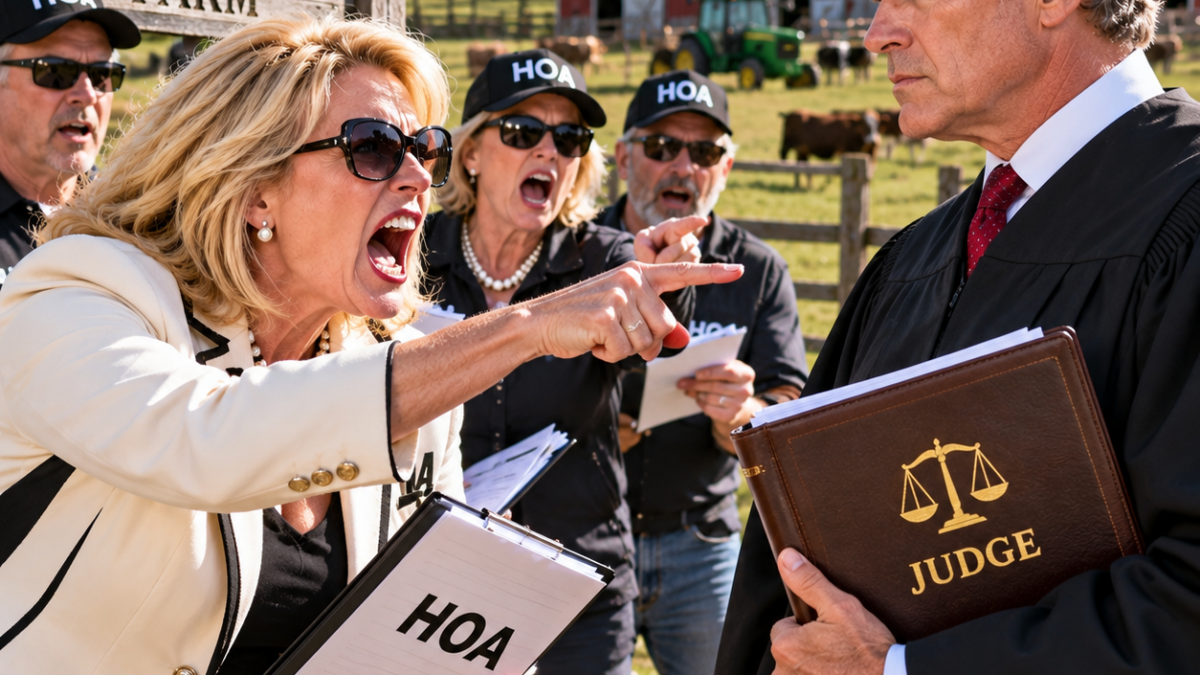
PART 2
For several seconds, all I heard was rain ticking against the tin roof of the barn.
“Say that again.”
“The medical examiner confirmed Thomas’s identity Wednesday morning at 9:20,” Mara said. “The HOA resolution declaring his property abandoned is stamped 8:45.”
I looked toward Evelyn.
She was standing beside the folding registration table, speaking rapidly to one of the Hollow Creek workers.
“So they declared the property abandoned before the county had even officially identified him?”
“That appears to be what happened.”
“How?”
“I don’t know yet.”
That answer bothered me more than any theory would have.
I watched Evelyn close the black binder.
“I’m coming to the farm,” Mara continued. “I’ll bring the probate papers, the death certificate, and Thomas’s letter. Until I get there, document everything.”
“Already doing it.”
“And Daniel?”
“Yes?”
“Do not tell them you’re a judge.”
I almost laughed, though nothing about the morning was funny.
“I wasn’t planning to.”
“I mean it. You have no jurisdiction in North Carolina, and I don’t want anyone claiming you used your office to intimidate them.”
“I understand.”
Mara had known me since high school.
She knew exactly why I had not mentioned my position.
I served on the Virginia Court of Appeals.
That mattered to my career.
It did not give me supernatural power over an HOA in North Carolina.
If anything, my job required more caution.
Every step I took needed to look exactly like what it was: an heir defending private property through ordinary legal channels.
Nothing more.
I ended the call and turned back toward the barn.
Caleb Dunn had stopped the auction.
The man in the green cap approached me.
“I’m not taking the tractor.”
“You paid?”
“Not yet.”
“Good.”
He glanced toward Evelyn.
“She told us this was an HOA foreclosure sale.”
“It isn’t.”
“So what happens to the stuff people already loaded?”
“I’m asking everyone not to remove anything until ownership is resolved.”
A woman near the drill press heard me.
“I already put a deposit down.”
“Talk to Mr. Dunn. I’m not accusing buyers of anything. You relied on what you were told.”
That distinction mattered.
The people standing in the grass were not my enemies.
They were bargain hunters who believed they had shown up at a legal auction.
The more I could keep the dispute focused on the people who had authorized the sale, the harder it would be for Evelyn to turn the crowd against me.
Caleb climbed onto his little podium.
“Ladies and gentlemen, bidding is suspended pending title verification. If you paid a deposit, see me before you leave.”
Evelyn spun toward him.
“You have a contract.”
“I also have a license I intend to keep.”
“You were provided legal authorization.”
“You provided a board resolution. That’s different from proving your organization owns the goods.”
Her face hardened.
“This is unacceptable.”
Caleb put his cowboy hat back on.
“Then have your lawyer call mine.”
He set the hammer down.
That was the first moment Evelyn lost control.
Not permanently.
But visibly.
She turned on me.
“You think stopping the auction changes anything?”
“I think it keeps people from driving away with property you may have no right to sell.”
“You’re making this difficult.”
“I drove all night to bury my grandfather. I arrived to find strangers auctioning his tools. Difficult started before I got here.”
Her eyes flicked toward the barn.
Then toward the survey marker.
I saw it.
A tiny movement.
Almost nothing.
But enough.
She was worried about the stone.
I filed that away.
Then she reached into her binder and removed a red folder.
“Perhaps you’d prefer to resolve this privately.”
She handed it to me.
The first page was titled **Settlement and Access Agreement**.
I read the first paragraph.
Ridgeview Estates would reduce the alleged $74,600 obligation by half.
In return, the estate would acknowledge the HOA’s authority over the disputed maintenance area.
Release claims arising from the auction.
And grant a perpetual sixty-foot access corridor through the Mercer farm.
I turned to the attached drawing.
The proposed corridor entered from Alder Ridge Drive, crossed the eastern pasture, and ran straight through the barn.
My barn.
My grandfather’s barn.
Then it connected with Hollow Creek’s undeveloped property.
I looked at Evelyn.
“So this is what today is about.”
“It’s a practical resolution.”
“You’re offering to forgive money my grandfather may never have owed in exchange for land.”
“You inherited a problem.”
“I inherited sixty-three acres.”
“You inherited years of conflict.”
I looked back at the map.
The corridor was far wider than the road-maintenance strip she claimed the HOA already controlled.
“Did your attorney draft this?”
“The board is fully authorized to negotiate agreements.”
“That wasn’t my question.”
“We don’t need a lawyer to deal with people like you.”
People like me.
I wondered what she thought that meant.
Out-of-state heir?
Grieving grandson?
Somebody who would take a quarter-million-dollar buyout and leave?
I flipped to the signature page.
Above the property-owner line, I wrote:
**Received for review only. No terms accepted.**
Then I signed my name beneath that notation and photographed every page.
Evelyn saw the signature and smiled.
“Smart choice.”
“You should read what I wrote.”
Her smile vanished.
“Six o’clock,” she said. “After that, the offer is withdrawn.”
She walked away.
I looked again at the corridor.
That folder had answered a question.
The auction was not primarily about collecting dues.
The barn demolition was not primarily about safety.
Someone needed the route.
And they needed it quickly.
What I did not yet understand was why the clock mattered so much.
—
Mara arrived a little after noon carrying two coffees, a portable scanner, and a cream-colored envelope.
She stepped out of her car, took one look at the red folder in my hand, and said, “I’m going to hate that, aren’t I?”
“Probably.”
We sat on the tailgate of my truck.
She read the entire proposed agreement without speaking.
When she reached the corridor drawing, she removed her glasses.
“This is the motive.”
“That was my thought.”
“They’re trying to convert an alleged debt into a permanent road.”
“Through the barn.”
“And across the wellhead.”
I had missed that.
Mara pointed to the old well location.
The proposed road crossed within yards of it.
“If you signed this, farming the eastern pasture would become substantially harder.”
“I’m not signing it.”
“I know.”
She looked toward Evelyn, who was supervising workers loading auction signs into a truck.
“What did they say this road is for?”
“Nothing specific. But Hollow Creek owns the land beyond us.”
Mara’s expression changed.
“You mean the proposed phase-four tract?”
“You know about it?”
“Everybody in the county land-use bar knows about it. They’ve been trying to develop that parcel for years.”
“Why haven’t they?”
“Access.”
Exactly.
Mara put the agreement aside.
Then she pulled out the board resolution.
It was one page.
**RIDGEVIEW ESTATES HOMEOWNERS ASSOCIATION**
**EMERGENCY ABANDONMENT AND PROPERTY SECURITY RESOLUTION**
The document declared the barn and its contents abandoned common property subject to association control due to unpaid assessments and “recent vacancy.”
Signed by Evelyn Cross, president.
Countersigned by Linda Shaw, secretary.
Time stamp: Wednesday, 8:45 a.m.
Mara opened the death certificate.
Thomas Mercer had been found Tuesday evening.
Formal identification confirmed Wednesday at 9:20 a.m.
I put the papers side by side.
“That’s thirty-five minutes.”
“Thirty-five minutes before the legal confirmation.”
“Could they have known unofficially?”
“Possibly. Small communities talk. Someone may have seen the sheriff here.”
“But ‘recent vacancy’?”
Mara shook her head.
“Your grandfather had been dead less than a day.”
She lifted the auction invoices.
“And this auction was organized almost immediately.”
Caleb had provided copies before leaving.
The earliest contractor communication was Wednesday afternoon.
The sale had been advertised privately to a regional bidder list Thursday.
The auction began Friday morning.
Somebody had moved extraordinarily fast.
Mara looked toward the farmhouse.
“Let’s inspect the barn.”
Caleb had left the keys with her after she showed him the probate appointment papers.
The moment we entered, I knew something was wrong beyond the missing equipment.
The eastern wall leaned slightly.
It always had.
My grandfather and I had reinforced it when I was seventeen.
The roof was dry.
The beams were solid old-growth oak.
Unsafe was not the word that came to mind.
Ransacked was.
Cabinet doors hung open.
File drawers had been pulled out.
Receipts and envelopes covered the floor.
The lock on my grandfather’s small steel document cabinet had been cut.
And the entire cabinet was missing.
Mara crouched beside the marks where it had stood.
“They searched this place.”
“Yes.”
“Before the auction.”
I looked toward the loft.
Years ago, after diesel started disappearing from his truck, my grandfather had installed game cameras around the property.
One had been mounted under the loft railing.
The bracket remained.
The camera was gone.
“Thomas had surveillance.”
“Cloud storage?”
“Some. Some used cards.”
“Where’s his phone?”
“The sheriff has his personal effects.”
Mara took out her phone.
While she called the sheriff’s office, I walked toward the workbench.
Auction tags and screws littered the surface.
Then I noticed a strip of blue painter’s tape.
My grandfather wrote notes on anything.
Receipts.
Cardboard.
Wood scraps.
Masking tape.
I peeled it back.
Three words had been written in black marker.
**NOT THE LOFT.**
I stared at them.
Mara ended her call.
“What?”
I showed her.
She frowned.
“Any idea?”
“When I was a kid, he used clues like this.”
“For what?”
“Birthday presents. Christmas gifts. If he said something wasn’t somewhere, he usually meant I was looking at the wrong version of that place.”
“I don’t follow.”
“If he wrote ‘not the kitchen,’ the thing might be near the camp stove or smokehouse.”
She looked toward the loft.
“So ‘not the loft’ means…”
“Stop looking up.”
I knelt.
Beneath the workbench was a low shelf.
I ran my fingers along its underside.
Nothing.
Then I saw two fresh-looking screw heads in the floorboard behind it.
My grandfather had never liked shiny hardware in old wood.
Those screws were deliberate.
I found a screwdriver and removed them.
The floorboard lifted.
Underneath sat a weatherproof plastic case.
Mara exhaled softly.
“Thomas.”
I pulled it out.
Inside were three memory cards.
A ring of keys.
A folded plat map.
And a handwritten note.
I knew my grandfather’s handwriting instantly.
Blocky.
Heavy.
Every letter pressed hard enough to leave a groove.
**Daniel, if you are reading this, they moved faster than I expected.**
**Start with the stone. Then follow the road money.**
**Do not trust the red folder.**
**T.**
For a few seconds, neither of us said anything.
I looked toward the red settlement folder sitting on the workbench.
“He knew.”
Mara spoke quietly.
“He knew enough to prepare.”
I swallowed.
Twelve years without speaking.
And in the final weeks of his life, Thomas had apparently been leaving me instructions.
Not because I deserved them.
Because he thought I might eventually come.
We inserted the first memory card into Mara’s laptop.
Most of the files were ordinary.
Deer.
Raccoons.
Thomas carrying firewood.
A fox crossing the yard.
Then Mara stopped scrolling.
“Thursday. Two-thirteen a.m.”
The video opened.
A white Hollow Creek Development truck backed toward the barn with its headlights off.
Two men got out.
I recognized both from the auction.
They carried shovels and a metal detector.
For eleven minutes they dug around the old stone survey marker.
Then they lifted it out.
One man carried it west.
They dug another hole.
Reset the stone.
Mara froze the frame.
“How far?”
“Hard to tell.”
“Twenty feet?”
“More.”
We watched them pack the dirt.
Then photograph the new location.
The second card showed footage twenty minutes later.
Evelyn’s SUV arrived.
She stepped out.
Walked directly to the moved stone.
Photographed it.
Then handed one worker an envelope.
She pointed along the exact route shown in the red settlement folder.
Mara said nothing.
Neither did I.
We did not need to.
The third card contained scanned documents.
Checks.
Dozens of them.
Payments from Thomas Mercer to Ridgeview Estates going back twelve years.
Every check included the same handwritten memo:
**Voluntary road maintenance contribution. No HOA membership.**
And every canceled check showed deposit by Ridgeview.
The payment history mattered because Evelyn had described my grandfather as a delinquent member refusing assessments.
His own records showed something different.
A neighbor voluntarily contributing toward shared road upkeep while explicitly denying membership.
I leaned back.
“This still doesn’t prove the whole case.”
Mara looked at me.
“No.”
That answer pleased me.
A weak lawyer would have declared victory.
Mara understood evidence better.
One document rarely settles a complicated property dispute.
What matters is how records fit together.
The checks.
The camera footage.
The survey.
The settlement corridor.
The rushed abandonment resolution.
They were beginning to form a pattern.
And patterns are dangerous when innocent explanations require every piece to be a coincidence.
—
The folded plat map from the hidden case was only a photocopy.
Someone had drawn over it in pencil.
A shaded area marked **PHASE FOUR** covered Hollow Creek’s tract.
Twenty-eight proposed lots spread across the ridge.
One road connected them to Alder Ridge Drive.
That road crossed the Mercer farm.
Passed through the barn.
And continued onto Hollow Creek’s land.
In the margin, Thomas had written three dates and one name:
**Owen Price.**
I knew Owen.
Not personally.
By reputation.
He was a licensed surveyor who had worked in the county for more than thirty years.
Mara called him.
He arrived at 3:15.
The first thing he said after getting out of his truck was, “Evelyn Cross called me at lunch.”
Mara raised an eyebrow.
“What did she want?”
“She said the Mercer property is under HOA control and warned me that any survey might interfere with pending litigation.”
“What litigation?”
“She didn’t identify a case.”
I almost smiled.
Evelyn had told me to take them to court.
Apparently she was already telling other people court proceedings existed.
Owen unfolded the official county plat across the hood of his truck.
Ridgeview Estates was clearly outlined.
One hundred twelve residential lots.
A clubhouse parcel.
Two common roads.
The Mercer farm was outside every boundary.
“Could the farm have been annexed later?” I asked.
“Only through a recorded amendment meeting the declaration requirements.”
“Did that happen?”
“I checked.”
He pulled six amendments from his case.
“None adds this tract.”
He pointed to a narrow strip along Old Mill Road.
“There is one agreement involving Thomas and Ridgeview.”
My stomach tightened.
“What kind?”
“Road maintenance.”
He read the terms.
Thomas allowed the HOA to maintain approximately seven hundred forty feet of Old Mill Road used by both properties.
His payments were expressly voluntary.
The document stated that no HOA membership, ownership interest, or additional easement was created.
Either side could terminate the maintenance arrangement with sixty days’ notice.
“Anything about the barn?” Mara asked.
“No.”
“Anything authorizing assessments against the farm?”
“No.”
“Anything giving the HOA foreclosure rights?”
“Not in this agreement.”
Owen carried his survey equipment toward the stone marker.
Twenty minutes later, he stared at the receiver.
Then he looked at the stone.
“Someone moved it.”
“How far?”
He measured again.
“Twenty-nine feet, eight inches.”
Almost exactly thirty feet.
The relocated stone made it appear—on a rough field sketch—that the barn clipped an area associated with the HOA’s maintenance strip.
That still would not have transferred ownership of the barn.
But to someone looking only at an informal map, it could create confusion.
And confusion can be useful when someone needs the next lie to sound slightly more plausible.
Owen documented the disturbed soil.
Placed a temporary stake at the verified boundary point.
Signed a field memorandum.
Mara immediately sent the survey, probate appointment, camera footage, auction documents, and demolition notice to the county court.
She requested emergency preservation relief.
At 4:12, a local judge issued a temporary order preventing removal of estate property and demolition of the barn until the following week.
It was exactly the kind of order I would have expected from a careful court.
Narrow.
Temporary.
Preserving the status quo.
Nobody had declared us right about everything.
The court simply refused to allow irreversible destruction while ownership was disputed.
At 4:30, a deputy served the order at the Ridgeview clubhouse.
At 4:41, power to the farmhouse went out.
I was standing in the barn when the lights died.
Mara looked up.
“Storm?”
“No.”
The sky had cleared.
We called the utility company.
There was no outage.
I walked toward the main disconnect near the road.
The handle had been opened manually.
A new padlock had been placed through it.
The tag read:
**RIDGEVIEW FACILITIES.**
Mara stared at it.
“They were served eleven minutes ago.”
I photographed everything.
“Pressure.”
“For what?”
I held up the red folder.
“The deadline is six.”
She checked the time.
“Five nineteen.”
A black SUV turned into the drive one minute later.
Evelyn stepped out.
Beside her was a man in a navy overcoat carrying a leather portfolio.
He introduced himself as Wade Halpern, regional director of Hollow Creek Development.
“Mr. Mercer,” he said, “I’m sorry for your loss.”
“Thank you.”
“I knew Thomas.”
“Did you?”
“He was difficult, but I respected him.”
I looked toward the false survey-marker hole.
“Before or after your employees moved his boundary stone?”
Wade’s eyes flicked toward Evelyn.
Only once.
But once was enough.
She recovered quickly.
“We have no knowledge of that allegation.”
“I have video.”
The sound of my grandfather’s generator filled the silence behind the house.
Wade changed tactics.
“Then all the more reason to resolve this professionally.”
He opened his portfolio.
“Hollow Creek is prepared to pay the estate two hundred fifty thousand dollars for the access corridor. Ridgeview will waive its claims.”
I almost laughed.
My grandfather’s notes had referred to “road money.”
Now I understood.
“You want sixty feet through the center of the farm.”
“We need efficient connectivity.”
“The route destroys the barn.”
“The barn is near the end of its useful life.”
“It survived longer than the company trying to demolish it.”
Evelyn’s mouth tightened.
Wade continued.
“You’ll still own substantial acreage.”
“The corridor crosses the wellhead and divides the pasture.”
“Those impacts can be mitigated.”
“Then build somewhere else.”
“The alternative route is economically inefficient.”
There it was.
Not impossible.
Expensive.
I looked at him.
“Why does this offer expire tonight?”
“Construction schedules. Financing. Ordinary business realities.”
“Did your financing assume you controlled access through my grandfather’s property?”
His thumb pressed against the edge of the leather portfolio.
“Our financing structure is not your concern.”
“Then my signature shouldn’t be urgent.”
He studied me more carefully.
Until then, I realized, they had been dealing with the version of me they had invented.
Out-of-state heir.
Estranged grandson.
Probably eager to sell.
Probably intimidated by $74,600 in alleged debt.
Probably overwhelmed by probate.
Probably unaware of the farm’s records.
Calm questions were beginning to disturb that picture.
Evelyn stepped forward.
“Your grandfather spent his last years fighting everyone around him.”
That hurt because part of it was true.
Thomas had fought.
Developers.
Neighbors.
Contractors.
County staff.
Sometimes me.
Evelyn saw the reaction.
“Do you really want to inherit that?”
I looked toward the dark farmhouse.
Then at the barn.
At the workbench where Thomas had taught me to sharpen a plane.
At the beam with his name carved into it.
“No,” I said.
For the first time, Evelyn looked almost relieved.
Then I continued.
“I intend to inherit what he was protecting.”
Her face went still.
At 6:00, their offer expired.
At 6:03, Wade and Evelyn left.
At 6:17, Mara found the first direct financial connection between them.
—
Hollow Creek Development had paid Ridgeview Estates fifty thousand dollars eight months earlier.
The payment appeared in board minutes under a bland description:
**Restricted planning contribution — future clubhouse improvements.**
But the special project account told a more complicated story.
Nineteen thousand dollars had already been spent on architectural plans.
Those plans included the proposed road corridor.
No membership vote had approved the access deal.
No public HOA meeting had disclosed a phase-four road through my grandfather’s farm.
Mara stared at the ledger.
“If this project fails, Ridgeview may have to return money.”
“Money they’ve already spent.”
“Exactly.”
That created a motive stronger than convenience.
Evelyn did not merely want a road.
She may have committed her association financially to a road she did not control.
The farm was the missing piece.
My grandfather had been the obstacle.
And now that he was dead, someone had tried to move before probate could catch up.
The next morning, I collected Thomas’s phone from the sheriff.
There were forty-six unheard voice messages.
Most were ordinary.
Pharmacy reminders.
Feed deliveries.
A neighbor asking about a tree.
Seven were from Ridgeview Estates.
The first was polite.
“Thomas, this is Evelyn. We need to revisit the access proposal. Please call me.”
The fourth was colder.
“Continued refusal may affect the board’s willingness to maintain your road.”
The seventh had been left two nights before he died.
“You cannot hold back progress forever. Once the board confirms the boundary, the barn issue will be handled with or without your cooperation.”
I replayed that one.
Then Mara noticed an unsent audio recording.
The file was labeled with my name.
My finger hovered over it.
“Daniel,” she said quietly, “you don’t have to listen right now.”
“Yes, I do.”
I pressed play.
My grandfather’s voice filled the cab of my truck.
Older than I remembered.
Tired.
Still unmistakably his.
“Daniel, I told myself I wouldn’t call again. That was pride talking.”
I stopped breathing for a second.
“Hollow Creek needs my land and Evelyn promised them something she doesn’t own.”
His voice cracked slightly.
“If you hear this, look under the false bottom in the steel cabinet. I kept the road records there.”
I closed my eyes.
Then he said:
“And son… whatever you decide about the farm, decide after you know the truth. Not after you remember our last argument.”
The recording ended.
For twelve years, I had remembered only the worst words from our final conversation.
I had told him I could not spend my life driving home every time a developer irritated him.
He told me I had become polished enough to mistake distance for wisdom.
I left angry.
He stayed angry.
Neither of us called again.
At least that was what I had told myself.
But he had recorded this.
He had called me “son.”
He had done that since I was a boy, even though he was my grandfather.
Mara gave me several minutes before speaking.
“The cabinet’s gone.”
I nodded.
“But we know it existed.”
“And the cameras may show who took it.”
We returned to Thursday’s footage.
There.
At 9:06 a.m.
Two Hollow Creek workers carried the steel cabinet out of the barn.
Ridgeview board secretary Linda Shaw stood nearby.
Mara called her before contacting the sheriff.
Linda denied everything.
“What cabinet?”
Mara emailed a still image.
Seven minutes later, Linda called back.
Her voice had changed.
“Evelyn said it had hazardous chemicals.”
“Did you see chemicals?”
“No.”
“Who ordered it moved?”
“Evelyn.”
“Who opened it?”
A pause.
“Wade cut the lock.”
“Where are the contents?”
Linda began crying.
“I don’t know.”
“Linda.”
“I don’t know. Evelyn took a file box home.”
Fear does not make someone innocent.
But fear can make coordinated stories collapse.
Linda agreed to meet us at the clubhouse with a deputy present.
The cabinet was in the maintenance garage.
Empty.
Its false bottom had been forced open.
The road records were gone.
But whoever emptied it missed one detail.
A small storage label under the bottom drawer.
**PIEDMONT RECORDS STORAGE — BOX 417.**
I almost laughed.
Thomas Mercer trusted paper so little that he kept duplicates of his paper.
For twenty-three years, he had rented storage space in Boone.
By late afternoon, Box 417 was sitting on Mara’s conference table.
Inside was the original 2012 road-maintenance agreement.
A certified letter from Ridgeview’s attorney four years earlier.
The letter stated clearly that the Mercer farm was **not subject to the Ridgeview Estates declaration**.
It asked Thomas to consider voluntary annexation because the HOA wanted to explore “future connectivity opportunities.”
Across the bottom, my grandfather had written:
**They know they don’t own it.**
I sat back.
That letter changed the dispute.
The HOA’s current claim was not merely unsupported.
Its own prior attorney had acknowledged the opposite.
There was more.
A dated photograph showed the survey stone in its original location.
Maintenance receipts showed Thomas had personally paid to grade much of Old Mill Road after Ridgeview stopped contributing.
And then Mara found another envelope.
Hollow Creek Development.
Inside was an older offer.
Nine hundred thousand dollars.
For essentially the same access corridor.
I looked at the number.
“Wade offered me two-fifty.”
“Under pressure.”
“While the HOA claimed I owed seventy-four thousand.”
“Correct.”
I stared at the older proposal.
My grandfather had known exactly how valuable the land was to them.
And they knew he knew.
—
By Saturday afternoon, Ridgeview could have stopped.
Its board could have hired independent counsel.
Preserved the records.
Canceled the demolition contractor.
Reviewed the old legal opinion.
Disclosed the Hollow Creek money.
Instead, Evelyn called an emergency membership meeting for Sunday evening.
The email accused me of blocking a “critical emergency-access improvement.”
It claimed one hundred twelve families could be endangered if the proposed route was delayed.
That was clever.
People will defend convenience.
They will fight much harder for safety.
If Evelyn could convince the community that my barn blocked fire trucks, then suddenly I was not the heir protecting family property.
I was the outsider endangering children.
So we checked.
County engineer Rachel Kim met us Sunday morning.
She examined the proposed phase-four road.
Measured the curve.
Studied the bridge on Ridgeview’s side.
Then she shook her head.
“This route cannot be certified for emergency apparatus in its current design.”
“Why?” Mara asked.
“The bridge is too narrow for the vehicles specified in the fire plan. This curve exceeds the turning template. And I don’t have an approved application for this alignment.”
I unfolded the Hollow Creek sketch.
“They told residents this is a critical fire-access project.”
Rachel looked genuinely surprised.
“Our office has not approved any road through the Mercer property.”
“What route is on file?”
She pulled up the development application on her tablet.
Hollow Creek’s submitted alternative ran entirely across land the company owned.
Longer.
More expensive.
It required construction of a new bridge.
“What’s the cost difference?” I asked.
Rachel hesitated.
“I can’t verify their private estimates.”
Mara showed her a preliminary engineering budget from Box 417.
Rachel read it.
The cheaper route through my farm saved approximately $1.4 million.
That was why they wanted the barn gone.
Not because the community would otherwise be trapped.
Not because emergency responders required it.
Because the road through my inheritance was cheaper.
And Thomas had refused to sell.
—
By 6:50 Sunday evening, the Ridgeview clubhouse parking lot was full.
Mara and I took seats in the back.
Owen Price joined us.
Rachel had provided a signed written statement about the county’s position but did not attend.
Evelyn stood at the front.
Another red suit.
Behind her, the projector displayed a photograph of my grandfather’s barn.
Across it, in large letters:
**OBSTRUCTION TO EMERGENCY ACCESS**
For twenty minutes, Evelyn controlled the room.
She displayed assessment ledgers.
Photographs of peeling paint.
Pictures of weeds.
She described Thomas as hostile.
Uncooperative.
Chronically delinquent.
She spoke about safety.
Property values.
Community responsibility.
Then Wade Halpern addressed the residents.
Hollow Creek, he announced, would fund the new access road.
The company would also contribute another two hundred thousand dollars toward clubhouse improvements.
Residents murmured approvingly.
I understood why.
Most of them had never seen the underlying records.
They were being offered a free road, emergency access, and community improvements.
The deception did not belong to the homeowners believing the presentation.
It belonged to the people who knew what had been left out.
When public comment opened, I carried the red settlement folder to the front.
Evelyn folded her arms.
“State your name and Ridgeview address.”
“Daniel Mercer. Sixty-three Old Mill Road.”
“That property is not recognized as a Ridgeview residence.”
“On that point, we agree.”
A few people laughed.
Evelyn didn’t.
“I’d like permission to display four documents.”
“The board has not verified your materials.”
An older woman in the second row stood.
“Evelyn, you displayed his account records.”
Evelyn frowned.
“Carol—”
“Let him display his.”
Another homeowner spoke.
“Yeah. Let’s see them.”
Then another.
Evelyn looked toward Wade.
He gave the smallest shake of his head.
She reluctantly handed the projector control to Linda Shaw.
Linda’s hands trembled.
First came the official subdivision plat.
Owen explained the boundary.
No annexation.
No Mercer acreage inside Ridgeview.
Second came the 2012 maintenance agreement.
I highlighted the sentence stating that no HOA membership or property interest was created.
A man near the front raised his hand.
“So how was he charged seventy-four thousand dollars in assessments?”
No one answered.
Third came Rachel Kim’s county statement.
No approved emergency route across my farm.
No demolition authorization.
No approved phase-four road using that alignment.
The room changed.
People stopped looking at me.
They started looking at Evelyn.
Then Mara nodded.
Linda started the fourth file.
The trail-camera video filled the screen.
No narration was necessary.
Everyone watched two Hollow Creek employees arrive after midnight.
Dig up the boundary stone.
Carry it almost thirty feet.
Reset it.
Photograph it.
Then the next clip played.
Evelyn arrived.
Inspected the false location.
Photographed it.
Handed one man an envelope.
Wade stood.
“This meeting is becoming a litigation trap. I strongly advise adjournment.”
Mara rose from her seat.
“You don’t represent the HOA.”
Wade turned.
“And you are?”
“Mara Ellis. Counsel for the Mercer estate.”
Evelyn pointed toward me.
“Then why has he been conducting himself like a lawyer this whole time? What exactly is this?”
Wade stared at me.
His face changed slowly.
“Mercer.”
I waited.
“Daniel Mercer.”
“Yes.”
He swallowed.
“Judge Mercer.”
The room went quiet.
Evelyn looked at him.
“What are you talking about?”
Wade never took his eyes off me.
“He sits on the Virginia Court of Appeals.”
Several residents turned in their chairs.
Evelyn’s face flushed.
“You’re a judge?”
“Yes.”
“And you concealed that?”
“I didn’t conceal anything.”
“You let us deal with you without disclosing your position.”
“My judicial position has nothing to do with ownership of this farm.”
“You’ve been using your legal knowledge to intimidate this board.”
“No.”
I kept my voice even.
“I have no jurisdiction in North Carolina. I have contacted no judge about the merits. I have asked for no favors. Mara represents the estate. Owen performed the survey. Rachel reviewed the road. Your contractors moved the stone. Your records created the debt. Your camera appearance speaks for itself.”
Nobody moved.
“I am not standing here as a judge.”
I looked directly at Evelyn.
“I am standing here as the lawful heir to property your association tried to auction three days after my grandfather died.”
The room remained silent.
Not cinematic silence.
Not the kind followed by applause.
Real silence.
Uncomfortable.
Confused.
Then people began whispering.
Carol Beck raised her hand.
“Where did Hollow Creek’s fifty thousand dollars go?”
Evelyn gripped the lectern.
“That money is restricted and fully accounted for.”
“Then show us.”
A man standing along the side wall spoke.
“What fifty thousand dollars?”
Mara looked at me.
The speaker was Malcolm Reed, Ridgeview’s treasurer.
Evelyn stared at him.
Malcolm stepped forward.
“I handle the association’s regular accounts. What deposit?”
That was the moment she lost the board.
Not when Wade recognized me.
Not when the survey video played.
When her own treasurer learned about money in front of the membership.
Linda began crying again.
“There’s a separate project account.”
Malcolm turned toward her.
“A what?”
“Evelyn told me the board had authorized it.”
“Who are the signatories?”
Linda looked down.
“Evelyn and me.”
Malcolm’s face went pale.
Mara opened the ledger.
Fifty thousand dollars in.
Nineteen thousand paid to architectural consultants.
Eight thousand to a planning firm connected to Hollow Creek.
Twelve thousand to the demolition contractor scheduled to reach my barn Monday morning.
Eleven thousand dollars remained unexplained.
Evelyn spoke quickly.
“It’s a bookkeeping issue.”
Malcolm stared at her.
“Eleven thousand dollars is not a bookkeeping issue.”
Wade rose.
“Hollow Creek has no knowledge of Ridgeview’s internal accounting.”
Linda took out her phone.
“I saved the emails.”
Evelyn turned.
“Linda.”
Linda flinched.
Then looked at the room.
“I’m sorry.”
She handed the phone to Mara.
The earliest relevant message was eight months old.
Wade to Evelyn:
**Once Mercer is no longer an obstacle, phase four access should be straightforward.**
Evelyn’s reply:
**The board can establish control through the maintenance agreement. His heir lives out of state and will sell.**
My grandfather had still been alive.
They were already planning around his absence.
Then came Wednesday morning.
7:58 a.m.
More than an hour before formal identification.
Wade wrote:
**Proceed with abandonment resolution. We need the barn cleared before estate counsel appears.**
The impossible timeline finally made sense.
Someone in the neighborhood had seen emergency vehicles at the farm Tuesday evening.
Word reached Evelyn.
She contacted Wade.
Before the county had formally finished identifying Thomas, they were already preparing to treat the property as abandoned.
Grief.
Distance.
Probate delay.
They believed those things had created a window.
A short one.
Enough time to move a stone.
Empty a barn.
Create an auction record.
Demolish a building.
Then offer the heir a settlement after the physical facts on the ground had been changed.
Malcolm stood.
“I move that the board immediately suspend President Cross, preserve all association records, terminate further work on the Mercer access project, and retain independent counsel.”
Linda wiped her face.
“I second.”
Three directors voted yes.
Evelyn struck the lectern with her palm.
“That vote is invalid.”
Malcolm looked at her.
“Then independent counsel can tell us tomorrow.”
She reached for the black binder.
Carol Beck stepped into the aisle.
“That belongs to the association.”
Evelyn stopped.
For several seconds, the two women stared at each other.
Then Evelyn placed the binder on the table.
She walked out alone.
—
Monday morning came.
No bulldozer touched the barn.
The temporary court order remained in place.
By Monday afternoon, Hollow Creek’s lender had learned that its proposed access relied on disputed property rights and manipulated boundary evidence.
Funding for phase four was suspended pending review.
The county paused consideration of the development until Hollow Creek submitted a lawful access plan.
None of that happened because I was a judge.
It happened because lenders dislike concealed risk.
Surveyors measure boundaries.
Engineers sign findings.
Courts preserve property when destruction would make later relief meaningless.
And documents do not become less inconvenient because someone in a red suit dislikes what they say.
At the formal hearing later that week, I sat behind Mara.
A local superior court judge handled the case.
I answered only factual questions related to the estate.
No speeches.
No judicial camaraderie.
No special treatment.
The judge reviewed the temporary order.
The trail footage.
Owen’s survey.
The auction records.
The 2012 agreement.
The prior Ridgeview legal letter.
Then she extended the preservation order while the civil claims proceeded.
That was all.
And it was enough.
Once Ridgeview hired independent counsel and notified its insurer, the structure Evelyn had built began collapsing rapidly.
The association withdrew every dollar of the alleged $74,600 debt.
Its lawyers could not produce a valid document placing the Mercer farm inside the HOA.
Every auction transaction was canceled.
Caleb refunded the buyers.
He waived his fee.
He also helped us track equipment that had already been removed before I arrived.
Most items came back within ten days.
The generator.
The welding cart.
The drill press.
The oak chests.
Almost everything.
One small tool chest remained missing.
It was a little oak box Thomas had built himself.
Nothing inside was especially valuable.
A few chisels.
Old measuring tools.
Wooden-handled screwdrivers.
But I wanted it back more than anything.
Three weeks later, Caleb called me.
“You still looking for that oak chest?”
“Yes.”
“Found it online two counties over.”
The seller wanted $180.
Mara told me we could pursue it as estate property.
I looked at the listing.
Then at the legal bills already accumulating.
“I’m buying it.”
“You shouldn’t have to.”
“No.”
“So why?”
“Because principle can turn into vanity if proving you’re right costs more than bringing something home.”
She smiled.
“That sounds suspiciously mature.”
“Don’t get used to it.”
I paid the $180.
When the chest arrived, one corner was cracked.
I repaired it at Thomas’s bench.
—
Hollow Creek eventually settled the estate’s property-damage claims.
The company paid to restore the survey marker.
Repair the cut locks.
Replace the farmhouse electrical disconnect.
Compensate the estate for damaged and missing property.
It abandoned the shortcut through my farm.
Phase four returned to the longer alignment shown in the original county filing.
That route required a new bridge.
It cost considerably more.
It delayed construction by nearly a year.
But every foot stayed on property Hollow Creek actually controlled.
Ridgeview elected a new board.
Malcolm became interim president.
The special project account was disclosed to every homeowner.
The side arrangement with Hollow Creek was terminated.
The unexplained $11,000 remained under investigation.
I was careful whenever residents asked what I thought happened to it.
“I don’t know.”
Some people found that answer frustrating.
But uncertainty is not permission to invent guilt.
I had spent my career watching disputes become uglier because accusation outran proof.
I wasn’t going to repeat that simply because Evelyn had wronged my family.
She resigned before the recall vote.
Her final letter to the residents maintained that she had acted to protect the community from an unreasonable landowner and secure future safety.
Maybe part of her believed that.
People rarely begin by telling themselves they are stealing.
They begin by telling themselves the goal is important.
Then someone else’s consent becomes inconvenient.
Then a temporary agreement becomes “community control.”
A neighbor becomes “an obstacle.”
A barn becomes “unsafe.”
A road becomes “emergency access.”
Eventually, the words do enough work that the person using them stops asking what they actually own.
The old road-maintenance agreement also needed attention.
I could have terminated it.
Part of me wanted to.
After everything that happened, nobody would have blamed me for refusing Ridgeview any cooperation.
But most residents had not moved the survey marker.
Most had not known about Hollow Creek’s project account.
Some had challenged Evelyn when the evidence surfaced.
Carol had demanded that I be allowed to speak.
Malcolm had acted when he discovered the hidden account.
So Mara drafted a new maintenance agreement.
Exact distances.
Exact cost-sharing.
Inspection rights.
Termination procedures.
No creative language.
And one paragraph so explicit that no future board could plausibly misunderstand it:
**The Mercer Farm is not part of Ridgeview Estates, is not subject to Ridgeview assessments or governance, and nothing in this agreement creates membership, annexation, ownership, or additional property rights.**
The homeowners approved it overwhelmingly.
I signed.
Not because I had forgotten.
Because I finally understood something Thomas had tried to teach me.
Setting boundaries does not require refusing every neighbor.
It requires making sure generosity cannot later be rewritten as surrender.
—
That winter, I took leave from the court.
Originally, I planned to stay at the farm for two weeks.
I stayed nearly three months.
I repaired the eastern wall of the barn.
The same one Evelyn had called unsafe.
I rewired the workbench.
Replaced several damaged boards.
Oiled Thomas’s tools.
Put the returned equipment back where I remembered it.
Some places had changed.
Others had not changed at all.
On one support post, under decades of dust, I found pencil marks.
**Daniel — 9**
**Daniel — 12**
**Daniel — 16**
My height.
Thomas had measured me against that post.
I ran my fingers over the marks.
For most of my adult life, I had told myself leaving the farm meant I had outgrown it.
Standing there, I realized adulthood does not always mean outgrowing something.
Sometimes it means finally understanding what it gave you.
One afternoon, Mara arrived with the cream-colored envelope.
I had almost forgotten about it.
Thomas’s letter.
“You ready?” she asked.
“No.”
She held it out anyway.
“You probably never will be.”
I sat at the workbench.
The envelope had my name written across the front.
I opened it carefully.
One page.
Thomas’s handwriting.
**Daniel,**
**If this reaches you, I ran out of time before I ran out of pride.**
I stopped reading.
Mara quietly walked outside.
I continued.
**The farm is yours. Keep it, sell it, or give it away. Just do not let anyone frighten you into believing they own what they never earned.**
**I was wrong to make you choose between your life and this land.**
My vision blurred.
**You were wrong to think asking for help made me weak.**
I laughed once through my nose.
That sounded exactly like him.
**That makes us even, though I would rather have had the argument in person.**
I put the letter down.
For twelve years, I had imagined our final conversation as a locked door.
Thomas had apparently remembered it differently.
He had left the door open.
I forced myself to continue.
**I did not leave you this place because you stayed.**
**I left it to you because I believed you would come back.**
**Thomas.**
I sat there for a long time.
Beside my elbow was a gouge in the workbench.
I had made it when I was eleven after dropping a hammer.
Thomas had been furious because I lied and blamed the mark on a loose board.
He made me sand the entire surface.
Then he showed me how to fill the gouge.
I had forgotten the punishment.
I remembered his hands guiding mine.
For years, I believed inheritance meant receiving whatever remained after someone died.
Money.
Property.
Objects.
Standing in that barn, I understood it differently.
Sometimes you inherit unfinished business.
Sometimes regret.
Sometimes responsibility.
And sometimes one final chance to become worthy of the faith someone placed in you long before you deserved it.
—
The following spring, we reopened the barn.
Not as a museum.
Thomas would have hated that.
He believed tools existed to be used.
We called it the **Thomas Mercer Workshop**.
On Saturdays, local teenagers came to learn carpentry, welding, basic equipment repair, and farm maintenance.
Some were Ridgeview kids.
That mattered to me.
The first weekend, Carol Beck arrived with donated lumber.
Malcolm brought a box of safety glasses.
Caleb Dunn showed up carrying the old auction podium.
“What am I supposed to do with that?” I asked.
“Registration desk.”
I stared at him.
“You’re joking.”
“Nope.”
We turned it sideways and used it exactly that way.
Owen Price came later carrying the old displaced survey stone.
The county had reset the official boundary marker correctly.
The stone that Hollow Creek’s workers moved no longer had a legal function.
Owen had mounted it in a small glass display case.
A brass label beneath it read:
**A boundary is determined by lawful record and measurement—not convenience.**
I smiled.
“That’s subtle.”
“I considered adding flashing lights.”
We placed it near the workshop entrance.
Not as revenge.
As history.
A physical reminder of how close thirty feet of dirt had come to creating months of damage.
I kept my home in Virginia.
I returned to the court.
My life did not transform into some fantasy where I abandoned everything and became a full-time farmer.
Thomas had never actually asked me to do that.
That realization may have been the most painful part.
I had spent twelve years angry at a demand he had not made as absolutely as I remembered.
Once a month, sometimes twice, I drove back to Old Mill Road.
I opened the barn doors.
Swept the floor.
Checked the tools.
Read Thomas’s letter less often than I did at first.
One Saturday, I stood outside while three teenagers struggled to build a square frame.
“Measure corner to corner,” I told them.
A boy frowned.
“Both directions?”
“Both.”
“Why?”
“Because if the diagonals match, the frame is square.”
He measured.
They didn’t match.
He groaned.
“Looks straight.”
“Straight and square aren’t the same thing.”
I stopped after saying it.
Thomas had said those exact words to me in that exact barn.
For a moment, I could hear him.
Not literally.
Memory does not need to become supernatural to feel present.
The boy adjusted the frame.
Measured again.
This time the diagonals matched.
He smiled.
“Got it.”
“Good.”
From the road came the sound of a truck slowing.
I looked up.
It was a Ridgeview resident hauling donated lumber.
He waved.
I waved back.
Beyond him, the correctly marked boundary ran through the grass exactly where it had for decades.
Hollow Creek’s new road was barely visible on the far ridge.
Longer.
More expensive.
Legal.
The barn stood where Thomas had built it.
His name remained carved above the eastern doors.
And inside, the little oak tool chest I had paid $180 to recover sat beneath the workbench.
Evelyn Cross had once looked at that entire place—sixty-three acres, one old barn, a grieving out-of-state heir—and decided the most valuable thing was the strip of ground somebody else needed for a road.
She told me that if I wanted my inheritance, I should buy it back.
Months later, standing inside that workshop while young people argued over measurements and sparks flashed from the welding table, I finally understood how completely she had misunderstood what Thomas left me.
The land mattered.
The barn mattered.
The tools mattered.
But the thing I had almost lost long before Evelyn arrived was the knowledge that my grandfather had never stopped believing I would come home.
And that was the one part of my inheritance nobody could auction.
[END OF STORY]








