PART 2: HOA Tried to Evict Me From My Lakefront Cabin—Then the Judge Found My Deed Under Their Entire Subdivision
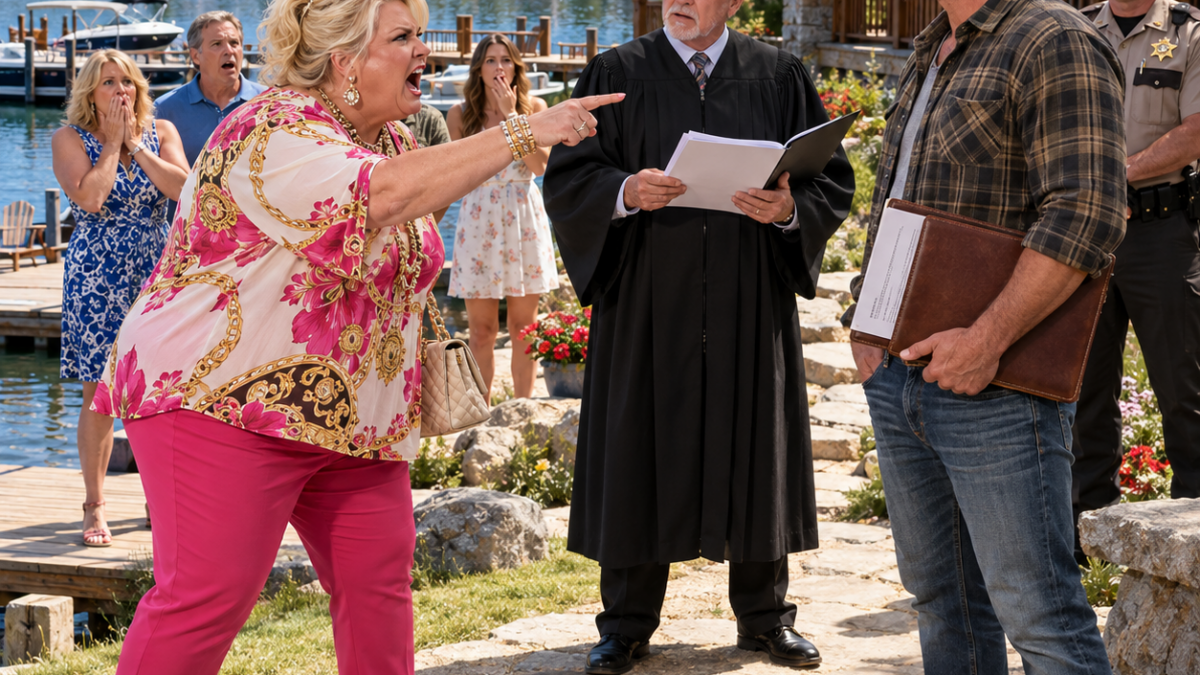
PART 2
Two days later, I was standing outside County Courtroom Three with Harold Reed, the leather binder tucked under my arm and Francesca Bloom twenty feet away pretending not to look nervous.
She had brought reinforcements.
Paula Mercer, the HOA secretary, sat beside her holding a three-ring binder thick enough to stop a door.
Dennis Avery, the treasurer, occupied the end of the bench and looked like a man who had arrived at the wrong funeral but was too polite to leave.
Then there was the HOA attorney.
Martin Greeley.
Expensive suit.
Silver tie.
Leather briefcase.
The kind of lawyer Francesca liked because he looked official before he ever spoke.
Harold leaned toward me.
“You recognize him?”
“No.”
“Subdivision lawyer. Mostly collections and covenant enforcement.”
“Good?”
“Competent.”
“That sounded almost complimentary.”
“It was.”
I looked at Francesca.
“You still think this is funny?”
Harold followed my gaze.
“No.”
That surprised me.
“What changed?”
“The fact she filed in court.”
“I thought that’s what we wanted.”
“It is.”
“Then?”
He adjusted his glasses.
“Jack, the old Weller leases are unusual. If they’re what Curtis represented, you’re in a strong position. But property law isn’t a magic trick. We don’t walk in, wave a deed, and suddenly own everyone’s furniture.”
“I know that.”
“I know you know. I’m reminding both of us.”
That was Harold’s way.
He liked winning.
He liked even more knowing exactly what he’d won.
We entered.
Judge Elena Ramirez took the bench at nine.
She was in her late fifties, compact, serious, and famous among county lawyers for interrupting anyone who mistook volume for evidence.
Francesca had apparently not heard about that reputation.
Greeley began.
“Your Honor, Pine Lake Shores Homeowners Association seeks enforcement of recorded community standards against Mr. Jack Ellison, whose repeated violations have created substantial hardship for neighboring homeowners.”
Judge Ramirez looked at the filing.
“Enforcement in what form?”
“Possession and removal, Your Honor.”
“Possession by whom?”
“The association, pending disposition under the covenants.”
The judge raised her eyes.
“Is the association Mr. Ellison’s landlord?”
“No.”
“Mortgagee?”
“No.”
“Holder of a judgment lien?”
Greeley hesitated.
“No.”
“Then explain the legal mechanism by which a homeowners association intends to evict a fee owner.”
Francesca shifted.
Harold looked down at his notes so nobody would see him smiling.
Greeley recovered.
“Our position is that Mr. Ellison acquired his cabin subject to Pine Lake Shores restrictions and related occupancy obligations.”
“Show me.”
He gave the clerk a packet.
Recorded declarations.
Amendments.
Architectural rules.
Board resolutions.
Francesca’s photographs.
My glorious brown trash cans featured prominently.
Judge Ramirez turned pages for nearly five minutes.
Then looked at Harold.
“Response?”
Harold stood.
“My client disputes the basic premise that his parcel is subject to the HOA’s declaration.”
Greeley said, “Every residence in Pine Lake Shores is subject to the same declaration.”
Harold didn’t look at him.
“Not this one.”
He opened the leather binder.
“This deed predates the declaration.”
Judge Ramirez took it.
Harold continued.
“More importantly, Your Honor, Pine Lake Shores did not originate as a conventional subdivision in which a developer conveyed fee-simple lots subject to covenants.”
The judge looked up.
“What did it originate as?”
“A ground-lease community.”
Francesca frowned.
I watched her turn toward Greeley.
He was no longer looking relaxed.
Harold handed up the 1961 instrument.
“Curtis Weller’s father, Samuel Weller, owned approximately two hundred and twelve lakefront acres. He created long-term residential leaseholds but retained the underlying fee interest.”
Judge Ramirez studied the pages.
“Were those leaseholds later converted?”
“Some terms were amended. Some cabins changed hands through assignment. But our title search found no blanket conveyance transferring the underlying tract to Pine Lake Shores HOA.”
Greeley stood.
“Your Honor, this is a collateral title issue unrelated to covenant enforcement.”
Judge Ramirez looked at him.
“If your association claims authority based on ownership or recorded restrictions attached to land, title is not collateral.”
She turned another page.
Then another.
I could hear Francesca whispering.
“What is he talking about?”
Greeley didn’t answer.
Judge Ramirez asked Harold, “How did your client acquire his interest?”
Harold handed up my deed.
“Curtis Weller conveyed the cabin parcel, the remaining Weller fee estate, and assignable interests connected to the original lease structure.”
The judge looked at me.
“You understood this when you purchased?”
“Yes, Your Honor.”
“Did you collect rents?”
“Only on a handful of surviving ground leases where payments were still required. Most older leases had prepaid or nominal structures.”
“Did you attempt to govern the homeowners?”
“No.”
“Why not?”
“Because owning the underlying land doesn’t make me their HOA.”
A tiny change crossed her face.
Approval, maybe.
She turned to Francesca’s side.
“Ms. Bloom, did you or the board obtain a title opinion before filing this action?”
Francesca leaned toward the microphone.
“We have always governed Pine Lake Shores.”
“That wasn’t my question.”
“No.”
“Did you inspect Mr. Ellison’s deed?”
“We assumed it was like every other purchase.”
Judge Ramirez looked at Greeley.
“Counsel?”
He stood reluctantly.
“I received the deed only with respondent’s opposition filing.”
Harold raised an eyebrow at me.
Translation: Francesca hadn’t told her own attorney enough.
Judge Ramirez turned to the original declaration.
“This declaration describes association authority over member leaseholds and later-acquired lots. I see no legal description including Mr. Ellison’s cabin tract.”
Harold nodded.
“Correct.”
She turned to another document.
“And I see references to common land being maintained by the association under licenses originating with the Weller estate.”
My heart beat a little faster.
That was the part Francesca hadn’t understood.
The roads.
Certain shoreline strips.
The community center parcel.
The boat-launch easement.
Much of Pine Lake Shores had operated for decades through a patchwork of licenses, easements and old leases created by Curtis’s father.
The HOA had maintenance rights.
Not ownership.
Judge Ramirez looked at Francesca.
“Ms. Bloom, I am denying the requested eviction relief.”
Francesca sat straighter.
“But Your Honor—”
“I am not finished.”
Silence.
“The evidence presently before this court suggests Mr. Ellison’s cabin is not subject to the governing declaration you’ve cited.”
Harold sat beside me.
I felt my shoulders loosen.
Then the judge continued.
“More concerning, the chain of title indicates Mr. Ellison may hold the underlying fee estate beneath substantial portions of Pine Lake Shores.”
A murmur moved through the courtroom.
Francesca’s face changed.
“No.”
The judge looked at her.
“Excuse me?”
“That can’t be correct.”
Judge Ramirez closed the deed.
“Court records are not adjusted based on surprise, Ms. Bloom.”
Francesca turned to Greeley.
He whispered sharply.
She stopped talking.
Judge Ramirez continued.
“Let me be precise. Mr. Ellison does not, by virtue of fee ownership alone, suddenly acquire ownership of every privately owned structure, nor may he arbitrarily dispossess residents holding valid leasehold or contractual rights.”
That mattered.
I was glad she said it.
The truth was strange enough without exaggeration.
“However,” she continued, “the association appears to have asserted regulatory and eviction powers against someone whose property is outside the declaration it relies upon.”
She looked toward Harold.
“Anything further?”
Harold stood.
“Yes, Your Honor.”
He placed a second folder on the lectern.
“I would like the court to consider whether the association’s financial practices are relevant to the relief requested.”
Greeley stood immediately.
“Objection. Beyond scope.”
Harold replied, “The HOA’s filing requests costs, fines and enforcement fees allegedly owed by my client. Those records are directly relevant.”
Judge Ramirez nodded.
“Limited to assessments asserted here. Proceed.”
Harold handed up a forensic accounting summary.
I had almost forgotten about it.
After Francesca sent the first attorney letter months earlier, Harold advised me to obtain publicly available HOA financial records and any documents I had lawful access to through the old ground-lease administration files.
The accountant had noticed odd overlaps.
Payments labeled:
Executive Wellness Retreat.
Community Leadership Development.
Resident Relations Consulting.
Then expenses billed to homeowner assessments with no clear votes attached.
Harold said, “The association is demanding monetary relief while its own records reflect assessment increases that may not correspond to recorded board authorization.”
Francesca whispered, “That’s irrelevant.”
Judge Ramirez looked at her.
“Please allow your attorney to represent you.”
Harold continued.
“One category alone totals more than forty-eight thousand dollars annually.”
The judge read.
“What is ‘executive wellness retreat’?”
Nobody answered.
She looked at Greeley.
He looked at Francesca.
Francesca finally said, “Team-building.”
“Monthly?”
“Board cohesion requires—”
Judge Ramirez stopped her with one look.
Then she turned to Dennis.
“You’re listed as treasurer?”
Dennis looked like he wanted the bench to swallow him.
“Yes, Your Honor.”
“Did you approve these expenditures?”
“I signed disbursements.”
“That is not what I asked.”
Dennis swallowed.
“I didn’t review every receipt.”
Francesca turned sharply.
“Dennis.”
Judge Ramirez tapped her gavel once.
“Ms. Bloom.”
Francesca sat back.
Harold handed up another exhibit.
“This spreadsheet reflects approximately thirty percent of homeowners receiving assessment increases not found in the board minutes provided to us.”
Greeley said, “We dispute the characterization.”
“Of course,” Judge Ramirez replied.
Harold added, “Several corresponding transfers move into an account controlled by Bloom Management Services.”
Francesca shot to her feet.
“That is a lie.”
Judge Ramirez’s expression went flat.
“Sit down.”
“Your Honor—”
“Sit.”
She did.
For the first time since I’d known Francesca, she looked frightened.
Not angry.
Frightened.
Judge Ramirez reviewed the documents for another minute.
Then she said something none of us expected.
“I am directing the clerk to transmit copies of these exhibits to the county financial-crimes unit for review.”
Francesca’s mouth opened.
No sound came.
“This court is not making a criminal finding,” Judge Ramirez continued. “It is recognizing information that warrants independent examination.”
She turned toward me.
“Mr. Ellison, regarding your property, the HOA’s eviction request is denied. I am also entering temporary relief prohibiting the association from attempting possession, penalties, inspections, or enforcement against your cabin under the declaration currently cited.”
Harold whispered, “That’s the win.”
But I was watching Francesca.
Because she wasn’t looking at the judge.
She was looking at Paula.
Paula stared at the table.
Dennis stared at Francesca.
Something was breaking between them.
The judge added, “As to the underlying land structure, I strongly suggest all parties obtain qualified title counsel before taking any action affecting leaseholders.”
I stood.
“Yes, Your Honor.”
Francesca couldn’t resist.
“So he can just shut down the subdivision?”
Judge Ramirez looked at her.
“No.”
“But he owns the land.”
“Ownership has legal obligations attached to it, Ms. Bloom. So do leases, licenses and easements.”
She leaned back.
“This court deals in documents, not kingdoms.”
That sentence ended the hearing.
Outside, Harold let out a breath.
“You owe me a cheeseburger.”
“For what?”
“For not laughing when she said team-building.”
I almost answered.
Then a deputy approached.
“Jack Ellison?”
“Yes.”
He handed me a sealed county envelope.
“Records office flagged this after the title pull.”
Harold moved closer.
I opened it.
Permit application.
Six months old.
Applicant:
Pine Lake Shores Homeowners Association.
Project:
Private Marina Redevelopment.
Proposed demolition:
Three existing lakefront structures.
I read the addresses.
Mine.
Earl Bennett’s.
Margaret Pike’s.
Both of them were retirees who had lived by the lake longer than Francesca had been president.
The application classified all three sites as “vacant or association-controlled improvements.”
My hands tightened.
Harold read over my shoulder.
“This was filed before she tried to evict you.”
“Yes.”
He turned another page.
Projected marina revenue.
Private slips.
Guest access.
Boat-storage fees.
A proposed clubhouse extension.
Then the line that changed everything.
LAND CONTROL CERTIFICATION:
Applicant asserts full development authority through Pine Lake Shores HOA governing instruments.
Harold’s face hardened.
“They were setting up a development project.”
“And my cabin was in the way.”
“So were Earl and Margaret.”
I looked back toward the courthouse.
Francesca was still inside.
Suddenly the seventeen violations made sense.
The dock.
The siding.
Trash cans.
Grass.
None of it was the point.
She needed me classified as a noncompliant owner.
Then removable.
The fight had never been about community standards.
It was about shoreline.
I drove directly to Earl Bennett’s house.
Earl was seventy-six, Vietnam veteran, retired diesel mechanic, and somehow always sharpening something.
That afternoon it was a garden knife.
He looked up as I walked toward his porch.
“You win?”
“For now.”
“Francesca cry?”
“No.”
“Shame.”
I handed him the permit.
He read.
Then read again.
“That is my address.”
“Yes.”
“Demolition.”
“Yes.”
He set the knife down.
“I’d like to revise my earlier opinion.”
“What opinion?”
“That she’s merely irritating.”
Margaret lived two properties farther.
She opened the door wearing gardening gloves.
When she saw the permit, she sat at the kitchen table without speaking.
Her husband had died five years earlier.
The lake cabin was where they’d raised three children through summers of fishing, thunderstorms and mosquitoes.
“They were going to tear it down?”
“They applied to.”
“But I own it.”
“Yes.”
“How?”
“I don’t think they legally could.”
She looked toward the window.
“Then why file?”
“To create a paper trail that made it look like they could.”
Margaret’s eyes filled.
“Jack, she offered to buy this place last year.”
I stopped.
“What?”
“Francesca.”
“For the HOA?”
“She said the board wanted shoreline continuity.”
“How much?”
Margaret retrieved a folder.
Offer below market.
Much below.
She had written NO across the first page.
Another piece.
By sundown, word had spread.
I didn’t call a meeting.
People simply arrived.
Tia Brooks, an ER nurse, brought a file of fines over wind chimes, flowerpots and “excessive porch individuality.”
Reena Patel, single mother of two, brought letters calling her daughter’s sidewalk chalk “unauthorized exterior markings.”
George Moreno had assessment statements showing increases three times in one year.
A retired teacher named June Park had been fined because her birdhouse was visible from the street.
Some stories were ridiculous.
Some expensive.
A few were serious.
One homeowner had received lien threats after challenging an assessment.
Another said Francesca repeatedly implied his home could be “reallocated” if he became delinquent.
Harold set up folding tables in my cabin.
By nine that night, the place looked like a war room.
He hated that description.
“It’s not a war room.”
“What is it?”
“Document review.”
“Much more exciting.”
“Legal work should not be exciting.”
Earl sat nearby.
“That explains lawyers.”
Harold ignored him.
We organized.
Fines.
Assessments.
Threats.
Board notices.
Sale offers.
Marina documents.
Residents signed affidavits.
Not statements written by me.
Their own words.
Dates.
Amounts.
Names.
Harold filed for emergency injunctive relief.
The county scheduled a hearing seventy-two hours later.
Francesca responded before the court did.
Black SUV.
Private security logo.
A man in a polo walked my shoreline.
I approached from the cabin.
“You lost?”
“No.”
He showed a badge.
Not government.
Private security.
“Compliance inspection on behalf of Pine Lake Shores.”
“They’re under a court restriction regarding my property.”
He looked genuinely surprised.
“I was assigned this address.”
“By whom?”
“Dispatch.”
“Company?”
“Guardian Community Services.”
“Leave.”
He did.
No argument.
That interested me.
I photographed the SUV.
License plate.
Badge.
Then called Harold.
“Another contractor.”
“Did you confront him?”
“I told him to leave.”
“Good.”
“He left immediately.”
“Also good.”
“Why would Francesca send him after today’s ruling?”
“Maybe she didn’t.”
That hadn’t occurred to me.
“What do you mean?”
“Don’t assume every moving piece belongs to her.”
“Who else?”
“I don’t know.”
That night, I installed motion-activated floodlights.
Two more trail cameras.
Not because I expected violence.
Because somebody kept sending people to land they had no legal right to inspect.
The second hearing drew more than fifty residents.
Judge Ramirez looked over the affidavits.
The marina application.
The private inspection evidence.
Then the HOA’s new attorney—Greeley had withdrawn after what the record politely called a “breakdown in representation.”
Francesca’s replacement lawyer requested a continuance.
“Denied,” Judge Ramirez said.
“Your Honor, we require time to evaluate—”
“You filed the original action.”
“Yes, but—”
“You asked this court to remove a man from his home based on governing documents your client apparently never confirmed applied to him.”
Silence.
She continued.
“The court now has evidence of potential fraudulent development filings and inconsistent financial records.”
The attorney sat.
Judge Ramirez appointed a temporary receiver over limited HOA operations pending audit.
Not because I owned the ground.
Because the board’s finances and authority were in dispute and residents still needed roads, trash contracts, insurance and common services maintained.
That distinction saved Pine Lake Shores from chaos.
Francesca had spent years making herself appear indispensable.
The court proved she wasn’t.
The receiver was Lena Morrison.
Former city planner.
Gray-streaked hair.
Utility vest.
Leather ledger.
The first morning she arrived, she changed access credentials to the HOA office, secured records, and posted a notice:
COURT-SUPERVISED ADMINISTRATION.
ESSENTIAL SERVICES CONTINUE.
ALL ENFORCEMENT ACTIONS SUSPENDED PENDING REVIEW.
She found me watching from across the road.
“You Jack?”
“Yes.”
“Do not call me every hour.”
“I haven’t called you once.”
“Excellent start.”
I liked her immediately.
By noon, auditors were cataloging boxes.
Then they found shredded paper in the dumpster.
Lena stood over it with both hands on her hips.
“Please tell me this is old.”
A volunteer shook his head.
“Dumpster was empty Monday.”
She turned to me.
“Who had access?”
“Francesca, Paula, Dennis, maybe maintenance.”
“Maybe?”
“I don’t run the HOA.”
“Good answer.”
Financial crimes took over the shredded records.
That evening Lena asked me for resident evidence.
“Copies only.”
“Of course.”
“And chain of custody on originals if criminal.”
“I know.”
“You a lawyer?”
“No.”
“You sound irritatingly informed.”
“My lawyer is irritatingly expensive.”
Harold, standing five feet away, said, “I heard that.”
Dennis came to my cabin the next morning.
No warning.
Cardboard box.
Face gray.
“I didn’t know.”
I opened the door.
“Know what?”
“Most of it.”
“Come in.”
He set the box on my table.
“I signed checks.”
“I know.”
“She said they were approved.”
“Who?”
“Francesca.”
“What changed?”
Dennis rubbed both hands over his face.
“She called me last night.”
“What did she say?”
“That if investigators ask, I handled finances.”
Harold happened to be there.
His entire posture changed.
“Exact words?”
Dennis looked at him.
“Pretty close.”
“Before you say anything else, you need independent counsel.”
Dennis blinked.
“I came to help.”
“I understand. You may also have exposure.”
“I didn’t steal anything.”
“Get a lawyer anyway.”
For once, Dennis took good advice.
His attorney contacted investigators.
Then Dennis returned under arranged conditions and surrendered the box.
Inside were two ledgers.
One matched HOA office records.
The other didn’t.
The second ledger included cash transfers.
Luxury vehicle rentals.
Spa packages.
Ski trip expenses.
And repeated payments to Bloom Solutions LLC.
Harold looked up the company.
Owner:
Francesca Bloom.
The first transfer was eighteen months earlier.
The same month assessment increases began.
Total suspicious transfers exceeded two hundred thousand dollars.
Not all necessarily theft.
Enough for investigators.
Financial-crimes officers took the ledgers.
Dennis gave a recorded statement.
Paula hired counsel the same afternoon.
Francesca disappeared.
At first nobody knew where.
Her Lexus was at home.
No answer.
Phone off.
The sheriff issued no dramatic statewide manhunt because she had not yet been charged with a crime requiring arrest.
Then evidence developed.
A warrant followed.
She was located at the regional airport preparing to board a charter flight.
Not disguised like a movie villain.
No fake mustache.
She did have a passport in her maiden name, legally valid but not the name investigators first checked.
She carried a large amount of cash, jewelry and a burner phone.
That mattered to the bail judge later.
The arrest happened quietly.
The media did the shouting afterward.
LOCAL HOA PRESIDENT ARRESTED IN FINANCIAL FRAUD INVESTIGATION.
Then:
PINE LAKE SHORES LEADER ACCUSED OF USING COMMUNITY MONEY FOR PERSONAL EXPENSES.
Then:
MARINA PLAN TARGETED HOMES BOARD DID NOT OWN.
People came to my cabin with food.
Margaret brought pie.
George brought trout.
Tia brought beer.
Earl brought nothing and ate everybody else’s food.
I stood by the counter looking at the pile.
“This is getting weird.”
Earl opened a beer.
“You’re a folk hero.”
“I’m a guy with a deed.”
“Same thing around here.”
But I didn’t feel heroic.
Pine Lake Shores was financially damaged.
Residents were angry.
Some embarrassed.
Some afraid their homes weren’t actually theirs because of the ground-lease revelation.
That last part kept me awake.
The next morning, I called Harold.
“We need to clarify the leases.”
“I was already going to.”
“I don’t want people thinking I’m their landlord in some predatory sense.”
“Legally, you may be ground lessor on certain parcels.”
“You know what I mean.”
“Yes.”
“Can we stabilize ownership?”
“That will take title work.”
“Do it.”
“Expensive.”
“Do it.”
For nearly two months, Harold’s title team reconstructed Pine Lake Shores parcel by parcel.
Some homes had been converted to fee-simple ownership decades earlier through properly recorded deeds.
Others remained on long-term ground leases.
Some leases had ninety-year renewals.
A few had almost no economic rent.
The roads depended on permanent easements.
The community center sat on land technically still in the Weller estate, now mine, subject to a decades-old license.
The picture was messy.
But not dangerous.
No one was about to wake up homeless.
I held a meeting at the community center.
Packed room.
People tense.
I stood with Harold.
“No one’s being evicted.”
Someone shouted, “Can you?”
Harold answered before I did.
“Not arbitrarily. Valid leases and occupancy rights remain enforceable.”
A woman asked, “Does Jack own my house?”
“No,” Harold said. “He holds underlying land interests on certain parcels. Your structure and leasehold rights are separate.”
Another voice:
“Do we owe him rent?”
“In some cases nominal rent is technically due under old leases. Jack has instructed us not to make any changes while title stabilization is underway.”
I took the microphone.
“My goal is simple. Nobody should live here wondering whether paperwork from 1963 is going to blow up their retirement.”
Margaret nodded from the front row.
“What will you do?”
“Where legally feasible, offer homeowners the chance to convert underlying lease interests into clear ownership on fair terms or preserve current lease rights if they prefer.”
Earl raised his hand.
“Can I pay you with fish?”
“No.”
“Then capitalism wins again.”
People laughed.
Tension broke.
That meeting mattered more to me than the courtroom victory.
I didn’t want Francesca replaced by Jack Ellison.
Same control.
Different personality.
The receiver’s audit deepened.
Lena discovered many fines Francesca had issued without documented board votes.
Some were within existing rules but improperly processed.
Others had no support at all.
A flamingo.
Wind chimes.
Chalk.
A sapling.
The HOA had slowly become Francesca’s personality written as policy.
“How did nobody stop her?” I asked Lena.
We were sitting in the old office surrounded by banker boxes.
“Easy.”
“Really?”
“Most people don’t want a second job.”
“What?”
“HOA governance.”
She held up board minutes.
“People work. Raise kids. Care for parents. They pay dues and assume somebody responsible is reading this stuff.”
“And board members?”
“Some defer to the strongest personality.”
“Dennis.”
“Exactly.”
“Paula?”
“Looks like she objected sometimes.”
“Not enough.”
“No.”
Lena put down the file.
“Systems fail quietly before they fail loudly.”
That sentence stuck.
Three weeks later, the court approved a restructuring plan.
HOA enforcement remained suspended.
A temporary receiver managed contracts.
Homeowners elected an advisory committee with no authority to fine anyone.
The old board was effectively finished.
Then the letter from Mariner Ridge Holdings arrived.
It was addressed to:
OFFICE OF PROPERTY MANAGEMENT
PINE LAKE SHORES
Mail carrier delivered it to my cabin because the old HOA office was locked.
Scheduled site inspection.
Phase One Lakeside Development Review.
Representative:
Kyle Denshaw.
I stared at it.
Another developer.
I called Lena.
“Mariner Ridge?”
Silence.
“You recognize it.”
“Yes.”
“From where?”
“Ledger.”
“How?”
“Consulting payment last year.”
“For what?”
“No invoice.”
“What do they do?”
“Development.”
I looked toward my dock.
“Marina.”
“Possibly.”
The old permit came back to me.
Three homes demolished.
Private marina.
Harold joined us.
We requested archived correspondence through the receiver.
Investigators reviewed it because Francesca’s financial case remained active.
Six months earlier, she had signed a letter of intent granting Mariner Ridge development rights over multiple shoreline parcels.
Including mine.
Problem:
She had no authority.
Worse:
The attached board resolution was fake.
Paula’s signature appeared.
Paula denied signing it.
Dennis’s too.
Dennis denied it.
Notary seal belonged to a woman who had never notarized anything for Pine Lake Shores.
Harold sat at my table reading copies.
“She was trying to sell rights she didn’t own.”
“Why?”
“Money.”
“Always?”
“Usually a reliable guess.”
Investigators found emails.
Francesca to Kyle Denshaw:
Once problem occupants are cleared, Phase One can move.
Kyle:
Need proof of shoreline control.
Francesca:
Board authority plus recorded community documents.
Kyle:
Counsel wants ownership certification.
Francesca:
Being handled.
I read that last line twice.
Being handled.
My eviction.
Margaret’s purchase offer.
Earl’s notices.
Not random.
Clear the shoreline.
Mariner Ridge planned a private marina with fifty-eight slips.
Premium memberships.
Guest dock.
Small restaurant.
Vacation-home shuttle.
And, unbelievably, a private helipad proposed on higher ground.
“Who needs a helipad at Pine Lake?” Earl asked.
“People with helicopters.”
“I hate them already.”
To be fair, Mariner Ridge had not yet built anything.
Maybe company executives believed Francesca possessed valid authority.
Maybe not.
Investigators would determine that.
The scheduled site inspection remained on the calendar.
I wanted to confront them.
Lena stopped me.
“No theatrics.”
“I can tell them to leave my land.”
“Yes.”
“Then?”
“Certified documents. Witnesses.”
“Boring.”
“Boring wins lawsuits.”
At nine the next morning, I sat in a folding chair beside the gravel loop with coffee.
Fog over the lake.
Kyle Denshaw arrived in a black SUV.
Blue sport coat.
Clipboard.
Phone.
Two consultants with him.
He looked around.
“You Jack?”
“Yes.”
“I’m here on behalf of Mariner Ridge.”
“I know.”
“We have a Phase One parcel inspection scheduled.”
“Who authorized access?”
“Pine Lake Shores.”
“That entity is under court receivership and had no property authority to grant access to my tract.”
He frowned.
“Our agreement predates the restructuring.”
I handed him a certified court order.
Then a title summary.
Kyle read.
His face changed slowly.
“This says you hold underlying land interests.”
“Yes.”
“Our contract identifies the HOA as development grantor.”
“That appears to be your problem.”
He looked toward the lake.
“We’ve already spent money on preliminary surveys.”
“I believe you.”
“If the land-control representation was false, that’s between us and the HOA.”
“Correct.”
“So why are you threatening trespass?”
“Because right now you’re standing on my land after I told you the person who invited you had no authority.”
He looked at the consultants.
One immediately stepped backward.
Smart consultant.
Kyle handed back the order.
“We were told the homes scheduled for removal were association-controlled.”
“They are not.”
He opened his clipboard.
“What about your cabin?”
“Mine.”
“The Bennett property?”
“Earl’s occupancy rights are protected.”
“Pike?”
“Margaret.”
Kyle exhaled.
“I need to call counsel.”
“Please do.”
He walked to the SUV.
Twenty minutes later, they left.
No yelling.
No threats.
No dramatic security confrontation.
Just lawyers recognizing a poisoned deal.
By evening, Mariner Ridge formally suspended its project.
Within a week, it withdrew.
Then investigators discovered one acquisition executive had communicated privately with Francesca about receiving exclusive lake privileges in exchange for helping structure the project.
Whether company leadership knew became a separate question.
That executive eventually faced charges tied to the alleged fraud.
Francesca’s case expanded.
Forged documents.
Attempted unauthorized property disposition.
Financial fraud.
Interstate communications.
The preliminary hearing drew cameras.
She wore a gray blazer.
No hat.
No jewelry.
No confidence.
I sat in the back.
Not to enjoy it.
Because my property was evidence and I had restitution claims.
Judge Ramirez handled part of the civil side.
A different judge handled the criminal case.
Good.
Separation mattered.
Francesca pleaded not guilty initially.
Her attorney challenged the ledgers.
The emails.
Intent.
Not every ugly financial decision is embezzlement, he argued.
True.
Not every false statement is fraud.
Also true.
The state had to prove each count.
The process took months.
Meanwhile, Pine Lake Shores changed.
The title-conversion project became my obsession.
One parcel at a time.
Survey.
Lease review.
Appraisal.
Homeowner choice.
Some residents bought the underlying fee interest for modest amounts reflecting the unusual history.
Others kept long-term leases because conversion wasn’t financially worthwhile.
For elderly residents, I offered favorable options after Harold structured them properly.
He accused me of destroying his image of ruthless land ownership.
“I never had that image.”
“You should. It’s professionally useful.”
Margaret chose conversion.
She signed at my kitchen table.
When Harold handed over the deed package, she cried.
“I’ve lived there forty-two years.”
“I know.”
“I thought I owned it.”
“You owned meaningful rights.”
“That’s lawyer talk.”
“Yes.”
She touched the new deed.
“Now?”
“Now the structure and underlying parcel are cleanly unified, subject to normal recorded easements.”
She looked at me.
“So you can’t evict me.”
“I wasn’t planning to.”
“Good.”
She hugged me.
That surprised both of us.
Earl refused conversion.
“Why?”
“I like paying you one dollar a year.”
“Your lease requires five.”
“Inflation.”
“You haven’t paid in fourteen years.”
“Then you owe me seventy.”
He placed a hundred-dollar bill on my table.
“Keep change.”
“I hate you.”
“Landlord.”
He never stopped calling me that.
Reena’s children painted chalk on the road outside their cabin during the first summer festival after restructuring.
Nobody fined them.
Tia hung twice as many wind chimes.
George planted another tree.
June Park installed a birdhouse shaped like a miniature Pine Lake Shores clubhouse.
On the side she’d painted:
NO MEETINGS.
It became neighborhood legend.
The receiver eventually recommended replacing the old HOA with a limited community association responsible only for truly shared services.
Road maintenance.
Snow removal.
Lake safety coordination.
Common dock repairs where applicable.
No aesthetic police.
No personal-property fines.
No surprise authority.
Membership and obligations tied only to properly recorded agreements.
Residents voted.
Passed overwhelmingly.
Calvin Mercer, a retired engineer, became chair.
His first meeting lasted forty-seven minutes.
Francesca’s meetings used to last three hours.
Earl stood afterward.
“I don’t trust any government that efficient.”
Calvin replied, “We’re not a government.”
“Good start.”
The criminal case against Francesca eventually resolved partly through plea negotiations after Dennis and Paula agreed to testify.
Dennis admitted negligence.
He had signed checks without reviewing invoices.
He avoided the worst criminal exposure because evidence showed he wasn’t receiving the money and later cooperated.
That didn’t make him innocent of responsibility.
He knew it.
One evening he came to my dock.
“I should’ve looked.”
“Yes.”
“I thought Francesca was smarter than me.”
“She probably was in some ways.”
“I thought that meant she was right.”
I didn’t answer.
He stared at the water.
“She’d put documents in front of me during meetings. Say counsel had reviewed everything. I signed.”
“Why?”
“I didn’t want an argument.”
There it was.
Not greed.
Cowardice through convenience.
He looked at me.
“Everybody thinks board corruption is people taking bags of cash.”
“Sometimes it’s people not reading.”
“Yes.”
He joined the new maintenance committee later.
Not treasurer.
Never again.
Paula testified that Francesca often prepared board minutes after meetings and inserted approvals that had never been voted on.
That explained years of policies nobody remembered approving.
The forensic report eventually identified more than two hundred thousand dollars in diverted or unsupported spending.
Some went to Bloom Solutions.
Some personal travel.
Some luxury transportation.
Some legal actions residents had never authorized.
Restitution orders followed.
Insurance litigation recovered part.
Asset seizures part.
Not every dollar came back.
Money disappears faster than justice finds it.
Francesca’s attempted airport departure damaged her position badly.
Her attorney argued she had planned travel.
Prosecutors pointed to cash, burner phone, and communications about moving money.
The judge ultimately treated her as a serious flight risk.
When the major case finally reached resolution, she accepted responsibility on multiple counts.
Financial fraud.
Forgery.
Attempted fraudulent conveyance-related conduct.
Other charges were dismissed as part of the agreement.
Some residents were disappointed.
They wanted every allegation tried.
Harold didn’t.
“Trials carry risk.”
“I know.”
“Plea gets restitution.”
“I know.”
“Finality.”
“I know.”
“You’re disappointed too.”
“A little.”
He nodded.
“Justice isn’t designed to satisfy anger perfectly.”
I hated how right he was.
Francesca received prison time.
Restitution.
Asset forfeiture.
Restrictions on future fiduciary roles.
The acquisition executive connected to Mariner Ridge faced separate consequences.
Mariner Ridge itself cooperated, terminated the deal, and eventually settled claims arising from the attempted project.
The marina never happened.
Neither did the helipad.
Earl put a small handmade sign near his dock:
NO HELICOPTERS.
Lena told him to remove it because it was unnecessary.
He said:
“Exactly why it’s staying.”
She laughed and walked away.
When Lena’s receivership ended, residents held a community dinner.
She tried to leave before anyone thanked her.
We blocked the door.
“I have work.”
“You’re retired from this case.”
“I have other work.”
Margaret handed her flowers.
Tia gave her a bottle of wine.
Earl gave her a framed copy of the old HOA rule banning unauthorized yard objects.
Under it he wrote:
VIOLATION RESOLVED.
Lena laughed harder than I’d ever heard her.
She turned to me.
“You ready to actually live here?”
“I’ve been living here.”
“No. You’ve been litigating here.”
That hit.
For almost a year, every morning had started with documents.
Emails.
Title reports.
Calls.
Audits.
Court dates.
Even victory had felt administrative.
That night, after everyone left, I walked down to the dock.
No folder.
No phone.
No camera check.
Fishing pole.
I cast.
Nothing bit.
Perfect.
A week later, Lena returned with a county letter.
Not dramatic.
Formal.
Title clarification and recording confirmation.
The remaining Weller estate interests were officially recognized under the updated land records.
Prior HOA claims inconsistent with those interests had been nullified.
Lena handed it over.
“You are now unquestionably the primary holder of the remaining underlying tract interests.”
I read.
“I don’t want to control people.”
“Then don’t.”
“That simple?”
“No.”
She looked toward the neighborhood.
“But intention matters when paired with documents.”
I folded the letter.
“What would you do?”
“Make the structure impossible for the next Francesca to abuse.”
That became my next project.
Not revenge.
Architecture.
Legal architecture.
Harold drafted permanent easements for roads.
Clear maintenance agreements.
Defined access rights.
Restrictions preventing unilateral expansion of community authority.
Conversion options for leaseholders.
Transparency requirements where shared funds were involved.
No one person could resurrect Pine Lake Shores as a little kingdom.
Residents reviewed everything with independent counsel.
That mattered.
I didn’t want them trusting my lawyer just because I liked him.
Calvin once asked:
“You really think someone could try this again?”
“Eventually.”
“That optimistic?”
“Human.”
He couldn’t argue.
The old HOA office became a community workshop and records room.
Glass cabinets held historical documents.
The 1961 Weller map.
Old photographs.
Copies of road agreements.
Current budgets.
Meeting notes.
Nothing hidden.
Dennis spent weekends sanding shelves.
One afternoon I found him behind the lodge working on the old HOA entrance sign.
PINE LAKE SHORES HOMEOWNERS ASSOCIATION.
Letters half removed.
“You keeping it?”
He asked.
“No.”
“Burn it?”
I looked at him.
“Is that responsible?”
“No.”
“Then yes.”
That night residents gathered around the firepit.
Dennis dropped the old sign onto the flames.
Wood caught.
Paint blistered.
Someone told the story about Francesca fining a canoe for remaining visible seventeen minutes past sunset.
Another remembered the wind-chime inspection.
Tia raised her hand.
“Twelve chimes now.”
Applause.
Reena’s daughter, Maya, shouted:
“She fined my chalk!”
Everyone laughed.
Maya was old enough now to understand why adults found that ridiculous.
She drew a giant chalk fish outside the community center the next morning.
Calvin walked past.
Looked.
Said:
“Needs more blue.”
That was all.
Months later, I opened the leather binder Curtis Weller had given me.
I hadn’t looked at it since the first hearing.
At the back was a handwritten ledger.
Notes about land.
Seasonal flooding.
Which road iced first.
Where the bass spawned.
Who borrowed tools and forgot to return them.
Then one sentence in Curtis’s handwriting:
Land doesn’t need kings. It needs caretakers. Keep it simple. Keep it honest.
I read it twice.
Curtis had known what the paperwork meant.
He could have squeezed every ground lessee.
Could have used technical ownership as leverage.
He hadn’t.
Neither would I.
That became the principle behind every conversion.
Fair.
Voluntary where possible.
Transparent.
No surprises.
A year after Francesca handed me the eviction notice, I sat on the same dock cleaning another catfish.
Tires crunched behind me.
For one ridiculous second, my shoulders tightened.
Then Earl’s pickup appeared.
He climbed out carrying a folding chair.
“You catching anything?”
“One.”
“Small?”
“Respectable.”
“So small.”
He sat.
We watched the lake.
Across the water, children jumped off the common dock.
No architectural inspector measured anything.
No private security patrol.
No Lexus.
Earl opened a soda.
“You know the funniest part?”
“What?”
“She tried to evict the landlord.”
I groaned.
“I’m not your landlord.”
He grinned.
“Five dollars a year says otherwise.”
“Your ground lease expires in nine years.”
“Then I’ll haunt you.”
“You’d violate community standards.”
“No standards.”
“Damn.”
He looked toward the cabins.
“You ever think about selling the whole tract?”
“No.”
“Someone offer?”
“Three developers.”
“How much?”
“A lot.”
“And?”
“No.”
He nodded.
“Good.”
“Why?”
“Because I don’t trust anyone who sees a lake and thinks marina revenue before fishing.”
I smiled.
Neither did I anymore.
That fall, the new community council held a festival.
Not mandatory.
Not funded through surprise assessments.
People volunteered.
Kids painted pumpkins.
A local band played badly.
George ran the grill.
Margaret sold pies for the volunteer fire department.
Reena organized games.
Tia hung wind chimes from the pavilion as a joke.
Harold came.
He wore jeans.
It was disturbing.
“You own those?”
“My wife made me.”
“You look like you’re undercover.”
“Shut up.”
Judge Ramirez did not attend, thankfully.
I didn’t need another court connection becoming gossip.
Lena did.
She stood beside me near sunset.
“Looks different.”
“Same houses.”
“Not what I meant.”
I knew.
The atmosphere was different.
Francesca had made people look over their shoulders.
The council made people look toward each other.
Not perfectly.
Neighbors still fought.
Dog barking.
Parking.
Dock schedules.
Snow plowing.
Real communities aren’t peaceful because nobody disagrees.
They’re peaceful when disagreement doesn’t threaten your home.
I had learned that distinction the expensive way.
The last loose thread surfaced in winter.
Mariner Ridge’s former acquisition partner, Kyle Denshaw, requested a meeting through Harold.
The same man I’d turned away at the gravel loop.
We met in Harold’s office.
Kyle looked older.
“I’m not asking for anything.”
“Good.”
He put down a folder.
“What?”
“Internal correspondence.”
Harold opened it.
Mariner Ridge executives had questioned Francesca’s land-control documents months before the inspection.
Kyle had pushed back.
Not hard enough.
But he had asked.
One email from him:
Need independent title verification before committing capital.
Response from acquisition partner:
Bloom says enforcement actions will clean shoreline title before closing. Don’t slow this down.
Kyle looked at me.
“I should have stopped it there.”
“Yes.”
“I thought the lawyers would catch it.”
“Did you send it to them?”
“No.”
“Why?”
“Deal pressure.”
Same story.
Different suit.
He continued.
“When people want a transaction badly enough, uncertainty becomes something they assume someone else checked.”
Harold looked at him.
“Why give us this now?”
“The executive involved is fighting restitution claims.”
“And?”
“I don’t want him blaming field staff for what management knew.”
Self-preservation.
At least partly.
Still useful.
The documents helped settle remaining civil claims.
No dramatic new prosecution.
No conspiracy revelation.
Just another layer showing how Francesca’s lie survived because several people found it easier not to verify it.
That became the part of the story I remembered most.
Not Francesca.
Not the judge.
Not even the deed.
The number of people who could have stopped the mess with one question.
Where is the authority?
Dennis could have asked before signing checks.
Paula before approving minutes.
Greeley before filing eviction.
Mariner Ridge before spending survey money.
Residents before accepting invented rules.
Me too.
For eighteen months, I treated Francesca’s fines like entertainment.
I had the deed.
I knew she couldn’t touch me.
So I ignored her.
Maybe if I had challenged the first false notice formally, the marina scheme would have surfaced sooner.
Maybe Margaret wouldn’t have spent months terrified of losing her cabin.
That thought bothered me.
One evening, Margaret came over for coffee.
I told her.
“I should’ve fought earlier.”
She shook her head.
“You’re not responsible for her.”
“I could have stopped—”
“No.”
Firm.
“You could have done things differently. That’s not the same as causing what she did.”
I looked at her.
“You sound like Harold.”
“God forbid.”
She smiled.
“Jack, I ignored her too. We all did until ignoring stopped working.”
That was probably the truth.
The following spring, Margaret’s grandchildren helped repaint her cabin.
Bright red front door.
Francesca would have hated it.
Nobody submitted an architectural form.
Earl helped me rebuild part of my dock after ice damage.
He worked for twenty minutes and complained for three hours.
Tia’s wind chimes became a navigation system.
You could hear her porch before seeing it.
Maya decorated the community trail with chalk arrows during a charity walk.
Calvin asked if they were removable.
Reena said, “Rain.”
He said, “Approved by weather.”
That was governance now.
Simple.
Limited.
Human.
Pine Lake Shores stopped being known locally for its HOA scandal after a few years.
Other stories replaced ours.
New development across the county.
Election fights.
Flood.
School bond.
That’s how communities heal.
Not by forgetting completely.
By acquiring newer things to complain about.
The courthouse file stayed.
The financial crimes report stayed.
The deeds stayed.
Documentation mattered even after outrage faded.
I kept the original eviction notice.
Not framed.
Not displayed.
Folded inside the Weller binder.
Occasionally I’d find it while looking for something else.
FINAL NOTICE BEFORE EVICTION.
Seventeen violations.
Trash-bin color.
Dock dimensions.
Community aesthetics.
I always smiled at the absurdity.
But less than before.
Because beneath the absurdity had been something serious.
Francesca understood one basic psychological fact.
Official-looking paper makes people afraid.
Most people don’t know the exact boundary between a rule and a threat.
Between a notice and a court order.
Between an HOA lien and ownership.
Between a ground lease and eviction.
She exploited confusion.
What stopped her wasn’t me “owning the subdivision.”
That was the viral version.
The real version was better.
I had documents she hadn’t bothered reading.
Residents had evidence she’d assumed they’d never organize.
A judge asked basic questions.
Auditors followed money.
A receiver preserved essential services.
Lawyers untangled sixty years of land history.
And neighbors decided fear was a terrible form of government.
One July evening, Curtis Weller visited.
He was eighty-seven.
Walked with a cane.
Still sharp enough to insult my fishing technique before saying hello.
He stood on the dock.
“You kept the place.”
“I did.”
“Heard you caused trouble.”
“I was served an eviction notice.”
He laughed so hard he had to sit.
“Francesca?”
“Yes.”
“Always wondered when that woman would step on a rake.”
I handed him the binder.
He touched the leather cover.
“You read it.”
“Eventually.”
“Told you.”
“Why didn’t you warn Pine Lake Shores about the ground title?”
He looked across the water.
“They knew once.”
“What happened?”
“People die.”
I waited.
“Original residents understood the leases. Their kids didn’t. Houses sold. Realtors simplified things. HOA got bigger. Paper got thicker.”
“So memory disappeared.”
“Paper was still there.”
“Exactly.”
Curtis smiled.
“That is why I gave you the binder.”
“Did you know Francesca was misusing authority?”
“Suspected she liked authority too much.”
“Why sell to me?”
“Because you annoyed me less than the developers.”
I laughed.
“Touching.”
He pointed toward the old community center.
“What did you do with the land rights?”
I explained conversions.
Easements.
Council.
Transparency rules.
He nodded.
“Good.”
“That’s all?”
“What do you want, a medal?”
“No.”
“Good.”
We sat quietly.
Then Curtis said:
“My father always said owning ground under someone else’s home makes you either responsible or dangerous.”
I looked at him.
“Which was he?”
“Depends who you ask.”
“Which am I?”
He smiled.
“Still finding out.”
He died the following winter.
Peacefully.
His daughter mailed me a small package afterward.
Inside was an old brass key.
No note except:
Dad said Jack would know.
I did.
The key opened a metal cabinet in the community records room.
Inside were copies of the earliest Pine Lake Shores agreements.
Every original ground lease.
Road maps.
Handwritten maintenance notes.
Receipts.
History.
We digitized everything.
Then put the originals in archival storage with the county historical society.
No more forgotten authority.
No more mystery ownership.
No more hoping someone remembered.
At the next council meeting, Calvin held up the digital index.
“This is boring.”
Everyone nodded.
“Good.”
More nodding.
Earl raised his hand.
“Can we adjourn?”
“After the snow contract.”
“I withdraw my support for transparency.”
Laughter.
I sat in the back.
Exactly where I wanted to be.
Not president.
Not landlord-king.
Not savior.
Just Jack.
The man with the cabin at the edge of the lake.
The cabin Francesca once tried to evict me from.
Years later, visitors occasionally asked which house was mine.
I pointed.
Weathered cedar.
Old dock.
Brown trash cans.
Still not regulation color.
There was no regulation anymore.
One summer afternoon, Maya—now in college—came home and stopped by.
She looked at the dock.
“You know I barely remember Francesca.”
“Lucky.”
“I remember Mom being scared.”
That was different.
She sat on the porch rail.
“Why did everyone let her get away with so much?”
I considered giving a clever answer.
Didn’t.
“Because each thing looked small when it happened.”
“Trash cans?”
“Small.”
“Wind chimes?”
“Small.”
“Chalk?”
“Small.”
“Dues?”
“Annoying.”
“Threat letters?”
“Scary, but private.”
“So?”
“So nobody realized we were all getting different pieces of the same problem.”
Maya nodded.
“Until your eviction.”
“Yes.”
She smiled.
“Worst tactical decision she ever made.”
“Probably.”
“Trying to evict the guy who owned the ground.”
I groaned.
“Earl has been talking to you.”
“All my life.”
She stood.
“Still funny.”
Maybe it was.
The legal truth remained more complicated.
I didn’t literally own every house.
I held the remaining fee estate beneath much of the historic subdivision and inherited the contractual interests attached to those old leases.
But Francesca’s claim had been simpler and more arrogant:
The HOA owns authority here.
The judge proved she was wrong.
That was enough.
On the fifth anniversary of the first hearing, I went fishing alone.
No celebration.
I hadn’t even remembered the date until Harold texted:
HAPPY EVICTION DAY.
I replied:
GET A HOBBY.
He answered:
YOU PAID FOR MINE.
I put the phone away.
Cast toward the reeds.
The lake was glass.
Across the water, Pine Lake Shores looked ordinary.
Red door.
Blue canoe.
Tia’s wind chimes.
Children on the common dock.
George’s trees taller now.
No private marina.
No helipad.
No security vehicle.
The old HOA sign gone.
I thought about Francesca.
I wondered whether she understood what she’d lost.
Not authority.
She never legally had as much as she believed.
She lost trust.
That’s harder to rebuild.
Money can return through restitution.
Documents can be corrected.
Titles can be amended.
Trust has no clerk’s office.
No filing fee.
No simple instrument.
People rebuild it slowly or not at all.
Pine Lake Shores rebuilt enough.
That was all I needed.
My fishing line moved.
I pulled.
Nothing.
Bait gone.
I laughed.
Curtis would have insulted me.
Earl definitely would.
I recast.
Behind me, gravel crunched.
I turned.
For half a second, memory played the old scene.
White Lexus.
Sun hat.
Manila envelope.
Instead, a battered pickup stopped.
Earl stepped out.
“You catching anything?”
“No.”
“Good.”
He brought two chairs.
We sat at the edge of the dock.
No reason.
No agenda.
No papers.
After a while he asked:
“You ever regret buying this place?”
I looked at the cabin.
“No.”
“Even with all that?”
“No.”
“Why?”
I thought about the answer.
Then pointed toward the lake.
“This.”
Earl nodded.
We stopped talking.
Sun lowered behind the pines.
Water turned copper.
Somebody across the lake laughed.
A dog barked twice.
Wind moved Tia’s ridiculous chimes.
Everything sounded normal.
Years earlier, Francesca Bloom had driven up my gravel road with an eviction notice and seventeen violations, certain that rules she controlled were stronger than a deed she’d never read.
She forced a court to examine the documents.
That was her mistake.
The judge found the old Weller ownership.
The audit found the money.
The residents found their voices.
And eventually Pine Lake Shores found something it had lost long before I arrived.
A community didn’t need a queen.
It didn’t need a king either.
Curtis had written the answer decades ago.
Land doesn’t need kings.
Just caretakers.
The catfish finally hit my line just before dark.
I set the hook.
Earl stood.
“Big one?”
“Feels like it.”
“Probably a branch.”
“Get the net.”
“You’re the land baron. Get your own net.”
I laughed and pulled.
The fish broke the surface.
Good-sized catfish.
Earl grabbed the net anyway.
We hauled it onto the dock.
For a few seconds, it thrashed against the boards.
Then settled.
I looked back toward the cabin.
My cabin.
Not because an HOA allowed it.
Not because a judge gifted it to me.
Because the deed had always said what the truth was.
We had just needed someone to finally read it.
[END OF STORY]








