PART 2: HOA Towed My $200,000 Truck While I Was Away—Then I Walked Into Their Meeting Wearing the County Sheriff’s Badge
PART 2
My truck was not a commercial vehicle under the HOA’s own governing documents.
It was privately registered.
Privately insured.
Used primarily for personal purposes.
I hauled my boat with it.
Sometimes I helped my brother-in-law with weekend excavation projects.
Before becoming sheriff, I had used it for odd jobs.
But nothing about those facts magically converted my privately owned pickup into a prohibited fleet vehicle.
The exemption was written plainly into the HOA documents.
Vivian knew that.
I knew she knew it because we had already fought about it years earlier.
Yet there was another problem with her notice.
An even more obvious one.
“The seventy-two hours hadn’t expired,” I said.
Renata nodded.
“No.”
“When did they tow it?”
“The morning after you left.”
I looked at the date.
Then I looked at her.
“She didn’t even wait.”
“No.”
I let out a slow breath.
“She waited for me to leave.”
Renata did not answer.
She didn’t need to.
The task force assignment had not been secret, exactly.
But I had mentioned to a neighbor that I would be gone.
My department vehicle had picked me up early that morning.
Vivian had spent years paying attention to everyone else’s business.
It did not require a genius to imagine her seeing an opportunity.
I sat down.
“Start from the beginning.”
Renata pulled out the first page of her notes.
“The day after you left, I worked a twelve-hour hospital shift. I came home around seven-thirty.”
She pointed to a photograph.
The empty driveway.
“I thought you’d taken the truck at first. Then I remembered you left in the department SUV.”
“What was on the mailbox?”
She handed me another photograph.
A laminated notice had been zip-tied to the post.
The message informed us that the vehicle had been removed due to repeated noncompliance with community parking standards.
Release required payment of towing and storage charges plus a $3,100 HOA compliance fine.
I looked up.
“Three thousand one hundred dollars?”
“That was my reaction.”
“For what?”
“She never gave a breakdown.”
I read the notice again.
“That number isn’t anywhere in the fine schedule.”
“I know.”
“You called her?”
“Immediately.”
Renata leaned back.
“She answered like she’d been waiting.”
I could imagine Vivian’s voice perfectly.
Controlled.
Formal.
Cold enough to make normal conversation sound like a court proceeding.
“What did she say?”
“That your truck was a prohibited commercial vehicle and the association had finally exercised its authority.”
“Finally.”
“That was her word.”
I felt the anger beginning to rise now.
Not explosive anger.
That would have been easier.
This was quieter.
The kind that settles somewhere beneath the ribs.
“What did you tell her?”
“That you weren’t home to respond to the violation.”
“And?”
“She said that wasn’t the association’s problem.”
I looked toward the window.
Our driveway was visible from the kitchen.
Empty.
For six years, that truck had sat there.
Never blocking the sidewalk.
Never blocking the street.
Never leaking oil.
Never causing a problem.
Vivian simply did not like looking at it.
Renata continued.
“I told her the truck is personally registered and specifically exempted under the bylaws.”
“What did she say?”
“That the board had interpreted the rules differently.”
“Did she say the board voted?”
“Yes.”
That mattered.
“Is there a vote?”
“No.”
“You checked the minutes?”
“All of them.”
I turned back.
Renata pushed a stack toward me.
“I downloaded every set of board minutes from the last six months.”
I smiled despite myself.
“You were busy.”
“I was angry.”
“With you, those are usually the same thing.”
She almost smiled.
Then the expression disappeared.
“I called Ironclad.”
“What did they say?”
“Registered owner only.”
“I’m the registered owner.”
“Yes.”
“And I had to appear in person.”
“With identification and payment in full.”
“How much?”
“Storage plus tow plus HOA fine. It kept increasing every day.”
I stared at her.
“They were charging daily storage while refusing to release it to you?”
“You’re the registered owner.”
I rubbed my face.
My exhaustion had vanished.
“So you couldn’t retrieve the truck, couldn’t reach me, and Vivian knew I was gone.”
“That about covers it.”
“What did Priya say?”
Renata turned another page around.
“She said not to pay.”
“Good.”
“She said if we paid the HOA fine, Vivian could later try to argue that we accepted their authority.”
“That sounds like Priya.”
“She also used a word.”
“Which word?”
“Conversion.”
I looked at her.
Renata said, “Unauthorized exercise of control over somebody else’s property.”
“I know what conversion is.”
“I figured.”
“Did Priya think we had a claim?”
“She said the tow could expose the HOA and possibly Vivian personally, depending on what paperwork she used and what authority she claimed.”
That sentence brought me fully awake.
“What paperwork?”
“That’s what she wants.”
I stood.
“Where’s my uniform?”
Renata blinked.
“In the closet.”
“I’m going to the lot.”
“Tonight?”
“Yes.”
“You just drove for hours.”
“I’m not waiting until morning while they add another storage charge.”
She watched me.
“You’re angry.”
“Yes.”
“I know.”
“I’m not going to do anything stupid.”
“That wasn’t what I was worried about.”
I looked at her.
“What are you worried about?”
Her expression softened.
“That you’ll do what you always do.”
“And what’s that?”
“Stay so calm everybody else thinks it didn’t hurt.”
I looked again toward the driveway.
That truck mattered to me.
Not because of the price.
The price was outrageous enough on its own.
But I had built that truck piece by piece over years.
Suspension.
Towing equipment.
Custom bed work.
Engine modifications.
Interior.
It was the first major thing I bought after Renata and I finally got financially comfortable.
I had hauled boats with it.
Helped family move with it.
Driven through storms in it.
Taken my niece to her first county fair in it.
A vehicle is a machine.
I knew that.
But people attach memories to machines.
Vivian had not simply removed an object from my driveway.
She had waited until I was gone, entered a situation she had no legitimate authority over, and had something worth more than many houses dragged across town because she believed nobody would stop her.
“It hurt,” I said.
Renata nodded.
“I know.”
Then she pushed one more sheet toward me.
“There’s something else.”
It was handwritten.
Names.
Addresses.
Short notes.
Desmond Okafor — trailer towed.
Colette Fenwick — $800 fence fine.
Mara Ellison — landscaping penalty.
Victor Chen — work van warning.
Lydia Peterson — trash enclosure assessment.
I looked up.
“What is this?”
“Neighbors started calling.”
“Why?”
“Because they heard about the truck.”
“How?”
“Ridgemont Hollow.”
Fair point.
Nothing traveled faster than outrage in a suburban development except speculation about property values.
Renata continued.
“Desmond said Vivian had his utility trailer towed while he was at his daughter’s hospital appointment.”
I frowned.
“I know Desmond.”
“He paid to get it back.”
“How much?”
“Almost two thousand with everything.”
I looked at the next name.
“Colette?”
“Fence dispute. Eight hundred dollars. She paid because Vivian threatened another hearing.”
“And nobody compared stories before?”
“Apparently not.”
That bothered me more than I expected.
Isolation is useful when you want to pressure people.
One resident thinks he is the problem.
Another resident thinks she misunderstood the rules.
A third decides fighting will cost more than paying.
Nobody realizes the same person is using the same tactics on everyone.
I picked up the list.
“How many?”
“So far?”
Renata hesitated.
“Seventeen.”
I stared at her.
“In eleven days?”
“Yes.”
The anger settled deeper.
“What did Priya say about that?”
“That one bad tow is a dispute.”
Renata tapped the list.
“This could be a pattern.”
—
My truck had always irritated Vivian.
I never understood why at first.
When Renata and I bought our corner lot on Birchwood Lane six years earlier, the truck was already mine.
It was big.
No question about it.
A heavy-duty diesel dually is not subtle.
But it fit completely inside my driveway.
It never blocked traffic.
It was not covered in company logos.
There were no tool racks sticking above the cab.
No flashing lights.
No trailer permanently attached.
It was simply a large privately owned pickup.
The first complaint came three weeks after we moved in.
A typed notice arrived stating that “commercial-class vehicles” were not permitted overnight in visible residential areas.
I walked to the clubhouse with the notice and a copy of the bylaws.
Vivian was not president then.
She was only a board member.
Only was not a word she would have appreciated.
I found her arranging folders before a meeting.
“Can I help you?”
She looked at the paper in my hand.
“I got this.”
“Yes.”
“My truck isn’t commercial.”
“It’s clearly commercial in design.”
“That isn’t what the rule says.”
She gave me a patient smile normally reserved for children who insist the sky is green.
“The intent is to maintain residential character.”
I opened the bylaws.
“The language exempts privately registered vehicles used for personal purposes.”
“It also allows the board discretion.”
“Not here.”
“The board has broad authority.”
“That doesn’t mean unlimited authority.”
Her eyes narrowed.
That was probably the exact moment she decided she disliked me.
Some people can tolerate disagreement.
Vivian interpreted it as disrespect.
I showed her the registration.
The matter disappeared for several months.
Then came another notice.
Then another.
Once, she claimed my truck’s tires extended too close to the edge of the driveway.
Another time, she said the height of the truck created a visibility hazard.
I asked whether she had an engineering report.
She stopped replying.
For a while.
Vivian eventually became HOA president.
After that, nuisance enforcement became something close to a personal hobby.
She fined a widow for wind chimes because a neighbor allegedly complained.
The neighbor later said he never had.
She sent a certified letter to a family because their garden gnome was visible from the sidewalk.
She once demanded a homeowner repaint a mailbox because the black finish was “inconsistent” with the community’s approved dark charcoal.
Nobody understood the difference.
Most people did not fight.
That was Vivian’s advantage.
An HOA fine of two hundred dollars is irritating.
A lawyer may cost more.
A hearing wastes an evening.
A dispute creates stress.
So people paid.
Changed the mailbox.
Removed the gnome.
Took down the wind chimes.
And every time they gave in, Vivian’s understanding of her own authority expanded.
I had largely avoided direct fights because I was rarely home enough to care.
Before I was elected sheriff, I had spent years in law enforcement working investigations and command positions.
My campaign for sheriff had been quieter than most people expected.
No giant motorcade.
No habit of introducing myself by title.
No sheriff star decal on my personal truck.
I did not wear campaign shirts around the neighborhood after election day.
I had no interest in becoming the kind of man who needed everyone in the grocery store to know what office he held.
The election happened during a period when I was also participating in an interagency narcotics investigation.
Within weeks of being sworn in, I was assigned to a joint task force deployment outside my normal jurisdiction.
That was why hardly anyone in Ridgemont Hollow knew I had become county sheriff.
And apparently Vivian never bothered to ask.
She knew my truck.
She knew my driveway.
She knew when my grass was half an inch too tall.
She knew where Renata worked.
She knew when I left town.
But she did not know what badge I carried.
That detail would soon become important.
Not because being sheriff gave me special property rights.
It did not.
The rules protecting my truck applied whether I wore a badge, worked construction, taught elementary school, or delivered pizza.
Vivian’s mistake was not that she targeted the sheriff.
Her mistake was believing the rules changed depending on whether the person she targeted could fight back.
Being sheriff simply meant I knew where to look.
—
Ironclad Recovery sat behind a chain-link fence in an industrial strip west of the county seat.
It was almost dark when I arrived.
My truck was visible before I reached the office.
It sat in the back row between a damaged delivery van and an old sedan.
I stopped for a second.
There was something infuriating about seeing your own property trapped behind somebody else’s fence.
I walked inside.
The attendant behind the counter looked up.
He was probably in his fifties, wearing a faded company polo.
“Help you?”
“I’m here for the gray dually.”
He typed.
“Plate?”
I gave it to him.
“Registered owner?”
“Dean Kessler.”
He looked at the screen.
Then at me.
Then back at the screen.
“Mr. Kessler.”
“Yes.”
“There’s a hold.”
“HOA?”
He nodded.
“Balance is—”
“I’m not paying it.”
He gave me the tired expression of a man who had heard those words a thousand times.
“Then I can’t release—”
“I’d like to see the tow authorization.”
He paused.
“Sir, we don’t normally—”
“I’m the registered owner of the vehicle. I’m disputing the legality of the removal. I’m asking to see the paperwork your company relied on to tow it off my private property.”
His expression changed slightly.
Not because I raised my voice.
I did not.
Maybe because of the way I said it.
He turned toward another desk.
“You have ID?”
I handed him my driver’s license.
When he saw the name, he looked at me again.
Then at the wallet in my hand.
My sheriff credentials were visible behind the license.
He froze.
“You’re Sheriff Kessler?”
“Yes.”
The color changed in his face.
I hated that reaction.
Not because it was inconvenient.
Because it proved something.
Five seconds earlier, I had been a frustrated vehicle owner.
Now I was somebody important enough to worry about.
The law should not work differently because of the badge.
“What I’m asking for,” I said, “is the same information I’d be entitled to ask for if I cleaned swimming pools.”
He swallowed.
“Yes, sir.”
“Please don’t call me sir.”
He disappeared into the back.
A younger employee looked through the doorway.
Then disappeared again.
Within a few minutes, the attendant returned with a file.
He placed it on the counter.
The first page was the tow request.
Requesting party:
**Vivian Castellon**
Authority:
**Ridgemont Hollow HOA President**
Reason:
**Abandoned prohibited commercial vehicle**
I stared at the word abandoned.
My truck had been parked in my driveway.
At my house.
Registered to that address.
Six years.
Abandoned.
I looked at the attendant.
“Who told your driver it was abandoned?”
He shifted.
“We get authorization from the property representative.”
“Which property?”
“The association.”
“The association doesn’t own my driveway.”
He did not answer.
I read farther.
Vivian had cited an “Emergency Compliance Removal Provision.”
I knew the HOA documents.
There was no such provision.
I pulled the governing documents up on my phone.
“Show me where this exists.”
The attendant looked uncomfortable.
“That’s what she provided.”
“That wasn’t my question.”
“I don’t know.”
I flipped to the tow record.
Private property removal.
State law required specific notice procedures.
Including advance posting before a vehicle could be removed under these circumstances.
“Where’s the photograph of the notice posted on the truck?”
The attendant looked through the pages.
“There should be one.”
“There isn’t.”
He searched again.
I already knew what he would find.
Nothing.
“Was a notice posted?”
“I wasn’t the driver.”
“Call whoever was.”
“Sheriff—”
“I’m not here in an official enforcement capacity right now. I’m the owner of the vehicle your company removed.”
He nodded slowly.
“I understand.”
“But your company is now on notice that I dispute the legality of this tow.”
He looked toward the truck.
“I need to call the owner.”
“Do that.”
Ten minutes later, a man named Russell Vane arrived.
He owned Ironclad Recovery.
Russell recognized me immediately.
“Sheriff.”
“Russell.”
We had met twice before at accident scenes.
He looked at the paperwork.
“What’s going on?”
“Your company towed my truck from my driveway.”
His eyes moved toward the yard.
“That’s yours?”
“Yes.”
He looked at the attendant.
Then back at me.
“HOA removal?”
“Unauthorized HOA removal, according to everything I’ve seen.”
Russell opened the file.
I watched his expression change as he read.
“Where’s the posted notice?”
“That’s one of my questions.”
He looked toward the attendant.
“Who ran this?”
“Caleb.”
Russell pulled out his phone.
The call lasted less than two minutes.
I heard only Russell’s side.
“You posted it?”
Pause.
“Where?”
Longer pause.
“Did you take the photo?”
Another pause.
“Who told you that?”
His eyes met mine.
Then:
“Call me tomorrow.”
He ended the call.
“What did Vivian tell him?” I asked.
Russell sighed.
“That there was an urgent association order and the owner might return.”
I did not move.
“She told your driver to hurry because I might come back.”
He rubbed his jaw.
“That appears to be what happened.”
“And no notice was posted.”
“No.”
“And your company towed anyway.”
“Yes.”
“Release my truck.”
“There’s still paperwork—”
“Release my truck.”
Russell looked at me.
For a moment, neither of us said anything.
Then he turned to the attendant.
“Remove the hold.”
The attendant began typing.
“I’m not paying the tow charge.”
Russell nodded.
“I understand.”
“Not storage either.”
“I understand.”
“Not the HOA fine.”
“That isn’t ours.”
“I know.”
Russell lowered his voice.
“Dean, I’m going to review the file.”
“You should review more than mine.”
That made him pause.
“What does that mean?”
“How many Ridgemont Hollow tows have you done in three years?”
He said nothing.
“Review them.”
I collected copies of everything they would give me.
Then I walked into the yard.
The truck started on the first try.
The diesel settled into its familiar rumble.
I sat behind the wheel without moving.
My hands rested on the steering wheel.
It should have felt good.
Instead, I kept thinking about the paperwork.
Abandoned.
Emergency provision.
No notice.
Hurry before owner returns.
This was not Vivian misunderstanding a rule.
This was deliberate.
I drove home.
Renata was waiting in the driveway.
She crossed her arms when she saw the truck.
I lowered the window.
“Need a commercial parking permit?”
She stared at me for half a second.
Then laughed.
It was the first time either of us had laughed about the situation.
I parked exactly where the truck had always sat.
Then I left it there.
Deliberately.
—
The HOA board meeting was scheduled for seven the next evening.
Vivian had probably expected another routine night.
According to the agenda, the board would discuss landscaping contracts, pool maintenance, and a proposal to increase violation fines.
That last item seemed especially fitting.
I came home from work at six-fifteen.
Renata was already dressed.
“You wearing the uniform?”
“Yes.”
She looked at me for a moment.
“You sure?”
“I’m going from work.”
“That isn’t what I asked.”
I understood.
Showing up in uniform would have an effect.
I knew that.
I was not going there to intimidate anyone.
But I was also done pretending my job was some secret to preserve Vivian’s comfort.
“She made this about authority,” I said.
Renata nodded.
“Then maybe it’s time she meets someone who knows what authority actually requires.”
Priya met us outside the clubhouse.
She carried a leather folder and wore the expression lawyers wear when they already know more than everyone else in the room.
“Dean.”
“Priya.”
“You got the tow file?”
I handed her copies.
She scanned the first page.
Her eyebrows rose.
“Abandoned?”
“That was my favorite part.”
“And what is an Emergency Compliance Removal Provision?”
“Fiction.”
She looked at me.
“It doesn’t exist?”
“No.”
Priya turned to Renata.
“She invented an authority, represented it to the towing company as legitimate, bypassed notice requirements, and ordered removal from private property before her own deadline expired.”
Renata said, “That sounds bad when you put it like that.”
“It should.”
“What do you want me to do?” I asked.
“Ask questions.”
“That’s it?”
“Questions are enough when the answers are bad.”
We went inside.
The clubhouse was fuller than usual.
Word had spread.
Desmond sat near the middle.
Colette sat two rows behind him.
Other residents from Renata’s list were scattered around the room.
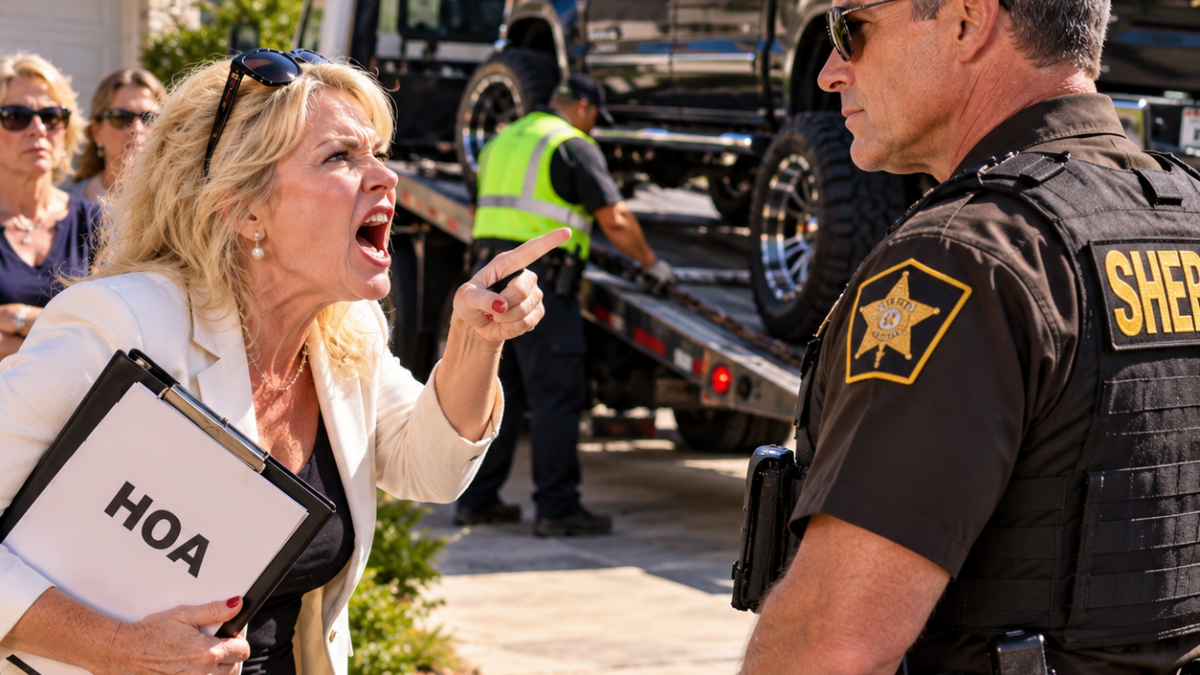
At the front, Vivian sat in her usual place.
Center chair.
Stack of folders.
Small wooden gavel she had purchased herself despite no rule requiring one.
She was speaking when I entered.
“We cannot continue allowing habitual noncompliance to undermine the standards everyone agreed to when—”
Her eyes found my face.
She stopped.
Not completely.
Just a tiny interruption.
Then she noticed the uniform.
Her gaze moved downward.
Sheriff’s star.
Nameplate.
Duty belt.
Then back to my face.
The room followed her eyes.
Voices disappeared.
I had heard that kind of silence many times in law enforcement.
It usually happened when someone realized the situation they thought they understood had just changed.
Vivian blinked.
“Mr. Kessler.”
I walked farther into the room.
“Good evening.”
She looked at the badge again.
“You’re—”
“Dean Kessler.”
“I know your name.”
“I assumed so. You’ve put it on enough violation notices.”
A few people laughed.
Vivian’s mouth tightened.
“What exactly is the meaning of this?”
“I came from work.”
“You’re with the sheriff’s department?”
“I am the county sheriff.”
For perhaps the first time in the six years I had known Vivian Castellon, she had nothing ready to say.
The board members looked at one another.
A man near the wall whispered, “No way.”
Renata sat beside Priya.
I remained standing.
Vivian recovered quickly.
She always did.
“I fail to see how your occupation is relevant to association business.”
“It shouldn’t be.”
That answer confused her.
I continued.
“My rights as a homeowner don’t increase because of this badge.”
Priya watched quietly from the back.
“The same rules should apply to me that apply to Desmond, Colette, or anyone else sitting in this room.”
Vivian leaned back.
“Then perhaps you should address the board as a homeowner rather than appearing in a law enforcement uniform.”
“I’m happy to.”
I took out the tow authorization.
“I have one question.”
She folded her hands.
“Go ahead.”
“Under what authority did you order Ironclad Recovery to remove my legally parked, privately owned vehicle from my privately owned driveway before your own seventy-two-hour notice period had expired?”
The room remained silent.
Vivian looked toward the board members.
“The vehicle was in violation.”
“That wasn’t the question.”
“It is directly relevant.”
“Then we can get to that next. What authority did you use?”
“The association has enforcement authority under the governing documents.”
“Which section permits towing from an owner’s private driveway under these circumstances?”
“The commercial vehicle section.”
“My truck is specifically exempted.”
“We interpret the exemption differently.”
“Show me the interpretation.”
She frowned.
“What?”
“Board minutes. Written opinion. Resolution. Anything.”
Vivian’s posture stiffened.
“The board has discussed your vehicle repeatedly.”
“Was there a vote authorizing the tow?”
“Yes.”
I looked toward the secretary.
“Can I see the minutes?”
The board secretary, a middle-aged woman named Nancy Hale, suddenly looked like she wished she were anywhere else.
She began flipping through a binder.
Vivian said, “Nancy, that isn’t necessary.”
I looked at Vivian.
“You just said the board voted.”
“It did.”
“Then there should be minutes.”
The secretary continued searching.
Finally she looked up.
“I don’t have a recorded motion specifically authorizing a tow.”
Vivian turned sharply.
“We discussed enforcement in executive session.”
Nancy hesitated.
“We discussed the truck.”
“Exactly.”
“But I don’t remember a vote.”
Vivian’s face hardened.
I placed the towing form on the table.
“Then let’s try a different question.”
I pointed to the document.
“What is the Emergency Compliance Removal Provision?”
She glanced at it.
“You have no right to inspect the association’s communications with vendors.”
“It was given to justify removal of my property.”
“It’s an internal enforcement authority.”
“Which section?”
She said nothing.
I opened the bylaws.
“I’ve read the entire document.”
Vivian looked at me as though that were somehow unreasonable.
“There is no Emergency Compliance Removal Provision.”
“That is your interpretation.”
“No.”
I slid the document toward her.
“That’s the text.”
A board member named Samuel Grant leaned forward.
“Vivian, where did that language come from?”
She looked at him.
“It’s based on the board’s general emergency authority.”
“For what kind of emergency?” I asked.
She snapped, “Compliance.”
My voice stayed level.
“My truck sitting in my driveway for the same six years it has always sat there was an emergency?”
Nobody laughed this time.
The absurdity had stopped being funny.
I continued.
“Where is the required posted notice?”
Vivian’s eyes narrowed.
“The vehicle owner received written notice.”
“That’s not what I asked.”
“We mailed a notice.”
“Your tow company logged this as a private-property removal. Where is the notice that was supposed to be posted on the vehicle before towing?”
She looked toward the other board members again.
Nobody helped her.
“There was no need for additional notice because you had already been cited.”
“That’s not what the towing requirement says.”
“I am not here to debate towing statutes with you.”
“That’s unfortunate.”
A few heads turned toward Priya.
She stood.
“I’m happy to.”
Vivian’s expression darkened.
“And you are?”
“Priya Malhotra. Counsel for Dean and Renata Kessler.”
That changed the room again.
Vivian lifted her chin.
“Then any further communication should go through our attorney.”
Priya nodded.
“That would be excellent.”
She stepped into the aisle.
“For clarity, my clients intend to pursue claims arising from the unauthorized removal and detention of their vehicle, including conversion and applicable violations of state towing requirements.”
A low murmur spread through the room.
Vivian said, “The association acted lawfully.”
Priya continued as though she had not spoken.
“Discovery will therefore include the association’s records concerning this tow.”
Vivian’s jaw tightened.
“And because we now have reason to believe this may not have been an isolated incident, we will also seek records regarding prior towing actions authorized by the association during Ms. Castellon’s tenure.”
That sentence changed everything.
Desmond stood.
“Does that include trailers?”
Every head turned toward him.
Priya said, “Potentially.”
Desmond pointed toward Vivian.
“She had mine towed.”
Vivian slammed the gavel once.
“This meeting is not an open forum for unrelated grievances.”
Desmond laughed.
“Unrelated?”
He stepped into the aisle.
“You had my utility trailer taken while I was at the hospital with my daughter.”
“You violated the storage rule.”
“It was behind my fence.”
“It was visible above the fence.”
“For three inches!”
Vivian struck the gavel again.
“Sit down.”
“No.”
That single word seemed to surprise everyone.
Especially Desmond.
He looked around the room as though realizing he had finally said something he should have said years earlier.
“No,” he repeated. “I’m not sitting down.”
Colette Fenwick stood next.
“And I want my fence fine reviewed.”
Vivian stared at her.
“Mrs. Fenwick, your case was resolved.”
“I paid because you threatened to double the fine every month.”
“You were noncompliant.”
“The county approved the fence.”
“This association has separate standards.”
“You told me there was no appeal.”
“There wasn’t.”
A board member interrupted.
“There is an appeal process.”
Colette turned.
“I know that now.”
More voices began rising.
A man from the back said Vivian had threatened to tow his work van.
A woman near the side wall said she had been fined over trash containers even though she had photographs proving they were inside before the deadline.
Vivian kept striking the gavel.
The more she demanded order, the less authority it seemed to carry.
Then Aldous Pruitt spoke.
Aldous was the board treasurer.
Soft-spoken.
Careful.
The kind of man who normally took ten minutes to make a point that could have been made in two.
That night, he stood without being recognized.
“Vivian.”
She turned.
“Aldous, not now.”
“Yes. Now.”
The room quieted.
He looked uncomfortable.
But determined.
“I raised concerns about Ironclad’s invoices four months ago.”
Vivian stared at him.
“No, you didn’t.”
Aldous blinked.
“Yes. I did.”
“What concerns?” Samuel asked.
Aldous looked at the board.
“Several charges didn’t match the service schedule in the contract.”
Vivian said, “Those were resolved.”
“No.”
Aldous’s voice became firmer.
“You told me not to bring them up publicly because you were negotiating revised terms.”
Vivian’s face changed.
Just slightly.
But I saw it.
Priya saw it too.
“What kind of discrepancies?” Priya asked.
Vivian pointed at her.
“This is a board matter.”
Aldous answered anyway.
“Administrative fees. Compliance charges. Different percentages attached to certain removals.”
Priya became very still.
“Percentages paid to whom?”
Aldous looked at Vivian.
“I don’t know.”
Vivian snapped, “Enough.”
Priya smiled without warmth.
“Actually, I think that is exactly where we need to begin.”
—
The meeting lasted nearly three hours.
Vivian did not resign.
Not that night.
She left angry.
Still insisting the entire situation was a misunderstanding manufactured by people who resented enforcement.
But something had changed.
For years, she had controlled disputes by keeping residents separated.
One complaint at a time.
One letter.
One fine.
One private threat.
That night, everyone compared notes.
By midnight, Renata’s list had grown from seventeen households to twenty-nine.
By the next afternoon, it was thirty-six.
Priya created a chronology.
She asked each homeowner for notices, receipts, photographs, emails, towing invoices, and board correspondence.
Patterns appeared.
Certain fines were always accompanied by administrative charges.
Certain tow orders had been requested personally by Vivian.
Ironclad appeared again and again.
The same wording showed up on authorization forms.
Emergency.
Immediate compliance.
Abandoned.
Safety concern.
Words chosen to create urgency where none existed.
Russell Vane called me three days after the meeting.
His voice sounded different.
“Dean.”
“Russell.”
“We’ve been reviewing the Ridgemont account.”
“I assumed you might.”
“There are problems.”
“How many?”
He hesitated.
“More than I’m comfortable discussing over the phone.”
“Then talk to Priya.”
“She represents you.”
“Yes.”
“Does she represent everyone?”
“Not yet.”
Russell sighed.
“I’m getting counsel.”
“You should.”
He was quiet.
Then he said, “I didn’t know.”
“Know what?”
“There were side arrangements.”
I straightened in my chair.
“What side arrangements?”
“I shouldn’t have said that.”
“Probably not.”
“I’ll have our attorney contact Ms. Malhotra.”
He ended the call.
I sat there staring at my phone.
Side arrangements.
That phrase was the first crack.
The full break came two weeks later.
Priya called Renata and me into her office.
A thick stack of documents sat on the table.
She closed the door.
“I want both of you to understand something before I show you this.”
Renata said, “That sounds promising.”
“It’s significant.”
I sat down.
Priya opened a folder.
“Ironclad had a written towing contract with the HOA.”
“We know.”
“Yes. But that isn’t the interesting agreement.”
She slid another document across the table.
It was not an HOA contract.
It was a separate payment ledger.
Names were abbreviated.
Initials.
Dates.
Amounts.
A recurring entry appeared beside several Ridgemont jobs.
**VC**
Renata looked at me.
“Vivian Castellon.”
Priya nodded.
“We believe so.”
I stared at the numbers.
“What are they?”
“Percentage payments.”
“Commission?”
“Essentially.”
“For towing cars?”
“For compliance collections connected to tows she authorized.”
Renata’s face went blank.
“You’re saying she got paid every time somebody paid a fine?”
“That appears to be the arrangement.”
“How much?”
Priya turned several pages.
“Nearly forty thousand dollars over two years.”
I leaned back.
The room became quiet.
Forty thousand dollars.
Suddenly the obsessive enforcement made more sense.
The aggressive towing.
The escalating fines.
The unwillingness to resolve disputes informally.
Vivian had spent years telling residents she was defending property values.
Meanwhile, every tow she pushed through might put money in her own pocket.
Renata looked genuinely sick.
“She took Desmond’s trailer while he was at the hospital.”
Priya nodded.
“She fined Colette.”
“Yes.”
“All of them?”
“Not every fine appears connected to Ironclad. But enough transactions overlap that the board needs a full forensic audit.”
I looked at Priya.
“Was the board aware?”
“Not from what we’ve found.”
“Was Aldous?”
“No.”
“Russell?”
Priya exhaled.
“That is one of several questions his attorney is now trying to answer carefully.”
“Is this criminal?”
“I’m not the county prosecutor.”
“You know what I mean.”
“There is enough here that the appropriate authorities need to review it.”
That presented a problem.
I was sheriff.
And I was also a victim.
The last thing I wanted was anyone claiming I had used my office to pursue a personal enemy.
“I’m recusing myself and my department from anything involving me directly.”
Priya nodded immediately.
“I assumed you would.”
“I want outside review.”
“That’s already being arranged.”
Renata looked at me.
“You shouldn’t have to leave your own department out because she targeted you.”
“Yes, I should.”
“Why?”
“Because authority has rules.”
The words came out before I thought about them.
Then I realized how perfectly they described the whole conflict.
Vivian believed authority meant getting what you wanted.
Actual authority meant accepting limits.
Especially when those limits were inconvenient.
“I don’t get to use the sheriff’s office as my private law firm,” I said. “If there’s a criminal matter, it goes where it needs to go.”
Renata nodded.
Priya smiled faintly.
“I suspect that distinction is why this story is going to end badly for Vivian.”
—
The HOA called an emergency meeting once the financial relationship surfaced.
This time the clubhouse overflowed.
Residents stood outside the doors.
Aldous had hired an independent accounting firm with approval from the rest of the board.
Vivian objected.
Loudly.
She claimed the audit was politically motivated.
She said disgruntled homeowners were coordinating a campaign to destroy her reputation.
She accused Priya of exploiting confidential association records.
She implied that I had pressured the towing company because of my office.
That accusation finally made me speak publicly.
I stood at the back.
“Vivian.”
She stopped.
“I have not directed a single member of the sheriff’s office to investigate you.”
She scoffed.
“Of course you would say that.”
“The department has been formally separated from any matter involving my complaint.”
A murmur moved through the room.
“The review is being handled outside my personal chain of command.”
She stared at me.
“You expect everyone to believe your badge had nothing to do with this?”
I shook my head.
“My badge had nothing to do with the rules you broke.”
Her face reddened.
“You walked into this room wearing it.”
“I came from work.”
“You wanted to intimidate this board.”
“No.”
I looked around the room.
“The reason I said that night that my job shouldn’t matter is because it shouldn’t.”
I pointed toward Desmond.
“When his trailer was taken, he deserved the same lawful process.”
Then Colette.
“When she was fined, she deserved an honest appeal.”
I looked back at Vivian.
“You didn’t suddenly do something wrong because you found out I was sheriff. If you did this to people before me, it was wrong then too.”
The room went completely quiet.
Vivian opened her mouth.
Nothing came out.
I continued.
“What changed is that this time people compared notes.”
Aldous raised a folder.
“And the notes are expensive.”
A few nervous laughs broke out.
Then Aldous addressed the room.
“The preliminary audit has identified payments connected to Ironclad Recovery that were not disclosed to the board.”
Vivian interrupted.
“I object to that characterization.”
Aldous ignored her.
“Records indicate Ms. Castellon received financial compensation tied to certain compliance collections.”
The room erupted.
Vivian stood.
“That money was consulting compensation.”
Samuel Grant stared at her.
“Consulting for whom?”
She hesitated.
“I advised on enforcement logistics.”
“You were HOA president.”
“Yes.”
“And you were being paid by our towing contractor?”
“It was independent work.”
The noise grew louder.
Aldous struck the table with his palm.
“Was this disclosed?”
Vivian raised her voice.
“It did not require disclosure.”
Every board member turned toward her.
That answer killed whatever protection she still had.
Samuel spoke slowly.
“You were personally receiving money from the company you repeatedly recommended we use?”
“It was not a conflict.”
“How?”
“Because enforcement decisions were based on objective violations.”
Desmond laughed from the audience.
“You mean like my daughter being in the hospital?”
Vivian shouted, “Your trailer violated the rule!”
“And you made money from the tow!”
People started speaking all at once.
Aldous finally said the words everyone had expected.
“I move that Vivian Castellon’s authority as president be suspended immediately pending completion of the audit.”
“Second,” Samuel said.
Vivian turned toward them.
“You cannot do this.”
Aldous looked exhausted.
“We can.”
“I was elected.”
“So were we.”
“You don’t understand the damage you’re doing to this community.”
Colette called from the audience.
“No, Vivian. We finally do.”
The vote carried.
Vivian remained standing as if she had not heard it.
Her fingers rested on the table.
White at the knuckles.
For three years, she had controlled that room.
Now she had no vote over her own suspension.
She looked at me.
I could see hatred in her face.
Not embarrassment.
Not regret.
Hatred.
“You’re enjoying this.”
I shook my head.
“No.”
“You expect me to believe that?”
“I wanted my truck left in my driveway.”
“You started all of this.”
“You ordered the tow.”
Her voice cracked.
“Because you refused to follow community standards!”
“My truck was exempt.”
“You always thought the rules didn’t apply to you.”
That almost made me laugh.
“You invented a rule.”
She pointed at my badge.
“And then you used that to crush anyone who challenged you.”
I stepped forward.
“No, Vivian.”
My voice stayed quiet.
“You’re describing yourself.”
That ended the conversation.
—
Ironclad Recovery lost the Ridgemont Hollow contract the same week.
State towing regulators began reviewing the company’s records.
The scope widened quickly.
My tow was not the only removal with missing notice documentation.
Neither was Desmond’s.
Records showed repeated instances where required notice periods had been shortened, skipped, or documented after the fact.
Some authorization forms used nearly identical emergency language.
The more investigators looked, the uglier it became.
Russell’s attorney tried to separate the company from Vivian.
Vivian’s attorney tried to characterize the payments as legitimate consulting compensation.
The HOA’s attorney tried to protect the association from both.
Insurance carriers sent letters.
Accountants requested records.
Residents filed reimbursement claims.
It became exactly the kind of administrative disaster Vivian had always threatened other people with.
Only now every document request was aimed at her.
I did not celebrate.
People expected me to.
A deputy once asked whether I planned to drive the dually past Vivian’s house every morning.
“No.”
“You should.”
“Why?”
He grinned.
“Psychological operations.”
I laughed.
Then I told him to get back to work.
The truth was that after the anger faded, the situation mostly made me sad.
Not for Vivian’s consequences.
Those belonged to her.
I was sad because of how unnecessary all of it had been.
She could have disliked my truck.
That was allowed.
She could have proposed a bylaw change.
She could have brought the issue to a legitimate vote.
She could have asked residents whether they wanted stricter vehicle rules.
She could have followed the notice process.
She could even have lost those arguments and gone home irritated.
Instead, she decided process was an obstacle.
And once a person starts believing rules are obstacles rather than limits, every shortcut becomes easier than the last.
First a questionable notice.
Then an invented deadline.
Then an invented emergency clause.
Then a tow without proper notice.
Then undisclosed payments.
Then years of residents who paid because they thought fighting was impossible.
Each step made the next step feel normal.
Until someone finally opened the records.
—
My civil case moved separately from the criminal and regulatory reviews.
Priya handled nearly everything.
That was another thing Vivian did not seem to understand.
I did not need to use my office.
I had exactly the same legal remedies any homeowner should have had.
Priya sought recovery for the improper tow, storage issues, loss of use, attorney expenses where available, and damages connected to the broader pattern exposed through the records.
Negotiations lasted months.
Ironclad wanted resolution.
The HOA wanted resolution even more.
Nobody wanted a public trial where every towing authorization could be placed on a screen and explained one by one.
Eventually, a settlement was reached.
It covered the costs associated with my truck.
My time.
The improper charges.
Other recoverable losses.
But the part I cared about most had nothing to do with me.
The audit established a reimbursement process for prior residents.
One by one, people received letters.
Colette got hers first.
She came to our house with the envelope still unopened.
Renata answered the door.
“Is Dean here?”
I came from the kitchen.
Colette held up the envelope.
“They’re refunding it.”
“The fence fine?”
She nodded.
Eight hundred dollars.
Plus related fees.
Her eyes were wet.
I smiled.
“That’s good.”
She looked down at the envelope.
“You know what bothers me?”
“What?”
“It isn’t the money.”
I waited.
“I paid because I thought I was alone.”
That sentence hit me harder than the refund amount.
She continued.
“I thought everybody else followed the rules and I was the difficult person.”
“You weren’t.”
“I know that now.”
She laughed bitterly.
“I spent three years embarrassed over a fence.”
I did not know what to say.
Renata did.
“You don’t have anything to be embarrassed about.”
Colette nodded.
“Maybe.”
Then she looked at me.
“When you walked into that meeting…”
I smiled.
“The uniform?”
“That wasn’t it.”
“No?”
“No.”
She looked toward our driveway.
“It was when you said the rules should be the same for everybody.”
I remembered.
“That mattered.”
“It should.”
She nodded slowly.
“Yes. It should.”
Desmond received reimbursement too.
His check included money tied to the towing and associated charges.
The day it arrived, he came over carrying a six-pack of root beer because he knew I rarely drank alcohol.
“My daughter says thank you.”
“For what?”
“For proving I wasn’t crazy.”
“You knew you weren’t crazy.”
“No.”
He shook his head.
“That’s the thing.”
He leaned against the truck.
“When somebody with a title tells you long enough that you broke the rules, you start wondering if maybe you did.”
I understood.
Authority affects people even when it is fake.
Maybe especially when it is fake.
Real authority comes with procedures.
Appeals.
Documentation.
Limits.
Fake authority survives on confidence.
Urgency.
Intimidation.
And the hope that nobody checks.
Vivian had once said, during another neighborhood disagreement, “Most people simply need clear direction.”
What she meant was obedience.
The residents of Ridgemont Hollow finally stopped giving it to her.
—
Vivian resigned before the board could complete the formal removal process.
Her resignation letter was four pages long.
I read only one.
Aldous gave me a copy because parts referenced my dispute.
Vivian blamed “personal animosity,” “political influence,” “mob pressure,” and “a coordinated campaign by residents hostile to community standards.”
She did not mention the nearly forty thousand dollars.
Not once.
She described the Ironclad arrangement as “outside professional consulting work.”
She claimed she had never personally benefited from an HOA decision.
The accounting records suggested otherwise.
Resignation did not stop the audit.
It did not erase the referral.
It did not make the towing regulator close its file.
And it did not restore her position.
The criminal side moved slower.
People often imagine investigations ending with dramatic arrests two days after wrongdoing is exposed.
Real life usually contains more paper.
Interview.
Subpoena.
Records.
More interviews.
Financial analysis.
Legal review.
Because I was personally involved, I stayed out of it.
When people asked me what charges Vivian would face, I gave the same answer.
“That’s not my decision.”
Some neighbors were disappointed.
They wanted handcuffs.
A perp walk.
A dramatic ending.
I did not.
Not because I thought Vivian deserved protection.
Because I had spent my career watching what happens when people decide punishment matters more than process.
I would not become Vivian to defeat Vivian.
Whatever happened had to happen lawfully.
That was enough.
The county attorney’s office eventually moved forward on matters related to the undisclosed payment arrangement and unlawful towing pattern.
Ironclad faced regulatory consequences separately.
The company restructured its procedures.
Several employees were retrained.
Contracts were reviewed.
Records were audited.
Russell came to see me months later.
He parked outside the sheriff’s office and asked for five minutes.
I met him downstairs.
He looked older than I remembered.
“Dean.”
“Russell.”
“I owe you an apology.”
“You already released the truck.”
“That isn’t an apology.”
“No.”
He stared at the floor.
“We got comfortable with the HOA account.”
I waited.
“They sent regular business. The forms came signed. My people stopped asking whether the paperwork made sense.”
“That’s dangerous.”
“I know.”
“Now.”
He nodded.
“Now.”
We stood in silence.
Then he said, “Vivian was aggressive.”
“That isn’t a defense.”
“I know.”
“She didn’t hook vehicles to your trucks.”
“No.”
“She didn’t falsify your employees’ notice photographs.”
“No.”
“She created pressure. Your company decided pressure was easier than procedure.”
Russell nodded.
I could tell the words hurt.
Good.
Not because I wanted revenge.
Because sometimes discomfort is the only thing that prevents repetition.
“We changed the system,” he said.
“How?”
“No private-property removal without photographed notice verification. Supervisor sign-off. Ownership review. No exception based solely on an HOA officer’s request.”
“That should have existed already.”
“I know.”
He looked at me.
“I’m sorry.”
This time, I believed him.
“I appreciate that.”
We shook hands.
Then he left.
I never used Ironclad personally.
But I also never spent energy trying to destroy the company after that.
People sometimes confused that with forgiveness.
It was not.
It was proportion.
Responsibility should follow wrongdoing.
It should not become a hunger that keeps eating after the lesson is learned.
—
The new HOA leadership rewrote the enforcement procedures.
For once, I supported a new rule.
The updated towing policy required documented board approval before towing a vehicle from privately owned residential property except in a legitimate emergency covered by law.
Written notice.
Posted notice where applicable.
Recorded vote.
Photographic evidence.
Appeal information.
Vendor verification.
No single board officer could unilaterally authorize a removal.
The new policy was posted inside the clubhouse entrance.
Renata and I stopped one evening to read it.
She crossed her arms.
“Look at that.”
“What?”
“All those words.”
“Very impressive.”
“Think they could’ve saved themselves some time by writing one sentence?”
“What sentence?”
She smiled.
“Don’t steal Dean’s truck.”
I laughed.
“That might be too specific.”
“Worked as a learning experience.”
We walked home.
The dually was sitting in the driveway.
Exactly where it had been before the tow.
Exactly where Vivian had spent six years insisting it did not belong.
Renata stopped at the sidewalk.
“You know what’s funny?”
“What?”
“She chose the only two-week stretch in six years when you weren’t here.”
“I’ve considered that.”
“She thought she’d found the perfect time.”
“She almost had.”
Renata looked at the truck.
“No. She didn’t.”
I turned toward her.
“She got it towed.”
“For eleven days.”
“That’s still eleven days.”
“She wanted you to fold.”
I nodded.
“And instead?”
Renata smiled.
“She accidentally gave thirty-six neighbors your attorney’s phone number.”
I laughed again.
She was right.
That was the irony Vivian never seemed to understand.
If she had left my truck alone, her arrangement might have continued much longer.
Residents would still have complained privately.
People would still have paid.
Ironclad would still have received tow orders.
Aldous might have continued wondering about invoice discrepancies without pushing hard enough to uncover them.
Desmond might have assumed his trailer case was unique.
Colette might still believe she had been the problem.
Vivian did not get caught because she finally targeted someone more powerful.
She got caught because she targeted one more person.
And that person happened to have a wife who documented everything, an attorney who knew where to look, neighbors who were finally ready to compare stories, and enough experience with evidence to understand that anger was less useful than records.
—
There was one conversation with Vivian after her resignation.
Only one.
It happened at a grocery store.
I was in the produce section buying tomatoes.
Very glamorous sheriff business.
I turned around and found her standing six feet away.
For a moment, neither of us spoke.
She looked different without the board table in front of her.
Smaller somehow.
Not physically.
Context matters.
At the clubhouse, she had always surrounded herself with folders, rules, motions, and titles.
At the grocery store, she was just a woman holding a shopping basket.
She spoke first.
“Are you satisfied?”
I knew exactly what she meant.
“No.”
She looked surprised.
“You ruined me.”
“No.”
“You brought lawyers into everything.”
“You ordered my truck removed.”
“You could have paid the fine and appealed.”
“The fine had no legitimate basis.”
“You always have an answer.”
“Usually because you keep asking questions with documents attached.”
Her eyes hardened.
“You think this is funny?”
“No.”
For once, I genuinely wanted her to understand.
“Vivian, none of this needed to happen.”
She scoffed.
“You refused every attempt at compromise.”
“You told me my privately owned truck couldn’t be parked on my privately owned driveway.”
“It destroyed the appearance of the street.”
I almost smiled.
“That was your compromise?”
“You could have kept it elsewhere.”
“Why?”
“Because communities require sacrifice.”
“Whose?”
She stared at me.
I continued.
“You never sacrificed your authority.”
“I was elected to enforce standards.”
“You were not elected to invent powers.”
“You think your position makes you better than me.”
There it was again.
The badge.
The title.
Her explanation for everything.
I shook my head.
“No.”
“Then why did everyone turn against me after you walked into that room?”
“Because they started talking to each other.”
Her expression flickered.
I stepped closer, keeping my voice low.
“You still think this happened because I’m sheriff.”
“It did.”
“No.”
I paused.
“This happened because Desmond kept his receipts.”
She said nothing.
“Because Colette kept her letters.”
Nothing.
“Because Aldous kept the invoices.”
Her grip tightened around the basket.
“Because Renata photographed the driveway.”
I looked directly at her.
“And because you put your instructions in writing.”
For the first time, she looked uncertain.
I continued.
“You didn’t lose to my badge, Vivian.”
I let the words settle.
“You lost to your own paperwork.”
Her face turned red.
“You always were arrogant.”
“Maybe.”
I picked up my tomatoes.
“But my truck is still in my driveway.”
I walked away.
I did not look back.
That was the last conversation we ever had.
—
Ridgemont Hollow became a different place afterward.
Not perfect.
No neighborhood is.
People still argued.
Somebody complained about pool chairs.
Someone else wanted stricter rules for short-term rentals.
A resident painted a front door a shade of blue that apparently caused a forty-minute architectural committee debate.
Normal HOA problems.
Boring problems.
Healthy problems.
The new board president, Aldous Pruitt, never seemed comfortable with the job.
That was one reason he was good at it.
He did not enjoy authority enough to abuse it.
At his first meeting as president, he opened with something I remembered.
“We are not a government.”
A few people laughed.
He continued.
“We are not law enforcement. We are not a court. We are a homeowners association with specific contractual responsibilities.”
He held up the bylaws.
“Our authority begins here.”
Then he closed the binder.
“And it ends here.”
I looked at Renata.
She whispered, “Frame that.”
I nearly did.
Aldous created a public enforcement log.
Not names.
Just actions.
Residents could see how many warnings were issued, how many fines, what category, whether appeals were filed, and whether the board reversed itself.
Transparency made everything less dramatic.
That was another lesson.
Bad authority thrives in secrecy.
Normal administration is often boring because boring systems are visible.
You know what happens next.
You know the deadline.
You know the appeal.
You know who voted.
Nobody has to wonder whether a president invented an emergency provision at breakfast.
The neighborhood improved.
People who had once avoided meetings started attending.
Not to fight.
To participate.
Desmond joined the property committee.
Colette served on an appeals panel.
Her first meeting lasted eighteen minutes.
She later told me she had expected it to be harder.
“It isn’t hard to be reasonable,” she said.
“That depends who you ask.”
She smiled.
“Fair.”
—
A year after the tow, I came home from work and found a small cardboard box on the porch.
No return address.
Inside was an orange toy tow truck.
Renata came outside.
“What is that?”
“I have no idea.”
There was a note.
**For the Sheriff who finally taught Ridgemont Hollow where the tow zone ends. — Desmond**
Renata laughed so hard she had to sit down.
I placed the toy truck on my workbench.
It is still there.
People tell stories about conflicts like mine as if the satisfying part is the moment the bully discovers who they picked a fight with.
I understand why.
There is something undeniably satisfying about Vivian looking at my sheriff’s badge and realizing she had misjudged me.
But that was never the important part.
If I had been an electrician, she still would have been wrong.
If I had been unemployed, she still would have been wrong.
If I had been eighty years old, she still would have been wrong.
If Renata and I had been new homeowners with no lawyer’s number saved in our phones, she still would have been wrong.
That is what mattered.
Rules are not supposed to protect only people who know how to fight.
Good systems protect the people who do not.
The widow who pays because she is afraid.
The father sitting beside his daughter in a hospital room.
The retired teacher who does not want to spend her savings on a lawyer.
The homeowner who assumes the official-looking letter must be legitimate because it has a logo at the top.
Those people were why the new procedures mattered more to me than the settlement.
My truck came back in one afternoon.
Trust takes longer.
—
The criminal referral remained a subject of neighborhood gossip for months.
I avoided discussing details.
Vivian’s financial exposure grew as the audit identified reimbursement obligations and professional fees.
The association pursued recovery where appropriate.
Ironclad’s records underwent review.
The state regulator imposed consequences connected to repeated notice failures.
Vivian’s attorney continued arguing that the money she received was unrelated to individual enforcement decisions.
Investigators had their own view.
I did not need to watch every development.
There comes a point when accountability belongs to the system.
My role was to tell the truth when asked.
Provide documents.
Answer questions.
Then step away.
That frustrated some people.
A local reporter once asked me, “Sheriff, don’t you want to see her punished?”
I said, “I want the process followed.”
He tried again.
“Given what she did to your property, surely this is personal.”
“It was personal when my truck disappeared.”
“And now?”
“Now it’s documented.”
He looked disappointed.
Reporters like sharper quotes.
But it was true.
Documentation had removed much of the emotion.
That is one reason evidence matters.
Anger says someone wronged you.
Records show how.
Anger can be dismissed.
Records are harder.
Vivian had built her power on making everyone feel emotional and uncertain.
The answer was not becoming more emotional than she was.
The answer was becoming more precise.
—
Sometimes deputies teased me about the truck.
“Sheriff, commercial vehicle in the parking lot.”
“Write me up.”
“Need an HOA permit?”
“Call Aldous.”
“Want me to check under it for orange stickers?”
“Get out of my office.”
It became a running joke.
I did not mind.
Humor meant the worst part was over.
The truck itself showed a few marks from the tow.
Minor.
Nothing compared with what could have happened.
The settlement covered repairs.
I kept one scratch near the rear hitch.
The body shop offered to fix it.
I told them not to.
Renata thought that was ridiculous.
“You spent how much on that truck and you’re keeping damage?”
“One scratch.”
“Why?”
I looked at the mark.
“Reminder.”
“Of Vivian?”
“No.”
“Then what?”
I thought about it.
“To read the paperwork.”
Renata rolled her eyes.
“That might be the most law-enforcement answer you’ve ever given me.”
Maybe.
But it was true.
—
Two years after the tow, Ridgemont Hollow held a summer block party.
I almost skipped it because I had work.
Renata made me go.
“You spend your life meeting people on their worst day,” she said. “Come meet your neighbors while nobody is being arrested.”
“That’s optimistic.”
“Put on normal clothes.”
I did.
No badge.
No uniform.
No county vehicle.
Just jeans, boots, and a T-shirt.
The dually sat in the driveway.
A folding table blocked half the street.
Kids ran through sprinklers.
Someone burned hamburgers.
Desmond was arguing with Aldous about music.
Colette brought three pies.
It felt normal.
A man who had moved into the neighborhood six months earlier walked up.
“You’re Dean?”
“That depends.”
He laughed.
“I’m Eric. New house on Hawthorne.”
We shook hands.
He glanced toward my truck.
“I heard about that thing.”
“The truck?”
“The story.”
“Oh.”
He smiled.
“Is it true?”
“Depends which version.”
“That the old HOA president had it towed and then found out you were sheriff?”
“That part is true.”
He laughed.
“I bet her face was incredible.”
People always focused on that.
The reveal.
The badge.
The silence.
I smiled.
“It was memorable.”
He lowered his voice.
“Did you use your office to get her?”
“No.”
He seemed disappointed.
“Really?”
“Really.”
“Then how’d you beat her?”
I looked around.
Desmond talking with neighbors.
Colette slicing pie.
Aldous carrying folding chairs.
Renata laughing beside the lemonade table.
“Records.”
He blinked.
“That’s it?”
“Pretty much.”
“That’s less exciting.”
“Usually is.”
I looked toward the clubhouse.
“The good stuff is rarely as dramatic as people want.”
“What good stuff?”
“Everybody who got their money back.”
He nodded.
I pointed toward Desmond.
“Him realizing he wasn’t alone.”
Toward Colette.
“Her joining the appeals panel.”
Toward Aldous.
“The board writing rules that make it harder for one person to do the same thing again.”
Eric considered that.
“Still like the badge part.”
I laughed.
“Most people do.”
—
Late that evening, after the party ended, I sat on the porch with Renata.
The street was quiet.
My truck reflected the porch light.
She rested her feet on the railing.
“Remember when you came home?”
“Which time?”
“When the truck was gone.”
“I remember.”
“You looked like somebody had stolen one of your children.”
“We don’t have children.”
“That’s why I said one of.”
I smiled.
She looked at the driveway.
“You really didn’t know?”
“Know what?”
“What I’d been doing while you were gone.”
“No.”
“I thought you’d be mad.”
“At you?”
“For calling Priya before talking to you.”
“That was the smartest thing anybody did.”
“I know that now.”
“You knew it then.”
She smiled.
“Maybe.”
For a while we listened to crickets.
Then she said, “Do you ever think about what would’ve happened if you weren’t sheriff?”
“Yes.”
“What?”
“I think we still would’ve fought.”
“Would people have listened?”
That question stayed in the air.
“I don’t know.”
Renata turned toward me.
“That bothers you.”
“Yes.”
Because that was the uncomfortable truth beneath the satisfying ending.
When I walked into the HOA meeting in uniform, the room went quiet.
People paid attention.
The same questions asked by someone without a badge might not have created the same reaction.
That was exactly why the new procedures mattered.
I never wanted the next homeowner to need a title.
“I don’t want anybody else to have to walk in wearing a badge,” I said.
Renata nodded.
“That’s the real ending, then.”
“What is?”
“The rules finally work before somebody has to scare the board into reading them.”
I smiled.
“Maybe you should run for HOA president.”
She kicked my leg.
“Don’t ever say that again.”
—
The truck is still in my driveway.
Same place.
Same angle.
I back it in because that makes hooking up a trailer easier.
No violation letters appear on the windshield.
No orange stickers show up on the concrete.
No tow truck arrives at dawn.
Every now and then, when I leave for work, I notice the clubhouse sign posted near the entrance.
**PRIVATE PROPERTY TOWING PROCEDURE**
Underneath are the requirements.
Board approval.
Documented violation.
Required notice.
Recorded authorization.
Appeal information.
Vendor compliance.
It is not dramatic.
Most people drive past without reading it.
That is exactly how good rules should work.
Quietly.
Before anyone loses a vehicle.
Before anyone writes a $3,100 check out of fear.
Before someone sitting beside a sick child has to choose between fighting an HOA and getting property back.
Vivian believed authority existed because she declared it.
She thought a title let her stretch language.
Skip steps.
Create emergency powers.
Punish resistance.
And for several years, it worked because people were too isolated to realize the same thing was happening all over the neighborhood.
Then she took my truck.
Not because she knew I was sheriff.
Because she didn’t.
That was the irony.
If she had known, she probably would have left me alone.
And if she had left me alone, she might have continued doing the same thing to people she assumed could not push back.
Her ignorance was the mistake that exposed everything.
People sometimes call that karma.
I do not.
I call it evidence.
She ordered a vehicle towed without following the required process.
There was paperwork.
She cited an authority that did not exist.
There was paperwork.
She claimed the board approved something it had not voted on.
There were minutes.
Ironclad skipped required notices.
There were records.
Money changed hands.
There were ledgers.
Residents paid fines.
There were receipts.
One by one, every confident claim ran into something written down.
That is how the whole thing ended.
Not with me shouting.
Not with me arresting her in the clubhouse.
Not with flashing lights surrounding her house.
Those would have made a better movie.
Reality was quieter.
A lawyer opened a folder.
A treasurer reviewed an invoice.
Residents stood up.
A board counted votes.
Auditors followed money.
Regulators checked tow records.
And a woman who had spent years telling everyone else they had no choice finally discovered that she did not get to choose which rules applied to her.
That was enough for me.
The morning after the new towing policy officially took effect, I walked outside before sunrise.
The neighborhood was still dark.
My truck sat under the driveway light.
I ran my hand along the driver’s door.
The small scratch near the hitch was still there.
I climbed inside.
The diesel engine turned over.
Its low rumble echoed gently between the houses.
For six years, Vivian had called that truck an eyesore.
A violation.
A commercial vehicle.
A threat to residential character.
Now nobody said anything.
A porch light came on across the street.
Desmond stepped outside with a coffee mug.
He saw me.
Raised the mug.
I waved.
Then I backed out.
At the stop sign near the clubhouse, I glanced toward the new policy notice.
For a moment, I remembered the first orange sticker sitting on my empty driveway.
I remembered Renata standing with her arms folded.
Vivian saying the HOA had every right.
The impound lot.
The invented emergency provision.
The board meeting.
The look on Vivian’s face when she finally saw the badge.
That moment had been satisfying.
I will admit that.
After six years of being treated like a troublesome homeowner because I refused to surrender rights the HOA never possessed, watching her realize she had badly misjudged the situation felt good.
But it was not the part I carried with me.
What I remembered most was Desmond standing up and saying no.
Colette realizing she could appeal.
Aldous admitting he had seen something wrong and should have spoken sooner.
Renata covering our kitchen table in evidence instead of paying a false fine.
Those moments mattered more.
Because my badge could only protect one career.
Good procedures could protect the whole neighborhood.
I turned onto the county road and headed toward the sheriff’s office.
The sun was beginning to rise behind me.
And just like every morning before Vivian tried to make an example out of me, my truck was exactly where it belonged:
Under my control.
On my property.
Backed out of my driveway by its owner.
No HOA permission required.
Vivian had wanted me to learn that the board could make my life difficult whenever it wanted.
Instead, she taught Ridgemont Hollow a very different lesson.
A title does not give you unlimited power.
Confidence does not turn fiction into law.
And the person you think will quietly pay your fine might be the one who finally asks to see every document you hoped nobody would ever read.
She had my $200,000 truck hauled away while I was serving the county.
She expected me to come home angry, pay thousands of dollars, and accept that she had won.
Instead, I came home, retrieved the paperwork, put on my uniform, and asked her one simple question in front of the people she had spent years controlling:
**“Show me where it says you had the authority to do this.”**
She never could.
And once everybody else started asking the same question, her entire kingdom collapsed.








