PART 2: HOA Tore Down My Rescue Tower for Her Million-Dollar View—Then She Showed the Sheriff a Removal Order With My Signature
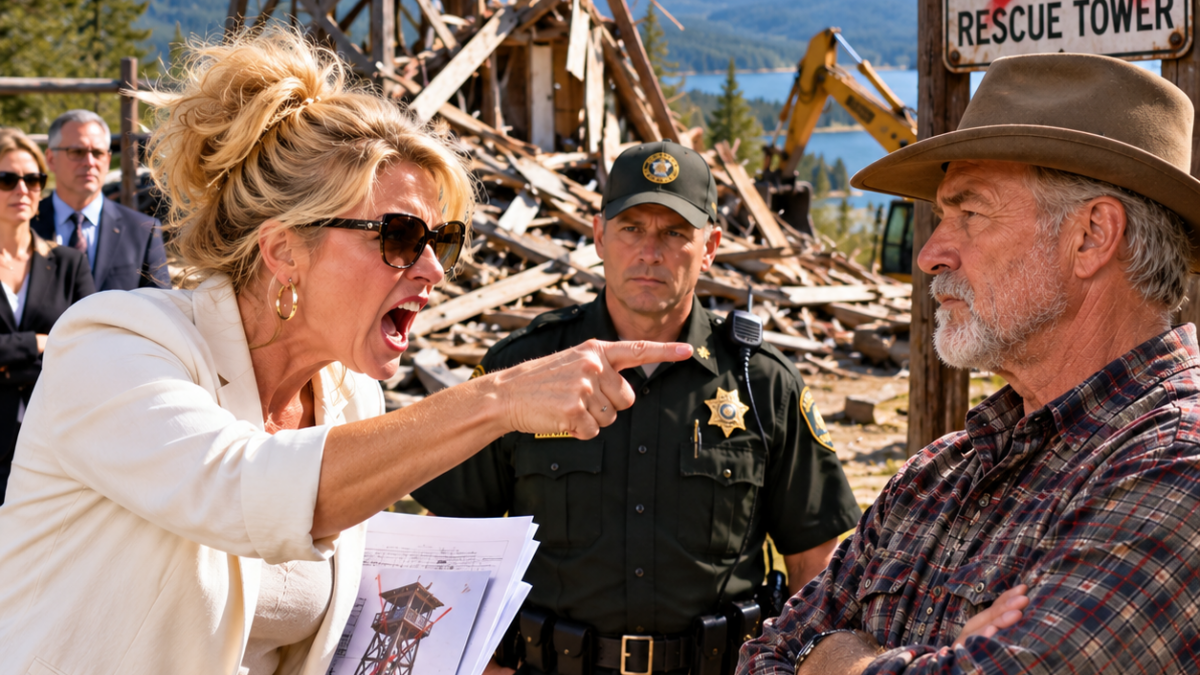
PART 2
For several seconds, I couldn’t move.
The workshop instructor was still talking at the front of the room. A projector displayed some diagram about backup battery management, and around me twenty people were taking notes.
None of them knew that I was staring at a live video of somebody dismantling an active emergency communications site on my property.
I zoomed in.
The warning sign beside the gate had been knocked facedown.
The chain had been cut.
A crane operator was lowering the upper antenna assembly onto padded stands.
Two workers were at the base of the tower.
Victoria stood near the equipment shelter.
Her scarlet jacket made her impossible to miss.
I stepped into the hallway and called sheriff’s dispatch.
“My name is Owen Mercer. I’m the property owner at 418 Ridge Spur Road. There is an active emergency communications installation on my property, and a contractor is dismantling it without my permission.”
The dispatcher asked whether anyone had a weapon.
“No.”
“Are you on site?”
“No. I’m about two hours away.”
“Can you safely verify what’s happening?”
“I have a live camera.”
“Is this equipment currently operating?”
“It was forty seconds ago.”
I looked at the monitoring application.
The repeater status icon had gone red.
“Now it’s offline.”
The dispatcher took the gate code, parcel information, and my number.
Then I called Elena.
She answered immediately.
“I know,” she said.
“You got the alarm?”
“County console lost the site. Ben Alvarez is already heading there.”
“Sheriff is going too.”
“Send me the camera link.”
I did.
“Do not rush your drive,” she said. “We need you there, not in a ditch.”
I almost laughed, but nothing about the moment was funny.
Before leaving the building, I checked the live feed again.
One worker pulled a section of heavy coaxial feed line from the shelter wall.
Another worker pointed toward the gate.
Victoria shook her head and gestured toward the crane.
Then my phone buzzed.
A text from her.
**The eyesore is finally being addressed. You’re welcome.**
I stared at it.
That message mattered.
She wasn’t claiming confusion.
She wasn’t asking whether something had gone wrong.
She believed the work was authorized—or wanted me to believe that she believed it.
I forwarded the text to my attorney, Daniel Reese, without answering.
Then I got in my truck.
I had driven maybe twenty minutes when Deputy Aaron Bell called.
“We’ve stopped the work.”
“Thank you.”
“I need to ask you something.”
“Go ahead.”
“Did you sign an owner consent allowing removal?”
“No.”
There was a short pause.
“The contractor has one.”
My hands tightened around the steering wheel.
“What?”
“He has a packet. Your name is on an owner consent form.”
“I never signed one.”
“He sent me a photograph. I’m going to send it to you.”
My phone chimed seconds later.
I pulled into a gravel turnout.
The attachment opened.
OWNER AUTHORIZATION FOR STRUCTURE REMOVAL.
The document identified my parcel.
My tower.
My name.
It stated that I acknowledged the antenna was no longer needed for active communications and voluntarily authorized Juniper Reach and its contractor to remove it as a cooperative neighborhood improvement.
At the bottom was a signature.
Mine.
Or something that looked enough like mine to stop a contractor from asking another question.
I zoomed in.
The M in Mercer leaned the way mine did.
The long tail beneath the final r looked familiar.
My full name was printed beside it.
For one disorienting moment, I wondered whether there was some document I’d forgotten.
A relocation discussion.
An estimate request.
A county access meeting.
Something I had signed without reading carefully enough.
Then I read the sentence above the signature again.
**Owner confirms that equipment is decommissioned and no longer serves an emergency communications function.**
There was no universe in which I would have signed that.
“I didn’t sign this,” I told Bell.
“Have you ever verbally approved demolition?”
“No.”
“Approved relocation?”
“I told them I’d discuss relocation if the county reviewed it and the site remained operational.”
“Any contractor authorization?”
“No.”
“Any email saying they could enter?”
“No. My attorney sent the opposite.”
“All right. Don’t confront anyone when you arrive. Come find me first.”
I merged back onto the highway.
Forty minutes later, Daniel called.
“I saw the consent form.”
“It looks like my signature.”
“Have you signed anything for the HOA recently?”
“No.”
“Anything at all?”
I thought.
“Notices? Meeting sheets? Delivery receipts?”
“Nothing giving them authority.”
“I’m not asking what the document was about. I’m asking whether Juniper Reach has access to an example of your signature.”
Of course they did.
I had attended a wildfire access meeting at their clubhouse months earlier.
I had signed the visitor sheet.
I had answered a landscaping acknowledgment years before that.
Maybe a certified-mail receipt.
Maybe something else.
“I’ve signed visitor sheets.”
“Good. Don’t speculate beyond that.”
“How is that good?”
“Because investigators need originals. We don’t solve forgery from a phone screenshot.”
“I want her off my property.”
“She will be.”
“And I want the tower restored.”
“One step at a time.”
“I don’t have one step at a time, Daniel. The repeater is down.”
That stopped him.
“What does that mean operationally?”
“It means the eastern valley just lost its primary radio relay.”
“Is there a backup?”
“Yes.”
I looked toward the mountains ahead.
“But not an equal one.”
When I reached the hill, three vehicles were parked along my driveway.
The contractor’s crane.
A sheriff’s SUV.
A county communications truck.
The sight of the tower made my stomach tighten.
The upper antenna assembly lay horizontally on padded supports.
One section was visibly bent.
The main feed line had been cut instead of disconnected properly.
Several mounting brackets had been removed.
The remaining tower looked amputated.
Deputy Bell met me near the gate.
“Stay with me a minute.”
Victoria stood near her SUV talking to a man I assumed was the contractor.
She saw me.
Her posture changed.
Not guilt.
Defiance.
“You approved the removal,” she called.
Bell raised one hand.
“Mrs. Vale, don’t approach.”
She stopped.
Then called again, “Now he’s trying to make the association pay for something he signed!”
Bell looked at me.
“That’s why I’m keeping everyone separated.”
“Good idea.”
He showed me the physical contractor packet.
The owner consent was there.
Behind it was an HOA work authorization.
A county-branded page.
A site drawing.
A copy of what appeared to be an email from Elena.
The contractor, Paul Henson, walked over after Bell waved him forward.
Paul was in his early forties, sunburned, wearing a reflective vest and work boots.
He looked less defensive than worried.
“You’re Mr. Mercer?”
“Yes.”
He glanced at the damaged antenna.
“Victoria told us this was retired equipment.”
“It was transmitting this morning.”
He rubbed the back of his neck.
“I asked about the county sticker.”
“What did she say?”
“That the county had moved service off this site.”
Elena arrived from the equipment shelter.
“No, we did not.”
Paul looked at her.
“You’re county?”
“Elena Cruz. Communications coordinator.”
His face changed.
Victoria stepped forward again.
“Paul, read the packet I sent you.”
Bell intervened.
“No one needs to argue.”
Victoria pointed at one page.
“It has county letterhead.”
Elena held out her hand.
Bell let her see it.
She read the page.
Then looked at Victoria.
“Where did you get this?”
“From communications with the county.”
“This is incomplete.”
“What does that mean?”
“It means it’s not the full message.”
Victoria crossed her arms.
“The relevant part is there.”
Elena handed it back to Bell.
“No. The relevant part includes the warning not to disconnect the active repeater.”
Paul stared at Victoria.
“You told me the county had shut it down.”
“They said no scheduled radio testing would take place Friday.”
Elena’s voice remained level.
“A system doesn’t become inactive because no test is scheduled.”
That was the first crack.
Not the biggest.
But I saw Paul hear it.
Ben Alvarez, the county radio technician, came out of the shelter.
“Owen.”
“How bad?”
He shook his head.
“Feed line’s cut. Antenna section’s bent. We need to inspect the remaining structure before putting load back on it.”
“Can we reconnect anything?”
“Not the original antenna today.”
I looked toward the valley.
“What about portable?”
“Working on it.”
Bell turned toward Paul.
“Who cut the gate chain?”
Paul raised one hand.
“My crew.”
“Why?”
“We were told owner-authorized access.”
“Did you ask?”
Paul pulled out his phone.
“Yeah.”
He scrolled.
Then showed Bell a message.
I couldn’t read every word, but the important part was obvious.
Paul had written:
**Gate is chained and posted active communications site. Confirm entry authorization.**
Victoria’s response:
**Owner consent attached. Remove chain as necessary and charge replacement to association. Warning sign belongs to retired installation. Proceed.**
I looked at her.
She looked back without blinking.
“I relied on your signed approval,” she said.
“My chain was purchased last month.”
“What does that have to do with anything?”
“It means nobody gave you an old access code or forgot to remove a stale lock. You told them to cut a current chain.”
“Because you authorized the project.”
Again.
Everything returned to that signature.
Bell photographed Paul’s messages.
Then Denise Porter arrived.
Denise was Juniper Reach’s treasurer.
Unlike Victoria, she wore jeans, hiking shoes, and no attempt at authority beyond a binder clutched against her chest.
“I brought the board minutes.”
Victoria’s shoulders stiffened.
Denise opened the binder on the hood of Bell’s SUV.
“This is the motion.”
Bell read it.
So did I.
The board had voted to obtain estimates for screening or possible relocation of the antenna.
Subject to two conditions.
**Property owner agreement.**
**County technical review.**
Nothing about demolition.
Nothing about decommissioning.
Nothing authorizing immediate removal.
Victoria stepped closer.
“That was the initial motion.”
Denise looked up.
“I pulled every signed set of minutes since then.”
“There were follow-up discussions.”
“Where?”
“Informally.”
“Which directors approved demolition?”
Victoria’s mouth tightened.
“The board authorized resolving the issue.”
“No,” Denise said. “We authorized estimates.”
Paul looked at Victoria again.
“You told me the board vote was unanimous.”
“It was.”
“For removal.”
“For addressing the structure.”
Paul’s jaw moved.
That was the second crack.
Denise pulled out another sheet.
“And this is the deposit.”
A payment had been made to Paul’s company Tuesday.
Three days before Victoria’s private house showing.
Five days before the violation notice’s fourteen-day deadline expired.
The invoice coding read:
COMMON AREA VEGETATION MANAGEMENT.
I stared at it.
“Vegetation?”
Denise nodded slowly.
“I noticed that too.”
Victoria waved one hand.
“It was a temporary accounting category. It would’ve been corrected.”
“Who authorized the deposit?” Bell asked.
“I did.”
“When?”
“Tuesday.”
Bell glanced at the violation notice I’d given him.
“The notice says Mr. Mercer had until Sunday.”
Victoria didn’t hesitate.
“The owner consent superseded the notice.”
Again.
The signature.
It was carrying every remaining explanation she had.
Ben called me back toward the equipment shelter.
“County’s bringing a portable repeater.”
“How long?”
“Soon. We can use the existing batteries. Concrete pad is fine.”
“Coverage?”
“Not as good.”
“How much worse?”
He spread a terrain map across the workbench.
The permanent tower’s elevation and antenna height reached over a saddle in the ridge and down into Eastern Valley.
A lower portable mast could reach the western approach and parts of the north spur.
The eastern creek drainage remained weak.
“That was the whole reason the tower went here,” I said.
“I know.”
Outside, clouds were stacking beyond the western ridge.
The forecast had mentioned afternoon thunderstorms.
Not unusual.
But mountain weather didn’t need to be unusual to become a problem.
Elena joined us.
“We’ll establish fallback coverage, then test.”
I looked toward the damaged antenna lying outside.
“Any emergency traffic right now?”
“No.”
That should have reassured me.
Instead, it reminded me of something my father used to say about fire extinguishers.
Nobody cares where one is until the room starts burning.
By three o’clock, the sheriff had documented the site and released the equipment area for emergency restoration.
Paul’s crew packed up.
Before leaving, he approached me.
“Mr. Mercer.”
I waited.
“If that consent is fake, I didn’t know.”
“I believe you didn’t come here intending to sabotage emergency equipment.”
His face showed relief for half a second.
Then I added, “But your crew cut through an active-site warning and a locked gate after the owner wasn’t present.”
The relief disappeared.
“I asked for confirmation.”
“You asked Victoria.”
“She had your signature.”
“And county logos.”
He nodded.
“I should’ve called the number on the sign.”
“Yes.”
He looked at the tower.
“I know that now.”
He walked away.
That exchange mattered later.
Not because Paul was innocent of every mistake.
He wasn’t.
But responsibility was becoming layered.
He had been deceived.
He had also ignored warning signs because paperwork gave him a convenient answer.
Victoria had provided that answer.
At 4:10, Elena’s radio came alive.
A search-and-rescue coordinator was calling from the lower staging area.
Three hikers had gone beyond the eastern creek crossing.
One had come out alone.
The other two remained in the valley.
Elena answered.
Within minutes, the equipment shelter stopped feeling like an evidence scene.
It became what it had always been built to be.
A communications point.
The hiker who had walked out was named Marcus Reed.
He’d reached the lower parking area soaked and exhausted.
His friend Evan Shaw had injured his ankle somewhere beyond the creek.
Another friend, Luis Ortega, stayed with him.
Marcus had left his jacket with Evan because the injured man was already getting cold.
He had come out for help because their cell phones had no service.
He could describe a trail junction.
A rock overhang.
A sharp creek bend.
He could not give exact coordinates.
Elena took the report.
Two search teams were deployed from separate approaches.
The portable repeater arrived while they were mobilizing.
Ben and another technician erected a temporary mast on the undamaged concrete pad.
We connected it to county equipment.
The first radio test reached the western approach clearly.
The eastern side came back broken.
Static.
Fragments.
A voice vanishing under rock.
I stood inside the shelter listening.
And suddenly I was thirty years younger.
The old rescue call came back to me.
A volunteer repeating coordinates.
Static swallowing every third word.
The awful calm of professionals trying not to sound afraid.
I looked at Ben.
“We need more height.”
“Can’t safely put anything on the remaining tower until inspection.”
“Portable mast on the slope?”
“Wind’s getting worse.”
Elena watched the weather.
“We use what we have.”
At 5:12, the eastern search team sent a short satellite message.
They had reached the described junction and were checking creek bends.
Their scheduled radio check followed minutes later.
Elena keyed the microphone.
“Eastern Team, Command. Radio check.”
Static.
A clipped syllable.
Nothing.
She tried again.
A volunteer on higher ground attempted to relay.
This time three words came through.
Then silence.
The satellite communicator remained available.
That mattered.
No one was blindly lost without options.
But satellite texting was slower and dependent on a clear enough sky.
A moving team couldn’t have the same immediate exchange that reliable voice radio provided.
Then the road crew called.
Falling debris had come down at a mountain cut.
The main approach road was being closed until the slope could be checked.
The rescue didn’t stop.
But the number of easy options shrank.
Vehicle access from the original staging area was gone.
The eastern team was intermittent on voice.
The injured hiker still hadn’t been located.
The storm was getting closer.
Denise came into the shelter holding her phone.
“You need to see this.”
Victoria had sent another message to Juniper Reach residents.
According to her version, a neighboring property owner had authorized removal of unused equipment and was now disputing costs after work began.
She described the tower incident as a “contract misunderstanding.”
My permission had become public fact before anyone determined where the signature came from.
Denise looked furious.
“Do you want to respond?”
Every part of me wanted to.
I wanted to send the live camera images.
The cut cable.
The board minutes.
Elena’s warning.
The contractor’s messages.
I wanted every resident below us to understand exactly who had created the problem.
Then Elena called the eastern team again.
Static answered.
“Save Victoria’s message,” I told Denise.
“What are you going to say?”
“Nothing right now.”
“She is controlling the story.”
“She can control the email.”
I looked at the radio.
“She doesn’t get to control what we work on.”
Victoria came up the driveway twenty minutes later.
Bell was still nearby.
She stopped outside the designated work area.
“I understand there’s a search incident.”
Elena kept her attention on the radio.
Victoria looked at me.
“Nobody should use this to imply the board caused a rescue failure.”
“No one said that.”
“You will.”
“We’re trying to reach a search team.”
“You signed the work order, Owen. We should release a joint statement before rumors start.”
I stared at her.
Two hikers were somewhere in a storm-shadowed valley.
A radio relay she had ordered dismantled lay bent outside my shelter.
And she was asking for a joint press statement.
Bell stepped between us.
“Mrs. Vale, remain outside the work zone.”
Victoria’s voice became quieter.
“This situation is being weaponized.”
Elena finally looked up.
“No. This situation is being managed.”
Victoria’s face tightened.
She walked away.
Already talking into her phone.
Ben performed another test.
Western team clear.
Eastern team broken.
He adjusted the temporary antenna.
No meaningful improvement.
The problem wasn’t simply signal strength.
It was geometry.
Mountains don’t care how badly you want radio waves to bend.
Thunder sounded close enough that Ben stopped outdoor work.
We secured the mast and moved inside.
At 5:40, a satellite message arrived.
The eastern team was safe.
They had found fresh signs near the creek.
No hikers yet.
The message had been transmitted from a small opening in the trees.
By the time command received and answered it, the team was moving again.
Elena sent the road closure update and asked for their next planned position.
No immediate answer.
I spread one of my old maintenance maps across the workbench.
For years after the tower went up, I had carried a handheld radio along the eastern trails testing coverage.
I marked dead spots.
Strong spots.
Seasonal foliage changes.
Places where snow or wet trees altered the path.
One handwritten circle sat near a northern spur.
I remembered it.
“That point.”
Ben leaned over.
“What about it?”
“Before we installed the higher antenna, I could sometimes hit the western relay from there.”
“How?”
“There’s a gap in the ridge.”
I traced the terrain.
“It’s not great. But at this junction, the rock wall drops enough.”
He compared my notes with the current map.
“How old is this test?”
“About five years.”
“Vegetation?”
“Some growth.”
“Elena.”
She came over.
Ben explained.
“It could give us a local relay position.”
Elena studied the map.
“Safe route?”
“Needs confirmation,” I said. “The northern spur avoids the creek ford.”
She radioed the rescue coordinator through the working western link.
The coordinator did not immediately redirect anybody.
He asked for a route assessment.
No one was going to send a rescuer onto exposed high ground just to make my theory work.
That mattered.
Emergency communication isn’t improved by creating another emergency.
A support unit waited at a safe road junction.
The injured hiker still hadn’t been located.
The southern ford was rising.
Daylight was fading.
And the old primary road remained closed.
My phone rang.
Paul Henson.
“I’m at the sheriff’s office.”
“What happened?”
“They’re asking about your signature.”
“Okay.”
“Have you ever written the word ‘guest’ above your name when you signed something?”
I went still.
“Yes.”
“When?”
“Juniper Reach wildfire access meeting. Three months ago.”
“Why?”
“The visitor sheet had a printed column labeled ‘owner.’ I crossed it out because I’m not a Juniper Reach owner and wrote ‘guest.’”
Paul was silent.
“Why are you asking?”
“The consent page has part of a crossed-out handwritten word above your signature.”
My eyes moved toward Denise.
She saw my expression.
“What?”
I held up a finger.
Paul continued.
“It looks like the bottom edge of something was copied with it.”
“Send Bell the image.”
“They have it.”
“Don’t send anything else to me. Give investigators the originals.”
I ended the call.
“Denise, do you still have the wildfire meeting sheet?”
Her face changed.
“I think so.”
“Find it.”
She opened her phone and called the management office.
The original attendance sheet was in archived meeting records.
A staff member photographed it.
Minutes later, Denise’s phone displayed the image.
There was my signature.
Above it, the printed word OWNER had been crossed out.
Beside it, in my handwriting:
GUEST.
The same diagonal stroke visible above the signature on the demolition consent.
Not proof by itself.
But a source.
Someone could have lifted my signature from the one place where I had explicitly written that I did not belong to the HOA.
I felt anger rise so quickly that I had to put both hands on the workbench.
Daniel answered my call.
“We found a likely source.”
“Tell me.”
I explained.
He became very quiet.
“Do not call Victoria.”
“I wasn’t planning to.”
“Good. Send the information to Bell. Preserve the attendance sheet. Investigators need the original and the electronic consent file.”
“She used a signature from a sheet where I wrote guest.”
“We don’t know who constructed the consent yet.”
“I know what it looks like.”
“So do I. But let the evidence reach the conclusion.”
I hung up.
Outside, the storm began moving east.
The thunder weakened.
Ben checked conditions and resumed work.
At 6:23, a satellite message arrived from the eastern team.
The northern spur was passable.
One volunteer could move toward my old test junction while the rest continued searching the creek overhangs.
Elena set the radio schedule.
The first check was weak.
A voice surfaced, then vanished.
Ben watched the signal meter.
“Don’t change anything.”
We waited.
The volunteer moved farther into the junction.
Elena keyed the microphone again.
“Eastern Team Relay, Command.”
Static.
Then a voice.
“Command, Eastern Team Relay. Reading you.”
Every person in the shelter froze.
Elena answered.
“Relay, repeat your position.”
The volunteer did.
Every word arrived intact.
Ben pointed at the meter.
“Hold there.”
The temporary system had not replaced my tower.
Not even close.
But my old test notes had given us a place where terrain opened a radio path.
The volunteer became a human relay point between command and the eastern team.
Within minutes, the next message changed the extraction plan.
The southern creek ford had overtopped.
The eastern team needed the northern footbridge checked.
The litter crew had originally been preparing for a different approach.
Without updated information, equipment and patient could have ended up on opposite sides of rising water.
Now Elena could ask a question and receive an answer while decisions were still being made.
A second team checked the bridge.
Passable.
Command redirected the litter crew.
At 7:03, the eastern team called.
“Command, Eastern.”
“Go ahead.”
“We have voice contact from upstream.”
Elena leaned forward.
“Human?”
“Affirmative.”
It was Luis.
He had heard rescuers calling.
Minutes later the team reached both hikers under a rock overhang.
Evan was cold.
His ankle was badly swollen and he couldn’t bear weight.
Luis had given him both jackets and used branches to block wind.
They were above immediate floodwater, but extraction required the litter crew now approaching from the north.
The relay volunteer stayed at the junction.
One message followed another.
Patient condition.
Trail status.
Bridge check.
Equipment confirmation.
No miracles.
No dramatic helicopter appearing through lightning.
Just trained people doing careful work while communications finally allowed information to move in both directions.
At 8:15, Luis crossed the northern bridge with a rescuer.
Evan followed on the litter.
The team carried him through wet timber to the alternate vehicle route.
Just after nine, the ambulance crew confirmed both hikers were out of the valley.
Marcus stood beside the ambulance waiting.
When he saw his friends, his shoulders folded forward and he covered his face with both hands.
I watched from a distance.
Nobody applauded.
The rescue workers still had equipment to retrieve.
Reports to complete.
Wet boots.
Cold hands.
I returned to the hill after ten.
The portable repeater continued operating.
Victoria’s house below us glowed through the trees.
Her deck faced the valley again.
For the first time that day, no tower section blocked part of her view.
I stood beside the damaged antenna lying on the ground.
The metal looked strangely harmless there.
Just tubing.
Bolts.
Feed elements.
Pieces that could have been scrap if you didn’t know what they did when assembled sixty-four feet above the ridge.
Ben came beside me.
“You all right?”
“No.”
“Fair.”
“Could the rescue have ended differently?”
He looked toward the dark valley.
“Maybe.”
“That isn’t an answer.”
“Because there isn’t one.”
He shoved his hands into his jacket pockets.
“We had satellite backup. We had local radio between teams. We found a relay location. Nobody was without options.”
“But?”
“But the permanent repeater was designed to give us continuous coverage where we spent half the evening improvising.”
I nodded.
“I don’t want anyone exaggerating this.”
“Neither do I.”
“The tower being down didn’t create the storm.”
“No.”
“Didn’t injure Evan.”
“No.”
“Didn’t close the road.”
“No.”
Ben looked directly at me.
“But damage to an active emergency site removed a communications tool during an actual emergency. That’s enough.”
That became important later.
The strongest evidence didn’t need exaggeration.
Victoria had not almost killed two hikers in some simple cause-and-effect way.
The rescue team adapted.
They had backups.
They did their jobs.
The problem was that someone had intentionally taken a functioning safety system offline because she wanted a better view.
The following morning, Daniel forwarded me an email from Victoria’s attorney.
Settlement proposal.
I read it at my kitchen table.
Victoria offered to contribute financially toward replacement equipment.
In return, I would agree to permanent removal of the original tower and sign a statement saying the demolition had been mutually authorized but improperly coordinated.
I would also agree to remove publicly accessible camera footage from the account hosting the security video.
I read the proposal twice.
Then called Daniel.
“She wants me to retroactively approve it.”
“That’s how I read it.”
“And remove the video.”
“Yes.”
“She spent yesterday insisting I already approved it.”
“Yes.”
“Now she wants my approval.”
Daniel gave a quiet laugh.
“Contradictions are useful.”
“What do we answer?”
“That evidence remains preserved. Any restoration must serve the active communications function. You won’t make false statements about prior consent.”
“No negotiation?”
“Civil liability can still be negotiated.”
“But not the story.”
“Correct.”
Juniper Reach scheduled an emergency board meeting that evening.
Denise asked if I’d attend.
I almost refused.
I’d had enough of the HOA.
Then Elena said she wanted to present the communications record.
So I went.
The clubhouse was full.
Residents had received Victoria’s earlier message.
Many arrived believing the tower had been removed with my consent and that I was now demanding money because the rescue incident made the project embarrassing.
Victoria stood at the front with a binder.
She wore dark blue instead of scarlet.
The room quieted when I entered.
I took a chair near the side wall.
Denise began.
“This meeting concerns board authorization, contractor documentation, and communications-site work performed Friday.”
Victoria interrupted.
“And misinformation being circulated about me.”
Denise looked at her.
“You’ll have time.”
The first document projected on the wall was the signed board motion.
ESTIMATES FOR SCREENING OR RELOCATION.
SUBJECT TO OWNER AGREEMENT AND COUNTY REVIEW.
Then Denise displayed the contractor authorization.
UNANIMOUS BOARD APPROVAL FOR IMMEDIATE REMOVAL.
Several residents began whispering.
Victoria stood.
“The motion was implemented through subsequent project discussions.”
“Where are the minutes?” Denise asked.
“Not every operational decision requires a new vote.”
“Who approved immediate demolition?”
“The executive process.”
“Which directors?”
Victoria looked toward two other board members.
Neither spoke.
Denise displayed the crane deposit.
Tuesday.
Before the survey confirmation.
Before any owner agreement.
Before the fourteen-day notice expired.
A resident asked, “Why is the charge coded as vegetation management?”
Victoria answered, “Temporary accounting classification.”
Another resident said, “Why was demolition paid before Owen’s deadline?”
“Because owner consent resolved the enforcement issue.”
Again, the signature.
Denise looked toward me.
“Did you sign that?”
“No.”
Victoria turned.
“You are looking directly at your signature.”
“I’m looking at a copy of it.”
“You attended meetings. You discussed relocation.”
“I discussed county-reviewed alternatives.”
“You were cooperative until you decided there was money in accusing the HOA.”
A few heads turned toward me.
I felt anger press against my throat.
Then I remembered Daniel’s advice.
Records age better than anger.
So I didn’t respond to the insult.
Denise changed slides.
Elena stepped forward.
“This is the email I sent Mrs. Vale before demolition.”
The complete message appeared.
It said the county had no scheduled radio test Friday.
Then, in the very next paragraph:
**The repeater remains operational for emergency use and must not be disconnected, altered, or removed without county coordination and property-owner authorization.**
Elena displayed the version included in Paul’s contractor packet.
It ended after the sentence about no scheduled radio test.
The entire warning paragraph was missing.
The clubhouse went silent.
Victoria stood.
“I received dozens of technical messages that week.”
Elena clicked again.
Victoria’s reply to the original email appeared.
**Understood. I will discuss this clarification with the board.**
Two days before demolition.
Denise looked at her.
“When did you discuss it with us?”
Victoria opened her binder.
“We had multiple informal conversations.”
“With which directors?”
“I’m not going to reconstruct every hallway discussion.”
One board member spoke.
“You never told me the repeater was active.”
Another shook his head.
“Me neither.”
Victoria turned toward them.
“You both knew county equipment was involved.”
“I thought we were talking about moving the visual structure after county approval,” the first said.
A resident near the front raised his hand.
“Why did the contractor receive a shortened version of the email?”
Victoria answered, “Someone likely formatted the packet for printing.”
“Who?”
“The management office.”
Denise looked toward the manager.
He stood from the back.
“We didn’t assemble the contractor packet.”
All eyes returned to Victoria.
Her binder remained open.
But she had stopped turning pages.
Paul Henson attended by video call.
Denise asked him who sent the work packet.
“Victoria Vale.”
“Directly?”
“Yes.”
“Did your company alter the county email?”
“No.”
“Did you receive any other county message?”
“No.”
“Did you ask whether the site remained active?”
“I asked about the warning sign and gate. I was told the installation was retired and owner authorization allowed access.”
The screen showed his messages.
The room became quieter.
Then Denise projected the wildfire meeting attendance sheet.
My signature sat near the bottom.
OWNER had been crossed out.
GUEST written beside it.
Next came the owner-consent page.
My signature appeared again.
Above it, faintly, was the lower stroke of the crossed-out word.
A woman in the second row whispered, “Oh my God.”
Victoria stood.
“Owen attended our meeting. His signature being in association records doesn’t prove anything.”
I finally spoke.
“I signed in as a guest.”
She looked at me.
“You signed your name.”
“Yes.”
“Then anyone could have a copy.”
“That doesn’t make it consent.”
“I never personally altered your signature.”
It was the first time she had phrased her denial that narrowly.
Denise noticed.
“So who created the consent?”
“Our project materials came from several sources.”
“Which source?”
“I don’t know.”
“Who sent it to Paul?”
“I sent the compiled packet.”
“Where did the consent come from?”
“I would have to review the electronic file history.”
Denise closed her folder.
“The sheriff already is.”
For the first time, Victoria looked genuinely frightened.
Not theatrical anger.
Not indignation.
Fear.
Then she tried another route.
“This entire situation is being distorted because of one rescue incident.”
Elena stepped back to the podium.
“No.”
She displayed the operations log.
11:43 — primary relay lost.
12:06 — site damage confirmed.
4:10 — search request.
5:12 — eastern team satellite update.
5:20 — scheduled voice check incomplete.
5:29 — primary road closure reported.
5:40 — satellite contact.
6:23 — northern relay route confirmed passable.
6:31 — stable voice relay established.
7:03 — hikers located.
8:15 — extraction across north bridge.
9:04 — patients clear of valley.
Elena looked at the room.
“I am not here to tell you the tower caused the emergency. It did not. I am not here to tell you the hikers would have died without it. I cannot say that.”
She pointed toward the log.
“I can tell you the active radio site was intentionally taken offline shortly before an emergency required that coverage. We then spent hours using reduced-capability backups and a temporary human relay to replace part of the function we had that morning.”
Nobody interrupted.
“The tower existed because terrain makes that valley difficult. Friday demonstrated the reason.”
A man near the aisle looked toward Victoria.
“Was your house really being shown that evening?”
She stiffened.
“My property sale is irrelevant.”
Denise projected the contractor deposit request.
At the bottom was Victoria’s note.
**Complete before Friday private showing if possible.**
The room changed.
Residents were no longer looking between documents trying to understand a complicated infrastructure dispute.
They were looking at the president who had pushed demolition of an emergency radio tower before a showing of her house.
Victoria’s voice rose.
“The view issue affected community property values, not just mine.”
A homeowner near the back said, “Your listing said uninterrupted valley view.”
“That language came from my agent.”
Another homeowner asked, “Did the tower exist when you bought the house?”
“Yes.”
“Then how was it suddenly an HOA violation?”
Victoria’s eyes moved around the room.
“The board has a responsibility to address visual nuisances.”
“On property outside the HOA?”
“It affects us.”
Denise sat down.
The directors asked Victoria to leave the room while they discussed her position.
She didn’t move.
“This board is reacting emotionally.”
Denise replied, “We’re reviewing records.”
“You are allowing Owen to manipulate an emergency.”
“I haven’t asked anyone to vote.”
Victoria looked toward me.
“You could have prevented all of this by agreeing to relocate the tower when I first asked.”
I stood slowly.
“You could have prevented all of this by accepting no.”
Bell, standing near the rear because of the ongoing investigation, watched us carefully.
Victoria picked up her binder.
“This is going to cost every homeowner.”
Denise answered, “Then the records will determine who is responsible.”
Victoria walked out.
The board met privately for forty minutes.
When they returned, Denise read the decision.
Victoria’s authority as president was suspended immediately under the association’s governance rules.
Another director would handle communications.
Independent counsel would preserve all records related to the tower.
The management company would cooperate fully with the sheriff.
A later membership vote removed Victoria from the board entirely.
That wasn’t the end of the criminal investigation.
Bell never promised me an arrest.
He never told me what he “thought” happened.
He gathered documents.
Original attendance sheet.
Electronic contractor packet.
Email metadata.
Payment records.
Messages.
Security-camera footage.
The original county email.
Victoria’s shortened version.
The consent document.
Daniel explained that digital evidence often looked simple from the outside but required tedious verification.
Who created the file?
Which device?
When?
Was it modified?
Was the signature an image layer?
Where did the image originate?
Who transmitted the final version?
For several weeks, I heard almost nothing.
That was difficult.
The physical damage was obvious.
The paper trail was becoming obvious.
But investigation moved at its own speed.
Meanwhile, we had a tower to rebuild.
The county could not simply replace everything overnight.
Engineers inspected the remaining steel.
One section of the tower had been twisted during removal.
The foundation remained sound.
Several brackets needed replacement.
The bent antenna assembly was not reusable.
The cut feed line had to be replaced rather than spliced for permanent service.
Insurance questions slowed procurement.
So did responsibility.
My policy covered some property damage.
The HOA’s carrier investigated whether Victoria acted within authorized board duties.
Paul’s company notified its insurer.
The county owned the repeater hardware but not my tower.
Every component belonged to somebody.
Every somebody had paperwork.
For the first two weeks, the portable system stayed in place.
Ben improved it.
A temporary mast was moved to a better position once engineers approved a safe installation.
Coverage improved substantially, though the eastern creek remained weaker than under the permanent tower.
I found myself checking status alarms at night.
More than necessary.
Every time the monitor hesitated, my stomach tightened.
One evening Elena called.
“You need to stop staring at the status screen.”
“How do you know I’m staring at it?”
“Because you’ve emailed me three signal reports in four hours.”
“I’m being thorough.”
“You’re retired.”
“That’s irrelevant.”
“No, it isn’t.”
I laughed despite myself.
Then she became serious.
“The fallback is stable.”
“I know.”
“And if it fails, we have other systems.”
“I know.”
“Owen.”
“What?”
“The demolition was not your failure.”
I stared through the kitchen window toward the damaged tower silhouette.
“I left that morning.”
“You had a legal notice, county warning, attorney letter, manager acknowledgment, and locked gate.”
“I still left.”
“Were you supposed to sleep beside the tower with a shotgun?”
“No.”
“Then stop pretending you failed to guard it.”
I knew she was right.
That didn’t immediately make the feeling disappear.
The damaged tower had become personal in a way it hadn’t been before.
For years, it was equipment.
I maintained it.
Inspected bolts.
Tested batteries.
Logged faults.
It served a purpose.
After the demolition, I looked at it and saw how easily somebody could destroy a useful thing if enough paperwork told workers they were allowed to.
I also thought about Victoria.
I didn’t want to turn her into a cartoon in my own mind.
That was tempting.
But it wasn’t accurate.
She hadn’t woken up one morning deciding emergency rescuers didn’t matter.
She wanted to sell her house.
She believed the tower hurt the sale.
She also believed, I think, that I was being unreasonable simply because I had the legal right to say no.
Each time someone challenged her, she reframed the problem.
First the HOA controlled the visual environment.
Then the board supposedly controlled the hill.
When the survey defeated that, my own consent suddenly appeared.
When the county said the tower was active, its warning disappeared from the contractor packet.
When the demolition became difficult to defend, she offered money to convert it into a mutual misunderstanding.
The pattern wasn’t one giant act.
It was a sequence of smaller decisions, each designed to preserve the result she wanted.
That made the final evidence more important.
About six weeks after the demolition, Bell called.
“Can you come to the sheriff’s office tomorrow?”
“Am I in trouble?”
“No.”
“Then that’s already a better invitation than the last few I’ve received.”
He didn’t laugh.
“Your attorney can come.”
Daniel met me there.
Bell placed a folder on the table.
“We completed the primary document comparison.”
I waited.
“The signature image on the owner consent was derived from the wildfire meeting attendance sheet.”
Even though I expected it, hearing the sentence aloud felt different.
“How sure?”
“The source image characteristics match. Investigators also recovered the electronic working file.”
Daniel leaned forward.
“From where?”
Bell looked at him.
“I can’t discuss everything before charging review.”
“Understood.”
Bell turned toward me.
“The consent was not physically signed by you.”
I let out a breath I hadn’t realized I was holding.
“What about the county email?”
“The contractor packet was assembled from an edited document set. The warning paragraph was removed before the file was sent.”
“By Victoria?”
Bell paused.
“The evidence has been referred to prosecutors.”
That was all he would say.
Three days later, he returned to the hill.
This time, he wasn’t there about the tower.
He carried an arrest warrant.
Victoria was charged.
The case took months.
People sometimes imagine that once a forged document is exposed, the rest happens in a dramatic afternoon.
It doesn’t.
Lawyers file motions.
Evidence gets reviewed.
Charging language changes.
Civil and criminal issues separate.
Insurance companies argue over coverage.
Contractors defend what they relied on.
Associations decide whether a president was acting for the board or for herself.
Victoria eventually pleaded guilty to forgery and property-damage charges arising from the demolition documents and unauthorized work.
Restitution covered documented losses assigned through the case.
The civil claims addressed the remaining restoration costs and responsibilities.
Paul’s company cooperated with investigators and resolved its own role through insurance and civil agreements.
I never believed Paul intended to damage emergency service.
I also never believed that erased his duty to verify a locked, posted communications site before cutting into it.
He understood that by then.
One afternoon during reconstruction, he came to see me.
No crane.
No crew.
Just his truck.
“I wanted to apologize in person.”
“You already did.”
“Not really.”
He looked toward the new tower sections stacked beside the shelter.
“I’ve changed our site-entry procedure.”
“How?”
“If there’s any posted utility or communications warning, client paperwork isn’t enough. Crew has to call the number on the sign.”
“That would’ve helped.”
“I know.”
He rubbed his hands together.
“Victoria had your signature. HOA vote. County letterhead. We thought we were being careful.”
“You were being careful about the paperwork that supported the job.”
He looked at me.
“Not the paperwork that challenged it.”
“Exactly.”
He nodded.
“That sentence has been bothering me for weeks.”
“Good.”
He laughed once.
“I suppose I deserved that.”
Seven weeks after the demolition, the replacement installation was ready.
The new antenna was not identical to the old one.
Technology had improved since the original system went up.
The county used the rebuild to upgrade some equipment.
The structure passed engineering inspection.
Feed line tested clean.
Battery backup checked.
Grounding verified.
Remote monitoring restored.
Then came the part that mattered.
Coverage testing.
Elena went into Eastern Valley with a field radio.
Ben stayed in the shelter with me.
She called from the lower trail junction.
Clear.
Then the creek bend.
Clear.
Then behind the rock wall where the temporary system had struggled.
A burst of static.
Then:
“Mercer Hill, Eastern test. How do you read?”
Ben keyed the microphone.
“Eastern test, Mercer Hill. Loud and clear.”
I closed my eyes.
Nothing dramatic happened.
No music.
No applause.
Just Elena’s voice traveling through the same mountains that had once swallowed rescue coordinates.
She moved farther down the trail.
Another check.
Clear.
The county signed off that afternoon.
For the first time in seven weeks, I shut down the portable system.
I carried its battery case into the shelter and set it beside the wall.
Ben looked at the permanent status lights.
“All green.”
I nodded.
“All green.”
A month later, Denise called.
“I have an awkward request.”
“Those are your specialty now.”
She laughed.
“Can the HOA photograph the tower?”
“For what?”
“Emergency information page.”
I was quiet.
“We’re updating resident materials. Wildfire evacuation routes. County alert numbers. Rescue contacts.”
“And you want a picture of the tower Victoria tore down.”
“The replacement tower.”
I looked through the window.
Steel rose above the ridge again.
“Fine.”
“Really?”
“Yes. But caption it correctly.”
“What do you want it to say?”
“Private communications site supporting county emergency radio coverage.”
She wrote it down.
“No scenic open space?”
“Absolutely not.”
“No HOA infrastructure?”
“Definitely not.”
“Understood.”
A few weeks later, I saw Victoria’s old house listing.
She had moved before the criminal case fully resolved.
The listing photographs were different.
No dramatic wide shot from the deck pretending the valley was empty.
No promise of uninterrupted views.
The new description said:
**Expansive eastern valley scenery.**
That was accurate.
The tower appeared at the edge of one photograph.
Small.
Gray.
Useful.
I stood on my hill one evening after the replacement had been operating for several months.
The valley below was quiet.
No rescue traffic.
No radio alarms.
No trucks at the gate.
The tower made a faint metallic sound as wind moved through the upper sections.
Before all of this happened, I sometimes wondered whether maintaining the site was worth the trouble.
Battery replacement.
Inspections.
Snow.
Lightning.
Paperwork.
County coordination.
Then I would remember that old rescue call from years earlier.
A man injured somewhere below.
A volunteer repeating coordinates.
Static eating the location.
Friday’s rescue had brought that memory back with uncomfortable clarity.
The permanent tower had not been the only thing keeping those hikers alive.
It would be dishonest to say that.
They had satellite backup.
Trained rescuers.
Alternate routes.
Good decisions.
A temporary relay.
People adapting under pressure.
But infrastructure exists because adaptation shouldn’t have to begin from unnecessary failure.
The tower’s value wasn’t that someone used it every minute.
Its value was that, when somebody did need it, the voice had a better chance of getting through.
Victoria looked at the same tower and saw an obstruction.
Something between her deck and the perfect photograph of the valley.
I saw steel, coax, batteries, grounding straps, and ordinary equipment.
The rescue teams heard something else.
A path for words.
That difference was at the center of everything.
One night, months after the criminal case ended, I found the original HOA violation notice in my desk.
Fourteen days to remove the tower.
Two hundred fifty dollars per day.
The paper seemed absurd now.
I had saved it with everything else.
Beside it was the photo of the wildfire meeting sheet.
My signature.
The word OWNER crossed out.
My handwritten correction:
GUEST.
Of all the documents in the case, that one still struck me as the strangest.
Someone had taken a signature from the moment I explicitly said I did not belong to their association and used it to claim I had surrendered control of my own property.
There was almost something too perfect about that.
But the part that stayed with me wasn’t the forgery itself.
It was how many other people the forged page had persuaded.
A contractor.
Workers.
HOA residents.
For several hours, even the investigation had to treat my consent as an open question.
A signature carries weight because most of the time we assume it represents choice.
That’s what made using mine so effective.
The paper looked ordinary.
No dramatic fake seal.
No wild legal language.
Just a form.
A parcel.
A signature.
And enough surrounding documents to make it believable.
If the security camera hadn’t existed, Victoria still would have faced the county warnings, survey, emails, and contractor records.
But the video preserved something documents couldn’t.
The physical sequence.
The chain on the ground.
The warning sign facedown.
The crane.
The antenna lowering.
Victoria standing beside it.
And the valley opening behind her house.
Years earlier, when I first agreed to host the county repeater, somebody asked me whether I was worried the tower would hurt the value of my land.
I remember laughing.
My twenty-two acres were never bought for a polished view.
The property had a gravel road, steep slopes, scrub oak, and enough rock to punish every fence post.
I liked it because it sat above the valley.
Not because I wanted to admire the valley from a deck.
Because from that ridge, radio signals could reach people who otherwise disappeared behind stone.
There are places in mountains where a few hundred feet of elevation changes everything.
One side of a ridge hears you.
The other side doesn’t.
The same is true of paperwork sometimes.
One sentence included.
One paragraph removed.
One signature placed beneath the wrong words.
Everything looks different depending on what somebody chooses to leave visible.
Victoria had spent months trying to make the tower disappear from her view.
In the end, the thing that exposed her wasn’t the tower.
It was the parts of the record she tried to remove.
The complete board motion.
The full county email.
The original attendance sheet.
The contractor’s unanswered warnings.
Each document restored a piece of the picture she’d cropped.
That mattered more to me than her guilty plea.
The legal case belonged to the court.
Restitution belonged to accountants and insurers.
The replacement tower belonged to my hill.
But the lesson I carried was simpler.
Useful things are often ugly.
Emergency radios.
Access roads.
Drainage ditches.
Firebreaks.
Survey markers.
Steel towers.
Most days, people barely notice them.
Then something goes wrong.
And suddenly what looked like an inconvenience becomes the thing everyone wishes had been left alone.
I still maintain the installation.
Retirement never quite took.
Every spring, I inspect the lower bolts.
Ben jokes that the county has technicians for that.
I tell him nobody owns a wrench good enough to keep an old radio man from checking his own tower.
He stopped arguing years ago.
Victoria’s old house eventually sold.
I don’t know whether the new owners love the view.
We’ve never spoken beyond a wave.
They have never complained about the antenna.
Once, while I was replacing a gate latch, the new owner walked up the county-side trail and stopped well below my boundary.
“Is that the rescue tower?” he asked.
“Yes.”
“My realtor mentioned it.”
I braced myself.
Then he said, “My daughter hikes down there.”
He pointed toward Eastern Valley.
I looked at him.
“Then I’m glad it’s working.”
“So am I.”
That was the whole conversation.
No legal notice.
No demands.
No board vote.
He walked home.
I finished fixing the gate.
That evening the valley disappeared beneath fog.
The tower stood above it.
The steel vanished halfway up into gray air.
For a while, I could only see the lower section.
Then the red indicator near the top blinked faintly through the mist.
A radio check came over the speaker inside the shelter.
Routine county test.
Nothing urgent.
“Mercer Hill, radio check.”
I reached for the microphone.
“Mercer Hill reads you loud and clear.”
The operator acknowledged.
Then the channel went quiet again.
I stood there listening to silence.
Years ago, I might have called that wasted equipment.
A tower waiting for something to happen.
Now I knew better.
Silence meant nobody needed the system at that moment.
It didn’t mean nobody ever would.
And after everything Victoria had done to erase sixty-four feet of steel from her view, that quiet signal was enough for me.
The valley could stay beautiful.
The tower could stay ugly.
And if somebody down there ever needed to be heard, the words would have a way out.
[END OF STORY]








