PART 2: HOA Tore $10,000 of Solar Panels Off My Roof—They Smirked Until They Learned the Law Could Take Their Own Money
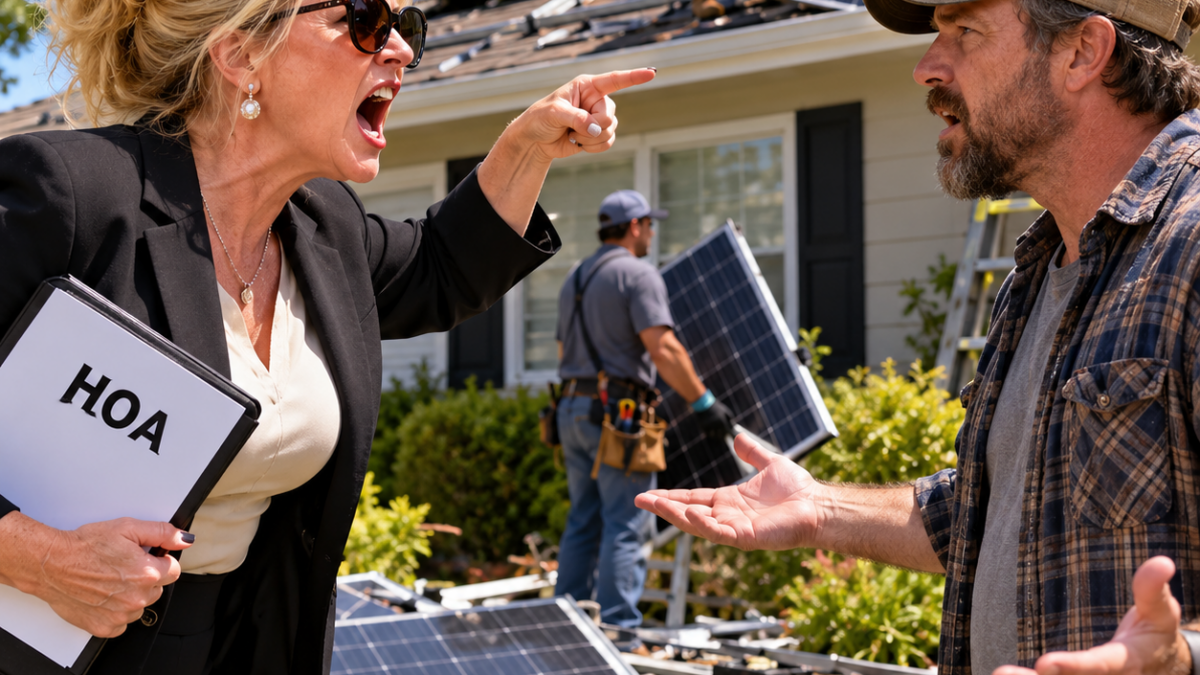
PART 2
For a minute, I remained in the driveway.
The neighborhood looked exactly as it had every afternoon since I moved there.
Neat lawns.
Matching mailboxes.
Clean sidewalks.
Identical decorative streetlights.
From a distance, Oak Haven Estates looked peaceful.
That was one of the reasons I had bought there.
After twenty-two years in uniform, I wanted predictability.
I wanted mornings in my garden, afternoons repairing things in my garage, and evenings quiet enough to hear birds settling into the trees.
I had no desire to become a neighborhood crusader.
I had certainly never imagined myself building a legal case against my homeowners association.
But peace built on intimidation isn’t peace.
It’s obedience.
And I was beginning to understand the difference.
My name is Frank Peterson.
I retired from the Army Corps of Engineers as a lieutenant colonel after twenty-two years.
People sometimes assume engineering in the military means sitting in an office drawing bridges.
Sometimes it does.
Other times it means coordinating enormous construction projects in places where equipment shortages, politics, weather, security problems, and human stubbornness can derail months of planning in a single afternoon.
I learned to document everything.
If somebody said something important, I wrote it down.
If somebody made a decision, I wanted a record.
If a contract had a clause that could become important six months later, I highlighted it.
Good documentation wasn’t bureaucracy.
It was armor.
That habit was about to save me.
I went inside and pulled the memory card from my security system.
Four cameras covered the exterior of my property.
At 9:53 that morning, a white truck bearing the logo A-1 Roofing & Maintenance turned into my driveway.
At 9:57, three men unloaded ladders.
At 10:04, one of them walked around the side of my house and looked directly into the camera.
At 10:17, they climbed onto my roof.
The footage was almost painfully clear.
They disconnected the panels.
Removed them one by one.
Carried them down.
Stacked them in the truck.
At one point, a worker slipped near the edge of the roof and kicked loose a shingle.
He looked down at it.
Then kept working.
At 1:46, the truck left.
I froze the clearest frame containing the license plate.
Printed it.
Then I printed my original installation invoice.
$10,487.
That number included the panels, mounting hardware, electrical work, inverter equipment, permits, and installation labor.
My system wasn’t a decoration.
It was infrastructure.
I opened another folder.
Three months earlier, when I decided I wanted solar, I had done exactly what the HOA required.
I had reviewed the governing documents.
Section Four, Subsection B required approval for exterior modifications.
So I submitted one of the most comprehensive architectural applications they had probably ever received.
Panel specifications.
Roof diagrams.
Load calculations.
Electrical drawings.
Manufacturer information.
Installation credentials.
Photographs showing that nearly the entire array would be located on the rear-facing roof plane.
I even included resale data because Karen loved talking about property values.
Three weeks later, my application had been rejected in one sentence.
The requested solar installation is inconsistent with the aesthetic harmony of Oak Haven Estates.
No safety objection.
No engineering objection.
No concern about glare.
No concern about wiring.
No alternative placement proposal.
Just aesthetic harmony.
That was when I researched the state law.
The statute was straightforward enough that even a nonlawyer could understand its intent: an association could not use general aesthetic restrictions as a disguised prohibition against a lawful solar energy system.
I had sent Karen and the board the relevant language.
I had written:
I respect the association’s architectural process. However, the reason provided for denial appears inconsistent with the state’s Solar Access Act. Because no health, safety, structural, or reasonable placement objection has been identified, I intend to proceed with installation. I remain willing to discuss legitimate compliance concerns before work begins.
They never answered.
Not once.
For two weeks.
So I proceeded.
Now Karen had effectively admitted that she had read that email and ordered the system removed anyway.
I created a new folder on my computer.
PROJECT KAREN
Maybe the name was childish.
I didn’t care.
Inside it went the security footage.
The installation invoice.
The application.
The denial.
My statutory notice to the board.
Photographs of the damage.
Screenshots of Karen’s messages.
Then I sat back.
I had everything needed to prove what happened.
What I didn’t yet know was how far the problem went.
The next morning, I started with the sheriff’s department.
The deputy who came to take my report looked about thirty.
He was polite but skeptical.
I didn’t blame him.
The phrase “HOA dispute” probably caused law enforcement officers to mentally prepare themselves for arguments about garbage cans and grass length.
He stood in my driveway, notebook open.
“So your association fined you for the panels?”
“No.”
“They ordered you to remove them?”
“They denied the application. I installed them anyway after notifying them that the denial conflicted with state law.”
He nodded slowly.
“And then?”
“They hired a contractor to enter my property while I was away and physically remove the system.”
The deputy stopped writing.
“They removed them?”
“Yes.”
“From the roof?”
“Yes.”
“Without your permission?”
“Yes.”
I handed him photographs.
Then still images from the video.
He studied them.
“So this truck comes in at ten in the morning.”
“Approximately.”
“And they leave with your equipment.”
“Yes.”
He looked up.
“Did the HOA president admit authorizing it?”
“Yesterday.”
“Recorded?”
“No. Our state requires consent under certain circumstances, so I didn’t record the call.”
“Anything written?”
“Not yet.”
He nodded.
“That’s still different from somebody mailing you a violation notice.”
“That was my understanding.”
He stared at the damaged shingles.
“I’ll be honest, Mr. Peterson. When dispatch said HOA disagreement, I expected lawn ornaments.”
“So did I.”
That earned the first faint smile.
He took a complete statement.
I gave him the contractor information and license plate.
Before he left, he handed me a case number.
“Someone from investigations may contact you.”
“Thank you.”
He looked toward the roof again.
“For what it’s worth, this is one of the stranger calls I’ve had.”
“It’s been a strange twenty-four hours.”
I watched his patrol vehicle disappear around the corner.
Then I made my second call.
Finding an attorney took longer.
I didn’t want someone who would immediately turn the situation into theatrical warfare.
I had seen enough bad litigators during government contracting disputes to know the type.
They confused aggression with effectiveness.
They wrote threatening letters because they enjoyed sounding threatening.
I needed someone who understood leverage.
A former colleague put me in contact with Mark Chen.
Mark had served as a Marine JAG officer before leaving active duty and opening a small property and civil litigation practice.
His office was in an older brick building downtown.
Nothing about the place screamed money.
No marble lobby.
No giant conference table.
No wall-sized logo.
Just shelves of casebooks, three healthy plants, and a framed photograph of Mark in uniform beside what looked like a tent in Afghanistan.
He listened while I explained.
He didn’t interrupt.
When I finished, I slid the binder toward him.
He opened it.
Read the denial.
Read my email.
Studied the security stills.
Read the relevant statutory language.
Then he leaned back.
For five seconds, he said nothing.
“What?” I asked.
“Do you have any idea how many clients come into this office convinced they have a perfect case?”
“I can imagine.”
“They tell me the defendant admitted everything. Then I ask for the admission, and it turns out their cousin heard it from somebody at the grocery store.”
He tapped my binder.
“You came in with the application, denial, legal notice, invoice, photographs, video, contractor identity, timeline, and police case number.”
“Old habit.”
“It’s a beautiful habit.”
I almost laughed.
“So what do you think?”
“I think the board had authority to regulate architectural modifications within lawful boundaries. I also think that authority does not magically create permission to trespass onto a homeowner’s property and take apart equipment because they dislike it.”
He turned to the statute.
“And this is where their situation becomes significantly worse.”
“The solar law.”
“Yes.”
“If the facts remain as you’ve described them, the denial itself may have been unlawful. But I’m more interested in what happened after you warned them.”
“That matters?”
“A lot.”
He pointed to my email.
“They can argue ignorance. They can argue bad advice. They can argue misunderstanding. Those defenses become much harder when you put the exact issue in writing before they acted.”
I nodded.
“And Karen admitted receiving it.”
“Can you prove the admission?”
“Not that conversation. But the email was sent through the HOA account.”
“We can obtain records.”
He flipped another page.
“And you said Karen specifically mentioned their lawyer?”
“Yes.”
Mark smiled without humor.
“Then I would very much like to know what that lawyer actually told them.”
I knew that tone.
It was the legal equivalent of smelling smoke.
“What are you thinking?”
“I’m thinking we send preservation notices immediately.”
“For what?”
“Emails. Meeting minutes. Internal messages. Communications with contractors. Communications about your application. Financial records connected to the removal. Anything relevant.”
“And then sue?”
“Eventually, probably.”
“Probably?”
He shut the binder.
“You already have a strong individual case. But I want to know whether your solar panels were one act of bad judgment or part of a pattern.”
I thought about Karen’s confidence.
The way she had laughed.
The way she called the removal a service to the community.
“You think she’s done this kind of thing before.”
“I think people rarely wake up one morning and decide, for the first time in their lives, that they have the right to send strangers onto someone else’s property and dismantle ten thousand dollars of equipment.”
That sentence stayed with me.
People rarely start with the biggest abuse.
They escalate toward it.
So instead of charging directly into court, we began asking questions.
That was how I learned the real story of Oak Haven Estates.
The first person I spoke to was Mrs. Gable.
She lived three houses down.
She was in her seventies, maybe older, and spent more time in her garden than anyone I knew.
Her roses were extraordinary.
Not manicured in the sterile way landscaping companies maintain entrances to commercial buildings.
They were alive.
Red.
Yellow.
White.
Pink.
Climbing along trellises and spilling over low borders.
People slowed when walking past her home just to look.
One afternoon, I found Mrs. Gable kneeling beside a patch of bare soil.
She wasn’t gardening.
She was staring at it.
I stopped.
“Everything okay?”
She looked up quickly.
“Oh. Frank.”
Her eyes were wet.
I walked closer.
“What happened there?”
For a moment, she seemed embarrassed.
Then she pointed at the dirt.
“My Peace rose.”
I knew the plant she meant.
It had stood taller than most of the others, with yellow petals touched by pink at the edges.
“What happened?”
“The association made me remove it.”
I thought I had misheard.
“Why?”
She gave a weak shrug.
“New indigenous planting guidelines.”
“Since when?”
“I don’t know.”
“Was the rose dangerous?”
That earned a tiny laugh.
“No.”
“Diseased?”
“No.”
“Blocking anything?”
“No.”
“Then why that one?”
Mrs. Gable looked toward the street before answering.
“Karen never liked it.”
There it was.
She went inside and returned with a stack of papers.
The first notice ordered removal of the rose because it was not included on a newly approved native landscaping list.
The second concerned a ceramic garden gnome.
The third cited her wind chimes for excessive noise.
The fourth involved decorative stones around a flower bed.
“How long has this been going on?”
“Three years.”
“Why didn’t you challenge it?”
Her expression answered before she spoke.
“I did. At first.”
“What happened?”
“Every time I complained, something else was wrong.”
She looked back at the empty soil.
“My husband planted that rose for our fortieth anniversary.”
Her husband, George, had died several years earlier.
I had never met him.
But I saw him in the way she touched the dirt.
“It wasn’t just a plant,” she said. “I know that sounds foolish.”
“No.”
I crouched beside her.
“It doesn’t.”
“They gave me forty-eight hours. Fifty dollars a day after that.”
“Do you still have the rose?”
“No.”
She swallowed.
“I cut it down myself.”
That hurt more than if a landscaping crew had done it.
Karen hadn’t merely destroyed something precious.
She had made Mrs. Gable do the destroying.
I asked permission to copy every violation notice.
She hesitated.
“You’re fighting them?”
“Yes.”
“She’ll come after you harder.”
“She already took my roof apart.”
That made her look at me.
“What can she possibly do after that?”
Mrs. Gable stared at the empty garden patch for several seconds.
Then something changed in her face.
Fear didn’t disappear.
It simply moved aside enough for anger to stand next to it.
“All right,” she said.
The second family was the Millers.
Tom and Rachel had two children, Ethan and Sophie.
The kids were seven and nine and spent more time outside than most children in the neighborhood.
Apparently, that made them criminals in Karen’s version of civilization.
Tom was washing chalk off the sidewalk when I approached him.
“What did they get you for this time?”
He looked at me and sighed.
“You heard?”
“I saw the notice.”
He sprayed the pavement.
A faded blue hopscotch pattern dissolved beneath the water.
“Defacing common property.”
“With sidewalk chalk?”
“Washable sidewalk chalk.”
He shut off the hose.
“Last month it was the basketball hoop.”
“What was wrong with the basketball hoop?”
“Visible recreational equipment.”
“It’s in your driveway.”
“Exactly.”
He walked me inside.
His folder was even thicker than Mrs. Gable’s.
Bicycles left on the porch.
A temporary inflatable pool in the backyard.
A treehouse extending slightly above the fence.
A garbage bin returned from the curb three hours later than regulations allowed.
A children’s wagon beside the garage.
Five hundred dollars in fines over one year.
“It’s not even the money anymore,” Tom said.
“Then what is it?”
“The feeling.”
He lowered his voice.
“You start waking up wondering what they’re going to find next.”
Rachel joined us from the kitchen.
“You don’t buy anything without asking whether Karen can fine you for it.”
She pointed toward the backyard.
“Our kids wanted a little plastic playhouse. We said no.”
“Why?”
“Because we couldn’t deal with another fight.”
Ethan appeared in the hallway.
“Mom, can I go ride my bike?”
Rachel looked at the clock automatically.
Then at me.
Then her expression hardened.
“Yes,” she said. “Go ride your bike.”
Something about that tiny act of defiance affected me more than I expected.
For years, Karen had trained these people to ask permission without realizing they were asking.
I copied the Millers’ notices.
By the end of the week, I had spoken with eleven homeowners.
Nine had stories.
One man had received repeated warnings because his American flag exceeded a board-approved dimension by less than an inch.
A woman was told her vegetable garden was incompatible with community aesthetics.
Another homeowner was fined after leaving his garage open too long while repairing a motorcycle.
Each incident was small enough to sound ridiculous in isolation.
Together, they formed a pattern.
Control through exhaustion.
That was Karen’s system.
Never attack everyone at once.
Pick one person.
Fine them.
Wear them down.
Then move to the next.
Most people eventually learned that compliance was cheaper than resistance.
Mr. Henderson understood that better than anyone.
He lived on the corner in a perfectly maintained home.
His lawn looked measured with a ruler.
His mailbox matched the trim.
His hedges were square.
I had always assumed he liked HOA rules.
One Saturday morning, I found him repainting his mailbox post.
“Maintenance?” I asked.
He looked up.
“Compliance.”
“With what?”
“New approved exterior color.”
I glanced at the post.
“It looks almost identical to the old color.”
“It is almost identical.”
He held up the can.
“Last year we were required to use Woodland Greige. This year Karen decided it looked depressing.”
“What’s this?”
“Oak Haven Taupe.”
I laughed.
Mr. Henderson didn’t.
“I paid two hundred dollars last year to repaint the trim.”
“And now?”
“Another two hundred.”
“Why keep doing it?”
He put down the brush.
“Because I watched what happened to people who didn’t.”
There was no pride in his voice.
Only fatigue.
“My philosophy became simple. Obey quickly and maybe they leave you alone.”
“Has it worked?”
“No.”
That answer came immediately.
He sat on the front step.
“They always find something.”
I told him about the solar panels.
He had already heard pieces of the story.
Then I explained the legal theory Mark was examining.
When I used the phrase personal liability, his eyebrows lifted.
“Personal?”
“Potentially.”
“You mean the directors themselves?”
“Under certain circumstances.”
He sat quietly.
Then he said something I hadn’t expected.
“Have you looked at the financials?”
“No.”
“You should.”
“Why?”
His eyes moved toward the street.
“Because harassment may not be the worst thing they’re doing.”
That changed everything.
Mr. Henderson had been an accountant for nearly forty years.
After retiring, he had requested detailed HOA financial records several times.
The board gave him summaries.
Never invoices.
Never complete vendor information.
Never enough detail to reconstruct major expenses.
“What bothered you?”
“Landscaping.”
“Landscaping?”
“The cost increased almost forty percent last year.”
“Additional services?”
“No.”
“Material costs?”
“Not enough to justify it.”
He leaned closer.
“The company is Green Pastures LLC.”
I recognized the name from trucks around the entrance.
“Who owns it?”
“Gerald Smith.”
That meant nothing to me.
Mr. Henderson waited.
Then he said, “Karen’s brother-in-law.”
I stared at him.
“You’re sure?”
“I checked the corporate registration.”
“What else?”
“Clubhouse maintenance. Fifteen thousand dollars.”
“For what?”
“I asked.”
“And?”
“No answer.”
“Anything else?”
“Legal consulting. Eight thousand dollars in one month.”
“What legal issue?”
“None disclosed.”
I called Mark that afternoon.
He listened.
Then whistled softly.
“This just became interesting.”
“Can we prove wrongdoing?”
“Not from vague financial statements.”
“So we don’t accuse them.”
“Correct.”
“We ask questions.”
“Very specific questions.”
Over the next two weeks, my dining room became a command center.
I hated calling it that, because I had retired from living around operations planning.
But old instincts returned.
Binders covered the table.
Mr. Henderson produced spreadsheets.
Tom Miller organized homeowner complaints by category and date.
Mrs. Gable helped contact neighbors.
Mark drafted preservation notices and a formal demand.
I created timelines.
Our legal demand was simple.
Replace the solar system.
Repair all roof damage.
Pay my attorney’s fees.
Compensate me for the unlawful removal and loss.
Stop interfering with a lawful installation.
And preserve all documents connected to the decision.
But Mark added one detail that changed the emotional temperature immediately.
The demand was addressed to the association and the individual board members.
Karen Peterson.
Robert Jones.
Brenda Davis.
Official capacities.
And, where permitted, personal capacities.
“Why list them like that?” Tom asked during one meeting.
“Because until now,” Mark said, “they’ve been thinking of the HOA as a shield.”
He tapped the page.
“This reminds them that shields sometimes have holes.”
“How long do we give them?” I asked.
“Fourteen days.”
“And if they ignore it?”
“We file.”
Mark sent the letter by certified mail.
Karen signed for it herself.
Three days later, she sent a neighborhood email announcing the upcoming monthly HOA meeting.
Nothing about my solar system.
Nothing about the demand.
Nothing about the growing petition Mrs. Gable and Tom had begun circulating.
But word was spreading.
Once neighbors realized other people had been treated the same way, embarrassment disappeared.
Anger replaced it.
People began bringing us documents.
Old fines.
Emails.
Threats.
Denials.
One resident showed us a letter warning him that continued questioning of board decisions could constitute harassment of volunteers.
Another had emails in which Karen personally criticized the “tone” of his home’s Christmas decorations.
Another showed a fine for installing a porch light she considered too bright.
The petition demanded two things.
An independent financial audit.
And a special vote concerning the board.
By the evening before the meeting, we had more than sixty signatures.
Oak Haven had never seen anything like it.
Neither had Karen.
The clubhouse normally held maybe eight people during HOA meetings.
That night, more than eighty arrived.
Every folding chair was taken.
People stood along the walls.
Several remained in the doorway.
Karen walked in seven minutes late.
Bob followed.
Then Brenda.
I will never forget the change in Karen’s expression when she saw the room.
For perhaps half a second, fear appeared.
Then she covered it with authority.
She sat at the center of the board table wearing a bright floral pantsuit and placed a wooden gavel in front of her.
The gavel was ridiculous.
There was no legal requirement for it.
She simply liked having one.
“Good evening,” she began. “Given the unusually large attendance, we will be strictly enforcing the three-minute public comment limit.”
Someone laughed.
Karen’s eyes searched the room for the source.
“Let’s maintain decorum.”
She began reading the previous month’s minutes.
Mr. Henderson raised his hand.
“Point of order.”
Karen ignored him.
He tried again.
“Point of order regarding approval of the minutes.”
She stopped.
“Yes, Mr. Henderson?”
“The attached financial summary contains entries that require clarification before members can reasonably approve it.”
“All financial inquiries must be submitted in writing.”
“I did.”
“When?”
“Two weeks ago.”
“We receive many communications.”
“You received mine by certified mail.”
A few people murmured.
Karen’s jaw tightened.
“What is your question?”
“The landscaping contract increased thirty-nine point six percent year over year.”
Bob shifted in his chair.
Mr. Henderson continued.
“The service scope appears unchanged. Can the board explain the increase?”
Bob leaned toward his microphone.
“Fuel costs. Labor. Inflation.”
Mr. Henderson nodded.
“I anticipated that answer.”
He lifted a sheet of paper.
“The regional landscaping cost index did not increase thirty-nine percent. Neither did fuel or wages.”
Karen picked up the gavel.
“This isn’t an accounting seminar.”
“No,” Henderson said.
“It’s a question about member money.”
Applause broke out.
Karen struck the gavel.
“Order.”
Henderson continued.
“Is Green Pastures LLC owned by Gerald Smith?”
Karen froze.
Bob looked at her.
Brenda looked down.
Someone in the back said, “Who’s Gerald?”
Mr. Henderson answered without taking his eyes off Karen.
“The HOA president’s brother-in-law.”
The room erupted.
Karen slammed the gavel so hard it bounced.
“That is a malicious insinuation.”
“I made no accusation.”
“You are implying corruption.”
“I asked whether a vendor receiving substantially increased payments from this association is owned by your relative.”
“It was competitively selected.”
“Then provide the bids.”
Karen’s face turned scarlet.
“This discussion is over.”
“No,” a woman behind me said.
“It isn’t.”
Karen turned.
Then another homeowner spoke.
“I want to see the bids too.”
“So do I.”
“Me too.”
Voices spread across the room.
Karen slammed the gavel repeatedly.
“ORDER!”
Eventually, she regained enough control to move to homeowner comments.
Her eyes landed on me.
“Mr. Peterson.”
I stood.
She gave me a thin smile.
“You have three minutes.”
“That will be sufficient.”
I walked to the front carrying one binder.
No shouting.
No theatrics.
I had spent a career giving briefings to people who could approve or kill enormous projects.
Facts were strongest when delivered calmly.
“My name is Frank Peterson. I live at 124 Willow Creek Drive.”
Karen stared at me.
“Two weeks ago, contractors working under the direction of this HOA entered my property while I was away and removed a solar energy system valued at more than ten thousand dollars.”
The room became silent.
“Prior to the installation, I followed the architectural review process. My application was rejected solely on aesthetic grounds. Before proceeding, I notified this board in writing that such a denial conflicted with applicable state solar access protections.”
I looked directly at Karen.
“The board did not respond.”
Her jaw moved slightly.
I continued.
“Instead, after installation, the association hired a contractor to enter my property and remove the equipment.”
Bob leaned toward Karen.
He whispered something.
She shook her head.
“The incident has been reported to law enforcement.”
Brenda’s eyes widened.
“A formal demand has also been served on the HOA and the responsible directors.”
Karen interrupted.
“This is an active legal matter, so you should not be discussing it publicly.”
Mark had prepared me for that.
“I am discussing actions taken against my own property and information I am legally entitled to discuss.”
Her mouth closed.
I turned toward the homeowners.
“This is not simply about solar panels.”
Mrs. Gable sat near the aisle.
I looked at her.
“It is about a system where residents have become afraid to enjoy their own homes.”
Karen slammed the gavel.
“Your time—”
I checked my watch.
“One minute and eleven seconds remain.”
Laughter broke across the room.
Karen looked furious.
I continued.
“Mrs. Gable was forced to remove a rose planted by her late husband because one board member decided it didn’t fit newly announced landscaping preferences.”
Mrs. Gable stood.
Her hands trembled.
But her voice didn’t.
“It was our fortieth-anniversary rose.”
Every face turned toward her.
“I begged them to reconsider.”
Karen stared at her.
Mrs. Gable continued.
“They gave me forty-eight hours.”
Tom Miller stood.
“They fined my family because our children drew hopscotch with sidewalk chalk.”
Someone laughed in disbelief.
Tom held up a notice.
“Here it is.”
Another homeowner rose.
“They threatened me over my vegetable garden.”
Another.
“They fined me for my flag.”
Another.
“They made me repaint my front door twice.”
Voices multiplied.
For years, everyone had believed their experience was private.
Now they could see the pattern.
Fear survives in isolation.
It weakens when people compare notes.
Karen stood.
“This meeting is adjourned.”
Tom walked forward carrying the petition.
“No.”
She stared at him.
“What did you say?”
“You heard me.”
He placed the petition on the table.
“This is signed by more than half the households in Oak Haven.”
Karen looked at it.
“What is it?”
“A demand for an independent audit and a special vote concerning this board.”
Her face changed.
Not anger.
Fear.
Real fear.
Bob reached for the petition.
He flipped through the signatures.
Brenda leaned toward him.
The three of them whispered urgently.
Karen finally stood straight.
“The board will review this.”
“When?” someone shouted.
“We will respond through appropriate channels.”
“When?”
“I said the board will review it.”
“You work for us,” another homeowner said.
That sentence broke something.
Karen had spent years treating the HOA as her private authority.
But an HOA board does not own a community.
Its members do not become rulers because they win a low-turnout neighborhood election.
For the first time, the room understood that.
Karen understood that they understood.
Her power had always depended on everyone believing resistance was pointless.
That belief was gone.
She gathered her purse.
“This meeting is over.”
Then she left.
Bob and Brenda followed.
No one followed them.
Instead, people remained in the clubhouse for another hour.
They exchanged phone numbers.
Compared violations.
Volunteered documents.
Offered to help.
Mrs. Gable sat beside me.
Her cheeks were wet.
“You all right?” I asked.
She smiled.
“I haven’t said George’s name in a room full of people since the funeral.”
I didn’t know what to say.
She looked around.
“He would have enjoyed tonight.”
“I think so.”
The legal deadline expired four days later.
At 3:20 that afternoon, Mark called.
“They responded.”
“Settlement?”
He laughed.
“No.”
“That bad?”
“For them? Wonderful.”
I drove to his office.
The response came from an outside law firm representing the association.
It accused me of attempting to intimidate volunteer board members.
It characterized my demand as frivolous.
It insisted the board had acted in good faith under its governing documents.
And, remarkably, it threatened a counterclaim seeking reimbursement for expenses incurred in correcting my “unauthorized architectural modification.”
I read that sentence twice.
“They’re asking me to pay for the crew that removed my panels?”
Mark smiled.
“Yes.”
“After receiving our letter?”
“Yes.”
“They put that in writing?”
“Yes.”
I lowered the paper.
“You seem very happy.”
“I am.”
“Why?”
“Because reasonable defendants sometimes save themselves.”
He took the letter from me.
“These people just documented their decision to double down.”
“What happens now?”
“We file.”
The complaint named the Oak Haven Estates Homeowners Association.
Karen Peterson.
Robert Jones.
Brenda Davis.
It alleged unlawful interference with my solar installation, trespass, property damage, conversion of removed equipment, breach of governing duties, and other claims Mark believed applicable.
We sought replacement costs.
Roof repair.
Legal fees.
Statutory damages where available.
And additional damages based on the allegation that they acted after receiving written notice that their position was unlawful.
The amount was high enough to change the atmosphere immediately.
But filing a lawsuit and making people understand they have been sued are two different things.
Mark arranged service.
Pure coincidence created the perfect setting.
The annual Oak Haven Community Picnic.
Karen loved that picnic.
Every year, she treated it as a combination campaign event and royal reception.
She approved the decorations.
She approved the food vendors.
She decided where tables went.
She even gave a short speech about “community standards.”
That Saturday was painfully beautiful.
Clear sky.
Bright sun.
The kind of day when my missing solar system should have been producing enough electricity to send power back toward the grid.
Families gathered in the park.
Children ran between picnic tables.
Smoke rose from grills.
Karen sat beneath a canopy wearing an enormous white sun hat.
Bob and Brenda sat nearby.
From a distance, anyone might have believed nothing had happened.
At exactly one o’clock, a process server entered the park.
He looked completely ordinary.
Khaki pants.
Polo shirt.
Sunglasses.
He walked toward Karen.
“Karen Peterson?”
She looked up.
“Yes?”
He held out an envelope.
“You’ve been served.”
For one second, she didn’t take it.
Then everyone around her became quiet.
She reached for the envelope.
The server turned.
“Robert Jones?”
Bob’s face went red.
He accepted his papers.
“Brenda Davis?”
Brenda whispered, “Oh my God.”
She took hers with shaking hands.
Thirty seconds.
That was all.
The process server walked away.
Karen tore open the envelope.
I watched from about forty yards away beside Mark and Tom.
Her eyes moved across the first page.
Then stopped.
She read another section.
The color drained from her face.
“What does it say?” Brenda asked.
Karen didn’t answer.
Bob opened his own packet.
His hand went to his mouth.
A woman seated near them asked, “Is everything okay?”
Karen stood so quickly her chair tipped backward.
Nobody moved to help her.
She gathered the papers.
Then walked away.
Not marched.
Not stormed.
Walked.
Fast.
Head down.
Bob and Brenda followed.
The three people who had controlled Oak Haven for years left their own community picnic while their neighbors watched in silence.
Tom looked at me.
“I thought I’d enjoy that more.”
“So did I.”
“You don’t?”
I watched Brenda crying as she followed Karen toward the street.
“No.”
Tom seemed surprised.
“Why not?”
“Because consequences aren’t entertainment.”
Mark glanced at me.
“That may be the most lieutenant-colonel answer you’ve ever given.”
I smiled faintly.
“I wanted them stopped.”
“You are stopping them.”
“That’s different from enjoying somebody realizing they may lose their savings.”
That distinction became important later.
I wanted justice.
Not destruction for pleasure.
Karen had confused power with punishment.
I refused to make the same mistake.
Within days, the board began collapsing.
Bob resigned first.
His letter claimed he had relied heavily on information supplied by others and had not fully understood the implications of the solar dispute.
Tom read the letter aloud at my dining table.
“Translation,” he said, “Karen made me do it.”
Mr. Henderson shook his head.
“He voted.”
“Yes.”
“He approved spending association money.”
“Yes.”
“Then he doesn’t get to become an innocent bystander because things went badly.”
Two days later, Brenda resigned too.
Her letter was shorter.
She cited stress and family concerns.
Karen remained.
One director.
No functioning majority.
No ability to pretend nothing had changed.
Then the management company sent notice that it was reviewing its relationship with Oak Haven.
Within the neighborhood, the change was immediate.
Violation notices stopped.
Not decreased.
Stopped.
The Miller children left their basketball hoop at the driveway.
Nobody fined them.
A homeowner placed bright blue flowers in front of her porch.
No letter arrived.
Someone painted a mailbox red.
Then, perhaps inspired by pure rebellion, another homeowner painted his green.
Mr. Henderson walked past both one morning and laughed.
“I spent four hundred dollars on taupe paint.”
“You could repaint.”
“I’m considering purple.”
“Do it.”
He nodded seriously.
“I might.”
Meanwhile, Mark pushed the civil case forward.
Through document requests and negotiations, we began learning what had happened behind the scenes.
The most important discovery was not a dramatic confession.
It was a chain of emails.
Karen had circulated photographs of my solar panels to Bob and Brenda after installation.
This cannot stand, she wrote.
Bob had replied:
Should we have counsel confirm removal authority?
Karen answered:
We already have authority under the architectural section. If we delay, others will think they can ignore us too.
Brenda asked:
What about his email citing the solar statute?
Karen’s response was four words.
He is bluffing us.
I read that line three times.
Mark watched my face.
“You okay?”
“She knew.”
“She knew you had raised the issue.”
“She thought I was bluffing.”
“Yes.”
I put the email down.
All the complicated legal analysis suddenly felt secondary.
At its core, this had happened because Karen could not tolerate the possibility that a homeowner might successfully tell her no.
The panels were never the real offense.
Defiance was.
Another email concerned A-1 Roofing.
Karen had asked the contractor whether they could “take down an unauthorized system quickly before the homeowner creates a scene.”
The contractor asked whether written homeowner permission existed.
Karen wrote:
The association has authorized access under enforcement provisions. Proceed.
That email had consequences for the contractor too.
Their insurer became involved.
A-1’s owner contacted Mark.
He sounded, according to Mark, furious and terrified.
The crew had been told the HOA had proper authority.
They had not been shown a court order.
They had not contacted me.
They simply believed the person writing the check.
A-1 eventually cooperated.
They provided the work order.
The invoice.
The emails.
The name of the person who authorized the job.
Karen.
More importantly, they identified where the panels had gone.
A storage yard.
They had not been destroyed.
Some were damaged.
Others remained intact.
That mattered financially.
It also mattered emotionally.
When I saw photographs of them stacked against a warehouse wall, I felt something strange.
Those panels had become evidence.
To Karen, they had been trash.
To me, they represented years of planning for a quieter, more independent retirement.
Now they looked abandoned.
Mark asked whether I wanted them returned.
“No.”
“Why?”
“I want a new system.”
He nodded.
“Fair.”
“And I want the old panels handled as part of the claim.”
“Done.”
The financial questions inside the HOA grew more serious too.
An independent review had not yet occurred, but Henderson found enough inconsistencies to justify one.
We were careful.
We did not accuse Karen of theft.
We did not invent crimes.
We demanded records.
That distinction mattered.
Angry people often damage strong cases by claiming more than they can prove.
I had no intention of doing that.
At the special homeowners meeting, the community voted overwhelmingly to conduct an independent audit and reorganize the board as permitted under the association’s procedures.
Mr. Henderson agreed to run for president.
Tom agreed to run for treasurer.
A retired high-school teacher named Linda Barrett ran for secretary.
Someone asked me to run.
I refused.
“You started this,” Tom said.
“That doesn’t mean I should govern it.”
“You’d win.”
“That’s exactly why I shouldn’t.”
He frowned.
I explained.
“This neighborhood doesn’t need another person who thinks winning a conflict makes him entitled to control everyone.”
Tom considered that.
Then smiled.
“Okay. That was annoyingly reasonable.”
“I’ve been practicing.”
The new board won by a landslide.
Mr. Henderson’s acceptance statement lasted less than one minute.
“No homeowner should fear this association,” he said. “Rules will be enforced where necessary, but rules will also be transparent, lawful, consistent, and reviewable. This board works for the membership.”
Mrs. Gable began applauding before he finished.
The room followed.
The new board’s first major policy was almost boring in its simplicity.
No new rule would take effect without proper notice.
No fine would be imposed without clear documentation and an appeal process.
Architectural decisions had to include a reason.
Vendor relationships involving relatives had to be disclosed.
Financial statements would be detailed.
And no director could unilaterally order entry onto private property.
That last one received laughter.
The first architectural application approved by the new board was mine.
Solar panels.
Unanimous.
The legal case remained.
Karen’s personal attorney eventually requested a settlement conference.
By then, months had passed since the afternoon I found the empty brackets on my roof.
When I entered the conference room, Karen was already seated.
I almost didn’t recognize her.
The confidence was gone.
Not because she looked physically different.
Because she occupied space differently.
Karen used to enter rooms as though everyone inside had been waiting for her.
Now she sat with both hands folded on the table.
Her attorney sat beside her.
Mark and I took the opposite seats.
Karen did not look at me.
Her lawyer began.
“My client recognizes that this dispute has become unnecessarily contentious.”
Mark immediately interrupted.
“No.”
The lawyer blinked.
“Excuse me?”
“It didn’t become contentious.”
Mark opened his folder.
“Your client intentionally authorized entry onto Mr. Peterson’s property after receiving written notice that the underlying HOA restriction was legally disputed. She then rejected an opportunity to resolve the matter.”
Karen looked up.
“I was enforcing the rules.”
Her attorney closed his eyes briefly.
Mark looked at me.
I understood.
Let her talk.
Karen continued.
“If every homeowner simply ignores decisions they don’t like, there is no point having an association.”
I spoke for the first time.
“There’s a difference between disliking a decision and a decision being unlawful.”
“You always thought you were smarter than everyone.”
“I barely knew you before this happened.”
“You humiliated me.”
That surprised me.
“You ordered people onto my property.”
“After you deliberately defied us.”
“You’re still describing this as a personal battle.”
“It became personal when you organized everyone against me.”
“No, Karen.”
I leaned forward.
“It became personal for you when I told you no.”
Her face tightened.
I continued.
“I didn’t make Mrs. Gable remove her rose.”
She looked away.
“I didn’t fine children for sidewalk chalk.”
“That was policy.”
“I didn’t raise questions about landscaping money paid to your relative.”
“My brother-in-law runs a legitimate company.”
“Then the audit can determine whether the contract was appropriate.”
She looked at Mark.
“This is exactly what I mean. Threats.”
Mark shook his head.
“Questions are not threats.”
Karen’s lawyer placed a hand near her arm.
“Let’s focus on settlement.”
He offered replacement of the panels.
Mark declined.
He offered roof repair.
Declined.
Replacement plus partial legal fees.
Declined.
Finally, the attorney looked frustrated.
“What exactly does your client want?”
Mark turned to me.
We had discussed this.
Money was part of it.
It had to be.
Without financial consequences, institutional abuse becomes an inconvenience paid from other people’s dues.
But money wasn’t enough.
I looked at Karen.
“I want the solar system replaced with an equivalent or better system.”
Her attorney nodded.
“All roof damage repaired.”
Another nod.
“All reasonable legal costs resolved.”
He wrote something.
“Compensation reflecting the unauthorized removal and the fact that the board proceeded after written notice.”
Karen stared at me.
“And?”
“I want a written statement to the community.”
She laughed bitterly.
“No.”
Her lawyer looked at her.
“Let him finish.”
“The statement does not need to humiliate you.”
She looked suspicious.
“It needs to say the removal of my panels was not a lawful enforcement action and that homeowners retain rights under state law and the association documents.”
“No.”
I waited.
Her attorney whispered something.
Karen shook her head.
He whispered again.
She stared at the table.
“What else?” he asked.
“Karen resigns from any remaining HOA position and agrees not to seek another board position for an agreed period.”
“I already lost the board.”
“That isn’t the same thing.”
She finally looked directly at me.
“You want revenge.”
“No.”
“Of course you do.”
“If I wanted revenge, I would insist on taking this to trial whether settlement made sense or not.”
Her attorney looked at me carefully.
Karen said nothing.
I continued.
“I want the damage repaired.”
“I want the costs paid.”
“I want the record corrected.”
“And I want you prevented from immediately trying to rebuild the same system.”
“That’s revenge.”
“No.”
I shook my head.
“Revenge would be wanting your life ruined.”
The room became quiet.
“I don’t.”
For the first time, something in Karen’s expression changed.
Not remorse.
Not yet.
Confusion.
Perhaps she had spent so long seeing every disagreement as a war that she could not imagine winning without destroying someone.
“I don’t want your house,” I said.
“I don’t want your retirement account emptied. I don’t want your family suffering. I want consequences proportionate to what you did.”
Her attorney leaned toward her.
“That is a much better offer than the risk profile we discussed.”
She looked at him.
Then at Mark.
Then at me.
“What do I have to pay personally?”
Mark gave the figure.
I won’t repeat the exact number.
It was substantial.
Enough to hurt.
Enough that Bob, Brenda, and Karen would each understand that board decisions were not games played with other people’s money.
But it was not designed to bankrupt them.
Karen closed her eyes.
For several seconds, nobody spoke.
Finally she asked, “And this ends it?”
“If all settlement terms are satisfied,” Mark said.
She opened her eyes.
“Fine.”
The word sounded painful.
Her lawyer corrected her gently.
“You need to say you agree.”
Karen’s lips tightened.
“I agree.”
Documents were drafted.
Reviewed.
Revised.
Signed.
The case ended without a public trial.
Some neighbors were disappointed.
Tom called me the evening the settlement became final.
“I kind of wanted to see her on the witness stand.”
“I know.”
“You didn’t?”
“A little.”
He laughed.
“I knew it.”
“But that wasn’t the objective.”
“No.”
“The objective was to stop it.”
“And make her pay.”
“Yes.”
“That part I like.”
Weeks later, the community newsletter arrived.
For years, Karen had used that newsletter to announce new restrictions in the language of royal decrees.
Now her statement appeared on page one.
It acknowledged that the association’s handling of my solar installation had been improper.
It acknowledged that the system should not have been removed in the manner it was.
It confirmed that homeowners possessed rights that could not simply be overridden by architectural preferences.
And it announced her departure from board service.
No insults.
No celebration.
Just facts.
Facts were enough.
The audit eventually answered some of the other questions.
Some expenditures were poorly documented.
Conflict-of-interest procedures had been inadequate.
The landscaping contract required rebidding and disclosure safeguards.
Not every suspicion became scandal.
That mattered to me.
Truth had started this fight.
Truth had to end it too.
We did not need invented crimes.
Karen’s proven conduct was enough.
A new landscaping contract was competitively bid.
The HOA saved money.
Financial statements became detailed enough that Henderson joked residents would soon know how many rolls of toilet paper the clubhouse purchased.
People attended meetings again.
Not eighty.
Usually fifteen or twenty.
That was healthy.
Meetings should be boring enough that residents feel safe skipping them.
A neighborhood that requires eighty angry people in a clubhouse every month has bigger problems.
The best moment came one morning in early spring.
A truck pulled into my driveway.
Not A-1 Roofing.
A solar installation company.
This time, invited.
This time, authorized by me.
This time, approved lawfully.
The new system was better than the first.
Higher-efficiency panels.
Improved monitoring.
Updated inverter equipment.
Better warranties.
The crew began at eight.
By noon, black panels once again covered the rear-facing section of my roof.
I stood in the driveway watching.
Mrs. Gable came walking toward me holding something small.
A plant.
“You’re working too hard,” I said.
“I walked three houses.”
“At your age, that counts.”
She pretended to glare at me.
“Careful.”
Then she handed me the pot.
Inside was a small rose cutting.
“What’s this?”
“A Peace rose.”
I looked at her.
She smiled.
“I planted a new one.”
“You did?”
“Yesterday.”
“What did the HOA say?”
She lifted her chin.
“Nothing.”
I laughed.
She pointed at the cutting.
“This is for your garden.”
“I don’t know anything about roses.”
“I’ll teach you.”
I turned the pot in my hands.
The plant was tiny.
Two green stems.
A few leaves.
Nothing impressive.
But I understood what she was giving me.
Not a plant.
A piece of something Karen had failed to erase.
“Thank you,” I said.
Mrs. Gable looked up at the workers on my roof.
“George would have loved those.”
“The panels?”
“He loved anything that irritated controlling people.”
I laughed so hard one of the installers looked down.
Across the street, a basketball struck pavement.
Ethan Miller took a shot.
Missed.
Sophie caught the rebound and yelled something about him being terrible.
Rachel sat on the porch drinking coffee.
Tom was washing his car.
The basketball hoop remained exactly where Karen had once said it could not be.
Farther down the road, I saw Mr. Henderson standing beside his mailbox.
It was bright blue.
I walked over later.
“Blue?”
He nodded proudly.
“Linda approved a new policy.”
“What policy?”
“Homeowners can choose reasonable mailbox colors.”
“Revolutionary.”
“I considered purple.”
“What stopped you?”
“My wife.”
“Probably wise.”
He looked toward my roof.
“System running?”
“Inspection tomorrow.”
He nodded.
Then his expression became more thoughtful.
“You know what bothers me?”
“What?”
“I spent years believing compliance was the price of peace.”
I leaned against the mailbox post.
“You weren’t alone.”
“I knew things were wrong.”
“You also knew fighting alone was expensive.”
He looked toward Mrs. Gable’s garden.
“She fought anyway.”
“Eventually.”
“We all did.”
That was the lesson Karen never understood.
People can tolerate a surprising amount individually.
A fine here.
A warning there.
An insulting letter.
A ridiculous rule.
Most of us have jobs.
Families.
Medical appointments.
Bills.
We do not want every disagreement to become a crusade.
Bullies depend on that.
They count on reasonable people being too tired to resist unreasonable behavior.
But there is a limit.
Karen found ours when she sent workers onto my property and tore solar panels from my roof.
She thought she was demonstrating power.
Instead, she created evidence.
She thought removing the panels would teach me obedience.
Instead, it connected me with every neighbor she had intimidated.
She thought the HOA documents protected her.
Instead, her own emails showed exactly how deliberately she had acted.
And she thought calling something “aesthetic harmony” made it lawful.
It didn’t.
Months after the new panels went online, I received my first full electric bill reflecting their production.
I opened it at the kitchen table.
The amount was almost laughably low.
I carried it outside.
The sun was dropping behind the trees.
The panels above me still caught enough light to reflect a dark blue shine.
Mrs. Gable’s rose cutting had been planted near my garage.
It had produced its first flower that week.
A pale yellow rose edged in pink.
The Miller kids were riding bicycles.
Someone nearby was grilling.
A dog barked.
Ordinary sounds.
That was what victory sounded like.
Not gavels.
Not lawyers.
Not process servers.
Normal life returning.
A few days later, I saw Karen for the first time since the settlement.
She was walking alone near the community entrance.
I was driving home.
For a moment, I considered passing without stopping.
Then she looked toward my truck.
I pulled over.
She approached slowly.
We stood several feet apart.
“Frank.”
“Karen.”
Her eyes moved toward my house in the distance.
“I heard the new panels are installed.”
“They are.”
“Better than the originals?”
“Yes.”
She gave a short laugh without humor.
“Of course they are.”
I waited.
She looked older.
Not dramatically.
Just tired.
“I suppose you’re happy.”
“I’m relieved.”
“That’s not the same thing.”
“No.”
She looked toward the rows of houses.
“People hate me.”
I didn’t answer immediately.
“I can’t speak for everyone.”
“They do.”
“Some are angry.”
“You destroyed my reputation.”
There it was again.
Old habits.
I could have argued.
Instead I asked, “Who ordered the removal?”
She looked down.
“You know I did.”
“Who wrote the violation letters?”
“I did.”
“Who refused the audit questions?”
Her jaw tightened.
“I understand your point.”
“Do you?”
She looked at me.
For once, there was no audience.
No board.
No gavel.
No lawyer.
Just two homeowners standing beside a road.
“I thought,” she began, then stopped.
“What?”
She tried again.
“I thought if I gave people exceptions, everything would fall apart.”
That answer was more honest than anything she had said during the entire dispute.
“So you stopped seeing the difference between exceptions and people.”
She looked away.
“Maybe.”
I thought about Mrs. Gable.
“The rose was never going to destroy Oak Haven.”
Karen closed her eyes briefly.
“I know.”
“The Miller kids weren’t destroying anything either.”
“I know.”
“My panels weren’t visible from the street.”
“I know.”
That last answer was almost a whisper.
There was nothing else I needed from her.
No dramatic apology.
No begging.
No humiliation.
Consequences had already arrived.
“I hope things get better for you,” I said.
She looked surprised.
“You mean that?”
“Yes.”
“After everything?”
“After everything.”
She studied my face as though searching for sarcasm.
There wasn’t any.
Then she nodded.
“Goodbye, Frank.”
“Goodbye, Karen.”
I drove home.
I never became her friend.
She never became some magically transformed person who everyone suddenly loved.
Life rarely wraps itself up that neatly.
But she stopped trying to control the neighborhood.
Eventually, she sold her home and moved.
There was no celebration.
No party.
Mrs. Gable merely said, “Maybe she’ll be happier somewhere else.”
That was probably the kindest thing anyone said.
Years later, people still occasionally referred to the solar panel fight.
New residents heard a simplified version.
Karen destroyed Frank’s panels.
Frank sued.
Karen lost.
But that summary misses the most important part.
The panels were only the spark.
The real story was Mrs. Gable standing up in a packed clubhouse and saying her husband’s name.
It was Tom refusing to erase his children’s existence from his driveway.
It was Mr. Henderson deciding survival through obedience was no longer enough.
It was eighty neighbors realizing that each of them had been made to feel alone by the same system.
And it was a reminder that power often survives because nobody compares experiences.
The first time Karen called my solar panels trashy, I thought the dispute was about a roof.
By the end, I understood it had always been about ownership.
Not ownership of property.
Ownership of decisions.
Who gets to decide what happens to your home?
Who gets to interpret rules?
Who gets to question authority?
Who gets to say no?
I had spent much of my adult life inside institutions built on hierarchy.
The military taught me respect for lawful authority.
But it also taught me that authority carries responsibility.
Rank without accountability becomes abuse.
Rules without purpose become control.
And leadership without humility becomes something ugly very quickly.
Karen had authority as HOA president.
She did not have sovereignty.
That difference cost her dearly.
My new solar array eventually paid for itself faster than projected.
Electricity rates continued climbing.
The panels kept producing.
Every month, when I opened my energy report, I thought briefly about the afternoon I came home to those empty brackets.
I could still remember the anger.
The broken shingles.
The mud.
Karen’s voice telling me I should thank her.
Sometimes I wondered what would have happened if she had simply responded differently.
Suppose she had said:
Frank, we made a mistake.
Suppose she had stopped the moment I cited the statute.
Suppose the board had asked a competent attorney before sending workers onto my land.
Suppose she had looked at Mrs. Gable’s rose and seen a widow instead of a violation.
Suppose she had seen children when she looked at sidewalk chalk.
The whole thing could have ended quietly.
That is another thing bullies misunderstand.
Most people do not want war.
I certainly didn’t.
But refusing to want conflict does not mean refusing to defend yourself.
The strongest retaliation I ever delivered required no shouting.
No threats in parking lots.
No vandalism.
No public insults.
I documented.
I asked questions.
I found allies.
I followed procedures.
I let Karen’s own decisions become the evidence against her.
She had built her power through paperwork.
In the end, paperwork dismantled it.
One spring afternoon, several years after the dispute, I sat on my porch with a cup of coffee.
The Peace rose Mrs. Gable gave me had grown taller.
I had become a competent enough gardener to keep it alive, though she still inspected it whenever she visited.
The solar panels shone above the rear roof.
The neighborhood was noisy.
Good noisy.
Children playing.
A lawn mower somewhere.
Music from an open garage.
Wind chimes from Mrs. Gable’s porch.
Yes.
The same wind chimes Karen once called noise pollution.
I sat there listening to them.
Light metal notes carried across the afternoon air.
I smiled.
There was a time when those sounds might have produced a violation notice.
Now they simply sounded like people living in their own homes.
Mrs. Gable walked over carrying pruning shears.
“You’re letting that rose grow wild,” she said.
“I knew you were going to say that.”
“You need to cut this branch.”
“I was told homeowners could make their own landscaping decisions now.”
She narrowed her eyes.
“Not stupid ones.”
I laughed.
Across the street, Ethan—older now—shot a basketball.
The ball struck the rim.
Missed.
Sophie shouted, “Still terrible!”
Some things never change.
I looked at the flower beside me.
Then at the roof.
Then at the neighborhood Karen had once tried to make perfectly uniform.
It wasn’t uniform anymore.
One front door was blue.
Another was red.
A mailbox down the street was, despite everything, purple.
Vegetable gardens appeared behind several homes.
Children left bicycles on porches.
The property values did not collapse.
The community did not descend into chaos.
People simply became less afraid.
And that, more than the settlement check or the upgraded solar system, was the part that satisfied me most.
Karen tore my panels off because she believed power meant being able to make another person obey.
She learned something different.
Real power is knowing your rights.
Keeping your evidence.
Standing beside people who have been pushed around too long.
And refusing to let somebody’s title frighten you into surrendering what is yours.
The morning after my new system passed its final inspection, I opened the monitoring app and watched the production line rise as sunlight crossed the roof.
One kilowatt.
Three.
Five.
Higher.
For months, Karen had tried to turn that roof into a monument to her authority.
Instead, every beam of sunlight became a quiet reminder of its failure.
And every time I saw those numbers climb, I thought about the sentence she had spoken on the phone.
“You should be thanking me.”
In a strange way, maybe she had been right.
Not for destroying my property.
Never for that.
But because her arrogance forced an entire neighborhood to finally look at what it had accepted.
She thought she was removing an eyesore.
Instead, she removed the last excuse we had for staying silent.
And in the end, the sun came back to Oak Haven.
Not just on my roof.
On all of us.








