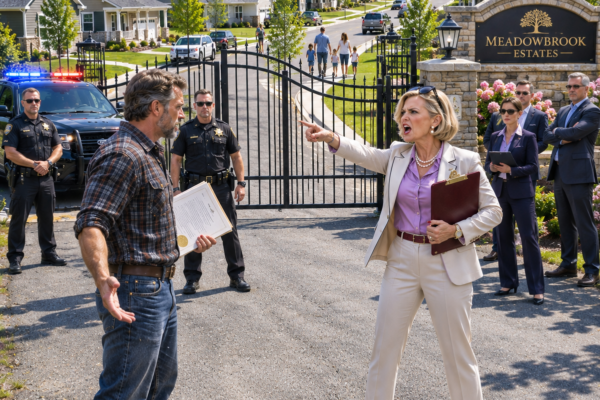
PART 2: HOA Threatened to Foreclose on My Home Over 12 Toy Soldiers—Then My Investigation Exposed a $500,000 Scheme
PART 2
Mrs. Gable’s name was Margaret.
I had seen her around the neighborhood since Sarah and I moved in, usually walking a small white terrier named Molly at a pace barely faster than standing still.
Until that morning, we had never spoken for more than thirty seconds.
Now she stood beside my mailbox looking terrified that somebody might see us talking.
“George kept everything,” she whispered.
“What kind of everything?”
“Budgets. Bids. Meeting notes. Letters.”
Her eyes flicked toward the houses behind me.
“He knew something was wrong.”
“What happened?”
Margaret swallowed.
“George was treasurer before Barry.”
That got my attention.
“When?”
“Eight years ago.”
“Before Karen became president?”
“He was still on the board when she took over.”
She looked toward the ground.
“At first, George liked her.”
That surprised me.
“He said Karen got things done. Nobody wanted to volunteer. She did.”
That part made sense.
The most dangerous people don’t usually begin as obvious villains.
They begin by being useful.
Margaret continued.
“Then she wanted to replace the landscaping company.”
“Green Pastures?”
Her head snapped toward me.
“You know about them?”
“I know the name.”
“George found three other bids.”
“How much?”
“The old company charged a little over twenty thousand a year. Green Pastures wanted almost sixty.”
“And the board approved it?”
“Karen pushed it through.”
“Why?”
“She said they offered premium community-image management.”
I almost laughed.
“What does that mean?”
“George asked the same question.”
Margaret didn’t smile.
“He started looking into the company.”
“And?”
“Karen’s brother-in-law owns it.”
There it was.
Not proof of wrongdoing by itself.
Family companies can perform legitimate work.
But combined with inflated cost, hidden records, and selective enforcement, it was enough to keep digging.
Margaret rubbed her thumb over Molly’s leash.
“George tried to challenge the contract.”
“What happened?”
“Violation notices.”
Her voice weakened.
“At first it was our shutters. Then the driveway. Then the birdbath.”
“The birdbath?”
“Wrong color.”
I said nothing.
“Every week there was something.”
“What did George do?”
“He kept fighting.”
“Good.”
“No.”
She looked at me.
“I used to think that too.”
Her eyes filled.
“The letters got worse. Then the lawyers.”
“Falk, Wexler & Croft?”
Margaret nodded.
“They threatened liens. Court. Legal costs.”
She pressed a hand against her chest.
“George stopped sleeping.”
I felt my jaw tighten.
“He resigned from the board because I begged him.”
“I’m sorry.”
“He told me if he quit, Karen won.”
Margaret wiped one eye.
“I told him I didn’t care. I wanted my husband.”
There was nothing useful to say.
So I waited.
“A year later, he had a heart attack.”
Her voice broke.
“The doctor didn’t say Karen killed him. I know that.”
I nodded.
“But George spent that last year angry and scared in the house he had worked thirty years to pay for.”
She looked directly at me.
“And she knew exactly what she was doing.”
That changed the emotional temperature of everything.
My twelve soldiers mattered.
My house mattered.
But George Gable had fought this battle alone before I ever arrived.
He had found something.
Karen had made sure nobody listened.
Margaret took a breath.
“The files are still in the attic.”
“Have you read them?”
“I couldn’t.”
“Why?”
“Because they’re the last thing he worked on.”
That made perfect sense.
“I won’t pressure you.”
“I know.”
She looked toward my porch.
At the twelve soldiers.
“George would tell me to give them to you.”
I didn’t know what to say.
“So come tonight.”
“Margaret—”
“After dark.”
She straightened slightly.
“And don’t park in front.”
At seven-thirty that evening, I told Sarah where I was going.
She looked at me over her reading glasses.
“You’re sneaking into an elderly widow’s house after dark to collect secret HOA files?”
“When you say it that way—”
“How else would anyone say it?”
“She’s afraid Karen will see.”
Sarah closed her book.
“I’m coming.”
“You don’t have to.”
“I know.”
We walked.
No flashlights.
No dramatic disguises.
Just a retired sergeant major and his wife strolling through their own neighborhood on a cold December night.
Margaret opened the door before we knocked.
She led us upstairs.
The attic smelled like cardboard, insulation, and the strange dry dust of things nobody has touched in years.
Near the far wall sat a banker’s box.
GEORGE — HOA.
Margaret rested her hand on the lid.
“I haven’t opened it since he died.”
Sarah stood beside her.
“You don’t have to tonight.”
Margaret looked at the box.
“Yes, I do.”
She opened it.
Inside were folders.
Not random papers.
Organized files.
Vendor Bids.
Reserve Fund.
Legal.
Landscaping.
Minutes.
Violations.
Karen.
George Gable had built a case.
I sat cross-legged on the attic floor and opened the landscaping file first.
Three legitimate bids.
All roughly twenty to twenty-four thousand dollars annually.
Then Green Pastures LLC.
Sixty-seven thousand eight hundred dollars.
I looked at Margaret.
“This was approved?”
“Yes.”
“Competitive vote?”
“George said Karen kept changing the agenda until two board members left early.”
Another folder contained state corporation records.
Martin Sloan.
Registered agent.
Business address.
George had handwritten:
KAREN’S SISTER’S HUSBAND.
Below that:
DISCLOSED? NO.
The reserve-fund file was worse.
George had tracked balances from meeting reports against expected dues revenue and expenses.
His notes showed a gap.
$18,000.
Then $27,000.
Then $40,000.
One page contained a sentence underlined three times.
BARRY WILL NOT PROVIDE FULL INVOICES.
Barry hadn’t been treasurer then.
He had been Karen’s committee ally.
George apparently suspected he was being positioned to replace him.
Sarah was reading a stack of legal correspondence.
“Jack.”
I looked.
Falk, Wexler & Croft.
Same language used against me.
Substantially the same paragraph threatening lien enforcement.
Different homeowner.
George.
Five years earlier.
I took out my phone.
Photographed everything.
Then stopped.
“No.”
Sarah looked up.
“What?”
“I want proper scans.”
Margaret said, “Take the box.”
I shook my head.
“No originals leave your house until we inventory them.”
She frowned.
“Why?”
“Because George preserved these.”
I looked at her.
“We treat them with respect.”
Something changed in her expression.
Maybe that was the first moment she truly trusted me.
We spent three hours cataloging.
File name.
Page count.
Approximate date.
Condition.
Then Sarah and I carried my portable scanner over from home.
By midnight, we had digital copies.
I uploaded them to encrypted storage and a backup drive.
The original box went back into Margaret’s attic.
Before we left, she handed me one last page.
George’s handwriting.
Not accounting.
A note to himself.
If something happens to me, don’t let this disappear.
I read it twice.
Margaret said:
“He always thought he was being dramatic.”
I folded the copy carefully.
“Maybe he just wanted someone else to finish.”
That night I did not sleep.
Neither did Sarah.
Our dining room became an evidence table.
Not a war room.
I stopped using that language after reading George’s note.
This was not war.
War made it too easy to think in enemies and destruction.
This was accountability.
At two in the morning, Sarah brought coffee.
“You’re shaking.”
“I’m angry.”
“I know.”
“They knew he was vulnerable.”
“I know.”
“They used legal fees to frighten him.”
“I know.”
“And now they’re doing the same thing to us.”
Sarah sat beside me.
“Then don’t do what George did.”
“What?”
“Fight alone.”
I looked at her.
She tapped the files.
“That was his mistake.”
She was right.
George had information.
What he lacked was a coalition.
Karen’s power came partly from making every homeowner believe his problem was private.
A hose.
A birdbath.
A welcome mat.
Twelve plastic soldiers.
Each person paid alone.
Complained alone.
Feared alone.
I needed to change that.
But first I needed facts strong enough that people would risk standing up.
I built a spreadsheet.
Green Pastures contract.
Estimated market price.
Official budget number.
Legal costs.
Reserve-fund changes.
Administrative fees.
Fine revenue.
Even with redactions, the picture was ugly.
Landscaping had tripled.
Legal spending had exploded.
One year showed more than fifty thousand dollars in attorney expenses.
Another line listed nearly thirty thousand dollars for administration and postage.
Pleasant Valley had two hundred homes.
We weren’t mailing gold-plated envelopes.
The next morning, I began researching Green Pastures.
The corporate record confirmed what George had written.
Martin Sloan.
Karen’s brother-in-law.
I found photographs online.
Karen at family gatherings.
Martin beside her.
Her sister.
Christmas.
Birthday parties.
The relationship itself was obvious.
The question was performance.
So for two weeks, I watched.
Not from bushes.
Not through windows.
From public streets and my own property.
Green Pastures usually arrived Tuesday mornings.
Two employees.
Old Ford pickup.
Mower.
Leaf blower.
First visit:
10:06 a.m.
Mowed entrance strip.
Twenty-two minutes.
Blew clippings.
Eleven minutes.
Sat inside truck.
Forty-seven minutes.
Departed 11:31.
Next week:
No visit.
Following week:
10:18 arrival.
One employee smoked beside the pond while the other used a blower.
They left before eleven.
Meanwhile, flower beds near the clubhouse filled with weeds.
A large dead branch hung over a walking path.
I photographed it.
Timestamped everything.
Arthur would later calculate that, based on actual service observed and comparable commercial bids, Pleasant Valley might have been paying three times market rate or more.
But I hadn’t met Arthur yet.
At that stage, I was still one man with spreadsheets.
Then I investigated Falk, Wexler & Croft.
Their website looked expensive.
Marble lobby.
Partners in dark suits.
Words like excellence, integrity, governance.
I searched public lawsuits.
Complaints.
Business-journal archives.
The firm specialized in HOA enforcement and collections.
That was not suspicious.
What interested me were prior allegations.
Homeowners in other communities had accused the firm of excessive billing.
Aggressive collection strategies.
Conflicts.
One older lawsuit mentioned Jonathan Croft, the partner whose name appeared on my threat letter.
A property-management company had allegedly referred HOA clients to his firm, generating large legal bills.
The dispute settled without an admission of wrongdoing.
That distinction mattered.
Allegation was not proof.
But patterns tell you where to look.
Then I researched Karen.
Her public profile described her as a “community management consultant.”
No clients listed.
No office.
No obvious professional history.
Company records showed a small LLC registered to her home address.
Pleasant Community Management Solutions.
I wrote it on the whiteboard.
Karen.
Green Pastures.
Falk Wexler Croft.
HOA fines.
Vendor contracts.
Legal fees.
I drew connections only where I had evidence.
No guessing.
Sarah walked into the room.
“Looks like one of those crime shows.”
“I’m missing red string.”
“Absolutely not.”
“I wasn’t serious.”
“You were.”
She looked at the board.
“Do you think Karen is stealing?”
“I think there’s enough smoke to ask where the fire is.”
“And if you’re wrong?”
“Then we correct the record.”
That became one of my rules.
If I was going to accuse people with reputations and livelihoods, I needed to be more careful than Karen had ever been with us.
Facts first.
Inference labeled.
Rumor ignored.
The neighborhood remained quiet until I wrote the newsletter.
One page.
No accusation.
Only questions.
ARE YOU SATISFIED WITH HOA TRANSPARENCY?
DO YOU KNOW HOW MUCH WE SPEND ON LANDSCAPING?
DO YOU KNOW HOW MUCH WE SPEND ON LEGAL SERVICES?
HAVE YOU EVER RECEIVED A FINE WITHOUT A HEARING?
HAVE YOU EVER BEEN DENIED ASSOCIATION RECORDS?
At the bottom, I created an email account:
PleasantValleyIntegrity.
I promised confidentiality.
Then I did something I hadn’t done since I was a young sergeant trying not to wake a barracks.
I walked the neighborhood after midnight.
Two hundred copies.
One in each newspaper box where permitted.
Not mailboxes.
I knew better than to create another issue.
I finished at 1:43 a.m.
Sarah was waiting in the kitchen.
“Well?”
“Nobody shot me.”
“Strong start.”
We went to bed.
At 6:15, I checked the email.
Seventy-three messages.
I thought the system had duplicated something.
It hadn’t.
Seventy-three households.
Some blank.
Some one sentence.
Some pages long.
A woman wrote:
I have paid $1,850 in fines in three years. I thought I was the only one.
A father wrote:
Karen threatened us after we questioned pool repairs.
Another:
Please do not use my name. My husband is terrified they’ll lien us.
Then:
My name is Arthur Bell. I am a retired forensic accountant. Your questions are the correct questions. Call me.
And:
I’m Sarah Jensen, paralegal. Their document-response letter contains several problems. I can help.
I showed my wife.
She smiled.
“Looks like you found your unit.”
“Don’t call it that.”
“Why?”
“Because this isn’t my operation anymore.”
That distinction mattered.
We met at Arthur Bell’s house.
Seven homeowners.
Arthur was sixty-eight, thin, quiet, and had the unsettling habit of staring at a financial statement as though it had personally insulted him.
Sarah Jensen was thirty-four, a paralegal at a civil-litigation firm.
There were also Daniel and Maria Miller, the couple with the forbidden welcome mat.
Mr. Henderson.
Margaret Gable.
My wife.
And me.
Arthur’s basement had a long workbench.
I laid out copies.
George’s files.
Redacted budget.
Green Pastures corporate records.
Photos.
My HOA violations.
Law-firm letters.
Arthur spent fifteen minutes reading before speaking.
“This budget is garbage.”
Maria blinked.
“That bad?”
“It’s not a budget. It’s a summary designed to stop questions.”
He pointed.
“Round numbers. No vendor detail. No account reconciliation. No reserve schedule.”
Sarah Jensen lifted Croft’s letter.
“And this?”
She tapped the legal-fee language.
“I’ve seen collection firms try this.”
“Legal?”
“Some may be. Some may not.”
She looked at me.
“Did the governing documents authorize shifting every attorney charge onto an individual homeowner?”
“Not that I found.”
“Neither did I.”
Arthur looked toward Margaret.
“Did George have bank statements?”
“No.”
“Invoices?”
“Some.”
“What we need is records.”
“I requested them.”
Arthur smiled without humor.
“And they gave you black pages.”
“Yes.”
“Then we make them refuse in front of more people.”
That became the strategy.
Not revenge.
Exposure.
We called ourselves the Pleasant Valley Committee for Integrity.
The name sounded painfully official.
Arthur liked it.
Sarah Jensen hated it.
Nobody came up with anything better.
Our first action was a formal records demand.
Not from me.
From seven households.
Ten pages.
Specific categories.
Specific date ranges.
Financial statements.
Bank reconciliations.
Vendor bids.
Invoices.
Board votes.
Executive-session records to the extent legally available.
Contracts.
Legal-billing summaries.
Green Pastures procurement files.
We did not demand privileged attorney-client communications.
Sarah Jensen was meticulous about that.
“Give them no easy excuse,” she said.
Each board member received a copy personally.
Karen.
Barry.
Linda.
Their reaction was immediate.
Jonathan Croft sent a new letter.
Frivolous.
Harassing.
Defamatory.
Improper.
Denied.
Then the board announced a $500 special assessment.
Legal defense.
Two hundred houses.
One hundred thousand dollars.
To defend the board against homeowners asking to inspect their own association’s records.
Arthur read the notice twice.
Then looked at me.
“They’re making residents finance the wall they’re hiding behind.”
Sarah Jensen said:
“This is the kind of fact a judge understands.”
Margaret whispered:
“George would’ve lost his mind.”
I looked at her.
“No.”
She smiled sadly.
“He’d have smiled first.”
That was when we decided the story had to leave Pleasant Valley.
We needed outside scrutiny.
Not a social-media rant.
Not anonymous posts.
Real reporting.
Documents.
Right of reply.
Verification.
The reporter we chose was Jessica Riley.
Channel 8.
State capital.
She had built a career on public-corruption investigations.
Her transportation-department series had triggered resignations and a government probe.
I got her number indirectly through an old Army public-affairs friend.
No favors.
No promise of coverage.
Only an introduction.
Jessica called me the next afternoon.
“I’m told you have an HOA story.”
“I have an HOA financial story.”
“I get HOA stories daily.”
“I imagine.”
“Fence colors. Parking fights. Mailboxes.”
“This isn’t that.”
“What is it?”
“Potential self-dealing. Vendor conflicts. selective fines. aggressive legal collections. withheld financial records. An elderly former board member who documented irregularities before he died.”
Silence.
“What can you prove?”
I liked her immediately.
“Enough to justify questions.”
“Not what I asked.”
“I can prove the landscaper is the president’s brother-in-law. I can prove the contract appears roughly triple comparable bids. I can document the service we’ve observed. I can prove the board denied records requests. I can prove legal spending increased sharply. I can prove they imposed a special assessment after residents demanded financial transparency.”
“And theft?”
“I cannot prove theft.”
“Kickbacks?”
“Not yet.”
“Good answer.”
She paused.
“Meet me Friday.”
Arthur came with me.
So did the binder.
Sarah Jensen had organized it with tabs.
Background.
Governing documents.
Fine pattern.
George Gable.
Green Pastures.
Legal expenses.
Records requests.
Special assessment.
Jessica opened it.
For forty-five minutes, she barely spoke.
Then she reached George’s handwritten notes.
Her face changed.
Margaret had provided a written statement.
George’s photograph was attached.
Jessica read it.
Closed the binder.
Then looked at us.
“This is not a quirky HOA segment.”
Arthur nodded.
“No.”
“Could be nothing criminal.”
“Correct,” I said.
She smiled.
“You really are military.”
“Retired.”
“Same disease.”
Then she tapped the binder.
“But there is absolutely a public-interest story here.”
“What do you need?”
“Independent verification.”
“Good.”
“I’ll call competing landscapers.”
“Good.”
“I’ll obtain property and corporate records myself.”
“Good.”
“I’ll ask the law firm and Karen for responses.”
“Good.”
She stared at me.
“Do you say anything besides good?”
“Occasionally.”
Arthur laughed.
Jessica leaned back.
“If your documents hold, I want interviews.”
“With me?”
“Yes.”
“Arthur?”
“Yes.”
“Margaret?”
“If she agrees.”
I shook my head.
“Do not pressure her.”
Jessica’s expression softened.
“I won’t.”
“And Karen?”
Jessica smiled.
“Absolutely Karen.”
The news team spent the next week checking us.
That was exactly what I wanted.
They verified Green Pastures ownership.
Verified Karen’s family connection.
Obtained comparative landscaping estimates.
Confirmed our observation that some common areas showed maintenance deficiencies.
They reviewed state HOA rules with outside counsel.
They examined Falk, Wexler & Croft’s prior litigation history.
They checked George’s board service.
They interviewed homeowners we had never contacted.
By the time Jessica returned, she had additional information.
“Our sources say Karen’s consulting company has received payments from entities associated with HOA vendors.”
Arthur sat forward.
“Can you prove that?”
“Not enough to air yet.”
Good reporter.
“Then don’t.”
She looked at me.
“You know, most people bringing me stories want me to say everything they believe.”
“I want you to say what you can prove.”
“That’s why I’m still here.”
Margaret resisted the camera.
Understandably.
“I don’t want George turned into entertainment.”
Jessica met with her privately.
No lights at first.
No microphone.
Just conversation.
When Margaret finally agreed, Sarah Jensen sat beside her.
Margaret held a photograph of George from their twenty-fifth anniversary.
He had thick silver hair.
Big smile.
Tie slightly crooked.
On camera, she said:
“My husband believed the homeowners deserved to know where their money went.”
She paused.
“He thought if he showed people numbers, they would care.”
Her voice broke.
“Instead, he became the problem.”
Jessica asked:
“What did that do to him?”
Margaret looked down at the photograph.
“He stopped sleeping.”
“What did the HOA do?”
“Letters. Fines. Legal threats.”
“Do you believe the stress caused his death?”
Margaret was careful.
“The doctor never said that.”
I respected her for that.
“But I watched the stress take him away from me long before his heart stopped.”
Nobody in the room moved.
Then she said:
“I am speaking now because I don’t want another wife watching her husband disappear inside a fight he thinks he has to carry alone.”
That became the emotional center of the report.
Not my toy soldiers.
Not Karen’s personality.
George.
A man who had seen numbers that didn’t make sense and paid a terrible personal price for refusing to stop asking why.
Meanwhile, Karen escalated.
Another legal notice arrived.
My alleged balance:
$7,850.
She had added attorney fees associated with responding to my records requests.
I laughed when I read it.
Sarah didn’t.
“They’re still threatening the house.”
“I know.”
“What if something goes wrong?”
There it was.
The fear I had avoided naming.
I sat beside her.
“They cannot simply walk in tomorrow and take the house.”
“That isn’t what I asked.”
“No.”
She looked at me.
“What if we spend years fighting?”
I had no answer.
“What if the lawyers cost more than the fine?”
Possible.
“What if you get so obsessed with beating Karen that she gets exactly what she wants anyway?”
That hurt.
Because it was possible too.
Sarah put her hand over mine.
“I don’t want the house if we lose our life inside it.”
I looked toward the porch.
The twelve soldiers were still there.
“Do you want me to take them down?”
She thought.
“No.”
“Why?”
“Because then every time I look at that railing, I’ll remember we took them down because she scared us.”
Sarah squeezed my fingers.
“I don’t want that either.”
“What do you want?”
“My husband.”
I nodded.
“You have him.”
“Then prove it by sleeping tonight.”
I did.
Seven hours.
Best operational decision I made all month.
The Channel 8 report was scheduled for Thursday.
Before then, Jessica wanted Karen’s response.
Karen held a weekly coffee gathering at a café outside Pleasant Valley.
Jessica’s team approached her there.
I did not participate.
I sat far away in my truck because Jessica had told me she might ask questions in person and wanted to know whether I was nearby if she needed a document clarified.
At 10:16, Karen exited carrying pastries.
Barry beside her.
Linda behind.
Jessica approached with a microphone.
“Ms. Peterson? Jessica Riley, Channel 8.”
Karen stopped.
The camera started rolling.
“I have no comment.”
Jessica walked with her.
“We’re investigating Pleasant Valley’s finances.”
Karen’s shoulders stiffened.
“We have documents showing Green Pastures LLC has received substantially more than competing landscapers quoted for similar work. The company is owned by your brother-in-law. Did you disclose that relationship before the contract was awarded?”
Karen’s face changed.
“That company provides excellent service.”
“Did you disclose the relationship?”
“This is harassment.”
“We also have records showing legal expenses increased dramatically during your presidency.”
Karen tried walking away.
Jessica continued.
“Why has the HOA denied homeowners detailed financial records?”
“Because these requests are being weaponized by a delinquent homeowner.”
“You mean Jack Davis?”
Karen pointed toward the street.
“That man refuses to follow rules.”
Jessica stayed calm.
“His original dispute concerns twelve small toy soldiers honoring men from his military unit who were killed overseas. Why has that dispute resulted in nearly eight thousand dollars in claimed fines and legal costs?”
Karen snapped.
“The rules apply to everyone.”
Jessica replied:
“Several residents provided photographs of larger violations at homes belonging to board supporters that received no fines. Can you explain selective enforcement?”
Barry said:
“We have procedures—”
Karen cut him off.
“These people are liars.”
Then Jessica asked the question that destroyed Karen’s composure.
“Why should every Pleasant Valley homeowner pay a new five-hundred-dollar special assessment to fund your legal response to their own demands for financial transparency?”
Karen exploded.
“I will sue you.”
Jessica didn’t move.
“I will sue your station.”
“Is there anything in our question that is inaccurate?”
“You people come here with cameras and harass respectable citizens because one disgruntled man doesn’t like authority.”
“Are the records wrong?”
“I’m done.”
Karen pointed at the cameraman.
“Turn that off.”
He didn’t.
“This is private property.”
They were on a public sidewalk.
Jessica said so.
Karen threatened police.
Then she said the line Channel 8 used in nearly every promotion.
“Pleasant Valley is my community, and I will do whatever is necessary to protect it.”
My community.
Not our community.
That was Karen in three words.
The report aired at six.
Sarah and I watched from our living room.
I hated seeing myself on television.
My face looked older.
My voice sounded strange.
Jessica opened with the plastic soldiers.
Then moved immediately to finances.
Arthur explained that Pleasant Valley’s reported vendor spending appeared disproportionate to observable services.
She carefully called it a red flag, not proven theft.
Then Margaret appeared.
Her interview changed everything.
She told George’s story.
Not theatrically.
Quietly.
At the end, Jessica showed Karen’s confrontation.
Then the special assessment.
Then the denied records.
Her final line:
“Pleasant Valley’s board insists it has acted lawfully. Homeowners are asking a simpler question: if everything is proper, why is it so difficult to see where their money went?”
The report ended.
Sarah exhaled.
“That was good.”
My phone started vibrating.
Then hers.
Messages.
Neighbors.
Old Army friends.
Unknown numbers.
Channel 8 reran it at ten.
By midnight, other stations had picked it up online.
The next morning, a man called.
“Jack Davis?”
“Yes.”
“David Chen. Economic Crimes Division, State Attorney General’s Office.”
I stood straighter without meaning to.
“How can I help you?”
“We watched Channel 8.”
“Okay.”
“We’d like to see your documents.”
“When?”
“As soon as practical.”
“How about today?”
He laughed.
“Sergeant Major?”
“Retired.”
“I figured.”
We met that afternoon.
Not with the binder.
Everything.
Digital archive.
George’s scans.
My correspondence.
Photographs.
Spreadsheets.
Email logs.
Arthur’s analysis.
Corporate records.
Chen listened for almost two hours.
Then asked:
“What do you believe happened?”
I answered carefully.
“I believe Karen Peterson may have used HOA authority to enrich people connected to her and potentially herself. I believe aggressive fines and legal threats were used to suppress resistance and generate revenue.”
“Do you have evidence of kickbacks?”
“No direct evidence.”
“Embezzlement?”
“No direct bank evidence.”
“Good.”
I must have looked confused.
Chen explained:
“People get excited and turn suspicions into facts.”
“I try not to.”
“Keep trying.”
He tapped the drive.
“We can get what you can’t.”
The Attorney General’s office opened a formal investigation.
The first subpoenas changed everything.
Karen had ignored me.
She could not ignore them.
Pleasant Valley.
Karen personally.
Barry.
Linda.
Green Pastures.
Falk, Wexler & Croft.
Banks.
Accounting software provider.
Electronic records.
Invoices.
Emails.
Contracts.
Seven years.
Jonathan Croft fought.
His firm filed to narrow the requests.
A judge rejected most of the challenge.
Then records began arriving.
And Arthur’s estimates turned out to be conservative.
Green Pastures invoiced the HOA for work its own internal records did not support.
Payments from Pleasant Valley far exceeded ordinary service charges.
Money moved from Green Pastures into another entity.
Then into Pleasant Community Management Solutions.
Karen’s company.
Not once.
Repeatedly.
Arthur called me when Chen allowed us to know the broad finding.
“You were right.”
“No.”
“What?”
“George was.”
Silence.
Then Arthur said:
“Yeah.”
The legal bills revealed another pattern.
Falk, Wexler & Croft had charged enormous sums for routine violation collection.
One homeowner’s $100 violation generated more than $2,000 in claimed legal activity.
Internal billing entries included conferences, strategy sessions, document reviews, and repeated calls.
Investigators suspected that some charges were inflated or tied to arrangements benefiting people associated with the scheme.
Croft denied wrongdoing.
For a while.
Karen continued telling residents the investigation was political harassment.
Then she made the worst decision of her life.
Retaliatory liens.
She called an emergency board session in her living room.
Karen.
Barry.
Linda.
They approved new enforcement actions against homeowners cooperating with Channel 8 or investigators.
Mine was the largest.
More than $50,000.
Violations included:
Unapproved holiday décor.
Failure to remediate.
Harassment of board officials.
Improper dissemination of association information.
Reputational damage to the community.
Legal-cost reimbursement.
There was no legitimate basis for most of it.
Karen filed lien paperwork at the county herself.
Chen called me that afternoon.
“She filed against you.”
“I expected something.”
“Not like this.”
“Is the house at risk?”
“No. We’re moving.”
“What does that mean?”
“I cannot tell you details.”
“Then why call?”
“Because I don’t want you confronting her.”
I almost laughed.
“David.”
“I’m serious.”
“So am I.”
“Stay home tomorrow morning.”
“Why?”
“Make coffee.”
The call ended.
Sarah was in the kitchen.
“What did he say?”
“Stay home tomorrow.”
Her eyes widened.
“Oh.”
At eight the next morning, I sat on my porch.
Coffee.
Cold air.
The twelve toy soldiers were still on the railing.
I had almost packed them away after Christmas.
Then I decided they were evidence of where everything began.
At 8:15, two unmarked sedans entered Pleasant Valley.
State police cruiser behind.
They stopped at Karen’s house.
Neighbors noticed instantly.
Curtains moved.
Garage doors paused.
Investigator Chen stepped out.
Two troopers followed.
They walked to Karen’s front door.
Knocked.
She opened it wearing a pink robe.
Even from two houses away I could see the change in her posture.
Annoyance.
Recognition.
Disbelief.
She began talking rapidly.
Chen showed her paperwork.
She waved one hand.
Pointed toward my house.
Of course she did.
Then one trooper stepped forward.
Karen stopped talking.
Turned.
Hands behind her back.
Cuffs.
I had imagined that moment more than once.
In those fantasies, I felt victorious.
I didn’t.
I felt tired.
Sarah stood in the doorway behind me.
“They arrested her.”
“Yes.”
Karen turned as they walked her toward the sedan.
Her eyes found me.
We looked at each other across the lawns.
I didn’t smile.
Didn’t wave.
Didn’t raise my coffee.
I nodded once.
Not congratulations.
Not revenge.
Acknowledgment.
This is where your choices led.
She got into the car.
Then the operation widened.
Barry was arrested while loading golf clubs.
Linda at home.
Martin Sloan at Green Pastures.
Investigators executed a search warrant at Falk, Wexler & Croft.
Computers.
Servers.
Financial records.
Jonathan Croft eventually left the building accompanied by investigators.
By noon, news vans crowded Pleasant Valley.
Jessica Riley walked toward my porch.
“Well.”
“Yeah.”
“You okay?”
“I think so.”
She looked toward Karen’s empty house.
“You’re not celebrating.”
“No.”
“Why?”
I looked toward Margaret’s porch.
She was sitting in her rocking chair with Molly beside her.
“Because George should be here.”
Jessica’s expression softened.
She lowered the microphone.
Not everything needed to become footage.
Later that day, the Attorney General held a press conference.
The allegations were larger than we understood.
A seven-year scheme.
More than half a million dollars potentially misappropriated or fraudulently extracted.
Racketeering-related charges.
Fraud.
Embezzlement.
Conspiracy.
Fraudulent legal filings.
Additional counts varied by defendant.
Pleasant Valley was placed into court-supervised receivership.
The board lost control immediately.
The fraudulent retaliatory liens were blocked.
The $500 assessment was suspended.
A receiver named Elaine Albright took over.
Her first neighborhood meeting had to be moved to the high-school auditorium because almost every household attended.
I sat beside Sarah.
Margaret beside us.
Arthur and Sarah Jensen in front.
Ms. Albright walked onto the stage carrying no gavel.
I liked her already.
She projected the preliminary numbers.
Reserve fund:
Nearly empty.
Legal expenses:
Massive.
Vendor overpayments:
Under review.
Fine collections:
Significant.
Potential recoveries:
Pending.
A resident shouted:
“Are we bankrupt?”
Ms. Albright answered plainly.
“Not yet.”
People murmured.
“But the association is financially distressed.”
Another homeowner yelled:
“Where did the money go?”
“That is what the forensic audit and criminal investigation are determining.”
Then she said something that made Margaret start crying.
“We have also begun reviewing every violation and lien issued during the previous seven years.”
The auditorium went quiet.
“Any fine found unsupported by governing documents, applied selectively, or imposed without required process will be voided.”
A woman gasped.
Ms. Albright continued.
“Where funds were improperly collected and records support reimbursement, homeowner accounts will be credited or refunded as available through recovered assets and association funds.”
Applause erupted.
Margaret didn’t clap.
She covered her face.
Sarah put an arm around her.
I leaned closer.
“You okay?”
She nodded through tears.
“George paid thousands.”
“I know.”
“He kept every receipt.”
“Of course he did.”
She laughed and cried at the same time.
“That stubborn man.”
Three months later, Margaret received her statement.
$6,420 in improper fines and fees identified for reimbursement.
She sat at our dining table holding the letter.
“I don’t care about the money.”
Arthur said gently:
“Yes, you do.”
She looked at him.
He smiled.
“Not because you need it.”
He tapped the letter.
“Because every dollar says George wasn’t crazy.”
Margaret stared.
Then nodded.
That was exactly it.
The money was evidence.
Recognition.
A ledger correcting another ledger.
The criminal cases moved slower than headlines.
That was healthy.
Evidence took time.
Negotiations.
Motions.
Interviews.
Forensic accounting.
Barry cooperated first.
Then Linda.
Both claimed Karen controlled everything.
Investigators did not accept that completely.
They had signed documents.
Approved payments.
Helped intimidate homeowners.
But they were lesser players.
Their agreements included probation, substantial financial penalties, restitution obligations, and bans from serving in association or nonprofit governance roles for years.
Martin Sloan’s company collapsed.
Assets were sold.
Funds went toward restitution.
Jonathan Croft held out longer.
Then investigators confronted him with billing records and communications.
He eventually cooperated.
His law license was gone.
His professional reputation was gone.
He served a custodial sentence and provided evidence against Karen.
Karen never forgave him.
According to Jessica, she called him a coward in court.
Croft reportedly answered:
“You were never going to save me.”
That might have been the truest thing anyone in their circle ever said.
Karen’s case lasted longest.
Her attorneys attacked the investigation.
Media prejudice.
Improper motive.
Selective prosecution.
Homeowner conspiracy.
They described me as an obsessed retired soldier who had weaponized public pressure over Christmas decorations.
That part almost made me admire the creativity.
Then prosecutors introduced financial records.
Payments.
Emails.
Contracts.
Retaliatory liens.
Her own consultancy.
Internal board messages.
One message from Karen to Barry became particularly damaging.
IF THEY WON’T PAY QUIETLY, MAKE IT EXPENSIVE TO FIGHT.
Another:
PEOPLE STOP ASKING QUESTIONS WHEN LAWYERS GET INVOLVED.
George Gable had been right.
Not suspicious.
Not paranoid.
Right.
The day Karen entered her plea, Margaret came with us.
She held George’s photograph in her purse.
Karen admitted to a series of offenses connected to financial misconduct and fraudulent association practices.
The final sentence:
Three years in state prison.
Restitution.
Financial penalties.
Loss of positions.
The judge spoke for almost fifteen minutes.
He said the association had been entrusted with limited power for a limited purpose.
Karen converted that trust into personal leverage.
He called the conduct a serious abuse of community authority.
Margaret sat perfectly still.
Outside the courthouse, reporters gathered.
Jessica approached.
“Mrs. Gable, would you like to say anything?”
Margaret looked at me.
I shrugged.
Her choice.
She stepped toward the microphone.
“My husband tried to warn us.”
Her voice was steady.
“I wish we had listened sooner.”
Then she looked directly at the cameras.
“But this is not about revenge against Karen Peterson.”
That surprised everyone.
“It is about making sure the next person who asks where the money went does not have to stand alone.”
She stepped away.
That was the best statement anyone made during the entire case.
Back in Pleasant Valley, recovery was not instant.
The association had money problems.
Some services had to be reduced.
The entrance flowers went without replacement one season.
Nobody died.
Residents volunteered.
Weeds got pulled.
People discovered not everything required a vendor contract.
A group painted the clubhouse.
Parents repaired playground benches.
The neighborhood looked slightly less perfect.
It felt much more alive.
Ms. Albright supervised new elections.
At the organizational meeting, someone nominated me for president.
Then someone else seconded.
Then half the room applauded.
I walked to the microphone.
“No.”
Laughter.
“I appreciate it.”
Someone shouted:
“Come on, Jack!”
“No.”
More laughter.
I waited.
Then:
“I didn’t fight Karen because I wanted Karen’s chair.”
The room quieted.
“Pleasant Valley does not need another strong personality everybody depends on.”
I looked around.
“That is partly how we got here.”
Heads nodded.
“We need transparent systems and people willing to participate even when nothing dramatic is happening.”
I turned toward Sarah Jensen.
She immediately shook her head.
Too late.
“I nominate Sarah Jensen.”
She whispered something I won’t repeat.
The room laughed.
“For treasurer, Arthur Bell.”
Arthur closed his eyes.
He knew.
“I’m retired,” he protested.
“So am I.”
“That’s not an argument.”
“Exactly.”
They were elected.
Sarah Jensen became president.
Arthur became treasurer.
Margaret joined the homeowner advisory committee.
Mr. Henderson joined landscaping.
Maria Miller chaired recreation.
No one person controlled everything.
That was the point.
The first thing Arthur did was publish the budget online.
Every line.
Vendor.
Amount.
Contract.
Reserve balance.
Monthly reconciliation.
He created a dashboard so clear even I could understand it.
“Insulting,” I told him.
“Designed specifically for infantry.”
“I was Army logistics.”
“Worse.”
The new board rebid landscaping.
Green Pastures’ old contract had been nearly seventy thousand dollars.
The winning legitimate bid:
Twenty-three thousand six hundred.
Better service.
More visits.
Documented work.
Insurance.
Performance terms.
Residents applauded a landscaping contract.
That was how damaged we had become.
The legal policy changed too.
No attorney letter to a homeowner without documented board authorization except genuine emergencies.
No fines without exact citation.
No invented fees.
No selective enforcement.
Required hearing.
Appeal process.
And perhaps most important:
No one could charge a homeowner the association’s attorney fees merely because that homeowner requested records or disputed a violation unless clearly authorized by governing documents and applicable law.
The twelve toy soldiers became a point of debate.
Sarah Jensen called me.
“Jack.”
“Yes?”
“We’re rewriting the decoration rules.”
“Congratulations.”
“I need to ask about your soldiers.”
I smiled.
“What about them?”
“Do you want an exemption?”
“No.”
Pause.
“What?”
“Write a reasonable rule that applies to everybody.”
“But your display is a memorial.”
“Then write a rule that permits reasonable porch displays.”
She laughed.
“Why are you making this harder?”
“Because if rules depend on whether the board likes my story, nothing changed.”
Silence.
Then:
“That is annoyingly correct.”
The new guideline fit on one paragraph.
Seasonal and personal decorative displays permitted if they did not create safety hazards, substantial nuisance, or damage common property.
That was it.
No subsection about traditional taste.
No committee deciding whether a two-inch plastic soldier had sufficient Christmas spirit.
The following December, I opened the storage box.
Twelve soldiers.
I lined them along the railing.
Same order as always.
Sarah stood beside me.
She touched the first figure.
“Tom?”
“Yeah.”
I touched the second.
“Martinez.”
Third.
“Lewis.”
We went down the line.
Names.
Faces.
Stories.
Some memories were funny.
Some I still couldn’t speak about without tightening inside.
Karen had called them trashy.
The new board called them permitted.
Neither description mattered much anymore.
They were mine.
Our porch.
Our memory.
That December, something unexpected happened.
A small package appeared at our door.
Inside were twelve tiny wooden bases.
Handmade.
Each engraved with a first name.
Tom.
Martinez.
Lewis.
And the others.
No sender.
Only a note.
FOR THE MEN WHO STOOD WATCH WHILE WE LEARNED TO.
Sarah cried.
I suspected Margaret.
She denied it.
Arthur claimed his woodworking skills were too sophisticated for such work.
Sarah Jensen smiled whenever asked.
We never learned.
I glued each soldier carefully to his base.
The display stayed until January.
Nobody complained.
Mrs. Gable changed too.
For years, Margaret had avoided board meetings.
Now she sat in the front row.
Sometimes she spoke.
The first time a homeowner complained about a proposed pool repair budget, the contractor presented three bids.
Arthur displayed them on the projector.
Resident asked questions.
Board answered.
Vote happened.
Afterward Margaret found me outside.
“George would’ve loved that.”
“The pool repair?”
“The argument.”
I smiled.
“He liked arguments?”
“He liked numbers.”
She looked back toward the clubhouse.
“He wanted exactly that.”
“What?”
“For them to answer.”
That was all George had wanted.
Not revolution.
Not arrests.
An answer.
Why does this cost so much?
Who approved it?
Where is the invoice?
Questions so ordinary they should never have required courage.
The Fourth of July block party became our first real community celebration after receivership ended.
Children ran through sprinklers.
Arthur grilled burgers badly.
Sarah Jensen confiscated the spatula.
Mr. Henderson coiled a garden hose deliberately into a crooked pile in full view of everyone.
“I feel dangerous,” he announced.
Maria put out a welcome mat beside the picnic pavilion.
NON-STANDARD, it said.
Margaret laughed harder than I had ever seen.
At sunset, people asked me to say something.
I refused.
Then Sarah handed me a microphone anyway.
“Traitor.”
She smiled.
“Retired wife authority.”
I looked at nearly two hundred neighbors.
A year earlier, many had been afraid to speak to each other.
Now they were laughing.
I said:
“George Gable should be standing here.”
The crowd quieted.
Margaret looked down.
“He saw the problem before most of us did.”
I continued.
“He made one mistake.”
Margaret looked at me.
“He thought he had to solve it alone.”
I let that sit.
“None of us does.”
That was my entire speech.
Under a minute.
Best speech I ever gave.
Margaret came over afterward.
“You called George wrong.”
“One time.”
“He would’ve argued.”
“I know.”
“He would’ve liked you.”
“I would’ve liked him.”
She looked toward the families.
“We got it back.”
“What?”
“Our neighborhood.”
I nodded.
“Yeah.”
The house Karen threatened to seize never went anywhere.
The lien never became valid.
Our title remained clean.
But for months afterward, I still woke sometimes thinking about losing it.
That surprised me.
I had been in real danger before.
Physical danger.
Incoming rounds.
Roadside explosions.
Aircraft warnings.
None of that prepared me for a letter saying someone might take the place where Sarah and I intended to grow old.
Home is strange.
Walls and lumber on paper.
Memory in practice.
Our hallway had marks where grandchildren had leaned suitcases during visits.
The kitchen counter had a burn Sarah blamed on me.
I blamed a defective pan.
The porch had twelve tiny soldiers every December.
The spare room held boxes from thirty years of moving.
You cannot explain all of that to a lien notice.
That was why Karen’s threat had worked for so long on others.
She wasn’t threatening property.
She was threatening belonging.
Once I understood that, I stopped feeling embarrassed that the letter frightened me.
Fear wasn’t weakness.
Silence would have been.
Two years after Karen went to prison, Jessica Riley called.
“I’m doing a follow-up.”
“Why?”
“People still ask.”
“About Karen?”
“About Pleasant Valley.”
“What do they want to know?”
“Whether things actually changed.”
I looked outside.
Arthur was walking toward the clubhouse with budget folders.
Kids played basketball near the park.
Margaret’s terrier barked at a delivery truck.
“Yeah.”
“Can we film?”
“You can film them.”
“You?”
“No.”
She laughed.
“Still hate cameras?”
“Deeply.”
The follow-up aired anyway.
Pleasant Valley’s reserves recovering.
Transparent budgets.
Lower vendor costs.
No retaliatory liens.
Homeowners attending meetings.
Jessica interviewed Margaret.
“What would George think?”
Margaret smiled.
“He would ask to see the invoices.”
That line made the segment.
Then Jessica showed my porch.
Twelve soldiers.
No interview.
Just the display.
Her narration said:
“The decorations that started Jack Davis’s confrontation with the former board remain exactly where he wanted them—small, quiet, and lawful.”
That was enough.
Karen served her sentence.
I heard she was released later under supervision.
She did not return to Pleasant Valley.
Her house had been sold.
A family with three children moved in.
First Halloween, they put a twelve-foot skeleton in the yard.
I stood on my porch staring at it.
Sarah came outside.
“What?”
“That is aggressively non-traditional.”
She elbowed me.
The skeleton stayed.
Nobody cared.
A month later, the new family received their first HOA letter.
The husband came running toward me with the envelope.
“Jack!”
“What happened?”
He looked worried.
“HOA.”
Old reflex.
My stomach tightened.
“What does it say?”
He opened it.
“Annual meeting reminder.”
I laughed so hard he thought I’d lost my mind.
“Long story,” I told him.
Life became normal.
Not perfect.
Normal.
Residents still argued.
One man hated basketball noise.
Another complained about dogs.
Arthur fought with Sarah Jensen about reserve percentages.
The landscaping committee nearly split over native grasses.
At one meeting, two women debated mailbox colors for forty-five minutes.
I sat in the back thinking:
This is democracy.
Annoying.
Slow.
Public.
Beautiful.
No security escort.
No secret invoices.
No lawyer threatening foreclosure because somebody asked a question.
Sarah and I finally learned to enjoy retirement.
We traveled.
Visited children.
Took a month-long road trip west.
When we returned, Margaret had watered Sarah’s plants.
Mr. Henderson had collected mail.
Arthur left an HOA financial report on my desk even though I had specifically asked him not to.
On top he wrote:
TRANSPARENCY IS FOREVER.
I wrote underneath:
GET A HOBBY.
He framed it.
Years later, Margaret asked me to help clean George’s attic.
She was selling her house.
Moving closer to her daughter.
We found the empty spot where the HOA box had once sat.
The originals had eventually been turned over to investigators, copied, returned, and then archived with her permission as part of the association’s historical records.
Margaret stood in the attic.
“Funny.”
“What?”
“That box scared me for years.”
I looked at the dust rectangle where it had been.
“Why?”
“I thought opening it would bring George’s fight back.”
She smiled.
“Instead it ended it.”
We carried boxes downstairs.
Before she left Pleasant Valley, the new board held a dinner for her.
Arthur presented a plaque honoring George.
Not me.
George.
FOR INSISTING THAT COMMUNITY MONEY BELONGS TO THE COMMUNITY.
Margaret read it.
Then pressed it against her chest.
“I wish he could see this.”
Sarah Jensen said:
“I think he’d complain the plaque cost too much.”
Margaret burst out laughing.
“So true.”
She moved three weeks later.
On her last morning, she walked Molly past our house.
Stopped at the porch.
Looked at the soldiers.
“They’re smaller than I remembered.”
I smiled.
“Trouble usually is afterward.”
She hugged Sarah.
Then me.
“Thank you for finishing what George started.”
I shook my head.
“We all finished it.”
“No.”
She looked at me.
“You showed us we didn’t have to be afraid.”
I thought about correcting her.
Then didn’t.
Sometimes gratitude doesn’t need a technical edit.
Arthur eventually stepped down as treasurer.
He had turned seventy-three.
The board gave him a cake shaped like a spreadsheet.
He hated it.
Naturally.
Sarah Jensen served two terms as president and refused a third.
“That’s another rule we should have had,” she told me.
“What?”
“People should leave power voluntarily.”
Good rule.
Pleasant Valley adopted term limits.
Not because every long-serving leader becomes corrupt.
Because rotation makes complacency harder.
Institutional memory stayed.
Personal kingdoms didn’t.
One afternoon, a young couple knocked on my door.
New residents.
They had heard the story.
“Are you the guy who took down the corrupt HOA?”
“No.”
They looked disappointed.
“I live here.”
“But weren’t you the one with the soldiers?”
“Yes.”
“And the investigation?”
“Yes.”
“So you did.”
“No.”
I pointed down the street.
“Arthur followed the money.”
Toward the corner.
“Sarah Jensen handled procedure.”
Toward Margaret’s old house.
“George started it.”
Then at the homes.
“Seventy-three people answered an email.”
The young husband frowned.
“So who took them down?”
“The people who stopped being afraid of each other.”
That was the truth.
Karen’s greatest weapon was never the lien.
It was isolation.
A homeowner received a notice and thought:
Maybe I’m wrong.
Maybe everybody else follows the rules.
Maybe if I speak, I’ll become the difficult one.
So they paid.
Karen never had to defeat two hundred households.
She defeated one household two hundred times.
Until we compared notes.
That lesson stayed with me.
Bad systems survive by convincing every victim that his experience is unique.
The antidote is often embarrassingly simple.
Talk.
Compare.
Document.
Ask.
One winter, almost a decade after the first confrontation, I opened the box containing the twelve soldiers.
My hands had started shaking slightly with age.
Nothing serious.
Just time.
Sarah sat beside me.
“You want help?”
“No.”
“Stubborn.”
“Professionally.”
I arranged them.
Tom.
Martinez.
Lewis.
Coleman.
Reed.
Jackson.
Nolan.
Price.
Harris.
Woods.
Garcia.
Bennett.
Twelve.
Sarah watched.
“You’ve never told me everything about that last tour.”
“I know.”
“You don’t have to.”
“I know.”
I held Bennett’s figure.
“He was twenty-two.”
Sarah waited.
“Had a baby he’d never met.”
My throat tightened.
“I told him he’d be home before Christmas.”
Sarah took my hand.
“You couldn’t know.”
“No.”
“You’ve carried that a long time.”
“Yes.”
She looked at the soldiers.
“Maybe that’s why Karen made you so angry.”
I nodded.
“She thought she was insulting decorations.”
“But you heard something else.”
“I heard twelve names being reduced to clutter.”
Sarah leaned against me.
“And then?”
I smiled faintly.
“Then I overreacted in an extremely organized manner.”
She laughed.
“That is the most accurate description of your personality I’ve ever heard.”
We finished arranging them.
That Christmas, children walking past asked about the soldiers.
For the first time, I told them.
Not war stories.
Names.
Tom loved fishing.
Martinez sang terribly.
Lewis cheated at cards.
Coleman wrote letters to his mother every Sunday.
Reed hated coffee.
Jackson wanted to open a gym.
Nolan could fix anything.
Price was afraid of snakes.
Harris laughed too loudly.
Woods collected baseball caps.
Garcia made the best field-expedient breakfast I ever ate.
Bennett had a daughter.
The soldiers became what they were always meant to be.
Not symbols of conflict with Karen.
Memory.
Years had stripped Karen out of them.
That felt like victory.
The house aged.
So did we.
Roof replaced.
Water heater twice.
One oak tree removed after lightning split it.
Porch repainted.
The railing where the soldiers stood eventually rotted.
Contractor told me it needed replacement.
I stared at it longer than necessary.
Sarah knew.
“It’s wood.”
“I know.”
“The soldiers will survive.”
“I know.”
“You’re becoming sentimental.”
“Dangerous rumor.”
We replaced the rail.
I saved a twelve-inch piece of the old one.
Sarah caught me.
“You saved rotten wood?”
“It’s historical material.”
“You need supervision.”
I mounted the piece inside the garage.
No one needed to understand.
At our fiftieth anniversary, our children asked whether we wanted to sell Pleasant Valley and move closer to them.
We discussed it.
For the first time, the possibility didn’t feel like losing.
That surprised me.
When Karen threatened the house, I believed defending it meant never letting anyone take it.
Age taught me something different.
A home is not valuable because you can never leave.
It is valuable because staying is your choice.
Eventually Sarah and I did leave.
Not because of the HOA.
Because stairs became annoying and grandchildren were too far away.
We sold to a young veteran named Michael Ortiz and his wife Elena.
At closing, Michael laughed.
“My father told me about this neighborhood.”
“Good things?”
“He said an HOA president went to prison because some guy refused to take toy soldiers off his porch.”
“That is an extremely inaccurate summary.”
“Still true?”
“Unfortunately.”
Before we handed over the keys, I showed him the attic.
Electrical panel.
Water shutoff.
Sprinkler valve.
Then the HOA portal.
“Budgets are here.”
He smiled.
“You’re serious.”
“Always read the budget.”
“Yes, Sergeant Major.”
“Don’t call me that.”
“Yes, Sergeant Major.”
I liked him.
Finally, we stood on the porch.
The railing was empty.
The soldiers were packed for our move.
Michael touched it.
“Can I ask something?”
“Sure.”
“Did you ever think they’d actually take the house?”
“Yes.”
He seemed surprised.
“But you had the law on your side.”
“Eventually.”
“You weren’t scared?”
“Terrified.”
That answer mattered.
“Courage isn’t knowing you’ll win.”
I looked at the front door.
“It’s deciding fear doesn’t get to make the decision.”
He nodded.
We handed over the keys.
Sarah cried in the car.
I did not.
Officially.
Our new place had a smaller porch.
The twelve soldiers fit perfectly.
That December, I received an envelope from Pleasant Valley.
Inside was a photograph.
Michael and Elena’s porch.
They had placed a small plaque near the railing.
NOTHING HERE IS “TRASHY” IF IT MEANS SOMETHING TO THE PEOPLE WHO CALL THIS HOME.
Underneath, the HOA had approved it unanimously.
I laughed.
Then I turned the photograph over.
Arthur had written:
WE CHECKED. THE PLAQUE WAS WITHIN BUDGET.
Sarah found me sitting at the kitchen table.
“You okay?”
I handed her the photo.
She read it.
Smiled.
“Looks like they’re doing fine without you.”
“Apparently.”
“Hurts?”
“Deeply.”
She kissed my head.
That night, I put the twelve soldiers on our new porch.
No Karen.
No fine.
No cameras.
No lawyers.
Just quiet.
I thought about George.
Margaret.
Arthur.
Sarah Jensen.
Jessica Riley.
David Chen.
Dozens of neighbors who found their voices.
And even Karen.
I wondered whether she had ever understood where she went wrong.
Probably not completely.
Most of us rarely do.
She did not fall because she disliked my porch.
She fell because she believed power meant never having to explain herself.
She believed rules existed to control other people rather than constrain her.
She believed fear was respect.
Silence was agreement.
Money entrusted to her was hers to steer.
Lawyers were weapons.
Liens were punishment.
Neighbors were subjects.
And one stubborn old soldier asking to see an invoice was an enemy.
She was wrong about all of it.
Especially the last part.
I had spent thirty years in uniform believing strength meant preparing for conflict.
Pleasant Valley taught me something different.
Sometimes the strongest thing you can do is ask for a document.
Then ask again.
Save the letter.
Compare the numbers.
Talk to the neighbor everyone stopped noticing.
Listen to the widow who still has a box in her attic.
Admit what you don’t know.
Find people who know more.
And when somebody threatens your home because they believe fear will make you silent, make sure the truth becomes louder than they are.
The twelve soldiers still stand on my porch every Christmas.
Their paint has faded.
One has a bent rifle.
Another leans slightly to the left.
I could replace them.
I never will.
They remind me of twelve men.
They remind me of promises.
And now, whether I like it or not, they also remind me of Pleasant Valley.
A woman once looked at them and saw trash.
A corrupt board looked at them and saw an excuse.
A neighborhood eventually looked at them and saw the beginning of something.
But when I look at them, I see what I always saw.
Tom.
Martinez.
Lewis.
Coleman.
Reed.
Jackson.
Nolan.
Price.
Harris.
Woods.
Garcia.
Bennett.
Men who taught me that courage is rarely loud when it matters most.
The HOA threatened to take my house because I refused to hide them.
Instead, that threat exposed where the neighborhood’s money had gone, brought down a corrupt board, returned thousands of dollars to frightened homeowners, cleared fraudulent liens, restored a widow’s faith in her husband’s final fight, and forced two hundred families to remember that a community belongs to everyone who lives in it.
Karen wanted the soldiers gone.
They stayed.
Karen wanted us silent.
We started talking.
Karen wanted my home.
She lost control of hers.
And years later, when Sarah sits beside me on our smaller porch and the December sun catches those twelve faded green figures, I no longer remember Karen first.
I remember the people who came home after years of living behind closed curtains.
I remember Margaret laughing at a public budget meeting.
I remember Arthur arguing over twenty dollars in playground expenses because transparency had become a habit instead of a crisis.
I remember children playing in streets their parents no longer crossed to avoid one another.
I remember Sarah squeezing my hand after the arrests and telling me the neighborhood could finally breathe.
And I remember George Gable—a man I never got to meet—whose dusty box of papers waited patiently in an attic until somebody finally opened it.
Karen threatened my house.
George helped save a community.
Maybe that was the real investigation all along.
Not discovering how much money had been stolen.
Discovering how much fear had cost us.
Money could be repaid.
Fines could be erased.
Liens could be removed.
But the years people spent afraid of one another could never be refunded.
So we made sure the future was different.
And that, more than any arrest, any sentence, any headline, or any courtroom victory, was the ending that finally felt like justice.
Not seeing Karen lose.
Seeing everyone else get their home back.