PART 2: HOA Threatened to Foreclose on My “Cheap” Home—Then I Found the Plat Map They Never Expected Me to See
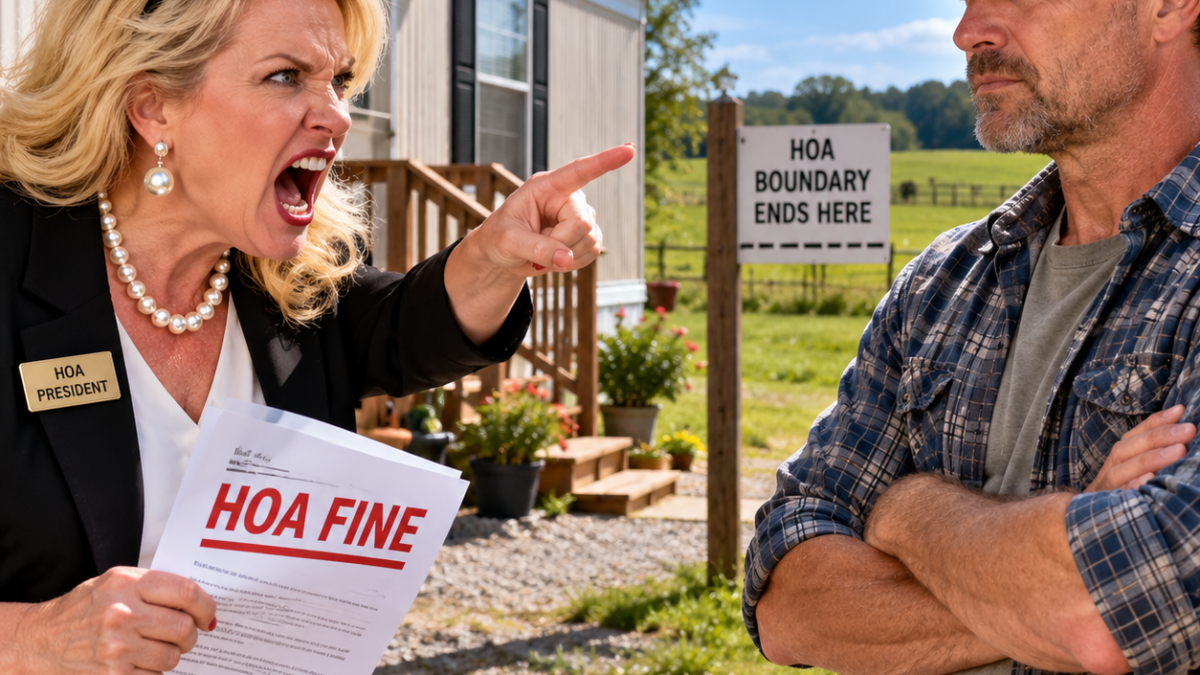
PART 2
I leaned closer until my nose was almost over the old paper.
The boundary line ran along the opposite side of Acorn Ridge.
Oakwood Estates ended there.
My house stood outside it.
So did four others on my side of the street.
I checked the legend.
Then the scale.
Then the plat number.
Book 62.
Page 14.
September 1978.
I looked at my deed again.
Lot 72 was described by county grid reference and metes and bounds.
No Oakwood Estates subdivision reference.
No declaration reference.
No mandatory association language.
I opened my title policy.
Nothing.
My closing paperwork.
Nothing.
For nearly two years, Sarah and I had been paying dues to an organization whose name did not appear anywhere in the legal description of our property.
Gloria rolled her chair beside me.
“You find something?”
I pointed.
“Tell me I’m reading this wrong.”
She adjusted her glasses.
Her finger traced the same boundary I had traced.
Then she found my parcel.
“Huh.”
That was not the legal opinion I was hoping for.
“Huh good or huh bad?”
“Huh interesting.”
“Gloria.”
She smiled.
“I’m a records clerk, hon. I’m not your attorney.”
“Fair.”
“But I can tell you what the recorded plat shows.”
“And?”
“Your parcel isn’t drawn inside Oakwood Estates.”
I sat back.
For months, Karen had made me feel like a trespasser in my own neighborhood.
Now I was staring at a county document suggesting the opposite.
She was the one trespassing into my life.
I asked Gloria for certified copies.
The plat.
The HOA’s original declaration.
Articles of incorporation.
Every amendment I could locate.
My deed.
Adjacent parcel maps.
She raised an eyebrow.
“You expecting a lawsuit?”
“I’m trying not to lose my house.”
Her expression changed.
“They threatened foreclosure?”
I slid the lawyer’s letter toward her.
She read the first page.
Then stopped.
“Oh.”
“Yeah.”
“You need an attorney.”
“That’s next.”
Before leaving, I paid for certified copies and photographed everything as backup.
In the parking lot, I sat in my Ranger for almost ten minutes.
The cab smelled faintly of motor oil and the pine air freshener Lily had given me for Father’s Day.
The same truck Karen called a neighborhood blight.
I put both hands on the steering wheel.
Then I laughed.
Not because anything was solved.
A map does not stop a lien by itself.
A county plat does not make a threatening lawyer disappear.
But for the first time in months, Karen had a problem she did not control.
Facts.
I called Sarah.
“Are you sitting down?”
“That sentence is never good.”
“I think our house isn’t in the HOA.”
Silence.
“What?”
“I said I think—”
“I heard you.”
“County plat shows us outside the subdivision boundary.”
Another pause.
“Then why have we been paying them?”
“I don’t know.”
“Mark.”
“I genuinely don’t know.”
“Are you sure?”
“Not enough to celebrate yet.”
I heard Lily in the background.
“Mom, what happened?”
Sarah covered the phone badly.
“Your father may have discovered that the people threatening to take our house don’t actually control our house.”
Lily shouted:
“Does that mean we can keep the truck?”
I closed my eyes.
Of course that was her question.
“Tell her yes.”
Sarah laughed for the first time in weeks.
Then her voice turned serious.
“What do we do?”
“Lawyer.”
Finding one took two days.
I wanted someone who understood property law and associations, not somebody whose first instinct would be to write Karen another polite letter asking her to be reasonable.
A veterans network led me to David Chen.
Former Army JAG.
Private practice.
Property disputes.
HOA litigation.
His office was above a coffee shop in a renovated brick building downtown.
No marble lobby.
No expensive art.
Just books, framed service photographs, a coffee machine, and a receptionist who told me he was running ten minutes late because he refused to end a client call mid-sentence.
I liked him before we met.
David was lean, mid-fifties, sleeves rolled to his forearms.
He shook my hand.
“Mark?”
“Yes.”
“Come in.”
His conference room table disappeared under my documents.
I started with Karen’s first three-thousand-dollar notice.
Then the returned unopened appeal.
Daily penalties.
Basketball hoop.
Flagpole noise.
Shingle.
Late fees.
Lien notice.
Foreclosure threats.
David asked short questions.
“Did you sign an HOA membership agreement?”
“Not that I can find.”
“Did your deed incorporate restrictive covenants?”
“No.”
“Did the seller disclose mandatory HOA membership?”
“The paperwork described ‘community association information,’ but I never found a recorded covenant tying this parcel to it.”
“Closing statement show dues?”
“A prorated annual fee.”
“Who requested it?”
“Not sure.”
He wrote something down.
Then I placed the plat in front of him.
David stopped writing.
He studied it.
Then opened the association declaration.
He found the jurisdiction language.
Read my deed.
Read the legal description.
He leaned back.
“Where did you get this?”
“County records.”
“Certified?”
I handed him the certified copy.
A slow smile appeared.
Not triumphant.
Interested.
“Mark.”
“Yes.”
“Based on what I’m seeing, your property appears to be outside the recorded subdivision covered by this declaration.”
“Appears?”
“I charge people money to distrust certainty.”
“Fair.”
“But this is very strong.”
He turned the map around.
“The association’s founding declaration ties its authority to properties within this recorded plat.”
He tapped my parcel.
“You are not within it.”
“What about later annexation?”
“Excellent question.”
He searched through the amendments.
We found annexations.
None included Acorn Ridge Lot 72.
None included the other four houses.
“No annexation instrument,” he said.
“No deed restriction.”
“No covenant acceptance.”
“No boundary inclusion.”
He folded his hands.
“So what have I been paying?”
“Possibly voluntary fees.”
“Voluntary?”
“You thought they were mandatory.”
“Because they told us they were.”
“Exactly.”
My anger sharpened.
“And the fines?”
“If you are not subject to the declaration, they had no contractual basis to fine you under it.”
“The lien?”
“That is more serious.”
He picked up the notice.
“Has anything actually been recorded yet?”
“I don’t know.”
“We check immediately.”
He called the recorder’s office while I sat there.
Ten minutes later, his expression hardened.
A claim of lien had been recorded.
Against my property.
For obligations arising from Oakwood Estates covenants.
Covenants that apparently did not bind my property.
Sarah’s fear from the kitchen table came back to me all at once.
Our home.
Lily’s room.
Sarah’s garden.
The place I had promised would finally be permanent.
Karen had attached a legal cloud to it.
David looked at me.
“Now we act quickly.”
“What can they do?”
“They can attempt enforcement.”
“Foreclosure?”
“Whether they could successfully foreclose is another matter, but a recorded lien itself creates problems.”
“I want it gone.”
“We’ll seek release.”
“And if they refuse?”
“Quiet-title and declaratory relief. Possibly slander of title or wrongful lien claims depending on state law and facts.”
He paused.
“Before we escalate, I need to know whether this is only your parcel.”
“Four other houses appear outside.”
“That changes things.”
“How?”
“If the association has been collecting money from multiple properties outside its jurisdiction for years, we need to understand how that happened.”
“You think Karen knows?”
“I think we should never begin with the accusation we hope to prove.”
There was Bill Sterling logic again, except I hadn’t met Bill in this story.
Military lawyers apparently come from the same factory.
David continued.
“We need chronology.”
“Meaning?”
“When did the HOA begin billing your parcel? Who added it to the mailing list? What documents did they rely on? Did prior boards know the boundary? Were dues voluntarily paid for common services? Was there ever an attempt at formal annexation?”
“That could take months.”
“It might.”
“My house has a lien now.”
“And we handle that first.”
He drafted a demand for immediate release.
Not RICO.
Not extortion.
Not a ten-page declaration of war.
Just precise facts.
My property’s legal description.
The association declaration.
The plat.
Absence of annexation.
Demand for the lien to be released because the HOA had no recorded covenant authority over Lot 72.
He gave them five business days.
Copies went to Karen.
Every board member.
The HOA’s lawyer.
Their registered agent.
Their management company.
“Why everyone?”
“So nobody later says Karen kept it from them.”
That sentence would matter.
While we waited, David gave me another assignment.
“Talk to the four houses.”
“About joining a lawsuit?”
“Not yet.”
“Then what?”
“Facts.”
The first was George Peterson.
Seventy-eight.
Retired postal worker.
Widower.
He lived at the far end of Acorn Ridge and had the kind of garage where every tool had a painted outline on the wall.
I found him cleaning fishing reels.
“George, can I ask you something weird?”
“At my age, weird is what’s left.”
I showed him the map.
His eyes narrowed.
Then he reached for reading glasses.
“Where’s my place?”
I pointed.
He followed the boundary.
He looked at me.
Then back at the map.
“That can’t be right.”
“I thought the same thing.”
“Oakwood sends me dues every year.”
“How long?”
“Since the eighties.”
“Were you ever given an annexation agreement?”
“A what?”
“Anything you signed joining?”
George shook his head.
“I bought from a fellow named Jenkins. Oakwood was across the road then.”
That made my neck tighten.
“Across the road?”
“Sure.”
He pointed through the garage door.
“Subdivision didn’t have this side.”
“When did the HOA start billing you?”
George sat down slowly.
“I don’t remember.”
“Could you check?”
He stared at the map again.
Then went inside.
He returned with a shoebox.
Cancelled checks.
Violation letters.
Assessment notices.
At least twenty years of paperwork.
“You kept all this?”
“I worked for the post office.”
He said it like that explained everything.
It did.
I picked up an assessment notice from twelve years earlier.
“Roof replacement reserve.”
Another.
“Entrance landscaping.”
Another.
“Clubhouse renovation.”
George looked embarrassed.
“I paid whatever they sent.”
“Why?”
“Because they threatened fees.”
He opened a letter.
“And once they said they could lien the house.”
I looked at him.
“Did Karen send that?”
“She wasn’t president then.”
Important.
That complicated things.
This problem might predate Karen.
Maybe by decades.
Which meant one of two things.
Karen inherited a mistake.
Or inherited a system nobody wanted examined.
The Wilsons lived two houses down from me.
Young couple.
Two children.
They had moved in eighteen months before us.
They were wary when I knocked.
Mrs. Wilson looked over my shoulder toward Karen’s street before letting me inside.
I showed them the plat.
Mr. Wilson frowned.
“So?”
“So your lot is outside.”
“Outside what?”
“Oakwood Estates.”
He laughed because it sounded absurd.
Then I showed him the declaration.
The boundary clause.
Their deed.
They pulled their closing packet.
No mandatory covenant reference.
Mrs. Wilson sat down.
“We paid a special assessment last year.”
“How much?”
“Twenty-four hundred.”
“For what?”
“Pool resurfacing.”
“Do you use the pool?”
“We were told our key wouldn’t work until the assessment was paid.”
That raised a new issue.
Benefits.
Maybe the outside lots had been treated as voluntary association members in exchange for amenities.
David would need to untangle that.
“What fines?”
Mr. Wilson brought me a stack.
Playset.
Trash bins.
Fence stain.
A bicycle left beside the porch.
Over a thousand dollars.
When I explained we were investigating, Mrs. Wilson started crying.
Not dramatically.
Quietly.
“I told him we should move.”
Her husband took her hand.
“We almost listed in March.”
“Because of Karen?”
“Because we couldn’t keep guessing what the next letter would be.”
I understood.
Sarah and I had nearly reached the same point.
The fourth property was rented.
The owner, a woman named Priya Shah, lived two states away.
When I called, she thought I was trying to sell roofing services.
Once I explained, she went silent.
“I pay Oakwood six hundred dollars a year.”
“Do your tenants use the common facilities?”
“No. I was told rentals don’t receive pool privileges.”
“Any fines?”
“Plenty.”
She emailed me statements that night.
The fifth house belonged to Tom and Brenda Walsh.
They had always seemed friendly with Karen.
Brenda attended HOA events.
Tom served briefly on a landscaping committee.
I expected resistance.
Instead, Tom closed his garage door before speaking.
“You didn’t get this from me.”
“That’s becoming a theme.”
He looked exhausted.
“Karen scares my wife.”
“Why?”
“She threatened collection after we challenged a special assessment.”
“How much?”
“Almost six grand across two years.”
“For what?”
“Road beautification, security cameras, clubhouse roof.”
“You paid?”
“We refinanced.”
My stomach turned.
“You refinanced your house to pay assessments to an HOA you may not belong to?”
Tom looked away.
“Brenda thought if we stayed friendly with Karen, she’d leave us alone.”
That explained their loyalty.
Not admiration.
Survival.
I went home with copies.
Sarah was at the table when I returned.
Lily slept upstairs.
I spread the map again.
Five houses.
Five files.
Decades of money.
Sarah stared.
“How much?”
“I don’t know yet.”
“Thousands?”
“Yes.”
“Tens of thousands?”
“Probably.”
She pressed both hands to her face.
“This is insane.”
“It may be a historical administrative mistake.”
She looked at me.
“Mark.”
“What?”
“She threatened to take our home after you showed her your appeal.”
“She hasn’t seen the map yet.”
“Then what happens when she does?”
We found out two days later.
David called at 7:12 a.m.
“They responded.”
“And?”
“Come in.”
His tone told me enough.
The HOA refused to release the lien.
Their lawyer claimed my property had become subject to Oakwood Estates through “longstanding course of conduct, implied acceptance, payment of assessments, and equitable membership.”
David slid the letter across his desk.
“Is that a thing?”
“Some legal theories can arise from conduct, depending on jurisdiction and facts.”
“So they could win?”
“I didn’t say that.”
He tapped the letter.
“They are arguing that because you and prior owners paid assessments and accepted benefits, you should be bound.”
“We never signed.”
“Important.”
“We didn’t know we were outside.”
“Also important.”
“They fined us.”
“Very important.”
He leaned back.
“This is not as simple as a cartoon where the map instantly destroys everything.”
I appreciated that even while hating it.
“What now?”
“We file.”
Quiet title.
Declaratory judgment.
Wrongful lien claims based on applicable law.
Refund claims for payments alleged to have been collected without contractual authority.
Injunctive relief preventing further enforcement while the case proceeded.
David also sent preservation letters demanding records related to the five outside parcels.
Billing histories.
Membership records.
Annexation documents.
Board minutes.
Legal opinions.
Correspondence.
Special assessments.
Lien files.
Karen’s first public response came at the next HOA meeting.
I attended with George and the Wilsons.
Sarah wanted to come.
I asked her not to.
Not because I thought she couldn’t handle it.
Because Lily had started noticing too much.
Whispered conversations.
Cancelled play dates.
Her mother checking the mailbox with visible dread.
I wanted one normal evening for them.
The clubhouse held about twenty-five people.
Karen stood behind the board table.
She had David’s demand letter in one hand.
“Before we begin,” she said, “I need to address some misinformation being spread by a resident.”
She looked directly at me.
“This resident claims his home is not part of Oakwood Estates.”
A few chuckles from Karen’s regular supporters.
She smiled.
“The claim is absurd.”
I kept my phone recording openly from my seat.
Karen continued.
“Mr. Davis has paid dues.”
True.
“Used association services.”
Possibly true in limited ways.
“Received notices for years.”
Also true.
“He simply does not want to comply with standards.”
She raised David’s letter.
“Our counsel has reviewed these threats. They have no merit.”
One board member, a quiet man named Robert Ellis, shifted in his seat.
I noticed.
Karen said:
“Mr. Davis and anyone assisting him remain responsible for all outstanding balances. Collection efforts will continue. The lien remains valid.”
I raised my hand.
She ignored me.
George stood.
“I have a question.”
Karen frowned.
“Sit down, George.”
“No.”
The room went quiet.
He had been paying Oakwood for decades.
Everyone knew him.
He held up the plat.
“My house is outside too.”
Karen’s expression flickered.
“That map is being misinterpreted.”
“By the county?”
“The legal situation is more complex.”
George’s hands shook.
“You’ve taken my money for thirty years.”
Nobody laughed now.
Karen said:
“You received community benefits.”
“What benefits?”
“Road maintenance. Appearance. Property values.”
“The county maintains my road.”
Karen’s face reddened.
“George, this is not the forum.”
“Then where is?”
Good question.
The Wilsons stood.
Then Tom Walsh.
Four properties.
One after another.
The mood changed.
Karen struck her gavel.
“This meeting is not being hijacked by people trying to avoid obligations.”
I finally spoke.
“We’re asking for the recorded document that puts our properties in the HOA.”
Her eyes locked on mine.
“You have been told by counsel that you are members.”
“That isn’t a recorded document.”
“The matter is in litigation.”
“Because you refused to release a lien.”
“Because you refuse to pay what you owe.”
I held up the certified plat.
“Then show us the annexation.”
She stared.
No answer.
Robert Ellis leaned toward his microphone.
“Karen, do we have one?”
She turned on him.
“Our lawyer is handling it.”
“That wasn’t my question.”
Something moved through the room.
Not outrage yet.
Doubt.
Karen could survive anger.
Doubt was more dangerous.
She adjourned early.
Outside, George stood beside me in the parking lot.
“She looked scared.”
“She looked angry.”
“No.”
He shook his head.
“I delivered mail forty years. I know the difference between angry and scared.”
The lawsuit triggered discovery.
For the first month, the HOA produced almost nothing useful.
Current bylaws.
Recent budgets.
Our violation files.
Then David filed a motion to compel historical records.
The court ordered reasonable production.
Boxes arrived.
Digital archives.
Old minutes.
Bank statements.
Member rosters.
Records dating back to the late 1980s.
That was when the story became stranger.
The five Acorn Ridge houses did not appear on the original membership roster.
They appeared later.
No annexation document accompanied the change.
No owner consent.
No amendment.
Just five handwritten addresses added to a typed list.
David held the page under his desk lamp.
“Who wrote this?”
“No idea.”
“Any initials?”
“No.”
“Date?”
“November 1989.”
He flipped to board minutes from the same period.
Nothing.
Then an old treasurer’s note surfaced.
Consider including Acorn Ridge outside lots in voluntary maintenance contribution due to benefit from entrance improvements.
Voluntary.
That word changed everything.
Further records showed letters were initially sent asking the outside houses to contribute voluntarily to entrance landscaping and private security patrols.
No fines.
No enforcement.
No covenant references.
Over time, the language changed.
“Contribution.”
Then “annual community fee.”
Then “assessment.”
Then “mandatory dues.”
Nobody could identify the precise moment voluntary participation became compulsory.
By the early 2000s, Oakwood’s management software simply listed the houses as full members.
Karen had become president eight years before my dispute.
She had inherited the list.
That complicated my anger.
I sat in David’s office looking at the old letters.
“So maybe she didn’t know.”
“At first?”
“Yes.”
“Possible.”
“Then she isn’t a fraud.”
“Mark, intent is fact-specific.”
He pointed to our demand letter.
“She was given certified evidence of the boundary issue before the meeting where she said collections would continue.”
“She trusted the HOA lawyer.”
“Also possible.”
“Then the lawyer—”
“Stop.”
David held up his hand.
“This is exactly why we do not decide criminal guilt at a conference table.”
I exhaled.
“You’re annoying.”
“I bill for it.”
The next batch of records changed things again.
An email from Robert Ellis to Karen dated six months before my three-thousand-dollar fine.
Subject:
ACORN RIDGE MEMBERSHIP QUESTION
Robert had discovered the outside-lot issue while reviewing delinquent accounts.
He wrote:
I cannot locate recorded declarations or annexation instruments for Lots 70–74 on the south side of Acorn Ridge. Before we pursue collections, we should obtain a title opinion.
Karen replied:
They have paid for decades. Do not open this can of worms. Treat them as members unless counsel says otherwise.
That was bad.
But not yet catastrophic.
Then Robert responded:
Have we asked counsel?
Karen:
No need unless someone challenges it.
I read the exchange twice.
“She knew there was a question.”
David nodded.
“Exactly.”
“She fined me six months later.”
“Yes.”
“She filed the lien after my appeal.”
“Yes.”
“Then when we challenged membership, she told the meeting it was absurd.”
“Yes.”
I felt that cold switch inside me again.
Not rage.
Clarity.
“She could have checked.”
“She chose not to.”
That became the heart of the case.
Karen might not have invented the original membership error.
But once someone raised the defect, she decided certainty was more useful than investigation.
Why?
Money.
The five outside lots paid annual dues.
Special assessments.
Fines.
Removing them meant refund questions.
Budget gaps.
Embarrassment.
Potential liability.
And most of all, it meant admitting the board had exercised authority it did not actually possess.
David deposed Robert first.
He looked miserable.
“Did you raise concerns about the Acorn Ridge lots?”
“Yes.”
“Why?”
“Collection review.”
“What did you discover?”
“No annexation paperwork.”
“Did you tell President Miller?”
“Yes.”
“Her response?”
“She told me they had always paid.”
“Did the board obtain a title opinion then?”
“No.”
“Why not?”
“She said not to spend money unless necessary.”
“Did you agree?”
“At the time, yes.”
“Do you agree now?”
Robert stared at the table.
“No.”
“Why?”
“Because we filed a lien.”
That answer mattered.
Karen’s deposition came a month later.
She arrived with her attorney and the same expression she had worn on my lawn.
Controlled.
Certain.
David was polite.
That was more dangerous.
“Mrs. Miller, how long have you served as president?”
“Eight years.”
“Were Lots 70 through 74 on Acorn Ridge listed as members when you took office?”
“Yes.”
“Did you independently verify every member’s deed?”
“Of course not.”
“Reasonable.”
He showed her Robert’s email.
“When did you first become aware there might be no recorded annexation?”
She read it.
“I don’t recall this.”
“Is that your email address?”
“Yes.”
“Your response?”
“Yes.”
“You wrote, ‘Do not open this can of worms.’”
“In context.”
“What context?”
“Robert had a tendency to overcomplicate things.”
“Did you ask counsel?”
“Eventually.”
“When?”
“After Mr. Davis became hostile.”
I clenched my jaw.
David did not.
“Before filing the lien?”
Karen hesitated.
“I would have to check.”
David already knew.
“No title opinion was obtained before the lien, correct?”
“Our management company handles liens.”
“Who authorized collection?”
“The board.”
“Recorded vote?”
“Our delinquency policy—”
“Who authorized this lien?”
Her attorney objected.
Karen answered anyway.
“I did.”
Silence.
David let it sit.
Then:
“You knew there was no annexation document in the association file.”
“I knew Robert hadn’t found one.”
“You chose not to investigate.”
“I relied on decades of payment history.”
“Then Mr. Davis appealed his fines.”
“He violated standards.”
“Did you read his appeal?”
“Yes.”
I nearly spoke.
The appeal had come back unopened.
David reached into the exhibit binder.
He placed the envelope in front of her.
Still sealed.
Her handwriting on the sticky note.
APPEAL DENIED.
Karen stared.
David asked:
“Would you like to revise your answer?”
Her attorney leaned toward her.
Karen’s face went pale.
“I may have reviewed a summary.”
“Who prepared the summary?”
“I don’t remember.”
“Did the board hold the hearing required by your own procedures?”
“We had enormous volume.”
“That’s not an answer.”
Her voice sharpened.
“No formal hearing occurred.”
“Yet late fees continued?”
“Yes.”
“And the lien?”
“Yes.”
David moved to the three-thousand-dollar notice.
“Where in Covenant 7.4 does it prohibit vehicles older than ten years?”
“It allows enforcement of aesthetic standards.”
“Where is the adopted vehicle-age standard?”
“I don’t have it in front of me.”
“We requested it.”
Karen stopped.
David waited.
Her lawyer looked down.
There was no vehicle-age standard.
“Your garden violation?”
“Unapproved modification.”
“Photograph?”
“Neighbor report.”
“Which neighbor?”
“Confidential.”
“Was the garden visible from common property?”
“I don’t know.”
“Did you inspect it?”
“No.”
“Then how did you determine it violated exterior aesthetics?”
Karen became defensive.
“Residents complained.”
“Names?”
Her lawyer objected.
David moved on.
Flagpole noise.
Basketball hoop.
Shingle.
Every violation became weaker under simple questions.
What written standard?
What evidence?
What process?
What hearing?
What jurisdiction?
By the end, Karen no longer looked powerful.
She looked tired.
Then David asked:
“When you told Mr. Davis that it would be unfortunate for a veteran to lose his home over a few rules, what did you mean?”
Her head snapped up.
“I never said that.”
“Mr. Davis says you did.”
“He lies.”
I felt Sarah’s hand in my memory.
The kitchen table.
The fear in Lily’s face.
David said nothing for several seconds.
Then:
“No further questions for now.”
Outside the deposition room, I was furious.
“She called me a liar.”
“I heard.”
“You believe me?”
“Doesn’t matter what I believe.”
I glared.
David smiled slightly.
“Your contemporaneous journal entry records the statement the same day.”
I had forgotten.
In my evidence log, I had written the entire confrontation that evening.
Date.
Time.
Words.
And Lily had heard part of it.
Sarah had seen the notice immediately afterward.
Not perfect proof.
But not nothing.
The quiet-title motion came first.
David moved for summary judgment based on the plat, declaration, deeds, annexation records, and historical documents showing the outside lots began as voluntary contributors.
The HOA opposed.
Their argument focused on decades of acquiescence.
Payment.
Benefit.
Estoppel.
Course of conduct.
The hearing was packed.
George came.
The Wilsons.
Sarah.
I asked Lily to go to school.
She protested.
“You always say family fights together.”
“And sometimes family fights by taking a math test.”
“That’s stupid.”
“Probably.”
Judge Eleanor Vance entered at nine.
No drama.
No speeches.
She read.
Asked questions.
A lot of questions.
To David:
“Is your position that payment alone can never create obligations?”
“No, Your Honor. Our position is that payment cannot unilaterally rewrite a recorded subdivision boundary and impose real-property covenants absent a legally sufficient mechanism.”
To the HOA lawyer:
“What recorded instrument subjects Lot 72 to this declaration?”
He referenced membership records.
Judge Vance repeated:
“Recorded instrument.”
He did not have one.
“What annexation?”
None.
“What deed reference?”
None.
“What owner consent?”
None produced.
“What provision permits the association to record a covenant lien against property outside the declaration?”
Silence.
The HOA lawyer tried the equity argument again.
Residents had paid.
Used entry landscaping.
Received patrol benefits.
Judge Vance asked:
“Does receiving incidental benefits from nearby private improvements transfer land into a subdivision?”
“No, Your Honor.”
“Then show me what did.”
He couldn’t.
She ruled from the bench on the core title question.
Lot 72 was not subject to Oakwood Estates’ recorded declaration.
The lien had no valid covenant basis and was ordered released.
All fines imposed solely under those covenants against my property were unenforceable.
I heard Sarah exhale beside me.
Not a gasp.
Not a cheer.
A breath she had been holding for months.
I closed my eyes.
Our house was ours again.
Permanently.
At least as far as Oakwood was concerned.
Outside, Sarah grabbed me.
“They can’t take it?”
“No.”
“Say it.”
“They can’t take it.”
Her face folded into my chest.
I held her.
For months, I had fought the threat like a soldier.
She had lived inside it like a wife and mother.
Different war.
Same house.
George came out behind us.
“What about mine?”
David answered.
“Your facts are similar, but your parcel needs its own determination or a broader settlement.”
George nodded.
“Then we keep going.”
That surprised me.
The quiet man who once paid every letter without question had changed.
The court victory broke the neighborhood story wide open.
Before then, some residents assumed I was gaming technicalities to avoid dues.
Now there was a judicial order.
Recorded property outside the HOA.
Invalid lien.
No covenant authority.
People started asking their own questions.
David reviewed the other four Acorn Ridge parcels.
Same result.
Then three houses near the eastern edge contacted him.
Their deeds were different, but the boundary issue looked similar.
Two proved outside.
One actually had been annexed properly years earlier.
That distinction mattered.
We did not want a crusade where everyone with an HOA complaint became “outside.”
Documents decided.
Not anger.
The group of wrongly treated properties grew to seven.
Then eight.
George’s payments went back decades.
Priya had years.
The Wilsons less.
Tom Walsh had multiple special assessments.
David hired a forensic accountant to reconstruct the money.
The numbers were painful.
Dues.
Fees.
Fines.
Assessments.
Late charges.
Legal charges.
Some homeowners had received optional services.
Those values had to be accounted for.
This was not simply “give every dollar back.”
Reality was messier.
But substantial money had clearly been collected under representations that association membership was mandatory.
Then the local reporter called.
Sarah Jenkins from Channel 8.
I had not contacted her.
David had forwarded a public court order to a consumer reporter after receiving my permission.
She called at lunchtime.
“Mr. Davis?”
“Yes.”
“I’m investigating the Oakwood Estates boundary case.”
“Okay.”
“Do you have ten minutes?”
“What do you know?”
“That a court ruled your property was never subject to the HOA declaration and ordered a lien released.”
Accurate.
“That several other families may be similarly situated.”
Accurate.
“And that the HOA president continued threatening foreclosure after being warned about the boundary defect.”
Potentially accurate.
“I have documents.”
“So do I.”
That made me smile.
She met us the next day.
Not hidden cameras.
Not theatrical ambushes.
First documents.
Then interviews.
Sarah—my wife—agreed to speak reluctantly.
The reporter asked:
“What was the worst part?”
Sarah looked toward our daughter’s room.
“The money wasn’t the worst.”
“What was?”
“Not knowing whether someone could take our home because our truck was old.”
The reporter paused.
“That sounds absurd when you say it.”
“It felt absurd while we were living it.”
George sat for an interview too.
He opened his shoebox.
Cancelled checks going back decades.
“What do you want from this?”
He looked at the reporter.
“My money would be nice.”
She smiled.
“Anything else?”
“I want somebody to tell me why an old man was afraid to put a birdbath in his own yard when the people scaring him never had authority over the yard.”
That became the emotional center of the broadcast.
Not me.
George.
The segment aired Thursday.
It showed the plat.
Red boundary line.
Oakwood Estates on one side.
Our houses outside.
My invalid lien.
George’s decades of payments.
The Wilsons’ fines.
Then Karen’s recorded statement from the HOA meeting:
They are and always have been members. We will proceed with all legal remedies, including foreclosure.
The reporter explained that Karen made that statement after receiving our attorney’s letter and supporting documents.
Then came the grocery-store interview.
Karen was walking toward her SUV when Sarah Jenkins approached.
“Ms. Miller?”
Karen stopped.
“Channel 8. Can you explain why Oakwood Estates collected mandatory dues from homes a court has now ruled were outside its covenant boundary?”
Karen’s expression hardened.
“No comment.”
“Were you aware of concerns about the Acorn Ridge properties before filing a lien against Mark Davis?”
“No comment.”
“Did board member Robert Ellis warn you that annexation records were missing?”
Karen stopped walking.
“Who told you that?”
That was not the answer her attorney would have wanted.
Jenkins continued.
“Did he?”
Karen pointed at the camera.
“This is harassment.”
“Ms. Miller, seven families now say they paid money to the association under threat of fines despite being outside the recorded declaration.”
“Talk to our lawyers.”
“Will the HOA refund them?”
Karen opened her SUV.
“You people are trying to destroy a community over paperwork.”
Then she drove away.
The phrase over paperwork spread through Oakwood faster than anything I had said.
Because everyone’s property rights were paperwork.
Deeds were paperwork.
Mortgages were paperwork.
Titles were paperwork.
Liens were paperwork.
Karen had spent years using paperwork against people.
Now she wanted everyone to believe paperwork did not matter.
The board fractured within forty-eight hours.
Robert resigned first.
Not because he believed himself innocent of every mistake.
Because he was done defending Karen.
He gave David a sworn statement confirming the six-month-old warning email.
Two other directors retained separate counsel.
The treasurer requested an emergency independent audit.
Karen refused.
The board voted without her.
Audit approved.
Her authority weakened.
Then records surfaced that were far more serious than bad boundary administration.
Some outside-lot payments had been coded in accounting systems in ways that made them indistinguishable from ordinary membership dues.
After concerns were raised, no separate legal review occurred.
Late charges continued.
Collection letters continued.
At least two prior liens against outside parcels had apparently been threatened, though not foreclosed.
The forensic accountant also found irregular waivers.
Karen’s allies sometimes received penalties reversed without formal hearings.
Others were denied appeals.
None of that automatically made Karen a criminal.
But it created civil exposure and governance problems.
Then the district attorney’s economic-crimes unit contacted David.
Not because a television story magically created an arrest.
Because David had provided the court order, lien documents, billing histories, historical voluntary-contribution letters, and later records showing continued collection after internal doubts were raised.
Detective Aaron Miller came to my house.
He was careful with language.
“We’re reviewing whether any criminal statutes were violated.”
“Meaning?”
“Meaning we investigate.”
“Karen getting arrested?”
“I didn’t say that.”
“Fair.”
“We need original documents.”
“I have copies.”
“Your lawyer has already arranged production.”
He looked toward my Ranger.
“That the famous truck?”
“Unfortunately.”
He walked around it.
“Looks fine.”
“Thank you.”
“My daughter drives something worse.”
“Tell Karen.”
He smiled once.
Then became serious.
“Mr. Davis, do not contact Ms. Miller.”
“I don’t.”
“Do not provoke her.”
“I don’t.”
“Do not discuss the criminal investigation publicly beyond what your lawyer approves.”
“Understood.”
The class-action idea shifted.
David decided a coordinated multi-plaintiff civil case made more sense initially than throwing the word “class action” around before certification issues were analyzed.
I appreciated that.
The complaint named Oakwood Estates and, on selected claims, certain officers based on specific conduct.
Fraud theories were pleaded carefully.
Unjust enrichment.
Wrongful collection.
Declaratory relief.
Restitution.
Slander of title where liens existed.
Statutory debt-collection theories where applicable.
Emotional-distress claims only where facts supported them.
No fantasy billion-dollar demand.
No claim that every board member was a gangster.
That made the case stronger.
Karen did not see it that way.
At the next community meeting, she entered to a room with more than a hundred residents.
Normally fifteen came.
Every folding chair was occupied.
People lined the walls.
Some held printed copies of the court ruling.
Karen struck the gavel.
“We will not discuss pending litigation.”
Mark Thompson—different Mark, the firefighter from another street—raised his hand.
“Then discuss leadership.”
Karen ignored him.
Another resident:
“Did Robert warn you about the boundary?”
Gavel.
“Did you file the lien anyway?”
Gavel.
“Where’s our money?”
Gavel.
“What did the lawyer know?”
Gavel.
Karen stood.
“This meeting will come to order!”
George rose slowly from the front row.
He carried his shoebox.
The room quieted because everybody knew him now.
“I paid this association thirty-one years.”
Karen’s expression softened artificially.
“George, your situation is being reviewed.”
“No.”
He shook his head.
“You don’t get to use that voice with me anymore.”
The room went still.
Karen stared.
George opened the box.
“These checks paid for your pool.”
“I don’t use it.”
“Your clubhouse.”
“I don’t belong to it.”
“Your entrance flowers.”
“I live outside your entrance boundary.”
He looked at her.
“I paid because people like you told me you could take my house.”
Karen said:
“Previous boards made those decisions.”
“You kept doing it.”
She had no answer.
Then Tom Walsh stood.
Then the Wilsons.
Then Priya joined by speakerphone.
Resident after resident spoke.
Some inside the HOA supported them.
This was no longer inside versus outside.
It became a question of whether anyone trusted the board.
A petition for removal had already circulated.
The bylaws required a special process.
David made sure everyone followed it exactly.
Notice.
Signatures.
Meeting date.
Voting eligibility.
No shortcut.
No mob justice.
Karen called the effort illegitimate.
Then, three days before the removal meeting, she resigned.
Her email said:
The current climate of hostility makes constructive volunteer leadership impossible.
George read it at my kitchen table.
“Volunteer.”
He shook his head.
“She makes herself sound like Mother Teresa with a clipboard.”
Sarah nearly spit out her coffee.
The remaining board members followed within the week.
Some because they had supported Karen.
Others because they were exhausted.
Robert stayed involved long enough to transition records but refused reelection.
A special election was held.
George was nominated.
He looked horrified.
“I’m seventy-eight.”
Someone shouted:
“Perfect. You have time!”
He won a board seat but refused the presidency.
A CPA named Linda Chavez became interim president.
Her first words after election were:
“Before anyone celebrates, our association is in a financial and legal mess.”
That was exactly what people needed to hear.
Not victory speeches.
Reality.
The new board retained independent counsel.
Independent accounting.
Separate insurance counsel.
They suspended questionable enforcement.
Released remaining disputed liens against the outside parcels.
They created a formal process to determine which properties were actually subject to Oakwood covenants.
The answer was documentary.
Not political.
Eight homes were ultimately confirmed outside the recorded HOA jurisdiction.
Several edge properties everyone thought were outside actually had valid recorded annexations and remained members.
Nobody liked that distinction more than David.
“Law is boring,” he told me.
“That’s why it works.”
The civil case entered mediation.
The insurer attended.
The association’s new leadership attended.
The outside homeowners attended through counsel.
Karen attended separately because some claims concerned her individual conduct.
She looked different.
No clipboard.
No bright floral outfit.
Gray suit.
Tired eyes.
We sat across from each other for the first time since the deposition.
The mediator separated us quickly.
Numbers moved back and forth.
Refund calculations were complicated.
Some voluntary contributions from decades earlier had legitimately purchased shared security or amenities.
Some payments were too old for certain claims because of statutes of limitation.
Some records were missing.
Some fines were unquestionably unauthorized.
Some special assessments had been paid under explicit representations of mandatory membership.
The eventual settlement did not give everyone every dollar ever paid.
But it was substantial.
George received restitution for a significant portion of wrongfully collected assessments and penalties, plus additional settlement money.
He stared at the figure.
“I don’t need this much.”
David said:
“That is rarely a legal objection.”
George smiled faintly.
“What do I do with it?”
“Whatever you want.”
He paid off the small remaining balance on his mortgage.
Replaced a failing roof.
Put money aside for his grandchildren.
Then bought a ridiculous fishing boat.
When I asked why, he said:
“Karen hated anything parked where she could see it.”
He kept the boat legally on his own outside-HOA property.
Beautiful.
The Wilsons paid off student debt and created college savings for their children.
Priya received a refund and sold her rental two years later on her own terms rather than under pressure.
Tom and Brenda used settlement funds to repair the financial damage from refinancing.
Sarah and I replenished the savings we had drained on attorneys and stress-related expenses.
The HOA’s insurer covered portions of the settlement falling within applicable coverage.
The association paid others from reserves and recovery arrangements.
It hurt.
Dues increased temporarily for actual HOA members.
That caused resentment.
Linda stood at a meeting and said:
“You should be angry. But direct that anger accurately. The current board did not create this liability. We are paying for years of governance failures. Our job is to make sure no future board creates another one.”
People listened.
Then came the criminal case.
For months, I heard almost nothing.
That was normal.
Investigators do not provide weekly updates to victims just because victims are impatient.
Then Detective Miller called.
“We’ve obtained charges against Ms. Miller.”
I sat down.
“For what?”
He described them carefully.
Not “being an HOA tyrant.”
Not “having an ugly personality.”
Charges tied to specific alleged financial representations, lien activity, and records.
The prosecutor ultimately focused on conduct that could actually be proven.
Karen surrendered through her attorney.
No dramatic SWAT team.
No sirens.
No public humiliation arranged for my benefit.
She was booked.
Released under conditions.
The local news reported it.
I watched thirty seconds.
Then turned the television off.
Sarah looked at me.
“That’s it?”
“What?”
“You’ve spent a year fighting this woman.”
“I know.”
“She gets charged and you change the channel?”
“What am I supposed to do?”
“I don’t know.”
Neither did I.
For so long, I had imagined justice as a moment.
Judge’s gavel.
Handcuffs.
Karen finally understanding.
But the real thing looked different.
Documents.
Hearings.
Mediation.
Investigators.
Audit spreadsheets.
Released liens.
Refund checks.
Neighbors speaking without fear.
There was no single explosion.
Her authority just disappeared layer by layer.
The prosecutor negotiated a plea months later.
Karen admitted to a felony-level fraud offense connected to knowingly pursuing unauthorized financial claims after being placed on notice of the jurisdictional defect, while other allegations were dismissed or resolved separately.
She avoided prison.
That angered some residents.
Three years’ probation.
Restitution.
Substantial financial penalties.
Restrictions on managing association or fiduciary funds.
No future Oakwood board position.
No contact with several plaintiffs, including my family, except through lawyers for remaining legal matters.
George called me.
“She should go to jail.”
“Maybe.”
“You don’t sound mad.”
“I’m tired.”
“I’m mad enough for both of us.”
“Good.”
He paused.
“Still taking the boat out Saturday?”
“Absolutely.”
“That’s better.”
Karen listed her house.
Months later, the moving truck arrived.
By coincidence, I was in my front yard with Lily.
She was thirteen now.
The soccer ball had been replaced by softball equipment.
We were oiling her glove.
She noticed Karen first.
“Dad.”
I looked up.
Karen stood beside the moving truck.
She had changed.
Not physically in any dramatic way.
Just smaller somehow.
Power changes posture.
So does losing it.
Her house had sold.
Part of the proceeds went toward legal expenses and restitution obligations.
She stepped toward the sidewalk.
Stopped.
Saw me.
For a long moment, neither of us moved.
Lily watched.
“Is she going to say something?”
“I don’t know.”
Karen crossed the street.
Not onto my lawn.
She stopped at the edge.
That mattered.
“Mr. Davis.”
“Karen.”
Her eyes went to my Ranger.
Still there.
Older.
More scratched.
Alive.
Then toward Sarah’s vegetable garden visible through the side gate.
“What do you want?” I asked.
She swallowed.
“I’m leaving.”
“I see that.”
“I know you probably consider this a victory.”
I looked toward Lily.
Then back at Karen.
“I consider keeping my home a victory.”
Her mouth tightened.
“You destroyed my reputation.”
“No.”
“You went to the press.”
“After you threatened foreclosure on property you didn’t control.”
“I was trying to maintain standards.”
“After Robert warned you there was a boundary problem.”
She looked away.
I continued.
“You could have checked.”
“I trusted the records.”
“Then we sent you the records.”
“I trusted counsel.”
“Then a judge ruled.”
She shook her head.
“You made me look like a criminal.”
“Karen.”
I kept my voice quiet.
“You pled guilty.”
That stopped her.
For a second, I thought she might explode.
Instead, her shoulders dropped.
“I spent eight years running that community.”
“I know.”
“Do you know how many people complained about everything?”
“I believe you.”
That surprised her.
“Trash cans. Dogs. Paint. Parking. Neighbors fighting over branches. Everybody wanted the board to fix something.”
“I believe that too.”
“Then you understand.”
“No.”
I shook my head.
“I understand how you got tired.”
She stared.
“I understand how you started thinking being responsible meant being in control.”
Silence.
“But I don’t understand why, when someone showed you a map proving you might be wrong, your answer was to threaten his house harder.”
Her eyes filled slightly.
She looked away before I could be sure.
“I couldn’t let every resident decide the rules didn’t apply to them.”
“That wasn’t what happened.”
“I know that now.”
There it was.
Small.
Quiet.
Too late.
But real.
I did not forgive her.
Not then.
Maybe not ever.
But I no longer needed anything else from her.
“You should go,” I said.
She nodded.
Then looked at Lily.
“I’m sorry she had to see all this.”
Lily answered before I could.
“So am I.”
Karen flinched.
Then walked back across the street.
The moving truck left twenty minutes later.
I returned to Lily’s glove.
She watched the truck disappear.
“Do you hate her?”
The question caught me.
“I hated what she did.”
“That’s not what I asked.”
Kids.
Always inconvenient.
“No.”
“Why?”
“Because hating somebody forever gives them too much room.”
She considered that.
“Mom says the same thing.”
“Your mother is annoyingly wise.”
“She says that about herself too.”
We went inside for dinner.
Oakwood rebuilt slowly.
The association did not dissolve.
Most residents still wanted common landscaping.
Pool maintenance.
Entrance signs.
Community events.
Reserve funds.
They just wanted boundaries.
Actual ones.
The new board rewrote procedures.
Every property in the association received a verification packet showing the recorded basis for membership.
No assumption.
No “you’ve always paid.”
Recorded instrument.
Deed reference.
Annexation.
Documented authority.
Fines required specific rule citations.
Homeowners received notice and meaningful appeal.
Serious collection required board review.
Liens required outside counsel to verify both the debt and the property’s membership status.
Board members could not decide their own appeals.
Financial statements were published quarterly.
Independent audits became annual.
Large assessments required member votes.
Karen’s “harmonious aesthetic” phrase survived, but only after being limited by objective adopted standards.
No more imaginary ten-year vehicle rule.
I celebrated by washing the Ranger.
George came by.
“You finally selling that piece of junk?”
“Get off my property.”
“Can’t fine me.”
“Neither can Oakwood.”
He smiled.
That joke never got old.
The eight outside houses faced a decision.
Join voluntarily?
Remain separate?
Some homeowners wanted pool access.
Others wanted nothing to do with the association.
For the first time, it was actually their choice.
George refused immediately.
“I spent thirty years trying to get out of something I was never in. I’m not joining now.”
The Wilsons also stayed out.
Priya’s rental remained independent.
Tom and Brenda considered joining but ultimately decided not to.
Sarah and I stayed outside.
Not because every HOA is inherently bad.
Because after everything, we valued knowing exactly where our obligations ended.
Linda offered a voluntary amenity membership with no enforcement authority over our property.
We declined.
Lily said:
“Does that mean I can’t use the pool?”
“Yes.”
“That stinks.”
“Freedom has consequences.”
She rolled her eyes.
We bought an above-ground pool the next summer.
It was blue.
Large.
Visible from Karen’s old house.
Completely legal.
The new owners across the street were a couple named Miguel and Anna Torres.
Two daughters.
Friendly.
Their first weekend, Miguel walked over while I was assembling the pool ladder.
“Need help?”
“I’d say no, but I’ve been holding this piece for twenty minutes.”
He laughed.
We built it together.
He had heard pieces of the Oakwood story during closing.
“The seller disclosure package was enormous.”
“I’m sorry.”
“Actually, our attorney loved it.”
“Good.”
“He said this may be the most carefully documented HOA in the county now.”
I smiled.
“That would be ironic.”
Miguel looked at the Ranger.
“This the famous truck?”
“Unfortunately.”
“I’ve got a 2004 Tacoma.”
“We should form a blight club.”
Anna brought lemonade.
Their girls became friends with Lily.
Life returned in embarrassingly ordinary ways.
That was the best part.
Sarah stopped checking the mailbox before work.
For months after the lien disappeared, she still tensed whenever an envelope with a law-firm return address arrived.
Eventually that stopped.
She expanded the garden.
Tomatoes.
Peppers.
Cucumbers.
Basil.
Then corn, which I told her was excessive.
“You fought a year for my right to garden.”
“I fought for a small vegetable patch.”
“You should have negotiated better.”
She planted corn.
I built a better fence around it.
Marriage.
George’s transformation surprised me most.
The man who once whispered about Karen became unbearable in the best possible way.
He attended county meetings.
HOA meetings, even though he wasn’t a member.
Property-rights seminars.
He started helping elderly neighbors organize paperwork.
One afternoon, I found him at his kitchen table teaching Mrs. Wilson how to scan documents.
“You created this monster,” she said.
George pointed at me.
“He did.”
“I showed you a map.”
“Exactly.”
He kept the old shoebox.
But he replaced it with labeled binders.
“Modern warfare,” he called them.
His fishing boat arrived in spring.
Twenty-one feet.
Deep blue.
He parked it beside his house behind a legal setback line.
The HOA could see the bow from across the street.
Nobody could say a thing.
George polished it every Saturday.
Sometimes I suspected he bought the boat mostly for that.
“Take her out yet?” I asked.
“Twice.”
“Catch anything?”
“No.”
“Worth it?”
He looked toward Oakwood.
“Every penny.”
The Wilsons changed too.
Their children’s plastic playset stayed.
Then the kids outgrew it.
When Mr. Wilson dismantled it, he stood holding one of the faded plastic panels.
“Funny.”
“What?”
“I spent two years furious because Karen wanted this gone.”
“And?”
“Now I want it gone.”
“That’s different.”
“How?”
“You decided.”
He smiled.
“Yeah.”
That was the whole thing.
Choice.
Not anarchy.
Not doing whatever you want without consequences.
Just the basic dignity of having authority exercised where authority actually exists.
A year after settlement, David Chen invited me to lunch.
“What did I do?”
“Nothing.”
“Lawyers don’t invite clients to lunch after cases end unless something is wrong.”
“I’m insulted.”
“You bill dessert?”
“Sit down.”
He slid a folder toward me.
Inside was the final recorded release of lien.
Corrected title records.
Court judgment.
Settlement satisfaction.
Every legal loose end.
“Keep these forever.”
“I planned to.”
“I know.”
We ate.
Then David said:
“You ever think about why the mistake lasted so long?”
“Fear.”
“Partly.”
“Bad records.”
“Partly.”
“Money.”
“Partly.”
“What’s the lawyer answer?”
“Institutional inertia.”
I frowned.
“That sounds expensive.”
“It usually is.”
He took a drink.
“Someone adds five addresses to a list in 1989 because they contribute voluntarily. Ten years later, a management company imports the list into new software. Twenty years later, nobody remembers why they’re there. Thirty years later, the president assumes the software is law.”
“Until Robert asks.”
“Exactly.”
“And Karen says








