PART 2: HOA Sold Off My Land While I Was Deployed, So I Had the Court Seize Their Whole Subdivision
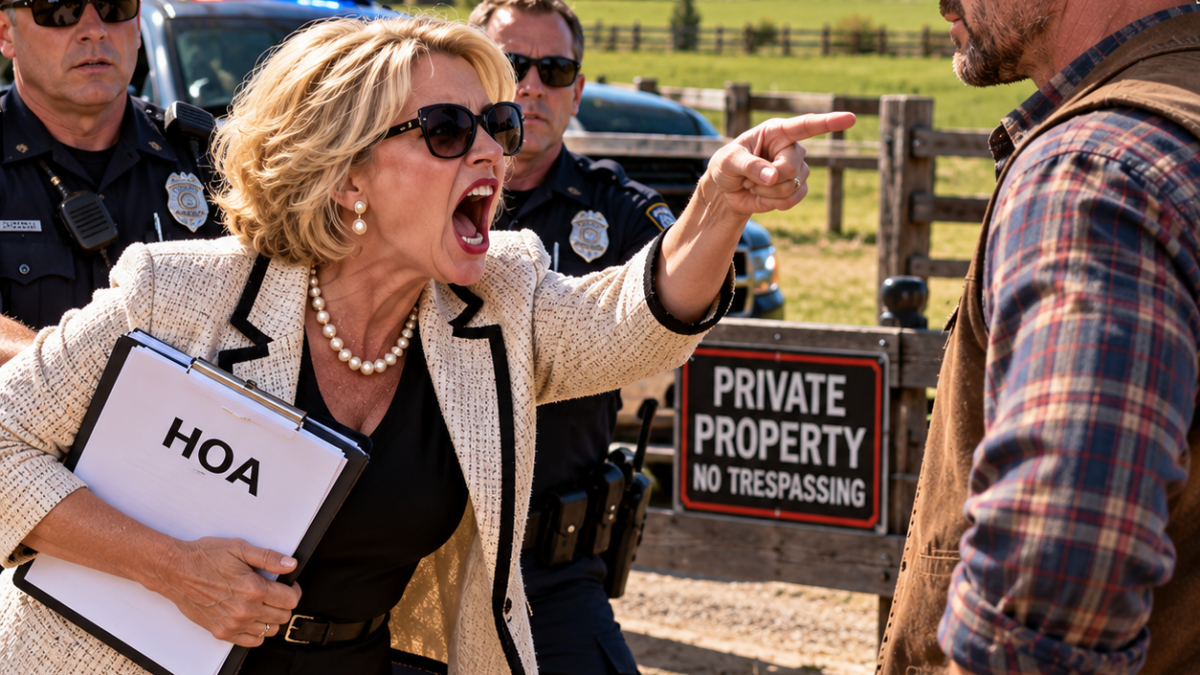
They waited until I was thousands of miles from home, wearing a uniform and worrying about whether I would make it back alive, before deciding that what belonged to me could simply become theirs.
When I finally turned onto my street after nine months overseas, I expected to see the same fence, the same deck, and the same patch of grass where I had spent years building a life—but forty feet of my property had vanished behind bright plastic fencing and a smiling HOA sign.
The first document I pulled from the county file told me this wasn’t a mistake, and from that moment on, I stopped thinking like an angry homeowner and started thinking like a man who had just discovered someone had badly underestimated him.
I stepped off the plane at Fort Hamilton with desert dust still worked into the seams of my boots and a duffel bag cutting into my shoulder.
Nine months overseas had rearranged my priorities in ways I still didn’t fully understand.
Before I left, I cared about little things. Whether the lawn needed mowing. Whether the cedar boards on my deck should be resealed before winter. Whether my neighbor Frank would finally stop pretending his ancient riding mower was quieter than a helicopter.
By the time I came home, I wanted almost nothing.
A hot shower.
A steak cooked too long on my own grill.
My own bed.
And one quiet evening on the deck I had built behind my house with my father three summers before he died.
That deck mattered to me more than most people knew.
Dad had been a carpenter. The last year of his life, when his hands had already started shaking from the medication, he still insisted on helping me set the final posts. Every time I looked toward that backyard, I could still see him standing there with a level in one hand, telling me I’d managed to build the only deck in America that leaned toward Canada.
So when my truck rounded the final curve into East Ridge Heights, I actually smiled.
The houses looked almost exactly the same.
Neatly cut lawns.
Mailboxes lined up like soldiers.
American flags hanging from two porches.
A kid riding a bicycle near the corner.
For the first time in months, my shoulders loosened.
Then I reached my house.
And slammed on the brakes.
At first, my brain couldn’t understand what I was looking at.
My fence was wrong.
Not damaged.
Not replaced.
Wrong.
The back section had been moved forward nearly forty feet.
Beyond it, where my yard should have continued toward the tree line, somebody had installed rows of wooden garden beds surrounded by temporary orange-and-green fencing.
There were tomato cages.
Mulch.
A half-built irrigation line.
And a cheerful white sign planted directly in what had been my property.
EAST RIDGE HEIGHTS COMMUNITY GARDEN.
BUILDING COMMUNITY TOGETHER.
I sat in my truck with the engine running.
For several seconds, I didn’t move.
I had seen buildings torn apart overseas.
I had watched people return to homes damaged by storms, war, and neglect.
But there was something uniquely disorienting about coming home and discovering that somebody had calmly redesigned your life while you were gone.
I got out.
My duffel was still in the passenger seat.
I was still wearing my uniform.
I walked toward the temporary fence and stared at the dirt.
My cedar planter boxes were gone.
The small maple my mother had given me after Dad died was gone.
The stone border I’d spent an entire weekend laying by hand had been ripped out.
I heard heels striking pavement behind me.
Then came a voice I recognized immediately.
“Oh, Henry. You’re back.”
Amanda Langford.
President of the East Ridge Heights Homeowners Association.
She came toward me wearing white pants, a pink cardigan, expensive sunglasses, and the expression of someone greeting a delivery driver who had arrived five minutes late.
She smiled.
I didn’t.
“Amanda.”
She stopped several feet away.
“I hope your deployment went well.”
I looked from her to the garden.
Then back to her.
“You want to explain this?”
Her smile tightened slightly.
“The garden?”
“My land.”
She gave a small laugh.
“Well, technically, that rear parcel has always been somewhat ambiguous.”
“No, it hasn’t.”
“The HOA reviewed the available surveys.”
“I have the deed.”
“We determined the area had effectively become unused common space.”
I stared at her.
“You determined my backyard became common space?”
“Henry, you weren’t using it.”
“I was deployed.”
Her mouth flattened.
“There’s no need to become emotional.”
That sentence did something to me.
Not because it made me angry.
Because it made everything suddenly very clear.
Amanda wasn’t confused.
She wasn’t embarrassed.
She wasn’t worried that some contractor had made a mistake.
She believed she could do this.
More than that, she believed there was nothing I could do about it.
I stepped closer to the plastic fence and pointed toward the garden.
“Who authorized this?”
“The board.”
“Who authorized the board?”
“The community elected us.”
“Not to sell my property.”
Her eyes shifted for half a second.
Just half a second.
But I saw it.
“Sell?” I asked.
She recovered quickly.
“It’s complicated.”
“Then simplify it.”
Amanda lifted one hand dismissively.
“I’m sure the paperwork can be reviewed. But the project has already been approved, funds have been allocated, and residents are expecting access next month. It would be irresponsible to undo everything now.”
“You’re standing on land I own.”
She sighed.
Then she said the sentence that guaranteed I would not let this go.
“Maybe you shouldn’t leave property unattended for that long.”
I felt my jaw tighten.
She turned away.
“Welcome home, Henry.”
Twenty minutes later I was driving toward the county records office with my uniform jacket still on and my homecoming duffel still sitting unopened in my truck.
I walked through the glass doors at 4:17 that afternoon.
At 4:39, a county clerk named Melissa pushed a folder across the counter and quietly said, “Mr. Carter, I think you need to see this.”
Inside was a boundary correction filed three weeks after my deployment began.
Attached to it was a transfer document.
My name appeared at the bottom.
The signature was supposed to be mine.
It wasn’t.
And according to the document, I had willingly transferred part of my property to the East Ridge Heights HOA.
Purchase price:
One dollar.
I stared at that number for a long time.
Then I took out my phone.
There was only one person I wanted to call.
And I knew exactly how I was going to begin.
“Curtis,” I said when my old friend answered. “I think somebody just committed a felony with my backyard.”
PART 2
Curtis didn’t laugh.
That was how I knew this was serious.
Normally, Curtis Mercer could find humor in a tax audit, a root canal, and probably his own funeral if somebody gave him enough bourbon. We’d known each other since college, long before he became the kind of attorney who wore three-thousand-dollar suits and scared local bureaucrats by remembering statutes they had forgotten existed.
There was silence on the line.
Then he said, “Tell me exactly what happened.”
I did.
I told him about the relocated fence, the garden, Amanda’s attitude, the boundary correction, and the one-dollar transfer.
When I finished, he asked, “Are you still at the records office?”
“Parking lot.”
“Go back inside.”
“They’re closing.”
“Then stand in the doorway until they hate you. Get certified copies of everything connected to that parcel. Survey submissions, signatures, notarizations, board authorizations, filing receipts, correspondence. Everything.”
“Already have most of it.”
“Henry.”
“Yeah?”
“Do not confront Amanda again.”
I looked toward the road leading back to East Ridge Heights.
“I wasn’t planning on confronting her.”
“What were you planning?”
“Finding out how deep she dug the hole.”
There was another pause.
Then Curtis gave a low chuckle.
“Good. Now you’re thinking correctly.”
I went back inside.
Melissa, the clerk who had helped me, was already gathering her purse when she saw me.
“I’m sorry,” I said. “I need one more favor.”
She studied my face.
Then she looked at the uniform.
“Give me five minutes.”
She gave me thirty.
By the time I left, I had a thick envelope containing certified copies of every filing connected to my property for the previous three years.
I sat in my truck beneath a flickering parking-lot light and went through every page.
That was when I found the second signature.
The transfer form had been notarized.
According to the stamp, a woman named Deanna K. Rudd had personally witnessed me sign an affidavit surrendering roughly twenty percent of my lot to the HOA for what the document called “community enhancement purposes.”
I checked the filing date.
Two weeks after I’d deployed.
On the day the document claimed I had signed it, I had been nearly seven thousand miles away.
I photographed every page.
Then I drove home.
The garden looked different at night.
During the afternoon it had seemed ridiculous—cheap fencing, new mulch, optimistic little garden beds.
At night it looked invasive.
Like somebody had cut a piece out of my life and expected me to accept the scar.
I parked in my driveway and stood there for a long moment.
Amanda’s house was three streets over.
Part of me wanted to walk over and slap the forged affidavit against her front door.
But Curtis had been right.
People like Amanda were dangerous when cornered.
They were even more dangerous when they knew exactly what evidence you had.
So instead, I carried my duffel inside, unpacked nothing, and opened the locked cabinet in my office.
I pulled out the original deed.
The survey from when I purchased the house.
Tax records.
Title insurance paperwork.
Photographs from before my deployment.
Receipts for the fence installation.
Even a permit I’d obtained when Dad and I built the deck.
By midnight, my kitchen table looked like a command post.
At 12:37, Curtis arrived carrying two coffees and a legal pad.
He had loosened his tie.
That was the Curtis equivalent of declaring war.
He spent nearly forty minutes reading without speaking.
Finally, he tapped the notarized affidavit.
“This woman Deanna Rudd. Know her?”
“No.”
He opened his laptop.
A few minutes later he turned the screen toward me.
A social-media photograph showed Amanda standing beside a younger blonde woman at a wedding.
The caption identified her.
Deanna Rudd.
Amanda’s niece.
Curtis searched the state notary registry.
Nothing.
He searched nearby states.
Nothing relevant.
He leaned back.
“She isn’t licensed here.”
“So the seal is fake.”
“Looks that way.”
He flipped another page.
“And if your signature was fabricated, the survey correction was fraudulent. If the transfer relied on the fraudulent survey, the transfer is void. If HOA money was used to develop property obtained through fraud, we start getting into financial misconduct.”
“How much trouble are they in?”
Curtis looked at me over his glasses.
“Potentially?”
He counted on his fingers.
“Forgery. Filing false instruments. Civil fraud. Conversion. Slander of title. Maybe conspiracy, depending on who knew. Maybe mail or wire issues, depending on how documents were transmitted. And if anyone moved HOA money through connected businesses…”
He stopped.
“What?”
“Nothing yet.”
“Curtis.”
“I want their financial records.”
I looked toward the dark window over my sink.
“So take them.”
He smiled.
“That’s what discovery is for.”
By morning, he had filed the first complaint.
I wanted my property restored.
Every fraudulent filing removed.
Every dollar spent on the project accounted for.
But Curtis added something else.
A request for emergency injunctive relief.
Until the court determined what had happened, the HOA would be prohibited from making further changes to the disputed land.
He also asked the court to freeze certain HOA discretionary development funds.
Amanda still knew none of this.
That was intentional.
For the next few days, I behaved as if nothing had happened.
I bought groceries.
Repaired a loose cabinet hinge.
Unpacked my gear.
Washed nine months of travel out of clothes that still smelled faintly of canvas and dust.
And I installed cameras.
One covered the driveway.
One covered the backyard.
One faced the disputed section of property.
Amanda walked past my house twice.
The second time she stopped at the temporary garden fence with Paul Davis, the HOA vice president.
Paul was the kind of man who always looked like he was attending a corporate picnic.
Polo shirt tucked into jeans.
Cell phone clipped to his belt.
Smile permanently stuck somewhere between nervous and obedient.
They stood in my backyard for fifteen minutes.
Amanda pointed toward the rear boundary.
Paul took notes.
The next morning, a landscaping company delivered twelve bags of mulch.
I photographed the truck.
Photographed the invoice number visible through the windshield.
Photographed the workers.
I said nothing.
Two days later, a crew measured another section of my yard.
I filmed that too.
On Friday afternoon, Curtis called.
“We’ve got the hearing Monday.”
“That fast?”
“Emergency property action. Judge granted expedited review.”
“Who?”
“Judge Robert Reeves.”
The name sounded familiar.
Curtis continued.
“Retired Marine.”
I laughed once.
“That matter?”
“Legally? No.”
“And otherwise?”
“Let’s just say Amanda might want to reconsider telling the court that deployed homeowners stop owning things.”
Monday morning, I put on a suit instead of a uniform.
That felt strange.
For most of the previous year, I’d known exactly what I was supposed to wear, where I was supposed to stand, what time I was supposed to be there.
Civilian life had too many choices.
Curtis met me in the courthouse parking lot.
He looked exhausted.
That usually meant he’d found something useful.
He handed me a thick folder.
“Exhibit G.”
“What is it?”
“Read it.”
I opened the folder while we walked.
The first page was a notarized affidavit.
I stopped.
“This is supposed to be me?”
“Apparently.”
It claimed I had voluntarily transferred a portion of my property to the HOA in exchange for “community improvement consideration.”
There was another signature.
Another fake version of my name.
And a statement claiming I had appeared personally before Deanna Rudd.
I looked at Curtis.
“On this date I was overseas.”
“I know.”
“Can we prove that?”
He smiled.
“Henry, the federal government has a surprisingly good habit of recording where deployed service members are.”
We entered the courtroom.
Amanda was already there.
No lawyer.
Just Paul and three color-coded binders.
When she saw me, she smiled.
Then she saw Curtis.
The smile weakened.
Judge Reeves entered shortly afterward.
He was tall, late sixties, with silver hair and the stiff gait of a man whose knees had spent too many years doing things they were never designed to do.
Everyone stood.
The judge sat.
He reviewed the case number.
Then looked directly at me.
“Mr. Carter, you are the recorded owner of Lot Forty-Three?”
“Yes, Your Honor.”
“And you allege that the East Ridge Heights Homeowners Association altered the recorded boundary and transferred a portion of your property without permission?”
“Yes, Your Honor.”
Curtis stood.
“More specifically, Judge, we have evidence the association submitted falsified survey documentation, forged Mr. Carter’s signature, relied upon a fraudulent notarization, and transferred the disputed land to itself for one dollar while Mr. Carter was deployed overseas.”
The judge looked toward Amanda.
“Ms. Langford, are you represented by counsel?”
“I don’t believe that’s necessary.”
Judge Reeves stared at her for a moment.
I watched Curtis lower his eyes to hide a smile.
Amanda opened one of her binders.
“This is being blown completely out of proportion. The HOA acted in the community’s best interest. The rear portion of Mr. Carter’s property had gone unused for months.”
Judge Reeves interrupted.
“Was it his property?”
Amanda hesitated.
“The boundary was disputed.”
“Was it his property according to the deed existing before this so-called correction?”
“Technically.”
The judge leaned back.
“Property ownership is a field in which ‘technically’ does considerable work, Ms. Langford.”
She flushed.
Amanda tried again.
“The board believed we had authority.”
“To forge his name?”
“I reject that characterization.”
Curtis handed copies of the deployment records to the clerk.
“Your Honor, the affidavit states that Mr. Carter personally appeared before Ms. Deanna Rudd on March eighteenth at approximately 10:00 a.m. On that date, military records place him overseas.”
Judge Reeves examined the document.
Then the deployment record.
Then the affidavit again.
“Who is Deanna Rudd?”
Amanda shifted in her chair.
“A notary.”
Curtis said, “We have certification from the Secretary of State that she holds no active notary commission in this jurisdiction.”
The courtroom became completely silent.
Judge Reeves looked at Amanda.
“Is she related to you?”
Amanda’s face changed.
That was the first time I saw fear.
“She’s my niece.”
Paul slowly turned toward her.
The judge took off his glasses.
“Ms. Langford, I strongly recommend that you stop speaking until you obtain counsel.”
For the first time since I’d returned home, Amanda had nothing to say.
Curtis requested the injunction.
Granted.
He requested suspension of further construction on the disputed parcel.
Granted.
He requested preservation of all HOA electronic and financial records related to land reassignment.
Granted.
Then he asked for access to board minutes, contracts, internal communications, and payment records.
Amanda stood.
“Your Honor, those records contain confidential association business.”
Judge Reeves looked at her.
“That is precisely why the court is ordering you not to destroy them.”
She sat down.
Outside the courtroom, Amanda caught up with me near the stairs.
“You planned this.”
Her voice was low.
I looked at her.
“Planned what?”
“Humiliating me.”
“No.”
“You could have come to the board.”
“I did. You told me maybe I shouldn’t have deployed.”
Her mouth tightened.
“I never said that.”
“You said maybe I shouldn’t leave for so long.”
“That’s not the same thing.”
“It was to me.”
She stepped closer.
“You don’t understand what you’ve started.”
I held her gaze.
“No, Amanda. I don’t think you understand what you started.”
Curtis touched my arm.
“That’s enough.”
We walked outside.
He waited until we were halfway across the parking lot before handing me his phone.
Three voicemail notifications.
“Your neighbors,” he said.
“What about them?”
“They’ve been calling my office.”
“Why?”
“Because apparently your backyard isn’t the first property line Amanda has adjusted.”
I stopped walking.
Curtis continued.
“An elderly couple on Birch Lane lost six feet of side yard while they were caring for their daughter in another state. A vacation property near the south entrance had an easement widened without the owner’s signature. Another resident says the HOA claimed part of his rear lot for a utility access corridor that no utility company requested.”
“How many?”
“We don’t know yet.”
My stomach tightened.
The garden suddenly felt smaller.
This was no longer about forty feet of my backyard.
“What else?”
Curtis hesitated.
“I’ve also been reviewing payments.”
“And?”
“Several community projects were awarded to companies with connections to Amanda’s relatives.”
“Kickbacks?”
“Maybe.”
“Can we prove it?”
“Not yet.”
I looked back toward the courthouse doors.
Amanda stood inside the glass vestibule talking furiously on her phone.
Curtis followed my gaze.
“Do not celebrate yet.”
“I’m not.”
“Good.”
“What do we do next?”
He smiled without humor.
“We ask the court to make them open every drawer.”
The injunction was issued that afternoon.
No further work on my property.
No new development decisions involving disputed land.
No destruction of financial or electronic records.
The next morning I walked into my backyard with coffee.
A fresh pile of mulch sat beside the garden.
At first I thought it had been delivered before the order.
Then I saw the stake.
A laminated sign attached to it read:
GARDEN EXPANSION – PHASE II.
APPROVED MAY 3.
The court order had been issued May 1.
I took photographs.
Checked my security footage.
At 6:14 that morning, a truck had arrived.
Amanda’s SUV appeared six minutes later.
She got out, spoke to the driver, and pointed toward my property.
I watched the video twice.
Then I sent it to Curtis.
He called immediately.
“Tell me that’s timestamped.”
“It is.”
“Don’t touch anything.”
“What are you doing?”
“Filing contempt.”
By noon, a county inspector was standing in my former backyard with a clipboard.
He read the laminated sign.
Looked at the mulch.
Looked at the injunction.
Then shook his head.
“This was installed after the order.”
“Video confirms it.”
“Who authorized it?”
I pointed to my camera.
“You’ll like this part.”
The inspector watched.
His eyebrows rose when Amanda appeared on screen.
“She’s either incredibly confident,” he said, “or incredibly stupid.”
“Those aren’t mutually exclusive.”
That afternoon, the court scheduled a compliance review.
But before it happened, the state attorney’s office contacted Curtis.
The evidence production had uncovered irregularities in five additional property transfers.
Five.
Same pattern.
Questionable survey corrections.
Signatures owners denied making.
Notary information that couldn’t be verified.
Projects approved while owners were absent, elderly, traveling, hospitalized, or otherwise unlikely to challenge the board immediately.
One couple had spent nearly eighteen months fighting to understand why their lot suddenly measured differently on county records.
They had eventually given up.
Amanda had counted on exhaustion.
That was her real weapon.
Not authority.
Not intelligence.
Exhaustion.
She created enough paperwork, enough warnings, enough meetings, enough official-looking letters that ordinary people eventually decided peace was worth more than being right.
I understood that strategy.
I’d seen versions of it elsewhere.
Make resistance expensive.
Make surrender convenient.
Then convince people their defeat was procedure.
A week later, Mary Ellen Shaw came to my house.
She had served as HOA treasurer for almost four years.
Soft-spoken woman.
Early sixties.
Always carried a binder.
I barely knew her.
When I opened the door, she looked behind herself before stepping inside.
“Mr. Carter.”
“Henry.”
She held the binder against her chest.
“I think you need this.”
Inside were printed emails.
Invoices.
Copies of checks.
Meeting notes.
Handwritten annotations.
Amanda had instructed board members to “fast-track” land reassignment whenever owners were unlikely to attend meetings.
One email specifically mentioned military deployments.
Another described elderly owners as “low resistance.”
My hands tightened around the paper.
Mary Ellen saw it.
“I’m sorry.”
“You didn’t write this.”
“No.”
“But you knew?”
Her eyes lowered.
“Not all of it.”
I waited.
She sat at my kitchen table.
For a long moment she said nothing.
Then the story came out.
At first, Amanda had framed everything as administrative cleanup.
Old surveys.
Unclear easements.
Boundary discrepancies.
Minor adjustments.
Board members were told lawyers had reviewed everything.
When Mary Ellen started questioning payments, Amanda reminded her that Mary Ellen’s husband depended on local permits for his contracting business.
His permits began getting delayed.
Inspections were rescheduled.
A routine license renewal disappeared from the system.
“Amanda told me I should concentrate on keeping the books clean,” Mary Ellen said, “or things could become difficult for my family.”
“You kept copies.”
She nodded.
“Every time something felt wrong, I printed it.”
“Why come forward now?”
Her eyes met mine.
“Because she chose you.”
I frowned.
Mary Ellen opened the binder to a page near the back.
There was an email from Amanda to Paul.
Subject line:
CARTER PARCEL.
The message said my deployment created a “useful window” to complete the transfer before I returned.
Another line read:
If challenged later, position as community reliance. He’ll look selfish trying to dismantle something residents are already using.
I read that twice.
That was the plan.
They wanted the garden completed before I came home.
Children planting vegetables.
Neighbors assigned plots.
Maybe a ribbon cutting.
Then if I objected, Amanda could frame me as the villain.
The soldier returning home and ripping out the community garden.
It was almost clever.
Almost.
But arrogance had made her sloppy.
Mary Ellen pointed to another email.
“This part matters.”
Amanda had authorized “administrative stipends” to three board members from the beautification fund.
“What were the stipends for?”
“Nobody knows.”
Curtis knew what they might be.
Hush money.
Two days later, he filed a motion asking Judge Reeves to place the HOA under temporary receivership.
Amanda arrived at the hearing with an attorney this time.
Good attorney, too.
The kind who objected before Curtis finished sentences and used phrases like “procedural overreach” as though saying them slowly made them true.
He argued that receivership would punish innocent residents.
Curtis agreed.
Then he explained that innocent residents were exactly why court supervision had become necessary.
He presented the five suspicious land transfers.
The vendor payments.
The emails.
The stipends.
The contempt evidence.
Mary Ellen testified.
Amanda stared at her from across the courtroom.
Mary Ellen’s hands shook.
Her voice didn’t.
Judge Reeves granted the receivership.
Effective immediately, Amanda Langford and the existing board lost control over the association’s finances, contracts, development decisions, and records.
A court-appointed administrator would take over.
For the first time in years, Amanda did not control East Ridge Heights.
The news spread before I got home.
Neighbors came outside when my truck turned onto the street.
Nobody cheered.
It wasn’t that kind of moment.
Some just watched.
Some nodded.
Frank raised one hand from his porch.
Then something happened I hadn’t expected.
A woman I barely knew approached my driveway.
She had tears in her eyes.
“Thank you.”
I didn’t know what to say.
“For what?”
“My mother lives on Willow Court. Amanda’s been threatening her with liens for almost a year over landscaping fines. Half of them aren’t even in the bylaws.”
I felt something shift inside me.
Until then, despite everything we’d found, a part of me still saw this as my fight.
My land.
My signature.
My case.
That ended in my driveway.
The first community meeting under the court-appointed administrator was held on a Thursday evening.
The recreation center was packed.
People stood along the walls.
Folded chairs filled every aisle.
Amanda sat near the front beside her attorney.
Paul sat three seats away from her.
That distance told me more than any statement could have.
Mary Ellen sat on the opposite side with her binder in her lap.
The administrator stepped to the microphone.
He was a gray-haired former municipal manager named Thomas Avery.
No theatrics.
No speeches.
He opened a folder.
“The court has concluded, on the present evidence, that the transfer involving Lot Forty-Three was obtained through fraudulent documentation and is legally invalid.”
People murmured.
I stayed still.
“Mr. Carter’s original boundary will be restored.”
That should have felt like victory.
And it did.
But Avery continued.
“Our preliminary review also indicates a broader pattern of unauthorized land adjustments, financial irregularities, improper assessments, and vendor conflicts involving the prior board.”
Amanda stood.
“This is outrageous.”
Her attorney reached for her sleeve.
She pulled away.
“You are destroying years of progress because one man doesn’t want to share unused property.”
The room changed.
You could feel it.
I stood slowly.
“I didn’t ask you to share your living room while you were on vacation, Amanda.”
A few people laughed.
Her face reddened.
“I built community here.”
Frank called from the rear.
“With whose money?”
More laughter.
Amanda turned toward him.
“This is exactly the mob mentality I warned people about.”
Avery tapped the microphone.
“Ms. Langford, sit down.”
“You cannot erase everything I’ve accomplished.”
Frank spoke again.
“Apparently the judge can.”
This time the laughter was louder.
Amanda grabbed her handbag.
Her attorney whispered something.
She ignored him.
She stormed toward the exit.
Her heels struck the floor so hard every step sounded like punctuation.
As she passed me, she stopped.
For half a second, nobody spoke.
“This isn’t over.”
I looked directly at her.
“For once, we agree.”
She left.
The door slammed.
Curtis found me outside after the meeting.
He leaned against my truck.
“The district attorney is preparing charges.”
I exhaled.
“Forgery?”
“Among other things.”
“How many?”
“Depends what the audit finds.”
“What happens to the HOA?”
“Special election eventually. Maybe restructuring. Could be dissolution if the financial misconduct is severe enough.”
“And Amanda?”
Curtis looked back toward the building.
“Her problems are no longer primarily civil.”
The next morning, an unmarked white SUV parked in front of Amanda’s house.
Two investigators walked to her door.
I watched from half a block away while pretending to adjust a sprinkler head.
Amanda opened the door in a bathrobe.
They showed her paperwork.
She argued.
One investigator spoke.
Amanda stopped arguing.
Within minutes, more vehicles arrived.
They carried boxes out of the house.
Computers.
Files.
A locked metal case.
Curtis called an hour later.
“Search warrant.”
“What are they looking for?”
“Electronic records. Financial documents. Evidence tied to several vendor companies.”
“Did they arrest her?”
“Not yet.”
I watched investigators load another box.
“That ‘yet’ is doing a lot of work.”
“It is.”
Then Curtis became quiet.
“Henry, they found something bigger.”
“What?”
“One contractor paid by the HOA appears to be a shell company.”
“I thought we knew that.”
“No. We knew it was connected to Amanda’s cousin. We didn’t know the company name had been used in another county two years ago.”
“For what?”
“Fraud.”
I leaned against the side of my house.
Curtis continued.
“Same style of invoices. Same questionable notarizations. Different victims.”
“So this started before East Ridge?”
“Looks that way.”
That evening, crews arrived to dismantle the community garden.
I stood on my deck and watched them remove the plastic fencing.
The cheerful HOA sign came down first.
One worker tossed it onto the grass.
Amanda’s name appeared near the bottom under PROJECT LEADERSHIP.
It landed face down.
I didn’t feel triumphant.
I felt tired.
The garden itself had never been the enemy.
The tomatoes hadn’t stolen anything.
The residents assigned plots probably had no idea how the land had been obtained.
So I asked the administrator if usable soil and materials could be moved to a legitimate community garden near the school.
He agreed.
A week later, the raised beds were rebuilt there.
Nobody put Amanda’s name on the sign.
The county sent surveyors to reestablish my original boundary.
Two orange stakes appeared near the back fence.
I walked between them slowly.
Forty feet.
That was all.
Forty feet of grass.
Forty feet of dirt.
Forty feet that had somehow exposed years of corruption.
Near the rear corner, I noticed a rectangular patch where the grass had not grown back evenly.
The soil looked disturbed.
I assumed it was leftover construction.
I grabbed a shovel.
About eight inches down, the blade hit wood.
I cleared the dirt.
A small weathered box had been buried beneath the old fence line.
At first I thought it belonged to a contractor.
Then I opened it.
Inside were notebooks wrapped in plastic.
Handwritten HOA notes.
Names.
Property numbers.
Amounts.
Abbreviations.
Dates.
I turned pages slowly.
Some entries matched disputed land transfers.
Others listed residents beside notes like:
Away six months.
Widowed.
Daughter handling affairs.
Behind on dues.
Won’t fight.
My stomach turned.
Then I found my name.
CARTER — LOT 43.
Beside it:
MILITARY. GONE MIN. 9–12 MONTHS.
Below that:
REAR LAND UNDERVALUED.
GOOD TARGET.
FAST-TRACK BEFORE RETURN.
I stood alone in my backyard holding the notebook while wind moved through the trees.
All the noise inside me stopped.
Until then, there had always been a tiny possibility—however absurd—that Amanda’s actions had grown from some twisted idea of community improvement.
Maybe she had convinced herself rules didn’t apply because her intentions were good.
Maybe she had crossed one line, then another.
The notebook destroyed that possibility.
This was deliberate.
Calculated.
She had looked at my service not as something to respect, not even as something neutral.
She had seen my absence as an opportunity.
I called Curtis.
“I found something.”
“How bad?”
“Come over.”
He arrived twenty-five minutes later.
I placed the notebook on my kitchen table.
He read one page.
Then another.
Then sat down.
“Where was this?”
“Buried near the old boundary.”
“Did you photograph it before moving it?”
“Yes.”
“Good.”
He turned another page.
“Henry.”
“What?”
“This isn’t a notebook.”
“Looks like one.”
“No.”
He looked up.
“This is a ledger of intent.”
Within forty-eight hours, investigators had the original.
Subpoenas went out.
Former board members received calls.
Some hired lawyers.
Some claimed ignorance.
Some blamed Amanda.
Paul Davis lasted three days.
On the fourth morning, Curtis told me Paul was cooperating.
“For immunity?”
“Reduced exposure.”
“What did he give them?”
“Passwords.”
“To what?”
“A private email server.”
Amanda had kept an offsite account separate from official HOA systems.
The server was routed through Nevada.
Investigators found years of communications.
Vendor arrangements.
Property targeting.
Backdated approvals.
And something none of us expected.
The HOA had gathered homeowner information through various “community security” initiatives.
Phone numbers.
Birthdates.
Vehicle information.
Emergency contacts.
Gate-access details.
In some cases, garage codes residents had voluntarily provided for maintenance access.
Amanda had sold portions of those databases to marketing firms.
One buyer had previously been flagged in a data-theft investigation.
When Curtis told me, I thought I’d misheard him.
“She sold garage codes?”
“Some of them.”
“To strangers?”
“Through intermediaries.”
“Why would anyone do that?”
“Money.”
That answer was becoming depressingly universal.
The case crossed jurisdictional lines.
Federal investigators joined.
Bank records were subpoenaed.
Tax identification numbers tied to several vendor companies were fake.
Money had moved across state lines.
Payments went into accounts linked to entities that did almost no legitimate work.
Amanda’s second search warrant was executed before sunrise.
This time they removed her desktop computer, three tablets, additional paperwork, a safe, and several prepaid debit cards.
By the end of that week, prosecutors were discussing wire fraud, mail fraud, identity theft, money laundering, conspiracy, and unauthorized sale of private data.
East Ridge Heights stopped being a neighborhood dispute.
It became evidence.
The second major community meeting was moved from the recreation center to the town civic hall.
Plainclothes officers stood near the exits.
A court reporter recorded everything.
The room held nearly twice as many people as the first meeting.
People had brought letters.
Fine notices.
Threats.
Photographs.
Old surveys.
Bank statements.
Thomas Avery took the microphone.
Curtis stood beside him.
Amanda was not present.
“The court-appointed review has determined that the existing East Ridge Heights HOA structure cannot continue in its current form.”
Nobody moved.
Avery continued.
“Effective immediately, the association’s governing authority is suspended pending formal dissolution proceedings. Administrative functions will temporarily revert to municipal oversight while residents establish a lawful replacement structure, if they choose to do so.”
A woman behind me whispered, “Oh my God.”
Another resident began crying.
Avery raised one hand.
“All pending special assessments imposed by the prior board are suspended. Amounts collected through projects determined to have been fraudulent will be addressed through restitution.”
Questions exploded across the room.
“What about landscaping fines?”
“What about liens?”
“What about the pool assessment?”
“What about the cameras?”
“What about the extra security fee?”
Avery answered patiently.
Illegal liens would be reviewed.
Improper fines would be voided.
Unauthorized cameras would be removed.
Fraudulent assessments would become restitution claims.
Then an elderly man near the aisle stood.
His name was Jean.
He lived alone on Sycamore Lane.
“What about fear?”
The room quieted.
Avery looked at him.
“Sir?”
Jean held up a stack of letters.
“For three years I got one of these every month. Paint your shutters. Replace your mailbox. Trim that tree. Fix the siding. Pay two hundred dollars. Pay four hundred. Appeal denied. Hearing canceled. Pay again.”
His voice shook.
“My wife got sick last winter. I was taking her to treatment three days a week. I told the board. They fined me anyway.”
Amanda’s former secretary looked at the floor.
Jean continued.
“My wife died in February. Three days after the funeral I got a notice threatening a lien because my front shutters weren’t finished.”
Nobody spoke.
Jean put the letters down.
“So what happens to that?”
Avery’s expression changed.
He answered softly.
“That should never have happened.”
Jean nodded.
“No.”
Then he sat.
That moment changed the meeting.
Until then, the scandal had been paperwork.
Fraud.
Land.
Money.
But Jean reminded everyone what abuse actually looked like.
It looked like a grieving husband opening a threatening letter three days after burying his wife.
Mary Ellen spoke next.
She told the room about Amanda threatening her husband’s permits.
About payments she had questioned.
About closed meetings.
About how fear slowly became normal.
“I should have spoken sooner,” she said.
A man shouted, “You came forward.”
Mary Ellen looked toward him.
“I came forward when someone else finally stood up first.”
Then she looked at me.
I wanted to disappear.
I hadn’t done anything heroic.
I had simply come home and noticed my fence was in the wrong place.
But sometimes one person refusing to surrender gives everyone else permission to stop surrendering too.
After the meeting, Paul found me outside.
He looked terrible.
Unshaven.
Eyes sunken.
“Henry.”
I didn’t answer.
He shoved his hands into his pockets.
“I didn’t know everything.”
“You knew enough.”
“I thought the land adjustments were legal.”
“You signed them.”
“Amanda said county counsel had approved the process.”
“Did you ever speak to county counsel?”
He looked away.
“No.”
“You signed my name?”
His face tightened.
“Not yours.”
“Whose?”
Silence.
“Paul.”
“She’d bring papers to meetings. Tell us signatures were already authorized. Sometimes she’d say owners had signed electronically and we just needed to certify the file.”
“And you believed her?”
“At first.”
“What about later?”
His shoulders dropped.
“Later I was scared.”
“Of what?”
“She threatened everybody.”
“That doesn’t make what you did disappear.”
“I know.”
I stepped closer.
“You know what I was doing while you people were deciding my backyard was available?”
He swallowed.
“I know.”
“No. You don’t.”
My voice stayed quiet.
“I wasn’t on vacation. I didn’t leave a cabin empty for the summer. I was deployed. My mother checked the house. My neighbor took in packages. I paid every tax bill. Every HOA payment. Every utility bill. And Amanda looked at the fact that I couldn’t walk into your meeting and defend myself and wrote ‘prime target’ beside my name.”
Paul’s eyes closed.
“I saw the notebook.”
“Good.”
“I gave investigators everything I had.”
“Good.”
“I don’t expect you to forgive me.”
“Then don’t ask.”
He nodded once.
“I won’t.”
He walked away.
That night I walked the entire neighborhood.
For the first time since returning, porch lights felt warm instead of watchful.
People waved.
Some came outside.
A young father thanked me because a six-hundred-dollar “architectural violation” had been frozen.
An elderly woman told me she could finally sleep after learning the lien notice against her home was invalid.
Someone left a pie on my porch.
No note.
Terrible crust.
I ate half anyway.
Two weeks later, the federal indictment was unsealed.
Amanda Langford was arrested.
Prosecutors argued she was a flight risk.
They had found a second passport issued under a false identity.
They also found travel reservations connected to the Cayman Islands dated shortly after the garden project began.
Bail was denied.
The woman who once walked through East Ridge Heights as if sidewalks moved out of her way was taken from the courthouse through a secured entrance.
I didn’t watch.
People expected me to.
Some neighbors wanted to see her in handcuffs.
I understood.
But I didn’t need that image.
The most satisfying thing wasn’t Amanda losing freedom.
It was everyone else getting theirs back.
The town council created a task force to help East Ridge Heights rebuild its governing structure.
They asked me to participate.
I refused immediately.
“I’ve had enough HOA meetings for one lifetime.”
Curtis laughed.
Then Jean asked me.
That changed my answer.
He came to my house one Saturday carrying a paintbrush.
His shutters were finally finished.
He’d chosen blue.
“I heard you turned down the committee.”
“I did.”
“You shouldn’t.”
“I’m not a politician.”
“Good.”
“I don’t want power.”
“Better.”
“I hate meetings.”
“So does every decent person.”
I laughed.
Jean didn’t.
“People like Amanda always volunteer for power,” he said. “People who don’t want it leave empty chairs. Then one day they wake up and wonder how Amanda got all the chairs.”
I looked at him.
He raised the paintbrush.
“Think about it.”
I did.
Two days later, I called the town.
“I’ll serve.”
Our first meeting lasted four hours.
I hated almost every minute.
But we rebuilt the neighborhood charter from the ground up.
No secret land transfers.
No property alteration without direct owner consent and independent verification.
No board member controlling contracts involving relatives.
No financial report hidden from residents.
No automatic fines created through unpublished rules.
No closed-door votes on assessments.
No more than one consecutive term without a new community vote.
Major financial decisions required disclosure.
Residents could petition for review.
Every meeting minute would be public.
Mary Ellen designed the accounting procedures.
Curtis reviewed the legal language.
Jean insisted the final welcome packet should be short enough that a normal human being would actually read it.
He won.
Amanda’s house was eventually ordered sold.
A portion of the proceeds became available for restitution.
My backyard was restored.
The temporary garden beds were removed.
The irrigation line came out.
Survey crews replaced the boundary markers.
A contractor rebuilt my fence exactly where it had stood before.
When he finished, I walked from one end to the other.
The cedar boards smelled new.
Near the back, I replanted a maple.
It wasn’t the same tree my mother had given me.
That one was gone.
You can’t restore everything.
That’s something courts don’t tell you.
Justice can return a deed.
It can reverse a fraudulent filing.
It can repay money.
It can punish the person responsible.
But justice doesn’t rewind time.
The maple that Dad had helped me protect through its first winter would never reappear.
The months Jean spent worrying about losing his house would never disappear.
Mary Ellen would still remember sitting in the clubhouse while Amanda threatened her husband’s livelihood.
Every victim carried something restitution couldn’t touch.
Maybe that’s why rebuilding mattered.
Not because rebuilding erased what happened.
Because it proved what happened didn’t get the final word.
The investigation kept expanding.
One hot afternoon I was installing cedar planter boxes when an unmarked Crown Victoria rolled slowly past my house.
I recognized Detective Lewis Kramer in the passenger seat.
He had interviewed me about Amanda’s financial records.
The car didn’t stop.
Fifteen minutes later, Curtis called.
“The Cayman accounts are active.”
I set down the drill.
“How much?”
“At least three hundred thousand tied directly to two traced transfers. Maybe more.”
“From where?”
“HOA escrow accounts routed through a Delaware holding company.”
I sat on the deck steps.
Curtis continued.
“Pool renovation money. Special assessments. Contractor deposits. Fines.”
“The pool renovation never happened.”
“Exactly.”
“How much from that?”
“About ninety thousand.”
I stared across the yard.
Children were playing somewhere beyond the trees.
“Racketeering?”
“They filed the enhancement this morning.”
“What does she face?”
“If convicted on the major counts, decades.”
“She’ll take a plea.”
“She tried.”
“And?”
“The prosecutor isn’t offering the kind of deal she wants.”
I leaned back.
Months earlier, hearing that would have thrilled me.
Now it just felt inevitable.
Curtis must have heard something in my silence.
“You okay?”
“Yeah.”
“You don’t sound excited.”
“I think I used up my anger.”
“That’s probably healthy.”
“Don’t tell anyone. I have a reputation.”
He laughed.
After we hung up, I walked down Sycamore Lane.
Jean was outside painting trim.
“Need help?”
He looked at me suspiciously.
“Last time you helped build something, half the county ended up under subpoena.”
“Fair.”
He handed me a second brush anyway.
We painted in silence.
After a while he said, “I heard about the money.”
“News travels fast.”
“This neighborhood always had excellent surveillance. Mostly elderly women with windows.”
I smiled.
Jean continued.
“You know what I realized?”
“What?”
“I used to hurry whenever I worked outside.”
“Why?”
“Because I thought she’d drive by.”
He kept painting.
“Stupid, isn’t it?”
“No.”
“I’d hear a car and wonder if somebody was photographing the house.”
I looked down the street.
“Do you still?”
“No.”
That single word meant more to me than any court ruling.
A few houses later, a young couple had moved in.
Their toddler ran through a sprinkler while a golden retriever tried to bite the water.
The mother waved.
“We got the new neighborhood welcome packet.”
“How terrifying?”
“Two pages.”
“Impossible.”
“Trash schedule, emergency contacts, voluntary association information.”
“No grass-height diagram?”
“Nope.”
“Approved mailbox colors?”
“Nope.”
“Threat of financial ruin if your trash can remains visible for thirteen minutes after collection?”
She laughed.
“Not yet.”
“Give Jean time.”
From down the street Jean shouted, “I heard that.”
The neighborhood started becoming boring.
That was wonderful.
No emergency meetings.
No certified threatening letters.
No strangers measuring property.
The new voluntary community council met every other week.
Attendance wasn’t mandatory.
Votes were open.
People argued about ordinary things.
Whether to replace playground equipment.
Whether to hold the fall picnic Saturday or Sunday.
Whether Frank’s mower genuinely violated international noise treaties.
Nobody threatened liens.
Nobody forged signatures.
One afternoon, Curtis arrived with two coffees and a manila envelope.
“Full federal indictment.”
“How long?”
“Fifty-two pages.”
“Sounds relaxing.”
He handed it to me.
Amanda was not alone.
Three former board members faced charges.
The IRS had opened a separate investigation into unreported income.
Several shell companies had never filed legitimate tax returns.
One company listed its business address as a post-office box attached to a trailer park that had burned down years earlier.
“Subtle,” I said.
“Criminal genius has peaks and valleys.”
I flipped through the indictment.
Transactions.
Emails.
Bank accounts.
Victim lists.
Then one line caught my attention.
VICTIM IMPACT STATEMENT – HENRY CARTER, LOT 43.
I stopped.
Curtis saw it.
“They want you at sentencing.”
“I figured.”
“You don’t have to speak.”
“Yes, I do.”
“You sure?”
I closed the document.
“Yeah.”
The trial took months.
Amanda fought everything.
Her lawyers challenged searches.
Challenged records.
Challenged testimony.
Tried to distance her from shell companies.
Blamed Paul.
Blamed accounting errors.
Blamed overzealous investigators.
Blamed misunderstood bylaws.
At one point, her defense suggested several homeowners had verbally consented to property changes and later reversed their stories after public sentiment shifted.
That argument collapsed when prosecutors displayed Amanda’s notebook.
GOOD TARGET.
LOW RESISTANCE.
AWAY.
WON’T FIGHT.
Then they displayed the entry about me.
MILITARY.
GONE.
FAST-TRACK BEFORE RETURN.
The jury saw the actual phrase enlarged on a screen.
Amanda didn’t look at me.
The prosecution called Mary Ellen.
She testified for almost three hours.
Defense counsel tried to portray her as a disgruntled employee.
Mary Ellen calmly reminded him she had never been an employee.
She had been an unpaid volunteer who had spent years trying to keep records accurate while being threatened by the woman now sitting at the defense table.
Paul testified too.
It cost him.
People despised him.
Some always would.
But he admitted what he had done.
He described Amanda directing signatures, changing minutes after meetings, routing invoices through connected companies, and pressuring board members who questioned her.
He admitted he signed documents he should have challenged.
Admitted he chose comfort over courage.
That mattered to me.
Not because it erased his role.
Because eventually he stopped lying about it.
The financial evidence was worse.
Money intended for neighborhood projects had purchased luxury travel.
Paid personal credit cards.
Funded private accounts.
Homeowner data had been treated like merchandise.
Special assessments had been manufactured to create cash flow.
The pool renovation was nearly fictional.
The security initiative had gathered far more personal information than residents understood.
And land transfers like mine had created development leverage Amanda could use to justify additional contracts.
It wasn’t one scam.
It was a system.
That system depended on one assumption.
Nobody would connect all the pieces.
The jury did.
The verdicts came back guilty on the major counts.
Amanda sat completely still.
No dramatic collapse.
No screaming.
No apology.
Just stillness.
Sentencing was scheduled for a Friday morning.
I woke before my alarm.
For several minutes, I lay in bed staring at the ceiling.
Nine months overseas had trained my body to wake instantly.
Months of court proceedings had apparently done the same thing.
I made coffee.
Walked outside.
The maple I’d replanted moved gently in the morning breeze.
I touched one of its leaves.
Then I went inside and put on my suit.
Federal court felt different from county court.
Colder.
Quieter.
More final.
Amanda entered wearing a gray pantsuit.
No expensive jewelry.
No pink cardigan.
Her hair looked dull.
She appeared smaller.
That surprised me.
For years, people in East Ridge Heights had treated Amanda as though she occupied more space than everyone else.
In reality, she had never been physically imposing.
Power had made her look large.
Without it, she was simply a woman sitting beside an attorney.
The judge reviewed the convictions.
Wire fraud.
Mail fraud.
Conspiracy.
Identity theft.
Embezzlement.
Money laundering.
Tax violations.
Racketeering-related conduct.
The prosecutor described the scale of harm.
Then Curtis touched my shoulder.
My turn.
I stood.
Walked forward.
Placed my prepared statement on the podium.
Then didn’t read it.
I looked at the judge.
“When I came home from deployment, I expected to find my house the way I left it.”
My voice sounded louder than I expected.
“I had spent nine months thinking about simple things. My deck. My backyard. My father’s planter boxes. A steak on the grill.”
Amanda stared at the table.
“I came home and found a community garden where part of my property had been. At first, I thought I was angry about land.”
I paused.
“I wasn’t.”
The courtroom remained silent.
“I was angry because someone had decided my absence meant my rights could be ignored. My service became an opportunity on somebody else’s spreadsheet.”
Amanda’s attorney shifted.
I continued.
“But this case stopped being about me very quickly.”
I looked toward Mary Ellen.
Jean sat two rows behind her.
“There was a widower who got violation letters while caring for his dying wife. There was a treasurer whose husband’s livelihood was threatened. There were homeowners who spent years wondering whether they could lose pieces of their homes because they couldn’t afford lawyers or didn’t know which office to call.”
My throat tightened.
I breathed.
“Amanda didn’t only steal money.”
For the first time, she looked up.
“She stole peace.”
Her eyes met mine.
“She made people afraid inside their own homes.”
I let that sit.
“I’ve been places where power operates without meaningful accountability. I’ve watched what happens when ordinary people decide resistance is pointless because the system feels too complicated, too strong, or too expensive to challenge.”
I looked at the judge.
“I never thought I’d come home and recognize even a small version of that feeling in my own neighborhood.”
My hands rested on the podium.
“But we did challenge it.”
Mary Ellen lowered her head.
“We didn’t burn anything. We didn’t threaten anyone. We didn’t break into offices. We used records. Courts. Elections. Audits. Testimony. We used the law exactly the way it is supposed to be used.”
I looked toward Amanda one last time.
“She wrote beside my name that I was a good target because I was gone.”
I swallowed.
“She was wrong.”
Then I stepped away.
Amanda’s attorney asked for leniency.
Age.
Lack of previous convictions.
Public humiliation.
Loss of reputation.
Financial ruin.
He described her community service before the criminal conduct came to light.
The judge listened.
Then spoke.
He said leadership did not mitigate deliberate abuse of trust.
It amplified it.
Amanda had targeted residents least able to defend themselves.
She had converted neighborhood authority into private leverage.
She had falsified documents, manipulated records, profited from public trust, intimidated dissenters, and continued even after being placed on notice that courts were reviewing her conduct.
Then came the sentence.
Twenty-four years in federal prison.
Amanda’s shoulders dropped.
A sound came from somewhere behind me.
Maybe relief.
Maybe shock.
I didn’t move.
The judge continued with restitution orders and forfeiture provisions.
When the hearing ended, reporters crowded the courthouse steps.
Curtis spoke briefly.
I walked past them.
One reporter called my name.
Another asked whether I felt vindicated.
I kept walking.
What would I have said?
Yes?
No?
Vindication is a strange word.
It sounds clean.
Nothing about the previous year had been clean.
Back at East Ridge Heights, Frank was mowing his lawn.
Jean was sitting on his porch.
A group of children rode bicycles near the old recreation center.
Life had not paused to wait for sentencing.
That comforted me.
A week later, formal dissolution of the old HOA structure was completed.
In its place, residents created a voluntary neighborhood association with no unilateral enforcement authority.
Dues became donations.
Meetings became optional.
Annual budgets fit on pages anyone could understand.
People still argued.
Of course they did.
A neighborhood without arguments doesn’t exist.
But disagreement no longer came with threats attached.
The illegally altered properties were restored through court orders and corrected records.
Residents who had paid fraudulent fines entered restitution claims.
Liens based on invalid assessments were released.
Amanda’s house was sold.
The buyers were a young couple with a newborn.
They painted the front door navy blue.
Hung a porch swing.
Planted hydrangeas.
They never mentioned Amanda.
Neither did I.
The rest of that summer, I rebuilt.
I restored the deck.
Replaced planter boxes.
Reset stone borders.
Fixed patches of grass destroyed by garden construction.
One afternoon, while clearing the final pile of debris, I found the old metal post that had supported the community garden sign.
For a moment I considered throwing it away.
Instead, I cut a small section from it.
A local engraver made me a simple metal plaque.
I installed it near the rear boundary where only someone standing inside my yard could see it.
The plaque read:
THIS LAND WAS TAKEN WITHOUT CONSENT.
IT WAS RETURNED THROUGH TRUTH, PATIENCE, AND LAW.
YOUR HOME REMAINS YOUR HOME WHETHER YOU ARE GONE FOR A DAY, A MONTH, OR A YEAR.
I didn’t put Amanda’s name on it.
She didn’t deserve permanent ownership of the story.
Fall came.
Leaves turned.
The new maple became red around the edges.
One evening, I stood on the deck with a beer while the sun dropped behind the trees.
My phone rang.
Curtis.
“Restitution payments started.”
“Good.”
“Jean’s getting his money back.”
“Good.”
“Mary Ellen’s husband’s permit issues were formally reviewed. No violations. Everything cleared.”
“Good.”
“You could sound slightly happier.”
I smiled.
“I am.”
“Hard to tell.”
“I’ll practice.”
There was silence for a moment.
Then Curtis said, “You realize this started with tomatoes.”
I looked toward the place where the garden had stood.
“Technically mulch.”
“Right. Criminal mulch.”
I laughed.
It might have been the first completely effortless laugh I’d had since coming home.
After we hung up, I stayed outside.
Lights appeared in windows.
Somewhere nearby, somebody was grilling.
Frank’s mower had finally gone silent.
A dog barked twice.
Normal sounds.
Beautiful sounds.
For months, people kept telling me I’d saved the neighborhood.
I never liked that version.
It gave me too much credit.
Mary Ellen saved documents when doing so frightened her.
Jean stood in a public meeting and turned private pain into testimony.
Curtis spent nights following money that criminals assumed nobody would bother tracing.
Investigators kept digging.
Neighbors came forward.
Even Paul, far too late but not completely too late, finally told the truth.
The court worked because people used it.
The community changed because people stopped accepting fear as normal.
I had simply been the first person Amanda targeted who happened to return home angry enough, prepared enough, and stubborn enough to keep pulling the thread.
She had expected me to see a garden and surrender because destroying it would make me look selfish.
Instead, I looked beneath the garden.
Under the cheerful sign was a forged survey.
Under the survey was a fake signature.
Under the signature was a fake notary.
Under the notary was a trail of money.
Under the money was intimidation.
Under the intimidation was years of people being taught that fighting back was more trouble than obedience.
Once all of that was exposed, her empire didn’t collapse because I was stronger than Amanda.
It collapsed because there had never been anything solid underneath it.
Only fear.
And fear works until somebody stops being afraid.
I thought about Dad.
I could almost see him standing beside the deck with that level in his hand, complaining about my measurements.
He would have hated every minute of the court case.
He distrusted committees.
Despised paperwork.
And believed any document longer than two pages was probably hiding a lie.
But he had also taught me something when we built that deck.
Measure twice.
Don’t assume the first line somebody draws is correct.
And when the foundation is wrong, don’t decorate around it.
Tear it out.
Start again.
That was what East Ridge Heights finally did.
Not perfectly.
Not painlessly.
But honestly.
By the following spring, Jean hosted the neighborhood cookout.
Mary Ellen ran the donation table.
Frank brought ribs.
Curtis arrived late in a suit and was immediately forced into an apron by three retired women.
The children used the recreation field without anyone demanding reservation forms.
Somebody asked whether the neighborhood association planned to inspect lawns.
Jean nearly dropped a plate laughing.
Late in the afternoon, I walked home alone.
My gate opened easily.
The fence stood exactly where it belonged.
The maple had new leaves.
I climbed onto the deck and looked over the yard.
Forty feet.
Such a small distance.
Once, losing it had felt like someone had reached into my life and moved the walls.
Now it was simply mine again.
That was enough.
I had served overseas because I believed home meant something.
Not just a building.
Not just property lines.
Home was the promise that there were places in this world where you could close a door and know the person on the other side couldn’t simply take what belonged to you because you were absent, weak, grieving, old, busy, frightened, or too exhausted to fight.
Amanda forgot that.
Maybe she never understood it.
She thought power belonged to the person holding the clipboard.
She thought signatures were obstacles that could be imitated.
She thought laws were inconveniences that only mattered if somebody had enough energy to enforce them.
She thought my deployment made me an easy target.
In the end, that assumption cost her everything she had built through fraud.
Her position.
Her money.
Her house.
Her freedom.
But the part that mattered most wasn’t what she lost.
It was what everyone else regained.
Jean regained the right to paint his shutters whenever he wanted.
Mary Ellen regained the ability to open financial records without fearing retaliation.
Families regained money taken through fraudulent assessments.
Homeowners regained land that had quietly been carved away.
Neighbors regained the freedom to disagree without wondering whether a threatening letter would appear three days later.
And I regained forty feet of dirt, grass, memory, and peace.
One evening, almost exactly a year after I came home, I grilled a steak.
I overcooked it.
Dad would have complained.
I carried the plate onto the deck and sat beneath the fading light.
The maple moved gently in the breeze.
Beyond the fence, East Ridge Heights was quiet.
No emergency board meeting.
No violation patrol.
No Amanda.
Just homes.
People.
Life.
I raised my glass toward the empty chair beside me.
“Got the deck back, Dad.”
The wind moved through the leaves.
For one ridiculous second, I could almost hear him.
Still leans toward Canada.
I laughed.
Then I sat there until the last light disappeared behind the trees.
Amanda Langford had waited until I was deployed to steal part of my home because she believed absence meant weakness.
She was wrong.
She sold my land for one dollar.
By the time the truth finished working its way through the courts, she had lost an empire built on fear, the old HOA had been dismantled, the people she had silenced were standing together, and every inch she tried to take from me was back where it belonged.
I didn’t win because I threatened her.
I didn’t win because I had more power.
I won because she forged a lie and I refused to live inside it.
And after everything was over, the most satisfying revenge wasn’t watching Amanda go to prison.
It was standing in my own backyard, behind my own fence, while my neighbors lived without fear—and knowing that the woman who once believed she owned the entire subdivision could never take another inch from any of us again.








