PART 2: HOA Sold My Father’s Walnut Trees as “Storm Cleanup”—Then One Mill Order Exposed When the Cutting Really Began
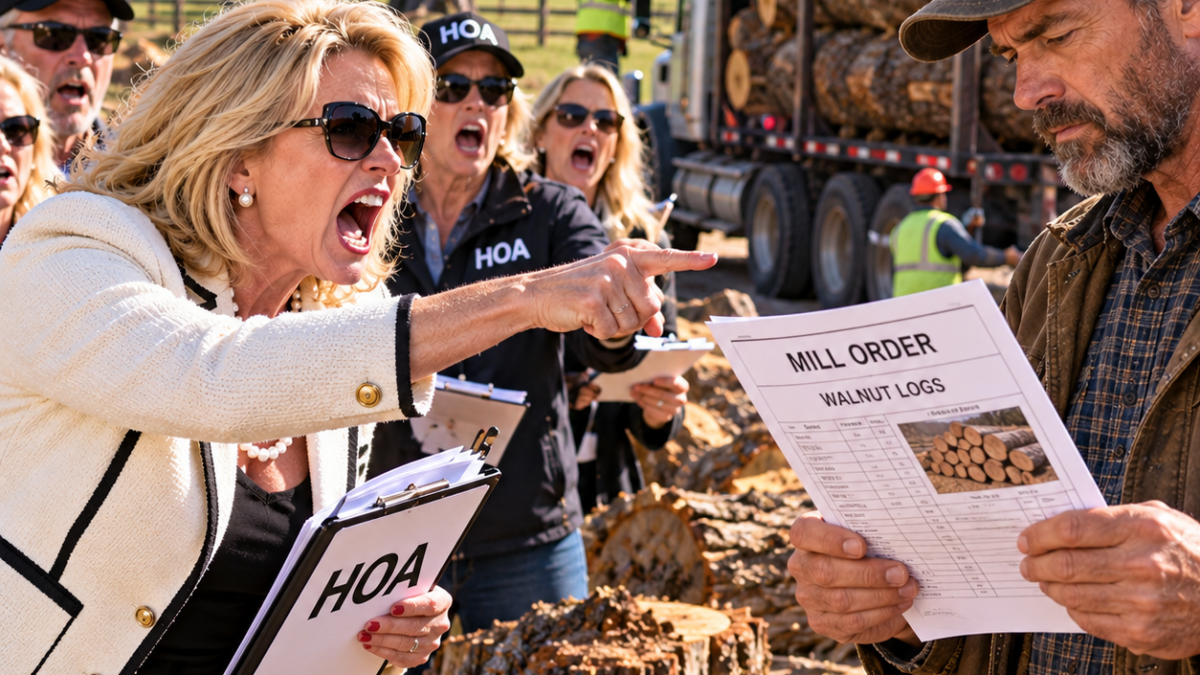
PART 2
I took the load-ticket photograph into the farmhouse and enlarged it on my computer.
The purchase-order code was still clear.
**EM-4271-W.**
I had spent seventeen years grading hardwood for a lumber yard before moving back to the farm full-time. I knew enough about timber sales to recognize what the code probably meant.
A commercial inquiry.
Maybe a standing order.
Maybe just an internal reference.
But I also knew enough not to turn suspicion into certainty.
A code printed Tuesday morning did not prove anybody had arranged the sale Monday.
And it definitely did not prove they had arranged it before the storm.
That distinction mattered.
I could already hear Vanessa’s answer if I accused her too soon.
*You saw a number on a truck ticket and invented a conspiracy.*
So I did something my father had never been especially good at.
I slowed down.
My name is Ethan Ward.
I was fifty-two that year, and our family owned eighty acres along the eastern side of Briar Creek Estates in central Missouri.
The subdivision had been built in phases during the last fifteen years.
Before that, the whole area had been pasture, creek bottom, and timber.
Our land remained mostly the same.
Hay field to the south.
Walnut grove along the western edge.
Old equipment barn near the house.
Pasture fence running roughly north to south.
Briar Creek’s newest homes stood just beyond that fence.
Years earlier, my father had signed a recorded maintenance agreement after one of his walnut limbs fell during an ice storm.
The agreement allowed the HOA to enter a defined strip near the subdivision and remove dangerous limbs or trees posing an immediate hazard to residents.
Dad had insisted I read it.
He tapped the exhibit with one thick finger and said, “A permission that isn’t measured becomes a story later.”
At the time, I rolled my eyes.
He had been seventy then.
I was thirty-eight and still believed most property disagreements came from old men refusing to let go of things.
Now I wanted to apologize to him.
The agreement did not transfer ownership.
It did not make our farm part of Briar Creek.
It did not grant the HOA a blanket logging right.
And it definitely did not say anything about selling commercial timber.
The problem was that I could not stand in front of chainsaws holding a memory of where the boundary lay.
Our old fence bowed around several trees.
The grass lane widened and narrowed.
Dad’s original survey stakes had disappeared under years of leaves and mowing.
If Vanessa brought another contractor Friday, I needed paper.
And measurements.
Not emotion.
At 10:46 that morning, an email arrived.
**FROM: Vanessa Cole, President, Briar Creek Estates HOA**
**SUBJECT: EMERGENCY STORM ACCESS**
Mr. Ward,
Your interference with emergency storm-remediation activity has caused unnecessary delay and additional contractor costs. The association will resume hazard removal no later than Friday. Continued obstruction may result in recovery of delay charges and any damages arising from failure to complete emergency work.
Regards,
Vanessa Cole
President, Briar Creek Estates HOA
I read it twice.
Then a third time.
Emergency work.
Delay charges.
Damages.
The language was designed to put me on defense.
If a tree fell on a house after I blocked legitimate cleanup, she wanted a record showing the HOA had warned me.
And the uncomfortable truth was that there had been real storm damage.
That mattered.
A large oak limb had come down near the south entrance.
Several maple branches were scattered across subdivision yards.
I had seen lightning over the ridge the night before.
The storm was not imaginary.
So the question was not whether the HOA had fabricated bad weather.
The question was whether Vanessa had used a real storm to justify something already planned.
I forwarded the email to Julia Chen.
Julia had handled a farm-access dispute for my uncle and had the kind of voice that became calmer when everyone else got louder.
She called five minutes later.
“Tell me exactly what you saw.”
I did.
Six walnut logs loaded.
Four trunks on the ground.
Thirteen numbered standing trees.
Twenty-three total.
“Any obvious storm damage?”
“Some. Not enough to explain all of it.”
“That answer is better than ‘none.’”
“I know.”
“Do you have the recorded maintenance agreement?”
“Dad’s copy somewhere. I’m pulling county records too.”
“Good. Anything from the contractor?”
“He called the job ‘hazard removal with recoverable timber.’ Said an estimator marked the trees before his crew arrived.”
“When?”
“He wouldn’t say.”
“Did you ask the mill about the order?”
“Not yet.”
“Do that carefully. Ask them to preserve the records. Don’t accuse them of taking stolen timber.”
“I wasn’t planning to.”
“Good.”
I heard paper moving on her end.
“I’m also getting a forester.”
“For what?”
“To separate the real storm hazards from the commercial cutting.”
“I already know which trees are healthy.”
“No, Ethan. You know what you believe. I want someone who can document condition tree by tree.”
I leaned back in my chair.
“You sound like my father.”
“That’s probably not the insult you meant it to be.”
I looked out the kitchen window toward the grove.
Number twenty-one was visible between the barn and the lane.
Blue paint on dark bark.
“I want her bluff called today.”
Julia paused.
“First make sure we know which part is a bluff.”
That sentence probably saved me from making the first serious mistake of the dispute.
—
Ellis Mill answered on the fourth ring.
A receiving manager named Greg Harmon took my call.
I gave him the purchase-order reference from the load ticket.
He asked me to hold.
When he returned, his tone had changed slightly.
“I have that load.”
“Six black walnut logs?”
“Yes.”
“They came from my farm. Ownership is disputed.”
Silence.
Then, “Are you saying the trucker stole them?”
“No. I’m saying the person who authorized the cut may not have had authority to sell them.”
Another pause.
“That’s different.”
“Yes.”
“Do you have documentation?”
“I have the haul ticket, photographs of the truck, photographs of the stumps, and the property information.”
“Email it.”
I did.
Greg called back twenty minutes later.
“I’ve separated the six logs.”
Relief loosened something in my shoulders.
“Thank you.”
“Understand what I’m saying, Mr. Ward. We are holding them temporarily while this gets reviewed. I am not deciding ownership.”
“I understand.”
“I can confirm the code refers to a purchase inquiry connected to that load.”
“When was the inquiry opened?”
“I can’t release customer records over the phone.”
“Can you preserve them?”
“Yes.”
“The original inquiry, tree list, emails, everything.”
“I’ll flag the file and send it to our legal office.”
“Was there a tree list?”
Greg became quiet.
“I’m not discussing that without authorization.”
That was an answer without being an answer.
I wrote down his exact words.
Then I called Julia.
“The mill separated the logs.”
“Good.”
“There may be a tree list.”
“Maybe.”
“He wouldn’t confirm it.”
“Then don’t say there is one.”
“You really enjoy ruining my dramatic conclusions.”
“I get paid to keep dramatic conclusions from ruining cases.”
She had already contacted a consulting forester.
Mara Flores would arrive at first light Wednesday.
Julia also requested the recorded maintenance exhibit from the county recorder, the contractor’s full file, every map revision, the mill inquiry, and the HOA board materials authorizing the work.
Then she said something I did not expect.
“Let Paul’s company handle any indisputable hazard close to the houses.”
I looked at the phone.
“You want me to let them keep cutting?”
“I want you to avoid giving Vanessa the ability to say you knowingly left a dangerous limb over somebody’s roof.”
I thought about the subdivision.
One broken branch had been hanging over Mrs. Albright’s fence since the storm.
Vanessa had already circulated a photograph of it to the board.
“What if they use that as an excuse to move deeper into the grove?”
“Then we define the work.”
I looked again at number twenty-one.
“All right.”
—
Mara arrived at 6:15 Wednesday morning.
She wore work boots, carried a diameter tape and tablet, and spoke to trees with the detached seriousness of a physician making rounds.
She started near the subdivision houses.
Not the walnuts I cared most about.
That irritated me.
I wanted her at number twenty-one.
Instead, she stood under a broken maple limb leaning toward Mrs. Albright’s roof.
“Real hazard,” she said.
I nodded.
We moved north.
Another broken branch.
Then one walnut near the edge.
Its crown had twisted during the storm.
Several upper limbs were hanging.
Mara circled the stump where the tree had already been cut.
“This one was damaged.”
“How badly?”
“Enough that removal could be defensible.”
I did not like the answer.
She must have seen that.
“You hired me to tell you what happened to the trees.”
“I hired you because the HOA is cutting my timber.”
“Then accurate details help you more than convenient ones.”
My father again.
Apparently every competent professional in Missouri had decided to channel him.
Mara marked documented storm damage with yellow flags.
By midmorning, a pattern emerged.
The real damage clustered near the western edge toward the houses.
The blue numbers did not.
Many blue-numbered walnuts stood deep inside our grove.
Healthy crowns.
No significant lean.
No broken leaders.
No nearby structures.
And the blue numbers seemed to increase with trunk size.
Mara stopped beside number seventeen.
She measured diameter at breast height.
Then number eighteen.
Then twenty-one.
“You notice the pattern?” she asked.
“Bigger trees.”
“Mostly.”
“Value selection.”
“Possibly. I can document size and condition. I’m not going to speculate about the buyer’s criteria.”
Number twenty-one measured among the largest.
The fork split twelve feet above the ground into two strong leaders.
Dad used to say it would make beautiful boards someday if nobody got greedy before the tree got old enough.
I stood under it and looked at the bench.
Mara followed my eyes.
“Your father?”
“Yes.”
“He plant these?”
“Most of them.”
“How long ago?”
“Forty-three years.”
She touched the blue paint with one finger.
“Then we should make sure our photographs are thorough.”
At 9:30, I called Paul.
“Mara documented the hanging branch over Mrs. Albright’s place.”
“I know the one.”
“You can remove that branch.”
“What about the numbered walnuts?”
“No.”
“Understood.”
“I want photographs of the route before you enter.”
“That’s fine.”
“And no equipment beyond the maintenance strip until we establish where it is.”
“Also fine.”
He lowered his voice.
“My office is preserving the job file.”
“Did your estimator mark these before the storm?”
“I can’t answer that yet.”
“Paul.”
“Ethan, my crew showed up with a map. We didn’t create it.”
That afternoon, Paul removed the dangerous branch.
Mrs. Albright stood on her porch with both hands wrapped around a mug while the crew worked.
When the branch came down safely, she waved at me.
I crossed the lane.
“Thank you,” she said. “That thing scraped the roof all night.”
“You’re welcome.”
She looked toward the grove.
“Why do those trees have blue paint?”
“I’m trying to find out.”
“I thought they were all dangerous.”
“So did the board, apparently.”
Mrs. Albright frowned.
“That one?”
She pointed toward number twenty-one.
It stood seventy yards from her house.
“No,” she said. “That doesn’t make sense.”
It was the first time a Briar Creek resident questioned Vanessa’s version in front of me.
Not the last.
—
By Thursday morning, somebody had posted in the neighborhood group that I had blocked emergency storm cleanup and expected HOA residents to pay for “my neglected trees.”
My daughter sent me a screenshot.
Her message underneath said:
**Do you want me to answer this?**
I typed:
**No.**
Deleted it.
Typed:
**Maybe.**
Deleted that too.
Finally I called Julia.
“I want to post the photographs.”
“Why?”
“Because Vanessa is telling people I blocked cleanup.”
“You did block part of it.”
“Commercial cutting.”
“Then say exactly that.”
She drafted three sentences.
**The documented storm hazard near Mrs. Albright’s property is being removed with my consent. Commercial cutting of additional walnut trees is disputed while the recorded maintenance area and contractor scope are reviewed. I have asked the HOA to preserve all project records.**
“That’s it?” I asked.
“That’s it.”
“Vanessa wrote three paragraphs.”
“Then let her.”
I sent Julia’s statement to the board.
No accusations.
No mill conspiracy.
No mention of number twenty-one.
Just facts we could already prove.
That afternoon, Paul called.
“Our estimator didn’t select the project independently.”
“Who did?”
“I’m sending the formal file through our office. You’ll get it through counsel.”
“Paul.”
He sighed.
“The estimator was given a proposed removal area before he visited.”
“By who?”
“Ethan, let the documents answer it.”
Again, everyone around me seemed determined to make me wait for paper.
Friday morning proved why.
At 7:08, a pickup I had never seen stopped outside the farm gate.
Two men got out carrying chainsaws.
No Paul.
No skidder.
No familiar company logo.
Vanessa arrived behind them in her SUV.
I walked down the lane.
“Who are they?”
“Replacement contractor.”
“Where’s the site map?”
“The association has already provided the necessary instructions.”
I looked at the two men.
“Have you seen the recorded maintenance exhibit?”
One shook his head.
“We were told storm trees along the boundary.”
“There are blue-numbered trees ninety feet inside my farm.”
Vanessa stepped between us.
“These men don’t need to debate legal documents with you.”
I took out my phone and called Caleb Price.
Caleb was the HOA treasurer.
His number appeared on the board notice Julia had obtained.
He answered sleepily.
“Caleb, this is Ethan Ward.”
A pause.
“What’s happening?”
“There’s a second tree crew at my farm.”
“What?”
“Vanessa brought them.”
I put the phone on speaker.
Caleb’s voice came through clearly.
“Vanessa, tell them not to cut anything until I check the board authorization.”
Her face hardened.
“You cannot cancel emergency work by telephone.”
“I’m not canceling anything. I’m telling them to wait.”
“The president has operational authority.”
“Not to change the scope the board approved.”
That sentence caught my attention.
“What scope did you approve?” I asked.
Vanessa glared at the phone.
Before Caleb could answer, a voice came from behind us.
“My dangerous branch is already gone.”
Mrs. Albright stood on her porch in slippers and a blue housecoat.
She pointed toward the grove.
“What emergency are those other trees causing?”
One of the chainsaw men looked at the other.
Neither started his saw.
By noon, the HOA attorney sent written notice.
All additional cutting was paused pending review of the recorded maintenance area and project scope.
The second crew left.
Vanessa did not speak to me before she drove away.
The thirteen standing walnuts survived Friday.
But the dispute was far from over.
Ten trees had already been cut.
Six logs were sitting at Ellis Mill.
Four trunks remained beside the lane.
And I still did not know whether the HOA’s board had authorized what happened—or whether Vanessa had told the board one thing and the contractors another.
—
Monday morning, surveyor Ben Tally arrived.
He ignored the fence.
That surprised me.
I pointed at it.
“Dad always treated that as the line.”
Ben nodded.
“Maybe it follows the line. Maybe it wandered. I’m locating the recorded strip, not your memory of the fence.”
He established control from the southern subdivision corner.
Then checked a second reference point.
He worked north slowly.
The lane narrowed.
The fence bent around old trees.
Several posts had leaned after decades of frost.
By lunch, little survey flags marched through the grass.
The legal maintenance strip ended west of the first row of walnuts.
I stared at the flags.
“You’re sure?”
Ben checked his drawing.
“That’s where the recorded exhibit places it.”
“What about number twenty-one?”
We walked to it.
He measured.
“Seventy-four feet beyond the eastern edge of the recorded maintenance area.”
Seventy-four feet.
Not four.
Not a judgment call around an old fence.
Seventy-four feet.
The farthest blue numbers reached nearly ninety feet beyond the strip.
Ben was careful.
“I’m locating the recorded area. I’m not telling you no other legal theory exists. Your lawyer handles that.”
“But this agreement doesn’t reach these trees.”
“Correct.”
Mara returned.
We took photographs showing three patterns in the same frame.
Yellow flags for storm damage.
Ben’s survey flags marking the recorded strip.
Blue numbers marking the proposed walnut removal.
They did not match.
The storm damage stayed near the houses.
The legal maintenance strip followed the boundary.
The commercial-looking blue numbers stretched deeper into our land.
Julia studied the images that afternoon.
Then she noticed something I had missed.
“How was the contractor supposed to reach number twenty-one?”
“Through the grass lane.”
“That lane leaves the recorded strip here.”
She traced the map.
“And here.”
She looked at me.
“So even their equipment access requires an explanation.”
The dispute was no longer only about whether particular trees were dangerous.
The work route itself crossed outside the recorded area.
Julia sent Ben’s signed drawing to the HOA attorney.
Then Paul’s full file arrived.
The first document was the work order.
**HAZARD REMOVAL WITH RECOVERABLE TIMBER.**
The second was the contractor map.
Twenty-three selected walnuts.
Six marked as first transport.
Four staged along the lane.
Thirteen remaining.
The shaded “harvest zone” extended deep beyond Ben’s surveyed flags.
I read the title again.
“Harvest zone.”
Julia nodded.
“That’s their language, not ours.”
Then she opened the metadata history.
There were multiple versions of the map.
The oldest preserved version predated the storm.
I stared at the screen.
“How far?”
“Several days.”
“That means the storm didn’t create the tree list.”
“It means a version of this map existed before the storm. We still need to establish what that version contained and who approved it.”
“You’re killing me.”
“No. I’m keeping you accurate.”
The storm had happened Monday night.
The earliest map revision was dated the previous week.
It showed the same general cutting area.
Maybe not every final number.
But enough.
The wind had not drawn the route.
Someone had already been planning work in my grove.
Then Ellis Mill confirmed that the purchase-order code related to a commercial inquiry.
Its attorney agreed to release the original inquiry and associated field list through the records process.
Until we saw those records, we still did not know when each tree had been selected.
But the wall around Vanessa’s story was beginning to crack.
—
Thursday afternoon, she came to the farm with Caleb.
Vanessa carried a folder.
Caleb looked like a man who had slept badly.
“We have a proposal,” Vanessa said.
Julia stood beside me.
“What kind?”
“The HOA is willing to compensate Mr. Ward for the first truckload.”
“That sounds like a promising start,” Julia said.
Vanessa continued.
“In exchange, Ethan will acknowledge the association’s operational buffer and allow completion of work within that area.”
Julia held out her hand.
“Show me the recorded document defining ‘operational buffer.’”
Vanessa’s eyes hardened.
“It’s standard contractor terminology.”
“Then it’s contractor terminology. Not a property right.”
Caleb unfolded Paul’s map.
He stared at it.
Then stared again.
“This isn’t the version we voted on.”
Nobody spoke.
Vanessa turned.
“It reflects field refinements.”
Caleb pointed to the deep blue-numbered trees.
“Our packet showed eight possible hazard trees near the fence.”
I looked at him.
“Eight?”
“Yes.”
“There are twenty-three.”
His jaw tightened.
“I can count.”
Julia asked, “Did the board approve this expanded map?”
Vanessa answered before him.
“The board delegated operational decisions to the contractor.”
Caleb looked at her.
“No. We authorized emergency work based on the packet.”
“Conditions changed after the storm.”
Julia moved beside him.
“Look at the revision date.”
Caleb did.
His face changed.
The expanded map was dated before the storm.
Vanessa folded the waiver.
“The board will address this with counsel.”
She walked away.
Caleb did not follow.
Instead, he took out his phone and photographed the contractor map.
Then he asked Julia for a copy of Ben’s survey.
That was the moment the dispute changed.
Until then, I had been the neighboring owner challenging the HOA president.
Now the HOA treasurer had discovered that the contractor was working from a map different from the one his board had approved.
Vanessa’s problem was no longer just me.
It was her own records.
—
The mill documents arrived the following week.
Julia called me.
“Come to the office.”
“Good or bad?”
“Come read them.”
I drove forty minutes without turning on the radio.
The first page was a purchase inquiry.
Customer information was partly redacted during the initial exchange.
But the date was not.
Four days before the storm.
Attached was a field list.
Twenty-three walnut numbers.
Species.
Estimated diameter.
Several grade notations.
Number twenty-one appeared near the top.
I recognized a short slash notation beside the higher-value trees.
The same kind of slash had been painted next to several blue numbers in the grove.
My years around hardwood yards suddenly mattered.
“That mark groups likely higher-grade saw logs.”
Julia tapped the page.
“Your experience helps us interpret it. But we verify through the mill.”
Greg Harmon did exactly that.
He confirmed the notation against his intake sheet.
The six logs already at Ellis Mill were kept separately.
I went there with Julia.
The yard smelled of wet bark and sawdust.
My father’s walnut logs lay apart from the main inventory.
Blue paint remained visible.
I touched the cut end of one.
Forty-three growth rings.
More, probably.
A life reduced to a cylinder waiting for a saw.
Greg pointed toward the markings.
“Four carry the higher-grade notation from the inquiry.”
“Which trees?”
We matched numbers.
Two logs had come from near the storm-damaged edge.
One was the walnut Mara agreed had a badly broken crown.
Four came from sound trees farther east.
Julia wrote everything separately.
That mattered.
One legitimately damaged tree did not authorize cutting healthy timber.
But if I pretended every cut tree had been perfectly sound, Vanessa only needed one storm-broken example to make me look dishonest.
So we kept the uncomfortable facts.
One damaged walnut.
Several questionable edge trees.
Multiple sound trees well beyond the recorded strip.
And a commercial buyer contacted four days before the storm.
The weather had changed the label.
Not the starting date.
—
Caleb gave Julia the board packet.
Eight possible hazard trees.
Near the fence.
Each required individual condition review.
And there was another instruction:
**Provide notice to Ward property owner before entry beyond designated maintenance area.**
I had received no notice.
The packet mentioned storm salvage only as a way to reduce legitimate cleanup costs.
The board’s reserve fund was tight.
Briar Creek needed to repair a cracked entrance wall.
Vanessa had apparently told directors that sale value from genuinely removed hazard timber could help offset the expense.
I understood why they accepted that.
If a tree truly had to come down, selling usable wood instead of paying to dispose of it was not inherently sinister.
But the board had authorized up to $6,000 in emergency work.
It had not authorized a twenty-three-tree commercial harvest deep inside my farm.
Caleb looked embarrassed when he explained.
“We thought we were approving limited hazard work.”
“Did you know a mill had been contacted before the storm?”
“No.”
“Did you know twenty-three trees were already numbered?”
“No.”
“Did you know the contractor had a larger map?”
“No.”
Julia asked the more important question.
“Do you still have the original board attachment?”
Caleb nodded.
“Saved exactly as received.”
“Good.”
Original records matter.
Forwarded copies collect markup.
Dates change.
Attachments get renamed.
The original email preserved exactly what directors saw before voting.
Eight trees.
Limited strip.
Individual review.
Owner notice.
Then came the management company’s archive.
And that file was worse for Vanessa than anything we had found so far.
Two weeks before the storm, she had emailed Paul’s company the expanded map.
Her message read:
**Attached is the full maintenance corridor agreed with owner. Proceed with field marking and timber-value assessment.**
Agreed with owner.
Me.
An unsigned note attached to the map claimed I had verbally approved the expanded work during a conversation.
The date was printed at the top.
I stared at it.
“That’s impossible.”
Julia looked up.
“Why?”
“My daughter graduated that afternoon.”
“Where?”
“Three hours away.”
“Were you gone all day?”
“From six in the morning until nearly midnight.”
“Phone call?”
“I never spoke to Vanessa.”
“Could she claim you approved it by phone?”
“She can claim anything.”
“Then we verify.”
My daughter sent the graduation photographs.
Time stamps.
Family pictures.
Restaurant receipt.
Parking payment.
But Julia did not overstate them.
“A photograph showing you three hours away doesn’t prove you didn’t receive a phone call.”
So we pulled call records.
No incoming call from Vanessa.
No outgoing call.
No text.
No email.
No message.
Nothing.
Julia wrote the HOA attorney one simple question:
**Please identify the communication supporting the note that Mr. Ward approved the expanded corridor on the date stated.**
No answer came.
Then Paul’s estimator supplied another email.
He had specifically asked Vanessa whether healthy walnuts outside the storm-damage zone belonged on the removal list.
Her reply:
**Proceed as mapped. We will manage owner communication.**
There it was.
A contractor had raised the exact issue.
Vanessa had been given an opportunity to check with me.
Instead, she told them to proceed.
—
Her attorney offered money.
The proposal would reimburse the first load and some lane damage.
In return, I would release the HOA and recognize the expanded corridor for future vegetation management.
Julia slid the document back across the conference table.
“No.”
Vanessa’s attorney frowned.
“Your client is being compensated.”
“For trees already cut.”
“And future clarity.”
“Future permission.”
The lawyer folded his hands.
“Mrs. Cole maintains that the expanded area is necessary for preventive safety.”
“Then obtain a lawful agreement.”
I said nothing.
Julia didn’t need help.
The offer was clever.
Pay me for what was gone.
Get my signature.
Turn the payment into retroactive evidence that the corridor existed.
Then number twenty-one and the other twelve trees would be vulnerable again.
We refused.
That weekend, Mrs. Albright called.
“Ethan, I found something weird.”
“What?”
“Come by.”
She stood in her kitchen holding her phone.
“I take bird pictures.”
“I know.”
“You remember that red cardinal that kept landing on my back fence?”
“No.”
“You wouldn’t. Thomas used to know them.”
That hurt unexpectedly.
She scrolled.
“There.”
A bright red cardinal perched in the foreground.
Behind it, blurred but recognizable, stood Vanessa.
And beside her was Paul’s estimator.
They were under number twenty-one.
The estimator held a diameter tape against the trunk.
Vanessa held a rolled map.
Mrs. Albright swiped to the previous image.
The estimator measuring.
Next image.
Vanessa pointing into the crown.
“What date?” I asked.
She opened the file information.
Weeks before the storm.
Julia nearly drove to Mrs. Albright’s house when I told her.
She asked for the original image files.
Not screenshots.
The sequence, metadata, shadows, leaf cover, and timestamps were all consistent.
The photographs did not record Vanessa ordering anybody to cut the tree.
We would not claim they did.
What they proved was enough.
Weeks before Vanessa told me a storm had made number twenty-one dangerous, she had already been standing beneath it with the estimator who later placed it on a commercial tree list.
Mrs. Albright had been photographing a bird.
Her camera accidentally documented a planning visit.
—
Caleb scheduled a special board meeting for Tuesday.
The clubhouse was full.
Julia advised me to keep the presentation simple.
“Don’t dump every document at once.”
“What do we lead with?”
“The difference between what the board approved and what the contractor received.”
“Then the mill inquiry?”
“If needed.”
“The fake note?”
“If she forces the issue.”
I wanted everything on the screen immediately.
Julia shook her head.
“Let Vanessa explain first.”
“She lies.”
“Then give her room to choose a version before the documents close around it.”
I hated how effective that sounded.
Vanessa opened the meeting.
She projected a colored map titled:
**BRIAR CREEK VEGETATION SAFETY BUFFER**
The shaded corridor extended deep into my grove.
She called it the “operational buffer.”
She said the eight trees in the original board packet had merely been representative examples.
The contractor, she explained, had refined the work after field review.
Caleb interrupted.
“Who approved the expansion?”
Vanessa looked at him.
“The board authorized emergency hazard mitigation.”
“That’s not what I asked.”
“The contractor had field discretion.”
The management representative stood from the second row.
“Our office did not redraw the scope.”
Vanessa turned.
“No one said you did.”
The manager continued.
“We forwarded Mrs. Cole’s revised attachment exactly as received.”
Caleb placed the board’s original eight-tree packet on the projector beside the contractor’s twenty-three-tree map.
The difference filled the wall.
People murmured.
Mrs. Albright stood.
“The branch over my roof was dangerous.”
Vanessa nodded quickly.
“Exactly.”
Mrs. Albright continued.
“It was removed Thursday. They didn’t need to cut a walnut to do it.”
The room became quieter.
A homeowner asked about the cracked entrance wall.
“Were the walnut sales supposed to pay for it?”
Caleb answered.
“An offset was discussed. No final timber revenue has been received by the HOA.”
Another homeowner said, “So whose trees were supposed to fund our wall?”
Vanessa raised a hand.
“This is being oversimplified. The association has maintenance authority and a responsibility to protect residents.”
Julia whispered, “Now.”
I stood.
“I agree the storm created real hazards.”
Vanessa looked surprised.
I continued.
“Mara Flores documented them. I allowed Paul’s company to remove Mrs. Albright’s dangerous branch. One walnut near the edge had a severely broken crown and may reasonably have required removal.”
Several heads turned.
I could feel Vanessa preparing to use my admission.
Then I put the mill field list on the screen.
“But this is not a list created after the storm.”
Twenty-three numbers appeared.
Vanessa’s jaw tightened.
“The mill inquiry was preliminary.”
“That may be true.”
Julia had drilled that discipline into me.
Never overclaim.
I pointed to the date.
“But it was opened four days before the storm.”
Then I put up the contractor map.
Same twenty-three trees.
Then Mrs. Albright’s photograph.
Vanessa beneath number twenty-one before the storm.
The estimator measuring the trunk.
I pointed toward Ben’s survey.
“Number twenty-one is seventy-four feet beyond the recorded maintenance strip.”
Caleb looked around the board table.
“Did any director approve cutting tree twenty-one?”
Nobody raised a hand.
Vanessa leaned toward her microphone.
“That photograph shows a courtesy inspection. It does not show an order to cut.”
She was right about that.
Julia nodded slightly.
Good.
Vanessa had committed herself to the inspection explanation.
Caleb opened the note attached to her pre-storm email.
“Then let’s talk about Ethan’s alleged approval.”
The note went onto the screen.
Vanessa sat straighter.
“He approved the broader corridor.”
“When?”
“The date stated.”
Caleb looked at me.
I stood.
“I was at my daughter’s college graduation three hours away.”
Vanessa replied immediately.
“You could have spoken by phone.”
Julia walked to the table.
“We anticipated that.”
She handed the HOA attorney the phone records.
“No call from Mrs. Cole. No outgoing call to Mrs. Cole. No text. No email. No message.”
Vanessa’s attorney studied the pages.
Julia continued.
“We are not asking this room to decide whether anybody committed a crime. We are asking for the communication supporting a written statement that the property owner consented.”
Vanessa looked toward the management representative.
Caleb asked, “Who created the note?”
The manager answered.
“It arrived attached to Vanessa’s email.”
The projector fan suddenly sounded very loud.
Caleb looked at Vanessa.
“Did Ethan agree?”
“He understood the maintenance needs.”
“That’s not the question.”
“The association has operated near this boundary for years.”
“Did he agree to this twenty-three-tree corridor?”
Vanessa pushed her chair back slightly.
“The contractor needed clear operational guidance.”
Caleb stared at her.
“That still isn’t an answer.”
Julia placed the estimator’s email on the table.
**Do the sound walnuts outside the storm zone belong on the removal list?**
Vanessa’s response:
**Proceed as mapped. We will manage owner communication.**
Nobody spoke for several seconds.
Then Caleb made a motion.
Suspend all commercial cutting.
Preserve every map, email, photograph, contractor instruction, mill communication, and board record.
Require legal review before any future entry beyond the recorded maintenance area.
Require any claimed expansion of HOA authority to be supported by recorded documents or a new written agreement.
The motion passed.
Vanessa voted no.
Thirteen standing walnuts were safe.
Including number twenty-one.
But when the meeting ended, I did not feel like celebrating.
Ten trees were already gone.
I could not put them back.
—
The next morning, Greg called Julia.
The mill’s temporary hold was expiring unless the parties reached a documented extension.
We drove there.
Caleb met us at the yard with the HOA attorney.
The six logs lay under straps, separated from other inventory.
I walked between them.
Blue numbers were still visible.
I put my palm against one cut end.
Cool wood.
Heavy.
Silent.
My father had planted these trees expecting somebody else to use them someday.
He had talked about making tables.
Cabinet fronts.
Gunstock blanks.
Workbench tops.
He never treated mature walnut like money standing upright.
To him, cutting was the last step of a decision that might take half a lifetime.
Caleb stood beside me.
“Which one was actually storm damaged?”
Mara’s report identified it.
One log from the tree with the badly broken crown.
Another came from near the hazard area but had less obvious damage.
Four came from sound trees farther east.
Julia proposed that the mill continue segregating the load while valuation and ownership were resolved.
Greg agreed.
Caleb rubbed his forehead.
“The entrance wall still needs fixing.”
I looked at him.
“Then show residents what the wall costs.”
He nodded.
“And show them what restoring this grove costs.”
He looked at the logs.
“Fair.”
That conversation told me Caleb finally understood the deeper problem.
Vanessa had tried to hide one budget problem inside another person’s property.
The HOA needed money.
Mature walnut had value.
If the trees could be categorized as storm cleanup, their sale could appear like clever cost recovery instead of what the records now suggested: a commercial removal plan operating beyond the board’s approved scope.
—
Negotiations took weeks.
Much longer than I wanted.
The HOA insurer reviewed coverage.
Paul’s company preserved its records and maintained that it had acted according to the scope provided.
The mill wanted certainty before releasing or processing the logs.
The HOA attorney separated legitimate hazard work from disputed commercial cutting.
That distinction mattered financially.
The first settlement draft offered money for the lost timber.
It ignored the skidder ruts.
I rejected it.
The second added tree replacement.
Tiny saplings.
No maintenance obligations.
No survival guarantee.
No soil work.
I carried that draft into the grove.
Rainwater had collected in the machinery tracks.
One rut had begun channeling runoff toward the grass lane.
Exposed soil showed where equipment had compacted the ground.
I imagined someone planting three-foot saplings beside those ruts, taking a photograph, and declaring the grove restored.
No.
I called Mara.
“Come measure everything.”
She developed a restoration schedule.
Stabilize damaged ground.
Correct drainage.
Protect natural regeneration.
Plant selected walnut and oak.
Inspect survival.
Replace failed plantings during the agreed establishment period.
Julia sent it back with timber appraisals.
“I’m willing to settle a documented loss,” I told her. “I’m not signing anything saying a mature walnut was replaced because somebody stuck a sapling in the mud.”
“Good.”
Before any final agreement, I asked Caleb to walk the surviving trees with me.
Mara joined us.
We stopped beneath number twenty-one.
The blue slash remained.
Faded now.
But visible.
Caleb looked up into the forked crown.
“This was really on the contractor’s list?”
“Number twenty-one.”
He checked the map.
“Seventy-four feet outside.”
“Yes.”
He touched the bark beside the paint.
“I’m sorry.”
It was the first personal apology I received from anyone on the board.
“Were you part of selecting them?”
“No.”
“Then learn from it.”
He nodded.
“We are.”
The settlement specifically identified the thirteen standing numbered walnuts.
No further cutting would occur under the disputed project.
Future genuine hazards would be assessed individually under the recorded maintenance right.
Notice would be provided.
No commercial buyer would determine the hazard list.
No contractor expansion would become HOA authority simply because it appeared on a work map.
Mrs. Albright’s roof could remain safe.
My father’s grove did not have to become inventory.
—
The final settlement funded the documented timber loss, lane repair, soil stabilization, replacement plantings, and follow-up inspections.
The six logs remained separately accounted for until the parties finished determining disposition.
I asked for something other than just money.
I wanted usable lumber from my family’s trees returned to the farm.
That took additional negotiation.
The mill had storage costs.
The insurer had valuation questions.
The HOA wanted a clean accounting.
Eventually we agreed.
Selected boards milled from the recovered walnut would come back to me.
No timber proceeds would be credited against Briar Creek’s entrance-wall project.
Caleb presented the wall budget honestly.
Without fictional tree money.
Residents approved the repair.
Dues increased modestly.
Some people complained.
That was their right.
But nobody’s private timber was used to disguise the cost.
Briar Creek also adopted new contractor procedures.
Before work crossed onto neighboring property, the project file had to contain written authority.
A reliable site map.
Owner notice.
Board approval for material scope changes.
The management company kept both maps in the permanent file.
The original eight-tree packet.
The expanded twenty-three-tree contractor version.
Future directors would not have to rely on anyone’s memory of what happened.
They could put the two documents side by side and see exactly where the project changed.
Vanessa stepped down as president before the winter election.
She never confessed.
Never called me.
Never admitted the mill inquiry existed before the storm for any improper reason.
Her final statement to residents said she had acted aggressively because she believed preventive tree management protected the community.
Maybe she believed that.
People are capable of believing two things at once.
That they are helping.
And that ordinary rules should bend because the goal feels important.
I did not need a confession.
The dated map.
The mill inquiry.
The unsupported note claiming my consent.
The estimator’s email.
The photograph beneath number twenty-one.
Those records had already forced the board to change course.
Vanessa lost control because of documents she had helped create.
There was something satisfying about that.
Not dramatic.
Not theatrical.
Just precise.
She had called it storm cleanup.
The records showed planning before the storm.
She had called the larger area an operational buffer.
The recorded exhibit showed where the actual strip ended.
She claimed I had agreed.
No communication supported the claim.
She said the contractor refined the plan after conditions changed.
The file history showed the expanded map existed beforehand.
One by one, the explanations lost room to stand.
—
Winter settled over the farm.
The machine tracks were repaired.
Mara’s crew planted young walnut and oak where appropriate.
Protective tubes stood around some of them.
They looked absurdly small compared with the old trees.
Pencils beside telephone poles.
I found myself checking them after storms.
Not because I believed they could replace what had been lost.
They could not.
A sapling is not a forty-year-old walnut.
But restoration is sometimes about starting a clock you know you will never personally finish.
My father understood that.
He planted trees whose best lumber he never expected to see.
That spring, Ellis Mill called.
The boards were ready.
A flatbed arrived at the barn one cold morning.
Strapped bundles of walnut rested under canvas.
My daughter drove down from Kansas City to help.
Her name is Rachel.
She had been the reason Vanessa’s false consent date was so easy for me to remember.
Her graduation.
She stood beside me as the driver loosened the straps.
“These are Grandpa’s trees?”
“Some of them.”
She ran her hand along the top board.
Dark chocolate heartwood.
Cream-colored sapwood along one edge.
Straight grain with small waves around a knot.
“They’re beautiful.”
“Yes.”
“Do you know which tree?”
“Not every board. The mill kept the log references for the selected bundle.”
We carried them inside.
Dad’s old workbench stood against the east wall.
The top was scarred by fifty years of hammers, glue, saw cuts, coffee rings, and mistakes.
One corner had split.
Rachel set down a board.
“What are we making?”
I looked at the bench.
I had been thinking about it for months.
“A new top.”
She smiled.
“For Grandpa’s bench?”
“Yes.”
We spent two weekends fitting it.
I had taught Rachel basic woodworking when she was younger, but life had taken her toward accounting instead of carpentry.
She still knew how to hold a square.
Still hated sanding.
Still pushed a hand plane too hard.
“You’re forcing it,” I told her.
“You sound like Grandpa.”
“I’ve been hearing that a lot lately.”
We glued the boards.
Clamped them overnight.
Trimmed the edges.
Flattened the surface.
Then rubbed in the first coat of oil.
The walnut darkened instantly.
Rachel stepped back.
“Wow.”
I rested one hand on the bench.
For a moment, I remembered the six logs at Ellis Mill.
Blue paint.
Purchase code.
Straps.
People arguing over who could sell them.
Now part of that wood had come home.
Not standing.
Not replaceable.
But not lost to somebody else’s budget either.
Rachel looked toward the open barn door.
“Which tree did this come from?”
I unfolded Mara’s final map.
One of the recovered logs had come from a sound walnut east of the strip.
I showed her the stump.
We walked outside.
Beside it, one of the new young walnuts had begun to leaf out.
Rachel stared at the slender stem.
“That thing’s going to take forever.”
“Yes.”
She laughed.
“You’ll be ancient before it looks like anything.”
“Probably.”
Then I pointed farther north.
Number twenty-one still stood above my father’s bench.
The blue paint had faded to a dull mark.
No fresh number replaced it.
No contractor map treated it as inventory.
Wind moved through the forked crown.
Its shadow crossed the old bench exactly the way I remembered from childhood.
Rachel looked from the sapling to the mature tree.
“So what happens when that one gets dangerous someday?”
“We assess it.”
“And if it really has to come down?”
“Then it comes down.”
She looked surprised.
“That simple?”
“That’s all I wanted from the beginning.”
A real hazard.
A real reason.
A real decision.
Not a sales list disguised as emergency work.
I sat on Dad’s bench.
For two years after his funeral, I had avoided that spot.
I told myself it was because the wood had started to rot.
The truth was simpler.
I missed him there.
Coffee thermos beside his boot.
Pencil behind his ear.
Looking up at the walnut branches as if time were something he could measure by rings.
When I was young, I used to tease him about planting valuable hardwood.
“What’s the point?” I asked him once. “You’ll be dead before these are ready.”
He looked at me as though I had just explained his own idea back to him.
“That’s the point.”
I did not understand then.
I did now.
He had never planted those trees because he expected to own every board.
He planted them because worthwhile things sometimes take longer than the person who starts them.
The HOA had looked at the grove and seen immediate value.
Saw logs.
Cleanup offsets.
A cheaper wall repair.
My father had looked at the same ground and seen decades.
That difference was why number twenty-one was still standing.
I leaned back against the bench and listened to its leaves move overhead.
Behind me, the young walnut near the repaired lane barely reached my shoulder.
It would take years before it gave meaningful shade.
Decades before anyone should even think about lumber.
Rachel sat beside me.
“You going to keep the blue paint on twenty-one?”
“Rain will take care of it.”
“Part of me thinks you should carve a big twenty-one into the bench.”
“No.”
“Why?”
I looked at the fading mark high on the trunk.
“Because Vanessa doesn’t get to name that tree forever.”
Rachel smiled.
We sat quietly.
Across the pasture, Briar Creek’s repaired entrance wall caught the late afternoon sun.
The homeowners had paid for it honestly.
The grove stayed ours.
And above my father’s old bench, the forked walnut moved in the wind, still growing on a schedule no HOA budget could shorten.
[END OF STORY]








