PART 2: HOA Sold Logging Rights to My 40 Acres—Then the Timber Crew Dug Up the Survey Marker My Dad Buried in 1978
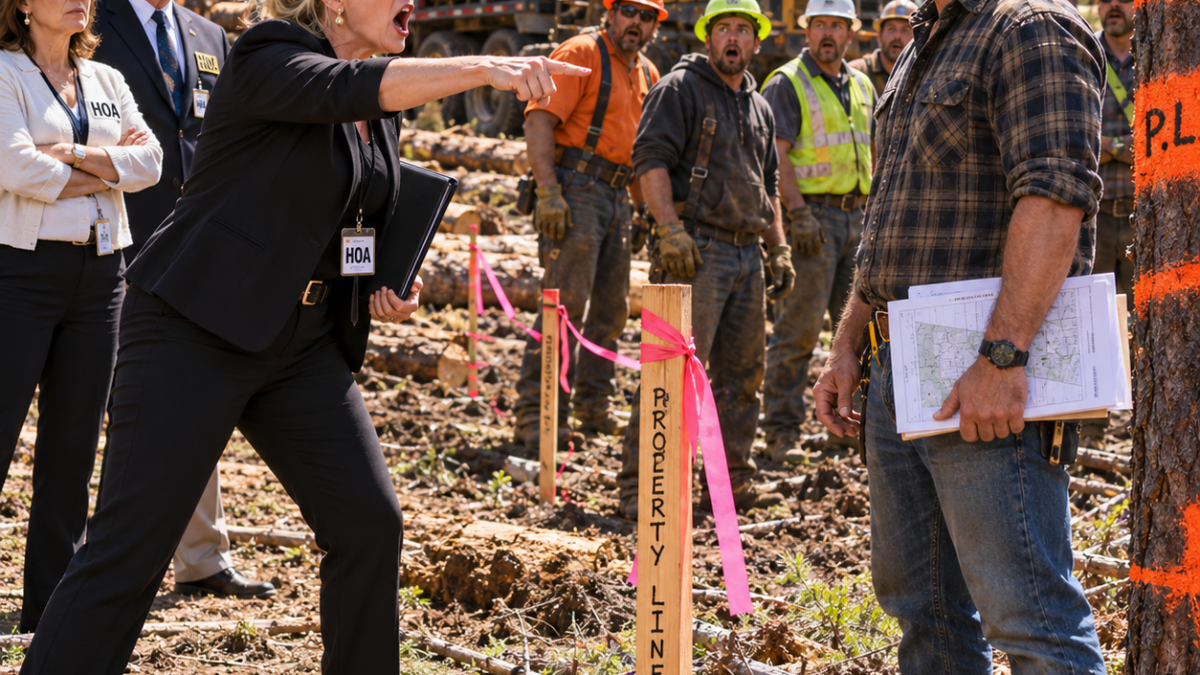
The first sound I heard that morning wasn’t my rooster or the wind through the pines—it was the hard, mechanical scream of chainsaws somewhere deep in the forty acres my father had left me, and when I stepped onto the porch I could already see the tops of logging trucks moving where no truck had any legal reason to be.
By the time I reached the tree line, men in hard hats were marking my oaks with orange paint, a skidder was dragging fresh-cut timber toward the road, and the president of the neighboring HOA was walking toward me with a laminated map under her arm, calmly explaining that her board had already sold the logging rights to land my family had owned since 1978.
Then the logging foreman knelt beside an old oak, brushed forty years of dirt away with his glove, and uncovered a brass survey marker my father had personally paid to install when I was ten—and the moment he read what was stamped into that metal cap, even the chainsaws seemed to stop sounding like the biggest problem in those woods.
My name is Dale Kirkwood, and I have walked that back forty since I was six years old.
My father bought the property in 1978, when most of the land around us was still pasture, timber, and two-lane roads. He planted the fence line himself, then hired a licensed surveyor because he believed arguments over land rarely started when people were honest about where the lines were.
When I was ten, he took me along.
I watched that surveyor set brass monuments at the corners while Dad stood beside him with a folded deed in his shirt pocket.
“Remember this,” he told me. “A man’s memory can fail. Paper shouldn’t.”
Dad died in 2009.
The land transferred to me through his estate, and I kept the forty acres exactly the way he had.
No subdivision.
No vacation cabins.
No sale.
Just woods.
Then Cedar Ridge Estates expanded against my eastern boundary, and eventually Colleen Ashworth became president of its HOA.
Colleen liked documents.
Especially documents she could laminate.
She carried maps into meetings the way some people carry badges.
That morning, she stepped through my timber in expensive boots while Russ Tilman, the logging foreman, stood over the old brass marker.
“Mr. Kirkwood,” she said, “the association owns the timber rights through the shared reserve.”
“No, it doesn’t.”
She gave me the same tight smile I had seen at county meetings.
“The board reviewed the plat.”
“This is my land.”
“The current plat says otherwise.”
“My deed says otherwise.”
Colleen pulled a laminated map from her folio.
A thick blue line crossed the back portion of my property.
“This area is community timber reserve.”
I stared at it.
“That line is wrong.”
“The board voted.”
“You can’t vote yourself onto somebody else’s land.”
Her smile disappeared.
“We signed a lawful contract with Whitmore Logging last month.”
Behind her, another trunk cracked.
I looked toward Russ.
“Stop cutting.”
Colleen turned.
“The crew has a contract.”
“With somebody who doesn’t own the timber.”
Russ did not argue.
He bent again beside the oak and cleaned more soil from the marker.
“Ma’am,” he said carefully, “this cap says private survey monument.”
Colleen looked at it.
For the first time that morning, she lost control of her expression.
Only for a second.
Then the smile returned.
“We’ll sort that out through the HOA office.”
“No.”
She looked at me.
“No?”
“Nobody cuts another tree until you prove you own the right to cut it.”
Russ immediately reached for his radio.
“Hold all saws.”
One by one, the engines stopped.
The silence that followed felt almost physical.
Colleen’s eyes hardened.
“You’re interfering with a commercial contract.”
“You’re standing on my property.”
She turned toward her SUV.
“You’ll regret making this difficult.”
Maybe she expected that to scare me.
Instead, I went home, pulled the old yellow survey tube from my closet, put my father’s 1978 documents in the truck, and drove straight to the county recorder’s office.
The clerk found Dad’s original deed in less than ten minutes.
Recorded.
Stamped.
Clean.
My forty acres were exactly where my father had always said they were.
Then the clerk frowned at her monitor.
“Mr. Kirkwood…”
She turned the screen toward me.
“There’s something else in this file.”
PART 2
The clerk’s name was Melanie Price.
I knew her only in the way people in a small county know one another—face, name, maybe a nod at the grocery store.
She was in her fifties, wore reading glasses on a silver chain, and had spent enough years behind that counter that very little seemed to surprise her.
But what she was looking at now had made her lean closer to the screen.
“What is it?” I asked.
She didn’t answer immediately.
Instead, she clicked through another document.
Then another.
Finally, she said, “There was an amended plat filed eight months ago.”
“By who?”
“Let me pull the full image.”
The printer behind her began feeding paper.
She walked over, waited, then brought three pages back.
The first was a neighborhood plat.
Cedar Ridge Estates.
The second was the amended boundary.
The third was an owner-consent page.
I knew something was wrong before I finished reading it.
The line between Cedar Ridge and my back forty had moved.
Not a little.
The amended plat pushed the HOA’s common timber area approximately thirty feet across part of my eastern boundary before sweeping deeper toward the timber stand Whitmore Logging had started cutting.
My stomach tightened.
“That isn’t the property line.”
Melanie looked at the yellow survey I had brought.
“I see that.”
“It’s not even close.”
She pointed to a notation.
“According to this filing, the change corrected an older mapping discrepancy.”
“Whose discrepancy?”
“The amendment says mutual boundary clarification.”
“Mutual?”
I turned the page.
There it was.
**PROPERTY OWNER CONSENT**
My name typed beneath a signature.
Dale Kirkwood.
Except I had never signed that document.
I stared at it.
The signature looked like somebody had been shown my name once and tried to copy the general idea.
Too wide.
Wrong slope.
My D never looked like that.
The K was completely wrong.
“I didn’t sign this.”
Melanie’s expression changed.
“Are you certain?”
I looked at her.
“Would you recognize your own signature?”
“Yes.”
“So would I.”
She sat back.
“I need to be careful here.”
“So do I.”
“This office records documents. We don’t determine whether the underlying representations are true.”
“I understand.”
“Do you want a certified copy?”
“Everything.”
She nodded.
I pointed toward the filing stamp.
“Who submitted it?”
Melanie hesitated.
Then turned the first page.
**Received and processed by: Randall Ashworth.**
I read the name twice.
Ashworth.
Colleen Ashworth.
“Does Randall still work here?”
“Yes.”
“Related to Colleen?”
Melanie looked uncomfortable.
“You should ask them.”
That answer was enough.
I gathered the certified copies.
Before leaving, I asked one more question.
“Was my father’s original deed ever challenged?”
“Not that I see.”
“Any transfer to the HOA?”
“No.”
“Easement?”
“Not for timber rights.”
“Any conveyance of these forty acres?”
“No.”
I folded Dad’s survey carefully and slid it back into the tube.
For almost fifty years, that property line had been clear.
Then eight months ago, somebody moved it on paper.
And somebody had attached my name to the change.
I sat in my truck for five minutes without starting the engine.
My first instinct was to drive straight to Colleen’s house.
That would have felt good for about thirty seconds.
Then it would have accomplished nothing.
Dad’s voice came back to me.
Paper first.
I called Grace Whitfield.
Grace was a licensed surveyor who had worked half the rural parcels in three counties.
She had surveyed a drainage easement for me years earlier and once told a developer’s attorney, in a room full of people, that “the ground does not care what your PowerPoint says.”
I trusted her.
She answered on the second ring.
“Whitfield.”
“Grace, it’s Dale Kirkwood.”
“Morning.”
“I need a boundary checked.”
“How soon?”
“Yesterday.”
Pause.
“What happened?”
“Logging crew showed up on my back forty.”
Another pause.
“Who authorized them?”
“Cedar Ridge HOA.”
“That doesn’t sound right.”
“It gets worse.”
I told her about the amended plat.
Then my signature.
Grace stopped interrupting.
When I finished, she said:
“Send me the documents.”
“I will.”
“And Dale?”
“Yes?”
“Don’t move a single marker.”
“I wasn’t planning to.”
“Don’t let anyone else move one either.”
“You think somebody might?”
“If the paper is wrong and the monuments are right, the monuments matter.”
Her voice became harder.
“Get me on that property tomorrow morning.”
Grace arrived at seven sharp.
Silver pickup.
GPS receiver.
Tripod.
Field notebook.
She wore work boots and the expression of someone already annoyed by a document she hadn’t proven wrong yet.
Russ was waiting by the logging road.
He had called me the previous evening.
Whitmore’s company attorney had told the crew not to resume until ownership was clarified.
I appreciated that.
Colleen had apparently called them repeatedly demanding they finish the job.
Russ looked tired.
“Morning.”
“Morning.”
Grace shook his hand.
“You found the monument?”
“This way.”
We walked through the trees.
Whitmore had cut seven mature trees before Russ stopped the job.
Seven.
It could have been hundreds.
The sight of the stumps made my chest ache.
Dad had walked among those oaks.
Not because every tree was sacred.
We had harvested timber before.
But we chose when.
We chose what.
Ownership means responsibility as much as control.
Somebody else had tried to make that decision for me.
Russ stopped beside the old oak.
“There.”
Grace knelt.
The brass monument sat several inches below grade.
She brushed away dirt.
Read the surveyor’s identification.
Then checked Dad’s original plat.
“Good.”
“Good?”
“Original monument number matches.”
She set up her equipment.
For the next four hours, we walked the boundary.
Corner one.
Marker exactly where Dad’s survey placed it.
Corner two.
Same.
Eastern line.
Same.
Southern monument.
Same.
Every coordinate Grace checked matched the 1978 survey within expected measurement tolerance.
The fence line Dad planted followed it.
The amended HOA plat did not.
At noon, Grace stood with one boot beside the eastern marker and looked toward Cedar Ridge.
“Your father’s survey is solid.”
“How solid?”
“As solid as forty-plus-year-old rural boundary work gets.”
“And the amended plat?”
She pulled it from her clipboard.
“This line doesn’t correspond to these monuments.”
“Could it be a mistake?”
“A mistake this large?”
“Yes.”
“Possible.”
I watched her face.
“But?”
She looked at me.
“Either someone made the mistake of their career, or someone wanted that line somewhere it didn’t belong.”
Russ whistled softly.
Grace continued.
“And the signature issue is separate. I’m not a handwriting expert.”
“I know.”
“But if you didn’t consent, somebody has a serious documentation problem.”
She prepared a signed preliminary finding.
Not a dramatic accusation.
Surveyors don’t write like television detectives.
She documented the original monuments.
Coordinates.
Historic survey.
Recorded deed.
Mismatch with amended plat.
That was enough.
I drove to the HOA office that afternoon.
Grace came with me.
Cedar Ridge’s office sat inside a clubhouse overlooking a pond.
Colleen was behind the front desk when we entered.
She looked up.
Her smile flickered when she saw the survey tube.
Then Grace.
“Mr. Kirkwood.”
“Colleen.”
“Ms. Whitfield.”
Grace nodded.
I placed Dad’s deed on the desk.
Then Grace’s report.
Then the amended plat.
Colleen barely looked.
“That signature is yours.”
She said it too quickly.
Grace looked at me.
I said:
“I haven’t even pointed at the signature yet.”
Colleen’s jaw tightened.
“The board reviewed this months ago.”
“Did I attend?”
“No.”
“Did I sign anything in front of you?”
“No.”
“Did you speak to me?”
“Correspondence was sent.”
“What correspondence?”
“Our records.”
“Show me.”
“This isn’t a discovery proceeding.”
“No.”
I leaned closer.
“It’s me asking why your HOA sold logging rights on land you don’t own.”
Her face hardened.
“The amended plat clarifies the shared timber reserve.”
“Grace?”
Grace opened her field notebook.
“The recorded monuments do not support that interpretation.”
Colleen looked at her.
“You were hired by him.”
“I was.”
“So you’re not neutral.”
“My measurements are.”
Colleen leaned back.
“The board approved the plat unanimously.”
“Where’s the underlying survey?” Grace asked.
Silence.
“Who prepared the amendment?”
Colleen crossed her arms.
“Our consultant.”
“Name?”
“I’d need to check.”
Grace pointed to the plat.
“This bears a county filing stamp, not a surveyor certification.”
Colleen’s expression shifted.
I placed another document beside it.
My father’s estate transfer from 2009.
My real signature.
Notarized.
I pointed.
“Mine.”
Then the amended plat.
“Not mine.”
Even to an untrained eye, they were obviously different.
Colleen stared at them.
Then looked away.
I turned the amended plat around.
“Your brother filed it.”
That landed.
Her eyes snapped toward me.
“Randall processed it through the recorder’s office.”
“That means nothing.”
“Maybe.”
“He processes hundreds of documents.”
“Maybe.”
“You’re accusing my family now?”
“I’m reading names.”
She reached for the phone.
Grace quietly closed her folder.
Colleen said:
“I think we need the sheriff.”
“Good.”
She paused.
“What?”
“I called an hour ago.”
For the first time, she looked uncertain.
Then the clubhouse door opened.
Deputy Cole Bennett walked in.
Cole and I had known each other for years.
Not friends exactly.
Small county.
He had responded when a storm took down power lines near my property three winters earlier.
Calm man.
Slow voice.
Never seemed hurried.
He carried a folder.
“Afternoon.”
Colleen stood.
“Deputy, thank goodness.”
Cole looked at her.
“What happened?”
“This man came into the HOA office making accusations.”
“I came here with documents.”
“He’s threatening board members.”
“I haven’t threatened anyone.”
Grace said:
“He hasn’t.”
Cole nodded.
“I’ve already reviewed Ms. Whitfield’s preliminary survey findings.”
Colleen went still.
He continued.
“And I have questions about a county filing.”
She looked at me.
“You coordinated this.”
“No.”
Cole set his folder on the table.
“Ms. Ashworth, your brother’s name appears on the amended filing.”
“He’s a clerk.”
“Yes.”
“He records what people submit.”
“Yes.”
“So?”
“The property-owner signature is disputed.”
“That’s Dale’s signature.”
I said:
“No.”
Cole raised a hand.
“Let’s keep this orderly.”
Then he opened his folder.
“What I need to understand is how the logging contract was created.”
Colleen’s face hardened again.
“Board business.”
“Whitmore Logging has already provided a copy.”
That surprised me.
Cole looked at me.
“Mr. Tilman contacted his corporate office after the stop-work.”
Russ.
Good man.
Cole continued.
“Whitmore paid Cedar Ridge Estates ninety-five thousand dollars for timber rights.”
I stared at Colleen.
Ninety-five thousand.
She had not been trying to trim a few trees.
This was a real sale.
A substantial one.
Cole said:
“The payment cleared six weeks ago.”
Grace looked at me.
I asked:
“Where did the money go?”
Colleen answered immediately.
“HOA reserves.”
Cole’s expression did not change.
“Not all of it.”
Silence.
Colleen’s fingers tightened around the edge of the desk.
He continued.
“A portion moved through an account labeled Ashworth Community Consulting.”
Her face lost color.
“That’s legitimate.”
“What services?”
“Project management.”
“For logging my land?”
I couldn’t stop myself.
Cole looked at me.
I stepped back.
He returned to Colleen.
“Your brother’s name also appears on transfers.”
“He helped with paperwork.”
“How much?”
She didn’t answer.
Cole said:
“We’ll need full financial records.”
“You need a subpoena.”
“If necessary.”
Colleen’s voice rose.
“The board needed money.”
That sentence changed the room.
Her attorney wasn’t there to stop her.
Her instincts were failing.
Cole waited.
“For what?”
Colleen looked toward the window.
“The clubhouse.”
“What about it?”
“Renovation.”
I stared.
She had sold timber from my land to remodel a clubhouse.
She continued, words coming faster.
“The reserve was short. The roof leaks. The kitchen is outdated. The community voted for improvements.”
“Did they vote to sell my trees?”
She turned toward me.
“It wasn’t supposed to hurt you.”
I almost laughed.
Seven stumps already stood in my woods.
“You changed my boundary.”
“It was an administrative correction.”
“You signed my name?”
“I did not say that.”
“Your brother filed it.”
“That doesn’t mean—”
Cole interrupted.
“Ms. Ashworth, stop.”
She did.
His voice remained calm.
“You should probably speak with counsel before answering further questions.”
That was the first moment I realized this had moved beyond an HOA dispute.
Not because Cole looked dramatic.
Because he was being careful.
Russ gave a statement that afternoon.
He explained the entire process.
Whitmore received a solicitation from Cedar Ridge for timber harvesting rights.
The packet included the amended plat.
Board authorization.
Representations that the HOA owned the timber reserve.
Whitmore paid $95,000.
Russ’s crew received GPS boundaries based on the amended map.
No one at Whitmore knew the land was disputed until Russ found Dad’s marker.
He showed me the contract later.
I recognized Colleen’s signature.
Then five board signatures.
I called Grace.
“Can a board sign timber rights over land it doesn’t own?”
She laughed once.
“Ask your lawyer.”
So I did.
My attorney, Calvin Brooks, had represented my family on farm and estate matters for almost twenty years.
Calvin read the deed.
Grace’s report.
Amended plat.
Whitmore contract.
Then removed his glasses.
“How many trees cut?”
“Seven.”
“Value?”
“Russ is helping calculate.”
“Any road damage?”
“Some.”
“Boundary disturbance?”
“Yes.”
“HOA received ninety-five thousand?”
“According to Bennett.”
Calvin leaned back.
“Do not accept any private settlement without counsel.”
“I wasn’t planning to.”
“Do not threaten Colleen.”
“I haven’t.”
“Do not remove anything from the county file.”
“I know.”
“And do not start posting this online.”
“I’m sixty.”
“That has never prevented anybody from using Facebook badly.”
Fair.
“Calvin.”
“Yes?”
“Can they lose the land?”
“The HOA?”
“Yes.”
“Not from this alone.”
“Can they lose money?”
He looked at me.
“Oh, absolutely.”
I should admit something.
Part of me wanted revenge.
Not violence.
Nothing foolish.
I wanted Colleen embarrassed.
I wanted her standing in front of every homeowner explaining why she sold trees that didn’t belong to the association.
I wanted every person who had ever sat through one of her board meetings while she talked down to them to see her lose that polished confidence.
Calvin saw it.
“Don’t.”
“What?”
“Make this personal.”
“It is personal.”
“The law is personal to you. Your response doesn’t have to be.”
“She forged—”
“Allegedly.”
I glared.
He smiled.
“You hired me for a reason.”
“To annoy me?”
“To prevent you from saying expensive things.”
The county investigation widened.
Two days later, Randall Ashworth was placed on administrative leave from the recorder’s office.
I heard it from Melanie.
Not officially.
Small county.
News moves faster than paperwork.
Then investigators collected records from his workstation.
That evening, Cole Bennett called.
“Can you come by tomorrow?”
“Why?”
“Another property owner.”
“What about them?”
“Same kind of amended plat.”
I sat down.
“What?”
“Different year.”
“How many?”
“Right now, three worth reviewing.”
My chest tightened.
Colleen hadn’t invented this for my timber sale.
Or if she had, she had practiced before.
The following morning, I met Grace and Cole at the county office.
On a conference table sat three plats.
The Simmons property.
Miller family.
Katherine Boone.
All bordered Cedar Ridge.
All had amended boundary “corrections.”
In every case, the line moved in the HOA’s favor.
Sometimes five feet.
Sometimes twelve.
One nearly twenty-five.
Not enough to trigger obvious outrage when looking only at a map.
Enough to capture drainage strips.
Tree lines.
Utility access.
Grace stared at them.
“This isn’t random.”
Cole said:
“We don’t know that yet.”
Grace pointed.
“All corrections move one direction.”
He nodded.
“That’s why we’re checking.”
I looked at the dates.
Nearly a decade.
“How long has Colleen been president?”
“Nine years,” Cole said.
Of course.
The Boone family came in that afternoon.
Katherine Boone was seventy-four.
She walked with a cane.
When Grace showed her the amended plat, Katherine looked confused.
“I never agreed to that.”
“Did the HOA ever contact you about the boundary?”
“They told me the drainage ditch was theirs.”
“When?”
“Five years ago.”
“What happened?”
“They put in a pipe.”
“On your property?”
Katherine stared at the map.
“Apparently.”
Her eyes filled.
“My husband argued with them.”
I asked gently:
“What did they tell him?”
“That the county map was final.”
There it was.
Not a gun.
Not a bulldozer.
Paper.
A line moved on paper, then presented to older property owners as settled fact.
Dad had understood the danger before I did.
Paper outlives promises.
But false paper can outlive truth if nobody checks it.
Grace’s audit expanded at the county’s request.
Not because of me alone.
Because the pattern now affected the integrity of public records.
She worked with another surveyor to independently verify boundaries.
Historic deeds.
Monuments.
Recorded surveys.
Amendments.
The results took weeks.
Meanwhile, Colleen’s board tried to control the neighborhood narrative.
An email went to Cedar Ridge residents.
**The Board is aware of misinformation being circulated by outside property owners regarding routine boundary corrections and a legitimate timber-management agreement.**
Outside property owners.
That was me.
The email claimed the $95,000 logging revenue had been approved for capital improvements.
No mention that the timber stood on my forty acres.
No mention of the disputed signature.
No mention of Randall.
Then another paragraph:
**The Board asks residents to avoid speculation while certain individuals pursue personal financial interests against the Association.**
Personal financial interests.
I read it twice.
Then called Calvin.
“She’s saying I’m doing this for money.”
“Don’t respond.”
“She sold my timber.”
“Don’t respond.”
“She—”
“Dale.”
“What?”
“You want her to keep writing.”
I stopped.
“Why?”
“Because every public statement creates another representation.”
I smiled.
“There’s the expensive lawyer.”
“Correct.”
The first Cedar Ridge resident to call me was a man named Howard Lane.
He lived two streets inside the subdivision.
“I don’t know you.”
“I figured.”
“Colleen says you’re suing us.”
“I haven’t filed anything against individual homeowners.”
“The association?”
“My lawyer is handling property and damages claims.”
“So yes.”
“I’m protecting my land.”
Howard sighed.
“Can I ask you something?”
“Sure.”
“Is there really a marker?”
I looked toward the woods from my kitchen window.
“Yes.”
“From 1978?”
“Yes.”
“And the logging crew found it?”
“Yes.”
Silence.
Then:
“My backyard touches the Boone property.”
I understood.
“You worried about your boundary?”
“I’m worried I’ve been mowing somebody else’s land for six years.”
That almost made me laugh.
“Call Grace Whitfield.”
He did.
Then others did.
Cedar Ridge residents started checking their own plats.
Some boundaries were fine.
Most, actually.
That mattered.
This wasn’t a story where every inch of the neighborhood was stolen.
But enough irregularities appeared that nobody could dismiss them as one clerical mistake.
The board scheduled an emergency meeting.
Colleen still presided.
I did not attend.
I wasn’t a Cedar Ridge member.
But Howard called me afterward.
“She lost them.”
“What happened?”
“She kept saying the maps were legal.”
“And?”
“Grace’s audit letter was already circulating.”
“What did the board do?”
“Two directors resigned.”
That surprised me.
“Why?”
“They said they didn’t know about Ashworth Consulting.”
I sat straighter.
“Consulting?”
Howard continued.
“Apparently there were payments nobody knew were related to Colleen.”
“How much?”
“Don’t quote me.”
“I won’t.”
“More than timber.”
The criminal investigation eventually answered that.
Ashworth Community Consulting had received tens of thousands of dollars from HOA-connected projects over several years.
Some payments had invoices.
Some were vague.
Some services may actually have been performed.
Others became part of the county attorney’s review.
I learned not to flatten everything into one simple story.
Colleen wasn’t stealing every dollar that passed through Cedar Ridge.
Some renovations were real.
Some contractors were legitimate.
Some board members genuinely believed her.
That complexity made the core misconduct worse, not better.
Because she did not need to invent an entire fake HOA.
She needed only to hide questionable decisions inside a mostly functioning one.
Whitmore Logging’s owner, Samuel Whitmore, met me at Calvin’s office.
Russ came too.
Samuel was apologetic from the moment he sat down.
“We relied on the recorded plat.”
“I understand.”
“And the contract.”
“I understand.”
“We should have done a title review.”
“Yes.”
He nodded.
“No argument.”
Russ placed a folder on the table.
Timber damage assessment.
Seven trees cut.
Road disturbance.
Three additional trees marked but not cut.
One skid trail started.
Samuel offered to restore the disturbed area immediately.
Calvin looked at me.
I said:
“Yes.”
No fight.
Whitmore had been deceived too.
The easiest villain version of the story would have made the logging company greedy.
They weren’t.
They had a contract.
A recorded plat.
Board authorization.
Payment.
The foreman stopped the minute physical evidence contradicted the paperwork.
That saved my woods.
I asked Russ:
“What made you check the marker?”
He shrugged.
“Orange paint line didn’t match the old fence.”
“You noticed that?”
“Been logging twenty-eight years.”
“So?”
“Old fences usually follow something.”
Dad would have liked him.
Russ continued.
“And brass doesn’t grow in dirt.”
I laughed.
Fair.
Whitmore refunded the unused portion of the contract payment into escrow pending the investigation.
The HOA demanded they resume.
Whitmore refused.
That ended the timber threat.
The larger case continued.
County investigators eventually traced the $95,000.
Some went into Cedar Ridge’s capital account.
A portion funded legitimate clubhouse work.
Another portion moved through project-management payments.
Some reached Ashworth Community Consulting.
Then separate transfers connected Randall.
The exact path became more complicated than any rumor.
I only cared about the part prosecutors could prove.
One afternoon, Cole came to my house.
He stood on the porch.
“Randall’s cooperating.”
I looked at him.
“With what?”
“The filing investigation.”
“He admitted the signature?”
Cole didn’t answer directly.
“He has counsel.”
“That’s not an answer.”
“You know I can’t tell you everything.”
“What can you tell me?”
“He’s giving investigators records.”
I folded my arms.
“Why?”
“Maybe he wants to help himself.”
“Good.”
Cole looked toward the back forty.
“People do a lot of honest things for selfish reasons.”
I thought about Frank—
No.
Different story.
Different man.
But the principle held.
People don’t have to become saints before they tell the truth.
Randall’s cooperation produced email records.
Those eventually surfaced through the legal process.
One message from Colleen to Randall read:
**Need the Kirkwood correction filed before timber bid closes.**
Correction.
Another:
**Dale doesn’t respond to association correspondence. Use estate signature reference.**
I read that line in Calvin’s office.
My hands went cold.
Estate signature reference.
My 2009 transfer.
She had known exactly where to find a sample of my real signature.
Randall responded:
**This is not clean.**
Colleen:
**It’s correcting an old error. Stop overthinking it.**
Calvin looked at me.
“Sit.”
“I am sitting.”
“Then stop gripping the table.”
I released it.
There are moments when anger is almost useful because it makes complicated things simple.
She knew.
Not a survey mistake.
Not a misunderstanding.
She knew she needed my apparent consent.
She knew I had not given it.
She pushed her brother anyway.
Another email came weeks later:
**Once harvest is complete we can restore the line in the next county update. No one will care about trees once clubhouse work is finished.**
That sentence hurt more than I expected.
No one will care.
I cared.
My father cared.
The trees themselves were not museum artifacts.
I might have harvested some eventually.
In fact, I had discussed selective cutting with Dad years earlier.
But that was ours to decide.
Colleen’s plan depended on the assumption that the damage could happen before anyone understood the paperwork.
Then the map could quietly change back.
A temporary theft disguised as administrative correction.
She had counted on speed.
She had not counted on Russ getting off his machine and checking one brass cap.
The county attorney filed charges after months of investigation.
Forgery-related allegations.
Public-record misconduct.
Fraud-related counts tied to the timber contract and financial transfers.
I am deliberately not going to pretend I understood every charging document better than the attorneys.
I didn’t.
What mattered to me was that the case finally named what had happened.
My signature wasn’t an innocent mistake.
My boundary had not wandered.
My trees had not become “shared.”
Colleen retained an experienced defense lawyer.
Randall entered negotiations early.
Cedar Ridge’s insurer hired separate counsel.
The board removed Colleen from financial authority before her criminal case was resolved.
Then residents forced an emergency election.
Colleen’s name did not appear.
Howard Lane called me after the vote.
“You should’ve seen it.”
“What?”
“Standing room only.”
“Who won?”
“A woman named Marjorie Bell.”
“Know her?”
“Retired school principal.”
“That sounds dangerous.”
Howard laughed.
“First thing she said was, ‘Nobody in this room gets to say “trust me” without showing a document.’”
I liked her immediately.
The new board hired an independent accountant.
Then an independent survey consultant.
Then sent a letter to every homeowner acknowledging that certain historic boundary filings were under review.
Not admitting every claim.
Not making promises.
But acknowledging reality.
That alone changed the atmosphere.
Grace’s final survey audit took almost four months.
She found several altered or questionable filings linked to Randall’s processing history and Cedar Ridge boundary interests.
Not all involved forged owner signatures.
Some were legitimate corrections.
Some had adequate consent.
Some did not.
Three families besides mine ultimately received corrected recorded boundaries.
Katherine Boone regained the drainage strip her husband had argued about years earlier.
When Grace showed her the final corrected map, Katherine cried.
“My husband died thinking he was wrong.”
Nobody knew what to say.
Grace sat beside her.
“He wasn’t.”
Katherine held the map to her chest.
“That would have mattered to him.”
I understood.
Sometimes vindication arrives too late for the person who needed it.
That doesn’t make it meaningless.
The civil side of my case settled before Colleen’s criminal case ended.
The HOA agreed to correct the plat.
Whitmore’s contract was formally voided as to my property.
Funds tied to timber rights were repaid or reallocated under legal supervision.
My legal costs were covered.
Restoration of the disturbed timber line was funded.
The seven cut trees were compensated at professionally assessed value, including restoration considerations.
I did not become a millionaire.
That was never the story.
I got something better.
My boundary went back where it had always been.
On paper.
On the ground.
In every official record.
Colleen personally faced separate financial consequences tied to misconduct established through the legal process.
Randall took a plea agreement.
Probation.
Restitution.
Cooperation.
Some people in town were furious that he did not receive a harsher result.
I had mixed feelings.
He processed the false filing.
That mattered.
But he also turned over evidence that proved the broader pattern.
Justice is rarely emotionally symmetrical.
The person who helps explain a scheme often receives consideration for doing it.
I didn’t have to like that to understand it.
Colleen fought longer.
At sentencing, the judge described her conduct as a sustained abuse of a position residents had trusted.
I was there.
Not because I needed to watch her suffer.
By then, the anger had cooled into something heavier.
The judge focused on planning.
The use of altered records.
The timber contract.
The financial benefit.
The effort to restore the boundary later so the taking would appear temporary.
That detail mattered.
Temporary wrongdoing is still wrongdoing.
Colleen was given an opportunity to speak.
She stood slowly.
For the first time since I had known her, she looked older than her confidence.
“I believed I was helping Cedar Ridge.”
Nobody reacted.
She continued.
“The clubhouse required major work. Residents complained constantly about conditions.”
Her attorney stood nearby.
Colleen looked toward the judge.
“I convinced myself the Kirkwood boundary had always been wrong.”
My jaw tightened.
She went on.
“I thought the association had a historical claim.”
The prosecutor asked through the proper process why she needed my signature if she believed that.
That was the question.
Colleen looked down.
“I don’t have a good answer.”
She did.
But finally, she had stopped pretending it was good.
The judge said something I remember almost word for word.
“Service to a community does not create ownership over another person’s property.”
Simple.
That was the whole story.
Colleen faced the sentence and financial obligations the court imposed.
I won’t dress it up as some movie ending.
She did not scream.
Nobody applauded.
The courtroom remained quiet.
When it ended, I walked into the hallway.
Colleen came out with her attorney.
For a moment, we stood perhaps fifteen feet apart.
She could have walked away.
Instead, she approached.
Her lawyer stayed beside her.
“Dale.”
I said nothing.
“I’m sorry about your father’s trees.”
I looked at her.
“They weren’t my father’s anymore.”
She seemed confused.
“They were mine.”
“Oh.”
“That was the point.”
She nodded.
“I know.”
“You kept talking about him like the land only mattered because he owned it.”
“I didn’t mean—”
“He taught me the line.”
She looked down.
“I know.”
“No. You knew the map. You didn’t know the line.”
That was as close as I came to the devastating speech I had imagined months earlier.
I didn’t need more.
She left.
I stood in the hallway with Calvin.
He waited.
“Well?” he finally asked.
“Well what?”
“Feel better?”
I thought about it.
“No.”
“Good.”
I looked at him.
“You lawyers are strange.”
“You’re the one who hired me.”
The strangest part came a week later.
Russ called.
“Got a minute?”
“Sure.”
“You ever think about harvesting some of the back forty?”
I laughed.
“Bad timing.”
“I know.”
“What are you asking?”
“Selective cut. Your terms.”
I leaned against the porch rail.
“Why?”
“Some of those mature trees are ready.”
“I know.”
“Your dad ever manage timber?”
“Yes.”
“Then you know leaving everything forever isn’t always healthy either.”
I did.
Dad had taught me that too.
Land isn’t preserved by freezing it.
Good stewardship sometimes means cutting.
Thinning.
Replanting.
Managing.
The problem with Colleen’s contract had never been that a tree could never come down.
It was that she had taken away my choice.
I met Russ in the woods.
We walked for hours.
He marked a small number of trees.
Not the old oak beside the brass monument.
Not the line Dad had planted.
Selective harvest.
No clear-cut.
No rushing.
I hired Whitmore Logging myself.
The irony was not lost on anyone.
Russ brought a different crew.
The first morning, before any saw started, he handed me the contract.
“Read it.”
I laughed.
“Twice.”
Every boundary attached.
Every tree category identified.
Payment clear.
Restoration clear.
Access clear.
I signed.
Russ pointed toward the brass monument.
“Want me to put a flag by that?”
“No.”
“Why?”
“Anybody who needs it should be willing to bend down.”
He smiled.
The harvest lasted nine days.
We took less timber than Colleen’s contract would have removed in the first two.
The income paid for trail restoration, taxes, and replanting.
I kept some.
Dad would have approved.
Probably after complaining I sold too cheaply.
The HOA paid for restoration along the disturbed edge.
Grace supervised the replacement of one marker that had been damaged by equipment.
The original brass monument Russ discovered stayed exactly where Dad’s surveyor had set it.
We cleaned it.
Reset the surrounding soil.
Then Grace installed a new stainless marker beside it.
Not because the old one had failed.
Because I wanted the next generation to have no excuse for pretending the line was uncertain.
She engraved the survey reference and date.
When she finished, I knelt beside both.
Old brass.
New steel.
Almost fifty years apart.
Same corner.
Grace said:
“Your dad did good work.”
“He hired good work.”
“That counts.”
I ran my thumb across the old cap.
It was scratched.
Weathered.
Still readable.
The object that stopped an entire logging job was smaller than my palm.
That humbled me.
People imagine property rights as huge things.
Courthouses.
Deeds.
Lawyers.
Judges.
Sometimes they are.
Sometimes they are a man in a hard hat kneeling in dirt and saying:
“Hey, check the marker.”
Cedar Ridge changed under Marjorie Bell.
She called me once.
“I owe you an apology.”
“You don’t.”
“The association does.”
“You weren’t president.”
“I’m president now.”
“That’s not how inherited guilt works.”
“Good.”
She sounded relieved.
“Then I owe you paperwork.”
“That sounds more useful.”
She sent the corrected plat.
Board resolution acknowledging my boundary.
Conflict-of-interest policy.
New rule requiring independent legal review before any HOA agreement affecting land outside recorded common property.
I read it.
Then called.
“This is good.”
“You sound disappointed.”
“I’m not used to efficient HOA paperwork being good news.”
She laughed.
“We’re trying.”
Cedar Ridge residents held their own meetings over what had happened.
Some wanted Colleen erased from every plaque and committee record.
Marjorie refused.
That surprised people.
“She did volunteer work before this,” Marjorie told me.
“You’re defending her?”
“No.”
“Then why leave her name?”
“Because history doesn’t become safer when you edit out the part that embarrasses you.”
I respected that.
The clubhouse renovation was completed eventually.
Not with my timber.
Residents approved a transparent assessment.
Three bids.
Published contracts.
No secret consulting payments.
Howard Lane invited me to the reopening.
I almost didn’t go.
Then Katherine Boone called.
“Go.”
“Why?”
“Because I want to eat free cake.”
Fair.
I attended.
Marjorie gave a short speech.
No mention of Colleen.
No mention of scandal.
She talked about the future.
Then she unveiled a small framed map near the clubhouse office.
Current boundaries.
Correct boundaries.
Mine clearly outside Cedar Ridge.
Katherine Boone’s drainage strip corrected.
Other affected parcels marked properly.
At the bottom:
**RECORDED PROPERTY LINES SHALL CONTROL ALL ASSOCIATION PLANNING.**
Howard whispered:
“That feels targeted.”
“It is.”
The cake was good.
Years passed.
The story became less raw.
People stopped calling every week.
Newspapers moved on.
The criminal case became old news.
The markers stayed.
That mattered more.
One fall, my grandson Caleb came to visit.
He was ten.
Same age I had been when Dad took me walking with the surveyor.
That coincidence hit me harder than expected.
Caleb spent most of the first day asking if there were snakes.
“Yes.”
“Big?”
“Some.”
“Dangerous?”
“If you annoy them.”
“Do you annoy them?”
“No.”
He thought about that.
“Grandma says you annoy people.”
“Different skill.”
The next morning, I handed him Dad’s old compass.
He looked at it.
“What’s this?”
“Ancient technology.”
“Does it have GPS?”
“No.”
He looked offended.
We walked the back forty.
I showed him the fence line.
The selective harvest.
Young saplings growing where mature trees had been removed properly.
Then the eastern corner.
The old oak.
The brass marker.
Caleb knelt.
“This tiny thing?”
“That tiny thing.”
“This stopped the logging?”
“Partly.”
“How?”
“Russ saw it.”
“Who’s Russ?”
“Good man who checked before cutting.”
Caleb brushed dirt from the cap.
“What does it say?”
I read it with him.
Private survey monument.
1978 survey reference.
He looked up.
“Your dad put this here?”
“He paid a surveyor to.”
“Why?”
“So nobody could argue where the property ended.”
“But somebody did.”
“Yep.”
“So it didn’t work.”
I smiled.
Kids are dangerous because they skip sentimentality.
“It worked perfectly.”
He frowned.
“They still argued.”
“Yes.”
“But the marker proved the argument wrong.”
He thought about that.
“Oh.”
I pointed toward the new stainless marker.
“Grace put that one in after.”
“Why two?”
“Because some things deserve backup.”
He touched the steel.
“Which is better?”
“The old one.”
“Why?”
“Because Grandpa trusted it before anybody knew they’d need it.”
We walked the rest of the boundary.
At every corner, I showed him the monuments.
I told him how deeds worked in simple terms.
Survey.
Record.
Transfer.
Consent.
He got bored around the third corner.
That was fine.
I had been bored too when Dad explained it.
Some lessons wait years before they become useful.
At the final marker, Caleb asked:
“Are you giving this land to Dad?”
“My son?”
“Yeah.”
“Eventually.”
“Then me?”
“Maybe.”
He looked suspicious.
“What do I have to do?”
“Don’t sell it to an HOA.”
He laughed.
I didn’t.
Months later, Grace retired.
Her office held a small gathering.
I went.
Russ did too.
So did Melanie Price from the recorder’s office.
Grace had framed one photograph from the case.
Not Colleen.
Not the courthouse.
The original brass marker.
Mud around it.
Russ’s glove beside it.
I stared.
“When did you take this?”
“First survey day.”
“Why?”
“Because everybody photographs houses.”
She handed me a copy.
“Markers do more work.”
I hung that picture in my study beside Dad’s survey.
The original yellow plat is still there too.
Faded.
Edges fragile.
I had it professionally copied so I don’t handle it often.
But I kept the original.
Dad would insist.
One winter evening, I found an old notebook among his things.
Mostly farm expenses.
Fence posts.
Fuel.
Tree seedlings.
Then one entry from summer 1978.
**Survey today. Dale came. Complained about walking. Made him finish. Need those corners permanent. Someday people forget where things belong.**
I sat at my kitchen table for a long time.
Someday people forget where things belong.
Maybe Colleen didn’t forget.
Maybe she decided remembering was inconvenient.
Either way, Dad had planned for both.
He didn’t plan for forgery.
He didn’t plan for HOA politics.
He didn’t plan for a $95,000 timber contract.
He simply made sure the truth had coordinates.
That was enough.
Cedar Ridge eventually asked whether I would grant a narrow walking easement along one edge of my property.
Old me would have said no immediately.
Too much history.
Marjorie came personally.
No laminated map.
No assumptions.
She brought a proposed agreement and said:
“Take it to your lawyer.”
That mattered.
“What for?”
“Residents walk between Pond Trail and county land. Current route is awkward.”
“How wide?”
“Six feet.”
“Timber rights?”
“Absolutely not.”
“Vehicle access?”
“No.”
“Permanent?”
“Revocable under defined conditions. Calvin can change whatever he wants.”
I looked at her.
“You’re doing this very differently.”
“That’s intentional.”
I let Calvin review it.
Grace’s successor surveyed it.
Residents approved it.
I granted the easement.
Some neighbors were surprised.
Howard asked:
“After everything?”
“Exactly because of everything.”
“What does that mean?”
“Permission is different from taking.”
That was the point.
Land ownership isn’t about saying no forever.
It’s about the right to say yes on your own terms.
Families began using the trail.
Kids.
Dog walkers.
Retirees.
Nobody crossed deeper into my woods.
Signs marked the easement.
It worked.
One afternoon, I found Marjorie picking up litter along it.
“HOA president doing maintenance?”
“Budget cuts.”
I laughed.
She held up a soda can.
“You know, Colleen would hate this.”
“What?”
“That people can enjoy the trail without Cedar Ridge owning it.”
I thought about that.
Maybe.
Or maybe the old Colleen would.
People are more complicated after consequences.
I never spoke to her again after the courthouse hallway.
I heard she moved.
I heard she lost friends.
I heard she blamed Randall.
I heard she apologized to some residents.
I didn’t investigate any of it.
Not my property.
Not my business.
That was another boundary worth respecting.
The back forty recovered.
Seven missing mature trees leave space.
You notice at first.
Sunlight reaches the ground differently.
Then younger growth fills in.
Birds adapt.
Seedlings rise.
Years later, only I could point to the exact places.
Russ still visits occasionally.
He retired from full-time logging but consults.
One morning, he stood beside the original marker and said:
“Best tree I never cut.”
I laughed.
“That oak?”
“The whole stand.”
“You cut some later.”
“Because you told me to.”
There it was again.
Choice.
He looked toward the marker.
“I almost missed it.”
“How?”
“Skidder track covered half.”
“What made you get down?”
“Something shiny.”
“That’s it?”
“That’s it.”
I had spent years turning that moment into a symbol.
For Russ, sunlight hit brass.
He checked.
Sometimes history survives because somebody does one ordinary thing correctly.
That may be the part I respect most.
No hero knew the whole story.
I didn’t.
Russ didn’t.
Grace didn’t.
Cole didn’t.
Melanie didn’t.
We each saw one thing that didn’t fit.
Chainsaws where they shouldn’t be.
Marker under dirt.
Boundary off coordinates.
Signature wrong.
Money moving strangely.
One question led to another.
That’s how the truth returned.
Not in one dramatic revelation.
In pieces.
Colleen’s biggest mistake wasn’t underestimating me.
That version sounds satisfying, but it isn’t accurate.
She underestimated process.
She thought the board vote made the logging contract real.
She thought Randall’s filing made the boundary real.
She thought a signature-looking mark made consent real.
She thought laminated paper could beat old brass in the ground.
It couldn’t.
Not once people looked.
Almost fifty years after Dad bought the land, I replaced one section of the original fence.
The posts had finally rotted beyond repair.
Caleb came again, older now.
Teenager.
Phone in his pocket.
Less interested in snakes.
We pulled the old post together.
He asked:
“Was this one Grandpa planted?”
“Your great-grandpa, yes.”
“So shouldn’t we keep it?”
“It’s rotten.”
“But history.”
I smiled.
“History doesn’t mean keeping broken wood forever.”
He considered that.
“What does it mean?”
“Remembering why it was there.”
We set a new post on the same line.
Not one inch toward Cedar Ridge.
Not one inch away.
Same boundary.
New material.
Caleb tamped soil around it.
Then looked toward the brass monument.
“Like the new marker?”
“Exactly.”
Some things deserve renewal, not replacement.
Dad’s paper survived.
His fence didn’t.
His lesson survived both.
That evening, Caleb and I sat on the porch.
Birdsong from the back forty.
No logging trucks.
No chainsaws.
The woods had gone gold with late light.
He asked:
“Did you hate that HOA lady?”
I thought about Colleen.
The laminated map.
Her confidence.
The courthouse.
“I did for a while.”
“Do you now?”
“No.”
“Why?”
“Takes too much energy.”
“Did she deserve what happened?”
“She deserved consequences.”
“That’s different?”
“Yes.”
“How?”
I looked at him.
“Hating someone is about what you carry. Consequences are about what they did.”
He nodded slowly.
I wasn’t sure whether he understood.
At ten, I wouldn’t have.
Maybe someday.
Before he left that weekend, I gave him a copy of Dad’s survey.
Not the original.
He unfolded it.
“What am I supposed to do with this?”
“Keep it.”
“Why?”
“Because people forget.”
He rolled his eyes.
“Dad has copies.”
“So do I.”
“So why me?”
I smiled.
“Backup.”
He laughed.
Then put it carefully in his bag.
Months later, he texted me a picture.
Survey hanging on his bedroom wall.
Caption:
**SO I DON’T FORGET WHERE THINGS BELONG.**
I stared at it until my vision blurred.
Dad would have liked that.
Today, when I walk the back forty, I still stop at the original brass marker.
Not every time.
Often enough.
I brush away leaves.
Check that it’s visible.
Then I look at the stainless marker beside it.
Two generations of proof.
The oldest tells me where my father stood.
The newest tells me what happened when somebody tried to move that truth on paper.
The trees around them have changed.
Some Dad knew are gone.
Others are young.
The land is still mine.
Not because I shouted louder than Colleen.
Not because I had more influence.
Not because the logging crew liked me.
Because the record held.
The monuments held.
And when an honest foreman found something that contradicted the map he’d been handed, he stopped and asked a question.
That was all it took to begin.
One question.
One marker.
One piece of paper compared with another.
Colleen believed a laminated plat and a copied signature could turn forty acres of private timber into an HOA asset long enough to collect $95,000 and solve her clubhouse problem.
For a few weeks, on paper, it almost worked.
On the ground, the line never moved.
Not thirty feet.
Not three.
Not one inch.
The last time I walked the property with Caleb, he reached the eastern corner before I did.
He knelt, wiped the dirt from Dad’s brass marker, and waited.
I caught up.
“You remember what that is?”
He looked at me like the question insulted him.
“Private survey monument. 1978.”
“Good.”
He pointed toward the stainless one.
“And that one is after Colleen.”
“Yes.”
Then he stood.
“Which one do I check someday?”
“Both.”
“Why?”
I looked down the fence line my father planted nearly fifty years earlier.
“Because paper outlives promises.”
Caleb smiled.
“You say that a lot.”
“My father did too.”
He started walking toward the next corner.
I followed.
Above us, the canopy moved gently in the wind.
No orange paint.
No trucks.
No men cutting trees because somebody else had sold them a right that never existed.
Just my grandson walking a boundary his great-grandfather had made certain he could still find.
And that was worth more to me than every tree Colleen ever thought she could sell.
[END OF STORY]





