PART 2: HOA Sold 63 Marina Passes to My Private Lake Road—Then a State Inspector Recognized Me and Called Me “Judge”
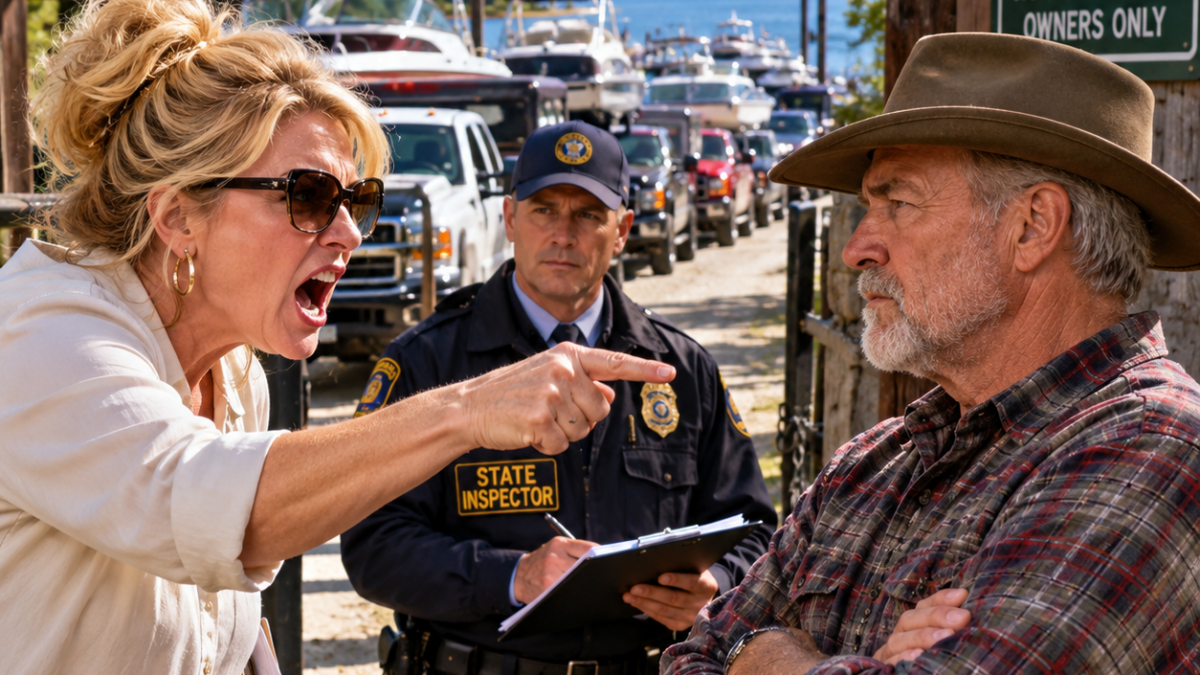
PART 2
I took the brochure off the wall and carried it outside, where the late-afternoon light made the fine print easier to read.
The map was small, but the omission was unmistakable.
Brier Glenn’s cul-de-sac appeared to connect directly to the gravel road leading down to my father’s boathouse.
There was no gap between the two properties. No separate boundary. No indication that the road crossed privately owned land.
Anyone looking at that drawing would reasonably assume the association owned a continuous corridor from its subdivision to the lake.
But I knew something the people who bought those marina passes didn’t.
Brier Glenn’s cul-de-sac had always ended 42 feet short of our property line.
That distance might not sound significant.
On a map, it was barely noticeable.
Legally, though, those 42 feet were the difference between a neighborhood amenity and an unauthorized road crossing somebody else’s land.
And the 1998 survey was not unfamiliar to me.
Years earlier, the complete document had been introduced as evidence in a shoreline access dispute.
I remembered a notation near the western boundary.
I couldn’t recall every word, but I remembered its meaning.
No public access had been acquired.
I folded the brochure and placed it in my truck.
Then I walked down to the lake.
My father’s green aluminum fishing boat sat beneath a blue tarp beside the boathouse. Someone had dragged it out of the water and pushed it against a retaining wall.
The trailer tires were flat.
One of the tie-down straps had been pulled so tightly that its metal hook had scraped the paint.
Dad had owned that boat for almost forty years.
It wasn’t valuable. The motor had been repaired so many times that I could practically identify each replacement part by the year he’d installed it.
But it was the boat he’d used to teach me to fish.
It was the boat he’d taken out every Sunday morning after my mother died.
Seeing it discarded beside a commercial-looking dock affected me more than the electronic gate.
I lifted the tarp and found his old wooden tackle box still beneath the middle bench.
For a moment, I could almost hear him telling me to stop standing around and check the fuel line.
Instead, I sat on the edge of the boat and looked across the water.
Dad had known Dana Whitmore.
That was what bothered me most.
He had mentioned her more than once during our telephone conversations.
He had called her persistent.
Then unreasonable.
Finally, after one particularly unpleasant encounter, he’d said, “That woman thinks everything has a price, Mason. And when somebody refuses to sell, she decides they must not understand the offer.”
At the time, I’d thought it was another neighborhood argument.
Now I wasn’t so sure.
I took photographs of the boat, the cut lock, the keypad, the pavilion, and the newly widened turnaround.
Then I started examining the boundary markers.
The first survey pin was buried beneath several inches of fresh gravel.
I found it by following the old property description and measuring from the corner of the stone retaining wall.
The red plastic cap was still intact.
Eleven feet away stood one of the electronic gate’s concrete posts.
I crouched beside the marker and brushed dirt from its stamped identification number.
The post wasn’t merely near our property.
It was on it.
I photographed both locations.
Then I went back to the house.
That night, I ate a sandwich standing at my father’s kitchen counter.
His reading glasses were still beside an unfinished crossword puzzle.
A half-used bottle of wood polish sat near the window.
The calendar above the refrigerator had stopped on the month he’d entered the hospital.
I had been away for too much of his final year.
That realization returned whenever the house became quiet.
I couldn’t change it.
But I could make certain that what he’d left behind wasn’t taken because I happened to arrive too late.
At 7:30 the next morning, someone pushed an envelope beneath the front door.
The letterhead read:
BRIER GLENN PROPERTY OWNERS ASSOCIATION.
Underneath, in bold capital letters:
NOTICE OF INTERFERENCE WITH COMMUNITY AMENITY.
I read it twice.
The association demanded that I immediately cease obstructing the lake access corridor, remove any vehicles from the marina turnaround, and surrender keys to the boathouse.
Failure to cooperate, it warned, could result in legal proceedings and financial liability for damages arising from the delayed Memorial Day opening.
I set the letter on the kitchen table.
Then I laughed.
Not because it was funny.
Because somewhere between my father’s funeral and the beginning of summer, an HOA president had decided she could threaten me for refusing to give her the keys to a building I owned.
My phone rang.
The caller ID displayed an unfamiliar local number.
“Mr. Reick?”
“Speaking.”
“This is Dana Whitmore.”
“Good morning, Dana.”
“I wanted to make sure you received our notice.”
“I did.”
“Then perhaps we can avoid making this more difficult than necessary.”
“That depends. Are you moving your gate?”
There was a pause.
“Mr. Reick, you’ve inherited a complicated property situation. I understand you’re grieving, but emotional attachment doesn’t override established community rights.”
I looked at my father’s glasses.
“Neither does printing a brochure.”
Her breathing changed slightly.
“The association has invested a considerable amount of money in this project.”
“How much?”
“That’s confidential financial information.”
“You’ve built part of it on my property. I think I’m entitled to ask.”
“Our membership has approved the improvements.”
“Did my father approve them?”
Silence.
I waited.
Finally, she said, “Your father was aware of our plans.”
“That’s not what I asked.”
“You’re repeating yourself.”
“Because you keep avoiding the answer.”
Her voice hardened.
“We’re holding an informational meeting this afternoon. You may attend if you’d like to hear the association’s position.”
“I’ll be there.”
“Please understand that the board will not tolerate disruptive behavior.”
I ended the call.
Then I photographed the notice and placed it with the brochure.
That afternoon, I drove to the county recorder’s office.
I requested the current deed, the subdivision plat, and any recorded easements affecting the western access road.
The clerk was a patient woman named Evelyn who had apparently spent most of her career answering questions from people convinced that a property line should exist wherever they wanted it.
She examined the parcel identification number.
“Your father’s place?”
“Was. He passed away.”
“I’m sorry. He used to come in here every few years to check things.”
That surprised me.
“What things?”
“Boundaries. Easements. He was careful about that property.”
She retrieved the recorded instruments.
The deed confirmed what I already knew.
The gravel road, private boat ramp, and boathouse were located within my father’s eleven-acre parcel.
There was no recorded permanent easement benefiting Brier Glenn.
But Evelyn found something else.
An index reference connected the association’s marina project to a correspondence file from 2019.
The actual file was in the county archive.
It would take time to retrieve.
“Was that about access?” I asked.
“Looks like it.”
“Can I get a copy?”
“I can put in the request.”
I thanked her.
Before leaving, I looked again at the subdivision plat.
Brier Glenn had its own internal streets, common areas, and lake-adjacent property.
But the road leading to our ramp wasn’t among them.
That evening, I arrived at the HOA clubhouse fifteen minutes before the meeting.
Approximately seventy people were already there.
The parking lot was full of pickup trucks, SUVs, and vehicles carrying boat racks.
Inside, rows of folding chairs faced a projector screen.
A large color map stood on an easel beside the podium.
My name appeared halfway down the printed agenda.
PROPERTY ACCESS CONCERNS — M. REICK.
I sat near the back.
A man in a fishing shirt leaned toward his wife and whispered something while looking at me.
She turned around.
Then she whispered something back.
Dana entered carrying the same blue binder I’d seen on the road.
She greeted several residents by name.
When she noticed me, she offered a small, controlled smile.
The meeting began with announcements about landscaping, the pool schedule, and summer security arrangements.
Then Dana switched on the projector.
A picture of the marina filled the screen.
“After years of planning,” she announced, “Brier Glenn is finally approaching completion of our beautiful new waterfront amenity.”
Several people applauded.
I remained seated.
“We’ve sold sixty-three household access memberships, and construction is nearly finished.”
She showed photographs of the pavilion, enlarged dock, and freshly paved parking area.
Then she changed slides.
My father’s road appeared on the screen.
“Unfortunately, we’ve encountered an unexpected challenge involving the adjoining property owner.”
People turned toward me.
Dana gestured politely.
“Mr. Mason Reick recently inherited the property adjacent to our established lake access corridor. Understandably, he has questions about the arrangement.”
I raised my hand.
She ignored it.
“Unfortunately, he has also suggested that he may restrict access just as families are preparing for Memorial Day.”
A man in the second row spoke.
“We paid for that access.”
“I understand,” Dana replied sympathetically.
I stood.
“You paid the association,” I said. “You didn’t pay me.”
The man turned around.
“What’s that supposed to mean?”
“It means I never sold anyone permission to use my road.”
Dana raised one hand.
“Mr. Reick, please allow me to finish.”
“Then explain where the association obtained the easement.”
“We have a longstanding right of access.”
“Recorded under what instrument number?”
Her smile tightened.
“Our legal counsel has reviewed the relevant documents.”
“Then you should have the recording information.”
“Mr. Reick, this is not a courtroom.”
I almost smiled.
Instead, I looked at the map.
“Why does your drawing show Brier Glenn’s cul-de-sac connecting directly to my road?”
“Because that’s the access route.”
“Where’s the property boundary?”
She hesitated.
Then she tapped the screen with a silver pointer.
“The route is clearly marked.”
“I didn’t ask about the route. I asked about the boundary.”
A few people shifted in their chairs.
Dana closed her binder.
“Mr. Reick, I appreciate that you have experience repairing tractors and farm equipment. But property law isn’t something you can settle by walking around with a tape measure.”
Someone laughed.
Dana glanced toward the sound.
“Owning a toolbox doesn’t make someone a surveyor. And it certainly doesn’t make someone an attorney.”
More laughter.
A man near the projector muttered, “Maybe he can weld himself an easement.”
I let the room settle.
Then I asked one final question.
“Did you offer my father money for permanent access in 2019?”
Dana’s pointer stopped moving.
It was only a moment.
But I saw it.
“What are you talking about?” she asked.
“I’m asking whether your association tried to purchase an easement.”
“Any historical discussions would have been handled by the board.”
“Did the board make an offer?”
“Mr. Reick, this meeting concerns our current marina.”
“And that marina sits behind a road my father refused to sell.”
Dana’s face hardened.
“Unless you have documentation proving that allegation, I suggest you stop making it.”
I nodded.
“Fair enough.”
Then I sat down.
For the remainder of the meeting, Dana presented construction photographs, event schedules, and optimistic revenue projections.
But whenever she discussed the road, her explanations became less specific.
By the time she announced the Memorial Day ribbon cutting, I understood the situation much better.
She wasn’t simply defending a mistaken survey.
She was defending an entire project whose financial success depended on a property right she couldn’t produce.
And apparently, she believed humiliating me in front of the neighborhood would make me go away.
The next morning, I called a surveyor.
Her name was Laura Chen.
She worked two counties away, and I’d never met her.
That mattered.
I wanted an independent professional whose findings couldn’t reasonably be dismissed as the work of an old friend.
When I explained the situation, she asked for the recorded deed and any existing survey documents.
I emailed them.
An hour later, she called back.
“Mr. Reick, there’s something unusual about the association’s drawing.”
“What did you notice?”
“The western boundary is missing.”
“Exactly.”
“That doesn’t necessarily prove anything was intentionally altered. But I’d like to see the original source document.”
“So would I.”
She agreed to begin the field survey Thursday.
Before hanging up, she asked, “What exactly do you do for a living?”
I looked down at my hands.
They were still stained from repairing Dad’s hydraulic lift.
“A little of everything,” I answered.
She chuckled.
“Well, you read property descriptions better than most people.”
“I’ve had practice.”
Thursday morning, Laura arrived in a white work truck with two field technicians.
They began setting up their equipment beside the county road.
Nine minutes later, Dana appeared.
She brought Tyler and her blue binder.
“You cannot conduct an unauthorized survey on association property,” she announced.
Laura didn’t stop adjusting her tripod.
“My client hired me to survey his parcel.”
“The ownership is disputed.”
“The boundary is disputed,” Laura replied. “The recorded ownership isn’t.”
Dana looked toward me.
“You’re escalating this unnecessarily.”
“I’m measuring what’s mine.”
“You’re trying to intimidate the entire community.”
Laura finally looked up.
“Ma’am, surveying a boundary is not intimidation.”
Dana took out her phone.
She filmed for nearly an hour.
Laura ignored her.
By the end of the second day, we had recovered three original boundary monuments.
The brass cap at the entrance.
The buried pin beside the electronic gate.
And an old iron pipe above the boat ramp.
All three matched the recorded deed.
The results were difficult to misunderstand.
The association’s electronic gate stood eleven feet inside my property.
Its newly constructed connecting road crossed forty-two feet of private land.
Sixteen feet of the marina turnaround occupied my parcel.
Even the pavilion roof extended eighteen inches beyond the boundary.
Laura displayed the overlay on her tablet.
“The monuments are consistent,” she said. “I don’t see a recorded easement supporting this construction.”
“Neither do I.”
She studied me.
“You don’t seem surprised.”
“I wasn’t expecting the ground to move.”
She smiled.
“No. But somebody certainly drew a map as though it had.”
I looked toward the clubhouse.
For the first time since returning to Bellweather, I felt we had something stronger than my memory of my father’s intentions.
We had measurements.
And measurements didn’t care who happened to be HOA president.
Unfortunately, Dana wasn’t finished.
That evening, she emailed every marina member.
The subject line read:
URGENT COMMUNITY ACCESS UPDATE.
According to Dana, an outside contractor hired by a disgruntled neighboring property owner had placed unverified markers across the association’s established road.
She claimed the board was preparing to take action to protect residents from interference.
The message included my name.
It did not include the survey.
It did not include the deed.
And it certainly did not mention that the association’s gate stood eleven feet inside my property.
The next morning, I discovered two orange barricades blocking the old logging trail behind my house.
A sign read:
CONSTRUCTION ZONE — NO ENTRY.
I stopped the truck.
For several seconds, I simply stared.
The trail was rough, narrow, and used almost exclusively by my father.
It had nothing to do with the marina.
Blocking it served no construction purpose I could identify.
But it did prevent me from reaching the house without using the road Dana controlled.
I photographed the barricades from several angles, moved them onto the shoulder, and drove through.
When I reached the porch, I called Dana.
She answered on the third ring.
“You’ve blocked my rear access.”
“Contractors are working in that area.”
“On my land?”
“The boundaries remain disputed.”
“The trail is nowhere near your construction.”
“Mr. Reick, the association cannot guarantee your safety if you enter an active work zone.”
“Then tell your contractors to stay off my property.”
She sighed.
“I was hoping we could handle this reasonably.”
“So was I.”
“Then stop threatening the marina.”
I looked through the kitchen window at the new dock.
“I haven’t threatened your marina. I’ve asked you to prove you have permission to reach it.”
“We have sixty-three families depending on that access.”
“Then you should’ve secured it before selling the passes.”
Her voice dropped.
“You’re going to make a lot of enemies.”
I ended the call.
A few hours later, I found out just how effective her campaign had become.
A family was waiting beside my mailbox.
The father introduced himself as Eric Shaw.
His wife was Marlene.
Their twelve-year-old son stood beside a recently purchased fishing boat.
The dealer’s temporary paperwork was still taped inside the windshield of their SUV.
Eric looked exhausted.
“Mr. Reick, can we talk?”
“Of course.”
He gestured toward the boat.
“We paid twenty-seven thousand dollars for this thing. We bought it because the HOA announced the marina.”
Marlene crossed her arms.
“Our son has been waiting all winter to take it fishing.”
The boy looked at me.
“Are you really going to close the road?”
I found that question harder than anything Dana had said.
“I’m trying to find out who gave the association permission to use it.”
Eric shook his head.
“Dana says your father agreed years ago.”
“Then she should be able to show you the agreement.”
“She says the documents are with the attorneys.”
“Has she shown you anything?”
He looked away.
Marlene answered.
“No.”
The boy was examining the boat’s trailer hitch.
He didn’t understand easements, property rights, or financing deadlines.
He understood that somebody had promised him a summer on the lake.
And now two adults were arguing over whether the promise could be kept.
I crouched slightly so we were closer to eye level.
“What’s your name?”
“Ben.”
“Ever catch a bass?”
He nodded.
“One time. My grandpa helped.”
“My father used to catch them out here before sunrise.”
He looked toward the trees.
“Is he still here?”
I swallowed.
“No, buddy. He passed away.”
Ben nodded solemnly.
Then he asked, “Would he have let us fish?”
I looked at his parents.
“He helped plenty of people fish. But that’s different from somebody selling strangers permission to use his property.”
Eric rubbed his forehead.
“I don’t know who’s telling the truth anymore.”
“Then ask Dana for the recorded easement. Ask her why the gate is inside my property line.”
Marlene studied me.
“Do you have proof?”
“I’m getting it.”
She nodded.
“We’ll ask.”
They drove away without making another accusation.
But after their taillights disappeared, I stood beside the mailbox longer than I needed to.
Dana had created a trap.
If I defended the boundary, I became the man ruining summer for families like the Shaws.
If I gave in, I rewarded the association for selling something it didn’t own.
And if I made one careless move, the entire dispute could be recast as an angry property owner using threats against his neighbors.
I needed the documents to speak before I did.
The next day, a contractor named Rick Alvarez arrived at my door.
He owned the company that had installed the gate footings and graded the road.
He was carrying a rolled set of construction plans.
“Mrs. Whitmore says you’re stopping our final paving,” he said.
“Did she tell you why?”
“She said you don’t agree with the property line.”
“Come inside.”
We spread the plans across the kitchen table.
Rick pointed to the proposed access corridor.
It was labeled HOA ACCESS RESERVE.
I asked where he’d obtained the drawing.
“The association’s project manager.”
“Did anyone give you an easement?”
“They said their attorney had it.”
“Did you see it?”
“No.”
I placed Laura’s preliminary survey beside his plan.
Rick leaned closer.
Then he looked at the property identification number printed inside the title block.
“That’s the subdivision cul-de-sac,” he said.
“Correct.”
He traced the road with one finger.
“But this section isn’t on that parcel.”
“No.”
He sat back.
For several seconds, he said nothing.
Finally, he asked, “You’re telling me we poured twelve thousand dollars of concrete on somebody else’s land?”
“I’m telling you what the survey indicates.”
His expression tightened.
“I asked them about the deed.”
“What did they say?”
“That their attorneys had cleared everything.”
“Who told you that?”
“Mrs. Whitmore.”
I let him study the documents.
Then I showed him the photographs of the original monuments.
Rick pulled out his phone.
He called his foreman.
“Cancel Monday’s paving.”
A pause.
“No, don’t move the crew here. Put them on the county job.”
Another pause.
“Because I said so.”
He ended the call.
Then he looked at me.
“Can I keep a copy of that survey?”
“I’ll give you one.”
He carefully rolled up his plans.
Before leaving, he said something that stayed with me.
“Mr. Reick, contractors make mistakes. We work off what clients give us. But somebody on that board knew enough to put the wrong parcel number on those drawings.”
I watched him drive away.
That was the first independent witness who could establish exactly what the association had provided to its contractors.
Dana could dismiss me.
She could attack the survey.
But now the man who had installed her gate was asking questions.
And the paving was canceled.
That afternoon, the county archive called.
Evelyn had found the 2019 correspondence.
I drove directly to her office.
She handed me a folder containing several letters and meeting records.
The first document was dated April 2019.
It was written on Brier Glenn letterhead.
The association offered my father eighteen thousand dollars for a permanent lake access easement across his road.
I recognized Dana’s signature.
Underneath was my father’s reply.
It was short and direct.
He acknowledged the offer, identified the road as private family property, and declined to grant permanent access.
I recognized his handwriting on the copy.
Dad had written one additional sentence at the bottom:
Please do not represent this road as community property.
I stared at it.
Then I turned to the board minutes.
Two weeks after receiving his refusal, the HOA had voted on increasing its offer.
The motion failed four to three.
The final paragraph contained a statement attributed to Dana Whitmore.
President Whitmore recommends alternative access strategy.
I read those words several times.
There was no misunderstanding here.
Dana had asked to purchase access.
My father had refused.
The board had declined to increase its offer.
And sometime afterward, the association had begun treating the road as though the transaction had already happened.
I drove back to the lake with the folder on the passenger seat.
As I passed the clubhouse, I noticed a new banner hanging above the entrance.
MEMORIAL DAY MARINA GRAND OPENING.
The date was only days away.
Dana still intended to proceed.
That evening, I called Laura.
“The 2019 file arrived,” I told her.
“Anything useful?”
“An offer to buy the easement. My father refused it.”
She was silent for a moment.
“That helps explain the history. It doesn’t replace the current boundary work, though.”
“I understand.”
“I’ll finish the signed survey Monday.”
“Thank you.”
After hanging up, I walked into my father’s bedroom.
His old wool sweater was still folded over the chair.
I sat on the edge of the bed and looked at the folder.
I remembered our last serious conversation about the property.
He’d been in the hospital.
His voice was weak, but his mind was clear.
“Don’t let them turn that road into a highway,” he’d told me.
I’d promised.
At the time, I hadn’t understood the urgency.
Now I did.
The next morning, I received a telephone call from Nolan Price.
He was a retired teacher who lived near Brier Glenn’s cul-de-sac.
We’d met briefly years earlier when my father helped him replace a trailer tire.
Nolan sounded embarrassed.
“I paid six hundred dollars for one of those marina passes,” he admitted.
“You’re not the only one.”
“My daughter bought one too. Dana told us your father donated the corridor after those negotiations in 2019.”
“He didn’t.”
“I suspected that when I heard you ask about the easement.”
I explained what the archive had produced.
Nolan was quiet.
Then he said, “There’s something else you should see.”
“What is it?”
“A board email.”
“From Dana?”
“Yes. She marked it confidential. But she’s asking us to pay for a project nobody can prove we legally have access to.”
He forwarded the message.
It contained financial information the members had not heard at the clubhouse meeting.
The marina pavilion had cost approximately $280,000.
The project was funded partly through special assessments and partly through a loan secured by anticipated amenity revenue.
The lender had conditioned its final $85,000 construction draw on proof of legal access and operational certification by May 31.
If that deadline was missed, the HOA might need an emergency assessment of approximately $1,350 per household to cover the resulting funding gap and obligations.
I read the email twice.
Suddenly, Dana’s behavior made sense.
The aggressive notices.
The hurried construction.
The threats.
The polished ribbon-cutting announcements.
The refusal to discuss the deed.
It wasn’t merely pride.
She was running toward a financial deadline.
Every day that passed without approval increased the risk that residents would discover how much money was tied to a right the association hadn’t secured.
And she had apparently decided that making me surrender was easier than admitting the truth.
Nolan called again.
“Did you read it?”
“Yes.”
“What do you think?”
“I think everyone who paid for a pass deserves to know what the board promised the lender.”
He exhaled.
“That’s what I thought.”
“Have you asked Dana?”
“She says you’re creating unnecessary legal complications.”
“Do you believe her?”
A long pause followed.
“No,” he said. “Not anymore.”
That Monday, Laura delivered the signed survey.
It confirmed every significant encroachment.
I assembled a packet containing the deed, current survey, archived correspondence, original plat, winter closure records, contractor’s plans, and aerial photographs.
The winter closure records came from my father’s old receipts.
For twenty-four years, he’d paid a local maintenance company to chain the road during the colder months and winterize the ramp.
Several invoices specifically mentioned turning away vehicles from Brier Glenn.
The aerial photographs supplied another important detail.
The gravel connection between Brier Glenn’s cul-de-sac and our road had not existed until the previous fall.
That made Dana’s claim of an established, continuously used community corridor much harder to reconcile with the physical evidence.
I sent the packet to the HOA, its attorney, the county permitting office, and the Bellweather Reservoir Authority.
I requested a routine compliance review of the marina permit and access plan.
Nothing more.
I did not demand arrests.
I did not ask anyone for special treatment.
I did not contact the courthouse.
There was a reason for that.
My work required me to be careful about the distinction between professional authority and private rights.
On this matter, I was a landowner.
That was all I needed to be.
The reservoir authority acknowledged receipt and scheduled a field inspection.
The date was Memorial Day morning.
The same day Dana intended to open the marina.
When I saw the confirmation, I stared at the screen for several seconds.
I hadn’t chosen the timing.
But I understood what it meant.
Dana would have to produce her documents in front of the very families who had paid her association for access.
She still had an opportunity to postpone.
Instead, she made the event bigger.
Banners appeared throughout the subdivision.
The newsletter advertised a ribbon cutting at ten o’clock, lunch at noon, and a boat parade at one.
By Thursday, a catering truck was delivering equipment to the clubhouse.
I received another association letter accusing me of interfering with community improvements.
Then, three days before the opening, Dana appeared at my front door.
She was alone.
No binder.
No golf cart.
Just the scarlet blazer and a two-page agreement.
“We need to talk,” she said.
I stepped onto the porch.
“Go ahead.”
She handed me the papers.
“I think we can resolve this without involving outside agencies.”
I read the agreement.
The proposed terms would grant Brier Glenn permanent use of my road, ramp, turnaround, and boathouse.
There was no purchase price.
No meaningful restriction on use.
No stated insurance requirement.
No limitation on the number of households.
In exchange, the association offered to maintain the gravel and waive any claim against me for construction delays.
I looked up.
“You’re asking me to give the association everything my father refused to sell.”
“I’m offering to end an unnecessary dispute.”
“You’re offering not to sue me for preventing you from using land you don’t own.”
She pressed her lips together.
“The association has significant expenses.”
“Then the association should have secured access before spending the money.”
“You’re being unreasonable.”
I held out the papers.
“Do you think my father was unreasonable when he refused your eighteen-thousand-dollar offer?”
She stopped.
For the first time, I saw genuine uncertainty cross her face.
“Where did you get that?”
“County archives.”
She looked toward the road.
Then she recovered.
“That was years ago.”
“It was your signature.”
“Circumstances have changed.”
“The property line hasn’t.”
She lowered her voice.
“Mr. Reick, you’re about to become the man who ruined summer for sixty-three families.”
I thought of Ben Shaw standing beside his new boat.
I thought of my father’s handwriting.
And I thought of the $85,000 loan draw the association was counting on.
“You sold them something you couldn’t deliver,” I said.
“Those families relied on our representations.”
“Exactly.”
Her eyes narrowed.
“Your father isn’t here anymore.”
The words landed harder than she probably intended.
For a moment, my hand tightened around the agreement.
I wanted to tell her about the hospital.
About the last afternoon Dad could still sit upright.
About how he’d been more worried about the road than the old fishing boat or the house.
But she hadn’t come to hear any of that.
She’d come to get my signature.
I folded the papers and handed them back.
“The inspection is Monday.”
“I know.”
“Bring the original survey.”
“Our maps have already been approved.”
“Then you shouldn’t have a problem.”
She stared at me.
“You have no idea how much trouble you’re causing.”
I kept my voice even.
“I know exactly what I’m asking for.”
She walked away.
I watched her SUV disappear between the trees.
Then I went inside and placed my father’s 2019 letter in the document case.
Memorial Day arrived clear and warm.
By nine in the morning, the subdivision looked as though it was hosting a wedding.
Blue balloons fluttered above the new dock.
Rows of folding chairs faced a small podium.
A white canopy covered the catering tables.
Families carried coolers and tackle bags toward the marina.
The smell of fresh coffee drifted across the lawn.
Dana stood near the entrance greeting people.
She wore the same red blazer.
This time, a large ceremonial ribbon stretched between two posts near the dock.
I came down from the house carrying my slim document case.
Nolan Price stood near the back of the crowd with his daughter.
Rick Alvarez was beside his work truck.
Laura Chen had already positioned her survey equipment near the road.
The Shaws were standing beside their boat trailer.
Ben spotted me.
He raised one hand.
I waved back.
At 9:40, Dana approached.
“Mr. Reick, I thought we agreed you wouldn’t interfere with the ceremony.”
“I’m here for the inspection.”
“The inspectors will review our approved documents.”
“Good.”
“You’re not authorized to address our guests.”
“I don’t intend to.”
She glanced toward Laura’s equipment.
“That surveyor is creating an unnecessary spectacle.”
“She’s here to answer technical questions.”
Dana folded her arms.
“I hope you understand that any inaccurate statements you make today could expose you to liability.”
I looked at her.
“Then it’s fortunate I brought the records.”
She started to answer.
But at that moment, three white state vehicles turned into the subdivision.
Conversation around the lawn slowed.
The first vehicle stopped near the old stone boundary marker.
A tall, gray-haired man stepped out wearing a Bellweather Reservoir Authority identification badge.
Two other officials followed him.
A permit officer carrying a tablet.
And a survey crew with field equipment.
Dana immediately straightened.
She walked toward them with a welcoming smile.
“Good morning, gentlemen. I’m Dana Whitmore, president of the Brier Glenn Property Owners Association.”
The gray-haired man nodded.
“Calvin Mercer. Reservoir Authority.”
He looked toward the marina.
Then toward Laura’s tripod.
Then he noticed me.
He stopped walking.
For a second, his expression showed surprise.
“Mason?”
“Morning, Calvin.”
He approached.
We shook hands.
“I didn’t realize this was your family’s property.”
“It was my father’s.”
“I’m sorry to hear about him.”
“Thank you.”
Then Calvin said the two words Dana had no way of anticipating.
“Judge Reick.”
The conversations around us faded.
Dana looked from Calvin to me.
“Judge?”
Calvin turned slightly.
“You haven’t met professionally?”
“No,” Dana answered.
He nodded toward me.
“Judge Reick has served on the Central Circuit Superior Court for eleven years. I’ve testified before him in two reservoir-related condemnation proceedings.”
I watched Dana’s expression change.
The confidence didn’t vanish all at once.
First, her smile froze.
Then her eyes moved to my work jacket.
Then to the document case in my hand.
The same man she’d dismissed as a tractor mechanic was suddenly standing beside a state official who knew him from a courtroom.
But I hadn’t come to embarrass her over my job.
And I certainly hadn’t come to use it against her.
I wanted the road measured.
Dana recovered quickly.
“Then this is an obvious conflict of interest.”
Calvin looked puzzled.
“What is?”
“Judge Reick is attempting to use his position to influence an agency in a private property dispute.”
Several residents turned toward me.
I had expected that argument.
It was one of the reasons I’d been careful from the beginning.
“I submitted the compliance request as the property owner,” I said. “My position was disclosed in the cover letter.”
Calvin turned toward the permit officer.
“How did this come in?”
The officer opened his tablet.
“Standard public submission portal. Received Monday at 8:14 a.m.”
“Any internal referrals?”
“No.”
“Priority designation?”
“No.”
“Judicial letterhead?”
“No.”
The officer scrolled further.
“The request includes a disclosure that the applicant serves as a judicial officer and seeks no preferential handling.”
Calvin looked at me.
“Why didn’t you just call my office?”
“Because the public counter was available.”
For a moment, nobody spoke.
Then Nolan said quietly from behind the chairs, “So he could’ve called somebody, and he didn’t.”
I didn’t answer.
It wasn’t necessary.
Dana tightened her grip on the blue binder.
“This association has approved plans,” she insisted.
“Then let’s examine them,” Calvin replied.
The inspection began beside the electronic gate.
Laura stepped forward and introduced herself.
She presented her signed survey.
“Our field work recovered three original monuments consistent with the recorded deed,” she explained. “The electronic gate is eleven feet inside Mr. Reick’s parcel. The connecting route crosses forty-two feet of private property.”
Dana interrupted.
“Those findings contradict our historical access documents.”
Calvin held out his hand.
“May I see those documents?”
She opened the binder.
The first sheet was a construction site plan.
The second was the familiar cropped 1998 map.
Calvin examined it.
Then his eyebrows moved slightly.
“Where’s the western margin?”
Dana leaned closer.
“This is the approved route.”
“That’s not what I asked.”
She looked at the page.
“It’s an enlarged exhibit.”
“Where’s the rest of the survey?”
“I believe this contains the relevant section.”
Calvin turned toward me.
“Judge Reick, did you bring the recorded documents?”
“Yes.”
I opened the case.
Inside was the certified copy of the complete 1998 shoreline access survey.
I handed it to him.
He unfolded the sheet on the hood of the state vehicle.
The wind caught one corner.
Laura held it flat.
Calvin studied the western boundary.
Then he pointed to a hatched strip between the subdivision and my father’s road.
Printed across it were four words.
NO PUBLIC ACCESS ACQUIRED.
Beneath that notation were three original signatures.
The boundary was not new.
It had existed long before I’d become a judge.
And the complete survey had been part of an earlier reservoir proceeding.
Calvin remembered it because he’d testified about it years before.
He looked from the certified copy to Dana’s cropped exhibit.
“These aren’t equivalent drawings.”
Dana stepped closer.
“The association has relied on the access corridor for years.”
“Your exhibit omits the parcel boundary and the access limitation.”
“That’s a technical matter.”
“It’s a material difference in the plan we’re being asked to approve.”
The permit officer examined the construction site plan.
Then he opened the county property record on his tablet.
“There’s another problem.”
He pointed to the parcel number.
“This identifies the HOA’s cul-de-sac as the access reserve.”
“That’s correct,” Dana said.
“No,” he replied. “The roadway connection shown here extends onto a different parcel.”
Rick Alvarez stepped forward.
“That’s the drawing my company received.”
Dana turned sharply.
“Mr. Alvarez, you’re not part of this inspection.”
“I’m the contractor who poured your gate footings.”
He held up his copy of the plans.
“You gave us this.”
“Your contract required you to verify site conditions.”
Rick stared at her.
“Site conditions? Yes. I wasn’t hired to establish whether you actually owned the parcel you told us to build on.”
The people nearest the vehicles began murmuring.
Dana raised her voice.
“The association has acted in good faith based on professional advice.”
“Then where is the recorded easement?” Calvin asked.
Her answer came too quickly.
“Our attorney has addressed that question.”
“Has an easement been recorded?”
“I don’t have that information with me.”
Calvin looked toward the permit officer.
The officer shook his head.
“We haven’t located one in the submitted file.”
For the first time all morning, Dana appeared to have no prepared response.
Then Nolan stepped out of the crowd.
“What about the 2019 offer?”
Dana turned toward him.
“Nolan, this isn’t the time.”
He held up a printed copy of the board minutes.
“You tried to buy the road.”
Several people looked at one another.
Dana’s face tightened.
“Those discussions were preliminary.”
“And the board voted against increasing the offer.”
“That has nothing to do with the current project.”
“It has everything to do with it,” Nolan replied. “You told us Mason’s father donated the corridor after that vote.”
A woman near the chairs gasped.
Dana looked around.
“I never said that.”
Nolan held up his phone.
“I have the email.”
I saw Eric Shaw move closer.
Marlene stayed beside their son.
Someone near the front asked, “If the old man refused, why did we sell passes?”
Another voice followed.
“Why did we pay the assessment?”
Then another.
“What happens to the loan?”
Dana raised both hands.
“Please, everyone. We need to remain calm.”
But the questions kept coming.
“Where’s the agreement?”
“Who approved the road?”
“Are we losing our marina?”
The permit officer continued working.
He compared Laura’s measurements against the construction plan.
He examined the gate.
He photographed the pavilion overhang.
He reviewed the altered map.
Then he asked Rick several questions about the site plan supplied to his company.
The answers were consistent.
The contractor had relied on representations made by the association.
The recorded ownership did not support those representations.
And the marina access shown in the permit packet crossed property the association did not control.
Calvin stepped toward the podium.
“Mrs. Whitmore, the authority cannot authorize marina operation under the present approval.”
Dana stared at him.
“Excuse me?”
“The access documentation is deficient. The approved site plan does not accurately identify the property being used.”
She took a step forward.
“But we’ve already scheduled our opening.”
“I understand.”
“We have families here.”
“I understand that too.”
“We’ve spent hundreds of thousands of dollars.”
Calvin kept his voice level.
“That doesn’t establish legal access.”
Dana looked toward the dock.
The ceremonial ribbon was still stretched between the posts.
Blue balloons moved above the water.
The caterer had begun placing lunch trays beneath the canopy.
Everything was prepared.
Except the one thing the association needed.
Permission to use the road.
The permit officer removed a red notice from his folder.
He attached it to the electronic gate.
MARINA OPERATIONS SUSPENDED PENDING COMPLIANCE.
Dana stared at the paper.
“You’re shutting us down?”
“We’re suspending the marina’s operating approval until lawful access is documented and the site plan is corrected.”
“For how long?”
“That depends on how the deficiencies are resolved.”
She turned toward me.
“This is what you wanted.”
I looked at the gate.
Then at the families standing behind her.
“No,” I said. “I wanted you to tell the truth before you sold those passes.”
Her face reddened.
“You could have approached us privately.”
“I did.”
“You could have negotiated.”
“My father tried that conversation six years ago. You asked to buy access. He said no.”
She opened her mouth.
I continued.
“You had his answer in writing. You had the board vote. You had the property records. And you built the marina anyway.”
Dana glanced toward Calvin.
“Is he allowed to make accusations during an inspection?”
Calvin replied before I could.
“He’s allowed to explain the documents he submitted.”
The people standing closest to us were silent.
A few yards away, Ben Shaw looked at his father’s unused fishing boat.
I could see the disappointment on his face.
That was the hardest part.
There was no victorious feeling watching the marina close.
No satisfaction in seeing children turn away from the dock.
My father had spent a lifetime helping neighbors.
He would have hated watching families get caught in a conflict they hadn’t created.
But he’d also believed that a promise meant nothing if the person making it had no right to give it.
Dana had made sixty-three promises.
And now the truth had arrived to collect on them.
The ceremony ended without the ribbon being cut.
No one shouted.
No police vehicles appeared.
Dana wasn’t led away in handcuffs.
The caterer continued arranging sandwiches because he’d already been paid.
The balloons drifted above a dock nobody could legally operate.
The scene was almost painfully ordinary.
A woman had built an elaborate public celebration around documents that could not withstand inspection.
And now the celebration had nowhere to go.
As people began leaving, Eric Shaw approached me.
Marlene stood beside him.
Ben was looking toward the water.
Eric extended his hand.
“I owe you an apology.”
I shook it.
“You were trying to protect your family.”
“Yeah. But I should’ve asked harder questions.”
Marlene glanced toward the suspended marina.
“What happens now?”
“That’s up to the association and its members.”
“Will you ever let us use the road?”
I looked at Ben.
“I haven’t ruled anything out.”
She seemed surprised.
“After all this?”
“My father never refused to help people. He refused to give away the right to decide.”
Eric nodded slowly.
“I think I understand.”
They walked back toward their SUV.
I stayed beside the stone boundary marker until most of the crowd had gone.
Calvin approached before leaving.
“You handled this carefully,” he said.
“I tried to.”
“You know someone will probably claim the agency favored you because of your position.”
“I know.”
“But the records stand on their own.”
“That’s why I wanted them.”
He glanced toward the red suspension notice.
“The permit review will follow its normal process.”
“Good.”
He looked at the lake.
“Your father must’ve loved this place.”
“He did.”
“Then I’m glad the ownership records were clear.”
I thanked him.
After the state vehicles departed, I walked back up to the house.
I set the document case on the kitchen table.
Then I sat in my father’s chair.
The house was quiet.
Outside, I could hear the faint sound of someone removing decorations from the marina entrance.
For the first time in weeks, I didn’t feel as though the road might be taken while I wasn’t looking.
But the dispute wasn’t finished.
Three days later, Nolan called.
“The board voted.”
“On what?”
“Removing Dana as president.”
I waited.
“Six to one,” he said.
I leaned back in my chair.
“That’s a decisive vote.”
“It wasn’t easy.”
He explained that the directors had received copies of my original compliance request, Laura’s survey, the archived 1998 plat, the 2019 correspondence, and the financing email.
Dana had continued claiming that I’d used my judicial position to pressure the reservoir authority.
But the portal submission showed the request had been handled through ordinary public procedures.
Two directors who had previously supported her changed their votes after reviewing the complete documentation.
One had apparently been particularly disturbed by the difference between the cropped access map and the archived original.
Nolan sounded exhausted.
“The board’s hiring independent counsel.”
“Good.”
“And an outside accountant.”
“Also good.”
“People want to know where the money went.”
I thought about the marina.
“I suspect most of it is standing beside my boathouse.”
He gave a humorless laugh.
“Probably.”
Then his voice softened.
“Mason, I wanted to apologize for the way people treated you at that first meeting.”
“You didn’t organize it.”
“No, but I sat there while they laughed.”
“I noticed.”
He was quiet.
“I should’ve spoken up.”
I looked toward the kitchen window.
“Nolan, the important thing is what happens next.”
The board’s accountant began examining the amenity fund.
There were no dramatic discoveries involving secret accounts or suitcases of cash.
The money had gone into exactly the kind of expenses the marina required.
Dock construction.
Pavilion materials.
Site grading.
Landscaping.
Gate installation.
Loan payments.
Professional fees.
The problem wasn’t that Dana had secretly pocketed the membership revenue.
The problem was that she’d committed the association to a costly project without securing lawful access.
She had treated an unresolved property right as an obstacle that could be overcome through construction, financing pressure, and community expectations.
Perhaps she’d convinced herself that once the marina existed, nobody would be willing to dismantle it.
Perhaps she believed the residents’ investment would eventually force me to surrender.
I never learned exactly how she justified it to herself.
But the board now had to deal with the consequences.
The association refunded the current year’s marina access fees from its reserves.
The independent attorney reviewed the construction plans and began discussions with the reservoir authority.
The contractor removed the electronic gate.
I watched as workers broke apart the concrete footings inside my property.
The sound echoed through the trees.
For weeks, that gate had been the first thing I saw whenever I came home.
Watching it disappear was an extraordinary relief.
The unauthorized gravel connection was removed and the affected portion of the property restored pending a lawful access arrangement.
The pavilion roof was cut back eighteen inches.
Survey markers were left visible.
A temporary fence was installed to prevent vehicles from entering the disputed corridor.
The marina remained closed while the association and its insurer evaluated the next steps.
For six weeks, the only boat using my father’s ramp was his old green aluminum fourteen-footer.
I worked on it myself.
The fuel line had dried out.
The trailer tires were beyond saving.
The motor needed cleaning.
I replaced what I could and repaired the rest.
One Tuesday morning, I finally launched it.
The lake was almost empty.
I drove out past the point where Dad had always stopped to fish and shut off the motor.
The boat rocked gently beneath me.
I rested one hand on the worn wooden seat.
For years, I’d associated this place with him.
The sound of his outboard motor.
The smell of gasoline and damp fishing rope.
The way he could tell whether a storm was coming by studying the far shore.
I remembered being twelve years old, frustrated because I’d tangled my fishing line for the third time that morning.
Dad had taken the rod from my hands.
Instead of scolding me, he’d patiently worked the knot loose.
“Some things get worse when you pull harder,” he’d said.
I’d forgotten that sentence for decades.
Now, sitting alone in his boat, it returned.
I had spent weeks pulling against Dana’s claims.
Every demand had brought another threat.
Every request for documentation had produced another accusation.
But in the end, the decisive facts had been waiting in the records all along.
The deed.
The survey.
The rejected offer.
The incomplete map.
None of them depended on my professional title.
None of them became more valid because a state inspector recognized me.
They simply told the truth.
I stayed on the lake until the sun began moving behind the western trees.
Then I started the motor and returned to the ramp.
A week later, I received an unexpected letter from the new HOA board.
It was different from Dana’s notices.
There were no threats.
No accusations.
No references to community damages.
The board acknowledged that the road, ramp, turnaround, and boathouse belonged to me.
It also acknowledged that previous representations concerning permanent access were not supported by the recorded property documents.
Then it asked whether I would consider discussing a limited, lawful access arrangement.
I read the letter twice.
My first reaction was to say no.
I had every reason.
Dana had threatened me, humiliated me publicly, obstructed my access, and tried to pressure me into surrendering my father’s property.
It would have been easy to close the road permanently and tell the subdivision to find another boat ramp.
Nobody could have reasonably blamed me.
But then I thought of the families.
Of Nolan and his daughter.
Of Eric, Marlene, and Ben.
Of the people who had purchased boats and paid assessments because someone they trusted told them the marina would be available.
They hadn’t invented the altered map.
They hadn’t installed the gate.
They had been sold a promise.
I called Nolan.
“Tell the board I’m willing to discuss a temporary license.”
He went quiet.
“Seriously?”
“With conditions.”
“Of course.”
“Strict ones.”
“I would expect nothing less.”
I looked at my father’s photograph on the mantel.
“And nobody gets to treat it as permanent ownership.”
Nolan’s voice softened.
“I think everyone understands that now.”
The negotiations took several weeks.
I insisted that the association retain independent counsel.
I retained an attorney of my own.
I wanted the agreement documented properly, with clear terms and no ambiguity about ownership.
The association initially proposed reopening access for all sixty-three membership households.
I declined.
The road was narrow.
The turnaround was limited.
The shoreline couldn’t handle unlimited traffic.
After discussions about safety, maintenance, and liability, we agreed on a smaller seasonal program.
Forty household permits.
Daylight use only.
A five-mile-per-hour speed limit.
No storage in my boathouse.
No association-controlled gate inside my boundary.
The HOA would maintain the authorized gravel route, restore the shoreline after seasonal use, and carry appropriate liability insurance.
An annual license fee would be paid into a separately accounted fund subject to resident review.
The agreement could be suspended for safety violations.
It would be reviewed every three years.
Most importantly, it granted a limited license.
It did not transfer ownership.
It did not create a permanent public road.
And it did not erase my father’s refusal to grant the easement Dana had sought.
The new board accepted those terms.
When I signed the agreement, I felt something I hadn’t expected.
Not triumph.
Relief.
I wasn’t being forced to choose between protecting my father’s property and allowing neighbors to enjoy the lake.
For the first time, the two things could coexist.
The marina reopened in August.
There were no balloons.
No ribbon cutting.
No elaborate speeches.
The association placed a small sign near the entrance explaining the seasonal rules.
The first permitted vehicle down the road belonged to Nolan Price.
I was standing beside the old brass boundary cap when he arrived.
He lowered his window.
“Morning, Mason.”
“Morning.”
He looked at the wooden gate.
“Feels different without that electronic thing.”
“It does.”
He smiled.
“I promise not to run over five miles an hour.”
“I’ll be watching.”
He laughed.
Then he pulled forward slowly.
The tires rolled over the gravel without kicking up dust.
I listened until the truck disappeared around the bend.
A few minutes later, the Shaw family arrived.
Ben was practically bouncing in the passenger seat.
Eric stopped beside me.
“Everything okay?”
“Permit displayed?”
He pointed to the windshield.
“Right there.”
“Life jackets?”
Marlene held one up from the back seat.
“Three of them.”
I looked at Ben.
“You ready?”
He grinned.
“Been ready since May.”
I stepped aside.
“Then have a good day.”
They drove toward the lake.
Watching the boy disappear down that road made me think of my father.
He would have appreciated the sight.
Not because the road had become a community amenity.
But because it was still private land, shared by choice rather than taken through pressure.
Dana remained in Brier Glenn.
I saw her once that fall at the grocery store.
She was standing near the produce section when she noticed me.
For a moment, neither of us spoke.
Then she glanced at my faded work jacket.
“You could have told me,” she said.
“Told you what?”
“Who you were.”
I rested one hand on the shopping cart.
“You knew who I was.”
She shook her head.
“You know what I mean.”
“Yes,” I said. “I do.”
Her eyes moved toward my hands.
They were stained from working on Dad’s tractor again.
She looked almost irritated by them.
“As a judge, you understood exactly how serious this would become.”
“I understood the importance of ownership records.”
“You let me stand there and make a fool of myself.”
I considered that.
Then I answered.
“Dana, I told you the road belonged to my father. I asked for your easement. I gave you opportunities to produce it.”
She looked away.
“You could have said you were a judge.”
“Would that have made you respect the deed?”
She didn’t answer.
I continued.
“I shouldn’t have needed a title for you to take my property rights seriously.”
For a moment, I thought she might argue.
Instead, she tightened her grip on the handle of her cart.
“People lost a lot of money over this.”
“Yes,” I said. “They did.”
She looked at me one final time.
Then she turned and walked away.
I didn’t follow her.
There was nothing left to settle between us in a grocery aisle.
The board had removed her as president.
The association had corrected the access problem.
The members had received their refunds and a new, limited marina arrangement.
The road was still mine.
And the lake was quiet again.
By late October, most of the boats had been put away for winter.
I closed the wooden gate after the final permitted day of the season.
Then I walked to the stone marker at the county road.
The brass plate was dull with dust.
I went back to the house, found my father’s old polishing cloth, and returned.
I worked slowly, clearing the dirt from the engraved letters.
REICK — WEST LINE — 1967.
The same words I’d seen when I first arrived and discovered strangers blocking the road.
I remembered Tyler telling me I needed a visitor pass.
I remembered Dana standing in her scarlet blazer, assuring the neighborhood that her attorneys had everything under control.
I remembered the laughter in the clubhouse.
The cut lock on the boathouse.
The altered map.
The moment Calvin Mercer recognized me.
And the silence that followed when the complete survey was unfolded on the hood of a state vehicle.
But none of those memories was as strong as the one that returned while I polished the brass.
My father, kneeling beside that same stone marker, showing a much younger version of me how to clear the weeds from around it.
He had placed his hand on the post and explained where our land ended.
At twelve years old, I’d assumed property boundaries existed mainly to keep people out.
It took me nearly fifty more years to understand what he had been protecting.
A boundary didn’t prevent generosity.
It made genuine generosity possible.
When the line was respected, I could open the gate because I wanted to.
I could help a neighbor because I chose to.
And I could let a family take their son fishing without surrendering the land my father had entrusted to me.
The road still belongs to my family.
The old boathouse still stands above the water.
My father’s green fishing boat is back where he always kept it.
And every spring, when the first approved vehicles come slowly down the gravel, I look toward the lake and remember the promise I made during his final weeks.
I kept his road.
I kept his name on the boundary.
And when I finally opened the gate again, it was because the choice belonged to me.
[END OF STORY]








