PART 2: HOA Sold 1,000 Christmas Tickets to My Private Tree Farm—Then Families Arrived to Find an Empty Field
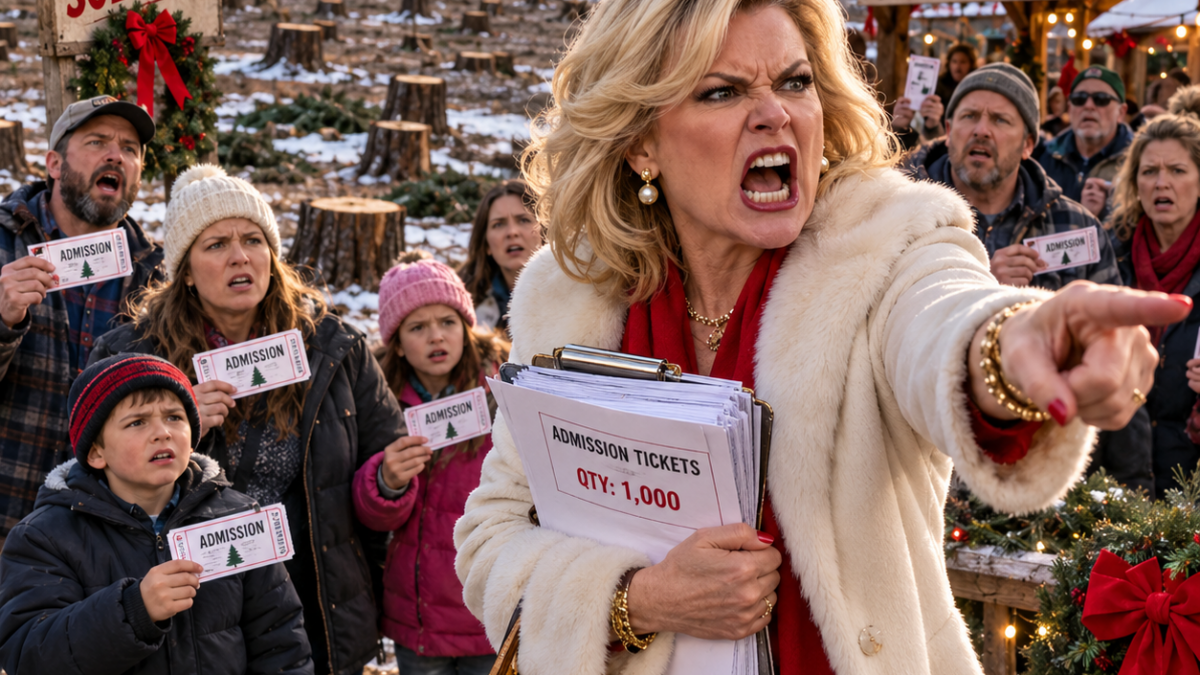
At 9:40 on the first Saturday of December, I stood on the hill above my Christmas tree farm with a cup of coffee in my hand and watched the first shuttle buses unload families who had paid $85 apiece to walk through a glowing forest that no longer existed.
Nearly a thousand people were coming, the HOA president was standing beneath a banner with my farm’s name printed across it, and she was still smiling as parents in matching Christmas sweaters began staring past her at acres of frozen dirt, young saplings, and freshly cut stumps.
Six weeks earlier, I had thought Vivian Cross was merely trying to bully me into lending her my land, but before that morning was over, I would learn she had built her entire holiday spectacle on something far more dangerous than arrogance.
My name is Tobias Ren, and Ren Hollow Tree Farm had been in my family longer than Pinerest Meadows had existed.
My grandfather planted the first rows by hand. My father expanded them. By the time the farm came to me, fifty-two acres held Fraser firs, Douglas firs, blue spruce, equipment sheds, a weathered farm stand, and enough memories that I could still walk certain rows and remember exactly where my father used to stop to sharpen his saw. The farm had its own deed, its own county-road entrance, paid its own taxes, and had never belonged to the neighboring HOA.
Vivian had spent three years pretending otherwise.
She mailed me violation notices about my barn lights.
She demanded I repaint the farm stand because the dark green trim wasn’t on Pinerest Meadows’ approved palette.
Once she fined me $1,200 for “unsightly agricultural debris.”
The debris was wood chips.
Every letter went back with the same handwritten sentence.
**Private property. Not part of your association.**
Then, late in October, Vivian arrived at my farm stand with a woman named Heather Blaine, an event planner wearing a red puffy vest and carrying a tablet.
Vivian walked inside as though we’d scheduled a meeting.
“We’ve finalized the Winter Forest Festival,” she announced.
I looked up from an invoice.
“Congratulations.”
Heather smiled uncertainly.
Vivian continued. “The first weekend of December. Friday evening through Sunday. Lighting installations begin several days beforehand.”
“Sounds expensive.”
“It will be spectacular.”
“Still not sure why you’re telling me.”
Her smile tightened.
“Because Ren Hollow is the venue.”
I stared at her.
Heather stopped tapping her screen.
“What?”
“We’ll need access to the entire farm.”
“You’ll need another venue.”
Vivian laughed.
Not nervously.
Actually laughed.
“Tobias, the board already approved it.”
“Your board can’t approve the use of my land.”
“We’re offering enormous exposure. Families from three counties will attend.”
“Exposure doesn’t pay my bills.”
She crossed her arms.
“What would?”
I gave her the number deliberately.
“Closing this farm during peak Christmas season would cost me more than a hundred fifty thousand dollars before we even discuss liability, cleanup, staffing, or damage.”
Heather’s eyes widened.
Vivian’s didn’t.
“That’s absurd.”
“Then finding another location should be easy.”
She stepped closer to the counter.
“This festival is important to the community.”
“So are the wholesale contracts that keep this farm operating.”
“You could benefit from cooperation.”
“I could benefit from selling Christmas trees in December.”
Her smile disappeared.
“The board has voted.”
“And my deed doesn’t care.”
Heather looked between us.
“Vivian, I thought Mr. Ren had already—”
Vivian cut her off.
“We’re still finalizing details.”
“No,” I said. “You’re not finalizing anything here.”
Vivian gathered her gloves from the counter.
“You’ve always been unnecessarily difficult about Pinerest.”
“I don’t belong to Pinerest.”
“We share a boundary.”
“That’s geography, not membership.”
She turned toward the door.
Then she stopped.
“You’ll come around, Tobias.”
“I won’t.”
She looked back at me with an expression I couldn’t read.
“People usually do.”
Nine days later, Heather called.
Her voice was bright at first.
“Mr. Ren, I just wanted to thank you personally. I know there was some tension during our first meeting, but I’m glad everything worked out.”
I put down the pruning shears in my hand.
“What worked out?”
“The festival agreement.”
“I didn’t agree to a festival.”
Silence.
Then I heard keyboard clicks.
“Your license agreement was executed Tuesday.”
“No, it wasn’t.”
Another pause.
“Mr. Ren, I have your signature.”
My hand tightened around the phone.
“Email it to me.”
“Tobias—”
“Send me the document, Heather.”
The message arrived less than a minute later.
Eleven pages.
I opened the attachment at the desk where my father used to do payroll, scrolled past clauses giving the HOA exclusive control of my farm for three December days, past insurance language I had never seen, past a paragraph claiming I had already accepted a $40,000 partnership payment I had never received, and finally reached the signature page.
For several seconds, I simply stared at my own name.
Someone else had written it.
[END OF FACEBOOK OPENING]
[FULL STORY CONTINUATION]
The signature wasn’t perfect.
That was almost worse.
If it had been obviously fake, a childish imitation of my handwriting, I might have reacted with anger first. Instead, whoever had written it had gotten close enough to make me feel as though somebody had been studying me.
The long downward stroke in the R.
The narrow loop in the b.
The way I usually ended my last name with the final letter rising slightly instead of trailing flat.
I enlarged the page on the monitor.
My stomach tightened.
Heather was still on the phone.
“Tobias?”
“Where did you get this?”
“Vivian sent the executed agreement to me.”
“When?”
“Tuesday morning.”
“Did you see me sign it?”
“No.”
“Did anyone from your company?”
“No, but she said—”
“Heather, I did not sign this.”
The words came out more quietly than I expected.
She stopped speaking.
I could hear faint office noise on her end.
Finally she said, “Are you saying this is forged?”
“I’m saying somebody put my name on an eleven-page agreement giving an HOA control of fifty-two acres I own, and it wasn’t me.”
“Oh my God.”
“Who else has this?”
“I don’t know.”
“That’s not good enough.”
“I need to check.”
“Check now.”
She sounded offended for half a second, then scared.
“I’ll call you back.”
“No. First send me everything you received with it. Original email. Attachments. Headers if you have them. Don’t forward just the PDF. Preserve the message.”
“Why?”
“Because I’m calling my attorney.”
I hung up before she could say anything else.
Then I called Vivian.
She answered on the third ring.
“Tobias.”
“Did you send Heather Blaine a contract with my signature on it?”
No surprise.
No confusion.
No question about what I was talking about.
Instead she said, “I’m glad you’ve finally seen the completed agreement.”
My chair creaked when I leaned back.
“Completed by who?”
“The negotiations are finished.”
“We never negotiated.”
“You gave us a price.”
“I told you what closing my farm would cost. Then I told you no.”
“I think you’re becoming emotional.”
I looked again at the signature.
“Did you sign my name?”
Her voice changed.
Just slightly.
“We have an executed document.”
“That wasn’t my question.”
“The board proceeded in reliance on your agreement.”
“What agreement?”
“The license.”
“I didn’t sign it.”
“Then perhaps you don’t remember signing it.”
That actually made me laugh.
Not because it was funny.
Because it was so insulting that my brain needed somewhere to put the reaction.
“You think I forgot leasing my entire farm to your HOA for one dollar?”
“The agreement includes community partnership compensation.”
“It says I received forty thousand dollars.”
“You agreed to consideration.”
“I have never received forty thousand dollars from you.”
“We have accounting records.”
“Then send them.”
“Tobias, fighting this now will only make you look unreasonable.”
There it was.
Not an explanation.
A threat wrapped in concern.
I stood so quickly the chair rolled into the wall.
“You forged a contract.”
“I would be very careful making accusations like that.”
“I am looking at a fake signature.”
“You are looking at an executed agreement.”
“Who watched me sign it?”
Silence.
“Where did I sign it?”
Nothing.
“What day?”
She exhaled.
“I don’t have time for an interrogation. We have vendors working from a fixed production schedule.”
“No vendor is stepping onto my farm.”
“You should speak with counsel before obstructing an event you’ve contractually authorized.”
“I am calling counsel.”
“Good.”
For the first time, she sounded pleased.
“Maybe they’ll explain what’s at stake.”
She hung up.
I sat there for a moment with the phone still at my ear.
Then I drove to Raymond Pike’s office.
Raymond had handled my father’s estate after Dad died. Before that, he’d helped us renegotiate a timber access easement and untangled a tax dispute that had started because a county clerk entered the wrong parcel number.
He wasn’t dramatic.
That was one of the reasons I trusted him.
Raymond could tell you your house was on fire in the same tone other people used to tell you the mail had arrived.
I placed the printed agreement on his desk.
He put on his glasses and began reading.
He didn’t speak for several minutes.
Halfway through, he circled a paragraph.
Then another.
On the signature page, his finger stopped.
“You didn’t sign this.”
“No.”
“Did you authorize anyone to sign for you?”
“No.”
“Power of attorney?”
“No.”
“Electronic signature?”
“No.”
“Verbal permission later reduced to writing?”
“Raymond.”
He looked up.
“I have to ask.”
“I told her no to her face.”
He took his glasses off.
“Do you have witnesses?”
“Event planner was there for most of it.”
“Good.”
“She works for Vivian.”
“That doesn’t make her blind.”
He read the payment section again.
“You didn’t receive forty thousand dollars.”
“Not a cent.”
“Any deposit?”
“No.”
“Any check offered and refused?”
“No.”
“Any transfer pending?”
“Not that I know of.”
Raymond set the pages down very carefully.
“This is no longer a nuisance HOA issue.”
“I figured.”
“This document purports to transfer temporary exclusive control of your land, grants access rights, limits your operations during your busiest season, and represents that consideration was paid. If your signature was fabricated, we’re looking at potential forgery and fraud issues in addition to civil claims.”
“What do we do?”
“We don’t call Vivian.”
“I already did.”
His eyebrows rose.
“What did she say?”
“She didn’t deny it.”
“Exact words.”
I told him.
He began taking notes.
When I reached the part where she said I might not remember signing it, he stopped writing.
“Did she actually say that?”
“Yes.”
“Wonderful.”
“Doesn’t feel wonderful.”
“For us, evidentially, it is.”
I stared at him.
“You lawyers have a disturbing definition of wonderful.”
Raymond slid the contract into a folder.
“First, we preserve everything. Second, we determine how far they’ve taken this. Third, we send notice. Fourth, we involve law enforcement if the evidence supports what it appears to support.”
“I want them off my land.”
“So do I.”
“The festival is six weeks away.”
“Then time matters.”
“What if they show up anyway?”
“Let’s find out how many people ‘they’ means before we decide which fire we’re putting out first.”
We found out quickly.
Heather called me that afternoon.
She sounded nothing like the woman who had cheerfully thanked me earlier.
“I’ve been going through the vendor file.”
“And?”
“There are contracts.”
“How many?”
“A lighting company. Two food vendors. Portable restrooms. Staging. Shuttle buses. A snow machine. Security. A local band. Choir performance.”
I closed my eyes.
“Anything else?”
A long pause.
“Tobias, have you seen the ticket page?”
“What ticket page?”
“I’ll send it.”
The link arrived while we were still talking.
The Pinerest Meadows website loaded with falling digital snow and gold lettering.
**PINEREST WINTER FOREST EXPERIENCE**
Beneath it was a polished promotional image of a glowing evergreen forest.
Not my forest.
Stock photography.
Then the description.
**Walk among 8,000 magnificent Christmas trees at historic Ren Hollow Tree Farm.**
I read it twice.
“Eight thousand?”
“That’s what Vivian supplied.”
My voice went flat.
“How many tickets?”
Heather hesitated.
“One thousand.”
“Sold?”
“Yes.”
“How much?”
“Eighty-five dollars.”
I did the arithmetic even though I didn’t need to.
Eighty-five thousand dollars.
Already collected.
“Does she have permission to use my farm’s name in advertising?”
“I assumed it was included in the agreement.”
“It isn’t a real agreement.”
“I know.”
“No, Heather. I need you to understand this. None of this is authorized.”
“I understand now.”
“Did you before?”
Silence.
“What did Vivian tell you?”
“That you’d been difficult because you wanted more money, but that the board had negotiated a partnership.”
“Did you ever ask me?”
“I tried at our meeting.”
I remembered.
She had started to say something before Vivian cut her off.
“What were you going to ask?”
“Whether the farm closure schedule had been finalized.”
I leaned against Raymond’s conference table.
“And Vivian interrupted you.”
“Yes.”
“Anything else?”
Heather’s voice became small.
“She told vendors all communication with you had to go through her because you were hostile.”
I looked at Raymond.
He could hear the call on speaker.
His expression didn’t change, but he wrote something down.
“Heather,” he said, introducing himself, “please preserve every email, text message, proposal, invoice, and version of that contract you received.”
“Am I in trouble?”
“Not from Mr. Ren at this stage.”
“At this stage?”
Raymond gave me a warning glance before I could speak.
“We’re establishing facts.”
“I didn’t know.”
“Then your records may help establish that.”
She agreed.
After the call ended, I stared again at the advertisement.
Eight thousand trees.
That number bothered me for a different reason than the thousand tickets.
Vivian had apparently assumed every mature evergreen standing on my farm in October would still be there in December.
It told me she knew nothing about the business she was trying to commandeer.
Ren Hollow wasn’t a decorative forest.
It was a working farm.
Every spring I signed wholesale contracts with garden centers, independent lots, a city parks department, and a church fundraising organization three counties over.
Every November, we harvested.
Not a few trees.
Thousands.
Some remained for choose-and-cut customers, but most mature stock left before Thanksgiving.
That wasn’t revenge.
That wasn’t sabotage.
That was the business calendar I’d followed for eleven years.
I looked at Raymond.
“Question.”
“I don’t like that tone.”
“My wholesale contracts.”
“What about them?”
“They’re signed.”
“Yes?”
“The buyers own commitments for most of this year’s mature crop.”
He stared at me.
“When is harvest?”
“Starts Monday before Thanksgiving.”
“How many trees?”
“About six thousand on the current orders. More if two option contracts exercise.”
“And the festival?”
“Two weeks later.”
His mouth twitched.
“Did Vivian ever ask whether the trees would still be standing?”
“No.”
“Did the forged agreement obligate you to maintain a specific number of trees?”
“I don’t know. You read it.”
He pulled the pages back out and scanned them.
“It describes existing farm grounds. It prohibits you from interfering with the festival, but since you never signed it, that doesn’t matter anyway.”
“Am I under any legal duty to cancel legitimate wholesale contracts because Vivian sold tickets to something she doesn’t own?”
Raymond looked at me for a long moment.
Then, for the first time that day, he smiled.
“Not one.”
I didn’t feel triumphant.
Not yet.
I felt tired.
Because in my mind I could already see what was coming.
Vivian would not admit she’d lost.
People like her rarely became reasonable when facts turned against them.
They became louder.
Two days later, she proved me right.
Pinerest Meadows held a special HOA meeting.
I wasn’t a member, so normally I wouldn’t have known what happened inside.
But by then some residents were beginning to question what Vivian had told them.
A man named Daniel Mercer, who had bought Christmas trees from me for years, called the next morning.
“You got a minute?”
“Depends.”
“Vivian talked about you for forty-five minutes last night.”
“Then I definitely have a minute.”
Daniel didn’t laugh.
“She told everyone you’ve changed your mind about the festival.”
“I never agreed.”
“I know.”
“Did you tell them?”
“I tried.”
“What happened?”
“She said you’re demanding another hundred thousand dollars.”
I gripped the edge of my desk.
“What?”
“She said the HOA already paid you forty grand and now you’re threatening to shut down the event unless they increase your fee.”
“That is completely false.”
“I figured.”
“Why?”
“Because you once argued with me over eight dollars when I accidentally overpaid for a tree.”
Despite myself, I laughed.
“I gave you the eight dollars back.”
“Exactly.”
He lowered his voice.
“She also said the board passed a resolution.”
“About what?”
“Thirty-thousand-dollar fine if you interfere with an approved community event.”
I looked through the farm-stand window toward the rows.
“For land that isn’t in the community?”
“That was my question.”
“And?”
“She said your farm benefits from Pinerest property values and therefore has reciprocal obligations.”
I actually had to sit down.
“That’s not a thing.”
“I didn’t think so.”
“It isn’t.”
“People believed her, Tobias.”
That landed harder.
Not because I cared what strangers thought.
I told myself I didn’t.
But Ren Hollow had always depended partly on local trust.
Families came back every year.
Parents who’d bought trees from my father brought their own children.
People didn’t need to love me.
They did need to believe I wasn’t stealing forty thousand dollars and holding Christmas hostage.
Daniel continued.
“She had slides.”
“Of course she did.”
“One said you’ve received substantial community compensation.”
“False.”
“Another said you’ve threatened hundreds of families.”
“Also false.”
“She said she’s trying to protect Christmas.”
I leaned back and looked at the ceiling.
“That’s a sentence grown adults applauded?”
“Some did.”
“Great.”
“Others didn’t.”
“How many?”
“More than you think.”
That helped a little.
Not much.
By Friday, the story had spread.
At the grocery store, a woman I recognized from Pinerest stared at me near the dairy case and then turned away when I looked back.
At the hardware store, someone muttered, “Merry Christmas,” in a tone that definitely did not mean Merry Christmas.
A man I’d never met confronted me beside a stack of salt pellets.
“You really going to cancel that thing after people bought tickets?”
“I didn’t sell any tickets.”
“My daughter paid three hundred forty dollars for her family.”
“Then Vivian Cross owes your daughter an explanation.”
He frowned.
“She said you signed.”
“I didn’t.”
“So she’s lying?”
“Yes.”
The answer came out before I could soften it.
He stared at me.
I stared back.
Finally he said, “That’s a serious accusation.”
“Forgery is serious.”
His expression changed.
That word traveled too.
Raymond sent a formal cease-and-desist notice demanding that the HOA cancel the festival, withdraw the forged contract, stop using my farm’s name, preserve all records, and refund ticket holders.
Vivian’s attorney responded.
Not by conceding.
By doubling down.
Their letter said the association believed the agreement valid and enforceable.
Raymond read it, then looked at me.
“They’ve made a choice.”
“What choice?”
“To turn a bad fact pattern into litigation.”
We filed a police report.
The deputy who took the initial statement asked to see the contract.
He looked at the signature.
“You have examples of your real one?”
“Thousands.”
“Checks?”
“Delivery receipts. Tax forms. Vendor contracts.”
“Bring copies.”
“I can bring originals.”
“Copies are fine for intake.”
Raymond handled most of the legal language.
I told the deputy the part that mattered.
I had said no.
Then my name appeared on paper.
I had received no payment.
Now a thousand people had been sold tickets to my property.
The deputy looked toward Raymond.
“Event date?”
“Three weeks.”
“That’s close.”
“Yes,” Raymond said. “Which is why we’re also seeking civil relief.”
Courts, unfortunately, do not move at the speed of panic.
Raymond filed for an injunction.
A hearing had to be scheduled.
Opposing counsel had to receive notice.
The judge’s calendar was crowded.
Thanksgiving was approaching.
Each day mattered.
Meanwhile, my farm still had contracts to fulfill.
That part became strangely comforting.
Work doesn’t care about legal drama.
Trees still had to be graded.
Trucks had to be scheduled.
Crews had to be paid.
Netting machines needed servicing.
The first wholesale buyers expected their loads on the same dates they’d expected them every year.
Owen Barlo, my foreman, had worked beside my father before working for me.
He was sixty-two, broad-shouldered, quiet, and unimpressed by almost everyone.
One morning he found me staring at my phone instead of inspecting a tractor tire.
“You planning to fix that tire with email?”
“No.”
“Then put the phone down.”
“Vivian sent another letter.”
“That woman ever have a job?”
“Apparently ruining mine.”
He checked the tire.
“What now?”
“She says any harvesting that affects the festival could be considered intentional interference.”
Owen straightened slowly.
“Harvesting.”
“Yes.”
“On a Christmas tree farm.”
“Yes.”
“Before Christmas.”
“Yes.”
He wiped his hands on his jacket.
“I’ve been cutting trees here forty years.”
“I know.”
“Your granddad cut trees before that.”
“I know.”
“She think Christmas trees reproduce by applause?”
I laughed for the first time all morning.
Then his expression became serious.
“You changing the harvest?”
“No.”
“Good.”
“You think that’s the right call?”
He stared toward the hillside where mature Fraser firs stood in straight rows.
“Those trees were sold in spring.”
“Yes.”
“Buyers paid deposits.”
“Yes.”
“People’s jobs depend on those orders.”
“Yes.”
“Then this isn’t about her.”
That sentence settled me.
He was right.
One of the risks in a fight like mine was allowing the other person to make themselves the center of every decision.
Vivian wanted me thinking about her.
Reacting to her.
Changing my business around her.
But the trees had been grown for customers who had contracts long before she’d invented her festival.
So I stopped thinking of harvest as an answer to Vivian.
It wasn’t.
It was Monday.
At 5:30 the morning before Thanksgiving week, headlights began moving up the gravel road.
Pickup trucks.
Equipment trailers.
Two flatbeds.
By sunrise, the harvest crews were in the first blocks.
Chainsaws cracked through the cold air.
Workers called row numbers.
Trees dropped, were dragged to the lanes, shaken, graded, netted, tagged, and loaded.
The farm smelled like fresh-cut fir so strongly that it clung to our coats.
Owen stood at the loading lane with a clipboard.
“City lot wants another hundred Frasers if we’ve got grade A.”
“We do.”
“Church group exercised their option.”
“How many?”
“Four hundred.”
“Add it.”
He looked toward the road.
“You got spectators.”
Three SUVs had slowed almost to a stop outside the fence.
One woman rolled down her window.
“What are you doing?”
Owen looked at me.
I walked over.
“Harvesting.”
“All of them?”
“The ones under contract.”
“But the festival.”
“What festival?”
Her face tightened.
“You know what festival.”
“I know about an event somebody sold tickets to without my permission.”
“Vivian said there’s a legal agreement.”
“There isn’t.”
“Then why would she sell tickets?”
It was an honest question.
I wished I had an honest answer that made sense.
“You’ll have to ask her.”
She stared at the rows behind me.
“What happens if there aren’t trees?”
I looked at the truck being loaded.
“Then I’d imagine selling a forest experience becomes difficult.”
She drove away.
By Wednesday night, almost six thousand mature trees had left Ren Hollow.
I kept every invoice.
Every bill of lading.
Every harvest record.
Every timestamp.
Raymond had told me to document the ordinary until nobody could describe it as extraordinary.
Thursday was Thanksgiving.
Friday morning, we finished another section.
By sunset, the fields looked completely different.
Young trees remained.
Saplings stood waist-high in some blocks.
A few mature trees were reserved for direct farm customers.
But the sweeping forest shown in Vivian’s advertisements did not exist anymore.
It hadn’t been destroyed.
It had been sold exactly as planned.
Owen and I stood beside the final wholesale truck.
Its trailer was stacked high with netted firs.
He watched the driver secure the load.
“Vivian know?”
“She never asked.”
“You tell her?”
“Raymond sent another notice yesterday.”
“About the harvest?”
“About everything.”
Owen shoved his hands into his coat pockets.
“That woman gonna blame you.”
“Probably.”
“You worried?”
“Yes.”
He glanced at me.
I appreciated that he didn’t say I shouldn’t be.
What worried me wasn’t Vivian yelling.
It was the thousand ticket holders.
They weren’t the enemy.
Most had bought what looked like a legitimate holiday event.
Families had scheduled weekends.
Grandparents had bought tickets for grandchildren.
People would drive hours.
Some would book hotels.
They would arrive expecting lights, music, cocoa, snow, and thousands of trees.
Vivian had put all of them between herself and the consequences of her own decision.
I hated her for that more than I hated the forged signature.
That evening, Heather called.
She was crying.
Not loudly.
The kind of crying people try to hide by speaking too carefully.
“I need to tell you something.”
“Okay.”
“I think the festival money is gone.”
I stood in the barn doorway.
“What do you mean gone?”
“The ticket revenue was used for vendor deposits.”
“All eighty-five thousand?”
“Most of it. But there’s more.”
“How much more?”
She hesitated.
“Vivian has approved roughly two hundred ten thousand dollars in expenses and deposits.”
I thought I’d misheard.
“For a three-day HOA Christmas event?”
“Lighting alone is over sixty thousand. Staging, sound, buses, snow equipment, catering guarantees, tents, generators, security.”
“Where did the money come from?”
“I asked.”
“And?”
“I shouldn’t know this.”
“Heather.”
“The board account.”
“HOA operating funds?”
“Not exactly.”
My stomach tightened.
“What exactly?”
“There’s a special assessment account.”
I knew vaguely that Pinerest had announced a large assessment earlier that year.
Storm-drain repairs.
Streetlights.
Residents had complained about it constantly.
“You’re telling me she used infrastructure assessment money for the festival?”
“I have an email where she says to code event expenses under community enhancement until reimbursement clears.”
“What reimbursement?”
“I don’t know.”
“Heather, send Raymond everything.”
“I’m scared.”
“I know.”
“She’ll know it was me.”
“Then don’t send it to me first. Send it to Raymond. Let him handle chain of custody.”
There was a pause.
Then she said, “There’s something else.”
“What?”
“A vendor asked whether you had personally approved the installation plan.”
“And?”
“Vivian responded.”
Heather emailed me the thread.
I opened it.
A lighting contractor had written:
**Before mobilizing, please confirm property owner approval and access authority.**
Vivian’s reply was short.
**Handled. Nothing will stop December.**
I read it twice.
Then I forwarded it to Raymond.
He called within five minutes.
“This is helpful.”
“Helpful enough to stop the event?”
“Helpful enough to make the record uglier.”
“That’s not what I asked.”
“I know.”
“Raymond, we’re running out of time.”
“I know.”
“I don’t want a thousand families arriving at my gate.”
“Neither do I.”
“Then what happens?”
“We keep building evidence and we get in front of a judge.”
There was one thing neither of us yet understood.
How had Vivian produced a signature that looked that close to mine?
The answer was sitting above my farm stand.
I’d installed a security camera two years earlier after somebody stole cash from the honor box.
It faced the counter and part of the office door.
Normally I kept the office locked.
But during busy weeks, employees moved in and out constantly.
I spent most of one night going through footage.
Nothing.
Next morning.
Nothing.
Then I found it.
October 18.
3:16 p.m.
Vivian walked into the farm stand.
I remembered the day.
I’d been in the south field meeting a fertilizer representative.
One seasonal employee had been working outside.
On camera, Vivian looked around.
Called my name.
Received no answer.
Then she stepped behind the counter.
My hands went cold.
She tried the office door.
It opened.
She entered.
The interior camera caught enough.
She moved directly to the desk.
Opened one drawer.
Then another.
She didn’t rummage wildly.
She looked like someone searching for something specific.
At 3:19, she found an old delivery receipt.
I recognized it.
A lumber supplier had needed my signature the month before.
Vivian held it under the desk lamp.
Then she took out her phone.
She photographed it.
Once.
Twice.
She zoomed in.
For almost a minute, she ran one finger beneath my signature.
At 3:27, she put the receipt back.
At 3:28, she left.
I sat motionless.
Owen came in carrying coffee.
“What?”
I turned the monitor toward him.
He watched.
His face hardened.
“She went in your office?”
“Yes.”
“Call Raymond.”
“I am.”
Raymond arrived at the farm that afternoon.
He watched the footage twice.
On the second viewing, he paused where Vivian’s phone was positioned over my signature.
“Do you still have the receipt?”
I opened the drawer.
There it was.
Same paper.
Same signature.
He put on gloves before handling it.
“You think she copied this?”
“I think somebody did.”
“We’ll get an examiner.”
“Before the hearing?”
“I’ll try.”
The handwriting expert worked overnight from high-resolution scans.
His preliminary declaration did not say, with absolute certainty, who had written the forged signature.
Experts are careful like that.
But he identified significant signs of simulation.
Slow line quality.
Hesitation.
Copied forms inconsistent with my natural signatures.
And most importantly, several distinctive features matching the specific receipt Vivian had photographed rather than my broader signing habits.
Raymond read the conclusion aloud.
“The questioned signature appears more consistent with a drawn simulation from a model signature than with the natural writing of Tobias Ren.”
I leaned back.
“So she copied it.”
“That’s what the evidence is starting to say.”
Thursday morning, the day before festival vendors were supposed to begin final setup, Raymond got us before a duty judge.
Judge Marlene Avery had less than an hour between other matters.
We needed less than twenty minutes.
Raymond presented the deed first.
Simple.
My land.
No HOA ownership.
No HOA easement authorizing an event.
Then the contract.
My declaration denying the signature.
No payment records showing I received $40,000.
Heather’s emails.
The vendor inquiry.
Vivian’s response.
The security footage.
The handwriting examiner’s preliminary statement.
Opposing counsel argued the HOA had relied in good faith on an executed agreement and would suffer substantial financial damage if the event were stopped.
Judge Avery looked at him.
“Who executed the agreement on behalf of the landowner?”
Counsel hesitated.
“The association’s position is that Mr. Ren did.”
“Mr. Ren is here saying he did not.”
“That is now disputed.”
“Do you have a witness to his signing?”
“No, Your Honor.”
“Proof of the forty-thousand-dollar payment represented in the contract?”
Another pause.
“We have not yet located the final accounting confirmation.”
The judge looked at Raymond.
“Do you have evidence the event remains advertised?”
He handed over printouts.
Sold out.
One thousand tickets.
Eight thousand trees.
Ren Hollow.
The judge read them.
Then she watched the video clip on Raymond’s laptop.
Vivian entering my office.
Photographing my signature.
The room became very quiet.
Judge Avery looked at opposing counsel again.
“Your client intends to enter this property tomorrow?”
“Vendor staging was expected, Your Honor.”
“Not anymore.”
She issued a temporary order.
The association was barred from entering Ren Hollow without my permission.
Barred from holding the festival there.
Barred from representing that it had authority to use my property.
Barred from using Ren Hollow’s name in further event advertising.
The county sheriff was authorized to enforce the order.
I exhaled for what felt like the first time in weeks.
Outside the courtroom, Raymond’s phone rang.
Vivian’s attorney.
I heard only Raymond’s side.
“No.”
Pause.
“No, enforcement is immediate.”
Another pause.
“Your client’s financial commitments do not give her a right to trespass.”
Longer pause.
“Then advise her not to test that interpretation.”
He hung up.
“What did he want?”
“To delay enforcement until Monday.”
“After the festival.”
“Exactly.”
I stared at him.
“She still wants to go forward.”
“Her lawyer appears to understand the order.”
“That’s not what I said.”
Raymond slid his phone into his pocket.
“No.”
We were both thinking the same thing.
Vivian had ignored every boundary so far.
Why would a judge’s order suddenly make her reasonable?
Friday morning, vendor trucks began appearing near Pinerest.
Not on my property.
Not yet.
Lighting trailers.
Portable toilets.
A stage truck.
Two buses.
I photographed license plates from my side of the road.
Raymond notified the sheriff.
By afternoon, Pinerest’s website had updated.
Not cancelled.
**FESTIVAL PROCEEDING AS SCHEDULED.**
I stared at the screen.
“She’s insane.”
Owen was beside me.
“Maybe.”
“Maybe?”
“Could be desperate.”
That was smarter.
Desperate people often look irrational from the outside because we don’t know what they think they’re saving.
Vivian had sold a thousand tickets.
Spent money.
Promised a spectacle.
Told residents I was the problem.
If she cancelled, she would have to explain why.
If she proceeded, maybe she believed the crowd itself would protect her.
Who would turn away a thousand families?
Who would call deputies on children in Christmas sweaters?
Who would become the villain ruining December?
She was betting I wouldn’t.
At 6:12 Friday evening, I received an email forwarded by Daniel Mercer.
It had gone to ticket holders.
**We are delighted to confirm that the Pinerest Winter Forest Experience will proceed tomorrow as planned. Due to final staging adjustments, guests should use the shuttle departure points listed on their tickets rather than driving directly to Ren Hollow.**
No mention of the injunction.
No mention of the harvest.
No mention that she had no legal right to hold the event.
Raymond called Sheriff Dana Ruiz.
The sheriff had already received the order.
She knew what morning might bring.
“We’ll have units nearby,” she told him.
I didn’t sleep much.
At 5:45 Saturday morning, I drove up to the north hill.
The sky was still dark.
Frost covered the fields.
The stumps formed long shadowed rows beneath the gray light.
I made coffee on the small propane burner in the equipment shed.
Owen arrived around seven.
“You sure you want to be here?”
“It’s my farm.”
“That’s not what I asked.”
“No.”
“Good answer.”
At eight, we saw activity near the lower gate.
Volunteers.
Folding tables.
A white welcome arch.
Then a banner.
I used binoculars.
**PINEREST WINTER FOREST EXPERIENCE**
My jaw tightened.
“They’re on the road shoulder,” Owen said.
“Not inside the gate yet.”
“Think she’ll cross?”
“Yes.”
At 8:25, Vivian arrived.
White wool coat.
Red scarf.
Hair perfect.
She stepped out of a black SUV and immediately began directing people.
A volunteer moved a table across the property line.
I called the sheriff.
By 8:40, two deputies had arrived and told the volunteers to move everything back.
Vivian argued for almost ten minutes.
From the hill, I couldn’t hear the words.
I didn’t need to.
Her body language said enough.
Pointing.
Document waving.
Hands spread wide.
Finally the table was moved.
But she did not cancel.
At 9:15, the first shuttle bus appeared.
Then another.
Then a third.
Families began stepping down.
Children in light-up antlers.
Parents carrying thermoses.
Grandparents with cameras.
Matching sweaters.
Santa hats.
Little boots crunching through frost.
People laughed at first.
Then they looked past the banner.
The laughter thinned.
From the entrance, the old main field was plainly visible.
Rows of stumps.
Young trees.
Open ground.
No glowing forest.
No eight thousand mature trees.
A little boy near the front pointed.
“Mom, where’s the forest?”
His voice carried farther than he probably intended.
People around him turned.
Vivian swept forward with the smile she’d practiced for weeks.
“The trees are undergoing final preparation for this evening’s lighting presentation.”
A man looked at the field.
“What trees?”
Another woman raised her phone.
“The ad says eight thousand trees.”
“They’re distributed throughout the property.”
I started walking down the hill.
Owen came with me.
“No,” I told him.
“Why?”
“Somebody has to keep the farm running if this gets stupid.”
“It’s already stupid.”
“Fair.”
He stayed halfway up.
When Vivian saw me, her smile disappeared.
She moved quickly before I reached the gate.
“What did you do?”
I stopped.
“Good morning.”
“You cut them.”
“Yes.”
“You deliberately destroyed the venue.”
“No.”
“You knew we needed those trees.”
“I knew I had wholesale contracts.”
“You did this to sabotage me.”
“I harvested my crop.”
“Two weeks before my event.”
“Every year.”
She stepped closer.
“Do you understand how much money is at stake?”
“Mine or yours?”
Her eyes flashed.
“You think this is funny?”
“No.”
Behind her, people were beginning to listen.
“I think it’s sad.”
“You’ve ruined Christmas for a thousand people.”
A woman near the front spoke.
“Excuse me?”
Vivian turned.
The woman held up her ticket.
“Did he say he didn’t approve the event?”
Vivian’s expression reset instantly.
“There is an ongoing contractual disagreement.”
“No,” I said.
Vivian hissed, “Stay out of this.”
I almost smiled.
“You’re standing at my farm.”
“You signed an agreement.”
“No, I didn’t.”
Now more people were listening.
Phones came out.
Vivian raised her voice.
“Mr. Ren is disputing a valid contract after accepting community compensation.”
I looked at the crowd.
“I never received a dollar.”
“You received consideration.”
“Show the transfer.”
Her face tightened.
“Financial information is confidential.”
A man laughed.
“If he got paid, shouldn’t he know?”
Another voice:
“Where are the trees?”
Someone farther back shouted:
“I paid $340 for four tickets.”
Vivian turned toward the volunteers.
“Please begin guest check-in.”
Nobody moved.
One volunteer looked terrified.
Then a sheriff’s SUV pulled into view.
Another followed.
Sheriff Dana Ruiz stepped out carrying a folder.
She was in her late forties, compact, composed, with the kind of face that made people lower their voices before she asked.
She walked directly toward Vivian.
“Ms. Cross?”
Vivian folded her arms.
“Yes.”
Sheriff Ruiz handed her the order.
“You’ve been served through counsel, but I’m providing another copy. The court has prohibited the association from entering Ren Hollow Tree Farm or conducting the advertised event on the property.”
Vivian skimmed the first page.
“This is invalid.”
The sheriff did not blink.
“It was signed by a judge.”
“Our attorney is appealing.”
“Until another court changes it, this order stands.”
“You can’t shut down an event with a thousand people already here.”
“I am not shutting down your event. The court has prohibited you from holding it on private property you don’t own.”
Vivian pointed toward me.
“He granted us a license.”
Sheriff Ruiz looked at me.
“Mr. Ren, is that your position?”
“No.”
Vivian pulled the contract from a leather folder.
“He signed it.”
She held the pages above shoulder height.
“I have the agreement right here.”
The sheriff turned toward me.
“Is the signature yours?”
“No.”
One word.
The crowd changed.
Noise rolled through it.
Raymond arrived from the parking area carrying his briefcase.
He walked beside me.
“We also have a handwriting examiner’s declaration and surveillance video relevant to the disputed signature.”
Vivian stared at him.
“You have no right to discuss confidential litigation with these people.”
Raymond’s tone stayed mild.
“Then perhaps you shouldn’t have brought the alleged contract into a crowd and announced that my client signed it.”
Heather appeared near one of the vendor vans.
I hadn’t known she was coming.
She looked pale.
Vivian saw her.
For one second, neither woman moved.
Then Heather walked forward.
Her voice shook.
“Sheriff, I need to say something.”
Vivian stepped toward her.
“Heather, don’t.”
The sheriff looked between them.
“Ms. Cross, let her speak.”
Heather swallowed.
“I received that contract from Vivian.”
“That’s not disputed,” Vivian said quickly.
Heather continued.
“She told me Mr. Ren had signed it and that all vendor communication should go through her because he was difficult.”
“That’s enough.”
“And when I asked for proof of owner approval—”
“Heather.”
“—she told me it was handled.”
Vivian moved closer.
Sheriff Ruiz raised one hand.
“Stay there.”
Heather looked at me once, then back at the sheriff.
“I never saw Tobias sign anything.”
The crowd went quiet.
Then somebody shouted:
“So we bought tickets to somebody else’s property?”
Another voice:
“Are we getting refunds?”
A man near the buses held up his phone.
“I just checked the farm’s website. Their harvest notice is dated before Thanksgiving. It says wholesale season.”
Vivian spun toward me.
“You planned this.”
I shook my head.
“The harvest calendar existed before your festival.”
“You could have left the trees.”
“They were sold.”
“You could have cancelled those contracts.”
“For an event I never approved?”
People began talking all at once.
“This is fraud.”
“Eighty-five dollars each!”
“We drove two hours!”
“My hotel is nonrefundable!”
“What happens to the tickets?”
“Where’s the money?”
Vivian climbed onto the edge of the welcome platform.
“Everyone, please calm down.”
That made things worse.
“We are dealing with a last-minute disruption caused by the property owner.”
I felt anger rise.
Not the hot kind.
Something steadier.
I stepped forward.
“No.”
She stared at me.
“No what?”
“No more blaming me.”
People turned.
“I told Ms. Cross six weeks ago she could not use this farm. I told her again through my attorney. I never signed the agreement she’s holding. I never received the forty thousand dollars it claims I received. My attorney demanded the event be cancelled. A judge ordered the association not to enter this property. She told you to come anyway.”
Vivian’s voice sharpened.
“You’re presenting allegations as facts.”
Raymond touched my arm lightly.
Enough.
He was right.
I stopped.
Sheriff Ruiz took control.
“Ticket holders need to return to the shuttle staging area. This event will not take place on Ren Hollow property. Questions regarding refunds should be directed to the event organizer.”
That phrase hit Vivian like a physical blow.
**Refunds.**
A thousand tickets.
Eighty-five dollars each.
Families immediately surged toward the volunteer tables.
Not violently.
But with purpose.
“Where do we get our money back?”
“My confirmation email says nonrefundable.”
“This isn’t cancellation by us.”
“I want four refunds.”
“We bought seven.”
“What about parking?”
“What about the hotel?”
The volunteers had no answers.
One woman opened a cash box.
It contained maybe a few hundred dollars for on-site purchases.
People saw it.
“That’s all you have?”
“We don’t handle ticket payments,” the volunteer said.
“Then who does?”
Every head seemed to turn toward Vivian.
Her face had gone pale.
“The association will issue appropriate credits after reviewing contractual responsibility.”
A father holding his daughter by the hand said, “I don’t want a credit. I want my money.”
“You will have to submit a claim.”
“A claim?”
Another man shouted, “You sold me something that doesn’t exist!”
More phones rose.
The line at the gate became the loudest refund line I had ever seen.
Vendors began realizing what was happening too.
The lighting company’s supervisor came over.
“Who authorized access?”
Vivian snapped, “I did.”
“Do you own the property?”
“The association has a contract.”
Raymond said, “The court has enjoined entry.”
The supervisor stared at Vivian.
“We’ve got forty thousand dollars’ worth of equipment on two trailers.”
“Your deposit is secure.”
“That’s not what I asked.”
A caterer joined him.
Then the stage contractor.
Then a man from the shuttle company.
Within ten minutes, Vivian was surrounded not by guests but creditors.
I almost felt sorry for her.
Almost.
Then she looked at me and said, “You did this.”
I stared at her.
“I grew Christmas trees.”
“You cut them because you wanted this to fail.”
“I cut them because people bought them.”
“You knew.”
“So did you.”
Her eyes narrowed.
“What does that mean?”
“You had weeks to ask what a Christmas tree farm does before Christmas.”
She opened her mouth.
Nothing came out.
That was when Raymond quietly said beside me, “Don’t underestimate desperation.”
I remembered Owen saying the same thing.
Vivian suddenly pushed through the cluster of vendors and marched toward Sheriff Ruiz.
“This entire order is based on fraudulent representations.”
The sheriff looked at her.
“Take that up with the court.”
“I’m telling you it’s invalid.”
“I heard you.”
“My attorney has challenged it.”
“Then your attorney can appear before the judge.”
“You are exceeding your authority.”
“No, ma’am.”
Vivian held up the order.
“This is a joke.”
Sheriff Ruiz’s expression changed.
Barely.
“Do not do what you’re thinking about doing.”
For a second, Vivian froze.
Then she tore the order in half.
People gasped.
She ripped it again and threw the pieces onto the frozen ground.
Nobody spoke.
Sheriff Ruiz bent down.
Picked up the pieces.
Handed them to a deputy.
Then she looked at Vivian.
“Turn around.”
Vivian stared at her.
“What?”
“Turn around and put your hands behind your back.”
“This is ridiculous.”
“You were explicitly ordered not to obstruct enforcement.”
“I tore paper.”
“You interfered with service and enforcement of a court order after repeated instructions.”
Vivian stepped back.
The deputy moved beside her.
Phones recorded from every direction.
“Tobias!” she shouted.
I didn’t move.
“This is what you wanted!”
“No.”
“Liar!”
Sheriff Ruiz guided her away from the crowd.
The image that stayed with me wasn’t the handcuffs.
It was her white wool coat against the empty field.
She had dressed for a Christmas festival she had invented on land she didn’t own, surrounded by a forest she hadn’t bothered to understand.
And behind her, a thousand customers were learning there was no refund money waiting at the gate.
By 10:30, buses were being loaded again.
Parents carried disappointed children back toward the road.
The choir director gathered two dozen singers beside the unused stage truck.
One little girl was crying because she’d been promised artificial snow.
I walked over to the choir group.
“I’m sorry.”
The director looked embarrassed.
“You didn’t book us.”
“I know.”
“Still.”
He looked across the field.
“I suppose we’re all learning that.”
A few vendors packed up.
Others refused to leave until somebody confirmed how contracts would be handled.
Heather sat on a folding chair with her hands around a paper cup.
I brought her coffee.
She looked up.
“I’m probably finished.”
“With event planning?”
“With my company.”
“Why?”
“I introduced Vivian to half these vendors.”
“Because you believed she had authority.”
“I should’ve checked.”
“Yes.”
She looked startled.
Maybe she expected me to tell her it wasn’t her fault.
I wasn’t going to lie.
“You should have checked. So should some of the vendors.”
She looked down.
“But Vivian gave you a contract.”
“Yes.”
“And once you became suspicious, you preserved records and came here.”
She nodded.
“That matters too.”
Her eyes filled.
“I hate that families got dragged into this.”
“So do I.”
“Are you going to sue me?”
“I don’t know.”
She looked frightened.
I continued.
“Raymond handles that part. But I’m not interested in destroying people who made a mistake and then told the truth.”
She let out a shaky breath.
“Thank you.”
“Don’t thank me yet.”
That made her laugh despite herself.
By noon, the farm was quiet again.
Almost.
News vans arrived.
I refused interviews.
Raymond gave one short statement.
Ren Hollow had not authorized the festival.
The signature was disputed as forged.
The farm had conducted its normal annual harvest.
A court order had prohibited the HOA event.
That was enough.
Pinerest Meadows exploded that afternoon.
Residents demanded emergency access to association financial records.
The board called a meeting.
Then cancelled it because Vivian, as president, had been detained and several members refused to proceed without counsel.
The treasurer, Gloria Finch, called Raymond around six.
I was still at the farm when he put her on speaker.
“I’m going through the accounts,” she said.
Her voice was calm.
Too calm.
“How bad?” Raymond asked.
“I don’t know yet.”
“What do you know?”
“Mrs. Cross authorized far more festival spending than the board approved.”
“How much?”
“At least two hundred thousand.”
That matched Heather’s estimate.
Gloria continued.
“But that’s not the problem.”
I sat straighter.
“What is?”
“The problem is where it came from.”
“Storm-drain assessment?” I asked.
Silence.
“How did you know?”
“Heather saw references.”
Gloria exhaled.
“I’ve found transfers from the infrastructure reserve into three categories: community enhancement, seasonal programming, and landscape beautification.”
“Authorized by the board?”
“Some general spending authority existed. Not these amounts.”
“Where are the drainage contracts?”
“That’s what I’m trying to find.”
“Streetlight replacement?”
“No completed contract.”
“How much was the assessment?”
“Nearly half a million collected.”
I looked at Raymond.
He was writing quickly.
Gloria continued.
“I’ve found payments going back eighteen months that I don’t recognize.”
“To whom?”
“Different names.”
“Known vendors?”
“Some. Others not.”
She paused.
“One is Cross Community Strategy LLC.”
My head lifted.
“Cross?”
“Registered six months ago.”
Raymond asked, “Who owns it?”
“I’m checking.”
A minute of keyboard noise.
Then Gloria said something that changed the entire scale of the case.
“The registered address is Vivian’s home.”
The audit started that night.
Not a formal forensic audit yet.
Just Gloria, two board members, their newly retained outside counsel, and stacks of bank statements.
By Sunday morning, the numbers had grown uglier.
Over eighteen months, roughly $380,000 had been moved through vague spending categories.
Some was legitimate.
Some paid actual vendors.
Some related to the festival.
But a significant amount had gone to the consulting company linked to Vivian’s address.
Invoices described services like:
**Community Strategic Advisory**
**Neighborhood Image Development**
**Vendor Coordination Services**
Nobody on the board remembered approving that company.
Nobody could identify its employees.
No website existed.
No office existed.
The HOA attorney advised immediate suspension of Vivian’s financial authority.
The remaining board did more than that.
They suspended her from the presidency pending investigation.
A week later, after an emergency membership meeting, she was removed entirely.
I attended that meeting because Raymond wanted me there.
He said I might be asked questions about the forged agreement.
I sat near the back.
The mood was different from festival morning.
No children.
No Christmas music.
No costumes.
Just angry homeowners holding folders.
Some had paid thousands in special assessments.
One elderly man stood with a photograph of water flooding the end of his driveway.
“The storm drain they told us they fixed still backs up every time it rains.”
Gloria sat at the front.
She looked exhausted.
“We have found no evidence that the main drainage rehabilitation contract represented to residents was completed.”
A woman shouted, “Then where did our money go?”
“That is under investigation.”
“How much is missing?”
“We do not have a final number.”
“How much, Gloria?”
The room erupted.
She raised both hands.
“Please. We need accurate numbers, not guesses.”
Then someone saw me.
“Tobias!”
Heads turned.
I wished I could disappear.
The man continued.
“Did Vivian really forge your signature?”
Raymond stood before I could.
“That matter is part of an active investigation. Mr. Ren can confirm he did not sign the festival license.”
I nodded.
“I didn’t sign it.”
A woman near the aisle covered her mouth.
Someone else muttered, “Jesus.”
Then Daniel Mercer stood.
“I owe him an apology.”
I looked at him.
“You don’t.”
“Yeah. I do.”
He turned to the room.
“Vivian told us Tobias took forty thousand dollars and demanded more. Some of us repeated it.”
Another resident nodded.
“So did I.”
A woman across the aisle said, “I posted it online.”
Then somebody else.
Within minutes, what had started as a financial meeting became something I hadn’t expected.
People apologizing.
Not everyone.
Some still looked angry at me because my field had been empty when their families arrived.
Emotion isn’t always logical.
But enough understood.
I stood.
“You don’t need to like me.”
The room quieted.
“I mean that. I’m not in your HOA. I’m not running for anything. I don’t need votes.”
A few people smiled.
“But the farm is next door, and it will still be next door when this is over. If you want to know something about my property, ask me. Don’t let anyone tell you what I agreed to without asking whether I actually agreed.”
Someone in the back said, “Fair.”
I looked at Gloria.
“That’s all.”
I sat down.
Raymond leaned over.
“Not bad.”
“I hate public speaking.”
“It shows.”
“Thanks.”
The criminal case developed more slowly than neighborhood gossip.
Investigators obtained Vivian’s devices.
The fake contract contained metadata tracing creation to her personal laptop three days before Heather received it.
That didn’t prove every physical act by itself, but combined with the security footage, the copied signature model, emails, and lack of payment, it was devastating.
The alleged forty-thousand-dollar payment presented another problem for her.
There was no transfer to me.
Instead, accounting entries appeared to move forty thousand dollars into an internal category labeled **Land Partnership Acquisition** and then out through another vendor line.
Gloria could not identify any legitimate recipient.
Prosecutors added financial records to the expanding investigation.
I gave statements.
Then another statement.
Then sat through a long interview where the same questions were asked in different ways.
Had I ever discussed a price with Vivian?
Yes.
I told her a closure would cost more than $150,000.
Had I ever agreed to $40,000?
No.
Had I ever allowed temporary use of the farm?
No.
Had I signed anything?
No.
Had I intentionally harvested trees to frustrate ticket holders?
No.
The harvest contracts existed months before the festival.
Did I know the festival would fail without trees?
Yes, by the time harvest began.
Why didn’t I stop harvesting?
Because the trees were already sold, customers had paid deposits, crews were scheduled, and I had no duty to destroy my own business to support an unauthorized event.
That answer was repeated several times.
I never changed it.
Because it was true.
Christmas came anyway.
That year Ren Hollow’s direct-sale season was strange.
We had fewer mature trees left for walk-in customers because the wholesale orders had been strong.
I worried local families would stay away because of the scandal.
Instead, people came.
Some because they’d always come.
Some because they were curious.
Some because they wanted to tell me they were sorry.
One woman walked into the farm stand carrying an envelope.
“I posted something about you.”
I recognized her vaguely from Pinerest.
“What?”
“That you were greedy.”
She looked miserable.
“I deleted it.”
“Okay.”
“I wrote you a letter.”
“You don’t have to.”
“I know.”
She put it on the counter.
“I need to.”
Then she bought a small Douglas fir.
Another family prepaid for the next year.
Then another.
A little boy asked if the “forest would grow back.”
I knelt beside him.
“Eventually.”
“How long?”
“For some of the new trees? Seven or eight years.”
His eyes widened.
“That’s forever.”
“When you’re your age, yes.”
His mother smiled.
“What happens until then?”
“We plant more every spring.”
That became the part of the story I cared about most.
Spring.
Christmas tree farming requires an odd relationship with time.
You plant something you cannot sell for years.
You prune it each season.
Protect it from disease.
Replace losses.
Watch it grow slowly while weather, markets, and life change around it.
My grandfather had planted trees for customers he would never meet.
My father had tended blocks I eventually harvested.
I had always understood that intellectually.
After Vivian, I felt it differently.
In March, two thousand seedlings arrived.
Owen and I started planting as soon as the ground was workable.
He brought his grandchildren one Saturday.
The oldest was twelve.
The youngest spent more time poking worms than planting trees.
We set seedlings row by row.
Hands in cold soil.
Measure.
Plant.
Tamp.
Move.
Again.
Around noon, a car pulled into the farm.
I expected a customer.
It was Gloria Finch.
She stepped out carrying a folder.
“You busy?”
I looked at the acres of seedlings.
“A little.”
“I can come back.”
“No. What’s up?”
She handed me the folder.
Inside was a letter on Pinerest Meadows letterhead.
For a second, my stomach tightened automatically.
Then I read it.
The new board formally acknowledged that Ren Hollow Tree Farm was not part of Pinerest Meadows.
The association claimed no ownership interest.
No easement.
No architectural jurisdiction.
No event rights.
No authority over farm operations.
Any future request involving my property had to be made as a normal arms-length proposal and accepted by me in writing.
I read it twice.
“Raymond draft this?”
“Our lawyer.”
“Raymond would’ve used more commas.”
Gloria smiled.
“I wanted to bring it personally.”
“Thank you.”
“We should’ve done this years ago.”
“Probably.”
She looked toward the seedlings.
“These replace the ones harvested?”
“Some.”
“How long until they’re Christmas-tree size?”
“About eight years, depending on species and conditions.”
She looked surprised.
“So when you planted the trees from last season—”
“My dad planted some. I planted some.”
She was quiet.
“Vivian thought they were decorations.”
“She wasn’t the only one.”
Gloria nodded slowly.
“Maybe that was part of the problem.”
I didn’t ask what she meant.
I already knew.
When people see a finished thing, they rarely see the years underneath it.
A tree.
A business.
A road.
A reserve account.
A reputation.
Trust.
They see what’s standing today and assume it can be used.
Vivian’s case eventually moved toward resolution.
She was charged with offenses tied to the forged document, fraudulent representations, misuse of association funds, and what happened during enforcement at the farm.
Her attorneys contested portions of the case.
Some counts changed during negotiations.
That’s normal.
Real legal cases are less tidy than stories people tell afterward.
What mattered was the outcome.
She accepted responsibility through a plea agreement.
Restitution was ordered.
Her financial liability contributed to a lien against her home.
She was permanently gone from the Pinerest board.
Money recovered from accounts, association insurance where coverage applied, and other sources went toward residents and ticket refunds.
Those refunds took time.
Months for some people.
I paid none of them.
I had never received their money.
A few ticket buyers initially threatened to sue me anyway.
Raymond responded with the deed, injunction, harvest contracts, and proof that I’d received zero ticket revenue.
Those threats disappeared quickly.
Heather cooperated fully.
Her company disciplined her for failing to independently verify site authority, but she kept her job.
Months later, she sent me an email.
She had changed one company policy.
No outdoor event could be booked without direct written confirmation from the property owner using independently verified contact information.
Not an organizer’s forwarded contract.
Not a board president’s assurances.
Direct confirmation.
She ended the message with one sentence:
**I learned this lesson at your expense, and I won’t make someone else pay for it again.**
I respected that.
Owen read the email when I showed him.
“Smart.”
“Expensive lesson.”
“Best ones usually are.”
“You sound like Raymond.”
“Don’t insult me.”
By summer, Pinerest finally began the drainage work residents had originally paid for.
Actual engineers came.
Actual contractors dug trenches.
Actual equipment replaced collapsed pipe.
Streetlights were changed afterward.
Nothing about it was glamorous.
No banners.
No catered tables.
No snow machines.
Just work people had already paid for.
Daniel stopped by one afternoon while I was servicing the irrigation pump.
“Funny.”
“What?”
“Ninety percent of residents are happier about new drains than they were about the festival.”
“Drains don’t photograph well.”
“They do when your basement isn’t flooding.”
Fair point.
He helped me wrestle a hose coupling into place.
Afterward he looked toward the young tree blocks.
“You going to do an event someday?”
“What kind?”
“Christmas lights. Cocoa. Something small.”
I stared at him.
He raised both hands.
“Asked, not voted.”
I laughed.
“Maybe.”
“Seriously?”
“Maybe.”
“Look at you becoming community-minded.”
“Leave before I charge you an exposure fee.”
The first anniversary of the failed festival arrived quietly.
First Saturday in December.
No HOA buses.
No giant arch.
No thousand-ticket spectacle.
Ren Hollow opened at eight like it did most December Saturdays.
By 8:30, cars were lining the county road.
I walked outside, confused.
Owen was already directing parking.
“What happened?”
“Customers.”
“I can see that.”
“Then why are you asking?”
The first family came up carrying a saw.
Then another.
Then Daniel.
Then Priya—no, wrong memory. That belonged to another life, another story. Here it was the families from Pinerest, some I’d known for years and some I’d only met because everything had gone wrong.
A woman bought a seven-foot Fraser fir.
A retired couple picked a blue spruce.
Children ran between rows we’d specifically kept for choose-and-cut sales.
Nothing elaborate.
No artificial snow.
No stage.
No entrance fee.
Hot cider sat in an insulated dispenser outside the farm stand because Owen’s wife had decided we needed it.
Someone brought cookies.
Not me.
I had rules.
One family stopped at the counter.
I recognized the father.
He had been at the failed festival.
The man who’d shouted that he’d paid for four tickets.
He put a tree tag on the counter.
“Seventy-two dollars?”
“With tax, yes.”
He handed me his card.
Then he hesitated.
“My kids still talk about last year.”
I braced myself.
He smiled.
“Not because it was fun.”
“I assumed.”
“My youngest is the kid who asked where the forest was.”
I looked toward the rows.
The little boy.
I remembered his voice cutting through that morning.
Where’s the forest?
“He’s here?”
The father pointed.
A boy in a red hat was helping his sister drag a tree.
He was bigger now.
I smiled.
“Tell him the forest’s working on it.”
The father laughed.
Then his expression softened.
“He asked why you cut them all down.”
“What’d you tell him?”
“That that’s what Christmas tree farms do.”
“Good answer.”
“I had to explain they’re crops.”
“Most people do.”
“He asked why we don’t get mad at corn farmers.”
I laughed.
“Smart kid.”
The father picked up his receipt.
“Anyway, I’m sorry.”
“You don’t owe me anything.”
“I believed Vivian.”
“So did a lot of people.”
“I called you greedy.”
“So did a lot of people.”
He winced.
“You’re not making this easy.”
“I’m selling you a tree. That’s pretty easy.”
He shook my hand.
When he left, I watched his children help carry the Fraser toward their car.
The boy turned around once.
He waved.
I waved back.
That evening, after the last customer left, Owen and I closed the stand.
The farm smelled like fir and cold air.
He counted the day’s tags.
“Good Saturday.”
“Yeah.”
“Better than last year’s.”
“Lower attendance.”
“Fewer deputies.”
“That’s usually a plus.”
He put the receipts in the drawer.
Then he noticed the framed Pinerest letter on the office wall.
I had hung it beside the old delivery receipt Vivian photographed.
Owen stared at the two frames.
“That’s petty.”
“It’s historical documentation.”
“Petty historical documentation.”
“I can live with that.”
He left laughing.
I stayed a few minutes longer.
The original delivery receipt looked ordinary.
Cheap paper.
Faded print.
My signature at the bottom.
Vivian had believed copying that signature would give her control of everything around it.
The farm.
The trees.
The calendar.
My labor.
My employees.
My customers.
She’d been wrong about all of it.
But the strange thing was, I didn’t feel victorious looking at it.
I felt tired.
Then grateful.
Not grateful for what she’d done.
Grateful that the truth had been documented before she could bury it under a thousand people’s expectations.
There had been moments when the crowd itself nearly became her argument.
Look how many people came.
Look how much money was spent.
Look how many vendors are here.
Surely we cannot stop now.
That was the logic underneath everything she did.
If she created enough momentum, reality would have to move aside.
If the board voted, the deed would become inconvenient.
If the contract looked official, my denial would look unreasonable.
If a thousand customers arrived, I would be too embarrassed to say no.
If enough money was spent, somebody else would have to surrender.
But land doesn’t change ownership because a crowd gathers on the road.
A forged signature doesn’t become authentic because it’s printed on eleven pages.
And six thousand trees don’t remain standing because somebody sold tickets to see them.
The following spring, we planted another block.
Then another.
Years passed.
The seedlings grew.
The scandal faded.
New families moved into Pinerest who had never met Vivian Cross and only vaguely knew why their governing documents contained unusually specific language prohibiting the HOA from claiming authority over neighboring agricultural property.
Every once in a while, someone would ask.
Daniel usually told the story badly.
According to him, I had “destroyed the entire forest overnight.”
“I harvested it over five days,” I’d correct him.
“Not dramatic enough.”
“I wasn’t trying to be dramatic.”
“That’s why I tell it.”
The truth was already dramatic enough for me.
Eight years after that December, I walked the same north field early one Saturday morning.
The seedlings we’d planted after the festival weren’t seedlings anymore.
They stood seven, eight, nine feet tall.
Full.
Dark green.
Ready.
Owen had retired two years earlier but still appeared whenever he suspected I might do something incorrectly without supervision.
That morning he was waiting near the first row.
“You cutting this block?”
“Some.”
“About time.”
“Trees weren’t ready.”
“I was.”
“You’ve been retired.”
“Technicality.”
His oldest grandchild—the twelve-year-old who had helped plant them—was twenty now and working part-time at the farm during college.
She walked between the rows tagging trees.
Owen pointed toward her.
“She planted half these crooked.”
“They’re straight.”
“Because I fixed them.”
“You complain like somebody still paying you.”
“You couldn’t afford my current consulting rate.”
I looked across the field.
Families were beginning to arrive.
Not a thousand.
Maybe fifty cars by midmorning.
Some people chose trees.
Some drank cider.
Some took photographs.
There was no admission fee.
No promised fantasy.
No fake forest.
Just a working farm on a cold December morning.
Then I heard a child’s voice behind me.
“Mr. Ren?”
I turned.
A teenage boy stood there with his father.
It took me a second.
Then I recognized him.
Red hat kid.
The boy from the gate.
He was taller than me now.
His father grinned.
“You remember him?”
I looked at the teenager.
“Where’s the forest?”
He laughed.
“My dad told me you still remember that.”
“Hard to forget.”
He looked toward the mature rows.
“These are the ones you planted after?”
“Some of them.”
“So they’re eight years old?”
“About that.”
He stepped closer to one Fraser and touched a branch.
“My mom wants this one.”
“Good choice.”
He looked at the tree, then at me.
“I kind of feel bad cutting it.”
I smiled.
“That’s what it’s here for.”
“After eight years?”
“Especially after eight years.”
He thought about that.
Then he said, “Still seems weird.”
I handed him the saw.
“Most worthwhile things look different when you know how long they took.”
His father gave me a look.
“That’s almost profound.”
“Don’t spread it around.”
The boy knelt beside the tree.
His father helped.
The saw moved back and forth.
Eventually the trunk gave way.
They caught the tree together.
For a moment, the smell of fresh Fraser fir filled the air.
Exactly the same smell that had filled the farm during the harvest eight years earlier.
But everything else was different.
No forged agreement.
No sheriff.
No angry crowd.
No woman standing at my gate claiming a vote could make my land hers.
Just a family carrying home a tree they had actually paid me for.
Before leaving, the teenager came back.
He held out his phone.
“Can I get a picture?”
“Of the farm?”
“Of us.”
I almost said no.
Then I saw his father smiling behind him.
“All right.”
We stood beside the stump.
He took the photo.
Afterward he said, “My mom is never going to believe you agreed to that.”
“Charge her eighty-five dollars.”
He laughed.
Then they drove away with the tree tied to the roof.
I stayed beside the stump for a while.
That question from years ago had bothered me more than Vivian’s shouting.
**Where’s the forest?**
At the time, the answer had been simple.
On trucks.
At city lots.
Outside garden centers.
In church parking lots.
Soon to be standing in living rooms.
The trees hadn’t vanished.
They had reached the purpose they were grown for.
And now, eight years later, the field was full again.
That’s the part Vivian never understood.
She believed ownership meant standing in front of something and declaring control.
Farming teaches the opposite.
You never truly control weather.
Or growth.
Or markets.
Or time.
You make agreements.
You do the work.
You honor the calendar.
You protect what you’re responsible for.
Then you let go when the time comes.
I walked back toward the farm stand.
Beside the door hung the old wooden sign my grandfather had painted decades earlier.
**REN HOLLOW TREE FARM**
Underneath it, after everything that happened, I’d added two smaller words.
**PRIVATE PROPERTY.**
For years, Owen said the addition was unnecessary.
Everyone knew.
But I kept it.
Not because I was angry.
Because clarity is cheaper than litigation.
By dusk, the parking area had emptied.
A few unsold trees moved gently in the wind.
Inside the farm stand, the framed HOA letter still hung beside the delivery receipt.
I switched off the lights.
Locked the door.
Then I walked the same hill where I had stood with my coffee eight years before and watched a thousand people arrive for somebody else’s lie.
Below me now, the mature rows stretched dark and quiet across the farm.
Not eight thousand.
Not a marketing number.
Real trees.
Planted by real hands.
Years of pruning, watering, losses, replacements, work.
The last customer of the evening turned onto the county road with a fir tied to the roof.
Its headlights disappeared around the bend.
I could smell pine on my gloves.
Behind me, young seedlings filled the next block.
Those wouldn’t be ready for years.
I was perfectly fine with that.
Some things are supposed to take time.
I looked once more across Ren Hollow, then headed down toward the barn.
The forest had come back.
This time, nobody had sold tickets to it but me.
[END OF STORY]








