PART 2: HOA Skimmed Our Road Fund for Five Years—Then I Audited Every Dollar They Thought Was Gone
PART 2
I drove home from Karen’s house without turning on the radio.
The sun was dropping behind the pastures, painting the hills in long copper bands. Cattle stood at the fence line chewing lazily, unconcerned with bank statements, HOA bylaws, or missing money.
I envied them.
But only slightly.
Because what I had seen inside that cardboard box had awakened a part of my brain I thought I had retired.
I had spent years examining financial records prepared by people who believed complexity created innocence.
It didn’t.
Bad bookkeeping is messy.
Fraud often pretends to be messy.
There is a difference.
And Karen’s box felt like the second kind.
When I reached the ranch, I parked beside the barn and carried my briefcase inside.
My dog, Ranger, followed me into the study.
I turned on both monitors.
Then I started uploading everything I had managed to preserve during that hour.
Karen had prohibited copying.
She had not prohibited note-taking.
She also had not noticed the pocket document scanner I carried from my old consulting days.
I had captured bank pages, invoices, handwritten ledgers, transfer notations, and enough partial records to begin reconstructing the financial picture.
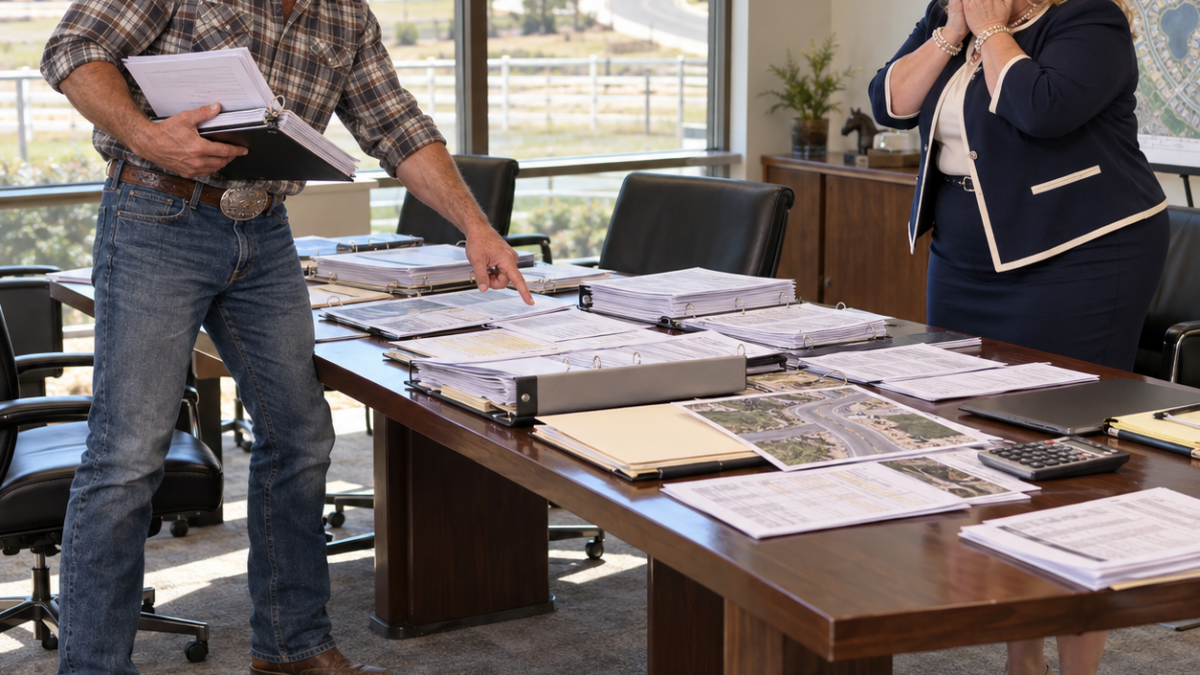
By midnight, my desk looked like a command post.
Road budget.
$30,000 annually.
Documented road invoices.
Roughly $10,000 annually.
Difference.
$20,000.
Quarterly transfers to the contingency account.
Four transfers a year.
$5,000 each.
Twenty thousand dollars.
Exactly.
I leaned back.
“Well, Ranger.”
He lifted his head.
“There’s our road.”
The dog sneezed.
“Good analysis.”
I began building a spreadsheet.
Date.
Source account.
Amount.
Description.
Payee.
Supporting document.
Missing document.
Question.
Then I worked backward.
Year one.
Year two.
Year three.
Year four.
Year five.
Every year showed the same basic pattern.
Residents paid dues.
The annual budget promised road maintenance.
The road contractor received about one-third of what had supposedly been allocated.
Most of the remaining road money moved into the contingency account.
That alone wasn’t illegal.
Reserve accounts were normal.
Responsible, even.
But if the money was still safely sitting there, Karen had nothing to hide.
Which meant her refusal to show me the account statements made no sense.
Unless there was something inside those statements she did not want anyone to see.
At one-thirty in the morning, I searched the state business registry.
Bob’s Tractor Service.
Nothing.
I tried variations.
Bob Tractor.
Bob’s Grading.
Bob’s Ranch Services.
Nothing.
I searched the neighboring county.
Nothing.
The invoices listed a post office box twenty miles away.
No phone number.
No tax identification information.
No website.
No business registration.
No insurance information.
Just a name and an amount.
$5,000.
Twice a year.
I sat forward.
Interesting.
The next morning, I called the post office serving the town where the box was located.
I didn’t ask for private customer information.
I simply asked whether mail sent to that box would reach an active recipient.
The clerk refused to discuss ownership, properly.
But when I asked whether the box number was valid, she said, “Not anymore.”
“When was it closed?”
“I can’t give account details.”
“Understood.”
I hung up.
Maybe Bob’s Tractor Service had been legitimate once.
Maybe it operated informally.
Maybe Karen had records she hadn’t shown me.
I wrote:
UNVERIFIED—DO NOT ASSUME.
That was important.
Suspicion is not evidence.
People destroy their own credibility when they fall in love with the conclusion before the facts arrive.
I had seen investigators do it.
I had seen executives do it.
I wasn’t going to.
At nine-thirty, someone pounded on my front door.
I opened it.
No person.
Just another envelope taped to the wood.
ARCHITECTURAL CONTROL COMMITTEE—NOTICE OF VIOLATION.
I read it standing on the porch.
My barn was apparently painted an unauthorized shade.
I turned and looked at the barn.
Forest green.
It had been forest green when I bought the property.
It had been forest green when Karen came to my welcome barbecue.
It had been forest green through five annual inspections.
Now, forty-eight hours after I had examined her financial records, the color had suddenly become a crisis.
I laughed.
Not because it was funny.
Because sometimes retaliation is so obvious that the person doing it practically signs the confession.
Ranger came outside.
“What do you think?”
He looked at the barn.
“Exactly.”
The notice gave me fourteen days to repaint.
Approved colors were beige, light beige, warm beige, ivory, cream, and something called “desert linen,” which appeared to be beige with better marketing.
The fine for noncompliance would be $50 per day.
I went back inside.
Opened the HOA ROAD FUND folder.
Created a new subfolder:
RETALIATION / SELECTIVE ENFORCEMENT.
Then I went outside with my camera.
I photographed my barn.
Front.
Sides.
Back.
Timestamp visible.
After that, I spent the afternoon driving every road in Ridgeview Ranch Estates.
I photographed barns.
Red.
Blue.
Brown.
Weathered wood.
Galvanized steel.
One enormous workshop painted bright yellow.
A horse shelter with green metal siding almost identical to mine.
Twenty-seven outbuildings.
At least seventeen did not match the newly cited palette.
That evening, I prepared a simple document.
Exterior Structure Color Survey.
Each photo.
Property address.
Visible color.
I attached the violation against my barn.
Then I drafted a response.
I requested every exterior-color violation issued during Karen’s presidency.
I requested the meeting minutes adopting the current palette.
I requested the ballots or board vote.
I requested architectural applications showing which structures had been grandfathered.
Then I wrote:
Until the association can demonstrate that Covenant 9.2 is being applied consistently and according to a lawfully adopted standard, I dispute this violation in full.
Certified mail again.
Karen was trying to bury me in paper.
That was like trying to drown a fish.
Two days later, I drove to see George Whitaker.
George owned the ranch adjoining mine.
He was seventy-eight, narrow as a fence post, sun-browned, and stubborn enough to make a mule seem cooperative.
His family had run cattle on that land before Ridgeview Ranch Estates existed.
When I found him, he was repairing fence.
I handed him a bottle of water.
“Bribery?”
“Neighborliness.”
“Suspicious.”
I leaned against the fence.
“How long has the road been bad?”
George drove another staple.
“Depends what you call bad.”
“Bad enough to break a tie rod.”
He stopped.
“That your truck they hauled out Tuesday?”
“Yes.”
“Figured.”
“How long?”
He scratched his jaw.
“Three years real bad. Five years going downhill.”
“Karen’s presidency.”
George looked at me.
“Careful.”
“Why?”
“Because that woman hears through walls.”
“I’m not accusing her of anything.”
“Yet.”
I smiled.
George noticed.
“What are you doing?”
“Audit.”
His hammer stopped halfway toward the post.
“What?”
“I asked for road records.”
“And she gave them to you?”
“Some.”
George laughed.
“Then she didn’t know what you used to do.”
“What do you mean?”
“You’re the accountant.”
“Among other things.”
“Maria told me.”
“Maria?”
“Old treasurer.”
I had met Maria Gonzalez only a few times.
She lived near the main gate and was known for growing roses that somehow survived our brutal summers.
“When was she treasurer?”
“Right before Karen took over.”
That interested me.
“What happened?”
George drove the staple.
“You should ask her.”
“I will.”
I started to leave.
George called after me.
“You find our road money?”
I stopped.
“Not yet.”
He nodded toward the cratered lane.
“Find it.”
Maria’s rose garden looked almost unnatural against the dry landscape.
She was clipping dead blossoms when I arrived.
“George sent you?”
“He suggested I ask about the old finances.”
Her scissors stopped.
“What did Karen do?”
Interesting question.
Not “Why are you asking?”
What did Karen do?
“My truck broke on the road.”
“That road is disgraceful.”
“I requested records.”
Maria gave a short laugh.
“And?”
“I got a box.”
“That sounds like her.”
“Were you treasurer?”
“One year.”
“Before Karen?”
“Yes.”
“How many HOA bank accounts existed then?”
“One operating account.”
“No reserves?”
“We kept reserve money inside designated ledger categories until balances justified a separate savings account. Everything was reconciled monthly.”
“When did the contingency account begin?”
Maria’s face tightened.
“Karen.”
“How soon?”
“Maybe six months after she became president.”
“Purpose?”
“She called it an investment and emergency reserve account.”
“Who had access?”
“She did. Later the secretary, maybe.”
“Statements presented to residents?”
“No.”
“Board?”
“I asked.”
“What happened?”
“She told me I was no longer treasurer and should stop interfering.”
I let that sit.
Maria clipped another rose.
“You found it, didn’t you?”
“The account?”
She nodded.
“I found transfers into it.”
“How much?”
“Twenty thousand a year.”
The scissors froze.
“For how long?”
“At least five years.”
Maria stared at me.
“That’s a hundred thousand dollars.”
“Yes.”
“Is it still there?”
“I don’t know.”
Her eyes met mine.
“That means no.”
“Not necessarily.”
“You don’t believe that.”
“I don’t believe anything until I have the records.”
Maria set down the shears.
“That’s why Karen hates people like you.”
“She doesn’t know me well enough to hate me.”
“She will.”
I smiled.
“She may be starting.”
I showed her the barn notice.
Maria’s eyebrows rose.
“Your barn?”
“Yes.”
“It’s been that color forever.”
“Correct.”
“She’s retaliating.”
“Probably.”
“No probably about it.”
“Can you prove it?”
Maria stared at me.
Then smiled.
“You really are an accountant.”
“Former.”
“People like you never become former.”
She invited me inside.
At her kitchen table, she retrieved an old file box.
Inside were financial reports from her year as treasurer.
Perfectly organized.
Monthly statements.
Canceled checks.
Contract bids.
Vendor insurance documents.
Budget comparisons.
It was beautiful.
I said so.
Maria laughed.
“My husband called it obsessive.”
“Your husband was wrong.”
“He usually was.”
We compared her last complete budget with Karen’s first.
Road allocation remained roughly the same.
But six months into Karen’s term, contractor detail became vague.
Then came “reserve transfers.”
Then fewer supporting schedules.
Transparency had not vanished overnight.
It had been slowly removed.
One attachment caught my attention.
Three competing road bids from the year before Karen became president.
All were from established companies.
All proposed twice-yearly grading plus fresh aggregate as needed.
Prices ranged between twenty-seven and thirty-two thousand dollars.
Which was exactly why the budget remained $30,000.
“Who hired the cheap tractor operator?”
“Karen.”
“Board vote?”
“I wasn’t on the board anymore.”
“Bid process?”
Maria shrugged.
“She announced he was saving us money.”
“Do you know him?”
“No.”
“Bob?”
She frowned.
“What Bob?”
“Bob’s Tractor Service.”
Her expression went blank.
“I’ve never heard that name.”
Now I felt it.
That little internal click when unrelated facts begin locking together.
I went home and added Maria’s historical records to the spreadsheet.
Then I called an attorney.
His name was David Chen.
Not a friend.
Not a veteran connection.
Just the best HOA litigation attorney I could find within driving distance.
His office was forty-five minutes away.
I brought the binder.
He spent an hour listening.
Then he asked the question good lawyers ask when clients want drama.
“What do you actually want?”
“A safe road.”
“That’s it?”
“And accurate books.”
“Removal of Karen?”
“If the facts justify it.”
“Money damages?”
“My truck repair if warranted.”
“Revenge?”
“No.”
David smiled.
“Good answer.”
“Would a bad answer have changed anything?”
“Only my enthusiasm.”
He reviewed our bylaws.
Then the financial-access provision.
Then Karen’s refusal.
Then my partial records.
He tapped the quarterly transfers.
“You need the contingency statements.”
“Yes.”
“She’ll refuse.”
“She already has.”
“Then we demand them formally through counsel.”
“What if she still refuses?”
“We file.”
“How expensive?”
He gave me a number.
I did not like it.
Neither did my bank account.
But before I decided, I wanted to know whether I was fighting one woman over my truck or whether the entire community had been damaged.
So I kept talking to neighbors.
The Air Force veteran was named Mike Reynolds.
He ran an HVAC repair business from his property.
His white service van sat in his driveway every evening.
Karen had cited him repeatedly for parking a commercial vehicle in public view.
“It’s my livelihood,” he said. “I leave at six every morning.”
“Did you appeal?”
“Three times.”
“Result?”
“Denied.”
“Fine?”
“Eight hundred so far.”
“Why pay?”
“Because she threatened a lien.”
Mark and Sarah Lewis had a newborn daughter.
Their offense was grass.
They had replaced part of their yard after installing a septic line.
A summer heatwave killed several strips of sod.
Karen fined them because the lawn was “visibly distressed.”
Sarah started crying while telling me.
Not because of the money.
Because she had been three weeks postpartum when the notices began.
“We were barely sleeping,” she said. “Every day there was another letter.”
Mark squeezed her hand.
“I begged Karen for sixty days.”
“What did she say?”
“He should have planned landscaping before having a baby.”
I closed my eyes.
“She said that?”
Mark nodded.
I wrote it down.
The widow was named Helen Price.
A windstorm had torn shingles from her roof.
Her insurance deductible was more than she could afford immediately.
Karen gave her ten days.
Helen asked for two months.
Karen assessed late penalties.
Helen borrowed money from her daughter.
Then there was George’s gate.
Two hundred dollars over peeling paint.
The same gate his family had used for thirty years.
“What happened?”
“I paid.”
“Why?”
George stared across the pasture.
“Because I was tired.”
That answer bothered me more than anger would have.
Karen’s power came partly from money.
But mostly from exhaustion.
Make resistance difficult enough and surrender becomes cheaper.
I invited five neighbors to my house.
George.
Maria.
Mike.
Mark.
Sarah.
Coffee on the table.
Binder open.
I explained only what I could support.
Annual road budget.
Documented road expenditure.
Transfers.
Missing account statements.
Unverified contractor.
Karen’s refusal.
Then Maria explained the old accounting system.
George described the road deterioration.
Mike described enforcement.
Mark and Sarah described theirs.
Nobody said much when I finished.
Then Sarah whispered, “How much do you think is missing?”
“I don’t know.”
“Estimate.”
“I don’t estimate guilt.”
“Marcus.”
I looked at her.
“If the budget and invoices are accurate, roughly a hundred thousand dollars moved out of the road allocation into the contingency fund.”
George swore.
Mike leaned forward.
“And if the money isn’t there?”
“Then we determine where it went.”
Maria said, “She stole it.”
I raised one hand.
“We do not say that yet.”
“You think it.”
“I think we have enough evidence to demand complete records.”
Mark rubbed his face.
“What does that cost?”
I told them.
George pulled out his wallet.
Two hundred-dollar bills hit my dining table.
“George—”
“I paid Karen two hundred over paint on a cattle gate. I’d rather give it to a lawyer.”
Mike added money.
Mark and Sarah contributed less.
I tried to refuse theirs.
Sarah pushed it back.
“We’re in.”
Maria wrote a check.
I matched the pool.
That night, the Road Improvement and Transparency Committee was born.
The name was boring.
Perfect.
Boring organizations win boring legal fights.
We gave everyone roles.
Maria would reconstruct historical budgets.
Mike would document road conditions and vehicle damage from other residents.
Mark was good with computers and built a secure document repository.
Sarah coordinated homeowner statements.
George talked to the old-timers.
I handled financial analysis and counsel.
David Chen sent the demand letter.
It went to every board member.
Complete financial disclosure.
Contingency fund statements.
Road contracts.
Vendor documentation.
Violation revenue.
Meeting approvals.
Ten business days.
The process server delivered Karen’s copy at home.
Two days later, she retaliated.
Mike called me at seven-thirty in the morning.
“They’re towing my van.”
“What?”
“Tow truck’s here. Sheriff too.”
I was already grabbing keys.
“Do not touch anyone.”
“I need that van.”
“Do not obstruct the deputy.”
“This is my business.”
“I know. Listen to me. Photograph everything. Get the deputy’s name. Get the tow slip. Ask what authority they’re acting under. Stay polite.”
I called David while driving.
“She’s towing Mike’s work van.”
“Why?”
“Commercial vehicle violation.”
“After our demand?”
“Two days.”
David went quiet.
Then:
“Excellent.”
“That’s not what Mike thinks.”
“Legally, I mean.”
“I know.”
“Document everything.”
“She’s escalating.”
“Then we show the judge.”
When I arrived, Mike stood beside his wife while a tow operator hooked the van.
A sheriff’s deputy was speaking quietly with them.
Karen stood thirty yards away beside her Escalade.
Watching.
That image remains burned into my memory.
Mike’s livelihood lifting onto a tow truck.
Karen observing.
Not angry.
Satisfied.
She saw me.
Smiled.
I took a photograph.
Her smile vanished.
That afternoon David amended the legal petition.
Retaliation.
Selective enforcement.
Improper towing.
Records obstruction.
We filed.
Karen had finally forced our private dispute into court.
Then something unexpected happened.
The neighborhood found out about Mike.
People got angry.
Not HOA-meeting angry.
Real angry.
Farmers understood equipment.
Tradesmen understood vehicles.
Everybody understood a man needing his work truck to feed his family.
George started making calls.
Maria completed a one-page letter.
No accusations.
Only questions.
Why are our roads collapsing despite $30,000 annual allocations?
Why has the president refused access to the contingency account?
Why was a homeowner’s work vehicle towed days after residents demanded financial transparency?
We distributed it.
Under the bylaws, ten percent of owners could demand a special community meeting.
By the end of the weekend, we had signatures from more than half.
We rented the Grange Hall ourselves.
Karen couldn’t stop it.
Then the court acted.
David called me at 4:16 p.m.
“Judge signed the temporary order.”
“What order?”
“No new fines. No towing. No liens. No retaliatory enforcement while the records case is pending.”
I sat down.
“For everyone?”
“Everyone covered by the association.”
For the first time since my truck broke, I smiled without forcing it.
Karen’s favorite weapon had just been removed by a judge.
The next two weeks were strangely peaceful.
No violation letters.
No certified threats.
No patrols from Karen’s Escalade.
Nothing.
Then every homeowner received a letter from Karen’s law firm.
Our committee, it said, was a “small disgruntled faction.”
The board was honorable.
The finances were sound.
The lawsuit was frivolous.
The road issues were exaggerated.
I read it twice.
Then forwarded it to David.
His reply:
Save it.
I already had.
Two days before the Grange Hall meeting, the judge issued the order that changed everything.
Full financial production.
All accounts.
All statements.
All supporting documents.
No redaction except legitimately protected personal information.
Karen had forty-eight hours.
Her attorney produced the records.
Six boxes.
Three digital folders.
Five years.
I picked them up at nine in the morning.
The meeting was at seven the following evening.
I did not sleep.
Maria came to my house.
Then Mark.
Then David joined remotely.
We scanned.
Sorted.
Reconciled.
By midnight, we had the contingency statements.
Balance should have approached $100,000.
It did not.
Deposits were exactly what I predicted.
Quarterly.
$5,000.
For five years.
Then withdrawals.
Credit-card payments.
Travel agencies.
Department stores.
Luxury retail.
A car dealership.
Checks to individuals.
I felt my stomach tighten.
Maria whispered, “Oh my God.”
I held up one hand.
“Keep going.”
At one-thirty, we found a $15,000 cashier’s check to a luxury dealership.
I searched vehicle records available through lawful sources.
Karen’s Escalade had been purchased days later.
Could be coincidence.
But then another trail appeared.
KL Management Services.
Monthly payments.
$1,500.
Regular.
Neat.
Professional.
I searched the state registry.
There it was.
KL MANAGEMENT SERVICES
Sole proprietor:
Karen L. Peterson.
The room went silent.
Maria sat back.
“She paid herself.”
“Apparently.”
“For what?”
I searched the files.
No management contract.
No board approval.
No disclosed related-party agreement.
No service invoices beyond generic monthly statements.
Mark stared at the screen.
“How much?”
I added it.
Ninety thousand over five years.
Maria covered her mouth.
Then we found personal credit-card payments.
Travel.
Cruises.
A Hawaii booking.
Designer retail.
Some could theoretically be legitimate HOA expenses.
Most did not look like it.
But the strongest case did not need every questionable transaction.
KL Management alone was devastating.
The road fund had not vanished in one dramatic theft.
It had been siphoned gradually.
Five thousand moved here.
Fifteen hundred paid there.
Personal expenses folded into miscellaneous categories.
Transfers concealed behind vague labels.
And the road deteriorated one pothole at a time.
At three in the morning, David joined a video call.
He looked at the spreadsheet.
Then the documents.
Then the business registration.
“Do not announce criminal guilt tomorrow.”
“I know.”
“Present the transactions.”
“Yes.”
“Let the records speak.”
“Yes.”
“I’m sending this to the district attorney’s financial-crimes intake unit.”
I looked at him.
“Already?”
“Marcus, these are court-produced bank records showing an association president moving association money into a business she owns without any apparent board authorization. We are past HOA drama.”
“What about the sheriff?”
“Investigators decide timing.”
“Understood.”
“Do not turn tomorrow into an ambush.”
“It isn’t.”
“It may feel like one.”
I hung up.
At sunrise, I walked outside.
The broken road stretched past my gate.
Dust.
Ruts.
Potholes.
Five years of neglect.
I had looked at those holes as maintenance failures.
Now they looked different.
Each one was a receipt.
Every time gravel should have been delivered but wasn’t.
Every time graders should have come but didn’t.
Every suspension repair.
Every flat tire.
Every delayed ambulance.
Every feed truck creeping five miles per hour through craters.
The missing money wasn’t abstract anymore.
We had been driving over the evidence for years.
The Grange Hall filled before seven.
More than a hundred residents.
Ranchers in work boots.
Retirees.
Young families.
Contractors.
Veterans.
People I had waved to for years without knowing their names.
Karen sat with the board on the opposite side.
Her turquoise jewelry flashed under fluorescent light.
The Escalade was parked outside.
The $15,000 Escalade.
I reminded myself:
Facts.
Only facts.
I opened the meeting.
“This is not a trial.”
The room quieted.
“We are not here to convict anyone. We are here because members demanded transparency regarding the condition of our roads, enforcement practices, and association finances.”
I showed photographs.
My broken truck.
The pothole.
Other road damage.
Then the budget.
$30,000 annually.
Next slide.
Road invoices.
$10,000 annually.
Next.
Five-year difference.
$100,000.
People began murmuring.
Karen leaned toward her attorney.
I continued.
“The board told us the difference was transferred to an HOA contingency fund.”
Next slide.
Deposits.
Exactly $100,000.
Karen smiled.
I saw it.
She thought that vindicated her.
I let the slide sit.
Then I said:
“So the board was correct about one thing.”
Silence.
“The money went into the contingency account.”
Karen leaned back.
Then I clicked.
Withdrawals.
The room stopped moving.
American Express.
Visa.
Travel agency.
Luxury retailer.
Resort.
Car dealership.
Karen’s smile disappeared.
“These are selected transactions from statements produced pursuant to court order.”
Someone shouted, “What the hell?”
I raised my hand.
“Please.”
Next slide.
$15,000 dealership payment.
Then a photograph taken from Karen’s own publicly visible HOA newsletter showing her standing beside the Escalade during a community event.
I did not say the HOA bought her car.
I didn’t need to.
Then KL Management.
Monthly payments.
$1,500.
Five years.
I clicked again.
State registration.
Owner: Karen L. Peterson.
The silence became physical.
I could hear the projector fan.
George whispered behind me, “Son of a bitch.”
Karen stood.
“This is completely misleading.”
I looked toward her.
“You’ll have time to respond.”
“I will respond now.”
Her attorney grabbed her arm.
She pulled away.
“KL Management provided legitimate administrative services.”
I nodded.
“Can you show the contract?”
“It exists.”
“Was it approved by the board?”
“Yes.”
Brenda, the secretary, looked up sharply.
Karen saw it.
“Brenda.”
Everyone turned.
Brenda looked terrified.
“I never saw a contract.”
Karen’s face hardened.
“You signed minutes approving professional services.”
“I signed minutes.”
“For this.”
“You said the services were external compliance consulting.”
“They were.”
“But KL is yours?”
Karen stared at her.
“Sit down.”
Brenda began crying.
“I asked you.”
“Brenda.”
“I asked you what those checks were.”
“Shut up.”
The room erupted.
Karen shouted louder.
“SHUT UP!”
Everything stopped.
Her face was red.
The polished president was gone.
She pointed at me.
“He manipulated these records!”
“These are bank statements produced by your attorney.”
“Then he manipulated the presentation!”
I nodded.
“That is possible for anyone presenting data, which is why copies of every underlying statement will be made available to members.”
Karen’s attorney closed his eyes.
Wrong answer for her.
Transparency was the one battlefield she could not survive.
Maria stood.
“I was treasurer before Karen.”
Karen spun toward her.
“You are irrelevant.”
Maria did not flinch.
“When I left, we had one checking account, complete monthly reconciliations, competitive bids, and no private management company owned by an officer.”
“You haven’t been on the board in years!”
“Correct.”
“So you know nothing.”
“I know what I handed you.”
The crowd reacted.
Mike stood next.
“Did road money pay KL?”
Karen said nothing.
Mike repeated.
“Did our road fund pay your company?”
Karen’s attorney stood.
“My client will not answer questions in this environment.”
George laughed without humor.
“She answered plenty when she was fining us.”
Then the Grange Hall doors opened.
Two sheriff’s deputies entered.
My stomach dropped.
I had not arranged it.
David walked behind them.
So did a man in a plain dark suit.
District attorney investigator.
The room became completely silent.
The investigator approached me first.
“Mr. Hale?”
“Yes.”
“We need to speak afterward.”
Then he turned toward Karen.
Her face changed.
Her attorney stepped between them.
“Is there a warrant?”
The investigator produced paperwork.
The attorney read it.
Karen whispered, “What is that?”
He did not answer immediately.
“Karen.”
“What?”
“Don’t say anything.”
Her mouth opened.
The investigator spoke calmly.
“Karen Peterson, we have a warrant for your arrest related to suspected theft and misappropriation of association funds.”
Someone gasped.
Karen looked at the crowd.
Then at me.
“No.”
The deputy approached.
“This is ridiculous.”
Nobody moved.
“These people are lying.”
Her attorney repeated:
“Karen. Stop talking.”
“I saved this community money!”
The deputy instructed her to turn around.
Karen stepped back.
“No.”
Her heel struck the chair.
“This is my association.”
George’s voice came quietly from behind me.
“No, ma’am.”
Karen looked at him.
He stood.
“It’s ours.”
The deputy placed her in handcuffs.
There was no applause.
I was grateful.
For all my anger, watching another human being lose control of her life was not entertainment.
Karen looked smaller once the cuffs closed.
Not weaker physically.
Just suddenly ordinary.
She passed my table.
Stopped.
Her eyes met mine.
“You did this.”
I shook my head.
“No.”
“You came after me.”
“My truck broke.”
“You could have let it go.”
That sentence told me everything.
Five years of missing money.
Destroyed roads.
Selective fines.
Harassment.
A man’s work van towed.
And her defense was that I should have let it go.
“No,” I said.
The deputy guided her onward.
The doors closed.
The meeting never formally resumed.
Nobody had the appetite.
Neighbors stood in clusters.
Some angry.
Some crying.
Some embarrassed they had trusted her.
Brenda sat alone at the board table, staring at her hands.
I walked over.
She looked up.
“I didn’t know.”
“I believe you.”
“I signed things.”
“You need a lawyer.”
Her face crumpled.
“She said KL was a consultant.”
“I know.”
“I asked.”
“I know.”
“Does that make me guilty?”
“I’m not the person who decides that.”
She nodded.
I gave her David’s card.
“Get your own attorney.”
She took it.
The investigation lasted months.
And the truth was more complicated than the Grange Hall presentation.
Some credit-card transactions initially looked personal but were legitimate association expenses.
A hotel charge was tied to an HOA-management conference.
Several hardware-store purchases were properly documented.
That mattered.
Accuracy matters most when you are angry.
We removed those transactions from our accusations immediately.
But the legitimate expenses could not explain the major withdrawals.
KL Management had received approximately $90,000.
No valid contract was found.
No independent board approval.
No disclosure that Karen owned it.
The dealership payment was traced.
It had ultimately benefited Karen personally.
Other association money had paid portions of travel unrelated to legitimate board business.
Then investigators examined fine revenue.
That was the second shock.
Karen had pushed aggressive enforcement partly because fines generated cash.
Some fine receipts were transferred into accounts she controlled.
Not every violation had been invented.
But enforcement patterns showed that residents who challenged Karen were cited far more frequently.
Mike.
George.
Mark and Sarah.
Helen.
Me.
The barn notice issued two days after my audit request became one of the clearest retaliation examples.
My forest-green barn became evidence.
I never repainted it.
I considered that one of my better decisions.
The criminal case eventually calculated total misappropriation above $150,000.
Karen accepted a plea agreement.
Three years in state prison.
Restitution.
Asset forfeiture.
The Escalade was sold.
So was Karen’s house.
Some residents wanted celebration.
George shut that down at the first new-board meeting.
“We’re not throwing a party because somebody went to prison.”
A man in the back said, “Why not?”
George looked at him.
“Because we let this happen too.”
The room quieted.
That hurt.
Because he was right.
Karen stole.
Karen intimidated.
Karen concealed.
Those were her choices.
But we had surrendered oversight.
We stopped attending meetings.
Stopped reading budgets.
Accepted pie charts instead of statements.
Accepted vague explanations because asking follow-up questions felt rude.
We chose convenience.
For years, trust had slowly become permission.
George continued.
“We fix the system. That’s our celebration.”
The remaining board resigned.
Emergency election.
George became president despite loudly insisting he was too old.
Maria became treasurer.
Mike joined the road committee.
Sarah took over community communications.
I was asked to become treasurer.
I declined.
Maria understood why.
“You don’t trust yourself?”
“I trust systems more than people.”
“Even yourself?”
“Especially myself.”
I agreed to chair a financial oversight committee instead.
My first condition:
All bank statements posted monthly.
Second:
Two signatures on checks above a low threshold.
Third:
No officer could approve payment to any business owned by themselves, family members, or close associates without full disclosure and independent member approval.
Fourth:
Annual outside audit.
Fifth:
Competitive bids for major projects.
Sixth:
Every homeowner could inspect records digitally.
No cardboard box.
No supervised hour in someone’s garage.
George listened to the list.
“Anything else?”
“Yes.”
He groaned.
“Of course.”
“Road fund gets its own restricted account.”
Maria smiled.
“Now he’s speaking my language.”
Recovered restitution did not return overnight.
Karen’s assets had mortgages.
Legal costs mattered.
Some money had been spent years earlier.
But enough was recovered, combined with proper existing reserves, to finally rebuild the road.
We hired an engineering firm first.
Not a man with a rusty box blade.
Engineers surveyed drainage.
Crown.
Base depth.
Culverts.
Water flow.
Aggregate composition.
Their report was brutal.
The road had not merely lacked grading.
Years of inadequate maintenance had allowed water intrusion to damage the base.
Surface patches would fail.
It needed reconstruction.
Cost:
A lot.
But for the first time, residents could see every number.
Three bids.
Detailed scopes.
Material quantities.
Equipment hours.
Drainage work.
Schedule.
Insurance.
Nobody complained about paying for legitimate work.
That surprised me.
People don’t necessarily hate expenses.
They hate feeling cheated.
Construction began in May.
For two months, Ridgeview sounded like an industrial site.
Graders.
Compactors.
Dump trucks.
Excavators.
Culvert crews.
Every morning I watched loaded trucks bring crushed granite Karen had claimed we could not afford.
They cut drainage ditches.
Rebuilt low sections.
Added proper base.
Raised the crown.
Compact.
Water.
Compact again.
Slow work.
Correct work.
George came by almost every day to supervise people who had not asked him to supervise.
One foreman eventually said:
“Sir, are you an engineer?”
“No.”
“Road contractor?”
“No.”
“Then why are you checking our slope?”
George answered:
“Because I’m paying for it.”
The foreman laughed.
“Fair enough.”
Mark and Sarah’s baby was walking by then.
One afternoon they brought her down in a stroller to watch the graders.
Sarah looked at me.
“You know what’s strange?”
“What?”
“I’m excited about gravel.”
“You’ve matured.”
“No. I’ve been traumatized.”
Mike recovered his towing costs through the civil settlement with the association’s insurer.
The old commercial-vehicle enforcement rule was rewritten.
Work vehicles were allowed if residents used them for legitimate employment and kept them reasonably maintained.
His van remained in the driveway.
He washed it once after the new rule passed.
George accused him of becoming soft.
Helen received refunds for penalties improperly charged during her roof-repair dispute.
The new board gave her extra time to complete repairs.
No drama.
No humiliation.
Just common sense.
The barn-color provision became voluntary guidance.
At the meeting where we repealed the old enforcement language, George looked at me.
“You keeping it green?”
“Yes.”
“Ugly.”
“You own a rusted cattle gate.”
“Historic patina.”
“Selective standards.”
“Presidential privilege.”
Everyone laughed.
Then Maria said, “Careful.”
George raised both hands.
“Right. No presidential privilege.”
That joke became important.
Humor replaced fear.
Under Karen, meetings had felt like courtrooms.
People waited to be judged.
Under George, people argued loudly, sometimes stupidly, then drank coffee together afterward.
We had disagreement without punishment.
That felt revolutionary.
One Saturday, months after construction began, the road crew reached the stretch where my tie rod had snapped.
I parked nearby.
The pothole was still visible.
Smaller after temporary repairs.
But unmistakable.
The foreman climbed out of his grader.
“You live around here?”
“That’s my fence.”
He nodded toward the crater.
“Bad one.”
“It cost me $1,384.”
He whistled.
“We’re digging this whole section.”
I watched the excavator bite into the road.
Layer by layer.
Loose gravel.
Mud.
Failed base.
Soft material.
The operator removed it all.
Then trucks brought stone.
Proper base.
Compacted.
More stone.
For an accountant, there was something deeply satisfying about watching bad foundation physically removed.
Maybe because we had spent months doing the same thing to the HOA.
Dig out what was rotten.
Expose it.
Replace it with something capable of carrying weight.
The new road finished in late summer.
George called everyone to the main gate.
I thought he was joking.
He had actually organized a ribbon cutting.
“For gravel?”
“It cost enough.”
Maria brought scissors.
Mike brought his van.
Mark and Sarah brought their daughter.
Helen came.
Dozens of neighbors.
George stood before the gate.
“I prepared remarks.”
Everyone groaned.
“I’ll keep them short.”
“Promise?” someone shouted.
“No.”
He looked down at his paper.
Then folded it.
“Actually, forget it.”
He pointed at the road.
“That belongs to you.”
Silence.
“Every foot.”
He pointed toward us.
“You paid for it. The books prove it. The invoices prove it. The bank proves it. From now on, if anyone tells you something is none of your business, remember that.”
He cut the ribbon.
People applauded.
Then somebody shouted:
“Marcus gets first drive!”
I shook my head.
“No.”
George pointed toward my truck.
“You started this.”
“A pothole started this.”
“Drive.”
So I did.
I climbed into the same F-250.
Same truck.
New tie rod.
New alignment.
Plenty of scars.
I pulled through the gate.
The road was smooth.
Not pavement smooth.
Better.
Ranch-road smooth.
A clean layer of crushed granite compressed tight beneath the tires.
Proper crown.
Firm shoulders.
No washboard.
No craters.
I kept the speed under fifteen.
Not because Karen had once blamed me.
Because fifteen felt right.
The truck glided.
Three miles.
For years I had unconsciously braced before every bad section.
Now there was nothing to brace for.
Near my property, I pulled over.
Exactly where the truck had broken.
I stepped out.
The old pothole was gone.
No scar.
No depression.
Just fresh road stretching toward the horizon.
George pulled up behind me.
Maria followed.
Then Mike.
Soon six vehicles were parked along the shoulder.
George climbed out.
“You getting sentimental over gravel?”
“Yes.”
“Accountants are strange.”
Maria walked over.
She looked down at the road.
“One hundred fifty thousand dollars.”
“More.”
“What?”
“Total theft.”
She nodded.
“Hard to imagine.”
I looked along the road.
“No.”
She followed my gaze.
I pointed.
“That’s what missing money looks like.”
Everyone went quiet.
Failed roads.
Deferred maintenance.
Broken trucks.
Tow bills.
Stress.
Neighbors afraid of mailboxes.
That was the part white-collar theft disguises.
Numbers seem clean.
$5,000 transfer.
$1,500 check.
$15,000 payment.
Typed rows on a statement.
But every stolen dollar becomes something absent.
Gravel never delivered.
Drainage never dug.
Equipment never hired.
Safety never provided.
Trust never earned.
Karen’s crimes had not happened inside a spreadsheet.
The spreadsheet merely recorded them.
The consequences lived in our suspension systems and bank accounts and relationships.
George said, “You know what still bothers me?”
“What?”
“I paid that gate fine.”
Everyone laughed.
“I’m serious.”
Maria said, “We refunded it.”
“Doesn’t matter.”
“Why?”
“Principle.”
I looked at him.
“You’re seventy-eight and still mad about peeling paint?”
“Seventy-nine.”
“My apologies.”
“And yes.”
“Fair.”
A year passed.
Ridgeview changed.
Not physically, except for the road.
The biggest change was people.
Before the fight, twenty-acre lots had made it easy to pretend we didn’t need one another.
We were independent.
Private.
Self-sufficient.
Or so we thought.
Afterward, people stopped at fences.
Borrowed equipment.
Helped with cattle.
Checked on Helen after storms.
Brought meals when Mark’s second child was born.
Mike repaired George’s air conditioner and refused payment.
Maria created an annual budget workshop.
Nobody wanted to attend.
She made us anyway.
“That’s revenge,” George said.
“Financial literacy,” Maria corrected.
“Same thing.”
Our annual meetings were packed the first year.
Less so the second.
By the third, attendance started dropping.
I noticed.
At the next meeting, I stood.
“Before everyone leaves.”
Groans.
“I’ll be brief.”
More groans.
“I mean it.”
George said, “He doesn’t.”
I looked around.
“Three years ago, everyone promised we’d never stop paying attention.”
A few people shifted.
“We fixed the road. The books are clean. That’s when oversight matters most.”
Maria nodded.
“Corruption doesn’t always walk in wearing a sign.”
George said, “Sometimes it drives an Escalade.”
Laughter.
I continued.
“Systems fail quietly. One exception. One unreviewed check. One meeting nobody attends. One person everybody trusts so much that verification feels insulting.”
The room settled.
“We don’t audit because we assume people are dishonest.”
I looked at Maria.
“We audit because honest people deserve systems that protect them too.”
That became part of Ridgeview’s annual routine.
Outside audit.
Budget meeting.
Road inspection.
Vendor review.
No drama.
Exactly the point.
Karen eventually completed her prison sentence.
I know because her name appeared in the local paper once.
Someone emailed me the article.
I read the headline.
Then deleted it.
I did not need updates on Karen.
Her chapter in my life had ended.
Years later, I heard she had moved to another county.
I hoped she rebuilt her life honestly.
That may disappoint people who want revenge stories to end with permanent misery.
But permanent misery wasn’t what I wanted.
Consequences?
Absolutely.
Restitution?
Yes.
Accountability?
Essential.
But if someone pays the legal price, admits wrongdoing, and has an opportunity to live differently afterward, I see no value in wishing eternal ruin on them.
The best revenge was driving home without breaking my truck.
It was Maria publishing the monthly reconciliation online.
It was Mike parking his van without fear.
It was Helen repairing her roof on a reasonable schedule.
It was George’s peeling gate still standing.
And my forest-green barn.
Especially the barn.
One evening, several years after everything happened, I was sitting on the porch when George’s pickup came crawling down the road.
He pulled into my driveway.
Slowly.
Very slowly.
I walked out.
“What happened?”
He climbed down holding a folder.
“Nothing.”
“You drove like something broke.”
“Saving the road.”
“You’re doing ten miles an hour.”
“Less wear.”
I shook my head.
“What’s the folder?”
“Found something.”
He handed it to me.
Inside was the old violation letter for his cattle gate.
The original one.
Peeling paint.
$200 fine.
Lien warning.
I looked at him.
“You kept this?”
“I keep everything important.”
“That sounds familiar.”
“Thought you might want it for your museum.”
“What museum?”
“Your binder museum.”
I laughed.
“I don’t need it.”
George looked past me toward the barn.
Then toward the road.
“You know what that letter bought?”
“What?”
“This.”
He waved around.
“The road?”
“No.”
He pointed toward his property.
“Neighbors.”
That surprised me.
“You getting sentimental?”
“Shut up.”
I smiled.
George shifted his weight.
“Before all this, I knew names. Didn’t know people.”
“Same.”
“Karen thought keeping us separated made us easier to manage.”
“Maybe.”
“She was right.”
I looked at him.
He nodded toward the folder.
“I paid because I thought it was easier to handle alone.”
Then toward my house.
“You didn’t.”
“No.”
“Good thing.”
We sat on the porch.
Ranger was older by then.
Gray around the muzzle.
He lay between us.
The sun settled behind the ridge.
Occasionally a pickup rolled along the road, kicking up a small trail of dust.
No rattling.
No swerving.
No violent braking.
George opened two beers.
“You know why you really beat her?”
“I didn’t beat her.”
“Fine. Why the numbers beat her.”
“Because bank statements exist?”
“No.”
“Because she was careless?”
“Partly.”
“Then what?”
George took a drink.
“She thought nobody cared enough to check.”
That was probably the closest anyone ever came to explaining the whole story in one sentence.
Karen had not hidden the money inside offshore trusts or complicated corporations.
She created an account.
Moved money.
Paid herself.
Used vague labels.
Then relied on something more powerful than sophisticated concealment.
Apathy.
Who wants to spend Saturday reviewing HOA statements?
Who wants to challenge a volunteer president?
Who wants to pay a lawyer?
Who wants conflict with neighbors?
Who wants to become “that person”?
Karen’s real security system was our reluctance to be inconvenient.
The road finally broke that.
More specifically, my tie rod did.
Sometimes large injustices survive because each individual consequence is barely tolerable.
A fifty-dollar fine.
A rough patch of road.
A vague budget.
An unanswered email.
A slightly higher repair bill.
Nobody reacts because no single thing feels large enough.
Then one day the accumulated damage becomes visible.
Metal snaps.
A truck hits the shoulder.
A widow cries.
A work van gets hauled away.
A hundred thousand dollars disappears.
And someone says:
Enough.
My binder still sits in my study.
The original cover reads:
HOA ROAD FUND.
Inside:
Photographs of the pothole.
Tow receipt.
Mechanic bill.
Karen’s letter blaming my speed.
Certified-mail receipts.
Barn violation.
Barn color survey.
Maria’s historical budgets.
Contingency statements.
KL Management registration.
Court orders.
Audit schedules.
Election results.
Final restitution accounting.
On the last page is a photograph.
Not Karen.
Not handcuffs.
Not the Grange Hall.
The road.
Fresh granite.
Sunset.
Empty.
I chose that deliberately.
Because when people tell stories like ours, they often focus on the takedown.
The confrontation.
The arrest.
The sentencing.
But tearing down corruption is only half the work.
The harder question is what you build afterward.
We built controls.
Transparency.
Routine.
And yes, a road.
A damn good road.
One autumn morning, I loaded feed into the F-250 and headed toward the far pasture.
A young couple had recently purchased one of the properties near the gate.
I saw their truck stopped beside the mailboxes.
The husband waved me down.
“You’re Marcus, right?”
“Yes.”
“I heard you’re the road guy.”
I laughed.
“No.”
“That’s what everybody says.”
“I chair finance oversight.”
“Same thing.”
“Not remotely.”
He pointed toward the road.
“We were wondering why the HOA paperwork has so many financial disclosure requirements.”
I looked at him.
“How much time do you have?”
His wife leaned across the seat.
“He has none.”
“Smart woman.”
He smiled.
“Give me the short version.”
I thought about it.
Then said:
“A long time ago, we trusted one person more than we trusted the system.”
“That bad?”
“It got expensive.”
He nodded.
“Lesson learned?”
“Repeated annually.”
They drove away.
I continued home.
Near the old pothole location, I slowed.
There was nothing there anymore.
No marker.
No plaque.
No scar.
Nobody new would ever know exactly where the road had failed.
I liked that.
Not every battle needs a monument.
Sometimes the repaired thing is enough.
I drove through my gate.
Forest-green barn on the left.
Cattle near the water tank.
Ranger’s successor, Duke, racing alongside the truck.
Home.
That evening, Maria emailed the quarterly financial package.
I opened it.
Road account.
Balance reconciled.
Every invoice attached.
Contractor bids visible.
No unexplained transfers.
No mystery accounts.
I reviewed it anyway.
Line by line.
Old habits.
Everything matched.
I closed the laptop.
Outside, tires crunched softly over the road.
There was a time when that sound would have irritated me.
Now I loved it.
It sounded like money spent where it was supposed to go.
It sounded like promises kept.
It sounded like a community that had finally learned the difference between trusting people and abandoning responsibility.
Karen once told us poor road quality was our fault because residents weren’t participating enough.
In one strange way, she had been right.
Not because we failed to pay.
We had paid every dollar.
Our failure was assuming payment completed our obligation.
It didn’t.
Shared money requires shared attention.
Shared property requires shared responsibility.
Shared government, even something as small and ridiculous as an HOA, requires people willing to ask uncomfortable questions.
The road fund was ours.
The association was ours.
The records were ours.
And Karen had been able to take advantage of them only while we forgot that.
Years after the criminal case ended, George died quietly in his sleep.
He was eighty-four.
His daughter called me.
I helped her with the cattle until the family decided what to do.
At the funeral, Maria sat beside me.
Mike sat behind us.
Mark and Sarah brought their children.
Half of Ridgeview came.
George’s daughter spoke about him.
His stubbornness.
His humor.
His devotion to the land.
Then she said something I hadn’t known.
“Dad told me one of the proudest things he ever did was putting two hundred dollars on Marcus Hale’s kitchen table.”
I looked down.
Maria squeezed my arm.
George’s daughter continued.
“He said it was the best investment he ever made.”
After the service, we drove back to Ridgeview in a long line.
The road carried all of us.
Smooth.
Solid.
Quiet.
I thought about George paying Karen’s fine years earlier because he was tired.
Then contributing exactly the same amount when we finally decided to fight.
Two hundred dollars surrendered.
Two hundred dollars resisted.
Same amount.
Completely different meaning.
A month later, the new owners of George’s ranch asked whether they should repaint his old cattle gate.
The paint was still peeling.
I stared at it for a long moment.
Then I said:
“Absolutely not.”
They laughed.
I didn’t.
Some things deserve preservation.
Today, when I drive that three-mile stretch, I barely think about Karen.
That might be the most satisfying ending of all.
Tyrants imagine they will live forever inside the memories of the people they controlled.
They usually don’t.
Systems improve.
Neighbors move on.
Roads are rebuilt.
Grass grows.
Children grow up.
Vehicles change.
Names fade.
What remains are the habits people learned because something once went wrong.
At Ridgeview, we learned to ask for the invoice.
Read the statement.
Check the bid.
Attend the meeting.
Question vague labels.
Never let one person control both approval and payment.
Never confuse hostility toward oversight with leadership.
And never assume a pothole is just a pothole when thirty thousand dollars a year is supposedly paying to prevent it.
Karen skimmed our road fund for years because she believed nobody would ever audit every penny.
She was almost right.
Most residents had ranches to run.
Jobs.
Families.
Health problems.
Lives.
Nobody wanted to spend nights reading bank statements.
Neither did I.
I had moved there specifically because I was finished with investigations.
I wanted cattle.
Open sky.
A quiet porch.
And a road that got me home.
Instead, I found one last set of books that needed reading.
One last account that did not reconcile.
One last person certain that nobody would bother checking her arithmetic.
She underestimated a rancher with a broken truck.
But more importantly, she underestimated what happens when neighbors stop fighting alone.
The $100,000 road gap became a $150,000 criminal case.
The mysterious contingency fund became evidence.
The fake tractor invoices led to real bank records.
The fines meant to frighten us became proof of retaliation.
The work van she towed became the moment the community finally stopped being afraid.
The Escalade became restitution.
And the road money eventually became what it had been meant to become all along.
A road.
Solid beneath our tires.
Draining properly when it rained.
Gravel packed tight enough that my coffee no longer jumped out of the cup every morning.
Sometimes justice is dramatic.
A courtroom.
An arrest.
A prison sentence.
But the justice I remember most is quieter.
It is the soft crunch beneath my tires when I drive home at sunset.
It is seeing Maria’s monthly report online and knowing anyone can open it.
It is Mike’s work van sitting in his driveway.
It is Helen waving from a house with a repaired roof.
It is George’s peeling cattle gate still standing against the pasture.
And it is my green barn glowing dark against the evening sky.
Karen tried to teach us that the HOA belonged to the person who controlled the paperwork.
We learned the opposite.
The paperwork belonged to the people whose money filled the account.
And once we remembered that, her kingdom lasted exactly as long as it took one stubborn rancher to balance the books.