PART 2: HOA Shut Off Water to 68 Homes for a Secret Victory Party—Then the County Inspector Knocked
PART 2
I stepped closer to the fence until the chain links pressed against my forearm.
The valve handle sat in the closed position.
There was no ambiguity.
No malfunction.
No equipment failure.
Somebody had deliberately isolated the well from the distribution line feeding Willow Bend.
“Ruth,” I said.
She was still on speaker.
“What?”
“They closed the main.”
There was a pause.
“You’re certain?”
“I’m looking at it.”
“Pressure?”
I glanced at the gauge.
“Forty-one and dropping.”
Her voice changed.
Not louder.
Sharper.
“Nathan, start a continuous video. Show the lock. Show the gauge. State the time. Do not enter the property by force.”
“My property.”
“I understand that.”
“Sixty-eight houses are about to lose water.”
“I understand that too.”
Thirty-eight.
Thirty-five.
The pressure tank could buy some time. The neighborhood’s elevated storage tank could buy a little more.
But not much.
It had been hot all week, and half of Willow Bend seemed to run irrigation systems every evening.
I knew that system better than anybody alive.
Once the main valve was closed, everything downstream was living on stored pressure.
After that, there was nothing.
I called the HOA emergency number.
Voicemail.
I called the management office.
Closed.
Then I called Delaney.
No answer.
I texted her.
**Someone has shut my main valve. Sixty-eight homes will lose water within the hour. Open it immediately.**
I watched the message go through.
Delivered.
Then, a few minutes later, read.
No reply.
I called again.
Straight to voicemail.
That was the moment irritation turned into something colder.
Until then, I had still been willing to believe some contractor had misunderstood an instruction. Maybe Delaney had authorized access and somebody had closed the wrong valve. Maybe the new lock was part of some reckless attempt to provoke me.
But she had read my warning.
If she didn’t know before, she knew now.
At 6:22, the gauge was below thirty pounds.
I walked back to my truck and pulled out an old system map.
The original phase of Willow Bend had three branches.
Larksburg Court.
Marigold Lane.
Wellington Circle.
Sixty-eight houses total.
The clubhouse.
The community pool.
And four hydrants.
I stared at the hydrant symbols.
Then I called Ruth again.
“If the pressure drops far enough, they lose fire protection.”
“I know.”
“I’m calling the county.”
“Good.”
Before I could, my phone buzzed.
A text from Harold Finch, one of the HOA board members.
**Nathan, are you doing something to the water?**
I called him.
He answered immediately.
“What is going on?” he asked.
“I was about to ask you that.”
“My kitchen pressure just dropped.”
“Your board had somebody lock me out of the pump station and close the isolation valve.”
Silence.
Then, “What?”
“You heard me.”
“I didn’t authorize that.”
“Did you vote on something?”
Another silence.
That one lasted longer.
“Nathan, there was a meeting.”
“What meeting?”
“Tuesday.”
“And?”
“Delaney said we were approving an emergency maintenance resolution.”
“What did the resolution say?”
“I’d have to look.”
“You voted on something you didn’t read?”
His voice hardened defensively.
“It wasn’t presented like this.”
“How was it presented?”
“As authorization to protect the system if you failed to maintain service.”
“I haven’t failed to maintain service.”
“I know that.”
“Then why was there an emergency resolution?”
He didn’t answer.
“Harold.”
“I need to call Delaney.”
“Good luck. She isn’t answering.”
He hung up.
The pressure gauge hit twenty-two.
At 6:40, my phone started ringing.
The first call came from Priya Raman, a woman who lived on Wellington Circle. I knew her because I’d repaired a broken irrigation backflow valve at her house the previous spring.
“Nathan?”
Her voice was tight.
“Yes.”
“Do you know what’s happening with the water?”
“How bad is it?”
“Nothing’s coming out. My son is covered in shampoo.”
I looked at the gauge.
Fourteen pounds at the station.
Probably zero at the far end.
“I’m working on it.”
“Did the pump break?”
“No.”
“What happened?”
I looked through the fence at that new lock.
“Someone shut it off.”
“Who?”
“I don’t know enough yet to answer that.”
That wasn’t entirely true.
I knew where the trail pointed.
I just wasn’t going to accuse someone before I had proof.
Priya lowered her voice.
“There are a bunch of cars at the clubhouse.”
“What?”
“They’ve been there for maybe an hour. Music too.”
“What kind of meeting?”
“I don’t know. The windows are covered.”
That made no sense.
The HOA didn’t normally cover clubhouse windows.
“Priya, do me a favor. Don’t touch any irrigation valves, don’t try opening hydrants, and if the water comes back discolored, don’t drink it until we know the line is safe.”
“What are you saying?”
“I’m saying loss of pressure can pull contamination into the system. I’m reporting it now.”
I ended the call and contacted county emergency dispatch.
The dispatcher initially sounded as if she thought I was reporting a broken residential main.
Then I gave her the system identification number.
Her tone changed.
“This serves sixty-eight residences?”
“Correct.”
“Cause of outage?”
“Manual closure of the primary isolation valve by an unauthorized party.”
“Are you the certified operator?”
“I’m the owner and contracted operator.”
“Can you reopen it?”
“I’ve been locked out of my own station.”
That sentence sounded insane even as I said it.
She transferred me to the on-call water response line.
I repeated everything.
Then I called the state drinking-water compliance hotline.
By 7:15, I had three separate calls going and a notebook full of times.
The gauge reached zero.
There is a very particular sound a pressure gauge makes when the system it has watched for years finally empties.
A tiny mechanical tap.
That’s all.
No explosion.
No alarm.
Just a needle touching the stop.
I had heard that gauge chatter during pump startups and storms. I had replaced it twice. My father used to tap the glass with one knuckle when he checked the station.
Seeing it at zero felt like watching a heartbeat disappear from a monitor.
My phone buzzed again.
Unknown number.
“Mr. Cole?”
“Yes.”
“This is Marcus Delgado with county water compliance. I’m about fifteen minutes from Willow Bend. Where are you?”
“North pump station.”
“Stay there. Fire department is checking hydrant pressure.”
“I can tell you what they’ll find.”
“Zero?”
“Close enough.”
He exhaled.
“Who closed the valve?”
“That’s what we’re about to find out.”
A second call came before I could put my phone down.
Captain Anika Strand from the fire department.
“Mr. Cole, we’re at Hydrant Four on Larksburg. We’ve got effectively no usable pressure.”
“I expected that.”
“Is there another feed?”
“No.”
“Backup tank?”
“Storage tank only, and it should be empty by now.”
“Can you restore the system?”
“Not without getting through a lock someone put on my property.”
“Understood.”
She sounded calm, but I knew what that meant operationally.
Until pressure returned, a structure fire in Willow Bend would require tankers and mutual aid.
Sixty-eight houses had not just lost showers and toilets.
They had lost their first line of fire protection.
At 7:32, Marcus Delgado’s county truck pulled beside mine.
He stepped out carrying a hard case and wearing the expression of a man who had already received enough information to dislike the evening.
“You Cole?”
“Yes.”
I showed him my driver’s license, operator credentials, system records, and the water agreement.
He read the relevant clauses under the beam of his flashlight.
“Who owns the property inside that fence?”
“I do.”
“Pump?”
“Mine.”
“Well?”
“Mine.”
“Distribution line downstream?”
“HOA’s once it crosses the easement.”
“And they locked you out?”
“About two hours ago.”
He examined the lock.
“Did you cut the old one?”
“No.”
“Good.”
“I was advised not to.”
“Also good.”
He looked through the fence.
“Can you verify the valve position?”
I aimed my flashlight.
“Closed.”
He swore quietly.
Then headlights appeared on the access road.
Captain Strand had arrived.
She walked directly to us.
“We checked two hydrants. No meaningful pressure.”
Marcus rubbed the side of his face.
“Any medical-risk households?”
“Dispatch has one resident reporting home dialysis dependency.”
I knew exactly who she meant.
Frank Doyle on Larksburg Court.
Retired Army mechanic.
Quiet man.
Always waved when I drove past.
I looked toward the subdivision lights beyond the trees.
“Where is Delaney?”
Marcus asked.
“HOA president?”
“Yes.”
“According to one resident, at the clubhouse.”
Captain Strand’s eyebrows went up.
“During this?”
“Apparently.”
Marcus handed me back the agreement.
“Let’s go.”
“You want me with you?”
“You’re the system operator and property owner.”
I got into my truck.
The drive from the pump station to the clubhouse took less than six minutes.
Halfway there, I started seeing people outside their houses.
A man stood at the curb holding a five-gallon bucket.
Two kids watched their father unscrew a garden hose from a dry spigot.
At the entrance to Wellington Circle, three women were gathered around a phone.
Then we turned onto the clubhouse road.
Cars lined both sides.
Forty, maybe fifty vehicles.
Music was coming from inside.
I stared at the building.
“You’ve got to be kidding me.”
Captain Strand pulled in behind Marcus.
A sheriff’s cruiser arrived less than a minute later.
The parking lot was already filling with residents.
Some were angry.
Some confused.
Some still wearing wet clothes from interrupted showers.
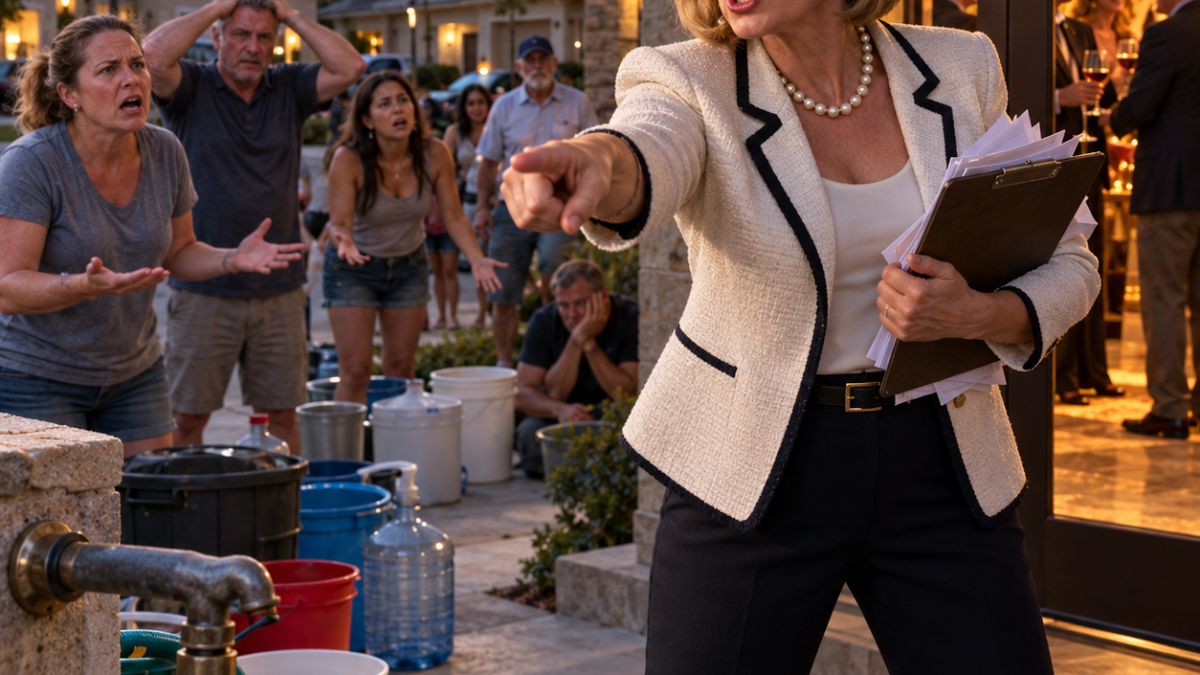
Priya stood near the entrance holding her toddler against one hip. A towel was wrapped around the boy’s shoulders.
She saw me.
“Nathan!”
People turned.
Questions hit me from five directions.
“When is the water coming back?”
“Was there a break?”
“Did you shut it off?”
“Why aren’t the hydrants working?”
I held up both hands.
“The pump hasn’t failed. Someone physically closed the main valve and locked me out of the station.”
A murmur moved through the crowd.
Priya looked toward the clubhouse.
“Then why are they having a party?”
I didn’t answer.
I couldn’t.
Because through the covered windows, I could hear laughter.
Marcus walked to the double doors.
Locked.
He knocked hard.
No response.
He knocked again.
“County water compliance!”
The music continued.
Captain Strand stepped forward.
“Try again.”
Marcus used the flat of his palm this time.
“COUNTY INSPECTOR. OPEN THE DOOR.”
The music stopped.
Not gradually.
Instantly.
The silence inside was followed by movement.
Chairs.
Footsteps.
Muffled voices.
Then the lock clicked.
One door opened six inches.
Delaney Price stood behind it.
She had a champagne glass in her hand.
For the first time since I’d met her, she didn’t look prepared.
Her eyes moved from Marcus to Captain Strand.
Then to the deputy.
Then past them to the crowd.
Finally she saw me.
Her mouth tightened.
Marcus held up his identification.
“Ms. Price?”
“Yes.”
“I’m Marcus Delgado, county drinking-water compliance. We have a confirmed interruption affecting the Willow Bend distribution system.”
Delaney opened the door a little wider.
“We’re aware of a temporary issue.”
“Who ordered the main isolation valve closed?”
She didn’t answer immediately.
Behind her, I could see tables.
Catering trays.
A chocolate fountain.
A sheet cake.
Two words in blue frosting:
**NEW ERA.**
My stomach turned.
Marcus repeated the question.
“Who ordered the valve closed?”
Delaney lifted her chin.
“The association exercised emergency operational authority over infrastructure serving our residents.”
I stepped forward.
“You locked me out of my own pump station.”
She looked at me.
“You left us no choice.”
“I left you no choice about what?”
“Your refusal to negotiate.”
A resident behind me shouted, “My kids can’t flush the toilet because he wouldn’t sell you land?”
Delaney’s face tightened.
“That is an oversimplification.”
Captain Strand spoke.
“No, ma’am. The immediate issue is simpler than that. Four hydrants serving this neighborhood have lost operating pressure.”
Delaney blinked.
“What?”
“Your hydrants.”
“There’s backup storage.”
“No,” I said.
She snapped her eyes toward me.
“Yes, there is.”
“The elevated tank isn’t backup supply. It’s pressure storage.”
Brent Salazar appeared behind her.
I recognized him instantly.
His collar was open, and he still had a cocktail napkin in one hand.
He whispered something.
Delaney ignored him.
Marcus opened the agreement.
“Show me the state-approved transfer plan authorizing the HOA to take control of this system.”
“It’s being processed.”
“Then show me the one-eighty-day written notice.”
“This was an emergency action.”
“What emergency?”
She glanced toward me.
“Concerns about continuity of service.”
I laughed once.
Not because anything was funny.
“You created the first service interruption we’ve had in years.”
Her jaw tightened.
“We had reason to believe you might use the system as leverage.”
“When?”
“You refused a reasonable acquisition offer.”
“That isn’t an emergency.”
Marcus raised a hand between us.
“Mr. Cole.”
I stopped.
He looked at Delaney again.
“Ms. Price, did you know closing that valve would interrupt service?”
“I was told the association had reserve capacity.”
“By whom?”
Her eyes moved toward Brent.
He took half a step backward.
Then another voice came from inside.
“I want to know that too.”
Harold Finch pushed through the doorway.
His face looked gray.
He looked at the crowd, then at me.
“Delaney, you said the resolution was maintenance authority.”
“It was.”
“No. You told us Nathan was threatening service.”
“I told you we had operational risk.”
“You didn’t tell us you were going to shut anything off.”
Delaney’s expression hardened.
“You voted for the resolution.”
“I voted for what you told me it was.”
Another board member appeared.
“I wasn’t even invited to that meeting.”
Then another.
“I was told it had been postponed.”
Whispers spread through the clubhouse.
Delaney turned.
“Everyone needs to calm down.”
Nobody did.
I heard a vehicle door slam at the edge of the parking lot.
The contractor’s white van was parked there.
The man I’d seen leaving my station stood beside it.
He watched the sheriff’s deputy start walking toward him.
His shoulders dropped.
Then he raised both hands where the deputy could see them.
“I’m not looking for trouble,” he called.
“Come over here,” the deputy said.
The man approached.
Delaney’s face changed.
Not much.
But enough.
I knew immediately that he mattered.
The deputy asked his name.
“Dale Whitaker.”
“You were at the pump station tonight?”
Dale looked at me.
Then at Delaney.
“Yes.”
“Why?”
He swallowed.
“I was hired to install a lock and close a valve.”
The crowd went dead quiet.
“By whom?”
Dale pointed.
“Her.”
Delaney stepped forward.
“That is a gross simplification of your instructions.”
Dale looked almost offended.
“You told me exactly which valve.”
“I told you to secure the facility.”
“You told me to shut the isolation valve.”
She shook her head.
“No.”
Dale pulled his phone from his pocket.
“I’ve got the texts.”
That was the first moment I saw real fear reach Delaney’s face.
Marcus noticed it too.
“Don’t delete anything,” he told Dale.
“I’m not.”
“Show me.”
Dale unlocked the phone.
Delaney moved toward him.
The deputy stepped between them.
“Ma’am.”
“I have a right to see what he’s presenting.”
“You’ll get that opportunity. Stay where you are.”
Marcus read the first message.
Then the next.
His mouth flattened.
“What time did you close the valve?”
“About five-forty.”
“Did you warn Ms. Price what would happen?”
“I told her the line would lose pressure unless there was another supply.”
Delaney cut in.
“He said it would be temporary.”
Dale looked at her.
“I said the tank might hold for forty minutes.”
“You told me there was storage.”
“I told you to confirm the storage.”
“I did.”
“With who?”
She didn’t answer.
Dale shook his head.
“I specifically asked if you had a backup source. You said yes.”
Residents started shouting.
Marcus raised his voice.
“Everybody back up. We need the system restored first.”
That pulled me out of the argument.
He turned toward me.
“Can we safely reopen?”
“Not instantly. We need to bring pressure up gradually and flush.”
“How fast can you do it?”
“If I can access my equipment, I can start now.”
The deputy looked at the lock.
“Who has the key?”
Dale raised his hand.
“I do.”
Delaney said, “That lock belongs to the association.”
I looked at her.
“It’s attached to my gate.”
She said nothing.
We drove back to the station in a small convoy.
Dale handed me the key.
I unlocked the gate.
The moment it swung open, I felt more angry than relieved.
Someone had crossed onto land my family had owned for decades, touched equipment they did not understand, disconnected controls, and locked me out.
But anger could wait.
Water couldn’t.
I inspected the chlorinator.
Checked the pressure tank.
Verified the pump controls.
Dale had disconnected a remote lead exactly as I’d suspected.
“Why’d you pull this?” I asked.
“She wanted your remote access disabled.”
“Why?”
Dale looked toward the deputy.
“I was told Mr. Cole might interfere.”
I almost answered.
Ruth touched my arm.
“Later.”
She had arrived while we were at the clubhouse, carrying the folder I’d asked her to bring.
Smart woman.
She knew when a client needed a lawyer standing physically beside him.
I reconnected the controls.
Marcus documented every step.
At 9:25, he authorized the valve reopening.
I moved it slowly.
Pressure climbed.
Five pounds.
Nine.
Fourteen.
The pipes vibrated beneath our feet.
Captain Strand watched the gauge.
“Tell me when hydrants should be usable.”
“Not yet.”
At twenty-five pounds, she radioed her crew.
At thirty-five, they reported pressure returning.
I kept the pump steady.
Brown water would be moving through parts of the system now.
Low pressure could allow infiltration through tiny leaks and service connections.
That meant the neighborhood wasn’t done suffering.
Marcus already knew.
“We’re issuing a boil advisory.”
Delaney, who had followed us under the deputy’s supervision, stared at him.
“For how long?”
“Until bacteriological samples clear.”
“How long is that?”
“Could be days.”
Residents groaned.
She turned toward me.
“This is exactly why the association needs operational control.”
I stared at her.
“You shut the water off.”
“Because you refused to cooperate.”
“You still think this is about cooperation?”
Her voice went low.
“You’ve made a fortune off this community for years.”
That stunned me.
Not because it was insulting.
Because it explained something.
“You think I’m getting rich from this?”
“You send invoices every quarter.”
“To operate a regulated water system.”
“On a well your grandfather paid for fifty years ago.”
I almost laughed.
“Do you know what pumps cost? Chlorine testing? Insurance? Electrical service? State sampling? Emergency maintenance?”
“You’ve been protected from competition.”
“By an agreement your developer asked for.”
She crossed her arms.
“The community should control its own resources.”
“Then build your own well.”
“We don’t need to when this one already serves us.”
There it was.
The entire argument in one sentence.
She didn’t want independence.
She wanted my asset.
Marcus stepped between us.
“This conversation is over for tonight.”
Delaney looked at him.
“Am I free to leave?”
“The deputy will answer that.”
She looked at the deputy.
He said, “We’re still documenting. Stay available.”
For the first time that evening, Delaney had no order to give.
No committee to control.
No closed door to hide behind.
And she hated it.
By 10:30, most homes had water again.
It came out yellow or brown in several sections.
We flushed until after midnight.
The boil advisory went out through emergency alerts, email, printed notices, and the HOA’s own text system.
Three days.
For three days, people boiled water.
Bought cases from grocery stores.
Drove to relatives’ homes to shower.
Priya’s husband took their toddler to his parents’ house.
Frank Doyle’s dialysis schedule had to be adjusted after he’d been sent for emergency medical evaluation.
Nobody died.
No house caught fire.
I was grateful for that.
But those facts didn’t erase what had happened.
Monday morning, Ruth filed for an emergency protective order.
The hearing was short.
The judge had the agreement.
Photos.
Videos.
County documentation.
My message to Delaney.
The new lock.
The shutdown timeline.
The association’s attorney tried to frame everything as an internal governance dispute.
The judge stopped him.
“Counsel, this ceased being merely internal when your client interfered with a regulated drinking-water system located on property it does not own.”
The attorney stood silent.
The judge signed the order.
The HOA, its officers, employees, agents, vendors, and contractors were barred from entering the pump property or touching any part of the system without my written authorization except under a genuine public emergency.
Ruth slid the signed order into her folder as we left.
“That’s step one.”
“How many steps are there?”
She gave me a tired smile.
“As many as Delaney bought herself.”
The county notice arrived Tuesday.
The state followed.
Forty-eight thousand dollars in regulatory penalties for the interruption, reporting failures, and related violations.
A full system review at association expense.
Sampling.
Operational audit.
Emergency-planning revisions.
The fine made headlines in the local paper.
That was when Willow Bend stopped treating Friday night as an inconvenience and started asking how it had happened.
Residents demanded records.
Meeting minutes.
Contracts.
Emails.
Invoices.
The HOA scheduled a special meeting.
More than two hundred people came.
I hadn’t planned to attend.
Ruth told me I should.
“Why?”
“Because for five weeks Delaney has been telling residents a story about you.”
“What story?”
“That you’re an obstacle to cheaper water.”
“I don’t care what she thinks.”
“This isn’t about what she thinks.”
She pushed a printed agenda across my desk.
“It’s about what everyone else has been told.”
So I went.
The clubhouse felt different without champagne.
No covered windows.
No music.
No cake.
Rows of folding chairs filled the room.
People stood along the walls.
Delaney sat at the front table between the HOA attorney and Harold Finch.
Harold looked like he hadn’t slept in days.
The treasurer, Lillian Brooks, had a stack of binders beside her.
I took a seat in the back.
Priya waved me forward.
I shook my head.
I didn’t want the front.
I wanted to watch.
The meeting began with shouting.
Residents demanded Delaney resign.
Others demanded the entire board resign.
One man wanted to know who would pay the fine.
A woman near the aisle shouted, “Not us.”
The HOA attorney repeatedly asked everyone to maintain order.
Nobody cared.
Finally Lillian switched on the projector.
“I requested all financial records relating to the Willow Bend Self-Reliance Initiative.”
Delaney leaned toward her microphone.
“Lillian, some of those records are subject to privilege.”
“No,” Lillian said. “Legal communications may be. Bank payments are not.”
Applause broke out.
Delaney looked furious.
Lillian continued.
“The association paid Brent Salazar Consulting seventy-three thousand five hundred dollars over the past five months.”
The room quieted.
I looked toward Brent.
He wasn’t there.
“What did he deliver?” someone asked.
Lillian clicked.
Invoices appeared.
**Water Infrastructure Strategy.**
**Vendor Transition Planning.**
**Operational Independence Assessment.**
“Where’s the report?” a resident shouted.
Lillian looked at Delaney.
“I have requested it six times.”
Delaney adjusted her microphone.
“Mr. Salazar’s work involved strategic consultation that does not necessarily result in a single written deliverable.”
A laugh came from somewhere behind me.
Then another.
Lillian clicked again.
A nineteen-thousand-dollar payment appeared.
Dale Whitaker Mechanical Services.
Classified as routine maintenance.
Harold turned toward Delaney.
“Nineteen thousand?”
“That included emergency mobilization.”
Dale was sitting near the side wall beside an attorney.
He raised his hand.
“No, it didn’t.”
Every head turned.
The HOA lawyer closed his eyes.
Dale stood.
“My invoice was nineteen thousand because I was told the scope included future control work after Friday.”
Delaney snapped, “You should speak through counsel.”
Dale’s lawyer stood beside him.
“He is.”
A few people laughed.
Dale continued.
“I’ve given the county and sheriff’s office my complete messages.”
Lillian clicked again.
Fourteen thousand two hundred dollars.
Landscaping budget.
Transferred to a special event account.
A woman near the front stood.
“Was that the party?”
Lillian said, “Yes.”
Delaney leaned into the microphone.
“It was an appreciation event for volunteers and stakeholders.”
Priya stood so fast her chair scraped backward.
“My son was standing in a towel without running water while you were eating shrimp.”
Delaney looked at her.
“I did not know the neighborhood had fully lost water.”
The room changed.
Not louder.
Quieter.
Because we all knew that sentence could be checked.
I looked at Ruth.
She was already reaching into her folder.
Lillian said, “You’re saying you did not know?”
“Not until later.”
“What time?”
“I don’t recall precisely.”
I spoke from the back.
“You read my warning at 6:14.”
Delaney looked at me.
“I receive many messages.”
“This one said sixty-eight homes would lose water.”
“I didn’t understand the situation was that severe.”
Dale walked toward the projector with his phone.
His attorney nodded.
Lillian connected it.
The first message appeared.
**5:42 PM — Delaney Price: Is the valve closed yet?**
Nobody moved.
Second message.
**5:44 PM — Dale Whitaker: Closed. Pressure will begin dropping. Confirm you have backup supply.**
Third.
**5:46 PM — Delaney Price: We do. Proceed with lockout.**
Then another.
**6:20 PM — Delaney Price: Make sure nobody can reopen it tonight.**
The room became so quiet I heard the projector fan.
Delaney stared at the screen.
Harold Finch slowly removed his glasses.
He looked at her.
“You knew.”
She answered without looking at him.
“I knew pressure might fluctuate.”
“You told him nobody could reopen the valve.”
“We needed control of the site.”
“While houses were losing water.”
“I was acting under the resolution.”
Harold stood.
“No. You lied to us about the resolution.”
Delaney finally looked at him.
“You voted for it.”
“I voted because you said Nathan was threatening to terminate service.”
“I said there was a continuity risk.”
“You told me he planned to use the well as leverage.”
She pointed toward me.
“He was using it as leverage.”
I stood.
“No, Delaney. You wanted me to sell it.”
“Because one private owner should not control essential infrastructure.”
“I didn’t control your water. I supplied it under a contract.”
“You could have stopped anytime.”
“No. The agreement specifically prevented me from doing that.”
She hesitated.
Just for a second.
Ruth noticed.
“So did you ever read it?” Ruth asked.
Delaney looked at her.
“Of course.”
“All of it?”
“I am familiar with the agreement.”
Ruth took out a copy.
“Clause eight.”
Delaney said nothing.
Ruth waited.
“Would you like to tell the room what clause eight requires before either party interrupts service?”
The HOA attorney whispered to Delaney.
Too late.
Residents were staring.
Ruth answered for her.
“One hundred eighty days’ written notice and a state-approved transfer plan.”
She turned toward the audience.
“Mr. Cole couldn’t lawfully turn your water off on a whim. Neither could the association.”
Delaney said, “We acted under emergency authority.”
I asked, “What emergency existed before you created one?”
She opened her mouth.
Nothing came out.
Harold looked down the table.
“I move to remove Delaney Price as board president effective immediately.”
The HOA attorney spoke.
“Mr. Finch—”
“I second,” another board member said.
Delaney turned.
“You cannot do this without proper notice.”
Lillian slid a document forward.
“This special meeting was noticed with officer removal listed on the agenda.”
Delaney stared at it.
For five weeks, I’d watched her use procedure like a weapon.
Now procedure was pointed back at her.
The vote passed.
Only one person voted against removal.
Delaney herself.
She sat there after the result was announced, hands flat on the table.
Nobody clapped.
That surprised me.
There was no triumphant roar.
No celebration.
Just exhausted silence.
As if the neighborhood had finally realized that removing her didn’t remove the bills.
Or the fines.
Or the liability.
Or the fact that most of them had never known one person could make a decision that affected every faucet on their street.
Delaney packed her binder.
That same blue binder she’d carried onto my property.
When she walked down the aisle, nobody moved aside quickly.
She had to stop twice and wait for people to shift their chairs.
She passed me near the back.
For a second, I thought she’d keep walking.
Instead she stopped.
“You enjoyed this.”
“No.”
She gave a bitter little smile.
“Please.”
“I enjoyed getting my property back.”
“You humiliated me.”
“You sent the messages.”
“You could have handled this privately.”
I stared at her.
“Sixty-eight houses lost water. There was nothing private about it.”
Her face hardened.
“You think they’re going to thank you when their dues double?”
“Why would their dues double?”
“For the fines. Claims. Lawyers. Upgrades.”
“Those aren’t my charges.”
“They’ll blame you anyway.”
Maybe she believed that.
Maybe she needed to.
I leaned closer.
“You still don’t understand what happened.”
Her eyes narrowed.
“You thought this was you against me.”
“It was.”
“No. It stopped being that the second you closed the valve.”
She walked out without answering.
The investigation kept moving.
Dale cooperated.
According to the statement he later gave investigators, Delaney and Brent had approached him weeks earlier.
The plan had sounded simple when they described it.
Gain physical control.
Create an “operational emergency.”
Call authorities.
Claim the private system had become unreliable.
Then argue that the HOA needed permanent control to protect residents.
Dale told investigators he had questioned the logic.
He was a mechanical contractor, not a water lawyer.
But he understood valves.
He knew closing the main meant closing the main.
He said Delaney assured him the subdivision had backup storage.
He believed her because, in his words, “No sane HOA president would intentionally shut off water to her own neighborhood.”
That sentence ended up quoted in more than one filing.
Brent’s role took longer to untangle.
He had sold Delaney on the idea that possession could create leverage.
Not ownership.
Not legally.
But leverage.
If the HOA controlled the station, restored water under its own authority, and documented itself acting as the system operator, he believed it might create enough regulatory confusion to force a negotiated transfer.
Ruth read that portion of the investigative memo at her office.
I looked at her.
“Would that ever have worked?”
“No.”
“Not even temporarily?”
“Temporarily, confusion can accomplish a lot.”
She set the pages down.
“But permanently? No. They had a recorded agreement, title records, easements, state permits, and decades of payment history working against them.”
“So Brent charged seventy-three thousand dollars for a bad bluff.”
“Apparently.”
“That’s expensive confidence.”
She smiled.
“It usually is.”
The insurance problem hit next.
The HOA’s carrier reviewed the shutdown and reserved its rights.
That meant it might cover some claims.
It might not.
Deliberate unauthorized conduct by an officer was different from an accidental pipe break.
Residents who had lost food filed claims.
Families who bought bottled water filed claims.
Frank Doyle’s medical expenses became the most serious.
The association hired separate counsel.
Then the insurer hired counsel.
Then Delaney hired her own attorney.
I began receiving letters from people I’d never heard of asking for records I had already provided to three agencies.
For a while, my kitchen table disappeared under paper.
One evening I sat there with my father’s old maintenance notebook beside a stack of legal notices.
His handwriting was still inside.
Pump readings.
Chlorine levels.
Filter dates.
Short notes.
**Replaced contactor.**
**Flushed north line.**
**Cold morning—pressure steady.**
He had run the system for years without ever attending a single HOA dispute.
He would have hated every minute of what was happening.
My mother called that night.
“You eating?”
“Yes.”
“That was too fast.”
I looked at the untouched sandwich on the counter.
“I have food.”
“Not what I asked.”
I smiled despite myself.
“Yes, Mom.”
She went quiet.
Then she said, “Your father would tell you not to sell because you’re angry.”
“I’m not selling.”
“He’d also tell you not to keep it because you’re angry.”
That stopped me.
“I know.”
“Do you?”
I looked at the maintenance notebook.
“I don’t know what I know anymore.”
“For thirty years, that well was just work to you.”
“Still is.”
“No. Now it’s a fight.”
I didn’t answer.
She was right.
That bothered me.
The next morning I drove to the station before sunrise.
No inspectors.
No lawyers.
No residents.
Just the steady hum of the pump.
Sixty-two pounds.
Exactly where it should be.
I stood there longer than necessary.
For the first time since Friday night, I wondered whether selling the system might actually make my life easier.
Not to Delaney.
Not under threat.
But someday.
Then I remembered Frank Doyle standing at the special meeting with his dialysis bag at his feet.
I remembered Priya’s son wrapped in a towel.
I remembered that gauge touching zero.
The well had never been a symbol to me.
I didn’t want it to become one.
It was infrastructure.
Infrastructure should be boring.
Reliable.
Invisible.
That thought gave me the idea for what happened next.
I called Lillian.
“I want to invite the neighborhood to the pump station.”
She sounded surprised.
“Why?”
“Because half of them didn’t know it existed.”
“You’re okay with residents on your property?”
“For one day.”
“What are you going to tell them?”
“How their water works.”
“That’s it?”
“That’s it.”
She laughed.
“After the month we’ve had, that might be revolutionary.”
The new board approved the visit.
Nearly a hundred residents came.
I divided them into small groups.
Showed them the wellhead.
Pressure tank.
Chlorinator.
Electrical controls.
Sampling ports.
Emergency generator hookup.
I explained the distribution map and why pressure mattered.
A kid asked whether the well went all the way to the center of the Earth.
Another asked whether fish lived in it.
For the first time in weeks, I laughed without feeling guilty.
Priya came near the end with her son.
He was holding a blue plastic cup.
She looked at the equipment.
“I feel stupid.”
“Why?”
“I’ve lived here seven years. I never knew any of this was here.”
“That’s normal.”
“I should’ve known.”
I shook my head.
“No. If I’m doing my job right, you shouldn’t have to think about where the water comes from.”
She glanced toward the pump.
“Until it stops.”
“Yeah.”
“Then you think about nothing else.”
Her son held up his cup.
“Water?”
I walked him to the sampling sink.
“Want to see where we test it?”
He nodded.
I filled the cup.
Priya immediately laughed.
“He can’t drink that without me asking ten questions now.”
“Fair.”
I tested the chlorine residual in front of her.
“Clear.”
The boy drank.
That tiny moment meant more to me than Delaney losing her position.
Because it reminded me what the argument had actually been about.
Not land.
Not leverage.
Not an HOA.
Trust.
People opened a faucet assuming water would be there.
They should have been able to.
The new board negotiated differently.
No surprise letters.
No invented theories.
No threats.
They asked Ruth and me to review the water agreement with their attorney.
We spent three meetings going line by line.
At the second meeting, Lillian slid a proposed rate adjustment across the table.
It was higher than what they’d been paying.
Fairly higher.
The original rate had barely kept up with rising testing, power, insurance, and maintenance costs.
I read it.
“You know I would’ve accepted something close to this years ago?”
Harold looked embarrassed.
“Apparently nobody thought to ask.”
“Delaney asked me to sell.”
“That isn’t what I said.”
“I know.”
He rubbed his forehead.
“I’m sorry.”
“For what?”
“For voting.”
I looked at him.
“You didn’t close the valve.”
“I helped give her the authority she used.”
“Then don’t do that again.”
He laughed once.
“Believe me.”
The board adopted new utility rules.
Any decision affecting water, sewer, electrical service, road access, or emergency infrastructure required written notice to all households.
Recorded votes.
Full board participation unless a genuine emergency prevented it.
Independent legal review.
No single officer could authorize physical interference with a utility.
It sounded obvious.
Most good rules do after someone proves why they’re needed.
The criminal investigation took months.
I wasn’t involved in most of it.
What I knew came through subpoenas, public records, court filings, and Ruth.
Delaney was accused of unlawful interference with a public water system, falsification connected to association records, and misuse of association funds.
Brent’s firm was referred for further investigation over its billing and role in the takeover scheme.
Dale cooperated.
That mattered for him.
Investigators concluded he’d followed terrible instructions and had failed to independently verify the authority behind them, but his texts showed he had warned Delaney about the loss of pressure and asked about backup supply.
He wasn’t innocent.
But he hadn’t invented the plan.
He became a witness.
The most damaging evidence against Delaney was not something I had recorded.
It was her own phone.
The message logs established when she knew the valve was closed.
When she knew pressure was falling.
When she read my warning.
And when she instructed Dale to make sure nobody reopened the system.
Investigators also recovered messages between her and Brent from earlier that week.
One line appeared in a later filing.
**Once we’re physically in control, Cole will have to negotiate from the outside.**
I read that sentence three times.
Ruth watched me.
“You okay?”
“She literally planned to lock me outside.”
“Yes.”
“And thought possession would pressure me into selling.”
“Yes.”
I leaned back.
“That’s almost impressive.”
“No.”
I looked at her.
“No?”
“It’s simple.”
“What is?”
“She confused inconvenience with legal leverage.”
Ruth closed the file.
“People do that constantly.”
Delaney eventually accepted a plea agreement.
Restitution.
A multi-year prohibition on serving as an officer or director of a homeowners association.
Civil liability that contributed to a lien against her house.
Her attorney negotiated down some of the criminal exposure.
The final outcome was less cinematic than people expected.
No dramatic handcuffs at a board meeting.
No judge shouting.
No courtroom confession.
Just signatures.
Conditions.
Payments.
Restrictions.
The slow administrative collapse of the authority she’d been so certain she possessed.
I saw her only once after that.
At a county building.
I was leaving a permit-review meeting when she walked through the lobby with her attorney.
She looked different.
Not ruined.
Not broken.
Just smaller somehow without an audience around her.
We stopped a few feet apart.
Her attorney kept walking, then realized she wasn’t beside him.
Delaney looked at me.
“I lost my house.”
I didn’t know what to say.
The lien and legal costs had forced a sale.
I had heard rumors.
I hadn’t known it was final.
“I’m sorry.”
She gave a short laugh.
“No, you’re not.”
“I’m not sorry about the consequences.”
“Then don’t pretend.”
“I’m sorry it went this far.”
Her expression changed.
For one second, some of the fight left it.
“You could’ve sold.”
There it was again.
Even now.
“You could’ve left the valve alone.”
She looked away.
“I thought they’d back me.”
“The board?”
“The neighborhood.”
“Why?”
“Because I was trying to make us independent.”
I studied her face.
I believed she believed that part.
At least at first.
Maybe that’s what made the whole thing worse.
“You didn’t ask them,” I said.
She looked back.
“What?”
“You keep saying you were doing it for the neighborhood. But you hid the vote. Covered the windows. Locked the doors. Didn’t tell residents what you were doing.”
Her jaw tightened.
“I had opposition.”
“You had people.”
She said nothing.
“If your plan only works when the people you’re supposedly helping don’t know about it, that’s not independence.”
Her attorney called her name.
She adjusted the strap of her bag.
Then she walked away.
I never saw her again.
Brent’s problems lasted longer.
His firm disputed several findings and blamed Delaney for acting beyond its recommendations.
Delaney’s attorney blamed Brent for encouraging the operational-custody strategy.
Dale blamed both of them.
The invoices became part of a broader financial inquiry.
I didn’t follow every development.
After a while, I stopped wanting to.
That surprised people.
They expected me to enjoy watching everyone who’d crossed me suffer.
But revenge is exhausting when you have equipment to maintain.
A pump motor does not care who won the board vote.
Chlorine levels do not care who’s under investigation.
Water samples still have to be collected.
Bills still have to be paid.
Winter still comes.
Life had a way of pulling everything back toward ordinary work.
One cold morning, Captain Strand stopped by while I was replacing a pressure switch.
She leaned against the open station door.
“Everything boring again?”
“Mostly.”
“Good.”
“I’ve developed a deep appreciation for boring.”
She smiled.
“What’s the thing you remember most about that night?”
I tightened the switch housing.
“The obvious answer is Delaney opening the clubhouse door holding champagne.”
“That was memorable.”
“Or the cake.”
“New Era.”
“Yeah.”
She laughed.
“Somebody from the station still has a photo.”
I sat back on my heels.
“But that’s not it.”
“What is?”
“The gauge.”
“What about it?”
“When it hit zero.”
She waited.
I looked at the pressure gauge mounted above the tank.
A newer one now.
Same model.
“All that noise that night. Phones. People yelling. Fire radio. Cars.”
I tapped the gauge glass lightly with one finger.
“But when this went to zero, it made one little click.”
Captain Strand nodded.
“Funny what sticks.”
“Yeah.”
She pushed away from the door.
“See you around, Nathan.”
“Hopefully not professionally.”
“That’s the nicest thing anyone says to the fire department.”
After she left, I finished the repair and restarted the pump.
The needle rose smoothly.
Twenty pounds.
Thirty-five.
Forty-eight.
Sixty-two.
Steady.
Months had passed since the shutdown.
The clubhouse had new board members.
The HOA’s financial mess was slowly being repaired.
The residents had approved a temporary dues increase—not because I demanded one, but because fines, legal expenses, and claims had to be paid.
People weren’t happy about it.
They shouldn’t have been.
But this time the numbers were published.
Meetings were open.
Votes were recorded.
Questions got answered.
Frank Doyle stopped by one afternoon with a box of donuts.
“I hear you’re the reason my dues went up.”
I stared at him.
Then I saw the grin.
“Get off my property.”
He laughed.
“That’s not very community-minded.”
“You brought glazed?”
“Half.”
“Then you can stay.”
He sat on the tailgate of my truck while I finished a sample log.
After a minute he said, “You know, I was angry at you that night.”
“I know.”
“I thought maybe you shut it off.”
“So did some other people.”
“Then I found out you were the one trying to get it back.”
I capped the sample bottle.
“Understandable.”
“No, it isn’t.”
“Frank—”
“I’m serious.”
He looked toward the station.
“I never knew your family owned any of this. That’s how little attention I paid.”
“You’re not supposed to think about it.”
“That’s what Priya said you told her.”
“She talks too much.”
He smiled.
Then his expression grew serious.
“Still. Thank you.”
I nodded.
He stood.
“Don’t make it weird.”
“You’re the one getting emotional over donuts.”
He gave me a rude gesture and walked to his truck.
That was Willow Bend after Delaney.
Not healed.
Not transformed into some perfect little community.
Just more aware.
People argued at meetings.
Residents complained about rates.
Someone always hated the landscaping contract.
Two board members nearly started a war over mailbox paint.
Normal problems.
I liked them.
Normal problems meant nobody was trying to seize a water system.
A year after the shutdown, Lillian asked whether I wanted to replace the old agreement entirely.
We sat in the clubhouse conference room.
Same building.
Different atmosphere.
The old contract lay between us.
My grandfather’s name was on the first page.
“Thirty years is a long time,” she said.
“Closer to fifty for the original arrangement.”
“We could negotiate a modern utility contract.”
“We should.”
She hesitated.
“Does it feel strange changing something your grandfather signed?”
“A little.”
“You don’t have to.”
“That’s not a reason to keep outdated language.”
I turned the page.
“He built the well. He didn’t expect me to preserve every piece of paper forever.”
“What do you think he expected?”
“Water to come out when people turned the faucet.”
Lillian smiled.
“That seems reasonable.”
It took four months.
Lawyers reviewed everything.
The state reviewed operational provisions.
Insurance requirements were updated.
Rates were indexed more sensibly.
Emergency procedures were rewritten.
Most importantly, ownership and access were made painfully clear.
The HOA had no unilateral right to enter, modify, isolate, disable, operate, or take possession of the well or station.
If there was a genuine emergency and I couldn’t be reached, county responders had an approved access protocol.
No board president.
No consultant.
No secret resolution.
When the agreement was finished, the board held an open meeting.
I signed first.
Lillian signed for the association.
Harold witnessed it.
Then someone joked that we should celebrate.
The room went silent for half a second.
Harold raised both hands.
“No champagne.”
Everybody laughed.
Even me.
A few days later, I framed two copies.
One went in the clubhouse.
One went inside the pump station.
I hung mine beside the old agreement.
The original stayed because history matters.
The new one stayed because history should teach you something.
I locked the station that evening with my own padlock.
A heavy brass one.
The replacement had the same shape as the lock my father used.
I stood outside the gate and pulled on it twice.
Secure.
Then I drove through Willow Bend on the way home.
Sprinklers clicked across lawns.
Somebody was washing a truck.
A little girl ran through a yard carrying a garden hose while her father pretended to chase her.
At Priya’s house, her son was filling a plastic bucket from the outside spigot.
At Frank’s place, I saw water running through the clear line attached to his treatment equipment.
Nobody looked toward my truck.
Nobody waved me down.
Nobody asked about pressure.
They didn’t need to.
I reached the stop sign at the end of Larksburg Court and sat there for a second longer than necessary.
A year earlier, I’d thought the worst part of Delaney’s plan was that she wanted something that belonged to me.
I had been wrong.
Property can be defended with deeds.
Contracts can be defended in court.
Money can be repaid.
The dangerous part had been how easily she convinced herself that controlling one valve gave her the right to make a decision for sixty-eight families.
She believed authority meant not having to explain.
She believed a closed meeting could turn a bad idea into an official one.
She believed a locked gate could make my rights disappear.
And for about an hour on a Friday evening, she got exactly what she wanted.
She controlled the valve.
She controlled the station.
She had her private celebration.
Then sixty-eight faucets went dry.
Children stood covered in soap.
A man on dialysis wondered whether his treatment was safe.
Firefighters opened hydrants and found no pressure.
Residents walked toward a clubhouse carrying empty buckets.
And behind those covered windows, the people celebrating control learned the simplest thing about infrastructure:
It belongs to everybody who depends on it, even when the equipment itself belongs to someone else.
I drove back to the pump station once more before heading home.
Old habit.
Sunday checks had become daily checks for a while after the incident.
By then I had finally reduced them again.
I unlocked the gate.
Walked inside.
Listened to the pump.
No strange vibration.
No leak.
No alarm.
I checked the chlorine feed.
Normal.
Tank level.
Normal.
Then the pressure gauge.
Sixty-two pounds.
Exactly where it belonged.
I reached up and tapped the glass once with my knuckle, the same way my father used to.
The needle didn’t move.
Outside the fence, Willow Bend’s streetlights came on one by one.
Somewhere beyond the trees, sixty-eight families were cooking dinner, washing dishes, bathing children, filling glasses, flushing toilets, and doing a hundred ordinary things nobody thinks about until the moment they can’t.
I closed the station door.
Locked the gate.
And this time, when I drove away, the water kept running.
[END OF STORY]








