PART 2: HOA Shifted a $1.9 Million Pool Onto My Ranch—Then I Found the Yellow Pipeline Post They’d Cut Down
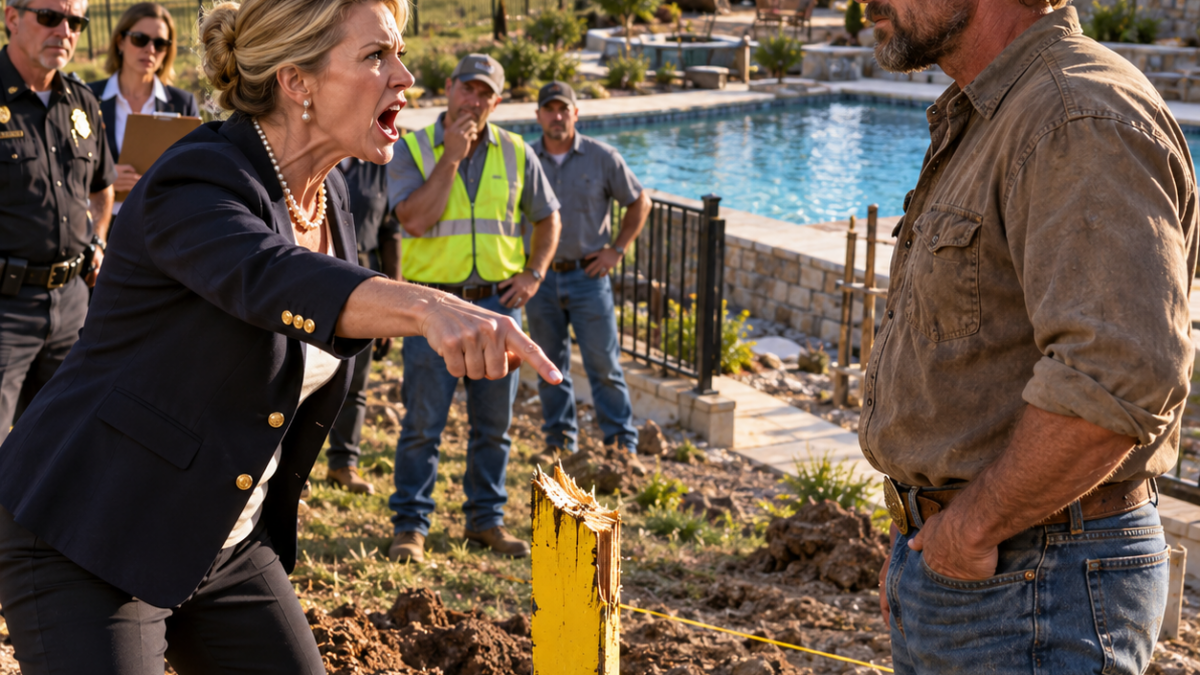
PART 2
Priya lowered her voice.
“Do you have any old development plans from when Sterling Oaks was built?”
“Not theirs.”
“County records?”
“I can get them.”
She looked past me toward the clubhouse.
“Do that before you argue about the fence.”
“What are you thinking?”
“I’m thinking the fence may be confusing everybody.”
“Everybody except my father.”
She glanced at me.
“Then let’s prove why.”
That sentence stayed with me after she left.
My father, Earl Holloway, had installed that cattle fence nearly four decades earlier.
I was twenty-four then and convinced that the pipeline company had stolen the best strip of grazing ground we owned.
I still remembered watching the operator’s crew drive the original yellow test station into the soil while Dad stood beside me.
“We still own the ground,” he had said, resting one hand against the new post, “but we don’t get to pretend the pipe isn’t there.”
I had been angry enough to argue.
“So why put the fence inside our own land?”
“Because cows don’t read easements.”
At twenty-four, I thought that was just another one of his dry answers.
At sixty-two, holding the replacement for that post in two cut pieces, I finally understood how carefully he’d separated three different things in his mind.
The land.
The fence.
And the pipeline.
They were not the same line.
Sterling Oaks was treating them as though they were.
Before sunset, an email went out to all 112 homeowners.
I didn’t receive it directly.
One of the residents forwarded it to me less than an hour later.
The subject line read:
CONSTRUCTION DELAY CAUSED BY ADJACENT PROPERTY DISPUTE.
According to the message, a neighboring ranch owner had raised a “new boundary objection” after pool construction was already underway.
It also stated that the pipeline operator had found no emergency and that delay costs were estimated at $18,000 per day.
Both statements were technically defensible.
That was what made them effective.
There was no emergency.
Elena hadn’t found a leak.
But she also had not cleared the excavation.
And my boundary objection was not new.
The construction was.
Laura had put enough truth into the email to make the rest sound inevitable.
About forty minutes later, a silver SUV stopped at my cattle gate.
The driver introduced himself as Miles Avery.
I knew the name.
Sterling Oaks treasurer.
He carried a thick board packet under one arm.
“I’m not here to take sides,” he said before I’d even opened the gate.
“That’s usually what people say right before taking one.”
He almost smiled.
“Fair.”
I unlocked the chain.
He stayed on the roadside.
“Laura says your family accepted the fence as the property line for years.”
“My family accepted the fence as a cattle fence.”
“She says Sterling Oaks has maintained the strip for twelve years.”
“That’s true.”
That caught him off guard.
“You admit that?”
“Why wouldn’t I?”
“Because you’re claiming it’s yours.”
“It is mine.”
He frowned.
I explained that the HOA’s landscaper had mowed the open strip between the fence and clubhouse for years because the work kept brush away from the pipeline corridor and saved me maintenance.
“Did you ever object?”
“No.”
“Did you ever give written permission?”
“No.”
“Did you ever tell them to stop?”
“No.”
He studied me.
“So you let the association maintain it.”
“I let their landscaper cut grass.”
“Laura thinks that matters.”
“It might matter to an attorney. It doesn’t relocate a deed monument.”
Miles looked past me toward the pool.
“Can you show me what you found?”
I took him to the section of fence where the cut yellow post was visible on the ground.
I didn’t let him cross.
Neither of us needed another argument about permission.
He photographed it through the wire.
Then I showed him Priya’s preliminary flag locations.
Finally, he opened his board packet on the hood of his SUV.
The approved rendering showed the pool beside three mature live oaks.
Between the pool and those trees was a band of lawn.
Beyond the trees, a thin gray line marked the western parcel boundary.
I leaned closer.
The cattle fence wasn’t shown at all.
Miles noticed the same thing.
“The board never voted to move the pool.”
“Move it from where?”
He flipped several pages.
“According to this, east of those trees.”
I looked through the fence at the excavation.
The deep end now sat west of them.
“How far was it moved?”
“I don’t know.”
“Who authorized it?”
He turned to the budget pages.
“I don’t know that either.”
Then he stopped.
The approved revenue schedule listed four premium poolside cabanas.
The construction sign near the gate showed ten.
Miles stared at the page.
Then at the sign.
Then back at the page.
“That’s six more than the board approved.”
“Maybe ask Laura.”
“I intend to.”
He photographed the construction sign.
Still, he wouldn’t accuse her of anything.
And I respected that.
“A field change might fall within the project committee’s authority,” he said. “If the land and utility clearances still work, that matters.”
“Agreed.”
He seemed surprised.
“You agree?”
“I don’t care whether your HOA builds four cabanas or forty. I care whether they’re digging on my property and above an active transmission line.”
He closed the packet.
“The lender’s progress inspection is Friday morning.”
“Same day as the shell pour.”
“Yes.”
We looked at each other.
Now the project had two clocks.
One belonged to the contractor.
The other belonged to the money.
At seven the following morning, a concrete truck appeared near the clubhouse.
My phone rang.
Darren Holt.
“I’m at the site gate,” he said. “Laura wants us pouring the eastern deck.”
“That’s between you and your client.”
“The operator’s buffer doesn’t cover that section.”
“Then why are you calling me?”
A pause.
“Because I want to know whether it’s on HOA property.”
“According to my deed, part of the revised project may not be.”
“According to the plan they gave me, it is.”
“Which plan?”
Silence.
Then Darren said, “That’s becoming the expensive question.”
He sent the truck away while his insurance carrier reviewed the dispute.
Laura responded by bringing in another subcontractor.
By nine o’clock, concrete was flowing through a pump hose into the eastern deck forms.
I stood on my ranch side of the fence and watched workers rake wet concrete into place.
Every yard that hardened reduced Laura’s options.
If the project had to move later, she could point at the completed deck and say retreat had become financially irresponsible.
She couldn’t yet prove the pool belonged where she’d put it.
So she was making it increasingly costly to put it anywhere else.
My attorney, Mark Ellis, sent Sterling Oaks a preservation notice that afternoon.
Permit drawings.
Utility locate records.
Change orders.
Contractor questions.
Board approvals.
Survey materials.
Emails related to the revised footprint.
Sterling Oaks counsel responded within hours.
They agreed to preserve relevant documents.
They also reserved all claims against me for interference and delay.
The next morning, a courier delivered a formal demand to my ranch house.
It accused me of making inaccurate boundary assertions and interfering with a permitted project.
The letter warned that Sterling Oaks might seek recovery of resulting costs if I continued contacting contractors.
As I stood on the porch reading it, a temporary construction fence was being installed along my cattle fence.
Black fabric stretched between the panels.
Within an hour, most of the excavation disappeared from view.
At the north end, the temporary fencing crossed the pipeline operator’s normal equipment approach from the clubhouse road.
Elena came out that afternoon.
She photographed it.
Then she asked Laura to preserve access.
Laura moved the panels six feet.
That was enough to create a narrow opening.
“See?” she told Elena. “We’re cooperating.”
Technically, she was.
Practically, every pipeline vehicle now had to squeeze through a single-file route beside fresh deck forms and active construction.
I opened my north pasture gate instead.
That meant moving eleven cattle into the lower paddock.
It also meant canceling a veterinary visit I’d scheduled for the next morning.
Nobody wrote an email about that inconvenience.
There was no $18,000-per-day figure beside my time.
That was when I stopped speaking to contractors unless they called me first.
Laura wanted the dispute framed as Grant Holloway versus the project.
I wanted records.
The pipeline operator found the original one-call locate ticket.
Elena called me that evening.
“I have something.”
“I’m listening.”
“The locate request matches the permitted footprint.”
“Meaning?”
“The request area stays east of your recorded deed boundary.”
“Does it cover where they’re digging now?”
“Not according to the attached map.”
I stood at my kitchen counter.
“Then the excavation moved.”
“That’s what it looks like.”
“Enough to cross the line?”
“I don’t establish property boundaries.”
“I know.”
“And Grant?”
“Yes?”
“Don’t get ahead of the evidence. The work map helps. It doesn’t tell us what was actually staked in the field.”
That was Elena.
Careful even when the answer appeared obvious.
It was one reason I trusted her.
Her crew returned the next morning.
Instead of working near the unstable excavation, they started at an undisturbed section of corridor farther north.
They used controlled excavation to expose a small section of active pipe.
Once they verified it physically, they connected the surface signals to the known steel.
Then they traced south.
At first, the result seemed to help Laura.
One buried repair lead distorted the signal toward the corridor shown on the old development exhibit.
Laura arrived while Elena’s technicians were marking both traces.
She pointed.
“That’s exactly what our consultant identified.”
Elena looked at her.
“No. It’s exactly why we’re verifying.”
“You have a point two hundred feet north.”
“One point.”
“You can project the route.”
“Projection is how people create mistakes.”
Laura’s jaw tightened.
A second concrete truck arrived.
She glanced toward it.
Then toward Elena.
“Can you narrow the buffer around the western deck?”
“Not yet.”
“How long?”
“As long as it takes to identify the active line safely.”
Every minute mattered to Laura.
You could see it in the way she kept looking at her watch.
Elena’s technicians established a second verified point.
The transmission line’s separation from the old gathering-line corridor became clearer.
Then they followed the active signal south.
It disappeared beneath the excavation spoil.
A vacuum unit came in.
The crew removed material from an undisturbed shoulder, not from the pit wall.
That process took almost two hours.
During those two hours, Laura kept the eastern concrete pour moving.
The drum turned.
The pump hose swung.
Workers finished edges.
The concrete set.
I stood by the fence watching the project become more expensive to undo by the minute.
Near noon, Elena’s technicians recovered a clean transmission-line signal beyond the spoil pile.
One yellow flag went into the ground.
Then another.
Then another.
They advanced directly toward Darren’s silent excavator.
Laura stopped talking.
The flags entered the pool excavation.
They continued.
Then stopped inside what would have been the deep end.
Elena walked over slowly.
She studied the equipment.
Then she looked at Laura.
“The active transmission line crosses the revised pool footprint.”
Darren exhaled through his teeth.
“How close did we get?”
Elena held up one hand.
“We’re not speculating until engineering checks cover depth and loading.”
Laura stepped closer.
“Your records must have changed after our utility clearance.”
Elena pulled the original locate map from her folder.
“The clearance didn’t change.”
She tapped the paper.
“The excavation did.”
For the first time since the dispute started, Laura didn’t answer immediately.
Elena expanded the no-work area.
There was no evacuation because the line hadn’t been struck.
No gas leak existed.
No emergency existed.
But the operator now knew that heavy construction had advanced above an active transmission line using a locate ticket prepared for a different footprint.
That afternoon, Sterling Oaks counsel changed its position on Priya’s access.
She could enter HOA property.
Supervised.
An association attorney stood beside her the entire time.
Priya found the northern monument beneath an overgrown hedge near the clubhouse.
It was undisturbed.
She checked it against the southern monument.
Then she established the deed line.
White flags appeared one after another.
Not at my cattle fence.
East of it.
Thirty-six feet east in the critical section.
Priya stood near the excavation and looked through her instrument.
Then she walked over.
“You were right about the fence.”
“How bad is it?”
“The revised pool moved thirty-six feet west from the permitted location.”
“And the encroachment?”
She checked her notes.
“Twenty-eight feet of the deep end is on your parcel.”
I stared at the hole.
Twenty-eight feet.
Laura had not merely crossed my fence by accident.
The fence itself was inside my property.
Her pool had gone beyond that, across the actual deed line, and twenty-eight feet into my ranch.
Priya handed me a preliminary sketch.
“Don’t use this as the final yet. I’ll seal the encroachment drawing after I finish calculations.”
Across the site, Laura was speaking with her attorney.
She looked at the white flags.
Then at the pool.
Then at me.
The next move came quickly.
She changed the argument.
The pool hadn’t been improperly moved, she said.
It had been reasonably adjusted in the field.
There were two reasons.
The first was the utility exhibit.
The second was the trees.
The trees were real.
Three mature live oaks stood near the originally permitted location.
An arborist had warned that excavation and deck construction could damage major roots.
Removing them would have created environmental and community opposition.
The older utility exhibit also existed.
A predecessor pipeline operator had retired a smaller gathering line west of the clubhouse in 1998.
That abandoned facility appeared on one sheet of Sterling Oaks’ original development binder.
The active transmission line on my ranch appeared elsewhere.
Laura’s consultant apparently had the abandoned-line sheet in his working documents.
For several uncomfortable hours, the story became more complicated than I wanted it to be.
I would have preferred a clean villain and a clean lie.
Real life rarely gives you that.
Laura hadn’t invented the trees.
She hadn’t invented the abandoned pipeline.
She had two legitimate project problems.
But instead of stopping and reopening the approvals, she’d solved them by moving the pool toward land and safety clearance that didn’t belong to Sterling Oaks.
Mark and I went to the county development office.
The approved permit set showed the original pool entirely on Sterling Oaks property.
Its western wall stopped eight feet east of my deed line.
The pipeline corridor was clearly shown on the adjoining ranch parcel.
Nothing in the approved set authorized construction where the excavation now existed.
Then Mark found the revision block.
A change order had been issued nine days before digging began.
There was no corresponding revised county site plan.
The shifted layout did more than preserve trees.
It created additional deck space beside the clubhouse.
Enough for six more premium cabanas.
Four had been approved.
Ten were being built.
Miles Avery called me that night.
His voice sounded different.
Less cautious.
“I checked the deposits.”
“What deposits?”
“The cabanas.”
“All ten?”
“All six added ones were already reserved.”
“For how much?”
“Three thousand dollars apiece.”
“So the field change created eighteen thousand dollars in upfront reservations.”
“Plus annual licensing revenue.”
I sat back.
“Did the board approve the additional cabanas?”
“No.”
“Did the board approve shifting the pool thirty-six feet?”
“Not that I can find.”
Miles sighed.
“Grant, I’m trying very hard not to accuse anybody before we have the full file.”
“That’s the right thing to do.”
“But I’m starting to wonder what the full file is going to show.”
So was I.
The next day, one of the cabana purchasers called.
His name was Travis Monroe.
His family had paid $3,000 to reserve one of the six new units.
He sounded angry.
“Are you really going to tear up an entire pool over twenty-eight feet of grass?”
I let the question sit.
Then I asked, “Would you sign away twenty-eight feet of your lot if a contractor dug first and asked afterward?”
Silence.
Finally, he said, “I was told the property line was the fence.”
“It isn’t.”
“Laura said your family accepted it.”
“My father put that fence inside our land to keep cattle off a pipeline corridor.”
Another pause.
“I didn’t know that.”
“Most of your neighbors didn’t.”
He exhaled.
“My kids have been watching this pool go up for months.”
“I understand.”
“Do you?”
“Yes. And that’s why Sterling Oaks should have built the pool it actually permitted.”
His anger softened.
“So what happens to us?”
“I don’t know.”
That was the truth.
Laura had built pressure into the project from several directions.
Families had paid for cabanas.
The eastern deck had hardened.
The lender inspection was approaching.
The shell pour was booked.
Every dollar already spent became another argument for leaving the pool where it was.
Wednesday afternoon, Laura came to my porch.
She carried a leather folder.
The concrete pump was still visible above the clubhouse roof behind her.
“I have an offer,” she said.
“From the board?”
“From Sterling Oaks.”
We sat at the outdoor table.
She slid the documents toward me.
The association would pay $65,000 for the encroached strip.
It would restore the test station.
It would rebuild my cattle fence along the deed boundary.
It would reimburse my survey expenses.
In return, I would grant permanent construction and maintenance access across the pipeline corridor and sign a statement acknowledging that the association had relied in good faith on the historical fence location.
I read the proposed deed.
Then I read it again.
The strip they wanted was four feet wider than the measured pool encroachment.
“Why the extra width?”
“Construction tolerance.”
“And?”
“Future maintenance.”
“Across the pipeline corridor?”
She clasped her hands.
“We’re trying to reach a practical solution.”
“No. You’re trying to buy enough land to legalize something you’ve already started.”
“We’re offering fair compensation.”
“Who approved the shift?”
“The project team.”
“The board?”
“The project was board-approved.”
“That’s not what I asked.”
Her eyes narrowed.
“Grant, every day you wait increases the potential claim against you.”
I pushed the papers back.
“That sentence about good-faith reliance comes out.”
“Then there’s no settlement.”
“Why?”
“Because the association needs certainty.”
“About the land or about the record?”
Her expression changed.
Only slightly.
But I saw it.
The offer wasn’t just purchasing dirt.
It was purchasing a narrative.
If I signed, Sterling Oaks could say the boundary had reasonably been misunderstood.
The fence caused confusion.
The HOA acted in good faith.
Then the landowner accepted compensation.
It would convert a disputed sequence of decisions into a mutually corrected mistake.
I left the folder unsigned.
That evening, Darren called from his insurer’s office.
“I can’t send you our full internal file,” he said.
“I didn’t ask you to.”
“Our carrier says I can describe the sequence to the board.”
“I’m listening.”
“We got two dig packages.”
My grip tightened around the phone.
“The first?”
“Matched the county permit. Original pool location. Original locate ticket.”
“And the second?”
“Pool shifted thirty-six feet west.”
“New locate ticket?”
“No.”
I stood up from the kitchen chair.
“They reused the same clearance?”
“Yes.”
“Did your crew question it?”
“Yes.”
“When?”
“Friday morning before the deep excavation.”
“What did you send?”
“An RFI.”
A request for information.
“About what?”
“The yellow post.”
I looked toward the window.
“Was it standing then?”
“Yes.”
“What did the response say?”
Darren hesitated.
“That it was an obsolete surface marker associated with the abandoned line.”
“Who answered?”
“The project consultant.”
“Anything attached?”
“An exhibit from Sterling Oaks.”
“The abandoned-line sheet.”
“Yes.”
“Did your crew remove the post?”
“No.”
“When you arrived Monday, it was already gone.”
“Correct.”
I ended the call and walked outside.
My ranch used several trail cameras.
Mostly for feral hogs.
One camera faced the strip near the fence because hogs regularly rooted in the soft ground around the utility corridor.
I hadn’t checked it in weeks.
I removed the memory card and went inside.
The footage was motion-triggered.
Cattle.
Deer.
A fox.
An HOA landscaping mower.
Then, on Thursday evening, a Sterling Oaks utility cart entered the frame.
Two maintenance workers got out.
One examined the yellow post.
The other crouched beside it.
Even without audio, I could see the moment they discovered the wires.
One of them stood and made a phone call.
They waited.
The call ended.
The utility cart left.
Twenty-three minutes later, it returned.
One man carried a battery saw.
He cut the first mounting bolt.
Then the second.
They lifted the active test station from the ground.
One worker wrapped the loose wires.
The other carried the yellow post toward the cart.
I watched the sequence twice.
Then I called Mark.
“Come over.”
He arrived forty minutes later.
We watched it together.
“This doesn’t show who told them to remove it,” he said.
“No.”
“But it shows they noticed the wires before cutting it.”
“Exactly.”
The next morning, through counsel, we requested the maintenance work order.
Sterling Oaks produced it later that day.
The description read:
REMOVE OBSOLETE YELLOW MARKER BEFORE EXCAVATION START.
The request had been approved through Laura Baines’s project account at 5:42 Thursday afternoon.
The two maintenance workers had added a closing note:
WIRES PRESENT BELOW MARKER. PROJECT OFFICE CONFIRMED REMOVAL.
I read that line several times.
They hadn’t simply knocked over a faded sign.
They found connected equipment.
They stopped.
They asked.
Then somebody told them to continue.
Laura’s attorney responded immediately.
The fact that the work order passed through her account did not prove she personally reviewed the maintenance note.
Project assistants occasionally routed routine tasks through the president’s credentials.
That explanation was possible.
I hated that it was possible.
Mark didn’t.
“Don’t get frustrated.”
“It gives her room.”
“Good.”
I looked at him.
“Good?”
“If the evidence only works when we exaggerate it, it’s weak. Let her have every reasonable explanation. Then we see what’s left.”
So we did.
The contractor’s RFI showed the post upright Friday morning beside the revised pool stakes.
The attached photograph clearly showed the wires.
Forty-three minutes after the RFI was submitted, the project consultant instructed the crew to proceed, remove or disregard the obsolete surface marker, and protect the schedule.
The abandoned-line exhibit was attached.
The active transmission-line sheet was not.
Laura could still say she believed the incomplete exhibit.
Then the lender inspection produced the document that changed the case.
Sterling Oaks’ construction lender had requested the current title materials, site plan, and utility exhibits before releasing the next draw.
The lender retained the preliminary package Laura had uploaded three weeks before construction.
That package contained both pipeline sheets.
The abandoned gathering line.
And the active transmission line crossing my ranch.
It also contained the recorded property reference and the original pool footprint.
Laura’s own project account had submitted the complete package.
Nine days later, she approved the change order shifting the pool thirty-six feet west.
The email accompanying that approval said the adjustment would preserve all three live oaks and create room for six additional premium cabanas.
Then came the sentence that tied everything together.
“Do not reopen clearance or we lose the start date.”
I read it on Mark’s laptop.
Again.
Then again.
She hadn’t written, “Ignore the pipeline.”
She hadn’t written, “Build on Grant’s ranch.”
People rarely put wrongdoing into sentences that cleanly.
She’d written something much more ordinary.
Keep the old clearance.
Protect the schedule.
But the footprint had moved.
The locate request had not.
The active utility sheet disappeared from the working package.
The post was relabeled obsolete.
Then somebody cut it down.
For days, Laura had warned everyone that I was trying to stop a $1.9 million community project over a fence dispute.
Now I understood why the fence had mattered so much to her argument.
If the fence was the boundary, the shifted pool looked close but defensible.
If the old locate remained valid, the utility problem looked like a harmless obsolete line.
If the old yellow post disappeared, the field itself supported that story.
Each individual decision could be described as practical.
Together, they created a project that existed where none of the original approvals allowed it to exist.
Miles called an emergency board meeting Thursday night.
Sterling Oaks’ clubhouse was packed.
I sat in the second row.
Laura stood near the front wearing the same scarlet jacket I’d seen at the excavation.
She looked composed.
Not frightened.
Not defeated.
That mattered.
She still believed she could explain this.
Miles began without ceremony.
Three images appeared on the projector screen.
The first showed the permitted pool.
Entirely on Sterling Oaks property.
The second showed Priya’s sealed survey.
The revised deep end extended twenty-eight feet across my deed line.
People whispered.
The third image was Laura’s change-order email.
DO NOT REOPEN CLEARANCE OR WE LOSE THE START DATE.
The room went quiet.
Laura raised one hand.
“The project team believed the active transmission line was elsewhere.”
Miles changed slides.
The lender package appeared.
Both utility exhibits were visible.
“This package was uploaded from your project account.”
“I do not personally review every technical appendix.”
“Did you approve the footprint change?”
“Yes.”
“Did you approve keeping the original utility clearance reference?”
“I approved the project consultant’s recommendation.”
Miles looked at her.
“That’s not what the email says.”
Laura’s voice sharpened.
“The alternative was destroying three mature live oaks, removing a retaining wall, losing cabana revenue, and delaying a project this community approved.”
“The community approved the permitted pool,” Miles said.
Then he pointed at Priya’s survey.
“Not this one.”
Darren stood.
He described the two dig packages.
The original matched the permit.
The second shifted the pool thirty-six feet west.
The same locate number remained attached.
His crew sent an RFI when they saw the yellow test station beside the revised stakes.
A homeowner interrupted.
“So your people knew about the post?”
“We asked about it.”
“What were you told?”
“That it belonged to the abandoned line.”
Elena spoke next.
She explained that the active transmission line was current, the test station was active, and the excavation had advanced above the transmission corridor.
A woman near the back asked the question everyone was afraid to ask.
“Could the pipeline have exploded?”
Elena didn’t dramatize it.
“No strike occurred. No leak was detected. We stopped work and established controls before that happened. I’m not going to speculate beyond what our engineering review supports.”
I appreciated that.
The facts were serious enough.
They didn’t need theater.
Priya confirmed the boundary.
Two recovered monuments.
Consistent deed calls.
No evidence that the cattle fence had ever been intended as the legal property line.
Then the maintenance footage played.
The room became absolutely still.
On the screen, the two workers discovered the wires.
One made the phone call.
They left.
They returned with the saw.
Laura watched without expression.
When the video ended, her attorney stood.
“The footage does not identify who authorized removal.”
Mark didn’t respond.
He didn’t need to.
Miles displayed the maintenance work order.
WIRES PRESENT BELOW MARKER. PROJECT OFFICE CONFIRMED REMOVAL.
Then he displayed the lender package.
Then the RFI.
Then the change-order email.
A man stood near the back.
I recognized his voice before his face.
Travis Monroe.
The cabana purchaser who had called me.
“Were we told those six new cabanas depended on buying Grant’s land?”
Laura looked toward him.
“No. Because the project team believed the land issue had already been resolved through historic maintenance and accepted boundary use.”
Miles held up the original board rendering.
“Then why does the approved plan show four cabanas instead of ten?”
Laura turned toward him.
“Because the field adjustment created additional usable deck area.”
“On land we didn’t own.”
“Land that had been maintained as part of Sterling Oaks for over a decade.”
I finally spoke.
“Mowing grass isn’t a deed.”
She looked directly at me.
“No, Grant. But long accepted physical boundaries matter.”
“So do monuments.”
“Our counsel believed there were legitimate issues regarding acquiescence.”
“Then why offer me sixty-five thousand dollars yesterday?”
The room changed.
Laura stared at me.
Her attorney shifted in his chair.
Miles looked down.
“You made him an offer?” he asked.
Laura answered carefully.
“We attempted a settlement.”
“Was the board informed?”
“The executive committee knew negotiations were possible.”
“That’s not what I asked.”
For the first time, she was hearing her own technique used against her.
Miles continued.
“Did the board authorize a $65,000 land purchase?”
“No final purchase had been authorized.”
“What exactly were you asking him to sign?”
Laura didn’t answer.
I had brought the folder.
I handed it to Miles.
He read silently.
Then he stopped at the clause concerning good-faith reliance on the fence.
His eyebrows rose.
“This says Grant would acknowledge that Sterling Oaks reasonably relied on the existing fence as the historical boundary.”
“Correct.”
“Why is that required to buy the strip?”
“For title certainty.”
Mark spoke from beside me.
“The strip in the deed is also four feet wider than the measured encroachment.”
Miles looked up.
“Why?”
“Maintenance access,” Laura answered.
“Across the pipeline corridor?”
No answer.
Another resident stood.
“If the pool was already disputed on Monday, why did we keep pouring concrete on the east side?”
Laura spread her hands.
“Because that work was outside the operator’s temporary buffer.”
“Was it also outside Grant’s property?”
“The deck area was believed to be association property.”
“Believed by who?”
The construction consultant shifted in his chair.
Miles looked at him.
The consultant cleared his throat.
“The field team relied on the revised site information provided by the project office.”
The homeowner wasn’t done.
“Laura kept telling us delay cost eighteen thousand dollars a day. Does that number include concrete she chose to pour after she knew the boundary and locate ticket were disputed?”
The consultant glanced toward the attorney.
“I’d need to separate committed delay costs from discretionary work performed after Monday.”
That answer changed the room more than any accusation could have.
For days, Laura had used the rising cost as proof that retreat was unreasonable.
Now some of that rising cost might belong to the decision to keep building after the warning appeared.
She had tried to turn sunk cost into leverage.
It was beginning to look like evidence.
Laura stepped forward.
“Everyone needs to understand something. This project was months in planning. We had a narrow construction window. Families paid assessments. The trees were protected. Contractors were booked. The lender had deadlines. Somebody had to make decisions.”
Miles nodded.
“Yes.”
“I made them.”
“Yes.”
“And now you’re pretending there was a perfect option available.”
“No.”
His voice stayed calm.
“I’m saying the option you chose required land we did not own and utility clearance we did not have.”
Laura looked around the room.
“You can still save this project.”
Several people shifted.
“We can buy the encroached land, redesign around the active line, preserve the trees, keep most cabanas, and avoid starting over.”
She turned toward me.
“Grant can be compensated fairly.”
The room looked at me.
I stood.
“I’ve already answered that offer.”
She held my gaze.
“You’d rather force 112 households to absorb the loss?”
“No.”
“What would you call it?”
“I’d call it refusing to sell land after somebody dug first.”
“You knew the project mattered to this community.”
“I knew about the project after I found your excavator eleven feet deep and your maintenance crew’s yellow post behind a shed.”
Her voice hardened.
“The board can litigate the boundary.”
“Yes.”
“We can litigate historic use.”
“Yes.”
“We can litigate interference damages.”
“Yes.”
I nodded toward Elena.
“But none of that changes the pipeline operator’s corridor.”
Then I looked toward Priya.
“And none of it moves those monuments.”
The room stayed quiet.
“I don’t need anybody here to believe I deserve special treatment. I need my land back. The operator needs safe access to its line. And your homeowners deserve a pool built where the permit says it belongs.”
Laura crossed her arms.
“You make it sound simple.”
“It isn’t.”
I looked toward Travis.
“People paid for cabanas. Concrete has already been poured. Trees matter. Money matters. None of that is imaginary.”
Then I pointed toward the survey.
“But neither is that line.”
Miles called for the board to go into executive session.
We waited almost an hour.
Homeowners stood in clusters.
Some blamed Laura.
Some blamed the contractor.
A few still blamed me.
That was fine.
I didn’t need unanimous approval from Sterling Oaks.
I needed them to stop building on my ranch.
When the board returned, Miles read the motions.
Laura’s authority over the pool project was suspended immediately.
Independent construction counsel would take control of the dispute.
The proposed purchase of my land was rejected.
No further construction would occur in the disputed footprint.
The board would direct its attorney to cooperate with the county, lender, pipeline operator, and my surveyor to establish a compliant redesign.
The vote passed.
Laura asked that her objection be entered into the minutes.
It was.
She didn’t shout.
She didn’t cry.
She didn’t confess.
She gathered the settlement folder, put it under one arm, and walked out beneath the rendering of the pool she’d moved thirty-six feet west.
That wasn’t the end.
The county postponed further inspections because the constructed footprint no longer matched the approved permit.
The lender withheld the next draw.
Sterling Oaks had to redesign before more money would be released.
The pipeline operator completed its engineering review.
The results were serious but not catastrophic.
There had been no leak.
No strike.
The buried steel remained sound.
Heavy equipment had reduced cover in one area enough to require restoration and monitoring.
The active test station needed replacement.
The western portion of the pool could not remain where it was.
Darren’s company and its insurer worked with the independent construction counsel.
Engineers redesigned the project.
The deep end moved east.
The western section became shorter.
The deck narrowed.
The six extra cabanas disappeared.
The three live oaks survived through a smaller north terrace that curved around their critical root zones.
That part mattered to me.
I didn’t want the trees destroyed just because Laura had used them as one justification for moving the pool.
A bad decision didn’t make every goal behind it bad.
Sterling Oaks restored the twenty-eight-foot encroachment strip.
Crews removed unauthorized material from my parcel.
The surface was regraded.
Pipeline access was reopened.
Permanent boundary markers went in at locations Priya established from the recorded monuments.
The HOA’s landscaping contractor received new written instructions.
The cattle fence was not to be treated as the property boundary.
The actual deed line would appear on every future site plan.
One afternoon, Elena came to oversee installation of the replacement yellow test station.
The new post was bright enough to see from the county road.
She stood beside it while a technician secured the test leads.
Then she glanced toward my cattle fence.
“Want us to coordinate moving that fence to the actual line?”
I shook my head.
“No.”
“You sure?”
“It’s where my father wanted it.”
“Still leaves that open strip.”
“That’s fine.”
She looked at me.
“After all this, you’re leaving the fence inside your own property?”
“Yes.”
“Why?”
I put one hand on the top wire.
“Because the fence wasn’t wrong.”
She waited.
“The map was.”
Elena smiled slightly.
“I can work with that.”
By midsummer, Sterling Oaks looked different.
The giant unfinished hole had been reshaped.
The construction fence came down.
The black fabric disappeared.
Residents could finally see the project again.
Some people waved when they passed my ranch.
Others didn’t.
Travis stopped one afternoon.
He parked outside the gate.
“My family got the cabana deposit back.”
“Good.”
“My kids were mad.”
“I figured.”
He looked toward the clubhouse.
“The new pool still looks pretty nice.”
“It does.”
He shifted awkwardly.
“I owe you an apology.”
“You don’t owe me one.”
“I called you and accused you of trying to ruin the project.”
“You had three thousand dollars in it.”
“Still.”
I shrugged.
“You believed what you were told.”
He nodded.
“That’s the problem, isn’t it?”
I didn’t answer.
He looked at the yellow post.
“Hard to believe that thing started all this.”
“It didn’t.”
He turned back.
“What did?”
“The pool moved.”
The post only proved that somebody knew enough to remove a warning.
Sterling Oaks’ board later completed an internal review of the project.
Laura remained a homeowner, but she no longer controlled construction.
The board revised its project approval rules so material site changes required written review from the full board when they affected boundaries, utilities, permit footprints, or revenue-producing additions.
Nobody went to jail.
There was no dramatic fraud indictment.
No one discovered a hidden bank account.
The money trail showed what we already knew.
The project had been expensive.
The extra cabanas were intended to help offset operating costs.
The trees genuinely complicated the original design.
The schedule genuinely mattered to the lender.
Laura’s failure wasn’t that she invented every problem.
It was that she started believing real problems entitled her to use unreal solutions.
If a tree stood in the way, move west.
If the west side created six new cabanas, take the revenue.
If the pool moved outside the locate area, keep the old clearance.
If a yellow post contradicted the working story, label it obsolete.
If the fence sat conveniently inside my property, call it the historical boundary.
Each decision made the next one easier.
By the time I found that cut post behind the maintenance shed, the project had accumulated so much money, concrete, expectation, and momentum that Laura seemed to believe stopping it would be more unreasonable than asking me to surrender.
That was the part I kept thinking about.
Not anger.
Momentum.
My father understood something about that too.
Years earlier, after one of our fences washed out in a flood, I wanted to rebuild it along the easiest ground.
He made me wait for the survey pins.
I complained the whole morning.
“It’s just a fence,” I’d said.
He looked at me and answered, “Anything becomes a boundary if people treat it like one long enough.”
At twenty-five, I’d thought he was being stubborn.
At sixty-two, I finally understood the warning.
Late that summer, Sterling Oaks opened its redesigned pool.
I knew the date because I could hear children yelling from the clubhouse.
The noise carried across the open strip between our properties.
I walked out to check cattle.
The sun was dropping behind the hills.
My cows grazed west of the same old fence Dad had installed in 1988.
Beyond it stood the clean pipeline corridor.
Beyond that, bright yellow in the evening light, was the new test station.
Farther east, entirely on Sterling Oaks land, families were swimming.
The pool was smaller than the original project.
The west deck was narrower.
There were four premium cabanas instead of ten.
The three live oaks still stood.
Nothing about the final design looked like a defeat.
It looked like what should have been built in the first place.
I walked to the yellow post and brushed dust from the top.
The operator’s identification plate was new.
The wires were secure.
No saw marks.
No confusion about whether it was active.
I could hear a whistle from the pool.
Then laughter.
For months, Laura had framed the problem as a choice between my ranch and everybody else’s enjoyment.
Standing there, I could finally see how false that choice had been.
The residents got their pool.
The trees survived.
The pipeline stayed protected.
My property stayed mine.
The only thing the project had lost was the right to pretend one line was somewhere other than where it actually was.
I looked toward the cattle fence.
It still sat well inside the deed line.
I had no intention of moving it.
Dad had placed it there for a reason.
Cattle needed distance from the pipeline corridor.
The operator needed access.
And I didn’t need to occupy every inch of land I owned just to prove that I owned it.
That had been the point Laura never understood.
Permission wasn’t surrender.
A setback wasn’t abandonment.
Mowing wasn’t ownership.
And a convenient fence didn’t become a legal boundary simply because somebody needed it to be one.
I turned toward the ranch house.
Behind me, the yellow post caught the last light before sunset.
For thirty-eight years, that little strip of steel had marked something buried beneath the ground.
After that summer, it marked something else for me.
Not where my ranch ended.
Not where Sterling Oaks began.
Just the place where somebody had tried to make an inconvenient fact disappear—and discovered that cutting down the marker didn’t move what was underneath it.
The excavator was already eleven feet below grade when I found the yellow pipeline post lying behind the HOA maintenance shed, both mounting bolts sliced clean through and two clipped test wires dangling from the bottom. Across my cattle fence, HOA President Laura Baines stood beside a $1.9 million swimming-pool excavation and calmly told me the active natural-gas line was nowhere near the hole, even though I had spent twenty-six years inspecting pipelines and knew an active test station did not become obsolete because somebody cut it down. What bothered me most wasn’t the missing marker or the massive pit creeping toward my ranch—it was how determined Laura seemed to keep the project moving before anyone could establish what was actually beneath the ground.
My name is Grant Holloway. I was sixty-two that spring, and I owned eighteen acres along the western edge of Sterling Oaks in the Texas Hill Country.
The gas transmission line had crossed the eastern side of our ranch since 1988 under a recorded easement. My father built our cattle fence inside our property line when the pipeline went in because he wanted livestock kept away from the operator’s access corridor.
That fence mattered.
But it was not the boundary.
Laura was treating it as though it was.
“That yellow post belonged to an abandoned line,” she said.
She stood in a scarlet jacket and white hard hat while an orange excavator idled behind her.
I held up the broken post.
“An abandoned line doesn’t usually have active test wires connected beneath it.”
Darren Holt, the excavation foreman, climbed out of the pit and walked toward us.
He looked at the wires.
“Nobody told me those were connected.”
Laura barely glanced at him.
“Your utility clearance is in the site trailer. Keep the eastern deck crew working.”
Darren stared toward the excavation.
Then he shut down the excavator.
The engine coughed once and fell silent.
The crew tying steel on the other side kept going.
Laura looked at me.
“Five days from now, we pour the pool shell. If you delay a $1.9 million project over a fence-line disagreement, Sterling Oaks will document every dollar.”
“Then document the post first.”
I walked back toward the county road and called the emergency number printed on the pipeline operator’s current warning sign.
Before I’d finished giving the dispatcher my parcel number, a concrete crew was already setting forms farther east.
Laura had lost the deep end for the moment.
She had not surrendered the schedule.
The pipeline operator’s field representative arrived fifty minutes later.
Her name was Elena Ruiz.
She stepped from her truck, introduced herself, then immediately asked both construction crews to stay outside a temporary buffer while her technicians reviewed the site.
Laura produced a laminated utility exhibit.
“The abandoned line runs west of the clubhouse,” she said. “The active transmission line is outside the pool footprint.”
Elena studied the page.
“This is a development exhibit.”
“It’s the exhibit our consultant used.”
“It isn’t our current field record.”
Laura crossed her arms.
“Can you tell us whether the pool is clear?”
“Not today.”
That answer didn’t settle anything.
No pipe had been exposed.
No leak had been found.
Elena could halt excavation in the immediate area, but she couldn’t yet prove that the active line crossed the new pool.
Laura used the uncertainty instantly.
She split the project into separate work zones.
The deep excavation stopped.
Carpenters continued on the east.
Plumbers continued installing sleeves.
Concrete forms continued appearing.
Laura approached my fence.
“Every hour this continues makes your demand to move the entire project less reasonable.”
I looked at the workers.
She wasn’t only constructing a pool anymore.
She was constructing leverage.
Every dollar already spent would become another argument for leaving the project exactly where it was.
That afternoon, I called Priya Desai, the licensed surveyor who had updated my ranch survey three years earlier.
Priya arrived with her equipment and recovered the southern monument near the county road.
The northern control point sat behind the Sterling Oaks clubhouse.
Before she could reach it, a security guard stopped her.
“Mrs. Baines says no access to HOA property without counsel present.”
Priya didn’t argue.
She returned to my side.
“I can establish a preliminary line,” she said, “but I won’t sign an encroachment survey until I verify the second monument.”
Laura overheard.
“So even your own surveyor can’t confirm your claim.”
Priya looked at her.
“I said I’m not going to guess.”
Laura smiled.
“Call it whatever makes you comfortable.”
Priya packed her equipment but pulled me aside before leaving.
“Your old cattle fence appears to sit inside your recorded parcel.”
“How far?”
“I want that northern monument before I give you a final number.”
I looked toward the massive excavation.
“What about the pool?”
Her expression tightened.
“Enough of it concerns me.”
Before sunset, Sterling Oaks emailed all 112 homeowners.
I got a copy from a resident.
The message described me as a neighboring ranch owner raising a newly disputed boundary after construction was underway.
It said the pipeline operator had found no emergency.
It estimated delays at $18,000 per day.
That was the clever part.
There really was no emergency.
But there was no clearance either.
And my boundary wasn’t newly disputed.
The pool was newly moved.
The wording made me sound like a man who had watched construction for months and suddenly decided to cause trouble.
Less than an hour later, Sterling Oaks treasurer Miles Avery arrived at my cattle gate carrying the pool’s board packet.
“I’m not here as your ally,” he said.
“That’s reassuring.”
He almost smiled.
“I’m here because eighteen thousand dollars a day eventually appears in somebody’s books.”
He opened the packet on the hood of his SUV.
“Laura says your family accepted the fence as the boundary.”
“My father built it inside the property.”
“Sterling Oaks has maintained the strip for years.”
“That’s true.”
He looked surprised.
“You admit that?”
“The landscapers mowed it. It saved me work and kept brush away from the pipeline corridor.”
“So you allowed HOA maintenance.”
“I allowed grass cutting.”
“Laura thinks twelve years of maintenance supports her position.”
“A lawn mower doesn’t move a recorded monument.”
Miles looked toward the construction site.
Then he showed me the board-approved rendering.
The original pool was positioned east of three mature live oaks.
A strip of lawn remained between the pool and the trees.
Beyond that, a thin line marked the western property boundary.
The cattle fence didn’t appear at all.
Miles stared at it.
“The board never approved moving the pool this far west.”
“Then who did?”
He turned to another page.
The approved plan showed four premium cabanas.
The construction sign outside the site showed ten.
Miles looked from one to the other.
“That’s six additional cabanas.”
“More revenue.”
“Potentially.”
“Enough to justify a design change?”
He closed the packet.
“Maybe. But a field change can be legal if it remains on HOA land and within approvals.”
“That’s a fair standard.”
That answer surprised him.
I wasn’t trying to stop Sterling Oaks from building a pool.
I wanted them to build it on Sterling Oaks property.
Before leaving, Miles told me the construction lender would inspect the project Friday morning.
That was also the day Laura intended to pour the pool shell.
Now the project had two deadlines.
Concrete.
And money.
At seven the next morning, Darren called me.
A concrete truck was waiting near the clubhouse.
“Laura wants us pouring the eastern deck,” he said.
“That’s your decision.”
“The pipeline buffer doesn’t reach that section.”
“Then why call me?”
“Because I want to know whether it’s actually on HOA property.”
“According to which plan?”
Silence.
Finally, he said, “That’s becoming the expensive question.”
He sent his truck off-site while his insurer reviewed the conflict.
Laura replaced his crew with another subcontractor.
By nine, concrete was pouring anyway.
I stood on my side of the fence and watched wet concrete fill the forms.
The more that hardened, the harder retreat became.
My attorney, Mark Ellis, sent a preservation request that afternoon covering permits, change orders, utility locate records, contractor questions, emails, and site plans.
Sterling Oaks counsel agreed to preserve the records but warned that the HOA reserved the right to pursue me for delay and interference.
The next morning, a courier delivered a formal demand to my house.
While I read it, workers installed a black temporary fence along the eastern side of my cattle fence.
At the north end, the new panels blocked the pipeline operator’s normal equipment route.
Elena arrived later and photographed it.
Laura moved the panels six feet.
“There,” she said. “We’re cooperating.”
Technically, she had reopened access.
Practically, operator trucks now had to squeeze through a narrow entrance beside active construction.
I opened my northern pasture gate instead.
That required moving eleven cattle and canceling a veterinarian appointment.
It wasn’t dramatic.
It was simply another example of someone treating a working ranch as blank space on a drawing.
After that, I stopped arguing.
I collected records.
The pipeline operator found the original one-call locate request first.
Elena called me.
“The ticket covers the permitted pool footprint.”
“Does it cover where they’re digging now?”
“No.”
That was the first major break.
But Elena remained careful.
“A locate map doesn’t establish a property boundary, Grant. And it doesn’t prove what was physically marked in the field.”
“So we verify.”
“Exactly.”
Her crew returned the following morning.
They started at an undisturbed section north of the excavation and used controlled methods to expose the active transmission line.
Then they traced the signal south.
At first, an old buried repair lead distorted the reading toward the abandoned-line corridor.
Laura appeared immediately.
“That’s exactly where our consultant said the active facility was.”
Elena shook her head.
“It means we have more than one signal.”
“You’ve verified the pipe two hundred feet away. Project it.”
“Projection is how mistakes become excavations.”
The crew established a second verified point.
They worked south again.
The active signal disappeared beneath a pile of excavation spoil.
A vacuum unit had to clear a controlled section of material.
That took nearly two hours.
During those two hours, Laura kept the eastern deck pour moving.
The concrete drum rotated.
Workers finished edges.
Forms filled.
Each minute increased the cost of reversing course.
Near noon, Elena’s technicians recovered a clean trace.
A yellow flag went into the ground.
Then another.
Then another.
They marched straight toward the excavation.
I watched them descend into the deep-end area.
One final flag went into the dirt beside Darren’s silent machine.
Elena studied the alignment.
“The active transmission line crosses beneath the revised pool footprint.”
Darren’s face tightened.
Laura responded immediately.
“Then your records changed after the original clearance.”
Elena held up the locate map.
“No. The clearance stayed where it was.”
She pointed toward the hole.
“The pool moved.”
That afternoon, Sterling Oaks counsel finally allowed Priya supervised access to the northern survey monument.
She found it beneath an overgrown hedge.
Undisturbed.
Consistent with the southern monument.
Priya established the deed line with a row of white flags.
The result was worse than I expected.
The pool had shifted thirty-six feet west from the approved position.
Twenty-eight feet of the deep end crossed onto my ranch.
The cattle fence wasn’t the boundary.
It had never been the boundary.
Laura changed tactics immediately.
She argued that the shift was a reasonable field adjustment caused by two legitimate problems.
Three mature live oaks would be endangered by the approved footprint.
And an old development binder showed an abandoned pipeline facility near the original work area.
Both facts were true.
That bothered me because I wanted the situation to be simple.
It wasn’t.
Laura hadn’t invented the trees.
She hadn’t invented the abandoned gathering line.
Her mistake was believing those problems entitled her to solve them using land and utility clearance that belonged to somebody else.
Mark and I obtained the county’s approved permit set.
The permitted western pool wall stopped eight feet east of my boundary.
Nothing in the file authorized the excavation sitting on my ranch.
Then we found the revision.
Nine days before excavation, somebody had shifted the pool thirty-six feet west.
No corresponding revised site plan had been submitted to the county.
And the new location created something else.
More deck space.
Enough for six additional premium cabanas.
The approved plan had four.
The revised project had ten.
Miles checked the HOA’s deposit records.
All six new cabanas had already been reserved.
One buyer called me.
“My family paid three thousand dollars,” he said. “Are you really going to destroy the whole pool over twenty-eight feet of grass?”
“Would you sign away twenty-eight feet of your property if the builder dug first?”
He went silent.
Finally, he said, “I was told the fence was the line.”
“It isn’t.”
“I didn’t know.”
“That’s exactly the problem.”
Wednesday afternoon, Laura came to my porch with a settlement folder.
She offered me $65,000.
Sterling Oaks would buy the encroached strip, restore the pipeline test station, reimburse my survey costs, and rebuild my cattle fence on the deed boundary.
In return, I would grant permanent construction access and sign a statement acknowledging that the HOA had relied in good faith on the existing fence.
I studied the deed.
The strip they wanted was four feet wider than the actual encroachment.
“Why the extra land?”
“Construction tolerance and future maintenance.”
“Meaning access through the pipeline corridor?”
“Meaning a practical solution.”
Then she leaned toward me.
“You can be paid by Friday. The trees stay. The pool stays. The homeowners don’t absorb a massive loss.”
“Who approved shifting the pool?”
“The project team.”
“The board?”
“The project was already approved.”
“Not this version.”
Her mouth tightened.
“Grant, every day you delay increases the potential claim against you.”
I closed the folder.
She wasn’t only buying land.
She wanted me to sign a sentence declaring that the HOA had acted reasonably.
That sentence could transform the entire sequence into an innocent boundary misunderstanding.
I left the agreement unsigned.
That evening, Darren called.
His insurer had reviewed his construction records.
“We received two dig packages,” he said. “The first matched the county permit and original utility ticket.”
“And the second?”
“Pool moved thirty-six feet west. Same locate number.”
“Did you question it?”
“We sent an RFI before excavation.”
“About what?”
“The yellow post.”
I stood slowly.
“It was still standing?”
“Yes. We photographed it next to the revised stakes.”
“What happened?”
“Forty-three minutes later, the consultant told us it belonged to an abandoned facility and said to protect the schedule.”
“Who removed it?”
“Not my crew.”
I remembered my trail camera.
It faced the fence because feral hogs often rooted in that strip.
I pulled the memory card.
The recording showed a Sterling Oaks utility cart stopping beside the yellow post the evening before excavation.
Two maintenance workers inspected it.
One crouched and found the wires.
They made a phone call.
Then left.
Twenty-three minutes later, they returned with a battery saw.
I watched one man cut the mounting bolts.
Then they carried the post away.
The maintenance work order was even more important.
REMOVE OBSOLETE YELLOW MARKER BEFORE EXCAVATION START.
The request had been approved through Laura’s project account.
The workers added a note before closing it.
WIRES PRESENT BELOW MARKER. PROJECT OFFICE CONFIRMED REMOVAL.
They had not mistaken the post for a meaningless sign.
They found wires.
They asked.
Someone confirmed the removal.
Laura’s attorney argued that project assistants sometimes used her account for routine work.
That was possible.
Mark told me not to overstate the evidence.
“Let every reasonable explanation survive,” he said. “Then see what’s left.”
The decisive document came from the lender.
Three weeks before construction, Laura’s project account had uploaded the preliminary financing package.
It contained both utility exhibits.
The abandoned gathering line.
And the active transmission line crossing my ranch.
It also contained the original boundary and approved pool footprint.
Nine days later, Laura approved the westward shift.
Her email said the change would preserve the live oaks and create six additional premium cabanas.
Then came the sentence that connected everything.
“Do not reopen clearance or we lose the start date.”
The footprint changed.
The locate did not.
The active-line sheet vanished from the working set.
The post became “obsolete.”
Then it was cut down.
Miles called an emergency HOA meeting Thursday night.
The clubhouse was packed.
Laura stood beside the screen in her scarlet jacket.
Miles showed three images.
The first was the permitted pool entirely on Sterling Oaks property.
The second was Priya’s survey showing the revised deep end twenty-eight feet onto my ranch.
The third was Laura’s email instructing the team not to reopen utility clearance after shifting the footprint.
Laura kept her composure.
“The project team believed the active line was elsewhere.”
Miles displayed the lender package.
Both utility sheets appeared on the screen.
“This came from your project account.”
“I don’t personally review every appendix.”
“But you personally approved keeping the old clearance.”
“The alternative was removing mature trees, losing cabana revenue, and delaying a project the community approved.”
Miles shook his head.
“The community approved the permitted pool. Not one built on Grant’s land.”
Darren explained the contractor’s RFI.
Elena confirmed the active pipeline.
Priya confirmed the boundary.
Then the trail-camera footage played.
Nobody spoke while the maintenance workers discovered the connected wires, called someone, returned with a saw, and removed the test station.
When the video ended, Laura’s attorney said, “That footage does not establish who personally authorized the removal.”
Miles displayed the work order.
Then the lender documents.
Then Laura’s change-order email.
A homeowner who had reserved one of the new cabanas stood.
“Were we told those cabanas depended on using Grant’s property?”
“No,” Laura said. “The project team believed the boundary issue had been resolved through longstanding maintenance.”
“Then why did the approved board plan only have four cabanas?”
Another homeowner spoke.
“You told us delays cost eighteen thousand dollars a day. Does that include the concrete you kept pouring after Grant raised the boundary issue?”
The construction consultant hesitated.
“I’d need to separate unavoidable delay costs from discretionary work performed after notice of the dispute.”
The room shifted.
For days, the rising cost had been Laura’s weapon.
Now the continuing construction looked different.
Some of that cost had been deliberately accumulated after the warning.
Laura made one final attempt.
“We can still save the investment. Buy Grant’s strip, redesign around the pipeline, preserve the trees, and finish.”
Everyone looked toward me.
I stood.
“I already declined.”
Laura stared at me.
“You would rather force 112 households to absorb the loss?”
“No. I’d rather Sterling Oaks build its pool on Sterling Oaks property.”
“It’s twenty-eight feet.”
“It’s my twenty-eight feet.”
She shook her head.
“You’re willing to destroy this project over dirt.”
“I’m not destroying your project. I’m refusing to legalize an unauthorized change after the excavation already happened.”
Then I pointed toward Elena.
“The operator needs its corridor.”
I pointed toward Priya’s survey.
“I need my land.”
Then toward the original rendering.
“And your homeowners deserve the pool they actually approved.”
The board went into executive session.
An hour later, they returned.
Laura’s authority over the project was suspended.
The land purchase was rejected.
Independent construction counsel was appointed.
Further work in the disputed footprint stopped.
The county postponed inspections because the construction no longer matched the permit.
The lender withheld the next draw.
Laura gathered her folder and asked that her objection be entered into the minutes.
Then she walked out beneath the rendering of the pool she’d moved west.
There were no handcuffs.
No shouting.
No dramatic confession.
The documents did enough.
The pipeline operator’s engineering review later found no leak and no strike. Heavy equipment had reduced cover over part of the corridor, and the test station needed replacement, but the steel remained sound.
The pool could not stay where it was.
Engineers redesigned it.
The deep end moved east.
The western deck became narrower.
The six additional cabanas disappeared.
The three mature live oaks survived through a smaller terrace built around their root zones.
Sterling Oaks restored the twenty-eight-foot strip of my ranch.
Permanent survey markers were installed.
My cattle fence stayed exactly where my father had built it.
When Elena’s crew installed the new yellow test station, she asked if I wanted the fence moved to the legal boundary.
“No.”
She looked surprised.
“After everything that happened?”
“The fence wasn’t the problem.”
“What was?”
I looked at the bright new post.
“The map needed to tell the truth.”
By late summer, Sterling Oaks opened the redesigned pool.
From my pasture, I could hear children laughing behind the clubhouse.
The pool was smaller than the project Laura had tried to build.
There were only four premium cabanas.
The live oaks still stood.
The pipeline corridor remained accessible.
And every inch of the pool was back on association property.
One evening, I walked along the old cattle fence as the sun dropped over the hills.
My cows grazed where they always had.
Beyond them stood the new yellow pipeline post.
I remembered my father placing his hand on the original marker when I was twenty-four.
“We still own the ground,” he’d told me. “But we don’t get to pretend the pipe isn’t there.”
For decades, I’d thought that lesson was about pipelines.
It wasn’t.
It was about respecting what actually existed even when reality was inconvenient.
My ownership didn’t erase the pipeline easement.
The pipeline easement didn’t erase my ownership.
Sterling Oaks mowing the grass didn’t move my boundary.
A cattle fence didn’t become a deed line because somebody needed it to.
And cutting down a yellow post didn’t move the buried steel beneath it.
I rested my hand on the new marker and looked toward the clubhouse.
Children were splashing in the smaller pool.
The three oaks moved gently in the evening breeze.
Nothing had been destroyed.
The neighborhood still got its pool.
The trees survived.
The pipeline was safe.
My ranch remained mine.
The only thing that disappeared was the version of the project that depended on pretending the lines were somewhere else.
[END OF STORY]








