PART 2: HOA Sent Tow Trucks for My $900,000 Construction Fleet—Then Their Own Cameras Exposed the Lie That Destroyed Them
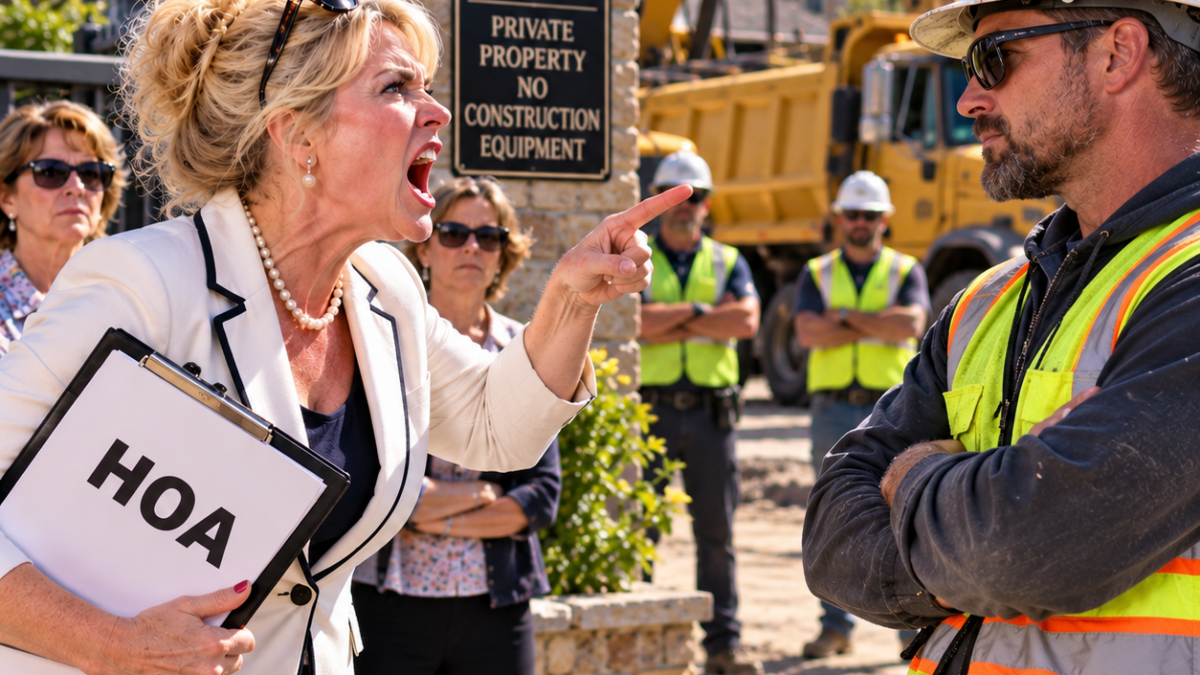
At 6:42 on a Wednesday morning, my foreman texted me a photograph of my bulldozer chained to a tow truck, followed by four words that made my stomach drop: **They’re taking everything.**
Forty minutes later, I was standing in front of nearly $900,000 worth of my own construction equipment while an HOA president smiled at me and claimed a court had ordered every machine removed from land her association didn’t even own.
What Marlene Crowe didn’t know was that the surveillance cameras she had installed to protect her neighborhood had quietly recorded the one thing she could never explain away.
I had spent eleven years building Whitaker Earthworks into something worth protecting.
Not because the company made me rich.
It didn’t, at least not in the way people imagine when they see a yard full of excavators and dump trucks.
Heavy equipment is expensive before it earns you a dollar. Fuel is expensive. Insurance is worse. Repairs arrive without asking whether cash flow is good that month. A hydraulic failure can turn a machine worth six figures into a very large yellow sculpture until somebody finds the right part.
But the company was mine.
More importantly, twenty-four people depended on it.
Teo Ramirez had been with me almost from the beginning. He started as a laborer, learned every machine in the yard, and eventually became my site foreman because I trusted him enough to hand him keys worth more than my first house.
So when his name appeared on my phone before sunrise, I answered immediately.
“Teo?”
“Dale.”
His voice sounded wrong.
“What happened?”
“They’re here.”
“Who?”
“The tow people.”
I sat up in bed.
“What tow people?”
“They’ve already hooked the D6.”
For half a second, my brain refused to process the sentence.
“Hooked it to what?”
“A heavy wrecker.”
“Who authorized that?”
“You know who.”
I was already pulling on jeans.
“Marlene?”
“She’s standing right here.”
Then my phone buzzed.
A photo arrived.
My bulldozer sat near the main yard entrance with a steel chain running from its undercarriage toward a massive recovery truck.
Behind it were two excavators.
A loader.
A compact track machine.
And one of our newer graders.
Another towing rig was backing toward them.
My entire chest tightened.
“How many machines are they touching?”
“Six so far.”
“Anybody move anything?”
“No. I told everybody to stay away from the equipment.”
“Good.”
“Dale, Marlene says there’s a court order.”
That stopped me.
“What?”
“She says a judge authorized removal.”
“Did you see it?”
“No.”
“Did anyone?”
“She’s holding a paper.”
Of course she was.
Marlene Crowe loved paper.
Letters.
Notices.
Resolutions.
Violation sheets.
If she printed something on heavy enough letterhead, she seemed to believe reality had a duty to cooperate.
“Don’t argue with her,” I said.
“She’s arguing with me.”
“Let her.”
“What do I tell the crew?”
“Don’t touch anybody. Don’t block the trucks. Record everything.”
“They’re taking the dozer.”
“No.”
My voice came out calmer than I felt.
“They’re trying to.”
I ended the call and phoned Naomi Brandt.
She answered sounding barely awake.
“Someone better be dying.”
“HOA tow trucks are at my yard.”
Silence.
Then:
“Repeat that.”
“Marlene hired a recovery company. Six machines. She claims she has a court order.”
Naomi was fully awake now.
“Have you seen it?”
“No.”
“Do not let anyone physically confront the tow crew.”
“I know.”
“Record everything.”
“Already told Teo.”
“Ask for the docket number.”
“I’m heading there.”
“Dale.”
“What?”
“If she actually fabricated judicial authority, this just became much bigger than a land-use fight.”
I already knew that.
I just didn’t yet understand how much bigger.
By 7:22, I turned onto Quarry Lane.
The first thing I saw was the boom of a heavy wrecker above my fence.
The second was Marlene.
She stood beside the entrance wearing a cream jacket, dark slacks, and the same expression she always wore at HOA meetings—calm, polished, certain everyone around her would eventually do what she said.
I parked.
Teo came toward me.
“They stopped after I told them you were coming.”
“Good.”
Marlene smiled.
“Dale.”
I ignored her and walked directly to the tow crew leader.
“You in charge?”
He nodded.
“Gavin Holt.”
“Dale Whitaker. This is my property.”
“I understand.”
“Do you?”
His expression tightened.
“We were contracted for an equipment removal.”
“By someone who doesn’t own this land.”
Marlene stepped closer.
“The association has already established jurisdiction.”
I finally looked at her.
“Show me the court order.”
She lifted a single sheet.
“Your attorney can review it.”
“No. You told a towing company a court authorized them to remove almost a million dollars of equipment. I want to see the order.”
Gavin looked at her.
Then at me.
After a pause, he held out his own copy.
I read the first line.
Then the second.
No court seal.
No docket number.
No judge.
No clerk.
One handwritten signature.
That was it.
I looked at Gavin.
“Read the top line out loud.”
Marlene snapped:
“There is no reason for theatrics.”
I never took my eyes off him.
“Please.”
He swallowed.
“Emergency nuisance abatement authorization.”
“Which court?”
His eyes went back to the page.
“It doesn’t say.”
“Judge?”
Nothing.
“Case number?”
Nothing.
Marlene moved between us.
“The association’s legal authority is not subject to your approval.”
I looked over her shoulder.
Across Quarry Lane, mounted high on a gray pole near Pine Crest Meadows’ gate, sat the surveillance camera Marlene had bragged about installing three months earlier.
A tiny gray box.
Pointed almost directly toward my entrance.
Marlene followed my eyes.
Then smiled.
“You want proof?” she said. “Our cameras have recorded your trucks violating community roads for months.”
I looked up at the lens.
Then back at her.
“I hope they have.”
Her smile faltered.
Only for a second.
But it was the first time all morning I saw doubt.
And I remember thinking that whatever those cameras contained, Marlene had just made a mistake by reminding me they existed.
PART 2
Six weeks earlier, Marlene Crowe was still just an irritation.
A persistent one.
But an irritation.
Whitaker Earthworks operated on forty-one acres along the eastern edge of Pine Crest Meadows, a planned residential development that had been built long after my property had already been zoned for industrial use.
That distinction mattered.
The county records were clean.
When Pine Crest Meadows was approved, the developer filed an exclusion document stating that my parcel was not subject to the homeowners association’s declaration, covenants, or architectural control.
My land did not sit behind their gate.
My trucks did not use their private entrance.
Every machine entered and left from Quarry Lane, a county-maintained road that ran along my property and connected directly to the state highway.
There was no ambiguity.
Marlene hated ambiguity anyway.
But she hated clarity more when it limited her power.
She had become HOA president two years earlier after campaigning on one phrase:
**Protect property values.**
At first, that sounded harmless.
Then she started using it to justify almost anything.
She pushed stricter landscaping rules.
Restricted overnight parking.
Created new architectural review procedures.
Started sending warnings over paint colors homeowners had used for years.
People complained.
Most complied.
Then she looked down from her house on the ridge and saw my yard.
Bulldozers.
Excavators.
Dump trucks.
Gravel piles.
Fuel tanks.
Equipment trailers.
An industrial property doing exactly what industrial property does.
To Marlene, it was offensive.
The first letter concerned dust.
I responded with our county dust-control permit and the inspection record showing compliance.
The second complained about backup alarms before eight in the morning.
I responded that equipment operations followed county industrial noise limits.
The third was my favorite.
She described the yellow paint used on my machinery as “visually aggressive and inconsistent with surrounding residential character.”
I read that sentence to Teo.
He stared at me.
“What color does she want a bulldozer?”
“Apparently beige.”
He laughed.
“Paint one pink.”
“I’d rather fight the HOA than Caterpillar.”
I answered Marlene with the same line I had used before:
**Not in your association. Not under your rules.**
That should have ended it.
Instead, it turned me into a challenge.
Nothing irritates a person obsessed with authority like discovering a boundary they cannot cross.
The real reason surfaced on a Tuesday afternoon.
A survey truck rolled slowly down Quarry Lane.
I noticed it from my office.
Two men stepped out near the northern fence.
Then a white SUV appeared behind them.
Marlene.
I walked outside.
“What’s going on?”
She smiled as though we had scheduled a meeting.
“Dale, perfect timing.”
The surveyor unrolled a map on the hood of his truck.
Across the ridge behind Pine Crest Meadows was a proposed development.
Forty new homes.
Bigger lots.
Higher prices.
The name printed across the top was:
**PINECREST HEIGHTS**
I looked at Marlene.
“What does this have to do with me?”
She pointed at a thick line running across the map.
Entrance road.
It crossed directly through my yard.
Not beside it.
Through it.
“We’ve been evaluating options.”
“We?”
“The association and development partners.”
“You don’t own this parcel.”
“We know.”
“Then your option is gone.”
She did not appreciate the answer.
“Let me finish.”
She produced a folder.
“The association is prepared to facilitate an acquisition.”
“How generous.”
“$1.1 million.”
I laughed.
I genuinely did not mean to insult her.
But the number was absurd.
A commercial buyer had approached me the year before with a figure far above that.
The land alone was worth more than Marlene’s offer without counting buildings, utilities, business disruption, relocation, or the fact that selling would destroy the operation I had spent eleven years building.
“No.”
Her smile faded.
“You haven’t considered it.”
“I just did.”
“Dale.”
“No.”
“That’s a generous number.”
“It’s not.”
“Our valuation consultant—”
“I don’t care what your consultant says.”
She lowered her voice.
“Think carefully.”
“I have.”
“The association has ways of making industrial operations very difficult when they negatively affect nearby property values.”
There it was.
No longer an offer.
A threat wrapped in polite language.
“Is that what this is?”
“What?”
“You can’t afford the land, so you’ll punish me until I sell?”
Her expression hardened.
“I said nothing of the kind.”
“You didn’t have to.”
The surveyor started rolling up his map.
Marlene looked annoyed.
“You should think about the future.”
“I am.”
I pointed toward my yard.
“This is mine.”
She left without saying goodbye.
Ten days later, a bright orange notice was zip-tied to my front gate.
**DECLARATION OF NUISANCE AND DEMAND FOR REMOVAL**
According to the HOA, Whitaker Earthworks was operating heavy equipment “within the Pine Crest Meadows community environment” in violation of community covenants.
Thirty days to remove every machine.
Five-hundred-dollar daily fine after the deadline.
I read the notice twice.
Then drove directly to Naomi Brandt’s office.
Naomi had represented me since I purchased the property.
She specialized in land use, zoning, and municipal fights.
She read the notice in silence.
Then looked at me.
“Do you want the professional answer or the less professional answer?”
“Start professional.”
“It has no legal effect.”
“And the other answer?”
“This is nonsense.”
I smiled.
“So we ignore it?”
She shook her head.
“No.”
“Why?”
“Because people who write something this ridiculous usually know the paper itself won’t work.”
She tapped the notice.
“They’re counting on something else.”
“Like what?”
“Pressure. Regulators. Contractors. Reputation. Cost.”
I leaned back.
“She threatened me after I rejected an offer.”
Naomi’s expression changed.
“What exactly did she say?”
I told her.
She wrote it down.
“From now on, save everything.”
“I already have the letters.”
“Good. Add this. Every inspector. Every phone call. Every email. Names. Dates. Reports.”
“You think this gets worse?”
“I think she already told you it would.”
Naomi was right.
The first inspector came two days later.
County environmental office.
Illegal grading near a drainage easement.
I walked him through the site.
There was no illegal grading.
He checked the maps.
Took photographs.
Closed the complaint.
Before leaving, he said:
“You’ve got an unhappy neighbor.”
“What makes you say that?”
He showed me the complaint form.
Submitted online through an account tied to Pine Crest Meadows management.
Two days later, fire inspection.
Fuel storage complaint.
Our tanks were permitted.
No violation.
The following Monday, county code enforcement.
Noise.
Again, nothing.
Three inspectors in less than a week.
Teo stood in my office after the third left.
“She’s trying to choke us.”
“That’s the idea.”
“We doing anything?”
“We’re documenting.”
Teo frowned.
“That doesn’t feel like doing anything.”
“It will.”
He looked toward the window.
“You sure?”
“No.”
That was the truth.
Being legally right does not make harassment painless.
Every inspector cost us time.
Every complaint distracted supervisors.
Every rumor made clients wonder if the business had problems.
Marlene understood that.
She did not need to win a lawsuit immediately.
She needed to make my property exhausting.
Then she escalated from paperwork to reputation.
Pine Crest Meadows held a packed board meeting.
I did not attend.
Nobody invited me.
The next morning, one of my equipment operators showed me a video circulating through the neighborhood group.
Thirty-one seconds.
A Whitaker Earthworks dump truck drove past what appeared to be the entrance to Pine Crest Meadows.
Residents reacted exactly as Marlene wanted.
**Those trucks are going to kill a child.**
**Why are they allowed inside residential streets?**
**I’ve seen them speeding too.**
**Shut that yard down.**
I watched the clip three times.
Something felt wrong.
Teo walked in.
“That’s my truck.”
“You sure?”
“Yeah.”
He watched again.
Then shook his head.
“But not recently.”
“Why?”
He pointed at the rear.
“Tailgate.”
I paused the video.
“What about it?”
“See the lower left corner?”
“Yeah.”
“That old gate had the white repair plate.”
I looked.
A pale rectangle was visible.
Teo continued.
“I replaced that tailgate in March.”
“When were the neighborhood cameras installed?”
“About three months ago.”
That mattered.
If the video was older than the cameras, it could not have come from the system Marlene claimed had recorded recent violations.
And another detail bothered me.
No timestamp.
No location.
No readable plate.
Just thirty-one seconds framed to look incriminating.
I sent it to Naomi.
She called ten minutes later.
“Where’s the rest?”
“Exactly.”
“If they have gate cameras, there should be complete footage.”
“What do we do?”
“Ask.”
She sent a formal records request for ninety days of camera footage covering the Pine Crest entrance and adjacent road.
Marlene answered personally.
Two days later.
**Requested video unavailable due to automatic overwrite caused by storage limitations.**
Naomi called me.
She was laughing.
“What?”
“She lied.”
“You know that?”
“I checked their budget.”
Of course she had.
“The camera system model is listed in last quarter’s technology expenditure.”
“So?”
“It stores six months.”
I sat forward.
“Locally?”
“And cloud backup by default.”
I looked toward the gate camera visible in the distance.
“So the footage exists.”
“Unless someone intentionally destroyed both copies.”
“Can they?”
“Maybe.”
She paused.
“But now we get to ask the vendor instead of Marlene.”
That changed everything.
Marlene had spent weeks manufacturing certainty.
Now we finally had something external.
A company.
Logs.
Backups.
Metadata.
Machines do not care who wins an HOA election.
But before Naomi could subpoena anything, the tow trucks arrived.
Back at the yard that Wednesday morning, Gavin Holt was still holding the so-called court authorization.
He had stopped his crew.
Marlene had not stopped talking.
“You are interfering with lawful nuisance abatement.”
Gavin looked increasingly uncomfortable.
I said:
“I’m not touching your trucks.”
Marlene turned toward him.
“Continue.”
He didn’t move.
“Mr. Holt.”
He looked at the paper again.
“I need to verify this.”
“I already verified it.”
“With whom?”
“The association’s legal channel.”
“What court?”
She hesitated.
“That isn’t your concern.”
Gavin folded the page.
“It is now.”
Marlene’s face changed.
“You have a contract.”
“I also have insurance.”
He took out his phone.
“You told us a court authorized removal.”
“It did.”
“Then the courthouse can confirm.”
She stepped closer.
“We’re already behind schedule.”
“My guys aren’t moving equipment worth nearly a million dollars based on something with no case number.”
I almost admired him.
Late caution was still better than none.
Marlene looked at me.
“This doesn’t change anything.”
“No?”
“Our cameras will establish months of violations.”
I looked toward the gray camera.
“I hope they do.”
Gavin walked away to call his office.
Ten minutes later, his crew began disconnecting chains.
Marlene was furious.
“You cannot simply abandon the job.”
Gavin said:
“Watch me.”
The first wrecker pulled away.
Then the second.
Teo stood beside me.
“That’s it?”
“No.”
“How do you know?”
I looked at Marlene.
She was already typing furiously on her phone.
“Because she doesn’t know how to stop.”
That afternoon, Naomi filed for an emergency temporary restraining order.
Attached:
The nuisance declaration.
The questionable removal authorization.
Photographs of the tow operation.
My property exclusion documents.
A sworn statement from Gavin Holt describing what Marlene had represented.
And the threat made after I rejected the land offer.
Naomi also filed something Marlene did not expect.
A subpoena to the camera company.
Not Pine Crest Meadows.
Not its management office.
The vendor that hosted the cloud backups.
The judge signed the restraining order before evening.
The HOA was barred from touching my equipment.
Marlene was served at home.
One of her neighbors later told Teo she read the order on her porch, folded it in half, and said:
“This isn’t over.”
Teo repeated that to me the next morning.
I sighed.
“Of course she did.”
For seven days, nothing happened.
No inspectors.
No letters.
No contractors.
No calls.
Silence.
It should have been peaceful.
It wasn’t.
Naomi said:
“Quiet opponents worry me.”
“Why?”
“Because reasonable people use quiet to reconsider.”
“And unreasonable people?”
“Use it to plan.”
On the seventh day, the lights in my office went out.
Then the shop.
Then the fuel pump.
Then the compressor.
Entire yard.
Dead.
Teo came running.
“Transformer?”
“No.”
I checked the breaker.
Nothing.
Called the utility.
They pulled the account.
Then the representative said:
“Service was disconnected pursuant to a code request.”
I stared at the phone.
“What code request?”
“Property violation.”
“From whom?”
“I’ll need a supervisor.”
Two hours later, we learned somebody had submitted a formal request containing my account number and claiming the property had been ordered disconnected for unresolved code violations.
No such order existed.
The submission came through a device tied to the Pine Crest Meadows management office.
Naomi’s reaction was quieter than mine.
“Good.”
I stared at her.
“Good?”
“Yes.”
“My business lost half a day.”
“And whoever did this just created another document.”
“You lawyers are strange people.”
“Paper is patient.”
The utility restored service and waived the reconnection fee initially, though we still documented every cost and lost hour.
Then, three days before the hearing, Naomi called me to her office.
She had documents spread across the conference table.
Vendor affidavit.
System specifications.
User logs.
Download records.
Deletion logs.
Cloud retention.
She looked almost cheerful.
“Marlene did not understand her own camera system.”
I sat.
“What did they send?”
“Everything.”
She pushed the affidavit toward me.
The vendor retained 180 days of cloud footage.
Nothing had been overwritten.
Not one day.
Marlene’s administrator credentials had accessed the system late one night three weeks earlier.
Downloaded forty-one hours.
Deleted corresponding footage from the local HOA drive.
Then exported exactly one thirty-one-second clip.
File name:
**WHITAKER EVIDENCE**
I stared at the page.
“She deleted the rest?”
“Locally.”
“But not cloud.”
“Correct.”
“Can we see it?”
Naomi turned her laptop around.
“Already downloaded.”
We started watching.
Hours of nothing.
Cars.
Dog walkers.
Delivery vans.
Residents leaving for work.
Then my trucks.
Every morning.
Whitaker dump trucks exited my yard.
Turned onto Quarry Lane.
And turned away from Pine Crest Meadows.
Again.
And again.
And again.
Not once through the neighborhood gate.
Naomi fast-forwarded.
“Here’s the clip.”
Timestamp.
The truck Teo identified.
But the full frame showed something Marlene’s version did not.
The community gate wasn’t behind the truck.
It was nowhere near it.
The footage came from another camera angle facing a county road three miles away, apparently captured during earlier roadwork near the neighborhood perimeter.
Marlene had cropped the video so tightly that a stone wall and landscaping feature made it resemble the Pine Crest entrance.
No readable plate.
No timestamp.
No context.
Just enough truth to create a lie.
Teo had been right about the tailgate.
Then Naomi said:
“You’re going to enjoy this next part.”
“I don’t think I’m enjoying anything anymore.”
“Fair.”
She clicked another file.
Night footage.
Rain.
My gate.
A figure appeared.
Rain jacket.
Flashlight.
Cordless drill.
I leaned toward the screen.
“No.”
Naomi smiled.
“Oh yes.”
Marlene Crowe.
At my gate.
Around 11:40 p.m.
She held a rectangular sign.
She positioned it against one of my posts.
The camera angle caught the words:
**HOA PROPERTY**
I stared.
She tried driving a screw.
The drill slipped.
She cursed.
Tried again.
The sign tilted.
She adjusted it.
The top screw failed.
The sign fell into the mud.
Even through my anger, I almost laughed.
For ten minutes, the president of Pine Crest Meadows fought a piece of plywood while unknowingly being recorded by the security system she had purchased.
Finally, she gave up.
Picked up the sign.
Walked away.
Naomi paused the video on Marlene staring directly toward the camera.
“She knew the camera was there.”
“She probably thought deleting locally erased it.”
“Exactly.”
I leaned back.
For six weeks, Marlene had told residents I was violating community property.
Now her own camera showed her entering mine at midnight with a drill and an HOA sign.
Naomi tapped the screen.
“This is not just useful.”
“What is it?”
“A gift.”
The hearing was Thursday.
The courtroom was packed.
Pine Crest residents filled almost every bench.
Some still believed Marlene.
I could hear whispers behind me.
“Industrial nuisance.”
“Truck traffic.”
“Property values.”
One woman said:
“He should’ve sold when he had the chance.”
I looked forward.
Did not turn around.
Naomi leaned over.
“Don’t.”
“I didn’t do anything.”
“You were about to.”
“Maybe.”
Marlene arrived with an attorney named Franklin Sorrell.
I knew enough about him to know he was competent.
That mattered because competent attorneys hate surprises their clients create.
He looked confident when the hearing started.
That would change.
Sorrell made three primary arguments.
Whitaker Earthworks allegedly harmed residential safety.
Our vehicles allegedly used Pine Crest roads despite restrictions.
The HOA had acted in good faith to protect residents from a nuisance that county authorities had failed to address.
Then he played the thirty-one-second clip.
Murmuring from the gallery.
Marlene watched the judge.
Not me.
She still thought the video was her strongest evidence.
When their presentation ended, Naomi stood.
She called Marlene.
Marlene walked to the witness stand.
Sworn.
Seated.
Naomi approached slowly.
“Ms. Crowe, are you president of Pine Crest Meadows?”
“Yes.”
“Were you responsible for providing counsel the video we just watched?”
“I provided association records.”
“Did that clip come from Pine Crest Meadows’ surveillance system?”
“Yes.”
“Does it show a Whitaker Earthworks truck using a prohibited community route?”
“Yes.”
“Is that the complete footage relevant to the event?”
Sorrell looked at Naomi.
Something in her phrasing bothered him.
Marlene answered:
“Yes.”
Naomi nodded.
“Does additional surveillance footage exist?”
Marlene said:
“No.”
Sorrell shifted.
Naomi asked:
“Why not?”
“The system overwrites older files due to limited storage.”
“Did you state that in your written response to my records request?”
“Yes.”
“And that statement was true?”
“Yes.”
Naomi returned to counsel table.
Picked up a document.
Walked back.
“Your Honor, may I approach?”
The judge nodded.
Naomi handed him the vendor affidavit.
Then another set.
Sorrell asked:
“What is this?”
Naomi looked at him.
“Your client’s surveillance vendor records.”
His face changed.
He had not seen them.
That was the moment I realized Marlene had not told her own lawyer.
The judge read.
Then looked at Marlene.
“Ms. Crowe.”
She sat very still.
“The system retains one hundred eighty days?”
She swallowed.
“Apparently.”
Naomi said:
“Not apparently.”
Sorrell stood.
“Your Honor—”
The judge held up a hand.
Naomi continued.
“The vendor confirms no relevant cloud footage was overwritten.”
She introduced access logs.
Marlene’s administrator account.
Forty-one hours downloaded.
Forty-one hours deleted locally.
One thirty-one-second export.
**WHITAKER EVIDENCE.**
The courtroom went silent.
Naomi looked at Marlene.
“Did you use this administrator account?”
“Several people had access.”
The answer came too quickly.
Naomi nodded.
“Which people?”
“I don’t know.”
“You were president?”
“Yes.”
“You approved the system?”
“Yes.”
“You personally responded to the footage request?”
“Yes.”
“But you cannot identify who had administrative credentials?”
“Not from memory.”
Naomi showed the login records.
The vendor had associated the administrator device with Marlene’s registered board laptop.
Sorrell closed his eyes.
Just briefly.
Naomi asked:
“Would you like to amend your testimony that all footage had been overwritten?”
Marlene looked toward her lawyer.
Sorrell whispered something.
She said:
“I relied on information available to me at the time.”
Naomi did not argue.
She simply said:
“Let’s watch the information available now.”
The courtroom monitor turned on.
Full frame.
Timestamp.
My truck.
Quarry Lane.
Not Pine Crest Meadows.
Naomi played Marlene’s cropped version beside the original.
Side by side.
Same truck.
Same movement.
Different truth.
Without the crop, there was no violation.
The judge leaned forward.
Residents started whispering.
Naomi continued.
Another morning.
Another Whitaker truck.
Turn away from Pine Crest.
Another.
Another.
Dozens.
Never entering the community.
Teo sat behind me.
Whispered:
“Told you.”
I almost smiled.
Then Naomi played the night footage.
Rain.
My gate.
Marlene.
The drill.
The sign.
**HOA PROPERTY.**
Somebody in the gallery gasped.
Someone else laughed.
The judge did not.
He watched every second.
Marlene struggled with the sign.
Dropped it.
Cursed.
Tried again.
Finally walked away.
The footage ended.
Silence.
Not ordinary courtroom silence.
The kind where every person knows something irreversible just happened.
The judge looked toward Sorrell.
“Counsel.”
Sorrell stood slowly.
“Yes, Your Honor.”
“Were you aware of this footage?”
“No, Your Honor.”
“Were you aware local video had been deleted while cloud backups remained?”
“No.”
“Were you aware the clip presented by your client had been cropped from a different location?”
“No, Your Honor.”
The judge looked at Marlene.
“Ms. Crowe, do you wish to amend any portion of your testimony?”
She opened her mouth.
Nothing.
Closed it.
Then finally:
“No.”
That was worse than an explanation.
The judge recessed.
Nobody moved for several seconds after he left.
Then the gallery erupted in whispers.
The same residents who had repeated Marlene’s claims were now watching her differently.
A retired nurse two rows back said loudly:
“So we paid lawyers to defend this?”
Nobody answered.
She continued:
“And the tow trucks?”
Still nothing.
“Did our dues pay for that too?”
The HOA treasurer, Howard Pell, sat near the aisle.
He stared at the floor.
I noticed he had a thick binder on his lap.
At the time, I did not know what was inside.
By afternoon, the ruling came.
Permanent injunction.
Pine Crest Meadows was barred from interfering with Whitaker Earthworks.
All HOA fines against my property were void.
The nuisance declaration was struck.
The association had no authority over my land.
The altered surveillance clip, questionable removal document, and testimony concerning surveillance retention were referred for further review.
All relevant association records had to be preserved.
Marlene sat motionless.
I expected relief.
Instead, I felt exhausted.
Naomi touched my arm.
“You won.”
“Did we?”
She looked at me.
“Yes.”
“Then why does it feel like somebody just set fire to six weeks of my life?”
“Because winning litigation is usually less fun than movies make it look.”
Behind us, residents surrounded Howard.
Questions.
Money.
Contracts.
Who approved the tow?
Who paid surveyors?
Why was the HOA trying to take industrial land?
Howard kept saying:
“Emergency meeting tonight.”
That meeting destroyed whatever remained of Marlene’s presidency.
I went only because Naomi recommended hearing what the board said about expenditures.
The clubhouse was packed.
Howard sat at the front with his binder.
Marlene arrived five minutes late.
No clipboard.
No smile.
She took the president’s chair.
“Let’s call this meeting to order.”
Howard said:
“Before we do, I have a financial report.”
Marlene looked at him.
“This meeting is about legal strategy.”
“No.”
Howard’s voice was quiet.
“This meeting is about why our reserve account is missing money nobody authorized me to spend.”
The room went still.
Marlene’s face tightened.
“You processed every payment.”
“I processed invoices coded through approved categories.”
He opened the binder.
“That’s the problem.”
First payment.
$18,500 to the towing company.
Coded as:
**Site safety and landscape remediation.**
Residents murmured.
Marlene said:
“That was emergency nuisance abatement.”
Howard looked at her.
“It was a tow company.”
Second.
$27,000.
Surveyors.
Coded:
**Landscape consultation.**
Third.
$64,000.
Design firm.
Pinecrest Heights renderings.
Howard looked directly at Marlene.
“The board never approved a sixty-four-thousand-dollar design package.”
Marlene responded:
“It fell within strategic planning authority.”
“No, it didn’t.”
Another board member leaned forward.
“What design package?”
Howard turned pages.
Road layouts.
Entrance concepts.
Luxury signage.
Forty ridge homes.
And the entrance road through my property.
Someone in the audience said:
“Oh my God.”
Howard lifted another document.
“There’s more.”
Letter of intent.
Developer.
Signed by Marlene.
Promise:
The northern access corridor would be “fully secured” by the third quarter.
Marlene had promised a developer control of land she did not own.
My land.
The whole picture finally became visible.
The lowball purchase offer.
The nuisance declaration.
Inspector complaints.
Fake truck video.
Tow attempt.
Utility disconnect.
She wasn’t merely protecting property values.
She needed me gone.
Pinecrest Heights required an entrance.
My property sat in the way.
If I sold cheaply, the project worked.
If I refused, she intended to make business impossible until I changed my mind.
A board member named Evelyn Shaw stared at Marlene.
“You told us the expansion was conceptual.”
“It was.”
“You signed a letter promising road access.”
“It was nonbinding.”
“On Dale’s land.”
“The route remained under negotiation.”
I spoke from the back.
“No, it didn’t.”
Every head turned.
Marlene glared.
I continued.
“You offered $1.1 million.”
“Yes.”
“I said no.”
“You refused to negotiate.”
“I refused to sell.”
“There were other options.”
“You tried to tow my bulldozers.”
Murmurs.
Marlene pointed toward me.
“This is not your meeting.”
“No.”
I nodded.
“But apparently it’s my property development.”
Howard looked down.
Almost smiled.
Marlene stood.
“You have spent six weeks obstructing a project that could add millions in value to this community.”
“There it is.”
“What?”
“Finally.”
I looked around the room.
“This was never about dust.”
Marlene said nothing.
“Never about truck traffic.”
Nothing.
“Never about yellow equipment being visually aggressive.”
Someone laughed.
I continued.
“You needed my land.”
Her face reddened.
“And when I wouldn’t sell it to you for what you wanted to pay, you started trying to destroy the business sitting on it.”
“That is a lie.”
“The camera says otherwise.”
The room erupted.
Howard struck the table.
“Enough.”
He looked toward the board.
“I move that Marlene Crowe be removed from all presidential authority immediately pending full investigation.”
“Second.”
Marlene stared.
“You cannot remove me based on one hostile court hearing.”
Evelyn answered:
“We’re removing you because you spent reserve funds on a development project we never approved.”
“You approved strategic expansion.”
“Not this.”
“You all knew.”
“No.”
One by one, board members shook their heads.
The vote was nine to one.
Marlene voted for herself.
When the result was announced, she sat still for several seconds.
Then stood.
Collected nothing.
Walked out.
Her nameplate disappeared the next morning.
The investigation moved quickly after that.
The surveillance evidence was unusually clean.
Metadata does not care about charisma.
Server logs don’t care who is president.
The cloud system showed which account accessed files.
When.
From what device.
What was downloaded.
What was deleted locally.
What was exported.
The original and altered videos could be compared frame by frame.
Then there was the tow authorization.
No legitimate court docket.
No valid judicial signature.
No filing.
Gavin Holt cooperated immediately.
He produced emails in which Marlene had represented the document as court-backed authority.
The utility request was traced through association systems.
The financial records showed reserve money rerouted through misleading budget descriptions.
The district attorney’s office reviewed everything.
Marlene’s lawyer argued she believed the HOA had broad nuisance authority.
Then investigators showed him the video of Marlene at my gate after midnight attempting to attach an **HOA PROPERTY** sign.
Good-faith confusion became difficult to defend after that.
I filed my own civil claim.
Naomi asked:
“How aggressive do you want to be?”
“I want what this cost.”
“That’s not what I asked.”
“It is.”
“You could seek more.”
“I know.”
“Punitive theories may exist.”
“I don’t want a number designed to punish her.”
Naomi studied me.
“After all this?”
“Yes.”
“Why?”
“Because I run a construction company, not a revenge business.”
She smiled.
“That is disappointingly mature.”
“I have moments.”
We calculated.
Damage related to the attempted tow.
Lost work.
Equipment downtime.
Utility interruption.
Legal fees.
Administrative cost.
Business disruption we could document.
Some reputational losses.
Just over $210,000.
No fantasies.
No inflated claims.
No million-dollar emotional number.
Documents.
Receipts.
Time sheets.
Invoices.
The court awarded the amount.
Most responsibility landed personally on Marlene because she had acted far outside legitimate association authority.
A lien was placed against her house.
I did not celebrate.
Teo did.
A little.
He brought donuts the morning we heard.
One had yellow frosting.
“What is that?”
“Bulldozer.”
“It looks like a duck.”
“Eat it.”
I did.
Then he became serious.
“You okay with the house?”
“What about it?”
“The lien.”
“I didn’t ask for her house.”
“Might lose it.”
“That’s not my decision.”
“She nearly took your business.”
“I know.”
“You feel bad?”
I thought about it.
“No.”
That was true.
“I just don’t feel good.”
Teo nodded.
“Probably healthier.”
“Maybe.”
Months later, Marlene’s house was sold to satisfy financial obligations arising from the judgment and other consequences.
People expected me to feel victorious.
Instead, I kept thinking about how unnecessary everything had been.
She could have made an honest offer.
I could have said no.
That should have been the end.
Instead, she convinced herself I was an obstacle rather than a property owner.
Once she decided the project deserved my land, every action after that became easier to justify in her own mind.
A complaint.
Then another.
A misleading video.
A false claim.
Tow trucks.
Utility interference.
The next step always felt only slightly worse than the last.
That’s how people cross lines.
Rarely in one leap.
Usually one rationalization at a time.
Pine Crest Meadows changed too.
The new board rewrote its procedures.
Legal action required full board approval.
Contracts above $5,000 required recorded votes.
Surveillance footage could not be selectively released by a single officer.
Resident requests for footage had to follow transparent procedures.
Preservation rules were posted.
And underneath the gate camera, the board installed a small plaque.
**VIDEO RETENTION: 180 DAYS**
**FOOTAGE AVAILABLE THROUGH FORMAL REQUEST**
The irony was not lost on anyone.
The camera stayed.
That surprised me.
I expected residents to demand removal.
Instead, they wanted it there.
Not as Marlene’s tool.
As a witness.
Teo once pointed toward it and said:
“Best employee we never hired.”
I laughed.
“Doesn’t take lunch.”
“Never lies.”
“Expensive benefits package.”
“Cloud storage.”
The yard returned to normal.
Dozers rolled out before sunrise.
Excavators came back covered in clay.
Drivers complained about traffic.
Mechanics complained about drivers.
Fuel prices rose.
Then rose again.
Normal business problems.
Beautiful problems.
Naomi stopped by one afternoon with final settlement papers.
She leaned against my office door.
“Feel vindicated?”
I looked through the window.
Teo was backing a dump truck toward the gate.
The camera across the road watched.
“I feel tired.”
“That isn’t vindication.”
“Then no.”
“Nothing?”
I thought about the tow trucks.
Marlene.
Courtroom footage.
Residents gasping when she appeared on screen with the drill.
“There was one satisfying moment.”
Naomi smiled.
“Which?”
“When her lawyer saw the camera logs.”
She laughed.
“I knew it.”
“But mostly?”
I watched the truck turn onto Quarry Lane.
“I’m glad they’re rolling.”
Naomi looked toward the equipment yard.
“That’s probably the healthiest answer.”
Maybe.
Because the truth is, winning never returned the six weeks.
It did not erase the stress.
It did not recover the hours I spent wondering whether inspectors would shut us down over some complaint I hadn’t heard yet.
It did not erase the look on Teo’s face when he thought our machinery might disappear.
It did not undo the calls from clients asking whether rumors about the property were true.
Legal victory is not time travel.
It just stops the damage.
Sometimes that’s enough.
One resident from Pine Crest eventually came to see me.
Her name was Margaret Ellis.
Retired nurse.
She had been in court.
The same woman who asked whether HOA dues had paid the lawyers and tow trucks.
She stood outside my office holding a folder.
“Can I talk to you?”
“Sure.”
She sat.
“I owe you an apology.”
“For what?”
“I believed the video.”
“So did a lot of people.”
“I posted something online.”
I vaguely remembered.
“You called me a menace.”
Her face reddened.
“Yes.”
“Strong word.”
“I know.”
I smiled so she’d know I wasn’t trying to make her suffer.
She looked down.
“Marlene told us children were nearly hit.”
“No Whitaker truck drove through your gate.”
“I know that now.”
She held out the folder.
Inside were screenshots.
Neighborhood messages.
Rumors.
Her own post.
She had printed it.
“I wanted you to know I deleted everything and posted a correction.”
“You didn’t need to bring this.”
“I did.”
“Why?”
“Because the video worked on me.”
I waited.
“I saw thirty seconds and stopped asking questions.”
She looked toward my window.
“That scares me.”
“Probably should.”
“I trusted her because she was president.”
“That doesn’t make you stupid.”
“No.”
She shook her head.
“But it made me lazy.”
That was unusually honest.
She continued.
“The new board wants me on the records committee.”
I smiled.
“Seems appropriate.”
“You think?”
“You’ll ask questions.”
“I will now.”
That mattered.
The whole conflict had started because one person believed controlling information meant controlling reality.
The best response was not simply replacing her with someone nicer.
It was building a system where no single person could do the same thing again.
A month later, the board invited me to a meeting.
I almost declined.
Teo said:
“Go.”
“Why?”
“Free entertainment.”
“No.”
“Free coffee?”
“HOA coffee.”
“Fair.”
I attended.
The new president, Howard Pell, opened by acknowledging that Whitaker Earthworks was legally outside Pine Crest Meadows.
A sentence that should never have required a public announcement.
Then he said:
“We also owe Mr. Whitaker and his employees an apology.”
I shifted in my seat.
I hate public apologies when I’m the subject.
Howard continued.
“The association allowed inaccurate claims about truck traffic to circulate without verification.”
He looked toward me.
“We funded actions on property we did not control.”
Then to the residents.
“And we trusted edited footage without requesting the complete record.”
He held up a remote.
The gate camera image appeared on the screen.
Live.
Cars entering.
People walking.
Nothing dramatic.
“This system wasn’t the problem.”
Howard said.
“How we used it was.”
That line stayed with me.
Technology is often blamed for what people do with it.
The camera didn’t manipulate anyone.
Marlene did.
The camera recorded everything.
She selected thirty-one seconds.
The full truth was sitting on the server the entire time.
Nobody asked to see it.
Until Naomi did.
Howard introduced the new surveillance policy.
Full context required for enforcement use.
Original footage preserved.
No edited clip admissible in internal proceedings without corresponding source footage.
Access logging.
Independent administrator permissions.
Residents could request relevant recordings.
Boring rules.
Necessary rules.
A man in the back asked:
“Are we doing all this because of one incident?”
Howard looked at him.
“No.”
He paused.
“We are doing this because one incident proved the old system depended entirely on trusting whoever held the password.”
That answer satisfied me more than an apology.
Trust is not a control.
Good governance assumes good people can make mistakes and bad people can win elections.
Rules are supposed to survive both.
After the meeting, Margaret caught me near the door.
“Still a menace?”
I asked.
She smiled.
“Visually aggressive equipment.”
I laughed.
“Careful. That’s copyrighted.”
The neighborhood eventually developed Pinecrest Heights.
Just not through my property.
A different access road was negotiated farther north.
It cost the developer more.
That was not my problem.
For months, people had acted as though my refusal made the project impossible.
It wasn’t impossible.
My land was simply the cheapest path.
That’s a distinction powerful people sometimes pretend not to understand.
When someone says your property is “necessary,” what they often mean is that respecting your ownership is expensive.
Marlene had mistaken inconvenience for injustice.
She thought because my land complicated her plan, I owed her a solution.
I didn’t.
Eventually, the developer purchased another parcel at market value.
Built a longer entrance.
The project moved forward.
Forty homes appeared on the ridge.
Property values did fine.
The world did not end because I kept my yard.
That made the whole fight seem even more absurd.
Marlene risked everything to avoid paying the real cost of a road.
I asked Naomi once:
“Why didn’t they just do this from the beginning?”
“Money.”
“Obviously.”
“And ego.”
“More expensive than money.”
“Usually.”
The district attorney’s case took time.
Charges involving fabricated evidence, false documents, and misuse of association money moved through normal procedure.
Marlene’s attorney tried several arguments.
Misunderstanding.
Delegated authority.
Administrative error.
Good faith.
But some evidence resists interpretation.
The access log was one.
The cropped video was another.
And then there was the rain-jacket footage.
According to someone who attended a later proceeding, prosecutors played the clip again.
Marlene at my gate.
Drill in hand.
HOA PROPERTY sign.
Trying to physically manufacture the illusion she had been asserting on paper.
There is no elegant explanation for that.
I never went to watch.
People were surprised.
“You don’t want to see it?”
Teo asked.
“No.”
“Why not?”
“I’ve already seen the video.”
“But seeing her answer for it?”
“That’s the court’s job.”
He shook his head.
“You are terrible at revenge.”
“Thank you.”
“I didn’t mean it as a compliment.”
I knew.
The civil judgment repaired what could be repaired.
The criminal process belonged to the state.
The board rebuilt its finances.
My company kept operating.
I did not need a front-row seat to every consequence.
One of the harder parts came when Pine Crest residents learned they would absorb some portion of the association’s legal costs.
Not because they caused the misconduct.
Because they belonged to the organization whose leadership had caused it.
Several residents were furious at me.
Even after Marlene’s removal.
One emailed:
**Congratulations. You proved your point and now all of us have to pay for it.**
I almost answered angrily.
Naomi told me not to.
“Why?”
“Because he is angry at the invoice.”
“He’s blaming me.”
“He’ll eventually understand.”
“What if he doesn’t?”
“Then you still don’t need to fight every person who misunderstands you.”
I hated when she was reasonable.
A few months later, the same resident wrote again.
Shorter.
**I reviewed the audit. I was wrong about where the blame belonged. Sorry.**
I replied:
**Thank you.**
That was enough.
Not every conflict needs a speech.
The audit itself revealed why Marlene had been able to do so much.
Weak controls.
President could approve certain vendor expenses under broad categories.
Management staff assumed she had board backing.
Board members skimmed summaries instead of invoices.
Nobody compared the “landscaping consultation” expense to what surveyors were actually doing.
Nobody asked why a design firm received $64,000.
Nobody inspected the letter of intent closely.
Marlene had not discovered some genius financial loophole.
She discovered people were busy.
That’s enough sometimes.
Howard later told me:
“I trusted the labels.”
“What labels?”
“Expense categories.”
He looked embarrassed.
“If something said landscaping consultation, I assumed landscaping consultant.”
“Reasonable.”
“No.”
He shook his head.
“Convenient.”
That distinction mattered.
Marlene’s wrongdoing was hers.
But systems failed around her because people treated verification as impolite.
They did not want to question the president.
They assumed somebody else had checked.
Nobody had.
After the audit, every major invoice included vendor identity, scope, vote reference, and contract attachment.
Howard complained it tripled the paperwork.
Then added:
“Worth it.”
The company changed too.
Before Marlene, I thought property records were enough.
Afterward, I installed additional cameras on my side of Quarry Lane.
Not aimed at Pine Crest homes.
Only my entrances, fuel area, equipment rows, and office exterior.
Teo approved.
“You finally respect cameras.”
“I always respected cameras.”
“You cursed theirs for six weeks.”
“I cursed Marlene.”
“Same sentence most days.”
Our retention system was simple.
Original files.
Cloud backup.
Restricted admin access.
No single person could delete everything.
Teo raised an eyebrow when I explained it.
“Learning from the HOA?”
“Take wisdom wherever you find it.”
“You going to put a plaque underneath?”
“What would it say?”
He thought.
Then:
**Smile. Marlene taught us backups.**
I laughed hard enough to spill coffee.
We didn’t put up the plaque.
I was tempted.
The two pines beside the north equipment shed grew taller.
The gravel yard expanded.
We hired four more people the following year.
One of them was a young operator named Calvin who knew nothing about the dispute when he started.
On his first week, he pointed toward Pine Crest’s camera.
“Why is that thing pointed at us?”
Teo said:
“Long story.”
Calvin looked at me.
“Bad?”
“Expensive.”
“Whose camera?”
“HOA.”
“Why do they record your gate?”
“Because once upon a time their president thought that would help her.”
Calvin waited.
“And?”
“It didn’t.”
Teo laughed.
“That is the shortest version I’ve ever heard.”
Sometimes that’s all the story needed.
But on quiet evenings, I still remembered the longer version.
The 6:42 message.
They’re taking everything.
I remembered driving too fast internally while forcing myself to obey every speed limit physically.
The tow chains.
The equipment sitting helpless beneath them.
Marlene’s smile.
The fake-looking paper.
The camera.
For a business owner, machinery is strange.
It is both replaceable and deeply personal.
Each machine is a balance sheet item.
Serial number.
Depreciation schedule.
Insurance value.
But it’s also memory.
The excavator you bought after your first major contract.
The dozer Teo learned on.
The loader that got you through a bad winter because a county snow contract kept payroll alive.
When I saw tow chains around those machines, I did not see $900,000.
I saw eleven years.
Payroll checks.
Late nights.
Risk.
My father’s loan when I started.
Teo working beside me before I could afford a second supervisor.
Twenty-four families depending on equipment Marlene had decided to label a nuisance because it stood between her and a developer’s entrance road.
That was why I was angry.
Not because she challenged my ego.
Because she treated other people’s lives like pieces on her planning map.
Years later, people still ask whether I regret refusing the $1.1 million.
Never.
Even if the offer had been fair, I would have been allowed to say no.
That’s the part Marlene never understood.
People often think disputes are about price.
Sometimes they’re about consent.
If I own something, your offer does not create my obligation to accept.
Your project does not make my refusal immoral.
Your inconvenience does not erase my boundary.
And your elected title does not convert desire into jurisdiction.
One morning, Howard stopped by the yard.
He had changed since the scandal.
More cautious.
More willing to admit what he didn’t know.
He brought a document.
“What’s this?”
“Updated boundary acknowledgment.”
“Why?”
“New residents keep asking why your property isn’t inside the HOA.”
I read it.
Clear language.
Whitaker parcel excluded.
Quarry Lane county maintained.
No association enforcement jurisdiction.
No access rights through my yard.
I looked at him.
“You don’t need my signature.”
“I know.”
“Then why bring it?”
“I thought you’d appreciate seeing it.”
I did.
At the bottom was a sentence:
**Nothing in association policy shall be interpreted as creating authority over adjoining non-member parcels.**
I smiled.
“That’s new.”
“Very.”
“Who wrote it?”
“Counsel.”
“Expensive sentence?”
“All our sentences are expensive now.”
I laughed.
Howard looked toward my machines.
“You know, Marlene was right about one thing.”
“Careful.”
“Your equipment is visually aggressive.”
I stared at him.
He smiled.
“I’m joking.”
“You’re improving.”
We shook hands.
Before leaving, he looked toward the camera.
“Still bothers you?”
“No.”
“Really?”
I considered it.
“No.”
“Why?”
“Because now I know where the backup lives.”
He laughed.
The camera became almost comforting.
Not because surveillance is inherently good.
Because memory can protect you when someone powerful decides their version of events should replace reality.
Human witnesses forget.
People become nervous.
Crowds follow confidence.
Video is imperfect too.
Angles mislead.
Clips can be edited.
Context can be removed.
That was Marlene’s mistake.
She thought owning the clip meant owning the truth.
But full records restored context.
Thirty-one seconds made me look guilty.
Forty-one hours proved the opposite.
That’s a lesson I wish more people understood.
Evidence is not simply something that supports your position.
Real evidence has to survive the parts you wish were not there.
Marlene preserved only what she liked.
The cloud preserved everything.
The following winter, a storm knocked power out across the area.
Pine Crest went dark.
My yard generator kicked on.
Teo called.
“You know what’s funny?”
“What?”
“The HOA camera still has backup power.”
“Good.”
“Watching us.”
“Let it.”
“You’ve changed.”
Maybe.
I no longer cared whether the camera watched.
I cared who controlled the recording and whether the full story could be recovered.
That is a more useful question.
Naomi retired from active litigation a few years later.
At her retirement dinner, she told the camera story.
Not the whole thing.
Just one part.
She said:
“My favorite cases weren’t the ones where I had brilliant arguments. They were the ones where the other side lied about something checkable.”
People laughed.
Then she looked at me.
“Dale gave me one of those.”
I raised my glass.
“You’re welcome.”
Afterward, she handed me an envelope.
Inside was a still image.
Marlene in the rain.
Drill.
Sign.
**HOA PROPERTY.**
I looked at Naomi.
“Why would I want this?”
“History.”
“This is terrible decor.”
“Frame it in the office.”
“No.”
“Teo will.”
That was true.
I hid it in my desk.
He found it three months later.
Now it hangs inside the mechanic’s break room.
Underneath, Teo added a label:
**ALWAYS BACK UP YOUR FILES.**
I threatened to remove it.
Everyone protested.
So it stayed.
Sometimes justice becomes a joke after enough time passes.
That’s not disrespect.
It’s recovery.
For months, Marlene controlled our emotional weather.
Every letter caused anger.
Every inspector triggered suspicion.
Every unknown vehicle approaching Quarry Lane made somebody wonder what came next.
Eventually, she became a story new employees laughed about.
That’s when I knew she no longer mattered.
The company had outlived her power.
Pine Crest had outlived her presidency.
The camera had outlived her lie.
And Quarry Lane was still exactly where county maps said it was.
One summer afternoon, I stood outside with Teo as a new bulldozer arrived.
Fresh paint.
Bright yellow.
He walked around it.
“Very aggressive.”
“Extremely.”
“HOA approve the color?”
“Absolutely.”
He looked surprised.
“Really?”
“No.”
He laughed.
The machine rolled through my gate.
Across my property.
Onto land the HOA never owned.
No one tried to tow it.
No one photographed it for evidence.
No inspector appeared.
Just another piece of equipment coming home.
That moment would have meant nothing before the fight.
Afterward, normal felt luxurious.
Marlene thought she could win by making normal impossible.
She failed.
And perhaps that is the best revenge against anyone who tries to control your life through chaos.
Return to normal.
Keep working.
Keep building.
Let their drama become smaller every year.
My civil award was eventually satisfied.
Some came through Marlene personally.
Some through other mechanisms determined by the court and insurance.
The HOA paid its smaller assigned share.
I used a portion to repair equipment damage and cover legal costs.
Another part went into the business.
Teo asked what I was buying.
“Security system?”
“No.”
“New lawyers?”
“Absolutely not.”
“Then?”
I pointed toward an older excavator.
“Replacing that.”
He grinned.
“Yellow?”
“Extremely aggressive yellow.”
The new excavator arrived two months later.
I stood at the gate watching it unload.
Across the road, Pine Crest’s gray camera recorded everything.
I raised one hand toward it.
Not a wave exactly.
More an acknowledgment.
“You thanking the camera?”
Teo asked.
“No.”
“Looked like it.”
“I was checking the angle.”
“Sure.”
He walked away laughing.
Maybe I was thanking it.
Not because technology saved me.
Naomi did the legal work.
Teo noticed the tailgate.
Gavin refused to complete a questionable tow.
The vendor preserved records.
The judge listened.
Residents questioned finances.
Howard kept a binder.
Lots of people mattered.
But the camera had one quality none of us could match.
It had no stake in who looked powerful.
It recorded Marlene.
It recorded my trucks.
It recorded the road.
It recorded rain.
It recorded thirty-one seconds she wanted.
And forty-one hours she didn’t.
Truth rarely arrives dramatically.
Sometimes it sits unnoticed on a server until somebody asks the right question.
For me, that question was simple:
**If your cameras prove I’ve been violating your neighborhood for months, where is the rest of the footage?**
Marlene thought deleting the local files erased the answer.
It didn’t.
She believed a title, a clipboard, and a carefully cropped video could decide what people saw.
For a while, she was right.
Residents believed her.
Contractors believed her.
Inspectors took her complaints seriously.
A tow company nearly removed my fleet.
But lies built from selective evidence have one weakness.
The full record.
The full record showed my trucks turning away from Pine Crest every morning.
The full record showed her clip came from a county road miles from where she claimed.
The full record showed her at my gate after midnight with a cordless drill, trying to physically attach the ownership claim she had already invented on paper.
And once that footage played in open court, the entire story changed in less than five minutes.
The woman who had accused me of violating her neighborhood became the person caught trespassing on my land.
The camera she installed to prove my guilt became the witness that destroyed her credibility.
The reserve fund she used to pressure me exposed the project she had hidden from her own board.
The court document she relied on brought prosecutors into the fight.
Every weapon she aimed at me eventually pointed back at her.
People call that revenge.
I don’t.
I didn’t create the footage.
I didn’t fabricate her signatures.
I didn’t make her move money.
I didn’t force her to lie under oath.
I simply refused to surrender my property because somebody in an HOA vest thought I would be easier to pressure than to pay.
Years after the last court filing, I still arrive at Whitaker Earthworks before sunrise some mornings.
The yard looks beautiful to me.
Most people would disagree.
Gravel.
Steel.
Diesel.
Mud.
Equipment lined up beneath floodlights.
No landscaped monument.
No decorative entrance.
No luxury homes.
Just work.
Sometimes Teo arrives before me.
Sometimes younger operators are already warming machines.
Engines start one by one.
Lights flicker on.
Backup alarms sound.
Then trucks begin leaving.
They turn onto Quarry Lane.
Every one turns away from Pine Crest Meadows.
Exactly as they always did.
The gray HOA camera records them.
Exactly as it always should have.
I used to look at that camera and remember Marlene.
Now I barely notice it.
That’s my favorite part of the ending.
Not the court award.
Not the lien.
Not her removal.
Not even the courtroom footage.
I like that something which once represented her attempt to control the story has become boring.
Just a camera.
Doing its job.
Remembering.
One morning, a new Pine Crest resident stopped near my gate while walking a dog.
“Are you Dale?”
“Depends who wants to know.”
He laughed.
“I’m Nathan. Moved in last month.”
We shook hands.
He pointed toward the camera.
“Someone told me there’s a crazy story about that thing.”
“There is.”
“HOA tried to tow all your bulldozers?”
“Six machines.”
“From your own industrial property?”
“Yes.”
“And the camera caught the president doing something?”
“Yes.”
“What?”
I looked toward the break room where Teo’s framed still image was probably still hanging.
“Long story.”
Nathan smiled.
“Did you win?”
I looked around the yard.
Employees working.
Machines moving.
My office standing where it had always stood.
Quarry Lane open.
Pine Crest homes on the hill.
No one threatening anyone.
“I kept my land.”
I said.
“That sounds like yes.”
Maybe it was.
But I have never liked the word win.
Winning suggests I ended up with more than I started with.
I didn’t.
I kept what was already mine.
My property.
My business.
My equipment.
My right to say no.
Marlene lost far more.
Her presidency.
Her credibility.
Money.
Her home eventually.
Possibly most painfully, the certainty that her title allowed her to decide what was true.
The camera stripped that away.
So did the deed.
So did the financial records.
And that may be the only revenge I ever needed.
Marlene wanted a courtroom to believe thirty-one seconds.
Instead, the courtroom saw forty-one hours.
She wanted a tow company to believe a piece of paper.
Instead, the crew leader asked for a real court number.
She wanted her board to believe she was protecting property values.
Instead, they discovered she had committed nearly $110,000 toward a development plan built around land she never controlled.
She wanted residents to see me as the problem.
Instead, they watched her on a giant courtroom screen in a rain jacket, holding a cordless drill against my gate.
There was no dramatic speech after that.
None was needed.
When the recovered footage stopped playing, the courtroom became so quiet I could hear someone shift on a wooden bench behind me.
The judge looked at Marlene.
Her attorney looked at her.
Residents looked at her.
And for the first time in six weeks, she had no document to wave, no edited clip to play, no fine to threaten, and no title big enough to make reality change.
Just the truth.
Recorded by her own camera.
The exact camera she had installed because she believed it would help her control everyone else.
That is the part I remember whenever someone asks how the whole fight ended.
Not with shouting.
Not with bulldozers.
Not even with the judgment.
It ended when the screen went black after the footage played and everyone in that courtroom understood the same thing at the exact same moment:
Marlene Crowe had spent weeks trying to manufacture a story.
The camera had simply remembered what actually happened.








