PART 2: HOA Sent Lawyers After I Built on a Lakefront Lot Outside Their Boundary—Then Their Own Paper Trail Took Them Down
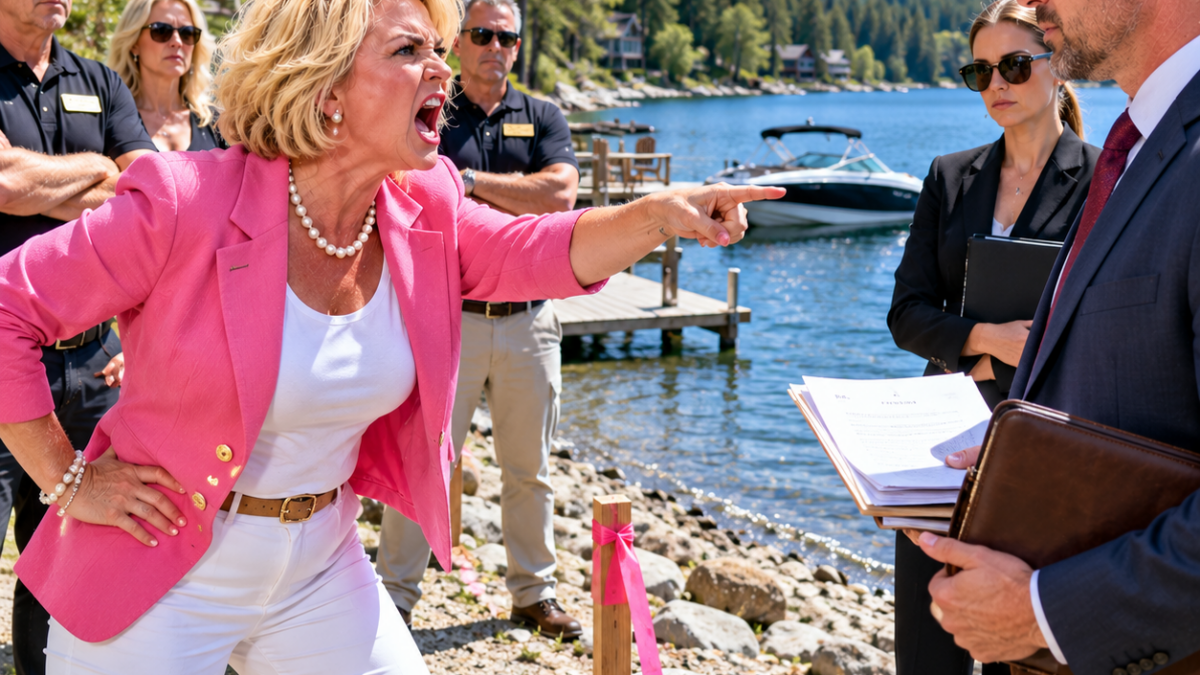
PART 2
I watched the footage three times before I trusted what I was seeing.
The camera was an inexpensive hunting model I’d bought at the hardware store on the way home from Brenda’s second visit. Infrared. Motion activated. Nothing sophisticated.
But it had captured enough.
The man kept his face turned away.
Dark jacket.
Baseball cap.
Work gloves.
He moved carefully until he reached the temporary service box, then crouched and disappeared below the camera’s angle for less than a minute.
The next morning my power cable was lying in the dirt.
Cut clean through.
I stood there staring at it while the October wind moved through the maples behind the cabin.
Until that point, part of me had still treated the whole thing as a ridiculous fight with people who couldn’t accept the word boundary.
Lawyer letters were irritating.
Fake HOA notices were pathetic.
A trespassing “inspector” was something for a police report and a good story later.
But a man creeping onto an active construction site in the middle of the night with cutters was different.
I had a sump pump connected to that temporary service whenever rain threatened.
Battery chargers.
Task lighting.
Tools.
The cable had been isolated and nobody was hurt, but whoever cut it had not checked what it supplied.
They had simply decided they were entitled to disable my site.
I called the sheriff.
Deputy Owen Langford arrived about forty minutes later in a dark green county SUV.
He was younger than I expected, maybe thirty-eight, with the flat expression of a man who had heard a thousand bad excuses and stopped being surprised around number three hundred.
He climbed out, looked at the severed cable, then looked at me.
“You touch it?”
“Enough to confirm it was cut.”
“Anything else?”
“No.”
He crouched and photographed the cable from three angles.
“Electrician coming?”
“I was going to repair it.”
“No.”
“I built houses for twenty years.”
“Congratulations. You’re still not repairing my evidence.”
I almost smiled.
He stood.
“Any cameras?”
“That is why I called you.”
We went inside the unfinished shell.
There were no doors yet, just plastic covering the openings.
I balanced my laptop on two stacked toolboxes and played the clip.
Langford watched.
“Again.”
I replayed it.
“Back five seconds.”
I did.
The figure crossed the road.
Langford leaned toward the screen.
“Pause.”
He pointed at the man’s right leg.
“You know him?”
“I can’t even see his face.”
“I didn’t ask that.”
“No.”
Langford studied the gait.
“He drags the right leg.”
I nodded.
“Thought that was strange.”
“Larry Cummings.”
The name meant nothing for about two seconds.
Then it clicked.
“Oak Shores maintenance committee?”
“You know him?”
“I’ve seen him once.”
Langford rubbed his chin.
“Snowmobile wreck last winter. Tore up his knee. Everybody in town knows the limp because he spent six months complaining about physical therapy.”
“Can you arrest him from this?”
“No.”
The answer came immediately.
“Can you question him?”
“Yes.”
“Will you?”
“Yes.”
He glanced around the half-built cabin.
“What’s the fight actually about?”
“I own land beside Oak Shores.”
“You’re not a member?”
“No.”
“Covenants?”
“No.”
“Easement?”
“No.”
“Then why do they care?”
“That is the question.”
I told him about Brenda.
The law firm.
The violation sign.
The fake inspector.
He wrote everything down.
When I finished, he said, “Do yourself a favor.”
“What?”
“Don’t contact Larry.”
“I wasn’t planning to.”
“Don’t contact Brenda either.”
“That one is harder.”
“You’re paying a lawyer, right?”
“Yes.”
“Let her be expensive.”
That afternoon, Cassidy Morgan rolled onto my lot with twelve rough-sawn cedar beams strapped to the bed of her truck.
Cassidy had spent nearly three decades with the fire department before retiring and buying a small sawmill twenty miles north of the lake.
She was sixty-one, five feet seven, built like she could still carry a grown man down a ladder, and incapable of witnessing stupidity without commenting on it.
She climbed out and looked at the temporary cable.
“What’d you do?”
“Apparently provoke democracy.”
She walked closer.
“That is cut.”
“Correct.”
“Who?”
“Sheriff thinks Larry Cummings.”
“HOA Larry?”
“You know him too?”
“Everybody knows Larry.”
She pulled off her work gloves.
“Man once measured where I parked a log trailer because Brenda thought one tire might be touching Oak Shores common land.”
“You’re not in Oak Shores.”
“That was my argument.”
I showed her the footage.
She watched silently.
When it ended, she looked toward the subdivision through the trees.
“They’re getting desperate.”
“Over a cabin?”
“People don’t get desperate over cedar siding.”
I thought about that.
“What are you saying?”
“I don’t know.”
She walked back toward her truck.
“But nobody crawls around at two in the morning cutting cables because they hate your roofline.”
That was the first time anyone said it out loud.
Maybe this wasn’t about the cabin.
At noon the next day, Priya Shah called.
“They cut your power?”
“Sheriff has the footage.”
“Who?”
“Possibly Larry Cummings.”
“Board connection?”
“Maintenance committee.”
She was silent for several seconds.
I could hear keyboard clicks.
“What are you doing?”
“Opening a new file.”
“You already have a file.”
“This one is called ‘They Finally Did Something Stupid Enough to Make My Week Interesting.’”
“You lawyers need hobbies.”
“This is my hobby.”
She asked me for every photograph, incident report number, and earlier HOA letter.
Then her tone changed.
“Trent, don’t bait them.”
“I haven’t.”
“Don’t walk into an HOA meeting with a camera and start yelling.”
“I wasn’t going to.”
“You thought about it.”
“For six seconds.”
“Don’t.”
“What are you planning?”
“Preservation letters first. Every relevant board member, their attorney, and any contractor they used.”
“Then?”
“If police develop evidence that Larry acted under board direction, we amend your civil claims.”
“Conspiracy?”
“Potentially.”
“You sound happy.”
“I like documentary evidence.”
“I prefer lumber.”
“That is because lumber usually stays where you put it.”
Three days later, Deputy Langford called while I was installing window headers.
“We arrested Larry.”
I put down the impact driver.
“For the cable?”
“Among other things tied to the incident.”
“What did he say?”
“I am not giving you an interview transcript.”
“So he talked.”
“I didn’t say that.”
“You said among other things.”
“Trent.”
“Fine.”
He sighed.
“I can tell you he made statements suggesting he believed he was carrying out a board objective.”
“A board objective.”
“His words weren’t that clean.”
“Did Brenda send him?”
“Investigation is ongoing.”
“Did someone send him?”
“Call your lawyer.”
Then he hung up.
Cassidy happened to be standing ten feet away.
“He talked?”
“Langford won’t say.”
“So yes.”
“That’s my guess.”
She handed me a beam.
“Don’t drop this while imagining Brenda in handcuffs.”
“I wasn’t.”
“You absolutely were.”
Later that afternoon, two sheriff’s vehicles drove into Oak Shores.
I didn’t see it happen, but half the lake apparently did.
Larry was walked out of a closed board meeting and placed in a patrol car.
By sunset, neighborhood Facebook pages were full of rumors.
Some claimed he’d tried to burn down my cabin.
False.
Some claimed he’d been arrested for attempted murder.
Also false.
Somebody wrote that I’d trapped him with military surveillance equipment.
My thirty-nine-dollar trail camera had never felt so important.
I stayed out of it.
Priya didn’t.
She filed suit that week.
Trespass.
Property damage.
Interference with lawful construction.
Claims related to unauthorized access and false assertions of authority.
She also requested preservation of Oak Shores emails, text messages, board minutes, contractor communications, and legal directives relating to my property.
The HOA’s law firm responded aggressively.
They argued Oak Shores had legitimate concerns regarding shoreline impact, visual continuity, erosion, and the welfare of community property bordering my parcel.
I drove to Priya’s office with the response printed in my hand.
“They’re still claiming environmental authority.”
She nodded.
“They have no authority.”
“I know.”
“The judge will know.”
“So why write twenty-seven pages?”
“Because legal arguments are partly about preserving positions.”
“I hate your profession.”
“You keep hiring me.”
“Temporary weakness.”
She turned her monitor toward me.
“Here’s the important part.”
Her motion for limited discovery had been granted.
Not everything.
Enough.
Emails related to enforcement strategy concerning my parcel.
Board directives involving Larry.
Communications with outside “inspectors.”
And records connected to the legal threats.
Ten days later, Priya called.
“Come in.”
“Good?”
“Depends how much you enjoy being right.”
“Very much.”
“Then excellent.”
Her conference table was covered with paper.
Not stacks.
Rows.
She had arranged the emails chronologically.
The first was from six months before I bought the parcel.
Brenda to several directors.
SUBJECT: EAST SHORE CONTINUITY.
The vacant Willow Creek parcel remains outside association control. Long-term risk to lakefront standards if acquired by independent owner. Explore acquisition or future incorporation options.
I looked up.
“They were talking about my lot before I owned it.”
“Yes.”
“Did they try to buy it?”
“Keep reading.”
Two months later:
Property owner unwilling to accept Oak Shores offer. Consider whether county shoreline designation can create leverage for future transfer.
I frowned.
“That is from Brenda?”
“Yes.”
“Before me.”
“Yes.”
Another email after my purchase.
Brenda:
New owner appears determined to build independently. Need immediate pressure before improvements increase parcel value.
My jaw tightened.
“Pressure.”
Priya nodded.
Next email.
Board member Michael Donnelly:
We have no covenant authority outside the recorded boundary. I strongly recommend we leave this alone.
Brenda:
Jurisdiction is not always as simple as a map line. Oak Shores has a responsibility to protect values.
Another director:
Are you proposing litigation?
Brenda:
If necessary.
Then:
Need pressure points. Architectural review should be presented as inevitable rather than optional.
I leaned back.
“They never believed I was actually under the HOA.”
“No.”
“They knew.”
“Yes.”
The fight wasn’t confusion.
It had never been confusion.
Brenda understood the boundary as clearly as I did.
She simply thought she could make the boundary irrelevant.
Priya slid over another page.
Larry:
I’ll handle the generator issue tonight.
Timestamp: 8:17 p.m.
Brenda replied at 8:23.
Do what needs doing. Do not create liability for the association.
I stared.
“She’s going to claim she didn’t mean cut the cable.”
“Yes.”
“Will anyone believe that?”
“Belief isn’t the legal standard.”
“But timing?”
“Very useful.”
“Larry’s testimony?”
“Potentially more useful.”
“What’s he saying?”
“His criminal attorney is negotiating. We don’t have full discovery yet.”
I kept reading.
Another exchange discussed placing compliance notices on my property “to create an administrative record.”
Another proposed contacting suppliers to ask whether deliveries complied with Oak Shores construction hours.
Another suggested notifying my insurer of “unresolved land-use conflict.”
That one made me angry.
“They were going after insurance?”
“Apparently considering it.”
“My insurance has nothing to do with them.”
“Correct.”
Then I found something else.
Brenda:
If construction stalls long enough, owner may become receptive to purchase.
I looked at Priya.
“There.”
She nodded.
“Exactly.”
“This was about buying the lot.”
“Maybe.”
“Maybe?”
“Don’t jump from evidence of purchase interest to motive for every act.”
“They wanted the land.”
“That is what we investigate next.”
That afternoon, a former board member named Michael Donnelly came to Priya’s office.
He was the same director who had written that the HOA lacked authority.
Gray hair.
Wire-rim glasses.
Retired accountant.
Nervous enough that he kept rotating his wedding ring while he talked.
“I resigned last year.”
“Why?” Priya asked.
“Brenda.”
“More specific.”
Michael glanced at me.
“She stopped treating disagreement like disagreement.”
I understood that instantly.
He opened a notebook.
He had written dates.
Not every meeting.
Enough.
One entry read:
Willow parcel. Brenda wants acquisition. Believes external owner creates hole in shoreline authority.
Another:
Legal counsel warns no jurisdiction. B.W. says create facts on ground.
Priya leaned forward.
“What did ‘create facts on ground’ mean?”
“I asked.”
“And?”
“She said if the owner started treating the HOA as legitimate, that could help establish practical oversight.”
I stared.
“You mean bully somebody long enough and later claim they accepted it.”
Michael nodded reluctantly.
“That’s how I understood it.”
“Why didn’t you report this?”
“To whom?”
“The homeowners.”
“I tried.”
He looked down.
“People liked Brenda.”
“Why?”
“She kept things clean. Dues stayed stable. She made problems disappear.”
Priya asked, “What kind of problems?”
“Contract disputes. Delinquent accounts. Neighbor fights.”
“And money?”
Michael’s fingers stopped moving.
“That is part of why I resigned.”
Priya waited.
He continued.
“Legal spending increased every year, but the board summaries didn’t show how much. Some expenses were moved into community relations.”
“How much?”
“I can’t say.”
“Guess.”
“Over three years? Maybe one hundred fifty thousand. Maybe more.”
“For public relations?”
“I never saw public relations.”
He pushed his notebook toward Priya.
“I asked Douglas Whitmore for the underlying invoices.”
“Brenda’s husband?”
“He wasn’t officially on the board. He handled some vendor relationships.”
“Why?”
“Brenda said he was volunteering.”
“That should have bothered you.”
“It did.”
Michael swallowed.
“I should’ve pushed harder.”
No one comforted him.
Eventually he said, “The last meeting I attended, Brenda said the Willow parcel would eventually belong to Oak Shores one way or another.”
I felt a chill that had nothing to do with weather.
“When?”
“About three weeks before I resigned.”
“Did anyone object?”
“I did.”
“Anyone else?”
“Not out loud.”
The HOA offered me twenty-five thousand dollars to settle.
Priya read the proposal on speakerphone while I was installing roof sheathing.
“They want dismissal of all civil claims, mutual releases, no admission, and confidentiality.”
“How much?”
“Twenty-five.”
I laughed.
“You’ve spent almost that much.”
“I appreciate your awareness of my value.”
“Tell them no.”
“They may increase it.”
“No.”
“Why?”
“Because they still want silence.”
“That isn’t always a reason to refuse settlement.”
“It is here.”
Priya paused.
“You sure?”
I looked across the lake toward Oak Shores.
The subdivision roofs were barely visible between trees.
Brenda had spent months trying to convert her fiction into reality.
If I took money and signed a nondisclosure agreement, homeowners might never know why their dues funded the fight.
“No NDA.”
“All right.”
“Actually, no settlement yet.”
“Also all right.”
“You wanted court anyway.”
“I enjoy judges.”
The preliminary hearing came two weeks later.
Judge Everett Lyle had the kind of face that discouraged drama.
Oak Shores’ attorney argued that lakefront development created effects beyond deed boundaries and the association was entitled to protect the visual and environmental interests of its members.
Judge Lyle adjusted his glasses.
“Counsel, does Mr. Sandell’s deed contain Oak Shores covenants?”
“No, Your Honor.”
“Recorded architectural restrictions?”
“No.”
“Mandatory membership?”
“No.”
“Easement granting association access?”
“No.”
“Then what legal instrument authorizes your client to post violation notices?”
The lawyer hesitated.
“The notices were advisory.”
Priya stood.
“One was physically titled Notice of Violation and threatened enforcement consequences.”
Judge Lyle looked toward opposing counsel.
“Advisory?”
“Poor wording.”
Priya handed up a photograph.
The judge read.
“Failure to submit architectural plans.”
He looked up.
“Plans to whom?”
“Oak Shores.”
“Which has no jurisdiction.”
The attorney began talking about shoreline consistency.
Judge Lyle lifted a hand.
“No.”
Silence.
“This court is not going to turn aesthetic concern into property authority.”
Then came the Larry email.
Judge Lyle read it twice.
His expression changed.
“Was Mr. Cummings subsequently arrested?”
Priya answered.
“Yes, Your Honor, in connection with damage to the temporary electrical line.”
Opposing counsel stood.
“No criminal conviction has occurred.”
“Correct.”
The judge nodded.
“And I am not determining criminal guilt.”
He looked at the emails again.
“But these communications are deeply troubling.”
The injunction was granted.
Oak Shores could not enter my land.
Could not post notices.
Could not interfere with contractors.
Could not represent that it possessed regulatory authority over the parcel.
Brenda sat behind her attorney.
She looked at me once.
Only once.
No rage.
No embarrassment.
Calculation.
I remember thinking that bothered me more than anger would have.
After court, Cassidy met me at the cabin with bourbon.
“You won.”
“I got an injunction.”
“Lawyer translation for won.”
“The case isn’t over.”
“Builder translation for can’t enjoy anything.”
She handed me the bottle.
We sat on the rough porch floor.
Roof finally sealed.
Lake dark below us.
Cassidy raised the bottle.
“To people who stay on their side of the property line.”
I took it.
“And cameras.”
“And judges with common sense.”
“And retired firefighters who sell overpriced lumber.”
She took the bottle back.
“My lumber is artisanal.”
For three weeks, Oak Shores went quiet.
No letters.
No inspectors.
No cars parked at the entrance.
Construction moved fast.
Roof.
Windows.
Weather barrier.
Cedar siding.
For the first time since I broke ground, I believed the fight might be ending.
Then the county assessor’s letter arrived.
PROPERTY CLASSIFICATION REVIEW.
My parcel had been temporarily flagged as recreational shoreline property under shared community oversight pending environmental evaluation.
I read the phrase twice.
Then a third time.
Shared community oversight.
Oak Shores finally had what Brenda had wanted from the beginning.
Not ownership.
Not yet.
A foothold.
I called Priya.
She read the letter.
“This is not normal.”
“Can they do it?”
“Flag parcels for review? Yes.”
“Change my classification without hearing from me?”
“Temporarily, under certain administrative procedures.”
“So Brenda found a legal route.”
“Maybe.”
“Maybe?”
“I want the trigger documents.”
Cassidy showed up while I was still angry.
She carried reclaimed oak flooring.
I handed her the letter.
She read it slowly.
“They got county government to do their dirty work?”
“I don’t know.”
“That means yes.”
“No. That means I don’t know.”
She handed it back.
“You’ve been around your lawyer too much.”
She was right.
That night I opened the county’s public records database.
I searched environmental review notices.
Land-use committee minutes.
Shoreline overlays.
Nonprofit submissions.
At 2:06 a.m., I found a memo.
Concerned Citizens Environmental Coalition requests review of privately developed Willow Creek lakefront parcel due to potential shared shoreline impact.
Organization name:
Willow Lake Citizens Environmental Coalition.
I’d never heard of it.
I opened the state’s corporation registry.
Created five months earlier.
Registered agent:
Douglas Whitmore.
I stared at the screen.
Brenda’s husband.
The address was a mailbox center.
No office.
No employees listed.
I downloaded the filings.
The coalition’s mission statement included phrases that looked familiar.
I opened Oak Shores’ environmental charter.
Side by side.
Whole sentences were nearly identical.
Priya called me at 7:10 after seeing the documents.
“You didn’t sleep.”
“No.”
“You’re an idiot.”
“Is it useful?”
“Yes.”
“Then I’m a useful idiot.”
“This organization appears legitimate on paper.”
“Appears?”
“It has filings.”
“It has Brenda’s husband.”
“That is not illegal.”
“It copied HOA language.”
“Also not illegal.”
“It was formed shortly before this fight.”
“Interesting.”
“And its first major action is attacking my parcel.”
“Very interesting.”
“Fraud?”
“Not yet.”
I hated when she said that.
“What do we do?”
“Challenge the reclassification.”
“And?”
“Request communications between the coalition and county staff.”
“And?”
“Wait.”
“I hate your profession again.”
“You say that every month.”
The court temporarily blocked enforcement of the new classification while due-process questions were reviewed.
Then county counsel, sensing a problem, agreed to preserve and produce relevant communications.
That was the moment Brenda’s strategy stopped looking merely aggressive.
An email chain connected Douglas Whitmore to Ryan Kellerman, a junior assessor’s-office employee.
Douglas:
Need temporary environmental flag on Willow parcel. Full hearing can happen later.
Ryan:
Basis is weak without shoreline coalition complaint.
Douglas:
Complaint submitted today.
Ryan:
I can enter provisional review status.
Brenda:
That is enough. He needs to understand continued construction will stay complicated until he agrees to architectural review.
Ryan:
How quickly would coalition withdraw?
Douglas:
Once compliance agreement is signed.
I read it twice.
Priya sat across from me.
“They created the environmental complaint to justify a classification they intended to remove once you surrendered.”
“Extortion.”
“Potentially coercive abuse of process.”
“Mine is shorter.”
Another email.
Ryan:
I am taking heat for bypassing normal committee intake.
Douglas:
We discussed the regional zoning-board opportunity. Brenda has contacts. Don’t lose sight of the long game.
I looked up.
“They promised him a job?”
“Maybe political support for advancement.”
“Same thing.”
“Not legally.”
“Close enough morally.”
Priya forwarded the material to the county ethics office and state public-integrity unit.
I did nothing.
That was harder than it sounds.
When somebody attacks your land, the instinct is physical.
Protect.
Respond.
Push back.
But once public corruption appeared, the smartest thing I could do was stop touching the pieces.
Two weeks later, state investigators arrived.
Ryan Kellerman was suspended.
Then arrested after additional evidence showed he’d manipulated the parcel-review process without required documentation and made false internal certifications.
His attorney initially blamed confusing procedures.
Then Ryan cooperated.
He told investigators Douglas and Brenda had pressured him to create delay.
He had expected them to help his career later.
He believed my parcel would quietly return to normal once I agreed to submit my cabin to Oak Shores.
In other words, government paperwork had been turned into a negotiating weapon.
The day after Ryan’s arrest, Brenda sent me a one-page letter.
No logo.
No attorney.
No signature.
Oak Shores proposes mutual accommodation in the interest of community harmony.
I read it standing on my new deck.
The lake was beginning to freeze along the edges.
Priya drove out.
She read it.
“They’re scared.”
“They should be.”
“Don’t get stupid now.”
“What does mutual accommodation mean?”
“They restore all opposition. You agree voluntarily to Oak Shores design review.”
I stared at her.
“So after all this, she still wants control.”
“Yes.”
I tore the letter once.
Priya snatched it from me.
“Evidence.”
“It’s a copy.”
“Still.”
She smoothed it.
“Lawyers don’t rip documents.”
“Builders do.”
“That’s why we need courts.”
The public still knew almost nothing.
That began to bother me.
Oak Shores homeowners were paying attorneys.
Their board had created a fake-looking environmental coalition.
Their maintenance member had been arrested.
A county employee had been arrested.
How many homeowners understood what was happening?
Very few.
Priya warned me not to conduct a media circus.
I agreed.
Then I called Alina Voss.
Alina wrote a weekly investigative column covering county contracts and public integrity.
We met at a diner on Highway 7.
I brought documents that were already public or lawfully releasable.
She read for nearly an hour.
Occasionally she looked up.
Mostly she didn’t.
Finally she closed the folder.
“This isn’t an HOA story.”
“It started as one.”
“This is a local-government story.”
“Yes.”
“And maybe a financial story.”
“What do you mean?”
She tapped the Oak Shores emails.
“Why spend this much money controlling one parcel?”
“That is the question.”
“Your former board witness says they wanted to buy it.”
“Yes.”
“Why?”
“Shoreline continuity.”
She stared at me.
“You believe that?”
“No.”
“Good.”
Her article ran Friday.
FAKE NONPROFIT, REAL POWER GRAB: OAK SHORES HOA LINKED TO QUESTIONABLE COUNTY ZONING ACTION.
Regional television picked it up before noon.
By Saturday, Oak Shores residents were demanding an emergency meeting.
By Monday, three board members had hired separate attorneys.
Then the finances started coming apart.
One of the state subpoenas requested legal expenses.
Another requested vendor contracts.
Another targeted “community relations.”
Michael Donnelly’s suspicion had been right.
The legal budget wasn’t the only problem.
A company called Lakeside Green Solutions had received more than ninety thousand dollars over three years.
Its listed business address was a vacant parcel outside town.
No equipment.
No employees.
Registered owner:
Douglas Whitmore’s cousin.
Another vendor billed thirty-seven thousand dollars for shoreline erosion work nobody could locate.
A third received consulting fees despite having no obvious business operations.
Priya called me late one evening.
“They found a secondary ledger.”
I was sitting on the cabin floor installing drawer pulls.
“How bad?”
“Potentially more than two hundred thousand dollars in questionable vendor payments.”
I stopped.
“Two hundred?”
“Over three years.”
“Where?”
“Multiple entities.”
“Douglas?”
“Ties to several.”
“Brenda?”
“Still being traced.”
“What does this have to do with me?”
“Maybe nothing directly.”
“Priya.”
“Listen to me. Your fight may have exposed a larger financial problem, but that doesn’t mean every missing dollar was spent targeting you.”
“Fair.”
“Investigators will separate it.”
I looked around the kitchen.
Nearly finished.
I had wanted nothing except a cabin.
Now my property file sat inside a public-corruption investigation.
“From fake shoreline rules to racketeering.”
“Slow down.”
“You’re going to say don’t get ahead of charges.”
“Correct.”
“Predictable.”
“Accurate.”
Douglas was indicted before Brenda.
Fraud-related counts.
Conspiracy allegations tied to the coalition and county manipulation.
Two board-linked individuals faced misuse-of-funds charges.
Brenda resigned as HOA president but remained under investigation.
Oak Shores elected an interim board.
Calvin Rimes called me.
I’d met him once.
Quiet engineer.
Always sat near the back of annual meetings.
“Mr. Sandell?”
“Trent.”
“Calvin Rimes.”
“I know.”
“I am apparently president now.”
“You sound thrilled.”
“My wife hasn’t stopped laughing.”
“What can I do for you?”
“We’re reviewing everything.”
“Good.”
“We want to formally acknowledge that your property is outside Oak Shores.”
“Also good.”
“And we would like you to attend a community meeting.”
“No.”
A pause.
“That was quick.”
“I’m not joining Oak Shores.”
“I didn’t ask you to.”
“I don’t want a committee.”
“Also not asking.”
“Then what?”
“We need homeowners to hear what happened from somebody who wasn’t in the board bubble.”
I looked through the windows at the lake.
“Why me?”
“Because we spent their money fighting you.”
That answer mattered.
“I’ll come.”
The community center was packed.
Some residents looked angry.
Some ashamed.
Most exhausted.
I stood in front with no slideshow except printed documents.
County map first.
Red line.
Oak Shores inside.
My land outside.
“Everything starts here.”
I pointed.
“This is not complicated.”
A man in the second row said, “Brenda told us shoreline authority went beyond the map.”
“It doesn’t.”
“How do we know?”
“Because your own attorneys admitted in court that my parcel carries no Oak Shores covenants, membership obligation, or easement.”
That created murmurs.
I held up the fake violation notice.
“This was planted on my property.”
Then the trail-camera photograph.
“This man came onto my lot at 2:46 a.m.”
People recognized Larry.
A woman whispered, “Oh my God.”
Then the email.
I’ll handle the generator issue tonight.
Then Brenda’s response.
Do what needs doing. Do not create liability for the association.
The room went silent.
I moved to the environmental coalition.
Douglas.
Ryan.
County emails.
Temporary classification.
I didn’t embellish.
I didn’t need to.
When I finished, an older woman stood.
Her name was Margaret Ellis.
“I paid dues for twenty-three years.”
Calvin nodded.
She pointed at the legal invoices.
“Did my money pay lawyers to threaten him?”
Calvin answered carefully.
“Yes. Association funds were used for legal action involving Mr. Sandell.”
Margaret sat down.
Another resident stood.
“Did Brenda know his lot wasn’t ours?”
Former director Michael Donnelly answered from the side wall.
“Yes.”
That hurt the room more than anything.
Mistakes can be forgiven.
Knowledge is harder.
A man near the back shouted, “Why?”
Nobody had a complete answer yet.
I did my best.
“They wanted influence over the parcel.”
“Why?”
“I don’t know the full motive.”
That was true.
The woman at the door stopped me when I left.
Faded hiking jacket.
Silver hair.
Maybe mid-sixties.
“You fought back.”
“I had help.”
“Most people don’t.”
“I had records.”
She smiled sadly.
“Most people get one lawyer letter and decide peace is cheaper.”
I thought about that all the way home.
Peace is cheaper.
That was the strategy.
Not authority.
Cost.
Make resistance expensive enough that surrender becomes rational.
That realization changed the emotional center of the fight for me.
I had resources.
A good lawyer.
Construction experience.
Time.
No children.
No employer threatening me over court dates.
No elderly spouse depending on me.
What if the owner of that lot had been eighty?
What if they barely had enough money to build?
Twenty-five thousand dollars and a nondisclosure agreement might have looked generous.
The HOA didn’t need to be right.
It only needed to be exhausting.
I understood Brenda better after that.
Not morally.
Strategically.
She had built power from fatigue.
People surrendered because challenging her took too much energy.
The state forensic audit deepened.
Calvin’s interim board opened records voluntarily.
That made investigators’ work easier.
“Community relations” turned out to be an umbrella category.
Legal fees.
Consulting payments.
Private investigators in two unrelated homeowner disputes.
Mail campaigns.
Vendor reimbursements.
Some legitimate.
Some not.
One memo discussed establishing “compliance leverage” over neighboring non-member parcels.
Plural.
Not just mine.
Another parcel belonged to an elderly couple named Arthur and Joan Bennett.
North side of the lake.
No HOA.
They had rejected a purchase offer two years earlier.
Investigators found draft environmental complaints targeting them.
Never filed.
Yet.
I drove there one afternoon.
Their house was small.
Blue siding.
Vegetable garden.
Arthur opened the door.
“You’re the cabin guy.”
“That is apparently my legal name now.”
He laughed.
Joan invited me in.
I showed them the documents.
Arthur read slowly.
His hands trembled.
“They were coming after us?”
“It appears somebody was preparing pressure.”
“Why?”
“Did you ever get an offer to sell?”
They looked at each other.
Joan disappeared into another room and returned with a folder.
Three purchase offers.
Same brokerage group.
Increasing prices.
The most recent nearly forty percent above assessed value.
Arthur shook his head.
“Joan’s parents built this place.”
She touched his arm.
“We weren’t selling.”
I understood.
“What happens now?” she asked.
“Give copies to investigators.”
“Are we in trouble?”
“No.”
She looked relieved.
Then angry.
“I spent two years thinking Brenda just didn’t like our dock.”
Maybe she didn’t.
Maybe the dock was convenient.
But pressure was pressure.
By spring, my cabin was finished.
The first night I slept there, a storm crossed the lake.
Thunder shook the windows.
Wind pushed rain against the cedar siding.
I slept through most of it.
When I woke at five, the storm had passed.
Mist sat over the water.
I made coffee and walked onto the deck.
No violation sign.
No trail-camera notification.
No certified letter.
Just quiet.
I stood there barefoot and realized I’d finally gotten what I’d bought the lot for.
Not victory.
Peace.
Cassidy arrived three hours later with seedlings.
“You look terrible.”
“I just woke up.”
“At eight?”
“Luxury.”
She opened her tailgate.
Mountain laurel.
Creeping thyme.
Black-eyed Susans.
“You bought landscaping?”
“Don’t say it like that.”
“HOA approve the species?”
I pointed toward the road.
“Leave.”
She laughed.
We planted until noon.
At one point she asked, “Ever think about selling?”
“No.”
“Even now?”
“Especially now.”
“What if somebody offered double?”
“No.”
“Triple?”
I looked at the lake.
“No.”
Cassidy nodded.
“Good.”
“Why?”
“I wanted to know whether this became about winning or whether you still wanted the place.”
That question stopped me.
I still wanted it.
That mattered.
Several months later, state prosecutors filed broader charges against five people connected to various Oak Shores-related financial conduct.
The exact counts differed by defendant.
Fraud.
Conspiracy.
Misuse of funds.
Brenda and Douglas sat at the center of the investigation.
Ryan’s cooperation helped prosecutors reconstruct the zoning manipulation.
Larry’s case supported the harassment timeline.
Financial records supported something bigger.
Eventually investigators traced a significant amount through inflated vendor contracts.
Not every questionable payment proved criminal.
Some were sloppy.
Some merely overpriced.
Some legitimate but badly documented.
Others were not.
Prosecutors didn’t treat them all alike.
That distinction mattered to me.
Anger makes everything look guilty.
Evidence doesn’t work that way.
Brenda remained under restrictions while her case proceeded.
Douglas faced stricter conditions after prosecutors argued he had attempted to destroy or conceal records.
News vans parked outside Oak Shores twice.
Residents hated it.
So did I.
They were already embarrassed.
They didn’t need strangers filming children riding bicycles because their former board had allegedly stolen money.
I turned down most interviews.
Alina called.
“You disappearing?”
“I said what I needed.”
“Your story is driving state legislation.”
“Then interview legislators.”
“You hate attention.”
“I bought land outside an HOA and started building alone. What was your first clue?”
She laughed.
The legislature did hold hearings.
The proposals focused on financial transparency.
Conflict-of-interest disclosure.
Limits on undisclosed related-party vendors.
Clear notice requirements.
Stronger owner access to financial records.
A state-level complaint process.
Some reporters called the package Sandell’s Law.
It wasn’t officially.
I made that clear whenever asked.
One senator invited me to testify.
I almost refused.
Then I thought about Margaret saying peace was cheaper.
So I went.
I told the committee:
“A private association does not have to win a legal argument to hurt somebody. Sometimes all it has to do is create enough expense and confusion that the homeowner gives up. Transparency reduces the ability to manufacture that pressure in secret.”
A senator asked, “Are you opposed to HOAs?”
“No.”
That surprised some people.
“Why not?”
“Because Oak Shores actually owns roads, common shoreline, a clubhouse, and other shared assets. Someone has to manage them. The problem isn’t that an association exists. The problem is pretending its authority extends beyond its documents or using money homeowners don’t understand to finance personal agendas.”
Another senator asked, “Would you ever live in one?”
“No.”
The room laughed.
“At least you’re consistent.”
The reforms passed months later with broad support.
Not because of me alone.
Other homeowners testified.
Association managers too.
Lawyers.
Auditors.
Even responsible HOA presidents who wanted bad boards stopped before they destroyed public trust.
Calvin testified.
He said:
“When governance becomes secret, ordinary volunteers become vulnerable to being led by whoever speaks with the most confidence.”
That sounded like Oak Shores.
It probably sounded like many places.
The criminal cases resolved slowly.
Douglas eventually entered a plea involving financial and conspiracy-related conduct.
Brenda fought longer.
Her lawyers attacked evidence.
Challenged interpretations.
Argued that aggressive governance had been mischaracterized as criminal intent.
Some arguments worked.
Others didn’t.
That’s what courts are for.
Eventually she entered a negotiated resolution on certain charges rather than risk trial on everything.
She agreed to restitution.
Financial penalties.
Restrictions against serving in association governance.
Additional conditions imposed by the court.
The headlines screamed that she’d been “destroyed.”
I didn’t see it that way.
She still had a life.
A family.
A house.
People who cared about her.
She also had consequences.
Those can exist together.
Larry sent a letter through his attorney.
He admitted cutting the cable.
He said Brenda never explicitly used the words “cut the power,” but he’d understood repeated board discussions about stopping construction as authorization to disable the site.
He apologized.
I believed part of it.
Maybe all.
Doesn’t change what he did.
But I didn’t need to hate him forever.
The restitution check for the damaged service box arrived one Tuesday.
I deposited it.
Then went back to installing shelves.
Priya called.
“You’re becoming disturbingly healthy.”
“Don’t worry. I still hate legal invoices.”
“Good.”
Our civil case settled last.
That was intentional.
I refused an NDA.
The new Oak Shores board supported transparency.
The settlement acknowledged that my parcel was outside HOA authority and resolved the damage and interference claims.
Some payment came through insurance.
Some through recovered funds.
Some legal costs remained mine.
Justice doesn’t refund every hour of your life.
But the principle was settled.
The red line on the county map remained exactly where it had been on the first morning Brenda drove onto my property.
One foot away.
Calvin installed physical markers along parts of the Oak Shores boundary after the new board voted to improve clarity.
I ran into him at the hardware store buying posts.
“Building a fence?”
“Apparently we’re idiots who need giant markers.”
“Accurate.”
He laughed.
“We found the line.”
“Congratulations.”
He picked up another bundle.
“Some homeowners blame you.”
“I know.”
“Others think you saved the association.”
“I didn’t.”
“You exposed the records.”
“The board saved itself after.”
He looked at me.
“You really believe that?”
“Yes.”
Calvin had done the hardest part.
He inherited a corrupt mess and chose to clean it publicly rather than hide it.
Budgets went online.
Board minutes were posted.
Vendor contracts above a threshold required competitive review.
Related-party transactions needed disclosure.
Legal spending was reported separately.
A boundary map appeared at the front of every annual packet.
The first time Calvin mailed me one, he circled my lot and wrote:
STILL NOT OURS.
I laughed harder than I should have.
Cassidy framed it.
She hung it above my workbench next to Priya’s framed county classification correction.
“You realize my workshop now looks like a law office.”
“A very poorly organized law office.”
Summer returned.
Loons came back.
The cabin aged into itself.
Fresh cedar faded slightly.
The landscaping spread.
I took the trail cameras down.
That felt strange.
They had protected me.
But leaving them up forever felt like letting Brenda keep a permanent place in my life.
Cassidy watched me unscrew the first camera.
“You sure?”
“Yes.”
“What if someone comes back?”
“I have regular security now.”
“Boring.”
“Exactly.”
She helped me remove the second.
We put them in a storage cabinet.
I never needed them again.
Then came the vacant lot.
Lakeside Green Solutions—the fake landscaping vendor tied to Douglas’s cousin—had owned a small piece of shoreline through a web of transactions investigators eventually unwound.
After litigation and asset proceedings, the county auctioned it.
Nobody bid much.
Bad access.
Overgrown.
Too small for a proper house under current setbacks.
I bought it for a few thousand dollars.
Priya called.
“What are you doing?”
“Buying land.”
“You already own land.”
“I need a hobby.”
“You have carpentry.”
“This one involves less dust.”
Cassidy assumed I planned to expand my property.
“No.”
“Rental dock?”
“No.”
“Workshop?”
“Too far.”
“Then why buy it?”
“Public fishing access.”
She stared.
“You spent two years fighting people over property rights and now you’re giving strangers access?”
“Recorded public access.”
“That is annoyingly wholesome.”
“Don’t spread it around.”
I cleared brush.
Installed a gravel path.
One bench.
One trash can.
A simple rail near the steep section.
I recorded an easement preserving public fishing access even if I sold the parcel someday.
Cassidy wanted a sign.
NO HOA DUES BEYOND THIS POINT.
I vetoed it.
Then:
BRENDA MEMORIAL FISHING PIER.
“Absolutely not.”
Finally:
WILLOW POINT ACCESS
PLEASE RESPECT THE WATER AND EACH OTHER
Cassidy stared.
“That sign has no personality.”
“Perfect.”
The first Saturday, a father brought two boys.
One caught a bluegill that could have fit in a coffee mug.
He yelled like he’d landed a marlin.
I sat on my cabin deck across the bend and heard him.
That felt better than any courtroom ruling.
People used the spot.
Old men with folding chairs.
Teenagers after school.
Mothers teaching children to cast.
Nobody asked who owned it.
Nobody had to.
The strangest part came almost a year later.
Handwritten envelope.
No return address.
Inside:
We were wrong. You stood your ground when the rest of us were afraid to ask questions. Thank you.
No signature.
I put it in my permit drawer.
Some victories don’t need names.
By then, Oak Shores looked different.
Not physically.
Same stone entrance.
Same community center.
Same docks.
Same expensive landscaping Brenda used to brag about.
What changed was atmosphere.
At meetings people asked questions.
Not hostile ones necessarily.
Questions.
“Why this vendor?”
“Where is that invoice?”
“Is this inside our authority?”
“Did counsel review it?”
The board answered.
Sometimes slowly.
Sometimes badly.
But answered.
One evening Calvin invited me to another meeting.
“No.”
“I haven’t asked yet.”
“Still no.”
“We’re discussing shoreline tree maintenance.”
“Definitely no.”
He laughed.
“You’re impossible.”
“You finally understand jurisdiction.”
I stayed home.
Made dinner.
Sat on my deck.
The lake was flat.
Across the water, Oak Shores lights flickered on one by one.
I could hear distant voices from their community dock.
They weren’t enemies.
That realization had taken time.
For months, I had thought of Oak Shores as one thing.
Brenda.
Larry.
Lawyers.
Letters.
But Oak Shores was also Margaret, who had paid dues for twenty-three years and never knew where some of the money went.
Families.
Retirees.
Children.
People who wanted roads plowed and docks repaired.
They had been controlled too.
Not the same way I was.
But enough.
A bad board turns neighbors into camps.
A good boundary prevents that.
Not every line exists to separate people emotionally.
Sometimes a line just says:
This is yours.
That is mine.
We can still share the lake.
Years later, a young surveyor came out because I planned a small workshop expansion.
He walked the northeast corner with his GPS equipment and found the brass monument.
“Here.”
I already knew.
He brushed leaves away.
“Property line is clean.”
“Good.”
“Oak Shores boundary is one foot over.”
“Very good.”
He looked at me.
“Are you the guy?”
“What guy?”
“The HOA cabin guy.”
I closed my eyes.
“Apparently.”
“My dad followed that case.”
“That makes me feel old.”
“He said you took them down.”
“No.”
The surveyor looked confused.
“The courts did their job. Investigators did theirs. Oak Shores homeowners fixed their board.”
“But you fought.”
“Yes.”
“That counts.”
Maybe.
After he left, I stood by the survey marker.
One foot.
That’s all.
One foot had separated years of peace from months of conflict.
Not because the distance itself was special.
Because Brenda couldn’t tolerate a place she couldn’t control.
On the first day, she’d told me Oak Shores governed the shoreline view.
It didn’t.
Then she sent lawyers.
Then notices.
Then inspectors.
Then pressure.
Then somebody cut a power line.
When legal authority failed, they tried creating administrative authority through county paperwork.
When that failed, their own records exposed financial problems nobody had expected to find.
The irony was that every escalation produced more evidence.
The certified letter proved they knew the dispute.
The fake violation sign proved they asserted authority on my parcel.
The cameras documented trespass.
Larry’s email linked sabotage to board discussion.
The environmental coalition filings tied Douglas to the zoning attempt.
County emails exposed Ryan’s role.
Subpoenas exposed the money.
Brenda kept trying to build a wall around her decisions.
Instead, she built a paper trail.
Priya once described it better.
We were sitting on my deck after the final settlement papers were signed.
She had brought sparkling water because she said attorneys needed to appear responsible around clients.
“You didn’t beat them,” she said.
I looked at her.
“You’re terrible at celebrations.”
“They beat themselves.”
“How?”
“Every time reality contradicted them, they created another document trying to make their version stronger.”
She counted on her fingers.
“Notice.”
“Email.”
“Inspection.”
“Coalition.”
“County request.”
“Payment.”
“More emails.”
She smiled.
“They kept documenting intent.”
“So I did nothing?”
“You preserved evidence.”
“Sounds less heroic.”
“Reality usually is.”
Cassidy joined us later with bourbon.
She pointed at Priya’s sparkling water.
“What is that?”
“Professionalism.”
“Throw it in the lake.”
We stayed outside until dark.
At some point Cassidy asked me whether I regretted buying the lot.
“No.”
“Not even for five minutes?”
“Maybe during discovery invoices.”
Priya raised her glass.
“Worth every penny.”
“No.”
Cassidy laughed.
Then she asked a better question.
“Would you still buy it if you knew all this would happen?”
I looked at the cabin.
The deck.
The garden.
The lake.
Lights across Oak Shores.
The fishing access around the bend.
“Yes.”
She nodded.
“Then they didn’t take much from you.”
I thought about that.
They had taken time.
Money.
Sleep.
Trust.
But they hadn’t taken the land.
They hadn’t changed what it meant to me.
That mattered.
One autumn morning, I woke early and walked down to Willow Point.
A little girl sat on the bench with her grandfather.
Pink jacket.
Fishing pole twice her height.
She looked at me.
“Are there fish here?”
“I’ve heard rumors.”
Her grandfather smiled.
“We’re working on patience.”
“That is the main thing fishing teaches.”
The girl frowned.
“I don’t like patience.”
“Most people don’t.”
I kept walking.
Behind me she suddenly screamed.
“I GOT ONE!”
I turned.
The grandfather was helping her reel in a tiny perch.
She looked happier than anyone I’d seen win a lawsuit.
I went home smiling.
Inside my workshop, the Oak Shores boundary map Calvin sent me still hung above the bench.
My lot circled.
STILL NOT OURS.
Below it, my original county building permit.
Beside that, the anonymous handwritten thank-you.
I kept them because together they told the real story better than any headline.
Permit.
Boundary.
Mistake acknowledged.
Nothing dramatic.
Just proof.
I hung Dad’s old level below them.
He wasn’t part of this story.
He’d been dead years before I found Willow Creek.
But he had taught me construction.
And one rule above all:
If the foundation is wrong, everything above it eventually cracks.
Brenda’s foundation was wrong.
She believed authority came from acting certain enough.
It doesn’t.
Authority comes from documents, laws, agreements, consent, jurisdiction.
She had none of those over my parcel.
Everything she built on top of that false assumption eventually cracked.
The lawyer threats.
The fake citations.
The environmental coalition.
The zoning pressure.
Then the finances behind them.
Oak Shores itself survived because homeowners finally rebuilt from the right foundation.
Transparency.
Limits.
Records.
Consent.
I survived for the same reason.
My deed was clear.
My survey was clear.
My permits were clear.
The line never moved.
One foot outside.
Always.
The last time I spoke to Brenda was accidental.
Years after the case.
Hardware store.
I was buying exterior screws.
She stood at the end of the aisle.
Older.
Hair different.
No clipboard.
For a second neither of us spoke.
Then she said:
“Trent.”
“Brenda.”
I expected anger.
She looked tired instead.
“I heard about the fishing access.”
“Okay.”
“That was good.”
I wasn’t prepared for that.
“Thanks.”
She looked at the box of screws in my hand.
“Still working on the cabin?”
“Always.”
She nodded.
Then said:
“I was wrong about your lot.”
Simple sentence.
Maybe the hardest one she’d ever said.
I could have reminded her of everything.
Larry.
Ryan.
Douglas.
The money.
The lawyers.
But none of that needed repeating.
“Yes,” I said.
She looked toward the floor.
“I thought if we lost control of one shoreline parcel, the whole neighborhood would start changing.”
“And?”
“It changed anyway.”
“That isn’t always bad.”
She nodded.
“No.”
Then she walked away.
No apology big enough to erase the fight.
No dramatic reconciliation.
Just two people standing in a hardware aisle understanding the facts.
That was enough.
I bought the screws.
Drove home.
Turned onto Willow Creek Road.
Passed the Oak Shores entrance.
Their stone sign looked exactly the same as the morning Brenda first came to my property.
Then I reached the survey marker.
The boundary marker was visible beside the road now.
Oak Shores on one side.
My lot on the other.
I slowed for a second.
Then kept going.
The cabin appeared between the pines.
Cedar warm in the late sun.
Black roof.
Wide deck.
Nothing about it ruined the view.
If anything, it looked like it had always belonged there.
I parked.
Carried the screws inside.
Opened the lake doors.
The loons were calling somewhere beyond the reeds.
No legal notice waited on the porch.
No violation sign stood in the gravel.
No clipboard crossed the property line.
Just my tools.
My house.
My lake.
And exactly one foot of ground that an entire HOA once convinced itself didn’t matter.
It mattered.
Not because a foot of dirt is worth fighting over.
Because boundaries only protect people when someone is willing to respect them.
Oak Shores finally did.
And so did everyone else.
[END OF STORY]








