PART 2: HOA Sent Bikers to Scare My Pregnant Wife—Three Minutes Later, They Were Begging at My Door
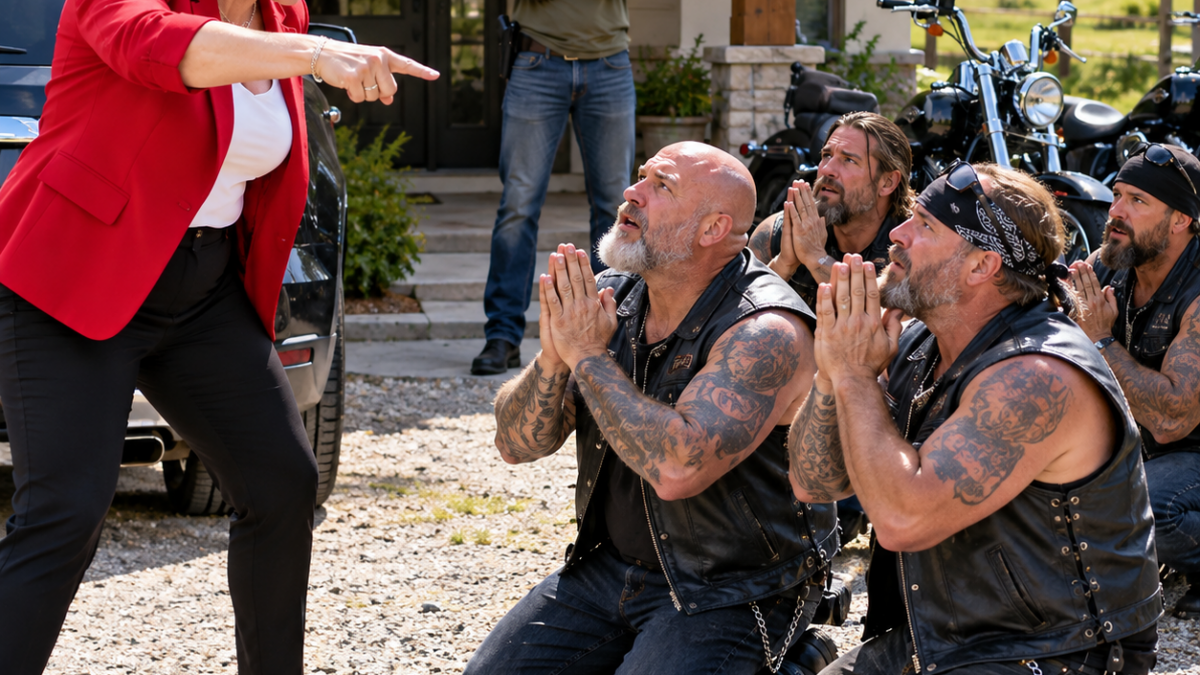
PART 2
His name was Randy Hartwell.
I had seen him once before, standing beside Delilah’s garage on a Saturday afternoon, smoking a cigarette and laughing while she pointed toward our house like she was explaining a business plan.
At the time, I thought he was just some relative doing yard work.
Now I knew better.
Randy was Delilah’s nephew.
Twenty-eight years old, loud motorcycle, cheap leather vest, thin beard, and the kind of confidence that comes from spending too much time around people who mistake noise for power.
I watched the footage one more time.
Randy had not touched Elena.
None of them had.
That mattered legally.
But intimidation does not need a fist to be real.
I could see my wife’s hand move to her stomach when the biggest biker stepped closer. I could see her shoulders tighten. I could see one grocery bag tear open, apples rolling across the driveway while three grown men blocked a pregnant woman from walking into her own house.
That was enough.
I turned away from the screen and found Elena sitting at the kitchen table with a notepad in front of her.
She had already written down the time, what each man looked like, what they said, where they stood, which direction they left, and the order of the motorcycles.
Seven months pregnant, shaken, furious, and still more organized than half the incident reports I had seen in war zones.
I went to her and knelt beside the chair.
“Look at me,” I said.
She did.
Her eyes were wet, but her chin was lifted.
“I’m okay,” she whispered.
“No,” I said. “You’re safe right now. That’s not the same thing.”
Her hand moved over our daughter.
“They wanted me scared.”
“I know.”
“I was.”
“I know.”
Then her expression changed.
“But I didn’t let them see it.”
That was my Elena.
She had spent years working pediatric emergency rooms, holding terrified children while doctors reset bones and parents fell apart in corners. She knew how to stay calm when other people wanted panic.
But this was different.
This was our home.
Our baby.
Our driveway.
And Delilah Hartwell had crossed a line that could not be uncrossed.
I kissed Elena’s forehead, then stood.
“What are you going to do?” she asked.
“The one thing Delilah never expected.”
“What?”
“Everything legally.”
That was the lesson I had learned from military logistics. Anger feels powerful, but documentation wins wars. You do not charge blindly into chaos just because your blood is up. You identify the chain of command. You preserve evidence. You make the right calls in the right order. You let the people who broke the rules discover how heavy rules can become when they fall back on them.
I made three calls.
The first was to Phyllis Brennan.
Phyllis was seventy-two, retired from a long legal career, and had joined our homeowner coalition after Delilah fined her for a porch railing that had been approved six years earlier. She was sharp, fearless, and carried herself like a woman who had spent forty years making arrogant men regret speaking too loudly in courtrooms.
She answered on the second ring.
“Marcus?”
“Delilah sent three men to intimidate Elena.”
The silence on the other end lasted one second too long.
“Is Elena hurt?”
“No.”
“Do you have footage?”
“Yes.”
“Preserve it in three places. Don’t edit anything. Don’t post anything. Send me a copy and call law enforcement.”
“I’m doing that now.”
“Good. And Marcus?”
“Yeah?”
“Do not go find those men.”
“I won’t.”
“I mean it.”
“I know.”
The second call was to Detective Luis Martinez with the county financial crimes unit.
He had already been reviewing preliminary complaints about Willowbrook HOA’s financial irregularities. I did not ask him for favors. I did not ask him to run plates. I did not ask him to bend a rule because my wife had been scared.
I reported a suspected intimidation incident connected to an ongoing HOA dispute and told him I had video evidence.
He became very quiet when I mentioned Delilah’s nephew.
“Send the footage through the evidence portal,” he said. “And keep your wife inside until patrol gets there.”
The third call was to Jake Mallory, a licensed private investigator who had once worked security audits on overseas logistics contracts. He owed me nothing, but we respected each other. I asked him to identify the men in the footage using legal open-source methods and publicly available information, nothing more.
He called me back three minutes after receiving the clip.
His voice was different.
“Marcus, you need to listen carefully.”
“I’m listening.”
“The man in front is Randy Hartwell. Delilah’s nephew.”
“I know.”
“He has an active warrant for unpaid child support.”
My jaw tightened.
“And the second?”
“Jake Barlow. Parole status. Conditions appear to prohibit association with known criminal activity.”
“The third?”
“Tommy Keane. He missed court-ordered anger management classes. There may be a bench warrant pending, but that needs law enforcement confirmation.”
I looked toward the driveway, where the apples still lay near Elena’s car.
Jake continued.
“I’m not saying any of that makes them guilty of what happened today. But if they were paid to intimidate a witness or pressure a resident in a legal dispute, they just stepped into something serious.”
“They threatened my pregnant wife.”
“I saw.”
His voice hardened.
“Then let the system do its work. Men like that act brave until consequences show up with paperwork.”
He was right.
Consequences showed up faster than I expected.
Within the hour, patrol officers arrived. Elena gave her statement. I provided the raw footage, not just the edited clip. We showed them the previous recordings of slow-driving security vehicles, HOA board members photographing our property, and Delilah standing across the street during the confrontation.
By late afternoon, Randy had been picked up on the outstanding warrant.
Word travels fast when a man who thinks he is terrifying gets arrested before dinner.
At 5:12 p.m., there was a knock on my front door.
I checked the camera.
Jake Barlow and Tommy Keane stood on my porch.
No motorcycles.
No swagger.
No skull bandanas pulled high over their faces.
Just two men shifting their weight like teenagers waiting outside the principal’s office.
Elena came up behind me.
“Don’t open it,” she said.
“I’m not letting them in.”
I turned on the porch speaker.
“What do you want?”
Jake Barlow swallowed.
“Mr. Donovan, we just want to talk.”
“You had your chance to talk when you surrounded my wife.”
He looked down.
“That got out of hand.”
“No,” I said. “It was planned.”
Tommy lifted both hands.
“Man, we didn’t know she was pregnant.”
Elena made a sound behind me, something between disbelief and disgust.
I opened the inner door but left the storm door locked between us.
“You didn’t know?” I said. “She’s seven months pregnant. You stood three feet from her.”
Tommy looked sick.
Jake rubbed both hands over his face.
“Randy said it was just to scare you. He said his aunt wanted you to back off the HOA thing. We weren’t supposed to touch anyone.”
“Were you paid?”
Neither answered.
“Were you paid?” I repeated.
Jake finally nodded.
“Five hundred cash.”
“By whom?”
He looked toward the street.
“Randy gave it to us.”
“From Delilah?”
He shut his eyes.
“She was there when Randy talked about it. Behind the community center. She said your family needed to get the message.”
Elena stepped forward.
Her voice was calm, but I could hear the steel in it.
“You delivered it to the wrong person.”
Both men looked at her.
The shame on Tommy’s face was almost painful to watch.
“I’m sorry, ma’am,” he said.
Elena didn’t soften.
“You’re sorry because Randy got arrested.”
He said nothing.
Jake looked at me.
“Randy’s girlfriend said you might be able to tell the DA we cooperated.”
I almost laughed.
That was the thing about cowards who rent themselves out for intimidation. They never understand that fear can reverse direction.
Three hours earlier, they had come to my house to make my wife feel helpless.
Now they were asking me to help them.
I opened the storm door but stayed in the doorway.
“Here’s what happens,” I said. “You’re going to speak to my attorney. You’re going to give complete sworn statements. You’re going to tell the truth about who sent you, what you were paid, and what you were told to say. After that, my attorney can inform the prosecutor that you cooperated. That is all.”
Jake nodded quickly.
Tommy did the same.
“And understand something,” I said. “If you leave out one detail, if you lie about one word, if you contact my wife again, there will be nothing I can say to help you.”
Jake’s face went pale.
“We understand.”
“No,” Elena said softly from behind me. “You don’t. But you will.”
They both looked at her again.
This time, they looked afraid.
Not because she yelled.
Because she didn’t have to.
They gave statements that night.
Phyllis supervised every word.
By ten o’clock, we had sworn testimony that Delilah’s nephew had paid them cash to intimidate my family and that Delilah had personally encouraged the plan.
By midnight, copies of their statements were secured in three locations.
And by morning, Delilah Hartwell’s perfect little kingdom had its first real crack.
### How Delilah chose the wrong family
Elena and I had moved into Willowbrook Estates six months earlier with simple hopes.
We wanted our daughter to be born into a home that felt stable.
We wanted quiet.
We wanted room.
We wanted to be the kind of neighbors who waved from porches, helped shovel snow when someone was sick, and brought casseroles when a family had trouble.
The house was expensive for us.
Four hundred eighty-five thousand dollars, every penny stretched, every document reviewed, every inspection checked twice.
But Elena loved the nursery.
It had soft morning light, a window overlooking the maple tree, and just enough space for the old rocking chair her grandmother had left her.
The day we moved in, she stood in that empty room with both hands on her stomach.
“She’s going to be safe here,” she said.
I believed her.
Willowbrook looked safe.
That was the genius of it.
Everything about the neighborhood looked polished. Matching mailboxes. Fresh sidewalks. Lawns so green they seemed painted. Children riding bikes beneath streetlights shaped like old lanterns. Couples walking dogs after dinner.
Then you started hearing stories.
A widow paying fines she could not afford.
A teacher threatened because her door color supposedly lowered property values.
A young couple harassed over solar panels that were perfectly legal.
People lowered their voices when they said Delilah’s name, the way employees speak about a boss who listens through walls.
She had been HOA president for six years because nobody wanted to run against her.
That was how she kept power.
Not by being loved.
By making the alternative exhausting.
At first, I thought she was merely controlling.
Then I saw the finances.
But before the money trail, before the criminal charges, before the packed church hall and the handcuffs, there was the landscaping.
Elena and I chose native plants because the county encouraged them. Less water. Lower maintenance. Better soil. Better for pollinators. And honestly, they were beautiful.
Black-eyed Susans, prairie grasses, coneflowers, milkweed, and low shrubs arranged in neat beds.
It was not wild or messy.
It was intentional.
Delilah hated it because it was not hers.
Her first violation notice called it “non-compliant landscaping material.”
Her second notice claimed it created an “inconsistent visual profile.”
Her third threatened a twenty-five-hundred-dollar fine.
I read the HOA governing documents the way other people read mystery novels.
By midnight on the third night, I found the first problem.
The HOA documents required seventy-two hours’ notice for emergency board meetings.
Delilah had fined me after a meeting announced only forty-eight hours in advance.
Then I found the second problem.
Fine increases over one hundred dollars required homeowner approval.
Delilah had approved new penalty schedules through board action alone.
Then the third.
The bylaws required documented appeal procedures.
Her letters provided none.
By the time I finished reviewing all eighty-seven pages, I knew Delilah had been bluffing for a long time.
The next morning, I mailed certified letters to the HOA, the management company, and every board member challenging the fine.
Then I did something Delilah never expected.
I mailed a plain-language summary to every homeowner in Willowbrook.
Not angry.
Not dramatic.
Just facts.
Here is what the bylaws say.
Here is what the board did.
Here is why the fine may not be valid.
Here is how to request your records.
Here is how to preserve your rights.
Within forty-eight hours, my phone would not stop ringing.
Martha Kowalski came first.
She was seventy, lived three houses down, and had the kind of sweet face that made you believe she baked pies for every church function.
Delilah had fined her eight thousand dollars over a garden gnome.
I thought I misunderstood.
“A gnome?”
Martha nodded, sitting at our kitchen table with a folder in her lap.
“My late husband bought it for me in Gatlinburg. It sits under the hydrangeas. Delilah said it violated the decorative object policy.”
I flipped through the letters.
The fines had piled up while Martha appealed.
When she missed one hearing because of a medical appointment, Delilah denied the appeal and added administrative fees.
Elena sat beside Martha and reached for her hand.
“You paid this?”
Martha’s eyes filled.
“I was afraid they’d put a lien on the house. Henry and I bought that house forty-two years ago. I couldn’t risk losing it.”
That sentence changed something in me.
Not because I was surprised by Delilah’s cruelty.
Because I understood her strategy.
She didn’t need to win in court.
She needed people too afraid to get there.
Trevor and Sage came next.
They were in their early thirties, both software engineers, both exhausted from months of harassment over solar panels that had been approved under state energy policy.
Then Dorothy, the retired teacher with the blue door.
Then Mr. Alvarez, fined for parking his pickup truck in his own driveway while recovering from knee surgery.
By the end of the week, twenty-three families had contacted me.
By the end of the second week, we had forty-seven.
Our meetings began at Murphy’s Diner on Main Street because the coffee was strong and Delilah would never be caught dead in a booth with cracked vinyl.
The first meeting filled one corner.
The second took half the diner.
By the fourth, people were standing along the wall holding folders full of violation notices.
That was where Phyllis Brennan joined us.
She listened for thirty minutes, asked three questions, and then said, “You don’t have an HOA problem. You have a governance problem wearing an HOA costume.”
Everyone went quiet.
She placed both hands on the table.
“If what I’m hearing is accurate, Delilah Hartwell has been using selective enforcement, invalid penalties, and fear of liens to control residents who do not understand their own documents. That ends when residents begin acting together.”
Diego Ramirez, a former city councilman, joined the next meeting.
He brought municipal knowledge, media contacts, and the political patience of a man who had survived budget hearings with people who confused volume for intelligence.
Martha began organizing the fines by household.
Trevor and Sage built a secure database.
Elena made coffee, reviewed medical appointments between meetings, and kept reminding all of us what mattered.
“Don’t become cruel just because she is,” she said one night. “We’re not trying to destroy a person. We’re trying to stop harm.”
I loved her for that.
Even after three bikers surrounded her, she still understood the difference between justice and revenge.
But justice was coming.
And Delilah had no idea how close it was.
### The fake security patrol
Before the bikers, Delilah tried uniforms.
She hired a private security company called Executive Protection Services, which sounded impressive until you saw the magnetic signs slapped crookedly onto a white Ford Explorer.
The guards began parking across from our house at seven in the morning.
They sat there taking notes while Elena left for work.
They followed Martha when she walked to the mailbox.
They photographed Trevor and Sage’s solar panels.
One guard even tried to issue me a “trespassing warning” for walking on a community sidewalk.
I looked at the paper.
“Is this a joke?”
The guard, a large man with a buzz cut and tired eyes, looked uncomfortable.
“Sir, I’m just doing what I was told.”
“Who told you to ban homeowners from sidewalks?”
He lowered his voice.
“Management.”
“What’s your name?”
“Jimmy.”
I studied him for a second.
The posture. The scan of the street. The way his eyes kept moving even when his body stayed relaxed.
“You served?”
He blinked.
“Afghanistan. Two tours.”
“Army?”
“Marines.”
I nodded.
“Then you know this is garbage.”
His jaw tightened.
“I know.”
That was the beginning of Jimmy quietly becoming useful.
Not because I bribed him.
Not because I pressured him.
Because decent men can only follow rotten orders for so long before something inside them starts pushing back.
Over the next week, Jimmy confirmed what we suspected.
Executive Protection Services was owned by Delilah’s brother-in-law, Russell Hartwell.
The contract had been approved without competitive bidding.
The instructions given to guards specifically mentioned “increasing resident discomfort” around certain households.
Mine was at the top of the list.
Martha’s was second.
Trevor and Sage were third.
Jimmy showed me a photo on his phone of a typed assignment sheet.
“Do you realize what this says?” I asked.
He nodded.
“It says we were hired to harass people.”
“Will you testify to that?”
He rubbed a hand over his face.
“I need this job.”
“I understand.”
“I’ve got a kid.”
“I understand that, too.”
He looked at me.
“But I didn’t sign up to scare pregnant women.”
A week later, he resigned.
Before leaving, he provided Phyllis with a sworn statement about the company’s instructions, the ownership connection, and the way Delilah personally directed attention toward certain residents.
That statement mattered later.
At the time, it only made Delilah angrier.
She tried noise complaints.
Zoning complaints.
Anonymous reports about dangerous landscaping.
She claimed our native plants attracted snakes.
She claimed my consulting business created “commercial traffic,” despite the fact that I met clients at home maybe twice a month.
Every complaint was investigated.
Every complaint failed.
Each failure made her more desperate.
That was when she met Randy behind the community center.
My security camera did not capture that meeting.
But Trevor’s did.
He and Sage lived near the walking path behind the clubhouse and had installed a high-quality camera after someone damaged one of their solar inverters.
The camera recorded Delilah standing beneath the security light with Randy, handing him an envelope.
There was no sound at first.
Then Randy stepped closer to the camera’s range.
The audio caught Delilah saying, “Whatever it takes to make them understand they are not welcome here.”
That line became important.
At the time, we did not yet know exactly what she meant.
Two days later, three motorcycles pulled into my driveway.
And my pregnant wife found out.
### When fear changed direction
The sworn statements from Jake and Tommy did more than confirm Delilah’s involvement.
They showed the intimidation had been planned.
Randy had told them to arrive when my truck was gone.
He had told them not to touch Elena, but to stand close enough that she understood the message.
He had told them Delilah wanted me “distracted at home” and no longer helping residents challenge fines.
He had given them five hundred dollars.
Cash.
The stupidity of it was almost stunning.
People like Delilah believe they are careful because they do things in whispers and parking lots. They forget that careless people love talking. They forget that frightened accomplices make excellent witnesses. They forget that every plan looks brilliant until the first participant realizes prison is not worth five hundred dollars.
The morning after Jake and Tommy gave their statements, I saw Delilah walking to her mailbox.
She glanced toward my house.
I stepped onto the porch.
For one second, our eyes met.
I did not wave.
I did not smile.
I simply stood there.
She turned around and went back inside without getting her mail.
That was when I knew she had heard about Randy.
By lunchtime, half the neighborhood had heard.
Not because I spread it.
Because Randy’s girlfriend called everyone she knew, crying that Marcus Donovan had “gotten Randy locked up.”
That version was convenient for them.
It ignored the warrant.
Ignored the intimidation.
Ignored the cash.
Ignored the pregnant woman they had surrounded in her own driveway.
But gossip has a strange way of revealing truth.
Residents who had been afraid to attend coalition meetings began showing up.
The next meeting at Murphy’s Diner overflowed into the parking lot.
Martha stood on a chair because nobody could hear her from the back.
“Everybody quiet down,” she said, clapping her hands like a Sunday school teacher facing a rowdy classroom. “We have work to do.”
That night, Phyllis explained our legal path.
“We do not win by acting like Delilah,” she said. “We win by being more disciplined than she is. We document. We request records. We file complaints with the proper authorities. We avoid exaggeration. We do not threaten. We do not harass. We do not give her anything she can use.”
A man in the back called out, “What about what she did to Elena?”
Elena stood slowly.
The diner went silent.
Her pregnancy made every movement deliberate, but her voice was clear.
“What happened to me matters,” she said. “But I don’t want this neighborhood to become a place where everyone waits for the next person to get hurt before they care. Delilah has been hurting people for years. I’m just the one she misjudged in public.”
That sentence stayed with everyone.
The one she misjudged in public.
Because that was Delilah’s real mistake.
Not that she had targeted us.
Not that she had sent Randy.
Not that she had put cash in an envelope.
Her mistake was assuming fear worked the same on everyone.
Fear can silence one household.
It can silence two.
It can silence a widow, a young couple, a tired nurse, a man recovering from surgery.
But when all those people find each other, fear changes direction.
And Delilah was about to feel it.
### The money beneath the kingdom
The financial records arrived in pieces.
Some came through formal HOA records requests.
Some came from homeowners who had saved old budgets and meeting minutes.
Some came through city records related to development agreements.
Some came after Bryce Marden, a retired bank vice president and one of Delilah’s board allies, began quietly panicking.
But the biggest opening came from Diego.
He knew where to look.
“Everyone focuses on HOA bylaws,” he told me one evening at my dining room table. “That matters, but developers make promises to cities before homeowners ever move in. If Delilah had any role in the original development sales, the city may have records she can’t control.”
So we filed public records requests.
The city planning department produced the original Willowbrook Estates development agreement.
I expected zoning maps and boring infrastructure provisions.
Instead, we found the first grenade.
Fifteen percent of the homes were supposed to be reserved or supported for moderate-income housing.
Teachers.
Nurses.
Firefighters.
Young families who served the community but could not afford half-million-dollar houses.
Willowbrook had eighty-five homes.
At least twelve affordability obligations should have been satisfied through units or approved fees.
None had been built as affordable homes.
Instead, the developer and affiliated sales interests had promised alternative payments to the city.
Six hundred thousand dollars over five years.
According to city collection records, those payments had not been made.
Delilah’s real estate business had been involved in sales and marketing representations for the community.
That did not prove she personally stole anything.
But it raised a question she could not answer with a violation notice.
Where was the money?
Then Martha found the second grenade.
Administrative fees.
For years, HOA budgets listed management and consulting expenses paid to Hartwell Property Solutions.
The name sounded professional enough until Trevor traced the company registration.
Hartwell Property Solutions belonged to Delilah.
Not indirectly.
Not vaguely.
Directly.
At first, she billed the HOA modestly.
Then the amounts grew.
Fifty thousand.
Sixty thousand.
Nearly seventy thousand in one year when combined with consulting add-ons.
The services were described in language so vague it could have meant anything.
Community oversight.
Compliance coordination.
Administrative strategy.
Resident standards consulting.
Martha read those line items at my kitchen table and made a noise I can only describe as a seventy-year-old woman choking on fury.
“Administrative strategy?” she said. “She charged us four thousand dollars to think about bossing us around?”
Elena laughed for the first time in days.
Then Martha found payments for landscaping projects that did not exist.
Emergency tree removal during a month when no trees had been removed.
Clubhouse repairs that longtime residents had never seen.
Security expenses paid to Delilah’s brother-in-law.
Consulting reimbursements that matched personal purchases.
Country club charges disguised as community relations expenses.
A trip to Hawaii categorized as a property management conference.
By midnight, the dining room table looked like a crime scene made of bank statements.
Martha’s pencil moved line by line.
Trevor and Sage built spreadsheets.
Phyllis made notes for complaints to the state attorney general and tax authorities.
Diego identified city officials who needed copies of the development agreement issues.
Elena sat with her feet propped on a chair, one hand on her belly, watching us uncover six years of betrayal.
Finally, Martha took off her glasses.
“Preliminary estimate,” she said quietly, “four hundred eighty thousand dollars.”
Nobody spoke.
She looked around the table.
“That is what appears to have been diverted, inflated, unsupported, or improperly paid over six years. It needs a certified forensic audit, but this is not sloppy bookkeeping.”
Her voice hardened.
“This is theft wearing perfume.”
I looked down at the documents.
Four hundred eighty thousand dollars.
That was not a strict HOA president being overzealous.
That was a system.
Delilah had fined widows, harassed young families, threatened liens, and sent bikers to scare my wife because every challenge risked exposing the cash machine beneath her authority.
Suddenly, everything made sense.
The selective enforcement.
The fake urgency.
The security patrol.
The threats.
She was not protecting property values.
She was protecting income.
### The war room
For two weeks, our house became the nerve center of Willowbrook’s quiet revolution.
Every evening, people arrived carrying folders, laptops, coffee, and anger.
Not wild anger.
Useful anger.
The kind that stacks documents, labels evidence, confirms dates, and refuses to make accusations without proof.
Phyllis called it “adult rage.”
“Elena,” she said one night, “your husband has military discipline, but you have hospital discipline. That may be more useful.”
Elena smiled.
“In the hospital, if you panic, people die.”
Phyllis pointed at her.
“Exactly. Nobody panic.”
Our plan had four phases.
First, complete the evidence file.
That meant organizing every violation letter, payment record, meeting notice, security incident, and financial document.
Second, submit complaints to the proper authorities at the same time.
State HOA oversight.
Attorney general.
City planning.
Tax authorities.
County financial crimes.
Third, force a community meeting where residents could see the evidence for themselves.
Not rumors.
Not whispers.
Documents.
Fourth, remove Delilah’s board through proper procedures and build safeguards so no future president could become a one-person government.
Trevor and Sage created a database.
Martha worked through transactions.
Diego handled media strategy, although we agreed not to go public until evidence was ready.
Phyllis drafted legal filings.
I built timelines and contingency plans.
Elena kept us human.
Whenever the conversation became too focused on crushing Delilah, she would remind us of Martha’s gnome, Sage’s solar panels, Mr. Alvarez’s truck, the Henderson family’s fines, and our daughter.
“This has to end with something better,” she said. “Not just her losing.”
That mattered.
Because there were nights I wanted nothing but to see Delilah humiliated.
I wanted her to feel every moment of fear she had placed inside our home.
I wanted her to look at Elena and understand that sending men to intimidate a pregnant woman was not power.
It was cowardice.
But Elena was right.
A destroyed bully was not enough.
Willowbrook needed a future.
During the second week, Bryce Marden appeared at our door.
Bryce had been one of Delilah’s loyal board members, a retired bank executive who wore golf shirts tucked too tightly into khakis and spoke at HOA meetings like every sentence needed a motion and a second.
That night, he looked ten years older.
His hands trembled around a manila envelope.
“I need to talk to you,” he said.
I did not invite him in until Elena stepped behind me and said, “Let him sit down before he falls down.”
We brought him to the dining room.
Phyllis happened to be there.
That was fortunate.
Bryce looked at her and almost turned around.
She pointed to a chair.
“Sit.”
He sat.
Then he began crying.
Not loud sobs.
Just a slow collapse.
“She said she’d ruin my grandkids,” he whispered.
Phyllis leaned forward.
“Who did?”
“Delilah.”
He pushed the envelope across the table.
“She made me sign off on things. I told myself it was temporary. I told myself she knew what she was doing. Then I asked questions about Hartwell Property Solutions, and she brought up my bankruptcy from thirty years ago.”
He wiped his eyes.
“My daughter doesn’t know about that. My grandkids don’t know. Delilah said she’d make sure everyone knew I was a fraud.”
Martha’s face softened.
“Bryce, a bankruptcy thirty years ago is not a crime.”
He looked ashamed.
“I know. But shame doesn’t have to be rational to work.”
That was the most honest thing I had ever heard him say.
The envelope contained board emails, internal approval notes, payment authorizations, and a written statement Bryce had prepared but never had the courage to submit.
It confirmed that Delilah had pressured board members, concealed related-party payments, and used threats to keep questions quiet.
Phyllis read in silence.
When she finished, she looked at Bryce.
“Are you willing to testify?”
His voice shook.
“Yes.”
“Under oath?”
“Yes.”
“To law enforcement?”
He closed his eyes.
“Yes.”
Phyllis placed one hand on the envelope.
“Then tonight is the first useful thing you’ve done in a long time.”
It was harsh.
It was also true.
Bryce nodded.
“I know.”
That night, after everyone left, Elena and I sat alone in the nursery.
The walls were painted soft yellow.
The crib stood under the window.
A little mobile of clouds and stars hung above it.
Elena touched one of the tiny stars.
“Do you think we’re doing the right thing?” she asked.
“Yes.”
“Even with everything that could happen?”
I looked at her.
“Elena, they came to our driveway.”
“I know.”
“They wanted you afraid in your own home.”
Her eyes filled.
“I was afraid.”
I took her hand.
“So was I.”
That surprised her.
“You?”
“I was terrified.”
I looked around the nursery.
“Not of Randy. Not of those men. I was terrified that I had brought you and our daughter into a place where someone like Delilah could reach us.”
Elena moved closer.
“You didn’t bring us into danger, Marcus. Delilah created it.”
I held her.
For a while, we stood silently beside the crib.
Then she whispered, “Promise me when this is over, we make this place good.”
I kissed her hair.
“I promise.”
### Delilah’s special assessment disaster
Cornered people often make predictable mistakes.
Delilah’s mistake was believing more fear would solve the problem created by too much fear.
On a Friday afternoon, every Willowbrook mailbox received an emergency board notice.
Special meeting.
Monday evening.
Urgent legal defense assessment.
Five thousand dollars per household.
I read the letter twice at the kitchen counter.
Then I began to laugh.
Elena looked up from the couch.
“What?”
“She wants every household to pay five thousand dollars so the HOA can defend itself against residents asking where the money went.”
Elena blinked.
“That’s bold.”
“That’s one word.”
The notice claimed radical homeowners were threatening the association with frivolous legal attacks. It warned property values could collapse if the HOA lacked funds to defend “community standards.” It described me as a recent arrival with a personal agenda and a history of hostility toward authority.
I had to admire the efficiency.
In three paragraphs, Delilah managed to insult me, terrify homeowners, demand money, and accidentally create another piece of evidence.
The Monday meeting drew eighty-nine residents.
Delilah had expected maybe twenty.
Her face changed when she saw the crowd.
She stood at the front of the community center wearing a navy suit and a pearl necklace, but her eyes looked restless.
She launched into a speech about outside agitators, legal threats, and irresponsible residents trying to destroy everything Willowbrook had built.
Then Martha stood.
The room quieted.
Martha did not look like a revolutionary.
She wore a pale cardigan, small gold earrings, and the expression of a grandmother about to correct a child in church.
“Delilah,” she said, “before we vote on giving this board another dollar, I formally request an independent audit of all HOA finances from the past six years.”
Delilah froze.
Martha continued.
“That audit should include all payments to Hartwell Property Solutions, all contracts involving relatives of board members, all security expenditures, all special assessments, and all fines collected under amended penalty schedules.”
You could hear the room breathing.
Delilah smiled tightly.
“Martha, I understand you may be confused by complex financial matters.”
Martha tilted her head.
“I balanced church books for thirty-one years, dear. I understand missing money just fine.”
A few people laughed.
Then more.
Delilah’s face hardened.
“This is not the time for theatrics.”
“No,” Martha said. “It is the time for receipts.”
The vote failed.
One hundred two against.
Three in favor.
Some residents had submitted proxy votes against the assessment before the meeting, and the in-person opposition buried it completely.
Delilah stood there like a queen watching the gates fall.
Afterward, residents did not rush out.
They stayed in clusters, whispering, comparing letters, asking Martha about the audit.
That was the night Delilah truly lost the neighborhood.
She still had the title.
She still had the office.
She still had keys to the clubhouse.
But she no longer had the most important weapon.
Isolation.
People were talking now.
And every conversation made her smaller.
### The restraining order that backfired
Three days before our planned community presentation, Delilah filed for a temporary restraining order against me.
Her petition described me as a dangerous former military contractor using psychological intimidation tactics against a vulnerable female community leader.
She claimed I had stalked her.
Threatened her.
Organized harassment.
Encouraged residents to target her family.
She included audio clips of my voice allegedly making threats.
She included statements from two neighbors who barely knew me.
She cried in the courthouse hallway for the local blogger who happened to be there.
It might have worked on someone without cameras.
But I had cameras.
So did Trevor and Sage.
So did half the neighborhood by then.
The audio clips were edited.
Badly.
One made it sound like I said, “You’ll pay for this.”
The original recording showed I had actually said, “You’ll need to provide documentation before residents pay for this.”
Another clip made it sound like I said, “I know how to make people disappear.”
In context, I had been describing overseas logistics paperwork and joked that bad inventory systems could make equipment disappear.
Not people.
Equipment.
The forensic audio specialist Phyllis hired produced a clean report showing the edits.
At the hearing, Delilah arrived looking fragile and righteous.
I arrived with Phyllis, Elena, and two folders of evidence.
The judge reviewed the filings, listened to Phyllis, and examined enough of the counter-evidence to understand the problem.
Delilah’s attorney requested a recess.
Ten minutes later, he withdrew the petition.
The judge looked at Delilah over his glasses.
“Mrs. Hartwell, I strongly advise you to speak with counsel before filing any additional sworn statements with this court.”
It was the kind of sentence that sounds polite until you realize it is a warning flare.
Delilah stormed out.
Outside the courthouse, she turned toward me.
“This isn’t over,” she hissed.
I looked at her.
“No,” I said. “But it’s close.”
She tried the media next.
She contacted Channel 7 with a story about a pregnant nurse being manipulated by her militarized husband and a fragile HOA president terrorized by a mob.
It might have been convincing if Diego had not already prepared an evidence packet for responsible reporters.
Channel 7 asked me for comment.
I gave them documents.
Within twenty-four hours, their interest shifted from “HOA president claims harassment” to “Willowbrook residents allege financial fraud and intimidation.”
Delilah had invited cameras to a fire she had started.
Now she could not stop them from filming the smoke.
### Sacred Heart
We moved the community presentation to Sacred Heart Church after Delilah tried to cancel the original venue by claiming security concerns.
The church fellowship hall could hold three hundred people.
I thought that would be more than enough.
I was wrong.
By seven o’clock, every chair was full.
Residents lined the walls.
People stood in the hallway listening through open doors.
City Councilwoman Patricia Williams sat in the front row with a notebook.
Detective Martinez stood near the back.
Channel 7 set up lights and cameras.
Phyllis sat beside Martha with the legal binders.
Diego managed the press.
Trevor and Sage controlled the presentation.
Elena sat beside me on the small stage, eight months pregnant, one hand on her belly, calm as moonlight.
I leaned toward her.
“You okay?”
She smiled.
“Our daughter is kicking like she wants the microphone.”
Despite everything, I laughed.
Then I looked across the room and saw Delilah.
She sat in the back corner.
Alone.
No board allies.
No security guards.
No nephew.
No loyal circle of supporters.
Just Delilah Hartwell in a gray suit, gripping her handbag like it was the last solid object in her life.
For a moment, I felt the strangest flicker of pity.
Then I remembered Elena backing against her car.
The feeling passed.
I walked to the podium.
The room settled.
“My name is Marcus Donovan,” I began. “Six months ago, my wife and I moved to Willowbrook because we believed this was a safe, honest community where we could raise our daughter.”
I glanced at Elena.
“We still believe it can be. But first, everyone deserves to know the truth.”
The first slide appeared.
Budgeted administrative expenses versus actual payments.
A murmur moved through the room.
I explained the numbers slowly.
No exaggeration.
No insults.
No theatrics.
Just records.
Hartwell Property Solutions.
Security contracts.
Unsupported invoices.
Emergency work that appeared never to have occurred.
Related-party transactions.
Fine revenue.
Penalty schedules adopted without required approval.
Then Martha took the microphone.
Her voice trembled at first, but it grew stronger as she spoke.
“I paid eight thousand dollars because I was afraid of losing the home my husband and I bought together,” she said. “I thought I was alone. I was not.”
The room was silent.
Trevor and Sage explained the solar panel harassment.
Mr. Alvarez described the letters he received while recovering from surgery.
Dorothy spoke about her door.
Jimmy, the former security guard, gave a sworn statement about being instructed to make residents uncomfortable.
Then the video played.
Delilah behind the community center.
Randy beside her.
Her voice through the speakers.
“Whatever it takes to make them understand they are not welcome here.”
The room changed.
It was not a gasp.
It was deeper than that.
Three hundred people understanding at once that their HOA president had not merely been harsh or controlling.
She had sent intimidation to a pregnant woman’s driveway.
Elena stood.
I reached for her hand, but she squeezed mine once and stepped to the microphone.
The hall went completely quiet.
“My daughter was inside me when those men surrounded me,” she said. “I need you to understand that. I was carrying groceries in one hand and holding my stomach with the other because I did not know how close they would come.”
Delilah stared at the floor.
Elena continued.
“I am a nurse. I have seen fear in children’s eyes. I have held parents while they cried. I know what fear does to a body. And Delilah Hartwell chose to put that fear into my home because my husband asked questions about HOA rules.”
Her voice broke.
But she did not stop.
“I do not want revenge. I want my daughter to grow up in a neighborhood where people don’t use power to hurt families.”
For several seconds, nobody moved.
Then Martha began clapping.
One clap.
Then another.
Then the entire hall rose.
Elena stepped back, and I wrapped my arm around her.
She was shaking.
But she had said what needed to be said.
Then Bryce came forward.
The room quieted again.
He looked like a man walking toward his own sentencing.
“My name is Bryce Marden,” he said. “I served on the Willowbrook HOA board under Delilah Hartwell. I failed this community.”
Nobody interrupted.
He described the pressure.
The concealed payments.
The threats.
The way he ignored questions because admitting the truth meant admitting his own weakness.
“I was afraid of embarrassment,” he said. “So I helped hide conduct that harmed my neighbors. I am ashamed, and I will cooperate fully with investigators.”
That testimony broke whatever defense Delilah had left.
She stood suddenly.
“This is all lies!”
Every head turned.
Her face was red, her eyes wild.
“You people have no idea how complicated community management is! You think you can run this place with feelings and flower beds? I kept your property values high! I kept trash out! I kept this neighborhood from turning into a dump!”
Martha stood slowly.
“Delilah, dear,” she said, “stealing from people is not community management.”
The applause was thunderous.
Delilah pointed at me.
“He did this! He came here six months ago and poisoned all of you!”
I stepped back to the microphone.
“No, Delilah. You did this over six years. I just read the paperwork.”
Detective Martinez moved from the back wall.
The room quieted before he even spoke.
“Mrs. Hartwell,” he said, “based on the evidence collected in an ongoing investigation, including sworn statements, financial records, and witness testimony, you are being placed under arrest.”
Delilah froze.
“No.”
He continued.
“You are under arrest for suspected fraud, conspiracy to commit harassment, and filing false reports connected to this investigation. Additional charges may follow after review by the prosecutor.”
Her mouth opened.
Closed.
Opened again.
“This is persecution.”
Detective Martinez approached calmly.
“Please turn around.”
She looked toward the crowd as if expecting someone to save her.
Nobody moved.
For six years, she had trained people to fear her disapproval.
Now the entire community watched her discover that fear has an expiration date.
The handcuffs clicked.
The sound was small.
Almost delicate.
But it carried through the whole hall.
Delilah began crying as she was led toward the exit.
Then she saw Elena.
For one second, something like shame crossed her face.
Elena did not look away.
She placed one hand on her stomach and watched Delilah pass.
Outside, camera lights flashed.
Inside, nobody cheered at first.
We were too stunned.
Then Martha whispered, “It’s over.”
But it was not over.
Not yet.
It was only the end of her power.
The rebuilding still had to begin.
### Hope
Two weeks after Delilah’s arrest, Elena went into labor.
It happened at 3:40 in the morning during a thunderstorm.
She woke me by grabbing my arm and saying, very calmly, “Marcus, either our daughter is coming, or I just became terrible at bladder control.”
I stared at her for half a second.
Then I moved faster than I had moved in years.
Hospital bag.
Car seat.
Phone charger.
Medical folder.
Snacks because Elena had insisted no man should be trusted in a labor room without snacks.
The drive to the hospital was wet, dark, and strangely peaceful.
Rain streaked across the windshield.
Elena breathed through contractions, one hand gripping mine, the other resting against the life we had fought so hard to protect.
At one red light, she looked at me.
“What if everything changes?”
I almost laughed.
“Everything already changed.”
She smiled through the pain.
“Good point.”
Our daughter was born at 11:18 that morning.
Seven pounds, two ounces.
Furious lungs.
Tiny fists.
A full head of dark hair.
When the nurse placed her on Elena’s chest, something inside me broke open.
Not in a painful way.
In the way a locked door breaks open when the people inside are finally rescued.
Elena cried.
I cried.
Our daughter screamed like she had complaints about the lighting.
“What’s her name?” the nurse asked.
Elena looked at me.
We had debated names for months.
But after everything, there was only one that fit.
“Hope,” Elena whispered.
Hope Donovan.
I touched my daughter’s tiny foot.
For months, Delilah had tried to make our home feel unsafe.
But she had failed at the one thing that mattered most.
She had not stolen the future from us.
### The reckoning
The legal process took months.
Real justice often moves slower than pain wants it to.
Delilah was not sentenced the next day like in a movie.
There were hearings.
Financial reviews.
Forensic audits.
Plea negotiations.
Additional witnesses.
Tax questions.
City enforcement issues related to the development agreement.
Hartwell Property Solutions became the center of a sprawling investigation.
Russell Hartwell, Delilah’s brother-in-law, was questioned over the security contract.
Randy faced his own charges and eventually cooperated.
Jake and Tommy, the bikers who had come to our door begging, testified about the cash payment and the planned intimidation.
Their cooperation did not erase what they had done.
But it helped prove who sent them.
Bryce testified, too.
He stood in court with his shoulders hunched and admitted he had allowed fear and shame to make him useful to corruption.
Some residents hated him.
I understood why.
But I also understood that without his documents, the case would have been harder to prove.
Martha said it best.
“Accountability does not require us to pretend courage came early.”
The final audit concluded that hundreds of thousands of dollars had been improperly diverted, unsupported, inflated, or misused over Delilah’s years in control.
Not every dollar was criminal.
Some was negligent.
Some was unauthorized.
Some was wrapped in contracts designed to look legitimate.
But enough was clear.
Delilah had treated Willowbrook’s money like a private account and its residents like tenants on her estate.
At sentencing, the courtroom was full.
Elena sat beside me with Hope sleeping against her chest in a soft yellow blanket.
Martha sat behind us.
Trevor and Sage held hands.
Mr. Alvarez wore his veteran’s cap.
Phyllis sat straight-backed, eyes sharp.
Delilah entered without the armor of power.
No pearl necklace.
No perfect suit.
No clipboard.
Just a woman who looked much older than she had six months earlier.
When given the chance to speak, she unfolded a piece of paper.
“I believed I was preserving the community,” she began.
A murmur moved through the courtroom.
The judge looked up.
Delilah swallowed.
“Over time, I lost sight of the difference between leadership and control.”
That was the closest she came to truth.
She apologized.
Some believed her.
Some did not.
I did not know what I believed.
I only knew Elena’s hand tightened around mine when Delilah said, “I never meant for anyone to feel unsafe.”
Elena whispered, “Yes, she did.”
She was right.
Delilah had meant fear.
She just had not meant consequences.
The judge sentenced her to eight years, with restitution ordered and additional financial penalties attached through the civil proceedings. Her real estate license was suspended pending professional review, and she was barred from serving in association leadership.
Randy received eighteen months and probation conditions that included community service.
Executive Protection Services lost its local contracts after regulatory review.
Hartwell Property Solutions was dissolved.
The old HOA board was removed.
A temporary board took over under strict oversight.
And for the first time in six years, Willowbrook had open books.
### The house on the hill
Delilah’s house sat on the largest lot in the neighborhood.
For years, it had looked down on Willowbrook from its manicured rise like a palace.
White columns.
Circular driveway.
Imported shrubs.
A backyard big enough to host weddings, though Delilah had never once invited the neighborhood to gather there unless she controlled the guest list.
After the financial judgments and asset proceedings, the house was sold.
People expected some wealthy family to buy it.
Instead, the community did.
Not easily.
Not quickly.
Not without arguments.
But with recovered funds, settlement proceeds, grants, and a lawful vote, Willowbrook purchased the property and converted it into a community center.
The irony was almost too perfect.
The place where Delilah had looked down on everyone became the place where everyone could walk in.
Her formal dining room became a meeting room with glass walls and posted agendas.
Her office became a records room where any homeowner could request documents without being treated like a criminal.
Her backyard became a native garden.
The same kind of landscaping she had tried to force me to remove.
Elena chose the first plants.
Martha chaired the garden committee.
Trevor and Sage installed solar lighting.
Mr. Alvarez built benches.
Jimmy, the former security guard, volunteered on weekends after finding better work with a legitimate company.
Even Bryce helped, mostly by carrying mulch and accepting the fact that some people still were not ready to forgive him.
The garden was named Hope Park.
I argued against naming it after our daughter.
Elena overruled me.
“This started because they tried to scare us before she was born,” she said. “Let the place that replaced fear carry her name.”
So Hope Park it was.
On the day it opened, our daughter was eight weeks old.
I pushed her stroller along the new path while Elena walked beside me.
The air smelled like fresh mulch and wildflowers.
Children ran across the lawn.
Neighbors who once avoided each other now stood in groups, laughing, sharing food, talking about school schedules and repairs and ordinary life.
Ordinary life had never looked so extraordinary.
Martha stood near the entrance, handing out programs.
She had insisted on including a simple line at the bottom.
*Transparency is a community value.*
Phyllis pretended not to tear up when she read it.
Diego gave a short speech about civic responsibility.
Trevor demonstrated the solar lights.
Sage organized a kids’ activity table.
Then Elena stepped forward with Hope in her arms.
“I’m not going to make a long speech,” she said.
Everyone laughed because all speeches in Willowbrook had become suspicious after Delilah.
Elena smiled.
“When we moved here, I wanted a safe place for our daughter. For a while, I thought safety meant quiet streets and nice houses.”
She looked around the garden.
“Now I know safety means neighbors who tell the truth, protect one another, and refuse to let fear become normal.”
She looked down at Hope.
“This is the neighborhood I wanted for her.”
People applauded softly.
Not the wild applause from the night Delilah was arrested.
Something gentler.
Something healed.
### What came back to us
Money came back first.
Not all at once.
Not every penny immediately.
But refunds were issued for improper fines.
Special assessments were corrected.
Insurance settlements and recovered funds were distributed according to the legal plan.
Martha personally verified every calculation because nobody trusted vague numbers anymore.
Then trust came back.
That took longer.
People who had spent years afraid of letters from the HOA did not suddenly relax because Delilah was gone.
For months, every envelope from the board made residents nervous.
So the new board changed the envelope design.
Plain white.
Clear subject line.
No red stamps.
No threatening language.
If there was a concern, the letter began with a conversation request, not a fine.
It sounded small.
It was not.
Children came back to the common areas.
The playground reopened after proper inspection and repairs.
Families brought picnic blankets to Hope Park.
The clubhouse calendar filled with actual community events instead of secret meetings.
A tool-sharing program began in what used to be Delilah’s four-car garage.
The first item checked out was a pressure washer.
The second was a hedge trimmer.
The third was a folding table that somehow came back with a slice of birthday cake on it.
Property values rose.
Not because lawns became identical.
Because people wanted to live somewhere residents worked together.
Channel 7 did follow-up stories.
Then regional newspapers.
Then a state senator contacted Diego about HOA reform.
Within a year, the state passed new legislation requiring stronger financial transparency, independent audits for larger associations, clearer conflict-of-interest disclosures, and fair appeal procedures before major fines.
Martha watched the signing ceremony on television from our living room.
She held Hope in her lap.
“Well,” she said, “that’s a lot of trouble from one garden gnome.”
We all laughed.
But she was right in a way.
Delilah thought small cruelties did not matter.
A gnome.
A blue door.
A solar panel.
A native plant bed.
A pregnant woman carrying groceries.
She never understood that small cruelties accumulate interest.
Eventually, somebody opens the books.
### Jake at the gate
One afternoon, almost a year after the biker incident, I found Jake Barlow standing outside Hope Park.
He looked different.
Hair cut short.
No bandana.
No leather vest.
Hands shoved into the pockets of a clean work jacket.
I was pushing Hope in her stroller.
Elena was at work.
For a second, old anger rose in me so sharply I tasted metal.
Jake saw my face and lifted both hands.
“I’m not here to cause trouble.”
“What are you doing here?”
He looked toward the garden.
“Randy’s doing a motorcycle safety program now. Court-ordered at first. But he says it’s helping kids.”
I said nothing.
Jake continued.
“I got off parole last month.”
“Congratulations.”
I did not say it warmly.
He accepted that.
“I wanted to apologize again. Properly. Not because I needed something this time.”
I looked down at Hope.
She was asleep, one tiny hand curled against her cheek.
Jake’s eyes followed mine.
Then he looked away, ashamed.
“I didn’t know what I was stepping into that day,” he said. “That’s not an excuse. I knew enough. I knew we were scaring a woman. I just told myself nobody was getting hurt.”
I was silent.
He swallowed.
“I was wrong.”
The wind moved through the native grasses.
I thought of Elena standing in the driveway.
I thought of the apples rolling across the concrete.
I thought of Jake on my porch, asking me to help him after he had helped terrorize my family.
Forgiveness is a strange thing.
People talk about it like it is a door you open once.
It is not.
Sometimes it is a fence you repair slowly, plank by plank, knowing it may never look exactly new.
“I’m glad you came to say it,” I said.
His shoulders dropped.
“Thank you.”
“I’m not ready to tell you it’s okay.”
He nodded quickly.
“I get that.”
“But I hope you spend the rest of your life becoming the kind of man who would stop what you did instead of joining it.”
His eyes reddened.
“I’m trying.”
Hope stirred in the stroller.
Jake stepped back.
“I’ll leave you alone.”
He turned to go.
“Jake,” I said.
He stopped.
“Tell Randy the same thing.”
He nodded.
Then he walked away.
I did not feel lighter immediately.
But later that evening, when I told Elena, she listened quietly and said, “Maybe that’s part of the ending, too.”
“What is?”
“People deciding they don’t want to be useful to bullies anymore.”
I thought about Bryce.
Jimmy.
Jake.
Even some residents who had stayed silent for years.
Maybe she was right.
### The night we finally slept
For months after the incident, Elena had trouble sleeping.
She never said it at first.
She would just wake when a motorcycle passed somewhere in the distance.
Her hand would move to my arm.
Her breathing would change.
I would pretend not to notice because I thought that spared her pride.
One night, after Hope was born, I found her standing at the nursery window at two in the morning.
Hope was asleep in the crib.
Elena had her arms wrapped around herself.
I came up behind her.
“Another bike?”
She nodded.
“I hate that sound now.”
“I know.”
She leaned back against me.
“I keep thinking about what would’ve happened if one of them had panicked. If I had fallen. If something had happened to Hope.”
I closed my eyes.
“I think about that, too.”
She turned.
“You do?”
“All the time.”
I had not wanted to burden her with my fear.
But maybe silence had become its own burden.
“I replay it,” I admitted. “I think about leaving physical therapy earlier. I think about being home. I think about what I would’ve done if I had walked into it.”
Elena touched my face.
“That’s why I’m glad you weren’t home.”
I looked at her.
She smiled sadly.
“If you had been, Delilah might have gotten exactly what she wanted. A confrontation. A reason to call you dangerous.”
I knew she was right.
That was the hardest part to accept.
Sometimes protecting your family means not giving the enemy the explosion they came to create.
Elena looked back toward Hope.
“She’s safe now.”
“Yes.”
“Are we?”
I thought about the cameras, the new board, Delilah in prison, the neighbors who now watched out for one another, the community center lights glowing at night where her mansion used to stand like a warning.
Then I looked at my wife.
“We’re safer,” I said. “And we’re not alone.”
She nodded.
That night, for the first time in a long time, Elena slept through the sound of a motorcycle passing on the main road.
I stayed awake a little longer, listening to Hope breathe through the baby monitor.
Then I slept, too.
### The final lesson
People still ask me how we beat Delilah.
They expect some dramatic answer.
They expect me to say it was my military background, or Phyllis’s legal skill, or Martha’s bookkeeping, or Diego’s political contacts, or the security footage, or the bikers’ statements.
All of that mattered.
But none of it was the real reason.
We beat her because people stopped being alone.
That was it.
That was the secret Delilah spent six years trying to keep buried.
A frightened homeowner is easy to pressure.
A widow sitting alone at her kitchen table will pay a fine she knows is wrong because the thought of losing her home feels worse than the money.
A young couple will consider removing legal solar panels because they do not want to become known as troublemakers.
A pregnant woman will wonder if peace is worth surrender.
But when those people sit together in a diner, put their letters side by side, and realize the same hand has been pushing all of them down, the whole machine changes.
Delilah did not lose because I was special.
She lost because Martha kept her receipts.
Because Trevor and Sage backed up the files.
Because Jimmy told the truth.
Because Bryce finally stopped hiding.
Because Phyllis understood the law.
Because Diego knew where the public records lived.
Because Elena stood in front of three hundred people and refused to let fear have the last word.
Because neighbors who had whispered for years finally spoke out loud.
That is how a kingdom built on intimidation collapses.
Not all at once.
Then suddenly.
### One year later
One year after the bikers came to our driveway, Willowbrook held its first annual community festival at Hope Park.
There were food trucks, folding chairs, music, games for children, and a long table where residents could sign up for committees that actually did useful things.
Garden committee.
Safety committee.
Records committee.
Scholarship committee.
Martha chaired two of them because apparently retirement had failed to slow her down.
Hope wore a yellow dress and a sun hat she kept trying to remove.
Elena sat on a blanket beneath the maple tree, laughing as our daughter grabbed fistfuls of grass.
I stood near the edge of the garden, looking toward the former Hartwell house.
Its doors were open.
Children ran in and out.
A sign beside the entrance read:
**WILLOWBROOK COMMUNITY CENTER**
No gates.
No guards.
No clipboard queen deciding who belonged.
Martha joined me with two paper plates of barbecue.
“You look thoughtful,” she said.
“I was just remembering.”
“The bad parts?”
“Some.”
She handed me a plate.
“Don’t let them take up all the room.”
I smiled.
“That sounds like something Elena would say.”
“Smart woman.”
“The smartest.”
Across the lawn, Elena lifted Hope into the air.
Our daughter laughed, bright and wild.
The sound carried over the flowers.
A year earlier, Elena had stood in our driveway surrounded by men sent to make her afraid.
Now she sat in the heart of the neighborhood they tried to drive us from, holding our child under open sky.
That was justice.
Not just Delilah’s sentence.
Not just the returned money.
Not just the laws changed afterward.
Justice was Elena laughing without checking the street.
Justice was Martha walking past the garden gnome Delilah once fined her over, now proudly placed near the entrance to Hope Park with a tiny plaque that read:
**FIRST AMENDMENT TO THE LANDSCAPE POLICY**
Trevor had made the plaque.
Phyllis claimed it was legally unnecessary but emotionally perfect.
Justice was neighbors arguing over barbecue sauce instead of fines.
Justice was Hope growing up surrounded by people who knew her name.
Elena waved me over.
I walked across the grass and sat beside her.
Hope crawled immediately into my lap and grabbed my shirt collar.
“She’s strong,” I said.
Elena smiled.
“She gets that from me.”
“No argument.”
We watched families move through the park.
Then Elena rested her head against my shoulder.
“Do you ever regret fighting?”
I looked at the garden.
At the community center.
At Martha laughing with Phyllis.
At Trevor showing a child how the solar lights worked.
At Mr. Alvarez teaching two teenagers how to fold an American flag properly for the festival display.
At Hope’s tiny hand gripping my thumb.
“No,” I said. “I regret that we had to.”
Elena nodded.
“That’s fair.”
The sun lowered behind the trees.
Warm light moved across the native flowers.
For a moment, I remembered the first violation notice Delilah handed me, the way she smiled as if the neighborhood already belonged to her and I was simply too slow to understand it.
She had been wrong.
Willowbrook never belonged to Delilah.
It belonged to every family that paid dues, planted roots, raised children, buried spouses, shoveled driveways, worried over bills, baked casseroles, and tried to build decent lives behind front doors she thought she controlled.
She sent bikers to scare my pregnant wife because she thought fear would make us leave.
Instead, fear introduced us to our neighbors.
It opened file cabinets.
It filled diners.
It packed a church hall.
It turned one native garden into a movement.
And in the end, three men who came to my driveway with threats were at my door begging me to stop the consequences Delilah had started.
I did not stop them.
I let truth do what truth does when it finally has witnesses.
It spread.
It burned.
It cleared the ground.
And from that ground, we built something Delilah could never understand.
A real community.
That evening, after the festival ended, after the folding chairs were stacked and the children dragged their tired feet home, I carried Hope through the garden.
Elena walked beside me.
The solar lights flickered on one by one.
Native flowers moved softly in the breeze.
At the center of the garden, we stopped near the little plaque with Martha’s gnome.
Elena slipped her arm through mine.
“Do you think Hope will remember any of this?”
I looked down at our daughter sleeping against my chest.
“No,” I said. “But she’ll grow up feeling what came from it.”
“What’s that?”
I looked toward the community center glowing in the twilight.
“Safe.”
Elena leaned against me.
For a long moment, neither of us spoke.
Then I whispered to my sleeping daughter, “This is your neighborhood, Hope. Not because someone controls it. Because people here learned how to protect each other.”
Her tiny hand opened against my shirt.
The breeze moved through the flowers.
And for the first time since those motorcycles rolled into my driveway, I felt the last piece of fear leave me.
**[THE END]**








