PART 2: HOA Sent a Convoy to Seize My Farm—Then My Wife Arrived in a State Police Helicopter
────────── END OF FACEBOOK OPENING / CONTINUE STORY BELOW ──────────
Three weeks before that convoy rolled toward my gate, Lorraine had stood in front of nearly four hundred Willow Bend residents and told them I was putting their families in danger.
I know because someone recorded the meeting.
I watched the video later in Walter Penn’s office, sitting beside a shelf full of land-use law books while Lorraine’s voice came through a laptop speaker.
“This is no longer simply a property disagreement,” she told the room. “Mr. Whitaker’s refusal to cooperate threatens the long-term water security of every homeowner in Willow Bend.”
There were murmurs from the audience.
Lorraine knew how to work a room.
She didn’t shout.
She didn’t pound the podium.
She did something more effective. She spoke slowly and calmly while making people afraid.
She displayed maps showing Willow Bend, the planned Phase 3 development, and my farm. The blue line representing my creek was enlarged until it looked like an interstate highway flowing straight through the center of the screen.
She called it a “shared environmental resource.”
It wasn’t.
She called the lower pasture a “critical regional water corridor.”
Nobody from the county had ever used those words.
Then she said I was “hoarding access during a period of increasing drought risk.”
That one almost made me laugh.
I had spent half my life maintaining the creek banks, repairing erosion, keeping cattle away from sensitive sections, and working with agricultural inspectors.
But Lorraine had discovered something useful about people.
If you put official-sounding words on a projector screen, almost nobody asks who gave you the authority to use them.
Almost nobody.
A woman sitting near the front raised her hand.
Her name was Joyce Bellamy.
I knew her only by sight then. She was a retired bookkeeper in her late sixties who had served as the HOA treasurer for eleven years. She wore wire-frame glasses, kept her hair cut short, and had the permanently cautious expression of someone accustomed to noticing when numbers did not line up.
“What are we paying in legal fees for this?” Joyce asked.
Lorraine barely looked at her.
“We’ll address financial details later.”
“The legal-services account is significantly over budget.”
“Joyce.”
“I’m asking because I’m the treasurer.”
A few people shifted in their seats.
Lorraine smiled at the audience.
“This is an emergency infrastructure matter. We cannot allow technical accounting discussions to distract us from public safety.”
That was Lorraine’s method.
Any question she couldn’t answer became a distraction.
Any rule that limited her became a technicality.
Any person who resisted her became a threat to the community.
She moved on before Joyce could ask another question.
Then Lorraine introduced a resolution authorizing what she called an “emergency abatement” of Harvest Hollow Farm.
When I first saw that part of the recording, I paused it.
“Walter,” I said, “can an HOA vote itself permission to take somebody else’s farm?”
Walter leaned back in his chair.
He had practiced land law for forty years and had the kind of face that looked carved by skepticism.
“No.”
“That’s the whole legal explanation?”
“For this part, yes.”
He tapped the screen.
“They can vote that the moon belongs to them. It doesn’t improve their title.”
The room on the recording had been almost silent when Lorraine called for the vote.
A few residents voted no.
A few abstained.
Most voted yes.
I didn’t hate them for it.
That surprised Walter.
“You’re taking this calmly,” he said.
“They’re being told I’m drying out their neighborhood.”
“Wouldn’t that make you angry?”
“It makes me angry at the person telling them.”
That distinction mattered later.
At the time, I just knew I didn’t want four hundred families turning into enemies because one woman had decided fear was useful.
A courier delivered the next document to Harvest Hollow.
He showed up shortly after lunch carrying a heavy envelope and asked me to sign for it.
Inside was a document titled:
ORDER OF EMERGENCY ABATEMENT AND SEIZURE.
I read the title three times.
The order claimed that Willow Bend Community Compliance had been authorized to take possession of my lower pasture, secure the creek, remove livestock, impound equipment, and take “all reasonable actions necessary” to establish access for a public-safety water project.
It had a seal.
A judge’s signature.
A case number.
And wording designed to make an ordinary person panic.
For about thirty seconds, it worked.
I stood at my kitchen counter while the paper shook slightly between my fingers.
I wasn’t frightened for myself.
I was imagining trucks driving through the lower fence.
Cattle scattered onto the county road.
Heavy equipment crossing the wet ground near the creek.
My employees arriving for work and discovering strangers had chained the barn.
The farm wasn’t just property.
It was an operating organism.
You couldn’t shut it down like a storage unit.
Cows still needed feeding.
Milk still had to be processed.
Orders still had to go to restaurants.
Eleven families still depended on their paychecks.
Hannah came through the kitchen while I was rereading the document.
My wife had spent twenty-four years in the state police. She started in highway patrol when we were both young enough to believe sleep was optional, then moved through investigations and command positions until she was overseeing aviation operations.
She could read my face better than anyone.
“What is it?”
I handed her the order.
She didn’t touch it immediately.
“Who delivered this?”
“Courier.”
“Did you sign anything besides the delivery receipt?”
“No.”
She put her coffee down and read.
I watched her eyes move from the title to the seal, then the signature, then the footer.
Her expression tightened.
Not dramatically.
Hannah rarely did anything dramatically.
That was how I knew she was concerned.
“This doesn’t feel right,” she said.
“I’m taking it to Walter.”
“Good.”
“You recognize the seal?”
She looked at me.
Then she slid the document back across the counter.
“I’m not touching this as a cop.”
“Hannah—”
“As your wife, I’m telling you to get a lawyer.”
“I already have one.”
“As a state police officer, I am telling you nothing.”
I understood.
Twenty years earlier, not long after we married, we had made an agreement.
Neither of us would ever use the other’s position as leverage.
I wouldn’t call Hannah because somebody gave me a speeding ticket.
She wouldn’t invoke my contacts in agriculture when her department needed favors.
No titles at the kitchen table.
No badges used to settle personal problems.
It had always seemed like a simple rule.
Now our farm was being threatened by a document that looked like a court order.
And my wife had more law-enforcement authority than anyone I knew.
Still, neither of us crossed the line.
I took the paper to Walter.
He read it for maybe ninety seconds.
Then he placed it on the desk.
“This is fake.”
I stared at him.
“You’re sure?”
“The county stopped using this seal style two years ago.”
He pointed.
“This judge retired in March.”
Then he turned to his computer and entered the case number into a database.
Nothing.
He checked another.
Nothing.
A statewide search produced the same result.
Walter leaned back.
“This isn’t a court order.”
“What is it?”
“A costume.”
I looked at the document again.
It suddenly seemed different.
Not less dangerous.
More.
A legitimate court order meant somebody had made an argument in front of a judge.
A forged one meant whoever created it had decided the law itself was an obstacle.
“What do I do?”
Walter folded his hands.
“You do not confront her.”
“She’s threatening to seize my land.”
“I know.”
“She could hurt somebody.”
“I know.”
“So why am I waiting?”
“Because right now you possess a forged document. That is serious. But if Lorraine attempts to use it to enter your property, seize equipment, threaten arrest, or direct other people to act under its authority, she creates witnesses, recordings, damages, and a trail that becomes very difficult to explain away.”
I didn’t like his answer.
Walter could tell.
“You want to stop her before she reaches your gate.”
“Yes.”
“So do I. But people like Lorraine survive because they spend years operating in gray areas. They intimidate people just enough that nobody wants the fight. They charge fines just small enough that residents pay them. They call threats ‘negotiations.’ They call coercion ‘compliance.’ If she crosses the line into an actual unlawful seizure, the gray disappears.”
“So I wait for her to cross it.”
“You prepare for the possibility.”
That afternoon, I bought more cameras.
By sunset, Tom and I had installed one on the main gate, another overlooking the equipment barn, two facing the lower pasture road, and another near the cattle fence.
We tested every angle.
Tom stood beside me as we watched the feeds on my phone.
“You think they’ll really come?”
“I hope not.”
“That wasn’t my question.”
“No.”
He waited.
I looked toward the ridge.
“Yes.”
Tom Reyes had worked for Harvest Hollow for sixteen years.
He was forty-seven, broad-shouldered, quiet, and better with cattle than most people were with their own children. His oldest daughter had started college the previous fall.
“What do you want us to do if they show up?”
“Nothing.”
His eyebrows rose.
“Nothing?”
“No fights. No shouting. Nobody touches anyone. Keep the crew close. Keep the animals safe. Record everything.”
“And if they cut the gate?”
I looked at him.
“Record it.”
“If they come for the tractors?”
“Record it.”
“If they come for the cattle?”
That one took me longer.
“Call me.”
Tom nodded.
Then he looked at the new camera over the barn.
“I don’t like this.”
“Neither do I.”
That night, Hannah and I sat at the kitchen table after the house had gone quiet.
She had been waiting for something.
Finally she said, “I need to tell you before it becomes public.”
I stopped sorting invoices.
“What?”
“In three days, I’m being sworn in as commander.”
I thought I had misheard her.
“Commander of the state police?”
She nodded.
For the first time in weeks, I forgot about Lorraine.
“Hannah.”
“I wasn’t supposed to tell anyone yet.”
I came around the table and wrapped my arms around her.
She laughed against my shoulder.
“You’re crushing me.”
“You’ve been chasing that position for half your life.”
“I have not been chasing it.”
“You absolutely have.”
“I’ve been doing my job.”
“For twenty-four years.”
She looked at me.
There were tears in her eyes.
Small ones.
Hannah hated crying almost as much as she hated bad paperwork.
I kissed her forehead.
“I’m proud of you.”
“Thank you.”
Then her expression changed.
She glanced toward the folder containing Lorraine’s forged order.
“There’s a problem.”
I knew immediately.
“If this becomes a state case…”
“I have to be away from it.”
“You already are.”
“I mean completely away.”
“Of course.”
“If somebody opens an investigation involving you, I cannot receive briefings. I cannot influence assignments. I cannot authorize warrants. I cannot tell investigators what I think.”
“I know.”
“No, Dale. I need you to really understand. If that woman drives a bulldozer through our gate, my new title cannot become your weapon.”
I looked at my wife.
“Our agreement hasn’t changed.”
She studied me for several seconds.
“No.”
“It hasn’t.”
She reached across the table and squeezed my hand.
“Good.”
Neither of us knew that while we were talking, Joyce Bellamy was sitting alone at her dining-room table with eleven years of HOA records spread around her.
And Joyce had found the number that would eventually destroy Lorraine.
One hundred eighty-six thousand dollars.
The payment had been made to a company called Puit Hale Consulting.
Joyce had seen the name several times over eight months, usually attached to vague descriptions such as “strategic services,” “project coordination,” and “community development consulting.”
That night she searched the state corporate registry.
The company had been created only months earlier.
The registered manager was Lorraine’s brother-in-law.
Then Joyce found another payment.
Seventy-three thousand dollars.
It had gone to a security company with no office address she could verify, no state license she could locate, and apparently no employees.
By midnight, she had stopped telling herself there might be an innocent explanation.
At 12:37, she opened the folder containing draft agreements for Willow Bend Phase 3.
Buried inside was a compensation clause.
If the development secured permanent water approval before the end of the month, Lorraine Puit would receive a personal finder’s fee of $250,000.
That creek.
My creek.
The one beside the fence post carrying my grandfather’s initials.
It had become Lorraine’s quarter-million-dollar deadline.
Joyce later told me she sat at the table for almost twenty minutes after reading that clause.
Not because she didn’t understand it.
Because she understood it perfectly.
The fines.
The public meetings.
The accusations.
The emergency resolution.
The forged order.
It was never about protecting Willow Bend.
Lorraine needed to deliver water to Russ Danvers before the deadline expired.
And if I wouldn’t sell it willingly, she apparently intended to create enough paperwork, pressure, and confusion to take it anyway.
Joyce did not take her discovery to Lorraine.
She didn’t even take it to the rest of the board.
She put copies of the ledgers and contracts into a grocery bag and drove to Walter Penn’s office the next morning.
Walter called me afterward.
“Dale.”
“What happened?”
“I need you to listen carefully. Do not call Lorraine. Do not contact Russ Danvers. Do not discuss this with anybody from Willow Bend.”
My stomach tightened.
“Why?”
“Because this is bigger than your property dispute.”
“How much bigger?”
“I am making a referral to law enforcement.”
I glanced toward the barn, where Tom was loading feed.
“What did you find?”
“Not me.”
“Who?”
“I can’t tell you everything yet.”
“Walter.”
“The treasurer came forward.”
I went silent.
He continued.
“There appears to be financial misconduct connected to the water deal.”
“How much?”
“Enough that I’m telling you to stay out of it.”
“Does Hannah know?”
“No.”
“Good.”
Walter paused.
“You understand why?”
“Yes.”
“Keep it that way.”
The tip reached Captain Marcus Doyle.
I had never met him before this mess.
Doyle had been an investigator for nearly three decades. He was the sort of cop who apparently preferred documents to drama, which made him exactly the wrong man for Lorraine to underestimate.
He did not call her.
He did not warn the board.
He did not send patrol cars to Willow Bend with flashing lights.
He started checking.
Bank records.
Corporate registrations.
Licensing records.
Emails.
The forged order.
The false case number.
The obsolete seal.
The private security company.
The developer agreement.
Eleven days before the convoy, Doyle had opened a formal case.
Hannah was never briefed.
That detail eventually saved all of us from the accusation Lorraine was preparing to make.
But on the morning she came for my farm, I knew almost none of it.
At 4:30 a.m., my phone rang.
Tom.
“Dale.”
His voice was different.
“What?”
“I’m at the county road.”
“Why?”
“Couldn’t sleep. Thought I’d check the south pasture.”
“And?”
“There are vehicles lining up outside Willow Bend.”
I swung my legs out of bed.
“How many?”
“I count eleven.”
“What kind?”
“Four white SUVs. Two tow trucks. Pickup trucks. Flatbed.”
He stopped.
“What’s on the flatbed?”
“A bulldozer.”
Beside me, Hannah stirred.
“What happened?” she asked.
I was already reaching for my jeans.
“They’re coming.”
She sat upright.
“Who?”
“Lorraine.”
The room changed.
Hannah looked at the clock.
Then at me.
“Call Walter.”
“I am.”
“Call the investigator Walter gave you.”
“I will.”
“Do not confront anyone.”
“That depends on what you mean by confront.”
“Dale.”
“I’m not letting them open the cattle fence.”
“Do not get yourself arrested.”
“They don’t have authority to arrest me.”
“That has never stopped stupid people from saying they do.”
She got out of bed.
Her uniform was hanging on the closet door.
She had a regional briefing that morning.
I watched her button her shirt.
“You’re going?”
“I have to.”
“Hannah—”
She turned.
We both knew what I wanted to ask.
Stay.
Not as the commander.
Not even as a trooper.
Stay as my wife.
She crossed the room and put both hands against my chest.
“If I stay here while an active state investigation is happening, Lorraine gets exactly what she needs. She gets to say this was personal from the beginning.”
“What if they come through the gate?”
“Then every camera you installed matters.”
“What if somebody gets hurt?”
“Call 911.”
“What if—”
She pulled me closer.
“Dale.”
I stopped.
“Trust the process.”
I almost laughed.
“Is that what cops tell people when they know the process can take three hours?”
Her mouth tightened.
“Sometimes.”
“You believe it?”
“Today I have to.”
I kissed her.
She held on to me half a second longer than usual.
Then she stepped away.
“Be smart.”
“You too.”
Neither of us said we were scared.
Twenty years of marriage teaches you that sometimes saying it out loud adds nothing.
Hannah drove toward the aviation facility.
I called Walter.
Then I called the number he had given me for Captain Doyle.
He answered on the second ring.
“Doyle.”
“This is Dale Whitaker.”
“I know.”
“They’re coming.”
“How many?”
“Eleven vehicles. At least one bulldozer.”
Silence.
Then his voice changed.
“Where are you?”
“My house.”
“Stay on your property.”
“I planned to.”
“Are your cameras recording?”
“Yes.”
“Do not prevent them from leaving if they decide to leave.”
“That sounds specific.”
“It is.”
“What aren’t you telling me?”
“I’m telling you what you need right now.”
I walked onto the porch.
Beyond the dark fields, headlights were beginning to move.
“Captain.”
“Yes?”
“If they cut the gate?”
“Document it.”
“If they touch me?”
“Do not retaliate unless you need to protect yourself from immediate harm.”
“If they go after the cattle?”
There was a pause.
“I have people moving.”
“How far?”
“I’m not discussing deployment over the phone.”
The line went dead.
Tom arrived at the barn five minutes later.
Two other employees came with him.
I sent one to the creamery and another to the far cattle lane.
“No heroes,” I told them.
Tom looked toward the road.
“You telling yourself that too?”
“I’m trying.”
The sky was beginning to turn gray.
The convoy reached the top of the drive at 5:52.
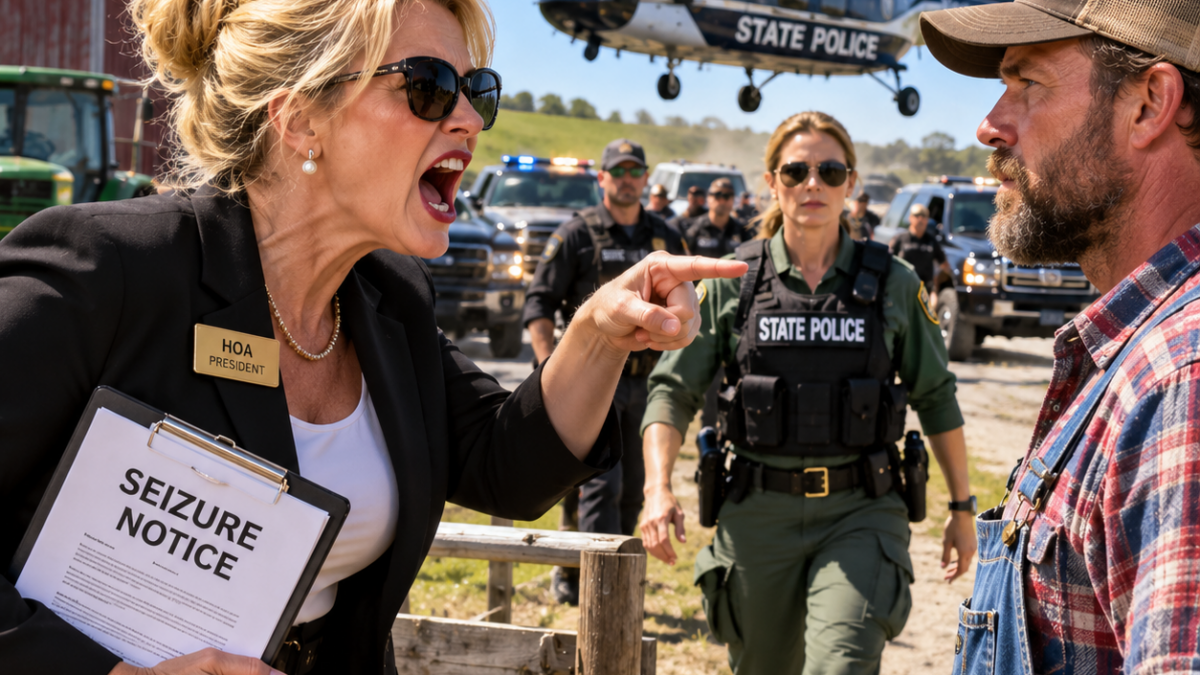
Four white SUVs carried black lettering:
WILLOW BEND COMMUNITY COMPLIANCE.
Behind them came two tow trucks.
Then pickups.
Then a flatbed carrying the bulldozer.
It was an absurd sight.
That almost made it worse.
There was something theatrical about the whole thing, as if Lorraine believed the size of the procession itself created authority.
She stepped out of the first SUV wearing a navy blazer and dark pants, carrying a folder under her arm.
Her shoes were polished.
At five-fifty-two in the morning.
On a gravel farm road.
That told me more about her intentions than the bulldozer did.
She had dressed for an audience.
A thick man in a tactical-style vest climbed out beside her.
Clay Dorsy.
I had seen him driving Willow Bend patrol vehicles before.
He had the posture of a man who enjoyed being mistaken for law enforcement.
My gate was closed.
I stood on my side of it with my hands in my pockets.
Tom and two employees stayed forty yards behind me.
Lorraine approached.
“Mr. Whitaker.”
“Lorraine.”
She held up the folder.
“Under authority of the emergency abatement order previously served upon you, Willow Bend Community Compliance is taking possession of the affected property.”
“The affected property being my farm.”
“The designated water-protection area.”
“My pasture.”
She ignored that.
“You are required to open the gate immediately and surrender all keys associated with vehicles, barns, storage buildings, pumping equipment, and machinery located within the seizure zone.”
I stared at her.
“You practiced that.”
Her jaw tightened.
“This is not a joke.”
“No.”
I looked at the bulldozer.
“I noticed.”
Clay stepped forward.
“Sir, you need to comply.”
I looked at his vest.
No badge.
No agency name.
No state license displayed.
“You a cop?”
His face hardened.
“I’m authorized security.”
“That wasn’t my question.”
Lorraine cut in.
“Dale, if you obstruct this operation, you will be arrested.”
“By who?”
She hesitated.
It was tiny.
Less than a second.
But Camera Two caught it perfectly.
I nodded toward the folder.
“Which judge signed your order?”
“It’s identified in the document.”
“Say the name.”
“You received a copy.”
“For the cameras.”
Her eyes flicked toward the post where one camera was mounted.
She had known they were there.
Now she understood why.
“I am not participating in your theatrics.”
“You brought eleven vehicles and a bulldozer to my farm before sunrise.”
Tom coughed behind me.
I’m almost certain he was hiding a laugh.
Lorraine opened the folder.
“You are in violation of a lawful order.”
“Read the case number.”
“Excuse me?”
“Out loud.”
Clay moved closer.
“Enough.”
I looked directly at him.
“Don’t touch me.”
He smiled.
Then Lorraine read the case number.
Her voice was louder than necessary.
I let her finish.
“Thank you.”
“For what?”
“The camera.”
For the first time that morning, I saw uncertainty.
Only a flicker.
But it was there.
She turned toward Clay.
“Proceed.”
The flatbed driver began lowering the ramps.
Metal slammed against gravel.
Chains came loose.
The bulldozer engine coughed, then roared.
At the same time, two men walked toward my gate carrying bolt cutters.
I felt something cold move through my stomach.
This was it.
Until that moment, there had still been some part of me that believed Lorraine was bluffing.
That the convoy was intimidation.
That she wanted me frightened enough to sign something.
But the men put the bolt cutters around my chain.
I said, “You cut that, you’re trespassing.”
One man looked at Lorraine.
She nodded.
The blades closed.
The chain snapped.
The sound was small.
Just one hard metallic crack.
But I can still hear it.
My grandfather had built the first gate there.
My father and I had replaced it when I was nineteen.
Every Whitaker for four generations had walked through that entrance.
And Lorraine Puit stood on the county road watching strangers cut it open because she wanted a development bonus.
Clay pulled the gate toward him.
“Move.”
I didn’t.
He stepped closer.
“Sir.”
“Still not a cop.”
His hand landed on my shoulder.
He shoved.
I stumbled one step backward.
Behind me, Tom shouted, “Dale!”
I raised one hand without looking at him.
Stay there.
Everything in me wanted to hit Clay.
I was fifty-one years old.
I had spent my life handling livestock and equipment.
Clay was strong, but strength wasn’t the issue.
The issue was that four cameras were watching.
Walter’s voice was in my head.
The gray disappears.
I straightened.
“That was your one free mistake.”
Clay smirked.
“Move.”
Two men headed toward the cattle fence with bolt cutters.
That changed things.
I walked around Clay and stepped directly between them and the fence.
“No.”
One of them looked uncomfortable.
“Sir, we were told—”
“If you open this fence before those cattle are secured, they can reach the county road.”
Lorraine called from behind them.
“Open it.”
I looked at her.
“You want a hundred forty head loose near morning traffic?”
“The livestock will be impounded.”
“By who?”
“We have contractors.”
“Where are your stock trailers?”
Nobody answered.
I looked at the two men.
“You see any cattle trailers?”
One lowered his bolt cutters slightly.
Lorraine’s face went red.
“Stop listening to him and do your jobs.”
The man beside him whispered something I couldn’t hear.
Clay came toward me again.
“Last warning.”
“No,” I said. “Mine.”
He stopped.
“If one cow reaches that road because you cut this fence, the cameras are going to show exactly who ordered it.”
Lorraine pushed past him.
“By sunrise, this property will be under association control. By noon, our survey team will have the creek secured. You had every opportunity to cooperate.”
“There is no ‘our’ creek.”
“There will be.”
“You sure about that?”
“I am completely sure.”
Then she said the sentence I would remember longer than the shove.
“Nobody is coming to save you, Dale.”
At first I thought the sound behind her was another truck.
A faint rhythmic pulse.
Thump.
Thump.
Thump.
Tom looked up.
The two men with the bolt cutters looked toward the eastern ridge.
The bulldozer driver reduced his throttle.
Thump-thump-thump-thump.
Loose gravel began trembling near my boots.
Clay turned.
Lorraine frowned.
Then the helicopter came over the ridge.
Dark blue.
White lettering.
STATE POLICE AVIATION.
It swept low across the pasture, banked once, and descended toward the open field beside the creek.
Rotor wash flattened the grass.
Dust exploded across the lower lane.
Men grabbed their hats.
The bulldozer driver shut off his engine.
Nobody said a word.
And for the first time since the convoy arrived, Lorraine Puit stopped smiling.
The helicopter settled into the field.
The side door opened.
A uniformed officer climbed out first.
Then another.
And then my wife stepped down into the grass.
Hannah wore full uniform.
Four stars on her collar.
A pilot’s headset hung around her neck.
She had been commander of the state police for less than twenty hours.
I forgot to breathe.
I hadn’t called her.
I hadn’t asked her to come.
In fact, the last thing she had told me was that she could not touch the case.
Later, I learned what had happened.
Hannah’s helicopter had been en route to a regional command briefing when Captain Doyle transmitted an operational notice regarding a suspected forged law-enforcement document being used during an active attempted property seizure.
The document carried state-police markings.
Hannah heard the location.
Harvest Hollow Farm.
Her farm.
Her husband.
For several seconds, everyone in the aircraft apparently waited for her decision.
Hannah did exactly what she had told me she would do.
She did not take control of the investigation.
She did not issue an arrest order.
She did not ask for the case file.
Instead, she ordered the aircraft to land because the department’s identity was being invoked publicly on a forged document and because, as commander, she needed to disclose her conflict immediately and remove herself in front of witnesses.
That distinction would become enormously important.
At that moment, all I knew was that my wife was walking across our pasture toward a woman who had just claimed nobody was coming.
Lorraine stepped toward her.
She clearly did not recognize Hannah.
“This is a private association matter,” Lorraine shouted over the fading rotor noise.
Hannah stopped.
“Good morning.”
“We have a lawful court-authorized abatement underway.”
“May I see the order?”
Lorraine straightened.
Something changed in her posture.
She thought the helicopter had come to assist her.
I could see it happen.
She walked forward almost eagerly and handed Hannah the folder.
“There have been repeated obstruction issues with the property owner.”
Hannah took the document.
Read the first page.
Turned it over.
Read the second.
Her face remained completely still.
I knew that face.
I had seen it when our son put a baseball through the kitchen window at twelve.
I had seen it when a drunk driver backed into her parked car and tried to claim the car had moved.
Hannah looked at Lorraine.
“Who authorized this?”
“The court.”
“Which court?”
“It is identified in the order.”
“Which court?”
Lorraine glanced around.
“The county court.”
“Which division?”
“I don’t understand why this is necessary.”
Hannah looked back at the document.
“I’ve read several thousand court orders in twenty-four years. This is not formatted like a valid order from any court in this county.”
Lorraine stiffened.
“That is your opinion.”
“Yes.”
Hannah’s tone stayed calm.
“It is.”
Then she pointed to the men in tactical vests.
“Which of you are sworn law-enforcement officers?”
Nobody answered.
“Any state troopers?”
Silence.
“Sheriff’s deputies?”
Nothing.
“Municipal officers?”
Clay folded his arms.
“We’re licensed security.”
Hannah looked at him.
“What is your state license number?”
Clay’s mouth opened.
Then closed.
Hannah continued.
“Which of you has statutory authority to seize real property?”
Nobody moved.
“Which of you has authority to impound agricultural equipment under a civil HOA action?”
Still nothing.
Lorraine finally snapped.
“You are interrogating the wrong people. He is the one violating the order.”
For the first time since stepping out of the helicopter, Hannah looked at me.
Our eyes met.
I didn’t smile.
Neither did she.
I nodded once.
She turned back.
“There is something everybody here needs to know before this goes any further.”
Lorraine looked irritated.
Hannah’s voice became louder.
“My name is Hannah Whitaker.”
I watched Lorraine’s face.
Nothing yet.
“I am Dale Whitaker’s wife.”
There it was.
The blood seemed to drain from Lorraine’s cheeks.
Clay looked from Hannah to me.
Several workers stepped backward.
Hannah continued.
“I am stating that relationship openly because there is an active law-enforcement matter connected to this property, and I will not participate in any investigative decision involving my husband.”
Lorraine recovered enough to point at her.
“This is abuse of power.”
“No.”
“You brought a state helicopter onto your husband’s farm!”
“I was aboard that aircraft when a departmental alert was transmitted concerning suspected fraudulent use of state-police identification at this location.”
“You expect people to believe that?”
“I expect the record to show it.”
Lorraine laughed.
It sounded forced.
“This is unbelievable.”
Hannah handed the order back.
“I will not arrest you.”
Lorraine blinked.
“I will not issue you a command related to the investigation. I will not seize evidence. I will not interview witnesses. I will not participate in a search. I will not make a charging recommendation.”
Hannah turned slightly toward the road.
“The case belongs to Captain Marcus Doyle.”
For half a second, nothing happened.
Then three unmarked vehicles appeared behind the convoy.
They moved slowly down the gravel road.
Lorraine turned.
I watched the moment she understood.
The helicopter had not been the trap.
The trap had already closed.
Captain Doyle stepped out of the first unmarked sedan carrying a folder.
Four investigators came with him.
Unlike Clay’s men, none of them needed tactical theater.
Doyle walked directly toward Lorraine.
“Lorraine Puit?”
She raised her chin.
“Yes.”
“I’m Captain Marcus Doyle, state police investigations.”
“I demand to know what this is about.”
“I have a warrant.”
“For what?”
He opened the folder.
“A search warrant covering specified vehicles, electronic devices, association records presently on site, and materials connected to the attempted execution of a suspected fraudulent order.”
Lorraine stared at him.
“This is ridiculous.”
Doyle looked toward the broken gate.
“Who cut that chain?”
Nobody answered.
Clay moved away from it.
Doyle noticed.
“Mr. Dorsy?”
Clay’s face changed.
“You know my name?”
“Yes.”
“I was hired for security.”
“By whom?”
Clay looked at Lorraine.
That was the first crack.
Lorraine saw it too.
“Do not answer him without counsel.”
Doyle turned his eyes toward her.
“You may exercise your own right to counsel. You do not give legal instructions to other adults.”
Clay raised his hands slightly.
“Look, I was paid four thousand dollars for this morning.”
Lorraine spun toward him.
“Clay!”
“I never saw the order until today.”
“Shut your mouth.”
Doyle looked at one of his investigators.
“Record that.”
“It’s already recording.”
The bulldozer driver climbed down from his machine.
“I’m a contractor,” he called.
Lorraine stared at him.
“No one is accusing you of anything yet,” Doyle said.
“I was told this was a court seizure.”
“Who told you?”
The driver pointed.
Lorraine looked as if he had stabbed her.
Within two minutes, the convoy that had looked like an army became eleven vehicles full of people trying to explain why they had never really been part of it.
One security man removed his vest.
Another began searching his phone for the message showing his work assignment.
A tow-truck driver asked if he was free to leave.
Doyle told everyone to remain available while investigators sorted out who had done what.
Lorraine stood in the middle of it.
Alone.
I walked toward the broken gate.
She saw me.
“You did this.”
Her voice was low.
I shook my head.
“You came here.”
“You set me up.”
“You cut my chain.”
“You knew!”
“I knew your paper was fake.”
Her eyes widened.
There it was.
The first honest fear I had seen from her.
“You knew?”
“My lawyer knew.”
“You let us come anyway.”
“I told you not to enter.”
“This is entrapment.”
Captain Doyle looked over.
“No, ma’am. It is not.”
She turned on him.
“You people are protecting him because of his wife.”
Doyle opened another folder.
“No.”
He removed several pages.
“We’ve been investigating you for eleven days.”
Lorraine stopped moving.
Doyle held up the first document.
“This order was created on a computer registered to the Willow Bend association office.”
Another page.
“Puit Hale Consulting received one hundred eighty-six thousand dollars from association accounts.”
Another.
“The registered manager is your brother-in-law.”
Lorraine said nothing.
“Seventy-three thousand dollars was transferred to a security vendor for which investigators have found no functioning licensed operation matching the services described.”
Her breathing became visible.
“And this—”
Doyle held up a contract.
“—is a draft development agreement providing you a personal finder’s fee of two hundred fifty thousand dollars if Willow Bend Phase 3 secured water approval before the contractual deadline.”
“That was compensation for consulting work.”
“Consulting work you disclosed to the board?”
Silence.
“Approved in a board vote?”
Nothing.
“Listed in association financial statements?”
Her face twisted.
“You don’t understand development.”
“No,” Doyle said. “But the attorney general’s office understands undisclosed financial interests.”
The expression on Lorraine’s face shifted from fear to rage.
She stepped forward.
“Give me that.”
Doyle moved the folder back.
“Ma’am.”
“That is confidential association material.”
“It is evidence.”
She grabbed for it.
Doyle turned.
Lorraine caught the edge of several pages and yanked.
Paper tore.
Everything stopped.
Two troopers moved instantly.
One took her left arm.
Another took her right.
Lorraine screamed.
“Get off me!”
“Stop resisting.”
“You cannot touch me!”
“Ma’am, stop pulling away.”
“I am the president of Willow Bend!”
That sentence echoed across the pasture.
Even now, I remember it because of how strange it sounded.
As if that title should stop handcuffs.
As if being HOA president placed her above forgery statutes.
As if five years of residents backing down had convinced her no authority existed above her own.
The cuffs closed at 6:41 a.m.
My cattle stood along the fence watching.
Tom was beside the barn.
My employees were silent.
Hannah remained near the helicopter, deliberately separated from Doyle’s team.
And Lorraine Puit stood at the gate she had ordered cut open, handcuffed in front of the same convoy she had assembled to humiliate me.
She looked at me.
There was hate in her eyes.
Pure hate.
“This farm will ruin you.”
I stepped closer, but not too close.
“No.”
I looked at the broken chain on the gravel.
“You almost ruined yourself trying to take it.”
She was placed in an unmarked vehicle.
The door shut.
For the first time since 4:30 that morning, I felt my knees weaken.
I sat on the gatepost.
Tom walked over.
“You okay?”
“Ask me tomorrow.”
He looked toward the helicopter.
“Your wife really knows how to arrive at work.”
I laughed.
I couldn’t help it.
It came out half laugh, half breath.
“That wasn’t planned.”
“Sure.”
“I’m serious.”
“Dale, she came over the ridge in a state police helicopter twenty minutes after that woman said nobody was coming.”
“I know what it looked like.”
Tom shook his head.
“If somebody puts that in a movie, no one’s going to believe it.”
That was the first time I smiled that morning.
But the story wasn’t over.
Not even close.
Because arresting Lorraine solved the emergency at the gate.
It did not solve Willow Bend.
By noon, videos of the convoy were already spreading among residents.
Someone had filmed the helicopter from the subdivision.
Someone else had captured Lorraine being placed in the state vehicle.
By evening, three different versions of the story were circulating.
In one, Hannah had ordered the arrest personally.
In another, I had been secretly working with the state police for months.
In the most ridiculous version, Harvest Hollow Farm supposedly contained an underground state water facility.
Walter called me just after dinner.
“Do not post anything.”
“I wasn’t planning to.”
“Do not answer comments.”
“I don’t use social media.”
“Today would be a bad day to start.”
“What happens now?”
“Now evidence gets boring.”
“That sounds good.”
“It is very good.”
Hannah got home after nine.
She walked through the door without her uniform jacket.
Her shoulders looked exhausted.
I was sitting at the kitchen table.
For a second, we just stared at each other.
Then I stood.
She crossed the room.
I pulled her into my arms.
This time neither of us pretended the morning had been routine.
“You all right?” she asked.
“Clay shoved me.”
Her head came back.
“What?”
“I’m fine.”
“Where?”
“Shoulder.”
“Did you report it?”
“It’s on four cameras.”
She closed her eyes.
“What?”
“I’m trying very hard not to become involved.”
I smiled.
“You’re doing great.”
“That is not funny.”
“A little funny.”
She sat down.
I poured coffee, then remembered the time and poured water instead.
“What happened after you left?” I asked.
“I can’t tell you anything operational.”
“I know.”
“I mean it.”
“I know.”
She looked at me.
“I landed, disclosed the relationship, and left the investigative area once Doyle had control.”
“Did you know he was coming?”
“I knew there was an active response.”
“That’s all?”
“That’s all I’m discussing.”
“Fair.”
We sat quietly.
Then Hannah looked toward the dark window.
“I heard her say they were taking the farm.”
My voice softened.
“Yeah.”
“I was in the helicopter when the radio traffic came through. For about two seconds, I forgot every rule I’d ever learned.”
“But you didn’t break one.”
“No.”
Her hand tightened around the glass.
“I wanted to.”
I reached across the table.
“I know.”
“She came after our home.”
“I know.”
“You were standing in front of a bulldozer.”
“Technically beside one.”
“Dale.”
“All right.”
She shook her head.
“I have spent my entire career telling young troopers that authority is not personal. You don’t use it because you’re angry. You don’t use it because somebody insulted you. You don’t use it because you can.”
“You did exactly that today.”
“What?”
“Didn’t use it.”
She looked at me.
“I hated every second.”
“That’s probably why you’re good at the job.”
She squeezed my fingers.
The next morning, Willow Bend held an emergency board meeting.
Lorraine’s chair was empty.
Joyce Bellamy sat three seats away from it.
Walter attended as my counsel because the board had requested discussion regarding the farm.
I went too.
The clubhouse parking lot was full.
Inside, residents packed every chair and lined the walls.
Nobody looked at their phones this time.
An acting board member opened the meeting.
“We are here under extraordinary circumstances.”
A man near the back shouted, “You think?”
Nobody laughed.
The board announced that Lorraine had been suspended pending removal proceedings and that an independent audit would begin immediately.
Then a resident stood.
“What did the rest of you know?”
The room erupted.
One person shouted about the $186,000.
Another demanded to know who authorized the security contractors.
A woman near the aisle wanted to know why HOA dues had increased while money disappeared.
For years, Lorraine had trained that room to be quiet.
Now the silence was gone.
Joyce raised her hand.
The acting chair recognized her.
She stood slowly.
“I need to say something.”
The room settled.
Joyce looked down at the table.
“I was treasurer while these transactions occurred.”
Someone muttered angrily.
She continued.
“I did not know their true purpose when they were first processed.”
A man called, “How could you not know?”
Joyce looked at him.
“Because I trusted explanations I should have verified.”
That silenced him.
She took a breath.
“When the legal account began exceeding its expected range, I asked questions. I accepted incomplete answers longer than I should have. When I finally reviewed the underlying vendor records and development documents, I found information I believed could indicate criminal conduct.”
Someone asked, “So you called the police?”
“I contacted an attorney.”
Walter nodded slightly.
Joyce’s voice trembled.
“I wish I had done it sooner.”
I looked at her.
She seemed smaller than she had on the meeting video.
Not weak.
Just tired.
I stood.
Walter whispered, “What are you doing?”
“Something useful.”
I waited until Joyce looked at me.
“You did it before they took my farm.”
The room went silent.
Joyce swallowed.
“That doesn’t erase what I missed.”
“No.”
I wasn’t going to lie to her.
“But you brought the records forward when it mattered.”
She nodded.
Her eyes filled.
I sat down.
That moment changed the meeting.
Not because everyone forgave the board.
They didn’t.
They shouldn’t have.
But people stopped looking for a single simple villain besides Lorraine and started asking the questions they should have asked years earlier.
How much power should one HOA president have?
Why did one person control vendor selection?
Why were legal bills approved without detailed review?
Why had private patrols been allowed to operate with so little oversight?
Why had residents become so accustomed to paying questionable fines rather than challenging them?
Then someone asked about me.
“What does Mr. Whitaker want?”
Every head turned.
Walter leaned toward me.
“You don’t have to answer.”
“I know.”
I stood.
“I want my gate fixed.”
A few people laughed nervously.
“I want the fence repaired.”
More silence.
“I want the association to put in writing that it has no authority over Harvest Hollow Farm.”
A woman near the front said, “That’s it?”
“No.”
I looked around the room.
“I want you to stop pretending what happened came out of nowhere.”
That landed differently.
“You all didn’t forge that order. You didn’t cut my chain. You didn’t move money into Lorraine’s family company. I know that.”
Several faces relaxed.
Then I continued.
“But some of you watched her stand here and claim an HOA had the power to take land outside your subdivision, and you voted yes because it was easier than asking whether she was telling the truth.”
Nobody moved.
“You were told my cattle were dangerous to your neighborhood. You were told my creek somehow belonged to you. You were told my refusal to sell made me selfish. Almost nobody drove five minutes down the road to ask me.”
A man lowered his eyes.
“I’m not suing four hundred families because they trusted the wrong president.”
Walter glanced at me.
That was the first time I had said it publicly.
“But if you replace Lorraine with somebody exactly like her six months from now, then none of this meant anything.”
I sat down.
After the meeting, Joyce found me in the parking lot.
She was carrying the same grocery bag she had brought to Walter.
“I suppose this thing is famous now,” she said.
I looked at it.
“Is that the bag?”
“Yes.”
“Hundreds of thousands of dollars in fraud exposed in a grocery bag.”
“It was the closest thing I had.”
“Fancy evidence box would have ruined the story.”
She smiled.
Then her face became serious.
“I’m sorry.”
“For what?”
“For not seeing it sooner.”
“Joyce.”
“I signed checks.”
“You also followed the numbers.”
“Eventually.”
“Eventually counts.”
She looked toward the ridge.
“I heard Lorraine talk about you for months. She made you sound like some wealthy land speculator sitting on water while families suffered.”
“I shovel manure before breakfast.”
“I know that now.”
I smiled.
“You’re welcome to come see the farm sometime when nobody’s trying to seize it.”
She laughed.
“I’d like that.”
The investigation widened.
The $186,000 transfer was not an isolated event.
The audit uncovered one vendor after another.
Consulting entities.
Maintenance companies.
Security payments.
Administrative services.
Some were legitimate.
Several were not.
Over roughly three years, more than $400,000 had been diverted through questionable or fraudulent arrangements.
The numbers made residents furious.
But the emails were worse.
Investigators recovered messages between Lorraine and Russ Danvers, the Phase 3 developer.
Russ initially claimed he had relied entirely on Lorraine’s assurance that the water rights would be obtained legally.
According to him, he was just a businessman negotiating with an association.
Then investigators found the emails.
Walter let me read portions after they became part of public court filings.
In one exchange, Russ asked whether “the Whitaker issue” would be resolved before the water deadline.
Lorraine responded that I would either cooperate or “be placed in a position where cooperation is no longer optional.”
In another, Russ asked whether title problems had been addressed.
Lorraine wrote that the HOA was “creating an enforcement pathway.”
Creating.
Not discovering.
Not asserting.
Creating.
When I read that word, I thought about the forged seal.
The retired judge’s signature.
The fake case number.
The convoy.
They hadn’t misunderstood their authority.
They were trying to manufacture it.
The attorney general’s office opened a separate inquiry into the finder’s fee and the development arrangement.
Russ stopped returning reporters’ calls.
Willow Bend Phase 3 stalled.
Without my creek, the water plan collapsed.
The irony was almost painful.
If Russ and Lorraine had approached me honestly with a proposal that respected the farm, the answer still would have been no.
But they could have walked away with their reputations intact.
Instead they treated “no” as a challenge to be defeated.
That decision cost them far more than the creek was ever worth.
Clay Dorsy cooperated quickly.
His story was simple.
Lorraine had hired him for the morning.
Four thousand dollars.
He had been told a court order authorized the operation.
He admitted he never verified it.
He admitted pushing me.
He admitted his men had no authority to arrest me despite the threats made at the gate.
When Walter told me Clay’s lawyer wanted to discuss the shove, I shrugged.
“I’m not interested in destroying the guy.”
“He did put his hands on you.”
“I know.”
“You could include that in the civil claim.”
“Include the actual damage.”
“That is actual damage.”
“My shoulder hurt for two days.”
Walter stared at me.
“You are an exceptionally inconvenient client.”
“So I’ve been told.”
“Dale, there is a difference between vengeance and accountability.”
“I know.”
“Good.”
“I want accountability.”
“That can include compensation.”
“I want my gate fixed. My fence fixed. The lost creamery sales covered. Your fees paid.”
“That’s all?”
“That’s what they damaged.”
Walter leaned back.
“You understand you could seek substantially more?”
“Would it make the creek run cleaner?”
“No.”
“Would it help my employees?”
“Possibly.”
“Then calculate what we actually lost.”
Walter studied me.
“You’re sure?”
“Yes.”
I knew what people expected.
They expected the farmer who had been threatened and humiliated to turn around and take every dollar available.
Part of me wanted to.
There were nights I lay awake replaying Clay’s shove.
The chain snapping.
Lorraine saying nobody was coming.
I imagined lawsuits large enough to bankrupt Willow Bend.
Then I imagined the people I had seen at the emergency meeting.
Families.
Retirees.
Young couples.
People who had already had dues stolen from them.
Making them pay for Lorraine’s greed wouldn’t give me justice.
It would just spread the damage.
So our civil claim stayed narrow.
The cut gate.
Fence repairs.
Three days of disrupted creamery sales.
Attorney fees.
Documented costs.
Nothing theatrical.
Walter complained the whole time.
I think secretly he was pleased.
The criminal case moved more slowly.
That part frustrated me.
Farm problems are direct.
A fence breaks, you fix it.
A tractor stops, you diagnose it.
A cow is sick, you call the vet.
Court cases do not behave like that.
There were hearings.
Motions.
Evidence reviews.
Continuances.
Interviews.
Audits.
Weeks became months.
Every time I drove through the repaired gate, I looked at the new chain.
Hannah noticed.
One evening she came home and found me standing beside it.
“You know it’s stronger than the old one.”
“I know.”
“So why do you keep checking it?”
“I’m not.”
“You are literally holding the chain.”
I let go.
“Habit.”
“No.”
I looked toward the road.
“It’s strange.”
“What?”
“Before this, a gate was just a gate.”
She waited.
“Now every time I hear a diesel engine coming down the road before sunrise, I think they’re back.”
Hannah’s expression softened.
“They’re not coming back.”
“I know.”
“Knowing isn’t always the same as believing.”
I smiled faintly.
“You learn that at command school?”
“No.”
She leaned against the fence beside me.
“Twenty-four years of police work.”
The internal review of Hannah’s conduct began almost immediately.
That was expected.
A newly sworn commander had landed in a helicopter at a scene involving her husband.
There had to be a review.
Lorraine’s lawyer tried to turn it into the centerpiece of her defense.
Political influence.
Selective enforcement.
Conflict of interest.
Abuse of power.
For several days, headlines focused more on Hannah’s arrival than on the forged order.
That hurt her.
She didn’t say so.
I could tell.
One night I found her at the kitchen table reading the same internal memo for the third time.
“You did everything by the book,” I said.
“That doesn’t stop people from asking.”
“Let them ask.”
“They should ask.”
I pulled out a chair.
“You really believe that?”
“Absolutely.”
“Even when it’s you?”
“Especially when it’s me.”
That was Hannah.
She had spent her career believing power should survive scrutiny.
So when scrutiny came, she sat still and let it happen.
The records were clear.
She had received no briefing on the case.
She had not ordered Doyle to open it.
She had not sought the warrant.
She had not reviewed evidence.
She had not directed arrests.
Within minutes of learning my property was involved, she had formally disclosed the conflict.
At the scene she made no arrest, conducted no search, and issued no investigative order.
Her presence looked dramatic.
The paperwork behind it was almost boring.
That boring paperwork saved her.
The review closed without a finding against her.
When the letter arrived, I found her opening it in the kitchen.
She read the first paragraph.
Then the second.
Then she set it down.
“Well?”
“Closed.”
“That’s it?”
“That’s it.”
I picked her up.
She slapped my shoulder.
“Put me down.”
“Commander.”
“Dale.”
“Yes, ma’am.”
She started laughing.
It was the first time I had heard her laugh freely in months.
Lorraine’s case did not end so gently.
Joyce testified for four hours.
I attended part of it.
She placed her grocery bag beside the witness stand.
The prosecutor asked why she had saved copies.
“Because the numbers stopped making sense.”
“When?”
“When invoices became less specific as the amounts became larger.”
That sentence stuck with me.
The defense tried to paint her as a disgruntled treasurer.
Joyce did not take the bait.
“Did you dislike Mrs. Puit?”
“No.”
“Did you resent her leadership?”
“No.”
“Did you disagree with her?”
“Frequently.”
“So there was conflict.”
“There is supposed to be conflict when a treasurer asks why money is leaving an account.”
A few people in the courtroom shifted.
The defense attorney tried again.
“Mrs. Bellamy, did you personally witness my client create the document alleged to be fraudulent?”
“No.”
“Did you personally witness her transfer every disputed payment?”
“No.”
“Did you personally negotiate the development agreement?”
“No.”
“So much of your testimony is interpretation.”
Joyce adjusted her glasses.
“No. Much of my testimony is arithmetic.”
Even Walter smiled at that one.
The prosecution introduced the ledger.
Corporate filings.
Bank records.
Emails.
Computer records showing the forged order originated from an association-office device.
Draft contracts.
Payment approvals.
The fake security vendor.
The consulting company connected to Lorraine’s brother-in-law.
The development fee.
Then came the videos from Harvest Hollow.
Camera One showed the convoy arriving.
Camera Two captured Lorraine reading the fake case number out loud.
Camera Three showed the chain being cut.
Camera Four showed Clay shoving me.
Another camera captured Lorraine ordering contractors toward the cattle fence.
The audio caught her saying the farm would be under association control by sunrise.
There was no ambiguity left.
She hadn’t merely possessed a fake document.
She had used it.
She had built a convoy around it.
She had threatened arrest under it.
She had directed people to break through my gate using it as authority.
Walter had been right.
The gray was gone.
Lorraine eventually pleaded guilty to forgery, fraud, and conspiracy to unlawfully seize property.
The court imposed a prison term.
After that came five years of supervised release, restitution, and a lifetime prohibition on serving on a homeowners association board anywhere in the state.
I attended the sentencing.
Not because I wanted to watch her suffer.
At least that is what I told myself.
Maybe part of me did want to see the moment she finally heard the word “no” from somebody she couldn’t threaten.
The judge spoke for a long time.
He talked about financial trust.
Abuse of organizational authority.
Forgery.
The danger of using false government documents.
Then he said something that stayed with me.
“An elected or appointed position in a private association is not sovereign power.”
Lorraine stared straight ahead.
The judge continued.
“Your victims were not obligated to surrender property merely because you spoke with confidence.”
I thought about the convoy.
The blazer.
The folder.
The bulldozer.
The way she had announced that my farm would belong to Willow Bend by sunrise.
Confidence.
That was what she had really weaponized.
Not law.
Not authority.
Confidence.
For years, people had mistaken one for the other.
When Lorraine was allowed to speak before sentencing, she stood slowly.
She did not look at me at first.
She talked about pressure.
About community expectations.
About the failure of the Phase 3 project.
About bad advice.
About decisions made too quickly.
Then she finally turned.
Her eyes found mine.
“I believed Mr. Whitaker was refusing a reasonable compromise.”
The prosecutor started to rise.
The judge held up a hand.
Lorraine continued.
“I believed one property owner should not be able to block something benefiting hundreds of people.”
I stood there listening.
Months earlier, that argument would have made me furious.
Now it mostly made me tired.
The judge asked, “Did that belief authorize you to forge a court order?”
Lorraine said nothing.
“Did it authorize you to misappropriate association funds?”
Nothing.
“Did it authorize an attempted seizure of land over which your association held no recorded interest?”
Her shoulders sank.
“No.”
It was the quietest I had ever heard her speak.
One word.
No.
The word she had refused to accept from me.
After the hearing, reporters waited outside.
Walter told me I didn’t have to stop.
I almost walked past them.
Then one reporter asked, “Mr. Whitaker, do you feel like you won?”
I stopped.
Hannah was several steps away.
Walter looked at me.
I considered the question.
“Won what?”
“Your fight with Willow Bend.”
“I still have the same farm I had before.”
“But Mrs. Puit is going to prison.”
“That doesn’t make my grass grow.”
The reporter blinked.
I continued.
“She came for something that didn’t belong to her. The system stopped her. That’s better than the alternative.”
“Do you forgive her?”
That question surprised me.
I looked back toward the courthouse.
“I don’t know her well enough to decide what forgiveness means for her.”
“Are you still angry?”
“Yes.”
That answer came easily.
“Do you want revenge?”
I thought about the families at Willow Bend.
Joyce with her grocery bag.
My employees.
Hannah sitting through an internal review.
The broken chain.
“No.”
“What do you want?”
I looked toward the parking lot.
“To go home.”
And I did.
The association eventually paid every dollar of our civil claim.
No battle.
No dramatic settlement.
They covered the gate, fence, creamery losses, and Walter’s fees.
More important to me, they sent a signed letter.
The wording had been negotiated by attorneys.
Walter called me the morning it arrived.
“I think you’ll like paragraph three.”
I drove to his office.
He handed me the page.
I read it.
Then read it again.
Willow Bend Homeowners Association acknowledged that it held no ownership interest, easement, covenant authority, enforcement authority, water right, regulatory jurisdiction, or other claim over Harvest Hollow Farm, its creek, or the water running beneath or through the property.
I looked at Walter.
“Can they change their mind?”
“Not without changing property law.”
“Can we make this bigger?”
“The font?”
“Yes.”
He laughed.
“Dale.”
“I’m framing it.”
“Of course you are.”
I had a copy enlarged.
Then I hung it in the creamery above the cash register.
Tom saw it the next morning.
“Subtle.”
“I considered putting lights around it.”
“You should.”
One of the creamery workers suggested a gold frame.
We used oak.
A month later, Joyce visited Harvest Hollow.
I gave her a tour.
She stood by the creek longer than anywhere else.
“So this is the water that nearly destroyed Willow Bend.”
“No.”
She glanced at me.
“This is the water Lorraine nearly destroyed herself trying to control.”
Joyce nodded.
We walked to the old fence post.
The initials my grandfather carved were faded but still visible.
D.W.
His name had been Daniel Whitaker.
Same initials as mine.
Joyce touched the top of the post.
“I understand why you wouldn’t sell.”
“It wasn’t only sentiment.”
“I know.”
“The cattle need it. The farm needs it.”
“But sentiment mattered.”
I looked downstream.
“Yes.”
She smiled.
“It’s allowed.”
The following spring, Willow Bend elected an entirely new board.
Their first public actions included stricter financial controls, independent approval for major vendors, annual audits, and limitations on the president’s authority.
Joyce refused to run again.
She said she had spent enough years looking at HOA spreadsheets.
Instead, she volunteered twice a week at the county library.
Russ Danvers’ Phase 3 project never received the water approval Lorraine had promised.
Without that approval, construction did not proceed under the plan that had caused the fight.
Harvest Hollow kept the creek.
My cattle kept drinking from it.
The creamery kept running.
Tom’s daughter finished her college year.
My eleven employees kept their jobs.
Life returned to something close to normal.
But not exactly.
Some things stay with you.
For me, it was the sound of the chain.
For Hannah, I think it was the sight of our farm coming into view beneath the helicopter.
She rarely talked about that flight.
Once, months later, we were sitting on the porch after dinner.
The creek was barely visible in the darkness below.
I asked her, “What did you think when you saw the convoy?”
She took a long time to answer.
“I counted vehicles.”
“That’s very romantic.”
“I’m serious.”
“I know.”
“I saw the bulldozer. Tow trucks. The open gate.”
She looked at me.
“Then I saw you.”
“What was I doing?”
“Standing where you should not have been standing.”
I smiled.
“Sounds right.”
“I wanted the pilot to land on top of Lorraine’s SUV.”
I turned toward her.
“You what?”
“I said wanted. We did not.”
“Hannah Whitaker.”
“I’m human.”
I laughed so hard the porch chair creaked.
She elbowed me.
“Don’t tell anyone.”
“State secret.”
“Exactly.”
We sat there listening to frogs near the creek.
Then she asked, “Were you afraid?”
That was harder.
I looked into the darkness.
“When Clay pushed me? Not really.”
“When they cut the chain?”
“A little.”
“When?”
“When those men walked toward the cattle fence.”
“Why?”
“Because that’s when I realized Lorraine didn’t understand what she was doing.”
Hannah waited.
“She thought property was paperwork. Move the paper, move the boundary. Change the order, change ownership. But animals don’t understand fake court seals. Equipment doesn’t understand HOA resolutions. You open a pasture wrong, cattle get loose. Somebody gets hurt. She was playing government without understanding consequences.”
Hannah rested her head against my shoulder.
“You know what scared me?”
“What?”
“That somebody would make you choose between protecting the farm and protecting yourself.”
I looked at her.
“I almost made that choice.”
“I know.”
“Tom would’ve stopped me.”
“No, he wouldn’t.”
“Probably not.”
She laughed quietly.
That spring was wet.
The creek ran high.
One afternoon I was repairing the lower fence when I heard rotor blades in the distance.
My hands stopped automatically.
Old reaction.
I looked up.
A dark blue state police helicopter crossed the ridge.
Not low enough to land.
Just low enough that I could see it clearly.
It passed over the pasture.
Then the nose dipped once.
A deliberate little wave.
I knew immediately.
Hannah.
I took off my hat and raised it.
The helicopter continued west.
I watched until it became a dark dot over the fields.
Then I went back to the fence.
That night, Hannah came home out of uniform, carrying her boots because the airfield mud had covered them.
She dropped into the porch chair beside me.
“You buzzed my pasture.”
“State airspace.”
“My pasture.”
“Federal airspace, technically.”
“You dipped the aircraft.”
“Routine maneuver.”
“Looked like a wave.”
“Your interpretation.”
I smiled.
She looked toward the gate.
“You still checking it?”
“Sometimes.”
“You ever going to stop?”
“Maybe when I stop hearing the bulldozer.”
She leaned back.
“That sound is gone.”
I looked at the road.
The repaired gate stood closed.
No SUVs.
No tow trucks.
No men in tactical vests.
No woman holding a fake order.
Only evening light on gravel.
“I know.”
Hannah took my hand.
For the first time, I realized I believed her.
Lorraine had believed a loud enough convoy could turn a lie into authority.
She believed a seal nobody examined could become a court order.
She believed a title could become jurisdiction.
She believed frightened residents would keep paying whatever she demanded, board members would keep approving whatever she placed in front of them, contractors would keep following instructions, and one farmer standing behind one locked gate would eventually understand that resistance was useless.
She almost proved herself right.
That is the part people sometimes miss when they hear the story.
They focus on the helicopter.
I understand why.
A state police helicopter crossing the ridge at the exact moment an HOA president thinks she has won is hard to forget.
But the helicopter did not save Harvest Hollow by itself.
The farm was saved weeks earlier when Walter looked closely enough to notice an obsolete seal.
It was saved when Joyce Bellamy refused to ignore numbers that no longer made sense.
It was saved when Captain Doyle investigated quietly instead of making noise.
It was saved when Hannah stepped away from a case she desperately wanted to touch because she understood that real authority survives only when it respects its limits.
And maybe, in one small way, it was saved when I decided not to throw the first punch after Clay shoved me.
Because Lorraine’s entire plan depended on confusion.
She needed everyone to lose track of where the boundaries were.
The boundary between an HOA and a court.
Between private security and police.
Between a demand and an order.
Between confidence and authority.
Between revenge and justice.
Between land somebody wants and land somebody actually owns.
In the end, every one of those boundaries held.
Years from now, someone else may own Harvest Hollow.
Maybe one of my children.
Maybe one of their children.
They may replace the barns.
They may grow something different in the upper field.
The creamery may become bigger or disappear completely.
The old cedar fence post will eventually rot into the ground.
But I hope the creek is still there.
I hope it keeps running downhill without asking permission from a homeowners association.
And somewhere inside the creamery, maybe that framed letter will still hang above the register.
Not because I need a piece of paper to tell me the farm is mine.
My family knew that long before Lorraine arrived.
I keep it because of what it represents.
A reminder that paperwork matters.
Questions matter.
Records matter.
Courage sometimes looks like a farmer refusing to open a gate.
Sometimes it looks like an elderly treasurer carrying ledgers in a grocery bag.
Sometimes it looks like a police commander refusing to use her own power when using it would be easiest.
And sometimes justice does not arrive with shouting.
Sometimes you hear it first as a low rhythmic thump coming over a ridge.
Lorraine Puit came to Harvest Hollow before sunrise with eleven vehicles, two tow trucks, private security, and a bulldozer because she believed numbers created strength.
I had one locked gate.
One lawyer.
A handful of cameras.
One honest witness inside her own organization.
And a wife who understood that the badge on her chest mattered only if she refused to bend the rules for the man she loved.
Lorraine lost more than her position.
She lost the money she had chased.
She lost the control she had spent years building.
She lost the trust of the people who had once been too intimidated to challenge her.
And when the court finally asked whether any of her reasons gave her the right to forge an order and seize somebody else’s property, she had to say the one word she had never been willing to hear from me.
No.
The creek still runs through Harvest Hollow.
The cattle still gather beside it on hot afternoons.
The old family initials are still visible on the fence post.
And every morning when I open that gate, I hear the chain slide through the steel loop.
For a long time, the sound reminded me of the morning strangers cut it.
Now it reminds me of something else.
They came with a bulldozer because they thought ownership belonged to whoever arrived with the most force.
They left without one acre.
And my gate closed behind them.








