PART 2: HOA Seized My $9,600 Hay Load Before the Ice Storm—Then the Full Survey Map Came Out
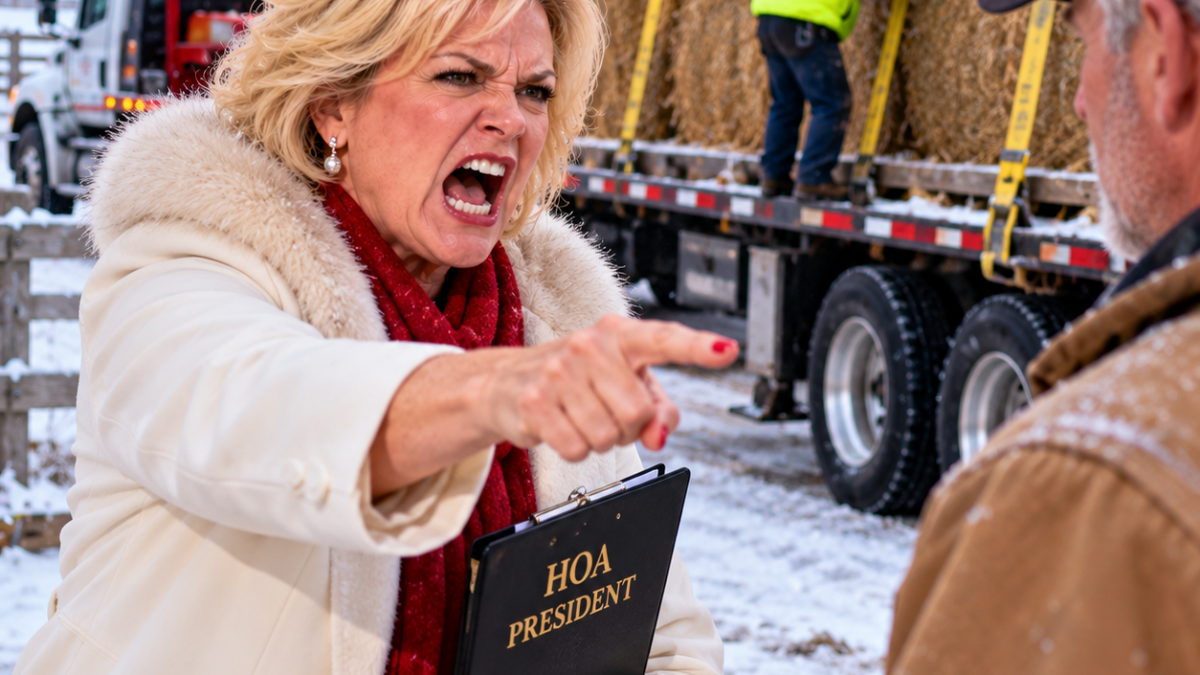
PART 2
The first thing I did was drive twelve miles south to High Ridge Property Services.
I could have called Marissa again.
I could have called Silver Creek’s property manager and demanded answers.
I could have called my attorney and spent the next hour telling him how furious I was.
None of those things would put my hands on the hay.
So I went where the hay was.
High Ridge occupied a fenced industrial yard behind an equipment-rental business and a concrete batch plant. The entrance was wide enough for semis, with a keypad gate and a small office trailer sitting beside a row of dumpsters.
My forty-eight bales were visible before I even parked.
They had been unloaded on bare earth.
Not concrete.
Not gravel.
Bare ground.
Two rows sat square enough.
The third didn’t.
One bale had a crushed corner where the loader fork had entered too high. Another had one strand of twine broken. Loose hay hung from the side.
And on the nearest bale, still fluttering slightly in the wind, was one of Cole Harland’s blue tags.
HARLAND CATTLE.
LOT 11-A.
That tag bothered me.
Nobody could look at it and honestly believe those bales were trash, abandoned material, or unmanaged debris.
They were inventory.
Sold inventory.
A man in a brown work coat stepped out of the office.
“You Wade Turner?”
“Yes.”
“Sam Ortega. Yard supervisor.”
“You have my hay.”
“I have forty-eight large squares under Silver Creek job 4187.”
“Can you release them?”
He shook his head immediately.
“Client hold.”
“They belong to me.”
“I understand.”
“Then why are they on hold?”
“Silver Creek ordered relocation and storage pending mitigation closeout.”
“What does closeout mean?”
“That’s between you and them.”
I looked through the fence.
“My buyer has until five before he cancels.”
Sam glanced toward the bales.
“I don’t control that.”
“I know.”
That answer probably helped both of us.
Sam wasn’t the person who ordered the seizure.
He didn’t need me making him the villain because he happened to be standing closest.
“Can I inspect them?”
“Yes.”
“Photograph them?”
“As long as you stay out of the equipment lane.”
“Can you show me your receiving record?”
He hesitated.
“I can show you the count.”
“Good enough for now.”
He let me through the side gate.
I walked the rows slowly.
Forty-eight lot marks.
Some facing out.
Some turned inward.
I photographed every one I could reach without moving anything.
The bale with the crushed corner had been sound when it left my pad.
I knew that because I had photographed the stack for Cole after moisture testing on Monday.
That photograph was still on my phone.
Clean gravel under the load.
Straight rows.
Blue tags.
No broken twine.
I pulled the picture up.
Sam looked over my shoulder.
“That’s Monday?”
“Yesterday.”
He nodded.
“Intake photo shows damage after unloading.”
“You have intake photos?”
“Four.”
“Can I see them?”
He went back to his tablet.
The first timestamp was 11:43 a.m.
The second, 11:46.
The third showed the crushed corner.
The fourth showed the full receiving row.
I wrote down every timestamp.
“Please preserve those.”
“They stay with the job.”
“I still want my request noted.”
Sam typed something.
“Noted.”
I pointed toward the screen.
There was a section labeled CLIENT RELEASE AUTHORIZATION.
Blank.
“So nobody from Silver Creek has even entered a release condition?”
“No.”
“If I pay you the normal loading charge and send my own truck, can I take them?”
“Not without client approval.”
“I’m the owner.”
“You’re the material owner. Silver Creek is the service client.”
“That sounds like a sentence designed by lawyers.”
“I work at a storage yard.”
He gave me a tired half-smile.
“We get paid to know who can sign the release box.”
“Call them.”
He did.
I stood twenty feet away while he talked to someone.
The call lasted less than a minute.
“No release,” he said when he returned.
“Reason?”
“Mitigation review incomplete.”
“What does that mean?”
“It means whoever took my call said no.”
I checked my phone.
3:52 p.m.
Cole’s deadline was close enough now that I could feel it.
I walked back to my truck and called Dennis Avery, another hay producer I knew two counties west.
“You got large squares?”
“Some.”
“Forty-eight?”
He laughed once.
“No.”
“Twenty-four?”
“Maybe Friday.”
“Same grade as my late cutting?”
“No chance.”
“I’ve got a buyer getting iced in.”
“So does everybody.”
That was the problem.
An approaching ice storm doesn’t create feed.
It makes every producer in the region call everybody else at the same time.
“When can you confirm?”
“Tomorrow.”
Too late.
I called Cole.
It was 4:38.
“They won’t release it.”
He sighed.
“I found another load.”
“I figured.”
“It’s more expensive.”
“Take it.”
“Freight’s worse too.”
“Take it.”
“I hate this.”
“Your cattle need feed.”
“Yeah.”
There was silence.
Then Cole said, “I’m sending you the cancellation in writing. Nothing personal.”
“Do it.”
Ten minutes later, it arrived.
The contracted load had not been made available for pickup within the required weather window.
That sentence landed harder than anger would have.
I had been farming long enough to know that reputation isn’t something you advertise.
It is a stack of small promises people remember.
The hay will be dry.
The count will be right.
The truck can get in.
Your load will be ready Thursday.
Cole knew why I failed.
That didn’t change the fact that I failed.
I sat in my truck for several minutes looking through the chain-link fence at forty-eight bales I could see but couldn’t deliver.
Then I opened Silver Creek’s invoice again.
$3,860.
They had removed $9,600 worth of inventory.
Blocked its release.
Cost me the sale.
And billed me for the operation.
That was the moment I stopped thinking of the situation as an argument about hay.
It had become a question about authority.
Not whether Silver Creek residents had a right to worry about fire.
They did.
Not whether hay could burn.
Of course it could.
The question was narrower.
Who had the right to send machines through my gate?
And what record justified it?
When I got home, the weather alert had changed again.
Freezing rain would begin earlier than originally forecast.
Before it, strong wind would move through the valley.
That combination made the fire discussion harder, not easier.
A dry, windy afternoon could absolutely increase fire risk.
A wet, icy night could absolutely damage uncovered hay.
Both facts could exist at once.
I didn’t want to win by pretending only one mattered.
For seventeen years, I had volunteered with the rural fire district.
I wasn’t a firefighter.
Mostly logistics.
Water.
Generators.
Road access.
Food during long incidents.
I had watched brush fires cross more ground in ten minutes than people expected them to cross in an hour.
I had seen ranchers furious when crews cut fences.
Then grateful when the same cut let a tanker reach a structure.
Real emergencies require speed.
They also require someone to know exactly where they are.
So I sat at my kitchen table and made three lists.
What Silver Creek claimed.
What the county had actually done.
What I could prove.
Under the first:
Seasonal wildfire advisory.
Emergency mitigation.
County guidance.
Under the second:
Unknown.
Under the third:
No county notice received by me.
No inspection I knew of.
No named county employee.
No case number.
No attached order.
I emailed the county fire marshal’s office.
I included everything.
Silver Creek’s notice.
My written response.
The High Ridge job number.
The exact phrase from dispatch:
COUNTY-DIRECTED ABATEMENT PER CLIENT.
I asked for any site inspection, case number, hazard determination, abatement order, or directive naming Turner Farm or my hay.
Then I sent Silver Creek a records request through management.
I wanted:
The board action.
The map supplied to High Ridge.
The exact property provision authorizing entry.
Any county order.
Any photographs or inspection records used to identify my stack as an emergency.
Any correspondence with the contractor.
I printed every message.
Then I went outside.
The eastern boundary of Turner Farm runs along Silver Creek for several hundred yards.
The subdivision came later than the farm.
Our properties touch.
They are not one property.
Years before, there had been a maintenance agreement covering a narrow twenty-foot strip along part of the boundary. It allowed Silver Creek limited access for vegetation and drainage work in specific conditions.
It did not give the HOA ownership of Turner Farm.
I knew my loading pad was farther west.
I did not know the precise measurement from memory.
That distinction mattered.
People lose good cases by turning approximate knowledge into confident numbers.
So I walked the line.
Found the old survey monuments.
Photographed them.
Measured for my own understanding.
Then stopped.
I would not put my tape-wheel measurement in a demand letter and call it a survey.
The next afternoon, Silver Creek management sent a document packet.
The first attachment was legitimate.
A valleywide seasonal wildfire advisory.
Dry vegetation.
Wind risk.
Maintain emergency access.
Remove specific hazards when identified.
Basic, sensible guidance.
No Turner Farm.
No hay stack.
No parcel number.
The next document was Silver Creek’s own emergency-resolution procedure.
That gave management authority to issue notices and, in urgent circumstances, arrange corrective work.
But there was language attached.
A specific emergency condition had to be documented.
The location had to be identified.
And if ordinary notice was considered too slow, the record had to explain why delay would create unacceptable risk.
Then came emails.
Marissa:
County wildfire guidance indicates elevated risk along eastern edge. Need action before front.
Property manager:
Notice sent to Turner. No confirmation of removal.
High Ridge dispatch:
Please identify agency order or authority basis for emergency abatement.
Then came the map.
Aerial photograph.
Red rectangle around my loading pad.
Text:
EAST BOUNDARY HAZARD AREA.
And the image ended just east of the pad.
The property line disappeared beyond the crop.
No survey monument.
No maintenance strip.
No parcel outline.
Nothing that told the contractor whether the red box sat ten inches or a hundred feet inside Turner Farm.
That was when I called Aaron Walsh.
Aaron had practiced property law long enough that he never became excited at the same moment I did.
That was why I trusted him.
He answered.
“Please tell me you’re calling because someone wants to buy acreage.”
“HOA hauled off my hay.”
He sighed.
“Of course they did.”
“I’m sending you a map.”
My phone pinged as the attachments went through.
He opened them while we talked.
“This crop is ugly.”
“Can you tell where the boundary is?”
“Not responsibly.”
“I think the pad is way beyond their strip.”
“Thinking is useful for deciding what to investigate.”
“And useless in a demand?”
“Exactly.”
“You’re annoying.”
“Billable skill.”
“What do I do?”
“Preserve the original file. Not a screenshot. The original attachment.”
“Done.”
“Ask High Ridge for the map they received from Silver Creek.”
“Already did.”
“Ask for dispatch history too.”
“I requested it.”
“Good.”
“What do you think?”
“I think we need to separate three things.”
“What?”
“Fire risk. Property location. Entry authority.”
“Aren’t they the same?”
“No. Hay can be combustible and still be on land the HOA has no routine right to enter.”
I leaned back.
“And an emergency?”
“Can sometimes expand what people are allowed to do.”
“So Marissa might still have authority.”
“Maybe.”
That wasn’t the answer I wanted.
It was the answer I needed.
Aaron continued.
“The question is whether their own emergency process was followed.”
“What do you need?”
“Recorded survey. Original map. Qualified field location. County response.”
“My first priority is getting the hay back.”
“What else?”
“The invoice withdrawn.”
“Reasonable.”
“Lost sale.”
“Document it.”
“Cole’s contract is $9,600.”
“That shows transaction value. It is not automatically your damage number.”
“I lost nine-six.”
“You still own forty-eight bales.”
“For the moment.”
“If you later sell forty-one of them, those resale proceeds matter.”
I knew that.
I still didn’t like hearing it while I was angry.
“So we don’t demand $9,600?”
“We calculate what actually happened.”
“Less satisfying.”
“More credible.”
That evening, High Ridge sent the original map file.
Same crop.
Same red box.
Aaron compared it against my recorded survey using visible fixed points.
A road bend.
A utility pole.
The corner of a drainage channel.
“Preliminary overlay puts the box outside Silver Creek’s twenty-foot strip.”
“How far outside?”
“Not giving you a number yet.”
“It looks obvious.”
“So do optical illusions.”
I swore under my breath.
Aaron laughed.
“I’m arranging a survey check tomorrow.”
The next morning, Leah Garrison met me at the east lane.
She was a licensed surveyor Aaron used for boundary disputes.
No drama.
No speeches.
She set equipment.
Recovered two monuments.
Checked the plat.
Measured.
Then drove a temporary flag near the closest corner of the gravel loading pad.
“How far?” I asked.
“From the recorded Turner-Silver Creek line?”
“Yes.”
“Ninety-six feet.”
I looked toward the subdivision.
“Ninety-six.”
“Yes.”
“The maintenance strip runs twenty feet.”
“Correct.”
“So the nearest point of the hay pad is seventy-six feet beyond the far edge of that strip.”
Leah glanced at her field book.
“Yes.”
I pulled out my phone.
She shook her head.
“Call your lawyer first.”
“Why?”
“Because you look like someone who’s about to call the other side while you’re still mad.”
Fair.
Aaron answered.
“Ninety-six.”
He repeated it.
“Signed field note?”
“Leah’s preparing it.”
“Good.”
“Can I call Marissa now?”
“No.”
“Aaron.”
“County first.”
“What difference does that make?”
“All the difference if the county really ordered it.”
So I waited.
Fire Marshal Mark Delaney called at 10:20.
He sounded like a man who had learned never to answer a question wider than his authority.
“Mr. Turner, I reviewed your records request.”
“Thank you.”
“Our office issued the seasonal advisory.”
“Yes.”
“I am finding no site inspection at Turner Farm before Tuesday’s removal.”
I wrote the words down.
“No inspection.”
“Correct.”
“Case number?”
“None.”
“Site-specific hazard determination?”
“None in our system.”
“County directive to remove forty-eight bales?”
“No.”
“Any county employee contact Silver Creek and order this?”
“Not that we can locate.”
I sat very still.
“Could Silver Creek have acted under its own documents?”
“That is a private-law question. I can speak for my office.”
Good.
Exactly what I needed.
“If you issued a formal abatement order, what would exist?”
“A case record. Location. condition. responsible party. basis for action.”
“And there isn’t one.”
“Not from us.”
“Can you send that in writing?”
“Yes.”
When the call ended, I almost felt relief.
Then I remembered my hay was still outside at High Ridge.
And the sky was darkening.
Sam called Thursday afternoon.
“Wade?”
“What happened?”
“We got rain sooner than predicted.”
I was already reaching for my coat.
“The bales?”
“We had them tarped. Wind got under an edge.”
“How bad?”
“Need inspection.”
The road south was slick enough that I kept my truck under forty.
When I reached the yard, one tarp had been retied.
Water had already reached the lower outside row.
The bale with broken twine had absorbed moisture at the exposed corner.
A second showed wetting along one side.
I touched the hay.
Cold.
Heavy.
Sam came up beside me.
“I’m sorry.”
“Can we move them under roof?”
“The covered bay has excavator attachments in it until morning.”
“Client release?”
“Still no.”
“Can you separate the wet ones?”
“Yes.”
“Put the good ones on pallets?”
“We can.”
“Cost?”
He gave me a number.
I paid it.
That may sound like surrender.
It wasn’t.
I wasn’t going to let $9,600 worth of inventory deteriorate because I wanted a cleaner legal argument.
Aaron called while the crew worked.
“You paid High Ridge?”
“For tarps, pallets, and labor.”
“Keep receipts.”
“Already photographed them.”
“I’m sending Silver Creek a demand for protective relocation.”
“Under roof?”
“Yes.”
“Without conceding liability?”
“You’re learning.”
“I’ve had an irritating teacher.”
By dusk, the bales were stacked higher.
Tarps tied low.
Damaged corners separated from standing water.
I could not drive them home.
But I could stop another six hours of rain from turning an argument into rotten feed.
Friday morning, Silver Creek attorney Daniel Price approved moving the full lot under High Ridge’s covered structure.
His email was a monument to careful wording.
Protective relocation does not resolve or concede ownership, authority, entry rights, condition, costs, liability, or release obligations.
Aaron called.
“I love lawyers.”
“You are one.”
“That’s why.”
I watched forklifts carry the bales inside.
A whole weather front late.
Cole answered when I called.
“Feed arrived?”
“Yesterday.”
“Cattle okay?”
“They’re happy. I’m not.”
“What did freight cost?”
“Too much.”
“Send me the receipt.”
“You planning to pay it?”
“I’m planning to document it.”
“Fair.”
Then he said something quieter.
“You know I didn’t cancel because I don’t trust you.”
“I know.”
“Good.”
That helped.
More than he probably realized.
Friday afternoon, Delaney’s written county response arrived.
Aaron built a chart.
COUNTY.
SILVER CREEK.
HIGH RIDGE.
Under county:
Seasonal advisory.
No Turner Farm inspection.
No case number.
No removal order.
Under Silver Creek:
Notice.
General emergency resolution.
Cropped hazard map.
Under High Ridge:
Emergency work order.
County-directed abatement per client.
Aaron tapped the last line.
“That phrase is where this case gets interesting.”
“Because it’s false?”
“Because it’s unsupported.”
“Same thing.”
“No.”
He shook his head.
“We don’t know who typed it, what they meant, or whether it was dispatch shorthand.”
I hated that he was right again.
“We get the audit.”
“Exactly.”
He opened my farm agreement.
“Silver Creek does have rights in a twenty-foot strip.”
“Not ninety-six feet.”
“Correct.”
“Could their emergency clause take them beyond it?”
“Potentially.”
“So the map isn’t enough.”
“No.”
“What is?”
“Whether their procedure was triggered properly.”
He showed me the language.
Specific condition.
Specific location.
Why ordinary notice cannot protect people in time.
Marissa’s action summary said only:
Elevated concern along eastern boundary.
No distance.
No quantified condition.
No explanation why I could not move the hay myself.
No reference to my offer to relocate it into the equipment shed.
That last part bothered me more the longer I thought about it.
If the danger was genuinely the hay’s location, my shed solved the problem immediately.
If the danger was delay, I had offered to begin moving it while she made one phone call.
Instead, the contractor continued because the contractor was already mobilized.
Momentum had become authority.
Saturday, Ruth Bell called.
Ruth lived in Silver Creek on the east road.
We knew each other from volunteer fire district events.
“I’m not calling to fight.”
“That makes one of us.”
She laughed nervously.
“I’ve been worried about that hay since I saw it.”
“Fair.”
“My daughter’s bedroom faces your farm.”
“I know.”
“There’s a photo going around. It looks like the bales blocked the emergency lane.”
“They didn’t.”
“You sure?”
“Yes.”
“Can you show me?”
She texted the photograph.
Tightly cropped.
The hay looked almost against the subdivision road.
No farm gate.
No gravel shoulder.
No open travel lane.
I asked whether she had the original.
“Maybe.”
Five minutes later, another photo arrived.
Same scene.
Wider frame.
Hay on pad.
Open lane beside it.
Farm entrance visible.
Space for vehicles.
“What happened to the crop?” I asked.
“Someone posted the tight version in the neighborhood group.”
“Do you know who?”
“No.”
“Would you let my lawyer preserve the original?”
“Yes. But please don’t circulate my house.”
“We won’t.”
Ruth hesitated.
“I still think hay that close to homes is scary.”
“I understand.”
“You do?”
“Yes.”
That seemed to throw her.
I continued.
“The disagreement is not whether dry hay can burn.”
“Then what is it?”
“Whether Silver Creek documented authority to enter ninety-six feet into Turner Farm and remove sold inventory.”
“Ninety-six?”
“That’s the survey.”
She went silent.
From her porch, perspective had collapsed that distance.
That was the power of the full map.
Not that it erased fear.
It gave fear a scale.
Sunday’s ice gave me another problem.
The contractor’s trailer had bent my gate wire so badly that the gate no longer opened fully.
I found it while checking the lane.
The irony was hard to miss.
Silver Creek cited emergency access while removing the hay.
The removal damaged the entrance responders would actually use.
I didn’t turn that into a dramatic accusation.
I put a ruler beside the bent wire.
Photographed it.
Called a fence crew.
They repaired the top strand, reset one post, and tested the gate.
I filmed it opening.
Closing.
A pickup passing through.
No blockage.
I also called Frank Ellis from the fire district again.
“Gate’s repaired.”
“Good.”
“Would tanker access be okay now?”
“Looks fine from what you sent.”
“I’m logging that as practical advice, not a fire-marshal opinion.”
“Wade, I regret ever giving you my number.”
I laughed for the first time all week.
That afternoon, neutral feed inspector Claire Donnelly met me at High Ridge.
She wore mud boots and carried a moisture probe.
For two hours, we checked lot marks and condition.
Forty-one bales sound.
Five reduced grade due to handling and weather exposure.
Two with elevated moisture and broken twine, unsuitable for the contracted feed grade unless later condition proved otherwise.
We recorded every bale.
Every tag.
Every defect.
Sam signed the count.
Then he looked embarrassed.
“I still can’t release them.”
“I know.”
“You’re being calmer about this than I would be.”
“No, I’m becoming more organized about being angry.”
He smiled.
“Probably healthier.”
Monday came.
The hay remained behind High Ridge’s fence.
The HOA invoice had been suspended but not formally withdrawn.
Storage remained disputed.
Cole’s sale was gone.
I had already spent money protecting property someone else moved.
And five board members were about to see the full map for the first time.
Aaron and I entered the Silver Creek clubhouse at six.
Board President Martin Hale sat in the center.
Four directors around him.
Marissa at one side.
Property manager Kevin Sloan beside her.
Daniel Price, the HOA attorney, at the far end.
A few residents waited outside.
One man had submitted the original fire complaint.
I didn’t resent him.
If I believed forty-eight bales threatened my home, I’d complain too.
Martin opened.
“Before we discuss property rights, I want it clear that this board has a duty to protect residents.”
Aaron leaned toward me and whispered, “Don’t argue with the sentence everybody agrees with.”
I almost smiled.
Marissa spoke first.
She presented the strongest version of her case.
The county wildfire advisory was real.
Dry hay was combustible.
High winds had been forecast.
Residents expressed concern.
The board had an emergency policy.
The HOA possessed limited recorded rights along the eastern strip.
She believed waiting for prolonged correspondence could increase danger.
She did not scream.
She did not lie about everything.
That made the discussion better.
And harder.
I had no interest in turning her into a cartoon.
People make their worst decisions when they believe the reason is good enough to excuse the process.
Aaron waited until she finished.
Then he separated the questions.
“Could Silver Creek send Mr. Turner a hazard notice?”
Daniel answered.
“Yes, assuming the covenants and agreements support it.”
“Could the county fire office issue an abatement order?”
“Yes.”
“Did it?”
Daniel looked down at Delaney’s response.
“No.”
“Does Silver Creek have a twenty-foot maintenance right along the recorded boundary?”
“Yes.”
“Does the loading pad sit inside that strip?”
Marissa pointed at High Ridge’s map.
“The hazard area is here.”
Aaron slid the full survey beside it.
“Please identify the legal boundary on the map sent to the contractor.”
Kevin picked up the crop.
Turned it once.
Then again.
“It’s outside the frame.”
Aaron nodded.
“Correct.”
He opened Leah’s signed field measurement.
“The nearest corner of Mr. Turner’s gravel loading pad is ninety-six feet inside Turner Farm.”
One director leaned forward.
“From the boundary?”
“Yes.”
“And our strip ends twenty feet in?”
“Correct.”
“So the pad begins seventy-six feet beyond our routine strip?”
“Yes.”
Martin looked at me.
“It doesn’t look that far from our upper road.”
“It doesn’t.”
I handed him Ruth’s photographs.
First the crop.
Then the full frame.
Same hay.
Same day.
Different context.
The full image showed the travel lane open beside the stack.
Then I handed over the gate photographs.
Before contractor entry.
After trailer damage.
After repair.
Marissa crossed her arms.
“Distance does not eliminate a fire hazard.”
Aaron answered before I did.
“She’s correct.”
Several board members looked at him.
“The property could still present an emergency condition beyond the routine strip. Silver Creek’s documents contemplate that.”
Marissa relaxed slightly.
Then Aaron opened the emergency procedure.
“But broader action requires a written determination.”
He read the requirements.
Condition.
Location.
Why ordinary notice is insufficient.
Then placed Marissa’s action summary beside it.
Elevated concern along eastern boundary.
Nothing else.
Martin asked, “What about Wade’s response to the notice?”
Kevin opened the email.
There it was.
I had stated the hay was sold.
Pickup Thursday.
I requested the governing rule and property-specific order.
And I offered to relocate it if a specific concern could be identified.
Daniel read silently.
Marissa spoke.
“The weather window was changing.”
“I offered to move it into my covered shed Tuesday morning,” I said.
“I remember.”
“Why wasn’t that accepted?”
“The contractor was already mobilized.”
Martin looked toward her.
“That’s not a safety reason.”
Marissa’s face tightened.
“No. It was an operational reality. The equipment was on site.”
Aaron let the words sit.
Operational reality.
That phrase mattered.
A loader already being there might explain why someone kept going.
It didn’t prove why they were entitled to continue.
Daniel turned to the county response.
“Mark Delaney confirms the seasonal advisory but no Turner inspection, case number, or directive.”
Marissa pointed toward High Ridge’s dispatch entry.
“The contractor categorized it as county-directed.”
“I didn’t type that.”
Aaron nodded.
“We are not asserting that you did.”
Then he opened the dispatch audit High Ridge had delivered that afternoon.
The first service request:
HOA-DIRECTED RELOCATION — COUNTY WILDFIRE GUIDANCE ATTACHED.
A later classification:
COUNTY-DIRECTED ABATEMENT PER CLIENT.
Between the two was a call note.
CLIENT REQUESTS EMERGENCY CATEGORY FOR FASTEST AVAILABLE CREW RESPONSE.
Kevin’s shoulders shifted.
Daniel looked at him.
“Did you tell High Ridge the county issued an order?”
“No.”
“What did you tell them?”
“That we were acting under county wildfire guidance.”
“Why did the classification change?”
“Dispatch terminology.”
Aaron nodded.
“That may be true.”
He put Delaney’s letter beside the contractor audit.
“But internal terminology cannot create a county directive.”
One director moved the sheets closer together.
On the left:
County seasonal advisory.
On the right:
County-directed abatement.
I watched his expression change.
Somewhere between those records, general guidance for an entire valley had become a specific work classification attached to my farm.
Then Aaron opened the full map.
The room became quiet.
The cropped contractor image had been persuasive because it showed a hazard box and nothing else.
The full map showed relationships.
Silver Creek lots.
The twenty-foot strip.
The property line.
My lane.
My gravel pad.
The red hazard box.
The ninety-six-foot measurement.
Martin looked at Marissa.
“Did the contractor have this?”
“No.”
“Why not?”
“They needed a service-location map.”
“That service-location map removed the boundary.”
“It focused on the work area.”
“Which was on Wade’s property.”
Marissa’s voice hardened.
“I was trying to protect homeowners.”
I believed that.
At least in part.
The residents had complained.
The weather was real.
The hay was combustible.
But a good motive doesn’t create a missing right.
Martin turned to me.
“Wade, do you believe Marissa intended to steal your hay?”
“No.”
She looked at me.
I continued.
“I think she decided removing it was more important than proving exactly what authority allowed removal.”
No one spoke.
“That decision cost me a buyer. It damaged inventory. It damaged my fence. And the hay is still sitting in a yard because Silver Creek hasn’t released it.”
Daniel folded his hands.
“Liability is not being decided tonight.”
Aaron nodded.
“We’re not asking you to decide final liability.”
“What are you asking?”
“Release the property your work order caused High Ridge to hold.”
He pointed at Claire’s condition report.
“Wade is paying to protect material that could be stored at his own farm.”
Daniel asked the board for an executive break.
Aaron and I waited in the hallway.
The building heater clicked.
Somewhere inside the closed room, five people were deciding whether the hay I owned could come home.
The situation would have seemed absurd if the consequences weren’t real.
Cole’s cattle were already eating replacement feed.
His cancellation could not be reversed.
My bales had been exposed to weather.
Storage costs accumulated.
The only thing still under direct control was what happened next.
Thirty-seven minutes later, the doors opened.
Martin read the motions.
“First, Silver Creek authorizes immediate release and return of all forty-eight bales following joint inventory and independent condition documentation.”
I breathed out.
“Second, the $3,860 emergency mitigation charge is withdrawn while the association and insurers complete review.”
Marissa looked toward Daniel.
He remained neutral.
“Third, pending procedural review, management and individual board officers are suspended from authorizing contractor entry beyond HOA-controlled land without counsel or board confirmation of authority.”
Martin added:
“The work-order audit, maps, and county correspondence will be sent to Silver Creek’s insurer and outside counsel.”
Marissa raised her hand.
“I request that the minutes reflect that my actions were based on concern for resident safety.”
Martin nodded.
“They will.”
Then he looked around the table.
“And the minutes will reflect that emergency procedures must be followed precisely when another owner’s property is involved.”
That was enough.
I didn’t need Marissa humiliated.
I needed High Ridge’s gate opened.
Tuesday morning, I returned to the yard.
Claire came back.
Sam had printed the inventory sheet.
We read each lot mark aloud.
Forty-one sound.
Five reduced grade.
Two wet and unsuitable for the original contracted grade.
We photographed everything again.
Then the flatbeds loaded.
I paid return transport under protest.
Another receipt.
Another line in the file.
The first truck entered Turner Farm through the same gate the contractor had used.
This driver stopped before turning.
“Want me wider?”
“Yes.”
He swung two feet farther west.
Cleared the repaired fence easily.
We unloaded the sound bales onto the gravel pad.
Five lower-grade bales went beneath separate cover.
Two wet bales went into an isolated area until final inspection and disposal arrangements.
When the trucks left, I walked the rows alone.
Cole’s blue tags were still there.
I touched one.
For twenty-six years, my work had been built around simple exchanges.
A buyer picks a lot.
We agree on price.
I protect the product.
He arranges pickup.
The load leaves.
Nobody thinks that sequence is meaningful until somebody breaks it.
My hay had left Turner Farm twice.
The first time without my agreement.
The second time coming home because a board finally looked at the whole record.
Ruth called that evening.
“They brought it back?”
“Yes.”
“Was Marissa wrong about the fire?”
“That’s not exactly what the board decided.”
“What did they decide?”
“The county didn’t order removal. The pad is outside the HOA strip. The emergency procedure wasn’t documented the way their own rules required.”
She was quiet.
“So the concern could be real and the removal still be wrong.”
“Yes.”
“I wish neighborhood arguments were simpler.”
“So do I.”
“Will you keep the lane open?”
“Always.”
I invited her and any interested Silver Creek residents to walk the boundary before my next major hay cutting.
Not a meeting in a clubhouse.
No lawyers.
Stand on the ground.
See the survey flags.
See the gate.
See the pad.
Ruth agreed.
Cole stopped by two days later.
He parked beside the barn and looked at the returned load.
“My cows are already eating the expensive stuff.”
“Good.”
“Good for them.”
He walked around the first row.
“Forty-one okay?”
“Inspector says sound.”
“Five downgraded?”
“Yes.”
“Two bad?”
“Yes.”
“You going to offer me the forty-one next cycle?”
“If you need them.”
“I’m not unwinding the replacement deal to help you out.”
“I wouldn’t ask.”
He looked at me.
“You still sound guilty.”
“I promised you feed Thursday.”
“You had feed.”
“Not where you could get it.”
“That part wasn’t your decision.”
“My name was on the contract.”
Cole sighed.
“Wade, if your barn burned after I bought hay, I wouldn’t accuse you of intentionally breaking a promise.”
“This wasn’t a barn fire.”
“No. It was weirder.”
That got a laugh out of me.
He continued.
“My cattle ate. I paid more than I wanted. We’ll sort out the rest.”
I nodded.
Trust doesn’t always survive because nothing goes wrong.
Sometimes it survives because people can see exactly what went wrong.
The insurance adjuster visited the following week.
Beth Miller.
Practical.
No patience for speeches.
We walked the entire route.
Loading pad.
Fence.
Boundary.
Maintenance strip.
Lane.
Gate.
Then sat at my kitchen table.
Aaron joined us.
I laid everything out chronologically.
Monday moisture-test photographs.
Cole’s purchase contract.
Tuesday removal video.
High Ridge intake photos.
Initial HOA invoice.
Cole cancellation.
Tarps.
Pallet labor.
Condition inspection.
Fence repair.
Return transport.
Later resale records.
Aaron’s first spreadsheet had one problem.
Beth found it.
“You’ve got overlap.”
Aaron leaned over.
“Where?”
“Reduced bale value here. Then part of the interrupted contract again here.”
He studied it.
“You’re right.”
He deleted the line.
I was relieved.
Beth noticed.
“Most claimants argue when I lower a number.”
“I want the right number.”
“Everybody says that.”
“I want a number Silver Creek can’t dismiss by pointing at bad arithmetic.”
She gave me a small nod.
“Better answer.”
Forty-one sound bales eventually sold to another buyer.
Not at the same net return.
Extra handling and delay reduced what I kept.
The five downgraded bales sold separately with full condition disclosure.
The two wet bales were not sold as the original feed grade.
Once Beth completed her inspection, I arranged safe non-feed use.
I refused to keep wet hay in a barn simply because deteriorating evidence might make a claim larger.
Cole sent his additional freight receipt.
Aaron kept it separate.
“That cost belongs to Cole.”
“I know.”
“If he wants us to discuss reimbursement, we need written authorization.”
“Do it properly.”
He smiled.
“That sentence would destroy half my profession.”
Beth also challenged the return transport.
“You would normally have delivery or pickup cost somewhere in this transaction.”
“Cole was picking up,” I said.
Aaron separated ordinary loading from extra return movement caused by the removal.
One line came out.
Another stayed.
Fence crew supplied timestamped job tickets.
Sam supplied High Ridge records.
Claire supplied feed-condition report.
Every disputed dollar had to connect to an event.
That discipline did something useful to my anger.
It gave it edges.
The final settlement came three weeks later.
Silver Creek and its insurer agreed to cover supported loss in bale value, extra handling, extra transport caused by the seizure and return, fence repair, weather-protection costs, and a documented portion of the economic damage from the cancelled transaction.
Cole’s reasonable additional freight was resolved separately with his written participation.
High Ridge waived disputed storage charges that accrued while Silver Creek blocked release.
The $3,860 mitigation invoice remained withdrawn.
No giant check.
No punitive jackpot.
No courtroom scene.
No criminal prosecution.
No one marched Marissa out of Silver Creek.
Some people would find that ending unsatisfying.
I didn’t.
I had spent enough time around real disputes to know that consequences don’t have to be theatrical to matter.
Marissa lost unilateral authority to order contractors onto property beyond HOA control.
Silver Creek changed its process.
The insurer required new mapping controls.
The board had to document emergency actions properly.
And the next owner beside that subdivision would not face the same cropped map without somebody asking where the boundary was.
A month after settlement, Martin invited me to a board work session.
“I’m not a member,” I reminded him.
“We know.”
“Then why me?”
“Because your gate was on the wrong end of our procedure.”
Aaron told me to attend.
“Why?”
“Rules written after conflict tend to remember the people in the room.”
So I went.
Marissa was there.
So was Ruth.
Kevin Sloan.
Daniel Price.
Two homeowners.
The full survey sat in the middle of the table.
Not cropped.
The whole thing.
Martin opened.
“We need a process that works when time matters.”
Marissa folded her hands.
“I still believe waiting could have created a fire risk.”
I answered.
“I believe you believed that.”
She looked surprised.
“That doesn’t mean you were entitled to do whatever seemed fastest.”
“No.”
Her tone sharpened.
“What would you have done if we’d called Tuesday morning and said residents were frightened?”
“Moved the hay into my equipment shed.”
“How quickly?”
“I offered ten minutes to start.”
“The contractor was already mobilized.”
“I remember.”
She looked toward the table.
“At that point, cancelling would have cost money.”
There it was.
Not fire.
Not entirely.
Money.
Mobilization.
Optics.
Momentum.
“You were worried the board would look incompetent if you stopped the job,” Ruth said.
Marissa looked at her.
“I was worried we would lose hours while weather conditions deteriorated.”
“Both can be true,” I said.
Marissa’s eyes returned to me.
That was something I had learned through the whole dispute.
Bad decisions often have more than one motive.
Maybe she wanted homes protected.
Maybe she didn’t want to admit the location was wrong.
Maybe she didn’t want to waste a contractor mobilization.
Maybe she worried residents would say the HOA was weak.
Those motives could exist together.
Martin asked, “What would a better emergency record look like?”
Aaron had helped me think about this.
“Specific location.”
Daniel wrote.
“Specific condition.”
Another note.
“Why normal notice is too slow.”
Marissa said, “And if a county advisory is involved?”
“Attach the advisory.”
“And if there’s a county order?”
“Attach the order.”
“What if it’s verbal?”
“Get the official’s name and callback number. Confirm it.”
Kevin added, “Map?”
“Full boundary context if the crew might cross private land.”
I pointed toward the survey.
“No more red box with the property line outside the frame.”
Marissa leaned back.
“I still think the hay looked too close.”
“It did from Silver Creek.”
“Ninety-six feet doesn’t make it noncombustible.”
“No.”
Again she seemed surprised.
I continued.
“I never needed the board to admit hay can’t burn. I needed the board to separate fire concern from entry authority.”
Martin nodded.
“That’s the lesson.”
Two months later, Silver Creek adopted the revised procedure unanimously.
Marissa voted for it.
That mattered to me more than removing her might have.
Not because it erased what happened.
Because consequences are most useful when they change future behavior.
Spring came.
The ice disappeared.
The east shoulder dried.
I filled the contractor ruts.
Moved one farm sign several feet so large trucks had a clearer turning reference.
Not because Silver Creek ordered me to.
Because the dispute forced me to look at my own lane with fresh eyes.
Ruth brought six residents out for the boundary walk.
We started at the subdivision road.
From there, my gravel pad looked close.
Then we walked toward the property line.
Twenty feet.
The maintenance strip ended.
We kept walking.
Another twenty.
Another.
By the time we reached the pad, one resident turned around.
“That’s farther than it looks from my porch.”
“Exactly.”
Ruth pointed toward the lane.
“So a truck can pass here with the stack full?”
“Yes.”
“What about tanker width?”
“Fire district prefers the farm gate fully open. We repaired the wire and tested it.”
A man named Howard crossed his arms.
“I still wouldn’t want forty-eight bales burning this close.”
“I wouldn’t either.”
“What do you do for fire?”
I showed them.
Bare gravel pad.
Mowed perimeter.
Water connection farther west.
Open lane.
Equipment shed.
My own response plan.
Howard listened.
The point of the walk wasn’t to make Silver Creek residents stop caring about risk.
It was to give them the same physical information I had.
Fear becomes easier to manage when everyone is standing on the same ground.
Marissa did not attend.
That was probably wise.
Cole came by during my next cutting.
The weather was clear.
No ice.
No wildfire advisory.
Just a cool morning and a stack of hay that smelled the way good hay should.
Another buyer’s driver backed in.
I stood near the gate guiding him.
Cole stopped his pickup.
“Need help?”
“No.”
He looked at the bales.
“Everybody know where the line is now?”
“They’ve got the full map.”
He laughed once.
“That dangerous?”
“What?”
“A full map.”
“To people who like cropped ones.”
He grinned.
Then his expression softened.
“You okay with us?”
“Yes.”
“You sure?”
“You bought feed somewhere else because cattle needed eating.”
“True.”
“I’d have done the same thing.”
He nodded.
“Good.”
He started his truck, then lowered the window again.
“Next winter, call me before the HOA.”
“I’m planning not to call either of you.”
“Better plan.”
He drove away.
The buyer’s driver tightened his straps.
Handed me the load sheet.
I checked:
Count.
Lot.
Destination.
Buyer.
Then signed.
The truck pulled through my gate.
That moment stayed with me.
Hay leaving a farm isn’t usually emotional.
It’s business.
But after everything that happened, watching a load leave because I had agreed to the transaction felt different.
Consent is quiet when everyone respects it.
You only notice how important it is after someone treats it like an inconvenience.
I thought the story was mostly over.
Then Martin called me one evening.
“We found something in the contractor review.”
“What?”
“An internal management note.”
“What does it say?”
“Not sure how much it changes legally.”
“That wasn’t my question.”
He sighed.
“Marissa had asked management Monday whether the hazard could be addressed by having you relocate the stack.”
I sat down.
“And?”
“Kevin replied that moving it farther west would likely address the immediate concern, but he recommended waiting for the contractor because they’d already been scheduled.”
For a moment, I said nothing.
That was almost exactly what I had offered Tuesday morning.
Move the hay.
Same farm.
Farther from Silver Creek.
Under roof.
No seizure.
No storage yard.
No cancelled sale.
No weather exposure.
“They knew relocation on my property could work.”
“Looks that way.”
“Before the loader?”
“Yes.”
“Why didn’t anybody tell me?”
Martin was quiet.
“I don’t know.”
That answer bothered me more than if he had defended them.
Aaron reviewed the note.
“Doesn’t necessarily change settlement.”
“I know.”
“It may matter to governance review.”
“I’m not reopening the case.”
“Good.”
“But I want it preserved.”
“It will be.”
A week later, the board discussed it in open session.
Marissa spoke.
“I did not believe voluntary relocation could be verified quickly enough.”
I was sitting in the back.
Ruth turned around and looked at me.
Marissa continued.
“The contractor was already scheduled and could guarantee removal.”
Martin asked, “Did Wade’s response indicate he was willing to move the stack?”
“Yes.”
“Did Kevin’s note say relocation farther west would likely address concern?”
“Yes.”
“Then why not give him a deadline?”
Marissa looked down.
“Because I believed direct action was safer.”
There was no dramatic confession.
No malicious scheme.
Just a decision.
She trusted control more than cooperation.
That was probably the simplest explanation for everything.
I didn’t speak at that meeting.
I didn’t need to.
The record now contained both paths.
The one that could have happened.
And the one she chose.
Later, Ruth found me outside.
“You could’ve buried her in there.”
“What would that do?”
“Make people understand.”
“They understood.”
“You’re less angry than I’d be.”
“No.”
I looked toward the clubhouse doors.
“I’m just tired of feeding the anger.”
Ruth nodded.
“Fair.”
The following summer was dry.
A real grass fire started three miles north of Silver Creek.
The sky filled with smoke.
Wind pushed it east.
Volunteer crews mobilized.
I got the call before noon.
“We may need Turner east lane for water staging.”
“Gate’s open.”
I moved equipment.
Cleared the loading pad.
Parked my tractor elsewhere.
By one, two tanker trucks were using Turner Farm as a turnaround.
Silver Creek residents could see them.
So could Marissa.
She stood near the boundary with Martin.
No one mentioned the hay dispute.
No one asked whether I would cooperate.
The need was real.
The location was specific.
The fire district had called me.
Everybody knew who authorized what.
For six hours, trucks came and went.
The fire never reached Silver Creek.
Late that evening, Frank Ellis leaned against one tanker.
“Funny.”
“What?”
“Last winter everybody fought about this lane.”
“And?”
“Today nobody had to.”
“Because you called first.”
He laughed.
“That’s your grand lesson?”
“It’s a pretty good one.”
Marissa approached before leaving.
She looked toward the black smoke north of us.
“Thank you for opening the farm.”
“I always would.”
She nodded.
“I know that now.”
It was not an apology.
Not exactly.
But it was something.
That fire changed how some Silver Creek residents remembered the hay dispute.
Not because it proved Marissa was right.
It proved something more useful.
Safety and property rights did not have to be enemies.
Emergency cooperation works better when authority is clear.
When people call.
When maps are complete.
When the person whose gate you need is treated like part of the solution instead of the obstacle.
The next winter, Silver Creek sent its seasonal fire-safety notice.
Different format.
At the bottom was a box.
IF A CONDITION APPEARS TO INVOLVE PROPERTY OUTSIDE SILVER CREEK CONTROL, CONTACT MANAGEMENT. CONTRACTOR ENTRY REQUIRES DOCUMENTED AUTHORITY.
I kept a copy.
Aaron laughed when I showed him.
“Frame it.”
“I thought lawyers framed settlements.”
“Procedures last longer.”
He had a point.
Years later, people still ask me whether I “won” the hay fight.
I never know how to answer.
Did I get the original Cole sale back?
No.
That deadline passed.
Did all forty-eight bales return in original condition?
No.
Seven suffered measurable damage.
Did I recover every dollar I first imagined I had lost?
No.
Because some of those imagined losses overlapped with value I later recovered.
Did Silver Creek pay supported losses?
Yes.
Did the $3,860 invoice disappear?
Yes.
Did High Ridge waive disputed storage?
Yes.
Did Cole get reimbursed for reasonable extra freight through the separate process he authorized?
Yes.
Did Marissa lose the power to send a loader ninety-six feet into someone else’s property based on a cropped map?
Yes.
Did Silver Creek’s procedure change?
Yes.
Did residents eventually see the full map?
Yes.
Maybe that is what winning looks like outside of stories where every consequence arrives with a judge’s gavel.
It looks like arithmetic.
Minutes.
Revised procedures.
Survey lines.
A repaired gate.
A future contractor who stops at the boundary instead of assuming a red box is enough.
One fall morning, three years later, I was stacking another large order on the eastern pad.
Forty-four bales.
Different buyer.
Different year.
Ruth walked along the Silver Creek road and waved.
“Fire hazard?”
I looked at the stack.
“Probably combustible.”
She laughed.
“Lane clear?”
“Come inspect it.”
She walked over to the boundary marker but stopped there.
That made me smile.
“You can come through the gate.”
“I know. I’m practicing.”
We stood beside the pad.
Silver Creek looked peaceful behind her.
She pointed toward the survey marker.
“Hard to believe we fought over that much distance.”
“We didn’t fight over distance.”
“What did we fight over?”
“People thought the map answered a question it had cropped out.”
She looked toward the stack.
“You farmers always this philosophical?”
“Only after expensive mistakes.”
A truck approached.
I guided it through.
Wide turn.
Plenty of room.
The driver backed toward the load.
Ruth watched.
Then said, “You know, from my house, this still looks closer.”
“Perspective doesn’t read deeds.”
She laughed.
“Put that on a sign.”
“Silver Creek would complain.”
“Probably.”
When the truck left, I went inside for coffee.
On my desk sat an old blue buyer tag.
Cole’s.
I had found it months after the dispute, caught beneath the edge of my equipment shed.
I kept it.
Not as evidence.
The case was closed.
I kept it because it reminded me of the part no map showed.
A promise between two farmers.
A buyer eighteen miles away watching an ice forecast.
Cattle that didn’t care who owned the strip.
A truck that needed to arrive before the road froze.
Property disputes look technical on paper.
Lines.
Easements.
Authority.
They are technical.
But behind every line are people making plans based on what others promised.
That was why the lost sale bothered me long after the settlement check cleared.
I had promised Cole those forty-eight bales.
The HOA’s mistake broke more than a boundary rule.
It reached into another farm.
Another feed budget.
Another winter plan.
That was also why I appreciated Aaron insisting we separate Cole’s freight from my claim.
His loss belonged to him.
His receipt had his name.
His consent mattered.
The same principle ran through the entire story.
Whose land?
Whose hay?
Whose authority?
Whose cost?
Whose decision?
Those questions may sound slow when a crisis is coming.
Used correctly, they make fast decisions safer.
I never stopped volunteering with the fire district.
Never stopped clearing the eastern strip.
Never stopped watching wind forecasts.
And I never stacked hay carelessly because Silver Creek had once overreacted.
That would have been the dumbest kind of revenge.
Instead, before each major load, I did what I had always done.
Checked moisture.
Kept the gravel pad clear.
Maintained turning room.
Watched the weather.
The only new thing was the full survey map laminated in the farm office.
Not because I expected another loader.
Because if anyone ever asked again, I wanted the entire answer in one frame.
The Silver Creek boundary.
The twenty-foot strip.
The lane.
The gate.
The pad.
Ninety-six feet.
No cropped edge.
No red box floating without context.
The full picture.
That became the quiet legacy of the whole mess.
Not the settlement.
Not Marissa’s embarrassment.
Not my cancelled invoice.
The map.
Because the first map had told the truth about where the hay was.
It had simply hidden the truth about whose land it was on.
That difference cost thousands of dollars.
Damaged feed.
Broke a sale.
Bent a fence.
And turned a seasonal advisory into an argument that consumed half a winter.
The full map did something much simpler.
It let five board members look at the same page and finally ask the right question.
Not, “Does hay burn?”
Not, “Should homeowners worry?”
Not, “Was Marissa trying to help?”
The question was:
“What exactly did we have authority to do at this location?”
Once they asked that, everything else became easier.
Years later, when the wind rises before a winter front, I still walk the east lane.
I check the gate.
Look toward Silver Creek.
Look at whatever inventory sits on the gravel pad.
Sometimes I remember those forty-eight blue tags disappearing through the entrance while Marissa held up a notice as if the paper itself had opened my gate.
Then I remember the boardroom.
The cropped map beside the full survey.
The county advisory beside the contractor’s “county-directed” classification.
The red hazard box.
The ninety-six-foot measurement.
And Martin turning toward Marissa with the expression of a man realizing that the most important information on a map was the part nobody had shown him.
That was the moment the fight turned.
Not because the HOA stopped caring about safety.
Because for the first time, everybody could see exactly where its authority ended.
The next bale I sold left Turner Farm on a cold, clear morning.
The driver checked his straps.
I checked the load sheet.
He asked if he was good to go.
I looked toward the gate.
Then toward the subdivision.
“Go ahead.”
The truck rolled onto the county road.
No security contractor.
No red notice.
No storage hold.
No attorney.
Just hay going where the person who owned it had agreed it should go.
After everything that happened, that ordinary sight felt better than any revenge ever could.
[END OF STORY]








