PART 2: HOA Security Tried a “Master Key” on My Truck—Then Called 911 and Learned They’d Just Framed the County Sheriff
PART 2
I woke at 5:45 Saturday morning without an alarm.
Old habits.
Twenty-two years in law enforcement had trained my body to wake before difficult days even when my mind pretended everything was normal.
The house was dark.
I made coffee and carried it into the living room, where the blinds gave me a clean view of the driveway without exposing much of the interior.
My F-150 sat exactly where it had every night since I moved in.
Same truck Barbara Walker had decided was an aesthetic threat.
Same truck Rick Dutton had photographed from six different angles.
Same truck the HOA had threatened to tow despite having no legal authority to touch it on my private driveway.
At 6:42, the Pinewood Security SUV appeared.
Slow.
Deliberate.
It stopped directly across the bottom of my driveway.
I set down my coffee.
Rick exited from the driver’s side.
A younger security officer stepped out of the passenger side.
I knew the kid by sight.
Tyler Reeves.
Twenty-three, maybe twenty-four.
He had the look of someone who had accepted what he thought was a normal security job and gradually discovered the job description was whatever Rick decided that day.
Tyler looked up and down the street.
Rick did not.
That difference mattered.
The younger man still worried about witnesses.
Rick believed the uniform made witnesses irrelevant.
They approached my truck.
Rick removed the slim jim from his duty belt.
Helen had called it a master key.
That phrase would have been funny if I hadn’t already heard what they allegedly did to the Petersons.
Rick slipped the metal tool between the driver’s window and weather stripping.
My dash camera activated immediately.
So did the exterior house camera.
I had a third camera angled toward the driveway from the garage eave.
Three views.
Cloud backup.
Time stamps.
Nobody could later argue about what happened.
Rick worked confidently.
Not experimentally.
He knew exactly where he expected the lock mechanism to be.
He manipulated the tool.
Nothing happened.
My Ford had an upgraded internal locking assembly installed several years earlier after a string of vehicle burglaries while I was still a detective.
Rick adjusted.
Tried again.
Tyler shifted behind him.
“Rick.”
“Shut up.”
Another attempt.
Nothing.
“Maybe we should leave it.”
Rick ignored him.
Five minutes.
Seven.
Nine.
I could see the frustration spreading through his shoulders.
Finally, he yanked the tool free.
Then he kicked my front tire.
Hard.
Tyler took one step backward.
“Man, seriously.”
Rick kicked it again.
Then slammed his palm into the driver’s door.
Metal popped inward.
A shallow but visible dent.
Criminal mischief.
On camera.
Rick stared at the damage.
For perhaps two seconds, I thought he realized he had gone too far.
Then ego rescued stupidity.
He pulled out his phone.
“Barbara.”
I couldn’t hear everything from inside my house, but the exterior microphone captured enough.
“The lock won’t open.”
Pause.
“No. Different system.”
Another pause.
Then:
“Call the cops.”
I leaned forward.
Rick continued.
“Report the vehicle as suspicious. Tell them someone was messing with it. Whatever. We need them out here so we can get access legally.”
Tyler stared at him.
“You’re kidding.”
Rick turned.
“What?”
“We’re the ones who were messing with it.”
Rick covered the phone.
“Shut your mouth.”
Tyler looked toward my house.
“I’m not lying to cops.”
“You won’t have to say anything.”
Rick returned to Barbara.
“Just make the call.”
He ended it.
For a long moment, I sat completely still.
I had expected trespass.
Vehicle tampering.
Maybe an attempted tow.
What I had not expected was for them to summon my own department to manufacture probable cause around a crime they had just committed themselves.
It was almost elegant in its stupidity.
They believed real law enforcement would arrive and validate their fake authority.
And because nobody in Pinewood knew what I did, they had no idea who owned the suspicious truck they had just reported.
My phone buzzed.
Emily.
**Morning, Dad. You alive?**
My daughter had begun texting more often since Elena died.
Not because she thought I was incapable.
Because grief makes children check whether their remaining parent is still there.
I typed:
**Very much alive. Interesting morning. Call you later.**
Three dots appeared.
**Define interesting.**
I smiled despite myself.
**Later.**
I set the phone down.
The badge sat upstairs on my dresser.
For a moment, the cop in me wanted to walk outside.
Stop everything.
Identify myself.
Secure the evidence.
But the sheriff in me understood something bigger.
Barbara and Rick had been doing this before I arrived.
The Petersons.
Helen’s fear.
The towing company telling me Pinewood flagged more cars than any client.
The invented fines.
Rick crossing my yard.
The intimidation.
If I revealed myself now, Barbara’s lawyer could later argue that the event ended before any false report actually brought deputies to the scene.
More importantly, Pinewood’s residents would see only a confrontation between their HOA and a sheriff.
Barbara would tell them I abused my position.
She was already telling people I was difficult.
I needed the truth to arrive wearing its own uniform.
So I waited.
Twelve minutes later, I heard sirens.
Two Summit County Sheriff’s cruisers turned onto my street.
Units Fourteen and Twenty-Two.
Jake Torres and Judy Mendoza.
Two of my best deputies.
The irony was almost painful.
Rick stepped from the security SUV.
Straightened his uniform.
Adjusted his belt.
He suddenly looked taller.
Authority was coming, and he believed it was coming for me.
Torres and Mendoza approached with exactly the professionalism I expected.
Hands free.
Eyes moving.
No assumptions.
Rick met them halfway.
“Officers.”
Deputy Torres said nothing.
“I’m Rick Dutton, Pinewood Estates security chief.”
Torres nodded.
“What’s going on?”
“We have a suspicious vehicle.”
He gestured toward my Ford.
Torres looked.
Then toward my house.
Then back to Rick.
His expression did not change.
But he had already run the plate.
I knew that.
My Ford was registered to Ethan King.
Residence address matched.
Occupation wasn’t necessarily visible from the plate return, but Torres knew my vehicle.
He had parked beside it at county meetings.
Rick continued.
“This resident has been hostile toward security. Vehicle doesn’t comply with community standards. We had reason to believe there might be illegal activity involving it.”
“What kind?”
Rick hesitated.
“Possible vehicle tampering.”
Tyler closed his eyes.
Torres wrote something.
“Who observed the tampering?”
“We did.”
“When?”
“This morning.”
“What did you see?”
Rick shifted.
“Damage around the driver’s door.”
Of course there was.
He had created it.
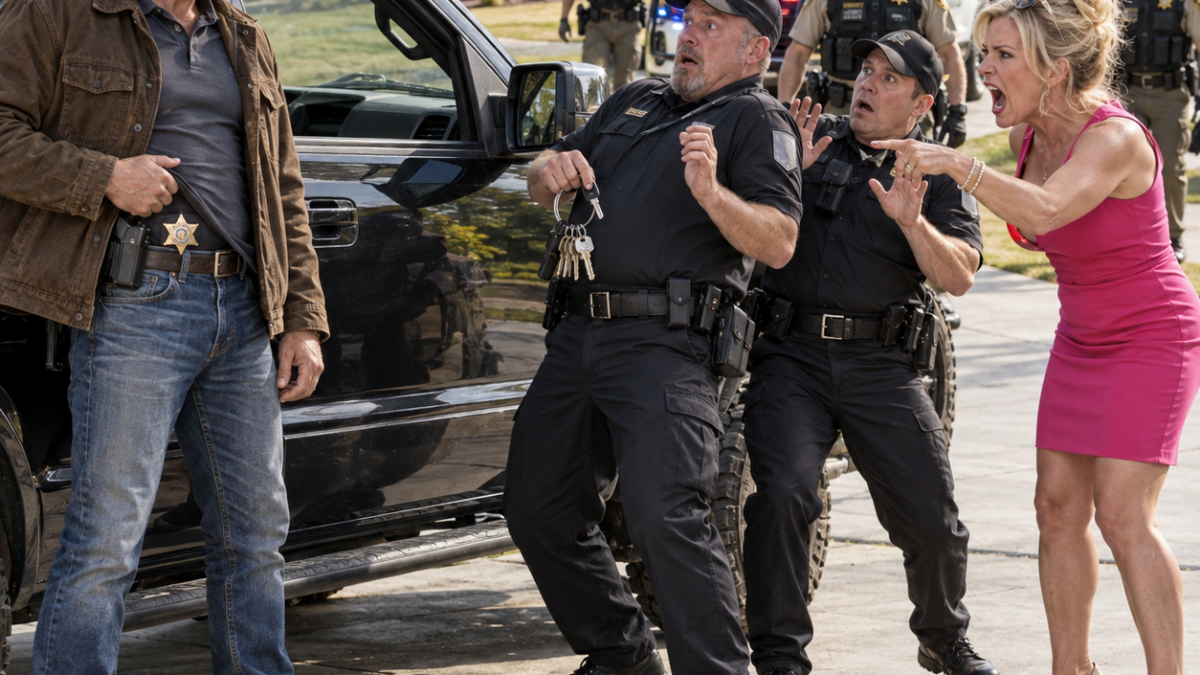
Before Torres could continue, a silver Mercedes swept into the street and stopped near my mailbox.
Barbara Walker stepped out dressed as if she had been attending a charity breakfast instead of coordinating a false 911 call before seven in the morning.
Cream blazer.
Pearls.
Hair perfect.
Folder in hand.
She walked toward my deputies.
“Thank God.”
Mendoza looked at her.
“You called?”
“Yes. Barbara Walker. HOA president.”
She pointed toward my house.
“That resident has been escalating for weeks.”
“Escalating how?”
“Hostile communications. Harassment of our volunteer security team. Refusal to comply with community standards.”
Torres asked:
“Did he threaten anyone this morning?”
Barbara looked at Rick.
Rick looked away.
“He has made threatening statements previously.”
“What specifically?”
She paused.
“Mr. Dutton informed me he said there would be consequences if we approached the truck.”
That was when I stood.
Enough.
I walked to the front door.
Opened it.
Morning air hit my face.
Rick saw me first.
He stopped talking.
Barbara turned.
Her expression immediately hardened.
“There he is.”
I walked down the porch steps.
Torres turned.
Professional neutrality.
“Sir.”
“Deputy.”
“Are you the homeowner?”
“Yes.”
“And the owner of the Ford?”
“Yes.”
Rick stepped between us verbally.
“This is what I’ve been trying to explain. He refuses all cooperation.”
Torres ignored him.
“Did you see what happened this morning?”
“Yes.”
Barbara smiled as if she had just won something.
“So you admit there was suspicious activity.”
“I watched two Pinewood security employees try to break into my truck.”
Silence.
Tyler looked at the ground.
Rick’s face tightened.
Barbara blinked.
I continued.
“Mr. Dutton used the lockout tool currently hanging from his belt.”
Torres’s gaze dropped.
Slim jim.
Still there.
“He worked the driver’s lock for roughly ten minutes.”
Rick opened his mouth.
“Then he kicked the tire twice and struck the driver’s door hard enough to leave that dent.”
I pointed.
Mendoza walked toward the truck.
Studied the door.
Fresh damage.
Rick finally spoke.
“We were conducting an authorized compliance inspection.”
“Using a slim jim?”
“Vehicle access tool.”
“On a locked private vehicle?”
“HOA security has broad authority—”
“No.”
He looked at me.
“That’s your opinion.”
“No, Rick. It’s the law.”
Barbara interrupted.
“We have master-access authority for enforcement purposes.”
Torres turned toward her.
“Do you have written consent from the vehicle owner?”
“No, because—”
“A warrant?”
“No.”
“A court order?”
“The CC&Rs—”
“That wasn’t my question.”
Barbara’s face flushed.
Torres looked toward me.
“Mr. King, do you have evidence of the attempted entry?”
“Yes.”
“How?”
“Dash camera, exterior camera, garage camera.”
Rick went pale.
Barbara recovered first.
“Anyone can manipulate video.”
“Cloud backed up in real time.”
That removed most of her confidence.
I continued.
“Audio also captured Mr. Dutton calling you after he failed to open the truck.”
Barbara’s mouth tightened.
“He suggested you call law enforcement and falsely report suspicious activity so deputies could search the vehicle.”
“That is absolutely false.”
“Then the recording will clear you.”
She stopped.
For half a second, nobody spoke.
Then Mendoza asked:
“Mr. Dutton, did you call Mrs. Walker after attempting to open the vehicle?”
He looked toward Barbara.
Bad choice.
Good witnesses answer questions.
People constructing stories look at each other.
“Yes.”
“What did you discuss?”
“Community enforcement.”
“Did you ask her to call 911?”
“Yes, but—”
“Why?”
“To report suspicious circumstances.”
“What suspicious circumstances existed before you attempted to open the vehicle?”
Silence.
Tyler took one step away from Rick.
Barbara pointed toward me.
“He threatened them.”
I looked at her.
“What did I say this morning?”
She hesitated.
“You’ve been threatening our security team for weeks.”
“That isn’t what you said on the call.”
Rick’s eyes narrowed.
“You weren’t outside.”
“No.”
“So how would you know?”
That was almost too easy.
“Because your entire conversation is recorded.”
His face changed.
Not pale anymore.
Gray.
Torres looked at me.
“You can provide the footage?”
“Immediately.”
“Before we review it, I need to confirm your identity for the report.”
“Of course.”
I reached into my back pocket.
Barbara flinched.
So did Rick.
I removed my credential wallet.
Opened it.
Held it where both deputies could see.
Then turned slightly toward Barbara.
“Ethan King.”
The gold star caught the morning light.
“Sheriff of Summit County.”
Barbara’s mouth opened.
Nothing came out.
Rick physically stepped backward.
Tyler whispered:
“Oh my God.”
Torres maintained professional composure.
Mendoza almost managed it.
Almost.
Barbara stared at the badge.
Then at me.
Then at the two marked cruisers.
“The sheriff?”
“Yes.”
“You’re the sheriff?”
“For approximately three months.”
Rick’s hand drifted away from his belt.
Every ounce of manufactured authority drained out of him.
Barbara finally found her voice.
“This is entrapment.”
“No.”
“You intentionally concealed your position.”
“I moved into a private home.”
“You let us believe you were an ordinary resident.”
“I am an ordinary resident.”
“You knew what Rick might do.”
“I knew what you had already done.”
Her eyes widened.
I continued.
“You sent unsupported violation notices. Threatened an unlawful tow from private property. Your security chief entered my side yard without permission. He repeatedly photographed my private vehicle. A neighbor warned me of prior vehicle entries.”
Helen’s porch light came on three houses down.
Maybe she had been listening.
Maybe she saw the patrol cars.
I looked back at Barbara.
“Nothing required me to announce my profession.”
Rick pointed at me.
“You were setting us up.”
“I parked my truck in my driveway.”
“That lock was modified.”
“It’s my truck.”
“You knew the master key wouldn’t work.”
“There is no master key to privately owned vehicles.”
His face twisted.
“We have always—”
He stopped.
Too late.
Torres heard it.
“So you’ve done this before?”
Rick stared.
Barbara snapped:
“Don’t answer that.”
Mendoza turned toward her.
“Ma’am, do not interfere with my questioning.”
Barbara looked offended.
“I’m the president of this association.”
“And I’m a sworn deputy sheriff conducting an investigation.”
That was the moment Barbara realized titles only matter inside the systems that recognize them.
Pinewood recognized hers.
Colorado recognized ours.
There was a difference.
Torres looked toward me.
“Sheriff, given your personal involvement, I’m going to contact the duty lieutenant and request outside supervisory review before any custodial decision involving serious charges.”
“Correct.”
That was why I trusted him.
I might be sheriff.
But I was also the victim.
I had no business turning my driveway into my personal courtroom.
“Secure the evidence,” I said. “Handle it exactly as you would for anyone else.”
Barbara looked almost relieved.
Then Tyler spoke.
“I’ll cooperate.”
Rick whipped around.
“Shut up.”
Tyler raised both hands.
“I told him not to do this.”
“Tyler.”
“I’m not getting arrested because of you.”
Mendoza moved between them.
“Mr. Reeves, step over here.”
Tyler did.
He pointed toward Rick’s belt.
“He uses that tool all the time.”
Helen had come down her walkway.
She stopped near the edge of my property.
Rick saw her.
“You.”
Helen’s posture stiffened.
Barbara said:
“Helen, go home.”
Something changed in her.
Maybe the sight of actual deputies.
Maybe my badge.
Maybe simply reaching the end of fear.
“No.”
Barbara stared.
Helen walked closer.
“My husband spent thirty years with Denver PD.”
Mendoza nodded for her to continue.
“I watched Rick use that tool before.”
“On what?”
“Residents’ vehicles.”
Rick shouted:
“She’s lying.”
Helen’s voice shook.
“The Petersons.”
Barbara went white.
Helen continued.
“They questioned HOA fees.”
She looked toward my house.
“Then things disappeared from their car.”
Rick shook his head violently.
“No.”
“Them and others.”
“Helen.”
Barbara’s voice became dangerously calm.
“Think carefully.”
Helen looked at her.
“I have been thinking carefully for four years.”
Neighbors were emerging now.
Doors opening.
Phones appearing.
The private conflict was becoming public.
Helen raised her voice.
“They drove families out.”
Barbara stared.
“They punished anyone who questioned them.”
A woman across the street stopped halfway down her driveway.
Helen continued.
“We all knew something was wrong.”
Her eyes filled.
“And we stayed quiet because we didn’t want to be next.”
No one laughed.
No one interrupted.
The lieutenant arrived ten minutes later.
Then a Colorado Bureau of Investigation liaison was contacted because my personal role required clean separation.
The dash-camera footage was reviewed first.
It was devastating.
Rick entering the driveway.
Slim jim.
Repeated attempts.
Kicking the tire.
Damaging the door.
Then audio.
**Call the cops. Report the vehicle as suspicious. Say we saw someone tampering with it.**
Barbara closed her eyes.
The 911 recording was preserved.
Her call contained claims that Pinewood security had observed “unknown suspicious activity” near my truck and feared it might be stolen or connected to criminal conduct.
She did not mention that Rick was the person manipulating the door.
She did not mention she knew who lived at the address.
She did not mention weeks of HOA conflict.
She manufactured urgency and omitted the facts that would expose the lie.
The lieutenant finished listening.
Then looked at Barbara.
“Mrs. Walker, I’m going to advise you not to answer additional questions without counsel.”
That sentence finally frightened her.
“Am I under arrest?”
“Not yet.”
Rick looked toward the patrol cars.
He had stopped pretending to be security chief.
Now he looked like every suspect I had seen after confidence breaks.
Small movements.
Dry lips.
Constant scanning.
Calculation.
Then he made his worst decision after the false report.
He started talking.
“This was Barbara’s policy.”
Her head snapped toward him.
“Rick.”
“She told us to inspect problem vehicles.”
“Stop.”
“She said HOA authority covered it.”
“Shut your mouth.”
“She bought the tools.”
Neighbors reacted.
Helen covered her mouth.
Rick kept going.
“The master key system was her idea.”
Barbara stepped toward him.
Mendoza blocked her.
Rick’s words accelerated.
“The Petersons. Yeah. I went into their car.”
Helen whispered:
“Oh God.”
“Small stuff.”
Rick sounded desperate to minimize it.
“Sunglasses. Loose change. Nothing important.”
The crowd reacted louder.
Barbara shouted:
“You idiot!”
Rick pointed at her.
“You told me to!”
“Stop talking!”
“You said it would encourage compliance.”
There it was.
Public.
Recorded.
Witnessed.
The operation in one sentence.
**Encourage compliance.**
Not enforce law.
Not protect property.
Make people uncomfortable enough to obey.
Torres removed Rick’s lockout tool.
Bagged it.
The dent in my truck was photographed.
My video copied.
Tyler gave a preliminary statement.
Then the lieutenant made the custody decision.
Rick Dutton was arrested.
Attempted unlawful entry into a motor vehicle.
Criminal mischief.
False reporting.
Additional charges pending investigation into prior incidents.
When the cuffs went around his wrists, he stared at them.
For four years, those restraints had hung from his belt beside the tool residents feared.
Now real deputies were using real authority on him.
Barbara was taken separately.
At first for questioning connected to the false report and conspiracy.
Within days, evidence expanded the case.
But that morning, before she entered the patrol car, she turned toward me.
“You destroyed Pinewood.”
I stood on my porch.
“No.”
“You had every chance to resolve this quietly.”
“I tried parking my legal truck in my own driveway.”
“This neighborhood will never be the same.”
“I hope not.”
Her expression hardened.
“You could have stopped this the first day.”
That one stayed with me.
Because she was technically right.
I could have shown the badge.
Stopped my own harassment.
Maybe intimidated Rick into leaving my truck alone.
Maybe forced Barbara to retract the notices.
But that wouldn’t have helped the Petersons.
Wouldn’t have helped Helen.
Wouldn’t have shown Tyler he could speak.
Wouldn’t have exposed what “master access” actually meant.
I looked at Barbara.
“I could have stopped what you were doing to me.”
I paused.
“But then you would’ve done it to somebody else.”
Mendoza placed her in the cruiser.
The door closed.
By eight that morning, Pinewood Estates looked like a neighborhood waking after a storm.
People stood in clusters.
Some recording.
Some whispering.
Some simply staring at the empty space where Barbara’s Mercedes had been.
Helen approached me.
Her eyes were red.
“I should’ve said something years ago.”
“You said something today.”
“Too late for the Petersons.”
“Maybe not.”
She looked at me.
“What do you mean?”
“If Rick told the truth, there are records.”
That became the next phase.
Search warrants were executed on Pinewood Security’s office and the HOA management files after investigators established enough cause.
The evidence was ugly.
Vehicle photographs.
Violation lists.
Target addresses.
Internal emails between Barbara and Rick.
One spreadsheet categorized residents.
**COMPLIANT.**
**RESISTANT.**
**HOSTILE.**
**MONITOR.**
My name appeared near the bottom.
**KING — HOSTILE / VEHICLE NONCOMPLIANCE / ESCALATE.**
The Petersons appeared too.
**PETERSON — FINANCIAL AGITATOR / MONITOR VEHICLE.**
Financial agitator.
Their crime had been asking where HOA money went.
Investigators contacted them.
They had moved nearly two hundred miles away.
When I spoke with Mr. Peterson by phone, he was silent for a long time.
Then:
“Someone finally believed us?”
“I believe you.”
“No.”
His voice broke.
“Someone with authority.”
That distinction hurt.
They had filed complaints.
Not formal criminal complaints because the missing property seemed too small and they lacked proof.
But letters to the HOA.
Requests for explanations.
Everything ended with Barbara telling them security inspections were authorized.
Eventually, they convinced themselves maybe they were overreacting.
That was the recurring damage.
Barbara and Rick did not need to terrorize everyone openly.
They only needed residents to distrust their own understanding.
The towing contractor cooperated too.
Records showed Pinewood had ordered dozens of aggressive tows under questionable authority.
Some were from common-area parking.
Others from private driveways.
Several residents had paid hundreds in fees to recover legally registered vehicles.
One couple had missed a medical appointment because their car disappeared overnight.
Another resident paid nearly $900 after challenging the tow and accumulating storage charges while Barbara refused to authorize release.
Every story sounded small in isolation.
Together, they became a system.
My daughter came home Friday.
Emily walked through the door carrying an overnight bag.
Then immediately looked toward the driveway.
“Where’s the dent?”
“Repair appointment Monday.”
She hugged me harder than usual.
“You okay?”
“Yes.”
“You sure?”
“No.”
She nodded.
“That sounds more believable.”
We sat on the back deck.
I told her everything.
The attempted entry.
911 call.
Rick’s confession.
Helen.
The Petersons.
When I finished, Emily stared toward the mountains.
“You could’ve ended it on day one.”
“I know.”
“Showed them the badge.”
“Yes.”
“Then none of this happens.”
“To me.”
She looked at me.
I continued.
“That’s the difference.”
Emily thought quietly.
“If Barbara knew you were sheriff, she’d have treated you differently.”
“Immediately.”
“And kept doing it to everyone else.”
“Probably.”
She smiled faintly.
“You’re terrifying sometimes.”
“Your mother said that too.”
Her face softened at Elena’s name.
Then she said:
“Mom would’ve liked Helen.”
I smiled.
“She would.”
Elena had hated bullies.
Especially polished ones.
The kind who smiled while making cruelty sound procedural.
For the first time since moving to Pinewood, I wished badly enough that Elena were sitting beside us that the grief became physical.
Two years after losing someone, people expect grief to become manageable.
It does.
Until suddenly it isn’t.
Emily reached across the table.
“You handled it the way she would’ve wanted.”
“How’s that?”
“Patient.”
I laughed.
“She called me the least patient man alive.”
“Patient when it matters.”
Emily squeezed my hand.
“And mean when necessary.”
“Now that sounds like your mother.”
The criminal case moved faster than expected because evidence was unusually clean.
Video.
Audio.
911 recording.
Witness statements.
The lockout tool.
Internal HOA documents.
Rick’s statements.
Tyler’s cooperation.
Investigators found four additional residents willing to describe unauthorized vehicle entries.
Three reported missing property.
One still had home-security footage showing Rick opening a vehicle door while another guard watched.
The statute of limitations complicated some incidents.
Others remained chargeable.
Barbara’s role came through messages.
One text to Rick regarding the Petersons said:
**Pressure needs to feel personal or they won’t leave.**
Another:
**Nothing expensive. We need discomfort, not police.**
That message destroyed any argument that vehicle entries had been legitimate inspections.
The financial side became equally uncomfortable.
Barbara had used HOA money to fund Pinewood Security’s expanded patrols without proper competitive review.
Rick’s company received incentive payments tied to enforcement collections.
More fines meant more revenue.
More enforcement revenue meant more money for Rick.
The system rewarded escalation.
It explained the ridiculous notices.
Truck aesthetics.
Grass.
Parking.
Small violations weren’t community governance.
They were production quotas wearing neighborhood language.
At the preliminary hearing, I testified as Ethan King, victim and witness.
Not as sheriff directing the case.
The distinction mattered.
Barbara wore navy.
Rick wore a suit that fit poorly.
Tyler testified first.
His voice shook.
The prosecutor asked:
“Were you instructed to enter residents’ vehicles?”
“No.”
“Were you instructed to assist?”
“Sometimes.”
“How?”
“Watch the street.”
“Did you believe you had legal authority?”
“At first.”
“What changed?”
“I asked Rick to show me.”
“Show you what?”
“Where the HOA rules said we could unlock private cars.”
“And?”
“He told me I asked too many questions.”
The prosecutor displayed an internal schedule.
Tyler’s hours dropped immediately afterward.
“So you learned what happened when employees questioned him?”
“Yes.”
“What did you do?”
“I kept quiet.”
He swallowed.
“I’m sorry.”
Helen testified next.
She described the Petersons.
Her husband’s declining health.
Her fear.
Then she described watching Rick behave like law enforcement.
“My husband wore a real badge.”
Her voice cracked.
“He spent thirty years being careful about what that badge allowed.”
She looked toward Rick.
“That man wore a costume and acted like it allowed anything.”
Even the judge looked up at that.
The Petersons testified remotely during a later proceeding.
Mrs. Peterson cried when prosecutors showed her Barbara’s messages.
She wasn’t crying about sunglasses.
She was crying because four years of self-doubt disappeared in one sentence.
“They did it on purpose.”
“Yes,” the prosecutor said gently.
She looked toward her husband.
“We weren’t crazy.”
“No.”
That was the moment I understood why exposure mattered more than stopping one morning’s burglary.
Validation can arrive years late and still change a life.
Rick accepted a plea first.
The final sentence was not the massive prison term some residents wanted.
Probation.
Community service.
Restitution.
Permanent loss of his security credentials.
Strict no-contact provisions.
Additional consequences tied to prior incidents.
Some people complained.
Helen didn’t.
“He’ll never put that uniform on again.”
That was enough for her.
Barbara held out longer.
Changed attorneys.
Attacked procedure.
Claimed political retaliation.
Claimed I engineered everything because I hated HOAs.
Claimed Pinewood Security’s practices predated her presidency.
Then investigators introduced her texts.
The defense changed.
Eventually she accepted a plea.
Two years probation.
Three hundred hours of community service.
Fine.
Restitution connected to affected residents.
Five-year prohibition from holding an HOA board position under the agreement.
Other civil claims followed separately.
At sentencing, the judge looked directly at her.
“You consistently confused elected community office with governmental authority.”
Barbara stared ahead.
“You created pressure systems designed to silence residents.”
No reaction.
“You empowered private security to conduct acts that had no lawful basis.”
Still nothing.
Then:
“You referred to your neighbors as problems to be managed rather than people whose rights you were obligated to respect.”
That finally made Barbara look down.
I felt no triumph.
Only relief.
Pinewood held an emergency election three weeks later.
The old board effectively collapsed.
Two members resigned.
Another was voted out.
Kelly Chen, a retired accountant, became president.
She had lived in Pinewood twelve years and had never once attended a board meeting before Barbara’s arrest.
Her campaign speech lasted four minutes.
“I don’t want power.”
Residents laughed nervously.
Kelly continued.
“I want the bills paid, the landscaping maintained, and the financial statements posted online.”
She won overwhelmingly.
Pinewood Security was dissolved.
The towing contract terminated.
A properly licensed security company was hired solely for common-area patrol, gate assistance, and emergency observation.
No police-style badges.
No vehicle-entry tools.
No invented detention authority.
Any suspected crime went to the sheriff’s office.
As it should have from the beginning.
The CC&Rs were reviewed by independent counsel.
Several vague provisions Barbara had stretched into enforcement powers were rewritten.
Vehicle rules became objective.
No more “aesthetic incompatibility.”
If it was legally registered, operable, and parked properly, the HOA stayed out of it.
The first time I read that amendment, I looked at my Ford in the driveway.
Still dark blue.
Still twelve years old.
Still apparently capable of surviving an HOA coup.
Helen came over after the election carrying wine.
We sat on my porch.
No whispers.
No checking the street.
She looked different.
Younger somehow.
“The Petersons called me.”
“How are they?”
“They’re thinking about visiting.”
“Good.”
“She said maybe moving back.”
That surprised me.
“After everything?”
Helen nodded.
“Her grandchildren are here.”
She looked toward Barbara’s house.
“For years they thought the whole neighborhood hated them.”
“It didn’t.”
“I know.”
“But nobody told them.”
Helen flinched.
“Exactly.”
We sat quietly.
Then she said:
“My husband would have liked you.”
I looked at her.
“He hated sheriffs.”
She laughed.
“Denver PD.”
“Fair.”
“He would’ve respected how you did this.”
“By letting someone dent my truck?”
“That part he would’ve called stupid.”
“Also fair.”
She smiled.
Then her face changed.
“Why didn’t you tell me?”
“What?”
“That you were sheriff.”
“You didn’t ask.”
“Oh, please.”
I laughed.
“I didn’t want Pinewood treating me differently.”
“Well, now everybody knows.”
“Unfortunately.”
“You realize the next HOA meeting is going to be terrified of you.”
“That sounds unhealthy.”
“Maybe healthy for one meeting.”
Emily came home again the following month.
She had law-school applications spread across my dining table.
One afternoon, a cream-colored envelope arrived.
For half a second, both of us froze.
Then Emily laughed.
“PTSD from stationery?”
“Apparently.”
I opened it.
Pinewood Estates Community Association.
Invitation to the next board meeting.
Kelly had added a handwritten note.
**We would be honored if you’d consider serving.**
Emily read over my shoulder.
Her eyes widened.
“Oh, this is fantastic.”
“No.”
“Sheriff HOA president.”
“Absolutely not.”
“I would pay money.”
“No.”
“You could finally regulate truck aesthetics properly.”
I pointed at her.
“Keep talking and I charge rent.”
She laughed.
“You can do some good.”
I looked toward the mountains.
“I already did.”
“You don’t think the board needs people like you?”
“No.”
That surprised her.
“Why?”
“Because the lesson fails if Pinewood only behaves because the sheriff sits at the table.”
She became quiet.
“The community needs ordinary people willing to read documents, challenge bad decisions, and vote.”
“So you’re declining.”
“Yes.”
“Mom would approve.”
“Your mother would run for president just to argue with everyone.”
Emily laughed.
That laugh was Elena’s.
Exactly.
For a moment, I closed my eyes.
Then I wrote Kelly a polite refusal.
The next year changed Pinewood slowly.
Not dramatically.
That was what I liked most.
Board meetings became boring.
People questioned budgets.
Kelly answered.
Security invoices were published.
Residents appealed fines.
Sometimes they won.
Sometimes they didn’t.
Nobody got targeted afterward.
The woman in tennis whites who had confronted Emily eventually left muffins on my porch with a note.
**I repeated things I did not verify. I’m sorry.**
I ate the muffins.
Threw the note into a drawer.
Not every apology needs analysis.
One Saturday, the Petersons visited.
I recognized their car from Helen’s description before they even knocked.
Mr. Peterson stood on my porch staring past me into the house that had once been his.
“This place looks good.”
“You kept it that way.”
He smiled faintly.
“My wife picked that light fixture.”
Mrs. Peterson touched the porch column.
Then she looked toward my truck.
“That’s the famous vehicle?”
“That’s it.”
“It looks normal.”
“I’m devastated.”
She laughed.
Then cried.
Helen walked over.
The reunion became messy.
Hugs.
Apologies.
Anger.
People saying things they should have said four years earlier.
I stayed mostly silent.
At one point, Mr. Peterson asked:
“Did you know what you were getting into when you bought here?”
“No.”
“Would you still have bought?”
I thought about Elena.
About wanting mountain quiet.
About Barbara.
Rick.
Emily.
Helen.
“I think so.”
He looked surprised.
“Why?”
“Because leaving every place with bad people to the bad people doesn’t improve much.”
He nodded slowly.
“Wish I’d been able to stay.”
“You survived.”
“That felt like losing.”
“Sometimes those are the same thing temporarily.”
They didn’t move back.
Not then.
But they visited often.
Eventually bought a smaller place nearby.
Close enough for grandchildren.
Far enough from old memories.
Rick completed his community service.
The last time I saw him, he was beside a county road in an orange vest collecting trash.
I recognized him instantly.
He recognized the truck.
He lowered his eyes.
I did not stop.
Some people expect confrontation after justice.
A speech.
Final humiliation.
I had none.
The court already spoke.
His license was gone.
His security career finished.
Anything I added would be performance.
Barbara sold her house four months after sentencing.
Moved out of state.
Her Mercedes disappeared.
Her influence disappeared faster.
Pinewood survived easily without her.
That is another thing controlling people rarely understand.
They convince themselves they are indispensable because everyone has been forced to route everything through them.
Remove them, and life often becomes simpler.
The mountains did not collapse.
Property values did not crater because my Ford remained visible.
Children continued going to school.
Garbage was collected.
Lawns grew.
People lived.
The HOA discovered civilization could survive a pickup truck.
I repaired the dent.
Almost regretted it afterward.
Emily said I should have kept it.
“Evidence of battle.”
“I have photographs.”
“Less dramatic.”
“I’m forty-five.”
“Exactly.”
She eventually got into law school.
The acceptance email arrived while she was visiting.
She screamed from the kitchen.
I thought someone was hurt.
Then she ran into the room holding her laptop.
“I GOT IN.”
I hugged her.
Hard.
For a moment the HOA story vanished.
Elena should have been there.
That ache arrived again.
Emily cried into my shoulder.
“Mom should see this.”
“I know.”
“She knew.”
“I know.”
Later that evening, Emily pointed toward my sheriff badge resting near Elena’s photograph.
“You know what’s funny?”
“What?”
“That stupid truck story is going to follow me forever.”
“Your law-school personal statement better not mention it.”
“I already used it.”
I stared.
She smiled.
“Relax. I wrote about the difference between authority and legitimacy.”
“That’s not terrible.”
“High praise.”
I raised my glass.
“To future lawyers.”
She clinked hers against mine.
“To sheriffs who don’t tell anybody they’re sheriffs.”
The phrase stayed with me.
Because that had been the heart of what happened.
Barbara and Rick behaved differently depending on who they believed stood in front of them.
That was the problem.
Rights aren’t supposed to depend on whether the person being mistreated can ruin your career.
Rick should not have respected my truck because I was sheriff.
He should have respected it because it wasn’t his.
Barbara should not have stopped harassing me because I had a badge.
She should never have started because the covenants did not support her.
Helen should not have needed a law-enforcement neighbor before telling the truth.
The Petersons should not have needed vindication years later.
Rules matter most when the person affected appears powerless.
That is where character appears.
Years after the case, new residents sometimes learned the story.
Usually exaggerated.
One version claimed Rick tried hot-wiring the truck.
Another said Barbara herself crawled underneath with bolt cutters.
Someone told a newcomer I emerged from the house wearing full sheriff tactical gear.
The truth was much less cinematic.
I walked outside in jeans and a shirt.
I asked questions.
Showed evidence.
Then showed a badge.
That was enough.
At a community barbecue, a new neighbor approached me.
“Are you the sheriff with the truck?”
“I own several shirts too.”
He laughed.
“Can I ask you something?”
“Sure.”
“Why didn’t you just tell them immediately?”
I had answered this question many times.
But that day, Helen was sitting nearby.
The Petersons were visiting.
Kelly was arguing with the treasurer over napkin expenses.
Kids were riding bicycles.
My Ford was parked openly along the curb.
So I answered differently.
“Because I wanted to know whether Pinewood was safe for someone who wasn’t sheriff.”
The man’s smile disappeared.
“Was it?”
“No.”
“And now?”
I looked around.
“Better.”
That was enough.
No place is perfect.
No HOA policy can eliminate ego.
No audit prevents every bad decision.
No bylaw can create courage.
Communities work because ordinary people decide not to surrender responsibility completely.
They read.
Ask.
Vote.
Object.
Support neighbors.
And sometimes admit they were wrong.
Pinewood eventually did that.
One morning several years later, I sat on the porch drinking coffee.
Same time.
Same mountain light.
Same truck.
A white utility SUV turned onto my street.
For an instant, old instinct tightened my shoulders.
Then I saw the logo.
Licensed security contractor.
The driver waved.
Kept moving.
No slowdown.
No photographs.
No tool belt.
No invented authority.
I smiled.
The Ford’s new dash cam still blinked green.
Habit.
Evidence is easier to collect before you need it.
Emily called.
“Morning.”
“Shouldn’t law students sleep?”
“No.”
“What happened?”
“Nothing.”
“Then why are you calling at six-fifty?”
“Checking if the HOA arrested your truck again.”
“Very funny.”
She laughed.
“What are you doing?”
“Coffee.”
“Mom’s porch?”
I looked toward Elena’s old chair.
I had kept it.
“Yeah.”
There was a pause.
“Good.”
After the call, I sat quietly.
The neighborhood was waking.
Garage doors opening.
Dogs being walked.
A man loading tools into a pickup truck two streets over.
A pickup.
Pinewood had survived another aesthetic catastrophe.
I thought about Barbara’s first visit.
**Pinewood has standards.**
She had been right.
The neighborhood did need standards.
Just not the kind she meant.
It needed standards for power.
Standards for evidence.
Standards for how neighbors treated people who disagreed.
Standards for how leadership handled criticism.
Standards for when private security stopped and police authority began.
Those were harder than vehicle rules because they applied to people in charge.
Barbara had loved rules that constrained everyone else.
The new Pinewood learned rules matter most when they constrain leadership too.
That was the real reform.
Not abolishing the HOA.
Not ending security.
Not turning every resident into a rebel.
Creating boundaries.
Rick thought his uniform made him law enforcement.
It didn’t.
Barbara thought a board vote gave her police powers.
It didn’t.
I was sheriff.
Even that did not give me unlimited authority.
That was why Torres’s decision to request outside review mattered.
Why investigators handled evidence rather than letting me control everything.
Why I testified as a victim.
Real authority accepts boundaries.
Fake authority hates them.
That is how you tell the difference.
The anniversary of Elena’s death arrived that spring.
Emily came home.
We visited the cemetery.
Then drove back through Pinewood.
As we turned onto my street, she pointed.
“Look.”
A new resident was washing an old pickup in his driveway.
Rust over one wheel well.
Mismatched tailgate.
Barbara might have fainted.
Emily laughed.
“Property values are doomed.”
“Clearly.”
We parked.
She looked at my Ford.
“Dad?”
“Yeah?”
“You ever think about buying something newer?”
I stared at her.
“Get out.”
She laughed all the way to the front door.
That evening we sat on the porch.
Mountain sunset.
Elena’s photograph between us.
Emily said:
“You found the quiet you wanted.”
I considered Pinewood.
Children shouting somewhere.
A lawn mower.
Music from a garage.
Helen talking with another neighbor.
Normal life isn’t silent.
“No.”
Emily looked at me.
“I found something better.”
“What?”
“Peace.”
She understood.
Quiet can be imposed.
Barbara had built a quiet neighborhood.
People stopped speaking because speaking had consequences.
Peace was different.
Peace was Helen walking across the street without fear.
Residents arguing at open meetings.
Emily challenging an angry neighbor.
The Petersons returning without shame.
A security guard driving past without pretending he owned the law.
Peace made noise.
I preferred it.
Years later, when somebody asks what happened the morning Pinewood’s fake cops called 911 because their “master key” wouldn’t open my truck, they usually expect me to talk about the badge.
And yes, that moment was unforgettable.
Rick Dutton had spent fifteen minutes trying to break into my Ford.
Damaged it.
Then called Barbara and helped create a false report designed to turn real deputies against me.
He stood in my driveway wearing a police-style uniform, acting like the neighborhood belonged to him.
Barbara arrived with a folder of accusations, certain the arrival of actual law enforcement would finally force me to submit.
Then I opened the leather case.
**SHERIFF — SUMMIT COUNTY.**
Rick’s face emptied.
Barbara stopped breathing for a second.
Tyler looked like he wanted the earth to swallow him.
My deputies remained professionals.
The neighborhood watched.
That was satisfying.
I won’t lie.
But the badge was not the weapon people think it was.
The footage mattered.
Helen mattered.
Tyler mattered.
The 911 recording mattered.
The CC&Rs mattered.
The Petersons mattered.
Documentation mattered.
If the only reason they fell was because I outranked them, Pinewood wouldn’t have learned anything.
The lesson was that they were wrong even before anyone knew who I was.
They were wrong when I was just Ethan King.
Widower.
Father.
Truck owner.
Neighbor.
That mattered more than the badge.
Barbara once said I had destroyed the community.
She was wrong about that too.
Her system had already damaged Pinewood.
I simply stopped pretending it was normal.
Rick called his lockout tool a master key.
But there is no master key to another person’s rights.
Not an HOA title.
Not a security uniform.
Not political connections.
Not even a sheriff’s star.
Authority always has a lock.
The law is supposed to be the key.
And on that Saturday morning, Rick Dutton finally discovered that his little piece of metal opened nothing that actually mattered.
The truck remained mine.
The house remained mine.
My neighbors found their voices.
My deputies did their jobs.
The people who abused their positions faced consequences.
And Pinewood Estates finally became the quiet mountain community I had thought I was buying in the first place.
Only now, when I sit on my porch with coffee and see a security vehicle pass, nobody slows down to photograph my truck.
Nobody leaves fake towing notices.
Nobody enters my yard.
Nobody tells me I’m hurting property values because I drive a Ford.
They simply keep going.
And every now and then, I think back to the morning Rick couldn’t get his “master key” to work, lost his temper, and made the call that ended everything.
He wanted real cops.
He got them.
He wanted them to investigate the owner of that suspicious truck.
They did.
And when the investigation was over, the suspicious man was still standing in his own driveway.
The HOA president was in custody.
Their fake security chief was wearing real handcuffs.
And the truck they tried so desperately to get rid of was parked exactly where it had always legally belonged.
My driveway.
My home.
My choice.
[END OF FULL STORY]








