PART 2: HOA Security Smashed My Wife’s New R0lls-Royce—Then Their President Called 911 and Made One Mistake Too Many
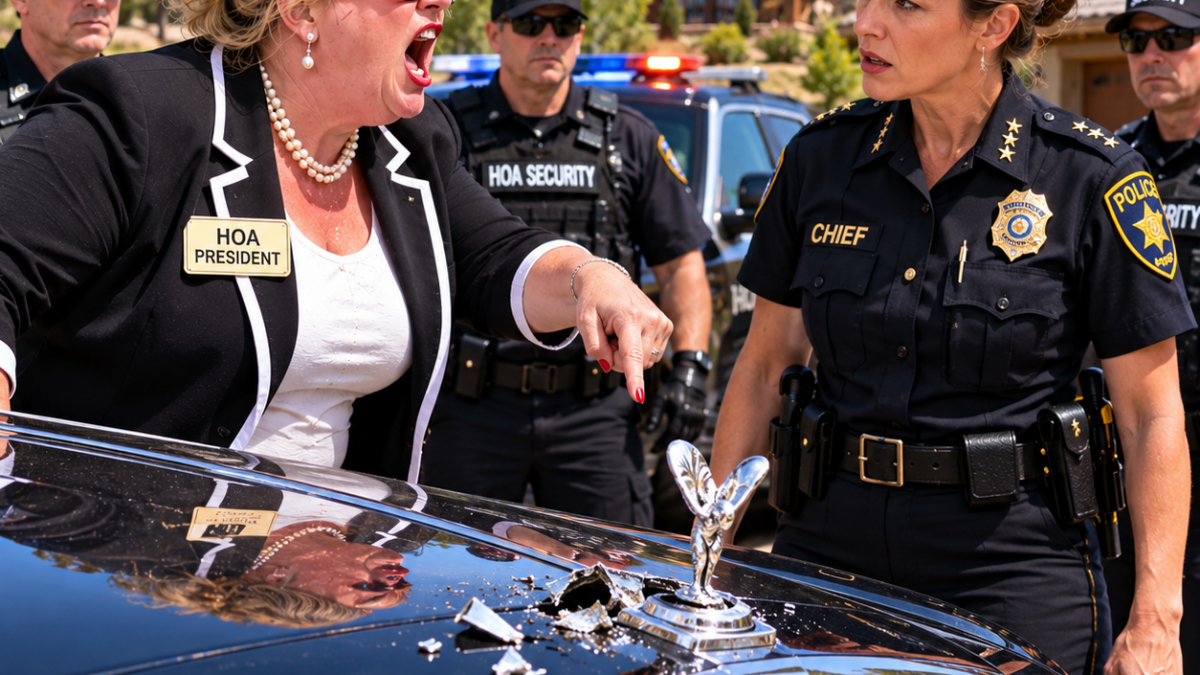
PART 2
After the officers left, Derek stayed.
Abigail’s Mercedes was drivable, barely.
She stood beside it.
“This isn’t over.”
“I hope you mean the insurance claim.”
“You think because one patrol officer takes your side you’ve won something?”
“No.”
“You’re going to learn how things work here.”
I looked toward my porch camera.
“They seem to work better when recorded.”
Her face sharpened.
Derek pointed toward the Cullinan.
“I’m issuing a violation for improper vehicle placement.”
I almost laughed.
“Under what section?”
“Parking regulation.”
“Number?”
“I don’t carry the bylaws.”
“Then don’t issue a legal demand you can’t identify.”
His face flushed.
“I’m authorized to enforce community rules.”
“You’re authorized by whom?”
“The board.”
“To do what?”
“Security.”
“That isn’t a legal definition.”
He stepped closer.
Derek was bigger than me.
He knew it.
“I suggest you watch your tone.”
My phone was still recording.
“I suggest you stop using physical intimidation while claiming to act as security.”
His eyes dropped to the phone.
That stopped him.
Abigail snapped:
“Derek.”
He stepped back.
Good dog, I thought.
Didn’t say it.
Cheryl had specifically instructed me not to provoke them.
I was already pushing the boundary.
Abigail drove away.
Derek followed.
I stood beside the damaged car.
The anger arrived after they were gone.
Not because it was expensive.
Because I knew what it meant to Cheryl.
She had spent years putting away money.
Overtime.
Promotions.
Bonuses.
Every time we considered using the account for something else, she said:
“Someday.”
The Cullinan was her someday.
And Abigail had hit it three days after delivery, then tried to turn Cheryl into a suspect.
I went inside and copied every recording three times.
***
Cheryl arrived after dark.
She didn’t come into the house first.
She parked her department-issued SUV, crossed the driveway, and stopped beside the Cullinan.
I watched from the porch.
She ran her fingertips along the bent quarter panel.
No expression.
Then she crouched beside the shattered tail lamp.
“Could be worse,” I said.
She stood.
“That is an extremely husband thing to say about my car.”
“I was trying optimism.”
“Stop.”
I smiled.
She didn’t.
Not yet.
“Torres filed the report.”
“You talked to her?”
“She routed it through normal channels.”
“Good.”
“She cited Abigail.”
“I know.”
“And the false stolen-car report?”
Cheryl leaned against the hood.
“The district attorney’s intake people may review it. But one exaggerated 911 call is not automatically a prosecutable false-report case.”
“She said stolen.”
“She’ll say she was suspicious.”
“She said drugs.”
“She’ll say community concern.”
“She lied.”
“I know.”
Her voice stayed calm.
That was how Cheryl handled anger.
She compressed it until it became structure.
“What do you want to do?” I asked.
“Insurance first.”
“Civil claim?”
“If justified.”
“HOA?”
She looked toward the street.
“That depends.”
“On?”
“Whether today was one arrogant woman having a bad morning or part of something bigger.”
I thought of Derek.
Mandatory orientation.
Camera approval.
Parking threats.
Abigail’s comment about “your type.”
“It’s bigger.”
Cheryl nodded.
“Then prove it.”
That was all I needed.
***
My porch camera showed the collision better than I expected.
8:17:24 a.m.
Abigail’s Mercedes entered frame.
Not speeding.
No dog.
No child.
No obstruction.
At 8:17:27, her vehicle drifted gradually right.
Her head angled downward.
One hand near her face.
Phone.
The Mercedes crossed toward our driveway apron.
Impact.
I preserved the original file with metadata.
Created read-only backups.
Sent a copy to insurance.
Sent another to my own counsel archive.
Then I turned to Pinerest Estates.
The original declaration was recorded in 2003.
Reasonably standard.
Architectural controls.
Assessments.
Maintenance.
Board elections.
Notice requirements.
Fine procedures.
Amendment thresholds.
Nothing especially sinister.
Then amendments started accumulating.
2007.
2010.
2012.
After Abigail became president, they accelerated.
Fine schedule expanded.
Board enforcement discretion widened.
Appeal windows shortened.
Security authority increased.
Orientation procedures.
Special assessments.
Some appeared properly approved.
Others didn’t.
I created a spreadsheet.
Date.
Provision.
Required homeowner vote.
Recorded vote evidence.
Meeting notice.
Quorum.
I expected a few procedural defects.
I found seventeen.
Seventeen amendments with missing or inconsistent approval records.
Some board minutes said “approved by board” when the original declaration appeared to require homeowner consent.
Others referenced quorum numbers that did not match attendance lists.
One amendment granted the president unilateral authority to authorize “emergency enforcement actions.”
That was the clause Derek relied on.
I searched Colorado law and current association records carefully rather than assuming every defect automatically voided everything.
Some issues might be curable.
Some might be barred by limitation periods.
Some could still be enforceable under different authority.
But collectively, the governance pattern was ugly.
Then I found a name.
Wayne Wilson.
Repeated in minutes.
**Mr. Wilson questioned quorum.**
**Mr. Wilson requested roll-call vote.**
**Mr. Wilson objected to executive-session procedure.**
Every time:
Motion denied.
Objection overruled.
Meeting moved forward.
Wayne lived four houses away.
I knocked on his door the next morning.
***
He was a real-estate attorney.
That made the conversation easier.
And harder.
He knew exactly why talking to me could become dangerous.
We sat in his home office.
I put the spreadsheet on his desk.
Wayne read three rows.
Then five.
Then looked at me.
“Where did you get the amendment dates?”
“Recorder’s office.”
“And the attendance records?”
“Meeting packets online.”
He leaned closer.
“You found the quorum discrepancy.”
“Several.”
He got up.
Went to a cabinet.
Pulled out a thick blue folder.
“I’ve been trying to reconstruct this for three years.”
“Why?”
“Because Abigail changed the fine-appeal process after a homeowner challenged her.”
He opened the folder.
“Then she used the new procedure retroactively.”
“Did anyone sue?”
“Yes.”
Tom Harrison.
Four years earlier.
Harassment.
Selective enforcement.
Due-process allegations.
The case settled.
Public docket showed $78,000 paid, though the detailed settlement terms were confidential.
“Insurance?” I asked.
“Mostly.”
“Homeowners?”
“Premium increase hit the budget the next year.”
“How much?”
“About forty percent.”
“Did residents know why?”
“The board called it market adjustment.”
Of course.
“Would you testify about the governance issues?”
Wayne leaned back.
“No.”
Blunt.
“Why?”
“My firm does title and land-use work here.”
“Abigail’s husband?”
“Charles Collins is a partner at Morrison and Associates.”
“I know.”
“Morrison handles a large percentage of development work in this county.”
“So?”
“So professional courage is cheaper when you’re retired.”
Fair.
“What would change your answer?”
“A case that can win.”
“Meaning?”
“Not outrage. Evidence. Enough homeowners. Enough documented violations. Something that survives if Abigail hires serious counsel.”
I closed the folder.
“So build it first.”
“Yes.”
“That’s what I’m doing.”
“I know.”
“How?”
He looked toward the window.
“Everybody knows what you’re doing.”
We’d been in the neighborhood less than a week.
Good to know.
***
Robert Hayes was retired.
Former Pinerest treasurer.
He spent mornings pruning roses.
Wayne gave me his name.
Robert saw me coming up the walk and said:
“Wayne sent you.”
“Apparently everyone knows everything here.”
“You moved in with a Rolls-Royce and got into a fight with Abigail Collins. You’re not subtle.”
“Fair.”
He kept trimming.
“What do you want?”
“History.”
“You already have bylaws.”
“I need people.”
That got his attention.
We sat on his porch.
Robert explained the Pattersons.
Nineteen violation notices in eighteen months.
Grass.
Mailbox.
Trash cans.
Driveway stain.
Holiday lights.
Eventually they sold.
Then Flores family.
Repeated city code complaints.
Noise allegations.
Parking.
Rental accusations.
They left.
Margaret Owens.
Retired teacher.
Challenged fines publicly.
Her car was keyed afterward.
“No proof Abigail did it,” Robert said immediately.
“Good.”
He looked at me.
“Good?”
“Because if you had said you knew without proof, I’d distrust everything else.”
That earned a small smile.
“She didn’t have to key cars.”
“What do you mean?”
“Authority attracts volunteers.”
“People trying to please her?”
“People who liked being close to the person making decisions.”
That was more believable than a secret criminal command structure.
“How long were you treasurer?”
“Five years.”
“Why quit?”
“Because I approved numbers I knew were being used badly.”
“That sounds like regret.”
“It is.”
He looked at his roses.
“My wife says I surrendered my spine.”
“Harsh.”
“Accurate.”
“Would you testify?”
Robert didn’t answer immediately.
“If this turns into one demand letter and then you settle, no.”
“Why?”
“Because Abigail survives those.”
“What if it goes further?”
“If you actually challenge the governance structure?”
“Yes.”
He cut a dead stem.
Then said:
“I’ll stand up.”
***
Derek was easier to research.
His mistake was pretending to have more authority than he possessed.
He called himself “Pinerest Security.”
His Explorer had yellow lettering and an amber light bar.
Harmless enough by itself.
But residents described traffic stops.
Derek would activate colored lights mounted inside the grille, pull residents over on private streets, demand names, photograph licenses, issue “community safety citations.”
Colorado licensing rules were more complicated than the source material suggested, and I wasn’t going to claim a crime from a Google search.
So I did what lawyers do.
I documented.
Photographs.
Resident statements.
Videos.
One homeowner had dashcam footage showing Derek positioning his Explorer behind her vehicle with flashing red-and-blue LEDs.
That was much more serious.
Another had a written “traffic warning” signed by Derek.
I requested his licensing status through the appropriate state database.
No active private-investigator or relevant occupational credential appeared under the role he claimed.
I also found an old employment matter from a shopping mall security contractor.
Termination after an excessive-force complaint.
No criminal charge.
No judgment.
I included it only as background, not proof of current misconduct.
Evidence works best when you resist making it carry more weight than it can.
By Sunday, my Pinerest file was thick.
Cheryl read it at the dining table.
She turned pages slowly.
At the end, she looked at me.
“You’ve been here nine days.”
“I’m efficient.”
“This is disturbing.”
“Me?”
“The HOA.”
“Thank you.”
She closed the folder.
“What’s your goal?”
That stopped me.
“Accountability.”
“Lawyer word.”
“Reform.”
“Another lawyer word.”
I leaned back.
“Fine. I want Abigail to stop using this association to punish people who challenge her.”
“And Derek?”
“Stop pretending he’s law enforcement.”
“And the car?”
“Insurance pays.”
“And what do you want personally?”
I knew what she was asking.
“An apology.”
“To you?”
“To you.”
Cheryl looked toward the garage.
The Cullinan was scheduled for repair assessment Monday.
“I don’t need one.”
“I do.”
She reached across the table.
“Then ask for one correctly.”
So I wrote the demand.
***
The letter was precise.
No threats of criminal prosecution.
No abuse of Cheryl’s position.
No dramatic accusations.
Vehicle damage.
Insurance cooperation.
Retraction of false criminal allegations.
Preservation of video and 911 records.
Notice that continued defamatory statements could create additional civil exposure.
I requested written confirmation within ten days.
Abigail responded in twenty-four hours.
Not to me.
To everybody.
**URGENT COMMUNITY SAFETY CONCERNS**
Emergency HOA meeting.
Tuesday.
Purpose:
“Legal harassment and destabilization efforts by new residents.”
She accused Cheryl and me of threatening community volunteers.
Undermining safety.
Using litigation tactics to intimidate board leadership.
The email did not mention that she hit our car.
Did not mention the traffic citation.
Did not mention the stolen-vehicle allegation.
Narrative control.
Cheryl read it over my shoulder.
“She wants an audience.”
“Yes.”
“Give her one.”
“That sounds unlike you.”
“Public facts survive better than private rumors.”
“You’re coming?”
“I live here.”
“You’re not speaking as chief.”
“No.”
“Even if she attacks you?”
Cheryl looked at me.
“Especially then.”
***
The clubhouse held eighty-three residents.
Nearly double normal attendance.
Abigail had succeeded in making us the event.
She stood at the front podium.
Derek near the door.
Two board members beside her.
Cheryl and I sat near the back.
Nobody greeted us.
Abigail opened carefully.
She spoke about service.
Sacrifice.
Property values.
Twelve years of unpaid leadership.
Then she described our collision as “a minor accident being weaponized by an attorney.”
That was me.
She described her 911 call as “a reasonable request for verification.”
Then:
“I never imagined that welcoming new neighbors would result in threats against my family.”
A woman nodded.
A man near the window muttered:
“Lawyers.”
I raised my hand.
Abigail stared.
“Mr. Walker, this isn’t a courtroom.”
“Good.”
A few people laughed.
Her expression tightened.
“Two minutes.”
I walked forward.
“Last Tuesday, Mrs. Collins drove across her lane and struck my wife’s parked vehicle.”
Murmurs.
“I have the original camera footage.”
Abigail interrupted.
“Disputed footage.”
“The responding officer issued Mrs. Collins a traffic citation based in part on her own statement and the scene.”
“That citation is being contested.”
“Fine.”
I turned toward the residents.
“She then called 911 and reported my wife’s legally registered vehicle as potentially stolen. She also suggested our income could be connected to drug activity.”
Someone gasped.
Abigail stood.
“That is not what I said.”
“I have the recording.”
Silence.
A voice:
“Play it.”
“I’ll provide copies through proper channels. But the police incident report is public.”
Abigail’s face tightened.
I continued.
“This would still be a dispute between neighbors if it were isolated.”
Robert Hayes stood.
“It isn’t.”
Every head turned.
Abigail said:
“Robert, sit down.”
He ignored her.
“I was treasurer.”
Murmurs.
“I watched this board use fines to grind down families.”
Abigail:
“That is outrageous.”
Robert:
“The Pattersons received nineteen violation notices in eighteen months.”
“They violated rules.”
“Every week?”
“They refused compliance.”
Robert turned toward the room.
“They sold at a loss.”
Someone said:
“That was their choice.”
Wayne Wilson stood next.
“The Harrison litigation cost this association seventy-eight thousand dollars.”
That got attention.
Wayne continued.
“Insurance covered substantial portions, but the community paid through increased premiums.”
Abigail’s face reddened.
“This is a coordinated attack.”
Wayne:
“No. It’s a governance discussion we should have had years ago.”
The room began to fracture.
Residents spoke.
Holiday-decoration fines.
Mailbox disputes.
Appeal denials.
A special assessment nobody remembered voting for.
Then a man in a golf shirt raised his hand.
“This is all anecdotal.”
Good objection.
I nodded.
“Correct.”
Abigail looked pleased.
“So let’s discuss documents.”
I held up my spreadsheet.
“The declaration requires specific voting procedures for certain amendments. I identified seventeen amendments where the public record and available minutes do not establish the required approval.”
Abigail laughed.
“You are not the association’s attorney.”
“No.”
“Then your interpretation is meaningless.”
“It’s reviewable.”
Wayne said:
“I independently identified several of the same defects.”
The room quieted again.
I continued.
“Separately, residents have documented Pinerest security using emergency-style lights during vehicle stops.”
Derek went pale.
Abigail snapped:
“Derek’s role has nothing to do with this.”
A woman near the aisle said:
“He stopped my daughter.”
Another voice:
“He stopped me.”
Derek shifted toward the door.
I said:
“I’m not accusing him of a crime tonight. I’m saying residents deserve to know what legal authority he claims when stopping vehicles.”
Abigail slammed a hand onto the podium.
“Enough.”
The room went silent.
“This is exactly what I warned you about.”
Her voice had lost the soft public-service tone.
“This community was safe before people like this arrived.”
There it was.
Not explicit enough to define.
Clear enough to make the room uncomfortable.
She continued.
“I have spent twelve years keeping the wrong elements out of Pinerest.”
Someone near me whispered:
“What does that mean?”
Abigail heard it.
“I mean people who do not respect our standards.”
She pointed at me.
“People who arrive with money, attorneys, threats, and an attitude that rules don’t apply to them.”
I almost laughed.
She was describing herself.
Then she pulled out her phone.
“I’m done.”
“Abigail,” one board member said.
“No.”
She dialed.
“If the board refuses to maintain order, I’ll call people who will.”
For the second time in eight days, she called 911 because reality wasn’t agreeing with her.
***
“Yes,” she said loudly.
“This is Abigail Collins at the Pinerest Estates clubhouse.”
The room was silent enough to hear the dispatcher’s muffled voice.
“We have individuals disrupting a private meeting, threatening residents, refusing to leave.”
Nobody had threatened anyone.
Nobody had been asked to leave.
Abigail looked directly at me.
“Yes. I’m concerned for my safety.”
She ended the call.
Several people shifted toward the exits.
Police make innocent people nervous too.
The man in the golf shirt rubbed his forehead.
“This has gotten ridiculous.”
He was right.
Cheryl had sat silently through everything.
Now she stood.
No drama.
No rush.
She walked down the center aisle.
Abigail watched her approach.
Probably thought Cheryl was finally coming to defend me.
Instead, my wife pulled out her phone.
She called dispatch directly.
“Milbrook dispatch, Chief Walker.”
The room changed before the sentence was complete.
A few people recognized the title.
Others didn’t.
Cheryl continued.
“Badge zero-zero-one. Cancel the priority response to Pinerest Estates clubhouse. I’m on scene. There is no active threat and no emergency.”
You could have heard a pen drop.
Abigail stared.
“Chief?”
Cheryl ended the call.
Then faced the room.
“My name is Cheryl Walker.”
Nobody moved.
“I became chief of the Milbrook Police Department three weeks ago.”
Abigail’s face emptied.
Cheryl’s voice stayed calm.
“The Rolls-Royce Mrs. Collins damaged is my personal vehicle. I bought it with savings accumulated over approximately twenty years in law enforcement.”
She paused.
“My husband and I deliberately did not disclose my position during this dispute because I did not want my office involved in a private neighborhood matter.”
Officer Torres’s behavior flashed through my mind.
She had known.
And respected the boundary.
Cheryl continued.
“Mrs. Collins called police after the collision and suggested my vehicle was stolen and that our finances might be connected to illegal activity.”
Abigail finally found her voice.
“I didn’t know.”
Cheryl turned toward her.
“What didn’t you know?”
“That you were—”
“The chief?”
Abigail stopped.
Cheryl’s voice became quieter.
“Would knowing have changed whether you hit my car?”
“No, but—”
“Would it have changed whether you reported it as stolen?”
“I had concerns.”
“Would it have changed whether you suggested I might be connected to drugs?”
Abigail said nothing.
Cheryl looked around the room.
“That is precisely why my title should not matter.”
The silence held.
“If behavior becomes acceptable or unacceptable depending on whether the person being targeted has institutional power, then the problem is not misunderstanding. It is selective treatment.”
That sentence hit harder than any accusation I could have made.
The clubhouse door opened.
Officer Torres stepped in with Officer Reed.
She saw Cheryl.
“Chief.”
“Officer.”
No theatrics.
No salute.
Just professional recognition.
Torres said:
“Dispatch relayed your update. Do you require assistance?”
Cheryl nodded toward Abigail.
“Please document the circumstances of tonight’s 911 call. Eighty-three witnesses were present. I will submit a statement through the appropriate process.”
“Understood.”
Then Cheryl looked toward Derek.
He was moving slowly toward the rear door.
“Mr. Simmons.”
He froze.
“Please stay.”
Abigail said:
“What does he have to do with this?”
Cheryl replied:
“Nothing involving my private dispute unless evidence supports it.”
That distinction mattered.
Then:
“But the department has received information regarding private traffic stops conducted with emergency-style lighting. That matter has been referred for investigation.”
Derek’s face went pale.
“I was doing what the board asked.”
Abigail turned on him instantly.
“I never told you to impersonate police.”
He looked at her.
“You told me to enforce traffic.”
“HOA traffic rules.”
“With the lights you approved.”
“I did not approve illegal lights.”
The betrayal arrived faster than I expected.
Not because Abigail suddenly hated Derek.
Because she understood liability.
Derek understood too.
“You signed the equipment reimbursement.”
Her head snapped toward him.
“What?”
“I have the receipts.”
That changed the room again.
Officer Torres raised a hand.
“Stop.”
Both of them did.
“This is not the place to litigate that issue.”
Exactly.
Real accountability is less cinematic than people expect.
Nobody immediately handcuffed Derek.
Instead, Torres obtained identifying information and instructed him not to interfere with residents while investigators reviewed the matter.
Derek looked almost disappointed.
As if some part of him had spent years believing handcuffs were what made authority real.
***
Robert Hayes stood.
“I move for an emergency no-confidence vote regarding Abigail Collins as board president.”
Abigail whirled.
“You cannot do that.”
Wayne said:
“The bylaws permit removal procedures.”
“Not tonight.”
Robert:
“Then call a special membership meeting.”
A dozen voices agreed.
Residents were no longer waiting for permission.
That was the true collapse.
Abigail had always survived because people challenged her individually.
Now the room had become collective.
One board member, Nancy Cho, tried to restore order.
“We need counsel before making decisions.”
Reasonable.
Wayne nodded.
“Yes.”
Abigail stared at him.
“You’re taking their side.”
“No.”
He looked around.
“I’m taking the side of following the governing documents.”
Someone laughed.
Abigail did not.
Robert amended his motion.
Formal petition for a special meeting to consider removal.
Enough homeowners volunteered signatures before we left to trigger the process under the bylaws.
Abigail watched them line up.
No badge did that.
No lawsuit.
Her own meeting did.
She had invited everyone to watch her destroy us.
Instead, they finally watched each other stop being afraid.
***
Outside, Cheryl stood beside me in the parking lot.
“You okay?” I asked.
“Yes.”
“You sure?”
“No.”
That was more honest.
“Want to go home?”
“Yes.”
Officer Torres approached.
“Chief.”
Cheryl’s shoulders tightened slightly.
Not because Torres had done anything wrong.
Because from that moment forward, she couldn’t be anonymous.
Torres said:
“I recognized the registration on the collision call.”
“I assumed.”
“I kept it out of the report except where ownership required it.”
“Thank you.”
“I wanted you to know I handled it normally.”
“I know.”
Torres looked relieved.
Then:
“Ma’am, for what it’s worth, Mrs. Collins did say she’d complain to the chief.”
Cheryl’s mouth twitched.
“I heard.”
“Sorry.”
“Don’t be. You did your job.”
After Torres walked away, I said:
“That may be the funniest part.”
“It isn’t.”
“Not even a little?”
She looked at me.
Then finally smiled.
“A little.”
***
The special membership meeting happened eleven days later.
This time, Abigail arrived with counsel.
So did the association.
And so did almost every homeowner.
The removal vote was decisive.
Not unanimous.
That mattered.
Some residents still supported her.
Some believed the entire dispute had become a pile-on.
Some thought her twelve years of service outweighed procedural mistakes.
That was reality.
But the votes were enough.
Abigail Collins was removed as president.
The remaining board elected Robert Hayes interim president pending a full election.
Derek’s “security” role was suspended immediately.
All emergency-style lights were removed from the Explorer.
Traffic enforcement stopped.
Robert’s first resolution commissioned an independent governance audit.
That audit became worse for Abigail than anything I had uncovered.
Nineteen amendments lacked adequate approval support or contained procedural defects requiring repeal, ratification, or legal review.
Several fine procedures conflicted with governing requirements.
Special-assessment approvals were questionable.
Appeal practices had been inconsistently applied.
The board’s unilateral enforcement expansion had exceeded what counsel believed the association could safely defend.
Not every amendment was automatically void.
The auditors were careful about that.
Some were rescinded.
Some re-adopted properly.
Others abandoned altogether.
The larger point was undeniable.
Pinerest had spent years operating on rules nobody had bothered to verify.
***
Abigail’s insurance carrier covered the Rolls-Royce repair after reviewing the video.
The final repair estimate came slightly above the first number once hidden damage was found.
Quarter panel.
Tail light assembly.
Sensors.
Paint blending.
Calibration.
The body shop needed weeks.
Cheryl drove her department SUV and acted like she didn’t care.
I knew better.
Once, I found her in the garage looking at the empty bay.
“Miss it?”
“No.”
“You’re a terrible liar.”
“I’m a police chief.”
“Those are not mutually exclusive.”
She gave me a look.
Then:
“Yes.”
That car represented more than money.
I think Abigail sensed that even without understanding it.
People who use status as a weapon assume expensive things are purchased to impress other people.
Cheryl had bought hers for the opposite reason.
She had spent two decades in uniform.
Being watched.
Judged.
Measured.
The Cullinan was something she chose entirely for herself.
***
Derek’s case also moved slower than neighborhood rumor.
Residents wanted instant criminal charges for impersonating an officer.
Investigators wanted evidence.
Videos were collected.
Vehicle equipment documented.
Statements taken.
Receipts subpoenaed where appropriate.
The central issue became whether Derek knowingly represented himself as law enforcement or used prohibited emergency equipment in a manner violating state law.
He ultimately accepted a negotiated resolution on charges supported by the evidence.
Probation.
Community service.
Restrictions that ended his ability to operate as Pinerest’s pseudo-police presence.
The association terminated him.
He sold the Explorer.
For a while I felt sorry for him.
Then Wayne gave me a statement from a nineteen-year-old resident Derek had stopped after dark.
The young man said Derek ordered him out of his vehicle and photographed his license while wearing a tactical vest.
No police authority.
No crime.
Just HOA power dressed to resemble something bigger.
My sympathy became more limited.
Still, Derek wasn’t Abigail.
He had been useful to her because he wanted authority.
She gave him a stage.
He performed.
Then when consequences arrived, they turned on each other.
That part felt predictable.
***
Abigail fought everything.
Her traffic citation.
The civil demand.
The HOA removal.
The governance audit.
The false-report concerns.
She hired outside counsel after her husband’s firm correctly refused the conflict.
Her lawyers were good.
They made arguments that deserved answers.
The 911 calls, they said, reflected subjective concern.
Her statements about stolen property were questions, not knowingly false reports.
Her comments about illegal money were irresponsible but potentially opinion rather than actionable defamation in every context.
The collision was an ordinary negligence claim.
The HOA governance disputes were corporate matters, not proof of personal fraud.
That legal caution frustrated residents.
They wanted a single proceeding where someone announced:
**Abigail Collins was wrong about everything.**
Law doesn’t work that way.
Different conduct.
Different elements.
Different burdens.
Different insurers.
Different procedures.
So we separated them.
The accident resolved through insurance.
The retraction through negotiated civil settlement.
The HOA governance issues through member action and board counsel.
Any criminal allegation through prosecutors, not through me.
That separation protected Cheryl too.
She recused herself from internal department decisions concerning Abigail whenever appropriate.
Complaints involving our personal dispute were routed outside her direct command.
She documented the conflict.
Sometimes another agency reviewed sensitive questions.
Abigail’s attorney later tried to suggest Cheryl’s position contaminated the process.
The paper trail showing Cheryl had deliberately walled herself off helped destroy that argument.
Cheryl had thought ahead.
She always did.
***
The civil negotiation took weeks.
My demand was simple.
Insurance cooperation.
Repair costs.
Incidental expenses.
Written retraction of criminal insinuations.
No admission requirement beyond what could be supported.
Abigail hated the retraction.
Money she could write off as settlement.
Words were different.
A written statement meant surrendering the narrative.
Her attorney called me.
“Your client doesn’t need public humiliation.”
“My client?”
“Your wife.”
“She’s not my client.”
A pause.
“Right.”
Lawyers sometimes forget spouses can be lawyers too.
He continued.
“What does Mr. Walker want?”
“I am Mr. Walker.”
Another pause.
Poor man.
Finally:
“What do you want?”
“Correction.”
“To whom?”
“The same audience who received the accusation.”
“The accusation occurred partly in person.”
“And partly in the police call.”
“We cannot distribute a 911 retraction to the world.”
“I didn’t ask that.”
I proposed a written notice to Pinerest residents.
Abigail had made communitywide claims after the collision and at the emergency meeting.
The correction would state that no evidence existed connecting Cheryl or me to theft, drugs, financial crime, or other illegal conduct.
Her lawyer pushed back.
We revised.
Three times.
Four.
Eventually Abigail signed.
When the letter arrived, I read it once.
Cheryl read half.
Set it down.
“That’s it?”
“That’s it.”
She shrugged.
“I told you I didn’t need an apology.”
“It isn’t an apology.”
“Exactly.”
She went back to her coffee.
For me, the retraction mattered.
For her, the car mattered more.
Not financially.
Symbolically.
She wanted the thing restored, not the insult debated forever.
***
The audit refunds surprised everyone.
Invalid or improperly imposed fines had accumulated over years.
The new board created a review process.
Not every resident received money.
Some fines had been valid.
Some documentation was too old.
Some disputes were unresolved.
But enough were refunded to make people angry all over again.
Margaret Owens received a check.
So did the family who had been fined over holiday decorations.
The Pattersons had moved, but Robert tracked down a forwarding address and sent them notice of the review.
Mrs. Patterson called him crying.
Robert later told me:
“That may be the first useful thing I’ve done as president.”
“Don’t get sentimental.”
“I’m seventy.”
“You’re allowed.”
He smiled.
Robert changed Pinerest more by doing less.
Open meeting records.
Clear agendas.
No surprise enforcement.
Written citation authority.
Independent appeal panel.
Security eliminated.
Orientation voluntary.
Homeowners could disagree without being treated like threats.
It turned out functional governance was boring.
Good.
***
The Collins house went on the market six weeks after Abigail lost the presidency.
Number 12 Maple Crest.
Large colonial.
Perfect landscaping.
Professionally staged.
Price slightly below recent comparables.
Neighborhood gossip said Arizona.
Charles Collins approached me one afternoon while I collected mail.
He looked older.
Not dramatically.
Just tired.
“Russell.”
“Charles.”
We had barely spoken before.
He put his hands in his pockets.
“We’re leaving.”
“I heard.”
“I wanted to say something.”
I waited.
“I should have stopped this years ago.”
That surprised me.
“What did you know?”
“Not everything.”
“That’s not what I asked.”
He winced.
“Enough.”
He looked toward his house.
“I told myself Abigail cared too much.”
“About the neighborhood.”
“Yes.”
“That she was controlling because she thought control was responsibility.”
“Yes.”
“And?”
“And it was easier to stay out of it.”
There it was.
Not villainy.
Cowardice.
Commoner and more damaging than people admit.
“Did you know about Harrison?”
“Yes.”
“Pattersons?”
“Some.”
“Derek?”
“I knew she relied on him too much.”
“Emergency lights?”
“No.”
I believed him.
Maybe because he sounded ashamed rather than defensive.
“She still doesn’t understand,” Charles said.
“What?”
“She thinks her biggest mistake was not knowing Cheryl was chief.”
I looked at him.
“She actually says that?”
“She says if she’d known who your wife was, none of this would have happened.”
“That’s the whole problem.”
“I know.”
He nodded.
“She still thinks different people deserve different treatment.”
I thought of the collision.
The “your type” remark.
The stolen-car report.
If Cheryl had been a nurse.
Teacher.
Restaurant manager.
Retired accountant.
Nothing would have been different morally.
Only Abigail’s risk calculation would have changed.
Charles said:
“I’m sorry.”
I believed he meant it.
That didn’t erase anything.
“You should’ve intervened earlier.”
“I know.”
“But Abigail made her choices.”
He nodded.
“Good luck in Arizona.”
It wasn’t forgiveness.
It was closure.
He walked back toward the moving truck.
***
The body shop called on Saturday.
Cullinan ready.
Cheryl insisted on going alone.
I was trimming shrubs when I heard the engine.
She turned onto Maple Crest slowly.
Petra Gold paint caught the afternoon sun exactly the way it had on moving day.
She pulled into the driveway.
Turned the engine off.
Stepped out.
Then walked around the back.
New quarter panel.
New tail lamps.
Perfect paint match.
She ran her fingers along the repaired section.
I waited.
“Well?”
She nodded.
“Well what?”
“Emotional speech.”
“No.”
“You saved twenty years.”
“It’s a car.”
“Now it’s a car?”
“It was always a car.”
“That you threatened to sleep in when it arrived.”
“I did not threaten.”
“You said I could have the house and you’d live in the Cullinan.”
“That was humor.”
“Chief Walker makes jokes?”
“Rarely.”
She finally smiled.
Then tossed me the keys.
“Want to drive?”
I caught them.
“Is this a test?”
“Yes.”
“What’s the correct answer?”
She took them back.
“Good.”
The next Monday, she drove it to work.
No ceremony.
No fear.
That was how Cheryl reclaimed things.
Use them.
Don’t worship the scar.
***
Robert won the spring board election.
Not unanimously.
About a fifth of the community voted for Nancy Cho, one of Abigail’s former allies.
Robert didn’t care.
“Democracy means people get to be wrong.”
Wayne said:
“That is not an official legal doctrine.”
“It should be.”
Wayne joined as unpaid governance adviser.
He insisted everything important be written.
Robert complained constantly.
They were perfect for each other.
Their first community project was a garden behind the clubhouse.
Abigail had blocked it for years because raised beds supposedly reduced aesthetic uniformity.
Now volunteers built them in a weekend.
I showed up with a shovel.
Wayne looked at my hands.
“You know how to use that?”
“I’ve seen them in discovery exhibits.”
Robert handed me gloves.
“City people.”
“You live in a subdivision.”
“I’m retired. Different species.”
Forty residents participated.
Some had defended Abigail.
Some had stayed silent.
That bothered me more than I expected.
I had wanted loyalty to sort itself cleanly.
Good people helped.
Bad people opposed.
Reality refused.
Some neighbors waited until Abigail lost before discovering courage.
I judged them.
Then I remembered Charles.
Then Robert resigning instead of fighting years earlier.
Then Wayne waiting until I built evidence.
People have risk thresholds.
Progress sometimes requires accepting help from those who arrive late.
I learned to live with that.
***
Our first months after the conflict were awkward.
Linda Hayes invited Cheryl on morning walks.
Wayne’s wife brought baked goods so frequently I suspected an organized campaign.
The man in the golf shirt who questioned me at the meeting nodded when we passed but never stopped.
A couple from Pine Court once crossed the sidewalk when they saw Cheryl and me coming.
Then apparently realized what they had done.
The next time they saw us, they became painfully friendly.
We didn’t push.
Trust does not come from one dramatic meeting.
It comes from trash-day conversations.
Borrowed ladders.
Packages picked up while someone travels.
Snow shoveled from sidewalks.
Ordinary contact.
That was what Abigail had destroyed.
Everybody was always evaluating everybody else.
Compliant.
Noncompliant.
Supporter.
Problem.
Neighborliness became surveillance.
It took time to reverse.
***
The block party was my idea.
Cheryl pretends it was hers because she organized almost everything.
Forty-three people came.
Robert brought beer.
Cheryl made carnitas.
Wayne burned something on a grill and blamed the equipment.
Children ran across lawns Abigail once fined people for using improperly.
Nobody wore name tags.
Nobody signed anything.
At some point, one little boy stopped beside the Cullinan.
“Is that the famous car?”
His mother turned red.
“Ethan.”
Cheryl laughed.
“You want to sit in it?”
His eyes widened.
Ten minutes later there were six children taking turns behind the wheel.
Parents photographing them.
One girl asked:
“Is this a police car?”
Cheryl said:
“No.”
“Can it chase bad guys?”
“No.”
“Is it fast?”
Cheryl considered.
“Ask my husband and he loses the keys.”
I raised both hands.
By sunset, the same car Abigail had treated as evidence of criminality had become a backdrop for family photos.
That affected me more than I expected.
Not because the neighborhood finally approved of our wealth.
I didn’t care about that.
Because the object had lost its burden.
It was just Cheryl’s ridiculous gold SUV again.
Perfect.
***
Months later, I opened the Pinerest file in my office.
Accident photos.
911 transcript.
HOA amendments.
Derek statements.
Meeting notes.
Settlement.
Retraction.
Governance audit.
It was thick.
Too thick.
I had represented corporations in disputes worth hundreds of millions of dollars that generated less emotional energy than one neighborhood power struggle.
I considered shredding it.
Didn’t.
Lawyer reflex.
I moved it to the bottom drawer.
The purpose was complete.
That mattered.
For a while, I had enjoyed building the case too much.
That embarrassed me.
Cheryl called it “litigator brain.”
When someone wronged me, my instinct was not merely to solve the problem.
It was to understand every problem they had ever caused.
That had helped here.
It could also become obsession.
The victory was not maintaining a perfect file.
The victory was no longer needing to open it.
***
The new owners moved into the Collins house the following May.
Young couple.
Two children.
Swing set.
Moving truck.
No interest in association politics as far as I could tell.
I watched from our driveway.
Cheryl asked:
“You going to tell them?”
“Tell them what?”
“The house history.”
“Why?”
She smiled.
“Good answer.”
Ghosts belong to the people who make them.
Not whoever buys the address later.
The Collins name slowly disappeared from neighborhood conversations.
I heard through Robert that Abigail was in Arizona.
Probation being completed.
Charles retired early.
I didn’t verify details.
Their life no longer required my attention.
That was another form of closure.
***
One autumn evening, Cheryl came home and found me on the patio.
She sat beside me.
We watched the sun disappear through the trees.
After a while she said:
“The department nominated me for a state leadership award.”
“For what?”
“Ethics. Community relations.”
“Sounds suspicious.”
She nudged me.
“They mentioned Pinerest.”
I turned.
“You hate that.”
“I don’t know.”
“You did everything right.”
“That isn’t why I did it.”
“I know.”
She had refused the easiest path from the beginning.
One phone call.
One disclosure of rank.
Abigail would have apologized before patrol arrived.
Derek would have backed down.
The HOA might never have escalated.
We could have avoided almost all of it.
But then Abigail would have learned the wrong lesson.
Be careful who you bully.
Instead of:
Don’t bully people.
“Do you regret not telling her?” I asked.
Cheryl thought.
“No.”
“The car?”
“Yes.”
I laughed.
She smiled.
Then became serious.
“I regret that it took my title for some people to believe us.”
That was the heart of it.
The reveal felt satisfying.
Too satisfying.
A room full of people changed when Cheryl said **Chief Walker**.
But we had been telling the truth before that.
The video existed before that.
The registration existed.
The governance records existed.
Robert’s testimony existed.
Wayne’s analysis existed.
Cheryl’s title did not make those facts more true.
It only made people pay attention faster.
“I hated that too,” I said.
She rested her head against my shoulder.
“Still worth staying?”
I looked toward Maple Crest.
Robert walking his dog.
Kids biking near the clubhouse.
Garden beds visible behind the fence.
Our ridiculous Rolls-Royce in the driveway.
“Yes.”
“Good.”
“Why?”
“Because I already unpacked.”
***
A year after the crash, Officer Torres came to the block party.
Off duty.
No uniform.
Cheryl introduced her to neighbors by first name.
Abigail once used police as a threat.
Now the officer who had responded to that threat was standing beside our grill arguing with Wayne about baseball.
That felt like the final correction.
Not punishment.
Normalcy.
Late that evening, after everybody left, Cheryl and I cleaned the driveway.
Paper plates.
Cups.
One child had left a toy police car under the rear tire of the Cullinan.
Cheryl picked it up.
“Evidence.”
“Bag it.”
She tossed it at me.
I caught it.
We laughed.
Then she locked the Cullinan.
The lights flashed once.
For a second, the Petra Gold paint reflected the porch camera.
The same camera Derek had told me required permission on our first evening.
The same camera that captured Abigail drifting into our driveway.
The same camera that made her lie harder because she knew evidence existed.
I looked up at it.
Still there.
Properly installed.
Never removed.
No violation.
No board permission required beyond whatever lawful architectural rules actually applied.
Cheryl followed my eyes.
“Thinking?”
“Dangerous, I know.”
“What?”
“First night here, Derek told me that camera was illegal.”
“And?”
“I think that was the moment I knew.”
“Knew what?”
“That this place had a problem.”
She unlocked the front door.
“No.”
I looked at her.
“You knew when you made a folder.”
Fair.
***
Two years after we moved into Pinerest, the Rolls-Royce stopped being “the Rolls-Royce.”
It became Cheryl’s car.
Sometimes dirty.
Coffee cup in console.
Gym bag in back.
Groceries rolling around.
Once a bag of mulch leaked into the cargo area and I thought she might finally lose emotional control.
She did not.
Much.
The symbolism faded.
Good.
Objects should become ordinary again.
So should neighborhoods.
Pinerest still had arguments.
Fence colors.
Budget increases.
Pool hours.
A vicious debate over pickleball noise that nearly broke Robert emotionally.
But nobody sent pseudo-cops to intimidate dissenters.
Nobody rewrote bylaws in quiet meetings.
Nobody treated the president’s preference like statute.
Residents disagreed openly.
Sometimes unpleasantly.
That was healthier than enforced harmony.
***
Robert resigned after two terms.
He meant it this time.
At his final meeting, he said:
“My greatest accomplishment was making this job boring.”
Everyone applauded.
Wayne whispered to me:
“He stole that from you.”
“I’m suing.”
“You’re exactly why lawyers have reputations.”
The new president was a pediatric nurse named Maya Lopez.
No connection to the old factions.
Her first email began:
**Please remember the board is administrative, not parental.**
I forwarded it to Cheryl.
She replied:
**Frame that.**
I almost did.
***
The final time I saw Derek was at a hardware store.
Three years after the accident.
No tactical clothes.
Jeans.
Work shirt.
He recognized me.
We both hesitated.
Then he walked over.
“Mr. Walker.”
“Derek.”
“I work construction now.”
“Okay.”
“Better.”
I wasn’t sure what he wanted.
Then:
“I was an idiot.”
Direct.
“I liked people moving out of my way.”
That was more self-awareness than I expected.
“Authority feels good,” he said. “Even fake authority.”
I said nothing.
“Abigail made me feel important.”
“You made your own choices.”
“I know.”
Good.
“Do you hate me?”
“No.”
He seemed surprised.
“I don’t think about you.”
That hurt him slightly.
But it was true.
Then he laughed.
“Fair.”
We nodded and went separate directions.
I bought screws.
He bought lumber.
Ordinary people doing ordinary things.
Another ghost gone.
***
On the fifth anniversary of Cheryl becoming chief, the department held a ceremony.
Nothing huge.
Colleagues.
City manager.
Families.
Officer Torres—now Sergeant Torres—gave a short speech.
She mentioned Cheryl’s insistence that rank should never determine whether someone receives fair treatment.
She did not mention Abigail.
She didn’t need to.
Afterward, Cheryl and I walked to the parking lot.
The Cullinan sat under a streetlamp.
Still Petra Gold.
A few scratches now.
One small door ding from a grocery store.
Proof of actual life.
Cheryl touched the repaired quarter panel.
The repair had held so perfectly I could no longer identify the exact damaged area.
“Remember?” I asked.
“I try not to.”
“Abigail calling it stolen?”
“I remember.”
“Threatening to complain to the chief?”
Cheryl laughed.
“That part was funny.”
“Finally.”
She got in.
I walked around to the passenger side.
She rolled down the window.
“You’re not driving.”
“I didn’t ask.”
“You were thinking it.”
“I’m married to a detective.”
“Chief.”
“Right.”
I climbed in.
She started the engine.
For years I had thought the satisfying ending was Abigail discovering who she had called the police on.
It wasn’t.
That was just the loud part.
The satisfying part came later.
When Abigail was gone.
When Derek stopped pretending.
When Robert made the HOA boring.
When children climbed into the car for pictures.
When Cheryl drove it to work without thinking about the crash.
When our porch camera became nothing more than a camera again.
When Maple Crest became a street instead of a battlefield.
Cheryl backed out.
Paused at the end of the driveway.
Then looked at me.
“What?”
“Nothing.”
“You’re doing the lawyer reflection thing.”
“I’m appreciating the neighborhood.”
“Quietly, please.”
She turned onto the street.
We passed the clubhouse.
Community garden behind it.
Lights glowing through the windows.
No Abigail.
No Derek.
No emergency meeting.
No sirens.
Just neighbors.
At the corner, Cheryl accelerated gently.
The Cullinan moved through the darkness without drama.
Five years earlier, Abigail had looked at that car and decided its price made us suspicious.
She had been wrong about the car.
Wrong about us.
Wrong about what authority meant.
But the biggest mistake she made was simpler than all of that.
She believed respect came from making people afraid to challenge her.
Cheryl never had to explain the difference.
She had spent her entire career proving it.
We turned toward home.
And this time, nobody was waiting in our driveway to tell us whether we belonged there.
[END OF STORY]








