PART 2: HOA Security Came to Tow My Father’s 1967 Mustang—They Had No Idea Who They Were Threatening
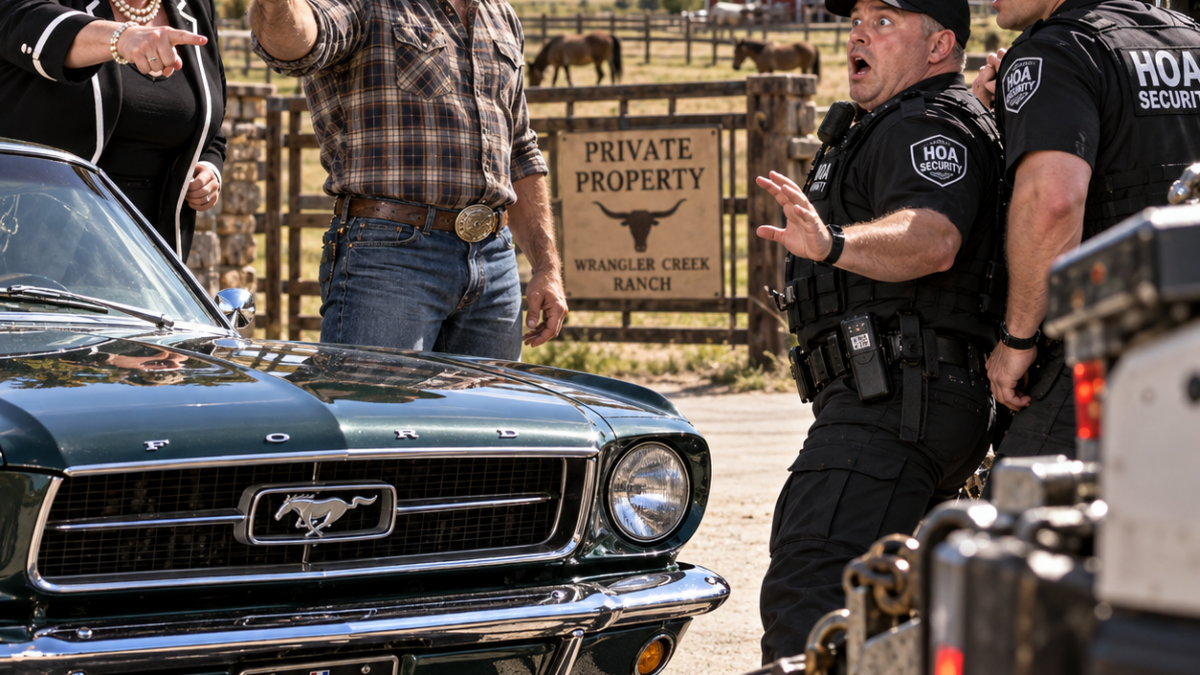
PART 2
His eyes moved from the camera over the garage to the smaller one mounted beneath the eave.
Then to the doorbell camera.
Then the corner camera facing the street.
The change in his face was almost imperceptible.
But I saw it.
People who rely on intimidation prefer memory to evidence.
Memory can be disputed.
Evidence has timestamps.
Gerald stepped forward.
“Mr. Reyes, nobody is accusing you of anything criminal.”
“That’s interesting.”
“Why?”
“Because you just brought a tow truck to take my vehicle without identifying any recorded authority that permits you to do it.”
Tony pointed at the paper in my pocket.
“You have the authorization.”
“No. I have a document Victor Manning signed.”
“That’s authorization.”
“Not from a court.”
“HOAs have enforcement authority.”
“Within their lawful governing documents.”
Tony’s face reddened.
Gerald raised one hand.
“Let’s not turn this into an argument about technical language.”
“It stopped being technical when you tried to take a sixty-year-old car.”
The tow driver climbed back toward his cab.
Tony noticed.
“Stay there.”
The driver stopped.
I looked at him.
“What’s your name?”
He glanced at Tony.
Then Gerald.
“Mike.”
“Mike, have you seen a recorded towing authorization for this address?”
Tony snapped:
“He doesn’t need to answer you.”
Mike swallowed.
“I just dispatch where the company sends me.”
“Were you told the car was on a public roadway?”
Silence.
Gerald said:
“We’re done here.”
Tony looked at him.
“We’re not leaving without the vehicle.”
Gerald’s voice dropped.
“Yes, we are.”
That told me something.
Gerald understood risk.
Tony understood authority.
Victor, I would later learn, understood money.
Different motives.
Same machine.
Tony stepped toward me.
“Listen carefully, Reyes.”
I stayed still.
“Victor Manning has spent fifteen years building relationships in this county.”
“Good for Victor.”
“Commissioners. Business owners. People in government.”
“Congratulations.”
“You think this is about some old car?”
My eyes went to the garage.
The Mustang sat under the overhead lights, polished red paint reflecting the movement outside.
“No.”
I said.
“I’m beginning to think it isn’t.”
Tony smiled.
“People who make problems here usually discover they have problems of their own.”
Gerald’s head snapped toward him.
“Tony.”
“What?”
“Stop talking.”
I asked:
“Was that a threat?”
Tony looked at the nearest camera.
His confidence faded another inch.
“No.”
“Good.”
Gerald took Tony by the elbow.
“We’re leaving.”
Tony shook him off, but he followed.
Mike was already in the flatbed.
The truck backed away first.
Gerald got into the black SUV.
Tony remained beside the passenger door long enough to point at me.
“This is not over.”
Then he climbed inside.
I waited until they turned the corner.
Only then did I let out the breath I had been holding.
***
I went straight to the garage.
Not because I expected another attack immediately.
Because I needed to touch the car.
Dad’s Mustang had survived five decades.
Arizona summers.
Two engine rebuilds.
A rear-fender dent from 1989 that he refused to repair because, according to him, “every car needs one honest scar.”
When he died, I almost sold it.
Restoration was expensive.
Time-consuming.
I lived out of hotels for work.
Then I found his napkin in the glove compartment.
**Take care of her, son. She’ll take care of you.**
I kept it.
Not because I believed cars had souls.
Because fathers leave behind fewer instructions than sons realize until they’re gone.
I closed the hood.
Went inside.
Reviewed the video.
Everything was there.
Arrival.
Truck positioning.
Tony’s false deadline.
Gerald admitting no court was involved.
The threat about Victor’s relationships.
Most importantly, their attempt stopped when challenged.
That suggested previous owners hadn’t challenged successfully.
I opened the Pinewood folder.
Added:
**ATTEMPTED TOW — VIDEO 1**
**ATTEMPTED TOW — VIDEO 2**
**SEIZURE DOCUMENT**
**THREAT STATEMENT**
Then I made a call.
Not to the FBI.
That mattered.
I was on leave.
This started as a personal property dispute.
Being a federal agent did not give me permission to convert my neighborhood problem into my private federal operation.
I called the Maricopa County Sheriff’s Office.
Lieutenant Kevin Ortiz.
I had never met him.
But before buying the house, I had done what I always do when moving somewhere new.
I researched local agencies.
Kevin’s name appeared in older public reports involving complaints about aggressive private towing in several planned communities.
He answered on the third ring.
“Ortiz.”
“My name is Daniel Reyes. I live in Pinewood Ridge Estates.”
“Okay.”
“I want to report an attempted unauthorized tow and possible impersonation of law enforcement by private neighborhood security.”
His tone changed slightly.
“What happened?”
I summarized.
No FBI title.
No influence.
Just facts.
Uniform.
Badge.
Light bar.
Fake seizure order.
Tow truck.
Video.
Threat.
Kevin was silent.
Then:
“Pinewood Ridge?”
“Yes.”
“Security guy named Briggs?”
I stopped.
“You know him?”
“I know complaints.”
“How many?”
“Enough that I’d like to see your video.”
“What happened to the previous complaints?”
“Some people didn’t follow through. Some lacked footage. Some turned into civil settlements.”
“Victor Manning?”
Another pause.
“You should come in Monday.”
“I’ll bring everything.”
“Mr. Reyes?”
“Yes?”
“Don’t confront them unnecessarily.”
“I don’t intend to.”
“Good.”
He hung up.
I sat with the phone in my hand.
Kevin knew Tony by name.
That meant my father’s Mustang wasn’t the first car.
Not even close.
***
Maria Santos was outside that evening watering plants.
I walked over.
She saw my face.
“They came?”
“Yes.”
“For the Mustang?”
“Yes.”
“They tried to tow it?”
“Yes.”
Her watering can stopped.
“What did you do?”
“Asked questions.”
A faint smile.
“That usually upsets them.”
“You said your friend’s vehicle was towed at three in the morning.”
“Yes.”
“You filmed it?”
Her face changed.
“You remember that?”
“I remember everything people tell me when it matters.”
She looked toward the street.
Then back.
“Come inside.”
Maria retrieved an older tablet.
The video quality wasn’t perfect.
But it was clear enough.
3:07 a.m.
Arizona Premier flatbed.
Tony Briggs.
Another uniformed man.
A third person carrying a flashlight.
They entered Maria’s driveway.
No visible posted tow notice.
No owner present.
They hooked a Honda sedan.
Removed it.
“Who owned the car?”
“My friend Elena.”
“Why was she here?”
“Night shift.”
“Hospital?”
“Yes. She was too tired to drive home.”
“Violation?”
“They said overnight guest parking.”
“On your private driveway?”
Maria nodded.
I watched again.
“Did Elena receive notice first?”
“No.”
“Hearing?”
“No.”
“Written appeal?”
“Victor said the tow was final.”
“Did she pay?”
“Eight hundred.”
“Card?”
“Yes.”
“To Arizona Premier?”
“Yes.”
“Would she talk to law enforcement?”
Maria hesitated.
“She moved.”
“Why?”
“This was part of it.”
“Can I contact her?”
“I’ll ask.”
I didn’t push.
Witnesses are not evidence machines.
Fear has to be respected or it becomes another kind of coercion.
Before I left, Maria said:
“Mr. Reyes?”
“Daniel.”
“Daniel.”
She looked toward my house.
“What do you do for work?”
I smiled.
“Government.”
“That sounds intentionally vague.”
“It is.”
She laughed once.
Good.
Fear loosens when people can laugh.
***
Monday morning, I carried thirty-seven pages and a flash drive into the sheriff’s office.
Kevin Ortiz was shorter than I expected.
Fifties.
Gray temples.
Eyes that never stopped measuring.
We sat in a conference room.
He read everything.
No small talk.
When he reached the video, he watched Tony’s threat twice.
Then:
“This is better documentation than we usually get.”
“Habit.”
“What kind?”
I ignored that.
“What have you heard before?”
Kevin leaned back.
“Community security has generated complaints for about two years.”
“Impersonation?”
“People describe badges, traffic stops, flashing lights.”
“Charges?”
“Difficult cases.”
“Why?”
“Residents get scared. Statements change. Civil lawyers get involved. Refund happens. Settlement. Complaint disappears.”
“Victor?”
“Always one layer away.”
“Arizona Premier?”
“Repeatedly mentioned.”
“Financial connection?”
“Suspected. Not proven.”
I nodded.
“What charges do you think the tow attempt supports?”
Kevin gave me a long look.
“You a lawyer?”
“No.”
“Cop?”
“Related field.”
“That is getting annoying.”
“I promise it improves.”
He almost smiled.
Then he explained.
Trespass questions.
Attempted theft depending on intent and circumstances.
Potential criminal impersonation issues if Tony represented himself as a peace officer rather than merely private security.
Towing violations.
Possible fraud if notices intentionally misrepresented legal authority.
“But Victor?” I asked.
“Need connection.”
“He signed the seizure paper.”
“That helps.”
“Enough?”
“For investigation. Not necessarily enough for the entire scheme.”
“Money trail?”
“That would help more.”
“Inside witness?”
“Even better.”
I reached into my jacket.
Placed my credentials on the table.
Kevin stared.
Then looked at me.
Then back at the badge.
“FBI.”
“Special Agent Daniel Reyes. Public Corruption Unit.”
“You could’ve mentioned that.”
“I wanted you evaluating the complaint, not my title.”
He leaned back.
“You’re on duty?”
“Leave.”
“So this is personal.”
“It started personal.”
“And now?”
“I don’t know yet.”
Kevin folded his hands.
“Federal nexus?”
“Not established.”
“Good answer.”
“I’m not opening my own case.”
“Better answer.”
“I’ll provide evidence as a complainant and witness. If facts support federal referral, someone else should supervise it.”
Kevin nodded slowly.
“You’ve done this before.”
“Eighteen years.”
“That explains the camera angles.”
“Those were accidental.”
“Sure.”
I took back my credentials.
Kevin said:
“Give me a few days.”
“I’m interviewing neighbors.”
“As an FBI agent?”
“No.”
“As a resident gathering information relevant to my complaint.”
“Be careful with that line.”
“I know.”
“Do you?”
“Yes.”
He looked at me.
“Federal agents are terrible at being civilians.”
“Occupational problem.”
“Document consent. Don’t imply authority.”
“I won’t.”
“Then keep me updated.”
***
The Henderson family changed the case.
Tom Henderson had lived in Pinewood Ridge nine years.
His wife Lisa had knee surgery eighteen months earlier.
Their pickup was parked in their driveway during recovery.
Arizona Premier towed it at 2:20 a.m.
Violation:
“Extended inactive vehicle storage.”
Lisa needed the truck for physical therapy.
Victor offered to reduce the release fees if she signed an acknowledgement.
She signed.
Tom kept a copy.
I read it at their dining table.
It wasn’t an acknowledgement.
It was a release.
A waiver giving up future claims against:
Pinewood Ridge HOA.
Community Security Patrol.
Arizona Premier Towing.
And related officers.
“You understood this?”
Tom shook his head.
“Victor said it only confirmed we received a reduced fee.”
“What did you pay?”
“Six hundred.”
“Original?”
“Nine hundred.”
“Did he tell you the paper waived liability?”
“No.”
“Would Lisa be willing to tell investigators that?”
He looked toward the hallway.
“She’s embarrassed.”
“Why?”
“Because she signed it.”
“That’s not embarrassing.”
“She thinks she got tricked.”
“That’s different.”
Lisa appeared in the doorway.
Brace gone now.
She had been listening.
“I got tricked.”
She said it herself.
I nodded.
“Yes.”
Her chin lifted.
“Then I’ll say that.”
That was witness number two.
***
The Chen family gave me the financial architecture.
David Chen ran a catering company.
Meticulous records.
His delivery van had been towed for commercial signage.
It was parked in his driveway.
Impound:
$850.
Administrative fee:
$250.
Storage:
$210.
Late penalty:
$90.
Total:
$1,400.
He kept every receipt.
The HOA administrative fee had been remitted to a post-office box in Nevada.
That got my attention.
“Why Nevada?”
David shrugged.
“Never knew.”
“Did you pay electronically?”
“Credit card.”
“Where was it processed?”
He opened his business accounting software.
Merchant descriptor.
A management company I hadn’t seen before.
**SILVER RIDGE ADMINISTRATIVE SERVICES.**
Nevada.
I wrote it down.
That did not automatically create a federal crime.
Interstate payment processing alone does not magically turn every dispute into wire fraud.
But it created a lead.
Who owned Silver Ridge?
What services did it provide?
Why did an Arizona HOA direct administrative fees through Nevada?
I asked David:
“Can law enforcement have copies?”
“Yes.”
“Can they verify with your processor?”
“Yes.”
“Would you testify?”
His answer was immediate.
“Yes.”
“Why no hesitation?”
He looked at his catering van parked outside.
“They almost killed my business.”
***
By Wednesday noon, I had interviewed twelve families.
Not all were victims.
That was important.
Two told me Victor had always treated them fairly.
One thought the towing program improved neighborhood safety.
Another homeowner said:
“People hate rules after they break them.”
I recorded those views too.
An investigation that collects only confirming facts becomes advocacy.
I needed to know whether there was another explanation.
Maybe Victor was strict but legal.
Maybe Tony exceeded instructions.
Maybe Arizona Premier overcharged independently.
Maybe residents misunderstood their own covenants.
But each interview added something.
Repeated tow company.
Repeated waivers.
Repeated references to Tony’s “badge.”
Repeated overnight removals.
Repeated fees.
Repeated inability to identify appeal rights.
Then Mrs. Martinez.
Seventy-four.
Her husband Luis used a wheelchair after injuries sustained during military service.
Their accessibility ramp had been cited as an unauthorized exterior alteration.
$200 per week.
They paid more than $3,000 before a lawyer finally forced the HOA to stop.
I stared at the citation.
“Did Victor know the ramp was medically necessary?”
Mrs. Martinez laughed without humor.
“He came to our house.”
“What did he say?”
“That rules were rules.”
“Did he offer accommodation?”
“He offered extra time to remove it.”
I closed my eyes.
That wasn’t towing.
Different legal issues.
Potential fair-housing and disability concerns.
I wasn’t going to turn every ugly HOA decision into one giant criminal theory.
But it showed Victor’s mindset.
Control first.
People second.
I called Kevin.
“I have twelve families.”
“Good.”
“And a Nevada payment processor.”
“That’s more interesting.”
“I’m sending the records.”
“Anything else?”
“Disability enforcement issue.”
“Separate it.”
“I already did.”
“Okay, federal agent.”
“Lieutenant.”
“Your leave going well?”
“Excellent.”
***
That evening I called Diana Torres.
Not the Officer Torres from the other story.
Special Agent Diana Torres, Phoenix field office.
We had worked together on public-corruption cases for almost a decade.
“I have a weird one.”
“You’re on leave.”
“I know.”
“Then why are you calling me?”
“Because the weird one followed me home.”
I described the facts.
Not my theories first.
Facts.
Fake HOA authority.
Towing pattern.
Nevada processor.
Potential kickback structure.
Threats involving county contacts.
Diana interrupted.
“Back up. Threats involving what?”
“Tony said Victor had relationships with county officials.”
“Specific officials?”
“No.”
“Then don’t call it corruption yet.”
“I didn’t.”
“You were thinking it.”
“Yes.”
“Financial records?”
“Partial.”
“Interstate wires?”
“Likely payment processing.”
“Fraudulent representations?”
“Possible.”
“Victims?”
“At least twelve documented.”
“Local case open?”
“Yes. Maricopa Sheriff.”
“And your role?”
“Victim. Witness. Source.”
“Keep it that way.”
“I know.”
“No, Daniel. I mean it. You don’t get to investigate your own victimization as a federal case.”
“I know.”
“Send me a written referral packet. I’ll route it through intake.”
“Thank you.”
“And enjoy your vacation.”
“Technically leave.”
“You are interviewing twelve neighbors.”
“Relaxing differently.”
She hung up.
***
At 2:17 Thursday morning, all four cameras alerted simultaneously.
I woke instantly.
Old habit.
Live feed.
Two figures approaching.
Tony Briggs.
I recognized his gait.
Slight hitch in the left leg.
A younger man stayed near the curb.
Tony walked toward my garage.
I reached for my phone.
Then stopped.
I wanted the intrusion documented.
But I was not going to let someone enter my home or endanger the vehicle.
I called 911 quietly.
Gave the address.
Reported suspected trespassers.
Kept watching.
Tony knelt near the garage door.
Used a thin tool near the side.
Then abandoned it.
Moved to the window.
Photographed the Mustang.
Walked to my front door.
Taped a document to it.
Then both men retreated.
Their car was parked three houses away.
They left before deputies arrived.
When I opened the door, the notice read:
**FINAL NOTICE OF NON-COMPLIANCE**
$1,000 per day.
Retroactive fines.
Total:
$6,000.
Payment deadline noon Friday.
Threats:
Vehicle seizure.
Lien.
Collections.
The formatting was sloppy.
Three spelling errors.
Victor’s signature.
I photographed it.
Turned it over.
Nothing.
Deputies arrived ten minutes later.
I provided footage.
Statement.
Names.
No badge reveal.
Not necessary.
Kevin called me at 6:20.
“I saw the upload.”
“Tony.”
“Clearly.”
“Attempted entry.”
“Looks like it.”
“He delivered Victor’s letter.”
“I saw.”
“You ready to move?”
“We’re moving.”
“Meaning?”
“Meaning stop gathering evidence tonight and get some sleep.”
I almost laughed.
“Daniel.”
“Yes?”
“You’re the victim. Remember that.”
That hit harder than he intended.
Agents are trained to move toward problems.
Victims are supposed to allow other people to do the moving.
I wasn’t good at it.
But he was right.
***
At 6:45, Victor called.
Unknown number.
I recorded after confirming Arizona’s consent rules with counsel and agency guidance.
“Mr. Reyes.”
“Victor.”
“I think this has gone too far.”
“I agree.”
“I’m prepared to withdraw every fine.”
“Generous.”
“Thirty days to relocate the vehicle.”
“Relocate where?”
“Outside Pinewood Ridge.”
“So your solution to your fabricated violation is that I remove my lawfully parked car?”
“You’re being combative.”
“Why was Tony at my house at two this morning?”
Silence.
“I don’t supervise Tony’s personal movements.”
“He delivered a notice with your signature.”
Another silence.
“Tony sometimes gets overzealous.”
“Did you send him?”
“No.”
Clear.
I wrote the word down.
“No?”
“No.”
“Did you authorize anyone to approach my garage?”
“No.”
“Good.”
Victor’s voice cooled.
“You don’t understand Pinewood Ridge.”
“Explain it.”
“I’ve spent fifteen years building relationships that keep this place functioning.”
“With whom?”
“Commissioners. Business leaders. Judges. People who matter.”
I said nothing.
He continued.
“People who decide to become problems usually discover the county can become very inconvenient.”
“What does that mean?”
“Permits take longer. Inspections happen. Taxes get reviewed. Employers receive calls. Life has friction.”
My stomach tightened.
“You’re threatening me with government action?”
“I’m explaining reality.”
“No. You’re describing retaliation.”
“I’m offering you a final chance to be smart.”
He hung up.
I saved the recording.
Then I sat at my kitchen table.
This was the first moment I felt something beyond professional interest.
Anger.
Real anger.
He didn’t know I worked for the FBI.
He thought I was an ordinary homeowner.
That mattered.
If he believed he could threaten permits, taxes, inspections, jobs—whether or not he actually had that power—he had probably used the same threat before.
I called Diana.
She listened.
Then:
“Send it.”
“Now?”
“Now.”
“Federal nexus?”
“Let us decide.”
Good.
The line I needed.
Not my case.
Not my decision.
I uploaded everything through the appropriate channel.
Then, finally, I slept.
***
Friday morning was clear.
Arizona blue.
No clouds.
7:31.
I was making coffee when I heard diesel.
Again.
Arizona Premier flatbed.
Tony’s SUV.
A silver Mercedes.
Victor Manning himself.
And Gerald Whitmore.
Three vehicles.
Four men.
The flatbed angled across my driveway.
Blocked my garage.
Maria Santos stepped onto her porch.
Another neighbor came outside.
Then another.
Victor liked audiences.
He assumed they reinforced authority.
He walked up first.
Golf shirt replaced by pressed slacks and a blazer.
Tony wore tactical black.
Same crooked badge.
Gerald looked nervous.
Victor stopped six feet away.
“Daniel.”
First-name familiarity.
Always useful for men trying to dominate a scene.
“Victor.”
“This ends today.”
He handed me a document.
**SEIZURE AUTHORIZATION — FINAL**
I read it.
Board emergency authority.
Repeated violation.
Community nuisance.
No court.
No recorded lien.
No lawful towing order I could identify.
I looked at Victor.
“Did you personally authorize this?”
“Yes.”
“Today’s tow?”
“Yes.”
“Arizona Premier removing the Mustang?”
“Yes.”
“From inside my garage?”
“If necessary.”
“Tony acting under your direction?”
Victor hesitated.
Then:
“Community Security acts under the board.”
I looked at Tony.
He smiled.
That answer contradicted the previous morning’s phone call.
Denying knowledge.
Now claiming board authority.
Gerald shifted.
The tow driver began lowering the flatbed.
I raised a hand.
“Stop.”
The driver looked at Victor.
Victor said:
“Continue.”
That was the moment.
Not because I suddenly became an FBI agent.
I already was one.
Not because flashing a badge magically created jurisdiction.
It didn’t.
But the tow driver needed to know the nature of the situation before he physically entered my garage.
And Victor needed to understand that the person he had threatened with fake authority knew exactly how seriously the evidence would be handled.
I reached into my back pocket.
Opened the credentials.
Held them at chest level.
“Before anyone takes another step, you need to know who you’re dealing with.”
Tony’s face froze.
Victor stared.
Gerald’s mouth opened slightly.
“Federal Bureau of Investigation.”
I kept my voice even.
“Special Agent Daniel Reyes.”
Nobody spoke.
The tow bed stopped moving.
I continued.
“I am currently on leave. This began as a personal property dispute. I have not used my position to direct this matter.”
Victor’s eyes moved rapidly.
Calculating.
“But your actions have been reported to local law enforcement, and relevant evidence has been referred through proper federal channels for independent review.”
Gerald stepped backward.
Victor looked at him.
“Stay.”
Gerald shook his head.
“I was told this was civil enforcement.”
“It is.”
Victor snapped.
I said:
“Then nobody should have a problem waiting for actual legal authority before entering my garage.”
The tow driver raised the bed.
Tony stared at my badge.
“Are you arresting us?”
“No.”
That surprised everyone.
“I’m telling you not to trespass onto my property or touch the vehicle without lawful authority.”
Victor recovered first.
“This is an abuse of office.”
“No.”
“You’re using a federal badge to intimidate HOA officials.”
“I identified myself after you threatened to remove my property and after your security officer entered my property at two in the morning.”
“You entrapped us.”
“No.”
“You’ve been setting this up.”
“I documented what you chose to do.”
That sentence landed.
Gerald turned.
Walked toward the Mercedes.
Victor called:
“Gerald.”
He kept walking.
“Gerald.”
Car door.
Engine.
Gone.
The tow driver followed.
He backed down Oak Street.
Empty.
Now only Victor.
Tony.
Me.
And neighbors.
Tony touched his fake badge unconsciously.
I almost felt sorry for him.
Then two sheriff’s cruisers turned onto the street.
Kevin Ortiz stepped out.
No dramatic siren.
No guns drawn.
Just an investigator arriving with paperwork.
Victor’s face finally changed.
Not panic.
Recognition.
Kevin approached.
“Mr. Manning.”
Victor looked at me.
Then Kevin.
“You two know each other.”
Kevin answered:
“Mr. Reyes filed a complaint.”
“Mr. Reyes is FBI.”
“That does not change your obligation to answer questions truthfully.”
Tony took one step backward.
A deputy stopped him.
“Sir, stay where you are.”
No handcuffs yet.
Kevin said:
“We’re executing a search warrant related to Community Security Patrol records and certain towing transactions.”
Victor’s jaw dropped.
That was the real reveal.
Not my badge.
The warrant.
Paper backed by actual lawful authority.
Everything Victor had been pretending to possess.
Kevin looked toward Tony.
“We also need your vehicle.”
“For what?”
“Evidence.”
Tony stared at the black SUV.
The fake light bar.
The badge.
The radios.
His entire costume becoming exhibits.
***
Maria crossed the street after they left.
“FBI?”
“Apparently.”
She stared.
“You never told me.”
“You never asked.”
“I asked what you did.”
“I said government.”
“That was dishonest.”
“Technically vague.”
She laughed.
Then her expression softened.
“Is it over?”
“No.”
I looked at the empty driveway.
“But now it’s in the right hands.”
She glanced toward the Mustang.
“Your father’s car caused a lot of trouble.”
“No.”
I smiled.
“Victor did.”
***
The federal review became a joint investigation.
I was not on the case team.
That was essential.
Diana Torres handled the federal side.
Kevin handled local evidence.
Another supervisor ensured my victim status and employment did not contaminate decisions.
I provided statements.
Footage.
Documents.
Introductions to willing witnesses.
Then I stepped back.
That was harder than anything Victor had done.
Sitting at home while other people interviewed sources I had found felt unnatural.
But procedure matters most when breaking it would be convenient.
Diana called once.
“You keep checking in.”
“I’m curious.”
“You’re meddling.”
“I’m a victim.”
“Exactly.”
“That was Kevin’s line.”
“Smart man.”
“What did you find on Silver Ridge?”
“Goodbye, Daniel.”
She hung up.
I hated competent colleagues.
***
Residents called an emergency HOA meeting Sunday.
More than 120 people packed a clubhouse built for eighty.
Patricia Wellman, a retired teacher and former board member, chaired it.
Victor attended with an attorney.
That surprised me.
Then I remembered.
Powerful people often believe the room will return to them if they can just speak long enough.
Mr. Henderson went first.
He held the waiver Lisa had signed.
Explained surgery.
Tow.
$900 fee.
Victor’s “discount.”
Then he read the release clause aloud.
Residents murmured.
Lisa sat beside him.
He said:
“My wife thought she was signing an acknowledgment. She was signing away her right to complain.”
Victor’s lawyer objected.
“This meeting is not a court.”
Patricia said:
“No. It is a membership meeting.”
Applause.
Then David Chen.
He itemized everything.
$1,400.
Nevada address.
Silver Ridge processor.
He held up the receipt.
“Why does an Arizona HOA send vehicle-enforcement money to Nevada?”
Victor wrote notes.
Did not answer.
Mrs. Martinez’s daughter spoke next.
Her father sat in his wheelchair beside her.
She read the accessibility-ramp citations.
$200 a week.
More than $3,000.
Then asked:
“Mr. Manning, which community value was protected when you fined a disabled veteran for the ramp he needed to enter his house?”
Silence.
Somebody called Victor a disgrace.
Patricia stopped them.
“No insults.”
Good.
Facts were enough.
Victor stood when testimony ended.
He looked composed.
Almost sympathetic.
“I hear your concerns.”
I watched the old skill return.
Leader voice.
“I acknowledge that mistakes may have occurred.”
May.
“Pinewood Ridge has grown rapidly. Enforcement can sometimes become overly rigid.”
He glanced at Tony’s empty seat.
“I relied on staff who may have exceeded their responsibilities.”
There it was.
Distance.
“We will form a review committee. We will examine towing practices. We will consider reimbursement where appropriate.”
Thirty seconds.
He was almost rebuilding.
Then Mrs. Martinez raised her hand.
Patricia recognized her.
“Mr. Manning, will your review include the $47,000 the HOA paid Arizona Premier over the last three years?”
Victor stopped.
His attorney looked at him.
David Chen said:
“That number appears in the budgets.”
Another resident:
“Was any of it refunded to board members?”
Victor’s posture stiffened.
“That is speculation.”
“Then answer.”
“These are complex finances.”
Another voice:
“Why Nevada?”
Victor raised his hands.
“This community is being manipulated.”
His lawyer whispered:
“Victor.”
He ignored her.
“Outside agitators have convinced people they were victims when they simply violated rules.”
He pointed at me.
“This man moved here weeks ago and has turned neighbors against each other.”
I remained seated.
Victor continued.
“He has abused his federal position to terrorize this board.”
I held up my phone.
“I’m recording.”
His attorney grabbed his sleeve.
He yanked free.
“You will regret what you’ve done to this community.”
The room went silent.
I said:
“Victor, threatening a federal witness in front of a room full of residents and your attorney is probably not the direction she was recommending.”
His lawyer closed her eyes.
Victor sat.
Done.
Not legally.
Socially.
The spell broke.
Patricia stood.
“I move for a vote of no confidence and removal of the current board under the emergency procedures in our governing documents, subject to confirmation by association counsel.”
Second.
Third.
Hands rose.
Volunteer counters moved through the room.
Final tally:
114 in favor.
3 opposed.
The remainder abstained or did not vote.
The existing board’s authority was terminated under the process association counsel confirmed, and an interim committee was appointed pending a formal election.
Maria Santos became interim president.
Victor walked out before adjournment.
His attorney followed.
Nobody stopped them.
They had no authority left to enforce.
That was enough.
***
The investigation took months.
Not days.
Bank records.
Subpoenas.
Tow logs.
Merchant processors.
Emails.
Board accounts.
Silver Ridge Administrative Services turned out to be connected to a Nevada management company partially owned by an associate of Arizona Premier’s owner.
Money moved through several channels.
Not every suspicious dollar was criminal.
Some payments represented actual services.
But investigators identified a system in which towing and administrative fees generated undisclosed benefits tied to people involved in Victor’s enforcement structure.
Gerald Whitmore cooperated.
Immediately.
He had apparently spent years telling himself he was merely a liaison.
A messenger.
A man carrying papers.
When prosecutors showed him emails and payment records, that self-image collapsed.
He agreed to describe Victor’s internal instructions.
Targets.
Tow schedules.
Waivers.
Fee splits.
Tony’s role.
Arizona Premier.
That was the inside witness Kevin had said we needed.
Tony tried a different strategy.
Victor made me do it.
Victor gave the orders.
Victor told me the badge was legal.
Victor approved the lights.
All partly true.
But video showed Tony enjoying authority far beyond what coercion could explain.
Threats.
Stops.
Trespasses.
He wasn’t simply following.
He had participated.
***
Victor eventually accepted a plea agreement on federal fraud-related charges and conspiracy theories supported by the final evidence.
The exact charging structure was narrower than neighborhood rumors expected.
That was normal.
Prosecutors charge what they can prove beyond a reasonable doubt, not every ugly thing people believe happened.
He received a federal prison sentence, supervised release, and restitution obligations.
Tony faced separate state consequences tied to his own conduct.
Gerald avoided incarceration through cooperation and other negotiated terms.
Arizona Premier lost contracts, faced regulatory action, financial penalties, and restrictions that effectively removed the company from its old role in Pinewood Ridge.
More important to residents, restitution claims opened.
Thirty-one families filed.
Total verified losses exceeded sixty thousand dollars once towing fees, improper administrative charges, and related penalties were reviewed.
The Hendersons recovered money.
The Chens recovered money.
The Martinez family received reimbursement.
Mrs. Martinez called Maria afterward.
She cried.
Maria told me later:
“She said she didn’t care about the three thousand.”
“What did she care about?”
“That somebody finally wrote down that they were wrong.”
I understood.
Money repairs numbers.
Acknowledgment repairs something else.
***
The new HOA board changed almost everything Victor had touched.
No private security patrol.
No emergency lights.
No overnight towing from private driveways without clearly documented lawful authority.
Clear notice requirements.
Appeal process.
Independent review.
Disability accommodations handled with actual legal guidance.
Open financial reporting.
Conflict disclosures.
Tow contracts publicly reviewed.
The black Community Security SUV went to auction.
Maria suggested donating the proceeds to a scholarship fund.
Residents approved.
“Can we keep Tony’s fake badge in a museum?” Harold Henderson joked.
Maria said:
“No.”
Good call.
Some objects do not deserve memorials.
***
Maria won the first contested board election in years.
Not unanimously.
That pleased her.
“Why?” I asked.
“Unanimous elections make me nervous now.”
Fair.
She asked me to join the board.
I refused before she finished.
“You literally dismantled the old one.”
“That qualifies me to avoid the new one.”
“Legal committee?”
“No.”
“Security advisory?”
“Absolutely not.”
“Classic-car committee?”
“That I’ll consider.”
She laughed.
***
My leave ended before the criminal case did.
I returned to work.
Different corruption case.
Different people.
Different money.
For months, colleagues teased me.
“You went on vacation and found fraud.”
“I bought a house.”
“Same thing for you.”
Diana was the worst.
She left a toy tow truck on my desk.
I threw it at her.
She kept it as evidence.
***
The Mustang restoration took five more months.
Victor had delayed the first real drive.
Ironically, his harassment also made me slow down and finish details I might otherwise have rushed.
Seats reconditioned.
Dashboard polished.
Carpet replaced.
Chrome restored.
Radio rebuilt to look period-correct.
The small dent on the rear fender remained.
Dad’s rule.
Every car needed one honest scar.
On a Saturday morning in October, I turned the key.
The V8 caught.
Deep idle.
The sound filled the garage.
For a moment I was twelve again.
Dad beside me.
One hand on the steering wheel.
Telling me not to flood the carburetor.
Telling me machines would tell you what was wrong if you listened long enough.
He had been talking about cars.
I had spent my career applying the same principle to people.
Victor’s operation made noise.
Fake citations.
Fake badges.
Tow trucks.
Threats.
Fees.
All I had done was listen until the pattern became clear.
***
I backed the Mustang out.
No tow truck.
No security SUV.
No Tony photographing the garage.
Just sunlight.
Maria stood on her porch three houses down.
She waved.
I waved back.
The Henderson pickup sat openly in their driveway.
Nobody cared.
At the Martinez house, Luis sat near the ramp Victor once fined.
The new board had sent a formal apology.
Not an “exemption” as though accessibility existed by HOA generosity.
An acknowledgment that the previous enforcement had been wrong and that disability-related modifications would be handled lawfully.
Mrs. Martinez sat beside him.
She saw the Mustang.
Smiled.
I slowed.
Luis raised his hand.
I raised two fingers from the wheel.
Then I reached the neighborhood exit.
For months, Victor had treated that boundary like the edge of his kingdom.
Now it was just a road.
I accelerated.
The Mustang answered immediately.
Not modern-fast.
Mechanical fast.
Engine.
Gear.
Vibration.
Wind through the window.
Arizona desert opened ahead.
Gold land.
Purple mountains.
Blue sky.
I reached into the glove compartment at a stoplight.
The napkin was still there inside a clear protective sleeve.
Dad’s handwriting.
**Take care of her, son. She’ll take care of you.**
I laughed.
“Little dramatic, Dad.”
The light turned green.
I put the napkin away.
***
A year later, Pinewood Ridge was boring.
That may have been Maria’s greatest achievement.
Arguments still happened.
Pool hours.
Landscaping budgets.
A dispute involving decorative rocks that nearly became a religious war.
But nobody arrived at houses dressed like police.
Nobody hauled away vehicles in darkness.
Nobody threatened to “make life complicated.”
Rules were rules because owners had lawfully adopted them.
Not because one man said so loudly enough.
I attended exactly one annual meeting.
Maria saw me enter.
“Lost?”
“Free food.”
“You’re paying dues.”
“So technically I bought it.”
Fair.
During open comments, an older man complained that the new board was “too soft.”
“Under Victor,” he said, “people followed standards.”
The room became uncomfortable.
Maria did not attack him.
She asked:
“Which standards do you believe we’re failing to enforce?”
He listed three.
Two were real.
One wasn’t.
The board agreed to address the real ones.
No humiliation.
No punishment for dissent.
I watched from the back.
That was how power was supposed to look.
Boring.
Limited.
Answerable.
***
After the meeting, the older man approached me.
“You’re Reyes.”
“Yes.”
“The FBI guy.”
“I also answer to Daniel.”
He looked embarrassed.
“I supported Victor.”
“A lot of people did.”
“I thought he kept this place safe.”
“Maybe he did some useful things.”
That surprised him.
“You think so?”
“Bad systems usually survive because they also provide something people value.”
“Then when did he go bad?”
I considered.
“I don’t know.”
That was the truth.
Maybe Victor started with genuine frustration.
Cars on lawns.
Neglected properties.
Unpaid dues.
Neighbors refusing to cooperate.
Then he discovered fear was faster than persuasion.
Then money attached itself to enforcement.
Then questioning him became disloyalty.
Power rarely announces the day it becomes abuse.
It just stops accepting limits.
The man nodded.
“I should’ve seen it.”
“Maybe.”
“That’s all?”
“What do you want me to say?”
He smiled faintly.
“Guess I expected an FBI speech.”
“I charge extra.”
***
Two years later, Kevin Ortiz retired.
I attended.
He introduced me to his wife as:
“The federal agent who ruined my quiet retirement years.”
“You were still working.”
“Exactly.”
He laughed.
Then became serious.
“You know what bothered me most about Pinewood?”
“What?”
“People tried to complain.”
“I know.”
“We had pieces.”
“But not enough.”
“We had enough to know something smelled.”
He shook his head.
“We just never got everybody into the same room.”
Fragmentation.
Same principle I had seen in corruption cases everywhere.
One resident loses eight hundred dollars.
Another pays a fine.
Another gets stopped by fake security.
Another signs a waiver.
Each story small.
Each person embarrassed.
Each thinks nobody else had the same experience.
Victor saw the system.
Victims saw incidents.
The investigation succeeded when the incidents became one picture.
Kevin raised his glass.
“To neighbors who keep receipts.”
I raised mine.
“To investigators who finally read them.”
***
Tony wrote me once.
I almost threw the letter away.
Then opened it.
He said prison and probation had given him “time to reconsider certain things.”
That sounded like attorney language.
Further down it became more human.
**I liked the uniform.**
I stopped.
**I know that sounds stupid. I liked people listening when I walked up. I liked cars stopping. I liked residents acting nervous. Victor gave me that feeling and I told myself it was respect.**
That was honest.
Then:
**I blamed him for a long time. But he never made me enjoy it.**
I read that sentence twice.
No request for forgiveness.
No excuse.
At the end:
**Your car looked good in the newspaper photo.**
I laughed.
I wrote back exactly one line.
**My father would agree.**
I never heard from him again.
That was fine.
***
The Mustang became what Dad intended.
A car.
Not evidence.
Not a symbol.
Not a target.
I drove it on weekends.
Sometimes to the office.
Mostly nowhere important.
Once Maria asked if I regretted keeping it in a community that had almost taken it.
“No.”
“Why?”
“Because they never almost took it.”
“They had a tow truck in your driveway.”
“That’s not authority.”
She smiled.
“You sound like a federal agent.”
“I sound like somebody who reads documents.”
“That’s worse.”
***
Five years after the first attempted tow, I found the original violation notice while cleaning my office.
**$500.**
**AESTHETIC VEHICLE NONCOMPLIANCE.**
I had forgotten how ridiculous it looked.
Victor’s signature at the bottom.
Words like **SEIZURE** printed in bold.
I considered keeping it.
Instead, I shredded it.
The evidence had been preserved in official records.
I no longer needed the paper.
The seizure order went next.
Then copies of Tony’s warning.
Old spreadsheets.
Duplicates.
I kept the original video archives because professional habits die hard.
But the paper pile disappeared.
The Pinewood folder on my desktop remained.
I renamed it.
**CLOSED.**
Then moved it to archive.
***
That afternoon, I opened the garage.
The Mustang caught the sunlight.
Same cherry-red paint.
Same honest dent.
Same smell of leather and old machinery.
I opened the glove compartment.
Dad’s napkin.
Still there.
I used to think his message meant the car would repay care with reliability.
Take care of the machine and the machine would get you home.
Now I understood it differently.
Taking care of something sometimes forces you to decide what you’re willing to protect.
Not because the object is priceless.
Because the promise attached to it is.
I started the engine.
The garage filled with that old V8 rumble.
Across the street, a teenager walking his dog stopped.
“That a ’67?”
“Yeah.”
“Fastback?”
“Yeah.”
He smiled.
“That’s sick.”
“Thank you.”
“Can I see it?”
I stepped out.
“Don’t touch the paint with the leash.”
He laughed.
For ten minutes I showed him the engine.
Carburetor.
Restoration work.
Original trim.
He asked why I had never fixed the dent.
“My father left it.”
“He damaged it?”
“Parking lot, 1989.”
“Then why keep it?”
“Every car needs one honest scar.”
The kid nodded like Dad had delivered ancient wisdom.
Maybe he had.
After the teenager left, I backed out.
No cameras recording for evidence.
No tow trucks.
No fake patrol cars.
No Victor.
No badge in my hand.
My FBI credentials stayed in the house.
I didn’t need them.
I drove past Maria’s place.
Past Henderson’s truck.
Past the Martinez ramp.
Through the entrance of a neighborhood that had finally learned the difference between rules and intimidation.
Then I turned toward the highway.
The desert opened in front of me.
I pressed the accelerator.
The Mustang surged forward.
My father’s napkin rested in the glove compartment.
And for the first time since moving to Pinewood Ridge, I wasn’t driving away from a fight.
I was simply taking his car out for the drive I had promised it years ago.
The first night after Victor Manning and Tony Briggs tried to tow the Mustang, I barely slept.
Not because I thought they would come back immediately. By then, I had four cameras covering the driveway, another aimed at the side of the garage, motion alerts tied to my phone, and enough recorded evidence to make any second attempt much harder to explain away.
What kept me awake was the realization that I had almost made the same mistake everyone else in Pinewood Ridge had made.
I had treated them like an HOA problem.
They weren’t.
The HOA was simply the wrapper.
Underneath it was something much more useful to men like Victor: a system that turned uncertainty into money.
Most homeowners didn’t know exactly what an HOA could legally do.
They knew it could fine them.
Maybe lien a house in some circumstances.
Control landscaping.
Restrict parking.
Beyond that, the boundaries became blurry.
Victor lived inside that blur.
He didn’t need residents to understand the law.
He needed them to believe he did.
The next morning, I drove to Maria Santos’s house carrying two coffees.
She opened the door and stared at the cups.
“Bribery?”
“Community outreach.”
“That sounds worse.”
She let me in.
Her kitchen smelled like cinnamon toast. Family photographs covered one wall—graduations, weddings, hospital scrubs, grandchildren in Halloween costumes.
Normal life.
The kind of life men like Victor weaponized inconvenience against because ordinary people had better things to do than spend three months arguing over an $800 tow.
Maria sat across from me.
“I talked to Elena.”
“The friend whose car was towed?”
“She’ll speak with you.”
“That’s good.”
“She’s scared.”
“That’s normal.”
“She asked if Victor can sue her.”
“He can file anything he wants.”
Maria frowned.
“That isn’t reassuring.”
“It’s the truth. Whether he could win is another question.”
“Can you promise he won’t hurt her?”
“No.”
She appreciated that more than false comfort.
“Then what can you promise?”
“That if she gives evidence voluntarily, I’ll document it accurately. No exaggeration. No promises of outcome. And if she wants law enforcement involved, I’ll connect her with Lieutenant Ortiz instead of trying to handle it myself.”
Maria studied me.
“You really do government work.”
“Sometimes.”
“You talk like a warning label.”
“Occupational survival.”
She slid her phone across the table.
Elena’s number was on the screen.
Before I took it, Maria covered the phone with her hand.
“There’s something else.”
“What?”
“People are talking about you.”
“Already?”
“You embarrassed Tony.”
“I asked him a question.”
“To Tony, that’s embarrassment.”
“What are they saying?”
“That you’re some retired prosecutor.”
“Wrong.”
“Ex-cop.”
“Wrong.”
“Private investigator.”
“Still wrong.”
“One person says cartel.”
I stared at her.
Maria tried not to laugh.
“Why cartel?”
“The Mustang.”
“That makes absolutely no sense.”
“I know.”
She finally handed me the phone.
“Victor hates things he can’t categorize.”
That sentence stayed with me.
Men who build systems of control like labels.
Compliant.
Problem.
Old.
New.
Weak.
Useful.
Once they decide what category you belong in, their playbook follows.
Victor had not categorized me correctly yet.
That uncertainty was making him reckless.
Elena worked nights at a hospital in Scottsdale.
We met at a twenty-four-hour diner after her shift.
She looked exhausted.
Not frightened exactly.
Careful.
She had the posture I had seen hundreds of times in witnesses who had already decided that speaking carried a price.
I kept my hands on the table.
No credentials.
No official tone.
“Maria said your car was towed.”
Elena nodded.
“Three in the morning.”
“From her driveway?”
“Yes.”
“Did you see the tow happen?”
“No. I was asleep.”
“Any prior written notice?”
“No.”
“Was overnight guest parking prohibited in the CC&Rs?”
“She checked later. Not in a private driveway.”
“Who told you otherwise?”
“Victor.”
“Directly?”
“Phone.”
“What did he say?”
Her mouth tightened.
“That Pinewood wasn’t a motel.”
I wrote it down.
“He actually said that?”
“Yes.”
“What happened when you asked for the car back?”
“Arizona Premier said eight hundred dollars.”
“Did you pay by card?”
“Yes.”
“Receipt?”
“I kept everything.”
Good witness.
Not because her story was dramatic.
Because she kept records.
She pulled an envelope from her bag.
Tow receipt.
Credit-card slip.
HOA warning.
Release paperwork.
The release caught my attention.
Not identical to Lisa Henderson’s, but similar.
Language waiving claims in exchange for immediate retrieval.
“How long did they hold the vehicle?”
“About nine hours.”
“And charged eight hundred?”
“Yes.”
“Why did you sign this?”
Elena gave me a tired look.
“Because I had work.”
Fair.
“Did anyone explain you were releasing claims?”
“No.”
“Would you make a formal statement?”
She stared into her coffee.
“Will Victor know?”
“Eventually, if there’s a case and your statement becomes relevant.”
“So yes.”
“Yes.”
“I hate that.”
“I know.”
She looked at me.
“No, you don’t.”
She was right.
My career had conditioned me to see fear as a problem to manage.
But I still had a badge in a drawer.
She didn’t.
If Victor targeted me, I had institutional options.
If he targeted a nurse working twelve-hour shifts, she had sleep deprivation, rent, insurance, and a supervisor who didn’t care about neighborhood politics.
“I’m sorry,” I said.
That surprised her.
“For what?”
“For acting like I understood the risk exactly.”
She softened slightly.
“I’ll give a statement.”
“Why?”
“Because I moved away partly because of them.”
That was new.
“Pinewood?”
She nodded.
“My lease ended. I could’ve stayed nearby. I went across town.”
“Because of one tow?”
“Not one.”
She told me about violation letters sent to Maria after Elena complained.
Guest-parking warnings.
Noise complaints.
One notice claiming Maria’s porch light exceeded brightness standards.
“It was like they wanted Maria to regret helping me.”
That sounded familiar.
Pressure rarely stays on the first target.
It spreads to anyone who offers support.
I added the statement.
Another pattern.
Retaliation by paperwork.
By Wednesday, word had spread far enough that people started approaching me.
That created a different problem.
Not every grievance belonged in the case.
One man wanted to tell me about Victor rejecting a gazebo color.
Another thought the board’s Christmas-light rules violated constitutional free speech.
A woman complained that Tony once looked at her “aggressively” near the mailbox.
I listened.
Recorded what mattered.
Separated what didn’t.
That discipline became essential.
A weak case can be buried by too much noise as easily as too little evidence.
The strongest witnesses were almost boring.
Dates.
Receipts.
Emails.
Video.
Specific words.
David Chen was one of those people.
He handed me a three-ring binder.
“I keep records for taxes.”
“I love people like you.”
“My wife says it’s a disorder.”
“It can be both.”
He showed me every charge related to his catering van.
Arizona Premier.
Pinewood administrative fee.
Storage.
Processing.
The Nevada post-office box.
Then something new.
“Look at these two transaction dates.”
The HOA administrative fee had been charged one day after the tow.
Then reversed.
Then charged again under a different merchant name.
SR Community Services.
“Same amount?”
“Yes.”
“Same processor?”
“Appears so.”
“Why reverse it?”
“No idea.”
I photographed both.
Diana later told me that type of irregularity could mean anything from accounting error to merchant routing.
So we did not jump ahead.
But federal investigations often begin with one strange entry somebody bothers to ask about.
Victor’s first public counterattack came through the neighborhood newsletter.
He wrote a column titled:
PROTECTING COMMUNITY STANDARDS FROM OUTSIDE INTERFERENCE
He never used my name.
He didn’t need to.
He described “recent residents” attempting to undermine volunteer enforcement.
Warned against sharing “confidential internal documents.”
Praised Tony Briggs for “years of dedicated safety service.”
Then included a paragraph about misinformation spread by individuals with “personal agendas.”
Maria read it on her porch.
“He’s scared.”
“Maybe.”
“You don’t think so?”
“I think he’s consolidating.”
“What does that mean?”
“If he frames this as outsiders versus community, residents who don’t understand the evidence may defend him out of identity.”
Maria frowned.
“You make neighborhoods sound like organized crime.”
“I work public corruption.”
“Is that finally an answer?”
I realized what I had said.
She smiled.
“Got you.”
I sighed.
“I work federal public corruption cases.”
Maria stared.
“Federal?”
“Don’t make a thing out of it.”
“You’re FBI?”
“Yes.”
Her jaw actually dropped.
For several seconds she said nothing.
Then:
“Does Victor know?”
“No.”
“Tony?”
“No.”
“Anyone?”
“Lieutenant Ortiz. Federal intake.”
She started laughing.
Not quietly.
I looked toward the street.
“Maria.”
“I’m sorry.”
She covered her mouth.
“You let that idiot threaten you?”
“I didn’t exactly schedule it.”
“He said Victor knows judges.”
“I remember.”
“He told an FBI agent that.”
“Yes.”
She laughed harder.
“Maria.”
“This is the best thing that has happened in Pinewood since the pool heater broke during Victor’s birthday party.”
“I need you not to tell anyone.”
She sobered immediately.
“Of course.”
“Seriously.”
“I understand.”
I trusted her.
Maybe I shouldn’t have.
But trust is unavoidable eventually.
And Maria kept it.
The hardest conversation was with Luis Martinez.
His daughter handled most of it because his speech had been affected by injuries and later medical complications.
He listened from his wheelchair while she explained the ramp.
I asked whether he wanted to speak himself.
His daughter looked at him.
He nodded.
It took effort.
“Victor… came here.”
“When?”
“After… first fine.”
“What did you tell him?”
“Need ramp.”
“His response?”
Luis’s left hand tightened on the chair arm.
“Rules.”
One word.
His daughter filled in the rest.
Victor had stood on that porch, looked at a wheelchair ramp, and told them exceptions would “open the floodgates.”
I felt anger rise.
Had to suppress it.
“Did anyone request a reasonable accommodation in writing?”
She handed me the letter.
They had.
Certified mail.
Delivered.
HOA response:
Architectural uniformity must be maintained regardless of personal circumstance.
That sentence belonged in another legal channel.
Housing discrimination specialists.
Civil rights review.
Not necessarily my fraud theory.
I made copies.
With permission, I forwarded the material to the appropriate agency contact.
Luis watched me.
“You… believe?”
I looked at him.
“Yes.”
His eyes watered.
It was not dramatic.
He didn’t give a speech.
He just nodded once.
That moment stayed with me longer than Victor’s threats.
Thursday night’s intrusion made everything more urgent.
After Tony left the notice, I reviewed the video frame by frame.
The younger man with him bothered me.
I didn’t know him.
He stood at the curb, nervous.
Unlike Tony, he looked like someone participating for the first time.
That distinction mattered.
People at the edge of schemes often become witnesses before they become defendants.
Kevin’s team identified him from the vehicle.
Evan Brooks.
Twenty-four.
Maintenance employee contracted by the HOA.
No criminal record.
When deputies interviewed him, according to Kevin, Evan folded quickly.
Tony had told him they were conducting “authorized compliance verification.”
He had no idea Tony planned to tamper with the garage area.
That helped corroborate Tony’s initiative.
But Evan also said something more important.
Tony regularly received instructions through encrypted messages from Victor.
Not proof by itself.
But a path.
Search warrants could now target specific devices and communications if supported by probable cause.
The machine was beginning to expose its internal wiring.
After Victor’s threatening phone call, I sat alone for almost an hour.
The house was quiet.
The Mustang was visible through the interior garage window.
I thought about Dad.
He had hated bullies.
Not in the sentimental way people say that after someone dies.
He genuinely hated them.
Once, when I was thirteen, he saw a man at a gas station scream at a teenage cashier over four cents.
Dad waited until the man finished, then said:
“You feel bigger now?”
The man asked what his problem was.
Dad said:
“Just checking if humiliating a kid helped.”
That was my father.
He had no FBI training.
No legal strategy.
He just recognized the pleasure some people took in forcing weaker people to absorb their frustration.
Victor was a more sophisticated version.
He didn’t yell first.
He wrapped control in governance language.
Standards.
Safety.
Community.
Procedure.
That made him more dangerous, not less.
Because people surrendered voluntarily.
The morning of the final tow attempt, I considered showing my credentials before they reached the driveway.
That would have stopped everything.
Probably.
Tony would have retreated.
Victor might have called counsel.
The tow truck would have left.
Clean.
Safe.
Easy.
I didn’t.
Not because I wanted to trap them.
Because by then law enforcement already knew they were coming back if Victor followed his own notice.
Kevin had told me:
“Do not encourage anything.”
“I won’t.”
“If they leave, let them leave.”
“Yes.”
“If they attempt entry, call us.”
“Yes.”
“If you identify yourself, keep it limited to safety and clarity.”
“I know.”
“Daniel.”
“I know.”
So when Victor personally authorized the seizure in front of witnesses, that was his choice.
When he ordered the driver to continue after I challenged authority, his choice.
When he admitted Community Security operated under the board after denying knowledge of Tony’s actions the previous day, his choice.
The badge didn’t create evidence.
It simply ended the physical confrontation before somebody made a worse decision.
That distinction mattered to me.
Professionally.
Personally.
After the sheriff’s vehicles removed records and secured Tony’s SUV under warrant, Pinewood Ridge went eerily quiet.
The black patrol vehicle had become part of an evidence inventory.
No one replaced it.
No one measured grass.
No one photographed driveways.
For forty-eight hours, residents experienced what silence felt like without surveillance.
Maria told me people kept looking out windows expecting Tony.
“He trained everybody.”
“To do what?”
“Check whether they were being watched.”
That was probably Victor’s most lasting damage.
Not money.
Habit.
People had internalized enforcement.
They corrected themselves before anyone asked.
Sometimes rules are necessary.
Fear disguised as rules is something else.
The emergency HOA meeting lasted more than three hours.
What I remembered most wasn’t the vote.
It was the order in which people found courage.
Henderson spoke.
Then Chen.
Then Martinez’s daughter.
Each testimony made the next person less alone.
A woman stood and described paying $650 after her son’s truck was towed.
Another produced an email where Tony threatened “escalated security response.”
A retired firefighter said Tony once followed him for six blocks with the light bar flashing because his visitor pass had fallen from the dashboard.
Victor’s lawyer repeatedly tried to narrow the meeting.
“Pending criminal matters should not be discussed.”
Patricia Wellman replied:
“We are discussing governance decisions.”
Perfect.
She had been a schoolteacher forty years.
You could hear it in her tone.
When Victor finally stood, he was still dangerous because he remained persuasive.
He apologized without admitting.
Promised review without surrendering power.
Blamed staff without naming Tony.
Promised refunds without acknowledging wrongdoing.
Some people started nodding.
I watched it happen.
Victor knew his audience.
Then Mrs. Martinez asked about the $47,000 in towing payments.
Everything shifted.
Money does that.
Residents who could overlook procedural abuse became very interested when budgets appeared.
Victor’s answer was too vague.
Then David Chen mentioned Nevada.
Victor became angry.
Anger made him careless.
He pointed at me.
“You brought federal pressure into a private community matter.”
I replied:
“The federal review arose from evidence. I did not authorize my own investigation.”
“You expect anyone to believe that?”
“Yes.”
“Why?”
“Because the paper trail shows it.”
His lawyer whispered something.
Victor ignored her.
“You think that badge makes you better than us?”
“No.”
“Then why show it?”
“To stop people from attempting to take my property without escalating into a physical confrontation.”
“You humiliated us.”
“No.”
I looked at him.
“You did that yourself.”
The room went quiet.
Victor leaned forward.
“You’ll regret this.”
His lawyer physically pulled him down.
That was when Patricia called the vote.
Not because of me.
Because Victor had finally demonstrated in public what residents had experienced privately.
He could not tolerate limits.
After Maria became interim president, she found the board office in chaos.
Three filing cabinets.
Two locked.
One external hard drive.
Hundreds of violation records.
Tow logs.
Personal notes.
Victor had written comments beside resident names.
DIFFICULT.
WATCH.
NONCOMPLIANT.
ALLY.
PRESSURE WORKS.
That last phrase appeared beside the Henderson file.
When Maria showed me, I stared at it.
“Can I give this to investigators?”
“Immediately.”
She looked sick.
“He literally categorized us.”
“Yes.”
“I told you Victor hated things he couldn’t categorize.”
“You did.”
“And he wrote it down.”
“Control-oriented people love lists.”
The files helped prosecutors establish intent.
They also helped the new board reverse years of bad decisions.
Restitution hearings were emotional in ways the criminal sentencing wasn’t.
Victor’s sentencing was formal.
Judge.
Lawyers.
Arguments.
Guidelines.
Restitution involved names.
Amounts.
People.
Maria sat beside Mrs. Martinez when their check arrived.
The Hendersons recovered towing and administrative fees.
David Chen received reimbursement plus documented losses from a canceled catering job caused by his van being impounded.
Elena got her $800 back.
She mailed Maria a photograph of the check.
On the back she wrote:
I wish this had happened before I moved, but I’m glad it happened.
Maria kept it in the new HOA records.
Not as propaganda.
As history.
The most unexpected consequence involved Pinewood itself.
Property values did not collapse when Victor lost control.
That had been one of his constant arguments.
Strict enforcement protects value.
Without him, chaos.
Instead, sales remained normal.
The neighborhood did not become a junkyard.
People still mowed lawns.
Maintained homes.
Paid dues.
The world did not end because Tony stopped measuring driveways.
That exposed another lie beneath Victor’s system.
He had convinced residents that order required him specifically.
It didn’t.
Order required processes people trusted.
That was much less glamorous.
And far more durable.
Months after the criminal cases ended, Maria invited me to dinner.
Several neighbors came.
Henderson.
Chen.
The Martinez family.
Patricia.
No speeches.
No discussion planned.
Eventually someone asked about my father.
Maria had told them the Mustang was his.
I described Dad buying it young.
Driving us across Arizona in summer with air conditioning that worked only when it felt like it.
Fixing the carburetor in motel parking lots.
Letting me steer on empty roads while he controlled the pedals.
Mr. Henderson asked:
“Was he law enforcement too?”
“No.”
“What’d he do?”
“Electrician.”
“Would he have liked all this?”
I thought.
“No.”
They laughed.
“He would’ve hated strangers touching his car.”
More laughter.
“And he definitely would’ve hated the attention.”
That part was true.
Dad believed the best victory was one that let you go home afterward.
I had spent my career chasing convictions.
He preferred working engines.
Maybe that was why finishing the Mustang became so important after Victor was gone.
I needed something that ended in a machine running rather than another file closing.
On the morning I finally finished the interior, I sat in the driver’s seat without starting it.
The garage was quiet.
Dad’s napkin in my hand.
The handwriting had faded.
For years I treated it like instruction.
Take care of her.
Now it felt more like permission.
Keep something because it matters to you.
Not because someone else understands.
Not because it has resale value.
Not because a board approves.
I slid the napkin back into its sleeve.
Started the engine.
The V8 shook the garage.
I laughed.
Actually laughed.
The entire ridiculous saga had started because Tony decided an old Mustang looked wrong.
Now the car sounded perfect.
I drove slowly through Pinewood.
Maria waved.
Chen was loading catering trays.
Henderson’s truck sat in the driveway where Victor’s people had once taken it.
At the Martinez house, Luis was outside.
Ramp still there.
No violation sticker.
No fine.
Just a man sitting in sunlight.
I stopped.
He looked at the Mustang.
“Nice.”
The word came slowly.
“Thanks.”
He pointed toward the hood.
“Father?”
I nodded.
He smiled.
“Good.”
That was enough.
I drove on.
At the neighborhood entrance, I looked once in the rearview mirror.
No black SUV.
No amber light bar.
No Tony.
No Victor.
Only houses.
That should have been normal.
After everything, it felt extraordinary.
I turned onto the highway.
The engine climbed.
Wind came through the window.
For once, I had nowhere to investigate.
No witness.
No interview.
No evidence bag.
No deadline.
My phone rang through the Bluetooth system.
Diana.
I ignored it.
It rang again.
Ignored it again.
A third time.
I answered.
“This better be national security.”
“Your leave ended months ago.”
“I’m driving.”
“Where?”
“Nowhere.”
Silence.
“That sounds suspicious.”
“You taught me not to discuss active operations.”
“Daniel.”
“What?”
She laughed.
“Enjoy the car.”
“I intend to.”
I hung up.
Pressed the accelerator.
The Mustang surged forward.
Dad had been right.
Take care of her.
She’ll take care of you.
For months, I thought that meant the Mustang had somehow led me to Victor.
It hadn’t.
The car had simply given Victor something he thought he could take.
What happened after that was about people.
Maria deciding to speak.
Lisa Henderson admitting she had been deceived.
David Chen saving receipts.
Luis Martinez insisting his ramp stay.
Kevin Ortiz refusing to let old complaints remain isolated.
Diana making sure the federal case stayed clean.
Patricia calling residents into one room.
Even Gerald choosing cooperation once the scheme finally cracked.
No single badge destroyed Victor Manning.
Not mine.
Not Kevin’s.
Victor’s operation collapsed because enough people stopped standing alone.
The badge only gave him one terrifying moment of clarity in my driveway.
The rest came from evidence.
And from neighbors who finally realized fear had been keeping them separate.
The highway opened ahead.
Golden desert on both sides.
Mountains purple in the distance.
I shifted gears and let the Mustang run.
For the first time since Victor Manning sent Tony Briggs to photograph my garage, my father’s car was no longer part of a case.
It was just his Mustang.
Then mine.
And that was exactly how I wanted it.
[END OF STORY]








