PART 2: HOA Security Blocked My Family’s Legal Road—Then Lied About My Shotgun. Their Own Bodycam Destroyed Their Story
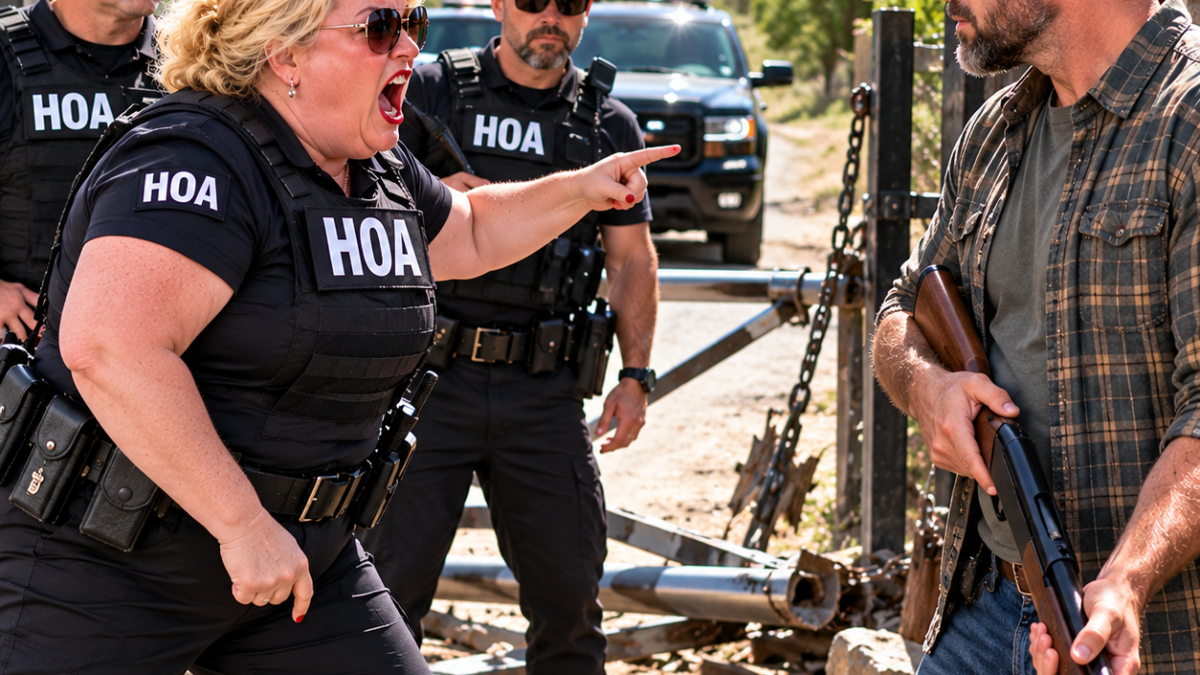
PART 2
The first phone call I made the next morning was to the Whispering Meadows HOA office.
A woman answered on the third ring with a voice so polished it sounded rehearsed.
“Whispering Meadows Homeowners Association. How may I direct your call?”
“My name is Walter Hadley. I own the forty-five-acre parcel behind the development. Your new gate is blocking my recorded easement.”
There was a pause.
Not long.
Long enough.
“Let me check our records.”
I waited.
Keyboard sounds.
Then:
“I see the adjacent parcel.”
“Good.”
“You are not currently registered as a Whispering Meadows resident.”
“I’m aware.”
“Then you would need a visitor authorization or resident access credential to use the private roadway.”
“It isn’t your private roadway.”
Another pause.
“I’m sorry?”
“There’s a perpetual easement recorded with the county. I’ve been using that road for thirty-seven years.”
“Sir, I’m not authorized to discuss legal documents.”
“Who is?”
“Our board president.”
“Connect me.”
“She’s unavailable.”
“When is she available?”
The woman put me on hold.
For four minutes, I listened to soft instrumental music while looking through my kitchen window at land my grandfather had spent half his life protecting.
When she returned, her voice had become even more formal.
“Ms. Mercer can meet Thursday afternoon.”
“Today is Friday.”
“Yes.”
“So I’m expected to drive an extra twenty-four miles round trip for six days because your board installed a gate across a legal easement?”
“I’m sorry for the inconvenience.”
It was the kind of apology people give when they are not sorry.
“I’d like the gate opened while your board reviews the deed.”
“I can’t authorize that.”
“Who can?”
“Ms. Mercer.”
“Who won’t meet with me until Thursday.”
“That’s correct.”
I almost laughed.
Instead, I thanked her.
Then I hung up and wrote an email.
No insults.
No threats.
No emotion.
I attached a scanned copy of the 1987 deed and highlighted the easement language.
I included the county recording number.
I requested written confirmation within forty-eight hours that my access would be restored.
Then I sent it.
9:14 a.m.
I wrote the time down.
That became the beginning of my log.
Date.
Time.
Person contacted.
Exact wording.
Evidence saved.
I had spent twenty-eight years as a deputy, and I had watched too many disputes become impossible to untangle because everybody remembered conversations differently.
Memory changes under pressure.
Paper doesn’t.
By Sunday evening, nobody had answered.
Meanwhile, the detour was already getting old.
Twelve miles around.
Narrow county road.
Several miles of gravel.
A low crossing that became ugly after heavy rain.
The difference between the two routes wasn’t merely convenience.
The main road gave me direct access to town.
Fire department.
Ambulance.
Feed suppliers.
Veterinarian.
The alternate route went the wrong direction before circling back.
I was sixty-two.
I lived alone.
My wife, Ellen, had been gone four years.
Most days I was healthy enough to convince myself age was something that happened to other men.
But I knew better.
I had answered too many emergency calls during my career.
Heart attacks don’t care how independent you are.
Neither do barn fires.
Neither do tractor accidents.
A road can be a lifeline.
That was why my grandfather had protected ours in writing.
Thursday afternoon, I drove into Whispering Meadows from the public entrance and parked outside the HOA office.
The development still had that new-neighborhood smell.
Fresh mulch.
Young trees.
Houses designed to look different while somehow looking identical.
The office sat in a temporary commercial building near the entrance.
Inside, architectural drawings lined the walls.
Future clubhouse.
Future pool.
Future walking trail.
Future expansion.
A receptionist led me into a conference room.
Diane Mercer was already seated.
Mid-fifties.
Navy blazer.
Gold earrings.
Perfect posture.
A stack of papers centered precisely in front of her.
“Mr. Hadley.”
She stood.
“Diane Mercer.”
We shook hands.
Her grip was firm.
Her smile professional.
Her eyes weren’t smiling.
“Thank you for meeting with me.”
“Of course.”
I sat.
She remained at the head of the table.
I opened my folder and slid over the deed.
“This is the document I emailed.”
She glanced at it.
“Your staff forwarded it.”
“Then you know what it says.”
“I know what you believe it says.”
I leaned back slightly.
“That’s an interesting choice of words.”
“Property law can be complicated.”
“Not this part.”
I pointed to the paragraph.
“The easement was created as a condition of the 1987 sale. It was recorded with the county. It runs with the land.”
Diane barely looked at it.
“Whispering Meadows now controls the development surrounding that road.”
“You control property subject to an existing easement.”
“Our attorneys may disagree.”
“Then ask them.”
“We will.”
“How long?”
“These things take time.”
“How much time?”
“I can’t say.”
“Meanwhile, I’m blocked from my direct route home.”
She folded her hands.
“I understand your frustration.”
“No, you understand the situation.”
Her smile tightened.
“Mr. Hadley, we’ve invested a significant amount in security infrastructure.”
“That has nothing to do with my easement.”
“We can’t simply dismantle access controls every time someone produces an old document.”
I stared at her.
“Old?”
“Yes.”
“The Constitution is old.”
Her eyes narrowed.
“The age of a legal document doesn’t make it disappear.”
She didn’t respond.
Then she changed direction.
“I may have a practical solution.”
I waited.
“A resident access credential.”
“I’m not a resident.”
“We could classify your parcel as an adjacent-access property.”
“And?”
“Five hundred dollars annually.”
I thought I had misheard.
“You want me to pay five hundred dollars every year.”
“For full gate privileges.”
“To use a road I already possess a recorded legal right to use.”
“It would avoid unnecessary conflict.”
I looked at her for several seconds.
There it was.
Not misunderstanding.
Leverage.
“I’m not paying you for my own easement.”
“That is your decision.”
“It isn’t a decision. There’s nothing to purchase.”
Diane’s expression changed.
Very slightly.
“Situations like this can become prolonged.”
“Only if somebody decides not to follow the recorded deed.”
She leaned back.
Then, almost casually:
“Your land has attracted interest.”
I stopped gathering my papers.
“What?”
“Developers have asked about that forty-five-acre parcel.”
“It isn’t for sale.”
“Circumstances change.”
“Mine haven’t.”
“You’re maintaining a large rural parcel alone.”
“I’m aware.”
She smiled.
“Forty-five acres could become burdensome.”
“It has been in my family since 1951.”
“Yes.”
Her tone became almost sympathetic.
“That’s exactly why emotional decisions can sometimes interfere with practical ones.”
I felt something inside me go very still.
My grandfather had cleared those fields.
My father had repaired those fences.
My wife had planted the dogwoods near the house.
My daughter had learned to ride a bicycle on that driveway.
And this woman had known me fifteen minutes before suggesting the land might become “burdensome.”
I stood.
“Open the gate.”
“Our attorneys will review the matter.”
“Open it.”
“You’ll receive a response.”
I gathered my papers.
Diane added:
“If you ever reconsider selling, I can make introductions.”
I looked at her.
“Don’t.”
That was all I said.
Outside, one of the security guards was standing beside my truck.
The shorter one from the gate.
His phone was raised.
Photographing my license plate.
I stopped.
He lowered it.
“Need something?”
“No.”
“Then why photograph my truck?”
“Security documentation.”
“Of what?”
He looked toward the office.
“Vehicles of interest.”
I almost smiled.
“Make sure you spell my name correctly.”
Then I got into the truck.
That evening, I made two calls.
First, the county recorder.
I gave the clerk the recording number.
She confirmed the easement remained active.
No release.
No abandonment.
No modification.
No later instrument superseding it.
My second call went to Ruth Claybourne.
Ruth had been recommended by a retired judge I trusted.
Property law.
Civil litigation.
No patience for nonsense.
Her assistant scheduled me for the next week.
Before going to bed, I opened a spiral notebook.
On the first page I wrote:
**WHISPERING MEADOWS ACCESS DISPUTE**
Underneath:
**Day 1: Gate installed across easement.**
Then everything.
Guard names if known.
Exact statements.
Diane’s $500 proposal.
Her comments about developers.
The guard photographing my plate.
By the time I finished, it was after midnight.
I sat alone at the kitchen table.
Ellen’s old coffee mug was still in the cabinet behind me.
Four years after losing her, I still sometimes reached for two mugs in the morning.
Grief creates habits the body doesn’t know how to surrender.
I thought about what she would have said.
Probably:
“Walter, don’t make this into a war.”
Then, after reading the deed:
“And don’t you dare pay them five hundred dollars.”
I smiled.
“Understood.”
Three days later, the HOA answered.
Certified mail.
Three paragraphs.
They claimed that “after careful review,” my easement lacked sufficient standing under current development agreements.
The gate would remain.
Any attempt to “bypass, defeat or damage HOA security infrastructure” would be treated as trespassing and referred to law enforcement.
I read that sentence twice.
Then a third time.
They had just threatened to report me for trespassing if I used my own recorded access road.
I scanned the letter.
Saved the envelope.
Photographed the postmark.
Added it to my file.
Then I called Ruth.
Her office occupied the second floor of an old Victorian house near the courthouse.
When I arrived, she was standing at a conference table reading my deed.
She didn’t waste time.
“Sit.”
I sat.
She read silently for several minutes.
Then the HOA letter.
Then my email.
Then Diane’s response.
Then the certified county record.
Finally, she looked up.
“This easement is clean.”
“That’s what I thought.”
“It is perpetual.”
“Yes.”
“Recorded.”
“Yes.”
“Used continuously.”
“Thirty-seven years.”
“Any period when the road was abandoned?”
“No.”
“Any alternative agreement?”
“No.”
“Any payment arrangement with the developer?”
“No.”
She pulled the deed closer.
“This obligation runs with the land.”
“That’s what I told Diane.”
“She knows?”
“I emailed it before meeting her.”
Ruth looked at the HOA letter again.
“That helps.”
“How?”
“Good-faith mistakes and intentional interference are different animals.”
She tapped the letter.
“They’ve put their refusal in writing after receiving notice.”
I explained the $500 pass.
Ruth’s eyebrows rose.
“They want to charge the easement holder access fees?”
“Yes.”
She wrote something down.
Then I told her about Diane’s comments regarding developer interest.
Ruth stopped writing.
“Exactly what did she say?”
I repeated it.
She wrote that down too.
“What do you want?”
“My road.”
“Anything else?”
“I want them to leave me alone.”
“That may take longer.”
“What are my options?”
“Injunction.”
“To open the gate?”
“Yes.”
“Damages?”
“Potentially. Actual costs from interference. Possibly enhanced damages depending on proof of willfulness.”
“And the gate?”
“If the easement doesn’t allow obstruction, we can seek removal.”
I nodded.
“Do it.”
Ruth held up a hand.
“Before litigation, I want one more piece.”
“What?”
“A professional survey.”
I hired Martin Deacon.
He had surveyed half the county over thirty years.
Martin spent most of a day walking the road.
GPS unit.
Original plat.
County coordinates.
Photographs.
Markers.
He came into my kitchen afterward and spread everything across the table.
“Walter.”
“What?”
“You weren’t exaggerating.”
“I generally don’t.”
He pointed to a transparent overlay.
The 1987 easement corridor ran directly beneath the new gate.
Not beside it.
Not near it.
Through it.
“Every inch of that gate structure sits inside the recorded easement corridor.”
“Any ambiguity?”
“No.”
“Could they argue the road moved?”
“No.”
“Abandonment?”
“You’ve been using it continuously.”
“Current development agreement?”
“Doesn’t erase a prior recorded interest.”
Martin tapped the original developer acknowledgment.
“This should have shown up during every title review associated with the development.”
“Should?”
“Either somebody missed it, misunderstood it, or decided it wouldn’t matter.”
I looked at the aerial map.
Whispering Meadows surrounded the road like someone had drawn a neighborhood around a line that refused to disappear.
“Can you testify to this?”
Martin looked offended.
“I can testify in my sleep.”
Two days after his final report was filed, another certified letter arrived.
This one came from a law firm representing the HOA.
It accused me of harassing association personnel.
Conducting unauthorized surveillance.
Creating a hostile environment.
They demanded I remove cameras from my own property.
Stop contacting security employees.
Avoid “provocative behavior.”
I read the letter at the kitchen table.
Then I laughed.
Actually laughed.
It was the first time in weeks.
I called Ruth.
“They sent another letter.”
“What now?”
“Apparently cameras on my farm constitute harassment.”
Silence.
Then a dry laugh.
“Save it.”
“I already did.”
“Good.”
“They’re accusing me of surveillance.”
“The same people whose guards photographed your plate?”
“Yes.”
“Walter.”
“Yes?”
“They are creating a wonderful record.”
That was Ruth.
She could make legal warfare sound like gardening.
Over the next two weeks, the consequences of the gate became worse.
My feed supplier called.
“Walter, we can’t use that alternate road.”
“Why?”
“Insurance.”
“What about it?”
“Too much unpaved access. Driver nearly got stuck last week.”
“So what now?”
“We can meet you near the highway.”
“And transfer everything?”
“Unless the main road opens.”
My delivery costs doubled.
Then my veterinarian stopped making routine farm calls because the detour added too much time.
A propane delivery had to be rescheduled.
One rainy night, the creek rose enough that I sat in the truck staring at the alternate crossing and decided not to risk it.
I slept at a motel twelve miles from my own bed.
That was the night anger changed shape.
Until then, I had thought about principle.
Family land.
My grandfather’s deed.
Now I understood the practical danger.
The HOA had effectively turned the safest route to my home into a controlled checkpoint.
Emergency services would face the same problem unless somebody coordinated access.
The next morning, Ruth added emergency-access concerns to the complaint.
The pressure did not stop.
White HOA patrol SUVs began appearing near my property line.
Sometimes they parked fifteen minutes.
Sometimes longer.
I photographed them.
Then garbage started appearing in my pasture.
Fast-food wrappers.
Plastic bottles.
Bags.
Once.
Then again.
I had no proof who did it.
So I didn’t accuse anyone.
I photographed.
Logged.
Cleaned.
Documented.
That was becoming my life.
I had once spent entire shifts writing reports because younger deputies hated paperwork.
Now paperwork was protecting me.
A woman named Helen Vasquez approached me at a gas station one afternoon.
I recognized her from Whispering Meadows.
Retired teacher.
Gray-streaked hair.
She looked around before walking closer.
“Mr. Hadley?”
“Yes.”
“I probably shouldn’t be talking to you.”
“That’s an odd opening.”
She gave a nervous smile.
“Diane’s talking about you.”
“What is she saying?”
“That you’re unstable.”
I felt my jaw tighten.
“Specifics?”
“Not really. That’s what makes it work.”
“How?”
“She says there are ‘security concerns.’ That you’ve been aggressive with guards. That staff feel threatened.”
“I haven’t threatened anyone.”
“I believe you.”
“Why?”
Helen looked embarrassed.
“Because I’ve seen her do this kind of thing before.”
We stood beside the gas pumps while traffic passed behind us.
“My husband and I lived in Florida before moving here,” she said. “Our community president there pushed three families out.”
“Pushed how?”
“Fines. Rumors. Restrictions. Making everything difficult until selling became easier than staying.”
“And Diane reminds you of her?”
Helen nodded.
“Last week, the HOA sent a safety advisory.”
“About me?”
“Your name wasn’t there.”
“But everybody understood.”
“Yes.”
I thanked her.
Before leaving, she said:
“Most people don’t think you’re dangerous.”
“Most?”
She sighed.
“People believe what gets repeated.”
That night, I ordered four cameras.
Road frontage.
Driveway.
Fence line.
Night vision.
Cloud backup.
Motion alerts.
Then I requested certified copies of every document tied to the easement.
Deed.
Survey.
Developer acknowledgment.
Amendments.
There were none.
Nothing had changed.
The law had not moved.
Only the gate had.
Ruth filed the civil complaint.
Easement interference.
Property-rights violations.
Actual economic damages.
Bad-faith conduct.
Request for injunction.
She also filed a complaint with county authorities regarding construction inside the easement corridor.
Then she prepared a formal demand:
Remove or open the obstruction within thirty days.
I told Ruth I wanted to hand-deliver a copy.
She looked at me over her glasses.
“Why?”
“I want proof they received it.”
“We can use a process server.”
“I know.”
“Then why?”
I hesitated.
“Because I want to look them in the eye.”
Ruth sighed.
“That is not a legal reason.”
“No.”
“You will stay calm.”
“Yes.”
“You will not argue.”
“Yes.”
“You will not touch the gate.”
“Yes.”
“You will keep your hands visible if they start acting stupid.”
“Yes.”
She studied me.
“And the shotgun?”
That surprised me.
“What about it?”
“You told me you normally keep one secured in your truck.”
“I do.”
“Leave it home.”
I considered it.
“It’s stored lawfully.”
“I know.”
“I don’t plan to touch it.”
“I know.”
Then she said:
“I also know these people are already trying to build a story about you.”
That landed.
I almost removed it.
But the firearm was part of my normal farm vehicle equipment during certain trips, kept secured in its locked case. I was going directly to check fencing afterward and had been dealing with nuisance animals near the back pasture.
So I left it locked where it always stayed.
That decision became important for reasons none of us expected.
Tuesday morning was cool.
Clear sky.
I drove toward the gate with the legal envelope on the passenger seat.
The tall guard recognized me immediately.
He stepped into the roadway.
Hand raised.
I stopped.
Window down.
“I’m here to deliver legal documents.”
“You need to exit the vehicle.”
“No.”
“Exit the vehicle, sir.”
“I’m not required to.”
“This is a controlled security point.”
“I’m delivering a notice to the HOA.”
His partner stood near the guard station.
Phone already out.
“Step out.”
I placed both hands visibly on the steering wheel.
“No.”
The tall guard moved closer.
“You are refusing a lawful security instruction.”
“No. I’m refusing your instruction.”
His face reddened.
“You need to leave.”
“I will after you accept the envelope.”
His partner was speaking into a phone.
I couldn’t hear everything.
Then I heard:
“…armed individual…”
I went completely still.
The tall guard stepped back.
“You threatened us.”
“No.”
“You said you have a weapon.”
“I said nothing about a weapon.”
“You’ve got a shotgun.”
I stared at him.
“How do you know what’s in my locked truck?”
No answer.
Eight minutes later, a sheriff’s cruiser arrived.
The deputy who stepped out was Tom Kendrick.
I had trained Tom when he was a rookie.
He was fifteen years younger than me and had once backed a cruiser into a mailbox during his first month.
He had become a good deputy.
Very good.
When he recognized me, surprise flashed across his face.
Then training took over.
“Walter.”
“Tom.”
“What’s happening?”
Before I could answer, the guard jumped in.
“This man threatened us with a firearm.”
Tom’s face changed.
He looked at me.
“Walter?”
“There’s a shotgun secured in a locked case behind my seat.”
“Did you remove it?”
“No.”
“Display it?”
“No.”
“Mention it?”
“No.”
The guard interrupted.
“He said he’d use it if we didn’t open the gate.”
I looked at him.
“That is a lie.”
Tom held up one hand.
“Everybody stop.”
He approached my driver’s window.
“Mind if I verify the firearm is secured?”
“No problem.”
I unlocked the truck doors from the driver’s seat.
Tom opened the rear passenger door.
Looked behind the seat.
The case was locked.
Strapped down.
Untouched.
He closed the door.
“Weapon is secured.”
The tall guard crossed his arms.
“That doesn’t mean he didn’t threaten us.”
“No,” Tom said. “It doesn’t.”
Then he looked at the small camera mount on the guard’s chest.
“You recording?”
The guard hesitated.
Tom pointed.
“Body camera.”
Silence.
The shorter guard looked at his partner.
Finally:
“Yes.”
Tom nodded.
“Good. I’ll need the footage.”
The taller guard’s face changed.
I saw it.
So did Tom.
“You said the threat happened here?”
“Yes.”
“Camera running?”
Another pause.
“It should be.”
Tom looked at me.
Then at him.
“Then this will be easy.”
I almost smiled.
Almost.
Tom spoke with both men separately.
Then returned to me.
“Walter, stay here a minute.”
He walked toward his cruiser.
Made a call.
Returned.
“You’re not being detained.”
“I assumed not.”
He lowered his voice.
“I don’t know what these people are doing.”
“I’ve got a pretty good idea.”
“They told dispatch you were pointing a gun.”
My jaw tightened.
“They said what?”
“Dispatch notes say armed subject threatening security.”
“I never touched the case.”
“I know what I saw when I arrived.”
He looked toward the guards.
“And the footage will tell us what happened before.”
I handed Tom copies of Ruth’s notice.
He read the first page.
“Recorded easement?”
“1987.”
“Gate is on it?”
“Survey says every inch.”
Tom exhaled.
“Of course it is.”
He handed the papers back.
“You’re free to go.”
I looked at the gate.
“Through?”
Tom glanced at the guards.
The shorter one looked away.
The taller one looked furious.
Tom said:
“Unless they want to explain to me why they are physically preventing the easement holder from using a road that is already the subject of a court filing.”
Nobody answered.
The gate opened.
For the first time in weeks, I drove through.
I handed the formal notice through my window.
The taller guard accepted it.
“I want your name acknowledging receipt.”
He almost refused.
Tom was still standing behind us.
He signed.
I drove home.
The shotgun stayed locked in its case the entire time.
That should have ended the day’s trouble.
Instead, Diane posted an “urgent security alert” online that evening.
**ARMED INDIVIDUAL MAKES THREATS AT COMMUNITY GATE. LAW ENFORCEMENT CONTACTED. RESIDENTS ADVISED TO REMAIN VIGILANT.**
No name.
No need.
Comments appeared immediately.
**Why wasn’t he arrested?**
**This is terrifying.**
**Does the HOA need more security?**
**People like this shouldn’t have weapons.**
I read until my hands began tightening.
Then I stopped.
No reply.
No argument.
Screenshots.
Timestamp.
Save.
Forward to Ruth.
She called me five minutes later.
“Please tell me their guards were recording.”
“Yes.”
“And law enforcement requested the footage?”
“Yes.”
“Walter.”
“Yes?”
“They may have just turned your strongest evidence into theirs.”
“I don’t understand.”
“If the footage shows what you say, then the people accusing you have created independent video proving the accusation false.”
I looked at the screenshot.
“The shotgun was supposed to make me look dangerous.”
“Correct.”
“It never left the case.”
“Correct.”
“And their own cameras recorded that.”
Ruth paused.
“Now you understand.”
Six weeks later, we walked into county court for the preliminary hearing.
I wore the dark gray suit I had last worn at Ellen’s funeral.
I hated that suit.
But I wanted something plain.
Serious.
No performance.
Ruth met me in the lobby carrying a thick leather briefcase.
Helen Vasquez sat near the back of the courtroom.
She gave me a small nod.
Diane arrived with three attorneys from a large city firm.
Charcoal suits.
Expensive shoes.
Matching folders.
Diane looked confident again.
Maybe she believed the number of lawyers beside her changed the deed.
Judge Patricia Hullbrook entered at nine.
The room stood.
Then the hearing began.
Ruth started with the easement.
Certified deed.
County recording.
1987 survey.
Developer acknowledgment.
Martin’s updated survey.
She projected the overlay.
Old boundaries.
Current aerial image.
Gate location.
Everything lined up.
The judge asked:
“Has the easement ever been legally extinguished?”
“No, Your Honor.”
“Released?”
“No.”
“Abandoned?”
“No.”
“Continuous use?”
“Thirty-seven years.”
The HOA attorney stood.
He argued the easement predated modern development agreements.
He suggested changing community conditions.
Security concerns.
Possible abandonment doctrine.
Judge Hullbrook interrupted.
“Counsel, do you possess a recorded instrument extinguishing the easement?”
“We are continuing title research.”
“You’ve had six weeks.”
“Yes, Your Honor.”
“So is the answer no?”
The lawyer hesitated.
“At present, we have not located such an instrument.”
Diane’s expression changed.
Tiny crack.
Ruth stood.
“One additional matter.”
The courtroom became still.
“On the date Mr. Hadley attempted to deliver formal legal notice, HOA security personnel reported to law enforcement that he threatened them with a shotgun.”
Diane’s lawyer shifted.
“We object to characterization—”
“We have the guards’ own body-camera recordings.”
That stopped him.
Ruth handed a drive to the clerk.
The video appeared.
There I was.
Inside the truck.
Hands visible.
Envelope on the dashboard.
The guard ordering me to exit.
Me refusing calmly.
The guard escalating.
Then his partner calling someone and saying I was armed.
At no point did I mention the shotgun.
At no point did I touch the rear door.
At no point did I reach behind the seat.
Then Tom arrived.
The video showed his inspection.
Locked case.
Secured firearm.
No display.
No threat.
The entire courtroom watched.
Nobody spoke.
The clip ended.
Judge Hullbrook removed her glasses.
“Counsel.”
Diane’s attorney stood slowly.
“Yes, Your Honor.”
“Your clients reported that Mr. Hadley threatened them with a firearm.”
“That appears to have been their understanding.”
The judge stared at him.
“The recording does not show an understanding. It shows an allegation.”
Silence.
“Did they tell law enforcement he pointed the firearm?”
The attorney shuffled papers.
“I would need to review the dispatch record.”
Ruth handed another document forward.
“We have it.”
The judge read.
Her expression hardened.
Then she looked directly at the defense table.
“This court is not making criminal findings today. But these materials raise serious questions.”
Diane whispered urgently to her lawyer.
He leaned away.
Judge Hullbrook continued.
“I am granting temporary injunctive relief.”
I felt my chest loosen for the first time in months.
“The HOA shall provide Mr. Hadley immediate unobstructed access through the recorded easement pending final adjudication.”
Diane stared ahead.
“The body-camera footage and corresponding reports will be preserved and referred to appropriate authorities for review.”
Ruth looked at me.
Just once.
No smile.
She didn’t need one.
Outside, the HOA’s attorneys moved quickly toward the parking lot.
Ruth and I remained on the courthouse steps.
“That was the first round,” she said.
“Gate opens.”
“Immediately.”
“And the criminal referral?”
“Not our decision.”
I looked toward Diane’s departing SUV.
“She’s going to escalate.”
Ruth looked at me.
“Yes.”
“How sure?”
“One hundred percent.”
“You sound happy about that.”
“I’m not.”
“You look happy.”
“I’m a litigator. Sometimes those are similar expressions.”
I laughed.
Then she became serious.
“Stay calm.”
“I have.”
“Keep doing it.”
“What do you think she’ll do?”
“People who’ve built their identity around control rarely respond well when a judge tells them no.”
She was right.
I drove home on Miller Creek Road that afternoon.
The gate stood open.
Chains held each side back.
No guards.
The security camera still blinked above me.
I slowed.
Not to celebrate.
Just to look.
Then I continued.
The dip near the oak.
Cracked asphalt.
Long curve.
Same road.
Exactly the same.
I thought I might feel triumphant.
Instead, I felt tired.
It was a door that should never have been locked.
Opening it wasn’t victory.
It was correction.
Two days later, the county newspaper ran the story.
**HOA GATE DISPUTE HEADS TO COURT; SECURITY FOOTAGE RAISES QUESTIONS**
I declined interviews.
The article quoted documents.
That was enough.
Whispering Meadows residents began behaving differently.
Some waved.
Some avoided me.
Some stared.
The patrol vehicles near my property became less frequent.
Then Diane sent a community-wide email.
Subject:
**PROTECTING OUR COMMUNITY**
She accused me of weaponizing the legal system.
Undermining community safety.
Threatening property values.
No mention of the court injunction.
No mention of the bodycam.
No mention of the false allegation now under review.
She announced an emergency HOA meeting.
Two additional security officers would be present.
Ruth called.
“She’s still doing it.”
“Yes.”
“Do nothing.”
“I wasn’t planning to.”
“Good.”
A week later, the security guards cracked first.
The shorter guard hired his own attorney.
Then he began cooperating with prosecutors.
According to Ruth, he had emails.
Instructions from Diane.
Keep me off the road.
Escalate if necessary.
Call law enforcement if I “created trouble.”
One email reportedly instructed staff to characterize me as a threat if conflict occurred.
Ruth’s voice changed when she described it.
“If those records authenticate, this becomes much bigger than a gate.”
“How much bigger?”
“Potential criminal exposure.”
“And our civil case?”
“Stronger.”
I sat in the barn office looking at my grandfather’s photograph.
“What happens now?”
“We wait.”
“I’m terrible at waiting.”
“I know.”
“Can we do anything?”
“Yes.”
“What?”
“Continue behaving better than they do.”
I hated when lawyers gave good advice.
The emergency HOA meeting collapsed.
Helen called afterward.
“You should’ve seen it.”
“What happened?”
“Diane started talking about security.”
“That sounds normal.”
“Then Marcus Webb stood up.”
I knew Marcus by reputation.
Accountant.
Lived on Maple Lane.
“What did he say?”
“He asked how much money they’d spent fighting you.”
I sat straighter.
“And?”
“Diane refused.”
“Then?”
“He had the quarterly statements.”
I smiled.
Helen continued.
“He asked about legal expenses. Security contracts. Why expenditures weren’t itemized.”
“What did Diane do?”
“Lost it.”
“Define lost it.”
“She started yelling.”
Helen imitated Diane:
“‘I am the only person protecting this community!’”
I could almost see it.
“People left.”
“During the meeting?”
“While she was talking.”
Helen sounded half shocked, half delighted.
“Walter, they literally stood up and walked out.”
Someone recorded it.
By night, the video was circulating through neighborhood groups.
Diane at the podium.
Residents leaving.
Her voice rising.
**Everything I built here will be destroyed!**
That sentence interested me.
Everything *I* built.
Not everything *we* built.
Not everything residents built.
Hers.
Control has a language.
People reveal themselves when they stop editing.
Within days, forty-three homeowners signed a petition for an independent audit.
Another petition demanded a special election.
A retired attorney named Donald Kemp requested a full accounting of legal spending.
The HOA’s law firm withdrew.
Ruth called me the morning the withdrawal hit the docket.
“Your friends need new lawyers.”
“They weren’t my friends yesterday.”
“Today they’re everyone’s problem.”
“Why did the firm withdraw?”
“Breakdown in attorney-client relationship.”
“Translation?”
“Diane won’t listen.”
Two board members resigned.
Then a third publicly distanced himself from Diane’s decisions.
Residents began contacting Ruth.
Some wanted settlement.
Some wanted the gate removed permanently.
Some wanted the civil case to disappear before homeowners ended up funding damages through special assessments.
I understood their fear.
I didn’t hate them.
Most had not poured the concrete.
Most had never seen my deed.
Most believed the board.
That’s what boards are for.
Trust itself wasn’t the failure.
Abusing trust was.
The months before trial exhausted me more than anything I had done since Ellen died.
Depositions.
Records.
Contractor invoices.
Delivery receipts.
Mileage logs.
Veterinary costs.
Emergency-access analysis.
Survey testimony.
Emails.
More emails.
Diane’s attorneys changed twice.
I repaired fences to clear my head.
Replaced barn roofing.
Cleaned equipment.
Worked until my hands hurt enough that my mind became quiet.
One evening, my daughter called.
“You sound tired.”
“I’m sixty-two.”
“You sounded tired at fifty.”
“That was your fault.”
She laughed.
Then:
“Dad.”
“What?”
“Sell.”
I stopped.
“What?”
“Not because they deserve it.”
I said nothing.
“If this is destroying you, sell the farm.”
I looked through the window.
The pasture was turning gold in the evening light.
“That isn’t what I want.”
“I know.”
“I don’t want another house.”
“I know.”
“I want this one.”
“I know.”
“Then why tell me to sell?”
“Because I need you to understand that staying is a choice, not an obligation to Grandpa.”
That hit harder than I expected.
I looked at his photograph.
She continued.
“You can love the farm without letting it kill you.”
“I’m not dying.”
“You know what I mean.”
I did.
After the call, I sat on the porch.
For years after Ellen died, the farm had been the thing that kept my life structured.
Animals needed feeding.
Fences needed repairing.
Grass grew.
Storms came.
Work remained whether I felt grief or not.
The land had never asked me to be happy.
Only present.
Was I fighting because I still wanted it?
Or because my grandfather had told me never to let anyone take the road?
I stayed outside until dark.
Then I knew.
I wanted it.
Not because Grandpa said so.
Because home was still home.
That made the fight mine.
Trial began in late October.
Gray morning.
Cold air.
I arrived early and sat in my truck drinking coffee outside the courthouse.
At sixty-two, I had spent enough time in courtrooms to know they were rarely dramatic.
Mostly waiting.
Paper.
Procedures.
People trying to reduce messy lives into admissible pieces.
I liked that.
Truth benefits from structure.
Ruth was already inside.
Martin sat in the gallery.
Helen was there.
Marcus too.
Several other Whispering Meadows homeowners had come.
Diane sat at the defense table with one attorney.
Not three.
Her polished appearance remained.
But the confidence was gone.
Judge Hullbrook entered.
Jury seated.
Ruth gave her opening.
She didn’t call Diane corrupt.
Didn’t call the guards liars.
Didn’t describe me as a victim.
She talked about a line on a map.
A legal right created in 1987.
A gate placed across it.
Notice.
Refusal.
Interference.
Retaliation.
False accusation.
Documentation.
Simple.
The defense talked about community safety.
Property values.
Modern development.
Balancing rights.
They barely mentioned the deed.
Martin testified first.
He projected the map.
The gate sat inside the easement.
No ambiguity.
The defense attorney tried:
“Mr. Deacon, boundaries can change over decades, correct?”
“Survey monuments can be updated. Recorded property interests don’t evaporate because neighborhoods change.”
“Roads can shift.”
“This one did not.”
“Are you certain?”
Martin pointed at three fixed reference points.
“Would you like me to explain it again?”
A juror smiled.
The developer acknowledgment came next.
Then county records.
Then the HOA letters.
Their refusal.
The $500 pass proposal.
The cease-and-desist letter.
The online security warning.
Then the bodycam footage.
Again.
This time in front of the jury.
My hands on the wheel.
Envelope on the dashboard.
No firearm displayed.
No threat.
Then the guard reporting me as armed.
Tom inspecting the locked case.
The clip ended.
Ruth allowed several seconds of silence.
Then:
“Mr. Hadley, did you ever remove the shotgun from that case during this interaction?”
“No.”
“Did you tell either guard you would use it?”
“No.”
“Did you threaten either guard?”
“No.”
“Why was it in your truck?”
“It was secured farm equipment I lawfully kept for specific rural uses. It remained locked.”
“Did you intend to use it against HOA personnel?”
“No.”
“Did you ever touch the case?”
“No.”
Ruth sat down.
The defense attorney approached.
“You were armed.”
“I possessed a secured firearm in my vehicle.”
“That’s armed.”
“You can call it whatever you want.”
He frowned.
“You were angry.”
“Yes.”
“Very angry.”
“Yes.”
“You wanted access.”
“Yes.”
“You were a former deputy.”
“Yes.”
“A Marine.”
“Yes.”
“You expected those guards to know that?”
“No.”
“Isn’t it possible your demeanor frightened them?”
“Anything is possible.”
He smiled slightly.
“So they might have genuinely believed you were dangerous.”
“Then why invent words I never said?”
The smile vanished.
Ruth didn’t react.
The jury did.
Then came the emails.
Diane’s instructions appeared on the screen.
**DO NOT ALLOW HIM THROUGH UNDER ANY CIRCUMSTANCES.**
Another:
**IF HE CAUSES TROUBLE, CONTACT LAW ENFORCEMENT AND REPORT HIM AS A THREAT.**
Another after the gate incident:
**WHY WASN’T HE TAKEN INTO CUSTODY? I NEED AN EXPLANATION.**
The jury watched.
Then a message discussing “additional pressure” through code contacts and public safety messaging.
Ruth called the cooperating guard.
He looked miserable.
He admitted exaggerating the incident.
“Why?”
“My job.”
“Explain.”
“Ms. Mercer wanted Mr. Hadley kept off the road.”
“What happened if you allowed him through?”
“We were told we’d be replaced.”
“Did she instruct you to describe him as threatening?”
He swallowed.
“Yes.”
“Did Mr. Hadley threaten you?”
“No.”
“Did he remove a firearm?”
“No.”
“Did you know one was in the truck before Deputy Kendrick opened the rear door?”
He hesitated.
“Yes.”
“How?”
The courtroom became very quiet.
“We’d been told.”
“By whom?”
“Ms. Mercer.”
I looked at Diane.
She stared at the table.
Ruth asked:
“Why would Ms. Mercer tell security personnel about a lawfully secured firearm inside Mr. Hadley’s vehicle?”
“I don’t know.”
“Did she tell you he was dangerous?”
“Yes.”
“Before the incident?”
“Yes.”
The story had been prepared before the evidence existed.
That was the real mistake.
Not the gate.
Not even the lie.
They had decided who I was first.
Then tried to make events fit.
Diane took the stand.
Her attorney clearly did not want her to.
Ruth began calmly.
“When did you become HOA president?”
Diane answered.
“When was the gate approved?”
She answered.
“Did you personally review title documents before construction?”
“Our contractor handled title review.”
“That was not my question.”
“No.”
“Did anyone show you Mr. Hadley’s easement before the gate was installed?”
“I don’t recall.”
“Did Mr. Hadley email it to you afterward?”
“Yes.”
“Did you read it?”
“I reviewed it.”
“So before you offered to charge him $500 annually, you knew he claimed a recorded perpetual easement.”
“He claimed it.”
“Did you verify it with the county?”
“Our attorneys—”
“Did *you*?”
“No.”
“Did you obtain a written legal opinion declaring the easement invalid?”
“I relied on counsel.”
“Where is the opinion?”
Her attorney objected.
The judge ruled.
Ruth moved on.
“Did you send this email?”
The screen displayed:
**DO NOT ALLOW HIM THROUGH UNDER ANY CIRCUMSTANCES.**
“Yes.”
“This one?”
**REPORT HIM AS A THREAT.**
Diane hesitated.
“I was protecting the community.”
“Did you send it?”
“Yes.”
“Had Mr. Hadley threatened anyone when you sent that instruction?”
“I had concerns.”
“What threat?”
“His behavior.”
“What behavior?”
“He was confrontational.”
“Describe one threat made before your email.”
Diane didn’t answer.
“Ms. Mercer?”
“He made staff uncomfortable.”
“That was not my question.”
Her voice rose.
“He was a former law-enforcement officer with a weapon.”
Ruth stopped.
“How did you know about the shotgun before the gate incident?”
Diane froze.
I watched her attorney close his eyes.
Ruth waited.
“Ms. Mercer?”
“Security had information.”
“From where?”
“I don’t remember.”
“Did you authorize staff to photograph Mr. Hadley’s truck?”
“Security documents vehicles.”
“Did you authorize surveillance near his property?”
“I would not call it surveillance.”
“What would you call repeated patrols parked at his boundary?”
“Community monitoring.”
“Did you authorize legal expenditures without full board approval?”
“I had emergency authority.”
“Show us where the bylaws grant you unilateral emergency spending above ten thousand dollars.”
Diane’s restraint finally broke.
“I was the only person doing anything!”
The courtroom went still.
She looked toward the jury.
“This man was threatening everything we built.”
Ruth said nothing.
Diane kept going.
“Property values. Security. Expansion. Nobody understood the pressure I was under.”
Her attorney whispered:
“Diane.”
She ignored him.
“If we let one outsider dictate access through the neighborhood, what happens next? Delivery trucks? Contractors? Strangers? I was protecting residents.”
Ruth waited until Diane stopped.
Then:
“The road was already legally subject to his easement, correct?”
Silence.
“You weren’t protecting residents from a new right.”
Silence.
“You were trying to erase an old one.”
Diane looked away.
Ruth sat down.
The jury deliberated less than three hours.
When they returned, I felt oddly calm.
The foreperson stood.
Liability on all major civil claims.
Economic damages:
$47,000.
Additional punitive damages for willful interference:
$150,000.
Attorney fees and court costs:
$85,000.
Total judgment:
$282,000.
Permanent injunction.
The gate had to be removed.
Not merely opened.
Removed.
No future obstruction could be placed in the easement corridor.
Judge Hullbrook addressed the defense.
“The evidence demonstrates not a simple misunderstanding but a sustained refusal to recognize a recorded property right after notice was provided.”
Then she mentioned the criminal referral.
Diane should obtain criminal counsel.
Diane sat motionless.
Outside, a reporter approached.
“How do you feel?”
I looked at the microphone.
Then at the courthouse.
Then at the road beyond it.
“I didn’t want to fight.”
The reporter waited.
“I wanted to go home.”
Another pause.
“The deed already gave me that right.”
That was all.
Ruth and I walked away.
The gate came down several weeks later.
I didn’t watch.
Helen called.
“It’s gone.”
“The posts?”
“Gone.”
“Concrete?”
“They dug it out.”
I looked down Miller Creek Road from my porch.
“You’d never know it was there,” she said.
“That’s good.”
“Walter.”
“Yes?”
“I’m sorry.”
“For what?”
“For believing Diane as long as we did.”
“You didn’t build the gate.”
“We supported the board.”
“You trusted people elected to handle things.”
“That feels stupid now.”
“No.”
I meant it.
“Trust isn’t stupidity.”
I looked toward the farm.
“Abusing trust is the failure.”
Diane’s criminal case resolved later through a plea agreement.
She admitted involvement in the false-report scheme.
She received supervised probation, fines and community-service obligations rather than prison.
She resigned permanently from HOA leadership.
Her real-estate career ended through separate licensing consequences.
Some neighbors thought the punishment was too light.
Maybe.
I had learned during twenty-eight years wearing a badge that punishment almost never feels large enough to people harmed by misconduct.
But Diane’s title was gone.
Her power was gone.
Her credibility was gone.
The guards faced consequences too.
The shorter guard—the one who cooperated—sent me a letter through Ruth.
He wrote that he had known the accusation was false.
He had been afraid of losing his job.
He apologized.
Didn’t ask forgiveness.
I read it twice.
Then put it in a drawer.
I never answered.
Not because I hated him.
Because sometimes an apology completes its purpose by being spoken.
The person receiving it doesn’t owe absolution.
Whispering Meadows changed.
Special election.
Old board removed.
Marcus Webb became president.
An independent audit followed.
Legal expenses nobody had properly approved.
Security contracts lacking appropriate oversight.
Vendor payments connected to Diane’s relatives.
More questions.
More litigation.
None of that was my fight anymore.
Mine was finished.
I returned to farm work.
Fence lines.
Barn roof.
Equipment.
Winter feed.
Ordinary problems.
Wonderful problems.
Problems that didn’t send certified mail.
The judgment money arrived in stages.
After costs, I kept roughly $160,000.
I repaired the barn.
Replaced old fencing.
Installed cameras.
Set aside emergency savings.
Then I ordered one sign.
White background.
Black letters.
Nothing dramatic.
**PRIVATE EASEMENT ROAD
RECORDED ACCESS RIGHTS
COUNTY RECORDING NO. [NUMBER]**
No warning.
No threat.
Just fact.
My daughter came for Thanksgiving with her husband and the boys.
The grandchildren wanted to hear about “Grandpa fighting the HOA.”
I refused.
“What happened?” the seven-year-old asked.
“They put something where it didn’t belong.”
“What?”
“A gate.”
“What did you do?”
“I asked them to move it.”
“Did they?”
“Eventually.”
My daughter laughed across the table.
“That’s the shortest possible version.”
“I’m trying to set a good example.”
Her oldest son asked:
“Did you really have a shotgun?”
My daughter shot me a look.
I answered carefully.
“There was a secured firearm in my truck.”
“Did you use it?”
“No.”
“Why?”
“Because there was no reason to.”
He thought about that.
“That’s boring.”
“Most good decisions are.”
After dinner, the boys fell asleep upstairs.
My daughter and I sat on the porch.
Cold air.
Coffee.
The farm dark beyond the yard lights.
She said:
“I’m proud of you.”
“For being boring?”
“For not letting them turn you into what they said you were.”
I looked at her.
She continued.
“They wanted an angry old former cop with a gun.”
I nodded.
“You gave them paperwork.”
I smiled.
“Terrifying stuff.”
She leaned against the porch post.
“Mom would’ve loved that.”
That hurt.
In a good way.
“She would’ve told me to stop being stubborn.”
“No.”
My daughter smiled.
“She would’ve told you to be stubborn more efficiently.”
I laughed.
Ellen probably would have.
Spring arrived early.
Grass turned green.
Creek filled.
The road became ordinary again.
That was the best part.
For months, every time I drove Miller Creek Road, I saw the gate even after it was removed.
Memory put it back.
Concrete posts.
Guards.
Black iron.
Then one morning I drove all the way into town and realized I hadn’t thought about it.
The road was just the road.
Healing can be like that.
Not a ceremony.
Not a verdict.
You simply stop noticing the place where something hurt.
One April afternoon, I was repairing fence when an unfamiliar pickup turned down the easement.
Out-of-state plates.
Young couple.
They slowed when they saw me.
The driver rolled down his window.
“Excuse me, sir.”
“Yes?”
“Is this a private road?”
“Easement road.”
“We’re looking at property nearby. Didn’t know whether we were allowed through.”
“If you have legitimate business, you’re fine.”
He looked relieved.
“Thank you.”
His wife leaned across.
“Do you live back there?”
I pointed toward the hill.
“Forty-five acres.”
“How long?”
“Family bought it in 1951.”
Her face brightened.
“That’s incredible.”
I looked down the road.
“Yes.”
“It is.”
They drove on.
Dust settled behind them.
I stood there with one hand on the fence post.
The road stretched open.
No gate.
No guard.
No access pass.
No uniformed man demanding permission.
I thought about Grandpa.
Fourteen years old.
Me sitting beside him on this same land.
**That road is the blood of this farm. Don’t ever let anyone take it.**
For decades, I thought he meant ownership.
He didn’t.
Not exactly.
He meant stewardship.
Some things reach you because people before you protected them.
Land.
A name.
A reputation.
A road.
A family story.
You don’t own those things the same way you own a truck.
You hold them for a while.
Then somebody else does.
That made the fight feel different in retrospect.
I had not defeated Whispering Meadows.
I had protected a line on a map long enough for law to do what it was supposed to do.
The shotgun they tried to turn into my weakness never came out of its locked case.
Their allegation did.
That was enough.
The body camera they wore because they wanted to document other people documented them instead.
The gate they built to demonstrate control became proof of interference.
The letters they sent to intimidate me became exhibits.
The emails they wrote believing nobody outside the HOA would ever read them ended up projected in front of a jury.
Their real mistake wasn’t blocking the road.
It was believing appearance could survive evidence.
Uniforms look powerful.
Gates look permanent.
Official letterhead looks authoritative.
A community email can make a lie feel true when enough people read it.
But a recorded easement doesn’t care about appearance.
Neither does bodycam footage.
Neither does a survey.
Neither does a courtroom.
Facts are stubborn things.
My grandfather would have liked that.
A year after the verdict, Marcus invited me to an HOA barbecue.
I almost refused.
“Why would I attend an HOA barbecue?”
Helen laughed.
“Because you’re the reason half these people know what an easement is.”
“That sounds like punishment.”
“Come.”
I went.
No one blocked me at the entrance.
No access pass.
A teenager volunteering at the parking lot pointed toward a space.
“Mr. Hadley?”
“Yes.”
“My dad says you’re the road guy.”
“I’ve been called worse.”
Inside the park, maybe eighty people were gathered.
Children.
Food.
Music.
Marcus spotted me.
“There he is.”
I pointed at him.
“Don’t.”
Too late.
He handed me a plate.
“This is Walter.”
“I know who I am.”
A younger homeowner approached.
“Sir, I owe you an apology.”
I frowned.
“For what?”
“I posted something online after that security alert.”
I remembered some of the comments.
“Okay.”
“I called you unstable.”
I looked at him.
He swallowed.
“I believed the board.”
“I know.”
“I should’ve checked.”
“Probably.”
He looked surprised by the answer.
I continued.
“But you admitted it.”
“I deleted the comment.”
“That helps you more than me.”
“I just wanted you to know.”
I nodded.
“Thank you.”
He walked away.
Helen looked at me.
“You could’ve been nicer.”
“I was nice.”
“That was you being nice?”
“Yes.”
She laughed.
I stayed two hours.
Talked to neighbors.
Ate terrible potato salad.
Listened to children argue over a soccer ball.
Then drove home on Miller Creek Road.
As I passed the spot where the gate had stood, I noticed something new.
Wild grass had started growing over the disturbed soil where the concrete posts had been removed.
Nature covering the scar.
By the following year, you could barely tell.
That suited me.
I never wanted a monument to the fight.
I wanted my road.
That was all I had wanted from the beginning.
Years later, people still ask me about the shotgun because that is the dramatic detail.
They expect the weapon to be the turning point.
It wasn’t.
The weapon stayed locked.
The camera was the turning point.
The deed was the turning point.
The survey was the turning point.
Patience was the turning point.
If I had reacted the way Diane wanted, the story might have changed.
If I had yelled.
Threatened.
Reached behind the seat.
Touched the case.
Anything.
One moment could have allowed them to say:
**See? We told you.**
Instead, their footage showed something they had not planned for.
A sixty-two-year-old man sitting in a truck.
Hands visible.
Legal papers on the dashboard.
A secured firearm nowhere near his hands.
Two guards building a story that the camera refused to support.
That was the mistake.
They thought the shotgun was dangerous to me.
It was only dangerous to their lie.
Not because I used it.
Because I didn’t.
Restraint left them with nowhere to hide.
That lesson stayed with me.
My granddaughter once asked what courage means.
I nearly gave her some old Marine answer.
Then I thought about the gate.
“Sometimes courage means doing something.”
She listened.
“Sometimes it means not doing something.”
She looked confused.
“That doesn’t make sense.”
“It will.”
Maybe it will.
Maybe she’ll never need to understand.
I hope she doesn’t.
The farm is still there.
Forty-five acres.
Barn repaired.
Fence straight.
Dogwoods Ellen planted blooming every spring.
My daughter still visits.
The boys are older now.
They know how to split firewood without endangering fingers.
Mostly.
The lockbox sits in the same cabinet.
Inside:
1951 deed.
1987 easement.
Survey.
Court judgment.
I added one more document.
The final permanent injunction.
Not because I expect another HOA to challenge it.
Because documents only protect people who can find them.
On the outside of the folder I wrote:
**MILLER CREEK ROAD — DO NOT THROW AWAY**
My daughter saw it.
“Very sophisticated estate planning.”
“I’m a simple man.”
“You’re impossible.”
“That too.”
One day, this property will probably become hers.
Maybe one of her boys.
Maybe both.
Maybe they’ll sell.
That will be their decision.
I finally understand that.
My grandfather asked me to protect the road.
He never asked me to imprison the next generation inside his choices.
I held it while it was mine to hold.
That was enough.
On summer evenings, I still sit on the porch.
Sometimes with coffee.
Sometimes nothing.
Sun sinks behind the trees.
Light stretches across the fields.
A vehicle occasionally moves along Miller Creek Road.
I don’t tense anymore.
I don’t look for uniforms.
I don’t check the camera every time.
The road is open.
That phrase sounds small.
It isn’t.
Freedom is often ordinary when you have it.
A road.
A key that works.
A gate that opens.
A document people respect.
You notice those things only after somebody decides they can take them.
Diane Mercer believed power came from control.
Control the gate.
Control the guards.
Control the story.
Control what residents believed.
Control what happened when I refused.
But control is fragile when it depends on information staying hidden.
Once the deed came out, she lost some.
Once the survey came out, more.
Once the bodycam played, more.
Once her emails surfaced, almost all of it.
The truth did not destroy her.
Her response to truth did.
She had chances.
Open the gate.
Review the deed.
Apologize.
Correct the mistake.
She could have done any of those things.
Instead, each time evidence contradicted her, she escalated.
Charge him.
Threaten him.
Call him dangerous.
Report him.
Spend more.
Push harder.
People often think downfall comes from one enormous mistake.
Sometimes it does.
But Diane’s came from dozens of smaller decisions, each made because admitting the previous one would have required humility.
By the end, she wasn’t defending the gate.
She was defending herself from the possibility that she had been wrong.
That can ruin people.
I’ve seen it in policing.
Business.
Families.
Politics.
HOAs.
Anywhere humans are given authority.
A mistake becomes dangerous when ego makes correction impossible.
I made mistakes during those months too.
I let anger keep me awake.
I isolated myself.
I nearly stopped calling my daughter because every conversation became the gate.
I allowed strangers’ opinions online to matter more than they should.
I carried the fight into rooms where it didn’t belong.
That part doesn’t make good viral storytelling.
But it is true.
Winning didn’t make those mistakes disappear.
I had to put the case down eventually.
Ruth helped.
After the final paperwork, she placed a banker’s box on my kitchen table.
“All yours.”
“Keep it.”
“No.”
“Burn it.”
“Definitely not.”
I stared at the box.
Months of my life.
Emails.
Photos.
Invoices.
Depositions.
Transcripts.
“What do I do with it?”
“Archive it.”
“Then?”
“Go fix your barn.”
I laughed.
“That’s legal advice?”
“No. Life advice.”
She was right.
I put the box in a closet.
Then went outside.
The barn roof still leaked.
That afternoon, rain clouds were coming.
I climbed the ladder and fixed it.
No judge.
No attorney.
No argument.
Just hammer.
Metal.
Rain.
Work.
When the storm arrived, I stood inside the barn and listened.
No water came through.
That felt better than the verdict.
Not bigger.
Better.
Because it belonged to normal life.
The fight had been necessary.
But necessary fights should end.
Otherwise, you become attached to being wronged.
I wasn’t going to make Diane Mercer the most important person in the final years of my life.
She didn’t deserve the position.
My family did.
My farm did.
The road did.
The morning after I finished the barn, I drove into town.
Passed the former gate location.
No thought.
Picked up feed.
Coffee.
Talked to three people.
Came home.
Only after parking did I realize:
I had gone an entire morning without thinking about Whispering Meadows.
That was when I knew it was really over.
Not when the jury ruled.
Not when the gate came down.
Not when Diane resigned.
When the fight stopped following me home.
If there is a satisfying ending to this story, that is it.
The road is open.
The farm is quiet.
My daughter visits.
My grandchildren know where their great-great-grandfather’s property begins.
The shotgun remains secured and unused.
Exactly as I always wanted.
The bodycam footage is archived in a court file.
The iron gate is gone.
And the old easement is still sitting in the county recorder’s office where it has been since 1987.
The same document Diane once dismissed as a “decades-old piece of paper.”
She eventually learned something my grandfather understood long before either of us met her.
Old paper can carry a very long memory.
And sometimes the most dangerous mistake you can make is believing nobody will bother to read it.




