PART 2: HOA Secretly Turned My Father’s Quarry Into a Dump—Then I Found What They’d Buried Under the Trash
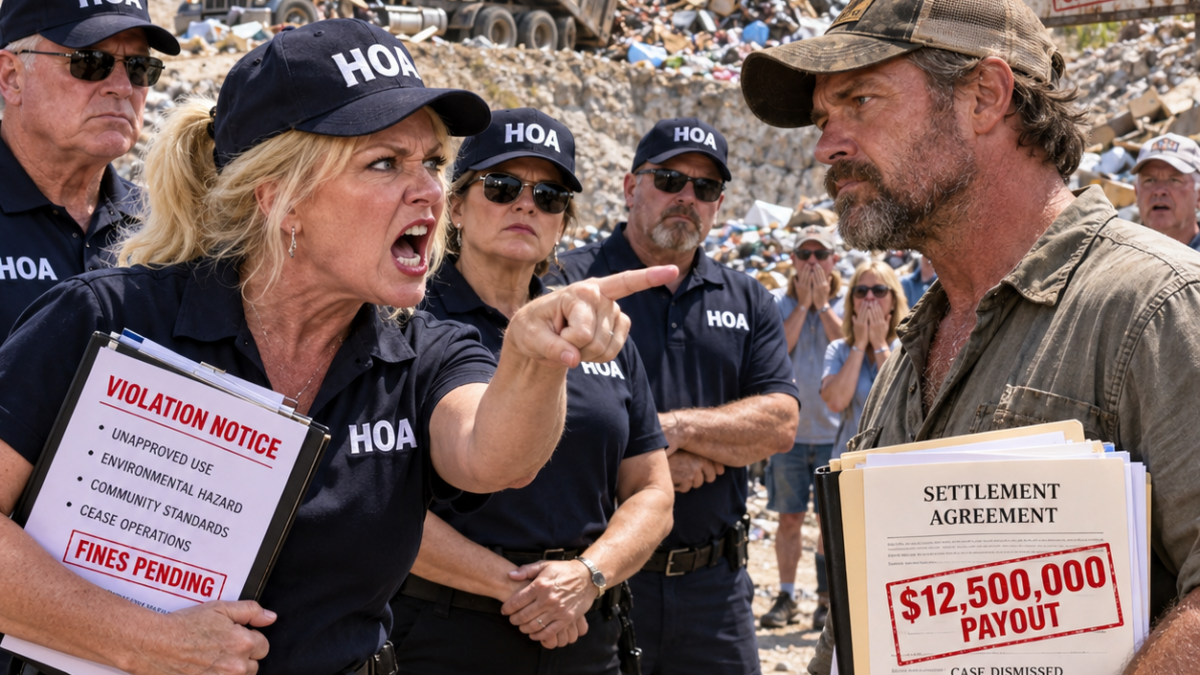
The HOA president was screaming for a sheriff’s deputy to arrest me for trespassing while I stood on forty acres my father had left me, but behind her three dump trucks were already lined up beside my quarry as if someone had scheduled another delivery before sunrise.
I had come home from a three-week work trip expecting nothing more than an empty pit, a locked gate, and the same wind moving across the limestone walls, yet someone had broken onto my land and dumped enough mattresses, broken toilets, construction debris, and black bags into the quarry to build a hill twenty feet high.
What Judith Crane did not know was that I had returned early, spent half the night watching trucks move through the darkness, and had just noticed something near the waterline that made her obsession with getting me off the property suddenly feel much more dangerous than a dispute over trash.
My name is Dean Holloway.
My father, Ray, left me the quarry after he died.
Forty acres at the edge of town, most of it rough limestone, scrub grass, and a pit that had not produced commercially in years. As a kid, I hated the place in summer because the heat bounced off the rock hard enough to make the air shimmer. As an adult, I understood why my father never sold it.
It was quiet.
That mattered to him.
I inspect bridges for a living, so I spend more time on the road than I do behind a desk. The quarry became the one place where nobody needed anything from me.
Before Dad died, he told me something strange.
“Keep the paper, Dean.”
“What paper?”
“The old envelope.”
He was weak by then, but his eyes sharpened.
“Never sell the pit.”
I thought grief and medication were mixing with nostalgia. I found the envelope later, sealed it in my home safe, and forgot about it.
Then Richmond Estates started writing to me.
Their HOA president, Judith Crane, claimed sections of the quarry were part of a “community reserve area.” Another letter referenced a “shared easement.” A third demanded board review before I made changes to the property.
I ignored them.
My father had owned the quarry longer than Richmond Estates had existed.
Then work sent me out of state for three weeks.
Before leaving, I locked the main chain myself.
When I returned early, it was almost two in the morning.
My headlights swept across the access road.
Fresh tire tracks.
Deep.
Wide.
Heavy.
The gate chain hung loose.
I killed the headlights and sat there listening.
Engines rumbled somewhere beyond the bend.
I walked in.
Three dump trucks were backing toward the quarry.
Their trailer lights were dark.
A man in a red cap stood near the edge waving one truck into position.
The bed lifted.
Something enormous slid out and disappeared into the pit with a crash.
Then came another load.
I stayed behind a limestone outcrop until they left.
At sunrise, I walked to the edge.
My stomach tightened.
Mattresses.
Broken furniture.
Construction waste.
Trash bags.
Toilets.
Chunks of drywall.
Someone had turned my father’s quarry into a dumping ground.
Then I saw the drums.
Dozens of them.
Rusted steel cylinders half buried near the lower waterline.
Several carried faded yellow warning labels.
One had split along the side.
A thin rainbow sheen moved across the surface of the quarry water.
I stepped backward.
I called the sheriff.
Deputy Mike Sorrell arrived twenty minutes later.
Before he could even get out of his cruiser, another vehicle came racing up the quarry road.
Beige SUV.
Judith Crane.
She stepped out wearing a blazer and gold earrings like she was arriving at a board meeting instead of an illegal dump site.
She pointed straight at me.
“That man is trespassing on HOA reserve property!”
Sorrell looked from her to me.
Judith never looked at the drums.
Not once.
She only said, “Remove him.”
That was when I understood she was not surprised by what was in the quarry.
And when Deputy Sorrell asked me for my deed, I realized the papers proving everything were locked in a safe three hours away.
PART 2
Judith smiled before I answered.
It wasn’t a big smile.
That made it worse.
Just the faintest upward movement at one corner of her mouth, gone almost as soon as it appeared.
She knew.
“Sir?” Deputy Sorrell asked. “Do you have documentation showing ownership?”
“Not with me.”
Judith folded her arms.
“Of course he doesn’t.”
I looked at her.
“You broke my gate.”
“That gate is on reserve property.”
“My father installed that gate twenty-six years ago.”
“Your father misunderstood the boundary.”
Deputy Sorrell raised a hand.
“One at a time.”
Judith ignored him.
“This man has repeatedly interfered with community property. We have correspondence documenting his refusal to cooperate with the association.”
I almost laughed.
“You mailed me demands.”
“We notified you of board jurisdiction.”
“You declared jurisdiction.”
“Same difference.”
“No.”
Deputy Sorrell looked toward the pit.
His expression changed when he noticed the trash.
“What exactly is happening down there?”
Judith answered before I could.
“Routine reserve maintenance.”
I stared at her.
“Those are chemical drums.”
“You don’t know what they contain.”
“Neither do you?”
She looked at me.
That half-second was enough.
Sorrell noticed too.
“What company is doing the work?” he asked.
“The HOA uses several vendors.”
“Which one today?”
“I’d have to check.”
Three dump trucks sat less than a hundred yards away.
One driver was still inside his cab.
Judith supposedly supervised the project yet could not name the contractor.
I wanted to press.
Instead, I forced myself to stop.
I had spent twenty-three years inspecting bridges and documenting structural failures. One thing the work teaches you is that anger makes people hurry, and hurried conclusions are easy to attack later.
Sorrell looked at me again.
“You said you own the land.”
“I do.”
“Where’s the deed?”
“My house.”
“How far?”
“About three hours.”
Judith laughed softly.
“Convenient.”
I looked at her.
“You seem very interested in whether I can prove ownership this morning.”
“I’m interested in stopping harassment.”
“Harassment?”
“You came onto association land at dawn and confronted contractors.”
“I called the sheriff.”
“You’re interfering with a permitted project.”
“Show him the permit.”
Her face went still.
Sorrell looked at her.
“Do you have one?”
“The HOA office maintains all permits.”
“On-site copy?”
“No.”
“Environmental authorization?”
Judith’s jaw tightened.
“You’ll need to speak with our management company.”
I looked toward the drums.
“So you don’t have one.”
“Dean, stop.”
The way she used my first name bothered me.
We had met twice before.
Both times at the edge of the quarry when she tried to persuade me to sign an easement agreement.
I had refused.
She had never called me Dean.
Now she did it like we were old adversaries.
Sorrell stepped between us.
“Here’s what’s going to happen. Until I can verify title and determine whether this contractor has lawful authorization, nobody is dumping anything else.”
Judith’s head snapped toward him.
“Deputy, you don’t understand. This is an HOA reserve project.”
“I understand there’s a property dispute and material is being deposited near water.”
“That man has no standing here.”
“And you have paperwork?”
“Our attorney can provide it.”
“Then provide it.”
She exhaled sharply.
“I expect him removed.”
Sorrell looked uncomfortable.
I understood why.
From his position, he had two people claiming control over the same land.
I had no deed.
Judith had an HOA title and confidence.
Confidence wins more arguments than it should.
Finally, Sorrell said, “Mr. Holloway, until ownership is verified, I need you to stay clear of the active work area.”
Judith smiled again.
I asked, “Am I being arrested?”
“No.”
“Ordered off?”
“I’m asking you to avoid escalating a property dispute until records are checked.”
Judith jumped in.
“Give him ten minutes.”
Sorrell turned sharply.
“Ma’am, I’m speaking.”
She closed her mouth.
I looked at the quarry one more time.
Then nodded.
“Fine.”
Judith looked almost disappointed that I didn’t fight.
I walked back toward my truck.
She called after me.
“You should have listened when we told you this land was part of Richmond Estates.”
I stopped.
Turned.
“Then why did you wait until I left town to start dumping?”
Her expression changed.
Tiny.
But real.
Then she said, “Coincidence.”
I got in my truck and drove away.
She thought I was going home.
I didn’t.
I drove five miles east to Clyde Baxter’s farm.
Clyde had known my father longer than I had been alive.
He was seventy-one, broad through the shoulders despite age, with a white beard he trimmed badly and hands permanently stained by machinery grease.
I knocked.
He opened the door, looked at me, and said:
“You saw it.”
Not hello.
Not what happened.
You saw it.
My chest tightened.
“Come inside.”
His kitchen smelled wrong.
Not strongly.
Just enough to notice.
Sharp.
Chemical.
Like paint thinner from another room.
Clyde turned on the faucet.
“Smell.”
I leaned closer.
The water looked clear.
The smell did not belong in a kitchen.
“How long?”
“Month.”
“You called anybody?”
“County tested once.”
“And?”
“Said something was off but needed more sampling.”
“You still drinking it?”
“Hell no.”
He pointed at cases of bottled water stacked by the pantry.
“Doctor says my liver numbers are wrong.”
I stared at him.
“What did he say caused it?”
“Couldn’t say.”
“Clyde, why didn’t you tell me?”
He looked ashamed.
“Didn’t want to bother you while Ray was sick.”
“Dad’s been gone six months.”
“And then you were traveling.”
“That’s not an answer.”
He sat at the kitchen table.
“Your father knew they were messing around near the quarry.”
“Who?”
“Richmond.”
“When?”
“A couple years.”
I sat across from him.
“What did he tell you?”
“Judith kept asking him to sign something.”
“Easement?”
“Maybe.”
“She asked me too.”
“He refused.”
“So did I.”
Clyde rubbed his face.
“After Ray died, trucks started coming at night.”
My pulse quickened.
“You saw them?”
“Sometimes heard them.”
“Why didn’t you call me?”
“I thought they were on the HOA side.”
“They weren’t.”
He looked toward the faucet.
“Then I started smelling this.”
I stood.
“Don’t use that water for anything.”
“I’m not stupid.”
“I know.”
“Where are you going?”
“State environmental office.”
“Now?”
“Yes.”
I found two clean glass containers in Clyde’s pantry.
We filled them from the tap.
I labeled the time and date.
Then I took photographs of the faucet, the bottles, and the handwritten note Clyde had made when the smell first appeared.
Maybe none of it would be admissible laboratory evidence.
That wasn’t the point.
It was enough to get someone’s attention.
The regional environmental office opened at eight.
I arrived at 8:07.
A receptionist looked at the jars.
“You can’t just bring water samples in.”
“I know.”
“Then why did you?”
“Because my neighbor’s well smells like solvent, and there are leaking industrial drums in a quarry uphill from his property.”
That got her attention.
Within twenty minutes, I was speaking with a field officer named Lena Ortiz.
She was in her forties, hair tied back, no-nonsense expression.
I showed her the photographs.
Her face changed at the yellow labels.
“When did you take these?”
“This morning.”
“Where?”
I gave her the parcel location.
“Who owns the quarry?”
“I do.”
“Any industrial use?”
“Not for years.”
“Who put the drums there?”
“I believe an HOA contractor.”
Her eyebrows rose.
“That needs explanation.”
I gave it.
She took notes.
When I finished, Lena looked at the jars.
“These aren’t chain-of-custody samples. We can’t treat them as formal evidence.”
“I understand.”
“But we can use the complaint to initiate preliminary testing.”
“That’s all I need.”
“How many drums?”
“Dozens.”
“Visible leakage?”
“One definitely.”
“Surface water?”
“Yes.”
“Any wells downgradient?”
“Clyde’s.”
“Other homes?”
“Probably.”
She stood.
“I’m opening a field complaint.”
“How fast?”
“I can’t promise.”
“There were trucks there this morning.”
She stopped.
“Active dumping?”
“Yes.”
“Then faster.”
I left feeling relieved for about thirty seconds.
Then angry.
Judith had known I was away.
Someone had cut my chain.
Trucks were arriving at night.
This wasn’t careless disposal.
It was concealed.
That evening, I returned to the quarry from the back side where scrub cedar hid the ridge.
I installed two trail cameras.
One aimed toward the access road.
One toward the dumping edge.
Then I parked half a mile away behind an abandoned equipment shed my father used decades earlier.
At 11:48 p.m., headlights appeared.
I killed my phone screen.
A truck came first.
Then another.
Then Judith’s beige SUV.
I watched through binoculars.
The man in the red cap stepped from the first truck.
Judith got out.
No blazer now.
Dark coat.
She handed him an envelope.
He opened it under the truck’s cab light.
Cash.
He counted.
I recorded with my phone from the shadows.
License plates.
Faces.
Vehicles.
Time.
I wanted to confront them.
Every part of me wanted to walk down there and ask Judith whether “routine reserve maintenance” usually involved cash envelopes at midnight.
Instead, I stayed still.
That decision probably saved the case.
The trucks dumped two loads.
Then left.
Judith stayed another five minutes.
She stood alone at the edge looking into the quarry.
No fear.
No hesitation.
She knew exactly what was below.
The next morning, I followed the red-cap driver.
Not closely.
I’m a bridge inspector, not a detective.
But industrial trucks are easy to follow when they drive slowly and carry company markings someone forgot to remove completely.
Faded lettering on the cab:
**KESSLER HA—**
The rest had been painted over.
Twenty miles outside town, the truck turned into a fenced industrial yard.
A rusted sign read:
**KESSLER HAULING & SALVAGE**
That was the man.
Bud Kessler.
I parked at a gas station across the highway and watched.
Two hours later, he left.
I drove into the yard pretending I needed to ask about gravel delivery.
The office was unlocked.
A woman behind the desk told me they didn’t sell gravel.
I apologized and turned to leave.
Through a dirty interior window, I saw stacks of paper.
Invoices.
One phrase stood out on the top sheet.
**RICHMOND RESERVE DISPOSAL FEE**
I didn’t photograph it.
I had no right to invade an office.
But I memorized the wording.
That night, someone slid an envelope under my front door.
No stamp.
No return address.
Inside was one photocopied ledger page.
Columns.
Dates.
Vendor names.
Amounts.
**Reserve Maintenance — Kessler Hauling — $18,500**
**Emergency Debris Mitigation — $22,000**
**Environmental Containment — $31,750**
None of those descriptions matched what I had seen.
At the bottom, someone had written:
**Check the reserve fund. I can’t live with this anymore.**
The handwriting shook.
I stared at it for a long time.
Then called Samuel Wickham.
Sam had handled my father’s estate.
He was sixty-three, dry sense of humor, old-fashioned suits, and the irritating habit of taking thirty seconds to answer questions that felt urgent.
I told him about the ledger.
He stayed quiet.
“Samuel?”
“I’m thinking.”
“Think faster.”
“No.”
I waited.
Finally:
“Who on the HOA controls the reserve?”
“I don’t know.”
“Find out publicly.”
“Meaning?”
“Don’t sneak into anything. Board minutes. Annual budgets. State filings.”
“I can do that.”
“And Dean?”
“Yes?”
“Open Ray’s envelope.”
I stopped.
“The old one?”
“The one he told you to keep.”
“How do you know about it?”
“Because he asked me to notarize something in 1987.”
I sat down.
“What?”
“Open the envelope.”
“Sam—”
“Not over the phone.”
Three hours later, I was in his office.
The envelope sat between us.
Brown paper.
My father’s handwriting.
**DEAN — KEEP WITH LAND**
I cut the edge.
Inside was a deed.
Recorded 1987.
And an original surveyor’s map.
Sam read them.
Once.
Then again.
He stood, walked to a filing cabinet, pulled a county plat book, and spread photocopies across his desk.
“Look.”
Richmond Estates had been developed in phases.
Their current HOA plat showed a boundary line extending into the quarry access corridor and across several acres near the pit.
My father’s recorded deed did not.
“Clerical error?” I asked.
“Looks like it began as one.”
“How?”
“Survey transcription.”
“And then?”
Sam tapped the later HOA map.
“They kept using the incorrect version.”
“So Judith thinks the quarry belongs to them.”
“No.”
I looked up.
“Why no?”
“Because your father challenged it.”
Sam found an old correspondence file.
Letters from Ray Holloway.
To Richmond developers.
County recorder.
HOA counsel.
One reply acknowledged the discrepancy and said the association would “review its mapping.”
They never corrected it.
Sam leaned back.
“Judith may have relied on the bad plat publicly.”
“But?”
“She cannot plausibly claim nobody ever told the HOA.”
My father had known.
That was what he meant.
Keep the paper.
Never sell the pit.
He hadn’t been sentimental.
He had been protecting a boundary everyone else found convenient to blur.
Sam looked at me.
“Your ownership is strong.”
“What about the lien threat?”
“What lien?”
I told him about Judith’s letters.
He frowned.
“She can’t lien land outside the association merely because she claims it’s reserve.”
“She may try.”
“Then she’ll create evidence.”
The anonymous ledger gave me a name.
Frank Mulder.
Treasurer.
HOA filings listed him.
It took two days to get him alone.
He refused my first call.
Ignored the second.
On the third, he texted an address.
Diner outside town.
Back booth.
No greeting when I sat down.
Frank was in his late fifties, narrow face, hands shaking around coffee.
“You got the page.”
“You sent it?”
He stared at the door.
“I shouldn’t be here.”
“Then why are you?”
He looked at me.
“Because Clyde Baxter is sick.”
That hit me harder than expected.
“You know about Clyde?”
“I know about the complaints.”
“Judith does too?”
Frank’s silence answered.
“How much money?”
He swallowed.
“Almost two million.”
I stared.
“In disposal fees?”
“Over three years.”
“For dumping in my quarry?”
“Some.”
“Some?”
“Some was never spent.”
“Where did it go?”
“I don’t know all of it.”
“You’re treasurer.”
“On paper.”
“Frank.”
His hands tightened.
“Judith controls the accounts through the management company. I sign reconciliations.”
“You signed false records?”
“I thought the vendors were real.”
“Kessler is real.”
“Not every invoice is.”
My stomach tightened.
“Ghost vendors?”
He nodded.
“How many?”
“I don’t know.”
“You keep saying that.”
“Because I don’t.”
His voice rose, then dropped immediately.
“I was stupid.”
“Or scared.”
“Both.”
He looked toward the window.
“She told me to move money between reserve categories.”
“How much?”
“Hundreds of thousands.”
“Why?”
“She said the board had approved emergency remediation.”
“Remediation of what?”
Frank gave a bitter laugh.
“The contamination they were creating.”
I leaned back.
He finally said it.
“Judith knew.”
“Yes.”
“How long?”
“At least a year.”
“Why keep dumping?”
“Because proper hazardous disposal costs money.”
“And she was charging the HOA for proper disposal.”
“Yes.”
“But paying Kessler less to dump illegally.”
“Yes.”
“Where did the difference go?”
Frank closed his eyes.
“I think into accounts she controls.”
“Think?”
“I saw transfers.”
“To her?”
“Not directly.”
“Then where?”
“A consulting LLC. Crane Community Strategies.”
Judith Crane.
I took out my notebook.
Frank grabbed my wrist.
“No.”
I looked at him.
“If she knows I talked—”
“Let go.”
He did.
“I’m not recording you.”
“I don’t believe you.”
“Then leave.”
He stared.
I continued.
“But before you do, decide whether you want to be the man who signed paperwork after knowing someone’s well was contaminated.”
His face collapsed.
“That’s why I’m here.”
“Then help me properly.”
“What does that mean?”
“Give the records to an attorney or investigators. Not me.”
He stared at his coffee.
“I kept copies.”
“Where?”
“Safe-deposit box.”
“All of them?”
“Enough.”
The next morning, the certified letter arrived.
Richmond Estates Homeowners Association.
**NOTICE OF LIEN**
$250,000.
Alleged reserve restoration costs.
Unauthorized access.
Interference with HOA operations.
Environmental damages.
I read that last phrase twice.
They were blaming me for the contamination.
Sam read it and almost smiled.
“That’s bold.”
“They’re trying to bankrupt me.”
“They’re trying to scare you.”
“Can they?”
“File something? They can try. Make it valid? Different issue.”
“They’re accusing me of environmental damage they created.”
“Yes.”
“Why are you smiling?”
“Because desperate people over-document.”
He held up the letter.
“This ties the association directly to the quarry dispute.”
“They already were.”
“Not like this.”
The laboratory results came back that afternoon.
Lena Ortiz called me personally.
“Mr. Holloway, are you somewhere you can talk?”
“Yes.”
“The formal samples from the quarry water show elevated arsenic, industrial solvents, and several heavy metals.”
I closed my eyes.
“How bad?”
“Above applicable safety thresholds.”
“And Clyde’s well?”
“We sampled it yesterday.”
Pause.
“Also affected.”
My hand tightened around the phone.
“Is he in danger?”
“He needs to continue using bottled water. We’ve notified county health.”
“Any other wells?”
“We’re expanding sampling.”
I stared through Sam’s window.
Traffic moved below like normal life still existed.
Lena continued.
“This is not a simple dumping complaint anymore.”
“What happens now?”
“State enforcement. Possibly federal referral depending on waste classification and interstate handling.”
“Do you have enough to stop dumping?”
“Yes.”
“When?”
“Soon.”
Two days later, Lena arrived at the quarry with a full inspection team.
White hard hats.
Sample equipment.
Cameras.
Two state vehicles.
A county health truck.
Deputy Sorrell came too.
This time I carried the 1987 deed in a plastic document case.
At 8:42, three Kessler trucks came down the access road.
As if scheduled.
Behind them:
Judith.
She got out smiling.
Then saw Lena.
The smile disappeared.
“What is this?”
Lena approached.
“State environmental inspection.”
“On whose authority?”
“Mine.”
“This is HOA reserve land.”
I stepped forward.
Judith saw the deed.
Her face changed.
“You.”
“Morning.”
Deputy Sorrell walked over.
Judith pointed.
“Arrest him.”
Sorrell didn’t move.
“He’s trespassing.”
I handed him the deed.
He read the recorded parcel number.
Then the survey.
Then looked toward Lena.
She handed him a county parcel verification.
His face tightened.
“Ma’am.”
Judith folded her arms.
“What?”
“This land belongs to Mr. Holloway.”
“No. The HOA plat—”
“Appears incorrect.”
“That’s impossible.”
Sam stepped from his car.
“It was disputed in writing by Ray Holloway decades ago.”
Judith stared at him.
Sam held up copies.
“You received notice through association counsel.”
“That was before my presidency.”
“Several notices continued after.”
Her mouth tightened.
The dump trucks sat idling.
Lena walked toward one.
“Kessler Hauling?”
The driver nodded.
“Do you have hazardous-waste manifests?”
He looked toward Judith.
Wrong move.
Lena noticed.
“So that’s a no?”
Judith stepped forward.
“This is regular debris.”
Lena pointed toward the drums.
“Then you won’t mind us inspecting them.”
Judith’s composure broke for the first time.
“You need a warrant.”
Lena answered calmly.
“We have the authority required for the site inspection based on documented contamination and active discharge concerns.”
Judith looked at Sorrell.
“Stop them.”
He shook his head.
“Not my jurisdiction to obstruct.”
She turned to me.
“You planned this.”
“No.”
“You set us up.”
“You dumped on my land.”
“You knew what would happen.”
“I came home early.”
That stopped her.
“What?”
“I was supposed to be gone another five days.”
Judith said nothing.
The truth landed visibly.
She had timed the dumping around my work schedule.
And I had just told her I knew it.
Lena’s team began photographing the trucks.
One inspector opened a side compartment and found transfer paperwork.
Not proper hazardous manifests.
Internal hauling sheets.
Origin points.
Industrial facilities.
Some outside the county.
Lena called someone.
The day escalated quickly.
Kessler arrived around noon.
Red cap.
Same man from the night video.
He started loudly.
“This is authorized.”
Lena asked:
“By who?”
Kessler pointed at Judith.
Judith turned toward him with pure hatred.
“Bud, stop talking.”
He stopped.
Too late.
I watched Sorrell write that down.
That night, Richmond called an emergency board meeting.
I wasn’t invited.
Frank was.
He arrived carrying a banker’s box.
Later, he told me exactly what happened.
Judith opened by claiming I had launched a coordinated attack on Richmond Estates.
She accused me of manipulating environmental regulators.
She said the quarry belonged to the HOA.
Then Frank put the box on the conference table.
“What’s that?” she asked.
“The real books.”
Nobody spoke.
Frank opened the first binder.
Reserve transfers.
Vendor payments.
Kessler invoices.
Ghost vendors.
Checks.
Board members stared.
Judith tried to interrupt.
Frank kept going.
Nearly $2 million labeled as disposal or environmental reserve expenses.
A fraction actually paid to Kessler.
Large transfers moving through Crane Community Strategies.
Judith said those were consulting fees.
A board member named Alice Dunham asked:
“For what consulting?”
Judith answered:
“Community risk management.”
Alice held up a bank record.
“Three hundred eighty thousand dollars?”
“Over multiple years.”
“For you?”
“For my company.”
The room went quiet.
Another director, Paul Mercer, pushed his chair back.
“You never disclosed that.”
“It was disclosed.”
“Where?”
“In executive session.”
“I was in every executive session.”
Judith stared at him.
“That’s not what I meant.”
Frank told me that was the moment the room changed.
Not when contamination appeared.
Not when the deed surfaced.
When board members realized Judith had been taking money through a company they did not know existed.
People forgive abstract risk longer than personal betrayal.
Paul said:
“Did we authorize dumping?”
Judith snapped:
“We authorized reserve management.”
“That isn’t what I asked.”
Alice:
“Did you tell Kessler to use Holloway’s quarry?”
Judith:
“Legal advised—”
Paul:
“Which lawyer?”
Silence.
Frank placed another document down.
A copy of Judith’s payment schedule to Kessler.
Cash withdrawals matched the nights my trail cameras captured.
Alice whispered:
“Oh my God.”
Judith stood.
“This meeting is over.”
Paul said:
“No.”
She stared.
“What?”
“You don’t get to end it.”
The board voted to suspend Judith’s financial authority that night.
Temporary.
Pending counsel review.
But the machine was already breaking.
The next morning, the HOA’s insurance carrier contacted Sam.
Not me.
They wanted mediation.
Two weeks later, I sat across from three insurance lawyers.
Dark suits.
Neutral conference room.
Pitcher of water no one drank.
Judith sat behind glass in an adjacent room with her own counsel.
Frank had already given investigators copies.
Lena’s agency had issued emergency orders.
The county had begun testing additional wells.
Four showed contamination above normal background levels.
Clyde’s was worst.
The HOA’s first offer:
$1.2 million.
Property damages.
Legal costs.
Confidentiality.
Release of claims.
I read the term sheet.
Then pushed it back.
One lawyer said:
“Mr. Holloway, that is a substantial offer.”
“My neighbor’s water is poisoned.”
“The environmental remediation component is separate.”
“Not separate to Clyde.”
“We’re discussing your damages.”
“I’m discussing what your insured did.”
Sam touched my arm lightly.
Not to stop me.
To remind me not to let anger take over.
The lawyer continued.
“You could spend years litigating.”
“I know.”
“Outcome uncertain.”
“I know.”
“Expert costs.”
“I know.”
“Potential comparative responsibility issues regarding historic quarry use.”
That got my attention.
“What?”
“The quarry had prior industrial activity.”
“My father mined limestone.”
“Which creates environmental questions.”
“Not arsenic drums.”
“We’re evaluating all potential sources.”
I stared at him.
There it was.
Their strategy.
Make the old quarry itself look guilty.
Sam said calmly:
“Your own insured’s records identify disposal payments.”
The lawyer didn’t blink.
“Records can be interpreted.”
I said:
“Trail cameras can’t.”
Silence.
“Neither can the cash handoff.”
One lawyer looked toward another.
I continued.
“Neither can Kessler telling a state inspector Judith authorized the site.”
Another silence.
“And Frank’s ledger.”
The lead lawyer leaned back.
“What would resolve your claims?”
I looked at Sam.
Then at the lawyers.
“Full cleanup.”
“That’s regulatory.”
“Full groundwater remediation attributable to the dumping.”
“That could be extensive.”
“Then you should’ve considered that before dumping industrial waste.”
The lawyer’s jaw tightened.
“Mr. Holloway—”
“New well for Clyde.”
“Potentially.”
“Testing for every nearby property.”
“Already happening.”
“Medical monitoring fund for affected households.”
They exchanged looks.
“Cleanup of the entire quarry.”
“Obviously subject to scope.”
“Restoration of my access road and fencing.”
“Reasonable.”
“Release of the fraudulent lien.”
“Assuming invalidity.”
“It is invalid.”
Sam slid the deed forward.
“Remove assuming.”
The lawyer looked at it.
I continued.
“Legal fees.”
“Negotiable.”
“And accountability.”
“What does that mean?”
“The current board resigns.”
That stopped them.
“We cannot dictate HOA elections.”
“Your insured board approved or ignored three years of fake reserve spending.”
“Not every director participated.”
“Then they can explain why they should stay.”
“That’s not a damages term.”
“It is to me.”
The lawyer shook his head.
“You’re asking for governance control over an association you don’t belong to.”
“No.”
“I’m asking for the people who let my land become a secret dump site to stop running the neighborhood.”
Judith’s silhouette moved behind the glass.
She knew we were talking about her.
The lead lawyer closed the folder.
“We’ll break.”
They disappeared for forty minutes.
I sat with Sam.
He looked at me.
“You’re shaking.”
“I know.”
“Anger?”
“Clyde.”
“Good.”
“Good?”
“Better than greed.”
I laughed once.
“Seven figures is still seven figures.”
“Yes.”
“Think I’m stupid for refusing?”
“No.”
“Why?”
“Because their first offer wasn’t really settlement.”
“What was it?”
“Price discovery.”
I stared.
“They’re measuring how scared you are.”
“And?”
“You just gave them an expensive answer.”
The lawyers returned.
Gray faces.
New term sheet.
I read the number twice.
$7 million.
Structured across property damage, nuisance, legal claims, settlement of disputed association actions, and other covered liabilities.
Separate from the environmental remediation funds.
Full quarry cleanup.
Groundwater remediation.
Replacement well for Clyde.
Testing and treatment support for affected neighboring properties.
HOA lien withdrawn permanently.
Association reimbursing my legal expenses within the settlement framework.
Board resignations as part of a negotiated governance resolution approved through counsel and membership procedure.
I looked at Sam.
He didn’t smile.
He simply nodded once.
The lead lawyer said:
“This is conditioned on final releases.”
“Not criminal or regulatory investigations.”
“No.”
“Not environmental agency authority.”
“No.”
“Not Frank’s cooperation.”
“No.”
I looked through the glass.
Judith stared back.
Her posture was rigid.
Not defeated yet.
Still angry enough to believe anger could reverse facts.
I picked up the pen.
Then stopped.
The lawyer sighed.
“What now?”
“Clyde.”
“What about him?”
“His replacement well starts before final payment to me.”
“We can arrange escrow authorization.”
“In writing.”
They changed it.
I signed.
The next morning, Richmond Estates held an emergency membership session.
Every sitting director announced resignation.
Some claimed they had been deceived.
Some probably had.
Alice Dunham cried during hers.
“I trusted information I should have verified.”
Paul Mercer said:
“I failed to ask questions because asking them felt disloyal.”
Frank did not run.
He resigned too.
Even though he had become the whistleblower.
He told residents:
“I signed records I should not have signed. Helping later doesn’t erase that.”
I respected him for that.
Judith was last.
She entered the clubhouse carrying a single banker’s box.
No gold earrings.
No blazer.
Plain sweater.
The woman who had arrived at my quarry demanding my arrest looked smaller without the machinery of authority surrounding her.
She walked to the microphone.
“I have served Richmond Estates for fourteen years.”
People stayed silent.
“I made difficult decisions.”
A voice from the back:
“You poisoned wells.”
The room stirred.
Judith gripped the podium.
“That allegation is under investigation.”
Another voice:
“You paid yourself.”
Her attorney approached.
She waved him away.
“This community asked me to solve impossible problems.”
Nobody responded.
She looked toward Frank.
He wouldn’t meet her eyes.
Then Judith saw me standing near the rear wall.
“You.”
The room went quiet.
Her lawyer whispered:
“Judith.”
She ignored him.
“You could have taken the first settlement.”
I answered:
“You could have used a legal disposal site.”
Her face reddened.
“You think this makes you righteous?”
“No.”
“You think your father’s deed makes you better than everybody here?”
“No.”
“Then what do you want?”
“Clean water.”
Silence.
“And my land left alone.”
She stared.
I continued.
“That’s all I wanted before you decided the quarry was cheaper than doing things legally.”
Her mouth tightened.
“I didn’t create the disposal problem.”
“No.”
“You don’t understand the budget pressure.”
“Then explain it to investigators.”
“You have no idea what residents demand. Lower dues. Perfect roads. Landscaping. Reserves. Nobody wants assessments.”
That was the first time I heard something human beneath the entitlement.
Not an excuse.
A motive.
She had promised residents a community that looked expensive without costing what expensive things cost.
Then she found shortcuts.
Kessler offered another one.
The first illegal load probably looked manageable.
Then one became ten.
Ten became dozens.
Then she needed fake books to hide the savings.
Then the difference became money she could move elsewhere.
Then everyone around her became a threat.
Greed had grown inside fear of exposure.
Judith’s lawyer touched her shoulder.
She looked away from me.
Then read her resignation.
When she walked through the side door, two state investigators were waiting in the hallway.
They did not drag her away.
They spoke with her.
Her attorney remained beside her.
That was how real consequences began.
Not theatrically.
Paperwork.
Questions.
Statements.
Records.
Frank gave a full statement that afternoon.
Bud Kessler eventually cooperated too.
The prosecutor’s office opened a criminal investigation covering illegal disposal, financial misconduct, false records, and related conduct supported by the evidence.
I was interviewed three times.
The first lasted four hours.
The second focused on the trail-camera footage.
The third on the midnight cash exchange.
Investigators asked the same questions repeatedly.
Dates.
Times.
Where I stood.
How far away.
Whether I enhanced footage.
Who touched the files.
It was exhausting.
Also reassuring.
Real cases should survive hostile questions.
The environmental cleanup began before the criminal case reached charging decisions.
Excavators arrived.
Protective equipment.
Containment barriers.
Pumps.
Water-treatment equipment.
The mattresses came out first.
Hundreds of cubic yards of ordinary debris.
Furniture.
Toilets.
Drywall.
Roofing waste.
Then drums.
Some intact.
Some corroded.
Some leaking.
Each one photographed, labeled, tested, packaged.
I watched from the ridge.
Lena stood beside me.
“You don’t have to stay.”
“I know.”
“You’ve been here six hours.”
“I know.”
“You always answer like that?”
“Usually.”
She smiled faintly.
Below us, an excavator lifted a rusted drum into a containment tray.
“Your father ever imagine this?”
“No.”
“What did he use the quarry for at the end?”
“Mostly nothing.”
“That may have saved you.”
“How?”
“Less legitimate industrial activity means fewer competing explanations.”
I looked toward the pit.
“So emptiness became evidence.”
“In a way.”
Clyde’s well replacement began the next week.
Drilling rig.
New casing.
Deeper protected source.
Treatment system until repeated testing cleared the supply.
Clyde stood beside the rig with his arms crossed.
“You didn’t have to pay for this.”
“I’m not.”
He looked at me.
“You know what I mean.”
“The settlement pays.”
“Because of you.”
“Because Judith dumped.”
He grunted.
“Your father would argue exactly like that.”
“Good.”
“No. It was annoying when he did it too.”
Months earlier, Clyde had looked gray.
Now he looked stronger.
The doctor said some of his lab markers were improving.
Not everything returned immediately.
Exposure isn’t a movie problem.
You don’t remove the villain and make the body forget.
But he improved.
The first day the new well produced clean water, Lena’s office tested it.
Then tested again.
When the final confirmation arrived, I drove to Clyde’s farm.
He was standing at the kitchen sink.
He turned the faucet.
Filled a glass.
Held it toward the light.
Then smelled it.
Nothing.
He handed it to me.
“You first.”
“Coward.”
“Guest privilege.”
I drank.
Cold.
No chemical edge.
Just water.
Clyde filled another glass.
He took one sip.
Then his face collapsed.
He started crying.
Not quietly.
He put the glass down and grabbed me.
For a second, I was eight years old again, hugged by the giant man who used to lift me onto tractors at my father’s quarry.
He said:
“Ray would’ve killed somebody over this.”
I laughed through my own tears.
“No, he wouldn’t.”
Clyde pulled back.
“He’d have thought about it.”
“That I believe.”
The settlement money arrived in stages.
People assumed the $7 million made me instantly rich.
It didn’t work exactly that way.
Taxes.
Legal costs.
Property restoration.
Lost work.
Professional fees.
Long-term monitoring obligations.
Still, it was life-changing.
I paid off my mortgage.
Set aside money for environmental stewardship of the quarry.
Created a fund for long-term testing beyond the required period because I never again wanted someone arguing they couldn’t afford one more sample.
The strangest part was feeling guilty about the money.
I told Sam that.
He looked at me like I had announced I felt guilty for owning shoes.
“Why?”
“Clyde got sick.”
“And?”
“I got paid.”
“Those are related because the same misconduct caused both.”
“Still feels strange.”
“Would you prefer the insurer kept it?”
“No.”
“Would you prefer Richmond residents bore everything personally?”
“No.”
“Would you prefer Judith kept control?”
“No.”
“Then stop turning compensation into a moral failure.”
Easy advice.
Harder to feel.
The new Richmond board inherited chaos.
Their first months were ugly.
Residents furious about legal costs.
Insurance premiums increased.
Emergency assessments debated.
Some people blamed Judith.
Some blamed the former board.
Some blamed me.
That surprised me less than it might have earlier.
One man named George Talley confronted me outside a grocery store.
“You cost us thousands.”
I knew who he was.
Richmond resident.
Never met him personally.
“I’m sorry your association is dealing with this.”
“You’re sorry?”
“Yes.”
“You got seven million.”
“Part of a settlement.”
“From our insurance.”
“Yes.”
“Our premiums doubled.”
“That’s unfortunate.”
His face reddened.
“Unfortunate?”
I could have walked away.
Instead, I said:
“Would you like me to tell you what happened to Clyde Baxter?”
He stopped.
“Who?”
“My neighbor.”
“I know who he is.”
“His drinking water was contaminated.”
“I didn’t dump anything.”
“I know.”
“So why should I pay?”
“You shouldn’t personally be blamed for what Judith did.”
“But I am paying.”
“Yes.”
“Then you did win and we lost.”
I thought about it.
“No.”
He laughed bitterly.
“That’s easy from your side.”
He walked away.
I stood beside my truck feeling angry.
Then embarrassed by the anger.
George wasn’t wrong about his experience.
He had bought a home.
Paid dues.
Trusted a board.
Now his insurance costs rose because people running his association had hidden misconduct.
He was another victim.
Different kind.
That complicated the story.
The new board asked to meet with me.
I almost declined.
Then Frank called.
“You should go.”
“You resigned.”
“I still live here.”
“George Talley yelled at me in a parking lot.”
“He yells at everybody.”
“That helps.”
Frank sighed.
“People need to hear you’re not trying to destroy Richmond.”
“I never was.”
“They don’t know that.”
The meeting took place at the clubhouse.
Not public.
Five new directors.
Sam joined me.
The new president was a woman named Karen Liu.
Accountant.
Calm.
She opened with:
“We want a reset.”
“Good.”
“Residents are angry.”
“I know.”
“Some at you.”
“I know.”
“Some want to challenge the settlement.”
Sam said:
“They can consult counsel.”
Karen nodded.
“I told them the same.”
She slid a map toward me.
The corrected boundary.
My quarry completely outside Richmond Estates.
“I want this recorded properly.”
“That’s what my father wanted.”
“We’ll pay the survey and recording cost.”
I looked at Sam.
He nodded.
Karen continued.
“We also want to build a buffer along the property line.”
“Fence?”
“Native vegetation. No shared access unless you approve.”
“Good.”
“And no more reserve-area language.”
“Better.”
She looked at me.
“Dean, can I ask you something off the record?”
“Depends.”
“Did you ever consider selling the quarry after the settlement?”
“Yes.”
“Why didn’t you?”
My father’s words came back.
Never sell the pit.
“Because my father asked me not to.”
“That simple?”
“No.”
I looked at the corrected boundary.
“But simple enough.”
The corrected plat was recorded three months later.
Sam handed me the certified copy.
I took it to the quarry.
Sat on the same limestone ledge where I had once watched illegal trucks move in darkness.
I placed the 1987 deed beside the new map.
My father had protected the land with paper.
I used to think that sounded weak.
Paper against bulldozers.
Paper against trucks.
Paper against an HOA president with lawyers.
But paper preserves memory when people decide memory is inconvenient.
That was what Ray understood.
Judith’s criminal case took longer.
Nearly a year.
The final charges were narrower than neighborhood rumors predicted.
That happens.
Investigations expand.
Prosecutors select what they can prove cleanly.
Frank’s cooperation mattered.
Kessler’s records mattered more.
His company had accepted cash and reduced payments in exchange for illegal dumping access.
Some waste came from contractors avoiding proper disposal costs.
Judith’s HOA reserve accounts disguised the spending.
The consulting company transfers created separate financial issues.
I attended only one hearing.
Judith saw me across the courtroom.
She looked different.
No anger this time.
Just exhaustion.
During a break, she approached with her lawyer.
Sam immediately stood.
Judith stopped several feet away.
“I want to say something.”
Sam looked at me.
I nodded.
Judith held her hands together.
“I did not know Clyde would get sick.”
I believed her.
That surprised me.
“I don’t think you wanted that.”
Her eyes filled.
“I thought the pit was dry enough.”
“It wasn’t.”
“I was told the lower section was isolated.”
“By Kessler?”
She nodded.
“Did you ask an environmental engineer?”
“No.”
“State agency?”
“No.”
“Anyone qualified?”
She looked down.
“No.”
“That’s the problem.”
She wiped one eye.
“I know.”
For months, I had imagined this moment.
In most versions, I said something devastating.
Perfect.
Sharp enough that she would never forget it.
Instead, standing there, I felt tired.
Judith said:
“I thought I could fix it before anyone found out.”
“How?”
“Stop the dumping. Move the drums.”
“When?”
“I don’t know.”
“That isn’t fixing.”
“I know.”
“No. It’s hiding.”
She looked at me.
“I know.”
Sam shifted beside me.
Her attorney touched her arm.
Judith said one last thing.
“Your father hated me.”
“No.”
She looked surprised.
“He didn’t trust the HOA.”
“He wrote about me.”
“He wrote about boundaries.”
“He called me arrogant once.”
“That sounds like Dad.”
A tiny laugh escaped her before she could stop it.
Then she looked ashamed.
“I’m sorry.”
I didn’t tell her it was okay.
It wasn’t.
I simply said:
“I hope you tell the truth.”
She nodded.
Then walked away.
The case ended with a plea agreement involving environmental and financial offenses supported by the investigation.
Kessler faced separate consequences.
Frank avoided the harshest outcome because he cooperated early and turned over records, though he still faced financial and civil repercussions.
People online would probably argue whether the sentences were enough.
I stopped caring.
The quarry was clean.
Clyde had water.
The board was gone.
The records were corrected.
Judith no longer controlled Richmond.
That mattered more to me than a number of years on paper.
The cleanup took almost eleven months.
The last barrel left on a cold morning.
I stood with Lena near the pit.
A crane lifted the final sealed container onto a transport truck.
She checked her clipboard.
“That’s it.”
“No more buried drums?”
“Not according to excavation limits and geophysical survey.”
“Water?”
“Trending better.”
“Groundwater?”
“Monitoring continues.”
“When do you call it done?”
She smiled.
“Environmental people don’t like that word.”
“Of course not.”
“We call it stable.”
“That sounds less satisfying.”
“It’s more honest.”
I looked into the quarry.
The water was clearer.
Limestone walls reflected pale morning light.
No mattresses.
No toilets.
No black bags.
No rusted drums.
Just rock.
Water.
Wind.
Like before.
Not exactly.
Land remembers disturbance even after cleanup.
So do people.
I rebuilt the gate.
Not expensive.
Heavy steel.
New cameras.
Solar lights.
Signs showing private property and the correct parcel number.
Clyde watched me install one.
“You’ve become paranoid.”
“Experienced.”
“Same thing with better paperwork.”
I laughed.
We replaced the old chain with a proper locking system.
When I finished, Clyde pointed toward the sign.
“Ray would say it’s too fancy.”
“Dad used baling wire for everything.”
“Worked.”
“Until it didn’t.”
Clyde looked toward the quarry.
“He really told you not to sell?”
“Yes.”
“Why?”
“I think he knew somebody would eventually want it.”
Clyde nodded.
“Your dad understood land.”
“I inspect bridges.”
“Same thing.”
“How?”
“You both worry about what’s underneath.”
That sentence stayed with me.
A bridge looks strong until the foundation fails.
An HOA looks legitimate until the books fail.
A property line looks settled until you read the deed.
A glass of water looks clean until you test it.
What’s underneath matters.
The $7 million changed my life.
But not in the way people imagine.
I didn’t buy a mansion.
Didn’t quit work immediately.
Didn’t buy five trucks.
I took fewer bridge assignments.
Eventually, I reduced travel.
I wanted to be near the quarry.
That surprised me.
For years, Dad’s land had been a responsibility I inherited.
After the fight, it became something else.
A promise I had chosen.
I restored his old shed.
Kept his rusted vise.
Found one of his coffee mugs behind a toolbox.
Cracked handle.
I almost threw it away.
Didn’t.
On the first anniversary of his death, I sat in the shed with that mug and the brown envelope on the workbench.
The 1987 deed lay inside its plastic sleeve.
I could hear him.
Keep the paper, Dean.
Never sell the pit.
At the time, I had thought he was being an old man afraid of losing the last piece of himself.
Now I understood.
He knew people had started rewriting the property history around him.
Maybe he didn’t know about future dumping.
Maybe he couldn’t imagine Judith.
But he knew one simple thing:
If I lost the paper, eventually somebody would tell me their version of the land was more official than mine.
So he saved it.
And I had almost forgotten it in a safe.
That bothered me.
I said aloud:
“Sorry, Dad.”
Only wind answered.
Then I laughed.
Because if he had been there, he would have said:
“Did you keep it?”
“Yes.
“Then stop whining.”
Probably exactly that.
Richmond Estates changed too.
The new board published financial statements.
Independent audit.
Open reserve reports.
Vendor bids.
Term limits.
No single president could approve emergency contracts above a small threshold without board authorization.
Residents complained about bureaucracy.
Karen Liu told me:
“That’s how I know the reforms are working.”
“Because people hate them?”
“Because they’re boring.”
Frank stayed in Richmond.
Some neighbors refused to speak to him.
Others treated him like a hero.
He disliked both.
One evening, he came to the quarry.
First time.
He stood at the edge.
“So this is where all that money went.”
“Some of it.”
He looked sick.
“I signed those reconciliations.”
“You turned over the real records.”
“After Clyde got sick.”
“Yes.”
“Too late.”
“Later than ideal.”
He looked at me.
“You always talk like an inspector?”
“Probably.”
Frank kicked a small stone.
“I keep wanting someone to tell me I did the right thing.”
“You eventually did.”
“That doesn’t answer it.”
“No.”
He stared into the water.
“I was scared of Judith.”
“I know.”
“She never threatened me directly.”
“No?”
“She didn’t need to.”
He described it.
Every time someone questioned finances, Judith reminded the board how difficult elections could become.
How rumors damaged reputations.
How disagreements could “fracture the community.”
Frank owned a small accounting practice.
Most of his clients came from Richmond referrals.
He told himself signing the reserve transfers was harmless because Judith had documentation.
Then he stopped reading closely.
“I outsourced my conscience.”
The phrase hit me.
“That’s harsh.”
“It’s accurate.”
We stood there awhile.
Finally, I said:
“Then don’t do it again.”
He looked at me.
“That’s all?”
“What else do you want?”
“Punishment?”
“You’ve got enough people offering that.”
He laughed sadly.
“I suppose.”
Years later, Frank became one of the people pushing hardest for transparent HOA finances across several neighboring communities.
Not as a hero.
As a warning.
He would stand at meetings and say:
“I was the treasurer who signed things because I was afraid to ask questions.”
That honesty mattered.
Clyde recovered as much as doctors expected.
Some health effects took time.
He became obsessive about water testing.
Every six months.
Then annually.
He kept every lab report in a binder labeled:
**WATER THAT DOESN’T SMELL LIKE HELL**
I told him the title lacked professionalism.
He told me to leave his kitchen.
The first fully normal annual result came three years after the cleanup.
He called before sunrise.
“Dean.”
“What happened?”
“Nothing.”
“What?”
“Nothing’s in the water.”
I sat up.
“Results?”
“Clean.”
He started crying again.
I said:
“You’re getting soft.”
“Shut up.”
Then he drove over with coffee.
We sat at the quarry until sunrise.
The limestone turned gold.
Dad loved that time of day.
He said the quarry looked less like a wound in the earth and more like a cathedral when the first light hit the walls.
As a teenager, I thought that was ridiculous.
At fifty, I finally saw it.
The water reflected the sky.
Birds moved along the ridge.
Grass had begun growing where contaminated debris once sat.
Clyde said:
“Ray would’ve been happy.”
“About the cleanup?”
“About you staying.”
I looked at him.
“You think that’s what he wanted?”
“Yes.”
“Why?”
“He was worried you’d sell when he died.”
“He told you?”
“Every week.”
I laughed.
“Why didn’t he tell me?”
“He did.”
“Not clearly.”
“He said never sell.”
“That’s annoyingly clear.”
“Exactly.”
We drank coffee.
A year after that, Richmond invited me to their annual meeting.
I almost refused.
Karen said:
“No speech required.”
“Then why?”
“We want you to see something.”
I went.
The clubhouse looked the same physically.
Different atmosphere.
Residents asked financial questions openly.
Board members answered.
No one looked frightened.
At the end, Karen displayed the new community environmental report.
Groundwater monitoring.
Reserve fund.
Vendor disclosures.
Then a map.
Correct boundary.
Quarry clearly outside Richmond Estates.
She said:
“This map will be included with every future resale package.”
I didn’t expect that to affect me.
It did.
My father had spent years insisting on that line.
A line.
Just a line on paper.
But property disputes often begin when one person decides a line is inconvenient.
I stood after the meeting.
Karen handed me a framed copy.
“For the quarry shed.”
“This is too nice for that shed.”
“Then fix the shed.”
I laughed.
I hung it above Dad’s workbench.
Below the 1987 deed.
One old.
One new.
Same truth.
Judith’s house eventually sold.
She left town after the legal proceedings ended.
I never asked where.
Clyde heard rumors.
I told him not to tell me.
That chapter was done.
Sometimes people expected me to hate her forever.
I didn’t.
Hatred requires maintenance.
I had enough land to maintain.
What I felt when I thought of Judith was closer to disbelief.
She had stood beside hazardous drums and screamed that I was the problem.
That image captured everything.
She had become so focused on controlling the story that she stopped seeing what was physically behind her.
Trash.
Leaking barrels.
Contaminated water.
Reality.
Authority can do that to people when nobody challenges them.
They start mistaking control of meetings for control of facts.
Judith controlled Richmond’s agenda.
She controlled reserve descriptions.
She controlled which contractors got paid.
She controlled what the board saw.
She did not control chemistry.
Arsenic doesn’t care who the HOA president is.
Neither does a recorded deed.
Neither does groundwater.
Neither does a camera.
That was why her system collapsed.
Not because I was cleverer.
Because reality accumulated faster than she could rename it.
One night years later, I found the original broken chain from the quarry gate in Dad’s shed.
I had thrown it in a corner during cleanup.
Rusty.
One link cut clean through.
I picked it up.
For a moment, I was back at two in the morning.
Fresh tire tracks.
Dark quarry road.
Engines.
The first load crashing into the pit.
I remembered being afraid.
That part of the story usually disappears when people retell it.
They say:
“You took down an HOA.”
“You got seven million dollars.”
“You forced the board out.”
It sounds clean after the fact.
It wasn’t.
I was scared.
Scared the deed might somehow be weaker than Judith claimed.
Scared Clyde’s illness would get worse.
Scared I had waited too long.
Scared the white-collar financial mess would become impossible to prove.
Scared Judith would convince residents I was an outsider trying to profit.
Scared the environmental damage might never be fully repaired.
There were nights I sat in my truck and thought:
Sell.
Take whatever they offer.
Leave.
Let someone else fight.
Then I would remember Dad.
Not heroically.
Annoyingly.
Keep the paper.
Never sell the pit.
I put the broken chain on the workbench below the framed maps.
Not as decoration.
As evidence of the moment somebody decided my boundary did not matter.
Years later, a developer offered me $4.8 million for the quarry.
Luxury homes.
Waterfront-style lots around the restored pit.
They called it:
**LIMESTONE COVE**
Beautiful renderings.
Walking trails.
Clubhouse.
I looked at the proposal.
Then laughed.
The developer frowned.
“Something wrong?”
“No.”
“Price?”
“No.”
“We can go higher.”
“No.”
“What would it take?”
“It’s not for sale.”
He looked confused.
“Everything is for sale.”
I thought of Judith.
“No.”
I smiled.
“Not everything.”
After he left, I called Clyde.
“You won’t believe this.”
“They want the quarry.”
“How’d you know?”
“Everybody wants land after somebody proves it matters.”
“What should I tell them?”
Clyde laughed.
“Ask your father.”
So I did.
Not literally.
I drove to the cemetery.
Ray Holloway.
Beloved husband.
Father.
Stubborn old man, though that wasn’t engraved.
I sat beside the stone.
“They offered almost five million.”
Wind moved through the grass.
“Plus I already got the settlement.”
Nothing.
“You realize this is economically irrational.”
Still nothing.
I laughed.
“Fine.”
I drove back.
Turned through the quarry gate.
Locked it behind me.
Walked to the edge.
The water was clear.
Sunlight touched the limestone.
No trucks.
No trash.
No Judith.
No shouting.
Just the pit.
The land my father asked me to keep.
And for the first time, I fully understood why.
Ownership was never about having the power to sell.
Sometimes ownership is having the right to say no.
I kept the quarry.
Clyde kept clean water.
Richmond kept its corrected boundary.
Frank kept telling uncomfortable truths at board meetings.
Karen’s reforms outlasted her presidency.
Lena’s monitoring reports eventually reduced from quarterly to annual.
The settlement money gave me freedom.
But the quiet gave me peace.
Every sunrise still turns the limestone walls gold.
And every time I see it, I remember the morning Judith stood at the edge of my father’s quarry, demanding that the sheriff remove me from land she never owned while barrels leaked behind her.
She thought authority was something you could create by saying the same lie loudly enough.
My father knew better.
That was why he kept the deed.
That was why he told me to keep the paper.
And that was why the quarry is still mine.
[END OF STORY]





