PART 2: HOA Secretly Tapped My Private Water Line—Then 40 Homes Lost Pressure and the State Came Looking
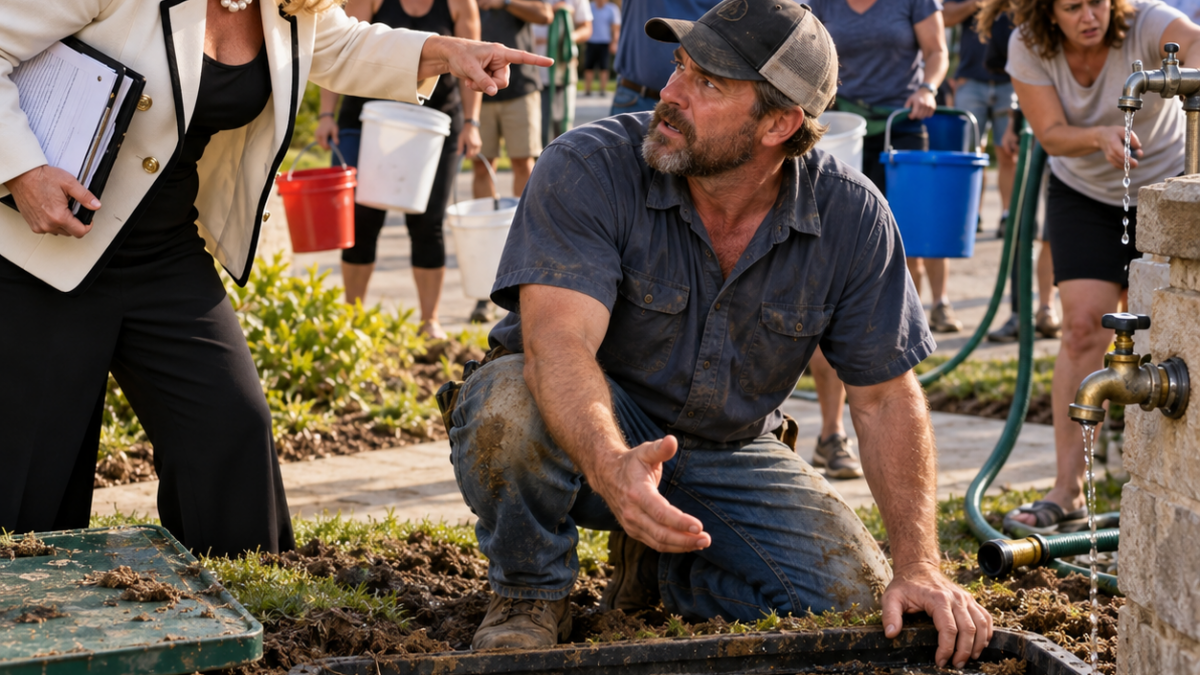
At 6:12 on a Tuesday morning, my phone buzzed with a message from the neighbor down the road asking if I still had water, and when I turned on my kitchen faucet it came out strong while forty homes across from my farm were already watching their sprinklers die and their faucets spit air.
Less than ten minutes later, HOA president Constance Hale came storming up my gravel driveway in a white SUV, accusing me of starving Pinerest Meadows of water even though my private well had never legally supplied a single house inside her subdivision.
What Constance did not know was that three days earlier I had discovered fresh asphalt, an unfamiliar valve box, and a pressure drop on a line my grandfather buried half a century ago—and by then I was beginning to understand that somebody had done far more than trespass.
My name is Dale Whitaker, and thirty-eight acres on the north side of the county had been in my family since before most of Pinerest Meadows was anything but pasture.
Behind my barn sat a private water system my grandfather built in 1974: a deep well, a pump house, a 20,000-gallon storage tank, and almost a mile of buried line. It supplied my farmhouse, my barn, and a handful of old farm lots whose owners had paid a modest annual maintenance fee for decades. Pinerest Meadows, by contrast, had always been served by the county utility district on the opposite side of the road.
That distinction mattered.
Constance never liked it.
Her first visit came during the last week of August, when the county utility announced a rate increase.
She arrived carrying a clipboard, with a consultant named Tamson Reed beside her.
Constance didn’t bother with pleasantries.
“The county is raising rates almost thirty percent,” she said. “Pinerest needs alternatives.”
I leaned against the pump-house fence.
“What does that have to do with me?”
She pointed toward the storage tank.
“You have excess capacity.”
“No, I don’t.”
Tamson smiled.
“We’ve reviewed regional water availability.”
“Have you tested my well?”
Constance answered for her.
“We don’t need to get lost in technical details yet.”
I looked at Tamson.
“What does my pump produce at sustained demand?”
She didn’t answer.
“What size is the main?”
Nothing.
“How many homes does your proposal add?”
Constance’s expression tightened.
“We’re suggesting a partnership.”
“With how many houses?”
“Potentially the eastern phase.”
“That means forty?”
“Initially.”
I shook my head.
“No.”
She stared at me.
“You haven’t heard the financial terms.”
“I don’t need to.”
The well had always been reliable because we never asked it to do more than it could.
My grandfather taught my father that.
My father taught me.
Water systems don’t care about optimism.
They care about gallons per minute, storage volume, pressure, recharge rate, pipe diameter, and demand.
Constance snapped her clipboard shut.
“People who refuse to share eventually learn sharing isn’t optional.”
I thought it was a threat meant to impress me.
Two weeks later, the letters started.
One claimed my pump house lacked HOA approval.
My property wasn’t in the HOA.
Another claimed my buried water line crossed association land.
It didn’t.
A third announced that the board had voted to pursue a “regional water cooperation agreement.”
I carried everything to Margarite Owens, an attorney who handled rural easements and water rights.
She read the stack once.
Then again.
Finally she pushed it away.
“None of this gives them jurisdiction.”
“So I ignore it?”
“You document it.”
She told me to photograph the pump house, copy the easement records, and monitor my pressure.
I had an unused data logger in my workshop.
That weekend, I installed it.
Three days later, driving home from town, I saw fresh blacktop near the bend where my buried main crossed beneath the county shoulder.
I pulled over.
There was new gravel.
Fresh asphalt.
And a green valve box that had not been there that morning.
I crouched beside it.
The soil around the edge was still damp.
When I checked the logger, one timestamp jumped off the screen.
**2:47 p.m.**
My pressure had dropped abruptly, then recovered.
Somebody had opened my water line.
And whatever they had connected to it was still buried beneath that road.
PART 2
I stood beside the valve box longer than I should have.
Cars went by.
One slowed because I was kneeling in the shoulder.
Another driver lifted two fingers from the steering wheel.
I barely noticed.
All I could think about was that pressure graph.
My system normally ran between fifty-eight and sixty-four PSI depending on tank level and pump cycling. If somebody flushed a stock tank or one of the farm lots drew heavy water, the pressure would dip gradually.
This had not dipped gradually.
It had fallen almost straight down.
Then recovered.
That meant somebody had opened the line.
Not a leak.
Not a pump hiccup.
Not a bad gauge.
A change.
I took photographs from every angle.
Wide shots.
Close-ups.
The fresh asphalt.
The valve lid.
Tire impressions in the gravel.
Then I called Margarite.
“What happened?”
“I found a new valve box.”
“Where?”
“County shoulder. Right over my main.”
“Did you open it?”
“No.”
“Good.”
“You sound surprised.”
“You own tools.”
“I do.”
“And you get angry.”
“I do.”
“Therefore I’m proud.”
I looked toward Pinerest.
“So what now?”
“Nothing.”
“Margarite.”
“You photograph. You document. You don’t disturb it.”
“Somebody cut into my line.”
“I know.”
“And you want me to leave it?”
“For now.”
“Why?”
“Because if you touch it, they can argue you changed whatever evidence is down there.”
I looked at the asphalt.
“So I just wait?”
“No. I’m going to arrange for someone qualified to inspect.”
“County?”
“Not yet.”
“Why?”
“Because we don’t know enough.”
I hated that answer.
But I listened.
The next morning, Margarite brought a hydrologist named Silas Okafor.
Silas wasn’t what I expected.
I’d pictured somebody carrying notebooks and wearing a county badge.
He arrived in a muddy pickup with three different pressure gauges rolling around on the passenger floor and spent five minutes looking at my pump before asking me to start explaining the system from the beginning.
“How old is the well?”
“Drilled in ’74.”
“Depth?”
“Three hundred eighty feet.”
“Casing?”
“Six-inch.”
“Pump replaced?”
“2018.”
“Rated output?”
I told him.
“Tank?”
“Twenty thousand.”
“Main?”
“Two-inch where it leaves the pump house, steps down farther south.”
He nodded.
“Users?”
“My house, barns, six farm lots.”
“Peak simultaneous?”
“Usually three or four.”
“Any irrigation?”
“Small domestic gardens. Nothing large.”
Then I showed him the pressure logs.
He studied the graph.
“What happened at 2:47?”
“That’s what we’re trying to find out.”
“Any valve work?”
“No.”
“Pump trip?”
“No.”
“Power?”
“Stable.”
He looked toward the road.
“Show me.”
We spent almost two hours tracing the line.
Near the new valve box, Silas used locating equipment and marked the main.
Then he marked another line.
It crossed the road.
That one had not existed before.
He stood slowly.
“You didn’t install this?”
“No.”
“County?”
“Not according to anything I’ve seen.”
“Utility district?”
“My line isn’t theirs.”
Margarite folded her arms.
“Can you determine where it goes?”
Silas looked toward Pinerest.
“I’ve got a pretty strong guess.”
He opened the valve box carefully.
Inside was brand-new hardware.
Clean brass.
New fittings.
A welded tap assembly tied directly into my main.
Silas crouched.
“Fresh.”
“How fresh?”
“Days.”
My stomach tightened.
He followed the new line using the locator.
Across the county road.
Under the drainage strip.
Straight toward the subdivision.
When he came back, he looked different.
Not angry.
Concerned.
“How many houses did she say?”
“Forty initially.”
He rubbed his chin.
“This main was designed for a handful of rural connections.”
“I know.”
“If they’ve tied even part of Pinerest into this—”
“They have county water.”
“Maybe they think they’re supplementing it.”
“What happens?”
Silas looked toward the tank.
“Best case? Pressure instability.”
“Worst?”
“You pull demand faster than the well and storage can recover.”
“And?”
“Your customers start losing pressure.”
I waited.
He continued.
“You can also create backflow concerns depending on how they’ve connected.”
“Backflow from the subdivision into my line?”
“Yes.”
My stomach turned.
“Chemicals?”
“If there isn’t proper protection? Potentially lawn chemicals, stagnant water, whatever exists downstream.”
Margarite’s voice changed.
“Can you prove the connection reaches Pinerest?”
Silas pointed across the road.
“Give me another hour.”
It took forty-three minutes.
The line entered near Pinerest’s maintenance yard.
We couldn’t access private HOA property without permission, but Silas could trace enough from the public edge to confirm direction.
He returned to the farm.
“Somebody tied that subdivision into you.”
I stared across the road.
“No.”
“Yes.”
“They wouldn’t.”
Silas looked at me.
“Somebody did.”
Margarite took out her phone.
“Dale, don’t call Constance.”
“I wasn’t going to.”
“You were.”
“I was thinking about it.”
“Thinking loudly.”
“I want to hear her explain this.”
“You’ll hear her explain it when we have enough evidence that she can’t change the story halfway through.”
That sentence probably saved the case.
Because Constance’s first instinct, we later learned, was always to reshape the facts around whatever had just been discovered.
Over the weekend, I checked the pressure logger obsessively.
Friday night looked normal.
Saturday morning, a dip.
Saturday evening, another.
Sunday morning was worse.
Demand spiked around six.
Pressure fell into the thirties.
Then recovered after eight.
Silas looked at the data.
“Residential demand curve.”
“Meaning?”
“People waking up.”
“Showers?”
“Showers. Dishwashers. Toilets. Coffee makers. Irrigation. Every little draw stacking on top of the others.”
“They’re pulling from my system.”
“Looks like it.”
“But the county line is still connected.”
“Probably.”
“Then why would my pressure matter?”
“Depends how they configured the supplemental feed.”
He pointed to the graph.
“If their system calls for pressure and your line is tied into the manifold, you’re feeding whatever deficit their pumps are trying to satisfy.”
“Can that even work legally?”
“No.”
“Can it work physically?”
Silas gave me a look.
“You’re looking at the answer.”
Monday morning at 5:30, my pressure collapsed.
I was awake because the logger alert buzzed.
Sixty-two.
Fifty-five.
Forty-one.
Twenty-nine.
Nineteen.
I ran to the kitchen.
My faucet came on weak.
Then steadied as the storage tank and pump caught up.
I called one of the old farm lots.
“Harold, how’s your pressure?”
“Bad.”
“Since when?”
“Ten minutes.”
Another customer said the same.
By eight, pressure recovered.
I forwarded everything to Margarite.
She replied:
**Do not engage. Preserve.**
I wanted to throw the phone.
Tuesday morning, at 6:12, my neighbor sent the message.
**Do you have water?**
I turned on my faucet.
Strong.
I walked outside.
Across the road, Pinerest looked strange.
Normally at that hour, lawn sprinklers painted arcs over the entry landscaping.
That morning, half of them sat motionless.
A man stood near his driveway holding a garden hose.
Nothing came out.
Another resident had opened an irrigation box.
Then my phone started ringing.
A farm customer.
“Dale, pressure’s low again.”
“I know.”
“What is it?”
“I think I know.”
Before I could explain, a white SUV turned hard into my driveway.
Gravel sprayed.
Constance got out before the vehicle had completely settled.
Tamson Reed sat in the passenger seat.
Constance walked toward me fast.
“You need to shut down your pumps.”
I stared at her.
“Good morning.”
“This isn’t funny.”
“I didn’t laugh.”
“Your system is interfering with Pinerest.”
I looked across the road.
Residents were gathering.
“How?”
“Pressure imbalance.”
“From a system that isn’t connected to yours?”
A tiny pause.
Half a second.
Maybe less.
But I saw it.
My phone saw it too.
I’d started recording the moment her SUV entered the drive.
She recovered.
“This is a technical issue.”
“Great.”
I lifted the phone slightly.
“Let’s discuss technical issues.”
Her eyes narrowed.
“You’re overpumping.”
“My well isn’t part of Pinerest.”
“Your pressure behavior is destabilizing our eastern distribution zone.”
“How does my pressure get into your eastern distribution zone?”
Tamson opened the passenger door.
“Dale, perhaps we should approach this cooperatively.”
I looked at her.
“You want to explain the new valve box?”
She stopped.
Constance’s face changed.
Barely.
But enough.
“What valve box?”
“The one sitting over my main.”
“I don’t know what you’re referring to.”
“Fresh asphalt?”
“Road work happens.”
“New pipe under the road?”
Tamson looked at Constance.
Constance ignored her.
“You need to shut your pump off until the county investigates.”
“No.”
“You’re risking dozens of homes.”
“No.”
I stepped closer.
“You’re going to explain how my private well suddenly became responsible for houses it has never served.”
“I already told you. Pressure interaction.”
“Through what connection?”
Silence.
“Where’s the connection, Constance?”
Tamson said quietly, “We should go.”
Constance turned.
“No.”
Tamson lowered her voice.
“Constance.”
I caught that too.
Whatever they knew, they did not want to discuss it on my driveway.
I smiled without meaning to.
“Actually, I agree with you.”
Constance looked at me.
“About what?”
“This needs the county.”
The color left her face.
Not all at once.
A slow drain.
“I didn’t say regulators.”
“You said investigate.”
“County operations.”
“State drinking-water agency sounds better.”
She pointed at me.
“You’re making a serious mistake.”
“No.”
I looked toward my pump house.
“You made that three days ago.”
She got into her SUV.
Tamson never looked at me again.
They left.
I called Margarite.
“I recorded it.”
“Good.”
“She denied knowing about the valve.”
“Also good.”
“She said my system is destabilizing Pinerest.”
“Even better.”
“You enjoy this too much.”
“I enjoy contradictions.”
By noon, Margarite had filed with the state drinking-water agency and the sheriff’s office.
Silas submitted his technical findings.
I sent photographs.
Pressure logs.
Video.
Easement records.
The old design documents from my family system.
We didn’t accuse anyone beyond what the evidence showed.
Someone had installed an unauthorized connection.
Pinerest appeared to be drawing through it.
The HOA president denied knowledge while simultaneously blaming my system for subdivision pressure.
That was enough.
At 3:47, a woman named Joanna Pruitt called.
“Mr. Whitaker?”
“Yes.”
“State drinking-water compliance.”
I stood straighter even though she couldn’t see me.
“I received your complaint.”
“How bad is it?”
“That’s what I’m coming to determine.”
“When?”
“Tomorrow morning.”
“That fast?”
“An unpermitted interconnection involving a private well and a regulated distribution system is not something we leave for next month.”
I appreciated her immediately.
Pinerest held an emergency meeting that night.
I learned about it from Hollis Grant.
Hollis lived on the eastern loop.
Retired plumber.
Thirty-one years in municipal systems.
I’d known him casually because he’d rented a post-hole auger from me once.
At 9:20, he called.
“Did you know Constance says you’re causing our water problem?”
“Yes.”
“You causing our water problem?”
“No.”
“I didn’t think so.”
“Why?”
“Because what she said makes no hydraulic sense.”
I leaned against the kitchen counter.
“What exactly did she say?”
“That your pump cycling is creating a negative pressure condition in our eastern zone.”
I laughed.
Hollis did not.
“That’s nonsense unless there’s a physical connection.”
I stopped laughing.
“What else?”
“I asked whether anybody altered our distribution recently.”
“And?”
“She said no.”
“Quickly?”
“Very.”
I looked at the recorder file on my phone.
“You might want to pay attention tomorrow.”
“Why?”
“I can’t say much yet.”
“That means yes.”
“Yes what?”
“That means somebody altered the distribution.”
I didn’t answer.
Hollis whistled softly.
“All right.”
The next morning, Joanna arrived at seven-thirty.
County engineer behind her.
Deputy behind him.
Silas met us at the pump house.
Joanna was efficient to the point of intimidation.
“Owner authorization?”
“None.”
“Permits?”
“None I know of.”
“Water-quality testing since suspected connection?”
“My normal schedule.”
“Any abnormal results?”
“No.”
“Backflow assembly?”
“Not on my side because there should not be another system attached.”
She nodded.
“Show me.”
We walked to the valve.
She photographed it.
Measured.
Checked markings.
Silas explained the weld.
Joanna crouched beside the box.
“This was professionally installed.”
“Looks that way.”
“Contractor?”
“Unknown.”
She stood.
“Let’s find the other end.”
We drove to Pinerest’s maintenance yard.
Constance was already there.
I don’t know who called her.
Maybe someone from county operations.
She arrived furious.
“You cannot enter association facilities without notice.”
Joanna showed identification.
“I can inspect a suspected unpermitted public-water connection.”
“This is private HOA property.”
“You operate a distribution system serving residents?”
“Under county utility authority.”
“Then I can inspect regulated equipment connected to that system.”
Constance turned toward the deputy.
“This is harassment.”
He said nothing.
A maintenance employee unlocked the utility shed.
The moment the door opened, Silas looked at me.
There it was.
A brand-new booster pump.
Pressure-control valve.
Manifold.
Two trunk connections.
And the line from my side.
Someone had painted a neat label on the wall.
**PHASE 2 SUPPLEMENTAL**
I felt physically sick.
Not because I was surprised anymore.
Because seeing it made the violation real.
Steel pipe.
Wiring.
A pump bolted to concrete.
Thousands of dollars of work.
Nobody improvises that over a weekend.
Joanna inspected every connection.
Then she opened a binder sitting on a shelf.
Invoices.
Schedules.
Equipment data.
A letter on Pinerest letterhead.
She read it.
Then read it again.
“Ms. Hale?”
Constance crossed her arms.
“Yes?”
“Is this your signature?”
Constance looked.
“Yes.”
Joanna handed the page to the deputy.
“What does it say?” I asked.
Joanna looked at Constance.
“I’ll let her explain.”
Constance said nothing.
Joanna finally read the relevant line.
“’The association’s supplemental water source will be operational by September, and all necessary approvals have been secured.’”
She closed the binder.
“Where are the approvals?”
“Our consultant handled them.”
Tamson wasn’t there.
Joanna asked:
“State permit?”
Constance looked toward the maintenance supervisor.
He looked at the floor.
“County utility approval?”
Silence.
“Private well agreement?”
Constance said, “Mr. Whitaker refused to negotiate reasonably.”
Joanna stared at her.
“That was not my question.”
“The association had to act in the residents’ interest.”
“Did he authorize this?”
“No.”
There it was.
Not even dressed up.
No.
I almost expected the room to react.
Nobody did.
The answer was too serious for theater.
Joanna walked to the manifold.
“Backflow prevention?”
The maintenance supervisor pointed at a small check assembly.
Silas shook his head.
“That isn’t compliant isolation between systems.”
Joanna’s face hardened.
“Correct.”
I asked, “Meaning?”
She turned toward me.
“If Pinerest’s distribution pressure falls below yours—or yours below theirs depending on pump conditions—water can potentially move in unintended directions.”
“From them into me?”
“Yes.”
I thought of every house on my line.
Harold.
The Clarks.
My own kitchen.
My livestock water.
“What could come back?”
“Anything present in downstream lines.”
“Lawn chemicals?”
“Potentially.”
“Bacteria?”
“Potentially.”
Constance cut in.
“There has been no contamination.”
Joanna looked at her.
“You do not know that.”
“Our residents are healthy.”
“That is not a water-quality test.”
Constance’s voice climbed.
“You’re exaggerating risk.”
Joanna’s voice remained calm.
“An unpermitted interconnection between a private groundwater system and a residential distribution network without approved backflow protection is exactly the kind of condition regulators are required to take seriously.”
She pointed at the pump.
“This connection is being shut down now.”
“No.”
Everyone looked at Constance.
She repeated:
“No. You cannot shut off supplemental service during a pressure emergency.”
Joanna’s face didn’t change.
“The pressure emergency exists because this system is improperly configured and apparently overdrawing the source.”
“We need it.”
“That does not make it legal.”
“You’ll leave forty homes without adequate pressure.”
“The county utility is still functioning.”
“Not at acceptable cost.”
The room went silent.
Even Constance seemed to hear what she’d just said.
Joanna tilted her head.
“Cost?”
Constance corrected herself.
“Capacity.”
Joanna looked at the binder.
“I’ll be reviewing every record in here.”
The unauthorized pump was shut down.
Valves isolated.
The line from my farm closed.
For the first time in three weeks, my pressure trace returned to normal.
Pinerest’s county water pressure also stabilized after operators corrected settings that had been altered to accommodate the illegal supplemental feed.
The problem had never been lack of county water.
The problem was interference.
Joanna ordered emergency sampling.
Every private connection on my line.
My tank.
My well.
Strategic locations in Pinerest.
I barely slept until the preliminary results arrived.
Clean.
Then the confirmation set.
Clean again.
Silas called.
“You got lucky.”
“I know.”
“No, Dale. Really lucky.”
“How bad could it have been?”
“Don’t ask questions you don’t want answered.”
I looked at my pump house.
“Everyone safe?”
“Based on testing, yes.”
I sat down on the back step.
For the first time since finding the valve box, my hands started shaking.
Not during the confrontation.
Not when Joanna found the illegal pump.
After.
When I knew we hadn’t poisoned anybody.
Margarite came by that afternoon.
She found me sitting behind the barn.
“Results?”
“Clean.”
“I heard.”
“I keep thinking about my neighbors.”
“I know.”
“They trusted me.”
“They still can.”
“What if the tests hadn’t been clean?”
“But they were.”
“What if—”
“Dale.”
I looked at her.
“You did not install that tap.”
“I should’ve noticed earlier.”
“How?”
“I drive past that road every day.”
“It was buried.”
“I should’ve—”
“Stop.”
She rarely raised her voice.
That got my attention.
“Responsibility belongs where the decisions were made.”
I looked down.
“You can improve security afterward. You cannot retroactively become responsible for someone else’s trespass.”
I nodded.
Didn’t entirely believe her yet.
But I remembered the sentence.
The paper trail opened next.
Joanna’s agency demanded records.
Margarite sought financial documents through civil discovery.
The county utility produced correspondence.
The HOA’s own treasurer started cooperating.
His name was Phineas Cobb.
Quiet man.
Former bank manager.
I’d seen him at the feed store.
Never really spoken.
He called Margarite first.
Then asked to meet.
We sat in her conference room.
Phineas looked as though he hadn’t slept.
He placed a folder on the table.
“I should’ve stopped this.”
Margarite said, “Tell us what happened.”
“Two years ago, county announced the expansion project.”
“What project?”
“A larger municipal connection for Pinerest.”
I knew vaguely about it.
“Residents approved a special assessment.”
“How much?”
“Eighteen hundred fifty dollars per household.”
I did the math roughly.
Nearly nine hundred thousand dollars across the whole development.
“What was it for?”
“Connection fees, trenching, larger meter station, internal upgrades.”
“Was it built?”
His eyes dropped.
“No.”
“Where’s the money?”
He swallowed.
“Some is still there.”
“Some?”
Margarite leaned forward.
“How much went out?”
Phineas slid over a ledger.
Three hundred ten thousand dollars.
**Reed Hale Consulting.**
I stared.
“Reed.”
Phineas nodded.
“Tamson Reed?”
“Yes.”
“What did she consult on?”
“Water strategy.”
“What does that mean?”
“I don’t know.”
“Reports?”
“Not that I’ve seen.”
“Engineering drawings?”
“No.”
“Hydrology?”
“No.”
“Permitting?”
“She said she coordinated.”
Margarite asked, “Who hired her?”
Phineas looked miserable.
“Constance.”
“Board vote?”
“General authority.”
“That isn’t a vote.”
“I know.”
Margarite continued.
“Relationship between Tamson and Constance?”
Phineas hesitated.
“Cousins.”
I sat back.
Of course.
“How much for the illegal connection?”
“About one hundred forty thousand so far.”
I stared at him.
“For a tap, pump, and pipe?”
“Including trench work, paving, controls, labor.”
“Authorized?”
Phineas rubbed his forehead.
“I signed payments.”
“Board vote?”
“Constance said the temporary supplement fell under the previously approved infrastructure project.”
“Did you believe her?”
“At first.”
“And later?”
Silence.
“Phineas.”
“No.”
His voice cracked.
“I knew something was wrong.”
“Then why sign?”
He looked at me.
“Because every time I questioned her, she had an answer.”
“That doesn’t explain it.”
“No.”
His eyes dropped again.
“She made uncertainty feel like incompetence.”
That sentence stopped me.
“What?”
“If I asked for another estimate, she’d say I was slowing the project. If I asked for legal review, she’d say counsel had already approved it. If I asked about your easement, she said you were bluffing. If I asked why Tamson’s invoices were so high, she said specialist work costs money.”
He rubbed both hands together.
“I kept telling myself she knew things I didn’t.”
Margarite said quietly:
“And you signed.”
“Yes.”
I was angry with him.
I could see it on his face.
He knew.
But I also understood something.
Constance didn’t operate alone.
She created an environment where questioning her felt like being the problem.
That didn’t excuse Phineas.
It explained how the machine kept moving.
He handed Margarite another folder.
“There’s more.”
Of course there was.
Emails.
One from Constance to Tamson:
**We cannot wait for Whitaker to become reasonable. Build the supplemental model around available access and we can formalize rights after operations begin.**
Another:
**Once residents see stable pressure and savings, nobody will support going back.**
Another, after my refusal:
**Dale is emotionally attached to the system because of family history. That doesn’t give him the right to block regional efficiency.**
I read that one twice.
Emotionally attached.
As if maintaining a private water supply for fifty years was sentimentality.
Then we found the message that explained the pressure collapse.
Tamson to Constance:
**Current source projection assumes 80+ GPM sustained. Need verification from owner records before final pump settings.**
Constance replied:
**Proceed with conservative programming. Owner will not cooperate.**
Silas later told me my system could never reliably support eighty gallons per minute sustained on top of existing demand.
Not remotely.
They had guessed.
Then attached forty homes.
And when the physics exposed the guess, Constance blamed me.
Pinerest residents didn’t know any of this yet.
Constance called another emergency meeting.
This time, I went.
Margarite advised against speaking unless necessary.
“Why?”
“Because she wants you angry.”
“She already has that.”
“She wants everyone else to see it.”
The clubhouse was built for eighty people.
Nearly two hundred squeezed inside.
People stood along walls.
Doors stayed open.
Residents carried bottled water even though pressure had largely recovered.
That image stayed with me.
Not because they needed the bottles anymore.
Because trust had changed.
Constance stood at the podium.
“Pinerest has been targeted by an outside property owner who refuses to participate in regional water planning.”
A few residents murmured.
She continued.
“The state has temporarily disabled a supplemental connection that was designed to stabilize pressure and reduce dependence on an increasingly expensive county utility.”
Hollis Grant sat three rows ahead of me.
I watched his shoulders tighten.
Constance said:
“The resulting investigation has been fueled by incomplete technical claims and personal hostility.”
Someone asked:
“Was the connection permitted?”
Constance looked toward the voice.
“We are resolving paperwork.”
“Was it permitted?”
“Our consultant understood approvals to be in process.”
Another resident shouted:
“Did Dale approve tapping his pipe?”
Constance raised a hand.
“The water corridor has served regional properties for decades.”
I stood before Margarite could stop me.
“No.”
Every head turned.
Constance looked almost pleased.
Finally.
She had me on stage.
I kept my voice calm.
“My system serves my farm and six private rural connections under recorded agreements.”
Constance interrupted.
“And runs adjacent to Pinerest.”
“Yes.”
“Exactly.”
“That does not make it yours.”
She smiled.
“Nobody said it was ours.”
I looked around.
“Somebody cut into it.”
The room went quiet.
Constance said:
“A supplemental connection was installed.”
“Without my permission.”
“Because negotiations failed.”
A woman near the front gasped.
Constance realized she’d gone too far.
She corrected quickly.
“I mean the association proceeded under its understanding of shared infrastructure rights.”
Hollis stood.
He had a folder.
“Constance.”
She looked irritated.
“Yes?”
“I’ve been a plumber thirty-one years.”
“I know.”
“And I’ve pulled the county records.”
Her expression changed.
Hollis opened the folder.
“There is no shared right.”
Applause started.
He raised one hand.
“Don’t clap. Listen.”
The room settled.
“The Whitaker line is private.”
He held up a map.
“The easement is private.”
Another page.
“The county utility remained fully functional during the pressure event.”
Another.
“The pressure drop pattern begins after the supplemental pump was activated.”
Constance interrupted.
“Those are Mr. Whitaker’s claims.”
“No.”
Hollis held up the state preliminary report.
“These are the regulator’s observations.”
The room changed.
People leaned forward.
Hollis read the timeline.
Installation.
Pressure anomalies.
Morning demand.
Nineteen PSI.
Complaints.
State inspection.
Unpermitted manifold.
No approved backflow protection.
Then he asked:
“Who authorized this?”
Constance folded her arms.
“The board.”
Phineas stood.
I hadn’t seen him near the side wall.
“No.”
Everyone looked at him.
Constance froze.
“Phineas.”
His voice shook.
“The board never voted on that connection.”
“You approved expenditures.”
“I signed checks because you told me it fell under the county upgrade.”
“It did.”
“No.”
He held up meeting minutes.
“The board approved municipal connection work.”
Constance said:
“This was interim infrastructure.”
“You never told us it connected to Dale.”
The room erupted.
Constance banged the podium.
“Enough.”
Hollis asked:
“How much did residents pay for the municipal project?”
Nobody answered.
He answered himself.
“About nine hundred thousand dollars.”
Murmurs.
“And how much did Reed Hale Consulting receive?”
Constance’s face hardened.
“That is confidential contracting information.”
Hollis looked at the crowd.
“Three hundred ten thousand.”
This time people shouted.
“What?”
“For what?”
“Who is Reed Hale?”
Hollis looked directly at Constance.
“Your cousin.”
The noise became overwhelming.
Margarite touched my arm.
“Stay quiet.”
I nodded.
This wasn’t my meeting anymore.
Residents wanted answers from their own board.
Constance raised both hands.
“Tamson Reed is a qualified strategic consultant.”
Hollis said:
“What are her qualifications?”
“Water-resource planning.”
“License?”
Constance hesitated.
“Consulting does not require an engineering license.”
“Clients?”
“That’s irrelevant.”
“Reports?”
“She provided ongoing analysis.”
“Show one.”
Constance stared at him.
He waited.
No report came.
Then a woman near the front stood.
“My family paid $3,700 because we own two lots.”
Constance said:
“Those funds remain invested in long-term water independence.”
“Where?”
“Across multiple assets and planning initiatives.”
“Where is the county connection we were promised?”
Silence.
Another resident shouted:
“Where’s our money?”
Another:
“Why was my water hooked to his farm without telling us?”
Another:
“Were we drinking untested well water?”
That one cut through the noise.
Constance looked toward Joanna, who was standing near the rear as an observer.
Joanna spoke.
“Pinerest received water through an unpermitted supplemental source.”
People went silent.
A man said:
“Was it safe?”
“Testing so far is clean.”
“So far?”
Joanna remained precise.
“Additional results are pending, but we have no evidence of contamination.”
A woman near the aisle started crying.
“My baby drinks formula.”
Constance said quickly:
“There was never any real danger.”
Joanna looked at her.
“I would not characterize an unpermitted cross-connection without approved backflow protection that way.”
The woman looked at Constance.
“You knew?”
“No.”
Constance pointed toward Tamson, who had entered through the side door.
“Our consultant handled technical compliance.”
Tamson stopped.
Everyone turned.
For one long second, the cousins looked at each other.
Tamson shook her head.
“No.”
Constance’s face went white.
“No what?”
“You signed the implementation.”
“Based on your advice.”
“I told you we needed source verification and permits.”
“That is not true.”
Tamson opened her bag.
She pulled out a folder.
Apparently she’d brought records too.
“I have the emails.”
The room became so quiet I heard the air conditioner click.
Constance’s voice dropped.
“Tamson.”
“You told me to proceed.”
“You were paid to manage approvals.”
“No. I was paid to advise on strategy.”
“Three hundred ten thousand dollars?”
A resident said it before I could.
Tamson visibly flinched.
That amount was about to become her own problem.
Constance turned on her.
“You created the supplemental design.”
“With subcontractors.”
“You recommended the tap.”
“I said it was technically possible if Dale agreed and the source tests supported it.”
“He refused for political reasons.”
“No.”
Tamson’s voice strengthened.
“He refused because the well didn’t have capacity.”
Hollis looked at me.
Then at her.
“You knew that?”
“I suspected it.”
“Before connection?”
“Yes.”
People started shouting again.
Constance stepped away from the podium.
“This meeting is becoming hostile.”
A man near the door laughed bitterly.
“Because we found out you spent our money stealing water.”
She snapped:
“Nobody stole water.”
I spoke.
“You didn’t pay me.”
She looked at me.
“That isn’t theft.”
Margarite murmured, “Careful.”
I stopped.
Hollis stepped forward.
“How much water did Pinerest draw from Dale’s system?”
Silas had estimated from logs.
We didn’t have exact meter data at the tap because there wasn’t an authorized meter.
But enough.
Thousands upon thousands of gallons.
No agreement.
No payment.
No testing plan.
No disclosure.
The board called an emergency vote that night.
Not to remove Constance yet.
To suspend her authority pending investigation.
Four days later, after state investigators interviewed Phineas and seized copies of financial records, they held another meeting.
Three hundred residents showed up.
Some stood outside watching through open doors.
Constance arrived with an attorney.
Tamson did not sit beside her.
That alone told people something.
The court had appointed an observer to ensure records were preserved and association governance continued lawfully while the financial dispute expanded.
Hollis brought the thickest folder I’d ever seen outside a courthouse.
He started at the beginning.
Special assessment.
Purpose.
Municipal connection.
Then invoices.
Reed Hale Consulting.
No substantial deliverables.
Unauthorized piping.
Permit search.
None.
State approval.
None.
Private agreement.
None.
Pressure logs.
My logger became the star witness.
At 2:47 Friday afternoon:
Drop.
Connection activity.
Monday 5:30:
Collapse.
Tuesday:
Subdivision complaints.
Then Constance’s recorded driveway statement:
**Your system is interfering with Pinerest.**
Hollis paused the audio.
He looked at her.
“You told residents there was no alteration to our lines.”
Her attorney said:
“Mrs. Hale is not required to answer.”
A resident shouted:
“She answered us before!”
Hollis continued.
He projected another email.
Constance:
**Once residents see stable pressure and savings, nobody will support going back.**
Next.
**Proceed with conservative programming. Owner will not cooperate.**
Next.
**We cannot wait for Whitaker to become reasonable.**
People weren’t shouting anymore.
They were reading.
That was worse for her.
Then Hollis reached the money.
Three hundred ten thousand to Tamson’s consulting company.
One hundred forty thousand into the unauthorized pump, trench, piping, controls, and paving.
Hundreds of thousands from the original assessment either spent, reserved, or diverted away from the promised county connection.
He asked:
“How much of our money did you spend on a pipe you knew Mr. Whitaker had not authorized?”
Constance stood.
Her attorney touched her arm.
She pulled away.
“You are all ignoring why I did this.”
Nobody spoke.
“The county utility raised rates by nearly thirty percent.”
A woman answered:
“So?”
“We were being trapped.”
“By our legal water company?”
Constance continued.
“We had access to a local source sitting twenty yards away.”
I felt anger rise.
She pointed toward me.
“He had water.”
I stood.
“I had enough water for the people already on my system.”
“You had twenty thousand gallons in storage.”
“Storage isn’t supply.”
“You had unused capacity.”
“No.”
“You never proved that.”
“I told you the well’s yield.”
“You gave us numbers designed to protect your monopoly.”
“My monopoly over my own well?”
The room reacted.
Constance turned toward the crowd.
“This is exactly what I’m talking about. One private landowner believes he gets to decide whether an entire community can access a natural resource beneath the ground.”
Hollis said:
“He does when the well is on his land.”
Constance ignored him.
“We had an opportunity to save residents hundreds of dollars per year.”
A man shouted:
“You spent nearly half a million dollars doing it!”
“Investment requires upfront cost.”
“Without telling us?”
“For your benefit.”
That phrase landed badly.
Another resident stood.
“For our benefit?”
His voice shook.
“My wife called me crying because our shower died while our daughter was covered in soap.”
A woman added:
“My mother thought her plumbing had failed.”
Another:
“I bought bottled water because you told us Dale was contaminating pressure.”
Constance looked toward me.
“He escalated this.”
“No.”
I didn’t raise my voice.
“You installed a pipe.”
“You refused to cooperate.”
“So you cut into it anyway.”
“You left us no alternative.”
Hollis snapped his folder shut.
“There was an alternative.”
Everybody looked at him.
“The county connection we paid for.”
Silence.
That was the line.
The one Constance could not cross.
Residents hadn’t been cornered.
They had already funded a legal solution.
She chose a different one.
Why?
That question opened the rest.
Reed Hale Consulting.
Tamson’s cousin relationship.
No deliverables.
Invoices structured under thresholds that avoided certain review procedures.
The prosecutor later described the pattern as evidence of misuse.
Tamson eventually cooperated.
She claimed Constance had pushed the project far beyond her initial proposal.
Constance claimed Tamson had sold her on it.
Their emails showed both had known enough to understand permits were missing.
Phineas admitted he signed invoices he should have challenged.
But unlike Constance, he began cooperating early.
The board voted that night.
Remove Constance Hale as president.
The result wasn’t close.
She received one vote to keep her.
Her own.
When the tally was announced, she stayed seated.
Nobody cheered.
That was what surprised me most.
People were too tired.
Too angry.
Too embarrassed.
Constance gathered her papers.
Then she saw me.
For a second, I thought she’d leave.
Instead she walked directly toward me.
“You ruined me.”
Margarite moved closer.
I held up one hand.
“It’s fine.”
Constance stared at me.
“You could’ve solved this quietly.”
“How?”
“By cooperating.”
“You mean giving you my water.”
“Selling excess capacity.”
“There was no excess.”
“You keep saying that.”
“Because pressure hit nineteen PSI.”
“That was because your pumps weren’t configured for our load.”
I actually laughed.
“You added the load.”
Her eyes flashed.
“You enjoyed watching the state shut us down.”
“No.”
“You wanted us humiliated.”
“No.”
“You wanted everyone to see you were right.”
I looked toward the residents.
“No, Constance.”
I lowered my voice.
“I wanted my neighbors to have water without you pulling mine out from under the people who were already depending on it.”
Her expression changed.
Just slightly.
“You always thought of us as outsiders.”
“I thought of you as neighbors.”
“Then why wouldn’t you share?”
“Because sharing a thing until it fails isn’t generosity.”
She stared at me.
I pointed toward the exit.
“You didn’t ask the well what it could supply. You asked how much you could take.”
She walked away.
That was the last time we spoke for months.
The legal consequences arrived slowly.
The state fined Pinerest Meadows seventy-five thousand dollars for operating an unpermitted supplemental water system and related compliance failures.
Residents were furious at first.
They saw another bill.
Margarite reminded me not to celebrate.
“I wasn’t planning to.”
“Good.”
“They’ll blame me.”
“Some will.”
“For reporting something illegal?”
“Yes.”
“That makes sense.”
“No. It makes people human.”
The county prosecutor charged Constance with offenses tied to tampering with a private utility, misuse of association funds, and unauthorized taking of services.
Tamson faced fraud-related charges tied to her consulting operation and representations.
Exact counts evolved as lawyers negotiated.
Real cases do that.
What didn’t change was the documentary record.
The pipe existed.
My authorization didn’t.
Permits didn’t.
The money transfers did.
The emails did.
The pressure logs did.
The false statement that approvals had been secured did.
Civil court moved separately.
The illegal connection had to be removed.
Not merely shut.
Removed.
The HOA paid for excavation.
I stood beside the road the day crews opened the shoulder.
Margarite was with me.
A different contractor this time.
Licensed.
Permitted.
State inspector present.
They uncovered the tap.
Fresh steel against my old main.
I felt angrier seeing it exposed than I had when Silas first found it.
My grandfather had laid the original line.
My father repaired sections.
I had replaced valves over the years.
That pipe carried water to people who trusted my family.
Somebody had cut into it like finding an unlocked extension cord.
The contractor asked:
“You want the tap section?”
“What?”
“When we remove it.”
“As evidence?”
“After releases.”
Margarite said:
“Keep it.”
I looked at her.
“Why?”
“You may want it.”
“I don’t.”
“You might.”
She was wrong.
Months later, when the litigation ended, that cut section sat in my workshop for three weeks.
Every time I saw it, I got angry.
So I took it to the scrap yard.
The attendant weighed it with a pile of rusted fittings.
“Good steel.”
“Not really.”
He shrugged.
Money from scrap went into the coffee jar at the shop.
That felt more appropriate.
The civil judgment reimbursed me for repair costs, testing, monitoring upgrades, legal expenses tied directly to the intrusion, and damage to the easement area.
Constance was held personally responsible for a substantial portion connected to actions she’d authorized outside valid board approval.
A judgment lien attached to her house.
People loved that part when they retold the story.
They imagined I smiled when I heard.
I didn’t.
A house is still a house.
Whatever she had done, watching someone’s life collapse is different from wanting accountability.
I wanted the bills paid.
The line restored.
The system protected.
The rest belonged to the court.
Her corner house sold within a year.
Tamson’s company disappeared.
Phineas resigned as treasurer.
Before leaving, he came to my farm.
I was repairing fencing behind the barn.
He parked near the pump house.
For a while, he just stood there.
“You need something?”
“To apologize.”
I leaned on the post driver.
“Okay.”
He looked toward the steel pump-house door.
“I signed checks.”
“I know.”
“I knew I should ask more.”
“I know.”
“I told investigators everything.”
“I know.”
He looked uncomfortable.
“You don’t make this easy.”
“What do you want me to say?”
“I don’t know.”
“Then don’t script it.”
He nodded.
“I was afraid of looking stupid.”
That was more honest than anything else he’d said.
“Constance always seemed certain.”
“Yeah.”
“I thought if I challenged her and I was wrong, everyone would think I couldn’t do the job.”
“And if you didn’t challenge her?”
He looked at the ground.
“This.”
We stood quietly.
Finally I said:
“Next time somebody makes you feel stupid for asking where nine hundred thousand dollars is going, ask twice.”
He laughed weakly.
“There won’t be a next time.”
“Good.”
He left.
I didn’t forgive him instantly.
Forgiveness isn’t a switch.
But I stopped being angry eventually.
The new Pinerest board hired an independent accountant.
Quarterly finances went online.
Every large vendor contract required two board signatures plus recorded approval.
Engineering work required licensed review.
Water projects required direct confirmation from the county utility and regulators.
Hollis Grant became treasurer.
He hated meetings almost as much as I did.
Which made him useful.
The legal county connection residents had originally paid for finally began the following spring.
Real permits.
Real engineering.
Real inspection.
A meter station.
A properly sized line.
Pressure testing.
Disinfection.
Sampling.
Nothing secret.
Nothing under a fresh patch of asphalt at 2:47 on a Friday.
I drove past the construction repeatedly.
At first, seeing trenches near the road made my shoulders tighten.
Silas noticed.
“You okay?”
“Fine.”
“You keep staring.”
“Habit.”
He looked at the permitted project signs.
“Different this time.”
“I know.”
“Permit number.”
“I can read.”
“Utility logo.”
“I see it.”
“Licensed contractor.”
“Silas.”
He smiled.
“Just making sure.”
The county connection opened in May.
Hollis invited me to the startup.
“No.”
“Why?”
“It’s your water.”
“Technically the county’s.”
“Exactly.”
“Residents want you there.”
“Why?”
“Because we’re trying to stop being weird neighbors.”
I laughed.
“That’s ambitious.”
I went.
Not for a ribbon cutting.
There wasn’t one.
Joanna was there.
County utility staff.
Board members.
Engineers.
They brought the system online.
Pressure stabilized.
Nobody applauded.
Hollis looked at me.
“You’ve ruined my sense of drama.”
“Water should be boring.”
Joanna overheard.
“Correct.”
The new system did exactly what infrastructure is supposed to do.
Nothing interesting.
Water came out.
Pressure held.
Rates were what they were supposed to be.
Residents complained about them.
That made me happy.
Normal complaints meant normal life.
A few weeks later, Hollis drove out to the farm.
He handed me an envelope.
“What is this?”
“Residents.”
I opened it.
A card.
Nearly two hundred signatures.
Some names I recognized.
Most I didn’t.
Messages:
**Sorry we believed what we were told.**
**Thank you for protecting the water supply.**
**Glad your neighbors tested clean.**
**Thank you for not shutting us out after everything.**
I read one twice.
**My daughter was the baby on formula. She’s fine. Thank you.**
That one got me.
I folded the card.
Hollis pretended to inspect the tank so I wouldn’t have to explain my face.
“That’s a lot of signatures.”
“People wanted to do something.”
“They don’t owe me.”
“Probably true.”
He looked toward the pump house.
“You know what the funny part is?”
“What?”
“For years most of us thought this place was abandoned.”
I stared at him.
“Abandoned?”
“Not literally.”
“You people see me driving in every day.”
“We didn’t know what was back here.”
“Water.”
“Now we know.”
He looked at the steel door.
“Constance called it underutilized.”
“My grandfather called it enough.”
Hollis smiled.
“Your grandfather sounds smarter.”
“He usually was.”
That summer, I invited the families on my private system to a barbecue.
Not Pinerest.
The original users.
Harold.
The Clarks.
The Merritts.
Old Mrs. Fallon.
People whose taps had gone weak because someone they didn’t know decided their water was available for redistribution.
We set folding tables behind the barn.
Hamburgers.
Corn.
Potato salad.
Kids running around the hay bales.
Before we ate, I explained what had happened.
Not dramatic.
Just facts.
Unauthorized tap.
Pressure loss.
Backflow risk.
Clean tests.
Repairs.
New safeguards.
Mrs. Fallon raised her hand.
She was eighty-one.
“What happens if somebody tries again?”
I smiled.
“They’ll have a harder time.”
I had installed a locked isolation vault.
Tamper sensor.
Pressure alarm.
Remote flow monitoring.
Camera coverage.
Silas had helped me add a backflow assembly where practical.
The system was safer than before.
“Harder isn’t impossible,” she said.
“No.”
“Nothing is.”
“That’s cheerful.”
She smiled.
“I’m old.”
Everyone laughed.
Afterward, Harold stayed behind.
“My father signed the original agreement with your grandfather.”
“I know.”
“Fifty years.”
“Almost.”
“Never had trouble.”
“Neither did we.”
He looked toward Pinerest.
“Then somebody saw extra.”
“What?”
“Extra water.”
I nodded.
“That was the problem.”
He shook his head.
“People see a tank and think full means spare.”
That sentence stayed with me.
Full doesn’t mean spare.
It means ready for the people it was built to serve.
A year after the incident, I ran into Constance.
Not at court.
Not at a meeting.
Grocery store.
Produce aisle.
She was standing beside tomatoes.
For a second, we both considered pretending we hadn’t seen each other.
Then she said:
“Dale.”
“Constance.”
She looked thinner.
Her hair shorter.
No clipboard.
No audience.
“I heard the county connection is finished.”
“Yes.”
“How are your pressure problems?”
“Gone.”
Her mouth tightened.
“You know what I mean.”
“My system is fine.”
She put a tomato back.
“I lost the house.”
I didn’t answer.
“You knew?”
“I heard.”
“Tamson says this was all my fault.”
I leaned against the cart.
“Was it?”
Her eyes flashed.
“You know she designed the system.”
“She didn’t cut into my line personally.”
“She told me it could work.”
“With permits.”
“She told you we needed my source data.”
Constance looked away.
“How do you know?”
“Emails.”
She laughed bitterly.
“Of course.”
For a moment, she looked exhausted.
“I was trying to stop the rates.”
“I know.”
That surprised her.
“You know?”
“Yes.”
“You think I woke up wanting to steal water?”
“No.”
“Then why does everyone tell the story like that?”
“Because you tapped a private water line.”
She closed her eyes.
“I thought once the system proved itself, you’d come around.”
“It didn’t prove itself.”
“We set the pump wrong.”
“No.”
She looked at me.
“The well couldn’t carry forty houses.”
“You don’t know that.”
“Yes, I do.”
“Because your hydrologist said so.”
“Because the pressure dropped to nineteen pounds.”
She said nothing.
I continued.
“You were trying to make reality negotiate with you.”
Her expression hardened.
“Easy for you. You weren’t facing residents furious about thirty-percent rate increases.”
“No.”
“You weren’t trying to balance a budget.”
“No.”
“You weren’t getting screamed at every meeting.”
“No.”
I nodded.
“But you could’ve told them the legal county project cost more.”
“They wouldn’t accept it.”
“You could’ve shown them the numbers.”
“They wanted a solution.”
“So you gave them a secret one.”
Her eyes filled.
“Do you think I haven’t replayed it?”
I believed her.
That was the uncomfortable part.
I believed she regretted it.
Regret didn’t erase anything.
But it made hating her feel less useful.
“I don’t want anything else from you, Constance.”
She looked at me.
“I know.”
“My system is fixed.”
“I know.”
“The residents have their county connection.”
“I know.”
“The court decided the money.”
“Yes.”
I picked up my cart.
“I hope wherever you go next, you ask permission before solving somebody else’s problem.”
She gave a tiny laugh.
“That sounds like you.”
“It should.”
I left.
Years passed.
The new Pinerest board kept publishing finances.
Hollis served two years as treasurer.
Then resigned before they could make him president.
“Coward,” I told him.
“Survivor.”
He still came by sometimes.
We’d stand near the pump house and argue about pipe sizes like men who had nothing better to do.
Joanna transferred to another district.
Before leaving, she stopped by.
“Still monitoring?”
“Every minute.”
“Good.”
“I’m obsessive now.”
“Better than careless.”
She checked the valve installation.
“Nice.”
“Silas designed it.”
“I assumed.”
I looked at her.
“You know what bothered me most?”
“The contamination risk?”
“That scared me most.”
“Different question.”
I nodded.
“The accusation.”
She waited.
“Constance drove up here and blamed me for Pinerest losing pressure.”
Joanna leaned against her truck.
“People often blame the source they can see.”
“What does that mean?”
“Your pump house was visible.”
She pointed toward the road.
“The illegal connection wasn’t.”
I thought about that.
“That’s annoyingly smart.”
“I work for the government. We’re occasionally useful.”
“Don’t spread that around.”
She laughed and left.
My grandfather’s pump house stayed exactly where it had always been.
I repainted the steel door once.
Dark green.
Fixed the roof.
Replaced a corroded fitting.
The well kept producing.
Enough.
Not endless.
Enough.
That difference became almost sacred to me.
A neighbor once asked if I would ever expand the system.
“Maybe.”
“For Pinerest?”
“No.”
“For more farm lots?”
“If testing supports it.”
“You’re not scared after what happened?”
“No.”
That surprised me when I said it.
For a while, I had been scared.
Every pressure change felt suspicious.
Every patch of roadwork made me stop.
Every unknown truck near the easement tightened something in my chest.
Then time did what it does.
Normal days accumulated.
Pressure stayed steady.
Water tests stayed clean.
Nobody cut into anything.
Trust returned through boredom.
One morning, years later, my logger buzzed.
Pressure drop.
I nearly jumped out of bed.
Opened the app.
From sixty-two to fifty.
Then forty-five.
I threw on boots and ran to the pump house.
Harold was already there.
“Problem?”
“I don’t know.”
We checked valves.
No tamper alarm.
No road work.
No leak.
Then I heard something behind the barn.
I followed the sound.
A hose.
My nephew had opened the three-inch washdown line full bore to rinse a piece of equipment.
I stared at him.
He looked at the hose.
Then at me.
“What?”
“You nearly gave me a heart attack.”
“Why?”
“Never mind.”
He shut the valve.
Pressure recovered.
Harold laughed for five minutes.
I didn’t.
At first.
Then I did.
That was when I knew the old fear had finally loosened.
The story had become a story.
Not an emergency I was still living inside.
On the fiftieth anniversary of the well, I found an old photograph in my mother’s things.
My grandfather stood beside the original drilling rig.
Young.
Sunburned.
Hands on his hips.
Behind him, muddy water poured from a temporary discharge pipe.
On the back he’d written:
**July 1974. Good water. Don’t waste it.**
I framed it.
Hung it inside the pump house.
Hollis saw it.
“That’s the whole case right there.”
“What?”
“Good water. Don’t waste it.”
“He wasn’t talking about HOAs.”
“Still applies.”
I thought about Constance.
She had seen the same system and reached a completely different conclusion.
Water sitting in a tank looked unused.
A pipe with pressure looked available.
A private well looked selfish when a subdivision’s rates went up.
But infrastructure isn’t judged by what seems idle.
Reserve capacity exists for heat.
Drought.
Fire.
Pump failures.
Peak demand.
The unexpected.
You don’t prove a system has extra capacity by taking until the pressure collapses.
You prove it with data before connecting anything.
That was the lesson Silas cared about.
Margarite had another.
“Paperwork before pipe,” she said.
“What?”
We were signing the final easement repair release in her office.
“You should put it on a sign.”
“I already have enough signs.”
“Paperwork before pipe.”
“No.”
“Permit before pump?”
“Worse.”
“Ask before stealing?”
I laughed.
“Better.”
She slid the release across.
“Sign.”
I did.
Years after the lawsuit, the road shoulder looked normal.
You would never know a trench had crossed beneath it.
Grass grew along the ditch.
The asphalt patch weathered until it blended with the rest.
Pinerest’s lawful county main ran underground nearby.
My line stayed on my side.
Separate.
Exactly as it had been before.
One summer evening, Hollis came over carrying two folding chairs.
“What are those?”
“Sit.”
“Why?”
“Because I’m retired again.”
“You retired years ago.”
“I retired from being association treasurer.”
“Congratulations.”
We sat outside the pump house.
Pinerest sprinklers turned on across the road.
Strong pressure.
My own tank gauge sat steady.
Hollis watched the irrigation arcs.
“Funny.”
“What?”
“Same neighborhood.”
“Yeah.”
“Same amount of water use, basically.”
“Different source.”
“Legal source.”
“That helps.”
He smiled.
“I’ve been thinking about that first meeting.”
“The one where Constance said I was causing the pressure loss?”
“Yes.”
“You believed her?”
“For five minutes.”
“That long?”
“I was being polite.”
I laughed.
He continued.
“She was good at making the answer sound settled before anybody asked the question.”
“That was her skill.”
“And weakness.”
“Same thing sometimes.”
He nodded.
“Phineas told me he still feels guilty.”
“I know.”
“You forgive him?”
I thought.
“Mostly.”
“Tamson?”
“Not my problem.”
“Constance?”
I watched the sprinklers.
“I don’t know.”
Hollis waited.
I finally said:
“I don’t think about her enough to know anymore.”
He nodded slowly.
“Probably better than forgiveness.”
Maybe.
Across the road, children ran through sprinklers.
They didn’t know the history under their feet.
Didn’t know one line belonged to the county and another to my family.
Didn’t know a pressure logger had once documented a secret.
Didn’t know adults had spent months fighting over valves, invoices, permits, and gallons per minute.
They just knew water came out.
That’s how infrastructure should feel to children.
Invisible.
Reliable.
Safe.
When the sun dropped lower, I walked inside the pump house.
The data screen read:
**61.8 PSI**
Normal.
I checked the flow.
Normal.
Tank level.
Normal.
Nothing dramatic.
I thought about the Tuesday morning when forty homes went weak and Constance came charging up my driveway looking for someone to blame.
She had believed my pump had failed her neighborhood.
In a strange way, she was almost right.
My pressure logs failed her.
My well’s physical limits failed her.
The pipe she installed failed her.
Physics refused to cooperate with the story she’d been telling.
That was the part she couldn’t intimidate.
She could pressure Phineas.
She could rush Tamson.
She could dismiss my warnings.
She could tell residents approvals existed when they didn’t.
She could sign letters.
Move money.
Hire contractors.
Cut asphalt.
But she couldn’t make a well produce eighty gallons a minute because a board wanted cheaper water.
She couldn’t make a two-inch farm main behave like a municipal trunk line.
She couldn’t make an illegal connection become safe by calling it supplemental infrastructure.
And when demand peaked, the system answered every argument at once.
Nineteen PSI.
The truth, displayed on a screen.
I shut the pump-house door.
Locked it.
Not because I believed somebody was coming.
Just good practice.
Then I walked toward the farmhouse.
Halfway there, my phone buzzed.
Pressure alert.
I stopped.
Looked at the screen.
Sixty-one.
Sixty.
Fifty-nine.
Then stable.
Normal pump cycle.
I smiled.
Years earlier, I would have turned around.
Checked the valve.
Walked the easement.
Looked at the road.
That night, I slipped the phone back into my pocket and kept walking.
Behind me, the pump started automatically.
Water moved through the line my grandfather built.
To my house.
The barn.
Six old farm lots.
No more.
No less.
Exactly enough for the people it was meant to serve.
Across the road, Pinerest’s lights came on one by one, and their water flowed through the system they had finally paid to build properly.
Two separate systems.
Two separate sets of pipes.
No secret valve between them.
That was all I had wanted from the beginning.
The pump ran for another minute.
Then shut off.
Pressure held.
And this time, nobody came up my driveway demanding something that wasn’t theirs.
[END OF STORY]








