PART 2: HOA Secretly Rerouted an Entire Subdivision’s Stormwater Into My Pasture—Then My Engineer Found What Karen Tried to Hide
PART 2
The paragraph was only six lines long.
I read it three times anyway.
The county had rejected the developer’s proposal to send concentrated stormwater toward the agricultural land behind Pleasant Meadows because the receiving property was privately owned, the creek crossed a sensitive drainage area, and concentrated discharge could cause erosion, contamination, and downstream damage.
The developer had been ordered to keep subdivision runoff within its approved retention system and route overflow toward the municipal storm infrastructure on the opposite side of the neighborhood.
I sat very still.
Sarah stood behind me, reading over my shoulder.
“So they already asked?”
“Ten years ago.”
“And the county said no.”
“Yes.”
“Could Karen know that?”
“I don’t know.”
“That’s not the same as no.”
“No.”
She pulled out the chair beside me.
“Mark—”
“Jack.”
She blinked.
I smiled faintly.
“You called me Mark.”
She rubbed her forehead.
“Sorry. I’m tired.”
“So am I.”
That small mistake broke some of the tension.
For the record, my name is Jack Davis.
Karen had called me “sergeant” during our argument even though I hadn’t held that rank when I left the service. She knew I was retired Army and had apparently decided all men with muddy boots and short hair were sergeants.
Normally I would have corrected her.
That day I had bigger problems.
Sarah touched the county denial on the screen.
“What do we do?”
“We document before we accuse.”
“You’re certain?”
“Very.”
She gave me a tired smile.
“That was the right answer.”
I had learned the hard way, both in uniform and out, that being right too early could be almost as dangerous as being wrong.
If I marched into Pleasant Meadows the next morning waving the denial letter and accusing Karen of knowingly violating it, she would do one of two things.
Deny everything.
Or start changing the record.
So before sunrise, I went back outside.
The water had slowed, but the pasture remained submerged.
I started at the creek and worked backward.
Wide photographs first.
Then closer images.
Damaged fencing.
Sediment.
Debris.
Standing water depths.
I drove survey stakes at intervals and marked water elevations.
I photographed each stake beside a measuring rod.
My old field habits returned without effort.
Date.
Time.
Location.
Condition.
Reference point.
Repeat.
Emily came down from the house wearing rubber boots.
“Mom said you’ve been out here since five.”
“I have.”
“Need help?”
I looked toward the barn.
“How’s Daisy?”
“Mad.”
“That’s good.”
“She hates the medicine.”
“Even better.”
Emily glanced toward the flooded field.
“She can ride again, right?”
That was the question I had been avoiding.
“The vet thinks so.”
“Thinks?”
“We caught the hoof infection early.”
Her jaw tightened.
“Because of them?”
I didn’t answer immediately.
“Because she stood in contaminated water too long.”
“From their pipe.”
“Most likely.”
“Dad.”
“I need to prove where the water came from.”
She looked at the pipe.
“Isn’t that proof?”
“It’s evidence.”
“What’s the difference?”
“Proof is what evidence becomes after nobody can explain it away.”
She absorbed that.
Then held out her hand.
“Give me something to do.”
I handed her a notebook.
“Write down stake numbers and depths.”
For the next two hours, father and daughter moved through muck together.
It was not how I had imagined spending spring mornings with her.
But I remember it now as one of the moments that changed the entire fight.
Emily was angry.
So was I.
But instead of screaming at Karen or posting accusations online, we measured water.
That discipline became the foundation of everything that followed.
By noon, I had enough photographs to fill several folders.
Then I took samples.
Water directly from the culvert.
Standing water near the lowest pasture.
Soil from the flooded area.
Soil from unaffected higher ground.
Creek water upstream.
Creek water downstream.
I sealed each container, labeled it, photographed the collection location, and put everything in a cooler.
Sarah stood on the porch as I carried it toward the truck.
“Where are you taking that?”
“Certified environmental lab.”
She nodded.
“And after?”
“Drone.”
“Of course.”
I owned a surveying drone mostly because retirement had not cured me of expensive technical hobbies.
That afternoon I put it up.
From ground level, the flooding looked terrible.
From four hundred feet, it looked deliberate.
Pleasant Meadows sat uphill from us.
Roads, driveways, rooftops, and landscaped lots created a broad impervious collection area.
The subdivision’s storm drains converged toward a low basin behind the rear homes.
From there, a newly altered swale directed water into the large culvert punched through the berm.
The outfall pointed directly toward the natural low point of my pasture.
Brown water had carved a visible channel through the grass.
I stared at the live feed.
Sarah stood beside me.
“That’s all their water.”
“Most of the rear basin, yes.”
“How many houses?”
“About fifty in the subdivision.”
She looked at the screen.
“They turned us into the retention pond.”
That was exactly what it looked like.
I saved the raw video files.
Not edited clips.
Not screenshots only.
Original files with timestamps and metadata.
Then I drove to the county records office the following morning.
The drainage plans confirmed what I had already seen online.
Pleasant Meadows had been designed with two retention basins and a distributed overflow system connecting to municipal storm infrastructure near the entrance.
No discharge onto my parcel.
I asked the clerk whether modifications to a subdivision’s master stormwater plan required approval.
He gave me the look government clerks reserve for people asking questions whose answers should be obvious.
“Major modifications? Absolutely.”
“What about adding a thirty-six-inch outfall through a rear berm?”
He stopped typing.
“Thirty-six?”
“Yes.”
“Where?”
I gave him the parcel information.
He pulled up the records.
Then frowned.
“I don’t see anything.”
“No permit?”
“Not here.”
“Could it be under maintenance?”
“Maybe if they replaced existing infrastructure. But you said new outfall.”
“Yes.”
“Then I’d expect a drainage revision.”
“There isn’t one?”
“Not that I see.”
I asked for certified copies of the original drainage plan and the old denial letter.
When I left the building, I had a stack of paper thick enough to make Karen uncomfortable.
But I still wanted one more thing.
Timeline.
When had the pipe appeared?
I searched my own photographs.
Birthdays.
Fence repairs.
Emily riding.
Drone images from the previous fall.
A photo from Christmas showing snow dusting the berm.
No pipe.
A picture from January.
No pipe.
February?
The ornamental grasses were disturbed, but the angle wasn’t good enough to tell.
Then I remembered Mr. Collins.
He owned a small property farther down our side of the boundary and spent every morning with binoculars watching birds.
I found him on his porch.
“Jack.”
“Morning.”
“You looking for that heron again?”
“No. Construction.”
He lowered his coffee.
“What construction?”
“Behind Pleasant Meadows. Berm area.”
He thought.
“Backhoe?”
My attention sharpened.
“You saw one?”
“Couple months ago.”
“When?”
“Late February. Maybe first week of March.”
“What were they doing?”
“Hard to say from my place. I figured landscaping.”
“How many days?”
“Two. Maybe three.”
“Any company markings?”
“Yellow machine. White pickup.”
He squinted toward the subdivision.
“Now that you mention it, they hauled in big black pipe.”
“Corrugated?”
“Looked like it.”
That was enough for a witness statement later.
I thanked him.
Then I went home and wrote the first formal demand to Pleasant Meadows.
No insults.
No threats.
I described the observed flooding.
Identified the new culvert.
Referenced the approved county drainage plan.
Attached photographs.
Requested immediate mitigation, disclosure of permits and engineering documents, payment of veterinary expenses, and coordination on pasture remediation.
My preliminary visible damage estimate was already above twenty thousand dollars.
Fence.
Veterinary treatment.
Erosion.
Lost pasture use.
Emergency drainage work.
I sent it certified mail to Pleasant Meadows HOA, attention President Karen Miller.
Then separate informational copies to the other listed directors.
The green delivery receipt came back with Karen’s signature.
And then nothing.
One week.
Two.
Not an email.
Not a phone call.
Not even a denial.
The silence annoyed me more than an argument would have.
But during those two weeks, the lab results arrived.
I opened them at the kitchen table.
Sarah was at work.
Emily was at school.
Daisy stood in the dry paddock outside.
I read the report.
Elevated nitrates.
Bacterial contamination.
Petroleum-related compounds consistent with urban stormwater contamination.
Not some Hollywood vial of poison.
No glowing chemical.
No mysterious industrial toxin.
Just exactly what you would expect when runoff from streets, driveways, lawns, pet waste, fertilizers, and vehicles gets concentrated into one outfall.
The flooded pasture sample was significantly worse than the upstream creek control.
I called Sarah.
“Results came back.”
“How bad?”
“Bad enough.”
“For Daisy?”
“Probably contributed.”
“For the creek?”
“Yes.”
She went quiet.
“What do we do now?”
“I call Mike.”
Michael Reynolds had served with me years earlier.
We had spent enough time together in hostile places to develop the kind of friendship that can survive five years without a phone call and resume in one sentence.
He had left the Army before I did and built a civil engineering practice specializing in hydrology, stormwater systems, erosion control, and drainage disputes.
When he answered, he sounded exactly the same.
“Jack Davis.”
“Mike.”
“Somebody finally build a subdivision uphill from you?”
I paused.
“How did you know?”
“Because retired engineers only call each other about drainage, retaining walls, or divorces.”
“Drainage.”
“Excellent. Cheaper.”
I explained.
When I mentioned the thirty-six-inch pipe, he whistled.
“When did they install it?”
“About two months ago.”
“Permit?”
“None I can find.”
“Approved master plan?”
“Different system.”
“Damage?”
“Five acres flooded. Horse injured. Fence gone. Creek impacted.”
“Send me everything.”
“I already organized it.”
“Of course you did.”
“I need an independent report.”
“You need someone who can testify without sounding personally offended.”
“That too.”
He laughed.
“I’ll be there Monday.”
Mike arrived in a truck carrying more equipment than some survey crews own.
Flow meter.
RTK GPS.
Soil probes.
Laser level.
Sampling equipment.
He stood in front of the culvert for less than thirty seconds before shaking his head.
“What?”
“Who designed the outlet?”
“I don’t know that anyone did.”
“No energy dissipation.”
“I noticed.”
“No riprap.”
“Yes.”
“No plunge basin.”
“Yes.”
“Concentrated discharge onto erodible pasture.”
“Yes.”
“Your berm elevation?”
“About four feet lower than theirs.”
He looked at me.
“Amateurs.”
For two days, Mike measured.
He mapped the drainage basin.
Calculated runoff volumes based on rainfall records and impervious area.
Reconstructed pre-modification flow patterns from the county’s approved plans.
Measured erosion.
Mapped saturation.
Evaluated creek impacts.
Then he went to the county.
He returned that evening with a certified copy of something I had not found.
The developer’s original drainage request file.
Not only had the county denied drainage toward my parcel.
The denial had been incorporated into Pleasant Meadows’ final subdivision approval.
Mike placed the order on my table.
“Binding condition.”
“So they couldn’t change it without county approval.”
“Correct.”
“And nobody got approval.”
“Correct.”
He sat down.
“Jack, this is stronger than you think.”
“How strong?”
“They didn’t just accidentally concentrate runoff across a property boundary.”
He pointed at the plans.
“They altered a regulated stormwater system in direct conflict with an approval condition designed specifically to prevent damage to your watershed.”
“Karen says it was maintenance.”
“Replacing a clogged inlet is maintenance.”
He tapped the aerial image.
“This is redesign.”
Over the next week, Mike built the report.
Fifty-three pages.
Maps.
Cross sections.
Flow calculations.
Photographs.
Lab data.
County approvals.
Damage estimates.
Remediation alternatives.
The number on the final page was higher than I expected.
$127,450.
I stared at it.
“You’re sure?”
“No engineer is ever sure. That’s why we use assumptions and ranges.”
“Mike.”
“Yes.”
“One hundred twenty-seven thousand?”
“That is the probable cost to restore the affected pasture properly, address contaminated soil, rebuild fencing, stabilize the channel, monitor the creek, and compensate for specific documented losses. It could go higher if contamination extends deeper.”
“Five acres.”
“Almost exactly.”
I did the rough math.
More than twenty-five thousand dollars per damaged acre.
Mike saw me calculating.
“Don’t think of it as acreage.”
“Why not?”
“Because they didn’t damage dirt. They damaged soil profile, drainage function, pasture production, fencing, and water quality. One acre of shallow standing water is different from one acre stripped by concentrated flow.”
I nodded.
“Title says every acre.”
“What?”
“Nothing.”
He slid the report toward me.
“Most important sentence is page fifty-one.”
I found it.
**Within reasonable engineering certainty, the documented flooding, erosion, and contamination of the Davis property are attributable to the unauthorized concentration and discharge of stormwater from the Pleasant Meadows stormwater system through the recently installed rear outfall.**
Dry.
Technical.
Devastating.
“Will you testify to that?”
Mike looked offended.
“I put my license number on it, didn’t I?”
I requested a formal board appearance.
Pleasant Meadows’ bylaws required them to allow adjacent owners to address matters affecting association property.
Karen scheduled me for ten minutes.
The clubhouse was small.
Stale coffee.
Artificial vanilla air freshener.
Three board members at the front.
Karen.
Gary Peters, treasurer.
Sharon Price, secretary.
Karen looked at my engineering binder but never opened it.
“Mr. Davis, you have ten minutes.”
“I’ll need eight.”
Sharon rolled her eyes.
I started with photographs.
Before.
After.
The pipe.
Flooding.
Fence.
Then county plans.
Original drainage configuration.
The denied rear discharge.
The binding approval condition.
Gary leaned forward.
Karen did not.
Then I placed Mike’s report on the table.
“This was prepared by Michael Reynolds, PE, a licensed civil engineer specializing in stormwater and hydrology.”
I gave each board member a copy.
Gary opened his.
Sharon didn’t.
Karen smiled.
“We have our own experts.”
“Who?”
“That is privileged information.”
“Engineers?”
“Professionals.”
“What firm?”
“We are not obligated to disclose internal consultations.”
“So no engineer is willing to put their name on a report?”
Her eyes narrowed.
“Mr. Davis, this is not a deposition.”
“No. It’s your opportunity to fix the problem before it becomes one.”
Sharon leaned forward.
“Your property had drainage problems before Pleasant Meadows existed.”
“That is false.”
“Our residents have photographs of standing water.”
“After storms?”
“Yes.”
“Temporary sheet flow in a natural low area is not the same as concentrating fifty homes’ runoff through a thirty-six-inch pipe.”
Karen tapped the table.
“We are not going to be intimidated by technical jargon.”
“Hydrology isn’t jargon.”
“To ordinary people it is.”
Gary was halfway through Mike’s report.
His expression had changed.
“Karen.”
She ignored him.
I continued.
“The preliminary remediation estimate is $127,450.”
Sharon laughed out loud.
“You expect us to pay you a hundred twenty-seven thousand dollars for mud?”
“No.”
Her smile widened.
I pointed at the report.
“I expect whoever caused the damage to pay the actual cost of restoring it.”
Karen leaned back.
“Your report is nothing more than an extortion attempt.”
Gary looked up.
“Have we actually checked the county order he attached?”
Karen turned toward him.
“Gary.”
“I’m asking.”
“It was an old developer document.”
Mike’s report sat open in front of him.
“It says the condition was incorporated into final approval.”
“That doesn’t mean it applies to maintenance.”
I asked:
“Was this pipe already there?”
Karen hesitated.
Sharon answered for her.
“The drainage system was upgraded.”
“So it was new.”
Karen snapped:
“We acted within our authority.”
“Did you get a permit?”
No answer.
“Did you submit revised drainage plans?”
No answer.
“Did a licensed engineer design it?”
Karen folded her hands.
“We reject the premise of your complaint.”
“That isn’t an answer.”
She looked at Gary and Sharon.
“I move that the complaint be dismissed as unsupported and that the association continue enforcement regarding Mr. Davis’s property violations.”
Gary stared at her.
“What violations?”
Karen’s expression sharpened.
“The nuisance condition.”
“What nuisance?”
“My pasture?” I asked.
“The swamp-like condition affecting our property values.”
I almost thanked her.
Almost.
Because that statement connected her official enforcement position directly to damage caused by their own project.
Sharon raised her hand.
“Yes.”
Gary looked between Karen and the report.
Then slowly raised his.
“Motion carries,” Karen said.
She smiled at me.
“This matter is closed.”
I stood.
“No.”
She blinked.
“This meeting is adjourned.”
“You now have the engineering report.”
“I heard you.”
“You have the county order.”
“I heard you.”
“You have lab results.”
“Mr. Davis—”
“From today forward, every storm you continue directing through that pipe happens after formal notice of the damage.”
Her smile disappeared.
“I will hold the association responsible for every additional acre damaged.”
Gary looked sick.
Karen glared.
“Are you threatening us?”
“No.”
I picked up my binder.
“I’m giving you notice.”
Then I walked out.
That should have been the point where lawyers took over.
It wasn’t.
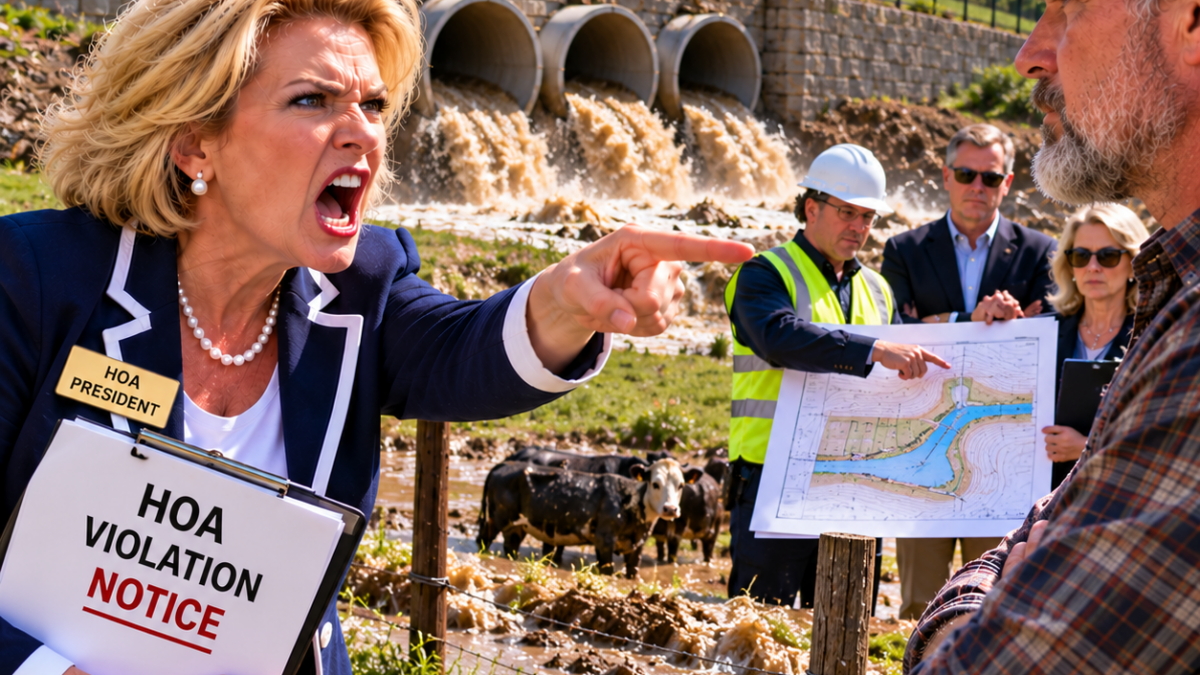
The next morning, a purple violation notice was taped to my mailbox.
I wasn’t a Pleasant Meadows member.
My mailbox sat on public right-of-way beside my property.
The notice accused me of maintaining an “unsightly swamp-like condition” visible from association property.
Daily fine: $100.
I laughed.
Then photographed it.
The following day brought another.
Damaged fencing.
Also $100 per day.
The fence their runoff had destroyed.
Two days later:
Unapproved agricultural equipment visible from Pleasant Meadows.
My tractor.
I filed all three.
Sarah found me at the kitchen table making copies.
“They’re fining us?”
“They think they are.”
“We aren’t members.”
“I know.”
“Can they lien us?”
“Not legitimately.”
“That wasn’t my question.”
She was worried.
I stopped copying.
“No association covenant is recorded against our parcel.”
“And if they file something anyway?”
“Then we challenge it.”
She sat.
“Jack, I need you to hear me.”
“I’m listening.”
“This isn’t Afghanistan.”
“I know.”
“It’s not a mission.”
“I know.”
“You haven’t slept properly in a week.”
That was true.
“You’re checking rainfall forecasts like they’re enemy movements.”
“That seems dramatic.”
“Last night you woke up at two because you heard thunder.”
Also true.
I looked away.
Sarah softened.
“I know what this land means to you.”
“It’s for us.”
“I know.”
“It was supposed to be—”
“Peace.”
I nodded.
We had moved more times than Emily could count during my career.
Different bases.
Different rentals.
Different schools.
Sarah had made every place home.
But this pasture was the first thing I had bought because I wanted it, not because orders placed us nearby.
Watching it disappear beneath someone else’s water felt strangely personal.
Like Karen hadn’t only damaged land.
She had proven my peace could still be taken away.
Sarah reached across the table.
“Fight it.”
I looked at her.
“Just don’t let the fight become the thing you live for.”
That night, I called Dave Morrison.
Retired attorney.
Former military.
Old friend.
He read everything.
Then we met for coffee.
“You can sue,” he said.
“I know.”
“You probably should sue.”
“Probably?”
“You’ve got strong evidence. Property damage. Trespass theories. Nuisance. Potential environmental claims. Maybe injunctive relief.”
“But?”
He smiled.
“You’re learning.”
“But litigation is expensive.”
“Yes.”
“They’ll spend dues.”
“Yes.”
“I’ll spend savings.”
“Yes.”
“So what would you do?”
“Change the battlefield.”
I waited.
Dave stirred his coffee.
“They didn’t only hurt you.”
He tapped Mike’s report.
“They altered a regulated drainage system.”
Another tap.
“They potentially contaminated a protected creek.”
Another.
“They may have violated subdivision approvals.”
Another.
“And their insurance carrier has no idea they’re sitting on a six-figure claim created by an unpermitted project.”
I smiled.
Dave pointed at me.
“That smile is why your wife worries.”
“Continue.”
“We send complaints where the facts belong.”
The first went to the North Carolina environmental regulator responsible for stormwater and water-quality enforcement.
We attached Mike’s report.
Laboratory data.
Photographs.
County order.
Coordinates.
Timeline.
The second went to county planning and stormwater officials.
We requested enforcement of the approved drainage plan.
The third went to Pleasant Meadows’ liability carrier as notice of a claim.
Not a threat.
Notice.
The association had been formally informed of damage and refused remediation.
If another storm made it worse, the insurer needed to know.
Dave warned me not to assume coverage would vanish automatically.
“Insurance is complicated.”
“I know.”
“Intentional-act exclusions don’t mean what angry homeowners think they mean.”
“I know.”
“Board members don’t instantly lose every corporate protection because they made a bad decision.”
“I know.”
“Good.”
He leaned closer.
“But insurers hate undisclosed risk and continued damage after notice. This will get attention.”
It did.
Before any agency visited, I started speaking with homeowners along Pleasant Meadows’ rear row.
Not about Karen.
Not initially.
I knocked on doors and asked a simple question.
“Have you noticed unusual ground saturation or settlement near the rear berm?”
The first woman stared at me.
“You’re the farmer.”
“Yes.”
“Karen says you’re suing us.”
“I haven’t filed suit.”
“She says you want hundreds of thousands.”
“I have an engineering estimate for damage.”
She closed the door.
The second homeowner was polite but distant.
No problems.
The third was Arthur Henderson.
Retired accountant.
Seventy-ish.
Sharp eyes.
Quiet voice.
He invited me inside before I finished the question.
“You noticed the soft ground.”
I stopped.
“What soft ground?”
“My patio.”
He led me through his kitchen.
At the back of his home, a concrete patio met the lawn.
A crack ran diagonally across one corner.
The ground near the berm felt spongy despite several dry days.
“When did this start?”
“After their drainage project.”
“You complained?”
“Karen told me normal settling.”
“Any engineering inspection?”
“No.”
“Would you like one?”
He studied me.
“You’re not here because of my patio.”
“No.”
“Show me what happened.”
I gave him Mike’s executive summary.
He read every page.
Then the county denial.
His expression tightened.
“She told us the work was pre-approved.”
“What work?”
“Drainage improvement.”
“How was it funded?”
“Special assessment.”
“How much?”
“Twenty thousand total.”
“For the project?”
“Yes.”
“Any engineer?”
“Not that residents were shown.”
“Bids?”
“Karen said time was important because spring rains were coming.”
“How convenient.”
Arthur looked at me.
“I ran against her twice.”
“For president?”
“Yes.”
“Lost?”
“Badly.”
“Why?”
“She told everyone I wanted to raise dues and stop beautification projects.”
“Did you?”
“I wanted audited financials.”
I liked him immediately.
Arthur had years of records.
Meeting minutes.
Budgets.
Newsletters.
Special assessments.
The drainage project had been introduced as a solution to recurring wet ground near the tennis courts.
Karen presented it as maintenance.
The minutes authorized up to twenty thousand dollars.
No engineer mentioned.
No permit discussed.
No drainage study.
One contractor.
When I saw the name, I asked:
“Know them?”
“Small excavation company.”
“Connected to Karen?”
“I don’t know.”
We found out later that there was no family connection.
That mattered.
Not every bad decision hides corruption.
Sometimes incompetence is enough.
The contractor had performed exactly what the HOA asked for.
Cut a new channel.
Install pipe.
Redirect water.
The fatal decision appeared to belong to the board.
Arthur made copies of the documents.
“You’re going to use this?”
“Yes.”
“Against Pleasant Meadows?”
“Against the people responsible.”
He nodded slowly.
“Good answer.”
A week later, the state environmental investigator called.
Her name was Rachel Albright.
Direct.
Professional.
No patience for speeches.
“I’ve reviewed the complaint.”
“Yes, ma’am.”
“I’d like to inspect both the receiving property and the outfall.”
“When?”
“Thursday.”
“Any problem if my engineer attends?”
“No.”
“Attorney?”
“Not necessary, but I don’t control who you speak with.”
Thursday morning, Ms. Albright arrived in a state vehicle.
Mike was already there.
We walked the pasture.
She photographed sediment deposits.
Took independent samples.
Measured the channel.
Examined the creek.
Then climbed toward the culvert.
Karen arrived ten minutes later.
Gary and Sharon followed.
Karen wore a teal athletic outfit bright enough to qualify as emergency signaling equipment.
She marched down the berm.
“This is private community property.”
Albright didn’t look up.
“I’m conducting an environmental investigation.”
“You need permission.”
“I have statutory inspection authority related to the reported discharge.”
Karen looked at me.
“You brought her here.”
“I filed a complaint.”
Albright finally looked up.
“Ma’am, are you Karen Miller?”
“Yes. President of Pleasant Meadows.”
“Did the association install this outfall?”
Karen paused.
“The association performed necessary drainage maintenance.”
“Was this pipe already here?”
“It replaced and improved existing drainage.”
Mike glanced at me.
Interesting wording.
Albright wrote something.
“Do you have the permit number?”
Karen’s confidence slipped slightly.
“This was maintenance. We didn’t require a permit.”
“Engineering plans?”
“Our contractor handled technical matters.”
“Licensed civil engineer?”
“I would have to check.”
“County stormwater approval?”
“The board has broad authority over common areas.”
Albright’s face remained neutral.
“HOA authority does not replace county or state permitting requirements.”
Karen’s cheeks reddened.
“We acted to protect residents from flooding.”
“So the board directed installation?”
“Yes.”
Gary looked at her.
She didn’t notice.
Albright asked:
“Under your direction?”
Karen squared her shoulders.
“I was project lead.”
Mike stared at the ground to hide his expression.
Albright wrote.
“Thank you.”
Karen seemed to realize too late that she had just put her name directly on the decision.
She shifted.
“To be clear, this hostile neighbor has been trying to extort our community.”
Albright looked at me.
Then back at Karen.
“My investigation concerns water discharge.”
“He’s using the government to harass us.”
“Do you dispute that the association installed this pipe?”
“We improved drainage.”
“Without a permit?”
Karen hesitated.
“As I said, one wasn’t required.”
Albright closed her notebook.
“I’ll verify that with the county.”
Karen followed us as we walked toward the vehicles.
“Can you at least tell us whether his complaint has merit?”
“No.”
“But—”
“You’ll receive findings when the investigation is complete.”
Albright left.
Karen remained.
Her eyes fixed on me.
“You think you’ve won something.”
“No.”
“You’re going to make every family in Pleasant Meadows pay because you can’t handle rain.”
I looked over the submerged pasture.
“You handled the rain by sending it here.”
“You bought downhill property.”
“You built an outfall after the county said not to.”
Her face changed.
Just slightly.
“You don’t know what you’re talking about.”
“I have the order.”
For the first time, Karen looked genuinely unsettled.
Then she turned and walked away.
The next development came from Pleasant Meadows’ insurer.
Not a denial.
A reservation-of-rights letter.
Arthur obtained a copy later through association records.
The carrier acknowledged notice of my claim but raised serious questions about coverage if the board had knowingly undertaken unauthorized work or continued harmful discharge after notice.
The letter recommended independent counsel.
Gary called Arthur that night.
Arthur called me.
“He’s panicking.”
“Gary?”
“Yes.”
“Why?”
“He thinks Karen told the insurer the pipe was pre-existing.”
I sat up.
“Was that in writing?”
“I don’t know.”
“Find out.”
“Jack.”
“What?”
“You’re enjoying this.”
Sarah had said the same thing.
I leaned back.
“No.”
Arthur was quiet.
“Maybe a little.”
“Be careful.”
“I know.”
“People like Karen aren’t dangerous because they’re the only people who like power.”
That one stayed with me.
The county acted next.
A large violation notice appeared at Pleasant Meadows’ entrance.
It cited unpermitted alteration of an approved stormwater system.
Deviation from the recorded master drainage plan.
Failure to obtain necessary review.
The HOA had sixty days to submit an engineered corrective plan.
Until then, no additional work could occur except emergency stabilization authorized by the county.
Residents saw the sign every time they entered the neighborhood.
Karen had spent years obsessing over Pleasant Meadows’ entrance landscaping.
Seasonal flowers.
Fresh mulch.
Perfect monument sign.
Now beside it stood a county violation placard.
Arthur sent me a photograph.
Caption:
**New landscaping feature.**
I showed Sarah.
She laughed despite herself.
Karen responded with a special newsletter.
Purple paper.
Large headline.
**PLEASANT MEADOWS UNDER ATTACK**
I read it at the breakfast table.
Emily leaned over.
“Are you the attack?”
“Apparently.”
Karen described me as a hostile outside landowner seeking to profit from “historic drainage characteristics.”
She claimed government bureaucracy threatened community finances.
She said the board had acted responsibly.
She called Mike’s report “privately commissioned advocacy.”
That phrase impressed him.
“Put that on my website,” he said.
She did not mention the thirty-six-inch pipe had been installed two months earlier.
She did not mention the county’s original denial.
She did not mention the approved drainage plan.
She did not mention her statement to Albright that she led the project.
The newsletter might have worked a month earlier.
Now residents had questions.
Arthur had quietly spoken with neighbors.
Rear-lot owners were noticing saturated soil.
One patio crack.
Another homeowner had a sinking fence post.
A mother named Rachel—not the investigator—learned the creek samples showed bacterial contamination.
Her children played near that creek.
She called me.
“What exactly did the lab find?”
I sent her the report.
She called back twenty minutes later.
“Why didn’t the HOA tell us?”
“I don’t know.”
“Karen says the state complaint is political.”
“I don’t belong to any Pleasant Meadows politics.”
“My son catches frogs down there.”
“Keep him out until the state finishes testing.”
Her voice changed.
Not angry anymore.
Scared.
“Could he get sick?”
“I’m not a doctor.”
“Would you let Emily play in it?”
“No.”
That answer traveled faster through Pleasant Meadows than anything I could have posted online.
Residents stopped asking whether I was trying to bankrupt them.
They started asking what the board knew.
Arthur circulated a petition for an emergency membership meeting.
Pleasant Meadows bylaws required twenty-five percent of owners.
He collected more than fifty percent in three days.
Karen challenged several signatures.
Arthur verified them.
The meeting was scheduled.
Meanwhile, rain was forecast.
Not a hurricane.
A strong line of thunderstorms.
Exactly what had flooded us the first time.
I watched the radar all afternoon.
Sarah found me checking culvert flow predictions at the table.
“You’re doing it again.”
“What?”
“Living inside the fight.”
“Rain is coming.”
“I know.”
“If they don’t shut the pipe—”
“I know.”
I stared out the window.
The pasture had partially drained.
Fresh grass was trying to recover on higher spots.
Daisy remained in the temporary paddock.
Emily had not ridden in weeks.
“What am I supposed to do?”
Sarah sat beside me.
“Prepare. Then stop pretending watching the radar controls it.”
That was harder.
Mike recommended temporary protection measures on my side.
Sandbags.
Diversion berm.
Erosion matting.
Not enough for a major storm.
Enough to reduce damage.
The county refused to let the HOA modify the system without approval, but emergency measures upstream were possible.
The new board didn’t exist yet.
Karen did nothing.
At 11:40 that night, rain began.
By 12:30, the culvert roared.
I stood beneath the porch roof watching water cross the pasture in the beam of a floodlight.
Emily came outside.
“Dad.”
“Go back in.”
“Is it happening again?”
“Yes.”
“Can we stop it?”
“Not tonight.”
The water hit the temporary berm Mike designed.
For almost fifteen minutes, it held.
Then overflowed.
Not catastrophically.
But enough.
Another strip of pasture disappeared.
I recorded video.
Flow.
Timestamp.
Depth.
Every drop after notice.
The phrase I had used at the board meeting came back to me.
Willful continued damage.
By dawn, nearly another half acre showed fresh erosion.
Mike arrived at seven.
He walked the field.
Said nothing for a while.
Then:
“Add it.”
“To what?”
“The damage map.”
We surveyed the new scar.
His revised estimate increased.
$139,800.
Karen’s decision to leave the outfall active after receiving the engineering report had just become expensive.
That was when the title people eventually gave this story started to make sense.
Mike did not literally send Karen an invoice “for every acre.”
What he did was more effective.
He divided the damaged pasture into mapped impact zones.
Severe erosion.
Contaminated deposition.
Moderate saturation.
Fence loss.
Vegetation loss.
Creek buffer impact.
For each zone, he calculated actual remediation tasks and unit costs.
Cubic yards of soil.
Tons of disposal.
Linear feet of fence.
Acres of regrading.
Acres of reseeding.
Water-quality monitoring.
Veterinary losses.
Engineering.
The result was a map where every damaged acre carried a documented price.
Not emotional value.
Not revenge.
Cost.
Karen had called my land a mud pit.
Mike turned that mud into line items.
The emergency Pleasant Meadows meeting happened four days later.
Standing room only.
Dave and I attended as invited guests.
Mike sat beside us.
Karen took the front table with Gary and Sharon.
Gary looked like he’d lost ten pounds.
Sharon still looked defiant.
Karen struck the gavel.
“We are here because our community is facing an unprecedented attack.”
A voice from the crowd shouted:
“Answer the drainage questions.”
Karen hit the gavel again.
“We will follow the agenda.”
Arthur stood.
He had a microphone residents had insisted be made available.
“The petition called this meeting. The membership sets the purpose.”
Karen stared.
“You do not chair this association.”
“Not yet.”
Murmurs.
She reddened.
Arthur opened a folder.
“I have six questions.”
Karen folded her arms.
Arthur’s accounting background showed in the way he spoke.
No drama.
No adjectives.
“Question one. Did the board know, before authorizing the drainage project, that the county had previously denied discharge toward the Davis property?”
Karen responded.
“That document concerned the original developer.”
“Yes or no?”
“It was not applicable.”
“That wasn’t the question.”
She looked toward the association attorney sitting off to the side.
He did not rescue her.
Arthur repeated.
“Were you aware of the document?”
Karen finally said:
“I had seen historical planning materials.”
The room changed.
Not loudly.
But people understood.
Arthur nodded.
“So yes.”
“It was outdated.”
“Question two. Did the association obtain a county permit before installing the new outfall?”
“We were advised none was needed.”
“By whom?”
“Our contractor.”
“Was the contractor a licensed engineer?”
“No.”
“County planner?”
“No.”
“Attorney?”
“No.”
Murmurs grew.
“Question three. Did the board solicit engineering review?”
“We did not consider it necessary.”
“Question four. How many bids?”
Karen glanced at Gary.
Gary swallowed.
“One.”
Arthur looked toward him.
“One?”
Gary nodded.
Sharon snapped:
“We had an urgent drainage problem.”
Arthur continued.
“Question five. Residents paid twenty thousand dollars through a special assessment. Where is the itemized project cost?”
Gary opened his binder.
“I have it.”
Karen looked sharply at him.
He continued anyway.
“Excavation, pipe, grading, landscaping restoration.”
“Any permit line item?”
“No.”
“Engineering?”
“No.”
“Environmental review?”
“No.”
Arthur paused.
“Question six. Why did the newsletter tell residents the state complaint was frivolous when the county had already issued a formal violation?”
Karen grabbed her microphone.
“Because the county action is based entirely on false information supplied by Mr. Davis.”
That was when Rachel, the mother whose children played near the creek, stood.
“Are the lab results false?”
Karen stopped.
Rachel held the report.
“My kids play there.”
“The association has not independently verified his private testing.”
“The state took its own samples.”
“We do not have those results.”
“Then why are you telling us there’s no danger?”
Applause broke out.
Karen struck the gavel.
“Order.”
A real estate agent named Monica stood.
“My clients are asking about the violation sign at the entrance.”
Karen glared.
“Sit down.”
“No.”
More applause.
“You promised this project would protect property values. Now there’s a state investigation, county enforcement, and a six-figure damage claim.”
“The claim is inflated.”
Mike looked at me.
I nodded.
Arthur saw him.
“Mr. Reynolds?”
Mike stood.
“I’m Michael Reynolds. Licensed civil engineer. I prepared the damage analysis.”
Karen laughed sharply.
“Paid by Mr. Davis.”
“Yes.”
That direct answer surprised her.
Mike continued.
“He paid me for professional engineering services. My license obligates me to provide an opinion I can support.”
Arthur asked:
“How do you get $139,800?”
Mike connected his laptop to the projector.
The pasture map appeared.
Colored impact zones.
He pointed.
“Zone A. Severe erosion and contaminated sediment deposition. Approximately 1.2 acres.”
Next.
“Zone B. Saturation and soil contamination requiring excavation and soil amendment. Approximately 2.7 acres.”
Next.
“Zone C. Vegetation and fence impact with lower contamination levels. Approximately 1.1 acres.”
Then the creek buffer.
“Separate stream-bank and water-quality impact.”
Karen interrupted.
“So you’re charging us by the acre.”
Mike looked at her.
“No.”
She frowned.
“I heard the numbers.”
“I’m estimating the work required within each acre.”
He zoomed in.
“Excavation volume is calculated by depth and area. Disposal costs by tonnage. Replacement topsoil by cubic yard. Pasture restoration by acreage. Fence by linear foot. Monitoring by sampling schedule. Engineering by scope.”
He clicked again.
Invoices.
Quotes.
Unit costs.
“This is not punitive.”
Another click.
Photographs after the second storm.
“This section was damaged after the board received my first report.”
Gary covered his face.
Mike continued.
“That increased the estimate.”
A homeowner asked:
“How much?”
“Twelve thousand three hundred fifty dollars.”
The room erupted.
Karen tried to speak.
Arthur lifted a hand.
“Let him finish.”
Mike did.
No rhetoric.
Just numbers.
When he sat down, I went to the front.
For weeks I had imagined making some grand speech.
I didn’t.
I showed the drone footage.
The subdivision.
The basin.
The pipe.
The brown water crossing my pasture.
Then Daisy.
Not suffering dramatically.
Just standing with her front hoof bandaged while Emily held the lead rope.
I heard Sarah inhale from the back.
I almost changed slides.
But Emily had told me to use it.
“They should see who paid first,” she had said.
I looked at the residents.
“My daughter’s horse recovered because we caught the infection early.”
Karen stared at the table.
“My family did not come here looking for a lawsuit.”
I showed the first certified letter.
“I asked for a meeting.”
Then the engineering report.
“I brought evidence.”
Then the board minutes dismissing it.
“You rejected it.”
Then the violation notices.
“You fined me for the swamp your pipe created.”
Somebody cursed under their breath.
I continued.
“So I went to the county.”
State investigation letter.
“Then the state.”
Insurance notice.
“And my attorney notified the carrier.”
I lowered the remote.
“You can be angry at me if you want.”
Nobody spoke.
“I understand why. The remediation money will come from somewhere. Some of it may come from insurance. Some may not. The environmental penalties may affect the association. Legal costs will affect the association.”
Karen looked up, sensing an opening.
I kept going.
“But I gave your board the chance to stop this before any agency was involved.”
Her expression collapsed again.
“Your president decided my damaged land was cheaper than admitting she was wrong.”
Silence.
“That decision is what you’re paying for.”
I walked back to my seat.
Arthur took the microphone.
“Motion from the floor.”
Karen struck her gavel.
“You are out of order.”
The association attorney finally spoke.
“Madam President, the petition notice includes removal proceedings.”
Karen turned toward him.
“What?”
“Members may make the motion.”
Her face went pale.
Arthur read the motion.
Removal of Karen Miller, Sharon Price, and Gary Peters from the Pleasant Meadows HOA board for failure to follow approved drainage requirements, exposure of the association to significant liability, and loss of confidence.
A homeowner seconded.
Gary stood.
“I resign.”
The room quieted.
Karen stared at him.
“Sit down.”
He didn’t.
“I should have stopped this.”
“Gary.”
“I asked you to get an engineer after Davis came to the board.”
She froze.
That was new.
Arthur looked up.
“You did?”
Gary nodded.
“I emailed her the next morning.”
Karen stood.
“This is not the time—”
“Do you have the email?”
Arthur asked.
Gary looked toward the attorney.
“Yes.”
Karen slammed her palm on the table.
“You are betraying this board.”
Gary’s voice shook.
“No.”
He looked at the residents.
“I betrayed them when I raised my hand.”
That line ended Karen’s presidency more effectively than anything I had said.
The vote proceeded.
Over ninety percent supported removal.
Sharon lost too.
Karen remained seated after the count.
No gavel.
No authority.
People began talking all at once.
Questions.
Anger.
Demands.
Who hired the contractor?
Where had the assessment money gone?
Why had the county denial been ignored?
Karen stood.
“This community will regret this.”
No one answered.
She walked toward the side exit.
For a moment, several residents followed, still shouting questions.
I stayed where I was.
Dave stood beside me.
“Not going to enjoy the moment?”
“I am.”
“You don’t look like it.”
I looked at Emily’s photograph still frozen on the projector.
“I’ll enjoy it when the pasture is green.”
Arthur Henderson became interim HOA president.
His first act was not revenge.
It was calling Mike.
The next morning, Arthur, Mike, Dave, the association’s newly retained independent counsel, and I met at my kitchen table.
No Karen.
No speeches.
Arthur opened a notebook.
“Tell us how to fix it.”
Mike did.
First, immediate engineering of a compliant temporary drainage solution so no more concentrated discharge entered my property.
Second, removal of the unauthorized rear outfall.
Third, restoration of the berm and the subdivision’s stormwater system to an approved configuration.
Fourth, excavation of contaminated sediment from affected portions of my pasture.
Fifth, clean topsoil.
Regrading.
Pasture reseeding.
Fence reconstruction.
Creek-bank stabilization.
Water testing.
Quarterly monitoring for two years.
Veterinary reimbursement.
Engineering oversight.
Arthur listened.
“How much?”
“Current estimate, $139,800, excluding state penalties and HOA legal costs.”
Arthur exhaled.
“Reserves?”
He gave us the number.
Not enough.
Not close.
“We’ll need an assessment.”
I hated hearing that.
Not for me.
For the residents.
Sarah later asked why I looked guilty.
“Because they’re paying.”
“They voted for Karen?”
“Some did.”
“Did they vote for the pipe?”
“They approved the assessment.”
“Based on what they were told.”
I nodded.
Sarah sat across from me.
“You didn’t make Karen ignore the county.”
“I know.”
“You didn’t make her dismiss the report.”
“I know.”
“You didn’t make the board keep the pipe active before the second storm.”
“I know.”
“So stop taking responsibility for consequences just because you can see them.”
That was easier said than done.
Arthur handled the new assessment differently.
He published every number.
Remediation estimate.
Legal costs.
Reserve balance.
Potential insurance recovery.
Possible state penalties.
Possible claims against former directors.
Nobody liked the assessment.
Several people were furious.
But they knew why it existed.
That difference mattered.
The HOA approved the restoration contract through competitive bidding.
A reputable environmental contractor arrived at my property a month later.
The first task was the pipe.
I watched from the pasture as an excavator dug around the thirty-six-inch culvert.
The pipe emerged from the berm covered in red clay.
Massive.
Ugly.
Simple.
Amazing that something so ordinary could cause so much trouble.
Emily stood beside me.
“That’s it?”
“That’s it.”
“It looks smaller now.”
“Everything does after you stop being afraid of it.”
The excavator lifted the pipe section.
For weeks I had imagined some triumphant moment.
Maybe cheering.
Maybe taking a photograph.
Instead, I felt relief.
The operator set it on the ground.
A worker cut it into manageable sections.
The line that had turned my pasture into a dumping ground became scrap.
Then the real work started.
Contaminated sediment removal was slow.
Soil had to be excavated to depths based on testing.
Loads tracked.
Disposal documented.
Clean fill brought in.
Grades restored.
Mike checked elevations constantly.
He became obsessed with restoring the natural sheet-flow pattern.
“You’re enjoying this,” I told him.
“Of course.”
“My wife says that’s unhealthy.”
“Your wife is correct about you. Not me.”
“You’re standing in mud smiling at a laser level.”
“This is what happiness looks like.”
The state investigation concluded while restoration was underway.
The final enforcement action was serious.
Pleasant Meadows received a significant civil penalty for unpermitted stormwater discharge and violations associated with the protected watershed.
The amount was fifty thousand dollars after agency review and negotiated compliance terms.
More important to me, the order required corrective work and monitoring.
Karen was named in the factual findings as the board representative who had directed the project and acknowledged installation without outside permitting.
The report also described her statements to the investigator.
It did not call her a liar.
Government reports are usually more restrained than that.
It documented inconsistencies.
That was enough.
Pleasant Meadows’ insurer covered some portions of the property claim after negotiation but reserved rights regarding conduct it considered potentially outside policy protection.
The HOA, under Arthur, sued former board members and pursued contractual claims against professionals involved in the drainage work.
Gary cooperated.
His email became important.
Sent the morning after my board appearance:
**Karen, we need to suspend the rear drainage discharge immediately and obtain independent engineering review. Davis’s report appears credible, and continued flow could increase association liability.**
Karen’s response came fourteen minutes later:
**Absolutely not. Shutting it down now validates his ridiculous claim. We will not let an outsider dictate operations inside Pleasant Meadows.**
That email cost her.
Not because it proved she had wanted to destroy my pasture.
It didn’t.
But it showed she had been warned after receiving an engineer’s report and chose image over risk reduction.
The second storm occurred after that email.
Every dollar of additional damage mapped by Mike suddenly had a timestamp attached to it.
When mediation began between the HOA, insurer, former directors, and me, Mike placed two pasture maps side by side.
Before notice.
After notice.
Karen attended with her lawyer.
It was the first time I had seen her since the recall.
She looked different without the HOA presidency around her.
Smaller.
Tired.
Still angry.
The mediator asked Mike to explain the difference between the maps.
He pointed to the second erosion zone.
“This damage occurred during the storm fourteen days after my engineering report was delivered to the board.”
Karen’s attorney said:
“You cannot state with certainty that shutting down the pipe would have prevented all flooding.”
“Correct.”
Karen looked surprised.
Mike continued.
“I can state within reasonable engineering certainty that the concentrated discharge from the outfall substantially increased flow volume, velocity, and damage in the mapped area.”
Her attorney nodded.
“And your incremental cost?”
“Twelve thousand three hundred fifty dollars attributable to post-report additional damage in that event, based on the remediation quantities.”
The mediator looked at Karen.
Her lawyer whispered to her.
She shook her head.
I couldn’t hear the words.
Then she looked directly at me.
“This was never personal.”
I almost laughed.
“You fined my broken fence.”
Her jaw tightened.
“The association had standards.”
“My property isn’t in your association.”
“You allowed it to become an eyesore.”
“Your water turned it into an eyesore.”
“The water followed gravity.”
Mike spoke before I could.
“Water follows gravity. Engineers decide where concentrated runoff starts.”
Karen glared at him.
He didn’t care.
She looked back at me.
“You wanted to destroy me.”
“No.”
“Then why did you go to every agency you could find?”
“Because you wouldn’t shut off the pipe.”
“You could have sued.”
“I gave you the report.”
“You demanded a hundred twenty-seven thousand dollars.”
“I demanded restoration.”
“You wanted money.”
“I wanted dirt.”
That stopped her.
“What?”
“My pasture back.”
I leaned forward.
“Your whole problem, Karen, is you keep thinking this is about power. Who controls the board. Who wins the meeting. Who looks weak.”
I pointed toward Mike’s map.
“That was land my daughter rode across.”
Her face changed slightly.
“My horse got sick.”
Nothing.
“My creek got contaminated.”
She looked away.
“I came to your house first because I thought neighbors could solve it.”
“You were hostile.”
“My boots were muddy because of your pipe.”
The mediator raised a hand.
“We’re moving away from productive settlement.”
He was right.
I sat back.
But for the first time, I realized something.
I didn’t need Karen to admit anything.
The engineering report existed.
The county order existed.
The state findings existed.
The pipe was gone.
My pasture was being repaired.
Her confession would change nothing.
Settlement followed weeks later.
The HOA paid for full restoration and my documented losses.
Insurance covered portions according to its policy obligations.
Pleasant Meadows obtained reimbursement through negotiated claims against responsible parties.
The former board members contributed under separate agreements.
Karen’s personal settlement terms were confidential.
I never saw the exact number.
Neighborhood rumors claimed she had to sell her house to pay it.
I cannot tell you that was definitely true.
I can tell you her house went on the market not long afterward.
I can tell you the HOA recovered money.
And I can tell you Karen moved.
Sharon contributed to the resolution as well.
Gary’s financial exposure was reduced substantially because he cooperated early, produced records, and helped the new board correct the problem.
No county issued some dramatic lifetime ban forbidding him from ever joining an HOA board again.
Real law doesn’t usually work like that.
He did, however, tell Arthur publicly:
“If I ever volunteer for another board, somebody please call my wife.”
That seemed sufficient.
The pasture took most of a season to restore.
For a while, it looked worse.
Heavy equipment.
Excavated soil.
Bare earth.
Temporary fencing.
Orange safety mesh.
Dump trucks.
But every ugly stage was progress.
Contaminated sediment left.
Clean soil arrived.
Grades returned.
Grass seed went down.
Rain came.
This time, water moved the way it was supposed to.
No concentrated torrent.
No brown lake.
Just rain.
I stood outside during the first big storm after the new system was completed.
Sarah opened the porch door.
“You’re going to get soaked.”
“I know.”
“You know normal people watch storms from inside.”
“I need to see something.”
She came out anyway.
We stood beneath umbrellas.
Water ran across the pasture in shallow sheets.
The creek rose.
No pipe.
No violent channel.
No flood.
I laughed.
Sarah looked at me.
“What?”
“Nothing.”
“You’re standing in rain laughing at drainage.”
“Correct.”
“You need hobbies.”
“I have hobbies.”
“Drainage is not a hobby.”
“Tell Mike.”
“I intend to.”
Daisy recovered completely.
That mattered more than every legal document.
For weeks after her hoof healed, Emily rode only in the high pasture.
She was afraid to take Daisy across the restored area.
I never pushed.
Then one evening, near sunset, I saw her open the gate.
“Where are you going?”
“Lower field.”
“You sure?”
She looked at Daisy.
Then at the new grass.
“Yeah.”
I followed at a distance.
Not because she needed me.
Because I needed to see it.
Daisy walked carefully at first.
Then faster.
Emily asked for a trot.
The mare moved cleanly.
No limp.
No hesitation.
Emily turned toward me.
Her smile was enormous.
“Dad!”
“I see.”
“She’s good.”
“I see.”
Then she urged Daisy into a slow canter across the pasture.
The grass was still young.
The fence was new.
A few areas had temporary stakes marking monitoring wells.
It wasn’t exactly what we had before.
But it was alive.
That was enough.
Arthur transformed Pleasant Meadows more thoroughly than I expected.
He published detailed financial reports.
Large projects required multiple bids.
Engineering review became mandatory for stormwater and structural work.
Independent legal review was required before major deviation from recorded plans.
The board created an open comment period before special assessments.
Not exciting reforms.
Useful ones.
Residents formed an environmental committee with the local conservation group.
They planted native trees along the creek.
Willows.
Sycamores.
River birch.
Not decorative shrubs chosen for entrance photographs.
Trees that held soil.
Filtered runoff.
Provided shade.
Mike volunteered a drainage workshop.
I attended only because he promised lunch.
Thirty homeowners showed up.
At one point, he projected the old aerial photograph showing the illegal culvert.
Someone asked:
“What’s the biggest mistake here?”
I expected him to say missing permits.
Or undersized drainage.
Instead he said:
“Believing water disappears when it crosses your property line.”
He looked around the room.
“Stormwater management is shared reality. You can move water. You cannot move responsibility.”
I wrote that down.
Don’t tell him.
His ego is difficult enough.
The environmental monitoring continued for two years.
Quarterly samples.
Nitrates decreased.
Petroleum indicators dropped.
Bacteria levels returned toward background conditions.
The creek stabilized.
Vegetation returned.
Fish I hadn’t seen since the flood reappeared in one deeper pool.
One Saturday, Emily found frogs near the bank.
She was almost nineteen by then.
Home from college.
She crouched beside the water.
“Remember when Mrs. Miller said this was our problem?”
“Yes.”
“She was technically right.”
I stared at her.
“How?”
“It became our problem.”
“That is not the same thing.”
She smiled.
“You hate when I do that.”
“Do what?”
“Sound like you.”
“I don’t sound like that.”
“You absolutely do.”
Sarah, standing behind us, laughed.
“Unfortunately, she does.”
Pleasant Meadows residents eventually stopped treating me like the angry farmer behind their subdivision.
A few became friends.
Rachel brought her kids to help with tree planting.
Monica sold homes without having to explain a county violation sign at the entrance anymore.
Gary occasionally walked the public road near our fence.
For months, he only waved.
Then one afternoon, he stopped.
I was replacing a gate hinge.
“Jack.”
“Gary.”
“Can I talk?”
“Depends.”
“Fair.”
He stood on the roadside.
“I never apologized.”
“No.”
“I should have.”
I waited.
He looked across the pasture.
“I knew Karen was wrong before the second storm.”
That was more direct than I expected.
“You sent the email.”
“Yes.”
“Why did you raise your hand at the first board meeting?”
He swallowed.
“Because Sharon raised hers.”
I almost laughed.
He continued.
“Because Karen stared at me.”
“That isn’t better.”
“I know.”
“Why?”
He rubbed his hands together.
“Because I had spent three years telling myself board service wasn’t serious.”
I stopped working.
“Meaning?”
“Landscaping. Pool maintenance. Mailboxes. Budgets.”
He looked toward Pleasant Meadows.
“Then suddenly I had an engineer telling me we had damaged someone else’s property, and I realized I didn’t understand half the documents in front of me.”
“So you voted anyway.”
“Yes.”
“Why?”
“Because admitting I didn’t know felt worse.”
That answer was painfully human.
I understood it better than I wanted to.
He continued.
“I thought Karen knew.”
“Did she?”
“I think she believed knowing what she wanted was the same as knowing what was true.”
That sounded right.
Gary held out his hand.
“I’m sorry.”
I shook it.
“Thank you.”
He exhaled.
“I won’t ask you to forgive me.”
“Good.”
He laughed softly.
Then looked toward the creek.
“It looks good.”
“It does.”
We never became close friends.
But after that, when Gary waved, I waved back.
Karen’s old house sold to a family with two young children.
The new owners removed some of her elaborate front landscaping because they wanted a larger lawn.
Arthur found that hilarious.
“Years of dictatorship over shrubs, defeated by a trampoline.”
A bright blue trampoline appeared three weeks later.
The new board approved it.
Pleasant Meadows survived.
Property values survived.
Civilization continued despite visible children’s equipment.
The first anniversary of the flood passed quietly.
I almost forgot it.
Sarah didn’t.
She came outside while I was repairing the tractor.
“One year.”
“Since what?”
She stared at me.
Then I remembered.
“Oh.”
“That’s progress.”
“What is?”
“You forgot.”
I wiped grease from my hands.
“I’ve been busy.”
“With normal things.”
“Mostly.”
She handed me a beer.
We sat on the tailgate.
Lower pasture green.
Daisy grazing.
Creek visible through trees.
Pleasant Meadows roofs beyond the berm.
No pipe.
“I thought I’d feel more triumphant,” I said.
“About Karen leaving?”
“About all of it.”
Sarah took a sip.
“What do you feel?”
“Tired.”
“That seems reasonable.”
“And stupid.”
“Why?”
“Because for months I told myself this was about protecting the farm.”
“It was.”
“It was also about beating her.”
Sarah didn’t argue.
“That part felt good.”
“I know.”
“You knew?”
“You built a binder with color-coded tabs.”
“That proves organization.”
“You named the agency complaint folder ‘Second Front.’”
I looked away.
She smiled.
“Jack, you’re allowed to enjoy winning.”
“That sounds dangerous.”
“You’re not allowed to need an enemy.”
That was the real lesson retirement kept trying to teach me.
In the Army, problems arrived with names.
Objectives.
Coordinates.
Deadlines.
Civilian life was messier.
Some days the mission was fixing a fence.
Some days it was driving Emily to an appointment.
Some days it was sitting with Sarah while she complained about hospital scheduling.
Peace wasn’t absence of purpose.
It was being able to choose small purposes without needing conflict to make them feel important.
I started volunteering with the county soil-and-water conservation district.
Not because I wanted another war.
Because Mike tricked me into attending one meeting and someone asked whether I’d help farmers understand subdivision drainage impacts.
The first property I visited belonged to an elderly couple whose pasture was receiving runoff from a new commercial parking lot.
Nothing illegal.
Just poorly stabilized construction.
We helped them contact the developer.
The developer fixed the swale.
No lawsuit.
No board revolt.
No purple newsletter.
When I told Sarah, she smiled.
“You disappointed?”
“A little.”
She laughed.
“Healthy.”
Years passed.
Emily finished college.
Daisy got older.
Eventually she stopped jumping and became more of a pasture queen than a riding horse.
She still liked the lower field best.
One autumn afternoon, Emily came home with her fiancé.
We walked the property.
At the creek, he asked about the young trees.
“Why are these planted in rows?”
Emily answered before I could.
“Long story.”
I said:
“Drainage restoration.”
She rolled her eyes.
“That is the boring version.”
“The accurate version.”
Her fiancé pointed toward Pleasant Meadows.
“Is that the HOA story?”
Emily groaned.
“Please don’t encourage him.”
I looked offended.
“I never tell that story.”
Sarah, twenty feet behind us, shouted:
“That is a lie.”
The story had become local legend by then.
And like all local legends, it grew.
People said Karen intentionally aimed the pipe at my horse.
Not true.
They said Mike calculated damages at exactly $25,000 per acre and made her personally write a check for every one.
Not true.
They said the state arrested Karen during the HOA meeting.
Definitely not true.
The truth was less theatrical.
And more satisfying.
A board made a reckless decision.
Its president refused to correct it.
An engineer measured the consequences.
Agencies enforced rules already on the books.
Residents demanded accountability.
The association repaired what it damaged.
Former leaders contributed according to legal settlements.
The land healed.
Karen left.
No handcuffs required.
Mike’s original report still sits in my office.
Page forty-three has the map I remember best.
Five acres divided into damage zones.
At the time, I looked at those colored shapes and saw money.
Loss.
Anger.
Evidence.
Now I see something else.
Precision.
Karen tried to reduce what happened to a phrase.
“Your mud pit.”
Mike refused to let her.
This acre required sediment removal.
That one needed regrading.
This section lost pasture.
That section needed clean fill.
Fence here.
Creek work there.
Every square foot mattered because somebody had to restore it.
That was how he made her pay for every acre.
Not by exaggerating damage.
By refusing to let any of it disappear inside a vague apology.
Years later, Pleasant Meadows asked Mike to redesign part of its front retention system.
He called me.
“You’re going to love this.”
“What?”
“They hired me.”
“Who?”
“Pleasant Meadows.”
I laughed so hard Sarah came in from the other room.
Mike continued.
“Arthur says no one understands their drainage better.”
“Please charge them appropriately.”
“I always do.”
“Every acre?”
“Every hour.”
When the project finished, Arthur invited Sarah and me to a neighborhood picnic.
I resisted.
Sarah made us go.
Pleasant Meadows’ clubhouse lawn was full of families.
Children ran through sprinklers.
People grilled burgers.
No one cared about muddy shoes.
Arthur found me near the drinks.
“Want to see something?”
“That sentence has caused problems before.”
“Come on.”
He led me toward the rear berm.
For a moment, an old discomfort returned.
Then I saw it.
Where the illegal culvert had once emerged, native grasses covered the slope.
A shallow engineered swale carried ordinary drainage toward the approved retention system.
No giant pipe.
No concentrated discharge.
A small sign stood near the planting area.
Not a memorial to the fight.
Not Karen’s name.
Not mine.
Just:
**WATERSHED BUFFER — PLEASE PROTECT NATIVE PLANTINGS**
Arthur crossed his arms.
“Boring.”
“Perfect.”
“You know what we spent on drainage maintenance this year?”
“No.”
He told me.
Less than half the cost of the reckless shortcut that started everything.
“Funny how doing things correctly saves money.”
“Don’t tell engineers that. They’ll become unbearable.”
“Too late.”
We looked over the berm.
My pasture spread below.
Daisy grazed near the fence.
Older now.
Gray around her muzzle.
Emily no longer lived at home, but whenever she visited, Daisy still searched her pockets for treats.
Arthur said:
“I owe you something.”
“What?”
“An apology.”
“You weren’t on the board.”
“I lived here.”
“That isn’t a crime.”
“I saw how Karen operated.”
“So?”
“I didn’t push harder.”
“You ran against her twice.”
“And lost.”
“Still counts.”
He shook his head.
“No. I decided people didn’t want to know.”
“Maybe they didn’t.”
“Some didn’t.”
He looked at the houses.
“But I used that as an excuse to stop asking.”
I understood.
“Everybody has a point where discomfort becomes easier than responsibility.”
Arthur nodded.
“That from the Army?”
“No.”
“Sarah?”
“Yes.”
“She’s smarter than you.”
“Frequently.”
We walked back to the picnic.
On the way, a child ran past us with mud on both knees.
Nobody fined him.
Daisy died three years later.
Old age.
Quietly.
Emily drove home when the vet told us the time had come.
We buried her beneath one of the oaks at the high edge of the pasture.
Not the flooded section.
Emily chose the spot.
Afterward, she stood looking over the field.
“I used to hate that lower pasture.”
“After the flood?”
She nodded.
“I thought every time it rained, something bad would happen.”
“So did I.”
“Then it got fixed.”
“Yes.”
She wiped her face.
“Daisy never cared.”
“No.”
“She went right back down there.”
“Horses are smarter than engineers.”
“Mom says everyone is smarter than engineers.”
“Your mother is biased.”
Sarah, behind us, said:
“I heard that.”
Even grieving, Emily laughed.
We planted a small sycamore near Daisy’s grave.
One of the same species used in the creek restoration.
The tree grew quickly.
After a few years, its branches were visible from our kitchen window.
Every heavy storm still made me look toward the pasture.
Habit.
But fear faded.
Water moved through the approved system.
The creek rose and fell.
Grass bent.
Then stood again.
No brown lake.
No pipe.
No Karen.
Just weather.
The last formal water-quality monitoring report arrived two years after restoration.
All parameters within acceptable range.
Creek recovery satisfactory.
Monitoring complete.
Mike mailed me the report with a handwritten note.
**MISSION ACCOMPLISHED. NOW PLEASE STOP SAMPLING YOUR CREEK FOR FUN.**
I framed that note.
Not the engineering report.
The note.
Sarah found it in my office.
“You framed his insult?”
“It is a professional commendation.”
“You two are strange.”
“Accurate.”
The original county denial, Karen’s newsletters, the violation notices, Gary’s email, and Mike’s maps went into storage boxes.
For the first time since the flood, my desk was clear.
I remember standing there looking at the empty surface.
It felt strange.
Then peaceful.
I walked outside.
The sun was low.
Sarah was watering herbs.
Emily’s old riding helmet still hung inside the barn.
Daisy’s paddock gate stood open.
The sycamore near her grave moved in the evening breeze.
Down by the creek, the restoration trees had grown tall enough to shade the water.
Beyond them, Pleasant Meadows looked exactly like what it had always wanted to look like.
Neat houses.
Trim lawns.
Quiet streets.
But the neighborhood was different.
Not because Karen was gone.
Because the people living there understood something they hadn’t before.
Their board was not the community.
Their bylaws were not the law.
Their property line did not end their responsibilities.
And silence was not the same thing as agreement.
I walked down through the pasture.
At the low point where the water had once stood chest-deep against fence posts, the grass was thick enough to brush my boots.
No oily film.
No trash.
No mud pit.
I stopped near the creek.
Water moved over stones.
Clear.
Ordinary.
A frog jumped from the bank.
For months, I had wanted justice to be loud.
A courtroom ruling.
A huge check.
Karen admitting she had been wrong.
Something dramatic enough to match the damage.
Instead, the moment that stayed with me was almost silent.
My daughter riding Daisy across restored grass.
Rain falling without fear.
A creek running clear.
The pipe hauled away.
An engineer’s map showing that every damaged acre had been counted, measured, priced, and repaired.
Karen once told me runoff became my problem the moment it crossed onto my land.
Years later, standing beside that clean creek, I finally understood how backward she had been.
Responsibility doesn’t end at a property line.
That’s where responsibility starts to matter.
I looked uphill.
Pleasant Meadows sat beyond the trees.
Downhill, my pasture stretched green beneath the evening light.
Water flowed between us exactly where it was supposed to go.
And for the first time since the day I found that hidden culvert, I didn’t see a battlefield.
I saw home.
[END OF STORY]








