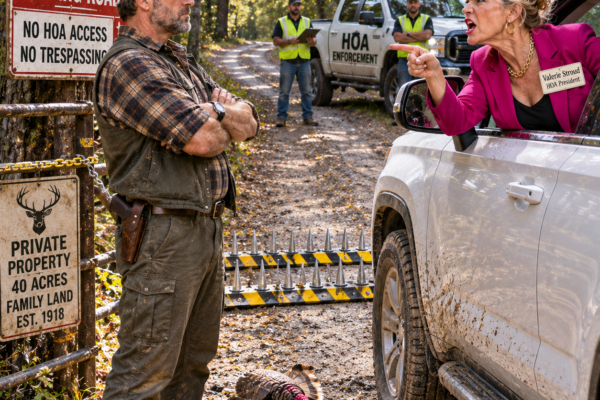
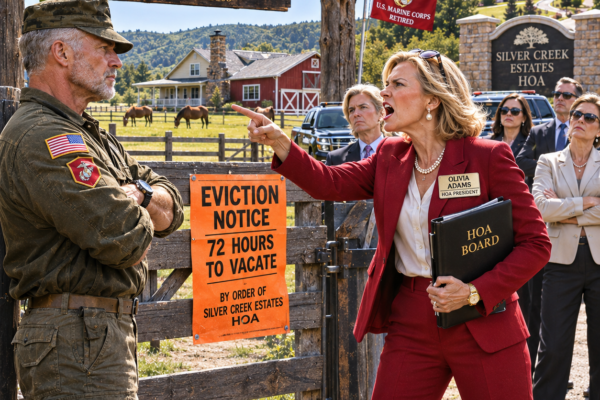
PART 2: HOA Karen Buried an Illegal Sewer Line Across My Ranch—She Had No Idea Who She Was Calling “Nobody”
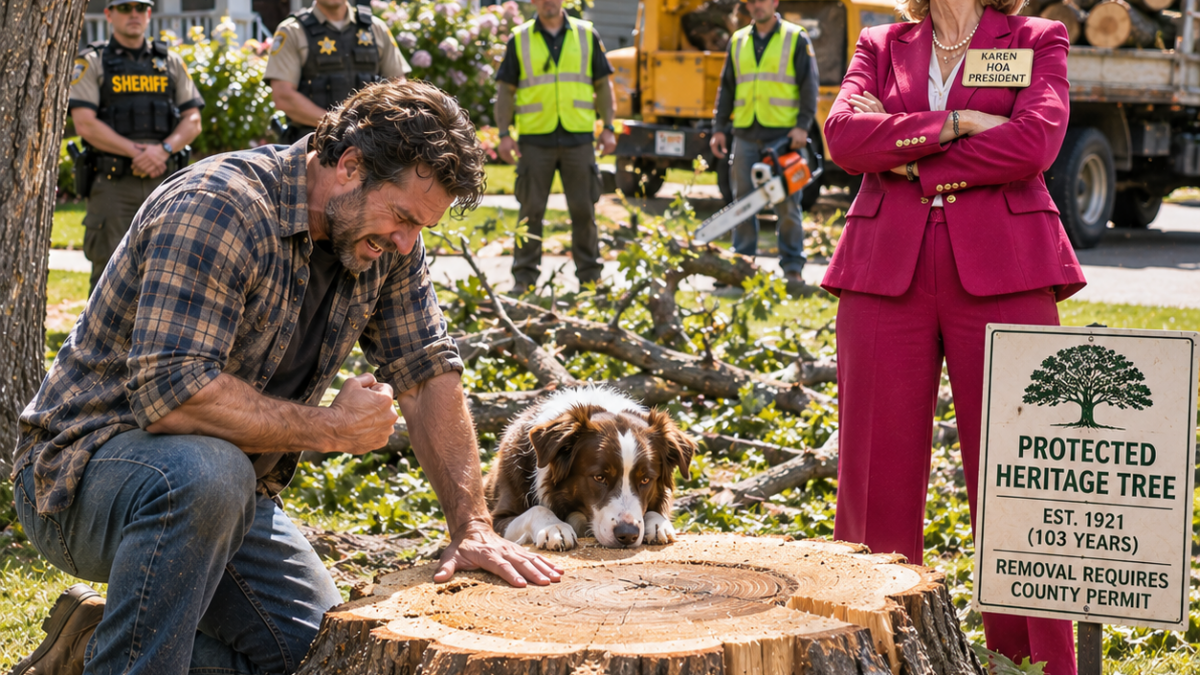
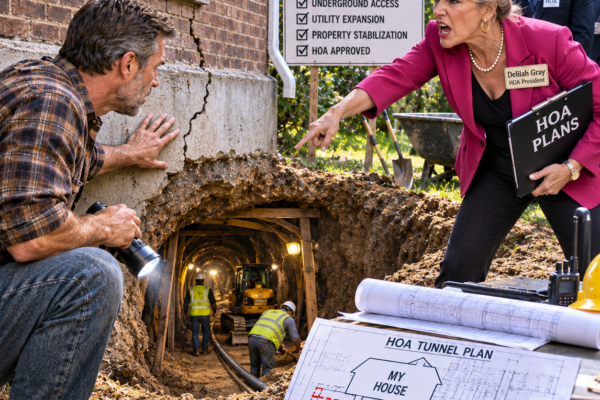
The first thing Karen destroyed wasn’t my fence, my irrigation line, or the pasture my family had spent years restoring—it was the boundary between ordinary HOA arrogance and a federal environmental crime when I found a three-foot sewer pipe being buried straight across my private ranch without a single permit, easement, or warning.
By the next morning, bulldozers had torn open more of my land, untreated wastewater was pooling near the creek that fed my lower pasture, and Karen was still standing in a hard hat telling contractors that I was “nobody” and that the HOA’s vote mattered more than county records.
What she didn’t understand was why I kept photographing every trench, broken pipe, contaminated puddle, and nervous worker instead of arguing with her, or why one quiet phone call from my truck was about to bring people to my ranch she had never imagined needing permission from.
Most of my neighbors knew me simply as the man who owned the old ranch beyond the south edge of Briarwood Estates.
That suited me.
The ranch was where I went when I wanted distance from meetings, reports, and government buildings. I kept cattle on the west pasture, hay on the north field, and a narrow creek crossed the lower section before continuing through three neighboring properties. I had spent years rebuilding fences, improving irrigation, and keeping the soil healthy.
Then Briarwood’s HOA elected Karen Whitmore.
Karen liked projects.
New entrance signs. Matching mailboxes. Decorative stone walls. Landscaping committees.
At first, none of that concerned me because my ranch was not HOA property.
Then I walked outside one morning and heard an excavator.
A trench nearly six feet wide cut through my pasture.
Fence posts had been ripped out. My irrigation line was exposed. Sections of black sewer pipe lay beside the opening, each one wide enough for a child to crawl through.
A plywood sign leaned crookedly against the dirt.
HOA SEWER PROJECT — DO NOT TOUCH.
I was still reading it when Karen stepped from behind a construction truck wearing sunglasses, a pink blazer, and the expression of somebody arriving to inspect work she owned.
“We’re expanding the community sewer system,” she said. “This route is approved.”
“Approved by who?”
“The board.”
“This is my ranch.”
She smiled.
“An emergency easement was approved.”
“Show it to me.”
Her smile tightened.
“We don’t need to carry paperwork out here.”
“County approval?”
“Internal approval.”
“Environmental review?”
“The HOA reviewed it.”
“Wastewater routing permit?”
She looked annoyed.
“You’re making this more complicated than it is.”
Behind her, three workers stopped pretending not to listen.
I walked to the trench and crouched beside one of the pipes.
“Who told you this land belonged to the HOA?”
Karen snapped, “Don’t answer him.”
The oldest worker hesitated anyway.
“We were told the association had the property rights.”
I pulled up the county parcel map on my phone.
My boundary appeared clearly on the screen.
So did my name.
The worker’s face changed.
Karen grabbed at the phone and knocked it into the dirt.
“That’s outdated.”
“No, it isn’t.”
“If you interfere again, I’ll call the sheriff.”
“For trespassing on my own land?”
“For obstructing community infrastructure.”
I picked up my phone and brushed mud from the case.
Then I noticed the smell.
Sour.
Chemical.
Wrong.
One of the pipes on the truck had residue around its opening, and a dark puddle beneath it carried a faint oily sheen.
I started taking pictures.
Karen stepped in front of me.
“Stop.”
“No.”
“You do not have authorization to photograph an HOA construction site.”
“It’s my pasture.”
“You keep saying that like it matters.”
That sentence told me everything I needed to know.
I photographed the equipment, trench, broken fence, pipe labels, vehicle plates, workers, damaged irrigation, and the runoff path toward the creek.
Then I asked the foreman one last question.
“Do you have permits?”
He stared at Karen.
Karen stared back.
Finally he said quietly, “We were told the HOA had them.”
Karen cut in.
“And that’s enough.”
“No,” I said. “It really isn’t.”
She pointed toward the excavator.
“Keep digging.”
The machine started again.
I watched another bucket of soil come out of my pasture.
Then I turned and walked toward my truck.
Karen called after me.
“Running away?”
I opened the driver’s door.
“No.”
I looked once more at the trench, then at the waterway downhill.
“I’m calling someone who actually has jurisdiction here.”
She laughed behind me.
I got into the truck, shut the door, and dialed a number I almost never used from home.
The person who answered didn’t call me rancher.
They called me Director.
PART 2
“Director, everything okay?”
It was Rivera.
Most people who met her for the first time underestimated her because she spoke quietly. They usually corrected that mistake within ten minutes.
Rivera supervised one of our regional environmental response teams. Before that, she’d spent years working spill sites, wastewater violations, illegal dumping cases, and contaminated industrial properties.
I looked through my windshield at the trench being cut across my ranch.
“No.”
Her tone changed immediately.
“What happened?”
“I need to report a potential unauthorized wastewater construction project.”
“Where?”
“My property.”
Silence.
Then:
“Your property?”
“Yes.”
“That creates a conflict issue.”
“I know.”
“Are you safe?”
“Yes.”
“Immediate release?”
“Possible.”
“Active excavation?”
“Yes.”
“Surface water nearby?”
“Less than three hundred yards downhill.”
“Livestock?”
“West pasture is separated. For now.”
She was already typing.
“Any visible discharge?”
“Not yet. Possible residue around stored pipe. I smell something I don’t like.”
“Did you touch it?”
“No.”
“Good.”
There was another pause.
Then Rivera said the sentence I hoped she would.
“You need to step out of any enforcement decision.”
“I know.”
Because that mattered.
I was the Director of the Environmental Protection Agency, but that did not make my ranch a kingdom where I could personally summon federal punishment because somebody damaged my fence.
If anything, my position meant I had to be more careful.
The moment I realized my property might become part of an EPA matter, I could report what I had seen.
I could preserve evidence.
I could protect people from immediate danger.
But I could not be the person determining penalties against someone with whom I was personally fighting.
“I’m recusing from the enforcement chain,” I said.
“Already drafting it.”
“Route it through regional counsel and the deputy.”
“Understood.”
“And get the state environmental office involved.”
“Yes.”
“County public works too.”
“Already on my list.”
I watched Karen point toward the excavator.
The bucket dropped again.
“Rivera?”
“Yes?”
“Move quickly.”
“We will.”
I hung up.
For the first time that morning, I felt something close to relief.
Then Karen walked toward my truck.
She tapped on the driver’s window with one fingernail.
I rolled it down halfway.
“Well?”
“Well what?”
“Did your little call make you feel better?”
“A little.”
She smiled.
“You should save your energy. This project has already been approved.”
“Karen, tell your crew to stop.”
“No.”
“If there’s contamination, you’re making it worse.”
“There isn’t.”
“How do you know?”
“Because this is a sewer improvement.”
I stared at her.
“You understand those two words don’t cancel each other out, right?”
She rolled her eyes.
“You government-types always think paperwork is more important than progress.”
That almost made me laugh.
If only she knew how close she had come.
“I’ll say this once more. Stop excavation until ownership, permits, utility locations, and wastewater handling are verified.”
She leaned closer.
“And I’ll say this once more. You’re a rancher. I’m the HOA president.”
Then she tapped the roof of my truck twice.
“Stay in your lane.”
She walked away.
I sat there watching her.
Of everything Karen said during the next few weeks, that might have been my favorite.
Stay in your lane.
I had spent more than thirty years in environmental policy, enforcement, public health protection, contaminated-site response, and water quality.
But Karen had seen boots, jeans, a pickup, and cattle.
So she had built an entire version of me in her head.
That version was convenient.
An older rancher who would complain, maybe hire a lawyer, maybe lose patience.
Somebody she could outtalk.
The truth didn’t fit her story, so she never bothered looking for it.
I went back to the house and started building a timeline.
8:12 a.m.—first observed construction.
8:17—photographs.
8:21—conversation with Karen.
8:26—contractor stated HOA represented land ownership.
8:33—county parcel map shown.
8:34—Karen knocked phone into soil.
8:42—possible contaminated residue observed.
8:48—environmental incident reported.
I uploaded my photographs without altering them.
Saved security-camera footage.
Backed everything up.
Then I called the county sheriff’s nonemergency line to document the property trespass separately.
After that, I contacted my ranch manager, Luis.
“Keep the cattle out of the lower pasture.”
“What happened?”
“Construction.”
“On our land?”
“Yes.”
“Authorized?”
“No.”
“Wonderful.”
“Also keep everyone away from the creek until we know what’s happening.”
His voice sharpened.
“Contamination?”
“Possible.”
“I’ll move them.”
Luis had been with me almost fifteen years.
He knew that creek as well as I did.
We used it for controlled irrigation farther downstream when conditions allowed, and wildlife depended on the riparian strip around it.
Deer.
Foxes.
Owls.
Herons.
In spring, frogs were loud enough to keep houseguests awake.
The thought of sewage reaching it turned my anger into something colder.
Around noon, Karen’s original crew stopped for lunch.
I expected somebody to reconsider.
Nobody did.
By four, they had placed perhaps eighty feet of pipe.
Then they left.
Karen stood beside the trench taking photographs like she had just completed a civic monument.
Before driving away, she shouted toward my porch:
“See? Progress.”
I didn’t answer.
That night I barely slept.
Not because I was afraid of Karen.
Because I kept thinking about what I had seen on that truck.
The residue.
The smell.
The pipe diameter.
The route.
Three-foot sewer pipe doesn’t appear behind somebody’s house because an HOA president suddenly feels inspired.
Somebody had planned something.
Maybe badly.
Maybe illegally.
But planned.
At 5:36 the next morning, my windows rattled.
I opened my eyes.
Then felt it again.
A low vibration through the house.
Heavy diesel.
I walked to the front window.
My stomach dropped.
Karen had doubled down.
The day before, there had been one excavator, a small crew, and a truck.
Now my ranch looked like a highway project.
Two excavators.
A bulldozer.
Dump trucks.
A concrete mixer.
Pipe trailers.
Temporary orange fencing.
At least fifteen workers.
A printed sign had appeared beside my gate.
**BRIARWOOD SEWER EXPANSION**
**AUTHORIZED PERSONNEL ONLY**
On my land.
I dressed, grabbed my phone, and headed outside.
Luis came across the yard from the barn.
“Tell me those people aren’t back.”
“They’re back.”
“With friends.”
“Yes.”
He looked toward the equipment.
“You called the sheriff?”
“Yes.”
“EPA?”
“Yes.”
He stopped.
Luis knew exactly where I worked.
“Does Karen know?”
“No.”
He looked at me.
“You haven’t told her?”
“No.”
He began smiling.
“Luis.”
“What?”
“This isn’t funny.”
“I know.”
His smile widened.
“It is a little funny.”
I tried not to join him.
“Keep the livestock away.”
“Already moved.”
“And don’t confront anyone.”
“I wasn’t planning to.”
“Good.”
He pointed at Karen.
“She looks like she’s wearing a toy hard hat.”
I sighed.
“Go.”
Karen stood inside the temporary fence wearing a white hard hat and neon vest over her pink blazer.
She was shouting instructions at an operator.
I walked up.
“Stop the equipment.”
The backhoe operator slowed.
Karen spun around.
“Keep working!”
The operator looked from her to me.
I climbed onto the track and knocked on the cab window.
He opened it.
“Sir?”
“This is private property. You have not been granted access by the owner.”
Karen hurried over.
“Get off that machine.”
I ignored her.
I showed the operator the parcel record.
“My property.”
He read it.
“Sir, our office said the HOA had a right-of-way.”
“Ask them to show it.”
Karen shoved her clipboard between us.
“He doesn’t need to see anything.”
The operator frowned.
“Ma’am, I really do.”
“You have a contract.”
“We have an email authorization.”
“Exactly.”
“That’s not the same thing.”
Karen’s face tightened.
“If you stop work, you’ll be in breach.”
“Of what?”
“The contract.”
The operator looked embarrassed.
“Our office hasn’t received a signed contract.”
Karen blinked.
“I emailed one.”
He stared at her.
“That isn’t how contracts work.”
I almost felt sorry for her.
Almost.
Then I saw what the excavator behind us had done.
A section of irrigation line lay twisted beside the trench.
Broken.
Water seeped into the dirt.
I climbed down.
“Who cut that?”
Nobody answered.
I walked toward it.
The line had taken me months to install years earlier. It supplied one of the lower grazing sections and supported a pair of stock tanks during dry periods.
Karen followed.
“It’s being relocated.”
“No one asked you to relocate it.”
“The sewer line takes priority.”
“According to who?”
“The HOA.”
“This ranch isn’t in your HOA.”
“We’ve discussed this.”
“No, you’ve announced it. There’s a difference.”
She put one hand on her hip.
“Everything within one mile of Briarwood falls under community influence.”
“Influence isn’t ownership.”
“It gives us emergency planning authority.”
“No.”
“You don’t understand HOA governance.”
I looked at her.
“Karen, if you only knew how funny that sentence is.”
Then the smell hit.
Stronger than the day before.
I turned.
Near the far trench, muddy water had collected around one of the pipes.
An oily film shimmered on the surface.
I walked faster.
The crew foreman intercepted me.
“Sir.”
“What happened?”
“We found an old connection.”
“What kind?”
He lowered his voice.
“Wastewater.”
“Active?”
“Possibly.”
“Did you stop?”
“I told her we should.”
Karen arrived.
“You people waste more time talking than working.”
The foreman looked at her.
“We need the utility location maps.”
“I already told you. The HOA map is sufficient.”
“It’s a landscaping map.”
“It shows the neighborhood.”
“It doesn’t show buried utilities.”
“I know where they are.”
The foreman stared.
“How?”
“I’ve lived here three years.”
He looked at me.
I looked at him.
Neither of us said anything.
Karen snapped:
“Keep working.”
The foreman didn’t move.
“Ma’am, if there’s an undocumented active line here, we’re stopping until it’s identified.”
“You are being paid to dig.”
“Not into live sewage.”
Karen pointed toward the excavator.
“Do your job.”
The foreman took off his hard hat.
“My job includes not getting my crew covered in waste.”
That was when another operator shouted.
“Hey!”
We turned.
The excavator bucket had struck something beneath the soil.
A dull crack.
Then a hiss.
The operator lifted the bucket.
Brownish water burst from the ground.
Not a trickle.
A pressurized spray.
Workers jumped back.
One man swore and stumbled out of the trench.
The smell rolled across the pasture.
Human waste.
Chemical cleaner.
Rot.
Everyone knew instantly.
Luis, watching from a safe distance near the barn, covered his nose with his shirt.
The foreman yelled:
“Shut it down! Everybody out!”
Karen screamed:
“No!”
He turned.
“We hit a wastewater line!”
“Then fix it!”
“We don’t know what we hit!”
“It’s just water.”
I stared at her.
“Karen.”
“What?”
“That is sewage.”
“It’ll soak into the ground.”
My voice went quiet.
“That is exactly what must not happen.”
She waved toward the pasture.
“You have acres.”
I couldn’t believe the words.
“So?”
“So there’s plenty of soil.”
“For what?”
“Absorption.”
A worker near us muttered:
“Jesus Christ.”
Karen glared at him.
I said:
“You’re proposing my ranch absorb untreated sewage.”
“It isn’t untreated.”
“How do you know?”
“It’s part of a sewer system.”
“That does not make it treated.”
She crossed her arms.
“It’s organic.”
The foreman looked at me.
“Did she just call sewage organic?”
“Yes.”
Karen shouted:
“It is!”
I stepped away from her and began filming.
The discharge moved downhill.
Toward the creek.
That was the point where the situation stopped being primarily about my property.
“Luis!”
He called back:
“Yeah?”
“Close the irrigation intake. Everything.”
“Already moving.”
I called Rivera.
She answered immediately.
“Status?”
“Active wastewater release.”
“How much?”
“Unknown.”
“Surface water threatened?”
“Yes.”
“Crew injuries?”
“None obvious. Possible exposure.”
“We’re fifteen minutes out.”
Karen heard.
“Who’s fifteen minutes out?”
I looked at her.
“The people I called yesterday.”
She scoffed.
“The county?”
“No.”
“State?”
“No.”
Her eyes narrowed.
“Who?”
“You’ll see.”
She laughed.
“You really enjoy dramatics.”
“No, Karen. I enjoy clean water.”
The foreman ordered everyone back.
This time he ignored her.
Engines started shutting down one by one.
Karen ran after him.
“You cannot stop!”
“I just did.”
“I’ll fire you.”
He turned.
“You can’t fire us from a project you never properly contracted.”
“I authorized it.”
“That is not helping.”
“You’ll never work for Briarwood again.”
He looked across the contaminated trench.
“That is becoming less threatening every minute.”
I almost smiled.
Then I heard tires on gravel.
Three white SUVs came down my ranch road.
Government plates.
EPA markings.
Karen watched them approach.
Her expression didn’t change at first.
Then the vehicles stopped.
Rivera stepped out wearing field boots and a navy EPA jacket.
Three specialists followed.
Cases.
Sampling equipment.
Protective gloves.
Water-testing gear.
A state environmental officer arrived behind them.
Then a county public-works truck.
Karen marched forward.
Of course she did.
“This is a restricted construction site.”
Rivera stopped.
“Good morning.”
“You cannot enter.”
“We received a report of an active wastewater release.”
“This is an HOA sewer improvement.”
Rivera looked past her.
Brown water continued flowing through the trench.
“Who’s responsible for the project?”
Karen straightened.
“I am.”
The foreman closed his eyes.
I could almost hear him thinking: Please stop talking.
Rivera opened a notebook.
“Name?”
Karen gave it.
“Position?”
“President of the Briarwood Homeowners Association.”
“Property owner?”
“The HOA controls the infrastructure corridor.”
Rivera looked at me.
I said nothing.
Karen pointed.
“He’s been interfering all morning.”
Rivera asked:
“Who owns the parcel?”
“The community has an emergency easement.”
“Recorded where?”
Karen folded her arms.
“Internally.”
Rivera paused.
“I’m asking where the easement is legally recorded.”
“The board approved it.”
“That wasn’t my question.”
Karen’s face tightened.
“This bureaucratic nonsense is exactly why communities can’t get anything done.”
Rivera glanced toward the contaminated runoff.
“This is why permitting exists.”
Another investigator walked toward the discharge.
Karen stepped in front of him.
“Don’t touch anything.”
He stopped.
“Ma’am?”
“This is HOA property.”
Rivera said:
“Let him work.”
Karen turned.
“You don’t have my permission.”
“You don’t control federal or state sampling decisions.”
Karen looked genuinely offended.
“You are on HOA land.”
I finally spoke.
“No, Karen.”
She spun toward me.
“Stay out of this.”
“This is my ranch.”
She pointed at the EPA team.
“You brought them here to intimidate me.”
“I reported a wastewater release.”
“You weaponized the government over a property disagreement.”
Rivera’s expression sharpened.
“For clarity, the Director has recused himself from enforcement decisions regarding this matter.”
Karen blinked.
The word hung there.
Director.
Karen looked at Rivera.
Then at me.
Then back at Rivera.
“What director?”
Rivera didn’t answer the question.
She turned to the team.
“Document the discharge path. Soil and water. Confirm utility identity before anybody touches the damaged line.”
The specialists spread out.
Karen followed one.
“You cannot take samples.”
He sealed a vial.
“We can.”
“I forbid it.”
He labeled the vial.
Karen stamped one heel into the mud.
“I said stop!”
No one stopped.
One specialist measured distance to the creek.
Another photographed the broken pipe.
Rivera interviewed the foreman.
The state officer asked for permits.
The county representative checked its database.
Nothing.
No excavation permit.
No approved utility routing.
No recorded easement.
No wastewater authorization.
No environmental review.
No approved construction drawings.
Karen produced three pages from her clipboard.
The county inspector read them.
“These are HOA meeting notes.”
“They’re approvals.”
“Not permits.”
“They authorize the work.”
“Not from us.”
“We don’t need county permission for HOA infrastructure.”
“Yes, you do.”
Karen looked at the state officer.
“What about you?”
He said:
“You need ours too.”
She looked at Rivera.
“And federal?”
Rivera said:
“That depends on the activity and impacts, which is why we’re here.”
Karen gave a short, angry laugh.
“This is ridiculous.”
Rivera handed the foreman a written field notice memorializing the shutdown and the environmental investigation while state and county officials issued their own stop-work directions.
“Until the site is stabilized and legal authority is established, no further excavation.”
Karen snatched one copy.
“You cannot stop this project.”
Rivera said:
“The contractor already has.”
Karen tore the paper in half.
Every worker stared.
Rivera looked at the pieces.
Then at Karen.
“Please preserve all notices and documents you receive. Destroying paperwork does not cancel an order.”
Karen’s face twitched.
The foreman turned to his crew.
“Pack up.”
Karen ran after him.
“No one leaves!”
He kept walking.
“I will sue your company.”
“Talk to our lawyer.”
“I’ll destroy your license.”
He stopped.
“For what?”
“Breach of contract.”
“You never signed one.”
“I sent you an email.”
He shook his head.
Then walked away.
One by one, engines went silent.
The sudden quiet felt enormous.
For almost two days, machines had dominated my ranch.
Now I could hear wind again.
And wastewater.
A soft, disgusting trickle moving through ruined soil.
Rivera came to me.
“Director.”
Karen was close enough to hear.
Her head snapped toward us.
Rivera continued:
“We have enough for an emergency environmental report. State will coordinate containment. County is locating the damaged line. We need to expand sampling toward the creek.”
“Do it.”
Then I corrected myself.
“Sorry. Your call.”
Rivera smiled slightly.
“Already doing it.”
That was the danger of thirty years of command habits.
She understood.
Karen did not.
She walked toward us.
“What did she call you?”
I said nothing.
“Director of what?”
Rivera closed her notebook.
“This isn’t relevant to the field assessment.”
Karen looked at my clothes.
Jeans.
Work shirt.
Muddy boots.
Then at the federal vehicles.
Then back at me.
“You work for them?”
“Yes.”
She laughed.
“Doing what, mowing lawns?”
Rivera almost smiled.
I didn’t.
Karen said:
“This explains everything. You’re abusing whatever little government job you have.”
I looked toward the ruined pasture.
“You should go home.”
“Don’t order me around.”
“I’m not.”
“You think these people scare me?”
“No.”
“You think the federal government can bully an HOA?”
“No.”
She stepped closer.
“This isn’t over.”
I looked at her.
“You’re right.”
That was the one thing we agreed on.
By late afternoon, emergency crews had contained the active leak.
A vacuum truck removed pooled wastewater.
Temporary barriers stopped runoff from reaching the main creek channel.
Contaminated surface soil was isolated.
My irrigation remained shut down.
The cattle stayed west.
The state environmental office opened its own investigation.
The county began reviewing the illegal construction.
My agency’s regional office started its process without me.
I went inside and showered twice.
The smell still seemed stuck in my nose.
That evening, Briarwood sent an emergency email.
**MANDATORY COMMUNITY MEETING**
**7:00 P.M.**
**FEDERAL INTERFERENCE WITH HOA INFRASTRUCTURE**
I read it twice.
Then Luis called.
“You going?”
“Yes.”
“You sure?”
“Yes.”
“Want company?”
“No.”
He paused.
“You planning to tell her?”
“If she asks.”
Luis laughed.
“She is definitely going to ask.”
The clubhouse parking lot was packed.
People had heard about the EPA vehicles.
Nobody knew exactly what happened.
Rumors had multiplied.
Chemical spill.
Federal raid.
Poisoned groundwater.
Exploding sewer.
One woman apparently heard I had called the FBI.
By the time I entered, nearly sixty homeowners were inside.
Karen stood behind a podium.
Pink blazer.
Clipboard.
No hard hat.
Two board members sat behind her looking like people who had accidentally boarded the wrong airplane.
Karen saw me.
“There he is.”
Conversation stopped.
I took a seat near the back.
She pointed.
“The man responsible for stopping Briarwood’s essential sewer improvement.”
I said:
“Good evening.”
“Don’t patronize me.”
“I said good evening.”
“You brought federal agents into our community.”
“They came to my ranch.”
“Our infrastructure corridor.”
“My deed disagrees.”
Karen slammed one palm on the podium.
“This obstruction is costing every homeowner money.”
A man in front raised his hand.
“What happened with the sewer?”
Karen answered:
“A temporary line was damaged.”
I said:
“A wastewater line was ruptured.”
She glared.
“It was controlled.”
“It discharged into open soil.”
“Briefly.”
“For hours.”
“Because he interfered.”
I almost admired the creativity.
A woman asked:
“Was there sewage on his property?”
Karen said:
“No.”
I said:
“Yes.”
The room stirred.
She snapped:
“It was diluted wastewater.”
A man beside her whispered:
“Karen, isn’t that sewage?”
“Don’t help.”
I stood.
“Would anyone like to see the field photographs?”
Karen shouted:
“No.”
That answered the room better than I could.
People started talking.
Karen banged the podium.
“This man has been antagonistic from the beginning. He refuses to recognize HOA authority. He obstructed workers, contacted outside agencies, and sabotaged a project the board approved.”
One board member leaned toward his microphone.
“We didn’t approve final construction.”
Karen turned.
“Excuse me?”
He swallowed.
“We approved exploring routes.”
Her eyes narrowed.
“We approved the project.”
“We approved feasibility.”
Karen whispered something at him.
He leaned back.
A homeowner called:
“Do we have permits?”
Karen said:
“Permits are pending.”
I asked:
“When were they filed?”
She looked at me.
“They are administrative details.”
“Date?”
“You’re not entitled to that.”
“Affected landowner.”
“You don’t cooperate with the association.”
I reached into my jacket.
Karen noticed.
“What are you doing?”
“Ending one misunderstanding.”
I took out my federal credential holder.
Not because I enjoyed revealing it.
Because the room had reached a point where continuing to hide my role would create more confusion.
I walked toward the front.
Karen smirked.
“What is that, a ranch permit?”
I opened it.
Her face changed.
A woman in the front row leaned closer.
Then whispered:
“Oh.”
The man beside her read the identification.
His eyes widened.
Someone asked:
“What does it say?”
Karen was still staring.
I said:
“I’m the Director of the United States Environmental Protection Agency.”
Silence.
Real silence.
Not dramatic-story silence.
The kind where sixty people simultaneously stop moving because their brains need a second to catch up.
Karen gave one short laugh.
“No.”
I closed the credential.
“Yes.”
“That is fake.”
“It isn’t.”
“You expect us to believe the head of the EPA lives on a ranch next to Briarwood?”
“I don’t expect you to believe anything without evidence.”
She looked at the board.
One member had his phone out.
He was searching.
His face went pale.
“Karen.”
“What?”
“That’s him.”
She grabbed the phone.
Read.
Her expression broke.
Only for a second.
Then anger rushed in to protect her.
“So this is corruption.”
A homeowner said:
“What?”
Karen pointed at me.
“He used his position to attack our HOA.”
I answered calmly.
“The moment my ranch became part of the incident, I recused myself from enforcement decisions.”
“You called them.”
“I reported an active sewage release.”
“You ordered the shutdown.”
“No. Field officials, state regulators, and county authorities acted under their own authority.”
“You’re splitting hairs.”
“No. I’m describing due process.”
A man near the aisle asked:
“Are we facing fines?”
“Possibly.”
The room erupted.
Karen shouted:
“Stop panicking.”
Another homeowner:
“Did we have permits?”
Karen ignored him.
“Did we have permits?”
“No final permits were necessary because this was emergency infrastructure.”
The board member behind her said:
“That is not what counsel told us.”
She turned.
“You talked to counsel?”
“This afternoon.”
“Without me?”
“Yes.”
“What did they say?”
He hesitated.
“That we should stop talking publicly.”
Half the room groaned.
I almost felt sorry for him.
Karen did not.
“You are undermining the board.”
Another resident stood.
“You dug through private land without permission?”
Karen shouted:
“The route was necessary.”
“Who decided?”
“I did.”
There it was.
The room changed.
She heard it too.
Karen tried to correct herself.
“The infrastructure committee.”
The second board member said:
“There is no infrastructure committee.”
She looked ready to kill him.
I stepped forward.
“I’m not here to tell your HOA who should lead it.”
Karen snorted.
“That’s convenient.”
“I am here because residents deserve to know what happened.”
I listed facts.
Private property excavated without recorded permission.
Sewer infrastructure installed without the permits identified by county and state officials.
An active wastewater line ruptured.
Contaminated runoff entered soil.
Workers were placed in a potentially hazardous area without adequate information.
Environmental samples had been collected.
Investigation remained ongoing.
I did not speculate.
I did not threaten.
I did not announce penalties.
That wasn’t my role anymore.
Karen interrupted anyway.
“This is fearmongering.”
I said:
“Then wait for the laboratory results.”
“You’ve already decided I’m guilty.”
“No.”
“You hate me.”
“No.”
“You’ve wanted to embarrass me since the first day.”
“I barely knew you before you dug up my ranch.”
Somebody laughed.
Karen slammed the podium.
“This meeting is about his obstruction.”
A homeowner stood.
“No. This meeting is about why you authorized sewer work without permits.”
Another:
“And lied about owning his land.”
Another:
“And didn’t tell us there was sewage.”
Karen shouted:
“Sit down!”
Nobody did.
Then Sandra Ellis—the HOA secretary, not one of the two members who had been on my ranch—walked toward the front carrying a binder.
“I want a motion.”
Karen stared.
“For what?”
“To suspend you pending investigation.”
The room erupted.
“You cannot.”
Sandra opened the bylaws.
“Yes, we can.”
Karen pointed at me.
“He put you up to this.”
Sandra laughed once.
“I’ve never spoken to him in my life.”
“You’re betraying the community.”
“No. I’m protecting it.”
A man shouted:
“Second.”
Another:
“Second.”
Sandra looked at counsel, who was attending remotely on a screen.
The attorney carefully explained the association’s procedure.
Temporary suspension.
Emergency vote.
Review of project authorization.
Financial records preserved.
No destruction of documents.
Karen looked around.
People she had spent years ordering around were raising their hands.
The vote was overwhelming.
Her authority was suspended.
Not because I ordered it.
Not because the EPA removed her.
Her own association did.
Karen stared at the room.
Then at me.
“This is your fault.”
“No.”
“You came here and turned them against me.”
“I didn’t authorize the trench.”
“You could’ve cooperated.”
“With sewage across my ranch?”
“The community needed that route.”
“You wanted that route because it was cheaper.”
That stopped her.
I had guessed.
Her face told me I was right.
“You don’t know anything about the budget.”
“How much was the legal route?”
She said nothing.
Sandra asked:
“Karen?”
Still nothing.
The board member behind her said quietly:
“The engineering proposal was four hundred thousand more.”
The room went still again.
I looked at him.
“What engineering proposal?”
He swallowed.
“The original sewer upgrade.”
Karen spun.
“Stop talking.”
He continued.
“The consultant said the approved route required pumping equipment and road work.”
“And the ranch route?” I asked.
“Gravity fed.”
Cheaper.
There it was.
My land had not been chosen because of an emergency.
It was chosen because the slope made it easy.
Karen had looked at my ranch and seen a shortcut.
A free one.
I said:
“Was my permission included in the estimate?”
He looked down.
“No.”
Karen screamed:
“This is confidential board information!”
Residents began shouting.
The meeting dissolved.
Karen grabbed her clipboard and stormed out.
At the door she turned.
“You’ll all regret this.”
Nobody followed.
The next morning, federal, state, and county teams returned.
I stayed mostly at the house.
That was difficult.
My instinct was to be in the field.
But the case involved me personally.
So Rivera ran it.
At ten, she came to the porch.
“We found more.”
“How much more?”
“Enough that you should walk with me as property owner, not Director.”
“Understood.”
We followed the illegal trench uphill toward Briarwood.
Investigators had traced pipe alignment beyond where I’d originally looked.
Near the HOA boundary sat a half-finished concrete basin.
It was badly graded.
Temporary supports.
Fresh excavation.
Several industrial containers stood nearby.
One specialist photographed labels.
Grease-trap waste.
Cleaning residue.
Mixed discharge.
My stomach tightened.
“What is that doing here?”
Rivera said:
“We’re trying to determine that.”
A state investigator joined us.
“We’ve found indications the HOA maintenance system may have accepted waste it wasn’t designed to receive.”
“How long?”
“Unknown.”
“Intentional?”
“Unknown.”
I appreciated the word.
Unknown.
Good investigations don’t fill blanks just because somebody is angry.
The laboratory results from my pasture came back later that day.
Bacterial contamination consistent with wastewater.
Elevated organic load.
Petroleum-related residue in one sample.
Detergent compounds.
Not some movie-level toxic waste dump.
Still bad.
Especially near surface water.
Then groundwater specialists tested the creek.
Contamination had reached a shallow tributary.
Three properties downstream required sampling.
Mrs. Hargrove’s vegetable garden sat nearest the waterway.
When investigators told her not to eat produce until testing cleared the soil and irrigation water, she looked devastated.
“My tomatoes?”
Rivera said gently:
“Just don’t consume anything until we know.”
Karen had once criticized Mrs. Hargrove’s garden because the tomato cages were visible from the road.
Now the woman stood beside her plants with tears in her eyes.
That bothered me more than the destroyed irrigation pipe.
A ranch can be repaired.
But once people stop trusting their water, the fear spreads faster than contamination.
Residents began calling the EPA hotline.
Then the state.
Then county offices.
Briarwood’s new temporary board released records voluntarily.
What came out was ugly.
Not a secret chemical cartel.
Not some giant criminal empire.
Something more ordinary.
Karen had been desperate to deliver a sewer expansion without raising dues.
The proper engineered route was expensive.
Residents had already complained about assessments.
Karen had campaigned on keeping fees stable.
Then somebody noticed my ranch sloped downhill toward the area they wanted to serve.
The alternate line would save hundreds of thousands.
There was only one problem.
I owned the land.
No easement.
No agreement.
No permission.
Karen decided that problem could be solved with confidence.
She told board members an emergency infrastructure power existed.
It didn’t.
She told contractors the HOA controlled the corridor.
It didn’t.
She told residents permits were administrative formalities.
They weren’t.
She told workers my approval had been obtained.
It hadn’t.
Then when complications appeared, she pushed harder.
By Friday, investigators found messages from the HOA group chat.
One board member:
**We need county approval first.**
Karen:
**County takes months. Start site prep. We’ll submit paperwork concurrently.**
Another:
**Does ranch owner agree?**
Karen:
**Influence-zone authority covers it.**
Another:
**I’ve never heard of that.**
Karen:
**You don’t need to. I had counsel review it.**
Counsel later denied ever giving such advice.
Then there was the voice memo.
Karen’s voice.
Clear.
**If anyone asks who approved the route, say the board voted. We don’t need to create unnecessary confusion over process.**
I listened once.
Then stopped.
Rivera asked:
“You okay?”
“No.”
“Why?”
“Because she convinced normal people that lying was administrative efficiency.”
Rivera nodded.
“Seen worse.”
“So have I.”
That didn’t make it easier.
Environmental disasters are rarely created by cartoon villains.
Usually they begin with a shortcut.
A delayed repair.
A cost somebody doesn’t want to pay.
A permit somebody calls unnecessary.
A manager who says it’ll probably be fine.
Then the next person inherits the consequences.
Karen just happened to perform the process loudly.
The state scheduled an administrative environmental hearing.
Because of my conflict, I did not sit as decision-maker.
Federal counsel handled our evidence.
County officials handled land-use violations.
The state handled its wastewater and contamination authorities.
I attended as property owner and agency director only where appropriate.
Karen arrived nine minutes late.
Pink suit.
Thick binder.
Two former board allies behind her.
One looked physically ill.
The commissioner opened:
“We are reviewing unauthorized excavation, wastewater handling, potential environmental contamination, and related construction.”
Karen stood.
“Objection.”
The commissioner looked at her.
“This is an administrative hearing.”
“I know.”
“Then please sit.”
“I am being targeted.”
“You’ll have time to speak.”
“I should speak first.”
“No.”
She sat hard.
Rivera testified.
No theatrics.
Maps.
Timestamps.
Photographs.
Sampling methods.
Chain of custody.
Laboratory results.
Flow direction.
The ruptured line.
The illegal trench.
The basin.
The downstream properties.
Karen interrupted repeatedly.
“That puddle was already there.”
Rivera showed a time series.
“That soil is naturally dark.”
Laboratory results.
“The rancher contaminated his own creek.”
Preconstruction samples and historical records.
“The contractor caused the rupture.”
Karen’s instructions to continue without utility verification.
Then the state hydrologist spoke.
Karen interrupted him.
“How do you know it’s sewage?”
He looked at her.
“Because wastewater analysis is my profession.”
She opened her mouth.
Then shut it.
One homeowner behind me whispered:
“Finally.”
The recording played.
Karen’s voice:
**Just dig. If anyone complains, say we voted. Tell the crew the route is HOA controlled.**
Then another message:
**Dump the temporary runoff in the ranch field. There’s enough acreage to absorb it.**
The room became completely silent.
Karen stood.
“That was private.”
Federal counsel said:
“Privacy does not change the substance.”
“It was taken out of context.”
“What context changes ‘dump the runoff in the ranch field’?”
Karen pointed at me.
“He set me up.”
I didn’t respond.
“He knew who he was. He let me keep talking.”
The commissioner looked at her.
“Are you saying he instructed you to excavate?”
“No.”
“Did he tell you to bypass permits?”
“No.”
“Did he authorize your contractor?”
“No.”
“Did he damage the wastewater line?”
“No, but—”
“Then stay with your own conduct.”
Karen sat.
For the first time, she looked less angry than frightened.
That mattered.
Fear sometimes opens a door arrogance keeps closed.
Federal counsel presented proposed remedies.
Full site restoration.
Contaminated-soil removal where necessary.
Water monitoring.
Irrigation repair.
Engineering redesign.
Proper disposal.
Penalties subject to statutory calculation.
Individual responsibility reviewed separately where supported.
Karen leaned toward her board allies.
One moved his chair farther away.
The commissioner addressed her.
“Do you understand?”
She whispered:
“How much?”
The answer was preliminary.
Depending on final findings, remediation and penalties could reach several hundred thousand dollars.
The source estimate discussed in the hearing ranged roughly between $280,000 and $480,000.
Karen’s face collapsed.
“That could cost me my house.”
Nobody answered.
She looked at the HOA’s attorney.
“You’re covering this.”
The attorney said carefully:
“The association’s insurer is reviewing covered claims.”
“So yes.”
“I didn’t say that.”
“You represent us.”
“I represent the association.”
“I was acting as president.”
“Coverage will depend on findings, including whether conduct was authorized.”
Karen looked at the former board members.
“You approved it.”
The one closest to her shook his head.
“We approved planning.”
“You were there.”
“We told you to wait.”
“Coward.”
The commissioner warned:
“Enough.”
Karen grabbed the hearing papers.
For a second, I thought she’d leave.
Instead she threw them onto the table.
“This is a witch hunt.”
The commissioner did not react.
“Sit down.”
“No.”
A deputy stepped closer.
Karen looked around.
Then sat.
That was all.
No dramatic arrest.
No handcuffs.
No television ending.
Just a woman who had spent months believing nobody could tell her no finally sitting because there were consequences attached to standing.
After the hearing, Rivera found me in the hallway.
“We need to talk.”
“What now?”
“Secondary source.”
My stomach tightened.
“Where?”
“Briarwood side.”
She showed me a contamination map.
A separate plume.
Not from the ruptured main.
It originated farther uphill.
Address:
142 Birch Hollow Lane.
I knew it.
Karen’s house.
I almost laughed.
Then stopped.
“Septic?”
“Likely.”
“How long?”
“Possibly weeks.”
“Connected to the illegal excavation?”
“The excavation may have worsened an existing failure.”
Of course.
Karen had tried to build a sewer shortcut while her own septic system was failing.
The irony was nearly too perfect to be believable.
But contamination isn’t funny just because the source is poetic.
“Wetland?”
Rivera nodded.
“Small protected wetland behind the lot.”
I remembered Karen once calling that area “swampy dirt” during a neighborhood argument.
“What happens?”
“State and county are preparing an inspection. Federal involvement depends on confirmed impact.”
“And me?”
“You stay out of the enforcement decision.”
“Gladly.”
I went back to my truck.
Sat behind the wheel.
Then laughed once.
I couldn’t help it.
Not because Karen was in trouble.
Because for two days she had told everyone I didn’t understand sewer infrastructure.
Her own septic tank had apparently been leaking downhill into the very system she was trying to expand.
Later that afternoon, agencies went to Birch Hollow.
I did not lead them.
I followed only after counsel confirmed I could be present as the affected downstream property owner once access was lawful.
Karen refused entry at first.
Rivera stood at the front door with state officials.
Karen shouted from inside:
“I’m not letting any more government people onto my property.”
Rivera answered:
“We have the appropriate inspection authority and documentation. Please review the notice.”
“This is harassment.”
“No.”
“You’re retaliating because of him.”
“No.”
“You people destroyed my reputation.”
Rivera waited.
Finally Karen opened the door.
Her hair was uncombed.
No polished sunglasses.
No clipboard.
Just exhaustion.
“You’ve already taken everything.”
Rivera said:
“We’re here because your septic system appears to be leaking.”
“No.”
“We have sampling evidence.”
“No.”
Rivera held out the report.
Karen didn’t take it.
“Photos can be faked.”
“These were collected under documented field procedures.”
“I don’t care.”
“You should.”
Karen looked toward me standing near the road.
“This is you.”
I shook my head.
“No.”
“You told them to come.”
“I didn’t know your septic tank was failing until after the hearing.”
“Liar.”
Rivera stepped between the argument.
“This isn’t productive.”
Karen folded her arms.
“You want my backyard? Fine. Go ruin that too.”
Inspectors found saturated soil near the septic access.
A thin discolored seep moved downhill.
The smell confirmed what instruments later documented.
System failure.
Likely worsened by disturbed drainage.
Contamination reached the wetland margin and connected through disturbed soil toward the construction corridor.
Karen stood near the patio.
Silent.
An inspector explained remediation requirements.
Tank repair or replacement.
Contaminated soil treatment or removal.
Monitoring.
Possible daily penalties depending on reporting and compliance.
Karen whispered:
“I can’t afford this.”
No one celebrated.
Not even me.
She sat down on the edge of her patio.
For the first time, Karen looked small.
Not because she had lost power.
Because she finally seemed to understand the physical reality of what she’d done.
Wastewater didn’t care about her title.
Gravity didn’t care about her vote.
Pollution didn’t stop at HOA property lines.
It moved.
Downhill.
Through soil.
Into water.
Onto somebody else’s land.
Karen looked up.
“Why are you doing this to me?”
It was the wrong question.
Still, I answered gently.
“I’m not.”
She laughed bitterly.
“You expect me to believe that?”
“Yes.”
“You hate me.”
“No.”
“You should.”
“I don’t have the energy.”
Her eyes filled.
“You’re going to make me lose my house.”
“Karen, I don’t determine your penalties.”
“You’re the Director.”
“And that’s exactly why I recused myself.”
“You could stop it.”
I shook my head.
“No.”
“You could.”
“No.”
“Then what’s the point of being Director?”
That question told me more about her than anything else she’d said.
She believed power existed so you could stop rules from applying to you.
I sat on the low retaining wall several feet away.
“The point is making sure they apply even when it’s inconvenient.”
She stared.
“That sounds noble when it isn’t your house.”
“My ranch has sewage in it because of your project.”
She looked down.
I continued.
“My irrigation is destroyed. The lower pasture is closed. My creek is contaminated. Neighbors downstream are scared to eat vegetables from their gardens. Your contractors were exposed to wastewater because nobody mapped utilities. This isn’t paperwork.”
Her mouth trembled.
“I was trying to save the neighborhood money.”
There it was.
Finally.
Not control.
Not aesthetics.
Money.
“I promised dues wouldn’t increase,” she said.
I listened.
“The original sewer proposal was going to require a special assessment. People were furious.”
“So you chose my ranch.”
“It was downhill.”
“Did you ever consider asking me?”
“You would’ve said no.”
“Maybe.”
“I couldn’t risk that.”
“So you decided my answer didn’t matter.”
She looked away.
“Yes.”
The honesty surprised me.
“If the project worked,” she whispered, “everyone would’ve thanked me.”
“Maybe.”
“I would’ve saved hundreds of thousands.”
“Maybe.”
“And instead…”
She looked toward the investigators in protective gloves.
I finished quietly.
“Instead the shortcut cost more.”
She covered her face.
I stood.
There was nothing else to say.
The next month was ugly.
Not dramatic.
Ugly.
Remediation trucks.
Soil removal.
Temporary fencing.
Water sampling.
Engineers.
Surveyors.
Insurance adjusters.
Attorneys.
Accountants.
My lower pasture looked scarred.
Crews removed the illegal pipe sections.
The trench was properly backfilled.
Damaged irrigation was replaced.
Contaminated soil was excavated where testing required it.
The creek remained under monitoring.
Livestock stayed away until water results cleared.
Every morning I walked the fence with Luis.
One day he said:
“Grass will come back.”
“I know.”
“You keep looking like it won’t.”
“I know.”
He kicked at the soil.
“You remember when the south field burned?”
“Yeah.”
“Look at it now.”
Green.
Healthy.
You’d never know.
“Land heals,” Luis said.
“Sometimes.”
“If you let it.”
I thought about Karen.
Maybe people did too.
Briarwood held another election.
This time the meeting lasted three hours because everyone suddenly cared about procedure.
That wasn’t a bad thing.
Sandra became interim president.
Then residents elected a new board.
They adopted rules requiring independent legal review before easements.
Professional engineering for infrastructure.
Recorded votes.
No unilateral contracts above a set amount.
Public access to major project documents.
Environmental review where applicable.
Contractor insurance verification.
It was astonishing what an HOA could accomplish once it stopped pretending one person’s confidence was a substitute for process.
Mrs. Hargrove eventually received clearance for her garden soil after remediation.
She still ripped out the tomatoes.
“I’m starting over,” she told me.
“With what?”
“Peppers.”
“Why peppers?”
“Karen hated peppers.”
I laughed.
“That seems unhealthy as a gardening philosophy.”
“Let me have this.”
“Fair.”
The contractors who had worked on my ranch cooperated.
The foreman apologized.
I told him he should have stopped sooner.
He agreed.
That mattered more than a perfect excuse.
His company faced its own review for accepting inadequate authorization and beginning work without proper permits.
But investigators also documented that workers had repeatedly raised concerns and eventually shut down.
Responsibility was divided according to evidence.
Not rage.
That was important to me.
Karen had tried to treat everyone around her like pieces on a board.
I did not want justice to become the same thing.
The final environmental resolution arrived months later.
The HOA faced remediation costs and civil penalties related to association actions.
Karen faced substantial individual liability for conduct determined to be outside authorized board decisions and for her own property contamination.
Some original penalty estimates changed during settlement, insurance review, and final calculation.
That’s how real cases work.
Numbers announced early are rarely the numbers written on the last page.
But Karen’s total financial consequences remained enormous.
Enough that she sold the house on Birch Hollow.
The day the moving truck arrived, I happened to be repairing fence near the road.
Karen saw me.
For several seconds, neither of us moved.
Then she walked over.
No pink blazer.
Jeans.
Gray sweater.
She stopped on the opposite side of the fence.
“I suppose you’re happy.”
“No.”
“Don’t insult me.”
“I’m not.”
“You won.”
I looked toward my pasture.
Sections had fresh seed.
New irrigation pipe.
Orange monitoring flags.
“Does that look like winning?”
She followed my eyes.
“You still have the ranch.”
“Yes.”
“I lost my house.”
“You sold your house.”
“Because I couldn’t afford everything.”
I didn’t answer.
She gripped the top rail.
“I hate you.”
“I know.”
“You could’ve told me who you were.”
“When?”
“The first day.”
“Would you have stopped?”
She opened her mouth.
Then closed it.
That was answer enough.
“You called me nobody,” I said.
She looked embarrassed.
“I was angry.”
“You knocked my phone into the dirt.”
She looked away.
“You ordered people to keep digging after they told you they didn’t have permits.”
Nothing.
“You told them to route runoff onto my land.”
She whispered:
“I know.”
“If I’d shown you my credential that first morning, what would you have learned?”
She looked at me.
“That you were important.”
“Exactly.”
She frowned.
I continued.
“But my property rights shouldn’t have depended on my job.”
Her eyes dropped.
“The rancher you thought was nobody deserved the same answer from you that the EPA Director did.”
That landed.
For once, Karen didn’t argue.
A moving worker called her name.
She turned.
Then looked back.
“I really thought I could fix everything.”
“I believe you.”
She seemed surprised.
“I thought if I could keep dues low, improve the sewer system, make the neighborhood look good…”
She stopped.
“People would think I was good at it.”
There was the heart of it.
Not evil.
Need.
Pride.
Fear of failure.
All twisted together until she had convinced herself other people’s boundaries were obstacles.
“I hope your next chapter is quieter,” I said.
She laughed without humor.
“I don’t think I get a next chapter.”
“Everybody does.”
“Even me?”
“Yes.”
She stared at me.
Then walked away.
I never saw her again.
Months later, the creek finally cleared every required monitoring threshold.
Rivera called.
“You can reopen the lower pasture.”
“You sure?”
“Yes.”
“Everything?”
“Based on the current data, yes.”
I sat on the porch after the call.
For almost a year, I had spent my career telling communities that environmental restoration was not abstract.
Clean water.
Healthy soil.
Safe food.
Trust.
Now I understood the personal side in a way no briefing had ever taught me.
I went down to the barn.
Luis was repairing a gate.
“Guess what?”
“What?”
“Lower pasture cleared.”
He stopped.
“Completely?”
“Yes.”
He smiled.
“About time.”
We opened the gate the next morning.
The cattle hesitated.
Animals notice changes humans ignore.
Then one cow stepped through.
Another followed.
Within minutes the herd spread into the grass.
The creek ran clear beneath cottonwoods.
New fencing followed the original line.
The trench was gone.
Not hidden.
Gone.
Properly restored.
I walked down to the place where Karen had once planted that plywood sign.
**HOA SEWER PROJECT — DO NOT TOUCH.**
For months I’d kept it leaning in the equipment shed.
Not as a trophy.
Evidence first.
Then memory.
Once the case closed, I carried it outside.
Luis looked at me.
“What are you doing with that?”
“Firewood?”
“Painted plywood.”
“Good point.”
He grinned.
“Hang it in your office.”
“Absolutely not.”
“EPA headquarters?”
“I’d be fired.”
“County museum?”
“Stop.”
We laughed.
Eventually I cut off the painted section.
Not for display.
I used the rest to patch the back wall of an old feed cabinet.
The words disappeared under shelves.
That felt right.
The thing Karen had used to claim authority over my land became something ordinary.
Useful.
No power left in it.
Briarwood changed too.
The new board invited residents to infrastructure meetings.
Attendance was terrible after the first few months.
That was probably a sign of recovery.
People went back to worrying about soccer schedules, dogs, landscaping, and whether the pool opened early enough.
One summer evening Sandra came to my ranch.
She brought a folder.
I groaned.
“No.”
“You don’t know what this is.”
“If it’s HOA paperwork, no.”
She laughed.
“It isn’t.”
She handed me a photograph.
The new Briarwood board stood beside a professionally installed sewer pumping station.
Permitted.
Inspected.
Engineered.
Located entirely on land the HOA had legal rights to use.
“How much?” I asked.
She winced.
“A lot.”
“Assessment?”
“Yes.”
“Residents survive?”
“Barely.”
“Complaints?”
“Endless.”
“System works?”
“Perfectly.”
“Then congratulations.”
She looked toward the pasture.
“I wanted to say thank you.”
“For what?”
“For making us deal with reality.”
“I didn’t.”
“You did.”
“No. Karen did.”
Sandra thought about it.
“Fair.”
Then she said:
“We almost let her do it.”
That was harder.
“We were tired of fighting her.”
“I know.”
“She’d talk until everyone gave up.”
“I know.”
“We should’ve stopped her earlier.”
“Yes.”
Sandra looked surprised I didn’t soften it.
“You really know how to comfort people.”
“Occupational hazard.”
She smiled.
“We changed the bylaws.”
“I heard.”
“No emergency easements invented by presidents.”
“Good start.”
“No contracts without two signatures.”
“Better.”
“No infrastructure work without actual permits.”
“Radical.”
She laughed.
Then grew quiet.
“I think the hardest part is realizing we weren’t powerless.”
“No.”
“We just acted like it.”
I looked toward Briarwood.
“That happens more often than people admit.”
Years of government work had taught me that institutions rarely fail because one person suddenly becomes all-powerful.
They fail because other people gradually stop asking questions.
One shortcut becomes precedent.
One exception becomes policy.
One loud voice becomes the only voice.
Then everyone wakes up wondering how things got so far.
Karen’s sewer project had been absurd.
But the pattern wasn’t.
That was what stayed with me.
Not her pink blazer.
Not the hard hat.
Not even the moment she called raw sewage fertilizer.
It was how many perfectly reasonable people had known something was wrong and assumed somebody else would stop it.
The contractors assumed the HOA had authority.
The board assumed Karen had counsel.
Residents assumed permits existed.
Karen assumed confidence could substitute for permission.
And I assumed, for one dangerous morning, that telling her no would be enough.
It wasn’t.
Documentation mattered.
Process mattered.
Professional expertise mattered.
People willing to stop a machine mattered.
The following spring, wildflowers returned along the restored creek bank.
Luis had planted native seed after remediation.
Bluebonnets.
Black-eyed Susans.
Switchgrass.
The first time I saw them blooming, I stood there longer than I expected.
A year earlier, that ground had smelled like wastewater.
Now bees moved between flowers.
A heron stood in shallow water.
The cattle grazed beyond the fence.
No orange barriers.
No sampling flags.
No excavators.
Just land.
My daughter visited that weekend.
She lived two states away and had followed most of the case through phone calls.
We walked toward the creek.
“This is where it happened?”
“Part of it.”
She looked around.
“I expected it to look worse.”
“It did.”
“Hard to imagine.”
“Good.”
She stopped beside the restored irrigation line.
“You retiring anytime soon?”
“Again?”
“You never retired.”
“I own a ranch.”
“You direct a federal agency.”
“Details.”
She smiled.
Then looked toward Briarwood.
“Is that the HOA?”
“Yes.”
“Which house was Karen’s?”
I pointed.
“New family now.”
“Do they know?”
“Probably.”
“Would be weird not to.”
We walked farther.
She said:
“You know what Mom would’ve said.”
I knew.
My wife had died years before Karen ever drove into Briarwood.
The ranch was one of the places where I still felt her most.
She hated unnecessary confrontation.
She also had an unmatched ability to identify nonsense in under thirty seconds.
“What?” I asked anyway.
My daughter smiled.
“She would’ve said you waited way too long to tell Karen who you were because you wanted to see how deep she’d dig.”
“That is completely false.”
“Dad.”
“Mostly false.”
“You enjoyed it.”
“Not the sewage.”
“The reveal.”
I thought about the clubhouse.
Karen’s face.
The moment the room realized.
“Maybe five percent.”
“Fifty.”
“Ten.”
“Forty.”
“Fifteen.”
“Deal.”
We laughed.
Then my daughter crouched near the creek.
A frog jumped from the bank.
She stood.
“Looks healthy.”
“It is.”
“You proud?”
“Yes.”
“Of winning?”
I shook my head.
“Of this.”
I pointed at the water.
That was the difference.
Punishment had never been the part that mattered most.
Karen losing her office was satisfying.
The hearing mattered.
The penalties mattered.
Her lies being exposed mattered.
But none of those things were the ending I wanted.
The ending I wanted was water moving through my ranch without carrying somebody else’s mistake.
Grass growing where trenches had been.
Animals returning.
Neighbors no longer afraid.
A community paying the true cost of infrastructure instead of forcing that cost onto someone else.
Restoration.
That was the victory.
One afternoon nearly two years after the sewer incident, Rivera visited without an official vehicle.
She had taken a personal day and was passing through.
We sat on the porch.
Coffee.
No reports.
No gloves.
No sample bottles.
“This is strange,” she said.
“What?”
“Being here and not smelling sewage.”
“High standard for hospitality.”
“You set it.”
I laughed.
She looked across the pasture.
“Regional office still uses your case in training.”
“You’re kidding.”
“No names.”
“Good.”
“Conflict recusal. Evidence preservation. Cross-agency coordination. Contractor safety. Surface-water protection.”
“Please tell me they removed the part where Karen called sewage fertilizer.”
Rivera smiled.
“That is the opening slide.”
I groaned.
“I’m retiring.”
“You say that every year.”
“This time I mean it.”
“No, you don’t.”
She was right.
Before leaving, she stood near the gate.
“You know, the field crew still talks about her.”
“I’d rather they didn’t.”
“Not because she’s funny.”
“Then why?”
“Because she reminded them why we show up before a spill becomes somebody else’s normal.”
I looked toward the creek.
“Fair.”
Rivera got into her car.
Then lowered the window.
“Oh, one more thing.”
“What?”
“Briarwood filed every permit correctly on their latest drainage project.”
“Miracles happen.”
“They even requested public comment.”
“Now you’re lying.”
She laughed and drove away.
That evening rain rolled across the ranch.
Heavy summer storm.
Water ran from the pasture.
Through proper channels.
Away from the barn.
Into vegetated swales.
Toward the creek at a manageable rate.
I stood under the porch roof and watched.
For most people, rainfall is background noise.
For me, after years in environmental work, it was always a system.
Where does it land?
Where does it move?
What does it carry?
Who is downstream?
Karen never understood that last question.
Who is downstream?
Every decision has somebody downstream.
Sometimes literally.
She wanted cheaper sewer lines.
I was downstream.
Mrs. Hargrove was downstream.
The creek was downstream.
Workers were downstream from her lies.
Homeowners were downstream from her financial promises.
Karen herself eventually became downstream from every shortcut she had taken.
That was why responsibility mattered.
Not because rules are sacred.
Because consequences travel.
The storm passed near midnight.
Next morning I walked to the creek.
Clear water.
No odor.
No sheen.
A deer drank from the far bank.
I crouched and touched the soil.
Firm.
Healthy.
Luis came up behind me.
“You checking again?”
“Yes.”
“Still paranoid?”
“Professionally cautious.”
“You’re standing in mud before breakfast.”
“Technical inspection.”
“Sure.”
He looked toward Briarwood.
“You think we’ll ever have another HOA project out here?”
“No.”
“You sure?”
I smiled.
“They know where the property line is now.”
He laughed.
We walked back toward the barn.
At the gate, somebody had attached a small metal marker to the fence.
I stopped.
“Did you put that there?”
Luis looked innocent.
“No.”
The sign read:
**PRIVATE RANCH — NO HOA EASEMENT**
Underneath, in smaller letters:
**YES, WE CHECKED.**
I stared at him.
“Luis.”
“What?”
“You did this.”
“I have no idea what you’re talking about.”
“Take it down.”
“Why?”
“Because it looks ridiculous.”
“Accurate though.”
I tried not to smile.
“Take it down.”
He walked away.
The sign stayed for six months.
People from Briarwood took pictures beside it.
Eventually I removed it myself.
Not because I was worried about Karen.
Because I didn’t want the ranch defined forever by the worst thing somebody had done to it.
The land existed before Karen.
It would exist after me.
It deserved a better story.
So I replaced the sign with a simple wooden one.
The ranch name.
Established year.
Nothing else.
The first evening it went up, I sat on the porch until sunset.
Cattle moved through the west pasture.
Sprinklers clicked along the repaired irrigation line.
Cottonwoods followed the creek.
Briarwood’s roofs caught the last light beyond the hill.
Somewhere underground, their new sewer system ran through a legal, engineered route.
Not mine.
The distinction no longer felt like a battle.
Just a boundary.
The way it should have been from the beginning.
My phone buzzed.
A message from Sandra.
Photograph of the new HOA meeting agenda.
Item seven:
**Annual wastewater compliance review.**
I laughed.
Then another message appeared.
**Thought you’d appreciate that.**
I typed back:
**Beautiful words. Never send me HOA paperwork again.**
She replied:
**Noted, Director.**
I put the phone away.
The sun disappeared behind the pasture.
For the first time in a long while, I wasn’t thinking about Karen, federal hearings, penalties, contractors, or sewage.
I was listening to water.
Clean water.
Moving exactly where it was supposed to go.
[END OF STORY]