PART 2: HOA Karen Kept Driving Her SUV Down My Private Hunting Road—So I Installed a Spike Strip and Waited
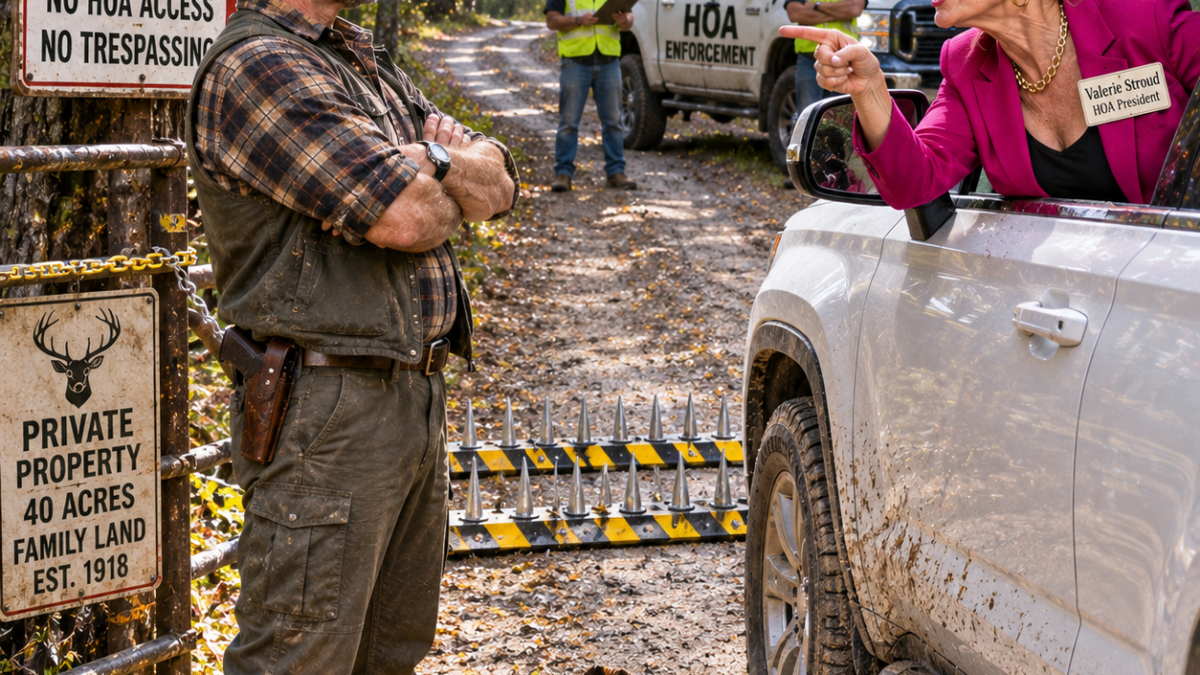
Valerie Stroud drove her white SUV past two PRIVATE ROAD signs and onto the hunting trail my family had used for four generations, crushed a turkey decoy beneath her front tire, then lowered her window and informed me that Maple Crest Estates had “assumed jurisdiction” over the road because the HOA needed future access through my land. When I told her the forty acres, the trail, and every tree around us were privately owned, she smiled, tapped her clipboard, and said people like me always resisted “community progress” until a board made the decision for them. I could have called my cousin at the sheriff’s office and turned the whole thing into a trespassing complaint that morning, but the look on Valerie’s face told me this was not a misunderstanding—and the document lying on her passenger seat made me wonder what she planned to send down that road next.
My name is Ethan Mercer. I was fifty-two, and my cabin sat at the back of forty forested acres outside Redwood Bluff, land my great-grandfather bought before paved roads reached that side of the county.
The hunting road was barely wide enough for one truck. My grandfather cut the first section by hand, my father widened it years later, and I learned to track deer on it before I was old enough to drive.
To Valerie, it was apparently “underused infrastructure.”
Maple Crest Estates had been built near the county line only a few years earlier. At first, I barely noticed it. Their houses stayed on their land. My cabin stayed on mine.
Then Valerie became HOA president.
Her first visit involved a laser measurer and a complaint that my cedar birdbath violated something she called “regional symmetry standards.”
The next time, she zip-tied an orange notice to my gate claiming my split-rail fence created an “optical hazard” for neighborhood joggers.
The nearest Maple Crest sidewalk was nearly a mile away.
I ignored both notices.
That was my mistake.
People who depend on intimidation often mistake silence for permission.
The morning she drove onto the trail, I was cleaning a deer I had taken legally before dawn when I heard tires crunching over gravel.
Her SUV rounded the bend fast enough to flatten one of my decoys.
I stepped into the road.
She stopped ten feet from me.
The window lowered.
“Move.”
I stared at her.
“You’re on private property.”
“This road is being evaluated for community use.”
“By whom?”
“The HOA.”
“Your HOA doesn’t own this road.”
She smiled.
“That’s being addressed.”
Those three words bothered me more than anything else she said.
I walked closer but stayed several feet from the vehicle.
“Back out the way you came.”
“You don’t understand the direction development is moving.”
“I understand a deed.”
Her jaw tightened.
“We’re considering a utility and emergency-access corridor. This route makes the most sense.”
“For you.”
“For everyone.”
“No.”
She looked past me toward the ridge.
Then down at the clipboard on her lap.
That was when I saw a map beneath it.
My road was highlighted in green.
At the far end, someone had drawn a square on my back acreage and labeled it SITE C.
I pointed.
“What’s Site C?”
She covered the paper.
“Planning material.”
“For what?”
“Nothing you need to concern yourself with yet.”
That answer changed the temperature of the morning.
I pulled out my phone and photographed her SUV, the crushed decoy, and the tire tracks behind her.
Her smile vanished.
“What are you doing?”
“Documenting trespass.”
“You can’t photograph me without permission.”
“From my own land?”
She rolled her window up.
Before leaving, she lowered it one last inch.
“You should think carefully before becoming the one person holding up something the entire community needs.”
Then she backed away.
I watched until the SUV disappeared through the pines.
That afternoon, I drove to the county road office, pulled the recorded maps, and confirmed what I already knew: Maple Crest had no easement, no access agreement, and no claim to my hunting road.
But one county clerk handed me a copy of a recently submitted planning inquiry.
The applicant was Maple Crest HOA.
The request concerned “communications infrastructure access.”
And the proposed route on the sketch was mine.
I read the first page twice.
Then I turned it over and saw a name I recognized from the document on Valerie’s passenger seat.
Site C.
Whatever Valerie wanted beyond my gate, it was bigger than a walking trail.
PART 2
I drove straight from the county office to see my cousin.
Caleb Mercer had been sheriff of Redwood County for six years and my cousin for fifty-four, which meant he had spent most of his life refusing to be impressed by me.
He looked at the planning inquiry across his desk.
Then at me.
Then back at the paper.
“Communications infrastructure?”
“That’s what it says.”
“You know anything about it?”
“No.”
“Anybody contact you for permission?”
“No.”
“Surveyor?”
“No.”
“Utility company?”
“No.”
“County planning?”
“Just the inquiry.”
Caleb leaned back.
“So right now you have a woman who drove onto your property without permission and a preliminary inquiry that references a route through your property.”
“And a square marked Site C.”
“Which could be anything.”
“I know.”
He pointed at me.
“Good.”
“What?”
“You said you know.”
“I’m not stupid.”
“You’re angry.”
“Different thing.”
“Exactly.”
He picked up the photograph of Valerie’s SUV.
“You want to file a trespass report?”
“Yes.”
“Good.”
“I also want to stop her from driving down there again.”
“That is where I become nervous.”
I stared at him.
“Why?”
“Because your father raised you.”
“My father taught me restraint.”
“Your father once electrified a trash can because raccoons kept getting into it.”
“Low voltage.”
“Ethan.”
“I’m listening.”
He folded his arms.
“You can put up a gate. You can improve signage. You can use lawful access-control equipment installed for private-road security.”
“I was thinking spikes.”
Caleb stared at me for a long time.
“No homemade spikes.”
“I didn’t say homemade.”
“No nails. No saw blades. No hidden metal. No booby traps.”
“That specific?”
“You own welding equipment.”
“Fair.”
He pushed a business card toward me.
“Call this company. They install commercial access-control systems for ranch roads, industrial yards, logging roads. If you want a tire-control strip, get one designed for that purpose, clearly marked, inside your property, with warning signs.”
“You’re helping me install spikes?”
“I am helping you avoid becoming the defendant in your own trespass case.”
That distinction mattered.
Two days later, a contractor named Luis Ortega came out.
He walked the road with me.
I showed him the property pins, survey, gate location, and the route Valerie had used.
“You get unauthorized vehicles often?”
“Recently.”
He looked at the tire marks.
“Expensive vehicle?”
“Very.”
Luis grinned.
“We can make the entrance inconvenient without making it dangerous.”
He recommended a heavy steel gate, reflective PRIVATE ROAD signs, a camera, and a commercial retractable tire-control strip inside the gate.
The spikes stayed down when the gate was open for authorized entry.
When I locked the road, the strip could be raised.
Anyone entering would have to pass two signs warning that the private road was closed and tire damage could result from unauthorized access.
No camouflage.
No trap.
No surprise.
Perfect.
Hank Dobson arrived while Luis was installing it.
Hank was sixty-eight, a former Marine, my closest neighbor, and the only man I knew who could make borrowing a socket wrench sound like a military alliance.
He stared at the hardware.
Then at me.
“You finally snapped.”
“It’s legal.”
“That is disappointing.”
“Caleb made me promise.”
Hank walked around the strip.
“Visible signs?”
“Two.”
“Camera?”
“Right there.”
“County knows?”
“Yes.”
He sighed.
“Responsible adulthood ruins everything.”
I handed him coffee.
“Stay tomorrow morning.”
“Why?”
“I have a feeling Valerie will be back.”
He smiled.
“Now you’re talking.”
She came at 9:37.
Not 9:43, as Hank later insisted.
I had the camera timestamp.
9:37.
Her white Audi appeared beyond the trees.
She slowed at the new gate.
Stopped.
I was standing fifty yards away beside the shed with Hank.
Neither of us moved.
Valerie got out.
She read the first sign.
**PRIVATE ROAD — NO HOA ACCESS — AUTHORIZED VEHICLES ONLY**
Then the second.
**ROAD CLOSED — VEHICLE CONTROL DEVICE IN USE — DO NOT ENTER**
She looked toward me.
“Ethan!”
I raised my coffee.
“Morning.”
“What is this?”
“A gate.”
“I can see that.”
“Good.”
She marched closer.
“You are obstructing a proposed emergency-access corridor.”
“No corridor has been approved.”
“That is under review.”
“On my land.”
“The community has needs.”
“So do I.”
“You cannot block planning access.”
“You’re welcome to send a licensed surveyor after they contact me and receive permission.”
Her mouth tightened.
“That isn’t how this works.”
“It is on private property.”
Hank whispered:
“Ten dollars says she drives through.”
“The gate is closed.”
“Twenty says she moves it.”
Valerie walked to the chain.
“Do not touch that,” I called.
She looked back.
“Are you threatening me?”
“I’m telling you not to open a private gate.”
She pulled out her phone.
For a second I thought she was calling the sheriff.
Instead, she took photographs.
Then she stepped around the gate, examined the road, and spotted the tire strip.
“You installed spikes?”
“Commercial access control.”
“This is illegal.”
“It was installed by a licensed contractor after I checked with the county.”
She hated that answer.
I saw it immediately.
Her entire strategy depended on me being the stubborn backwoodsman she could describe as unreasonable.
Survey records, permits, invoices, and county calls made that harder.
“You are creating a hazard.”
“For people who ignore a locked gate and two warning signs.”
She stared at me.
Then at the Audi.
Then did something I still struggle to understand.
She walked back to her vehicle.
Started it.
Hank whispered:
“No way.”
She backed up about twenty feet.
The gate was offset beside a wide gravel shoulder used years earlier for logging equipment.
Not a legal entrance.
Not a road.
Just enough open space between two trees for a vehicle if someone was willing to drive across rough ground.
Valerie was willing.
She steered off the road.
Around the gate.
Down the shoulder.
I put my coffee down.
“Valerie!”
She kept going.
The front tires dropped back onto the road inside the gate.
Right in front of the warning sign.
She looked through the windshield at me.
Smiled.
And accelerated.
The first front tire rolled across the raised control strip.
There was a sharp pop.
Then a hiss.
Her smile disappeared.
The second tire hit.
Another pop.
She slammed the brakes.
The rear tires stopped just short.
The Audi leaned forward slightly as the front tires deflated.
Hank said:
“I owe you twenty.”
Valerie threw open the door.
“You destroyed my car!”
I pointed at the signs.
“You drove around a locked gate.”
“You put that there because of me.”
“I put it there because people keep trespassing.”
“You knew I would drive through.”
“I hoped you would read.”
She stormed toward me.
Hank stepped closer, not between us, just near enough that I wasn’t alone.
“You’re paying for those tires.”
“No.”
“I will sue you.”
“That’s your right.”
“I will have this road condemned.”
“That isn’t your right.”
Her phone came out.
This time she did call the sheriff.
She told dispatch that I had “weaponized a public access road.”
Caleb sent Deputy Maria Torres.
He did not come himself.
Smart.
Family conflict.
When Maria arrived, she photographed everything.
Gate.
Signs.
Tire-control strip.
Audi tracks around the gate.
Valerie’s tire position.
Then she asked me:
“Did you activate the device after Ms. Stroud entered?”
“No. It was already up because the road was closed.”
“Did you conceal it?”
“No.”
“Any warning signs?”
I pointed.
Maria looked at Valerie.
“Did you see those?”
Valerie said:
“They’re invalid.”
“That wasn’t the question.”
“They don’t apply to HOA officials.”
Maria looked toward me.
I could almost see the headache forming.
She continued.
“Did you drive around the closed gate?”
“I exercised emergency access.”
“What emergency?”
“Community infrastructure planning.”
“Was somebody injured?”
“No.”
“Fire?”
“No.”
“Utility outage?”
“No.”
“Immediate threat to life or property?”
Valerie’s mouth tightened.
“This is bigger than that.”
Maria wrote something.
“I’ll document your complaint.”
“And arrest him.”
“No.”
“His device damaged my vehicle.”
“After you bypassed a locked gate.”
“He admitted he installed it.”
“It appears to be clearly marked.”
“You’re taking his side because the sheriff is his cousin.”
Maria’s expression changed.
“Ms. Stroud, Sheriff Mercer is not involved in this call.”
“You all protect each other.”
Maria nodded once.
“Then I’ll request a state trooper review the incident if you’d like an outside agency.”
Valerie hesitated.
That wasn’t what she wanted.
She wanted instant validation.
Maria offered process instead.
People like Valerie hated process when it did not begin with agreeing with them.
The tow truck arrived an hour later.
Before leaving, Valerie pointed at the gate.
“This will be gone.”
I said:
“Not without a court order.”
She looked at me.
“We’ll see.”
The state trooper later reviewed the report and camera footage.
No charge against me.
The recording clearly showed Valerie reading the signs, driving around the locked gate, and entering anyway.
Caleb called that evening.
“Happy?”
“Not especially.”
“You sound disappointed.”
“I wanted her to stop.”
“She may.”
“No.”
“Why?”
“Because she wasn’t embarrassed.”
“What was she?”
“Angry that the gate worked.”
Caleb sighed.
“Document everything.”
“I already have a folder.”
“Of course you do.”
The next morning I found a camera on one of my pines.
Not at the boundary.
Inside my land.
Twenty yards inside.
Small gray housing.
Battery pack.
Lens aimed at the cabin and road.
A laminated Maple Crest tag hung beneath it.
**COMMUNITY SAFETY MONITORING**
I didn’t touch it.
I photographed it.
Called Maria.
She came out with a county investigator named Owen Brooks.
They documented the camera and removed it after confirming the tree was on my property.
“What does it record?” I asked.
Brooks shook his head.
“We’re not accessing it here.”
“Can you?”
“If there’s probable cause and legal authority.”
Hank arrived halfway through.
He stared at the empty bracket.
“She put a camera on your tree?”
“Looks that way.”
“I own a potato cannon.”
Maria turned.
“No.”
Hank raised both hands.
“Conversation starter.”
“No.”
He looked wounded.
That afternoon Valerie emailed me.
Subject:
**DISTURBING CONDUCT TOWARD HOA SAFETY EQUIPMENT**
She demanded replacement of the confiscated camera.
I forwarded it to Brooks.
Did not answer.
The following day another camera appeared.
This one was on a tree just outside my property line.
Different angle.
Still pointed down the hunting road.
Potentially legal depending on what it captured.
I left it alone.
That irritated Valerie.
She wanted reactions.
I began understanding that.
So I changed strategy.
No shouting.
No handmade traps.
No threatening notes.
No war.
Records.
Survey pins.
Photographs.
Time stamps.
Formal complaints.
When she sent a violation saying my mailbox was “incompatible with Maple Crest visual standards,” I returned a one-line certified letter.
**My property is not within Maple Crest Estates or subject to its covenants. Please direct future legal claims through counsel.**
Her next notice targeted my hammock.
Same answer.
Then the cedar mailbox my father built.
That one hurt.
Dad had made it when I bought the cabin.
He carved our last name into the side with a pocketknife because he said store-bought letters were “for people without patience.”
He died twelve years earlier.
Valerie’s notice called it:
**AN UNAPPROVED RURAL STRUCTURE DETRIMENTAL TO COMMUNITY VISUAL CONTINUITY**
I stood at the mailbox for a long time.
Then Hank walked up.
“You going to paint it neon?”
“No.”
“Antlers?”
“No.”
“Fire?”
“No.”
He studied me.
“You’re getting mature.”
“I hate it.”
“Me too.”
I put the notice in the folder.
Then things changed.
One of my actual trail cameras stopped reporting.
The one farthest into the back acreage.
Near the part of the county inquiry labeled Site C.
At first I assumed battery failure.
I hiked out after sunset with a flashlight and spare batteries.
The camera was gone.
Not damaged.
Gone.
The strap had been cut.
That made me stop.
Deer don’t cut nylon straps.
I followed the road another quarter mile.
Then saw light through the trees.
Blue-white.
Steady.
Not moonlight.
Not a hunter’s flashlight.
A generator hummed somewhere beyond the ridge.
I switched off my flashlight.
Listened.
The sound came from a clearing on the northern slope.
My land.
I knew every hunting blind, shed, old fence corner, and fallen cedar on those forty acres.
There was no structure there.
Or there hadn’t been.
I moved close enough to see without entering the clearing.
A small plywood building stood on blocks between the trees.
Corrugated roof.
Generator beside it.
A compact dish mounted on a mast.
Several weatherproof equipment cases.
And parked under branches was a dark Chevy Tahoe with a Maple Crest parking sticker.
I did not approach.
Did not touch.
Did not “investigate.”
I backed out.
Slowly.
Then called Caleb.
He answered on the third ring.
“If this is about a mailbox—”
“Somebody built a shack on my property.”
Silence.
“What?”
“Back acreage. Near the north clearing.”
“You sure it’s yours?”
“Yes.”
“Anybody inside?”
“Don’t know.”
“Weapons visible?”
“No.”
“Stay where you are.”
“I’m already leaving.”
“Good.”
“See? Mature.”
“Don’t make me regret saying good.”
Two deputies met me at the cabin.
I showed them the survey map.
Then walked them to a point from which the structure was visible.
They photographed it.
Checked coordinates.
Confirmed it appeared well inside my recorded boundary.
Caleb arrived after that.
No jokes.
“What do you know?”
“Nothing.”
“You recognize the Tahoe?”
“Maple Crest sticker.”
“Owner?”
“No idea.”
He looked toward the lights.
“We’ll handle it.”
“What does that mean?”
“It means you go home.”
“Caleb.”
“It means exactly that.”
I hated it.
My land.
My road.
My missing camera.
And I had to leave.
But he was right.
So I left.
The next morning the clearing was quiet.
Law enforcement had secured the area overnight while investigators worked on the legal steps needed to search the structure.
That process was slower than Hank wanted.
He came over carrying binoculars.
“Government moves like cold syrup.”
“Government is making sure evidence survives court.”
“Still syrup.”
By afternoon, county investigators confirmed the Tahoe was registered to a management contractor that had done work for Maple Crest.
The shack had no building permit.
No land-use approval.
No lease from me.
No utility permit.
The generator and communications hardware raised additional questions, so the sheriff contacted county code enforcement and state investigators.
Then Caleb told me something unexpected.
“Talk to Agatha Doran.”
I stared.
“Mrs. Doran?”
“She used to work in communications.”
“I thought she worked for the government.”
“She did.”
“Doing what?”
“She’ll tell you what she wants to tell you.”
Agatha lived on the older side of Redwood Bluff.
Seventy years old.
Widowed.
Rose garden.
Lemon bars dangerous enough to ruin a diet in one sitting.
I knocked.
She opened the door before my hand dropped.
“Ethan.”
“Mrs. Doran.”
“You only call me Mrs. Doran when something is wrong.”
“Agatha.”
“Better.”
I explained the shack.
Not details Caleb told me privately.
Just what I personally saw.
Her expression barely moved until I mentioned the mast and dish.
“What kind?”
“I took a photograph from my property line.”
I showed her.
She adjusted her glasses.
“Interesting.”
“That’s it?”
“What do you want? A gasp?”
“Maybe.”
“Waste of oxygen.”
She enlarged the photograph.
“I can’t tell you what they’re doing from a picture.”
“Could it be normal HOA equipment?”
She looked at me over the glasses.
“No HOA I’ve ever joined needed a field communications station in another man’s woods.”
“Could it be illegal?”
“Anything can be illegal depending on how it’s used.”
That sounded like Caleb.
She handed the phone back.
“Do not touch it.”
“I haven’t.”
“Do not attempt to intercept signals.”
“I wasn’t planning to.”
“Do not let Hank attempt to intercept signals.”
“That may be harder.”
She went inside.
Returned with her cardigan.
“Let’s walk.”
“Where?”
“To your property line.”
“You coming?”
“I am retired, not dead.”
Agatha had spent nearly thirty years as a communications analyst for the federal government.
She did not tell me classified stories.
She mostly corrected my terminology.
“That isn’t a satellite dish in the sense you’re imagining.”
“It looks like a dish.”
“Many things look like many things, Ethan.”
“Helpful.”
“It is directional communications equipment.”
“Better.”
From the legal perimeter, she studied the structure through binoculars.
She noted that several antennas and commercial units appeared inappropriate for a routine HOA maintenance operation.
That was all she would say.
Then she looked at me.
“Valerie wanted your road because moving equipment here from Maple Crest streets would attract attention.”
I stared at the shack.
“You think that’s what Site C is.”
“I think you should give that planning document to investigators.”
“I already did.”
“Good.”
She lowered the binoculars.
“Then we go home.”
“No secret operation?”
Agatha looked offended.
“I’m old enough to know paperwork is more dangerous than trespassing.”
I liked her immediately.
Investigators searched the structure under legal authority the following day.
I was not allowed inside.
Good.
The days when homeowners wandered through potential evidence scenes belonged in bad television.
Caleb told me only what he could.
Equipment was seized.
Data-storage devices.
Records.
Maps.
Several small cameras.
One of them was later identified as my missing trail camera.
That mattered.
It connected the structure directly to property taken from my land.
The investigation widened.
Maple Crest’s board attorney received subpoenas for certain records.
Valerie called another emergency meeting.
The email arrived that Thursday.
**URGENT VOTE — AMENDMENT 12F**
The proposal:
Maple Crest would claim administrative authority over “adjacent natural routes essential to community safety, utility access, and emergency infrastructure.”
My hunting road.
She wanted the HOA to vote itself authority over land it did not own.
I read the amendment twice.
Then drove to Agatha’s.
She was pruning roses.
“She’s trying to legalize it after the fact.”
Agatha clipped a dead bloom.
“She is trying to make residents believe a vote creates property rights.”
“Same thing.”
“No.”
She looked at me.
“Words matter.”
Fine.
“She is trying to create political cover.”
“Better.”
I showed her the amendment.
She read it.
“This doesn’t grant an easement.”
“I know.”
“Does the board?”
“Some do.”
“Then tell them.”
The meeting was Saturday.
Before it happened, I met with Caleb and Investigator Brooks.
I wanted to know what I could say publicly.
Brooks made it simple.
“Your own property records?”
“Yes.”
“Your photographs taken from places you had a legal right to be?”
“Yes.”
“Public planning documents?”
“Yes.”
“Anything we told you from an active investigation?”
“No.”
“Anything seized under warrant?”
“No.”
“Anything Agatha thinks she knows because she worked in signals forty years?”
Agatha, who had insisted on attending, said:
“Thirty.”
Brooks smiled.
“Still no.”
She nodded.
“Fair.”
That gave us our boundaries.
I prepared a short presentation.
Not a spy thriller.
A property case.
Survey.
No easement.
No HOA jurisdiction.
Photograph of Valerie on my road.
Camera mounted to my tree.
County planning inquiry.
Site C.
Photograph of the unpermitted shack from my own land.
Nothing more.
Hank saw the slides.
“Needs drama.”
“No.”
“Red arrows.”
“No.”
“Maybe music.”
“No.”
“What am I even here for?”
“Beer.”
“Fair.”
The community center filled early.
Tony and Mara sat near the front.
Hank leaned against the back wall.
Agatha sat in the aisle wearing a soft blue cardigan and carrying lemon bars.
Valerie stood behind the podium.
Perfect hair.
Cream blazer.
Maple Crest pin.
If you hadn’t known anything, she looked like competent suburban leadership.
That was part of the problem.
Bad control rarely arrives wearing a villain costume.
It arrives holding minutes from the last meeting.
Valerie began.
“Recent events have demonstrated a serious weakness in Maple Crest’s emergency infrastructure.”
I almost laughed.
My locked gate was now a public emergency.
She continued.
“Certain adjacent landowners have interfered with responsible planning.”
Several residents looked at me.
Valerie put the proposed amendment on a screen.
“Amendment 12F will allow Maple Crest to coordinate natural access routes necessary for safety, utility planning, communications, and emergency response.”
A man raised his hand.
“Does that mean Ethan’s road?”
Valerie smiled.
“It includes routes of strategic value.”
“Does he agree?”
Her smile tightened.
“Private interests cannot always override community welfare.”
That sentence did it.
I stood.
“I object.”
She looked at me.
“Of course you do.”
“I’d like three minutes.”
“This is an HOA meeting.”
“You’re voting on my land.”
“It is adjacent land.”
“Still mine.”
Murmurs.
One board member, Leonard Price, leaned toward Valerie.
“Let him speak.”
She glared.
“We have an agenda.”
Leonard said:
“We’re about to vote on access to his property.”
That surprised me.
A crack.
Small, but real.
Valerie stepped aside.
“Three minutes.”
I walked forward.
I had practiced.
Still, my hands shook.
I wasn’t afraid of public speaking.
I was angry.
Different problem.
I put the survey on screen.
“This is my deeded property.”
Then the county map.
“No Maple Crest easement.”
Then the road.
“No county right-of-way through this section.”
Then the planning inquiry.
“This is an HOA request filed before Valerie drove down my road.”
People leaned forward.
Valerie interrupted.
“A request. Nothing more.”
I nodded.
“Correct.”
That threw her.
I continued.
“Now Site C.”
The square appeared.
Valerie’s face changed.
Just slightly.
I saw it.
So did Agatha.
“What is Site C?” I asked.
Valerie answered:
“Conceptual infrastructure.”
“On my property?”
“Adjacent to Maple Crest.”
“That’s not an answer.”
She raised her voice.
“This is exactly why the amendment is necessary. Uncooperative landowners make infrastructure planning impossible.”
I changed the slide.
The photograph of the shack.
The room went silent.
Someone whispered:
“What is that?”
I said:
“I found this structure inside my property boundary near the location marked Site C.”
Valerie stepped forward.
“Turn that off.”
I looked at her.
“Why?”
“It concerns confidential association operations.”
The room reacted.
Not loudly.
A collective intake of breath.
She heard herself too late.
Leonard stood.
“Association operations?”
Valerie recovered quickly.
“I mean potential contracted operations.”
“Whose?”
“Vendor.”
“What vendor?”
“I’m not discussing security vendors publicly.”
Agatha lifted one eyebrow.
I put up the photograph of the camera mounted on my tree.
“This one had a Maple Crest tag.”
A woman named Rebecca Thorne, normally one of Valerie’s strongest supporters, stood.
“Valerie, were you putting cameras on his property?”
“No.”
I said:
“The sheriff’s office removed that one.”
Rebecca looked at Valerie.
“You told us the cameras were only at community entrances.”
“They are.”
“Then why was one on his tree?”
“It may have been improperly placed by a contractor.”
I went to the final slide.
The county planning inquiry.
The language about communications infrastructure.
Then I stopped.
No accusations I couldn’t prove.
No claims about secret transmissions.
Just facts.
Valerie looked around.
“That is all speculation.”
I said:
“Some of it may be.”
Another surprise.
She smiled.
Then I finished.
“But whether the shack is part of something improper is for investigators to determine. The question for this board tonight is simpler.”
I pointed at the survey.
“Do you want to vote for a document pretending you have authority over land you know you don’t own?”
Silence.
Leonard asked the HOA attorney:
“Can Amendment 12F give us access to Mr. Mercer’s road without an easement?”
The attorney looked uncomfortable.
“No.”
Valerie turned.
“That is not what we’re voting on.”
“It says assume full authority.”
“Administrative authority.”
The attorney shook his head.
“Ownership and easement rights cannot be created by an internal HOA vote against a nonmember property owner.”
The room erupted.
Not chaos.
Questions.
Hard ones.
“Why were we told this would work?”
“Who approved Site C?”
“Why didn’t the board know about the shack?”
“What communications equipment?”
Valerie struck the podium.
“Order.”
Nobody stopped.
She struck it again.
“Order!”
Then the back doors opened.
Caleb walked in.
Beside him were Investigator Brooks and two people I didn’t recognize.
He didn’t announce anything.
Didn’t perform.
He walked to Valerie.
“Ms. Stroud, could we speak with you outside?”
Her face went white.
“This meeting is in progress.”
“I understand.”
“Am I under arrest?”
Caleb answered carefully.
“We have a warrant concerning matters connected to the investigation. We’ll explain outside.”
The entire room went silent.
Valerie looked at me.
Not at Caleb.
Me.
“You.”
I shook my head.
“No.”
“You did this.”
“No.”
“You’ve been working against me from the beginning.”
I felt my anger surge.
Then remembered Dad.
Remembered the mailbox.
The trail.
The camera.
Every piece of paper.
I said:
“You drove onto my land.”
Nothing more.
Valerie stared.
Then walked outside with Caleb.
No dramatic sprint.
No screaming.
No agents tackling her across folding chairs.
Reality was quieter.
And somehow more final.
The meeting did not continue.
Leonard suspended the vote.
The board attorney recommended all actions involving adjacent property be frozen.
People clustered in small groups.
Rebecca sat alone.
Her goldendoodle rested beneath her chair.
She looked shaken.
I was gathering my papers when she approached.
“I defended her.”
I didn’t know what to say.
“Yes.”
Rebecca winced.
“I thought she was strict because nobody else was willing to do the hard stuff.”
“Maybe she was at first.”
“I repeated things she told me.”
“I know.”
“I called you selfish.”
“You did.”
She looked at the floor.
“I’m sorry.”
I nodded.
Not forgiveness.
Acknowledgment.
“Thank you.”
Hank appeared carrying two beers.
“Victory beverage?”
“No.”
He looked disappointed.
“Later?”
“Maybe.”
Agatha took one.
“Waste not.”
Over the following weeks, the actual picture emerged.
Slowly.
Not through rumors.
Through court filings, board records, investigative disclosures, and eventually testimony.
Valerie had created Site C as part of an unauthorized communications and surveillance project she told select vendors was a “community resilience network.”
Some equipment was legitimate commercial hardware.
Some had been imported and configured in ways investigators said required regulatory review and licensing she had never obtained.
The network itself was not a magic spy machine.
No Hollywood satellite interception.
No military secrets.
But it did gather far more information than residents had authorized.
Cameras.
Vehicle movement.
Property activity.
Wireless device identifiers collected by hardware around HOA-controlled areas.
Logs.
Patterns.
Valerie had also been communicating with outside consultants who wanted neighborhood behavioral data for marketing and property acquisition strategies.
The more disturbing part for me involved land.
According to emails later introduced in court, Valerie needed a quiet equipment site away from Maple Crest’s common areas because the HOA’s insurer had begun asking questions about surveillance hardware purchased under vague budget categories.
My back acreage fit her needs.
Remote.
Tree cover.
Existing private road.
Close enough to Maple Crest’s network.
She had no permission.
So she tried to create permission after the fact.
First through “regional cohesion.”
Then through the communications inquiry.
Then through Amendment 12F.
Her repeated drives down my hunting road hadn’t been curiosity.
She had been checking access.
One email made my stomach twist.
It was from Valerie to a contractor.
**Mercer continues to resist. Use route only when necessary until governance issue is corrected.**
Governance issue.
My ownership.
Another:
**Once residents perceive the road as a community route, closing it becomes politically difficult.**
I read that one three times.
She didn’t need a valid easement if she could normalize trespass.
Get people accustomed to using the road.
Build a structure.
Move equipment.
Then make me look unreasonable for taking it away.
Hank read the email over my shoulder.
“She was colonizing you one committee meeting at a time.”
“Basically.”
“You should’ve used bigger spikes.”
I looked at him.
“Joke.”
“Not funny.”
“Little funny.”
It was a little funny.
The HOA board removed Valerie unanimously.
Rebecca voted yes.
That mattered.
Leonard became interim president.
His first letter to me was one page.
No threats.
No demands.
No citations.
**Mr. Mercer, Maple Crest Estates acknowledges that your property, including the hunting road, is outside our association and not subject to our covenants. The association withdraws Amendment 12F and any prior claim, suggestion, or planning assumption concerning access without your express written consent. We apologize.**
I framed it.
Not in the bathroom.
Hank suggested that.
I put it in my office.
The county removed the shack after evidence collection was complete.
Not men in hazmat suits.
Just a licensed contractor under county supervision.
The equipment left in tagged trucks.
The plywood came down.
The generator disappeared.
The clearing was bare again.
I walked out there the first evening after removal.
The disturbed soil looked wrong.
Four generations of my family had left marks on that forest.
Trails.
Fence lines.
An old hunting blind.
The remains of a stone fire ring.
But those marks belonged because they carried memory.
The shack had felt different.
It had been an argument built out of plywood.
Someone saying:
I can use this place because you won’t stop me.
I stood there until dark.
Then found my missing trail camera in a sealed evidence-return box weeks later.
Its casing was scratched.
The strap had been cut.
Caleb handed it to me.
“Want it back?”
“Yeah.”
“Still works?”
“Probably.”
“Where are you putting it?”
“Same tree.”
He smiled.
“Good.”
The criminal cases were complicated.
Valerie faced state charges connected to trespass, theft of equipment, unauthorized surveillance practices, and financial misconduct.
Federal authorities handled separate issues involving communications regulations, imported equipment, data practices, and transactions crossing state lines.
Some early rumors were wrong.
No, she wasn’t transmitting classified government data.
No, she wasn’t working for foreign intelligence.
No, the shack did not contain a missile-guidance system, despite what Hank told Tony after three beers.
The truth was serious enough without fiction.
Valerie eventually entered plea agreements resolving some charges while contesting others.
Several vendor employees cooperated.
One company paid substantial civil penalties.
Maple Crest’s insurance carrier disputed portions of the association’s losses.
Residents sued over privacy violations.
Lawyers multiplied.
For almost two years, the neighborhood’s most common landscaping feature was certified mail.
I testified twice.
Once about the road.
Once about finding the shack.
Valerie’s attorney tried to make the tire-control strip the center of my credibility.
“Mr. Mercer, you installed a device designed to puncture tires.”
“Yes.”
“Knowing Ms. Stroud had previously driven on the road.”
“Yes.”
“So you wanted to damage her vehicle.”
“No.”
“You expected she might return.”
“Yes.”
“And you sat where you could watch.”
“I was on my property.”
He stepped closer.
“Enjoying the prospect?”
I thought carefully.
“Part of me wanted her to learn the signs applied to her.”
“So yes.”
“Part of me, yes.”
The attorney smiled.
Then I continued.
“That is why I didn’t build anything myself.”
His smile changed.
“I consulted law enforcement, hired a licensed installer, used commercial access-control equipment, installed a gate, posted multiple warnings, and kept the device visible.”
The prosecutor displayed the camera video.
Valerie reading the sign.
Walking around the gate.
Looking directly at the strip.
Then driving around the gate anyway.
Her attorney watched silently.
I added:
“I wanted her to stop entering. She chose to enter.”
That issue went nowhere.
The court did not treat the tire damage as criminal conduct by me based on the evidence and circumstances presented.
I was relieved.
More than I admitted.
Because Caleb had been right.
Anger makes people stupid.
If I’d buried nails beneath leaves the way my first impulse suggested, the entire story might have ended differently.
Maybe with somebody hurt.
Maybe with me writing checks.
Maybe with Valerie getting to claim victimhood.
Instead, the most satisfying part wasn’t the tires.
It was the camera showing her read the warning and decide rules still didn’t apply.
Her own arrogance became the evidence.
Agatha testified too.
Not about secret spy work.
About what she personally observed and why certain equipment raised enough concern that she encouraged us to involve authorities.
The defense attorney tried to turn her into an eccentric old woman.
“Mrs. Doran, you’re not currently employed as a communications engineer, correct?”
“No.”
“You retired many years ago?”
“Yes.”
“So some of your knowledge may be outdated.”
“Certainly.”
He smiled.
“Then why should anyone rely on your interpretation?”
Agatha smiled back.
“They shouldn’t.”
He froze.
She continued.
“I told Mr. Mercer not to rely on my interpretation. I told him to call people with warrants.”
The jury laughed.
The judge did not, but I saw the corner of his mouth move.
The attorney changed subjects.
Outside court, I told Agatha:
“You enjoyed that.”
“Very much.”
“I thought you believed in restraint.”
“I answered the question.”
“With pleasure.”
“Restraint does not require misery.”
Hank nearly proposed marriage to her after hearing that.
She declined before he finished asking.
“I already raised one difficult man.”
Hank looked wounded.
I bought her lemon bars for a month.
The biggest emotional hit came from something I hadn’t expected.
Dad’s old maps.
During the civil land review, the county surveyor asked whether I had historical documents showing long-term private use of the trail.
I went into the attic.
Found a steel box that had belonged to my father.
Inside were hunting licenses.
Receipts.
A faded Polaroid of Dad beside his first Ford.
And hand-drawn maps.
One showed the hunting road.
Dad’s handwriting ran beside the curve where Valerie’s SUV had later lost its tires.
**Keep this road narrow. Quiet is the point.**
I sat on the attic floor.
Dad had been gone twelve years.
Grief is strange.
It can sleep through lawsuits, police reports, and confrontation.
Then wake because of six words in pencil.
I carried the map downstairs.
Hank was waiting at the kitchen table.
He saw my face.
“What?”
I handed it to him.
He read.
Then grew quiet.
“You miss him.”
“Every day.”
“Still?”
I looked at him.
“Does that stop?”
“No.”
Hank knew.
His wife had died nine years before.
He folded the map carefully.
“That’s why Valerie got under your skin.”
“She was taking land.”
“No.”
I stared.
“She was treating memory like unused space.”
That sentence hit harder than anything a lawyer had said.
Unused.
Valerie had called my trail underused.
Site C had called the clearing available.
The HOA plan called the road adjacent infrastructure.
Every bureaucratic phrase erased the people who came before me.
My great-grandfather.
Grandfather.
Dad.
Me.
Land doesn’t become meaningless because nobody builds a subdivision on it.
That was the part I had struggled to explain.
Hank understood in one sentence.
The county eventually designated the trail as a protected rural access route under a local preservation arrangement I voluntarily entered.
Not because a judge magically declared it historic.
I worked with a land-use attorney and county preservation staff.
The agreement preserved my ownership and restricted future conversion without proper process.
Maple Crest’s board adopted its own binding policy acknowledging the trail and surrounding acreage were outside HOA authority.
Two layers.
My deed.
Their promise.
I wanted both.
Leonard asked me to attend the first reform meeting.
“I don’t want to join the HOA.”
“We’re not asking.”
“Good.”
“We want advice.”
“That seems dangerous.”
He smiled.
“What should we change?”
I gave them three things.
“No cameras aimed at private property outside the association.”
He wrote.
“No vendor gets access to land without verified ownership or written permission.”
More writing.
“And no board president gets to create ‘temporary authority’ by saying the word emergency loudly.”
Rebecca laughed.
Leonard did too.
I wasn’t entirely joking.
The new board added financial controls.
Vendor review.
Public meeting minutes.
Annual audits.
Clear limits on surveillance.
A process for residents to challenge violations.
No secret “priority resident” lists.
Maple Crest did not dissolve.
I was glad.
The problem had never been that neighbors wanted shared landscaping or a community pool.
The problem was one person turning a limited private contract into a personal government.
A functioning HOA wasn’t revenge.
A functioning HOA was proof Valerie had never been necessary.
That probably hurt her more.
The first year after her removal, Maple Crest held an election.
Three people ran for president.
Imagine that.
Leonard won narrowly.
Rebecca became secretary.
Some residents were angry about that because she had supported Valerie.
Rebecca stood at the first meeting and addressed it directly.
“I did.”
No excuse.
“I defended her.”
She looked toward me.
“I repeated claims about Mr. Mercer’s land that I never verified.”
Then toward the room.
“I trusted confidence instead of evidence.”
She paused.
“If you don’t want me in this position, vote me out next year.”
Nobody did.
Accountability changes the way people see you.
Not instantly.
But sometimes enough.
Tony and Mara became unofficial ambassadors between Maple Crest and the older rural properties.
They brought beer to Hank.
Eggs to Agatha.
Never bylaws to me.
Perfect arrangement.
The surveillance civil cases eventually settled.
Residents received notices explaining what data had been collected and what could be verified.
Some assumptions had been exaggerated by fear.
That mattered too.
People deserve truth when the truth makes the villain look worse.
They also deserve truth when it makes the story less dramatic.
The verified system tracked vehicles, property activity, violation patterns, and certain device-related technical information in ways residents had not properly authorized.
Some private-facing cameras had captured people in yards.
No evidence showed cameras inside homes.
That distinction relieved families.
Not completely.
But enough.
Maple Crest paid for independent privacy reviews.
Several cameras were removed permanently.
Data archives were destroyed under supervision after litigation holds ended.
Vendor contracts were terminated.
The HOA paid for counseling sessions for several residents who felt especially violated.
That sounded excessive to some people.
Until you talked to Rosa Mendoza.
One unauthorized camera had captured her teenage daughter sunbathing in their backyard.
Nothing explicit.
Still private.
Rosa cried when she told me.
“My daughter keeps asking what else they saw.”
I didn’t know.
Nobody did.
That uncertainty was the injury.
I understood because I had experienced a smaller version.
Every time I walked the trail, I wondered how often Valerie had used it before I caught her.
Every tire print became suspicious.
Every snapped branch.
Every unfamiliar sound.
For months, I stopped hunting alone before dawn.
I never told Hank.
He figured it out.
One October morning he appeared at 4:45 carrying a rifle case.
“What are you doing?”
“Hunting.”
“You don’t hunt.”
“I have a license.”
“Since when?”
“Yesterday.”
“You hate getting up early.”
“I hate lots of things.”
He climbed into my truck.
I looked at him.
“You know I don’t need a babysitter.”
“Good. I’m too old to babysit.”
We drove.
He came with me four mornings that season.
We saw exactly one deer.
He scared it away by sneezing.
On the fifth morning, I finally told him:
“You can stop.”
“Stop what?”
“Coming.”
“Why?”
“I’m fine.”
He looked toward the ridge.
“You sleeping?”
“Yes.”
“Checking trail cameras twelve times a night?”
“No.”
“Walking the whole road every time a branch snaps?”
“Less.”
He nodded.
“All right.”
He didn’t come the next morning.
That scared me.
Then I realized it was what I had asked for.
I walked alone.
Before sunrise.
The same road.
The same bend.
At first every tree looked like somebody hiding.
Then the forest returned.
A barred owl called.
Creek water moved over stone.
A deer stepped between two cedars.
I stopped.
It looked at me.
I looked at it.
No Valerie.
No cameras.
No engines.
Just the land.
I realized I’d been waiting for permission to feel safe on my own property.
That made me angry.
Then sad.
Then tired.
I sat on a fallen log until sunrise.
When I returned, Hank was on my porch.
“Bag anything?”
“No.”
“Good hunt?”
“Yes.”
He smiled.
Never asked why.
Months later Valerie’s plea became public.
Tony arrived jogging up my driveway waving his phone.
“Ethan!”
“If this is gossip—”
“Court.”
I took the phone.
The article summarized a plea agreement involving unauthorized surveillance-related conduct, financial offenses, trespass-related counts, and federal regulatory violations connected to the communications equipment.
The exact charges were less cinematic than Maple Crest rumor had promised.
Still serious.
The agreement included prison time on certain counts, supervised release, restitution, financial penalties, and restrictions tied to related business activity.
I handed the phone back.
Tony waited.
“Well?”
“What?”
“You don’t have anything?”
“Like what?”
“Justice speech.”
“No.”
“Come on.”
I looked at him.
“She made choices. Now a court is dealing with them.”
Tony groaned.
“Hank gives better quotes.”
“Yes.”
“Can I talk to him?”
“No.”
He did anyway.
Hank’s quote ended up on Tony’s neighborhood podcast:
“She dug the hole. Government just provided the shovel inspector.”
I still don’t know what that means.
Agatha understood apparently.
She laughed for two minutes.
Valerie’s house sold.
A family named the Parkers moved in.
Two teachers.
One kid.
An elderly Labrador named Biscuit.
The first week, Mrs. Parker knocked on my cabin door.
“Hi. We live in the Stroud house.”
“I know.”
She looked embarrassed.
“The realtor told us there was history.”
“Some.”
“We just wanted to introduce ourselves.”
“Good.”
She held out a loaf of banana bread.
No clipboard.
I accepted.
Then she asked:
“Is the forest road public?”
My body tightened before my brain caught up.
“No.”
She nodded immediately.
“Okay.”
That was it.
No argument.
No community access theory.
No emergency corridor.
Just okay.
She pointed toward the ridge.
“Our son likes hiking. Is there somewhere nearby that’s public?”
I gave her directions to county trails.
“Thanks.”
She left.
I stood there holding banana bread.
It took me a full minute to understand why the interaction felt emotional.
She asked.
I answered.
She accepted.
Three simple steps Valerie had turned into two years of chaos.
The private-road gate remained.
So did the tire-control strip.
But I rarely raised it anymore.
Not because I trusted everyone.
Because Maple Crest stopped treating my land like unfinished paperwork.
Eventually I removed the retractable spike unit entirely.
Hank watched the contractor unbolt it.
“End of an era.”
“It did its job.”
“You should mount it over the fireplace.”
“No.”
“Coffee table?”
“No.”
“Art?”
“No.”
He sighed.
“You hate history.”
“I have Dad’s map.”
That stopped him.
“Fair.”
I replaced the unit with a heavy gate and camera.
Enough.
The section of road where Valerie’s Audi had stopped gradually changed.
Rain softened the tire tracks.
Needles covered the disturbed gravel.
Grass returned at the edges.
Nature is rude that way.
It doesn’t preserve your dramatic moments.
I liked that.
One afternoon Agatha and I walked the trail.
She had slowed over the years.
Used a cane now.
Refused help unless the ground became steep.
At Site C, she stopped.
Young ferns covered the clearing.
“Looks better.”
“Yes.”
“Poor radio propagation.”
I laughed.
“You can’t help yourself.”
“No.”
She sat on an old stump.
I handed her water.
She looked around.
“You know what Valerie’s actual mistake was?”
“Where do I start?”
“She believed information was the same thing as wisdom.”
I waited.
Agatha continued.
“She collected data.”
“Cars.”
“Schedules.”
“Properties.”
“Signals.”
“Complaints.”
“Yes.”
“She knew many things.”
Agatha looked toward the ridge.
“But she understood almost nothing.”
That sounded like one of her deliberate old-spy statements.
“What didn’t she understand?”
“Why this road mattered to you.”
I looked down.
“She saw a line connecting two places.”
I nodded.
“You saw your father.”
I sat beside her.
The trees moved in the wind.
“People like Valerie call that sentimentality.”
“People like Valerie are often lonely.”
That surprised me.
“You feel sorry for her?”
“No.”
“Then what?”
“Understanding a person is not acquitting them.”
Agatha tapped the cane against the dirt.
“Control is sometimes what frightened people use instead of trust.”
“You think she was frightened?”
“I think people who need to monitor everyone are rarely relaxed.”
Fair.
The years after Valerie became quieter.
Not instantly.
Legal notices still arrived.
Depositions.
Settlement documents.
County correspondence.
Then less.
And less.
Until one month passed with nothing.
Then two.
My mailbox became a mailbox again.
Dad’s cedar box lasted another winter.
Then the post rotted.
I could have bought a new one.
Instead, I took it into the workshop.
The bottom had split.
One side was soft.
The carved MERCER remained intact.
Hank came over.
“Replace it.”
“No.”
“Ethan.”
“Dad built it.”
“You’re becoming sentimental.”
“You said memory mattered.”
“I also said rot is rot.”
We compromised.
New internal frame.
New cedar post.
Original carved face.
Took us two days.
When we reinstalled it, Hank stepped back.
“Ugly.”
“It was always ugly.”
“Your father built like he was angry at wood.”
“He was.”
We laughed.
That evening I found the old HOA citation in my files.
**MAILBOX NON-COMPLIANCE — RURAL AESTHETIC INCOMPATIBILITY.**
I put it into a drawer behind Dad’s map.
Not because I cared about Valerie’s opinion.
Because someday somebody might see the ridiculous notice and ask why I kept it.
Then I could tell them about Dad.
That was how I wanted the story to survive.
Not as Valerie’s war.
As our family’s road.
Maple Crest eventually asked county preservation staff to create a walking loop entirely inside its own land.
Leonard invited me to review the boundary map.
I did.
The trail ended seventy feet from my property.
At the connection point, the HOA installed a sign:
**MAPLE CREST TRAIL ENDS HERE**
**PRIVATE PROPERTY BEYOND**
No explanation.
No threat.
No legal paragraph.
Perfect.
On opening day, residents walked the loop.
Kids.
Dogs.
Strollers.
Tony carried beer even though it was ten in the morning.
Rebecca distributed maps.
Mrs. Parker brought Biscuit.
No one crossed the boundary.
One boy stopped at the sign and asked:
“What’s down there?”
His mother said:
“Someone else’s land.”
He nodded and kept walking.
I stood behind a pine where nobody saw me smile.
Hank saw.
Of course.
“You crying?”
“No.”
“Looks like crying.”
“Allergies.”
“To private-property signs?”
“Shut up.”
He handed me a beer.
We sat on a fallen log.
“Worth it?” he asked.
“What?”
“All of it.”
I looked down the hunting road.
“No.”
He raised an eyebrow.
“No?”
“I wish none of it happened.”
“Fair.”
I thought.
“But I’m glad we didn’t lose the trail.”
Hank nodded.
“And I’m glad I didn’t bury homemade spikes.”
He laughed.
“Caleb saved your butt.”
“Yes.”
“Don’t tell him.”
“Never.”
My cousin retired the following year.
At his party, someone gave him a framed photograph of my gate.
Caption:
**THE CALL THAT NEVER ENDED.**
He blamed me.
I blamed Valerie.
Hank blamed development.
Agatha blamed poor governance.
We were all right in different percentages.
The final legal paperwork arrived almost three years after Valerie first drove past my signs.
A county preservation certificate and updated survey were enclosed in a heavy envelope.
The road was documented exactly where it had always been.
Private.
Protected under the agreement I had chosen.
No HOA claim.
No utility easement.
No Site C.
I framed the certificate using reclaimed wood from Dad’s old barn.
Not perfect wood.
Nail holes.
Saw marks.
A dark stain near one corner.
Perfect frame.
I hung it above the fireplace.
Beside Dad’s map.
One official.
One hand-drawn.
Two versions of the same truth.
The county said the road was mine.
Dad had known all along.
Agatha came that Sunday with lemon bars.
Hank brought beer.
Caleb brought nothing.
“Retired,” he said.
“Still cheap,” I told him.
We sat on the porch.
No one talked about Valerie for almost an hour.
Then Hank ruined it.
“Remember the tires?”
Caleb groaned.
“Don’t.”
Agatha said:
“I still believe the best part was her reading the sign first.”
“It was,” I said.
Caleb pointed at me.
“See? This is why I worried.”
“I followed your advice.”
“Barely.”
“Legally.”
“Barely.”
Hank lifted his bottle.
“To barely legal.”
Caleb lowered it.
“Do not toast to that.”
We laughed.
The sun moved behind the ridge.
I watched light fall across the hunting road.
The bend where Valerie’s SUV first appeared was empty.
The Site C clearing was forest again.
My trail camera blinked once from an oak.
My camera.
My tree.
My land.
Nothing dramatic happened.
That was the reward.
Years later, I would still occasionally hear people introduce the story as:
“That time Ethan blew out the HOA president’s tires.”
I always corrected them.
Not because it wasn’t memorable.
Because that wasn’t really the story.
The story was that Valerie believed property lines were obstacles that could be worn down by confidence.
She thought if she drove the road enough, planned around it enough, wrote enough official-looking language, and convinced enough neighbors, reality would eventually surrender.
It didn’t.
But neither did I beat her by being crazier.
That part mattered.
My first instinct had been anger.
Metal.
A workshop.
A private lesson delivered through rubber tires.
If I’d followed that instinct, I might have given her exactly what she needed.
Instead, the thing that defeated Valerie was boring.
A survey.
A gate.
Warning signs.
Photographs.
Board minutes.
Invoices.
Witnesses.
A county file.
A warrant.
Her own emails.
Her own planning documents.
Her own choices.
She kept stepping over lines until the lines formed a record around her.
The most effective revenge I ever got was letting that record become complete.
I learned something else.
Land isn’t protected simply because you love it.
Love doesn’t appear on a county map.
Memory doesn’t stop a survey crew.
A story about your father doesn’t defeat a recorded easement.
You protect land by knowing the boring parts too.
Deeds.
Pins.
Access rights.
Boundaries.
Documents.
Then the memories have somewhere solid to stand.
One autumn morning, I took my nephew hunting.
He was fourteen.
Same age I was when Dad first trusted me to walk the trail ahead of him.
We reached the ridge before sunrise.
My nephew stopped near the old Site C clearing.
“Uncle Ethan?”
“Yeah?”
“Was this where that HOA lady built the spy shack?”
“Communications shack.”
“Same thing.”
“Not exactly.”
“Grandpa Hank says it was basically the CIA.”
“Hank is not your grandfather.”
“He says spiritually.”
“That sounds like Hank.”
The boy looked toward the trees.
“Did you really pop all four tires?”
“Two.”
“Only two?”
“Front two.”
“He said four.”
“Hank lies for entertainment.”
My nephew seemed disappointed.
Then he looked at the gate farther down.
“Why’d you take the spikes out?”
“Didn’t need them anymore.”
“What if somebody trespasses?”
“I call the sheriff.”
“That’s boring.”
“Yes.”
He kicked a pinecone.
“Dad said you used to be more fun.”
“Your father owes me money.”
We kept walking.
Near the top of the ridge, he found a deer track.
Fresh.
He crouched.
“Big one?”
“Maybe.”
“How can you tell?”
I knelt beside him.
Started explaining.
Width.
Depth.
Direction.
Mud.
The same things Dad had shown me.
The same road.
The same trees.
Different boy.
That was continuity.
Not a preserved museum.
Not a frozen memory.
The land still being used for the reason my family kept it.
When we returned to the cabin, he walked past the framed preservation certificate.
Didn’t notice it.
Went straight to Dad’s old hand-drawn map.
“Who wrote this?”
“My father.”
He read the pencil note.
**Keep this road narrow. Quiet is the point.**
He smiled.
“He sounds like you.”
I looked at the handwriting.
“No.”
Then I looked through the window toward the ridge.
“I sound like him.”
That evening I sat alone on the porch.
The sun fell low enough to turn the road gold.
No white Audi.
No HOA clipboard.
No cameras on my trees.
No generator humming beyond the ridge.
Just wind in the redwoods and the faint sound of my nephew telling Hank an exaggerated version of our hunt over the phone.
I could hear Hank correcting details he himself had invented.
I laughed.
Then I looked toward the gate.
Years before, Valerie Stroud had driven through there believing a title made my road hers.
For a while I thought stopping her meant proving I was tougher.
More stubborn.
More willing to fight.
I was wrong.
The road survived because I finally understood the difference between defending something and becoming consumed by the person threatening it.
Valerie left.
The documents stayed.
The trail stayed.
My father’s handwriting stayed.
And eventually, even the anger left.
The forest didn’t care who won the HOA election.
It didn’t care how many lawyers billed how many hours.
It didn’t care about Site C.
Pine needles covered the old tire marks.
Rain washed the dust away.
Roots kept pushing beneath the road exactly as they had before Valerie ever arrived.
I took the last swallow of coffee.
Then walked to the gate.
The PRIVATE ROAD sign was weathered.
One screw had loosened.
I tightened it.
Not dramatically.
Just enough.
Then I opened the gate for the morning hunt.
No spike strip waited beyond it anymore.
It didn’t need one.
The road curved into the trees, narrow and quiet, exactly the way my father had wanted.
I stepped onto it.
And this time, nothing followed me in.
[END OF STORY]