Cruel Warden Locked Her in a Cell With Vicious K9s—Then She Showed Her Navy SEAL Medals
Cruel Warden Locked Her in a Cell With Vicious K9s—Then She Showed Her Navy SEAL Medals
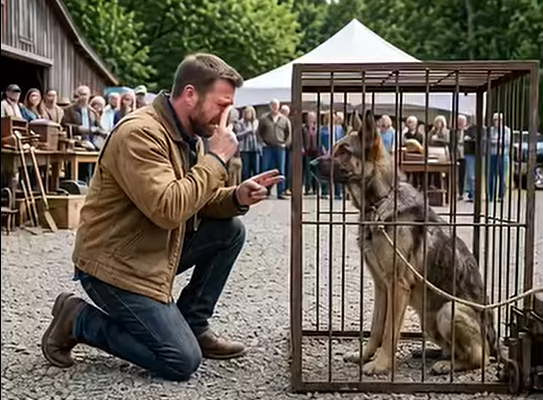
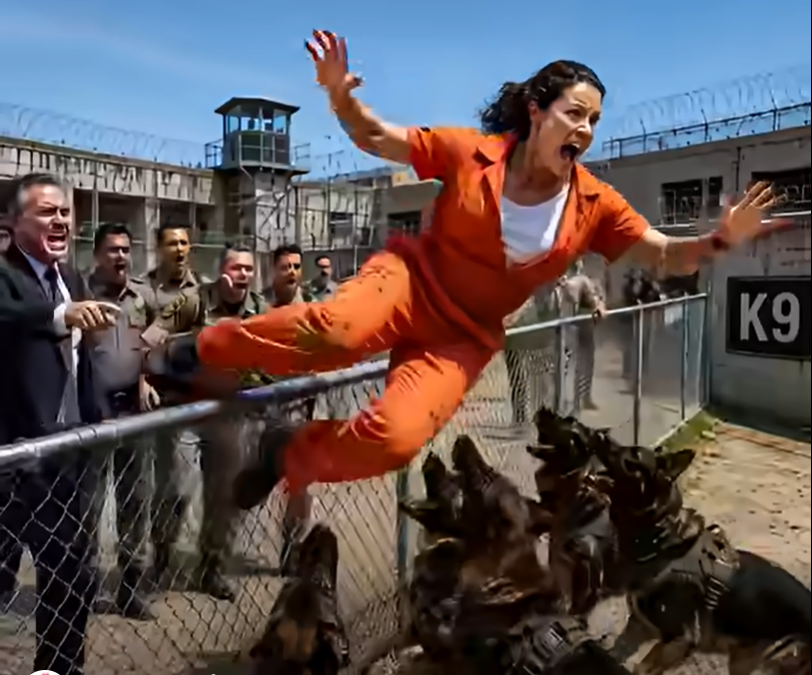
The warden expected the vicious German Shepherd to tear me apart inside that concrete cell, never realizing I had spent twelve years learning the exact difference between a dog trained to attack and one trained to be afraid.
When Brutus launched toward my throat, I gave him one command nobody inside Red Creek Correctional Facility should have known—and the hundred-and-ten-pound K9 stopped so fast his claws scraped sparks across the floor before he dropped beside my left leg.
But the medals hidden inside the lockbox Warden Arthur Pendleton had smashed open upstairs were not the most dangerous things he had stolen from me, because beneath them was a federal evidence packet that could send half his command staff to prison.
The steel door slammed shut behind me.
The sound rolled through the corridor and disappeared into the concrete like a gunshot.
For a moment, there was complete darkness.
Then I heard the dog breathing.
Low.
Heavy.
Close.
Somewhere beyond the barred inner partition, something large shifted its weight against the floor.
Wet fur.
Bleach.
Rust.
Old urine.
And fear.
Not mine.
His.
The German Shepherd growled again.
Deep.
Chest-level.
Controlled.
It was not the warning growl of a nervous pet.
It was the sound of an animal that had learned men only listened when teeth entered the conversation.
I stood in the center of the cell with my hands cuffed behind my back.
My left wrist throbbed where the steel had cut skin.
The prison-issued orange jumpsuit hung loose around my shoulders.
My boots were gone.
My hair was still damp from the roadside rain.
Somewhere outside the door, Warden Arthur Pendleton was waiting for me to scream.
I knew because he had told me exactly what he expected.
“Let’s see how tough you are after a few minutes with Brutus.”
His voice had carried the lazy confidence of a man who believed power and accountability were opposites.
I had seen that kind of confidence before.
Different uniforms.
Different countries.
Same eyes.
Pendleton was tall and narrow, with pale skin, carefully combed silver hair, and a charcoal suit that probably cost more than some correctional officers made in a month.
He smiled too often.
Not because he was friendly.
Because he liked watching people understand that he could do something and they could not stop him.
I had met him ninety-three minutes earlier.
Before that, my day had been ordinary.
Mostly.
I had been driving north through eastern Oregon in an old black SUV with rain hammering the windshield and a federal evidence lockbox strapped beneath the rear cargo panel.
My name is Claire Mercer.
Forty-two years old.
PART2:
Former United States Navy.
Currently a civilian investigator attached to the Office of Inspector General through a contract Pendleton would have understood if he had bothered reading the credentials he confiscated instead of laughing at them.
I had been sent to Red Creek for one reason.
Financial records.
Not dogs.
Not prisoners.
Not heroics.
Money.
Two years of corrections grants had vanished into maintenance contracts belonging to companies that seemed to exist only on paper.
Medical transport invoices showed prisoners making hospital trips that no hospital could verify.
K9 training funds had doubled while the number of certified dogs had decreased.
Food purchases exceeded inmate population requirements by nearly forty percent.
One whistleblower inside the prison had mailed documentation through an intermediary.
Then the whistleblower disappeared.
Officially:
Transferred.
Unofficially:
Nobody could locate him.
That moved the inquiry from accounting irregularity to something more interesting.
My assignment had been simple.
Drive to the regional federal office.
Deliver the physical packet.
Meet Agent Naomi Brooks at 3:00 p.m.
Go home.
Then Deputy Greg Collins lit me up on County Road 17.
No obvious reason.
I was eight miles below the speed limit.
Registration valid.
Lights working.
Seat belt on.
I pulled onto the shoulder.
Hands visible.
Driver’s window halfway down.
Collins approached from behind with one hand resting on his holster.
“License.”
I gave it to him.
He stared at the card.
Then at me.
“Where you headed?”
“North.”
“Specific.”
“Federal building in Halloway.”
That was my first mistake.
His expression barely changed.
But it changed.
“What for?”
“Work.”
“What kind?”
“Government.”
He looked into the vehicle.
“Step out.”
“Why?”
“Routine.”
“No, it isn’t.”
His jaw tightened.
“Step out of the vehicle.”
I did.
Arguments on roads rarely improve with volume.
He searched visually.
Asked whether I had weapons.
I said no.
Technically true.
My concealed carry permit had expired after I stopped carrying routinely.
He asked about the rear compartment.
“Work materials.”
“Open it.”
“No.”
His eyes narrowed.
“Why?”
“Protected federal material.”
That should have slowed him.
It accelerated him.
He called another deputy.
Then another.
Twenty minutes later, my SUV was being searched over my objection under a probable-cause story Collins invented around “suspected contraband transport.”
They found the steel lockbox.
Black.
Reinforced.
Serial-numbered.
Tamper seal intact.
Federal property marking on the underside.
Collins looked at me.
“What’s inside?”
“Documents you are not authorized to access.”
That was when he smiled.
Same kind of smile Pendleton would use later.
“You people always say that.”
“You people?”
“Out-of-state government types.”
“I live in Oregon.”
He ignored me.
“Open it.”
“No.”
He arrested me for obstruction.
Not a valid arrest.
Not one that would survive five minutes under competent review.
But the nearest holding facility with processing capability was Red Creek Correctional’s county intake wing.
That should not have been where they took me.
Which meant someone had made a call.
By the time I arrived, Pendleton was waiting.
That was when the situation stopped feeling incompetent.
And started feeling organized.
They took my phone.
Wallet.
Watch.
Belt.
Boots.
Then Collins dropped the lockbox onto Pendleton’s desk.
“Out-of-state woman. Refused a search. Gave me lip on the highway.”
Pendleton examined my license.
Then me.
“Navy?”
My license did not say Navy.
Neither had anything Collins legally opened.
I filed that detail away.
“What do you do, sweetheart? Type memos for admirals?”
“I want my phone call.”
“You’ll get one.”
“The box contains protected federal material.”
He laughed.
“So you said.”
“I am formally advising you not to open it.”
Pendleton looked delighted.
“Formal.”
He called for a crowbar.
That was when I knew he was not merely arrogant.
He was looking for something.
He did not know exactly what.
But he knew there was something to find.
The lid resisted for almost a minute.
Then the lock broke.
Pendleton dumped the contents onto his desk.
At the top:
Two folded uniform items.
A sealed evidence envelope.
A second encrypted storage device.
A small mahogany presentation box.
Pendleton picked up the wooden box first.
“Jewelry?”
I said nothing.
He opened it.
The room changed.
Inside were medals I rarely looked at.
A Navy and Marine Corps Commendation Medal with Combat “C.”
Purple Heart.
Bronze Star Medal.
Navy Cross.
And beneath them, an old Naval Special Warfare insignia wrapped in black cloth.
Pendleton stared.
Collins did too.
For half a second, arrogance lost its footing.
Then Pendleton recovered.
“Bought these online?”
I almost smiled.
“Sure.”
He held up the Navy Cross.
“You expect me to believe these belong to you?”
“No.”
“Good.”
“I expect the Department of the Navy to tell you.”
That irritated him.
He turned toward Collins.
“Put her downstairs.”
Collins hesitated.
“Warden—”
“Special holding.”
Another officer looked uncomfortable.
“With Brutus?”
Pendleton smiled.
“With Brutus.”
Now I stood in darkness listening to Brutus breathe.
The inner barred gate rattled.
Someone outside manipulated a second lock.
Then Pendleton’s voice came through the observation speaker.
“Last chance.”
I looked toward the sound.
“For what?”
“Tell me what’s really in the box.”
“You already opened it.”
“I found paper.”
“Congratulations.”
“You think the uniform makes you special?”
“No.”
“The medals?”
“No.”
“Then what does?”
I listened to Brutus.
His breathing had changed.
He could hear Pendleton too.
That mattered.
Pendleton said:
“You government people think you can come into places like mine and start asking questions.”
There.
Finally.
No more pretending this was a traffic arrest.
I said:
“So you do know who I am.”
Silence.
Pendleton realized his mistake.
Then he chuckled.
“Enjoy the dog.”
The inner gate unlocked.
Metal rolled.
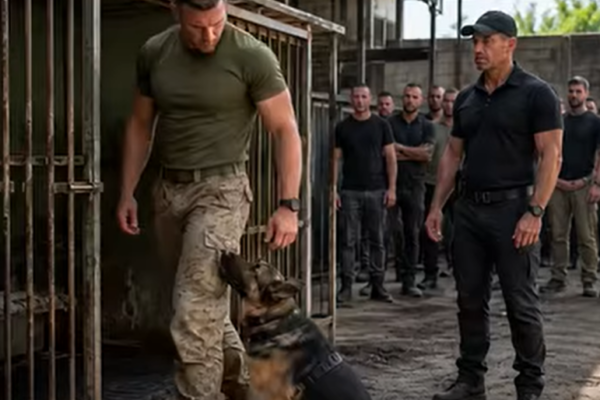
Brutus stepped into the cell.
Huge.
Black-and-tan German Shepherd.
Maybe seven.
Maybe eight.
Heavy shoulders.
Scar across the nose.
One damaged ear.
He wore a wide correctional K9 collar connected to nothing.
No handler.
No muzzle.
His pupils were enormous.
Body low.
Weight forward.
He growled.
I remained still.
There are moments when fear is appropriate.
This was one.
Fear sharpened everything.
Position of his feet.
Angle of his neck.
Tail.
Breathing.
Distance.
The difference between forward aggression and defensive panic.
Brutus advanced.
Three steps.
Stopped.
Teeth visible.
He was waiting for me to move.
I did not.
Outside the cell, somebody laughed quietly.
Pendleton.
Maybe Collins.
They expected motion.
Running.
Screaming.
Kicking.
The reactions an abused working dog had probably been trained to punish.
I knew dogs like Brutus.
Not personally.
But I knew the architecture of what had been done to him.
Twelve years in Naval Special Warfare had taught me many things that never belonged in recruiting brochures.
Some useful.
Some ugly.
My medical specialty eventually placed me around multipurpose K9 teams.
Tracking.
Detection.
Patrol.
Recovery.
You learn quickly that dogs do not become reliable under pressure because someone teaches them cruelty.
The best ones work because trust becomes stronger than distraction.
A dog trained through partnership will enter darkness because the handler entered first.
A dog trained through fear enters because darkness is less frightening than the person behind him.
Brutus was the second kind.
Pendleton had mistaken brokenness for viciousness.
Brutus lunged.
Fast.
Everyone later described it as an attack.
It was.
But not the attack Pendleton intended.
The dog launched toward my upper chest.
I pivoted.
Not enough to challenge.
Enough to deny a direct throat line.
Then I used one word.
“PLATZ!”
German.
Down.
But commands alone do not stop a committed attack dog.
Tone does.
Timing.
Body position.
Recognition.
Brutus’s front paws hit the floor.
Claws scraped across concrete.
His body slid less than two feet from me.
He snapped once at empty air.
Then froze.
I repeated.
Lower.
“Platz.”
The dog’s chest touched concrete.
Outside the door, nobody moved.
I heard one man whisper:
“What the hell?”
Brutus stared at me.
Still dangerous.
Still aroused.
But listening now.
I slowly turned sideways.
Less confrontational.
Hands still cuffed behind me.
“Bleib.”
Stay.
His ears moved.
One damaged.
One upright.
He remained down.
I took one step.
Brutus’s eyes tracked.
No lunge.
Another.
Then I crouched.
That was risky.
Necessary.
He smelled me.
Hospital soap from my morning shower.
Rain.
Metal cuffs.
Old leather from my removed boots.
Nothing familiar.
But my behavior was familiar.
Calm command.
No strike.
No fear performance.
No attempt to dominate.
Brutus whined.
Just once.
That sound told me more than the growling had.
I lowered my voice.
“You don’t want to do this, do you?”
He swallowed.
Panting.
I said:
“Fuss.”
Heel.
Brutus stood.
Moved to my left.
Sat.
The hallway outside erupted.
A guard swore.
Another shouted for Pendleton.
The observation panel opened.
Pendleton’s face appeared.
He looked less pale than before.
Now he was white.
“What did you do?”
“Nothing.”
“That dog doesn’t obey anybody but Mercer.”
I looked at him.
“Mercer?”
Pendleton closed the panel.
Mistake number two.
He had just given me a name.
Brutus sat beside my left leg.
I turned my body enough to examine him.
Old scar tissue around the neck.
Pressure abrasions.
One area where the collar had rubbed fur away.
I could not touch him properly with my hands cuffed.
But I could see enough.
This dog had not become unstable naturally.
Someone had manufactured the behavior.
And if Red Creek was claiming grant reimbursement for certified K9 care, the condition of Brutus alone could become evidence.
The speaker clicked.
Pendleton:
“Officer Mercer to special holding.”
So Mercer was still here.
Footsteps came several minutes later.
Heavy.
Fast.
Then the observation slot opened again.
A different face.
Late forties.
Thick neck.
Correctional uniform.
K9 patch.
He looked inside.
Brutus saw him.
Everything changed.
The dog pressed against my leg.
Not toward Mercer.
Away.
His body lowered.
Eyes averted.
Tail tucked.
That response was not respect.
Fear.
Officer Mercer stared at me.
Then the dog.
“How?”
I looked at Brutus.
“What do you use on him?”
Mercer’s jaw tightened.
“What?”
“Electric collar?”
No answer.
“Bite suit punishment?”
Nothing.
“Food deprivation?”
Brutus licked his lips.
Mercer said:
“Shut up.”
“Does Pendleton know?”
“Shut your mouth.”
“He signs your training logs.”
Mercer stepped back.
The slot slammed.
I smiled.
Not because anything was funny.
Because I finally understood why the K9 budget was inflated.
A certified working dog requires documented training.
Veterinary care.
Handler hours.
Equipment.
Food.
Kennel standards.
Red Creek had billed hundreds of thousands of dollars.
Brutus looked like half that money had never reached the dogs.
Maybe there were others.
The federal packet contained photographs from the whistleblower.
Kennels.
Invoices.
Medical logs.
I had not seen every page.
Now I understood why someone was desperate enough to stage a traffic arrest.
The cuff on my left wrist cut deeper when I shifted.
Brutus noticed.
He sniffed toward my arm.
I said:
“Easy.”
He sat.
Then gently touched his nose against my elbow.
Outside, voices argued.
Mercer.
Pendleton.
Collins.
I could not hear every word.
Enough.
“…should’ve never opened…”
“…federal…”
“…get rid of…”
Then silence.
Get rid of.
Possibly documents.
Possibly me.
Both.
I looked around.
Concrete cell.
Steel exterior door.
Interior dog gate now open.
Small drain.
Old camera high in one corner.
Camera.
That mattered.
Pendleton was arrogant.
Men like him often recorded abuse because recording made them feel powerful.
If the system archived automatically, there might now be footage of him intentionally releasing Brutus on a restrained detainee.
Unless he deleted it.
I looked toward the camera.
Tiny red light.
Still recording.
Good.
“Brutus.”
His ears moved.
“Come.”
He shifted closer.
I turned my back slightly.
“Hands.”
Not a standard dog command.
A human request.
I positioned the cuffs near his mouth.
Brutus sniffed.
I did not expect him to magically remove handcuffs.
Movies have damaged people’s expectations of trained dogs.
But I wanted his attention near my wrists.
He licked blood from the cut.
Then stopped.
A key ring rattled outside.
Door opened.
Mercer entered holding a catch pole.
Brutus instantly growled.
Mercer stared.
“Back.”
Brutus did not move.
“Brutus, kennel.”
The dog pressed closer to me.
Mercer’s face darkened.
“Damn dog.”
He lifted the pole.
I stood.
“Don’t.”
He laughed.
“You’re giving orders now?”
“Hit him and you’ll prove my point.”
“To who?”
I glanced at the camera.
Mercer looked up.
His face changed.
He had forgotten.
He backed toward the door.
Pendleton appeared behind him.
“Turn the cameras off.”
There it was.
I said:
“Too late.”
Pendleton stared.
“You think anyone’s going to see that?”
“I think your server probably mirrors externally under your federal grant agreement.”
He did not know whether that was true.
Neither did I.
His hesitation told me enough.
“Take her out.”
Mercer looked at Brutus.
“How?”
Pendleton snapped:
“He’s a dog.”
“You come get him.”
Pendleton did not move.
Interesting.
He was afraid too.
Mercer reached for a remote clipped to his belt.
Brutus saw it.
Body collapsed.
That confirmed the collar.
Mercer pressed a button.
Brutus screamed.
Not barked.
Screamed.
His body spasmed.
I stepped between him and Mercer.
“Stop!”
Mercer pressed again.
Brutus dropped.
Something inside me went very cold.
The kind of cold that used to arrive before missions.
Not rage.
Decision.
“Do that again.”
Mercer smiled.
“What?”
“Do it again.”
He started to raise the remote.
Pendleton said:
“Enough.”
Not compassion.
Risk management.
Mercer lowered it.
I looked at Brutus.
“Easy.”
He trembled.
I crouched beside him as far as the cuffs allowed.
Pendleton said:
“You’re coming upstairs.”
“Good.”
“You think this ends well for you?”
“No.”
I stood.
“I think it ends badly for you.”
They removed me with Brutus still inside.
The dog tried following.
Mercer shocked him again.
I heard the scream after the door closed.
That sound followed me all the way upstairs.
Pendleton brought me to his office.
My lockbox lay open.
Documents scattered.
Medals still on the desk.
The encrypted drive was gone.
So was the sealed evidence envelope.
I looked at Pendleton.
“Where is it?”
“Where’s what?”
“You opened federal evidence.”
“You keep saying federal like it’s magic.”
“No.”
I sat because Collins pushed me into a chair.
“It’s jurisdiction.”
Pendleton poured himself coffee.
“How long were you actually Navy?”
“Twelve years.”
“SEAL?”
I looked at him.
He held the warfare insignia.
“This says Naval Special Warfare.”
“Good reading.”
He tossed it onto the desk.
“No woman did what you’re pretending you did.”
I understood why he wanted to believe that.
If the medals were fake, I was fake.
If I was fake, he still controlled the room.
I said:
“Call Naval Personnel Command.”
“I don’t need to.”
“You should.”
“Why?”
“Because in twenty minutes somebody else will.”
Pendleton looked at the wall clock.
“Who?”
“Agent Naomi Brooks.”
“No phone call, remember?”
“I missed a scheduled federal evidence delivery.”
He stopped.
“At 3:00.”
It was now 3:42.
“When I miss a check-in carrying sealed material, the response protocol starts automatically.”
Pendleton’s face changed.
Collins looked at him.
“Warden?”
Pendleton ignored him.
“How long?”
“I don’t know.”
Lie.
I knew.
First missed check.
Fifteen minutes.
Second attempt.
Ten.
Then escalation.
My phone was probably already being geolocated.
My government vehicle transponder was not government-marked, but it reported continuously.
Collins had towed it.
Where?
Probably Red Creek’s impound lot.
Which meant federal investigators already knew exactly where I was.
Pendleton recovered.
“You were arrested.”
“Illegally.”
“You obstructed a deputy.”
“By refusing an unlawful search.”
“You think federal agents are coming to storm a prison because some woman missed a meeting?”
“No.”
I looked at the open box.
“They’re coming because evidence in an active Inspector General investigation stopped moving at the same location as a missing investigator.”
Collins turned toward Pendleton.
“Missing investigator?”
That was new information to him.
Good.
The conspiracy had layers.
Not everyone knew everything.
Pendleton said:
“She’s bluffing.”
I looked at Collins.
“Ask him about Daniel Voss.”
His eyes moved to Pendleton.
“Who?”
The whistleblower.
A Red Creek corrections accountant.
Officially transferred five weeks earlier.
No transfer facility had him.
Pendleton’s jaw tightened.
I continued:
“Daniel Voss found duplicate K9 invoices.”
“Medical transport fraud.”
“Food vendor kickbacks.”
“Then he mailed records.”
Collins said:
“To you?”
“No.”
“Then why do you have them?”
“Because the person he mailed them to was found dead.”
That was not fully true.
The intermediary had died in a single-vehicle crash currently listed as accidental.
Timing made coincidence difficult.
Pendleton stepped closer.
“You should be very careful.”
I smiled faintly.
“That advice arrived late.”
He turned to Collins.
“Take her back downstairs.”
Collins did not move.
Pendleton noticed.
“Deputy.”
“You said she was some activist.”
Pendleton’s expression hardened.
“She is.”
“She has a Navy Cross.”
“Fake.”
Collins looked at the medals.
Then me.
“You really federal?”
“Yes.”
Pendleton snapped:
“Do not answer her.”
I looked at Collins.
“He already used you.”
“Claire.”
First time Pendleton used my name.
I continued.
“When this turns, he’ll say the traffic stop was yours.”
“The search was yours.”
“The arrest was yours.”
“You brought me here.”
Collins swallowed.
Pendleton said:
“She’s manipulating you.”
“Then show him the warrant.”
Silence.
I looked at Collins.
“There isn’t one.”
His breathing changed.
Pendleton said:
“Get her out.”
Collins still hesitated.
Then somewhere outside:
Sirens.
Not one.
Several.
Pendleton looked toward the window.
I looked at the clock.
3:49.
Faster than expected.
A corrections officer entered without knocking.
“Warden.”
“What?”
“Federal vehicles at the south gate.”
Pendleton went still.
“How many?”
“Four.”
Another officer appeared.
“State police too.”
Pendleton looked at me.
I said:
“I told you to call the Navy.”
He moved quickly.
Not toward me.
Toward the desk.
Opened a drawer.
I stood.
Collins reached for me.
“Stay seated.”
Pendleton pulled out the encrypted drive.
There.
He had hidden it.
He moved toward a small shred bin unit.
I said:
“Arthur.”
He looked at me.
“If you destroy that with federal agents at your gate, even your lawyer will hate you.”
He hesitated.
Then shoved the drive into his pocket.
“Take her to segregation.”
Collins said:
“No.”
Everything stopped.
Pendleton slowly turned.
“What?”
“I’m not moving her.”
“You work for the county.”
“I don’t work for you.”
Pendleton stepped close.
“You want your career over?”
Collins looked at me.
Then the medals.
Then Pendleton.
“I think it already might be.”
That was the first decent thing he did that day.
It did not erase the arrest.
The search.
The insults.
But people are not cleanly divided into villains and heroes.
Sometimes cowardice ends one decision before it ends the next.
Pendleton reached for his office phone.
No dial tone.
Someone had cut internal control access.
The federal team had entered.
A voice over the corridor:
“Warden Arthur Pendleton, remain in your office.”
Pendleton looked toward a side door.
I saw the calculation.
Back corridor.
Administrative exit.
Evidence drive in his pocket.
I stepped sideways.
His eyes snapped to me.
“You’re cuffed.”
“Yes.”
“You think you can stop me?”
“No.”
Then I heard barking below.
Brutus.
Not frantic.
Three sharp barks.
Pause.
Three.
I smiled.
Pendleton’s face changed.
“What?”
“Your dog.”
“So?”
“He’s alerting.”
“To what?”
Footsteps thundered down the hall.
Federal agents entered.
Naomi Brooks first.
Black rain jacket.
Hair plastered to her forehead.
Pistol low and controlled.
“Hands!”
Pendleton froze.
Two agents took Collins.
Another secured me.
Naomi saw the cuffs.
“What happened?”
“Long story.”
Her eyes moved to the medals.
The broken lockbox.
Then Pendleton.
“What did you open?”
He said:
“She was lawfully detained.”
Naomi looked at me.
“Were you?”
“No.”
“Thought so.”
She turned.
“Cuff him.”
Pendleton shouted:
“I am the warden of this institution.”
Naomi said:
“Then you should know how handcuffs work.”
They removed mine.
Pain hit when circulation returned.
Naomi saw the cut.
“What happened to your wrist?”
“Cuffs.”
“Anything else?”
I looked toward the floor.
“Dog.”
Her expression sharpened.
“You were bitten?”
“No.”
“Then?”
“They put me in a cell with one.”
Silence.
Naomi stared at Pendleton.
“You did what?”
Pendleton answered:
“Brutus is a controlled corrections animal.”
I said:
“He shocked him twice.”
Naomi looked toward an agent.
“Get veterinary services into that K9 unit now.”
Pendleton started:
“You have no authority—”
Naomi turned.
“Inspector General warrant was signed fourteen minutes ago.”
She held up her phone.
“State animal cruelty warrant is being processed.”
Then:
“And your own county prosecutor is downstairs.”
Pendleton stopped talking.
I pointed toward his right pocket.
“The encrypted drive.”
An agent removed it.
Pendleton’s shoulders dropped.
That was when I knew he understood.
Not when they handcuffed him.
Not when the agents entered.
When the evidence left his pocket.
Power depends on controlling what can be proven.
He had lost that.
Naomi unlocked my mahogany box.
Looked at the medals.
Then me.
“You carry these around?”
“My father’s house sold last week.”
“So?”
“They were in storage.”
She held up the Navy Cross.
“You could’ve mentioned this.”
“You never asked.”
Naomi shook her head.
“You are the strangest investigator I have ever worked with.”
“Thank you.”
“Not a compliment.”
“Still taking it.”
A veterinarian reached Brutus twenty minutes later.
I insisted on going down.
Naomi objected.
“You were illegally imprisoned with the animal.”
“Yes.”
“Which is why normal people would not want to see him again.”
“He’s not the problem.”
She looked at me.
“You said that very quickly.”
“Because it’s true.”
The K9 kennel door opened.
Brutus was in the rear corner.
Mercer had disappeared during the federal entry.
Security found him later trying to leave through a maintenance tunnel.
Coward.
The electronic collar still sat around Brutus’s neck.
Veterinarian Dr. Hannah Lee crouched outside.
“Can he be approached?”
“By me.”
Naomi said:
“Absolutely not.”
Brutus heard my voice.
His ears lifted.
I crouched.
“Brutus.”
He stood.
Walked forward.
Stopped.
Dr. Lee watched.
I gave the command.
“Fuss.”
He moved to my left.
Sat.
Naomi whispered:
“You’ve got to be kidding me.”
Dr. Lee said:
“That dog trusts her.”
I did not correct her.
Trust was too large a word.
He tolerated my rules because my rules made sense.
Sometimes that is how trust starts.
Dr. Lee entered carefully.
Removed the collar.
Underneath:
Pressure sores.
Electrical contact burns.
Old scar tissue.
She went quiet.
Naomi looked sick.
“How long?”
Dr. Lee shook her head.
“Some of this is chronic.”
Brutus leaned against my leg.
I touched his neck.
Very lightly.
He flinched.
Then stayed.
I whispered:
“You’re done.”
His ears moved.
“No more.”
The investigation lasted months.
Pendleton’s house was searched.
Mercer’s too.
Records recovered from Red Creek’s accounting server confirmed nearly every allegation in Daniel Voss’s files.
Fake vendor contracts.
Inflated K9 training expenses.
Medication purchases routed through a shell company.
Prisoner transport claims for trips that never occurred.
Grant money diverted into private accounts.
And worse.
Three inmates had filed formal complaints alleging dogs were deliberately used during unauthorized punishment sessions.
Two complaints vanished from the internal system.
The third complainant was Daniel Voss’s source inside segregation.
That inmate had later suffered a “fall.”
He survived.
Barely.
Video archives recovered from an offsite backup showed Mercer using electronic collars and physical punishment during K9 training.
Brutus was not the only dog.
There were four.
One had already been transferred.
Two remained on site.
All were removed.
One required surgery.
The other shook whenever a man in a correctional uniform entered the room.
Pendleton had treated the dogs the same way he treated prisoners.
Fear was efficient.
Fear produced compliance.
Fear created silence.
Until someone stopped being afraid enough.
Deputy Collins cooperated.
Fully.
His testimony documented that Pendleton had directed him to stop my vehicle after receiving my description from someone monitoring the federal investigation.
Collins had known the arrest was questionable.
He claimed he did not know why Pendleton wanted me.
I believed part of that.
Not all.
He lost his badge.
Later pleaded to misconduct and obstruction-related charges.
Some people online called him a hero for eventually helping.
He wasn’t.
Doing the right thing after doing the wrong thing does not erase the first decision.
But it matters.
Pendleton attempted to claim I had attacked Brutus.
The cell video destroyed that argument.
Every second had recorded.
Me cuffed.
Brutus released.
The lunge.
My command.
The dog dropping.
Mercer entering.
The shock collar.
The scream.
Pendleton ordering the cameras turned off.
That footage became some of the strongest evidence in the case.
Funny.
He had put me in the cell because he believed a dog would erase his problem.
Instead, Brutus preserved it.
Three months after Red Creek, Naomi called.
“You sitting down?”
“No.”
“Sit.”
I sat at my kitchen table.
“What?”
“Voss is alive.”
For several seconds, I could not process the words.
“Daniel Voss?”
“Yes.”
“Where?”
“Protective federal custody.”
“What?”
“He never transferred.”
“I know that.”
“He escaped.”
I stared.
“From Red Creek?”
“During a medical transport.”
One of the fake transports had not been fake.
Voss had bribed a driver.
Reached a church shelter.
Contacted federal authorities through an attorney.
They hid him because he believed Pendleton had law enforcement contacts.
The records I carried had been copies he released through an intermediary.
He had been watching to see whether the investigation was compromised.
My illegal arrest confirmed it.
“So he knew I was coming?”
“Not you personally.”
Naomi paused.
“He knew someone was.”
I looked out my window.
“Is he testifying?”
“Yes.”
“Good.”
Then:
“Why didn’t you tell me earlier?”
“He requested it remain compartmentalized.”
I laughed.
“Of course he did.”
Naomi said:
“He asked about the dog.”
“Brutus?”
“Yes.”
“What did you tell him?”
“That the dog is safe.”
That mattered more than I expected.
Brutus went to a rehabilitation foster specializing in retired working dogs.
Not immediately adoptable.
Maybe never suitable for an ordinary home.
That was fine.
Rescue does not mean forcing an animal into somebody’s living room to complete a happy photograph.
Sometimes rescue means safe containment.
Predictability.
No pain.
Professionals who understand.
Months later, I visited.
Brutus remembered me.
Or remembered the pattern.
Hard to know.
He approached.
Sat on my left.
His coat had improved.
The sores healed.
He wore a plain leather collar.
No electronics.
I scratched beneath his chin.
The behavior specialist smiled.
“He likes you.”
“He likes structure.”
“Same difference sometimes.”
“No.”
I looked at Brutus.
“Structure without fear is different.”
She nodded.
Fair.
He had learned new commands in English.
No more German required.
He could walk past men without lowering his body.
He still reacted badly to remote controls.
Uniformed corrections clothing was avoided entirely.
Healing does not require pretending triggers do not exist.
One afternoon during the visit, a metal gate slammed accidentally.
Brutus dropped instantly.
Chest to ground.
Eyes wide.
The old response.
Nobody touched him.
Nobody commanded.
We waited.
He looked at me.
I sat on the floor several feet away.
“Easy.”
His breathing slowed.
One step.
Another.
He came over.
Rested his head beside my knee.
That was better than obedience.
He chose proximity.
Pendleton’s trial began the following spring.
His attorneys tried to keep the medals out.
Good.
They had little relevance to financial fraud.
The public story loved them, though.
Former Naval Special Warfare officer arrested by corrupt warden.
Warden releases attack dog.
Dog obeys veteran.
Federal corruption uncovered.
Headlines flattened everything into a movie.
Reality was less elegant.
I did not “show” Pendleton my medals.
He stole them.
He broke the box.
He found them while violating my rights.
Brutus did not recognize my medals.
Dogs do not care about decorations.
He responded to training language and body cues.
I did not defeat an attack dog with mystical military power.
I recognized an abused working animal and used the smallest amount of control necessary to prevent either of us from being injured.
The medals proved something only because Pendleton had decided I was lying.
His worst mistake was not underestimating a SEAL.
It was believing people were whatever he decided they were.
Prisoner.
Criminal.
Weak woman.
Bad dog.
Disobedient officer.
Disposable inmate.
Pendleton did not see individuals.
He saw categories he could dominate.
That is why Brutus and I understood each other faster than Pendleton understood either of us.
The dog had spent years being told:
Obey or hurt.
I had spent twelve years in environments where hesitation could kill people.
But the best leaders I knew taught the opposite of Pendleton’s philosophy.
Control is not the goal.
Clarity is.
Trust is.
Knowing the person beside you will not use your vulnerability against you.
Pendleton received more than eighteen years across combined federal and state sentencing.
Mercer took a plea.
The county sheriff resigned after investigators discovered he had ignored repeated complaints about Collins and Red Creek.
Several correctional officers were cleared.
Two became witnesses.
Three lost certification.
Red Creek’s K9 program was suspended entirely, then rebuilt under outside supervision.
The dogs never returned there.
Good.
Brutus was adopted almost a year later.
Not by me.
People always expect that part.
No.
I knew enough to understand I was not his best home.
My work still required travel.
Unpredictable hours.
Hotels.
Airports.
Brutus needed routine.
His adopter was a fifty-eight-year-old former military veterinarian named Samuel Greene.
Quiet property.
No children.
One older Labrador.
Fenced acreage.
Samuel did not ask Brutus to be a hero.
Did not dress him in tactical gear.
Did not introduce him to crowds.
He gave him breakfast at the same time every morning.
Walks.
Training games.
Soft beds.
Choice.
The first photograph Samuel sent me showed Brutus asleep on a rug with his belly exposed.
I stared at it for a long time.
That was freedom.
Not an open door.
Not dramatic rescue.
Sleeping deeply enough to become vulnerable because you believe nobody will punish you for it.
A year after Pendleton’s sentencing, Naomi asked me whether I regretted the traffic stop.
“Strange question.”
“You know what I mean.”
We were sitting in a diner outside Portland.
Rain against the windows.
Of course.
“Without it, maybe we don’t get the dog-cell footage.”
“We already had the financial case.”
“But not the abuse.”
“True.”
She stirred her coffee.
“Still?”
I thought.
“I regret Collins choosing to stop me.”
“I regret Pendleton touching my property.”
“I regret what they did to Brutus.”
“Do I regret surviving it?”
“No.”
Naomi smiled.
“That sounded almost healthy.”
“Don’t spread it around.”
My medals went back into the mahogany box.
Repaired lock.
New hinge.
But I stopped keeping them buried inside storage.
They sit on a shelf in my study now.
Not displayed dramatically.
Box closed.
Most people who visit never ask.
Those medals belong to another life.
Important.
Not the whole one.
The Navy Cross is not proof that I am brave every morning.
The Purple Heart does not make me immune to fear.
The warfare insignia does not mean I can control every dangerous situation.
They prove only that certain things happened.
Certain people were there.
Certain choices were made.
The choice I think about most has no medal attached.
A concrete cell.
Hands cuffed.
A frightened German Shepherd moving toward me.
I could have kicked.
Shouted.
Tried to make myself larger.
Maybe the outcome would have been different.
Maybe I would have been bitten.
Maybe Brutus would have been shot afterward.
Instead, I looked at him and recognized something Pendleton could not.
The dog was not evil.
He was terrified inside a job somebody had poisoned.
That distinction saved both of us.
Years later, Samuel brought Brutus to see me.
Gray around his muzzle now.
Slower.
The damaged ear still crooked.
He walked into my yard.
Stopped.
Looked at me.
I wondered if he remembered the cell.
I hoped not.
Then I said:
“Fuss.”
Samuel laughed.
Brutus walked to my left.
Sat.
Looked up.
I scratched behind his ear.
“No more prisons, buddy.”
His tail moved once.
Samuel said:
“He doesn’t need the command anymore.”
“I know.”
“Why use it?”
I smiled.
“Old joke.”
Brutus leaned against my leg.
That was all.
No drama.
No attack.
No medals.
No federal agents.
An old dog and an old command that no longer carried fear.
Sometimes people ask what I said when Pendleton first saw the medals after the agents arrived.
The answer disappoints them.
I did not give a speech.
I did not tell him who I was.
I did not list missions.
I did not threaten him.
Naomi lifted the Navy Cross from his desk, looked at him, and asked:
“Did you break into this federal lockbox?”
Pendleton said nothing.
Then she looked at me.
“Are these yours?”
“Yes.”
Pendleton stared.
That was enough.
For the first time all day, the man who had forced everyone else to explain themselves had no explanation that mattered.
And Brutus?
He was downstairs waiting for someone to remove the collar that had taught him fear.
That became the part of the story I cared about.
Not the moment a cruel warden discovered he had imprisoned the wrong woman.
The moment a dog discovered the door could open without pain waiting on the other side.
Pendleton wanted Brutus to prove what fear could do.
Instead, Brutus became evidence of what fear had done.
And once enough people finally looked closely, Arthur Pendleton lost the one weapon he had spent years depending on.
Silence.