PART 2: HOA Demanded $10.3 Million After My House Survived the Hurricane—Then Accused Me of Making the Storm Worse
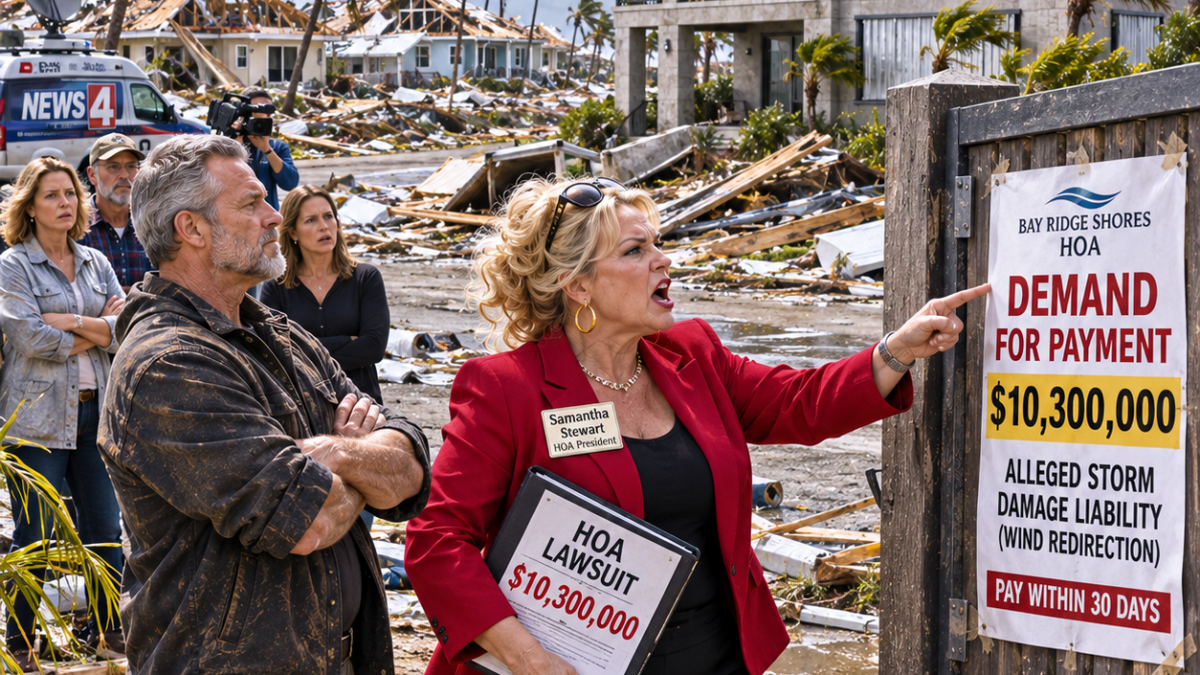
Three days after Hurricane Helena tore Bay Ridge Shores apart, I was handing bottled water to neighbors who had lost roofs, cars, and entire rooms when HOA president Samantha Stewart taped a laminated demand to my gate ordering me to pay more than $10 million because my house was one of the only structures still standing. By sunset, the explanation became even crazier: Samantha was telling residents and reporters that the reinforced walls I had built years earlier might have “redirected destructive wind forces” into the subdivision, which somehow turned surviving a hurricane into evidence that I had harmed everyone who didn’t. I knew the physics were nonsense and the HOA had no legal authority over my property, but when I compared their new disaster map with the recorded survey I had kept since construction, I found something far more troubling than an absurd lawsuit—the storm had given Samantha a reason to resurrect a plan she had already tried once before.
My name is Frank Bailey. I was sixty-one years old, semi-retired after three decades flying industrial inspection routes over the Gulf, and I had built my home on a parcel just outside Bay Ridge Shores because I had seen what hurricanes could do.
I didn’t build a bunker because I wanted attention.
I built for wind.
Reinforced concrete walls. Impact-rated windows. Roof straps. Elevated mechanical systems. Drainage designed by an engineer who had spent half his career studying Gulf storms.
People laughed during construction.
Samantha laughed the loudest.
Back then she was only the HOA vice president.
“Planning for the apocalypse?” she once asked.
“Planning for August,” I told her.
My property had never belonged to Bay Ridge Shores. The exclusion was recorded. The parcel lines were clear.
That had annoyed Samantha for years.
The HOA had repeatedly tried to convince me to join, arguing that a single independent parcel disrupted “community cohesion.”
I always refused.
Then Helena arrived.
The storm came ashore at night.
For six hours, my house sounded like it was being sandblasted by the sky.
Trees snapped.
Transformers exploded blue beyond the shutters.
Water crossed roads I had never seen flood.
By sunrise, Bay Ridge Shores looked like somebody had picked up the neighborhood and dropped it.
My place was bruised but intact.
One damaged fence panel.
Branches everywhere.
A dented shed roof.
The house itself held.
So I did what people do after disasters.
I helped.
I ran extension cords from my generator.
Charged phones.
Gave an elderly couple space in my guest room.
Helped pull a family from a flooded SUV.
Then Samantha arrived.
Not to ask for water.
She carried an envelope.
“This is formal notice.”
I looked at the letter.
**COMMUNITY RESTORATION LIABILITY ASSESSMENT: $10,347,000.**
I read the number again.
“You’ve added three zeroes.”
“No.”
“You’re demanding ten million dollars?”
“Your nonparticipation created disproportionate loss.”
“My nonparticipation in what?”
“Our collective mitigation program.”
“I’m not in your HOA.”
“That technical argument is part of the problem.”
Technical argument.
My deed had become a technicality.
She pointed toward my house.
“Look at it, Frank.”
“I have.”
“Everything around you is destroyed.”
“That’s why I’m helping people.”
“And yours is untouched.”
“Because I built for hurricanes.”
Her eyes hardened.
“Or because your structure changed how the storm moved through the area.”
I actually laughed.
She didn’t.
“You’re serious?”
“We have people looking into it.”
“Who?”
“Experts.”
“Names?”
She tucked the folder against her body.
“You’ll hear from counsel.”
Then she walked away.
By that evening a drone photograph was everywhere online.
Rows of damaged homes.
Debris.
Blue tarps.
Floodwater.
And in the middle of the image, my house still standing.
Someone captioned it:
**COINCIDENCE?**
Within hours, strangers were accusing me of using military construction, illegal storm barriers, even technology that supposedly “bent” wind away from my parcel.
Then local news interviewed Samantha.
She stood beside the damaged clubhouse and said:
“We’re only asking why one nonparticipating property survived while so many cooperating families lost everything.”
That sentence changed everything.
People who had accepted water from me stopped waving.
Someone threw a rock at my gate.
A radio host called me “the bunker man who beat the storm at everybody else’s expense.”
I called my attorney, David Monroe.
He laughed when he read the HOA demand.
Then I sent him the new Bay Ridge boundary map Samantha had attached.
His laughter stopped.
“Frank.”
“What?”
“Pull your recorded survey.”
I did.
We compared them.
My parcel had moved.
Not physically.
On paper.
The HOA’s new post-hurricane map suddenly showed my land inside Block C.
David went quiet.
Then he said:
“Don’t call Samantha.”
“Why?”
“Because if this map is what I think it is, that ten-million-dollar demand is only the part they expect you to notice.”
PART 2
I stared at the two maps on my kitchen table.
The recorded survey from when I built the house showed exactly what I had known for fifteen years.
My parcel sat outside Bay Ridge Shores.
Separate legal description.
Separate access.
Separate drainage easement.
No HOA covenants.
No shared common property.
No membership.
The version Samantha had attached to her post-hurricane demand showed something different.
My acreage had been shaded the same pale blue as the subdivision.
A new line curved behind my house.
The legend identified the area as:
**BLOCK C — COMMUNITY RESILIENCE DISTRICT**
I looked at David.
“What is a community resilience district?”
“In this document?”
“Yes.”
“Something somebody invented.”
I leaned back.
“Can an HOA redraw boundaries?”
“No.”
“Can the parish?”
“Not like this.”
“Could this be a planning proposal?”
“Maybe.”
He tapped the page.
“But if it is, the document should say proposed.”
It didn’t.
It said:
**UPDATED COMMUNITY BOUNDARY — EFFECTIVE IMMEDIATELY**
David turned over the last page.
“Who signed this?”
A signature appeared beneath:
**Samantha Stewart, President**
Another line read:
**Approved for emergency planning purposes.**
No parish official.
No surveyor’s seal.
No recorder’s stamp.
David shook his head.
“This isn’t a legal boundary map.”
“Then why include it?”
“To make their claim look better.”
“That’s fraud.”
“Slow down.”
I hated when lawyers said that.
“David.”
“It’s potentially evidence of misrepresentation. We find out who created it first.”
I stood and walked to the window.
Beyond the shutters, Bay Ridge Shores was still full of chainsaws and generators.
Tarps flapped over broken roofs.
People had lost everything.
And I was sitting inside an intact concrete house talking about map fraud.
For one second, guilt hit me.
Not because I had caused anything.
Because mine had survived.
Survivor’s guilt doesn’t need logic.
It just needs contrast.
David seemed to read my face.
“You’re allowed to have a house still standing.”
“I know.”
“Do you?”
I didn’t answer.
He closed the folder.
“First thing tomorrow, we get certified copies of every relevant parish record.”
“What about their demand?”
“We respond that you deny liability, deny HOA jurisdiction, preserve all defenses, and demand the factual basis for the amount.”
“Ten million.”
“Ten million three hundred forty-seven thousand.”
“Very precise insanity.”
“That usually means somebody built a spreadsheet.”
He stood.
“And Frank?”
“What?”
“No interviews.”
“I wasn’t planning one.”
“No Facebook.”
“I don’t use it.”
“No angry letters.”
“I was thinking about one.”
“I know.”
He pointed at me.
“Do not give Samantha anything except documents through counsel.”
That evening somebody spray-painted **STORM THIEF** across my fence.
The words were still wet when I found them.
I stood beneath a temporary work light holding a rag and solvent.
The first time I read it, I laughed.
Then I didn’t.
A storm thief.
I had spent the previous three days helping people clear debris.
I had given away fuel I had paid a premium to store before hurricane season.
I had pulled a little boy from a truck window while his mother screamed from waist-deep floodwater.
But a television interview and a drone photo had changed me from neighbor to villain.
Fear moves fast when somebody gives it a direction.
At eleven that night, David called.
“Turn on Channel Eight.”
“I thought you told me not to watch television.”
“I’m amending that advice.”
I turned it on.
Samantha stood in front of the shattered Bay Ridge clubhouse.
Her hair was perfect.
That bothered me more than it should have.
The reporter asked:
“Is the HOA truly alleging Mr. Bailey’s home increased storm damage?”
Samantha did something clever.
She didn’t say yes.
“We’re asking questions that responsible leaders have to ask.”
“Do you have engineering evidence?”
“We’ve retained consultants.”
“Can you identify them?”
“At this stage, legal counsel has advised caution.”
“Mr. Bailey says he isn’t a member of Bay Ridge Shores.”
Samantha looked straight into the camera.
“Disasters don’t respect technical boundaries.”
There was that word again.
Technical.
The reporter continued.
“Are you demanding more than ten million dollars?”
“The community suffered catastrophic losses. Everyone who benefited from collective infrastructure must participate in recovery.”
My house did not benefit from Bay Ridge infrastructure.
Separate well.
Separate septic.
Separate access.
Separate power connection.
But the statement sounded reasonable if you didn’t know the facts.
That was Samantha’s gift.
She could make theft sound collaborative.
I shut off the television.
David said through the phone:
“Don’t respond.”
“She’s accusing me without accusing me.”
“Yes.”
“That seems intentional.”
“Yes.”
“She keeps saying consultants.”
“Yes.”
“You believe she has any?”
“We’ll find out.”
The next morning we visited the parish recorder.
The building had survived with roof damage and temporary generators.
A clerk named Melanie pulled the parcel history.
Nothing had changed.
My land remained outside Bay Ridge Shores.
No annexation.
No emergency designation.
No new easement.
No legal Block C covering my property.
Then we checked the HOA’s older recorded filings.
The same thing.
My exclusion remained intact.
David ordered certified copies.
As we waited, Melanie looked at the map Samantha had circulated.
“Where’d this come from?”
“The HOA.”
She adjusted her glasses.
“This isn’t parish GIS formatting.”
“Can you tell who made it?”
“No.”
“Does the parish use the term community resilience district?”
“Not like that.”
She looked at me.
“Somebody should not be presenting this as official.”
David said:
“We agree.”
That afternoon we sent our first formal response.
It was not dramatic.
Lawyers are devastating when they are boring.
The letter stated that I denied membership, denied jurisdiction, denied any obligation to pay the demand, denied causation, and required the HOA to preserve all records concerning the claimed damages, boundary map, engineering theory, restoration amount, and public statements.
Two days later, a courier delivered forty-one pages from the HOA’s attorney.
The lawsuit.
David brought it to my house.
He dropped it on the table.
“Well.”
I looked at the stack.
“They actually filed?”
“They actually filed.”
“For ten million?”
“More now.”
I sat down.
The complaint listed community restoration costs, emergency response losses, reputational harm, legal fees, and what it called “comparative structural impact.”
I looked at David.
“Comparative structural impact.”
“Fancy way to say your house stayed up.”
One count alleged:
**willful environmental isolation.**
Another:
**failure to participate in collective hurricane mitigation.**
Another claimed my home’s “atypical reinforced configuration may have contributed to altered localized wind behavior.”
“May have.”
David nodded.
“They don’t say it did.”
“So how do they claim damages?”
“They’re hoping to survive long enough to force a settlement.”
“How?”
“Litigation costs. Public pressure. Insurance complications.”
“I don’t have HOA insurance.”
“You have homeowners coverage. Umbrella. Potential lender concerns. They make enough noise and maybe you pay to make it stop.”
I pushed the complaint away.
“I won’t.”
“I know.”
“Then what?”
“We answer.”
He smiled slightly.
“And we ask questions.”
That was when the fight changed.
Until then, Samantha controlled the narrative.
Now she had placed her claims inside a courtroom.
Courtrooms have rules.
One of them is discovery.
If you accuse another person of causing ten million dollars in damage, you may eventually have to explain how you calculated ten million dollars.
And who told you the wind was their fault.
And where the maps came from.
And what records support your authority.
David filed a motion attacking the legal sufficiency of the HOA’s claims and a counterclaim for defamation, abuse of process where supported, harassment, and property-related misrepresentation.
He also requested preservation of electronic evidence.
Then we hired an engineer.
Not because I needed someone to tell me I hadn’t caused a hurricane.
Because absurd allegations become less funny when they have a court docket number.
Dr. Elena Vargas had spent twenty years studying structural wind loads and storm damage.
She came to my property wearing boots and carrying more measuring equipment than I owned in my entire workshop.
She examined the house.
Roof geometry.
Wall construction.
Setbacks.
Tree line.
Elevation.
Drainage.
Neighboring structures.
Then she stood on my porch looking toward Bay Ridge Shores.
“Your house survived because it was designed well.”
“That simple?”
“Mostly.”
“Could it have redirected hurricane winds into the subdivision?”
She gave me a long look.
“Buildings affect very local airflow.”
My stomach tightened.
Then she continued.
“Every building does.”
“So Samantha can claim—”
“No.”
She raised a hand.
“Do not turn a technical statement into television.”
I shut up.
She explained that a structure can create turbulence immediately around itself, just as trees, fences, and neighboring buildings do.
But the idea that my single house had redirected hurricane-force winds in a way that caused widespread subdivision destruction was unsupported by any evidence she had seen and physically implausible as the explanation being suggested.
“What caused the damage?”
She looked toward the subdivision.
“Wind.”
“That’s it?”
“Wind, debris impact, water intrusion, construction differences, roof connections, exposure, maintenance, luck.”
“Luck?”
“Engineering does not eliminate probability.”
I liked her.
“Can you write that?”
“I can write something a judge will understand.”
“Better.”
Her report later became one of the strongest pieces of the case.
But before we got it, the public campaign grew uglier.
Someone dumped construction debris across my driveway.
Teenagers threw eggs.
A dead fish appeared wired to the gate.
I installed more cameras.
The sheriff’s office took reports.
They were overwhelmed after the hurricane, so patrol response wasn’t always fast.
I understood.
Still hated it.
One night I caught two boys spray-painting **STORM DEVIL** on the repaired fence.
I stepped outside with a flashlight.
They froze.
I knew one of them.
Tyler Givens.
Seventeen.
His parents’ roof was gone.
“Tyler.”
He lowered the paint can.
“Mr. Bailey.”
“Go home.”
His friend ran immediately.
Tyler stayed.
“You made it worse.”
There was no anger in his voice.
Just grief.
“Who told you that?”
“Everybody.”
“Your house was on Cypress?”
He nodded.
I had helped tarp it two days after the storm.
“Your mother’s okay?”
“Yes.”
“Your little sister?”
“Yes.”
His face crumpled.
“We lost everything.”
I looked at the paint can.
“I know.”
“No, you don’t.”
He was right.
My house stood.
His didn’t.
“You’re right.”
That surprised him.
I said:
“I don’t know what losing your home feels like.”
He wiped his nose with the back of his hand.
“But I didn’t cause it.”
He stared at me.
“The news said—”
“The news said people were asking questions.”
“Samantha says—”
“I know what Samantha says.”
He looked toward the house.
“Why did yours survive?”
“Because I spent more money and time building for storms than most people thought was reasonable.”
“That’s not fair.”
“No.”
“Then what are we supposed to do?”
There it was.
Not hatred.
Helplessness.
I lowered the flashlight.
“Give me the paint.”
He handed it over.
“Go home.”
“You calling the police?”
“No.”
“Why?”
“Because you’ve already got enough problems.”
He started walking.
Then stopped.
“I’m sorry.”
I looked at the fresh paint.
“Come back tomorrow and help me cover it.”
He did.
At eight in the morning.
His father came too.
We repainted the fence together.
That was the first crack in Samantha’s narrative.
Not because of evidence.
Because one family looked me in the eye.
A week later, Tyler’s father, Matt, called.
“I’ve got something.”
“What?”
“HOA email.”
“Send it to David.”
“No. I think you need to hear this.”
I still made him send it to David.
The message had gone to selected homeowners before Samantha’s television interview.
It read:
**We must present a unified explanation for recovery funding. Individual nonparticipation may have materially worsened community losses. Please avoid contradicting official association messaging until legal strategy is finalized.**
David read it twice.
“She was coordinating language.”
“That illegal?”
“Not necessarily.”
“Useful?”
“Yes.”
“Why?”
“Because it suggests the public story wasn’t spontaneous.”
Then came the anonymous email.
The subject:
**THEY FORGED MORE THAN MAPS.**
Attached was an HOA document labeled:
**Emergency Protection Fund — Q3 Allocation**
I almost opened it immediately.
Then remembered David.
I forwarded the entire email unopened to him.
Progress.
He called twenty minutes later.
“Good boy.”
“Don’t.”
“You didn’t click the mystery attachment.”
“I’m sixty-one.”
“Age has never prevented bad decisions.”
“What is it?”
“I’ll have our forensic people look at it safely.”
Two days later, he returned with a man named Howard Chen.
Howard was a forensic accountant.
Soft voice.
Gray suit.
No dramatic personality whatsoever.
He looked like somebody who could ruin your life with a spreadsheet and apologize for the inconvenience.
He set a printed report on my table.
“The document appears internally consistent with other HOA accounting records we’ve obtained through discovery.”
“So real?”
“Likely authentic. Not proven yet.”
David smiled.
“I told you he’d ruin every dramatic moment.”
Howard ignored him.
“The concerning issue is an entity called Sunland Mutual.”
I looked at the page.
“Insurance?”
“Purported supplemental catastrophe coverage.”
“Purported?”
“We cannot locate evidence that Sunland Mutual was authorized to sell the type of policy represented in these records.”
He showed us premium payments.
For years, Bay Ridge homeowners had paid a portion of assessments identified as emergency catastrophe protection.
The association’s statements showed premiums going to Sunland Mutual.
But Howard traced corporate registrations.
Sunland was not what homeowners had been told.
Its registered agent led to another company.
That company led to an investment entity.
Then:
**S. Stewart Holdings LLC.**
I stared.
“Samantha.”
“Possibly.”
“Possibly?”
Howard remained infuriatingly calm.
“The company is associated with her name and address. We need bank records to prove where money went.”
“How much?”
“From what we can document so far, several hundred thousand dollars.”
The source story had jumped straight to millions.
Reality made us earn that number.
Discovery did.
Subpoenas.
Bank production.
Accountants.
Old invoices.
Premium schedules.
Over the next two months, Howard traced roughly $2.6 million in funds that homeowners believed were being used for catastrophe protection, reserve investment, or related emergency purposes.
Some money had gone to legitimate expenses.
Some had not.
Transfers moved through entities connected to Samantha.
Real-estate investments.
Brokerage accounts.
A condominium purchase through a related company.
The storm didn’t create the fraud.
The storm exposed it.
Because when residents tried to make claims against the supplemental program they believed they had funded, there was no valid policy paying the benefits they expected.
And Samantha needed another explanation.
My house.
Suddenly the $10.347 million demand made a different kind of sense.
It wasn’t about recovering money from me because anyone truly believed I controlled hurricane winds.
It was leverage.
If I paid anything, the HOA could frame it as recovery.
If I settled confidentially, Samantha could buy time.
If litigation kept attention on the “bunker house,” people might ask fewer questions about missing insurance money.
David stared at the accounting chart spread across my table.
“She needed a villain.”
I nodded.
“And I was dry.”
“Exactly.”
He pointed at Bay Ridge on the map.
“Everyone else is looking at damaged roofs.”
Then my house.
“Yours is visually offensive.”
“That’s a strange compliment.”
“You know what I mean.”
I did.
The intact house was proof that damage had not been evenly distributed.
People wanted an explanation.
Samantha supplied one.
Then Carl Benson came to my gate.
Late afternoon.
Dusty pickup.
Faded windbreaker.
Folder clutched to his chest.
He looked over both shoulders before I opened the gate.
“Frank Bailey?”
“Yes.”
“My name’s Carl Benson.”
The name meant nothing to me.
“I handled bookkeeping for Bay Ridge.”
“Handled?”
“I quit three months before Helena.”
That got my attention.
“Why are you here?”
He looked toward the road.
“Can we talk somewhere not visible?”
I nearly laughed.
“You realize how that sounds?”
“I know.”
I called David.
Put him on speaker.
Carl agreed.
Then I let him inside.
We sat at the kitchen table.
Carl opened the folder.
Copies.
Wire confirmations.
Internal emails.
Board notes.
“Sunland Mutual,” I said.
He stared at me.
“You know?”
“Some.”
He looked relieved and terrified at once.
“Samantha said it was a reserve investment vehicle.”
“Was it?”
“No.”
“You knew?”
“Not at first.”
“When?”
His hands tightened.
“About a year ago.”
“And you stayed?”
“Yes.”
“Why?”
He looked ashamed.
“Mortgage. Two kids in college. I kept telling myself the money was still there somewhere.”
David said through the phone:
“Mr. Benson, do you have counsel?”
Carl blinked.
“No.”
“You may need one before you make admissions.”
Carl stared at the phone.
“You’re his lawyer.”
“Yes.”
“Why are you helping me?”
“Because I don’t want a useful witness destroying himself in Frank’s kitchen.”
That was David.
Carl found a lawyer.
Then gave a formal statement through the proper channels.
His documents supported Howard’s work.
He also gave us the sentence that changed the entire case.
Samantha had told the finance committee:
**If Bailey’s structure becomes the story, nobody asks why the catastrophe program failed.**
There it was.
Not a theory.
A strategy.
More records followed.
An internal memo labeled:
**POST-STORM NARRATIVE OPTIONS**
One heading:
**OUTLIER PROPERTY NONPARTICIPATION**
Another:
**COMMUNITY HARM FROM INDEPENDENT MITIGATION**
And a handwritten note attributed to Samantha:
**MORAL ARGUMENT STRONGER THAN TECHNICAL JURISDICTION.**
David read that line aloud.
Then smiled without humor.
“She knew.”
“Knew what?”
“That jurisdiction was weak.”
I looked at the demand letter.
Ten million dollars.
Technical boundaries.
Collective responsibility.
It had been constructed from the beginning.
Then Howard found the pre-storm litigation draft.
Dated two weeks before Hurricane Helena.
Not a finished lawsuit.
A contingency memo.
It discussed what to do if my property survived better than surrounding homes.
One line read:
**If Bailey remains intact while participating properties incur major losses, use comparative resilience to reopen annexation pressure.**
I sat back.
“They planned to use a hurricane before they knew what the hurricane would do.”
David said:
“They planned scenarios.”
“Same thing.”
“No.”
I glared.
He held up a hand.
“Precision matters. They didn’t plan the hurricane.”
“I know.”
“They planned how to exploit damage.”
“That’s worse enough.”
“Yes.”
It was.
That became the foundation of our counterattack.
Not revenge with tricks.
Discovery.
Expert reports.
Financial records.
Witnesses.
And Samantha’s own words.
The public narrative began turning.
Slowly.
The first serious article came from the St. Bernard Parish Tribune.
The headline:
**BAY RIDGE HOA FUNDS UNDER REVIEW AS HOMEOWNERS QUESTION STORM COVERAGE**
No accusation of guilt.
No sensational conclusion.
Questions.
Evidence.
Carl’s attorney confirmed he was cooperating with state investigators.
Howard’s preliminary accounting was filed under seal in the civil case and referred to Louisiana insurance regulators.
The Department of Insurance opened an inquiry.
The parish prosecutor’s office began reviewing possible financial crimes.
The homeowners didn’t know everything.
But they knew enough.
At the Bay Ridge emergency meeting, residents shouted at Samantha.
I didn’t attend.
I watched a recording later.
One woman held up three years of HOA statements.
“Where did my premiums go?”
Samantha replied:
“The association’s insurance structure is complex.”
“Did we have coverage?”
“We had layered protection.”
“Did we have a policy?”
“Please allow counsel to—”
“Did we have a policy?”
Silence.
Another resident stood.
“My house is gone.”
Samantha looked at her.
“I know.”
“My husband and I paid these assessments for eight years.”
“I know.”
“We were told disaster protection would supplement our homeowners insurance.”
“The association is evaluating—”
“Where is the money?”
Samantha ended the meeting.
That was the night Bay Ridge stopped looking at my house.
Not completely.
But enough.
A week later, somebody removed the **STORM THIEF** graffiti that remained on the far end of my fence.
I didn’t see who.
In the morning there was a note taped nearby.
**Sorry.**
No signature.
I kept it.
The first major court hearing happened four months after Helena.
Judge Evelyn Harris presided.
She was not theatrical.
Thank God.
I had grown tired of people turning disaster into theater.
The hearing addressed several things:
Whether the HOA had any contractual or property basis to sue me.
Whether certain claims should be dismissed.
Whether my counterclaims could proceed.
Whether discovery should be expanded because of evidence suggesting financial misconduct.
The courtroom was full.
Residents.
Reporters.
Lawyers.
Samantha sat behind her counsel.
She looked composed.
That impressed me.
If investigators were examining my bank accounts, homeowners were shouting about missing funds, and my own emails were appearing in court, I’d probably look like a man hit by a truck.
She looked ready for a board meeting.
David stood.
“Your Honor, this case began with an extraordinary proposition: that Mr. Bailey owes a homeowners association more than ten million dollars because his independently owned, independently engineered residence survived a hurricane better than neighboring homes.”
The HOA attorney rose.
“That’s a caricature.”
David nodded.
“Then let’s use the complaint’s language.”
He displayed it.
**Comparative structural impact.**
**Environmental isolation.**
**Nonparticipation damages.**
Judge Harris read.
Then looked at the HOA lawyer.
“What is the contractual basis?”
The attorney cited community agreements.
David placed my deed on the screen.
Then the recorded exclusion.
Then the prior injunction from an earlier dispute.
The judge studied it.
“Mr. Bailey is not a member?”
“No, Your Honor.”
“His property is not bound by the declaration?”
The HOA lawyer hesitated.
“Not by the original declaration.”
Judge Harris looked up.
“Is there another?”
The attorney referenced the updated emergency map.
David was ready.
Certified parish records.
No annexation.
No amendment binding my parcel.
No recorded easement.
No valid boundary change.
Then Judge Harris asked the question I had wanted somebody to ask for months.
“How does an internal association map alter title to property owned by a nonmember?”
The HOA lawyer began explaining emergency planning.
The judge interrupted.
“I didn’t ask about planning.”
Silence.
“Does it alter title?”
“No, Your Honor.”
That took a chunk out of their case.
Then came causation.
The HOA had retained a consultant named Dr. Malcolm Reed.
Not a fraud.
Not incompetent.
A legitimate engineer.
That mattered.
Bad cases sometimes hire real experts.
Reed testified that unusual structural geometry could affect local turbulence.
David did not mock him.
He asked:
“Can you state to a reasonable engineering certainty that Mr. Bailey’s house caused the widespread losses claimed in this lawsuit?”
Reed paused.
“No.”
“Can you quantify additional damage caused by his house?”
“No.”
“Can you identify a specific neighboring roof that failed because of airflow from Mr. Bailey’s structure?”
“No.”
“Did you calculate ten million dollars in damages?”
“No.”
“Who did?”
“I don’t know.”
That was brutal precisely because nobody shouted.
Then Dr. Vargas testified.
She explained design standards.
Wind loads.
Failure modes.
Why my house survived.
Not magic.
Not stolen wind.
Reinforcement.
Elevation.
Connections.
Maintenance.
Exposure differences.
Probability.
At the end, Judge Harris asked:
“Doctor, can one homeowner make a hurricane worse for an entire subdivision by building a code-compliant reinforced house?”
Vargas answered:
“Not in the manner alleged here.”
That was the cleanest sentence in the whole case.
Then David brought up the map.
Not to prove fraud that day.
To prove the HOA had tried to manufacture jurisdiction.
The judge studied both versions.
“I am deeply concerned by any document presented as an effective boundary map that does not correspond to recorded property records.”
The HOA lawyer said:
“It was intended for internal emergency planning.”
Judge Harris looked at the legend.
**EFFECTIVE IMMEDIATELY.**
“I can read, counsel.”
The gallery went quiet.
She dismissed the HOA’s central property-based and hurricane-causation claims against me, while leaving narrower procedural matters to be resolved separately.
My counterclaims survived enough challenges to continue.
Then she addressed discovery.
Because the HOA had placed its restoration losses and financial condition at issue, David was entitled to pursue relevant records.
The Sunland documents were no longer something Samantha could dismiss as gossip.
Her lawsuit had opened the door.
Outside the courthouse, reporters surrounded us.
“Mr. Bailey, how does it feel?”
I kept walking.
“Did you beat the HOA?”
Kept walking.
“Do you believe Samantha Stewart stole disaster funds?”
Kept walking.
Then someone shouted:
“Did your house redirect the hurricane?”
I stopped.
David touched my arm.
I looked at the reporter.
“No.”
Then kept walking.
That was my entire press career.
The criminal investigation accelerated after the hearing.
Not because the judge declared anybody guilty.
She didn’t.
Because civil discovery and whistleblower information gave regulators leads they could independently verify.
State investigators subpoenaed bank records.
Insurance regulators examined Sunland-related representations.
The attorney general’s financial-crimes unit joined.
Then federal investigators became involved because some transfers crossed state lines and electronic communications were relevant.
Samantha’s accounts did not instantly freeze because a newspaper headline said so.
Courts issued orders based on evidence.
Certain assets were restrained.
Records were seized under warrants.
The process took months.
Meanwhile Bay Ridge remained physically broken.
That mattered more than legal drama.
People still needed roofs.
Mold remediation.
Temporary housing.
Insurance adjusters.
Contractors.
The HOA scandal made recovery worse because homeowners no longer trusted anybody.
That hurt people who had done nothing wrong.
I started helping again.
Quietly.
Tyler and his father needed a generator cord.
I gave them one.
Rosa Martinez needed someone to look at a damaged support beam before a contractor arrived.
I called an engineer.
The elderly couple who had stayed in my guest room needed help moving furniture back after repairs.
I helped.
At first people were awkward.
Then less.
One evening Rosa sat on my porch drinking coffee.
She had defended Samantha publicly for weeks after the storm.
“I owe you an apology.”
“You lost your house.”
“That doesn’t make what I said true.”
“No.”
She looked toward the subdivision.
“I wanted somebody to blame.”
“I know.”
“That doesn’t excuse it.”
“No.”
“You really don’t make this easy.”
I smiled.
“Sorry.”
She laughed.
Then cried.
“I paid almost twenty-two thousand dollars into those emergency assessments over the years.”
I didn’t know what to say.
“My husband kept asking why we needed it when we already had insurance.”
She wiped her face.
“I told him it was community security.”
“Samantha?”
“She made it sound smart.”
Rosa looked at my house.
“Was it worth what you spent building this?”
“Yes.”
“You ever feel guilty?”
Every day.
I said:
“Sometimes.”
She nodded.
“Me too.”
That surprised me.
“For what?”
“For believing her.”
We sat there while generators hummed across the neighborhood.
Two people guilty about surviving different things.
Neither guilt particularly useful.
That winter, Tom Weaver came forward.
Not Thomas Briggs from later rumors.
Tom Weaver had served as HOA treasurer during part of Samantha’s presidency.
He had resigned shortly after Helena.
He came with counsel.
His testimony added another layer.
Samantha had pushed for transfer of remaining emergency funds into a reconstruction-management entity.
The entity was related to businesses controlled by associates.
Tom refused to approve the final transfer.
Then resigned.
“Why didn’t you say anything earlier?” David asked during a deposition.
Tom looked miserable.
“Because I had signed earlier things.”
“What things?”
“Statements.”
“False?”
“I didn’t understand all of them when I signed.”
“But eventually you did?”
“Yes.”
“And you stayed?”
“Yes.”
“Why?”
Tom looked toward Samantha’s lawyers.
Then down.
“I was scared.”
No excuse.
Just truth.
He produced email backups.
One contained a line from Samantha:
**Bailey must remain the external cause. If attention shifts to funding, recovery confidence collapses.**
Another:
**Annexation after crisis remains viable if public pressure is maintained.**
The hurricane lawsuit wasn’t only a desperate reaction.
It was part of a strategy.
Keep me isolated.
Keep homeowners angry.
Use the crisis to revive annexation.
And keep questions away from money.
Howard’s final forensic report traced approximately $2.6 million in questionable transfers and expenditures that investigators later examined in detail.
Not every dollar was proven stolen.
Important distinction.
Some had legitimate explanations.
Some became part of civil settlements.
Some transactions formed the basis of criminal allegations.
But enough was wrong that the case no longer revolved around whether my concrete walls had offended the wind.
Samantha resigned as HOA president before the board could remove her.
Her resignation letter blamed “hostile political conditions and coordinated misinformation.”
Residents did not accept that quietly.
At the next meeting, the new acting board president read the letter.
Someone shouted:
“She stole from us!”
The acting president said:
“That allegation is being investigated.”
Another resident yelled:
“She blamed Frank!”
The acting president looked toward the door.
I wasn’t there.
He said:
“Yes.”
That was enough.
Bay Ridge retained independent counsel.
Then independent accountants.
They discovered poor controls beyond Samantha.
Board members had approved things without reading.
Committee chairs had accepted verbal explanations.
Records were incomplete.
Oversight had become trust.
Trust had become obedience.
Samantha had exploited that.
But she hadn’t invented every weakness.
That realization made reform harder.
It also made it more honest.
The state eventually filed charges against Samantha and two business associates.
The federal government later added its own case involving interstate financial transactions and electronic fraud allegations.
No television arrest.
No dramatic chase.
She appeared through counsel and surrendered.
The mugshot still spread online within hours.
I didn’t save it.
David sent me the article.
**SAMANTHA STEWART CHARGED IN BAY RIDGE FINANCIAL SCHEME**
I stared at the headline.
Expected satisfaction.
Felt tired.
David called.
“Well?”
“Well what?”
“You’ve been waiting for this.”
“I thought so.”
“And?”
“I want my fence finished.”
Silence.
Then he laughed softly.
“That’s healthy.”
“I don’t know.”
“It is.”
I spent the afternoon replacing storm-damaged rails.
The hurricane had broken them.
Not Samantha.
That distinction felt important.
The criminal proceedings took another year.
Some counts were dismissed or narrowed.
Some defendants cooperated.
Samantha ultimately pleaded guilty to several financial offenses tied to misuse of association funds and fraudulent representations involving the supposed catastrophe program.
She also resolved separate civil claims.
The prosecution did not prove that she literally stole every dollar homeowners accused her of stealing.
They didn’t need to.
The verified conduct was serious enough.
At sentencing, victims spoke.
Rosa spoke.
Tom spoke.
An elderly widower named Earl Jenkins spoke about paying assessments because Samantha told him his wife would be protected if another storm came.
“She died before Helena,” he said.
His voice barely carried.
“I kept paying because that was our plan.”
Nobody moved.
“When the storm came, there was no extra protection.”
Samantha looked down.
“I don’t care about my money.”
Earl swallowed.
“I care that she used my wife’s fear to get it.”
That hurt more than any legal argument.
When my turn came, I almost declined.
David said:
“You don’t owe anyone a speech.”
I agreed.
Then stood anyway.
“My name is Frank Bailey.”
The courtroom knew.
I continued.
“This case became famous because my house survived.”
I looked toward Samantha.
“People acted like survival was a crime.”
No reaction.
“I was angry about the ten-million-dollar demand.”
A few people shifted.
“I was angry about the forged-looking boundary map.”
More silence.
“I was angry when strangers called me a storm thief.”
I paused.
“But none of that was the worst part.”
I looked toward Rosa.
Earl.
Tom.
“The worst part was watching people who had just lost homes get told that their pain had an enemy convenient enough to keep them from asking harder questions.”
Samantha raised her eyes.
I held them.
“You didn’t create Hurricane Helena.”
Nobody had accused her of that.
“You didn’t tear off those roofs.”
I continued.
“But you used the destruction.”
Her face changed.
“That was your choice.”
I sat.
The judge sentenced Samantha to prison followed by supervised release and ordered restitution consistent with the criminal case.
Civil judgments and settlement obligations were handled separately.
The punishment was significant.
Not life.
Not some fantasy sentence.
Years.
Money.
Reputation.
Loss of control.
Consequences tied to what prosecutors could prove.
That was enough.
The HOA itself did not vanish overnight.
A homeowners association is a legal entity with contracts, debts, insurance, common property, and responsibilities.
Residents couldn’t simply burn the bylaws and walk away.
They had a pool.
Drainage infrastructure.
Private common areas.
Road-maintenance obligations in parts of the development.
So the remaining homeowners did something much less cinematic.
They voted.
They hired counsel.
They restructured.
Certain damaged common assets were transferred or sold.
The association reduced its scope.
Some portions eventually dissolved through the legal process while a smaller property-management entity remained for shared infrastructure.
No monarch.
No community empire.
No annexation dreams.
Just practical maintenance.
Leonard Moss became interim chair.
An accountant.
Quiet.
Painfully boring.
The first time I met him, he came to my gate without entering.
That alone impressed me.
“Mr. Bailey?”
“Yes.”
“I’m Leonard Moss.”
“I know.”
“I wanted to formally acknowledge the association has no jurisdiction over your property.”
“Thank you.”
“We’re correcting the internal maps.”
“Good.”
“And removing references to your parcel from community planning.”
“Better.”
He held a folder.
“I also have a written apology approved by the board.”
“You can leave it there.”
He handed it through the gate.
Then hesitated.
“One more thing.”
I waited.
“Would you consider advising our reconstruction committee?”
“No.”
He nodded immediately.
“Fair.”
That was how normal people handled no.
I almost liked him.
The civil case against me ended completely.
The remaining claims were dismissed or withdrawn.
My counterclaims were resolved through a settlement involving the association’s insurers and responsible parties.
The amount was substantial but nowhere near the ridiculous numbers people later invented online.
A portion covered legal fees.
A portion covered documented damage and defamation-related claims.
I kept some.
Then did something Samantha would never have predicted.
I put part of it into a local hurricane-recovery nonprofit.
Anonymous at first.
David figured it out.
“You’re donating settlement money to the same community that accused you of causing the storm?”
“Not the HOA.”
“I know.”
“Families.”
He smiled.
“You’re annoying.”
“So are you.”
“Why anonymous?”
“I don’t want another headline.”
“Eventually people will know.”
“They don’t have to.”
Some did.
Rosa did.
She never told anyone.
As Bay Ridge rebuilt, something shifted.
The houses came back differently.
Some owners upgraded roof straps.
Some raised mechanical systems.
Some used impact glass.
A few asked Dr. Vargas for recommendations.
The fortified-house jokes stopped.
One afternoon Tyler came to my property.
He was eighteen now.
Starting community college.
He stood beside the fence we had repainted.
“Mr. Bailey?”
“Yeah?”
“My dad wants to rebuild.”
“Good.”
“He asked if you’d show us what you did here.”
I looked at the house.
“Sure.”
We walked the property.
I showed him connections.
Shutters.
Drainage.
Backup power.
Nothing secret.
Nothing magical.
Tyler looked at one reinforced wall.
“This is what people said redirected the storm.”
“Yes.”
He touched the concrete.
“Feels pretty normal.”
“It is concrete, Tyler.”
He laughed.
Then became serious.
“I really believed it.”
“I know.”
“Why didn’t you hate me?”
“I did for about twelve minutes.”
He smiled.
“Only twelve?”
“I was busy.”
That was the truth.
Hatred takes maintenance.
I had enough systems to maintain.
The next hurricane season arrived quietly.
That made everyone nervous.
Storm forecasts became neighborhood religion.
People watched every tropical wave off Africa like a personal threat.
I did too.
Preparation isn’t fear if it has an end point.
Check generator.
Fuel.
Shutters.
Water.
Food.
Then live.
The first storm turned north.
The second fell apart.
The third became a tropical storm and drenched us without major damage.
One night while rain hit the shutters, I stood in the same kitchen where David and I had spread those first maps.
The table was clear.
No binders.
No subpoenas.
No anonymous USB drives.
Just a bowl of oranges.
I realized how much I had missed ordinary furniture.
Then came the final visitor.
Three months after Samantha’s sentencing, someone knocked softly at my door.
Not reporters.
They knocked like they weren’t sure they deserved an answer.
It was Tom Weaver.
He looked older.
Thinner.
He carried a small wooden box darkened by water and smoke.
“Frank.”
“Tom.”
“I found something.”
“Where?”
“Old HOA storage.”
The final records had been released after investigators cleared the building.
He held out the box.
“Original charter.”
I didn’t take it immediately.
“Why bring it here?”
“Because you should see what it used to say.”
We sat at my kitchen table.
He opened the box.
Inside was a water-stained document from the association’s founding years.
Across the top:
**TO CREATE A COMMUNITY WHERE NEIGHBORS PROTECT ONE ANOTHER THROUGH SHARED RESPONSIBILITY AND TRUST.**
I read it twice.
Tom laughed bitterly.
“We used to quote that.”
“What changed?”
He stared at the table.
“Nothing all at once.”
That answer sounded familiar.
“First it was extra assessments.”
“Then stronger enforcement.”
“Then people stopped questioning Samantha because she got results.”
“Then?”
“We started calling disagreement disloyalty.”
He rubbed his hands.
“After that, anything could be justified.”
I looked at him.
“You signed some of the transfers.”
“Yes.”
“Why?”
“Because I thought if I challenged her, I’d lose everything.”
He smiled without humor.
“I lost almost everything anyway.”
“Are you cooperating with restitution?”
“Yes.”
“Good.”
He looked up.
“You hate me?”
“No.”
“You should.”
“I don’t have the energy.”
That surprised him.
I continued.
“I think you failed people.”
He flinched.
“You did.”
“I know.”
“You also testified.”
“Too late.”
“For some things.”
Tom’s eyes filled.
“Earl lost his wife believing the program was real.”
“You didn’t cause her death.”
“No.”
“But I lied to him.”
“You helped continue a lie.”
He nodded.
I didn’t rescue him from that.
Guilt can be useful when it becomes responsibility.
It becomes poison when people make it their permanent identity.
I poured coffee.
He laughed.
“You still make terrible coffee?”
“Consistency matters.”
We sat quietly.
Then Tom pulled out another document.
A map.
Not the fake Block C map.
An internal acquisition plan.
Six parcels outside Bay Ridge were circled.
Mine first.
Then five others stretching toward the parish road.
A column labeled:
**AMENABLE**
and
**RESISTANT**
My name:
**RESISTANT — PRIORITY**
Tom said:
“Phase Four.”
I stared at the map.
“She wanted all of this?”
“She wanted Bay Ridge to expand to the road.”
“How?”
“Pressure.”
“Annexation.”
“Purchases.”
“Liens where possible.”
“Zoning challenges.”
“Whatever worked.”
I recognized two families on the map.
The Landrys.
Owned bayou acreage since the 1940s.
The Chens.
Small nursery operation.
Neither knew they had ever been targets.
I leaned back.
“The hurricane accelerated it.”
“Yes.”
Tom’s voice dropped.
“You were the test.”
“If she forced you in—”
“The others would look easier.”
“Yes.”
For a long time, neither of us spoke.
I had spent nearly two years telling myself I had defended my house.
My boundary.
My name.
Now I saw the larger shape.
Samantha had viewed independence as inventory.
Property waiting to be absorbed.
People waiting to be pressured.
The storm had been an opportunity.
Not a cause.
Tom left before sunset.
The wooden box stayed.
So did the original charter.
In the source version of this story, I might have burned it.
I almost did.
I carried it to the fire pit.
Set it beside the grate.
Then stopped.
The people who wrote those words in 1996 had not known Samantha.
They had not invented fraud.
The line itself wasn’t corrupt.
**Neighbors protect one another.**
That wasn’t the problem.
The problem was what happened when protection became ownership.
I took the charter back inside.
I put it in a frame.
Not beside Samantha’s documents.
Beside the hurricane photograph.
The one showing the whole neighborhood after Helena.
Damage everywhere.
My house standing.
For months I had hated that image.
It made me look separate.
Unfairly untouched.
Eventually I saw something else.
The photograph didn’t prove I had cheated nature.
It proved preparation mattered.
It also proved survival creates responsibility.
Not legal responsibility for other people’s roofs.
Human responsibility.
If you have power while your neighbor doesn’t, you can share power.
If you have water, share water.
A generator, share a plug.
Knowledge, share it.
But help is not ownership.
Community is not consent to be controlled.
That difference had cost Bay Ridge millions of dollars and years of trust.
The next time a major storm threatened, people came to my place before landfall.
Not because they thought my house was supernatural.
Because they wanted advice.
Rosa brought a checklist.
Tyler brought his father.
Leonard came with the new association emergency plan.
He stopped outside the gate.
“Can we come in?”
That question made me smile.
“Yes.”
We spent two hours reviewing preparations.
Backup communications.
Tree hazards.
Fuel storage.
Vulnerable residents.
Drainage.
No secret fees.
No fake catastrophe fund.
Every account independently audited.
Every insurance policy verified directly with the carrier.
Copies available to members.
Leonard held up the binder.
“This is painfully boring.”
“Good.”
“I’m beginning to understand that.”
Dr. Vargas later spoke at a community workshop.
She explained why different homes fail differently.
No blame.
No miracle technology.
No wind redirection.
Just engineering.
At the end, Earl Jenkins raised his hand.
“What should people like me do if we can’t afford to rebuild a fortress?”
Vargas smiled.
“You don’t need a fortress.”
She talked about priorities.
Roof-to-wall connections.
Openings.
Water intrusion.
Maintenance.
Safe rooms.
Insurance documentation.
Reasonable upgrades.
That mattered to me.
The lesson wasn’t that everyone should build what I built.
The lesson was that preparation shouldn’t become a luxury myth.
Bay Ridge established a grant fund for lower-income homeowners using recovered settlement money and legitimate donations.
They named it the Helena Resilience Fund.
They asked if they could name it after me.
I said no.
Hank would have said yes.
Different story.
One spring afternoon, the Landry family came by.
Their parcel had appeared on Samantha’s Phase Four map.
Mr. Landry was seventy.
His daughter handled most of the property now.
She unfolded the map on my porch.
“Tom gave us a copy.”
I nodded.
“We never knew.”
“Neither did I.”
“She had our land marked amenable.”
Mr. Landry laughed.
“Should’ve met my wife.”
His daughter smiled.
“She passed six years ago.”
“Sorry.”
“Thank you.”
They looked toward my house.
Mr. Landry said:
“You kept them from getting this far.”
“I don’t know that.”
“We do.”
I shook my head.
“Samantha stopped herself.”
“What does that mean?”
“She left records.”
“She filed a lawsuit.”
“She put her theory in writing.”
“She recruited people who eventually talked.”
“She kept assuming everybody else would be too scared or too tired to resist.”
Mr. Landry nodded.
“Sounds like you resisted.”
“I did.”
“But she supplied the rope.”
“Basically.”
He smiled.
We sat on the porch until sunset.
No lawyers.
No reporters.
Just three landowners talking about drainage.
That felt like recovery.
David retired from full-time practice two years later.
He came by wearing shorts.
I almost didn’t recognize him.
“No tie?”
“Never again.”
“Court would be relieved.”
He brought a bottle of bourbon.
We sat outside.
He looked at the house.
“You ever regret building this?”
“No.”
“Regret not joining Bay Ridge?”
“No.”
“Regret fighting?”
I thought.
“Sometimes.”
He looked surprised.
“Really?”
“The cost.”
“Money?”
“Time.”
That was the part nobody understood.
Litigation consumes years.
Not just hearings.
Thought.
Sleep.
Every envelope becomes a threat.
Every unknown number.
Every car slowing near the gate.
Every knock.
Winning does not refund all of that.
David nodded.
“I understand.”
“Do you?”
“I’m a lawyer, Frank. I’ve watched people win cases and lose five years of their lives.”
I looked toward the bayou.
“Would you do it again?”
“Defend you?”
“No. Become a lawyer.”
He laughed.
“Absolutely not.”
I laughed too.
Then he grew serious.
“You know what I always thought was the strangest part?”
“The ten million?”
“No.”
“The hurricane accusation?”
“No.”
“What?”
“That Samantha underestimated how much paperwork you keep.”
I looked at him.
“My father.”
“What?”
“He taught me.”
“Your father was an engineer?”
“Mechanic.”
“What’d he say?”
I smiled.
“Paperwork is the only weapon polite society lets you sharpen in public.”
David raised his glass.
“To your father.”
I raised mine.
“To boring evidence.”
We drank.
That night rain started.
Hard.
For a few seconds the sound against the shutters sent me back to Helena.
The screaming wind.
Blue flashes outside.
Roof debris.
The morning after.
My house standing.
Then Samantha at the gate with that ridiculous demand.
Ten million dollars because concrete survived.
I walked through the house.
Checked the generator panel.
Not because I was afraid.
Habit.
Everything normal.
I opened the front door.
Rain blew under the porch roof.
Bay Ridge lights glowed in the distance.
Rebuilt homes.
Not all.
Some lots remained empty.
Some families never returned.
You don’t get perfect endings after disasters.
You get what people manage to rebuild.
Rosa’s house had a new roof.
Tyler’s family added impact shutters.
Earl sold his damaged home and moved closer to his daughter.
Tom left Louisiana after completing his legal obligations and sent me one Christmas card from Colorado.
It showed snow-covered mountains.
Message:
**No HOA. Lots of weather. Progress.**
I kept it.
Samantha served her sentence.
I never visited.
Never wrote.
Never followed interviews.
Years later, David mentioned she had participated in financial-accountability programs while incarcerated.
I said:
“Good.”
He asked if I wanted more details.
I said no.
Her life no longer needed to occupy mine.
That was probably the final victory.
Not prison.
Not settlement money.
Not a newspaper article.
Irrelevance.
The storm had made her central to my life.
Healing made her small.
The sign at my gate eventually rusted.
The first version said:
**PRIVATE PROPERTY — NOT PART OF BAY RIDGE SHORES**
I replaced it.
The new sign was simpler.
**BAILEY PROPERTY**
**PLEASE CALL BEFORE ENTERING**
That surprised Rosa.
“No warning about HOA trespassers?”
“No.”
“No cameras?”
“Oh, there are cameras.”
She laughed.
“Public mockery?”
“Retired.”
“You’re getting soft.”
“Old.”
“Same thing.”
One afternoon a young journalist named Natalie Perez came to the gate.
She called first.
That helped.
She said she was writing about hurricane rebuilding and community governance.
Not “the bunker man.”
Not “HOA revenge.”
I agreed to twenty minutes.
We sat on the porch.
She asked:
“Why did your house survive?”
“Engineering.”
“Not luck?”
“Some luck.”
“Not secret military technology?”
“No.”
She smiled.
“Did your house make neighboring damage worse?”
“No evidence supports that.”
“What did Samantha want from you?”
“At first? Membership.”
“Later?”
“Control.”
“And money?”
“That too.”
Natalie looked toward Bay Ridge.
“Do you hate HOAs now?”
Interesting question.
“No.”
She seemed surprised.
“You spent years fighting one.”
“I spent years fighting people who abused one.”
“Difference?”
“Yes.”
“Would you ever join?”
“No.”
She laughed.
“Very clear.”
“I like my land.”
Then she asked:
“What was the real turning point?”
Most reporters expected court.
Fraud.
Whistleblower.
I answered:
“When they filed the lawsuit.”
“Why?”
“Before that, Samantha could say anything.”
“Once she sued me, she had to start proving things.”
Natalie wrote that down.
Then:
“Was the revenge satisfying?”
I stared at her.
“Revenge?”
“Seeing her convicted.”
“That wasn’t revenge.”
“What was it?”
“Consequences.”
She waited.
“So you never wanted revenge?”
I laughed.
“I wanted plenty.”
“Then what stopped you?”
“Age.”
“Your lawyer.”
“Fear of becoming stupid.”
She smiled.
“Which?”
“All three.”
Then I told her something I hadn’t expected to say.
“The most satisfying thing wasn’t Samantha losing.”
“What was?”
“Watching Bay Ridge learn to work without needing someone like her.”
Natalie stopped writing.
I looked toward the rebuilt subdivision.
“That’s how you know a controlling leader was never actually necessary.”
She closed her notebook.
Before leaving she asked one final question.
“What do you think the storm revealed?”
I almost gave her something polished.
A quote.
Instead I said:
“Which storm?”
She smiled.
“Hurricane Helena.”
I looked at the house.
Then the neighborhood.
“Construction.”
“And the other one?”
“What other one?”
“The fight afterward.”
I thought about Samantha.
Carl.
Tom.
Rosa.
Tyler.
David.
Earl.
The original charter.
“It revealed where people had confused trust with obedience.”
Natalie nodded.
That was the last interview I ever gave.
Her article ran two weeks later.
The headline wasn’t dramatic.
**AFTER HELENA, BAY RIDGE REBUILDS MORE THAN HOMES**
I liked that.
She quoted me once.
Not about freedom.
Not revenge.
Not concrete.
Just:
**“A community should be strong enough to survive disagreement.”**
I clipped it.
Put it beside Dad’s old saying.
Years passed.
The palms grew back.
Storm-damaged oaks put out new limbs.
Bay Ridge’s welcome sign changed.
The words **A PROUD HOA COMMUNITY** disappeared.
The new sign simply read:
**BAY RIDGE SHORES**
That felt right.
One August morning, another hurricane entered the Gulf.
Not as powerful as Helena.
Still enough to make everybody nervous.
This time nobody blamed anyone.
People prepared.
Leonard called.
“Frank, we have two elderly residents whose backup batteries failed.”
“Bring them over.”
“You sure?”
“Yes.”
Rosa arrived with coolers.
Tyler, now working as an electrician, came with extension cables.
The storm turned east before landfall.
We ended up sitting in my kitchen eating sandwiches while rain tapped gently against the windows.
Earl’s old neighbor, Mrs. Coleman, looked around.
“This the famous house?”
“Unfortunately.”
She touched the concrete wall.
“Doesn’t look like much.”
“Thank you.”
Everyone laughed.
Later, after they left, I stood alone in the kitchen.
Same house.
Same walls.
But different feeling.
The first storm had made the house look like separation.
This one made it shelter.
Not because an HOA ordered it.
Because I opened the door.
That distinction mattered more than anything.
That evening I took the original Bay Ridge charter from the wall.
**TO CREATE A COMMUNITY WHERE NEIGHBORS PROTECT ONE ANOTHER THROUGH SHARED RESPONSIBILITY AND TRUST.**
I used to think the sentence was ironic.
Now I wasn’t sure.
Maybe the people who wrote it had been right.
Maybe Samantha hadn’t corrupted the idea because the idea was bad.
Maybe she corrupted it because she removed the most important part.
Trust.
Trust cannot be demanded.
Cannot be assessed at ten million dollars.
Cannot be created by annexing somebody’s land.
Cannot be enforced by shame.
You earn it.
And you can lose it.
I placed the charter back in its frame.
Then looked at the photograph of Helena’s aftermath.
My house still standing.
For years, people saw that picture and asked:
Why him?
I had spent years answering with engineering.
Concrete.
Roof straps.
Glass.
Elevation.
All true.
But there was another answer.
I had spent my life expecting storms.
Natural ones.
Mechanical failures.
Financial trouble.
I liked redundancy.
Backup systems.
Records.
Plans.
That personality had annoyed people.
Until it mattered.
Preparation had saved my house.
Documentation had saved my land.
Evidence had saved my name.
But none of those things alone rebuilt my peace.
People did that.
Tyler coming back to repaint the fence.
Rosa apologizing.
Tom testifying.
David refusing to let me do something stupid.
Earl telling the court about his wife.
Neighbors rebuilding honestly.
The house survived Helena in one night.
It took me years to survive everything after it.
That was the truth nobody put in headlines.
The final time I saw the old $10,347,000 demand, it was sitting in a storage box in my office.
I held it.
The paper had yellowed slightly.
Bay Ridge Shores seal at the top.
Samantha’s signature at the bottom.
The number still absurd.
I considered shredding it.
Instead, I carried it to the workshop.
Dad’s old metal toolbox sat on a shelf.
Inside were wrenches, measuring tools, and a stack of his handwritten notes.
I folded Samantha’s demand once.
Put it underneath Dad’s papers.
Not as a trophy.
As perspective.
One piece of paper had tried to tell me that surviving made me guilty.
Another, written decades earlier by my father, said:
**Check the bolts twice before weather arrives.**
I knew which advice had aged better.
Outside, thunder rolled somewhere over the Gulf.
Not close.
Summer weather.
I stepped onto the porch.
Bay Ridge lights flickered through the trees.
A few roofs still looked newer than the rest.
Mine looked exactly as it had before Helena.
Concrete does not become sentimental.
People do.
The wind picked up.
For years after the hurricane, strong gusts tightened something in my chest.
That evening they didn’t.
I stood there.
Listened.
No accusations.
No television vans.
No certified mail.
Just weather.
Honest weather.
It had never needed a villain.
I walked to the gate.
The old repaired fence still carried a faint difference in paint where Tyler had covered the words STORM THIEF.
You had to know where to look.
I did.
I ran my hand across it.
Then looked toward Bay Ridge.
I no longer saw the neighborhood that tried to destroy me.
I saw Rosa’s porch light.
Tyler’s rebuilt roof.
Leonard’s boring budgets.
Families who had learned that shared responsibility meant more than shared rules.
Behind me stood the house Samantha once called selfish.
The same house had sheltered neighbors during two storms.
That seemed like enough of an answer.
Rain began.
Soft at first.
I left the gate open while I walked back.
Not because boundaries no longer mattered.
Because I finally trusted the people on the other side to recognize them.
By the time I reached the porch, the rain was steady.
I stepped inside.
Closed the door.
The storm shutters remained open.
And for the first time since Hurricane Helena, the sound of rain against my house sounded like nothing more than rain.
[END OF STORY]