PART 2: HOA SECRETLY AUCTIONED MY FAMILY’S 3,200-ACRE RANCH OVER AN $847 “DEBT”—THEN THEIR $2.3 MILLION LAND GRAB EXPLODED IN FEDERAL COURT
PART 2
His name was Daniel Morrison, and until that moment I knew him only as the county inspector who occasionally showed up after somebody filed a complaint about my cattle, my diesel tank, my barns, or whatever else Marlene had decided was offensive that month.
He looked uncomfortable standing beside his county truck.
Not hostile.
Not smug.
Uncomfortable.
That bothered me more.
“What does the county file show?” I asked.
Morrison looked toward the certified notice in my hand.
“Your parcel status changed.”
“My parcel status?”
He nodded.
“When I ran the inspection file this morning, your property was listed as residential-agricultural under Meadowbrook Estates jurisdiction.”
For a few seconds I honestly thought I’d misunderstood him.
“My ranch?”
“Yes.”
“All thirty-two hundred acres?”
He looked back at his tablet.
“That’s what the system shows.”
I laughed once.
There was nothing funny in it.
“Morrison, Meadowbrook didn’t exist when my grandfather was putting fence around half this property.”
“I know.”
“Then how in the hell am I suddenly inside their HOA?”
He rubbed the back of his neck.
“That’s why I came out here.”
He turned the tablet toward me.
The screen showed the parcel record.
My name.
My address.
The acreage.
And beneath it, a classification entry dated April 15, 2019.
MEADOWBROOK ESTATES—ASSOCIATION JURISDICTION.
Reason for administrative correction:
ABANDONED AGRICULTURAL STATUS.
I stared at those words.
“Abandoned?”
Morrison nodded slowly.
“I don’t understand it either.”
I pointed toward the pasture.
Thirty head of Black Angus were grazing in plain sight.
A tractor sat beside the equipment shed.
Fresh tire marks ran from the hay barn to the feed lot.
“I’ve been working this ranch every year since my father died.”
“I know.”
“I paid agricultural taxes in 2019.”
He nodded.
“I can see that.”
“I filed the exemption.”
“I can see that too.”
“So who marked it abandoned?”
Morrison looked at the tablet.
“The administrative correction was processed through the county clerk’s office.”
“By whom?”
His eyes moved down the screen.
Then stopped.
“Deputy Clerk Rebecca Torres.”
The name meant nothing to me.
Not yet.
Morrison handed the tablet back to himself.
“You’ll need an attorney, Jake.”
That was the first time he’d ever called me by my first name.
I noticed.
“You think this sale is real?”
“I think somebody created enough paperwork to make it look real.”
The wind moved across the pasture.
My cattle continued grazing.
I heard one of them low in the distance.
Everything around us looked exactly the same as it had when I woke up that morning.
But something fundamental had shifted.
A computer in a county office said the land beneath my boots belonged inside an HOA I had never joined.
And a law firm was claiming that same HOA had auctioned it away over an $847 debt.
I folded the notice.
“Can they come onto my property?”
Morrison hesitated.
“I wouldn’t let anyone take possession without a court order.”
That wasn’t the answer I wanted.
But it was honest.
He climbed into his truck.
Before closing the door, he looked at me.
“Jake.”
“Yeah?”
“Get copies of everything.”
Then he drove away.
I stood alone beside the broken gate.
Five minutes later, I called the one person I knew who understood paperwork better than I understood engines.
My ex-wife.
Patricia answered on the fourth ring.
“What happened?”
No hello.
No small talk.
She could tell something was wrong from the way I breathed.
“Somebody sold the ranch.”
There was silence.
Then she said, “Say that again.”
I sat on the tailgate of my truck.
“I got a notice saying Meadowbrook auctioned all thirty-two hundred acres for eight hundred forty-seven dollars in unpaid HOA assessments.”
Another silence.
Longer this time.
“Jake, you’re not in Meadowbrook.”
“I know.”
“You never signed their covenants.”
“I know.”
“Your land predates the subdivision.”
“I know that too.”
She exhaled.
Patricia had spent most of our marriage working as a paralegal. Divorce hadn’t made us enemies. It had simply forced us to admit that we’d become better parents apart than spouses together.
When it came to our kids or the ranch, we still trusted each other.
“Take pictures of the notice,” she said.
“I already did.”
“Good. Scan everything. Don’t hand originals to anybody. And don’t call Marlene.”
“I already called the law firm.”
“That’s fine. Don’t call Marlene.”
“You really think she’s behind this?”
“I think you don’t know enough yet to confront anyone.”
That sounded annoyingly reasonable.
I hated when Patricia was annoyingly reasonable.
“I need an attorney,” I said.
“Yes.”
“Know anybody?”
She paused.
“Sarah Bennett.”
I knew the name.
Most farmers in three counties knew it.
Sarah had built a reputation representing landowners in title disputes, easements, water cases, agricultural zoning conflicts, and the kind of property fights where one side usually had more money than sense.
“She’s expensive.”
“So is losing thirty-two hundred acres.”
That ended the discussion.
Patricia texted me the number.
I called.
Sarah returned the message twenty minutes later.
By four that afternoon, I was sitting in her office with my family’s deed, tax records, the certified notice, and a copy of the county classification Morrison had shown me.
Sarah was in her early forties, sharp-eyed, dark-haired, and dressed like someone who could turn a filing deadline into a weapon.
She read the notice without speaking.
Then she read it again.
Finally, she looked at me.
“Mr. Riverside, have you ever signed any declaration annexing your ranch into Meadowbrook Estates?”
“No.”
“Ever agreed to HOA assessments?”
“No.”
“Received ballots?”
“No.”
“Paid dues?”
“Not one dollar.”
She tapped the notice.
“Then an HOA cannot create jurisdiction over you simply by deciding it wants your land.”
“That’s what I thought.”
“But somebody has created a paper trail suggesting otherwise.”
She leaned back.
“And paper trails can cause real damage until they’re corrected.”
“What do we do?”
“First, we stop anyone from relying on this purported sale.”
She picked up the phone.
“Second, we find out who changed the county record and on what authority.”
“And third?”
Sarah looked at me.
“We find out why anybody wanted a cattle ranch inside a forty-seven-home HOA badly enough to manufacture the paperwork.”
That question followed me home.
Why?
At first, I thought the answer was obvious.
Expansion.
Meadowbrook had forty-seven expensive houses and ambitions that seemed larger every year. Maybe Marlene wanted more land for another subdivision phase.
But thirty-two hundred acres was enormous.
Too enormous.
You don’t create years of fraudulent records because you want a prettier entrance sign.
There had to be something else.
Sarah moved fast.
The next morning, she filed an emergency action challenging the lien and the purported foreclosure transfer and requested temporary relief preventing anyone from changing possession, recording additional interests, or interfering with ranch operations until the title dispute could be heard.
I spent the day at Morrison’s Diesel pretending I could concentrate.
I rebuilt an injector assembly.
Changed a fuel pump.
Diagnosed an electrical problem on a feed truck.
But every time the shop phone rang, my stomach tightened.
At three seventeen, Sarah called.
“We got the temporary order.”
I closed my eyes.
“What does that mean?”
“It means nobody is taking possession of your ranch while we sort this out.”
I leaned against my toolbox.
For the first time in thirty hours, I could breathe.
“Thank you.”
“Don’t thank me yet.”
That sentence became something Sarah said often.
“Why?”
“Because I pulled the recorded instruments.”
“And?”
“The HOA lien is based on assessments that appear to have been backdated to 2019.”
“Backdated?”
“Yes. They claim your property entered Meadowbrook through an administrative boundary correction in April 2019.”
“I saw that.”
“The problem is that the correction references abandoned agricultural status.”
“My cattle might disagree.”
“So might fifteen years of tax filings.”
I smiled despite myself.
Sarah continued.
“I’ve ordered the complete title history. And I want a survey.”
“I know who to call.”
Pete Kowalski.
No relation to anybody in the HOA story. His family had surveyed ranches in our county for sixty years.
His father had worked with my grandfather.
Pete Jr. answered immediately.
When I told him what happened, he said only one thing.
“I’ll be there tomorrow morning.”
Pete arrived before sunrise.
He drove an old red truck with newer surveying equipment than I could name.
We walked the eastern boundary together.
He knew some of the old markers from childhood.
“My dad used to tell me your great-grandfather didn’t trust wooden stakes.”
“He didn’t trust much that termites could eat.”
Pete laughed.
We found the first iron marker beneath decades of soil and grass.
Then another.
Then another.
Pete set up his modern GPS equipment and began checking the lines against recorded plats.
I followed him for three hours.
Around ten, he stopped near Meadowbrook’s stone entrance.
He looked at his screen.
Then at the entrance.
Then back at the screen.
“Well.”
I knew that tone.
“What?”
“Somebody’s got a problem.”
“Me?”
“Not this time.”
He pointed to the broad manicured strip running beside the neighborhood’s decorative entrance.
“You see that grass?”
“Yeah.”
“About fifty feet of it is yours.”
I stared at him.
“What?”
“The original boundary runs through the entrance landscaping.”
He walked toward the stone wall.
“This monument, part of the irrigation system, and a chunk of their access lane appear to be inside the Riverside parcel.”
I laughed.
Pete didn’t.
“I’m serious.”
He checked his reading again.
“Your great-grandfather’s legal description is clean.”
I looked at the enormous carved sign:
MEADOWBROOK ESTATES.
For years, Marlene had insisted my ranch threatened her property values.
Apparently part of her precious entrance was standing on my land.
I could have marched straight to her door.
Instead, I called Sarah.
She listened.
Then said, “Do not touch the entrance.”
“I wasn’t going to.”
“Jake.”
“I was only thinking about it.”
“I know how you think.”
That made me smile.
“Can I put up no-trespassing signs on my land?”
“If we confirm the survey and don’t interfere with lawful access, yes.”
“Good.”
“What are you planning?”
“Nothing dramatic.”
Sarah sighed.
“Those are usually the words people say before doing something dramatic.”
Two days later, after Pete certified the survey, I installed three modest PRIVATE PROPERTY signs along the confirmed line.
I didn’t block the road.
I didn’t damage their landscaping.
I simply marked my boundary.
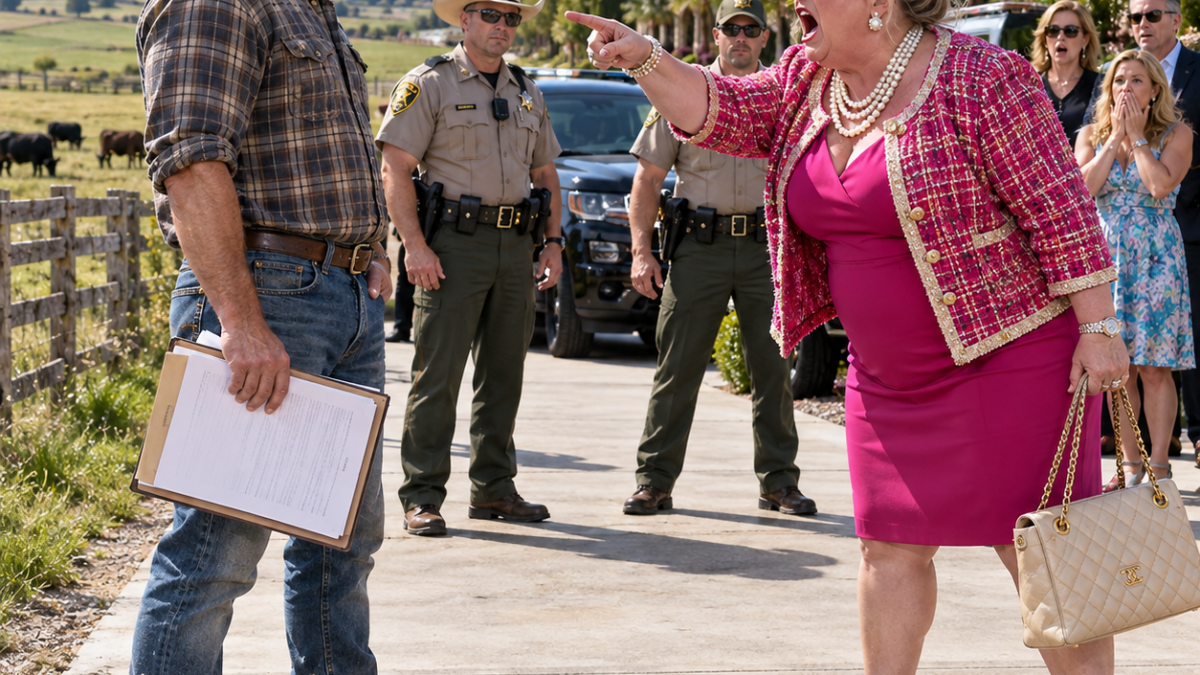
Marlene arrived within twenty minutes.
Her Lexus came down my gravel driveway too fast and stopped in a cloud of dust.
She stepped out wearing cream slacks, a navy jacket, and heels no sane person would choose for a cattle ranch.
“You cannot put those signs there.”
I was leaning against my truck holding Pete’s survey.
“Morning, Marlene.”
“Remove them.”
“They’re on my property.”
“That land belongs to Meadowbrook.”
I opened the survey.
“Funny thing about that.”
She crossed her arms.
“What?”
“Your entrance is fifty feet inside my recorded boundary.”
Her face changed.
Only slightly.
But enough.
“No, it isn’t.”
“Licensed surveyor says otherwise.”
“Your surveyor is wrong.”
“He’s using the same original record your subdivision plat references.”
Marlene stepped closer.
“You need to understand something, Jake. Fighting this will cost you more than your ranch is worth.”
I looked at her.
“My ranch was supposedly sold over eight hundred forty-seven dollars.”
“You failed to comply with community obligations.”
“I’m not part of your community.”
“The county record says you are.”
“For now.”
Her eyes narrowed.
I held up another paper.
“And I’m getting curious about why.”
She stared at it.
I had printed the county entry showing the administrative correction.
“Rebecca Torres,” I said.
Marlene went still.
“You know her?”
“No.”
That answer came too quickly.
I said nothing.
Marlene looked toward the signs.
Then back at me.
“You don’t know what you’re getting involved in.”
“Neither do you.”
For a moment, neither of us moved.
Then she smiled.
It wasn’t friendly.
“Take the signs down.”
“No.”
“You’ll regret this.”
She returned to her Lexus.
The tires threw gravel as she left.
I watched until the vehicle disappeared.
Then I called Sarah.
“She knows Rebecca Torres.”
“How do you know?”
“She lied before she had time to think.”
Sarah was quiet.
“That’s not evidence.”
“I know.”
“But it’s interesting.”
“Very.”
That evening Patricia came to the ranch.
She brought takeout and two banker boxes.
Emma and Tyler were already at the kitchen table.
Emma was eighteen, stubborn, practical, and too observant for my comfort.
Tyler was seventeen, quieter but relentless when a problem caught his attention.
I had tried to shield both of them from the worst details.
They’d found out anyway.
Teenagers have ways.
Patricia spread the documents across my grandfather’s old oak table.
“You’re not going to like this,” she said.
“That phrase is becoming popular.”
She ignored me.
“Rebecca Torres lives in Meadowbrook.”
I stopped.
“Where?”
“Three houses from Marlene.”
Emma looked up.
“Seriously?”
Patricia nodded.
“And that’s not all.”
She opened her laptop.
“Social media photos from 2019.”
Pictures appeared.
Marlene.
Rebecca.
A resort pool.
Palm trees.
Cocktails.
Patricia zoomed in on the caption.
CABO WITH MY FAVORITE TROUBLEMAKER.
Dated April 11, 2019.
Four days before Rebecca processed the correction placing my land under Meadowbrook jurisdiction.
I stared at the screen.
Tyler spoke first.
“That’s not a coincidence.”
“Maybe,” Patricia said. “Maybe not. Friendship alone proves nothing.”
Emma pointed at another photo.
“They were traveling together four days before she changed Dad’s property records.”
“Yes.”
Patricia looked at me.
“This is why Sarah told you not to confront anyone.”
I nodded.
“What else?”
She opened a second file.
“Rebecca wasn’t just involved with your parcel.”
That was the first moment I understood we were dealing with something bigger.
Three additional properties bordering Meadowbrook had received similar administrative corrections between 2019 and 2021.
Pete Kowalski’s horse pasture.
A tract owned by an elderly widow named Betty Morrison.
And another family farm farther south.
Together, the properties totaled nearly eight hundred acres.
All had strategic value.
Road access.
Development frontage.
Drainage control.
Potential expansion land.
All the corrections had passed through Rebecca Torres.
Emma whispered, “Dad…”
I looked at my children.
The worry on their faces hurt more than the legal notice ever could.
“This is our home,” Tyler said.
“I know.”
“They can’t take it, right?”
I wanted to give him the answer fathers are supposed to give.
Of course not.
Everything will be fine.
Instead, I told the truth.
“I’m going to do everything legally possible to make sure they don’t.”
Emma’s jaw tightened.
“And if they try?”
I looked toward the dark pasture beyond the window.
“Then they’re going to learn the Riverside family keeps records.”
The next move came from Marlene.
She called an emergency HOA meeting.
I wasn’t invited.
The board minutes reached Sarah three days later.
They read like someone had decided to manufacture a debt one line at a time.
Fifty dollars per day for agricultural structures that didn’t meet Meadowbrook architectural standards.
Fifty dollars per day for landscaping noncompliance.
Additional penalties for unauthorized livestock.
Retroactive assessments dating back to the 2019 “annexation.”
Twelve thousand dollars immediately due.
More accumulating every day.
Sarah laid the minutes on her desk.
“They’re building a foreclosure number.”
Patricia, sitting beside me, nodded.
“That’s exactly what it looks like.”
I stared at the paperwork.
“They already claim they sold the ranch.”
“The purported sale is under emergency restraint,” Sarah said. “If that fails, they’re creating alternative debt theories.”
“Why?”
“Because somebody wants leverage.”
I rubbed my face.
“What do they want me to do?”
Sarah looked at me.
“Panic.”
I laughed bitterly.
“Working.”
She leaned forward.
“Then stop giving them that.”
Her voice softened.
“Jake, I grew up on a farm. I know what land like yours means to a family.”
I looked at her.
“But right now you need to treat this like a mechanical failure. You don’t start swinging a hammer because the engine sounds wrong. You diagnose.”
That got my attention.
Sarah knew exactly how to speak to me.
“Follow the connection,” I said.
“Exactly.”
So we did.
Betty Morrison became our next witness.
She was eighty-three and lived east of my property in a farmhouse built long before Meadowbrook.
She invited me and Sarah to Murphy’s Diner.
Betty drank black coffee strong enough to strip paint.
“They came after my husband’s workshop,” she said.
“What happened?”
“Marlene said it violated Meadowbrook standards.”
“Are you in Meadowbrook?”
“Never have been.”
Sarah leaned forward.
“Was your parcel ever administratively reclassified?”
Betty smiled.
Not pleasantly.
“Rebecca Torres.”
Sarah and I looked at each other.
Betty pulled papers from an old handbag.
“They changed my record while I was in the hospital having a hip replaced.”
My stomach tightened.
“She claimed the property was temporarily inactive.”
Betty nodded.
“Then Meadowbrook started sending violation letters.”
“What did they want?”
“At first? The workshop gone.”
“And later?”
She stared at me.
“An easement.”
“Where?”
“Across the back of my property toward yours.”
Sarah’s pen stopped.
“Toward Jake’s ranch?”
Betty nodded.
“They said it was for future drainage planning.”
I looked at Sarah.
The pieces weren’t forming a complete picture yet.
But they were beginning to touch.
Road access.
Drainage.
My ranch.
Border properties.
A development company.
Maybe expansion was still the motive.
Then Sarah found the financial records.
Meadowbrook’s annual reports were dense enough to discourage curiosity.
That appeared to be the point.
Forty-seven luxury homes.
Landscaping.
Security.
Legal expenses.
Insurance.
Maintenance.
Reserve contributions.
Sarah handed me three years of reports and told me to look for anything strange.
I wasn’t an accountant.
But I knew when numbers didn’t fit.
One line caught my eye.
LEGAL CONSULTING SERVICES.
Year one: $264,000.
Year two: $291,000.
Year three: $292,000.
Total:
$847,000.
I stared at the figure.
A forty-seven-home subdivision had spent nearly a million dollars on legal consulting in three years.
I checked the vendor.
Whitfield & Associates Legal Services.
I called Patricia.
“Does Bradford have a law firm?”
“No.”
“Brother?”
“His sister’s husband.”
I closed my eyes.
Marlene’s husband, Bradford Whitfield, was a technology executive.
His brother-in-law apparently owned the firm receiving almost $847,000 from the HOA.
Sarah dug deeper.
The legal company had billed Meadowbrook for compliance matters, boundary disputes, acquisition consulting, and property strategy.
Property strategy.
That phrase sat badly with me.
Sarah circled it.
“So now we know they were spending enormous amounts on property-related legal work.”
“Paid to family.”
“Yes.”
“Can we sue?”
“We already are.”
“I mean really sue.”
Sarah smiled slightly.
“Jake, we’re only getting started.”
We hired a private investigator named Buck Hawkins.
Buck was a retired state trooper with gray hair, a weathered face, and the habit of speaking only after he’d decided words were necessary.
He spent two weeks following public corporate records, land filings, vendor connections, and business relationships.
Then he came to the ranch.
He carried one folder.
That worried me.
People like Buck needed only one folder when the contents were bad.
We sat at the kitchen table.
Emma and Tyler were at school.
Patricia joined by speakerphone.
Sarah sat across from Buck.
He opened the folder.
“Bradford Whitfield is a senior executive with Horizon Data Solutions.”
“I know.”
“Horizon has a contract with Chesapeake Energy Development.”
Sarah straightened.
“For what?”
“Geospatial analysis. Geological modeling. Acquisition targeting.”
I frowned.
“English, Buck.”
“They help energy companies identify land worth acquiring.”
I felt something cold move through me.
Buck slid a map across the table.
My ranch.
Colored zones ran beneath the pastures.
Geological formations.
Proposed access corridors.
Potential drilling sites.
Pipeline routes.
“What is this?”
“A preliminary energy-development assessment.”
Sarah looked at the date.
Eighteen months earlier.
My ranch had been identified as a high-value target for natural gas rights.
I stared at the projected numbers.
The estimated lease value over ten years exceeded $2.3 million.
For a moment, I heard nothing.
Not Sarah.
Not Buck.
Not Patricia through the phone.
Only the old refrigerator humming.
Finally I said, “They don’t want the subdivision.”
Buck shook his head.
“No.”
“They want what’s under the ranch.”
“Yes.”
Sarah studied the report.
“Who commissioned this?”
“Horizon performed the analysis for Chesapeake.”
“And Bradford had access?”
“His division handled part of the project.”
I leaned back.
Suddenly every ridiculous HOA violation made sense.
The barn.
The cattle.
The fines.
The manufactured classification.
The supposed foreclosure.
They didn’t care whether my pasture looked suburban enough.
They needed control of title.
Once they controlled the land, they could control the mineral rights.
My great-grandfather had spent his life worried about drought.
He had never imagined somebody would use fake HOA fees to steal what lay beneath the grass.
I walked outside alone.
The sun was lowering behind the west ridge.
Cattle grazed near the creek.
My father had taught me to fix fence along that creek.
My grandfather had taught my father.
When I was nine, Grandpa Riverside had taken me to the highest hill on the ranch and pointed across the pasture.
“Land isn’t just dirt, Jakey.”
He called me that until the day he died.
“Then what is it?”
“Time.”
I hadn’t understood.
He smiled.
“Someone spent time making this place worth something. Your great-granddad. Me. Your daddy. Someday you.”
I remembered kicking at the dirt with my boot.
“What if I don’t want to ranch?”
Grandpa laughed.
“Then don’t. But don’t let anybody take away your right to choose.”
Standing on that same hill forty years later, I finally understood.
Marlene wasn’t just trying to steal acreage.
She was trying to steal my children’s choice.
Emma might become a lawyer.
Tyler might work in technology.
Neither might ranch full-time.
That was their decision.
But if I let strangers manufacture ownership through fraudulent paperwork, my children wouldn’t get to decide anything.
Someone else would have chosen for them.
I went back inside.
Sarah was packing her files.
I looked at her.
“What do we do next?”
She closed the folder.
“Now we find proof of intent.”
Proof came from Betty Morrison.
The eighty-three-year-old widow had attended more Meadowbrook meetings than most Meadowbrook residents because she had spent years defending her property against them.
One evening she called me.
Her voice was shaking.
“Jake, I recorded something.”
“What?”
“You need to hear it.”
Sarah and I drove to Betty’s house.
She handed us her grandson’s phone.
The recording came from a board meeting held the previous week.
Betty had been present during an open portion and the phone continued recording as she gathered her belongings.
Marlene’s voice was unmistakable.
At first, she complained about delays.
Then one board member asked why they were spending so much money fighting rural property owners.
Marlene lost her temper.
“We have invested too much time and money in this project to let some hillbilly farmer ruin everything.”
I felt my jaw tighten.
Then came the sentence that changed the case.
“Bradford’s people are expecting those mineral rights transferred before the acquisition window closes. We cannot afford more delays.”
Sarah paused the recording.
Nobody spoke.
Betty looked at me.
“Is that what this is about?”
I stared at the phone.
“Yes.”
Sarah played it again.
Marlene’s voice.
Mineral rights.
Bradford.
Transfer.
No ambiguity.
Sarah leaned back.
“This is no longer just an ugly title dispute.”
I looked at her.
“What is it?”
“A possible conspiracy involving falsified public records, fraudulent liens, financial self-dealing, and an attempt to acquire valuable property through deception.”
Betty’s eyes widened.
“Federal?”
Sarah nodded carefully.
“Potentially. Especially if interstate companies, electronic communications, or federally protected property interests are involved.”
I thought about the map beneath my ranch.
The $2.3 million projection.
The forged jurisdiction.
The county clerk.
Bradford’s company.
“How far does this go?”
Sarah looked at the phone.
“We’re going to find out.”
The original Riverside land documents became critical.
Sarah ordered certified copies reaching back through the chain of title to the original grant and later recorded family protections.
For decades, my family had simply treated those documents as history.
Sarah treated them like ammunition.
One afternoon she called me into her office.
The original pages were spread beneath protective sleeves.
“Jake, your family retained the mineral estate.”
I nodded.
“Grandpa always said we owned everything under the fences too.”
“He was right.”
She pointed to the chain of title.
“No severance.”
“What does that mean?”
“Surface and minerals stayed together.”
I sat down.
“So whoever controls the ranch controls the gas rights.”
“Exactly.”
She moved to another document.
“And there are restrictions and federal interests in the old grant history that create additional problems for anyone attempting to use fraudulent title manipulation for speculative acquisition.”
“Problems how?”
“Potential federal jurisdiction, depending on what investigators establish.”
I looked through the glass at my great-grandfather’s name.
The ink was faded.
The paper older than my children by decades.
He had signed those documents with a hand that spent most days holding tools.
He wasn’t a lawyer.
He wasn’t wealthy.
He just knew that once a family finally had land, the worst thing it could do was stop protecting it.
I looked at Sarah.
“Send everything.”
“To whom?”
“Whoever needs to see it.”
She studied me.
“You sure?”
“Yes.”
Sarah nodded.
The referral went to federal investigators through counsel.
And from that moment, the fight changed.
We filed the quiet-title case aggressively.
Sarah asked the court to remove every fraudulent claim connecting my ranch to Meadowbrook.
She challenged the assessments.
The lien.
The purported foreclosure.
The registry correction.
At the same time, she expanded the civil action against the HOA and relevant participants.
Pete Kowalski joined with his property claim.
Betty joined.
Three other neighboring landowners joined.
Together, seven families had enough documentation to show a pattern.
Marlene had expected isolated rural owners.
What she got was a coalition.
Pete jokingly called us the Grudge Squad.
Sarah hated the name.
Betty loved it.
I pretended I didn’t.
The whole town started paying attention.
Murphy’s Diner put a coffee jar beside the register for legal-defense donations.
The hardware store owner taped a handwritten sign to his window:
WE STAND WITH LOCAL LANDOWNERS.
The Farmers Association offered expert witnesses.
Then Tom Bradley, editor of the county newspaper, published the first story.
RURAL LANDOWNERS CHALLENGE MEADOWBROOK PROPERTY GRAB.
The article included photographs of my ranch, copies of public filings, and interviews with Betty and Pete.
It spread beyond the county.
Agricultural publications picked it up.
Then a regional television station called.
Marlene stopped being able to control the story through HOA newsletters.
That made her dangerous.
The first anonymous complaint arrived with the fire marshal.
A caller had reported illegal fuel storage.
The marshal inspected my diesel tank.
Permit current.
Containment compliant.
No violation.
Two days later, environmental officials appeared after an anonymous complaint claimed I was contaminating the creek.
They sampled water.
Checked grazing practices.
Reviewed manure management.
Nothing.
A week after that, an IRS notice arrived concerning alleged unreported agricultural income.
Patricia looked at it across the kitchen table.
“They’re trying to drown you in process.”
I nodded.
“Sarah says cooperate with everything.”
“She’s right.”
I rubbed my face.
“Doesn’t make it cheaper.”
Every inspection meant time away from work.
Every response meant more legal bills.
Every allegation made my children wonder what would happen next.
Then the sabotage began.
I smelled the oil before I saw it.
One morning I approached the main cattle trough and caught the sharp chemical scent.
A rainbow sheen moved across the water.
My stomach dropped.
I shut the supply line.
Called the veterinarian.
Then Buck.
Thirty cattle stood nearby, thirsty and confused.
We brought emergency tanks.
Flushed the system.
Tested water.
Documented everything.
The vet examined the herd.
Thankfully, we’d caught it early.
But whoever contaminated that trough had crossed a line far beyond paper harassment.
They had risked living animals.
I stood beside the water system with fists clenched.
Buck looked at me.
“Don’t do anything stupid.”
“I know.”
“You’re thinking about it.”
“I know.”
He pointed toward the cameras we’d recently added.
“This is why we record.”
No useful face appeared on the main camera.
Whoever approached the trough understood the property.
That worried Buck.
Then three nights later, somebody cut my east fence.
Not once.
Three separate sections.
Thirty cattle wandered toward County Road 18 before dawn.
I woke to air horns.
Tractor-trailers braking.
Cattle scattering across pavement.
For thirty terrifying minutes, I thought somebody was going to die.
Neighbors arrived in pickups.
Pete brought horses.
Tyler and I drove cattle away from traffic.
Emma opened gates and helped funnel them toward the south pasture.
By sunrise, the herd was secured.
Nobody had been killed.
One calf had a minor leg injury.
I stood beside the road shaking.
Not from cold.
From the knowledge that somebody had intentionally created that danger.
Buck checked the new camera system.
The main cameras showed a dark figure avoiding obvious coverage.
Professional enough to recognize surveillance.
But we had wildlife cameras near the creek.
The saboteur hadn’t known.
At 2:15 a.m., one camera captured a Mercedes parked beside the county road.
License plate visible.
Bradford Whitfield.
Two minutes later, another camera caught him entering my property with bolt cutters.
Buck paused the footage.
“Well.”
I stared at the screen.
Marlene’s husband.
Tech executive.
Neighbor.
Future ex-husband, though none of us knew that yet.
He had personally cut my fence and endangered my cattle.
Buck looked at me.
“You’re not calling him.”
“No.”
“You’re not driving to his house.”
“No.”
“You’re giving this to law enforcement.”
“Yes.”
He nodded.
“Good.”
Then I added, “After I make twelve backups.”
Buck smiled.
“Now you’re learning.”
Bradford’s footage went to investigators.
The confrontation I expected never came.
Instead, the bureaucratic attacks intensified.
Twenty-three complaints reached different agencies over roughly six weeks.
Animal welfare.
Fire safety.
Tax issues.
Water use.
Child welfare.
Agricultural permits.
Noise.
Chemical storage.
Traffic.
Some were anonymous.
Others used false names.
Most collapsed quickly under inspection.
But each required time.
And each created fear.
The worst involved my children.
An anonymous report alleged Emma and Tyler were living in unsafe conditions.
A social worker came to the ranch.
Then another.
They interviewed my children.
Inspected buildings.
Asked about firearms storage, farm equipment, school attendance, food, supervision, and my emotional stability.
I answered everything.
I cooperated.
Then I went into the barn afterward and punched a wooden post so hard my knuckles split.
Not because the social workers were wrong to investigate.
They were doing their job.
Because somebody had deliberately dragged my children into a property scam.
Emma found me wrapping my hand.
“Dad.”
“I’m fine.”
“You’re bleeding.”
“Still fine.”
She took the bandage away and redid it properly.
“You know this isn’t your fault.”
I looked at her.
I didn’t answer.
She tightened the wrap.
“They’re doing this because you’re winning.”
“No.”
“Yes.”
“Emma—”
She met my eyes.
“They couldn’t beat you on the deed, so they’re trying to scare us.”
I hated hearing my daughter understand people that clearly.
“Are you scared?”
She considered it.
“Yes.”
My chest tightened.
Then she continued.
“But I’m not leaving.”
I looked at her.
“This is your home too.”
She nodded.
“Exactly.”
Patricia surprised everybody.
Rumors had begun appearing online claiming I was unstable, violent, abusive, and dangerous.
Fake profiles repeated the same accusations.
One post claimed our divorce proved Patricia had fled an abusive marriage.
I wanted to ignore it.
Patricia didn’t.
She wrote a public statement.
She said we’d divorced because two stubborn people had grown apart, not because I had ever harmed her.
She called me one of the hardest-working men she’d known.
She said anyone using our divorce to attack my character was lying.
The post spread.
Old customers from the diesel shop commented.
Ranchers.
Teachers.
Neighbors.
People I’d helped twenty years earlier.
The smear campaign backfired.
One evening Patricia and I sat on the porch after the kids went inside.
“I never thought you’d be defending me on Facebook,” I said.
She smiled.
“I never thought you’d need me to.”
“Thanks.”
She looked across the pasture.
“You were a terrible husband sometimes.”
I laughed.
“So were you.”
“Exactly.”
Then she became serious.
“But you were never what they’re saying.”
I nodded.
Patricia looked at the house.
“This place mattered to us once.”
“Still does.”
“Yes.”
She turned toward me.
“And those kids matter more.”
“I know.”
“Then finish this.”
I looked at her.
“I intend to.”
The $50,000 settlement offer arrived through an intermediary attorney.
Sarah read it aloud.
The HOA and associated parties would resolve certain claims if I dismissed litigation, limited public statements, and conveyed the mineral interests to a development entity.
Compensation:
Fifty thousand dollars.
Sarah finished reading.
Nobody spoke.
Then Betty started laughing.
She laughed so hard she coughed.
“Fifty thousand?”
Pete grinned.
“For two-point-three million in projected rights?”
Sarah set down the letter.
“It’s not funny.”
Betty wiped her eyes.
“It’s a little funny.”
I stared at the offer.
Months earlier, I might not have known what those mineral rights were worth.
That was what they were counting on.
They still thought I was the same man who had opened an $847 foreclosure notice beside a broken fence and wondered whether the paperwork meant I had already lost.
I handed the offer back.
“No.”
Sarah nodded.
“I expected that.”
“No counter.”
“Good.”
“No private compromise that leaves Betty or Pete exposed.”
Sarah smiled slightly.
“Also good.”
“And no confidentiality clause.”
She leaned back.
“Now you’re thinking like a lawyer.”
“Don’t insult me.”
Betty laughed again.
The offer became even more damaging when additional recordings and communications emerged through lawful investigative processes.
Marlene had pressed the intermediary to increase pressure.
Her recorded words were chilling.
Threaten bankruptcy.
Threaten the children’s college funds.
Get the mineral rights transferred before investigators went deeper.
The moment Bradford realized how much evidence existed, his loyalty collapsed.
He retained separate counsel.
Horizon Data Solutions issued a statement distancing the company from any improper HOA activity.
Bradford filed for divorce.
Marlene’s board members began resigning.
The woman who had controlled Meadowbrook through fear suddenly found herself alone.
But she still wasn’t finished.
Desperate people rarely stop because stopping requires admitting they lost.
The county commission scheduled a public hearing for October 15.
By seven that morning, people were already outside the courthouse.
Farmers in clean button-down shirts.
Meadowbrook homeowners who had begun questioning their own board.
Reporters.
Local business owners.
Retired county employees.
Families from neighboring towns.
Betty arrived wearing her late husband’s bolo tie.
Pete brought a folder big enough to require both hands.
Patricia sat between Emma and Tyler.
I arrived with Sarah and Buck.
The courthouse smelled like coffee, old paper, and nervous sweat.
Marlene entered fifteen minutes late.
Her attorney walked beside her.
She wore a dark suit.
No smile.
Her face looked thinner.
For the first time, I understood that consequences had been working on her even before any final judgment.
I didn’t enjoy that.
I had imagined I would.
Instead, I mostly felt tired.
Sarah leaned toward me.
“You okay?”
“Ask me after.”
Commissioner Williams called the meeting to order.
The room went silent.
Then Sarah began.
She started with the land.
Not Marlene.
Not the insults.
Not the mineral rights.
The land.
She displayed the original Riverside chain of title.
Then the county record.
Then the 2019 administrative correction.
No owner notice.
No legitimate abandonment.
No evidence that I had consented to HOA jurisdiction.
Next came my timesheets from Morrison’s Diesel.
One justification supporting the record change implied I’d been absent from active ranch operations.
The time records showed I had worked locally every week.
Agricultural filings showed continuous cattle operations.
Tax records showed the property had never been abandoned.
Then Sarah displayed Rebecca Torres’s connection to Marlene.
The neighborhood address.
The travel photographs.
The repeated administrative corrections involving other rural properties.
Betty’s.
Pete’s.
The others.
A pattern.
Marlene shifted in her chair.
Sarah moved to the money.
$847,000 in HOA legal consulting.
Whitfield family connection.
Contracts.
Property strategy.
Then the geological assessment.
My ranch highlighted as a high-value acquisition target.
Projected mineral value.
$2.3 million.
A murmur swept through the chamber.
Sarah waited.
Then she showed the acquisition planning documents indicating an expectation that control of the property would pass to a Meadowbrook-related development entity.
Commissioner Williams stared at the screen.
“This existed before Mr. Riverside received the foreclosure notice?”
“Yes.”
“How long before?”
“Months.”
Another commissioner leaned toward his microphone.
“So negotiations concerning mineral exploitation were progressing while the owner had no knowledge his property was supposedly inside the HOA?”
Sarah nodded.
“That is our evidence.”
People began whispering.
Marlene’s lawyer wrote furiously.
Then came the audio.
Marlene’s voice filled the chamber.
“We have invested too much time and money in this project to let some hillbilly farmer ruin everything.”
The room reacted immediately.
Sarah raised a hand.
People quieted.
The recording continued.
Bradford’s connections.
Mineral rights.
Deadlines.
Transfer expectations.
Then the second recording.
Threaten him with bankruptcy.
Threaten his children’s college funds.
Get the rights transferred.
I watched Marlene.
Her face lost color.
For months, I had imagined this moment.
Her lies collapsing in front of everyone.
I thought I’d feel powerful.
Instead, I looked at Emma.
She was holding Patricia’s hand.
Tyler stared straight ahead.
Those threats had involved them.
Their education.
Their home.
Their future.
My anger returned.
But beneath it was something steadier.
Relief.
The truth was finally outside my kitchen.
Outside Sarah’s office.
Outside confidential investigative files.
People could hear it.
Sarah documented the sabotage.
The contaminated trough.
The cut fence.
Bradford’s Mercedes.
The wildlife-camera image of him crossing onto the ranch.
The false regulatory complaints.
The cyber harassment.
The attempts to surveil our communications.
She didn’t turn the presentation into theater.
She didn’t need to.
The facts were dramatic enough.
When she finished, Commissioner Williams looked toward Marlene.
“Mrs. Whitfield, do you wish to respond?”
Her lawyer whispered urgently.
Marlene stood anyway.
“This is a witch hunt.”
Her voice cracked.
She pointed toward me.
“That man has refused every effort to improve the appearance and value of this community.”
I stayed seated.
“My agricultural operation is not a subdivision,” I said.
She ignored me.
“His cattle lower residential values. His structures are incompatible with Meadowbrook standards. His land has been underutilized for years.”
Betty shouted from the audience.
“It was a ranch before your houses existed!”
Several people applauded.
Williams struck the gavel.
“Order.”
Marlene kept speaking.
“We were trying to create economic opportunity.”
Sarah stood.
“By acquiring mineral rights from a man who didn’t agree to sell them?”
Marlene looked at her.
“You don’t understand development.”
Sarah’s expression didn’t change.
“No, Mrs. Whitfield. I understand property ownership.”
That line ended Marlene’s argument more effectively than shouting ever could.
Then the rear door opened.
Two federal agents entered with local officers.
The lead agent approached the front.
Her name was Special Agent Rebecca Hale.
She did not make a speech.
Real arrests rarely come with speeches.
She identified herself, confirmed Marlene’s identity, and informed her that a federal arrest warrant had been issued in connection with the ongoing fraud investigation.
The room went silent.
Marlene’s attorney stood.
The agents remained calm.
The warrant addressed allegations including conspiracy and fraudulent schemes involving property acquisition and related financial transactions.
The exact charges would be litigated later.
But the meaning of the moment required no explanation.
Marlene turned toward Bradford.
He wasn’t there.
For years, she had relied on family connections.
County friends.
Board allies.
Corporate relationships.
Now nobody stood beside her except her attorney.
The agents secured her hands.
Camera shutters clicked.
I remained seated.
Betty began crying.
Pete put an arm around her.
Emma looked at me.
“Dad.”
I nodded.
She whispered, “Is it over?”
I looked toward Marlene.
Then at Sarah.
“No.”
Not yet.
But the fear had changed sides.
Outside the courthouse, reporters surrounded us.
Sarah warned me to keep my statement short.
I stepped to the microphones.
For a moment, I saw my reflection in a camera lens.
Work shirt.
Old jacket.
Hands still rough from fence repairs.
Exactly the kind of man Marlene had assumed would never understand what she was doing.
I thought about my great-grandfather.
Then I spoke.
“This was never about a farmer fighting an HOA because he didn’t like rules.”
The crowd quieted.
“It was about whether somebody can manufacture debt, manipulate public records, and take land from a family that never agreed to surrender it.”
I paused.
“My great-grandfather worked this ranch. My grandfather protected it. My father protected it. I intend to leave my children the same thing they left me.”
I looked toward Emma and Tyler.
“The right to choose what happens to their home.”
That was all.
No victory speech.
No insults.
No celebration of Marlene’s arrest.
I stepped away from the microphones.
Sarah smiled.
“That was good.”
“I had practice.”
“Where?”
“Talking to cattle.”
She laughed for the first time all day.
The criminal cases took months.
There were plea negotiations.
Hearings.
Motions.
Separate counsel.
Financial examinations.
Additional evidence.
Rebecca Torres, the deputy county clerk who had processed the questionable property corrections, was terminated and later faced charges tied to falsification of public records and related misconduct.
Bradford’s conduct became part of separate investigations concerning sabotage, surveillance, and business dealings.
Horizon Data Solutions faced scrutiny concerning how proprietary geological data had been used.
Marlene ultimately pleaded guilty to federal conspiracy-related charges under an agreement that resolved significant portions of the case.
She received eighteen months in federal custody followed by three years of supervised release.
Some people thought the sentence was too short.
Others thought seeing a fifty-eight-year-old woman go to federal prison was punishment enough.
I stopped caring about the number.
Prison time couldn’t give me back the months my children spent wondering whether we’d lose our home.
It couldn’t erase Emma’s child-welfare interview.
It couldn’t make Tyler forget the night cattle spilled onto the highway.
It couldn’t restore Betty’s years of fear.
What mattered to me was the title.
And one cold morning, Sarah called.
“Jake.”
I was repairing a hydraulic line.
“What?”
“It’s clear.”
I stopped moving.
“What’s clear?”
“Your title.”
For a second, I couldn’t breathe.
She laughed.
“Thirty-two hundred acres. Riverside Ranch. No Meadowbrook jurisdiction. Fraudulent lien discharged. Purported foreclosure invalidated.”
I sat down on the shop floor.
My knees had gone weak.
“Say it again.”
“Your ranch is yours.”
I closed my eyes.
Around me, air tools rattled.
An engine started.
Somebody shouted across the shop.
Ordinary noise.
But I could hear my grandfather.
Don’t let anybody take away your right to choose.
I covered my face with one hand.
And cried.
That evening, Emma and Tyler came to the ranch.
Patricia followed.
I had placed the court order in the center of the kitchen table.
Tyler read it first.
Then Emma.
She looked at me.
“So they can’t claim us anymore?”
“No.”
“No HOA?”
“No.”
“No lien?”
“Gone.”
Emma started crying.
Then she crossed the room and hugged me.
Tyler joined us.
Patricia stood nearby wiping her eyes.
I pulled her in too.
The four of us hadn’t hugged like that since before the divorce.
For one strange, beautiful minute, there was no ex-wife.
No custody schedule.
No legal case.
No HOA.
Just a family standing in the kitchen of the home we’d nearly lost.
Patricia whispered, “Your grandfather would be proud.”
I looked around the room.
His oak table.
My mother’s pantry labels.
The dent in the baseboard from Tyler’s toy tractor when he was four.
Emma’s height marks beside the doorway.
“We’re staying,” I said.
Emma laughed through tears.
“We weren’t going anywhere.”
The civil resolution came later.
The HOA and other responsible parties were ordered or agreed to substantial damages, fees, and restitution-related obligations.
My recovery totaled roughly $347,000 across damages, legal costs, and related awards.
It sounded enormous.
Then I looked at the invoices.
Experts.
Surveyors.
Attorneys.
Lost work.
Equipment repairs.
Veterinary bills.
Security.
The number became less glamorous.
Still, it mattered.
Not because I wanted Meadowbrook homeowners punished.
Most of them had never known what Marlene was doing.
In fact, many were victims too.
Their dues had been funneled into questionable legal and consulting arrangements.
Their names had been used to justify a scheme they never approved.
When the new Meadowbrook board approached me, I refused to demand anything that would force innocent families from their homes.
That mattered to me.
Marlene had treated property ownership like a weapon.
I wasn’t going to become her by using the judgment to hurt people who hadn’t participated.
Instead, the responsible individuals and entities bore the consequences.
Assets were liquidated where necessary.
Insurance applied where appropriate.
Improper contracts were terminated.
Family-connected vendors lost their lucrative arrangements.
Meadowbrook homeowners elected new leadership.
And the subdivision itself survived.
That was justice.
Not collective revenge.
The biggest financial surprise came from Chesapeake.
Once the scandal became public, the company worked hard to distance itself from any fraudulent acquisition strategy.
Its lawyers contacted Sarah.
They still wanted access to the natural gas beneath part of my property.
This time, however, nobody pretended I had no choice.
They made a legitimate offer.
Sarah negotiated for months.
Environmental protections.
Surface-use limits.
Water safeguards.
Restoration obligations.
No unrestricted roads.
No surprise assignments.
And a financial package projected at approximately $2.8 million over fifteen years if production targets were met.
I sat across from Sarah.
“Should I sign?”
She smiled.
“That’s the first question in this whole story nobody else gets to answer for you.”
I drove home without deciding.
That evening, I walked the ranch.
The creek.
The west ridge.
The barn.
The pasture where my father taught me to drive.
I stopped at my great-grandfather’s grave marker near the cottonwoods.
“I don’t know what you’d do,” I said aloud.
The wind moved through the grass.
No answer.
Which was probably appropriate.
The whole point of what he left us was the right to choose.
I negotiated harder.
Protected the surface.
Reserved large portions from development.
And eventually signed a limited lease on terms my family could live with.
For the first time, money beneath the ranch would benefit the Riverside family because the Riverside family chose it.
That distinction meant everything.
The county changed too.
The scandal embarrassed officials badly enough that reform became unavoidable.
New procedures required meaningful notice before administrative property classifications could be changed.
Owners received appeal periods.
Higher-level review became mandatory for changes affecting HOA jurisdiction or long-established agricultural parcels.
People jokingly called the reforms the Riverside Protocol.
I hated the name.
Emma loved it.
“You have a protocol, Dad.”
“I don’t want a protocol.”
“Too late.”
Tyler laughed.
“Better than a roundabout.”
I pointed at him.
“Don’t give the county ideas.”
For the first time in a year, we could joke about the case.
That felt like progress.
Sarah was appointed to a county property-rights review board.
Pete continued surveying.
Betty became something of a local legend.
At eighty-three, she attended every public meeting and sat in the front row.
Nobody ignored her anymore.
One afternoon she stopped at the ranch.
“You did good, Jake.”
“We did.”
She waved away the credit.
“I’m old. I supplied coffee and recordings.”
“You supplied courage.”
She looked toward the pasture.
“Your granddad once fixed our well pump during a drought.”
I hadn’t known that.
“He wouldn’t take money.”
“That sounds like him.”
Betty nodded.
“He told my husband neighbors don’t keep score.”
She looked at me.
“Marlene kept score about everything.”
“Property values. Violations. Fines.”
“Power.”
I nodded.
Betty smiled.
“Don’t become her.”
I looked at her.
“I won’t.”
That was probably the most important warning anybody gave me.
With part of the settlement and eventual lease income, I created the Homestead Heritage Foundation.
The name was Emma’s idea.
The purpose was simple.
Help rural landowners who received the kind of letter I had received.
People with land but little cash.
People facing developers, fraudulent claims, predatory contracts, or bureaucratic errors.
We funded title searches.
Survey work.
Initial legal consultations.
Document preservation.
Not every case involved corruption.
Sometimes the government was right.
Sometimes the landowner was wrong.
But nobody should lose a family property merely because they lacked money to understand the paperwork.
The foundation’s first major case helped a Nebraska farmer challenge a questionable water-rights claim.
When Sarah told me they’d kept the farm, I sat on my porch smiling for ten minutes.
That victory felt almost better than my own.
Because it proved what happened to us didn’t have to end at our fence line.
Emma changed her college plans.
She had intended to study business.
One evening she came into the barn while I was repairing a feed gate.
“Dad.”
“Yeah?”
“I changed my major.”
I looked at her.
“To what?”
“Agricultural policy.”
I set down the wrench.
“You sure?”
“Yes.”
“Because of this?”
“Partly.”
She leaned against the stall.
“I watched Sarah save our ranch with documents nobody else bothered to read.”
“Sarah would say the documents saved the ranch.”
“Exactly.”
Emma smiled.
“I think I want to go to law school.”
I looked at my daughter.
For a moment, I imagined her standing in Sarah’s office ten years from now, helping another family.
My throat tightened.
“You know lawyers work terrible hours.”
She laughed.
“You worked eighteen-hour days fixing trucks and cattle.”
“Fair.”
“And I get my stubbornness from you.”
“That part is unfortunate.”
She hugged me.
I held on longer than she expected.
“Dad?”
“Just proud of you.”
Her voice softened.
“I know.”
Tyler took a different path.
The strange network surveillance during the case had fascinated and terrified him.
He began studying cybersecurity.
By the time he started college, he was already helping the foundation think about document backups, digital security, and evidence preservation.
One afternoon he showed me a secure system he’d built for landowners to upload deeds, notices, photographs, and correspondence.
I stared at the screen.
“Your great-great-grandfather used a metal box under his bed.”
Tyler smiled.
“Different century.”
“His never needed software updates.”
“His also wouldn’t survive a house fire.”
I considered that.
“Fair point.”
He turned serious.
“You always say documentation saved us.”
“It helped.”
“Then people need somewhere safe to keep it.”
I looked at him.
Same enemy, different war.
He had said that months earlier.
He’d been right.
Patricia and I didn’t remarry.
People assumed we would.
Small towns love tidy endings.
Life isn’t always tidy.
What did happen was better.
We became friends again.
Real friends.
The kind we probably should have been before we tried so hard to remain married.
She continued helping the foundation as a paralegal consultant.
We ate dinner as a family more often.
Birthdays became easier.
Holidays stopped feeling like scheduling negotiations.
One evening, after Emma left for college and Tyler was working late on a computer project, Patricia and I sat on the porch.
“You know,” she said, “Marlene accidentally improved our divorce.”
I laughed.
“That may be the worst compliment anybody’s ever given her.”
Patricia smiled.
“We spent years arguing about little things.”
“True.”
“Then someone tried stealing the ranch and suddenly we remembered what mattered.”
I looked toward the sunset.
“I’m sorry.”
“For what?”
“For the years I made everything harder than it needed to be.”
She was quiet.
Then she said, “Me too.”
We didn’t need more.
Some endings don’t require people to reverse the past.
They require them to understand it.
A year after the first foreclosure notice, we held the first Freedom Ranch Day.
It wasn’t supposed to become a tradition.
I invited the families who had helped us.
Pete brought his horses.
Betty brought pies.
Murphy’s Diner donated coffee.
The hardware store brought folding tables.
Sarah arrived late because lawyers are apparently incapable of attending anything on time unless a judge orders them.
More than four hundred people showed up.
The next year, eight hundred.
Children learned about cattle.
Farmers discussed property records.
Attorneys volunteered for short consultations.
Families walked the creek.
Musicians played near the barn.
No political speeches.
No angry chants.
Just people celebrating land, work, and the right to make decisions about your own property.
Near the entrance, we installed a small plaque.
PRESERVED FOR FUTURE GENERATIONS BY THE RIVERSIDE FAMILY.
AMERICAN FARMERS SINCE 1960.
I stood beside it with Emma and Tyler.
Emma touched the lettering.
“Grandpa would’ve liked this.”
“My grandfather?”
“Your dad too.”
I nodded.
All of them.
I also placed five hundred acres under a conservation easement.
That surprised people.
“Why restrict your own land after fighting so hard against restrictions?” a reporter asked.
I smiled.
“Because there’s a difference between choosing a restriction and having one forced on you through fraud.”
The conservation area protected creek habitat, old pasture, and part of the west ridge.
It couldn’t become another luxury subdivision after I died.
Emma and Tyler approved.
That mattered.
We were not freezing the whole ranch in 1960.
We were protecting enough of it so future generations would always know what the land had been.
Choice again.
It kept coming back to choice.
Marlene eventually disappeared from local public life.
Her federal sentence became part of the record.
Bradford lost money through the collapse of their marriage, legal costs, restitution exposure, and the consequences of his own choices.
I never followed his life closely.
I had spent enough time thinking about the Whitfields.
Rebecca Torres faced her own consequences for public-record misconduct.
Meadowbrook elected a completely different board.
The new president was a retired school principal named Helen Carver.
The first time she visited my ranch, she arrived in sensible boots.
That immediately improved my opinion of her.
“Mr. Riverside.”
“Jake.”
She smiled.
“Jake. I came to discuss the entrance.”
I laughed.
“The fifty feet?”
“The fifty feet.”
The Meadowbrook monument still encroached onto my side of the line.
Legally, I had options.
I could demand removal.
I could charge for an easement.
I could use the leverage to make the new board miserable.
For months, people joked that I should fence off their entrance and make everyone drive through a cattle gate.
I didn’t.
Helen and I negotiated a proper easement.
Fair terms.
Recorded boundaries.
Maintenance obligations.
A modest annual payment to the foundation.
When Sarah reviewed it, she looked at me.
“You realize revenge would have been more dramatic.”
“I’ve had enough drama.”
She smiled.
“Good answer.”
I signed.
Meadowbrook kept its entrance.
My title stayed clear.
The relationship began again on honest paperwork.
That’s how it should have been from the start.
There was one thing I did refuse.
Helen offered to rename a small Meadowbrook park after my family.
I laughed.
“No.”
“Why?”
“Because I don’t live in Meadowbrook.”
She laughed too.
“Fair enough.”
Then she looked serious.
“I want you to know something. Most of us had no idea what Marlene was doing.”
“I know.”
“Some residents feel ashamed.”
“They shouldn’t.”
Helen studied me.
“You could have gone after the whole neighborhood.”
“For what?”
“Your damages.”
I looked toward the subdivision.
Forty-seven homes.
Families.
Retirees.
Children.
People who had paid dues to an organization they believed was legitimate.
“Marlene tried to take my home because she saw property as leverage.”
I looked back at Helen.
“I wasn’t going to prove her wrong by doing the same thing to innocent people.”
Helen’s eyes filled.
“Thank you.”
I shook my head.
“Just run the HOA honestly.”
She smiled.
“We intend to.”
That decision mattered to me.
The original title people repeated online made the story sound simpler.
HOA SOLD FARMER’S RANCH—FARMER TAKES THEIR HOMES.
It was catchy.
It was also wrong.
I never wanted every Meadowbrook family homeless.
Most had nothing to do with Marlene’s scheme.
Some had been manipulated by her.
Others had questioned her privately and been ignored.
Several later provided evidence that helped us.
My lawful revenge wasn’t selling innocent families’ houses.
It was better.
I made the fraudsters answer to the law.
I cleared my deed.
Recovered damages.
Exposed the financial scheme.
Protected neighboring landowners.
Negotiated the mineral lease on my terms.
And helped build protections so the same trick would be harder to use against someone else.
Anyone can destroy.
Building something after you’ve been hurt is harder.
That’s the part Grandpa would have understood.
On the second anniversary of the certified letter, I walked to the north fence.
The same section I’d been repairing when the mail carrier arrived.
The post I’d been working on was still there.
Weathered now.
Straight.
I put one hand on it.
Across the pasture, cattle moved slowly toward water.
The creek reflected the morning sky.
Nothing looked extraordinary.
That was what made it beautiful.
Emma was home from college.
She came walking up behind me.
“You getting sentimental over a fence post?”
“Yes.”
“Should I be worried?”
“Probably.”
She stood beside me.
“This is where you got the letter?”
“Right here.”
She looked across the ranch.
“What did you think when you read it?”
I considered the question.
“That I’d failed.”
She turned toward me.
“Failed who?”
“You. Tyler. Grandpa. Everybody.”
Her face softened.
“Dad.”
“I thought I’d let someone take it while I wasn’t looking.”
Emma put her arm around me.
“But they didn’t.”
“No.”
“Because you looked.”
I laughed quietly.
“Eventually.”
She leaned her head against my shoulder.
For a while, we stood in silence.
Then she said, “You know what I remember?”
“What?”
“That first night at the kitchen table. Tyler asked if they could take the ranch.”
I nodded.
“You said you’d do everything legally possible to stop them.”
I looked at her.
“You did.”
My eyes burned.
I looked away toward the cattle.
Sometimes children don’t understand how much power their words have over their parents.
Maybe that’s for the best.
Later that afternoon, Tyler arrived from college.
He brought a new camera system for the foundation office.
Patricia came with dinner.
Sarah stopped by after a hearing.
Betty arrived with pie even though she’d been explicitly told not to cook for twenty people.
Pete brought beer.
We ended up around the old oak kitchen table.
The same table where I had spread the foreclosure notice.
The same table where Patricia had found the fraudulent pattern.
Where Sarah had explained the mineral rights.
Where my children had asked whether they were going to lose their home.
Now it held plates, laughter, and too much food.
I looked around.
These people had become part of the ranch’s history.
Not because we won money.
Not because Marlene went to prison.
Because when someone tried to separate us through fear, we did the opposite.
We showed up.
Betty raised her coffee mug.
“To Jake.”
I shook my head.
“No.”
Everyone looked at me.
I raised my own glass.
“To people who keep copies.”
They laughed.
Then Sarah added, “And hire lawyers.”
More laughter.
Pete raised his beer.
“And surveyors.”
Tyler said, “And cybersecurity.”
Emma rolled her eyes.
Patricia lifted her glass.
“To family.”
The room quieted.
We all drank to that.
As the sun went down, I stepped onto the porch.
The sky turned orange above the pasture.
The smells were the same ones I’d known all my life.
Hay.
Dust.
Cattle.
Earth.
A faint trace of diesel from the barn.
For months, Marlene had talked about those things as though they were evidence I didn’t belong beside her subdivision.
She called agriculture incompatible.
She saw worn boots and old barns and decided they were inferior to stone entrances and manicured lawns.
What she never understood was that every rough board on my barn had earned its place.
Every fence had been repaired because an animal depended on it.
Every scar on my hands had a reason.
And every acre had survived because someone before me chose not to surrender it.
My phone buzzed.
A message from a farmer in Oregon.
He had received a strange notice claiming a development association had authority over part of his property.
He’d found the Homestead Heritage Foundation online.
Could we help?
I looked toward the kitchen.
Sarah was laughing at something Betty said.
Emma was arguing with Tyler.
Patricia was packing leftovers.
I typed three words.
Send everything you have.
Then I changed it.
Send every document you have.
Better.
People sometimes ask whether I hate Marlene.
I don’t.
Hate requires maintenance.
You have to feed it.
Check it.
Carry it.
I already have cattle.
I don’t need another thing to feed.
What I feel is something more useful.
Certainty.
Certainty that her behavior was wrong.
Certainty that she underestimated the people she targeted.
Certainty that systems fail when nobody checks them.
And certainty that honest people can still win without becoming cruel.
Marlene believed power meant controlling the rules.
I learned power can mean knowing them.
She believed money could purchase enough paperwork to turn theft into ownership.
I learned paperwork can also expose theft.
She believed my family history made me old-fashioned.
But the old records she dismissed were part of what saved us.
She believed a mechanic couldn’t understand a multimillion-dollar land scheme.
But mechanics spend their lives diagnosing systems.
You follow the leak.
You trace the wire.
You test each connection.
You don’t stop at the broken part.
You ask what caused it to break.
That was all I did.
Follow the connections.
The last document I framed wasn’t the judgment.
It wasn’t Marlene’s conviction.
It wasn’t the $347,000 award.
It wasn’t the mineral lease.
It was a copy of my great-grandfather’s old land record.
I hung it in the ranch office.
Beneath it, I placed a photograph of him.
Work shirt.
Suspenders.
Dusty boots.
He was standing beside a wooden fence with a shovel in one hand.
He looked tired.
Proud.
Ordinary.
The kind of man Marlene would probably have dismissed without a second glance.
I sometimes stand in front of that photograph after everyone goes home.
I think about how little he had when he started.
How much weather he endured.
How many years he worked without knowing whether the ranch would survive another generation.
He couldn’t have imagined computers changing property records.
Or geological satellites.
Or private investigators.
Or federal fraud cases.
He wouldn’t have understood cybersecurity.
But he understood the thing beneath all of it.
People will sometimes try to take what you have.
Know what belongs to you.
Take care of it.
And don’t sign it away because somebody in a nicer suit tells you you’re too ignorant to understand.
One October evening, during Freedom Ranch Days, I climbed the west hill.
Eight hundred people were spread across the property below.
Children ran between picnic tables.
Local musicians played near the barn.
Cattle grazed beyond the temporary fencing.
Sarah was answering questions beneath the foundation tent.
Emma was speaking with a farmer about agricultural law.
Tyler was helping an elderly couple scan old deeds into secure storage.
Patricia was arguing with Pete about whether the chili needed more salt.
Betty was telling anyone who would listen that she’d personally brought down an HOA with an iPhone.
I didn’t correct her.
She deserved the legend.
I stood alone on the hill for a while.
In the distance, Meadowbrook’s roofs caught the sunset.
The subdivision was still there.
So was my ranch.
That felt right.
Justice hadn’t required erasing one community to save another.
It had required drawing the line honestly.
Respecting ownership.
Punishing fraud.
Protecting choice.
I thought about the first letter.
NOTICE OF PROPERTY SALE.
My hands had shaken when I read it.
I believed someone had taken three generations of my family in a single envelope.
Now I understood something I hadn’t understood that day.
A fraudulent document can frighten you.
It can cost you.
It can create chaos.
But paper doesn’t become truth merely because someone stamps it.
Truth still has to exist underneath.
And underneath every false lien, every manufactured assessment, every altered registry entry, every threat about community standards, there had been one stubborn fact.
Riverside Ranch belonged to the Riverside family.
I walked down the hill as the sun disappeared.
Tyler spotted me.
“Dad!”
“What?”
“Come here.”
He held up his phone.
Emma joined him.
Patricia waved me over.
A photographer from the local paper wanted a family picture beside the preservation plaque.
I almost refused.
Then Emma grabbed my arm.
“Don’t be difficult.”
“I’ve built an entire reputation on being difficult.”
“Not today.”
We stood together.
Me.
Emma.
Tyler.
Patricia.
Behind us, the plaque carried the Riverside name.
The photographer raised his camera.
“Ready?”
I looked toward my kids.
They were smiling.
I thought about what Grandpa had told me.
Don’t let anybody take away your right to choose.
“Ready.”
The shutter clicked.
In that photograph, nobody could see the liens.
The court orders.
The FBI files.
The threats.
The contaminated trough.
The cut fences.
The sleepless nights.
The money.
The anger.
They saw a family standing on its land.
That was enough.
Marlene Whitfield had tried to turn my ranch into a line item in somebody else’s development plan.
She had an HOA.
Corporate connections.
A friendly county clerk.
Expensive lawyers.
Access to geological information I didn’t know existed.
She thought all I had was cattle, an old deed, and dirt under my fingernails.
She was wrong.
I had tax records.
Survey markers.
Neighbors.
Children worth fighting for.
An ex-wife who knew how to read legal paperwork.
An attorney who understood rural land.
An eighty-three-year-old widow with a phone recorder.
A retired trooper who knew how to follow money.
And a great-grandfather who had left behind cleaner paperwork than the people trying to steal from me.
Most of all, I had time.
Not unlimited time.
Generational time.
The kind that makes an eighteen-month prison sentence look small beside sixty years of family history.
When this began, I wanted revenge.
I’ll admit that.
There were nights when I wanted Meadowbrook’s gates locked.
I wanted Marlene’s house auctioned.
I wanted every person who ignored what she was doing to experience the fear I felt reading that foreclosure notice.
But anger likes simple answers.
Justice rarely does.
Forty-seven families lived in Meadowbrook.
Most weren’t conspirators.
Their children didn’t falsify my title.
Their retirees didn’t poison cattle water.
Their mortgages didn’t alter county records.
Punishing them would have made me another person willing to take innocent people’s homes to settle a personal score.
So I didn’t.
I went after the fraud.
The liens.
The contracts.
The people who signed them.
The people who profited.
That was enough.
More than enough.
Because when the judgments came, the corrupt structure collapsed on its own.
Marlene lost her office.
Her reputation.
Her freedom for a time.
Her financial security.
Bradford lost the future he’d imagined buying with somebody else’s mineral rights.
Rebecca lost her county position.
The family-connected legal arrangements ended.
The fraudulent lien disappeared.
The ranch remained.
And the innocent homeowners kept their houses.
That was the ending I could live with.
Years from now, Emma and Tyler will decide what happens here.
Maybe Emma will practice agricultural law nearby.
Maybe Tyler will build some technology company and spend weekends complaining that the ranch internet is terrible.
Maybe neither child will raise cattle.
Maybe one will.
I don’t know.
And for the first time in this entire story, not knowing feels wonderful.
Because uncertainty is different from theft.
Uncertainty means the future is still theirs.
One day, when I’m gone, they’ll stand on this ground and choose.
Lease.
Ranch.
Conserve.
Sell part.
Keep everything.
Whatever they decide, the choice will belong to them.
That’s the inheritance I fought for.
Not 3,200 acres.
Not $2.8 million in mineral rights.
Not a judgment.
Choice.
The certified foreclosure letter is still in my desk.
Sometimes I think I should throw it away.
Then I remember the fear I felt when I opened it.
So I keep it.
Not as a trophy.
As a warning.
The document claims an HOA sold my family’s ranch for $847 in manufactured debt.
The paper looked official.
The envelope came certified.
The law firm’s name was real.
The county record supported part of the lie.
Everything about it was designed to make a working man believe the fight was already over.
It wasn’t.
That may be the most dangerous trick corrupt people use.
They don’t always need to defeat you.
Sometimes they only need to convince you you’ve already lost.
I almost believed them.
For maybe five minutes.
Then I started checking.
This morning I repaired another fence post.
Different pasture.
Same old truck.
The cattle watched me work.
I hammered the post straight, tightened the wire, and stepped back.
My phone stayed quiet.
No lawyers.
No county inspectors.
No emergency calls from Sarah.
Just wind moving through grass.
When I finished, I drove to the west hill.
The ranch stretched below me.
Thirty-two hundred acres.
Not perfect.
Not untouched.
Not frozen in history.
Alive.
The mineral lease operates under restrictions my family chose.
Five hundred acres are permanently conserved.
The cattle operation has expanded.
The foundation helps other landowners.
My children are building lives connected to the place without being trapped by it.
And Meadowbrook still sits beyond the eastern fence, now run by people who understand that a homeowners association ends where its legal boundary ends.
I stood there until the sun rose above the hills.
Then I thought about Marlene’s first visit all those years ago.
“Those cattle are an eyesore.”
I smiled.
They looked pretty good to me.
My great-grandfather used to say the land would take care of the family if the family took care of the land.
When I was younger, I thought he meant rain.
Grass.
Cattle.
Work.
Now I think he meant something larger.
Land carries memory.
Responsibility.
Choices made by people you’ll never meet.
Sometimes those choices become protection decades later.
A boundary marker driven deep enough.
A mineral reservation nobody sells.
A deed carefully stored.
A family that remembers where the line actually runs.
Marlene had money.
Influence.
Technology.
Lawyers.
But she built her plan on the assumption that nobody would look backward.
She didn’t understand that farmers live backward and forward at the same time.
We worry about next year’s calves while remembering who dug the well.
We plan for next season while repairing fences built by dead men.
We think about our children while using tools our fathers handed us.
That’s hard to beat with fake paperwork.
I touched the brim of my hat and looked down at the ranch.
Somewhere near the barn, Tyler was testing a security camera.
Emma’s car was coming up the gravel road.
Patricia had texted that she was bringing dinner.
Life was waiting.
I headed downhill.
And for the first time since that certified envelope arrived, the ranch didn’t feel like something I had to defend.
It felt like what it had always been.
Home.
Marlene tried to steal thirty-two hundred acres for a debt she helped manufacture.
She discovered mineral rights worth millions and assumed that made my family’s history available for purchase.
She manipulated records, weaponized an HOA, and counted on an ordinary rancher being too tired, too poor, or too intimidated to fight.
But she made one mistake.
She thought ownership was determined by whoever could produce the scariest piece of paper.
It isn’t.
Ownership survives because somebody is willing to protect the truth underneath that paper.
I didn’t need to take innocent people’s houses to get even.
I didn’t need to become the kind of person I was fighting.
I kept my ranch.
I cleared my family’s name.
I exposed the scheme.
I helped neighbors recover their rights.
And I turned part of the money they tried to steal into a foundation that now helps other families keep what belongs to them.
That was better than revenge.
That was legacy.
And as I walked back toward the old farmhouse with cattle moving across the pasture behind me, I finally understood what my grandfather had meant forty years earlier.
The land had taken care of us.
Because when the time came, we took care of the land.
THE END.








