PART 2: HOA Ripped $10,000 in Solar Panels Off My Roof for Being “Ugly”—They Had No Idea I’d Already Warned Them About the Law
PART 2:
I stood in the driveway with the afternoon sun burning across the top of my head and replayed the video twice because I wanted to be certain emotion wasn’t making me see something that wasn’t there.
It wasn’t.
At 9:57 that morning, a white A1 Roofing and Maintenance truck rolled slowly into my driveway. A second vehicle stopped behind it—a dark SUV I recognized immediately.
Karen’s.
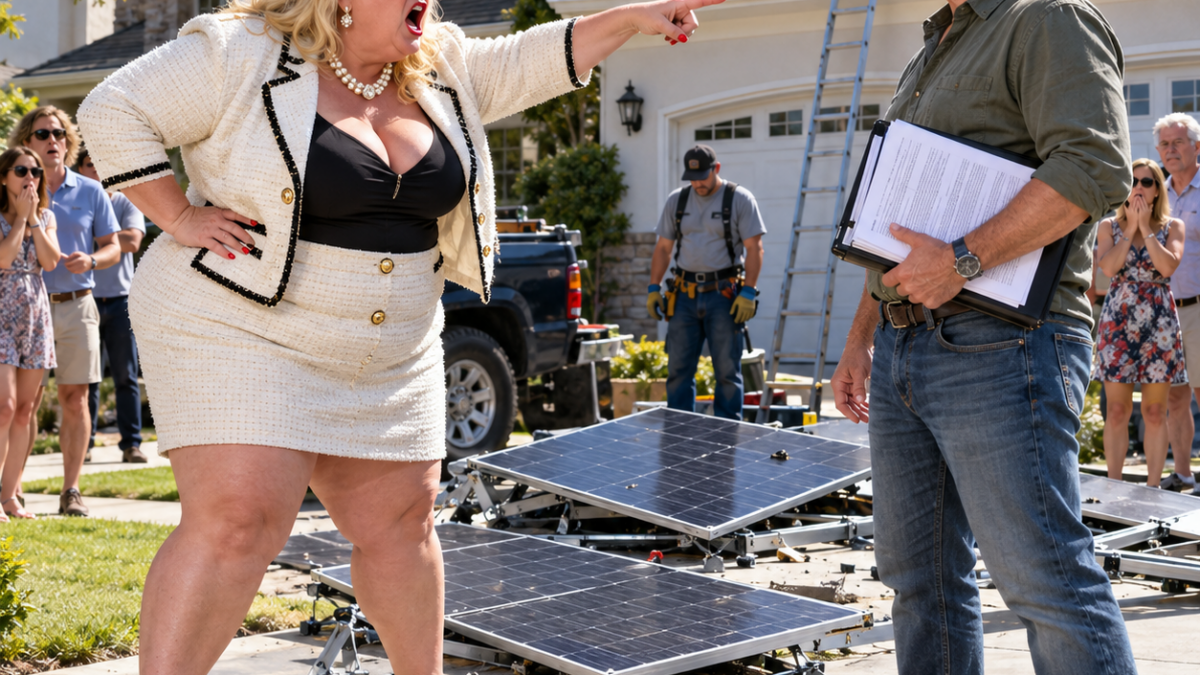
She got out wearing white slacks, oversized sunglasses, and the kind of expression she always wore at HOA meetings when she was about to tell someone their own property no longer belonged entirely to them.
Three workers climbed out of the truck.
One of them spoke to her.
Karen pointed toward my roof.
Then she pointed toward the side gate.
The microphone wasn’t strong enough to capture every word, but it caught enough.
“Take all of them.”
One worker hesitated.
“You’re sure the homeowner approved this?”
Karen answered without looking at him.
“The association approved it.”
That was the moment my anger changed.
Until then I had imagined the crew might have been lied to. Maybe Karen told them I had abandoned the system. Maybe she claimed there was an emergency. Maybe she produced some document that looked official enough to convince a contractor that everything was legitimate.
But the footage showed uncertainty.
The foreman asked the obvious question.
Karen simply overrode it.
The workers eventually unloaded their equipment.
For the next four hours they climbed onto my roof, disconnected wiring, unbolted panels, stacked them on the truck, cracked shingles around several anchor points, dropped one panel against the side of the house, dragged another across the edge of my landscaping, and loaded the entire system into their vehicle.
Karen stayed for nearly half an hour.
At one point she stood in my driveway looking directly toward the garage.
Toward the camera.
Then she smiled.
She had no idea it was recording.
I downloaded the original file immediately.
Then I copied it to an external hard drive.
Then another.
Then cloud storage.
Twenty-two years in uniform had taught me that if evidence exists in only one place, you don’t have evidence.
You have a future problem.
Inside my house I opened a new folder on my computer and named it simply:
OAK HAVEN — SOLAR INCIDENT.
I started placing documents inside.
The original installation proposal.
The engineering drawings.
The invoice.
The structural assessment.
The HOA denial.
Karen’s email stating the panels were “inconsistent with community aesthetics.”
My response citing the state solar statute.
Delivery confirmation showing the email had been opened.
My follow-up offering to meet with the architectural committee.
The unanswered message.
Then I added the video.
I printed everything.
By the time darkness settled over Oak Haven, my dining table looked less like a place where one man ate dinner and more like a litigation command center.
That description probably sounds dramatic.
But if there was one thing Karen had misunderstood about me, it was this:
I hated drama.
I hated shouting.
I hated pointless conflict.
And because I hated those things, I prepared carefully enough to end them.
The next morning I called the county sheriff’s office.
The deputy who arrived was younger than my oldest nephew and initially wore the patient expression officers probably develop after responding to too many neighborhood disputes.
“What’s going on, sir?”
“Property damage and trespassing.”
“Related to the HOA?”
“Yes.”
That made him pause.
He glanced toward the roof.
“I’ll be honest with you, Mr. Peterson. HOA disagreements are usually civil.”
“I understand.”
I handed him a folder.
“This isn’t.”
He opened it.
The first page showed a photograph of the solar system installed and functioning.
The second showed the roof after removal.
The third was the invoice.
His eyebrows rose.
“Ten thousand dollars?”
“Just under that before inspection fees.”
“You’re saying the HOA physically removed it?”
“I’m saying their president admitted authorizing a contractor to remove it.”
I opened the security video on my tablet.
He watched the first few minutes without speaking.
When the worker asked whether the homeowner had approved the removal, the deputy looked at me.
Then back at the screen.
When Karen said, “The association approved it,” his expression changed completely.
“Did you give anyone permission to enter?”
“No.”
“Was there a safety emergency?”
“No.”
“Court order?”
“No.”
“Lien?”
“No.”
“Notice that contractors would be entering?”
“No.”
He sighed.
“Well.”
He took out his notebook.
“That’s different.”
He spent nearly an hour documenting everything.
Before leaving, he handed me a case number.
“A detective will probably contact the contractor first,” he said. “Depending on who claims ownership of the panels and where they went, there may be other issues.”
That sentence bothered me.
“Where they went?”
“They removed them from your property. Do you know where they took them?”
I hadn’t thought beyond the destruction.
“No.”
“Find out.”
After he left, I called A1 Roofing.
The receptionist sounded cheerful until I gave her my address.
There was a pause.
Then she transferred me.
A man named Rick answered.
“You’re the homeowner?”
“Yes.”
Another pause.
“I was expecting your call.”
“Were you the foreman at my house yesterday?”
“Yes.”
“Where are my panels?”
“They’re in our secured yard.”
“Why?”
“We were told the HOA had legal authority to remove them.”
“Did anyone show you an order?”
Rick exhaled.
“No.”
“Did anyone show you anything signed by me?”
“No.”
“Then why did you remove them?”
His voice dropped.
“Mr. Peterson, I’m not trying to dodge responsibility. We’ve done work for Oak Haven for years. Mrs. Whitmore told us the association had authority under the covenants and that the owner had been properly notified.”
“I wasn’t.”
“I understand that now.”
“Some of my panels were damaged.”
“I know.”
“And my roof was damaged.”
Another silence.
“I know.”
That answer told me more than excuses would have.
Rick knew his company had stepped into something serious.
I didn’t raise my voice.
“I want the panels preserved exactly as they are. Nothing repaired, nothing discarded, nothing moved without documentation.”
“Understood.”
“And I want your work order.”
“I’ll have to talk to our lawyer.”
“You should.”
By noon, I had accomplished the first part of what I wanted.
Nobody involved could pretend the event hadn’t happened.
The HOA knew.
The contractor knew.
The sheriff knew.
Evidence was preserved.
Now I needed someone who understood exactly how to turn those facts into leverage.
I didn’t want the loudest attorney in town.
I wanted the most precise one.
Through a veterans network I found Mark Chen.
Mark had served as a Marine JAG officer before opening a small property and civil-litigation practice downtown. His office was on the second floor above a pharmacy, with two employees, one receptionist, and absolutely none of the marble columns or fake leather furniture used by firms trying to look expensive.
I liked him immediately.
He spent twenty minutes reading before asking his first question.
“Did they know about the solar statute before the removal?”
“Yes.”
“Proof?”
I handed him the email.
He read it twice.
“You sent this?”
“Yes.”
“To the full board?”
“President, vice president, treasurer, management company, architectural committee.”
“And nobody responded?”
“No.”
“Then they removed the system?”
“Yes.”
“After receiving this?”
“Yes.”
Mark leaned back.
Then he laughed once.
Not because it was funny.
Because sometimes a professional sees something so astonishingly reckless that disbelief has nowhere else to go.
“Frank, I need you to understand something.”
“I’m listening.”
“If these facts are accurate—and judging by your documentation, they are—your HOA didn’t stumble into a gray area.”
He tapped my email.
“You gave them a flashlight.”
Then he tapped the security screenshots.
“And they used it to walk directly off a cliff.”
I almost smiled for the first time since discovering my roof.
“What do we do?”
“First, we don’t rush.”
That was exactly what I wanted to hear.
Mark continued.
“Your panel replacement is easy. Roof damage is easy. Trespass is easy. The interesting question is whether we can establish knowing misconduct by the board members individually.”
“Personal liability.”
“Exactly.”
Karen had laughed when I mentioned it.
Mark didn’t.
“Board members usually rely on indemnification and directors-and-officers coverage. But policies have exclusions. Intentional unlawful acts, bad faith, sometimes gross negligence. The language varies.”
“And if they knowingly violated the statute?”
“We make their insurer very nervous.”
He studied the rest of the folder.
“But I want context. Is Karen an aggressive president generally, or was this isolated?”
I thought of neighbors avoiding eye contact when Karen walked past.
The identical mailboxes.
The endless beige.
The silence at community meetings.
“I think you’re going to find a pattern.”
Mark folded his hands.
“Then let’s find it.”
That evening, instead of sitting in front of my television replaying the violation in my head, I walked.
Oak Haven looked perfect from a distance.
That was Karen’s achievement.
Every lawn was trimmed.
Every mailbox matched.
Every fence had been approved.
Every visible trash container disappeared by seven in the morning.
Every front door existed somewhere inside Karen’s personal spectrum of acceptable earth tones.
But perfection can hide fear.
Once I started looking for it, I saw fear everywhere.
I found Mrs. Gable three houses down kneeling beside an empty patch of soil in her rose garden.
She was seventy-six, widowed, soft-spoken, and one of the few people in Oak Haven who still waved at everyone.
Her roses had always been extraordinary.
People slowed down when passing her property just to look at them.
But one section was bare.
“What happened?”
She looked up.
For one second I thought she might lie.
Then her face folded.
“The association.”
I crouched beside her.
“What did they do?”
“They said my Peace rose wasn’t approved anymore.”
I stared at the empty soil.
“That plant has been there longer than I have.”
“Twenty years.”
Her fingers trembled slightly as she brushed dirt from them.
“George planted it for our fortieth anniversary.”
Her husband had died seven years earlier.
Everyone knew she had kept that rose alive because it was one of the last living things he had put into the ground with his own hands.
“They made you remove it?”
“They said it wasn’t native.”
“When was that rule adopted?”
“I don’t know.”
“Were you given minutes from the meeting?”
“No.”
“A vote?”
“No.”
“A copy of the amendment?”
She shook her head.
“They gave me forty-eight hours. Fifty dollars a day after that.”
She tried to smile.
“I can’t afford fifty dollars a day.”
There are violations that make you angry because they cost money.
Others make you angry because they reveal character.
I looked at that empty patch and understood exactly what kind of person Karen was.
She hadn’t protected a neighborhood.
She had found a widow’s weakest spot and pressed.
“Do you still have the letter?”
Mrs. Gable glanced toward Karen’s house even though it was several streets away.
“Yes.”
“Would you let me see it?”
“Why?”
“Because I’m fighting them.”
Her face changed.
“About your roof?”
“You heard?”
“Everyone heard.”
I nodded.
“They crossed a line with me. But I’m starting to think they crossed a lot of lines before mine.”
Fear returned to her expression.
“Frank, I don’t want trouble.”
“I know.”
“They can fine me.”
“I know.”
“They can put a lien on the house.”
“I know.”
Her eyes filled.
“This is all I have left.”
I sat beside her in the grass.
“Then nobody gets to make you afraid inside it.”
She turned toward the empty spot.
“My George hated bullies.”
“Mine too.”
That got a tiny laugh.
A minute later she invited me inside.
She returned carrying a grocery bag.
Not a folder.
A grocery bag.
It was packed with HOA notices.
Garden gnome violation.
Wind-chime noise complaint.
Unapproved planter.
Improper holiday wreath.
Decorative bench visible from roadway.
One after another.
Different dates.
Same signature.
Karen Whitmore.
By the time I left, Mrs. Gable had agreed to let me copy everything.
The next person was Tom Miller.
I found him scrubbing chalk from the sidewalk in front of his house while his eight-year-old daughter stood nearby holding a bucket.
“What happened?”
Tom looked at me.
“Apparently hopscotch is vandalism now.”
He held up a notice.
DEFACEMENT OF COMMON PROPERTY.
Twenty-five-dollar fine.
The chalk was washable.
Rain would have removed it overnight.
Tom laughed without humor.
“You know what my son asked me yesterday?”
“What?”
“He asked whether Karen owns the sidewalk.”
His daughter looked up.
“Does she?”
I could have laughed.
I didn’t.
“No,” I said. “She doesn’t.”
Tom stopped scrubbing.
“You’re fighting her, aren’t you?”
“Yes.”
He looked toward his children.
“How serious?”
“As serious as it needs to be.”
He disappeared inside and came out holding a file box.
“My wife calls this Karen’s greatest hits.”
Inside were notices for bicycles left on the porch, a basketball hoop, a temporary kiddie pool, a treehouse visible over the fence, a garden hose that hadn’t been rolled properly, and one particularly absurd warning because their trash cans had remained visible until 7:14 a.m. on collection day.
Tom sat on the driveway beside me.
“We’ve talked about moving.”
“Because of this?”
“Only because of this.”
He gestured toward his house.
“My kids were born here. My wife’s parents live twenty minutes away. We know everyone. We love the neighborhood.”
He looked down at the stack.
“We just hate feeling like tenants.”
That phrase stayed with me.
Tenants.
We were homeowners.
Yet Karen had managed to make dozens of people feel as if their deeds were temporary permissions granted by her office.
I told Tom about Mrs. Gable.
His expression hardened.
“She made her remove George’s rose?”
“Yes.”
“That woman is sick.”
“Maybe. But anger isn’t enough.”
“What do you need?”
“Documentation.”
He handed me the entire box.
“Take it.”
My third ally surprised me.
Arthur Henderson lived on the corner and followed every HOA rule so perfectly that I had assumed he enjoyed them.
His lawn looked measured with instruments.
His mailbox was freshly painted.
His garbage cans vanished before sunrise.
He even replaced his exterior porch bulbs after the board announced a preferred color temperature.
I found him touching up his mailbox post.
“New scratch?”
He sighed.
“New approved color.”
I looked at the paint can.
“Oak Haven Taupe?”
“Last year it was Woodland Gray.”
“How many times have you repainted?”
“Four.”
“Why?”
He stopped brushing.
“Because it’s cheaper than fighting.”
Arthur had spent thirty-eight years as a corporate accountant.
Numbers were his native language.
He wasn’t timid.
He was calculating.
And for years, compliance had seemed less expensive than resistance.
Until I mentioned personal liability.
He looked at me sharply.
“For board members?”
“Yes.”
“You’re certain?”
“My attorney is.”
Arthur put down the brush.
“Interesting.”
“What?”
He glanced toward the clubhouse.
“I’ve been looking at the HOA financials.”
That got my attention.
“And?”
“They don’t make sense.”
We went inside.
Arthur pulled three years of statements from a filing cabinet.
The landscaping budget had increased almost forty percent without any meaningful expansion in services.
Clubhouse maintenance included several large unexplained payments.
Legal fees appeared in months when no litigation had been reported.
Consulting expenses lacked descriptions.
Worst of all, a contractor receiving a significant amount of HOA landscaping money shared a surname with Karen’s sister.
Arthur had already checked the state business registry.
The company’s registered agent was Karen’s brother-in-law.
“You reported this?”
“Asked about it.”
“What happened?”
“Karen told me I was creating a hostile environment for volunteer board members.”
I smiled despite myself.
“I think she uses that phrase whenever somebody asks for paperwork.”
Arthur studied me.
“What exactly are you planning?”
“I’m not entirely sure yet.”
“That doesn’t sound like you.”
“I know what I’m not planning.”
“What?”
“Quiet settlement while nothing else changes.”
For the first time, Arthur smiled.
“Good.”
Within a week, four angry homeowners became a committee.
Mark jokingly called us the Oak Haven insurgency.
Mrs. Gable hated the name.
Tom loved it.
Arthur insisted that any group involving financial records needed a more respectable title.
We settled on Concerned Homeowners Committee.
Our first meeting took place at my dining room table.
Mark arrived carrying legal pads.
Arthur brought spreadsheets.
Tom brought pizza.
Mrs. Gable brought cookies.
That detail mattered more than it sounds.
Because somewhere between legal statutes and evidence folders, we stopped feeling like isolated victims.
We became neighbors again.
Mark laid out the strategy.
“We need two tracks.”
He wrote on a yellow pad.
LEGAL.
COMMUNITY.
“Legal first. Frank’s case is straightforward enough that I’m comfortable sending a demand immediately.”
He handed me a draft.
It was seven pages.
Not emotional.
Not insulting.
Not dramatic.
Which made it more terrifying.
It identified the board members by name.
It described the denial.
It cited my prior notice.
It described the contractor entering my property.
It documented property damage.
It demanded replacement of the system, roof repairs, attorney fees, and additional damages.
Most importantly, it preserved claims against Karen, Bob, and Brenda individually.
Tom read that paragraph twice.
“So they could personally owe money?”
“If the facts support the applicable liability standard, yes,” Mark said. “That possibility is exactly why this should get their attention.”
Arthur leaned forward.
“And the community track?”
“That’s yours.”
Arthur’s eyes almost lit up.
Over the next ten days he reconstructed the HOA’s finances using every document residents possessed.
He compared invoices.
Checked business registrations.
Calculated year-over-year increases.
Identified missing disclosures.
He never exaggerated.
He didn’t need to.
The numbers were enough.
Meanwhile Mrs. Gable and the Millers went door to door with a petition requesting an independent audit and a special meeting to consider removal of the board.
The first night they got six signatures.
The second night they got eleven.
Then something shifted.
People began telling stories.
A father who had been fined because his daughter’s graduation banner stayed up two extra days.
A nurse who worked nights and received repeated warnings because she placed her trash cans out before the exact approved hour.
A widower forced to remove a handmade bench because its stain didn’t match community guidelines.
A disabled resident who had spent months fighting for approval of a small access modification.
None of those stories alone seemed revolutionary.
Together, they described a government of irritation.
A system designed to exhaust people until obedience felt easier than dignity.
By the week of the HOA meeting, the petition had more than sixty signatures.
Nearly half the community.
Karen knew something was happening.
We knew because the violation notices suddenly stopped.
No warnings.
No new fines.
No threatening newsletters.
Silence.
Bullies become careful when witnesses start comparing notes.
The night of the meeting, I arrived twenty minutes early.
The clubhouse parking lot was already full.
Families walked in carrying folders.
Older residents who hadn’t attended meetings in years took seats near the front.
People stood along walls.
Others filled the hallway.
Karen entered through the side office and froze.
For one second, the expression on her face was almost comical.
She had expected the usual five people.
More than eighty were waiting.
She recovered quickly.
Karen always recovered quickly when there was an audience.
She sat at the center of the folding table wearing a bright floral jacket.
Bob sat to her right.
Brenda to her left.
Karen picked up the wooden gavel she loved far too much.
Bang.
“Welcome to the regular monthly meeting of the Oak Haven Estates Homeowners Association.”
Nobody spoke.
“We have a very full agenda tonight.”
Her smile tightened.
“So homeowner comments will be limited to three minutes.”
Arthur raised his hand.
“Point of order.”
Karen’s eyes narrowed immediately.
“Mr. Henderson, comments are later.”
“This concerns approval of the previous minutes.”
“What concern?”
“The attached financial statement.”
Bob looked down.
Arthur opened a folder.
“The landscaping contract increased thirty-nine-point-six percent this year.”
Murmurs moved through the room.
Karen’s jaw stiffened.
“Inflation.”
Arthur looked almost offended by the laziness of that answer.
“Fuel and labor inflation did not increase thirty-nine-point-six percent.”
“Are you an expert in landscaping now?”
“No.”
Arthur paused.
“I’m an accountant.”
A few people laughed.
Karen did not.
Arthur continued.
“More specifically, I’m an accountant who checked the corporate filing for Green Pastures Landscaping.”
The room became quiet.
“The registered agent is Gerald Whitmore.”
Karen’s face changed.
Arthur looked directly at her.
“Your brother-in-law.”
Someone behind me whispered, “You’ve got to be kidding.”
Karen slammed the gavel.
“That contract was competitively awarded.”
“To whom else were bid requests sent?”
“That information is confidential.”
“No, it isn’t.”
Bang.
“You’re out of order.”
Arthur closed the folder calmly.
“That answer will look excellent in an audit.”
The room erupted.
Karen struck the table several times.
“Order!”
Eventually she pointed toward me.
“Mr. Peterson. Three minutes.”
I stood.
I didn’t bring the entire binder.
Just one folder.
I walked to the front and turned toward my neighbors before looking at the board.
“My name is Frank Peterson.”
Nobody needed the introduction.
“Two weeks ago, this association hired a contractor to enter my property without permission and remove a solar-energy system from my roof.”
Someone whispered, “Jesus.”
I continued.
“The system cost approximately ten thousand dollars. Its removal damaged portions of my roof and landscaping.”
Karen leaned toward the microphone.
“Because the installation violated—”
I raised one hand.
“You gave me three minutes.”
That stopped her.
A few people smiled.
I opened the folder.
“The board denied my installation application based on aesthetic concerns.”
I held up the denial.
“Before installation, I notified every board member in writing that state law restricts an HOA’s ability to prohibit residential solar systems for purely aesthetic reasons.”
Next document.
“I provided the statute.”
Next.
“I offered to meet.”
Next.
“They did not respond.”
I turned slightly toward Karen.
“Then they sent contractors onto my property anyway.”
I held up a still image from the security video.
Gasps.
Karen looked toward Bob.
Bob looked ill.
“The incident has been reported to the sheriff’s office.”
Brenda visibly flinched.
“A legal demand has been served.”
Bob’s head jerked up.
“And unless this matter is resolved, suit will be filed against the association and responsible individuals.”
That was when Karen snapped.
“This is intimidation.”
“No.”
My voice stayed level.
“This is accountability.”
She pointed at me.
“You deliberately violated community standards.”
“I followed state law.”
“You think because you were in the military you can come in here and bully volunteers?”
That sentence changed the room.
Until then I had controlled my anger easily.
But I felt something cold move through me.
I stepped closer to the table.
“My military service has nothing to do with your decision.”
Karen folded her arms.
“You bring it up constantly.”
“I didn’t bring it up tonight.”
She realized her mistake too late.
I continued.
“I’m not asking for special treatment. I’m asking you to follow the same laws you expect every homeowner to follow.”
Applause broke out.
Karen slammed the gavel.
“Three minutes are over.”
I stayed where I was.
“Then I’ll finish with this.”
I turned toward the crowd.
“This stopped being about my solar panels the moment I learned Mrs. Gable was threatened until she removed a rose her late husband planted.”
Every head turned toward her.
She slowly stood.
Her hands were shaking.
“George planted it for our fortieth anniversary.”
Silence.
Karen looked uncomfortable.
Mrs. Gable continued.
“You said it was ugly.”
“I said it wasn’t native.”
“You said it was gaudy.”
Karen’s face hardened.
“That is not relevant.”
A chair scraped.
Tom Miller stood.
“What about my kids?”
Karen looked toward him.
“You fined us over five hundred dollars this year.”
“That’s inaccurate.”
Tom held up a folder.
“Want to count?”
More people stood.
A nurse.
A retired firefighter.
A young mother.
An elderly widower.
Voices came from every side.
“My fence.”
“My mailbox.”
“My vegetable garden.”
“My daughter’s graduation banner.”
“My wheelchair ramp.”
“My flag.”
“My trash cans.”
“My Christmas lights.”
Karen began hammering the gavel.
“ORDER!”
Nobody listened.
Fear was disappearing in real time.
Tom walked forward carrying the petition.
He placed it on the table.
“Sixty-four homeowners.”
Karen stared at it.
“We’re demanding an independent financial audit and a special election.”
Bob whispered something to her.
She ignored him.
Brenda looked close to tears.
Karen rose slowly.
“The board will take this under advisement.”
“No,” Arthur said.
She turned.
“This petition meets the threshold under the bylaws.”
For once Karen didn’t have an answer.
Arthur tapped the document.
“You don’t get to take it under advisement.”
He paused.
“You get to follow it.”
The room erupted.
Karen grabbed her purse.
“This meeting is adjourned.”
She walked out.
Bob followed.
Brenda hesitated.
For a strange second our eyes met.
She looked terrified.
Not angry.
Terrified.
Then she followed them.
The clubhouse remained full long after the board disappeared.
People exchanged phone numbers.
Compared violation letters.
Made copies.
Volunteered for committees.
Offered statements.
Something had changed.
Karen had always understood that her power came from keeping homeowners isolated.
One complaint was whining.
Two complaints were coincidence.
Sixty complaints became evidence.
But Mark had warned me before the meeting.
“Don’t underestimate what someone will do when their identity is built around authority.”
Four days remained on our demand.
Karen used every one.
On the final afternoon, Mark called.
“She responded.”
I was sitting in my garage repairing an old lawnmower.
“Accepted?”
Mark laughed.
“Better.”
“What does better mean?”
“They rejected everything.”
I set down the wrench.
“The letter calls your claims frivolous and vexatious.”
“Of course it does.”
“They claim complete authority under the covenants.”
“After receiving the statute?”
“Yes.”
“Anything else?”
“They’re threatening to counterclaim for harassment and the cost of removing your unauthorized modification.”
I actually stopped breathing for a second.
“The cost of removing it.”
“Yep.”
“So they put in writing that they removed it.”
“Yep.”
“After our second legal notice.”
“Yep.”
“And they want me to reimburse them.”
“Frank?”
“Yes?”
“I love these people.”
The lawsuit was filed the next morning.
Oak Haven Estates HOA.
Karen Whitmore.
Robert “Bob” Jones.
Brenda Davis.
Defendants.
Trespass.
Property damage.
Conversion.
Breach of governing duties.
Statutory solar-rights violations.
Attorney fees.
Actual damages.
Enhanced damages where allowed.
The complaint was thick.
The evidence thicker.
But Mark had one more decision to make.
“How do you want them served?”
“At home.”
“That’s discreet.”
“That’s usually a good thing.”
“Usually.”
I heard something in his voice.
“What are you thinking?”
“The community picnic is Saturday.”
I was silent.
Mark continued.
“I am not suggesting spectacle for spectacle’s sake.”
“Sure sounds like it.”
“Karen has spent years making enforcement public. Violation notices on doors. Homeowners reprimanded at meetings. Public humiliation is part of how she maintains control.”
I knew that.
“What changes if she gets served publicly?”
“Everyone understands immediately that this is real.”
I thought about Mrs. Gable kneeling beside empty dirt.
Tom scrubbing sidewalk chalk.
Arthur repainting a mailbox for the fourth time.
Karen standing in my driveway directing strangers onto my roof.
“Saturday,” I said.
The annual Oak Haven picnic took place beneath a cloudless sky.
Perfect solar weather.
That irony wasn’t lost on anybody.
Children ran across the park.
Smoke rolled from grills.
Music played.
Karen occupied her usual position beneath the largest canopy like nothing had happened.
She wore an enormous sun hat.
Bob stood nearby pretending to laugh at something.
Brenda carried a plate she barely touched.
I stayed on the opposite side with Tom and Arthur.
Mrs. Gable was helping at the dessert table.
At exactly one o’clock, a man in khakis and a blue polo walked through the crowd.
Nothing about him drew attention.
Until he stopped under Karen’s canopy.
“Karen Whitmore?”
She looked up.
“Yes?”
“You’ve been served.”
He handed her a thick envelope.
Conversation stopped nearby.
Then he turned.
“Robert Jones?”
Bob’s face went gray.
Envelope.
“Brenda Davis?”
Her hand trembled.
Envelope.
Thirty seconds.
That was all.
Then the process server walked away.
Karen tore open the packet.
I watched her eyes scan the first page.
IN THE SUPERIOR COURT.
FRANK PETERSON, PLAINTIFF.
KAREN WHITMORE, INDIVIDUALLY…
She read faster.
Her lips parted.
Bob opened his packet and immediately began sweating.
Brenda started crying.
A woman standing near the potato salad asked, “What is it?”
Karen folded the papers.
“Nothing.”
Mark, standing beside me, whispered, “It’s always ‘nothing’ until page one has your name on it.”
Karen saw us.
For one second, pure hatred crossed her face.
Then she walked directly toward me.
People moved aside.
She stopped less than three feet away.
“You humiliated me.”
I looked at the documents in her hand.
“No.”
“You could have done this privately.”
“So could you.”
“What?”
“You could have called me before tearing apart my roof.”
Her face reddened.
“You knew what you were doing.”
“Yes.”
“So did you.”
She lowered her voice.
“I will destroy you before I let you take this association from me.”
That sentence removed the last piece of doubt I had.
This had never been about roofs.
Or landscaping.
Or aesthetics.
It was about ownership.
Karen believed Oak Haven belonged to her.
I leaned closer.
“Karen, the association was never yours.”
She stared.
“And neither were we.”
Then I walked away.
The first collapse came six days later.
Bob resigned.
His letter claimed he had relied on incomplete information.
Mark called it the legal equivalent of jumping off a sinking ship while insisting you never liked boats.
Brenda resigned forty-eight hours after him.
Her letter was different.
Shorter.
Apologetic.
She admitted she had gone along with decisions she privately questioned because confrontation with Karen felt impossible.
I believed her.
That didn’t excuse her.
But I believed her.
With two resignations, the board lost its quorum.
The management company announced it was reviewing its relationship with Oak Haven.
The insurance carrier sent reservation-of-rights notices concerning potential coverage exclusions for intentional acts.
Karen was suddenly alone.
For six years, she had surrounded herself with procedure, titles, committees, management staff, contractors, and loyal board members.
Within two weeks almost all of it vanished.
But the most dramatic blow came from the financial records.
Once residents formally demanded an audit, the books could no longer hide behind vague summaries.
Arthur sat at my dining table one night staring at a spreadsheet.
“What?”
He didn’t answer.
“Arthur?”
He removed his glasses.
“The landscaping overpayments are worse than I thought.”
“How much?”
“Enough that an auditor is going to ask questions.”
“Criminal?”
“I’m an accountant, not a prosecutor.”
“That wasn’t my question.”
He looked at me.
“Potentially serious.”
The independent auditor later found irregular contracting practices, inadequate competitive bidding, incomplete documentation for several expenditures, and payments to companies connected to people personally close to Karen.
Not every questionable expense was theft.
Some were simply terrible governance.
But the effect was devastating.
Karen had spent years accusing residents of undermining property values while approving sloppy transactions with their money.
The special-election campaign began immediately.
Arthur reluctantly agreed to run for president.
Tom ran for treasurer.
A retired high-school principal named Maria Alvarez ran for secretary.
Karen attempted to fight the election.
Emails arrived claiming the petition was defective.
Another claimed homeowners behind on any fine—even disputed fines—could not participate.
Mark responded to each argument with the relevant governing language.
Karen postponed nothing.
Then came settlement negotiations.
Her personal attorney contacted Mark three days before our motion hearing.
“They want to talk.”
“About what?”
“Surrender.”
The conference took place downtown.
Karen entered looking ten years older.
No floral jacket.
No oversized sunglasses.
No smile.
She sat beside her attorney and refused to look at me.
Mark opened with the evidence.
Security video.
Emails.
Contractor work order.
Police report.
State statute.
HOA denial.
Their lawyer’s rejection.
Nothing emotional.
Just paper.
Karen’s attorney eventually interrupted.
“We understand the evidentiary posture.”
Mark leaned back.
“Good.”
“We believe prolonged litigation benefits nobody.”
“Agreed.”
“We’re prepared to arrange replacement of the system.”
“That offer expired.”
Karen finally looked up.
“You want money.”
I held her gaze.
“No.”
She laughed bitterly.
“That’s what this is.”
“If I wanted only money, I would have accepted a quiet check two weeks ago.”
“What do you want?”
“Accountability.”
She looked away.
Her attorney tried again.
“What specifically does your client require?”
Mark slid one page across the table.
Replacement with an equivalent or superior solar array.
Roof restoration.
Reimbursement of legal expenses.
Additional monetary damages.
Contribution from responsible individuals consistent with settlement terms.
Resignation.
Agreement not to seek another board position within Oak Haven.
Written acknowledgment that the removal had been unauthorized and inconsistent with applicable law and proper HOA governance.
Karen read the page.
“No.”
Her attorney whispered to her.
She shook her head.
“No.”
More whispering.
Then Karen looked at me.
“You’re taking my home from me.”
That stunned me.
“I’m not taking your home.”
“You’re taking everything I built.”
“You built a presidency.”
Her eyes glistened.
“I built this community.”
“No.”
My answer came softer than she expected.
“The people living in it built the community.”
She leaned back.
For the first time, I saw something underneath the arrogance.
Fear.
Maybe even grief.
Karen had made the board her identity.
Power had become the place where she stored every insecurity she didn’t want to face.
Losing it probably felt like losing herself.
Part of me felt sorry for her.
But sympathy does not require surrender.
I thought of George Gable’s rose.
My roof.
The Miller children.
Every frightened homeowner who had paid an absurd fine because resistance seemed impossible.
“Karen,” I said, “you could have stopped this at any point.”
She said nothing.
“When I submitted the plans.”
Nothing.
“When I cited the law.”
Her jaw tightened.
“When I offered to meet.”
She looked at the table.
“When you saw your contractor hesitate in my driveway.”
That landed.
She knew the video existed.
“You could have stopped.”
Her voice cracked.
“You embarrassed me.”
“No.”
I shook my head.
“I disagreed with you.”
Her eyes met mine.
“You treated disagreement like disobedience.”
The room went completely silent.
Her attorney touched the paper.
“If we resolve this today, the terms remain confidential except for the agreed community statement.”
Mark nodded.
Karen closed her eyes.
Then signed.
The lawsuit ended not with a screaming courtroom victory but with the scratch of a pen.
That sound was more satisfying than a gavel ever could have been.
Because revenge, I had discovered, is overrated when it means destroying someone simply because they tried to destroy you.
Consequences are better.
Karen paid.
Bob paid.
Brenda paid.
The association’s insurer covered applicable portions under the final agreement.
My legal expenses were resolved.
My roof was repaired.
A replacement system was ordered.
And Karen resigned.
A week later, Oak Haven held the special election.
The clubhouse was packed again.
This time there was no gavel pounding.
No shouting.
No three-minute intimidation rule.
Arthur stood near the front looking deeply uncomfortable.
“I’m an accountant,” he whispered to me. “How did I become a politician?”
“Bad luck.”
He laughed.
The results were overwhelming.
Arthur Henderson, president.
Tom Miller, treasurer.
Maria Alvarez, secretary.
Their first motion was simple.
Suspend all discretionary enforcement pending review of the rules.
Passed unanimously.
Second motion.
Commission an independent legal review to ensure HOA rules complied with state law.
Passed unanimously.
Third motion.
Approve my solar application.
Tom raised his hand.
“All in favor?”
Every board member said yes.
From the audience somebody shouted, “Put panels on the clubhouse too!”
The room exploded with laughter.
Arthur actually considered it.
Three weeks later, a solar crew pulled into my driveway.
Not A1.
A different company.
The new system was better than the old one.
Higher-efficiency panels.
Upgraded inverter.
Battery-ready wiring.
The crew worked carefully.
I watched them climb onto the same roof Karen had stripped bare.
For a moment, unexpectedly, my throat tightened.
It wasn’t because of the money.
It wasn’t because I had won.
It was because the house felt like mine again.
That sounds obvious.
Until someone makes you feel otherwise.
Near lunchtime, Mrs. Gable walked across my lawn carrying a small clay pot.
She looked different.
Brighter.
“What’s that?”
She held it out.
A rose cutting.
“Peace rose.”
I stared at it.
She smiled.
“I planted another one.”
“You did?”
“Three.”
I laughed.
“Three?”
“Well, the new board repealed that ridiculous planting rule.”
She nodded toward the pot.
“This one is for you.”
I accepted it carefully.
“I’m not much of a rose gardener.”
“You’re an engineer. Figure it out.”
That made me laugh harder.
Across the street, the Miller kids were playing basketball.
The hoop remained at the edge of their driveway.
Bright chalk squares covered the sidewalk.
Tom stood nearby pretending not to see that his daughter had drawn an enormous sun wearing sunglasses.
Arthur was two houses down repainting his mailbox.
“What color?” I called.
He looked at the brush.
“Blue.”
“Approved?”
He smiled.
“By me.”
Oak Haven began changing in small ways.
Not becoming chaotic.
Not becoming ugly.
That had always been Karen’s false choice.
She wanted people to believe there were only two possibilities: absolute control or complete disorder.
Instead, we discovered the obvious middle ground.
Reason.
Rules remained.
Dangerous structures still needed review.
Common areas still had standards.
Noise rules still existed.
People still couldn’t abandon broken cars on front lawns or paint obscenities across garage doors.
But enforcement became transparent.
Fines required documentation.
Homeowners received meaningful appeals.
New rules required recorded votes.
Financial contracts above a certain amount required competing bids.
Board relationships with vendors had to be disclosed.
Meeting minutes were published promptly.
The association finally began acting like an organization owned by its members instead of a miniature kingdom.
Six months later, I attended another board meeting.
Karen wasn’t there.
She still lived in Oak Haven, though I rarely saw her.
Once, while checking my mail, I noticed her walking on the opposite sidewalk.
Our eyes met.
For a second I expected anger.
Instead she looked away.
I didn’t feel triumphant.
That surprised me.
For months I had imagined what victory would feel like.
I had expected satisfaction.
Vindication.
Maybe even pleasure at watching someone who abused power lose it.
Instead I felt tired.
And relieved.
Because the greatest victory wasn’t Karen losing her title.
It was everyone else losing their fear.
After that meeting I walked home beneath a deep orange sunset.
The panels on my roof caught the final light.
Inside the garage, a small display showed how much energy the system had generated.
I stood there longer than necessary watching the number climb.
There was something poetic about it.
Karen had torn the original panels away because she considered them ugly.
Now their replacements represented the exact thing she had spent years trying to suppress.
Independence.
Not independence from neighbors.
That isn’t community.
Independence from intimidation.
There is a difference.
Before all this happened, I thought my military career had prepared me to fight Karen.
I was wrong.
The most important lessons didn’t come from rank or command.
They came from engineering.
When a structure fails, you don’t simply repair the visible crack.
You identify the load.
You determine where the stress traveled.
You find out why the system allowed the failure.
Then you rebuild it so the same weakness cannot produce the same collapse again.
Karen was only one person.
The bigger problem was a community structure that allowed one person to accumulate power because everyone else was too exhausted, isolated, or frightened to challenge her.
So we fixed the structure.
That was the real victory.
The following spring, Mrs. Gable knocked on my door.
“You’re needed.”
“For what?”
She pointed down the street.
“Come.”
I followed her to her garden.
Dozens of neighbors were gathered outside.
Tom’s children.
Arthur.
Maria.
Families I barely knew before the solar fight.
In the center of the garden stood three healthy Peace rose bushes.
Golden petals edged with pink moved gently in the breeze.
Mrs. Gable touched one blossom.
“George’s original plant is gone.”
Her voice trembled.
“But this came from a cutting I saved years ago.”
I looked closer.
She had propagated the new bushes from the same plant Karen forced her to remove.
“She never really killed it,” Mrs. Gable said.
“No.”
She smiled.
“No, she didn’t.”
I understood immediately why she had brought me there.
It wasn’t only about flowers.
Some things survive because people protect a piece of them until it is safe to grow again.
Dignity works that way.
Community works that way.
Courage definitely works that way.
One person keeps a cutting.
Then another plants it.
Then suddenly the thing somebody tried to destroy is blooming in three places instead of one.
Arthur raised a paper cup.
“To George.”
Everyone raised theirs.
“To George.”
Tom’s daughter tugged my sleeve.
“Mr. Frank?”
“Yes?”
“Are you still fighting the HOA?”
I looked around.
At the roses.
At her parents.
At Arthur arguing good-naturedly with Maria about whether the clubhouse needed better coffee.
At neighbors talking instead of whispering.
“No.”
She looked disappointed.
“Why not?”
“Because there’s nothing left to fight.”
She thought for a moment.
“Did you win?”
Children ask complicated questions with terrifying simplicity.
I looked back toward my house.
From Mrs. Gable’s yard I could just see the edge of my solar panels above the rooftops.
“I think everybody did.”
That evening I planted the rose cutting she had given me months earlier.
I chose a spot beside my garage where the afternoon sun stayed longest.
The plant had survived winter in a pot.
I dug the hole carefully, loosened the roots, filled the soil, and watered it until the ground was dark.
Then I stepped back.
The plant looked small.
Almost insignificant.
But I had learned not to underestimate small things.
A single email can become evidence.
A single photograph can destroy a lie.
A single widow can find her voice.
A single family can stop apologizing for their children playing outside.
A single accountant can expose numbers everyone else ignored.
A single homeowner saying “no” can remind an entire neighborhood that rules exist to serve people—not the other way around.
And one small rose can become three.
People sometimes ask whether I would handle things differently if I could return to the afternoon I found my roof stripped bare.
Maybe I could have hired Mark immediately after the original denial.
Maybe one stern legal letter would have stopped the entire situation.
Maybe the first solar system would still be sitting on my roof.
But then Mrs. Gable might still be afraid.
The Millers might still be discussing moving.
Arthur might still be repainting that mailbox every year.
The financial records might never have been questioned.
Karen might still be pounding a gavel and telling grown adults that obedience was the same thing as community.
So no.
I wouldn’t change it.
I wouldn’t choose to have my property damaged.
But I also wouldn’t erase what came afterward.
The fight cost me sleep.
It cost money before the settlement.
It cost peaceful evenings.
It created tension every time I drove through my own neighborhood.
But it gave us something Oak Haven hadn’t possessed for years.
Neighbors who knew one another.
Not just houses lined along the same streets.
A community.
Sometimes justice doesn’t arrive as flashing police lights or a judge slamming a gavel.
Sometimes it arrives quietly.
A resignation letter.
A signed settlement.
A repaired roof.
Children laughing beside a basketball hoop.
A mailbox painted blue.
A widow planting the flower somebody told her she wasn’t allowed to love.
And sunlight falling across twenty-four dark panels that somebody once called an eyesore.
The next summer, Oak Haven’s electricity committee presented a proposal.
Arthur came to my house carrying the packet.
“You’re going to enjoy this.”
“What?”
He handed it over.
The proposal was for solar panels.
On the clubhouse.
I looked at him.
He tried to remain serious.
Failed.
“You’re kidding.”
“Unanimous recommendation.”
I flipped through the engineering plan.
South-facing installation.
Battery storage.
Projected savings.
Reasonable payback period.
It was good work.
“Who designed this?”
Arthur pointed toward himself.
“I had help.”
I laughed.
“What color are the panels?”
“Black.”
“Karen would hate them.”
Arthur’s smile faded slightly.
“Frank.”
“What?”
“I don’t want everything we do to be about her.”
That stopped me.
He was right.
Revenge can become another prison if you keep arranging your life around the person you defeated.
I closed the packet.
“You’re right.”
“So?”
I reopened it.
“The inverter is undersized.”
Arthur stared.
“You engineers are impossible.”
“And your battery estimate is optimistic.”
“Anything else?”
“Yes.”
“What?”
“Where do I sign?”
The clubhouse solar project passed.
Installation day became an unofficial neighborhood event.
People brought folding chairs.
Tom grilled burgers.
Children drew suns in chalk across the walkway.
Mrs. Gable arrived carrying roses for the clubhouse lobby.
Nobody mentioned Karen.
Not once.
When the final panel was secured, the electrician energized the system.
A small screen came alive.
Power began flowing.
Arthur stood beside me.
“Funny.”
“What?”
“All this because she didn’t like how panels looked.”
I nodded.
“Sometimes people destroy things because they’re afraid of what they represent.”
“What did yours represent?”
I thought about it.
“A homeowner she couldn’t control.”
Arthur looked toward the children.
“And now?”
The clubhouse roof shimmered under the afternoon light.
“Now they represent a community that learned how to control itself.”
Years have passed since that first afternoon.
My original evidence binder still sits on a shelf in my office.
OAK HAVEN — SOLAR INCIDENT.
It’s thicker than some engineering manuals I used in the Army.
Occasionally I open it.
Not because I miss the fight.
Because I don’t want to forget how easily reasonable people can surrender authority when exercising it becomes inconvenient.
Power rarely announces itself as tyranny.
Sometimes it arrives disguised as efficiency.
Aesthetic standards.
Property values.
Community harmony.
Words that sound perfectly respectable.
And usually are.
Until somebody decides those words matter more than people.
That was Karen’s mistake.
She thought preserving uniformity justified humiliation.
She thought procedure justified cruelty.
She thought a title gave her ownership over decisions that belonged to homeowners.
And worst of all, she thought nobody would make the cost of her behavior higher than the cost of complying with it.
For years she was right.
Then she tore down my solar panels.
The act she believed would demonstrate her authority exposed how little legitimate authority she actually had.
The day my new system passed final inspection, the utility technician handed me the paperwork.
“All good.”
I signed.
He looked toward the roof.
“Nice setup.”
“Thanks.”
“HOA give you trouble?”
I laughed.
“You could say that.”
He shook his head.
“They’re getting better around solar.”
“So is ours.”
After he left, I stood in the driveway where I had stood the afternoon Karen called my panels an ugly black stain.
The memory felt distant.
My lawn had recovered.
The shingles were repaired.
The new panels looked cleaner than the originals.
Beside the garage, the Peace rose had grown nearly four feet tall.
One flower had opened that morning.
Yellow center.
Soft pink edges.
I crouched beside it.
For some reason, that flower moved me more than the settlement check ever had.
Maybe because money compensates for damage.
Growth proves the damage didn’t win.
Mrs. Gable happened to walk past.
She stopped at the driveway.
“First bloom?”
“First one.”
She came closer.
George’s rose.
Karen had ordered it destroyed.
Mrs. Gable had saved a cutting.
She had planted another.
Given me one.
Now it was blooming beside the house that had started the entire rebellion.
She touched one petal.
“He would have liked this.”
“George?”
“Yes.”
“You think?”
“He never trusted anyone who cared too much about matching mailboxes.”
I laughed.
Then she looked toward my roof.
“He would have liked those too.”
“The solar panels?”
“He was cheap.”
I laughed so hard I had to stand up.
Mrs. Gable laughed with me.
That might be my favorite memory of the entire story.
Not Karen getting served.
Not the lawsuit.
Not her resignation.
Not the settlement.
Two neighbors standing beside a rose, laughing about a dead man who would have approved of free electricity.
Because that was what Karen never understood.
A neighborhood cannot be manufactured through uniform paint colors.
Community is not identical mailboxes.
It isn’t silent children.
It isn’t lawns trimmed within an inch of their lives.
It isn’t residents too frightened to question a board.
Community is people caring whether a widow loses something her husband planted.
It is parents being allowed to hear their children laugh outside.
It is disagreements without enemies.
It is rules with reasons.
It is accountability without cruelty.
And sometimes it is eighty people finally filling a clubhouse after years of staying home because one homeowner showed them that saying “no” was still an option.
I never wanted to become the man who fought his HOA.
I wanted a quiet retirement.
A garden.
A workshop.
Low electricity bills.
Maybe a few road trips.
Instead, for several months, I found myself organizing documents, meeting lawyers, gathering witness statements, and discussing governance reform at my dining room table.
But life has a strange way of assigning missions you never volunteer for.
Some are loud.
Some are quiet.
This one began with empty brackets on a roof.
It ended with people reclaiming ownership of their own neighborhood.
And if there is one thing I carried away from it, it is this:
Bullies depend on isolation.
They need each person to believe their problem is unique.
That everybody else is satisfied.
That resistance is embarrassing.
That speaking up will only make things worse.
The moment people compare stories, the illusion begins to collapse.
Mrs. Gable thought she was the only person being targeted.
Tom thought his family was simply unlucky.
Arthur thought compliance was the rational price of peace.
I thought my solar dispute was my problem.
We were all wrong.
The problem belonged to all of us.
So did the solution.
And on certain mornings, when the sun clears the trees and the monitoring app shows my house producing more electricity than it is using, I still look up at those panels and remember Karen’s words.
“An ugly black stain.”
She wanted them gone because they didn’t match her picture of Oak Haven.
Now similar panels sit on the clubhouse roof.
Mrs. Gable’s roses bloom freely.
The Miller children’s basketball hoop still stands.
Arthur’s mailbox has been blue, green, and once—during football season—an absolutely terrible shade of orange.
Nobody’s property value collapsed.
Nobody descended into chaos.
Oak Haven actually became more desirable.
Homes sold quickly.
Families stayed.
People attended meetings.
Financial reserves improved because contracts were competitively bid.
Disputes decreased because homeowners had meaningful ways to resolve them.
It turned out respect was better for property values than fear.
Karen had been wrong about many things.
But she was right about one.
Removing my panels changed Oak Haven.
Just not in the way she intended.
She thought tearing them down would prove who was in control.
Instead, it forced all of us to ask a question we should have asked years earlier.
Who gave her that control in the first place?
Once we answered that question, everything changed.
The sunlight did the rest.
And every morning when it hits my roof, powers my house, and falls across that rose beside the garage, I’m reminded that the most satisfying revenge was never ruining Karen.
It was building something better after she failed to ruin us.








