PART 2: HOA Put My 40-Acre Family Farm Up for Auction Over $47,312 in “Fines”—So I Opened the Deed Box
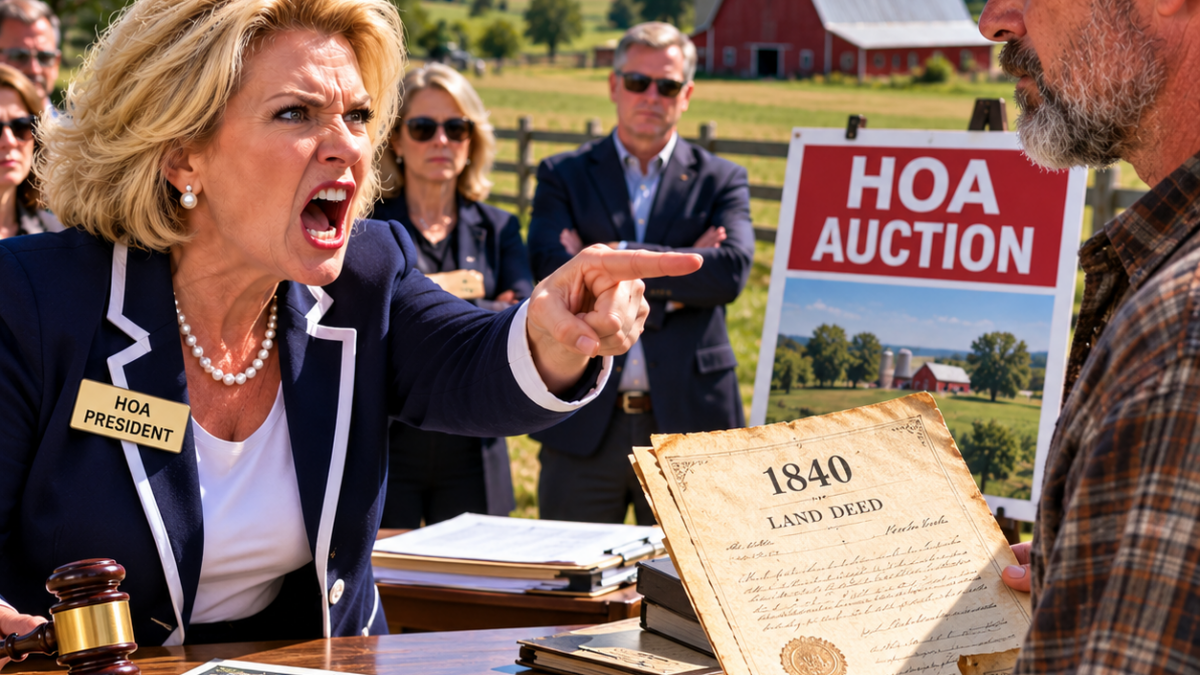
PART 2
I carried both documents to the dining table and turned on every light in the room.
The original deed was brittle enough that I stopped touching the edges with my bare fingers. The language belonged to another century—metes and bounds descriptions, landmarks that no longer existed, references to an old creek bed, a stone marker, and a sycamore that lightning had destroyed before I was born.
But the name was unmistakable.
**Silas Sterling.**
My great-great-grandfather.
Forty acres.
The Sterling farm.
I unfolded the second document.
It was newer, though only by comparison.
A county survey from 1952, completed when the state widened the road near the eastern boundary.
My father had shown it to me once when I was young.
At the time, I had been more interested in getting outside than listening to him explain survey monuments and right-of-way lines.
Now I could hear his voice almost word for word.
*Paper matters when memory dies, John.*
I had thought he was talking about family history.
Sitting there with Karen’s auction packet beside me, I realized he had been talking about ownership.
My phone rang.
My younger sister Sarah.
I answered.
“John, what the hell is happening?”
“Hello to you too.”
“Don’t do that.”
She sounded scared.
“I saw a post about an auction. Somebody sent me a screenshot. They’re saying the farm is being sold.”
“It isn’t.”
“They’ve announced a date.”
“I know.”
“Forty-seven thousand dollars?”
“Made-up fines.”
“John, can they actually do this?”
“No.”
I said it too quickly.
Sarah caught it.
“You don’t sound sure.”
“I’m sure about who owns the land.”
“That wasn’t my question.”
I looked at the deed.
“I need to verify exactly what they filed and what authority they’re claiming.”
“Dad would lose his mind.”
“I know.”
“No, I mean he would actually climb out of his grave and start throwing tools.”
That got a laugh out of me.
Barely.
Sarah became quiet.
“You’re not going to lose it, are you?”
“The farm?”
“Yes.”
“No.”
This time I said it slowly.
“No.”
She exhaled.
“Call me when you know more.”
“I will.”
“And John?”
“Yeah?”
“Don’t do the thing.”
“What thing?”
“The Army thing where you decide you’re protecting everybody and stop telling anybody you’re scared.”
I stared at the packet.
“I’m not scared.”
“Exactly.”
Then she hung up.
For another minute I sat alone at the old table.
The house was quiet except for the refrigerator cycling in the kitchen and the faint rattle of wind against the porch screen.
I finally reached for my phone.
There was one person I should have called years earlier.
“Chen.”
“Dave, it’s John Sterling.”
“Well, this cannot be good. You only call during business hours when somebody is dead or suing you.”
“Remember the HOA?”
A pause.
“The pine-cone fascists?”
“That would be them.”
“What did they do now?”
“They’re auctioning the farm.”
Silence.
Then:
“They’re doing what?”
I told him.
The fines.
The meeting.
Parcel 7B.
The glossy development map.
The forty-seven-thousand-dollar balance.
Dave Chen and I had met during my last Army assignment. He’d been a JAG officer then, compact, relentless, and frighteningly cheerful whenever somebody handed him a stupid legal argument.
After leaving the service, he built a property-law practice in town.
He had warned me years earlier that ignoring Karen’s letters was safe only as long as the HOA stayed within the limits of annoyance.
Apparently we had reached the limit.
“You still have everything?” he asked.
“Every letter.”
“The deed?”
“In front of me.”
“Plat?”
“I have an older survey. I’m going to the courthouse tomorrow.”
“Good.”
“What do you think?”
“I think nobody sells forty acres because a woman with a clipboard says so.”
“That reassuring lawyer language?”
“No. That’s me trying not to swear before dinner.”
I heard papers moving.
“John, listen to me. Do not communicate with Karen tonight. Don’t post online. Don’t threaten anybody. Don’t remove signs. Don’t do anything theatrical.”
“I wasn’t planning to.”
“You sounded exactly like that before you put a lieutenant colonel’s desk in a supply warehouse.”
“He signed for the desk.”
“He did eventually.”
“After I found it.”
“Because you hid it.”
“I relocated it according to inventory procedure.”
Dave sighed.
“Courthouse tomorrow. Certified title documents. Recorded plat. Any liens or notices they may have filed. Then bring me every piece of paper they’ve sent.”
“I’ll be there.”
“John?”
“Yeah?”
“If they have actually noticed an auction on land they do not own, this stopped being funny.”
“I know.”
“No. I don’t think you do yet.”
The courthouse opened at eight-thirty.
I was there at eight-twenty.
The county clerk recognized my last name before she recognized me.
“Sterling farm?”
“Yes, ma’am.”
She looked over her glasses.
“My father knew your father.”
“That can either help me tremendously or get me arrested.”
She smiled.
“Depends what you’re here for.”
“Property records.”
That erased the smile.
Three hours later, my confidence had hardened into something much more useful.
Facts.
Certified facts.
The original chain of title traced the property cleanly through the Sterling family.
The 1952 survey matched the deed.
Then came the document that mattered most.
The 2006 recorded plat for Whispering Pines Phase One.
The subdivision sprawled across the hundred acres east and south of my farm.
Roads.
Lots.
Common areas.
Retention pond.
Entrance parcel.
HOA-controlled property.
And immediately beside it:
**PARCEL 7B — NOT A PART OF THIS PLAT.**
I read the words twice.
Then I asked the clerk for three certified copies.
She studied my face while stamping them.
“Problem?”
“You could say that.”
“You’re not planning to sell, are you?”
“Someone else is.”
Her stamp stopped in midair.
“What?”
“Long story.”
She looked at the plat again.
Then at me.
“Not if that’s the property.”
“No, ma’am.”
“That seems like a very short story.”
It should have been.
By lunchtime I was in Dave’s office.
His conference table disappeared beneath paper.
The 1888 deed on one end.
County plat on the other.
Years of HOA letters in between.
Dave read in silence.
Occasionally he made a small noise through his nose.
That was never a good sign for the person who wrote whatever he was reading.
Finally he held up one letter.
“Unapproved agricultural structure.”
“The barn.”
“How old?”
“Built around 1912.”
He found another.
“Failure to maintain uniform turf height.”
“Hay.”
Another.
“Unapproved commercial vehicle.”
“A friend visited in his plumbing van.”
He lowered the page.
“These people fined you because somebody else drove a van onto your farm?”
“They tried.”
“You paid any of this?”
“No.”
“HOA dues?”
“No.”
“Signed covenants?”
“No.”
“Architectural application?”
“No.”
“Used their pool? Clubhouse? Trash service? Private roads?”
“No.”
“Ever represented yourself as a member?”
“No.”
He leaned back.
“Good.”
I slid Karen’s auction packet toward him.
His expression changed before he finished the first page.
“Where did you get this?”
“At the meeting.”
“They’ve planned roads.”
“Yes.”
“They’ve drawn residential lots.”
“Yes.”
“Did they hire an engineer?”
“Doesn’t say.”
Dave flipped to the final page.
Projected revenue estimates.
My stomach tightened again.
I hadn’t seen them the night before.
Depending on density and zoning approval, the packet estimated the finished lots could represent several million dollars in potential development value.
Dave looked up.
“This isn’t about your grass.”
“No.”
“They want the land.”
“I figured that out.”
“No, you figured out Karen wants the land.”
He tapped the packet.
“This took work. Someone made maps. Someone estimated yield. Somebody discussed infrastructure. This is beyond one woman being obnoxious.”
That possibility had been sitting quietly in the back of my mind.
Now Dave had said it aloud.
“What’s next?”
“First, we establish that they have absolutely no recorded interest in your property.”
He tapped the plat.
“This is very strong.”
“Strong enough?”
“On the HOA-membership issue? Assuming there’s no later declaration or annexation instrument hiding somewhere, yes.”
“I asked for every filing tied to Parcel 7B.”
“And?”
“Nothing connecting it to Whispering Pines.”
Dave nodded.
“Then we put them on notice.”
He drafted the letter while I sat across from him.
It wasn’t dramatic.
That was why it frightened me.
Recorded deed.
Recorded plat.
No HOA declaration burdening the property.
No recorded covenant.
No membership.
No dues obligation.
No authority to levy fines.
No valid lien.
No authority to convey title.
Immediate cancellation of auction demanded.
Written retraction demanded.
Any publication suggesting the HOA held a right to sell Parcel 7B could support a claim for slander of title and other damages.
Any entry onto my property for purposes connected with the auction would be treated as trespass.
When he finished, I read it.
“You forgot to call her a thief.”
“That’s why I’m the lawyer.”
“I could add it in handwriting.”
“You could also hire another lawyer.”
We had Karen personally served the following afternoon.
I didn’t need to watch.
But I did.
Not from behind binoculars like the original story people later told about me.
I parked legally at the end of the public street because Dave had warned me that if this turned into litigation, the last thing he wanted was a story about me stalking an HOA president.
A process server named Mike walked up Karen’s driveway.
She was directing two landscapers.
I couldn’t hear what was said.
I saw the envelope.
Saw her sign.
Saw her tear it open.
Her shoulders stiffened.
Then she looked toward the street.
Even from that distance, I knew she had spotted my truck.
For perhaps five seconds, neither of us moved.
Then she turned and went inside.
The door slammed.
I drove home.
The response arrived a week later from a downtown law firm whose stationery probably cost more than my first pickup truck.
Dave called while I was opening my copy.
“You reading?”
“Page two.”
“Get to page seven.”
I skipped ahead.
The HOA did not claim a recorded declaration covering my property.
It could not.
Instead, their attorneys constructed a theory that my long-standing proximity to Whispering Pines, supposed benefits from the subdivision’s road improvements and property-value increases, and my failure to challenge years of correspondence supported some form of implied obligation or equitable estoppel.
I read it twice.
“Dave?”
“Yeah?”
“This sounds insane.”
“Not insane. Aggressive.”
“Difference?”
“One gets laughed out of court. The other may cost money before it gets laughed out of court.”
“They admit I’m adjacent.”
“I noticed.”
“Then two pages later call me a community property owner.”
“Also noticed.”
“They don’t have a deed restriction.”
“No.”
“So why continue?”
“Because Karen has access to association money and is betting you don’t want to spend your own.”
There it was.
The simplest explanation.
Attrition.
I had spent two decades in an organization where logistics decided wars long before speeches did.
Karen didn’t need to be right if making me prove she was wrong became expensive enough.
That night I opened the cabinet where I had stored years of her correspondence.
I pulled out every envelope.
I built a timeline.
The first note had complained about my barn-red front door.
Then the rooster.
Then the vegetable garden.
Then hay height.
Then my friend’s plumbing van.
Then the barn roof.
The fines increased.
The language hardened.
Then suddenly—months before the auction announcement—the notices began describing the farm as “noncompliant peripheral property.”
Peripheral.
Not member property.
I highlighted the term.
A later letter called it “adjacent acreage.”
Another called it “community-impacting land.”
None called it part of the HOA until Karen needed to justify fees.
I called Dave.
“Found something.”
“What?”
“Their own terminology changed.”
He listened.
“Send it.”
I did.
Ten minutes later he called back.
“Good catch.”
“Useful?”
“Very.”
“Enough?”
“John, stop asking whether every individual document is enough. Litigation is accumulation.”
I looked at the old service logbook on my shelf.
Accumulation I understood.
The next phase started almost by accident.
I drove the western edge of Whispering Pines one afternoon and noticed an old chain-link fence behind a row of immaculate vinyl-sided homes.
On the other side sat three dead lawn tractors, two partially restored cars, a vegetable garden, and a workshop.
I knew the property.
Arthur Henderson.
His family owned it before Whispering Pines existed.
I pulled over.
Arthur was bent over an engine.
“Mr. Henderson?”
He wiped his hands.
“Depends who’s asking.”
“John Sterling.”
“The farm.”
“That’s me.”
His expression shifted.
“Heard they’re trying to take it.”
“They are.”
He laughed once without humor.
“Of course they are.”
That answer interested me.
“You’ve heard from Karen?”
He pointed toward his fence.
“Visual nuisance.”
“Your fence?”
“Rust.”
“Are you in the HOA?”
“Nope.”
“Ever been?”
“Nope.”
“Paid anything?”
“Fifty bucks once.”
My stomach tightened.
“Why?”
“She threatened collections. My wife had just started chemotherapy. I wrote a check because I didn’t have room in my life for another fight.”
He stared toward the subdivision.
“They sent another one last month.”
“How much?”
“Five hundred.”
“For rust?”
“For ongoing noncompliance.”
I asked if I could see it.
He went inside and returned with the letter.
Same management company.
Same Karen signature.
Same language.
Different nonmember property.
That mattered.
Arthur gave me another name.
Eleanor Gable.
Eighty-one years old.
Widow.
Lived in a small pre-development cottage bordered by Whispering Pines on two sides.
Her front garden was astonishing.
Old roses, some taller than I was.
She met me with suspicion.
Then I mentioned Karen.
Her hand tightened around the door.
“That woman.”
She had been fined for “nonconforming floral species.”
Two hundred dollars.
Then threatened with additional assessments after rose petals blew across a property line during a storm.
“Are you in their HOA?” I asked.
“No.”
“Did you pay?”
Her eyes dropped.
“Yes.”
“Why?”
“I live alone.”
That was all she said.
It was enough.
Sunday afternoon, six of us gathered around my dining table.
Arthur.
Eleanor.
A couple named the Parkers whose older home sat near the north entrance.
A retired teacher named Linda Brooks.
Sarah drove in from two counties away because, in her words, if I was starting a rebellion, somebody needed to bring decent food.
I laid out the documents.
The 1888 deed.
County plat.
The HOA letters.
Dave’s analysis.
“She’s counting on confusion,” I said. “Most people don’t know whether being beside an HOA means the HOA can regulate them.”
Arthur snorted.
“Apparently neither does she.”
“I think she knows more than she’s pretending.”
Eleanor folded her hands.
“What do you mean?”
I showed them the changing terminology in the letters.
Adjacent.
Peripheral.
Community-impacting.
Then suddenly member.
“Her own records acknowledge these properties are outside.”
Linda leaned forward.
“Then why send fines?”
“Because some people pay.”
Eleanor looked down.
Nobody judged her.
Sarah touched her arm.
“You were scared. That’s different.”
Eleanor nodded but didn’t speak.
Arthur looked at me.
“So what do we do?”
“First, nobody sends money without talking to Dave.”
“Free lawyer?” Arthur asked.
“Not exactly.”
Dave, who had joined by speakerphone, answered from the center of the table.
“I heard that.”
Arthur grinned.
“Good ears.”
“I’ll review the nonmember notices initially. If this broadens, we’ll discuss costs.”
“What broadens?”
Dave’s voice turned serious.
“If the HOA has knowingly asserted authority over multiple outside properties, that’s no longer one boundary misunderstanding.”
That evening, after everyone left, Sarah stayed.
She stood at the sink washing cups.
“You should’ve done this years ago.”
“I know.”
She turned.
“I wasn’t blaming you.”
“I know.”
“You thought ignoring her was enough.”
“Dave told me it was.”
“Legally maybe.”
I leaned against the counter.
“What are you saying?”
“That while you were filing her letters under ‘nonsense,’ Eleanor was paying because she was afraid.”
That hurt.
“I didn’t know.”
“Exactly.”
I looked through the doorway toward the empty chairs.
My instinct had always been to mind my land and expect others to mind theirs.
It had felt principled.
Maybe sometimes isolation was just another way to leave people alone with bullies.
“I should’ve talked to them.”
Sarah dried her hands.
“You’re talking now.”
Two days later my niece Jessica called.
Sarah’s daughter.
Twenty-seven, sharp, patient with technology in a way I never would be.
“Mom says you’re fighting the HOA.”
“Your mother exaggerates.”
“She said you have binders.”
“That proves nothing.”
“I can search public records.”
That got my attention.
“For what?”
“Anything tied to the HOA, Karen, property sales, lawsuits. Public stuff.”
“Dave should approve.”
“Fine.”
Dave approved.
Three nights later, Jessica called after ten.
“Uncle John.”
Her voice had lost its usual teasing edge.
“What?”
“I found a property transfer.”
“Whose?”
“It’s a one-acre lot inside the subdivision. Or kind of between two developed sections.”
I pulled a legal pad toward me.
“Go on.”
“The owner lived in Florida. HOA meeting minutes say he had unpaid maintenance fines.”
“How much?”
“A lot.”
“Then?”
“There was a foreclosure proceeding.”
“Was he actually in the HOA?”
“I don’t know yet.”
“Keep going.”
“The HOA ended up with the lot.”
“Okay.”
“Then sold it.”
“To whom?”
Silence.
“Jessica?”
“An LLC.”
“What LLC?”
“Pine Residential Holdings.”
“Who owns it?”
“I had to go through the registered-agent filing.”
“Jessica.”
“Karen’s husband is listed as manager.”
I stopped writing.
“When?”
“Three years ago.”
“How much did the LLC pay?”
“Ten thousand.”
“For an acre?”
“Yes.”
“What happened after?”
“Two months later, the LLC sold it to a developer.”
“How much?”
Another pause.
“One hundred fifty thousand.”
I didn’t say anything.
“Uncle John?”
“Send everything to Dave. Don’t post it. Don’t tell anyone else.”
“You think it’s connected?”
“I don’t know.”
That was the truth.
I didn’t know.
But suddenly the proposed subdivision drawn over my forty acres looked different.
Not stupid.
Not merely aggressive.
Profitable.
Dave called at seven the next morning.
“Where did Jessica get this?”
“County records and corporate filings.”
“She did good work.”
“What are we looking at?”
“A transaction that deserves explanation.”
“Fraud?”
“Don’t jump.”
“Karen’s husband buys land from Karen’s HOA for ten grand and sells it for a hundred fifty.”
“I know what it looks like.”
“What does it legally look like?”
“Potential conflict of interest. Potential self-dealing. Possibly worse depending on disclosures, authorization, appraisal, notice, foreclosure validity, and where the money went.”
“So we have her.”
“No.”
I hated when he said that.
“We have questions.”
“Dave—”
“John, this is exactly where people wreck legitimate cases. They find something ugly and outrun the evidence.”
I leaned back.
“What do you want?”
“The foreclosure file. Board minutes. notices. appraisal if one existed. Proof of who knew what. And we need to know whether Karen disclosed her husband’s connection before the sale.”
“What if she didn’t?”
“Then she has a much larger problem.”
We obtained more records.
Slowly.
The old owner in Florida had inherited the lot from his brother.
Public filings indicated a lien and foreclosure process.
But the sale afterward raised concerns.
The HOA minutes referred only to “disposal of distressed surplus parcel.”
No recorded disclosure of the buyer’s connection to Karen appeared in the minutes Jessica found.
Dave still refused to call it criminal.
He called it “very interesting.”
Lawyers have a gift for understatement when everyone else wants fireworks.
Then he asked a question that changed our strategy.
“How certain are you about your current physical boundary?”
“I have the plat.”
“That’s not what I asked.”
“The farm hasn’t moved.”
“Neither have most boundary disputes. Get a survey.”
He recommended Chet Romano.
Chet was sixty-seven, sunburned year-round, and possessed the warmth of a fence post until he decided he liked you.
He arrived before sunrise with two employees and equipment that looked more expensive than my tractor.
I gave him the deed.
1952 survey.
2006 plat.
He studied them on the hood of his truck.
“HOA says they own some of this?”
“They say I’m in the association.”
He grunted.
“Different question.”
“They’re trying to auction all forty acres.”
That got his attention.
“Seriously?”
“Yes.”
He looked toward Whispering Pines.
“People build twenty houses and suddenly think they discovered eminent domain.”
For four days his crew worked.
Old markers.
Modern GPS.
Recorded monuments.
Road right-of-way.
Easements.
Pins buried beneath decades of soil.
It fascinated me.
The legal description written in 1888 was being translated into coordinates precise enough to survive a courtroom.
Karen appeared on day two.
Her minivan stopped at the end of my lane hard enough to kick gravel.
She marched toward Chet.
“What is this?”
Chet remained behind his instrument.
“Survey.”
“I can see that.”
“Then we’re making progress.”
Her face tightened.
“You cannot conduct commercial operations in the common-area easement.”
Chet finally looked at her.
“Which easement?”
“The ten-foot association easement along this road.”
He pointed to a flagged stake.
“Show me.”
“What?”
“Recorded document. Book and page.”
Karen stared.
“This is HOA property.”
“No, ma’am. I’m asking where the easement is recorded.”
“I don’t have to justify association property rights to a contractor.”
Chet turned back to the instrument.
“Then please step out of the line.”
“You’re trespassing.”
“On Mr. Sterling’s contracted survey?”
“This isn’t all his property.”
Chet sighed.
He walked to his truck.
Pulled out the certified plat.
Pointed.
“Whispering Pines ends there.”
Karen followed his finger.
He pointed again.
“You’re standing here.”
She looked down.
“Which makes you the only person currently standing on somebody else’s property without permission.”
I almost smiled.
Karen looked at me.
“John, you are intentionally escalating this.”
“No.”
I nodded toward the survey equipment.
“I’m measuring.”
“You know exactly what you’re doing.”
“For once, so do you.”
She left.
She came back the next day.
Different argument.
Stormwater easement.
Chet asked for the recorded instrument.
She didn’t have it.
Day four, she complained that survey flags constituted unapproved signage.
Chet ignored her entirely.
Then, late that afternoon, he called me to the southeast corner.
Whispering Pines’ entrance sign stood there.
Brick columns.
Carved timber.
Landscaping.
Uplighting.
**WHISPERING PINES — A COMMUNITY OF DISTINCTION.**
Chet kicked an orange-flagged stake.
“John.”
“Yeah?”
“You’re going to enjoy this too much.”
“What?”
He pointed from the stake to the sign.
“The western footing crosses your line.”
“How far?”
He checked his notes.
“Four feet, two inches at the widest point.”
I stared.
“The HOA sign is on my farm?”
“Part of it.”
“The landscaping?”
“Part.”
“The lights?”
“One fixture.”
I laughed.
Couldn’t help it.
Chet remained serious.
“Don’t touch anything.”
“I wasn’t going to.”
“Good.”
“Can I put a little sign beside it saying ‘unapproved structure’?”
He looked at me.
“No.”
“You’re no fun.”
“That’s why courts like me.”
His final survey was devastatingly clear.
Parcel 7B remained separate.
No overlap with HOA lots.
No basis for Karen’s claimed boundary.
And Whispering Pines itself was encroaching onto my land.
I sent it to Dave.
He called twenty minutes later.
“I love surveyors.”
“I’ll tell Chet.”
“Don’t. It’ll make him unbearable.”
“What now?”
“Now we demand cancellation again.”
“And if they refuse?”
He paused.
“When is the auction?”
“One week.”
“Then we file.”
Karen refused.
Worse, she began advertising.
Glossy flyers appeared at the clubhouse.
Then at the entrance.
**PUBLIC AUCTION — PRIME 40-ACRE DEVELOPMENT PARCEL.**
A photograph of my farm sat beneath the headline.
My barn in the distance.
My oak line.
My fields.
No mention that I disputed the sale.
No mention that the recorded plat said the property was outside Whispering Pines.
No mention that the association’s own entrance sign was partially sitting on the property it claimed authority over.
I took photographs.
Sent them to Dave.
His reply came five minutes later.
**Perfect. Don’t touch them.**
I called.
“Perfect?”
“Evidence.”
“I’m getting tired of evidence.”
“That’s because you want the ending before we earn it.”
He was right.
I hated that too.
We placed a public notice in the County Chronicle.
Dave wrote it.
No accusations of theft.
No dramatic language.
Just facts.
Parcel 7B belonged to John Sterling.
Title disputed no HOA claim.
Auction authority challenged.
Prospective bidders warned that the HOA could not guarantee clear title.
Pending legal action.
Call counsel before bidding.
Then Jessica created a page for homeowners concerned about governance.
We posted only documents we could support.
The recorded plat.
Survey extract.
1888 deed.
Photographs of the encroaching entrance sign.
No insults.
No memes.
At least not from us.
Other people supplied those.
Eleanor posted first.
Her roses.
Her fine.
Then Arthur posted the fence letter.
Then Linda.
Then actual Whispering Pines members began sharing their own notices.
Wrong mailbox color.
Basketball hoop.
Holiday lights.
Charcoal grill smoke.
Swing set two inches above the approved height.
A veteran’s service flag.
The stories accumulated.
People who had assumed they were uniquely targeted discovered dozens of neighbors had felt the same.
Karen responded through the official HOA account.
The message called the page a “misinformation campaign organized by disgruntled outsiders.”
That phrase cost her.
Outsiders.
Residents who had paid dues for years didn’t appreciate being lumped in with me because they questioned her.
Screenshots spread.
The following day, someone posted Karen’s auction flyer beside the recorded plat.
The caption simply read:
**HOW DO YOU AUCTION PROPERTY MARKED “NOT A PART OF THIS PLAT”?**
That image traveled farther than anything we had posted.
Then came the private messages.
One homeowner claimed Karen had threatened a lien after he questioned a landscaping contract.
Another said she had waived penalties for a committee member.
Another said a contractor frequently working for the HOA was related to one of Karen’s relatives.
I forwarded credible documents to Dave.
He kept repeating the same phrase:
“Save it. Don’t speculate.”
The day before the auction, Dave filed our verified complaint.
Slander of title.
Declaratory relief regarding HOA jurisdiction.
Injunctive relief to stop the purported sale.
Trespass and encroachment claims relating to the entrance structure.
Other claims based on the record as counsel deemed supportable.
The old one-acre transaction was provided separately to appropriate counsel for further review rather than thrown into the complaint as an accusation we could not yet prove.
That distinction mattered.
The emergency hearing occurred the morning of the scheduled auction.
I sat beside Dave in a county courtroom that smelled faintly of carpet cleaner and old paper.
The HOA’s attorneys argued there was no need for emergency relief because any successful bidder would still have to complete title procedures.
Dave stood.
“Your Honor, the association has publicly advertised itself as having authority to sell land it does not own and has distributed proposed development materials to potential bidders. Every hour that representation continues clouds my client’s title and creates additional harm.”
The judge looked at the recorded plat.
Then the survey.
Then the association’s lawyer.
“Where is the recorded declaration subjecting Parcel 7B to your covenants?”
The attorney shifted.
“Our position involves equitable—”
“That wasn’t my question.”
I almost looked at Dave.
He kept his face perfectly still.
The attorney admitted there was no recorded declaration he could identify that morning.
The judge issued a temporary order preventing the HOA from conducting or purporting to conduct a sale of Parcel 7B until the ownership and jurisdiction questions could be resolved.
We had the signed order before noon.
The auction was scheduled for seven.
Dave looked at me outside the courthouse.
“They have notice through counsel.”
“Think they’ll cancel?”
“They’d be insane not to.”
At four-thirty, Karen posted:
**AUCTION WILL PROCEED AS SCHEDULED.**
I showed Dave.
He closed his eyes.
“She did not.”
“She did.”
“I need to call their lawyer.”
Twenty minutes later he called me back.
“Their lawyer told them not to proceed.”
“And?”
“Karen apparently believes the court order is based on incomplete information and the board can preserve the meeting while counsel seeks clarification.”
“Can she?”
“No.”
“What are we doing?”
“Going to the meeting.”
I contacted the sheriff’s office only because tensions online had become ugly.
I did not ask anyone to arrest Karen.
I did not claim a crime was occurring.
I told them a court order had halted a disputed property auction and a large crowd was expected.
A deputy was assigned to maintain the peace.
At six-forty, I entered the Whispering Pines clubhouse.
The room was packed.
Karen had arranged it like an auction.
Rows of chairs.
Podium.
Printed maps.
Bidder registration table.
A large rendering labeled:
**WHISPERING PINES EXPANSION PARCEL.**
My farm.
Three men in business suits sat near the front.
Developers, judging by their conversation.
Residents lined the walls.
Eleanor stood beside Arthur.
Jessica had driven in.
Sarah was already there.
She saw me and frowned.
“What are you wearing?”
“Suit.”
“I expected the uniform.”
“Dave threatened to leave if I showed up dressed like Patton.”
“Good lawyer.”
I wore only a small Army veteran pin on my lapel.
Nothing more.
At exactly seven, Karen took the microphone.
“Good evening.”
The room quieted.
She launched into a speech about fiscal responsibility.
Delinquent property.
Community standards.
Future growth.
She never used my name.
She referred to Parcel 7B as “the abandoned adjacent tract.”
Adjacent.
The word almost made me smile.
Even now, she couldn’t keep her story straight.
Then she raised the gavel.
“Bidding will begin at fifty thousand dollars.”
Dave touched my arm.
“Now.”
We walked forward.
Chet joined us from the side aisle carrying a rolled survey.
People moved out of the way.
Karen saw us.
Her expression hardened.
“Mr. Sterling, this is a closed association proceeding.”
Dave answered.
“No, Mrs. Miller. This is a proceeding prohibited by court order.”
He placed a certified copy on the podium.
Her hand stopped over the gavel.
“This is being challenged.”
“It is in effect.”
“The board has legal counsel.”
“Your legal counsel received it.”
Karen looked toward her secretary.
Then at the bidders.
“This is a delay tactic by a disgruntled neighboring landowner.”
One of the developers stood.
“Is there an injunction?”
Karen ignored him.
Dave turned.
“Yes.”
The man closed his folder.
His two partners followed.
“Gentlemen,” Karen said quickly, “our attorneys are addressing—”
“We’re not bidding on disputed title.”
They headed for the door.
Karen’s face flushed.
“You’ve wasted everyone’s time,” she snapped at me.
I unrolled Chet’s survey on the front table.
“No, Karen.”
Chet flattened the corners.
The room leaned closer.
I placed the certified 2006 plat beside it.
Then the 1888 deed.
Karen stared at the documents.
I pointed to Whispering Pines.
“This is your subdivision.”
Then to my forty acres.
“This is the Sterling farm.”
I pointed at the printed words.
**NOT A PART OF THIS PLAT.**
“You’ve known for years that your own letters called my property adjacent.”
Karen lifted her chin.
“Your farm benefits from our community.”
“That doesn’t transfer title.”
“You ignored lawful notices.”
“They weren’t lawful notices.”
“You never objected.”
“Silence doesn’t sign a deed.”
Applause began somewhere behind me.
Karen struck the gavel.
“Order.”
Dave held up the court order.
“The auction is over.”
Karen’s eyes moved to the doorway.
The deputy had stepped inside.
Not approaching her.
Not threatening.
Simply present.
Reality made visible.
Karen lowered the gavel.
Then I did something she did not expect.
I pointed through the clubhouse windows toward the entrance.
“And while we’re discussing property boundaries, Chet found something.”
Chet slid another page forward.
Karen’s face tightened.
“The western portion of the Whispering Pines entrance monument encroaches four feet, two inches onto Mr. Sterling’s property.”
Someone laughed.
Then another.
The room broke into stunned conversation.
Karen stared at Chet.
“That is impossible.”
“No, ma’am.”
“Our developer surveyed that entrance.”
“Then your developer missed.”
“The sign has been there fifteen years.”
“Still over the line.”
Karen’s hands tightened around the podium.
For the first time, the woman who had tried to auction my farm looked as if she understood that paper could work in both directions.
Then Arthur Henderson stood.
“You sent me a five-hundred-dollar fine for rust on my fence.”
Karen looked at him.
“This meeting isn’t about—”
Eleanor stood next.
“You fined me for roses.”
“Mrs. Gable—”
“My house isn’t in your association.”
Voices rose.
Actual Whispering Pines members started speaking too.
Mailboxes.
Flags.
Swing sets.
Fines.
Karen hit the gavel.
Nobody stopped.
“Order!”
The deputy remained near the door.
Dave leaned toward me.
“Don’t say anything.”
“I wasn’t going to.”
“Your face was thinking.”
Arthur walked toward the front holding a printed copy of Karen’s own auction flyer.
“You called John’s farm abandoned.”
“My position is supported by—”
“He lives there.”
“Mr. Henderson—”
“You’ve been sending letters to all of us because you thought we’d pay.”
“That is false.”
“Then why did Eleanor pay two hundred dollars when she isn’t even a member?”
Karen looked at Eleanor.
Wrong move.
The old woman stepped forward.
Her voice shook.
Not from weakness.
From anger.
“You knew I was alone.”
The room became quiet.
Karen’s mouth opened.
Nothing came out.
That silence mattered more than anything I could have said.
Then one of Karen’s own board members, the treasurer, stood.
“Karen.”
She turned.
“Not now.”
“No. Now.”
He held one of the development brochures.
“When was this approved?”
“What?”
“The subdivision concept.”
“The board discussed future planning.”
“I’ve never seen this.”
Her secretary looked down at the table.
The vice president frowned.
The treasurer continued.
“Who paid for these drawings?”
Karen’s expression changed.
Not much.
Enough.
I saw Dave see it too.
“That’s an internal board matter,” she said.
The treasurer laughed bitterly.
“Apparently everything is.”
The auction dissolved.
No bids.
No sale.
No authority.
No control.
Karen left through the side door while residents crowded around the survey maps.
The local reporter who had attended because of our newspaper notice interviewed Dave.
Then Eleanor.
Then me.
I kept it simple.
“My family has owned that property since 1888. The recorded public documents show it was never part of Whispering Pines. I want the false claims removed, my title left alone, and the same rules applied honestly to everybody.”
The story aired that night.
By morning, Karen’s lawyers were calling Dave.
Not Karen.
The lawyers.
“They want to talk settlement,” he told me.
“Already?”
“Their auction proceeded after a court order told them not to. Their title claim is collapsing. Their entrance sign is trespassing. Their members are furious. And now the press is asking why the board had development drawings for land it didn’t own.”
“What about the old lot?”
“We’re not using that as leverage.”
“Why?”
“Because if the transaction involved wrongdoing, it belongs in an independent investigation, not a private settlement threat.”
That was why I trusted Dave.
He liked winning.
But he liked staying on the right side of the line more.
Our settlement demands were direct.
Written acknowledgment that Parcel 7B was not subject to Whispering Pines covenants.
Permanent withdrawal of every fine and assessment asserted against my property.
Removal of any false lien notices or collection references.
Reimbursement of reasonable legal and survey costs.
Correction of the public auction notice.
Removal or relocation of the HOA entrance monument from my land.
Independent review of governance practices affecting neighboring nonmember properties.
And because homeowners themselves were demanding it, a forensic audit of selected HOA transactions and contracts would be put to a membership vote.
Karen refused to resign.
The rest of the board began to fracture.
The treasurer hired separate counsel.
The secretary claimed she had relied entirely on Karen and the management company.
The vice president stopped answering Karen’s calls.
Three days later, the HOA’s insurer became involved.
Then their law firm sent a formal notice canceling any purported auction activity and acknowledging that no transfer had occurred.
The first battle was over.
The larger one wasn’t.
A crew arrived the following week to move the entrance sign.
Chet supervised the boundary.
I sat on the porch with coffee.
Sarah had driven over again.
“You’re enjoying this.”
“No.”
“You made coffee and put your chair where you could see.”
“Coincidence.”
“John.”
“Fine. A little.”
The workers removed shrubs first.
Then lighting.
Then the brick footing.
When the excavator cracked the concrete that had crossed onto our land, I felt something I hadn’t expected.
Not revenge.
Relief.
For months Karen had tried to make my own property feel uncertain.
There is a particular psychological violence in that.
You wake up in a house your family has occupied for generations and somebody mails you a document suggesting it can be taken away because you failed to trim grass according to rules you never joined.
Even when you know they’re wrong, repetition gets inside your head.
Seeing that concrete footing come out of my soil did something no court filing could.
It made the boundary tangible again.
Halfway through the work, Karen’s minivan appeared.
She slowed.
Sarah nudged me.
“Don’t.”
“I’m drinking coffee.”
“You’re thinking something obnoxious.”
Karen stopped briefly.
Looked at the broken entrance sign.
Then at me.
I didn’t wave.
Didn’t smile.
Just held her gaze.
She drove away.
A check for my agreed expenses arrived two weeks later.
I deposited it.
Then I paid Dave.
He complained that I had ruined his fantasy of accepting payment in farm produce.
“You don’t eat vegetables.”
“I could learn.”
“No.”
The membership scheduled a special meeting.
Standing room only.
The remaining board sat at the front.
Karen was absent.
The vice president read the settlement terms.
Applause followed the acknowledgment of my property boundary.
Louder applause followed cancellation of improper fines against nonmember neighbors where the HOA had no jurisdiction.
Then came the audit vote.
Overwhelming approval.
Finally:
“The board has received a written resignation from President Karen Miller.”
People cheered.
Then the side door opened.
Karen walked in.
The room quieted.
She had been crying.
Or wanted people to think she had.
Either way, she looked smaller than I remembered.
“I am not resigning.”
The vice president stared at the paper.
“Karen, this is your signed letter.”
“I signed under coercion.”
Murmurs.
She walked toward the microphone.
“This entire situation has been manufactured by one man with a personal vendetta.”
She pointed at me.
There it was.
The old strategy.
Reduce the crowd to one enemy.
Make the problem personal.
“This man has slandered me, embarrassed this association, and deliberately turned neighbors against people who volunteered countless hours to protect your investments.”
Nobody interrupted.
For one dangerous moment, I wondered whether she might still reach some of them.
Karen was good at this.
Better than I wanted to admit.
She knew what frightened homeowners.
Property values.
Disorder.
Loss.
She lowered her voice.
“Ask yourselves what happens when standards disappear. Ask yourselves what your homes are worth when neighboring properties become junkyards, farms operate without restrictions, and anyone can do anything they want.”
Arthur’s chair scraped.
He stood.
“My property isn’t your property.”
Karen ignored him.
“You benefited from Whispering Pines.”
“I benefited from paying my own taxes and minding my own business.”
A few people laughed.
Then Eleanor stood.
She looked tiny among the rows of adults.
Karen saw her.
“Mrs. Gable, please—”
“No.”
That single word silenced the room.
Eleanor held up one of Karen’s notices.
“You fined me because my roses dropped petals.”
“That notice was issued pursuant to—”
“I was afraid of you.”
Karen stopped.
Eleanor’s hand trembled.
“I paid money I needed for medicine because you made me believe you could put a lien on my house.”
“I never personally—”
“Your name is here.”
She held up the paper.
Karen glanced away.
Arthur raised his letter.
“My name too.”
Then others stood.
One after another.
A member fined over holiday decorations.
Another over a basketball hoop.
Another whose architectural application had sat unanswered for five months after she argued with Karen at a meeting.
A father whose son had been ordered to remove a service flag.
The room became a catalog of accumulated resentment.
Karen tried to answer.
There were too many voices.
Finally the vice president leaned into the microphone.
“Karen.”
She turned.
“It’s over.”
Her face hardened.
“You don’t have the authority to remove me.”
He looked exhausted.
“The bylaws do.”
A motion was made to accept her resignation and, to eliminate any dispute, remove her from the board independently if necessary.
Seconded.
Vote called.
Hands rose.
Almost every hand in the room.
“Opposed?”
None.
Not even Karen.
She stood behind the podium, staring at people who had once lowered their voices when she entered a room.
Then she picked up her purse.
For a second I thought she might speak to me.
She didn’t.
She walked out.
The door closed.
Nobody applauded immediately.
Instead, people began talking.
Quietly at first.
Arthur to Eleanor.
Residents to neighbors they had barely spoken with.
People comparing letters.
Sharing dates.
Explaining what had happened to them.
That sound stayed with me longer than the vote.
Not cheering.
Conversation.
The audit took months.
Real audits do.
Records had to be reconstructed.
Invoices compared.
Payments traced.
Board authorizations examined.
The one-acre transaction Jessica found received special attention.
So did vendor contracts.
The findings were uglier than I expected.
Karen and her husband had benefited from the distressed-lot transaction through the LLC.
Investigators also examined payments involving a landscaping company connected to Karen’s brother-in-law and discovered a pattern of inflated or poorly supported invoices.
The total questionable benefit identified across the reviewed transactions approached six figures.
The board turned the audit over to law enforcement and state regulators.
Dave cautioned everyone—including me—to stop using words like “embezzlement” until prosecutors decided what they could prove.
Eventually charges were filed.
Karen did not go to prison for decades.
There was no cinematic perp walk through Whispering Pines.
She negotiated a plea resolving the criminal case, was ordered to pay restitution, received probation and community-service requirements, and lost any realistic possibility of returning to HOA leadership.
Her husband faced financial consequences tied to the property transaction and restitution arrangements.
They sold their house.
The day the moving truck arrived, I didn’t watch.
Not at first.
Arthur called.
“You know they’re leaving?”
“I heard.”
“Want to come celebrate?”
“No.”
“You sick?”
“No.”
He paused.
“You’ve changed.”
“Don’t spread that around.”
After lunch I walked to the edge of my field.
From there, through the trees, I could see part of Karen’s street.
The moving truck was visible.
So was her minivan.
I thought about walking closer.
I didn’t.
A year earlier I might have wanted her to see me standing on the land she failed to take.
By then I no longer needed it.
The farm was still there.
That was the answer.
Whispering Pines elected a new board.
Arthur somehow became president despite spending months insisting he hated every form of committee.
His first meeting lasted forty-three minutes.
Karen’s meetings sometimes lasted three hours.
“How?” I asked.
“We don’t debate petal color.”
“Efficiency.”
“We also don’t fine people who aren’t members.”
“Radical.”
Eleanor stopped receiving letters.
Her roses grew wider.
One summer they spilled over a fence.
Nobody measured them.
The HOA eliminated many of Karen’s most intrusive rules and rewrote enforcement procedures to require clearer notice, hearings, and documented board authorization.
More importantly, the new board published minutes and financial reports where members could actually read them.
Anonymous complaints no longer automatically became enforcement cases.
People had to put names behind serious accusations.
The atmosphere changed.
It wasn’t perfect.
No neighborhood is.
People argued about parking.
Pool hours.
Dues.
Tree removal.
But disagreement stopped feeling like treason.
My own life changed too.
Before Karen tried to auction the farm, I had treated Whispering Pines like another country.
I stayed on my side.
They stayed on theirs.
That felt peaceful.
In reality, it was isolation.
Arthur began visiting my barn on Saturdays.
He brought a six-pack and some mechanical project that inevitably took three times longer than promised.
Eleanor brought bread.
I gave her tomatoes.
Linda started walking through the farm lane because she preferred it to the subdivision sidewalk.
Sarah visited more often.
One evening she sat on my porch watching children ride bicycles near the new entrance sign—now correctly placed.
“You know what Dad would say?”
I looked at her.
“He’d ask why it took you this long to meet your neighbors.”
“He wasn’t exactly social.”
“No.”
She smiled.
“But he’d still say it.”
We sat quietly.
Then she added, “You scared me.”
“When?”
“The auction.”
“I told you it wasn’t going to happen.”
“You didn’t know that yet.”
I didn’t answer.
She was right.
Again.
“There was a night,” I admitted.
“When?”
“After their lawyer responded.”
She turned toward me.
“I wondered whether fighting would bankrupt me before I proved I was right.”
“You didn’t tell me.”
“No.”
“The Army thing.”
“The Army thing.”
She reached over and squeezed my forearm.
“You don’t have to do that anymore.”
“Do what?”
“Act like fear becomes less real if nobody sees it.”
The sun was low over the west field.
“I’ll work on it.”
“You’re seventy percent finished with your life, John.”
“That’s encouraging.”
“You know what I mean.”
“I do.”
Eventually, the lawsuit formally closed.
My title remained untouched.
Every supposed HOA charge against Parcel 7B was withdrawn.
The encroachment had been cured.
The association reimbursed agreed expenses.
The public record reflected that Whispering Pines had no authority over the Sterling farm.
Dave sent me the final file.
It arrived in a box.
I set it beside the old container marked HOA NONSENSE.
The new box was four times larger.
I called him.
“You’ve created a storage problem.”
“Billable revenge.”
“You’re proud of this.”
“Deeply.”
“What do I do with it?”
“Keep it.”
“For how long?”
“Forever.”
“Lawyers are hoarders.”
“Lawyers are people who know what happens when clients throw away the one document they suddenly need.”
I put the files in my father’s rolltop desk.
Then I found the original deed.
I had been keeping it in a protective archival sleeve since the case began.
For months it had felt like a weapon.
That bothered me.
It wasn’t created to fight Karen.
It existed because a man named Silas Sterling bought land in 1888 and somebody wrote down the fact so the next person would know.
I returned it to the canvas wrap.
Placed it carefully in the drawer.
The following spring, I walked to the strip where the old HOA sign had trespassed.
The contractors had filled the excavation with topsoil.
Grass had grown.
I had considered building a fence.
Chet even gave me coordinates.
A clean boundary.
Posts.
Wire.
No ambiguity.
I bought the materials.
They sat beside the barn for two months.
Then one Saturday I loaded them back into the truck and returned them.
At the nursery, I bought twelve native saplings instead.
Oak.
Maple.
Sycamore.
Arthur saw me unloading.
“You building a forest?”
“Trying.”
“Boundary line?”
“Loosely.”
“That sounds suspiciously friendly.”
“Don’t start.”
He helped anyway.
We planted them along the reclaimed strip.
Not in a straight row.
I couldn’t bring myself to do that after years of Karen’s obsession with uniformity.
We spaced them naturally.
Enough room for roots.
Enough room for time.
Eleanor arrived carrying lemonade.
Sarah came later.
By afternoon, half a dozen people were helping.
At one point a Whispering Pines kid asked whether the trees belonged to the farm or the neighborhood.
I looked at the saplings.
“The land belongs to the farm.”
He nodded.
“But when the trees get big?”
“They’ll still be on the farm.”
“Can we sit under them?”
“If you don’t break them.”
He seemed satisfied.
That was a better boundary than a fence.
Clear ownership.
Voluntary welcome.
Two things Karen had never understood could exist together.
Years passed.
The smallest oak reached above my head.
Arthur stepped down as HOA president after one term.
“I’ve learned something,” he told me.
“What?”
“Anyone who enjoys that job should immediately become ineligible to hold it.”
“I support the amendment.”
Maria Alvarez, a younger resident who had helped with the governance page, became president later.
She ran meetings efficiently.
Published budgets.
Asked lawyers before threatening anyone.
A shockingly successful system.
Eleanor’s roses became locally famous.
Someone nominated her garden for a county horticultural tour.
When the organizers asked whether the roses complied with neighborhood standards, Arthur almost fell out of his chair laughing.
The farm remained a farm.
I never subdivided it.
Developers called.
Offers climbed.
One company offered enough money that I sat at the kitchen table for an hour staring at the number.
Sarah came over that evening.
“You considering it?”
“Maybe.”
She looked out at the fields.
“What would you do?”
“Travel.”
“You hate airports.”
“I could buy a nicer tractor.”
“You already have a tractor.”
“Two nicer tractors.”
She laughed.
Then became serious.
“You don’t have to keep it because you’re afraid Dad will haunt you.”
“I know.”
“You don’t owe dead people your entire future.”
That was a difficult sentence.
I thought about Silas.
Granddad.
Dad.
The 1888 deed.
The barn.
Karen’s development map with neat little rectangles covering everything.
Maybe refusing every offer simply because someone once tried to take the land would mean Karen still controlled a piece of my decision.
So I asked myself a different question.
Did I want to sell?
The answer was no.
Not never.
Just not now.
I leased part of the acreage to a neighboring farmer.
Restored another section as native meadow.
Placed the farm into an estate plan so Sarah’s children would not inherit a legal mess.
That felt more useful than swearing the land could never change.
My grandfather once told me that land doesn’t really belong to a person the way a truck or a chair does.
“You hold it,” he’d said. “Then somebody else holds it.”
As a boy, I’d thought that was sentimental nonsense.
Now I understood.
Ownership gives rights.
Stewardship creates obligations.
Karen had understood the first half in the worst possible way.
She treated every rule as proof that somebody somewhere should be controlled.
The fight taught me the other danger too.
I could have turned the Sterling name into its own kind of tyranny.
*My family was here first.*
Therefore nobody else matters.
That would have been just another version of Karen.
The better ending was not old residents defeating new residents.
It was everybody learning where authority stopped.
Whispering Pines controlled its own common areas.
Homeowners controlled their homes within lawful covenants.
Arthur controlled his two acres.
Eleanor controlled her roses.
I controlled the farm.
And neighbors could still act like neighbors across every one of those lines.
One October evening, years after the attempted auction, I walked the eastern boundary just before sunset.
The saplings we planted had become young trees.
Their leaves were beginning to turn.
Beyond them, Whispering Pines looked different than it had during Karen’s reign.
Not physically.
Same roofs.
Same streets.
Same clubhouse.
But I could hear children shouting near the entrance.
Somebody was grilling.
Arthur was arguing cheerfully with a man about carburetors.
Eleanor’s roses were visible in the distance.
I stopped where Chet had once driven an orange survey stake into the ground.
The old entrance sign had stood four feet onto my side.
There was no scar now.
Just grass and trees.
In my pocket was a photocopy of the 1888 deed.
I had brought it because Maria had asked whether the HOA could display a historical map of the area in the clubhouse.
Not ownership propaganda.
History.
The original farms.
Roads.
Creeks.
The land before the subdivision.
I had agreed.
That amused me.
The same clubhouse where Karen once announced she would auction Parcel 7B would now display the document proving how long Parcel 7B had existed outside her authority.
But I no longer needed that to feel like revenge.
The revenge had already happened.
Karen tried to turn my silence into consent.
Her own letters showed the opposite.
She tried to turn association money into enough pressure to make me surrender.
Her own spending helped trigger scrutiny.
She tried to market my land before she had the right to sell it.
Her own glossy brochure showed intent.
She tried to use an auction to demonstrate her authority.
The auction became the place where her authority collapsed.
She tried to hide behind community interests.
The community itself removed her.
The most satisfying part was that I never had to invent a trap.
I only had to stop protecting her from the consequences of what she had already done.
I heard footsteps behind me.
Sarah.
“You planning another war?”
“No.”
“Good.”
She stood beside me.
For a while we watched the last sunlight move across the hay field.
Then she looked at the young trees.
“Dad would’ve liked those.”
“I think so.”
“He would’ve complained you planted them wrong.”
“Definitely.”
“Too random.”
“Almost certainly.”
We laughed.
A breeze moved through the branches.
They were still thin enough to bend easily.
Someday they would shade the boundary.
Long after I was gone.
Maybe long after anyone remembered Karen Miller.
I looked back toward the farmhouse.
The same house she had called abandoned.
The porch light was on.
My truck sat beside the barn.
A curl of smoke rose from the chimney.
Forty acres of ordinary evidence that somebody still lived there.
Sarah started toward the house.
“You coming?”
“In a minute.”
She kept walking.
I stayed beside the boundary until the sun dropped behind the western oak line.
Then I followed her home.
Not to Parcel 7B.
Not to an expansion tract.
Not to forty acres on an auction flyer.
Home.
[END OF STORY]








