PART 2: HOA President’s Son Turned My Field Into a Toxic Dump—They Had No Idea What I Did for a Living
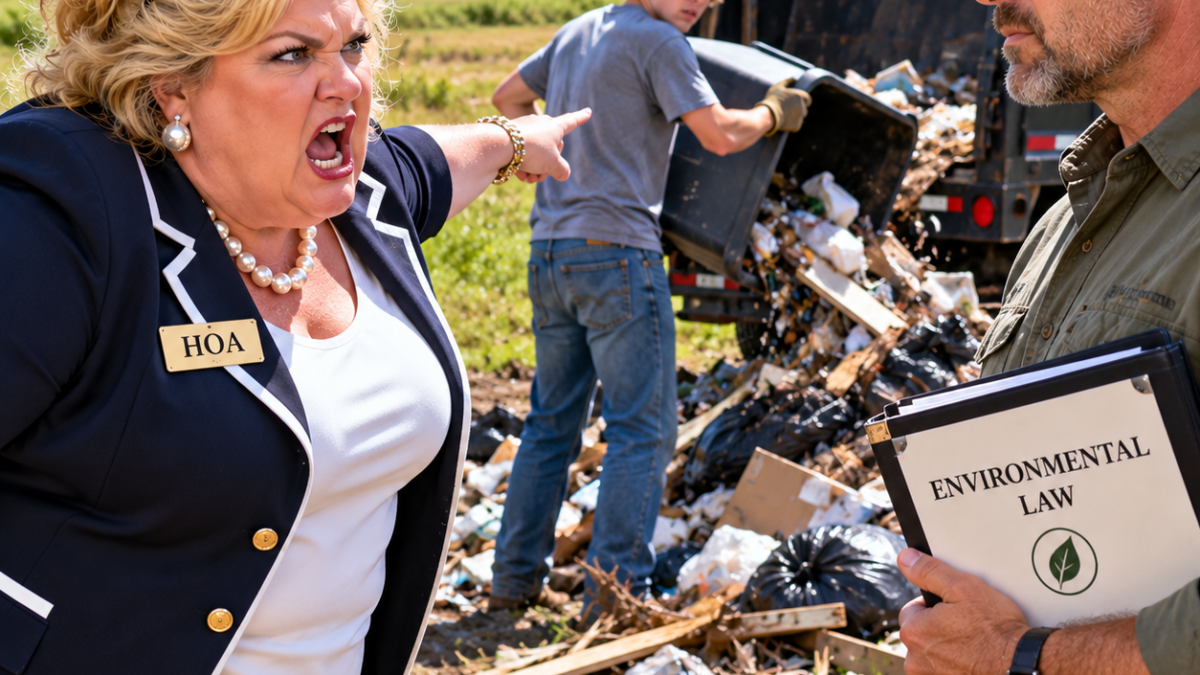
The first dump truck came through my western fence at 2:17 in the morning, killed its lights before reaching the ridge, and unloaded twelve tons of construction debris into a field the HOA president had been trying to force me to sell for almost a year. Three weeks later, after I found broken drywall, solvent containers, roofing adhesive, and material that tested positive for asbestos contamination buried beneath fresh dirt, Karen Whitmore stood at my gate and accused me of operating an illegal dump on my own forty-acre ranch while her adult son’s hauling company was billing the neighboring developer for “off-site disposal.” What Karen did not know was that I had already identified every truck that crossed my property, every load that arrived after midnight, and one small detail buried in a shipping manifest had changed the problem from a vicious property dispute into something none of them could control.
My name is Daniel Mercer.
To Karen, I was just the stubborn man who owned the forty acres blocking the grand entrance road planned for Ridgeline Estates, a luxury development spreading across the north end of our valley.
She had offered to buy my ranch fourteen months earlier.
Actually, “offered” was generous.
She arrived with maps, a purchase agreement, and the confidence of somebody who believed the only unresolved question was how quickly I would sign.
Her proposal showed a four-lane landscaped boulevard cutting directly across my lower pasture.
The developer wanted the route because building around me meant expensive grading, another bridge, and nearly two additional miles of road.
Karen slid the contract across my dining table.
“Three-point-two million dollars.”
I looked at it.
Then at her.
“No.”
Her smile remained frozen.
“You haven’t read the final number.”
“I heard it.”
“This is considerably above agricultural value.”
“I’m not selling.”
She leaned back.
“Everyone has a number.”
“Then mine is no.”
That was where the trouble started.
Within a month, I began receiving violation notices from Ridgeline’s property owners association even though my ranch had never been included in it.
Wrong roof color.
Commercial gravel.
Agricultural equipment visible from association roads.
Dust.
Fence materials.
Livestock odor.
I ignored the nonsense and kept copies.
Then security vehicles began sitting near my property at night with spotlights aimed toward the house.
Someone moved two survey stakes.
I replaced them and installed cameras.
Then the dumping began.
The first truck was white.
The second was blue.
The third had magnetic company markings removed but left enough adhesive shadow that I could read part of the name when I enlarged the infrared footage.
Whitmore Environmental Hauling.
Karen’s son, Eric, owned it.
That discovery changed how carefully I handled everything afterward.
I photographed the debris but touched almost nothing.
Instead, I marked locations, documented dates and times, preserved video, and kept people away from the contaminated ridge.
My ranch manager, Cole Ramirez, wanted to block the access trail with concrete barriers.
“Not yet,” I told him.
“They’re poisoning your land.”
“I know.”
“So why are we letting them come back?”
“Because I need to know who is sending them.”
Cole stared at me.
“You already know.”
“I know who owns one truck.”
“That isn’t enough?”
“No.”
He shook his head.
“You’re a strange man, Daniel.”
He wasn’t wrong.
Karen assumed my patience meant fear.
A week later, she mailed me a formal complaint accusing me of storing hazardous construction waste in violation of county regulations.
The letter demanded immediate remediation and warned that the association would “take corrective possession measures” if I failed to cooperate.
That phrase interested me.
Corrective possession.
Not a real legal remedy.
But somebody wanted my land badly enough to invent one.
I put the letter beside the truck photographs.
Then I pulled the disposal records I had quietly obtained through proper channels.
One manifest listed material leaving a Ridgeline construction site at 6:40 p.m.
Destination:
A licensed disposal facility two states away.
The truck never arrived there.
My camera recorded it entering my ranch shortly after midnight.
I read the manifest again.
Then I looked at the federal watershed map covering the western ridge.
And for the first time since Karen began trying to take my land, I stopped thinking about property law.
I reached for a different phone.
PART 2
The phone was not the one I used for neighbors, contractors, or ranch business.
It stayed locked in a drawer inside my home office when I was off duty.
I powered it on.
Waited for the encrypted system to authenticate.
Then called Supervisory Special Agent Rachel Kim.
She answered on the third ring.
“Mercer.”
“Rachel.”
There was a pause.
“You’re on leave.”
“I know.”
“If you’re calling about work, I’m hanging up.”
“I think somebody dumped regulated construction waste on my property.”
Her voice changed immediately.
“Accidental?”
“No.”
“How much?”
“Multiple truckloads.”
“Known source?”
“Possibly an active construction project.”
“Your property?”
“Yes.”
Another pause.
That mattered.
I had spent eighteen years in federal law enforcement.
The last six were with a multi-agency environmental-crimes task force where my job was coordinating operations involving illegal hazardous-waste transport, fraud tied to disposal manifests, and organized schemes crossing state lines.
I was not an EPA chemist.
I was not a county code officer.
And contrary to what Karen would later claim, I could not simply put on a badge and investigate anybody who annoyed me.
The fact that I owned the contaminated land created an obvious conflict.
Rachel understood that before I finished the sentence.
“You’re a victim.”
“Yes.”
“You’re out of the case.”
“I know.”
“Completely.”
“Yes.”
“No database searches.”
“I haven’t.”
“No interviews.”
“I haven’t.”
“No subpoenas.”
“I know.”
“You preserve what you already have and turn it over.”
“That’s why I called.”
“Good.”
Her tone softened slightly.
“What happened?”
I gave her the clean version.
Developer wanted land.
I refused.
Association harassment followed.
Night dumping began.
My cameras captured trucks.
One appeared connected to Karen Whitmore’s son.
A disposal manifest identified an interstate destination the truck apparently never reached.
Rachel interrupted.
“How did you get the manifest?”
“Publicly accessible shipping documentation supplied to me by the receiving facility after I asked whether they had accepted material represented as coming from Ridgeline.”
“You identified yourself as federal?”
“No. Landowner trying to identify dumping source.”
“Good.”
“Facility confirmed one listed load never arrived.”
“Don’t call them again.”
“I won’t.”
“Any samples?”
“None collected by me.”
“Excellent.”
“You sound shocked.”
“I’ve known you twelve years.”
“Fair.”
Rachel asked for copies of the camera recordings exactly as originally stored.
Not edited clips.
Original files.
Device metadata.
Installation records if I had them.
All letters from Karen.
Photographs taken before and after dumping.
Property survey.
Access history.
Anything showing the western ridge was clean before the incidents.
“What about the waste?”
“Stay out.”
“I already fenced it.”
“Good.”
“Cole knows?”
“He knows there’s contamination. Not what I do.”
Rachel paused.
“Still?”
“Still.”
That surprised people later.
Most folks in the valley thought I was a retired federal employee who had bought a ranch.
That description was technically close enough.
I had never seen any reason to announce the rest.
I spent enough of my professional life walking into bad situations with body armor and warrants.
On my own property, I wanted to be Daniel.
Not Agent Mercer.
The ranch was not a cover identity.
It was my real life.
My wife, Laura, had understood that better than anybody.
She died three years before the Ridgeline development began.
Pancreatic cancer.
Six months from diagnosis to funeral.
The ranch had been her idea.
We bought the forty acres thirteen years earlier, when our daughter was still in high school.
Laura loved the western ridge because in spring the grass turned gold beneath the cottonwoods and you could see nearly thirty miles down the valley.
After she died, I considered selling.
Our daughter Emily told me not to.
“Mom would haunt you.”
“Your mother didn’t believe in ghosts.”
“She’d make an exception.”
So I stayed.
That was one reason Karen’s money never mattered.
Selling the property wasn’t just a financial decision.
It was the place Laura had chosen when we were finally tired of living according to temporary assignments and federal calendars.
Karen had interpreted my refusal as negotiation.
It wasn’t.
Rachel arrived the following afternoon in jeans and a government fleet SUV without markings.
With her came two people I did not know.
One was an EPA Criminal Investigation Division special agent named Owen Price.
The other was Dr. Maya Patel, an environmental scientist contracted to support preliminary hazardous-material assessment.
I met them at the equipment barn.
Rachel pointed at me.
“You do not cross the western isolation line with us.”
“I know.”
“You do not tell Maya where to sample.”
“I know.”
“You do not explain your theory before they observe.”
“I know.”
Owen smiled.
“She always like this?”
“Worse.”
Rachel looked at him.
“You’ll learn.”
Cole watched from fifty yards away.
He eventually approached me.
“Friends?”
“Government.”
His eyes narrowed.
“What kind?”
“Environmental.”
“About the dumping?”
“Yes.”
He looked toward the ridge.
“You knew this was bigger.”
“I suspected.”
“What aren’t you telling me?”
“Quite a bit.”
Cole rubbed his jaw.
“I hate when you do that.”
“I’m protecting the investigation.”
“You’re protecting me from the investigation?”
“Both.”
He walked away muttering something in Spanish that my years working with him allowed me to translate without assistance.
The team stayed nearly six hours.
They photographed.
Mapped.
Sampled soil.
Sampled a drainage depression below the dump site.
Bagged material.
Documented labels.
Recorded tire impressions where possible.
Dr. Patel identified multiple materials that required laboratory confirmation before anyone could call them hazardous.
She found pieces of insulation.
Drywall.
Adhesive containers.
Sealant tubes.
Paint-related waste.
Demolition debris.
Sections of old pipe wrapping.
One broken panel immediately concerned her because of its appearance and age.
But she would not speculate.
“Laboratory first.”
Exactly right.
Before leaving, Rachel came inside.
She placed a receipt for the digital evidence I had transferred.
“You did something smart.”
“Only one?”
“You didn’t confront the haulers.”
“Cole wanted to.”
“Cole sounds normal.”
“He’s healthier than I am.”
Rachel studied me.
“Any chance Karen knows what you do?”
“Not from me.”
“What about public records?”
“My position isn’t secret.”
“So if she searched?”
“She could probably piece together that I’m federal law enforcement. Specific task-force work is harder.”
“She hasn’t?”
“Based on her letters, she thinks I’m a semi-retired rancher with some government background.”
Rachel nodded.
“Keep it that way.”
“Gladly.”
“Daniel.”
I looked at her.
“If this develops the way I think it might, you don’t get to be the hero.”
“I don’t want to be.”
She watched me carefully.
“You sure?”
That question bothered me.
Maybe because Laura used to ask versions of it.
I had built a career around being useful in crises.
Some habits survive retirement plans.
“This is my land.”
“I know.”
“My employees are being harassed.”
“I know.”
“She targeted me.”
“I know.”
“And you’re telling me to sit down.”
“I’m telling you that because she targeted you, the cleanest case is one you don’t control.”
I hated the logic because it was flawless.
Rachel gathered her bag.
“Be the victim for once.”
“That sounds terrible.”
“Good practice.”
Three days later, the lab called Rachel.
She called me afterward.
“I’m giving you only what you’re entitled to know as the property owner.”
“Understood.”
“Asbestos-containing material confirmed in part of the demolition waste.”
I closed my eyes.
“What else?”
“Several solvent-related compounds in soil immediately beneath disposal areas. Additional testing ongoing.”
“Water?”
“Low-level detections below the ridge. We need more work before attributing source.”
“How bad?”
“Don’t graze livestock there. Don’t disturb soil. Keep workers out. We’ll provide written precautions.”
“Already done.”
“Good.”
“Federal case?”
“Daniel.”
“I had to ask.”
“You know better.”
“Yes.”
She hesitated.
“Interstate paperwork involving waste represented as going to one facility and appearing somewhere else is not something agencies ignore.”
That was all she would say.
It was enough.
Meanwhile, Karen continued performing her own investigation.
Her version required no laboratory.
No chain of custody.
No jurisdiction.
Just stationery.
A certified letter arrived accusing me of operating an unpermitted hazardous-waste disposal site.
She copied the county environmental office.
County planning.
The sheriff.
Ridgeline’s association counsel.
Even the local newspaper.
Her requested remedy was extraordinary.
She demanded I remove the waste within ten business days.
Pay fines to her association.
Grant temporary access across my ranch for “community safety inspection.”
And enter negotiations to transfer the western twenty acres to the development entity so it could “undertake permanent remediation.”
I read that last part twice.
Then called Rachel.
“Can I send you something?”
“Through the evidence portal.”
“You’re going to like this.”
“I doubt that.”
She called twenty minutes later.
“You were wrong.”
“About?”
“I don’t like it.”
“Why?”
“Because either she’s catastrophically stupid or she’s trying to create paperwork suggesting you caused the exact contamination somebody else put there.”
“That’s my reading.”
“Do not answer her.”
“Attorney?”
“Yes. Civil counsel. Separate from us.”
I hired a land-use attorney named Claire Bennett.
She was fifty-two, soft-spoken, and allergic to theatrics.
When I showed her Karen’s demand, she read it without expression.
Then said:
“This is ambitious.”
“That polite?”
“Very.”
“My ranch isn’t in the association.”
“I know.”
“She knows.”
“Probably.”
“She wants access.”
“Yes.”
“To clean up waste I didn’t put there.”
“Which would destroy evidence.”
I looked at her.
She held up a hand.
“That’s a law-enforcement issue. My concern is simpler.”
She pointed to the demand.
“They are asserting authority they don’t have and creating a record that could later be used in property negotiations.”
“So we respond.”
“We respond narrowly.”
Claire drafted four pages.
No accusation of dumping.
No mention of a federal investigation.
She denied association jurisdiction.
Denied liability for association fines.
Denied access.
Directed all future communications through counsel.
Preserved all claims.
Not satisfying.
Extremely useful.
Karen responded publicly.
Ridgeline residents received a newsletter warning of a “serious environmental threat” emanating from the adjacent Mercer property.
She wrote that the ranch owner had “refused repeated requests to remediate dangerous dumping.”
Technically, I had refused her requests.
Because she had no right to conduct the remediation.
But she was building a narrative.
Dirty rancher.
Dangerous field.
Responsible HOA.
Helpful developer.
Then came the sentence I suspect Rachel printed and pinned to a wall.
Fortunately, Whitmore Environmental Hauling has offered its expertise in hazardous-site cleanup at substantially reduced community rates.
Karen’s son wanted to be paid to remove the material his trucks had allegedly helped place there.
I called Claire.
“You saw it?”
“I did.”
“How calm do I have to remain?”
“Very.”
“I don’t like you.”
“I bill by the hour whether you like me or not.”
Emily called that evening.
She lived three hours away with her husband and two daughters.
“Dad.”
“Hey, kid.”
“Why is your ranch on Facebook?”
I sighed.
“Local nonsense.”
“There’s a post saying toxic waste is leaking off your land.”
“It’s under investigation.”
“By who?”
“Proper agencies.”
Silence.
Then:
“Work?”
“Not mine.”
“Dad.”
“Emily.”
“Is this because of the people trying to buy Mom’s field?”
I looked toward the western windows.
Even in darkness, I knew exactly where the ridge was.
“Probably connected.”
“Are you safe?”
“Yes.”
“Are you sure?”
“Yes.”
“That’s your work voice.”
“I have one voice.”
“You have six.”
I almost smiled.
She continued.
“Should I bring the girls somewhere else this month?”
That hurt.
Our granddaughters visited the ranch almost every other weekend.
I told Emily the truth.
“Until the environmental team finishes their assessment, stay away from the western ridge. The house and eastern side are fine.”
“That wasn’t my question.”
“No.”
“You’re not sure.”
“I’m sure enough for me.”
“Dad.”
“Give me a couple weeks.”
The line stayed quiet.
Finally:
“Mom would’ve been furious.”
“At Karen?”
“At you.”
That surprised me.
“Why?”
“Because you sound excited.”
I sat down.
“I don’t.”
“You do.”
“Emily—”
“Every time something dangerous happened when I was growing up, you got calmer and more alive.”
“That was my job.”
“Exactly.”
She sighed.
“I know this matters. Just don’t turn Mom’s ranch into another operation.”
Then she hung up.
Twice in one week, women I trusted had told me essentially the same thing.
Rachel:
Don’t become the hero.
Emily:
Don’t turn home into the job.
I went outside.
The valley was dark.
The Ridgeline construction zone glowed in the distance under portable floodlights.
Somewhere beyond the ridge were barrels and broken building materials people had deliberately put on our land.
Laura would have been furious.
But Emily was right about who.
Me too.
So I made one change.
I stopped checking camera alerts myself.
Cole received ordinary ranch security alerts.
Anything involving the western ridge automatically uploaded to the federal evidence system set up by investigators.
If something happened, Rachel’s team saw it first.
That lasted six nights.
On the seventh, another truck came.
I learned the next morning when Rachel called.
“We got one.”
“One what?”
“Truck.”
My pulse increased.
I forced my voice flat.
“Same company?”
“I’m not discussing investigative details.”
“You called me.”
“To tell you federal agents may need temporary access to the south service road later today.”
“Warrant?”
“Yes.”
“For my property?”
“Search authorization related to the disposal site and vehicle. Claire has a copy through proper channels.”
“Anybody arrested?”
“Daniel.”
“Right.”
She lowered her voice.
“Let us work.”
I did.
That truck changed the pace of the investigation.
I later learned—after charging documents became public—that agents had followed disposal activity beyond my ranch.
Whitmore Environmental Hauling trucks were collecting mixed construction and demolition waste from several Ridgeline sites.
Invoices showed legitimate disposal fees.
But at least some loads were diverted.
The company still billed for proper disposal.
Some material went to unauthorized sites.
My ranch was one.
Two abandoned industrial parcels were others.
By avoiding legitimate disposal costs while still charging the developer, somebody made money twice.
The western ridge had another purpose.
Pressure.
The prosecutors later alleged that dumping there was specifically intended to create environmental liability against me and weaken my refusal to sell.
That allegation came from messages.
Not guesswork.
One exchange between Eric Whitmore and a development land-acquisition executive eventually appeared in a federal filing.
Mom says keep pressure on Mercer. He’ll sell when cleanup numbers hit him.
The response:
Do not put that in writing.
Too late.
Karen’s harassment also escalated.
Private security vehicles began appearing more often.
One parked outside our gate from midnight until dawn.
Another followed Cole’s pickup down the county road.
Claire sent a formal notice to the security company.
They claimed they were conducting “association boundary protection.”
Claire replied with our survey.
The ranch lay entirely outside Ridgeline.
The patrols continued.
Rachel’s team documented them.
Then someone moved a boundary stake.
That mistake produced better video than the dumping.
Two men arrived at 3:11 a.m.
Flashlights covered.
Faces partially visible.
One carried survey equipment.
The other dug up a wooden marker and placed a new one almost thirty feet inside my property.
Cole watched the footage in the morning.
“Can I shoot the next one?”
“No.”
“Warning shot?”
“No.”
“Hit him with a shovel?”
“No.”
“You federal people remove all joy from land ownership.”
“We preserve your right not to go to jail.”
He stared at the screen.
“What is this even supposed to accomplish?”
“Create confusion.”
“Thirty feet?”
“Today.”
He looked at me.
“Tomorrow?”
“Maybe another thirty.”
“That actually works?”
“Not against a recorded survey. But disputes can delay things, cloud transactions, increase legal cost, create leverage.”
Cole shook his head.
“All this because you said no.”
“Yes.”
“Three million dollars.”
“Three point two.”
“You could have retired.”
“I’m already trying.”
He laughed.
“Badly.”
The investigation expanded without me.
Rachel became increasingly unavailable.
That was a good sign professionally.
A terrible sign emotionally.
I received almost no information.
Claire handled civil harassment.
Cole ran the ranch.
I repaired fencing.
Vaccinated cattle.
Rebuilt an irrigation gate.
Tried to live normally.
Then the association’s attorney contacted Claire.
His name was Martin Hale.
He asked for a confidential meeting.
Not Karen.
Not the developer.
Him personally.
Claire met him without me.
When she returned, she looked unsettled.
“What?”
“He’s scared.”
“Of what?”
“He believes the association is being used for things the board does not understand.”
“What things?”
“Financial transfers.”
“Related to Eric?”
“Maybe broader.”
She sat across from me.
“Hale has documents.”
“Did he give them to you?”
“No.”
“Why meet?”
“He wanted to know whether your federal employment was real.”
I went still.
“What did you tell him?”
“That your current professional role was irrelevant to the property dispute and he should retain personal counsel if he believes he has exposure.”
“That answer seems evasive.”
“It was.”
“Did he know about the investigation?”
“He suspects.”
Two days later, Martin Hale contacted the FBI.
I learned that months later.
His documents opened a second track.
Association dues had moved through a network of vendors.
Some legitimate.
Some questionable.
Development-related payments crossed through companies sharing addresses, officers, or bank relationships with businesses tied to Karen’s family.
Investigators found suspicious property filings.
Assignments.
Altered maps.
Notary irregularities.
Loan documents using questionable property interests as collateral.
The case was no longer a dumping investigation.
It was a financial conspiracy investigation with environmental crimes attached.
And because I was a victim, Rachel enforced my recusal even more aggressively.
I wasn’t even allowed in certain task-force briefings.
Colleagues I had supervised for years stopped talking when I entered rooms.
Professionally, that was correct.
Personally, it made me insane.
One afternoon I drove to Rachel’s office anyway.
She saw me through the glass and came into the hallway.
“No.”
“I haven’t asked.”
“Whatever it is, no.”
“I need to know if my employees are in danger.”
“That I can answer.”
“Are they?”
“We believe harassment risk is elevated.”
“How elevated?”
“Enough that you should review ranch security protocols and call local law enforcement immediately if anyone enters unlawfully.”
“Is Karen planning something?”
“I can’t tell you.”
“Eric?”
“No.”
“The developer?”
“No.”
“Rachel.”
“Daniel.”
I lowered my voice.
“Cole has a wife and two kids.”
“I know.”
“Seven men work on that ranch.”
“I know.”
“If there’s an operational threat—”
“If we identify a specific credible threat, we will act.”
“That isn’t good enough.”
Her expression hardened.
“It has to be.”
I turned away.
“Daniel.”
I stopped.
“You taught me this.”
I looked back.
“What?”
“Investigations don’t belong to victims.”
That ended the argument.
For the next month, very little happened publicly.
That turned out to be because everything was happening privately.
Grand jury subpoenas.
Bank records.
Search-warrant affidavits.
Environmental lab reports.
Phone extraction.
Corporate records.
Financial tracing.
Interviews.
A hauling supervisor began cooperating.
Then a bookkeeper.
Then one of Karen’s board members.
The case that started with midnight dumping was turning into a map of relationships far beyond my fence.
Karen interpreted the silence differently.
She thought she had won.
Her association notices became bolder.
She announced that my environmental violations justified “emergency intervention.”
She claimed local authorities had failed to act.
She circulated an internal document titled:
COMMUNITY PROTECTION ORDER
Claire called it “legal cosplay.”
It purported to authorize private security to enter my ranch, secure hazardous areas, remove obstructions, detain trespassers, and protect contractor operations.
Claire stared at the document.
“She signed this herself.”
“Yes.”
“There’s no judge.”
“No.”
“No court.”
“No.”
“No sheriff.”
“No.”
“No statutory authority cited.”
“Not one that means anything.”
“Daniel.”
“Yes?”
“This is one of the stupidest documents I’ve seen in twenty-seven years.”
“I thought you’d enjoy it.”
“I do not enjoy future exhibits.”
She sent copies to Rachel and local law enforcement.
Then came Friday.
Rachel called at 5:40 in the morning.
“Where are you?”
“House.”
“Stay there.”
My body reacted before my brain did.
“Why?”
“Federal operation.”
“On the ranch?”
“Do not leave the house until Cole calls you.”
“Rachel.”
“You are not part of the entry team.”
“What happened?”
“You’ll be briefed when authorized.”
She hung up.
I dressed anyway.
Jeans.
Boots.
No badge.
No gun beyond the one normally secured in my home safe.
At 6:12, Cole called.
“They’re here.”
“Who?”
“Karen.”
My jaw tightened.
“How many?”
“Too many.”
“Explain.”
“Black SUVs. Security guys. Nine, maybe ten vehicles total. Excavators.”
“Workers?”
“Already in the east field.”
“What are they doing?”
“Daniel.”
His voice changed.
“They put Luis on his knees.”
I was already moving toward the truck.
Rachel’s order stopped me.
Barely.
“Cole, listen to me.”
“I’m listening.”
“Do not fight them.”
“They have zip ties.”
“Do not fight them.”
“Those are my guys.”
“I know.”
“Karen is here with a megaphone.”
Of course she was.
“Get somewhere safe.”
“She’s coming toward the office.”
“Do not obstruct her.”
“What?”
“Cole.”
“I don’t like your tone.”
“Trust me.”
Silence.
Then:
“You knew.”
“Not this.”
“But something.”
“Yes.”
“You better get here fast.”
He disconnected.
What happened over the next thirty minutes I reconstructed later from body-camera footage, security video, employee statements, and court records.
Karen arrived with private security contractors hired through an affiliated firm.
Some were armed.
That did not make them law enforcement.
They cut the ranch gate chain.
Entered.
Confronted workers repairing an irrigation trench.
Ordered them to stop work.
When Luis Ortega demanded a warrant, a security man forced him down.
Others followed.
Several ranch employees were restrained with heavy plastic flex cuffs.
Their phones were taken.
No court order existed.
No sworn law-enforcement officers were present.
Karen read portions of her “Community Protection Order” through a megaphone as if volume could turn association stationery into legal authority.
Cole walked out of the operations office.
He asked:
“Show me the judicial order.”
Karen held up her document.
“Here.”
“Judge’s signature?”
“The association has emergency authority.”
“Statute?”
“You’ve been warned repeatedly.”
Cole read the first page.
Then handed it back.
“This is paper you signed giving yourself permission to enter land you don’t own.”
Karen’s face reddened.
“Detain him too.”
The security chief hesitated.
Cole noticed.
“That pause is the smartest thing you’ve done today.”
Karen turned on the man.
“I’m paying you to secure the property.”
One security contractor said:
“Ma’am, we were told there was a municipal enforcement order.”
“There is.”
Cole pointed at the document.
“That isn’t one.”
Karen shouted:
“Take their phones.”
That order later mattered.
Security personnel collected phones from restrained ranch employees and put them into a canvas equipment bag.
Then two excavators entered through the cut gate.
Their tracks damaged the gravel road.
One moved toward the eastern fence.
The other idled near the irrigation line.
Karen announced that the property was being secured due to environmental violations and boundary encroachment.
Then she accused my ranch crew of creating the illegal dump on the western ridge.
Cole laughed.
Actually laughed.
Karen snapped:
“What is funny?”
“You.”
“Excuse me?”
“You picked the wrong morning for this.”
“You don’t intimidate me.”
“I’m not trying to.”
He checked his watch.
According to body-camera time, it was 6:41.
Cole looked toward the county road.
“I’m telling you that whatever chance you had to leave before real law enforcement arrived is getting smaller every second.”
Karen mistook certainty for bluffing.
That had been her problem from the beginning.
She ordered the workers moved into the equipment barn.
Some security contractors objected.
The chief complied.
That decision transformed a catastrophic trespass into something prosecutors would later treat far more seriously.
Then Karen entered the ranch office.
The door was unlocked because Cole had been pulled outside.
On the center desk sat a manila folder.
I need to be precise about that folder because the exaggerated version of this story later made it sound like federal agents deliberately baited Karen into stealing evidence.
That is not exactly what happened.
Investigators had already copied and secured the underlying evidence.
Cole had assembled his own working file containing duplicates of dumping photographs, correspondence, and cleanup estimates because Claire needed documents for the civil property case.
The folder was labeled:
RIDGELINE—DUMPING / FINANCIAL DISCREPANCIES
It should probably have been locked away.
Cole admitted that later.
Karen opened it.
Saw copies of photographs showing her son’s trucks.
Saw payment records.
Saw emails supplied in civil discovery.
Then put the folder into her leather tote.
No one told her to.
No one encouraged her.
No trap was necessary.
She simply found evidence damaging to her interests and stole it.
By then, nine unmarked federal vehicles were less than two miles away.
I was in the passenger seat of the lead command vehicle.
Not as case agent.
Not as arresting officer.
Rachel had sent an agent to collect me after the ranch intrusion created an immediate victim-safety issue and because I was needed to identify employees and private areas during the execution of warrants.
She made the boundaries painfully clear.
“You observe.”
“I know.”
“You do not arrest Karen.”
“I know.”
“You do not interview her.”
“I know.”
“You do not touch evidence unless asked for safety reasons.”
“I know.”
“You do not give tactical orders.”
“I know.”
She looked at me.
“You look happy.”
“I’m furious.”
“Good. Keep it that way.”
Our convoy turned onto my road.
The ranch gate hung open.
Chain cut.
Security vehicles filled the entrance.
Two excavators stood inside.
Workers were being held near the equipment barn.
I felt something inside me go cold.
This was no longer satisfying.
Luis had worked for us eight years.
His wife brought tamales every Christmas.
Miguel had a new baby.
Cole had warned me.
I had known harassment risk was rising.
I had trusted the system to move before Karen did something this reckless.
Professionally, I knew that was not fair.
Emotionally, I wanted someone to blame.
The federal vehicles entered.
No sirens.
No theatrical synchronized doors.
Real tactical operations are coordinated, not choreographed.
Agents positioned vehicles to control exits.
FBI.
EPA Criminal Investigation Division.
U.S. Marshals Service personnel assigned to warrant execution and fugitive operations support.
Local sheriff’s deputies waited beyond the main gate.
Warrants had been signed earlier that morning.
Search warrants.
Arrest warrants.
Not because Karen invaded the ranch.
Those warrants arose from months of investigation before she cut my lock.
Her invasion simply gave agents more crimes to assess in real time.
Rachel stepped out first.
Agents moved quickly.
Commands.
Hands visible.
Weapons controlled at low ready where appropriate.
Private security contractors froze.
Several immediately placed their hands up.
No shots.
No heroic gunfight.
The security chief looked from federal vests to his own men.
Then toward Karen.
I exited only after Rachel signaled.
I wore body armor because the scene was unsecured.
My credentials were visible.
Karen saw me.
For several seconds, her face showed nothing.
Then recognition.
Not of me.
Of the badge.
Of the agency markings around me.
Of the fact that the rancher she had spent fourteen months trying to bankrupt and intimidate had never been what she assumed.
“You.”
Her voice was barely audible.
I did not answer.
Rachel had already told me not to.
Agent Price approached the security chief.
“Who’s in charge of your team?”
“I am.”
“Name.”
“Curtis Hale.”
“Are you armed?”
“Yes.”
“Do not reach for it.”
“I won’t.”
“Have your personnel restrained any ranch employees?”
Curtis looked at Karen.
Price said:
“Look at me.”
Curtis did.
“Yes.”
“Under what legal authority?”
“We were contracted for an enforcement action.”
“By what government agency?”
Silence.
“Court order?”
“We were told there was one.”
“Have you seen it?”
Curtis swallowed.
“She had paperwork.”
Karen rushed forward.
“This is private association business.”
Rachel held up one hand.
“Ma’am, stay where you are.”
Karen stopped.
“You have no right to interfere.”
Rachel identified herself.
Then asked Karen’s name.
“You know who I am.”
“I need you to state it.”
Karen’s eyes flicked toward me.
“Karen Whitmore.”
Rachel directed another agent to remain with her.
Other agents cut the workers’ flex cuffs.
Medical personnel checked wrists.
Luis saw me.
His face was furious.
“Boss.”
“I’m sorry.”
“For what?”
I looked at the red marks around his wrists.
“I should’ve—”
He shook his head.
“Later.”
That was all.
Cole walked over.
A security contractor had not restrained him after several members refused to follow Karen’s final order.
“Your timing sucks.”
“I know.”
“You going to explain?”
“Eventually.”
He looked at my vest.
Then at the agencies surrounding us.
“You’re not retired.”
“Not exactly.”
“I knew you were weird.”
Fair.
Karen’s tote bag became relevant when agents secured her under one of the existing arrest warrants.
The warrant was tied to the environmental and financial case.
Not the morning’s trespass, which investigators were still documenting.
A female agent conducted the search incident to arrest.
She opened the bag.
Removed wallet.
Keys.
Phone.
Then the manila folder.
Cole pointed.
“That’s mine.”
The agent looked at him.
“What?”
“That folder was on my desk.”
Karen shouted:
“He gave it to me.”
Cole laughed once.
“No, I did not.”
The agent preserved the folder.
Karen’s face changed.
She realized what she had done.
Rachel advised her of her rights.
Karen said she wanted a lawyer.
Questioning stopped.
That should have been the end of her statements.
It nearly was.
Then Karen saw one photograph through the clear evidence sleeve as the folder was inventoried.
A dump truck on the western ridge.
Eric’s company.
She blurted:
“Those were stolen from our files.”
Rachel’s head turned slightly.
Nobody asked a follow-up question.
Karen’s lawyer would later argue the statement was ambiguous.
Prosecutors would argue it demonstrated knowledge of the materials.
Either way, agents documented it and moved on.
Curtis Hale, the security chief, asked for an attorney too.
Later—after counsel—he chose to cooperate.
Several of his employees did the same.
Their messages told a damaging story.
Karen had represented the action as legally authorized.
She supplied the “Community Protection Order.”
She told Curtis local law enforcement had approved it.
They had not.
The security firm’s owner had asked for a court order.
Karen emailed back:
Association counsel has cleared authority. Proceed.
Association counsel had done no such thing.
At the same time agents were securing my ranch, other teams executed warrants at Ridgeline’s association office, Whitmore Environmental Hauling, and development-company offices.
Karen’s home was searched under separate authority.
Eric Whitmore was arrested at his hauling yard.
I did not see it.
I learned later through public court filings.
His phone contained messages discussing disposal routes.
Cost savings.
My refusal to sell.
Cleanup pressure.
His financial records linked loads billed to licensed disposal facilities with trucks that never appeared in those facilities’ intake logs.
The association office produced another category of evidence.
Property maps modified to show boundaries inconsistent with county surveys.
Draft lien notices against land outside the association.
Notary materials.
Vendor-payment files.
Related-party contracts.
And a Ridgeline expansion binder Karen had kept.
The binder was less cartoonishly explicit than neighborhood rumors later suggested.
It did not say:
STEP ONE: COMMIT CRIMES.
What it did contain was a development strategy.
Target parcels.
Acquisition priorities.
Projected costs.
Resistance notes.
My parcel had a page.
MERCER—40 ACRES
Under it:
Critical western access. Owner refuses all sale proposals. Pressure options: code, environmental, access, nuisance.
A handwritten note in Karen’s script said:
Eric can solve disposal issue and create leverage.
That note became important.
So did an email from a development executive:
Keep association activity separate from acquisition file. We need deniability.
Another executive replied:
Karen understands.
She did.
Until she didn’t.
The seventy-page original charging package expanded as prosecutors reviewed the ranch invasion.
The federal case did not move like a freight train.
Nothing in federal court moves like a freight train.
It moved like something heavier.
Slow.
Methodical.
Difficult to stop once properly built.
Grand jury proceedings.
Superseding indictment.
Discovery.
Motions.
Defense challenges.
Suppression arguments.
Expert disputes over waste classification.
Financial analysis.
Jurisdictional questions.
I returned to work but remained walled off from substantial parts of the prosecution.
That frustrated me more than I admitted.
Rachel found me one afternoon reviewing an unrelated fugitive case.
“You look miserable.”
“I’m working.”
“You haven’t complained in thirty minutes.”
“Busy.”
She put coffee on my desk.
“Eric’s counsel filed a conflict motion.”
I looked up.
“I’m not on the prosecution team.”
“I know.”
“He’s arguing I used federal authority for personal retaliation.”
“Expected.”
“Anything I need to do?”
“Nothing unless counsel calls you.”
I leaned back.
“Do you think I did?”
Rachel studied me.
“No.”
“Quick answer.”
“You disclosed the property conflict when the dumping became a federal matter. You did not direct the criminal case. Independent agents collected samples. Independent prosecutors obtained warrants. You weren’t in grand jury. You weren’t the arresting agent.”
She took a sip.
“You were annoying.”
“Thank you.”
“But clean.”
That mattered more than I expected.
The defense still attacked.
They had to.
Karen’s attorneys issued statements calling the case federal overreach.
They said a powerful law-enforcement officer had transformed a zoning dispute into a criminal prosecution.
They described me as a disgruntled landowner who refused legitimate development.
The government responded mostly in court.
Not press conferences.
The timeline hurt Karen.
The first dump-truck footage predated my disclosure to federal investigators.
Independent laboratory samples corroborated contamination.
Receiving facilities documented loads that never arrived.
Toll-camera and fuel-card data placed trucks on routes inconsistent with declared disposal destinations.
Bank records showed payments.
Messages showed coordination.
Association counsel Martin Hale testified to the documents he independently discovered before knowing the full extent of the environmental case.
Security contractors described the ranch invasion.
Cole described Karen taking his file.
My professional role was almost beside the point.
Almost.
I still had to testify.
I hated that day.
Not because I feared cross-examination.
Because Laura’s ranch became an exhibit.
Photographs of the western ridge appeared on courtroom screens.
Our fence.
Our field.
Our barn.
Drone images.
Dump debris.
I sat in the witness chair and explained when the first truck appeared.
Why I installed cameras.
How I preserved original files.
Why I contacted Rachel.
Why I recused.
Karen sat at the defense table.
She looked older.
Eric sat several seats away with separate counsel because their defense interests had diverged.
The prosecutor asked:
“Mr. Mercer, did you refuse to sell your property to Ridgeline Development?”
“Yes.”
“Why?”
“I did not want to sell it.”
“Did your federal position play any part in that decision?”
“No.”
“Did you threaten Ms. Whitmore with your federal position?”
“No.”
“Did you identify yourself to her as a federal agent before the investigation?”
“No.”
“Why not?”
“Because she was trying to buy my ranch. My employment wasn’t relevant.”
Then the defense attorney stood.
He was good.
Calm.
No theatrics.
“Agent Mercer, you had cameras on your property before any alleged hazardous dumping, correct?”
“Yes.”
“You were suspicious of Ms. Whitmore.”
“Yes.”
“You disliked her.”
“I disliked what she was doing.”
“So yes.”
“Yes.”
“You knew how federal investigations work.”
“Yes.”
“You knew how to preserve evidence.”
“Yes.”
“You knew what evidence would interest federal prosecutors.”
“Yes.”
He paced slowly.
“And when trucks came onto your property, you allowed them to continue rather than physically block access.”
“For a limited period, yes.”
“Because you wanted evidence.”
“I wanted to identify who was entering my property and why.”
“You could have installed a gate.”
“There was a gate.”
“A stronger gate.”
“Possibly.”
“You could have placed concrete barriers.”
“Yes.”
“You could have called local police after the first truck.”
“Yes.”
“But you didn’t.”
“No.”
“Because you wanted them to keep coming.”
That question bothered me because it contained some truth.
The courtroom waited.
I answered carefully.
“At first I wanted enough information to understand whether the dumping was accidental, isolated, or deliberate.”
“That’s not my question.”
“I know.”
“Did you want them to return?”
I looked at Karen.
Then Eric.
Then the jury.
“I wanted to know who was responsible.”
The attorney nodded.
“And the more trucks came, the stronger the case.”
“Also the greater the damage to my property.”
“But stronger evidence.”
“Yes.”
“So you benefited professionally from additional criminal conduct occurring on your own ranch.”
“No.”
He raised his eyebrows.
“No?”
“I was not assigned to the case.”
“You’re a federal investigator.”
“Yes.”
“You enjoy investigations.”
The prosecutor objected.
Sustained.
The attorney changed direction.
“Your daughter once accused you of treating the matter like an operation, didn’t she?”
That surprised me.
A text message.
Discovery had reached more of my communications than I realized.
“Yes.”
“So even your family thought you were becoming personally invested.”
“Of course I was personally invested. It was my property.”
He smiled faintly.
“Exactly.”
For two hours he tried to turn involvement into misconduct.
He never quite got there.
But he made me confront something uncomfortable.
I had been excited.
Not by contamination.
Not by employees being endangered.
But by the puzzle.
The pattern.
The feeling of using skills I understood against someone who underestimated me.
That did not invalidate evidence.
It did remind me that clean motives are rarer than people claim.
At recess, Emily was waiting in the hallway.
“You okay?”
“Yes.”
“You look mad.”
“At myself.”
“That seems healthier.”
I stared at her.
“Your mother taught you disrespect.”
“Genetics.”
She hugged me.
“I was hard on you.”
“No.”
“I was.”
“You were right.”
She stepped back.
“What?”
“Don’t make me say it twice.”
She smiled.
“I wish Mom heard that.”
“She would’ve recorded it.”
“Absolutely.”
The criminal cases separated.
Several defendants pleaded.
The security-company owner reached a civil settlement with my workers and cooperated regarding Karen’s representations.
Curtis Hale accepted responsibility for his role and testified about the invasion plan.
His sentence was far less severe than the rumors later claimed.
The court considered his cooperation, lack of prior criminal history, and the fact that Karen had misrepresented the supposed legal authority.
That did not erase what he did.
Luis still had nightmares about being forced to his knees.
Miguel quit ranch work for several months.
One employee moved his family out of the valley.
There was no clean reset.
The private security company dissolved after lawsuits and loss of licensing.
Its insurer funded part of the civil settlements.
Development executives faced fraud, conspiracy, and environmental charges based on their own conduct.
Eric pleaded guilty before trial to multiple counts connected to unlawful waste disposal and fraud.
His plea agreement required cooperation.
Karen did not plead.
She went to trial.
That decision exposed more evidence publicly than almost any settlement would have.
Martin Hale testified.
Rachel testified.
EPA investigators testified.
Hauling employees testified.
A Ridgeline bookkeeper testified.
Eric testified against his own mother.
That was the moment Karen finally changed.
Not when agents arrived.
Not when her tote bag was searched.
Not when the indictment became public.
When Eric took the witness stand.
He looked at her once.
Then mostly looked at the prosecutor.
He admitted his hauling company diverted waste.
Admitted falsified disposal representations.
Admitted the ranch was targeted because I would not sell.
The prosecutor asked:
“Who suggested the Mercer property?”
Eric swallowed.
“My mother.”
Karen closed her eyes.
“Why?”
“She said if environmental violations got attached to the land, cleanup costs could force him to negotiate.”
“Did you object?”
“At first.”
“What changed?”
“She told me Ridgeline would cover us.”
“Did the development company know?”
“Yes.”
“Who?”
He named two executives.
Then came the hardest question.
“Did your mother understand hazardous material might be included?”
Eric’s voice dropped.
“She told me not to ask questions about mixed loads.”
Karen whispered something to her lawyer.
Her lawyer put one hand on her shoulder.
Eric continued.
“She said the point was to make the property look contaminated.”
That testimony did not stand alone.
Messages corroborated it.
Invoices corroborated hauling patterns.
Laboratory evidence corroborated contamination.
Video corroborated trucks.
The case never depended on one bitter son blaming his mother.
That made it stronger.
The prosecution also presented the ranch invasion.
Karen’s self-signed “Community Protection Order.”
The cut gate.
Flex-cuffed workers.
Stolen phones.
Excavators.
Cole’s folder found in her tote.
Her spontaneous statement.
The defense argued she genuinely believed the association had emergency authority.
That explanation became harder to sustain when association counsel testified he had warned her repeatedly that the ranch was not subject to HOA jurisdiction.
Martin Hale produced an email.
Karen, stop asserting enforcement authority over Mercer acreage. The association has no recorded covenant interest, ownership interest, easement, or judicial order supporting entry.
Her reply:
Legal technicalities cannot interfere with community safety.
One sentence.
Her own.
No villain speech could have been more effective.
The jury deliberated for three days.
Karen was convicted on numerous counts.
Not every count.
That mattered to me.
The government alleged a broad conspiracy.
Jurors accepted much of it and rejected portions they found insufficiently proven.
That was how the system was supposed to work.
She faced substantial prison time.
The judge imposed a sentence measured in years, not the fantastical life term some neighbors wanted.
Restitution orders followed.
Forfeiture proceedings targeted assets traceable to criminal proceeds.
Environmental penalties against the involved companies were separate.
Ridgeline Development entered bankruptcy restructuring after financing collapsed, permits were suspended, lenders withdrew, and litigation multiplied.
The half-built luxury development did not disappear overnight.
Construction stopped in sections.
Some legitimate contractors were never fully paid.
Homebuyers panicked.
Employees who knew nothing about the scheme lost jobs.
That part never felt like victory.
When a corrupt organization collapses, innocent people get hit by falling pieces.
The property owners association faced its own reckoning.
Most board members were not criminally charged.
Some had been negligent.
Some gullible.
Some intimidated.
A few cooperated early.
All directors resigned.
Homeowners elected an interim board under court and management-company supervision.
Martin Hale helped transfer records before leaving association work entirely.
I attended one town hall.
No badge.
No government title on the agenda.
Just:
Daniel Mercer—Adjacent Landowner
I sat in the back.
The new president was a middle-school principal named Anita Brooks.
She opened the meeting by saying:
“We have one job tonight. Separate what belongs to homeowners from what belonged to Karen.”
That was a good start.
The association had been used as a pressure tool.
But homeowners still needed roads.
Landscaping.
Drainage.
Common insurance.
Reserves.
Contracts.
A functioning HOA was not automatically evil because a corrupt president had controlled one.
Anita proposed boundaries.
Every enforcement action had to identify the recorded covenant granting authority.
No enforcement beyond association parcels.
Related-party vendor transactions required disclosure and independent bids.
Financial statements published quarterly.
Outside legal review for property acquisitions.
No private security enforcement beyond ordinary observation and emergency services coordination.
Homeowners approved the reforms overwhelmingly.
Then Anita said:
“Mr. Mercer, would you like to speak?”
I hadn’t planned to.
I stood anyway.
A hundred faces turned toward me.
Some knew me from television.
Most knew the ranch story.
I kept it short.
“Your association didn’t dump waste on my ranch.”
People shifted.
“Individuals did.”
I continued.
“Your dues account didn’t cut my gate. People made those decisions.”
I looked around.
“If you replace one powerful president with another and keep the same culture, you will be back here someday with different names.”
Anita nodded.
“So read your records.”
I thought about Laura.
“Ask questions before things become emergencies.”
Then I sat.
No applause at first.
I preferred that.
Then somebody clapped.
Others joined.
I wished Laura had been there.
The cleanup of the western ridge took nearly eleven months.
Environmental remediation was not simply a matter of loading trash into trucks.
First, contaminated material had to be characterized.
Then segregated.
Asbestos-containing debris required specialized handling.
Impacted soil was excavated according to sampling grids.
Additional testing determined boundaries.
Stormwater controls prevented contaminated sediment from moving downslope.
Clean fill replaced removed soil where necessary.
Native grasses were reseeded.
Monitoring continued.
Costs came from multiple sources.
Corporate assets.
Insurance where coverage applied.
Restitution.
Court-ordered recovery.
Environmental enforcement settlements.
I still paid some money upfront because environmental cleanup does not always wait for litigation.
Later, portions were reimbursed.
Money irritated me less than the damage.
On the first day excavators removed contaminated soil, I stood with Cole at the edge of the exclusion zone.
He looked toward the machines.
“Different excavators.”
“Yes.”
“These ones invited?”
“Yes.”
“Good.”
We watched a sealed truck leave.
Cole said:
“Laura would hate this.”
“I know.”
“She loved this hill.”
“I know.”
“You ever think about selling after all?”
“No.”
He smiled.
“Good.”
Then:
“Three point two million was a lot.”
“Go back to work.”
“Yes, boss.”
Luis stayed.
So did Miguel.
The employees who had been restrained received settlements from parties responsible for the unlawful detention.
I did not pretend money fixed it.
We paid for counseling independent of the lawsuits.
Luis initially refused.
“I’m fine.”
His wife called me.
“He’s not.”
I told Luis counseling was part of ranch benefits for anyone involved.
That let him accept without feeling singled out.
Months later, he thanked me.
Quietly.
No drama.
“Helps.”
“Good.”
He rubbed one wrist.
The marks had vanished long before.
Memory hadn’t.
The broken gate stayed broken longer than necessary.
I could have replaced it in a day.
For some reason, I didn’t.
The cut chain hung from the post.
Emily noticed during a visit.
“Why is that still there?”
“Haven’t gotten around to it.”
“Liar.”
She was becoming disturbingly like her mother.
“It doesn’t affect operations.”
“It affects you.”
“How?”
“You look at it every time you drive in.”
I did.
The gate represented the morning Karen crossed from harassment into force.
Part of me wanted it visible.
A reminder.
Emily picked up one end of the chain.
“Mom would’ve thrown this away.”
“Your mother kept everything.”
“She kept sentimental things.”
“This is sentimental.”
“This is trauma with rust.”
I laughed despite myself.
She let go.
“Fix the gate, Dad.”
The next weekend, Cole and I replaced it.
New steel posts.
Heavier hinges.
Electronic access.
Nothing theatrical.
When we finished, I held the old chain.
Cole pointed toward the scrap bin.
“Go.”
I dropped it in.
That night I slept better.
The western ridge began healing.
First green shoots.
Then grass.
The following spring, wildflowers appeared where contaminated soil had been removed.
Some seeded deliberately.
Some volunteered.
My granddaughters came back to the ranch after environmental specialists cleared the area for ordinary use.
Maya Patel herself called.
“Your western ridge is boring now.”
“Best report you’ve ever given me.”
“Monitoring continues.”
“Understood.”
Emily brought the girls the following weekend.
Sophie was nine.
Grace six.
They ran toward the hill.
I stopped them automatically.
“Stay on the marked path.”
Emily looked at me.
“Cleared.”
“I know.”
“You heard the scientist.”
“I know.”
“Dad.”
I exhaled.
“Go.”
The girls ran.
Grace found a grasshopper within thirty seconds and treated it like a scientific breakthrough.
Sophie climbed the low rise where Laura used to sit.
Emily stood beside me.
“You okay?”
“Working on it.”
She slipped her arm through mine.
“Mom would’ve liked the flowers.”
“Too purple.”
“Mom loved purple.”
“She claimed she did.”
Emily laughed.
For several minutes, neither of us mentioned Karen.
That was progress.
Karen’s sentencing occurred later that year.
I submitted a victim-impact statement but did not speak in court.
I wrote about contaminated land.
Employees restrained.
The emotional strain.
The attempts to force a sale.
I avoided words like monster.
Tyrant.
Evil.
The evidence did not need help.
Karen addressed the court.
She blamed the developer at first.
Then Eric.
Then advisers.
Then pressure.
Eventually she said:
“I convinced myself that protecting the development justified decisions I would never have accepted from somebody else.”
That was the closest she came to understanding the problem.
The judge addressed her for a long time.
I remember one sentence.
“Authority you do not possess cannot be manufactured by repetition.”
I wrote it down.
Naturally.
Karen was sentenced.
Eric too, under his plea agreement, received a lesser sentence reflecting cooperation.
Development executives received their own outcomes.
Civil litigation continued long after the criminal case ended.
Ridgeline’s original grand boulevard was never built across my ranch.
Eventually another developer purchased portions of the failed project out of bankruptcy.
They redesigned access.
More expensive.
Less elegant.
Completely legal.
Before construction began, the new company sent two representatives to my house.
I almost refused the meeting.
Claire told me to take it.
They sat at the same dining table where Karen had offered three-point-two million.
The younger representative unfolded a map.
My shoulders tightened.
Then he pointed nowhere near my property.
“We aren’t asking you to sell.”
“Good opening.”
“We want to make sure our drainage plan doesn’t create impacts downstream.”
That surprised me.
“We’ve commissioned independent review.”
He slid a report toward me.
“Would your engineer like a copy?”
“I don’t have one.”
He looked confused.
“I thought—”
“I work for the federal government. Not your project.”
“Right.”
He looked embarrassed.
“I apologize.”
“No problem.”
They voluntarily funded additional watershed monitoring during construction.
No easement request.
No land pressure.
No midnight trucks.
No HOA letters.
Ordinary business.
It felt revolutionary.
The new development ended up smaller.
Lower density.
The grand entrance Karen wanted became a modest road farther east.
Houses still appeared along the ridge.
I didn’t love that.
But they were built on land somebody chose to sell.
That distinction was everything.
Cole retired three years after the case.
We held a barbecue at the ranch.
Luis roasted a whole pig.
Miguel brought music.
Rachel came wearing civilian clothes.
So did Owen Price.
Claire came late and charged nobody for the hour, which I considered evidence of personal growth.
Cole stood beside the barn holding a beer.
“You going to tell everybody what you really do now?”
“Everybody already knows.”
“Ruined your mysterious rancher act.”
“Tragic.”
He looked toward the western ridge.
“Remember when Karen put me in charge of her imaginary prison?”
“You weren’t restrained.”
“Still offended.”
“I’m sure.”
Cole smiled.
“I thought you were going to lose it when you came through the gate.”
“I almost did.”
“No.”
He shook his head.
“You went quiet.”
“That means worse.”
“I know.”
We stood there.
After a moment, he said:
“You did one thing right.”
“One?”
“You let Rachel run it.”
“That wasn’t voluntary.”
“Still counts.”
He finished his beer.
“Could’ve turned ugly if you’d made it personal.”
“It was personal.”
“You know what I mean.”
I did.
The most important decision I made had not been identifying Eric’s truck.
Not calling Rachel.
Not preserving video.
It was letting other people control the case once I became the victim.
Real authority has limits.
Karen never understood that.
I had nearly forgotten it myself.
Rachel retired before I did.
At her ceremony, someone put up photographs from major cases.
One showed the line of federal vehicles outside my ranch.
I groaned.
Rachel saw me.
“Classic.”
“You included that?”
“I wasn’t in charge of slides.”
“Liar.”
She handed me a drink.
“You ever regret not arresting her yourself?”
“No.”
She looked skeptical.
“Eventually no.”
“Better.”
“Did you know she was invading that morning?”
“Not until the surveillance team reported movement.”
“So the warrants really just happened to be that day.”
“Yes.”
“That’s ridiculous.”
“It is.”
“People think we planned it.”
“People think federal agents control weather too.”
“You let them?”
“When useful.”
I laughed.
Rachel became serious.
“Your ranch was the cleanest environmental case we ever got from somebody emotionally attached to the evidence.”
“That sounds like an insult.”
“It’s a compliment.”
“I’ll take it.”
Then she added:
“Mostly because I kept you away from it.”
There she was.
Years passed.
The story became legend in the valley.
Like all legends, it got worse every time somebody told it.
People said Karen invaded with fifty armed mercenaries.
There were fewer.
They said tanks came.
Excavators.
They said I emerged from a barn in tactical gear like some movie hero.
I arrived with the federal convoy after the entry team was already operating under independent command.
They said Karen’s son personally dumped nuclear waste.
No.
Construction waste containing regulated hazardous materials and asbestos-related debris was bad enough.
They said I secretly designed a fourteen-month sting.
Absolutely not.
The actual truth required less brilliance and more patience.
I said no to selling.
Karen couldn’t tolerate no.
Her son helped create pressure through illegal dumping.
I documented what came onto my land.
Professionals investigated.
Documents led to money.
Money led to people.
People led to more documents.
Eventually the structure collapsed under its own records.
That was less cinematic.
Also more frightening.
Because nothing in it required a criminal genius.
Only people who repeatedly decided that rules applied to everyone except them.
I retired fully at sixty-two.
No more task force.
No encrypted phone.
No late-night calls.
On my final day, Owen gave me a box.
Inside was a cheap clipboard.
Across the front he had engraved:
COMMUNITY PROTECTION ORDER
I stared at him.
“You spent money on this.”
“Twenty-eight dollars.”
“Government waste.”
“Personal funds.”
“Still waste.”
Rachel, already retired, sent me a text:
FRAME IT.
I did not.
Emily took it.
She claims it hangs in her garage.
My retirement lasted three weeks before I began annoying Cole’s replacement about irrigation efficiency.
Laura would have expected nothing less.
The ranch became quieter.
New development lights dotted the northern hills, but our forty acres remained whole.
The western ridge became healthy enough for grazing again after long-term monitoring.
I kept cattle off it another season anyway.
Overcautious.
Nobody argued.
One April morning, I walked up there alone.
No contamination flags.
No exclusion tape.
No sample stakes.
Just grass.
At the highest point stood the cottonwood where Laura used to sit.
A storm had split one major limb years earlier, but the tree survived.
I sat beneath it.
From there I could see the new development road.
The association entrance.
My barn.
The field where security contractors once forced my employees to kneel.
The repaired gate.
Everything looked smaller than memory.
Emily came up behind me carrying two coffees.
“You’re getting predictable.”
“How did you know I was here?”
“Where else?”
She handed me a cup.
We sat.
After a while she asked:
“Would you ever have sold?”
“No.”
“Even for five million?”
“No.”
“Ten?”
“No.”
“Twenty?”
I looked at her.
“Are you working for a developer?”
She smiled.
“Just wondering.”
I looked across the ranch.
“Your mom chose this place.”
“I know.”
“That isn’t the only reason anymore.”
“What is?”
I thought about Luis.
Cole.
The girls chasing grasshoppers.
The cleaned ridge.
The new gate.
All the people who had worked to restore what somebody tried to contaminate.
“Because keeping something isn’t the same as refusing change.”
Emily waited.
“That sounded suspiciously wise.”
“Don’t tell anyone.”
She leaned against the tree.
“Mom would’ve liked that.”
“Your mother would’ve told me I stole it from her.”
“She would’ve been right.”
We finished the coffee.
On the way down, we passed one of the old camera trees.
The camera itself was long gone.
But the mounting holes remained.
Emily touched them.
“This is where you caught the trucks?”
“One of them.”
“You keeping the tree?”
“I wasn’t planning to cut it down.”
“Good.”
Then she asked:
“Do you ever think about Karen?”
“Less.”
“Eric?”
“Less.”
“Good.”
At the barn, Grace—now a teenager—was helping Luis’s grandson repair a water trough.
Another generation complaining about my instructions.
Normal life.
I stood there listening.
That evening, the sun turned the western ridge gold.
Exactly the color Laura loved.
For years, I had remembered that field as a crime scene.
Dump trucks.
Evidence flags.
Protective suits.
Excavators hauling contaminated soil.
Then as a courtroom exhibit.
Then as a symbol of what Karen tried to take.
It took a long time before it became a field again.
That may have been the final part of winning.
Not the arrests.
Not the indictment.
Not the convictions.
Not even keeping the ranch.
It was reaching a point where I could walk across my own ground without automatically remembering who had tried to poison it.
I locked the equipment barn.
Checked the trough.
Then walked toward the house.
Near the western fence, purple lupine moved in the evening wind.
No tire tracks.
No waste.
No cameras.
No evidence markers.
Just grass growing over soil that had finally been cleaned.
At the gate, I paused.
The original chain Karen’s security crew cut was long gone.
In its place was ordinary hardware.
Functional.
Unremarkable.
Exactly the way I wanted it.
Beyond the valley, lights came on in the homes built by the company that eventually replaced Ridgeline.
People cooked dinner.
Kids rode bicycles.
Sprinklers clicked across lawns.
Nobody needed to own my land for their neighborhood to exist.
Nobody needed to destroy my field for theirs to have value.
They had simply needed to build within the boundaries the law gave them.
I closed the gate behind me.
The latch clicked.
Then I headed home while the last sunlight moved across the western ridge, and for the first time in years, there was nothing on that field that needed to become evidence.
[END OF STORY]








