PART 2: HOA President Towed My Father’s Restored ’62 Ford and Listed It for $1,500—She Never Asked What I Did for a Living
When I pulled into my driveway after work and saw four dark drops of oil where my father’s candy-apple-red 1962 Ford Galaxie had been sitting that morning, I knew someone had taken more than a car from me.
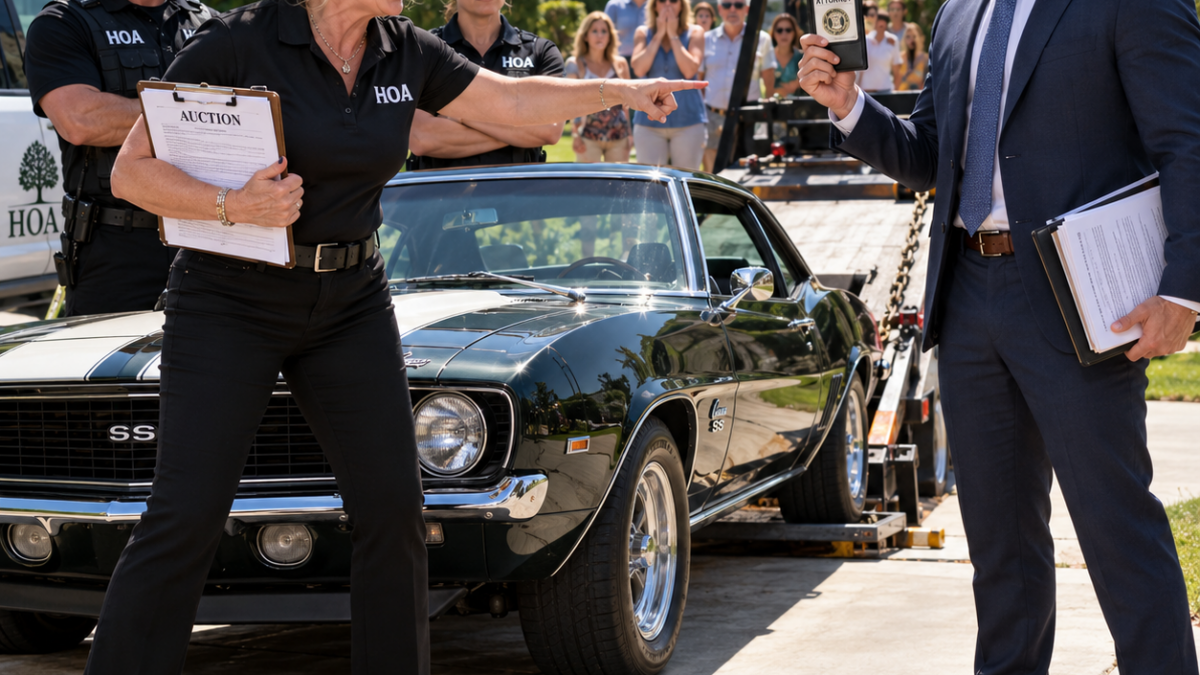
By the time my next-door neighbor showed me the video of our HOA president standing beside a tow truck while my father’s Galaxie was dragged out of my driveway, I learned she planned to auction a fully restored family heirloom for less than two thousand dollars before I had enough time to stop her.
What Lorna Fairbanks did not know was that for sixteen years I had made my living reading documents, finding the sentence other people overlooked, and waiting until someone became confident enough to put the wrong thing in writing.
My name is Ethan Maddox, and the Galaxie had belonged to my father.
Dad bought it in 1989 when I was eight years old.
Back then, calling it a car was generous. The body was rusted, the upholstery was torn, and the engine had not run properly in years. Dad paid almost nothing for it and brought it home on a trailer while my mother stood in the driveway staring at him like he had lost his mind.
Every Saturday after that, I handed him wrenches in a garage that smelled like motor oil, coffee, and whatever song happened to be playing on his little radio.
We rebuilt that Ford one piece at a time.
Dad died fourteen months ago.
His will contained one line that mattered more to me than anything else he owned.
**The Galaxie goes to Ethan.**
I finished the restoration myself.
The final coat was candy-apple red, the exact color Dad had chosen years earlier.
When I saw it polished for the first time, I sat on an old shop stool and cried harder than I had at the funeral.
Six months later, I moved into Maple Ridge Estates because I wanted quiet.
What I got instead was Lorna Fairbanks.
She arrived during my first week carrying muffins and a forty-page HOA handbook highlighted so aggressively in yellow that it looked radioactive.
“We’re a family here,” she told me.
Then she smiled.
“A family that follows rules.”
Three days later, she fined me because my trash can was visible from the road.
Trash pickup was the following morning.
Two weeks after that, I received another notice because my mailbox flag was supposedly the wrong shade of black.
I paid both.
Not because I thought they were reasonable.
Because I had spent too many years fighting other people’s disputes at work, and I wanted my house to be the one place where I didn’t have to argue.
That was my first mistake.
My second was assuming Lorna would eventually get bored.
One Saturday, I backed the Galaxie into the driveway to wash it.
I had just finished polishing the chrome when Lorna’s white Lexus slowed in front of the house.
Her window lowered.
She stared at the car.
“That,” she said, “is an eyesore.”
I laughed because I assumed she was joking.
She wasn’t.
“It’s registered, insured, and running.”
“Classic vehicles are not part of our community aesthetic.”
“There’s nothing in the rules about classic cars.”
Her smile sharpened.
“There will be.”
Three days later, the notice arrived.
**INOPERABLE VEHICLE.**
Remove within forty-eight hours or face towing and sale.
I had driven the Galaxie that weekend.
I emailed the board its registration, insurance, photographs, and odometer reading.
Lorna replied with one sentence.
**The board does not discuss exceptions.**
That Thursday, I had an important court hearing downtown.
At 12:10 p.m., while I was standing in a courtroom focused on a client whose property was at risk, a white flatbed from Beckett Towing entered Maple Ridge Estates.
Mrs. Dolores Hayes, my seventy-year-old next-door neighbor, ran outside wearing slippers.
She raised her phone and started recording.
Lorna stood beside the truck in a coral blazer holding a clipboard.
The tow operator was Stan Beckett.
Her cousin.
When I returned home at six, the driveway was empty.
Mrs. Hayes was waiting for me.
Her eyes were wet.
“Ethan,” she whispered. “I tried.”
Then she handed me her phone.
I watched my father’s car being pulled onto a flatbed while Lorna stood beside it smiling.
My own phone was already in my hand when Mrs. Hayes said the words that turned grief into something much colder.
“They’re auctioning it Saturday.”
PART 2
For a few seconds, I couldn’t speak.
Mrs. Hayes—Dolores to everyone who knew her well—stood beside me in the fading light while the video replayed on her phone.
The Galaxie’s front wheels climbed the steel ramp.
The suspension dipped.
The candy-apple-red paint flashed beneath the sun.
Then the entire car disappeared onto the flatbed.
Lorna stood beside Stan Beckett with a clipboard pressed against her hip, calm as somebody supervising a delivery.
At one point Dolores moved closer.
I heard her voice through the recording.
“You can’t take that car. Ethan lives here.”
Lorna turned.
“Dolores, go inside.”
“I’m recording.”
“You’re interfering with an enforcement action.”
“It’s his car.”
“Not for long.”
I paused the video.
“Go back.”
Dolores looked at me.
“Which part?”
“That.”
She dragged the timeline backward.
Lorna’s voice came through again.
**Not for long.**
I stared at the screen.
That wasn’t the language of someone removing an alleged nuisance.
She already knew what was going to happen to it.
“Did she say anything else?”
Dolores frowned, thinking.
“She told Stan the auction paperwork had already been approved.”
“When?”
“Before they loaded it.”
I looked at her.
“Before?”
“Yes.”
“So the sale was arranged before they actually towed the car.”
“I guess.”
I took a slow breath.
“What time did they arrive?”
“About noon.”
“Who else saw it?”
“Mrs. Alvarez across the street. Tommy Pierce drove past. Maybe the mail carrier.”
“Did anybody from the board come?”
“Just Lorna.”
“No treasurer?”
“No.”
“Secretary?”
“No.”
“Management company?”
“No.”
Only Lorna.
That mattered.
“Can you send me the original video?”
“Of course.”
“Don’t edit it.”
“I wouldn’t know how.”
“Perfect.”
She sent it.
I downloaded it immediately.
Then backed it up to my laptop and cloud storage.
Dolores watched me.
“You look very calm.”
“I’m not.”
“You always look like this when you’re angry?”
“Usually.”
“That’s unsettling.”
I almost smiled.
Then I looked at the empty driveway again.
I could still see Dad washing the Galaxie there when I was a kid, though of course that had been a different house, a different driveway.
Same car.
Same ritual.
The car had followed me through every version of my life.
High school.
College.
Law school.
My first real job.
My father’s retirement.
His illness.
His funeral.
Now Lorna Fairbanks had put it on a tow truck because she decided she disliked looking at it.
I called the number printed on the towing notice.
Someone answered on the fourth ring.
“Beckett.”
“Stan Beckett?”
“Yeah.”
“My name is Ethan Maddox. You removed a 1962 Ford Galaxie from my property today.”
Chewing sounds.
“Yep.”
“I want it returned.”
“Then pay the balance.”
“What balance?”
“Forty-six hundred.”
I actually pulled the phone away from my ear to make sure I had heard correctly.
“Four thousand six hundred dollars?”
“Tow, storage, administrative lien, compliance processing.”
“It’s been on your lot for six hours.”
“Fees are fees.”
“Send me an itemized invoice.”
“You’ll get paperwork when you pay.”
“I want the legal basis for the tow.”
“HOA lien.”
“What lien?”
“Talk to your board.”
“The vehicle is titled to me. What document authorizes you to sell it?”
He laughed.
Not nervously.
Condescendingly.
“Buddy, pay the forty-six hundred by Friday or kiss the car goodbye.”
“When is the auction?”
“Saturday. Ten.”
“Starting bid?”
“Whatever auctioneer decides.”
“And if I dispute the lien?”
“Dispute it after somebody else owns the car.”
The line went dead.
I stood in my driveway staring at my phone.
Dolores said:
“Well?”
“They want $4,600.”
Her mouth fell open.
“For one afternoon?”
“Yes.”
“That’s robbery.”
I looked at the empty concrete.
“Maybe.”
There are moments in legal work when emotion wants to get ahead of evidence.
You feel wronged.
You know something is absurd.
You want to name it immediately.
Fraud.
Theft.
Extortion.
Whatever word fits your anger.
The discipline is learning to wait.
Facts first.
Labels later.
I went inside, changed out of my suit, then drove to Beckett Towing.
The lot sat on the industrial side of town between an auto salvage yard and a concrete supplier.
Chain-link fence.
Barbed wire.
Faded office.
A hand-painted sign beside the entrance read:
**NO REFUNDS — CASH TRANSACTIONS FINAL**
The irony was almost impressive.
Stan stepped outside when I rang the bell.
He was in his late forties, heavy around the middle, baseball cap turned backward.
“You Maddox?”
“Yes.”
“You bring cash?”
“No.”
“Then why are you here?”
“To inspect my vehicle.”
“Can’t go in the yard.”
“Then bring it out.”
He laughed.
“You don’t control the lot.”
“I still own the car.”
“HOA lien says otherwise.”
“Show me.”
He disappeared into the office.
A minute later, he returned with a crumpled sheet of paper.
I unfolded it.
**MAPLE RIDGE ESTATES — VEHICLE LIEN AUTHORIZATION**
My name.
Address.
Vehicle description.
$4,600 claimed.
No itemized fee schedule.
No board meeting date.
No notice date.
No appeal period.
At the bottom were two lines labeled:
**President Approval**
**Treasurer Approval**
I looked at the signatures.
Lorna Fairbanks.
Ruth Albright.
No dates beside either.
I studied the document for exactly three seconds.
Then I smiled.
Stan noticed.
“What?”
“Nothing.”
“You think this is funny?”
“No.”
“Then what’s the smile?”
“I was wondering who drafted this.”
“HOA lawyers.”
“Which lawyer?”
“I don’t know.”
“You don’t know the lawyer whose lien you’re relying on?”
“Look, man, you want your car or not?”
“I want a copy.”
“You can’t have that.”
“You just gave it to me.”
“I gave it for you to look at.”
I took out my phone.
He grabbed the top edge.
“No pictures.”
I let go.
Fine.
He returned inside with the paper.
I walked toward the fence.
Behind a rusted bus, beneath a gray tarp, I saw a narrow line of red.
My chest tightened.
I moved closer to the fence.
“Don’t touch anything!” Stan shouted.
“I’m outside the fence.”
“That’s close enough.”
I could see the chrome front bumper.
Just enough.
The Galaxie was there.
That mattered more than I expected.
At least nobody had damaged or stripped it yet.
Stan pointed toward my truck.
“Come back with cash.”
I turned.
“You really plan to auction a 1962 Galaxie Saturday?”
“If payment doesn’t clear.”
“You know what it’s worth?”
He shrugged.
“Old Ford.”
“Did anyone appraise it?”
“Not my job.”
“Who chose the starting price?”
“HOA.”
“What price?”
He smirked.
“About eighteen hundred.”
I stared at him.
“You’re auctioning a fully restored vehicle for eighteen hundred dollars.”
“It’s abandoned property.”
“It was in my driveway six hours ago.”
“Tell it to Lorna.”
That was exactly what I intended to do.
I arrived at her house at eight that evening.
White Lexus in the driveway.
Perfectly trimmed shrubs.
Warm light through front windows.
I rang the bell.
Lorna opened it holding a glass of red wine.
She seemed genuinely pleased to see me.
“Oh, Ethan.”
“Lorna.”
“I heard you visited Stan.”
“I did.”
She sipped her wine.
“Sorry about your little hobby car.”
I looked at her for several seconds.
“My father’s car.”
Her expression didn’t change.
“I’m sure it has sentimental value.”
“It also has legal title.”
“You had forty-eight hours.”
“Your rules require thirty days.”
That was a guess.
I had not read the documents yet.
But I wanted to see her reaction.
Her eyes narrowed slightly.
“Which rules?”
“Was there a board vote?”
She laughed.
“Ethan.”
“Yes?”
“Do you really think the HOA needs a formal meeting every time somebody violates a community standard?”
“I asked whether there was a vote.”
“The board supports me.”
“That isn’t the same thing.”
She leaned against the doorframe.
“You seem confused about how things work here.”
“Maybe.”
“You’re new.”
“Yes.”
“Maple Ridge isn’t downtown. We maintain standards.”
“By auctioning private property?”
“By removing nuisances.”
“It runs.”
“That’s irrelevant.”
“It’s registered.”
“Also irrelevant.”
“Insured.”
“Still irrelevant.”
“Then what made it inoperable?”
She smiled.
“The board’s determination.”
“Where is that determination?”
“Ethan, why are you doing this?”
“Doing what?”
“Making things difficult.”
I almost laughed.
“You took my car.”
“Because you ignored a notice.”
“I responded with proof.”
“You argued.”
“I documented.”
“Same thing.”
That sentence told me a great deal about Lorna Fairbanks.
I asked again:
“Was there a board vote?”
She raised the wine glass.
“Honey, what do you even do for a living? Fix cars?”
I looked at her.
“I work in an office.”
She rolled her eyes.
“Then perhaps you should focus on that.”
She closed the door.
I stood on her porch another second.
Then walked home.
That was the last conversation we had before I stopped treating Lorna like an irritating neighbor and started treating the entire situation like a case.
I brewed coffee.
Took the HOA binder out of a kitchen drawer.
Then downloaded the full governing package from the resident portal.
The welcome handbook had been forty pages.
The real documents were 212.
Declarations.
Bylaws.
Enforcement provisions.
Amendments.
Vehicle restrictions.
Collection procedures.
Board authority.
I printed the relevant sections and spread them across my dining room table.
Dad’s photograph sat beside the lamp.
It was one of my favorites.
He was forty-five in it.
Standing beside the Galaxie while it was still mostly primer.
Grease on his shirt.
Coffee in his hand.
I heard his voice in my head.
*Read before you sign anything, Ethan.*
He told me that my entire childhood.
Probably one reason I became an attorney.
At 1:47 a.m., I found Section 7.4.
I read it once.
Then again.
Then I highlighted it.
**No resident-owned vehicle may be removed from private property for covenant enforcement without thirty days’ written notice, documented opportunity to cure, recorded majority authorization by the Board of Directors, and use of a lawfully licensed towing contractor.**
I sat back.
Thirty days.
Lorna gave me forty-eight hours.
Documented cure opportunity.
I had sent registration, insurance, and proof the vehicle operated.
Recorded board majority.
I had seen none.
Lawfully licensed towing contractor.
Unknown.
Four separate conditions.
Lorna had apparently ignored at least three.
Maybe all four.
Next I opened the board minutes.
Twelve months.
January.
February.
March.
April.
Nothing about my Galaxie.
Nothing about classic vehicles.
Nothing about “community aesthetic.”
Nothing about any vote authorizing a tow.
I searched the digital text for:
Maddox.
Ford.
Vehicle.
Tow.
Inoperable.
Nothing.
The monthly president’s report looked almost identical each time.
**Preserving property values.**
**Maintaining visual consistency.**
**Strong enforcement protects community investment.**
It was less governance than branding.
At 2:38 a.m., I closed the laptop.
I was exhausted.
But for the first time since coming home, I felt something other than anger.
Clarity.
The HOA’s own documents contradicted Lorna.
And if Stan’s paperwork claimed board approval that did not appear in the official minutes, the problem was no longer simply that she had interpreted a rule aggressively.
Somebody had manufactured authority after the fact.
At 6:10 the next morning, someone knocked.
Dolores Hayes stood outside in a robe with a flash drive in her hand.
“Coffee?”
I let her in.
She sat at the kitchen table.
“You’re not the first.”
I froze.
“What?”
She pushed the flash drive toward me.
“I’ve been saving things.”
“What things?”
“Videos.”
“Of yesterday?”
“And before.”
“How far before?”
She looked embarrassed.
“Three years.”
“Dolores.”
“I know.”
“Why?”
“Because every time Lorna had something towed, she said nobody saw it happen.”
I inserted the drive.
Folder names appeared.
**PARKER BOAT**
**WILSON MOTORCYCLE**
**DIAZ MINIVAN**
**HAYES GARAGE ARGUMENT**
I opened the first.
Lorna.
Same coral blazer? No, different year.
Same posture.
A fishing boat being removed from a side driveway.
Second video:
A motorcycle.
A man arguing with Stan.
Third:
A minivan being towed while a young woman held a toddler and cried.
I looked at Dolores.
“What happened to these people?”
“Parker paid.”
“Wilson?”
“Moved.”
“Diaz?”
“Paid, then moved six months later.”
“Why didn’t anybody challenge it?”
“They tried.”
“Lawyers?”
“Some.”
“And?”
“Too expensive.”
She looked toward Dad’s photo.
“Lorna makes the fines bigger when people argue.”
“That’s retaliation.”
“I don’t know what lawyers call it.”
I almost smiled.
“We call it a lot of things.”
She reached across the table.
“Ethan, please don’t let them sell that car.”
The emotion in her voice surprised me.
I asked:
“Why does this matter so much to you?”
Her eyes filled.
“My husband had a ’59 Chevrolet.”
I waited.
“After he died, I sold it because I couldn’t stand seeing it in the garage.”
She looked down.
“Worst decision I ever made.”
I didn’t correct her.
She continued.
“I know what it means when something is the last piece of a person.”
My throat tightened.
“I’m getting it back.”
“You sound very certain.”
“I have to be.”
At eight, I called Gloria Tran.
Certified classic-car appraiser.
I knew her professionally from an estate matter years earlier.
She came that afternoon.
The Galaxie itself was inaccessible behind Beckett’s fence, but I had restoration records, photographs, receipts, engine numbers, chassis information, insurance documentation, and detailed pre-tow condition photos.
Gloria studied everything.
“How much did you spend restoring it?”
“I stopped counting.”
“Smart.”
“No. Cowardly.”
She smiled.
“Numbers hurt.”
She examined photographs of the undercarriage.
Interior.
Engine bay.
Paint.
Original trim.
Then she asked:
“Matching numbers?”
“Most major components, yes. Some restoration replacements.”
“Documentation?”
I handed over a binder.
She raised an eyebrow.
“You really are a lawyer.”
“I haven’t told the HOA that.”
“Why?”
“I wasn’t hiding it.”
“Sounds like you were.”
“I told them I work in an office.”
She laughed.
“That is obnoxiously lawyerly.”
“Thank you.”
Two hours later, she typed the final figure.
$94,000.
I stared.
“That much?”
“Insurance replacement could be higher depending on market.”
“Stan plans to start bidding around eighteen hundred.”
Gloria looked up sharply.
“What?”
I showed her the auction information.
She read it.
“Abandoned vehicle?”
“Yes.”
“This car is registered.”
“Yes.”
“Insured.”
“Yes.”
“Taken from your driveway yesterday.”
“Yes.”
She stared at me.
“Ethan.”
“I know.”
“No, I don’t think you do.”
She pushed the appraisal toward me.
“If somebody connected to the HOA buys a ninety-four-thousand-dollar car for two grand, this stops looking like enforcement and starts looking like a transfer.”
That was the word I had been avoiding.
Transfer.
Not tow.
Not nuisance abatement.
Transfer of value.
I thanked her.
That afternoon, the auction notice appeared online.
**ABANDONED VEHICLE AUCTION**
1962 Ford.
Starting bid: $1,500.
Cash only.
Saturday 10:00 a.m.
I printed it.
Then sent certified demand letters to Maple Ridge Estates and Beckett Towing.
Return the vehicle.
Preserve all records.
Produce the board authorization.
Suspend any sale pending dispute resolution.
I copied the HOA’s attorney.
Preston Gaines.
His reply arrived four hours later.
**Your threats are baseless. The association lien is valid. The sale will proceed as noticed. See you Saturday.**
No analysis.
No request for registration.
No board-minute review.
No question about valuation.
No call.
That bothered me.
A competent lawyer receiving a detailed demand from a resident claiming unlawful conversion of a valuable vehicle should at least verify the factual basis before doubling down.
Either Gaines had already been given a false story, or he was careless.
Maybe both.
I made one more call.
County licensing office.
“Beckett Towing.”
The clerk asked:
“What about them?”
“Current private-property tow license.”
“Public record request.”
“I’ll submit.”
“Could take several days.”
“I have an auction Saturday.”
She hesitated.
“Send it marked expedited.”
I did.
The answer arrived forty-eight hours later.
I read it at my desk during lunch.
Beckett Towing’s private-property towing license had expired eight months earlier.
I leaned back.
Then opened the attachment.
License status.
Expired.
No renewal.
No reinstatement.
Then another document.
A towing authorization form from Maple Ridge Estates.
Same form Stan had shown me.
Lorna Fairbanks.
President.
Ruth Albright.
Treasurer.
I enlarged Ruth’s signature.
Something looked wrong.
Not dramatically.
That’s rarely how questionable signatures work.
The shape was close.
The loops were not.
I searched the resident portal for HOA tax filings and annual financial certifications.
Ruth had signed several.
I printed them.
Placed the signatures side by side.
On genuine documents, the capital R began with a tight upward stroke.
On the tow form, broad loop.
Her lowercase t crossed high in every authentic sample.
The tow form crossed low.
Pressure differed.
Slope differed.
I could not declare forgery from visual comparison alone.
I could do something better.
Ask Ruth.
She lived on Willow Court.
Sixty-six.
Retired bank employee.
I called.
“Mrs. Albright?”
“Yes.”
“My name is Ethan Maddox.”
Silence.
Then:
“Oh.”
That told me Lorna had already discussed me.
“I’d like to show you a document.”
“I don’t want to be involved.”
“I understand.”
“I’m serious.”
“So am I.”
She sighed.
“What document?”
“Your signature appears on an authorization to tow my vehicle.”
Long silence.
“I did not authorize your vehicle.”
I sat straighter.
“Can we meet?”
“No.”
“Mrs. Albright—”
“Not at my house.”
“Anywhere you choose.”
Another silence.
“Marvin’s Diner. Four.”
She sat in a back booth.
Coffee untouched.
Hands wrapped around the cup.
I placed a copy of the tow authorization on the table.
She looked at the bottom.
Color drained from her face.
“That isn’t mine.”
“You’re sure?”
“I know my signature.”
“Did the board vote to tow my car?”
“No.”
“Was a vehicle matter discussed?”
“No.”
“Did Lorna ask you to approve one?”
“No.”
“Has she ever signed for you?”
Ruth looked toward the diner window.
“That’s a different question.”
“How?”
“Sometimes she brings papers after meetings.”
“For what?”
“Routine things.”
“And?”
“She says the board approved them in principle.”
“Do you sign without reading?”
“Sometimes.”
I said nothing.
Her eyes filled.
“I know.”
“I didn’t say anything.”
“You didn’t need to.”
“Ethan, I’m not part of whatever she’s doing.”
“I don’t know yet what she’s doing.”
Ruth pointed at the copy.
“She made that.”
“You believe Lorna signed your name?”
“I believe I didn’t.”
Good distinction.
Lawyers learn to love good distinctions.
“Would you sign an affidavit stating that?”
Her eyes widened.
“That makes this official.”
“It’s already official. Your name is on a lien document supporting the sale of my property.”
She looked frightened.
“I could lose friends.”
“Maybe.”
“I’ve lived there twenty-eight years.”
“I’m not asking you to accuse Lorna of a crime.”
“What are you asking?”
“To state one fact. That this is not your signature and you did not authorize the tow.”
Her fingers trembled.
“I should have stopped her years ago.”
“What happened?”
“Nothing like this at first.”
She looked at me.
“She was efficient.”
That word again.
People often tolerate too much from efficient leaders.
“Meetings used to last forever,” Ruth said. “Lorna took over and everything became simple.”
“How?”
“She said boards didn’t need to argue about every enforcement decision.”
“So you delegated.”
“Yes.”
“How much?”
“Too much.”
She looked at the signature.
“I thought she was protecting the neighborhood.”
I slid a blank affidavit template toward her.
“You can take this to independent counsel if you want.”
She read it.
Then reached into her purse.
Pulled out a pen.
“I’m tired of being scared of her.”
She signed.
Not the tow authorization.
The affidavit.
Her real signature.
I watched the capital R form.
Tight upward stroke.
Nothing like the document Lorna had submitted.
That night, I emailed Lorna and Preston Gaines one final time.
One sentence.
**See you Saturday. — Ethan Maddox, Esq.**
It wasn’t dramatic.
I didn’t list the evidence.
I wanted to know whether they would finally investigate who I was.
At 9:12 p.m., Dolores called.
“You broke Lorna.”
“What?”
“She’s at Ruth’s house.”
My stomach tightened.
“Right now?”
“Yes.”
“Doing what?”
“Yelling.”
I stood.
“Don’t go outside.”
“I’m already outside.”
“Dolores.”
“I’m behind my hydrangeas.”
“You are seventy.”
“Which means people ignore me. It’s useful.”
I almost laughed despite myself.
“Call me if anything changes.”
Ten minutes later, another call.
“Lorna left.”
“Ruth okay?”
“I think so.”
I called Ruth.
She answered after several rings.
“You told her.”
“No.”
“She knows.”
“She may have received my email.”
“What email?”
“I signed as an attorney.”
Ruth laughed suddenly.
Not because anything was funny.
Relief.
“Oh, Ethan.”
“What?”
“She thinks you’re pretending.”
I frowned.
“What?”
“She told her husband you probably got some online certificate and added Esq. to scare her.”
I stared at the wall.
“You heard that?”
“She said it in my driveway.”
I closed my eyes.
“All right.”
“Is that bad?”
“For her?”
“Yes.
“No.”
I looked toward Dad’s old workbench in my garage.
“It’s convenient.”
I spent Friday night there.
The Galaxie wasn’t in the garage.
Without it, the room felt wrong.
Dad’s tools still hung on the pegboard.
His old Craftsman wrench lay in the drawer.
I picked it up.
He had engraved his initials in the handle years ago.
H.M.
Harold Maddox.
I sat on the stool where I had cried after finishing the restoration.
For the first time that week, I let myself stop being a lawyer.
I missed my father.
That was the truth beneath everything else.
The car was valuable.
Ninety-four thousand dollars, according to Gloria.
But if somebody had offered me ninety-four thousand in cash and told me the Galaxie would disappear forever, I would have refused.
Dad and I had spent thirty years talking through that car.
When I was twelve, he taught me patience rebuilding the carburetor.
When I was sixteen, he taught me what responsibility meant before letting me drive it around the block.
When I came home from law school after failing to make a moot-court team I desperately wanted, he made me help replace a fuel line before he let me complain.
“Things don’t always work because you want them to,” he said. “Figure out why. Fix what you can.”
When he got sick, we still sat in the garage.
Near the end, he could barely hold a wrench.
He would point.
I would turn.
The Galaxie was the last project we finished together.
Lorna called it my little hobby car.
I closed my hand around Dad’s wrench.
Then called Deputy Carl Mendez.
Carl and I had met nine years earlier when I represented him in a civil matter after a dispute involving an off-duty incident.
Nothing glamorous.
He had been treated unfairly.
We got it resolved.
He remembered.
“Maddox?”
“Sorry for the hour.”
“You only call after nine when somebody did something stupid.”
“That’s unfair.”
“Is it wrong?”
“No.”
I explained the auction.
He was quiet.
Then:
“You have a court order?”
“Not yet.”
“Then what do you want from me?”
“Be there.”
“As your friend?”
“As a deputy observing a disputed property sale. I’m not asking you to arrest anybody for me.”
“Good.”
“Ten fifteen?”
“For you, counselor, ten.”
I smiled.
“Thanks.”
“And Ethan?”
“Yeah?”
“Get the order.”
Saturday morning, 8:45.
Judge Margaret Ellison reviewed my application for a temporary restraining order in a small emergency hearing.
I had prepared the motion days earlier.
Exhibits:
Vehicle title.
Registration.
Insurance.
Gloria’s $94,000 appraisal.
HOA notice.
Section 7.4.
Board minutes showing no vote.
Ruth’s sworn affidavit.
County towing-license record.
Auction listing.
Dolores’s video stills.
Certified demand.
Gaines’s refusal.
Judge Ellison read in silence.
Then looked over her glasses.
“Counselor, when did you learn of the auction?”
“Thursday evening.”
“And you demanded suspension?”
“Yes, Your Honor.”
“No response other than counsel’s email?”
“Correct.”
“Your vehicle was removed from your private driveway?”
“Yes.”
“HOA asserts it was inoperable?”
“Yes.”
“Evidence contradicting that?”
“Registration, insurance, recent photographs, odometer logs, and witness statements. It was driven three days before the tow.”
She turned to Ruth’s affidavit.
“The treasurer denies this signature.”
“Yes.”
Judge Ellison looked at me.
“This is a temporary order. I am not determining final liability.”
“Understood.”
“I am preserving the property pending adjudication.”
“Yes, Your Honor.”
She signed.
Then pushed the order across the bench.
“Go prevent your car from disappearing.”
I looked at the signature.
9:02 a.m.
“Thank you.”
She almost smiled.
“Counselor.”
“Yes?”
“Go.”
At 9:50, Beckett Towing looked more like a county fair than an impound yard.
Folding chairs.
Hot dog cart.
Auction signs.
Forty or so bidders carrying numbered paddles.
A small platform had been set up beside the office.
And near the front stood Lorna.
Coral blazer.
White Lexus parked by the gate.
She looked radiant.
Victorious.
Preston Gaines stood nearby in a pinstripe suit, phone in hand.
Stan Beckett climbed onto the platform.
Roy Toliver, the auctioneer, tapped a microphone.
I stayed outside the gate at first.
Carl’s cruiser arrived at 9:57.
He parked across the road.
Walked over.
“You look overdressed.”
“Court.”
“Order?”
I opened the briefcase slightly.
He saw it.
“Good.”
“You’re here to observe.”
“I know.”
“Don’t do anything unless something actually happens.”
Carl raised an eyebrow.
“Ethan, I have been a deputy longer than you’ve been annoying judges.”
“Fair.”
At exactly ten, Stan pulled the tarp from the Galaxie.
The crowd reacted immediately.
Candy-apple red.
Whitewall tires.
Chrome catching sunlight.
Even people there hoping for a bargain knew they were looking at something special.
A man behind me whispered:
“That’s not fifteen hundred.”
Another answered:
“No chance.”
Roy lifted the microphone.
“1962 Ford Galaxie. Abandoned vehicle sale pursuant to lien. Starting at fifteen hundred.”
One paddle rose immediately.
Green polo.
Mid-thirties.
Smug smile.
I recognized him from Lorna’s social-media photos.
Travis Odom.
Her nephew.
Nobody else bid.
That was strange.
A car that would normally attract enthusiasts had forty potential buyers standing around it, but only Travis moved.
I watched Lorna.
She looked across the crowd.
Not openly threatening.
Just making eye contact.
A whisper to one bidder.
A small shake of the head toward another.
The sale wasn’t designed to obtain market value.
It was designed to transfer the car.
Roy said:
“Fifteen hundred. Do I hear seventeen?”
Silence.
“Fifteen going once.”
I walked through the gate.
“Stop the sale.”
Forty heads turned.
Lorna’s face changed.
“What is he doing here?”
I walked toward the platform.
Roy lowered the microphone.
“Sir?”
“I own the vehicle.”
Lorna laughed.
Loud.
Shrill enough that people looked at her instead of me.
“He has no standing. Continue.”
I looked at Roy.
“If you complete the sale after receiving a court order prohibiting it, you’ll be intentionally violating an injunction.”
Roy’s eyebrows rose.
Lorna waved dismissively.
“He fixes cars.”
I opened my wallet.
Pulled out my state bar card.
Held it where Roy and Gaines could see.
“Ethan Maddox. Attorney at law. Sixteen years.”
The entire yard became quiet.
I looked at Lorna.
“I told you I work in an office.”
Her face lost color.
I removed the court order.
“Judge Margaret Ellison signed this at 9:02 this morning.”
I handed it to Roy.
He read the first page.
Then immediately lowered his auction microphone.
“Sale suspended.”
Lorna stepped forward.
“You can’t do that.”
Roy held the order away from her.
“I absolutely can.”
“This is HOA property.”
“No,” I said.
“It isn’t.”
Gaines hurried toward us.
“What is going on?”
I handed him the evidence packet.
“Your client gave my father’s car to an unlicensed towing operator without the required thirty-day notice, without a recorded board vote, and using an authorization bearing a treasurer’s signature she denies making.”
Gaines’s expression changed.
“Excuse me?”
Lorna snapped:
“Preston, don’t engage with him.”
He ignored her.
I continued.
“Beckett Towing’s private-property license expired eight months ago.”
Stan, who had been smiling moments earlier, stopped.
“What?”
I handed Gaines the county record.
He read it.
Then Ruth’s affidavit.
His face went gray.
“Lorna.”
She folded her arms.
“What?”
“You told me the board approved this.”
“They did.”
“When?”
“Consensus.”
“Which meeting?”
“It doesn’t matter.”
“It matters now.”
“The board supported enforcement.”
“That is not a recorded majority vote.”
Lorna’s jaw tightened.
“It was approved in spirit.”
Gaines actually stared at her.
“In spirit?”
“Yes.”
He closed the packet.
“I advised you specifically that towing required compliance with the governing documents.”
“We complied.”
“The treasurer says she did not sign this.”
Lorna looked around.
“You’re taking his side?”
“I am looking at evidence.”
“You work for the association.”
“Correct.”
“Then defend the association.”
Gaines lowered his voice.
“I cannot defend facts you misrepresented to me.”
Lorna’s face reddened.
“You’re being ridiculous.”
He took one step backward.
“No.”
Then another.
“I am withdrawing from advising you personally, effective immediately. The association will receive separate notice regarding representation.”
For the first time, Lorna looked afraid.
Stan Beckett came off the platform.
“What do you mean my license expired?”
I looked at him.
“You didn’t know?”
“My office handles renewals.”
“County says eight months.”
He grabbed the record from Gaines.
Read it.
Sweat formed along his forehead.
Then he turned toward Lorna.
“You said everything was good.”
She snapped:
“Your license is your problem.”
“You told me your lawyer cleared the tow.”
“I told you the HOA authorized it.”
Stan pulled out his phone.
His thumb moved quickly.
Then he stared at the screen.
“You texted me.”
Lorna’s voice changed.
“Stan.”
He read aloud:
“‘Just take it. I’ll handle the paperwork. He’s just a mechanic.’”
The bidders reacted.
A few laughed in disbelief.
Others lowered their paddles.
Stan looked at her.
“You said everything was signed.”
“It was.”
“No, it wasn’t!”
His voice echoed through the yard.
Lorna looked toward the gate.
Then toward her Lexus.
I knew that calculation.
Leave.
Regroup.
Control the story later.
She moved quickly.
Not running at first.
Walking.
Then faster.
Her keys appeared in her hand.
Carl stepped away from his cruiser.
“Mrs. Fairbanks.”
She stopped.
“Move.”
“Need you to stay here.”
“I have somewhere to be.”
“There’s a disputed property seizure and a court order on-site. I need to identify involved parties and preserve the situation.”
“You don’t have authority over me.”
Carl remained calm.
“Ma’am, step away from the vehicle while we sort this out.”
“I’m the HOA president.”
“That doesn’t change what I just said.”
She looked at me.
“You did this.”
“No.”
“You set me up.”
“I read your rules.”
“You think this is funny?”
“No.”
“You’ll regret this.”
Carl’s expression sharpened.
“Ma’am, don’t threaten anybody.”
“I’m not threatening him.”
She pointed at me.
“He has harassed me for days.”
Dolores’s voice came from behind us.
“That’s a lie.”
I turned.
She had arrived with Mrs. Alvarez.
Dolores held her phone up.
Again.
Always recording.
Lorna stared at her.
“You.”
Dolores smiled sweetly.
“Me.”
Carl spoke with Stan.
Then Roy.
Then Gaines.
Then me.
The immediate issue was not a dramatic movie-style arrest based solely on my accusation.
Carl contacted a supervisor.
Another deputy arrived.
The court order was verified.
The auction stopped.
The Galaxie was placed on hold as disputed property pending release arrangements.
Then Carl reviewed Ruth’s affidavit and the authorization form.
Forgery allegations required investigation.
So did the removal and attempted sale.
Lorna was not allowed simply to drive away in the middle of that process.
She eventually left with investigators after giving an initial statement and being advised the matter was under formal review.
For the first time all morning, I was able to walk toward the Galaxie.
Stan’s employees lowered it from the auction area.
I opened the driver’s door.
The smell hit me.
Old leather.
Vinyl.
A faint trace of gasoline.
And underneath it, something that existed only in memory.
Dad’s garage.
I sat behind the wheel.
Put my hands on the steering wheel.
For a second, the tow yard disappeared.
I saw Dad beside me.
“Easy on the clutch.”
I was sixteen.
Nervous.
He laughed when I stalled.
“Again.”
I blinked.
The yard returned.
Dolores stood outside the car crying.
Carl looked away, giving me privacy.
I turned the key.
The engine caught.
Deep, familiar rumble.
Still running.
Still mine.
I rested my forehead against the steering wheel.
“We got it back, Dad.”
Not completely.
Not yet.
But enough.
The court fight began the following week.
Once the auction failed, people started talking.
That changed everything.
The fisherman whose boat had been towed contacted me.
James Parker.
He had paid $6,800 in combined towing and “compliance fees” to recover it.
No thirty-day notice.
No recorded board vote.
Same Beckett paperwork.
Then Marcus Wilson.
Army veteran.
Motorcycle removed from his driveway while he was at a medical appointment.
He paid because he needed the bike sold to cover bills.
When he retrieved it, the storage fees had consumed nearly half the sale value.
Then Elena Diaz.
Young mother.
Minivan towed.
Her crime?
Expired registration sticker.
It had actually been renewed online.
The physical sticker was delayed.
She paid $3,900.
“What happened when you appealed?” I asked.
Elena laughed bitterly.
“Lorna chaired the appeal.”
Of course she did.
“What did she say?”
“That rules are meaningless without consequences.”
I wrote it down.
The more people spoke, the clearer the structure became.
Lorna identified property she considered undesirable or residents she found difficult.
Fast notice.
Tow.
Beckett.
Large release fee.
If the owner paid, case closed.
If they didn’t, auction.
Some auctioned property appeared to go to people connected to Lorna or Stan.
That required more proof.
I refused to speculate publicly.
Privately, I requested records.
Auction logs.
Buyer names.
Vehicle IDs.
Tow authorizations.
Payment records.
Maple Ridge initially resisted.
The new attorney representing the association—not Lorna individually—changed strategy quickly once Ruth’s affidavit and licensing records became public in the civil case.
The board finally held the meeting it should have held before touching my car.
This one lasted four hours.
Residents filled the clubhouse.
Lorna sat at the front, but her confidence had changed.
No coral blazer.
No smile.
She was flanked by her own attorney.
Ruth sat three chairs away.
Not beside her.
The board secretary, Martin Cole, opened with a statement.
“The board is reviewing concerns regarding enforcement practices.”
Lorna interrupted.
“Allegations.”
Martin looked at her.
“Concerns.”
She leaned toward her microphone.
“Manufactured concerns by a resident seeking financial gain.”
I was sitting in the third row.
I raised my hand.
Martin hesitated.
Then recognized me.
I stood.
“My car was listed for $1,500.”
Lorna said:
“Starting bids are not final sale prices.”
“To your nephew.”
The room murmured.
“That is irrelevant.”
“Then disclose every auction buyer related to board members or contractors.”
Her attorney touched her arm.
She stopped.
Ruth spoke.
“I want my statement entered into the minutes.”
Lorna turned sharply.
“Ruth.”
Ruth’s hands trembled.
But her voice didn’t.
“I did not sign the authorization for Mr. Maddox’s vehicle.”
Silence.
Lorna leaned toward her.
“We discussed enforcement.”
“I did not sign.”
“You agreed the car violated standards.”
“I never voted.”
“You knew.”
“That isn’t the same.”
Ruth looked toward residents.
“For years, I allowed Lorna to tell me that formal votes were unnecessary because the board trusted her.”
Lorna shook her head.
“This is unbelievable.”
Ruth continued.
“I should have asked more questions.”
Her voice cracked.
“I didn’t.”
Then she looked at me.
“I’m sorry.”
I nodded.
The apology wasn’t the important part.
The record was.
Martin asked:
“Did you authorize President Fairbanks to sign your name?”
“No.”
That sentence landed harder than anything else.
Lorna stood.
“This is absurd.”
Her attorney whispered something.
She ignored him.
“You all benefited from strict enforcement.”
A man in the rear shouted:
“Not when you steal cars.”
Lorna pointed.
“Sit down.”
He didn’t.
Another resident spoke.
“My daughter moved because of you.”
Then another.
“You fined me $900 over a basketball hoop.”
Another:
“You threatened a lien over my fence.”
The meeting started slipping away from her.
I had seen this happen in courtrooms.
Control rarely disappears all at once.
First, people stop laughing at the powerful person’s jokes.
Then they stop waiting to be recognized.
Then somebody says aloud what everyone else has only whispered.
Dolores stood.
“You scared us.”
The room quieted.
Lorna stared at her.
Dolores continued.
“For years.”
“You have no idea what I did to protect property values.”
“I know exactly what you did.”
“You’re emotional.”
“My husband has been dead eight years. I know the difference between grief and fear.”
Lorna’s expression hardened.
“You recorded residents without permission.”
“I recorded tow trucks from my porch.”
The room actually laughed.
Lorna looked toward me.
“This is your fault.”
I didn’t respond.
She said it louder.
“You came here and turned everyone against the board.”
I finally stood.
“No.”
“What do you call this?”
“People comparing notes.”
That silenced her.
Because that was what had actually changed.
One resident alone was easy to dismiss.
Parker’s boat was an isolated enforcement action.
Wilson’s motorcycle was another.
Diaz’s minivan.
My Galaxie.
Separate files.
Separate fines.
Separate frightened homeowners.
But once people compared the paperwork, the pattern became impossible to explain as coincidence.
Same towing company.
Same missing votes.
Same shortened notices.
Same president.
Same inflated release fees.
And several of the same auction buyers.
The board voted that night to suspend Lorna from enforcement authority pending an independent investigation.
She refused to resign.
That came later.
The civil case moved faster than she expected because she had created unusually clean evidence.
My car title was clear.
The governing procedure was clear.
The notice was forty-eight hours.
Section 7.4 required thirty days.
No board vote existed.
Ruth denied the signature.
Beckett’s license had expired.
The auction listing described the vehicle as abandoned despite the current registration and the fact that it had been removed from my occupied residence.
And the intended first bidder was Lorna’s nephew.
Her attorney tried to explain that last point away.
“He is entitled to attend public auctions.”
True.
That alone proved nothing.
Then we obtained auction records.
Travis Odom had purchased three prior HOA-towed items.
A motorcycle.
A utility trailer.
A fishing boat.
All below later resale values.
That was not automatically unlawful.
But it raised obvious questions.
Then Stan Beckett decided his loyalty had limits.
His business was in serious trouble.
Expired licensing.
Potential civil exposure from multiple prior tows.
He produced texts.
Lots of texts.
Lorna:
**Take it Thursday. He’s downtown all day.**
Lorna:
**Don’t give him extra time.**
Stan:
**Need board signatures.**
Lorna:
**I’ll handle paperwork.**
Stan:
**What if he pays?**
Lorna:
**Fine. If not, Travis wants the Ford.**
That message changed the tone of the case.
I read it in my office twice.
Then a third time.
I felt no satisfaction.
Only anger.
The entire “inoperable vehicle” issue had been pretext.
She knew Travis wanted the Galaxie before Stan removed it.
Dad’s car had not been towed because it violated a rule.
The rule had been used because somebody wanted the car.
Gloria Tran updated her appraisal after inspecting the vehicle directly.
The towing process had caused minor undercarriage damage and chain marks.
Repairable.
But documented.
We added it.
Lorna’s attorney requested mediation.
I agreed.
Not because I wanted peace.
Because mediation forces people to confront numbers.
My claimed damages included:
Wrongful loss of use.
Physical damage.
Towing expenses.
Attorney fees where recoverable.
Statutory or enhanced damages where applicable.
Other civil claims supported by the facts.
The HOA’s insurer had different views.
That’s what insurers do.
The first mediation lasted nine hours.
Lorna attended for the morning.
She could barely look at me.
At noon, she finally said:
“You’ve made your point.”
I answered:
“My father’s car was almost sold to your nephew for $1,500.”
“I said I’m sorry.”
“No, you didn’t.”
Her face tightened.
“I’m sorry you were upset.”
I looked at Sam—I had retained outside counsel for portions of my own case because representing yourself in an emotional dispute is often a bad idea.
He gave me a look that said:
Don’t.
So I didn’t.
Lorna continued.
“You got the car back.”
“That doesn’t erase what happened.”
“No one was hurt.”
I thought of Parker.
Wilson.
Diaz.
Dolores hiding behind hydrangeas because she had learned to fear her own HOA president.
“People were hurt.”
“Financially.”
“As opposed to what?”
She looked away.
The first mediation failed.
Then the criminal investigation developed.
I wasn’t part of those charging decisions.
That mattered.
I gave evidence.
Witnesses gave statements.
Ruth cooperated.
Stan cooperated.
Investigators and prosecutors decided what they believed could be proved.
The forged authorization became central.
So did prior paperwork.
Ruth’s name appeared on several tow approvals she denied signing.
Not all.
Some she had genuinely signed without reading closely.
That distinction protected the integrity of her testimony.
She didn’t claim everything was fake.
Only what she knew wasn’t hers.
A handwriting examiner later identified significant inconsistencies in multiple questioned signatures.
Again, not magic.
Not television.
One piece among many.
The board called a recall election before the criminal case finished.
By then, Lorna’s support had collapsed.
She still had defenders.
That surprised some residents.
It didn’t surprise me.
Power creates relationships.
Some people genuinely believed she had kept the neighborhood beautiful.
One resident, George Wilkes, stood at the recall meeting and said:
“Property values rose every year Lorna was president.”
Dolores answered from the second row:
“So did property values everywhere.”
People laughed.
George continued.
“She enforced rules.”
I said nothing.
A woman behind him did.
“She invented them.”
Another resident:
“She signed people’s names.”
Another:
“That’s still being investigated.”
George turned.
“So we convict her here?”
No.
He had a point.
The recall wasn’t a criminal trial.
The question was whether residents trusted her to continue governing.
They didn’t.
The vote removed her overwhelmingly.
Dolores Hayes—the woman who had filmed the Galaxie leaving my driveway in slippers—was nominated for president.
She protested immediately.
“I’m too old.”
People shouted no.
“I hate meetings.”
That made them want her more.
“I don’t understand budgets.”
Ruth raised her hand.
“I do.”
That was the ticket.
Dolores for president.
Ruth for treasurer.
Dolores won with ninety-one percent.
When someone told her the number, she sat down and said:
“Oh, hell.”
The clubhouse erupted in laughter.
Her first meeting was chaos.
Residents wanted every rule Lorna had enforced repealed immediately.
I warned them against overcorrecting.
Some rules were legitimate.
Trash-storage requirements.
Noise standards.
Parking access.
Common-area safety.
The problem had not been the existence of rules.
It was using procedure as a weapon.
Dolores looked at me.
“So what do we change?”
“Process first.”
Ruth nodded.
Notice periods.
Written evidence.
Recorded votes.
Independent appeal procedure.
No president deciding appeals from her own enforcement.
Vendor-license verification.
Conflict disclosures.
Auction restrictions.
Public board minutes.
Those reforms mattered more than burning a rule book.
Although Dolores did eventually burn something.
At a neighborhood barbecue, she brought the old highlighted welcome handbook.
“Symbolic disposal,” she announced.
James Parker shouted:
“Is open burning allowed under the CC&Rs?”
Everyone laughed.
Dolores looked at me.
“Lawyer?”
“Technically, we should probably use the grill.”
So she placed the handbook inside a barbecue grill and lit it.
The yellow highlighter made some pages burn strangely.
Ruth stood beside her laughing so hard she cried.
I did too.
The criminal case resolved months later.
Lorna faced consequences for the falsified authorization and related conduct.
Stan faced licensing and civil consequences.
Beckett Towing lost the ability to operate as it had.
The company eventually shut down.
Several former residents pursued restitution or separate civil claims.
Not everyone recovered everything.
Some records were old.
Some cases were weak.
Some people wanted no more conflict.
That was their right.
Parker recovered part of what he had paid.
Wilson received compensation.
Diaz’s case was resolved through the association’s remediation process and insurer.
Ruth helped review each old enforcement file.
That job nearly broke her.
One Saturday, I found her alone in the clubhouse surrounded by boxes.
She was crying.
I sat across from her.
“What happened?”
She pushed a file toward me.
The Diaz minivan.
“I signed this one.”
I looked.
Her real signature.
“Yes.”
“I don’t remember reading it.”
“You probably didn’t.”
“That doesn’t make it better.”
“No.”
She wiped her face.
“I told myself Lorna knew the rules.”
“That’s common.”
“That sounds like an excuse.”
“It can be.”
She looked at me.
“Do you hate me?”
“No.”
“Why not?”
“Because people are more complicated than documents.”
She laughed sadly.
“That’s a terrible lawyer answer.”
“It’s a good human one.”
Ruth looked down.
“I spent years being proud that our meetings were efficient.”
I waited.
“We approved fifteen agenda items in twenty minutes.”
“That is efficient.”
“It also means nobody asked anything.”
That stayed with me.
Efficiency without scrutiny can become permission.
Months after the recall, Dolores asked if I would hold a free homeowner-rights clinic at the clubhouse.
I refused.
She asked again.
I refused.
She brought muffins.
I said:
“Bribery.”
She replied:
“Community outreach.”
I agreed to one Saturday.
Twenty-three people came.
Then thirty-one the next month.
I limited it to general information and encouraged people to obtain independent counsel for actual disputes.
The questions were not dramatic.
Can the HOA require fence approval?
What records can residents inspect?
How do appeals work?
Can a board enforce a rule that isn’t in the governing documents?
What happens if a neighbor violates parking rules?
Most people didn’t need a courtroom.
They needed someone to explain where authority began and ended.
I started enjoying those Saturdays.
Dad would have mocked me.
“Working free now?”
I could hear him.
“Law school really paid off.”
The Galaxie returned to the driveway.
At first, I was afraid to leave it there.
That embarrassed me.
The court had protected my ownership.
The HOA had changed.
Lorna was gone.
Still, the first week after I brought it home, I checked the window every hour.
At night, I looked at the security camera before bed.
One Saturday morning, I opened the garage door and simply stood there.
Dad’s car was parked inside.
Safe.
And I realized Lorna had managed to change my relationship with something I loved.
The Galaxie used to represent Saturdays with my father.
Now it also represented towing paperwork.
Auction signs.
Court orders.
That made me angry all over again.
So I did the only thing I could think of.
I drove it.
No destination.
Just roads.
I took the highway out past town.
Turned onto the two-lane road Dad used when he wanted to “clear the carbon out,” which was his excuse for driving too fast without admitting it.
I lowered the window.
The engine settled into that familiar deep note.
At a red light, an older man in a pickup rolled down his window.
“Sixty-two?”
I nodded.
“Beautiful.”
“Thanks.”
“Yours long?”
“My dad’s first.”
He smiled.
“Best kind.”
Light changed.
We drove on.
By the time I returned home, the car felt like ours again.
Not Lorna’s evidence.
Not Beckett’s inventory.
Not an auction lot.
Dad’s car.
My car.
Our work.
I washed it in the driveway.
Exactly where the fight began.
Dolores walked over.
“You’re brave.”
“I have cameras.”
“That isn’t bravery.”
“No.”
She looked at the Ford.
“You going to hide it in the garage from now on?”
I thought about it.
“No.”
“Good.”
“Want to help?”
“I’m president now. I supervise.”
“That sounds like Lorna.”
She grabbed the hose.
“Take that back.”
A year after the tow, Maple Ridge held another fall barbecue.
Families filled the clubhouse lawn.
Kids ran through sprinklers.
Ruth had become a surprisingly strict treasurer.
Every expenditure required documentation.
Dolores complained constantly.
“You created a monster.”
“You elected her.”
“I didn’t vote for myself.”
“You were busy burning manuals.”
Laughter came easier now.
The community still argued.
Of course it did.
One meeting nearly collapsed over whether basketball hoops could remain visible overnight.
Another lasted two hours because someone wanted to ban political yard signs entirely and three lawyers in the neighborhood nearly had a collective breakdown.
But residents argued openly.
Votes happened.
Minutes recorded them.
Nobody disappeared behind the president’s “determination.”
That was healthier than perfect agreement.
One afternoon, I received a letter from Travis Odom.
Lorna’s nephew.
The first bidder.
I almost threw it away.
Then opened it.
Three handwritten paragraphs.
He claimed Lorna had told him the Galaxie was legitimately abandoned and that the HOA wanted “a local collector” to buy it.
He admitted she told him the starting bid would be low.
He apologized.
I didn’t know whether to believe every word.
But one sentence felt honest.
**I should have known a car that nice did not become abandoned in two days.**
I folded the letter.
Didn’t respond.
Not every apology requires a relationship afterward.
Sometimes acknowledgment is enough.
The damages case ultimately compensated me for the wrongful seizure, physical damage, loss of use, fees, and applicable enhanced remedies.
The exact accounting mattered less to me than the court’s findings.
The towing had not complied with the HOA’s own procedure.
The attempted sale could not stand.
The questioned authorization had serious consequences.
The association could not invent a forty-eight-hour shortcut around a thirty-day rule simply because the president found compliance inconvenient.
When Judge Ellison issued the final order, I thought I would feel victorious.
Instead, I felt tired.
Outside the courthouse, Dolores hugged me.
Ruth shook my hand.
Gloria Tran wanted an updated photo of the Galaxie after repairs.
Carl sent a text:
**Counselor finally done?**
I replied:
**Never say that to a lawyer.**
Dad wasn’t there.
That was the part nobody could fix.
I drove home alone.
Parked the Galaxie in the driveway.
Took Dad’s old wrench from the garage.
Set it on the hood.
The afternoon sun turned the red paint almost orange.
I ran my hand over the chrome.
“We got it back, Dad.”
I had said those words at Beckett’s lot.
But now they meant something different.
Not just the car.
The memory.
The right to decide what happened to it.
The part of my home I had surrendered when I kept paying ridiculous fines because I thought silence bought peace.
I understood now that peace purchased by surrender is temporary.
Lorna had learned that every small fine I paid made the next demand easier.
Trash can.
Mailbox.
Car.
I had helped train her to believe I would always choose convenience.
That was my mistake.
I don’t blame myself for her conduct.
But I learned something about my own.
There is a difference between choosing your battles and convincing yourself you have no right to object.
For months, I had called every ridiculous notice “the price of peace.”
It wasn’t.
It was the price of silence.
And eventually the bill became my father’s car.
The next spring, a new family moved into Lorna’s old house.
She had sold after the recall and legal proceedings consumed much of her attention.
I didn’t ask where she went.
People told me anyway.
I stopped listening.
The new owners were the Parkers.
Young couple.
Two children.
The first Saturday after moving in, the husband walked over while I was waxing the Galaxie.
“Is this the famous car?”
I groaned.
“Please tell me people don’t call it that.”
“They do.”
“Wonderful.”
He walked around it carefully.
“What year?”
“1962.”
“Your dad’s?”
I looked at him.
“How much do people tell new residents?”
“Apparently everything.”
“Most of it’s probably wrong.”
He pointed at the hood.
“Can my son see the engine?”
His boy was standing at the sidewalk, maybe nine years old, trying very hard not to stare.
I remembered myself at eight.
Dad opening the hood.
Handing me a wrench.
“Sure.”
The boy approached.
“What’s that?”
He pointed at the air cleaner.
I explained.
Then another part.
Then another.
Soon I had grease on my hand and the kid had ten questions.
His father apologized.
I shook my head.
“No.”
I handed the boy a rag.
“Here.”
He took it.
For a moment, the years folded.
Dad beside me.
Me beside this kid.
Same old Ford.
I suddenly understood that keeping the Galaxie wasn’t only about preserving something frozen from the past.
Dad had never treated it like a museum piece.
We drove it.
Broke it.
Fixed it.
Learned from it.
Memory survives better when it is used.
That summer, Dolores asked if the Galaxie could lead the Maple Ridge Fourth of July parade.
“There is no parade.”
“There is now.”
“Since when?”
“Tuesday.”
“Was there a board vote?”
She glared at me.
I grinned.
Ruth called from behind her.
“Yes, Ethan. Recorded vote. Proper notice. Licensed event vendor. We learned.”
I laughed.
The Galaxie led.
Dolores rode in the passenger seat wearing a ridiculous red-white-and-blue hat.
Children decorated bicycles.
Marcus Wilson followed on a motorcycle—the replacement for the one he had lost years earlier.
Elena Diaz drove behind him in a minivan with her kids waving through the windows.
James Parker hauled a fishing boat.
It wasn’t planned as symbolism.
At least nobody admitted it.
But as I looked in the mirror and saw all of them behind Dad’s car, I understood what the community had done.
The things Lorna once used to pressure people had become ordinary again.
Vehicles.
Property.
Homes.
Lives.
Not leverage.
After the parade, Ruth stood beside me.
“Do you ever miss practicing law before Maple Ridge knew?”
“I still practice.”
“You know what I mean.”
“When everybody thought I fixed cars?”
She smiled.
“Yes.”
“Sometimes.”
“Why?”
“People said more around me.”
“Lorna certainly did.”
I laughed.
Ruth looked at the Galaxie.
“She really thought you were a mechanic.”
“There’s nothing wrong with being a mechanic.”
“I know.”
“My father would’ve preferred it.”
“You think?”
“Absolutely. He trusted mechanics more than lawyers.”
“Smart man.”
“Careful.”
She laughed.
Years passed.
The free Saturday clinics continued.
Not every month.
Eventually quarterly.
Residents from neighboring HOAs started attending.
Most stories were far less dramatic than mine.
Some residents were wrong.
That mattered.
One man insisted his HOA had no right to stop him from storing a commercial trailer across a sidewalk.
They did.
Another homeowner wanted to sue because she disliked the approved paint palette.
No case.
A board member asked how to enforce legitimate restrictions without becoming “another Lorna.”
That question was more important than most.
I told him:
“Document the rule. Give notice. Let the resident respond. Follow the same process whether you like the person or not.”
He wrote it down.
“That’s it?”
“Pretty much.”
“No secret?”
“No.”
“That sounds boring.”
“Good governance usually is.”
Dad would have laughed at me for saying good governance.
He used to call homeowner associations “little governments with landscaping committees.”
But even he believed rules mattered when everyone understood them.
The problem was never rules.
It was power without friction.
Lorna hated friction.
Votes slowed her down.
Appeals questioned her.
Thirty-day notices gave residents time to resist.
Vendor licensing required verification.
So she skipped those things.
Every shortcut made her feel more efficient until efficiency became entitlement.
Then entitlement became ownership in her mind.
My driveway.
My car.
Ruth’s signature.
Stan’s truck.
Travis’s bargain.
All pieces she believed she could arrange because nobody had stopped her before.
One rainy evening, almost three years after the auction, I found another envelope in my mailbox.
No return address.
For a second, my stomach tightened.
Old reflex.
Inside was a photograph.
The Galaxie at the parade.
Below it, someone had written:
**Your dad would be proud.**
No signature.
I never found out who sent it.
I put the picture in Dad’s old toolbox.
A few months later, I finally moved some of his remaining belongings from storage.
Old shirts.
Service manuals.
Receipts.
Photographs.
At the bottom of one box, I found a small spiral notebook.
Dad’s restoration notes.
Pages of measurements.
Part numbers.
Paint codes.
Then an entry from the year before he died.
**Ethan will finish what I can’t. He always does.**
I sat on the garage floor.
Read it again.
That sentence broke me more completely than anything Lorna had done.
Dad knew.
He knew he was running out of time.
He trusted me with the car not because he thought I would preserve it exactly as he left it.
Because he believed I would finish.
I had thought the final coat of candy-apple red was the end of the restoration.
It wasn’t.
Maybe this was.
Not the lawsuit.
Not the auction.
The moment I understood why he left it to me.
I carried the notebook outside.
Sat behind the steering wheel.
The leather creaked.
I put the notebook on the passenger seat.
“Okay, Dad.”
I started the engine.
Drove.
No destination.
The road was wet.
Clouds breaking.
A strip of orange sunset opened ahead.
I drove until the city disappeared behind me.
For years, I had associated law with control.
Documents.
Deadlines.
Arguments.
Judges.
Rules.
Dad understood a different kind of control.
Tightening a bolt exactly enough.
Listening to an engine.
Knowing when a part needed replacing and when it only needed patience.
Maybe that was why I had become good at my job.
Different tools.
Same lesson.
Pay attention.
Don’t rush.
Know what holds the structure together.
Lorna lost because she stopped asking that question.
She thought her title held Maple Ridge together.
It didn’t.
Trust did.
Procedure did.
Neighbors did.
Recorded votes did.
People like Ruth being willing to admit when they failed.
People like Dolores pressing record instead of going inside.
People like Stan deciding self-preservation finally mattered more than loyalty.
Even lawyers.
Sometimes.
The Galaxie still sits in my driveway on sunny weekends.
I keep it garaged during bad weather because Dad would haunt me if I didn’t.
The paint has tiny marks now.
A stone chip near the passenger fender.
Small scratch under one door from the tow chain.
I could repair that scratch completely.
Gloria told me how.
I chose not to.
It’s barely visible.
But I know where it is.
Dad’s car carries our history.
Why erase the chapter just because it was ugly?
Sometimes new residents ask about it.
Sometimes old residents tell the story for me.
They usually exaggerate.
They say I stormed into the auction with police.
I didn’t.
They say Lorna fainted when I showed my bar card.
She didn’t.
They say Judge Ellison personally ordered everybody arrested.
Definitely not.
Real life was less theatrical.
And, to me, more satisfying.
I read.
Dolores recorded.
Ruth told the truth.
Gloria valued the car.
County records exposed Stan’s license.
The court stopped the sale.
Residents compared stories.
The board changed.
That was enough.
One Saturday, a teenager walking past stopped while I was polishing the hood.
“Mr. Maddox?”
“Yeah?”
“My mom says this is the car that got the old HOA president arrested.”
I laughed.
“Your mom needs a hobby.”
“So it is?”
“This is the car.”
“Can I take a picture?”
“Sure.”
He photographed it.
Then asked:
“How much is it worth?”
“Ninety-four thousand at one point.”
His eyes widened.
“And they tried to sell it for fifteen hundred?”
“Yes.”
“That’s insane.”
“Pretty bad.”
He walked around it.
“What would you sell it for now?”
I stopped polishing.
Looked at Dad’s old notebook on the shelf through the open garage.
Then back at the kid.
“Nothing.”
“You mean like… not for sale?”
“Exactly.”
“Everything has a price.”
I smiled.
I had heard that sentence before.
“No.”
I ran the cloth over the chrome.
“Not everything.”
That evening, I washed the Galaxie slowly.
The neighborhood was quiet.
No tow truck.
No clipboard.
No coral blazer at the curb.
Dolores’s porch light came on next door.
She walked over carrying two glasses of lemonade.
“You still baby that thing.”
“Yes.”
“Good.”
She handed me one.
We sat on the curb.
The sunset reflected in the candy-apple-red paint.
Dolores looked at the car.
“Think your dad knows?”
“Knows what?”
“That you got it back.”
I looked through the windshield.
At the steering wheel his hands had once wrapped around.
The dashboard he taught me to remove without cracking.
The chrome we polished together.
“I think so.”
Dolores nodded.
Then smiled.
“Good.”
I stayed outside after she went home.
Long enough for the streetlights to come on.
Long enough for the hood to cool.
Then I took Dad’s old wrench from the workbench.
The same one with H.M. scratched into the handle.
I placed it on the passenger seat.
Turned the key.
The engine came alive.
Deep.
Steady.
Familiar.
For a moment I could smell oil and coffee in Dad’s garage again.
I could hear him telling eight-year-old me to stop losing his sockets.
I could see him laughing when I dropped a wrench.
I could hear him saying the words that had followed me through every courtroom and every repair:
“Slow down. Figure out what’s actually wrong.”
Lorna thought the problem was a red car she didn’t like looking at.
She was wrong.
The problem was that she had spent years believing the rules belonged to her.
They didn’t.
They belonged to everyone.
And once people finally read them together, her power disappeared much faster than she ever imagined.
I backed the Galaxie out.
Closed the garage.
Then drove down the same Maple Ridge street where a tow truck had carried it away years earlier.
This time, nobody stopped me.
Nobody issued a notice.
Nobody decided that a memory worth ninety-four thousand dollars was an eyesore.
At the entrance to the neighborhood, I turned onto the open road and pressed the accelerator gently.
The old Ford moved forward exactly the way Dad and I had built it to.
And for the first time since the day he died, I didn’t feel like I was driving the last thing he left behind.
I felt like he was still riding with me.
[END OF STORY]





