PART 2: HOA President Spent Our Water Repair Fund on a $380,000 Luxury Gala—Then 68 Homes Went Dry
PART 2
For several seconds, I simply stared at the faucet.
No water.
Not low pressure.
Not a weak stream.
Nothing.
Then came another cough of air from somewhere inside the plumbing, a hollow metallic sputter that every water engineer recognizes immediately.
Loss of pressure.
I turned the handle off.
Opened it again.
Same sound.
I walked to the laundry sink.
Nothing.
Bathroom.
Nothing.
Outside spigot.
Nothing.
My phone was already ringing.
The caller ID said Linda Mercer.
Linda lived three houses down.
“Marcus?”
“I know.”
“My water’s gone.”
“I know.”
“My daughter has the baby here tonight.”
“How much bottled water do you have?”
“Maybe two bottles.”
“Do not turn on your water heater. Don’t keep opening faucets.”
“Is there a break?”
“I don’t know yet.”
That was technically true.
But I knew what I feared.
Before Linda could say anything else, another call appeared.
Then another.
Then another.
I walked onto my front porch.
Ridgeline Court looked different.
Normally, on a Saturday night, maybe one or two people would be outside.
That evening, doors were opening all along the street.
A man in pajama pants stood in his driveway holding a phone.
A woman carried two empty pitchers from her kitchen.
Someone farther uphill shouted, “Anybody have pressure?”
“No!”
“Nothing here!”
I checked the time.
9:16.
Down the slope, nearly half a mile away, light from the clubhouse lawn glowed between the trees.
Even from where I stood, I could hear music.
String orchestra.
Dorothia’s gala was still going.
My phone rang again.
Teddy Brandt.
I answered immediately.
“Teddy.”
His voice was shaking.
“Marcus, the tank is at nine percent.”
I closed my eyes.
“What?”
“Nine.”
“What was it when the gala started?”
“Seventy-three.”
“And the event line?”
“Still open.”
“You’re joking.”
“I wish I was.”
“Where’s the cutoff?”
“You know where.”
Disabled.
My hand tightened around the phone.
“Teddy, close the temporary line.”
“I tried.”
“What do you mean you tried?”
“I called the event coordinator fifteen minutes ago.”
“Teddy, you maintain the system.”
“I know.”
“Then close it.”
“Dorothia told them the event supply stays open until the fireworks are finished.”
I looked toward the lights below.
“What did you tell her?”
“I said upper-ridge pressure was falling.”
“And?”
“The coordinator called back and said the president’s instructions were, quote, ‘The show goes on.’”
For a second, I forgot how to speak.
Thirty-one years.
Floods.
Main breaks.
Pump failures.
Ice storms.
Boil advisories.
Contamination events.
I had heard public officials make bad decisions.
I had seen frightened supervisors hesitate.
I had watched operators make mistakes under pressure.
But I had never heard anyone knowingly choose a party over a drinking-water system.
“Where are you?” I asked.
“Pump station.”
“I’m coming.”
“Marcus, you’re retired.”
“So are half my tools.”
I hung up.
From my garage, I grabbed a flashlight, gloves, an old pressure gauge, and the notebook I had carried to board meetings.
That notebook was already open to the page where I had written:
GALA BUDGET — $380,000.
Under it, weeks earlier, I had added:
6″ TEMP LINE FROM TANK.
And beneath that:
MINIMUM CUTOFF DISABLED.
I put the notebook on the passenger seat.
Then I drove downhill.
People were outside everywhere.
A woman stopped me at the intersection.
“Marcus!”
I rolled down the window.
“My son is trying to mix formula. We don’t have enough bottled water.”
“Linda Mercer has two bottles. I’m going to the pump station.”
“Is it coming back?”
“I’m going to find out.”
Another neighbor approached.
“Walter’s machine won’t run.”
“Walter who?”
“Puit. Number forty-eight.”
I knew Walter.
Retired high-school history teacher.
Seventy-two.
Home dialysis.
My chest tightened.
“He needs clean water?”
“Yes.”
“Call his family. If his treatment depends on supply tonight, don’t wait for the system.”
“They’ve been trying the utility emergency line.”
“Call the hospital.”
The man nodded and ran back toward his house.
I continued downhill.
The closer I got to the clubhouse, the louder the music became.
By the time I reached the pump station, I could hear violins clearly.
Teddy stood inside the chain-link fence under the security light.
He looked like a man waiting beside a sinking ship.
I parked.
“What do we have?”
He pointed at the level display.
8.7%.
I stared.
A 300,000-gallon tank.
More than ninety percent depleted.
The six-inch event line was still wide open.
Water roared through it hard enough that I could feel vibration in the pipe.
A catering employee stood farther down the temporary connection filling stainless-steel tubs.
I looked at Teddy.
“You left this open?”
“I told you—”
“Teddy.”
“I don’t own the system, Marcus.”
“No. Three hundred twelve homeowners do.”
“Dorothia said if I shut it down, I’m fired.”
“You might be fired anyway when the state regulator sees this.”
His face went pale.
I regretted the sharpness immediately.
Teddy wasn’t the problem.
He was a contractor caught between a president issuing orders and infrastructure doing exactly what physics required.
I lowered my voice.
“Do you have written instructions?”
He nodded.
“Email.”
“Save it.”
“Already did.”
“Work order for the cutoff?”
“In the maintenance file.”
“Signed?”
He looked at me.
“Initialed.”
“By?”
“You know.”
Dorothia.
I pulled out my phone and began recording.
First the tank display.
8.6%.
Then the gauge.
Then the temporary line.
Then the disabled minimum-level circuit.
I narrated quietly.
“Saturday, 9:28 p.m. Willow Crest pump station. Upper-ridge residential service has been lost. Storage tank currently reads eight-point-six percent. Temporary six-inch event connection remains open.”
Teddy watched me.
“You planning to sue somebody?”
“I’m planning to make sure nobody gets to say this didn’t happen.”
I followed the temporary line to the isolation valve.
“Marcus.”
I looked back.
“What?”
“You shut that and Dorothia’s going to come after both of us.”
“Teddy, sixty-eight houses have zero pressure.”
“I know.”
“One resident is on home dialysis.”
“I know.”
“A drinking-water system under zero pressure can pull contamination through leaks, connections, backflow points—”
“I know.”
“Then why are we talking about a chandelier?”
He didn’t answer.
I put both hands on the valve wheel.
Then I stopped.
“Record me.”
“What?”
“Take your phone out.”
He did.
“Tell me the tank level.”
“Eight-point-four.”
“Tell me residential pressure.”
“Upper zone effectively zero.”
“Tell me why this line is open.”
He swallowed.
“Event supply.”
“Did you recommend closing it?”
“Yes.”
“Were you told not to?”
“Yes.”
“By whom?”
Teddy stared at me.
I waited.
“Dorothia Blake, through the event coordinator.”
“Good.”
I turned the valve.
It fought me at first.
Then moved.
A quarter turn.
Half.
Three quarters.
The roar weakened.
I kept turning.
Finally the line shuddered.
Then went quiet.
The water wall below had just lost its supply.
I looked at Teddy.
“Now call the regulator.”
“I already called the county.”
“Call the state too.”
He nodded.
“What are you doing?”
“Going to the gala.”
He stared at me.
“You’re going down there?”
“Yes.”
“Marcus.”
“What?”
“You’re wearing work boots.”
I looked at my clothes.
Jeans.
Old county jacket.
Boots with pump-station mud.
Then I looked downhill at four hundred people in formal clothes.
“Perfect.”
The Willow Crest clubhouse lawn looked like something from a luxury wedding magazine.
Tall white tents.
Gold lighting.
Crystal fixtures.
Tables covered in linen.
Waiters carrying trays of champagne.
An orchestra performing on a raised stage.
At the center of the lawn stood the water wall.
Or what remained of it.
Water had been flowing down forty feet of illuminated glass.
Now the top jets sputtered.
One section weakened.
Then another.
Guests began looking toward it.
A woman laughed as if it were part of the show.
Then the whole feature went dark.
I kept walking.
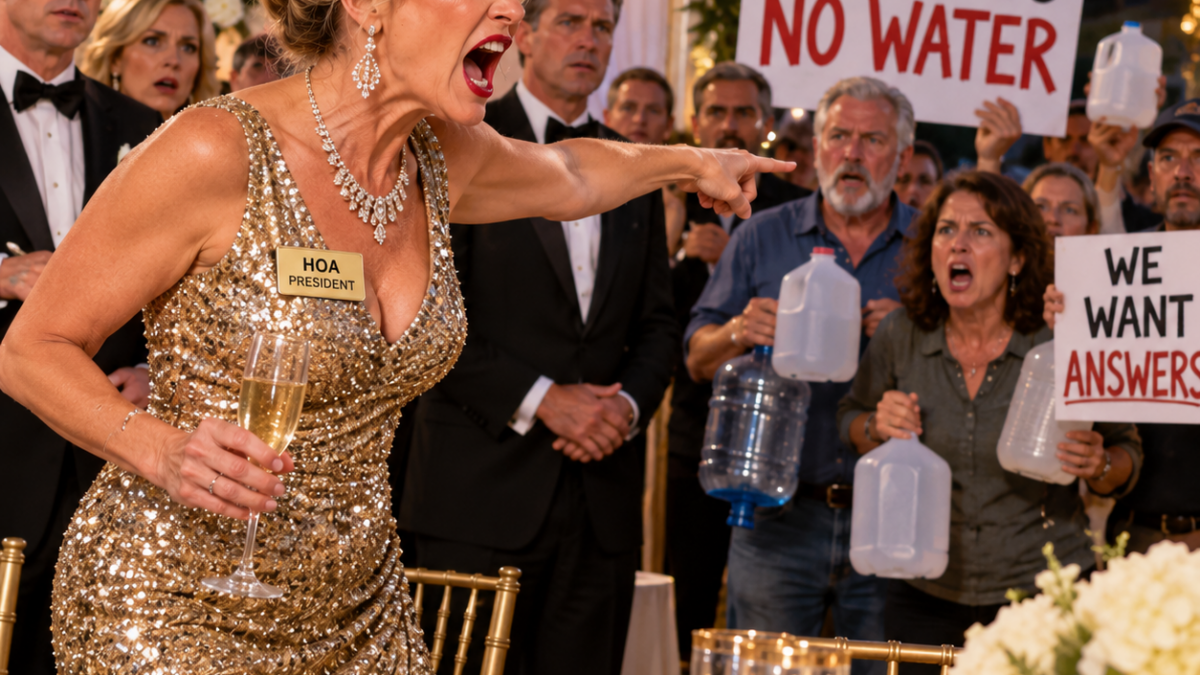
I saw Dorothia immediately.
Gold gown.
Gold earrings.
A microphone in one hand.
A county developer in the other conversation.
She noticed me halfway across the lawn.
Her expression changed.
Only slightly.
But I saw it.
She excused herself and walked toward me.
“Marcus.”
“Dorothia.”
“This is a private event.”
“I live here.”
“You were not invited.”
“Neither was the water shortage.”
Her eyes hardened.
“Not here.”
“Sixty-eight homes have no water.”
“Lower your voice.”
“Why?”
“Because you are creating panic.”
“No. A dry faucet creates panic.”
She glanced toward nearby guests.
“There’s been a minor pressure fluctuation.”
“Zero is not a fluctuation.”
“The maintenance team is handling it.”
“I just came from the pump station.”
Her jaw tightened.
“You had no authorization to enter.”
“I was with Teddy.”
“Did you interfere with association equipment?”
“I closed the event valve.”
The color in her face changed.
“You what?”
“I shut off the six-inch line.”
“That line is permitted.”
“Permitted does not mean unlimited.”
“You had absolutely no right—”
“Upper-ridge pressure is gone.”
“We will restore it after the event.”
I stared at her.
“After?”
“The gala ends in approximately forty-five minutes.”
“There is a man on home dialysis.”
“That is not my responsibility.”
The words came out fast.
Too fast.
For the first time that night, Dorothia realized she had said something dangerous.
I stepped closer.
“There is a baby whose mother can’t mix formula.”
“People have bottled water.”
“Not everyone does.”
“This is becoming melodramatic.”
“No. What’s melodramatic is an ice sculpture garden while sixty-eight homes can’t flush a toilet.”
“Marcus.”
“Stop the event.”
“No.”
“Shut down catering. Release your bottled water. Cancel the fireworks. Put your volunteers in cars and get water uphill.”
“I am not humiliating this community in front of county officials because of a maintenance problem.”
I looked around.
Champagne tower.
Crystal lights.
White flowers.
A giant banner reading WILLOW CREST: BUILDING OUR FUTURE.
Then I looked back at her.
“You already humiliated the community.”
Her mouth tightened.
“Leave.”
“Would you like me to announce the situation?”
“You will do no such thing.”
“Then do it yourself.”
“Marcus.”
“Tell them.”
“This is my event.”
“No.”
I gestured toward the houses on the hill.
“This is their water.”
Dorothia stepped close enough that nobody else could hear her.
“You have spent months trying to undermine me.”
I almost laughed.
“I wrote one letter.”
“You show up at meetings pretending you’re the only person who understands infrastructure.”
“I spent thirty-one years doing this.”
“And that does not make you president.”
“Thank God.”
Her eyes flashed.
A stage manager approached holding a second microphone.
“Mrs. Blake, we need to know whether to delay the fireworks announcement.”
Dorothia turned.
“Continue on schedule.”
I looked at the man.
“Sixty-eight homes currently have no water.”
He froze.
Dorothia snapped, “Ignore him.”
I held out my hand.
“Give me the microphone.”
The stage manager looked between us.
“Sir—”
“Give me thirty seconds.”
“No,” Dorothia said.
I looked at her.
“Then you say it.”
She said nothing.
That was her second mistake.
I took the microphone.
Not violently.
The stage manager simply stopped holding it tightly.
Maybe he wanted somebody else to make the decision.
I walked toward the edge of the stage.
The orchestra continued playing.
I tapped the microphone once.
A few heads turned.
Dorothia hurried behind me.
“Marcus, do not—”
I spoke.
“Excuse me.”
The orchestra kept playing for another three seconds.
Then the conductor looked up.
Music stopped.
Four hundred guests turned toward a retired engineer wearing muddy boots.
I hated public speaking.
Always had.
My hands were shaking.
So I kept it simple.
“My name is Marcus Hale. I live on Ridgeline Court.”
Some residents recognized me.
Others didn’t.
“At 9:14 tonight, homes in the upper pressure zone lost water service.”
A murmur moved across the lawn.
“As of approximately ten minutes ago, sixty-eight homes had no effective water pressure.”
Someone called, “What?”
I continued.
“The association storage tank has been drawn down to below ten percent while supplying water to this event.”
Now the crowd became louder.
Dorothia reached the stage.
“Marcus.”
I kept speaking.
“Because system pressure fell below the safe operating threshold, the county and state water authorities will need to evaluate whether a boil-water advisory is required.”
A woman near the front lowered her champagne glass.
I continued.
“There are infants in those homes.”
Silence began spreading.
“There is at least one medically vulnerable resident who requires water for home treatment.”
Dorothia grabbed for the microphone.
I moved it away.
“I am asking anyone with unopened bottled water, transportation, or the ability to assist to help deliver drinking water to the upper ridge immediately.”
The lawn went completely quiet.
No applause.
No shouting.
Just four hundred people realizing the water glittering in their champagne glasses had become something ugly.
Then Dorothia took the microphone.
“This is a minor maintenance issue.”
Several people turned toward her.
“Our professional team is addressing it.”
Priya Anand stood near the catering tent.
She was the HOA treasurer.
Early thirties.
Usually quiet.
I remembered her from the meeting where Dorothia had dismissed my warning.
Priya looked from Dorothia to me.
Then she set her champagne flute down.
Walked into the catering area.
Picked up two cases of bottled water.
And carried them toward her car.
A man followed.
Then a woman.
Then two more people.
Within ten minutes, at least a dozen cars were loading water.
The county commissioner who had been standing near the fireworks rig took out his phone.
I heard him say:
“I need the health department duty officer.”
Dorothia watched her gala collapse without anyone ordering it to end.
The orchestra never resumed.
People stopped drinking.
Guests clustered around phones.
Residents called neighbors uphill.
The fireworks contractor asked whether he should cancel.
Nobody answered him at first.
Then Priya did.
“Yes.”
Dorothia spun.
“You do not have authority to cancel my contract.”
Priya closed the trunk of her car.
“Then you tell four hundred people why we’re launching fireworks while Walter Puit is being taken to the hospital.”
Dorothia stared at her.
“What?”
“His family just called me.”
For the first time that night, Dorothia looked frightened.
Not guilty.
Frightened.
There is a difference.
Walter’s home dialysis machine could not operate safely without reliable clean water.
His daughter eventually stopped waiting for restoration and drove him to the hospital.
He spent the night there.
That fact would follow Dorothia much longer than any photograph from the gala.
By midnight, volunteers had delivered bottled water to all sixty-eight affected homes.
Restaurants donated sealed meals the next day so families could avoid washing cookware.
The gym opened its showers.
Residents carried water to elderly neighbors.
Parents filled coolers.
People who had barely spoken to one another in years knocked on doors and asked:
“What do you need?”
The irony was almost painful.
Dorothia had spent $380,000 trying to manufacture community.
She had ordered decorations.
Music.
Speeches.
Branding.
A champagne tower.
But the first genuine community I saw that weekend happened after the lights came down, when residents drove case after case of bottled water up a dark hill.
The county crew arrived shortly after midnight.
By then, the storage tank had fallen to approximately six percent.
One of the technicians looked at the level display.
Then at Teddy.
“Who disabled the low-level cutoff?”
Teddy pointed toward the work order.
The technician read it.
“Who is D.B.?”
Nobody answered immediately.
I did.
“Dorothia Blake.”
The technician looked at me.
“HOA president?”
“Yes.”
He slowly lowered the paper.
“You’re telling me the association president authorized bypassing a drinking-water safety control for an event?”
“I’m telling you to preserve that document.”
He looked at me for another second.
Then folded it carefully and put it into a clear sleeve.
“Already planned to.”
The advisory came the next morning.
BOIL WATER UNTIL FURTHER NOTICE.
Because the upper system had lost pressure, contamination could have entered through any vulnerable connection.
That meant restoration did not solve the problem.
People could not simply turn the tap back on and trust what came out.
The water had to be sampled.
Flushed.
Tested.
Cleared.
For four days, Willow Crest lived differently.
People boiled pots.
Bought bottled water.
Drove to relatives’ homes for showers.
Restaurants sent food.
Parents washed baby bottles with boiled water.
A resident posted a photograph of two cases of bottled water beside an ice sculpture centerpiece abandoned from the gala.
The image spread through the neighborhood.
No caption was necessary.
Dorothia sent an email the following morning.
The subject read:
IMPORTANT COMMUNITY WATER UPDATE.
It described what happened as an “unexpected mechanical event.”
I read the sentence twice.
Then called Priya.
She answered after one ring.
“Marcus.”
“Did you see the email?”
“Yes.”
“Unexpected.”
“I saw.”
“Mechanical.”
“I saw that too.”
“The pump didn’t cause the outage.”
“I know.”
“The tank did exactly what a tank does when you drain it.”
“I know.”
“Priya.”
She exhaled.
“I’m looking into the money.”
Something in her tone stopped me.
“What money?”
“The reserve fund.”
“What about it?”
Silence.
Then she said:
“I can’t find the $412,000.”
I sat down.
“What do you mean you can’t find it?”
“The pump rehabilitation allocation.”
“Yes.”
“It isn’t there.”
“You’re the treasurer.”
“I know.”
“How can you not know where it went?”
Her voice tightened.
“Because Dorothia has been processing transfers through the president’s authorization procedure and presenting them as temporary reallocations covered by sponsor reimbursements.”
I rubbed my forehead.
“How much is gone?”
“I don’t know yet.”
“Find out before Tuesday.”
“I’m already doing it.”
“Priya.”
“Yes?”
“Make copies.”
She was quiet.
Then:
“I already did.”
That told me she understood how serious the situation had become.
The emergency board meeting was scheduled for Tuesday at seven.
By six fifteen, people were arriving.
By six thirty, every chair was taken.
At six forty-five, residents were standing against the walls.
More than two hundred people filled the clubhouse that had hosted champagne three nights earlier.
The chandelier was still there.
That bothered me.
I don’t know why.
Maybe because it looked exactly the same.
Three nights earlier, light from those crystals had reflected off champagne glasses while homes uphill went dry.
Now the same chandelier hung over angry residents holding repair invoices, medical receipts, cases of bottled water, photographs of brown sediment, and copies of Dorothia’s “unexpected mechanical event” email.
Dorothia arrived at 6:57.
Dark suit.
Hair perfect.
Binder under her arm.
She walked to the front as though she still controlled the room.
That was her mistake.
The meeting opened at seven.
Dorothia adjusted the microphone.
“As everyone is aware, Willow Crest experienced an unfortunate equipment failure Saturday evening.”
My chair scraped against the floor.
I stood.
“Say that again.”
The room changed.
Dorothia looked at me.
“This is not public comment yet.”
“I heard you.”
“Then sit down.”
“No.”
A few residents murmured.
Dorothia tightened her grip on the microphone.
“Marcus, you will follow procedure.”
I held up my notebook.
“You’re calling it an equipment failure.”
“That is the preliminary assessment.”
“Whose assessment?”
“The maintenance team.”
Teddy was standing near the rear wall.
Every head turned toward him.
He shook his head.
Dorothia saw it.
“Teddy,” I said, “did the booster pump fail Saturday night?”
“No.”
“Did the storage tank rupture?”
“No.”
“Did a main break drain the system?”
“No.”
Dorothia interrupted.
“This is not an interrogation.”
I looked toward the residents.
“She’s right.”
Then I looked back at her.
“It’s simpler than that.”
I walked to the front carrying copies.
I placed the previous year’s engineering report on the table.
“This is the inspection report.”
Dorothia stared at it.
“Page seventeen identifies the failing booster pump.”
I turned the page.
“Page twenty-one recommends generator replacement.”
Another.
“Page twenty-six recommends upgrading the tank-level control system.”
Another.
“Total estimated cost: $412,000.”
Someone in the room called, “We already paid for that!”
“Yes,” I said.
I looked at Dorothia.
“The board voted to fund it.”
She crossed her arms.
“That project was temporarily delayed.”
“Why?”
“Budget considerations.”
I pulled out my phone.
“Then let’s discuss Saturday.”
I connected it to the clubhouse screen.
The first video appeared.
Pump station.
Tank display.
8.6%.
Someone gasped.
Next clip.
Six-inch temporary line.
Wide open.
Water roaring toward the gala.
Next.
Disabled cutoff.
Then the work order.
I froze the image.
D.B.
Initials.
I turned toward Dorothia.
“Yours?”
She stared at the screen.
“Documents need context.”
“Are those your initials?”
“I authorized an operational adjustment.”
“What adjustment?”
“To ensure uninterrupted event service.”
The room exploded.
A man shouted:
“Uninterrupted event service?”
Another:
“My toilet didn’t flush!”
A woman near the aisle stood.
“My granddaughter is six months old!”
Dorothia raised both hands.
“Please. Everyone remain calm.”
I almost laughed.
She had told us to remain calm after choosing an ice sculpture over household water.
I continued.
“At 8:30 Saturday night, the tank crossed the minimum operating level.”
I turned toward Teddy.
“Correct?”
“Yes.”
“At 8:51, pressure began collapsing on the upper ridge.”
“Yes.”
“At 9:14, the upper zone reached effectively zero service pressure.”
“Yes.”
I looked at Dorothia.
“What part of that was unpredictable?”
She said nothing.
I waited.
The room waited.
Finally she said:
“You are presenting this as though one decision caused the entire incident.”
“One decision didn’t.”
I placed my warning letter on the table.
“Several did.”
Three pages.
Date stamped.
Delivered weeks earlier.
I read one section aloud.
“Disabling minimum-level protection while supplying a high-volume temporary decorative feature may result in loss of residential pressure to the upper zone.”
The room went silent.
I continued.
“This sentence was in the warning you received.”
Dorothia looked at the paper.
“You are not a currently retained engineer for the association.”
“No.”
“You had no authority to make that determination.”
“Physics doesn’t require an HOA appointment.”
Someone laughed.
Dorothia flushed.
Then Priya stood.
She was carrying a thick folder.
That was the moment the meeting stopped being about water.
“Marcus,” Priya said quietly.
I stepped aside.
Dorothia looked at her.
“What are you doing?”
“My job.”
Priya approached the microphone.
She looked terrified.
Her hand shook as she opened the folder.
“I reviewed the reserve account.”
Dorothia cut in.
“Financial matters should be discussed in executive session.”
Priya ignored her.
“The $412,000 allocated for pump-station rehabilitation is no longer in the reserve account.”
For one second, there was no reaction.
People needed time to understand the sentence.
Then the room erupted.
“What?”
“Where did it go?”
“Four hundred twelve thousand?”
Priya raised her voice.
“Please let me finish.”
Dorothia stood.
“This discussion is inappropriate.”
Priya turned toward her.
“No.”
One word.
Calm.
Clear.
“No, it isn’t.”
I watched Dorothia’s face.
She had spent years controlling meetings by making everyone believe she knew the rules better than they did.
Priya had just stopped believing it.
She continued.
“The money was moved in three transfers over four months into an account identified as Special Events.”
Dorothia spoke quickly.
“Temporary internal allocation.”
Priya opened another page.
“The gala cost approximately $380,000.”
“Our sponsors covered the cost.”
“No.”
Priya’s voice became steadier.
“They contributed $61,000.”
The room went silent again.
One resident whispered:
“Oh my God.”
Priya looked down at the figures.
“The remaining cost exceeded $320,000 and was paid primarily from reserve funds.”
A woman stood.
“So our pump money bought that party?”
Dorothia said:
“That is an inflammatory characterization.”
The woman pointed toward the chandelier.
“My house had no water while you stood under that thing drinking champagne!”
Applause broke out.
Not celebratory.
Angry.
Dorothia raised her voice.
“The Founders Gala was an investment in property values, community prestige, and future development opportunities.”
A man near the back shouted:
“My property value isn’t helped by dry pipes!”
Another resident stood.
“Who voted to transfer the money?”
Priya answered.
“No recorded board vote appears in the minutes.”
The room exploded again.
Dorothia slapped her palm against the table.
“The board was informed.”
Priya looked directly at her.
“Show me the vote.”
Silence.
“Show me the motion.”
Nothing.
“Show me where the board approved taking $320,000 from the reserve account.”
Dorothia’s mouth tightened.
A board member named Alan Pierce shifted in his seat.
Everyone noticed.
Priya turned toward him.
“Alan?”
He looked miserable.
“I signed transfer authorizations.”
Someone shouted:
“Why?”
Alan rubbed his face.
“Dorothia told me sponsor reimbursements had already been committed.”
Priya asked:
“Did you read the attachments?”
He looked down.
“No.”
The reaction from the crowd was brutal.
Not because Alan was evil.
Because his answer was so ordinary.
No.
He hadn’t read them.
Hundreds of thousands of dollars had moved because somebody signed something without reading it.
Dorothia stood again.
“You are all acting as though money was stolen.”
Priya closed the folder.
“Was it?”
Dorothia stared at her.
“Excuse me?”
“Was any money paid to you personally?”
That changed the room.
Dorothia’s face became unreadable.
“What exactly are you insinuating?”
“I am asking.”
“This is character assassination.”
“Then answer.”
“Priya.”
“Did the association pay you or any company you own?”
I saw it.
The hesitation.
Not long.
Maybe one second.
But once two hundred people are watching someone for an answer, one second feels enormous.
Dorothia finally said:
“All compensation was legitimate.”
The room erupted.
Priya looked down at her folder.
“How much?”
“Professional services unrelated to tonight’s subject.”
“How much?”
Dorothia did not answer.
Priya did.
“Thirty-eight thousand dollars.”
Someone shouted:
“For what?”
“Community branding consulting.”
The laughter that followed was ugly.
Dorothia turned red.
“It was legitimate professional work.”
“You were HOA president,” Priya said.
“And I also have professional qualifications.”
“Was the relationship disclosed?”
“Yes.”
“Where?”
“To appropriate parties.”
“Which parties?”
Dorothia turned toward the board.
Nobody spoke.
Priya asked:
“Was there a board vote approving your company?”
Still nothing.
“Was there competitive bidding?”
Nothing.
“Was the conflict recorded in the minutes?”
Silence.
Dorothia raised her chin.
“You cannot prove wrongdoing.”
That was when I spoke again.
“Three people can.”
She turned toward me.
“The pump contractor kept records.”
I held up one finger.
“The event coordinator kept records.”
Second finger.
“The county permit office kept records.”
Third.
“And every one of those records has your name somewhere on it.”
She stared at me.
Then she said something I will never forget.
“You’re enjoying this.”
The room quieted.
I looked at her.
“No.”
“You’ve wanted this since the first time I dismissed your little engineering lecture.”
“No.”
“You resent me.”
“No.”
“You resent leadership.”
That almost made me smile.
“No, Dorothia. I resent people who confuse leadership with getting their way.”
Several residents clapped.
I raised a hand.
“Don’t.”
They stopped.
I looked around the room.
“This isn’t entertainment.”
That mattered to me.
Walter Puit had spent the night in a hospital.
Families had gone four days boiling water.
Teddy might lose his contract.
The association could face regulatory penalties.
Every homeowner could be financially damaged.
If the room turned the moment into a spectacle, we would become exactly what Dorothia had turned the gala into.
A performance.
I sat down.
Priya did not.
“I am moving,” she said, “for an independent forensic audit of all association reserve and operating accounts covering the past three years.”
Another board member immediately said:
“Second.”
Dorothia slammed her binder shut.
“You cannot conduct business like this.”
Priya looked toward the association attorney.
Lorraine Whitfield had been sitting silently at the end of the table.
She was in her fifties, silver-haired, composed, the kind of lawyer whose calm made angry people nervous.
Lorraine folded her hands.
“Actually, they can.”
Dorothia looked at her.
“You represent the board.”
“I represent the association.”
“I am the association president.”
“You are one officer of the association.”
That sentence hit almost as hard as the financial disclosure.
For three years, Dorothia had behaved as though there were no difference.
Lorraine continued.
“Given the financial concerns raised tonight and the possibility of regulatory and civil exposure, I recommend immediate preservation of all electronic records, financial statements, emails, text messages, vendor agreements, permits, work orders, and board communications.”
Dorothia stood very still.
“What are you saying?”
“I am saying delete nothing.”
The audit began the next morning.
It took eleven weeks.
Those eleven weeks changed Willow Crest more than the previous eleven years.
The first discovery involved the gala.
The second involved Dorothia’s consulting company.
The third involved association credit cards.
The fourth involved travel.
Some of the expenses were small.
Meals.
Hotel charges.
Transportation.
Others were not.
The $38,000 consulting payments were confirmed.
Then auditors found charges associated with conferences where no board authorization existed.
A luxury hotel stay had been described as “regional community outreach.”
Airfare had been coded as “development relations.”
Residents stopped being shocked after a while.
That was almost worse.
At every meeting, Priya published updated numbers.
Not rumors.
Not accusations.
Numbers.
Date.
Amount.
Vendor.
Authorization.
Purpose.
Documentation.
I watched a neighborhood learn the power of boring evidence.
Dorothia had built her authority through confidence.
Priya dismantled it with spreadsheets.
Meanwhile, the state water regulator opened its investigation.
That part frightened everyone.
Because unlike the HOA’s internal problems, regulatory penalties belonged to the association unless they could be recovered elsewhere.
The investigators reviewed system records.
Tank levels.
Pressure readings.
Maintenance logs.
The disabled cutoff.
Temporary connection permit.
My warning letter.
Teddy’s email.
Dorothia’s instructions.
They determined that Willow Crest had operated its drinking-water system below required pressure protections and had knowingly bypassed a safeguard.
Potential penalties reached $96,000.
The health department issued findings of its own.
Walter’s family filed a claim for his hospital stay and lost income.
Thirty-one households filed smaller claims.
Spoiled food.
Plumbing damage.
Air in water heaters.
Bottled water.
Hotel costs.
Medical expenses.
One homeowner had sediment enter a filtration system.
Another had to replace a damaged fixture.
The numbers accumulated.
Then came the insurer’s letter.
I remember the meeting where Lorraine Whitfield read it.
The clubhouse was almost as crowded as the emergency session.
She stood at the front holding three pages.
“The association’s insurance carrier is reserving rights regarding coverage.”
A resident called:
“What does that mean in English?”
Lorraine looked up.
“It means they may refuse to pay damages arising from intentional acts committed by an officer.”
The room turned restless.
Another resident asked:
“So who pays?”
Lorraine did not answer immediately.
Everyone knew.
We would.
Through assessments.
Higher dues.
Reserve depletion.
Maybe special charges.
That was the moment I had been afraid of from the beginning.
Anger is easy when there is one obvious villain.
It becomes more dangerous when the bill arrives.
A man near the back stood.
“I’m not paying for her gala.”
Someone across the room shouted:
“Neither am I.”
A third voice:
“Then who does?”
The argument started immediately.
Retirees worried about special assessments.
Young families worried about mortgages.
One man demanded that the entire board resign.
Another blamed people who had attended the gala.
A woman shouted back that she had attended because she had been told sponsors paid for it.
I saw something forming.
Not justice.
A mob.
I stood.
“Stop.”
Nobody heard me.
I raised my voice.
“STOP.”
The room quieted.
I hated shouting.
That was why people listened when I did.
“Everyone in this room is angry.”
A man answered:
“You think?”
“Yes.”
I looked at him.
“And if you want to spend tonight deciding which neighbor deserves punishment, Dorothia wins twice.”
That silenced the room.
“The families who attended that gala didn’t drain the tank.”
I pointed toward the board table.
“The residents who believed sponsorship claims did not transfer $320,000.”
I looked around.
“The people whose names happen to appear on the wrong RSVP list did not disable a safety cutoff.”
Nobody moved.
“The question is not how we make everybody hurt.”
I looked toward Priya.
“The question is how we recover from the people who made the decisions.”
Priya stood.
“I have a motion.”
Lorraine Whitfield looked at her.
Priya continued.
“I move that the association authorize counsel to pursue recovery directly against Dorothia Blake and any related entity for breach of fiduciary duty, misuse of reserve funds, undisclosed self-dealing, and damages resulting from the water outage.”
Someone seconded immediately.
Then another voice called:
“Vote!”
Dorothia was no longer seated at the front.
She had stopped attending meetings.
The vote passed overwhelmingly.
That was when the fight changed.
Until then, Dorothia had been defending herself in public.
Now she had to defend herself in court.
Lorraine Whitfield became relentless.
Quietly relentless.
She subpoenaed bank records.
Vendor files.
Emails.
Text messages.
Event contracts.
Permit documents.
Maintenance communications.
Dorothia’s consulting records.
Teddy’s emails.
She built the case the same way engineers diagnose system failures.
Not from one dramatic clue.
From a sequence.
The gala permit had Dorothia’s signature.
The cutoff work order had her initials.
The temporary six-inch connection had been approved under her authority.
The financial transfers traced back to the reserve account.
The consulting payments went to a company she owned.
But the most damaging evidence came from Teddy’s saved email thread.
Two weeks before the gala, Teddy wrote:
Tank demand projections indicate risk of upper-zone pressure loss if event usage exceeds estimates. Recommend maintaining minimum-level cutoff and reducing decorative water load.
Dorothia’s reply was short.
The event experience must not be compromised. Disable automatic event interruption and monitor manually.
That was bad.
Another message was worse.
During the gala, at 8:48 p.m., Teddy warned:
Upper-zone pressure dropping. Recommend immediate shutdown of decorative water feature.
The event coordinator forwarded it to Dorothia.
Dorothia responded by text.
The message was eventually entered into evidence.
Nobody on the ridge will notice a few hours without water. Keep the feature running through the main program.
When Lorraine read that sentence to me for the first time, I didn’t speak.
She asked:
“Marcus?”
I was staring at the page.
“Nobody will notice.”
“Yes.”
I thought about Linda holding two bottles of water while her daughter tried to prepare formula.
Walter’s daughter driving him to the hospital.
Neighbors standing in driveways holding empty buckets.
“Nobody will notice.”
Lorraine closed the folder.
“Courts notice records.”
That became the theme of the entire case.
Dorothia’s attorney tried to argue that she had acted in good faith.
That the gala served a legitimate community purpose.
That infrastructure problems had contributed.
That the pump station needed upgrades.
That multiple board members had signed documents.
Some of those arguments contained pieces of truth.
The system did need upgrades.
Other board members had been careless.
The gala had been described as a promotional event.
But none of those facts erased the message.
Nobody on the ridge will notice a few hours without water.
At the hearing, Lorraine stood before the judge.
Dorothia sat at the defense table.
I was behind counsel with Priya.
Teddy sat two rows back.
Walter attended with his daughter.
He looked thinner than before the outage.
That angered me more than I expected.
Lorraine approached the witness display.
“Your Honor, opposing counsel characterizes the outage as an unforeseen consequence of infrastructure weakness.”
She placed the message on the screen.
“Then we have this.”
Dorothia’s attorney stood.
“Objection to characterization.”
The judge waved him down.
“I can read.”
Lorraine said nothing.
She didn’t need to.
The judge read the message.
Once.
Then again.
His eyes lifted slowly over his glasses.
He looked directly at Dorothia.
Nobody in the courtroom moved.
That silence lasted maybe five seconds.
It felt like a minute.
Later, Walter whispered to me:
“That was the moment.”
“What?”
“The moment she knew.”
He was right.
Before that, Dorothia still looked angry.
Afterward, she looked smaller.
Not physically.
Her certainty had disappeared.
The judgment came weeks later.
The court found her personally liable for misuse of reserve funds, breach of fiduciary duty, regulatory-related damages attributable to her intentional decisions, and damages suffered by affected households.
The total exceeded $540,000.
The court ordered the $38,000 consulting money returned.
Her company was dissolved.
A lien was placed against her Willow Crest home.
And she was prohibited from serving on an association board in the state for ten years.
When Lorraine called to tell me, I was repairing a cabinet in my garage.
“What did the judge say?”
She read the key sections.
I listened.
Then asked:
“What happens to the residents?”
“The association can recover significant portions of its losses from the judgment.”
“The penalties?”
“Included in the recovery structure.”
“Walter?”
“His claim is covered.”
“The thirty-one households?”
“Covered subject to documented damages.”
I sat on my workbench.
“So people aren’t getting hit with the whole thing?”
“Not if collection succeeds.”
I looked toward the ceiling.
That was the first moment I felt relief.
Not when Dorothia was removed.
Not when the audit exposed the money.
Not when the court ruled.
When I realized the families who had already paid once might not have to pay again.
Lorraine was quiet.
Then she said:
“You didn’t ask what happens to Dorothia.”
“No.”
“You want to know?”
I hesitated.
“Yes.”
“The judgment exceeds her liquid assets.”
I understood.
“The house?”
“Potentially.”
Dorothia had lived in one of Willow Crest’s largest homes.
Stone front.
Three-car garage.
Wide view across the valley.
From the clubhouse porch, she used to gesture toward that part of the neighborhood when talking about “preserving standards.”
For years, people joked she surveyed Willow Crest like royalty inspecting a kingdom.
Eventually, the house went into a court-supervised sale.
The judgment had to be satisfied.
On the morning the sale notice appeared in her yard, I happened to be walking past.
I stopped across the street.
Not because I planned to.
Because seeing that sign did something strange to me.
For months, I had imagined accountability as a satisfying moment.
A gavel.
A judgment.
A public defeat.
A villain finally getting what she deserved.
The reality looked different.
It looked like a white sign in wet grass.
A woman inside a house losing the place she had once believed represented her status.
Two neighbors walked past.
One slowed.
Neither smiled.
Nobody celebrated.
That surprised me.
Then I realized why.
Willow Crest had already paid too much for spectacle.
We didn’t need another.
Priya came up behind me.
“I thought I might see you here.”
I turned.
“You stalking retired engineers now?”
“Only the troublesome ones.”
We looked at the house.
“You feel sorry for her?” Priya asked.
I took my time.
“I don’t know.”
“That’s not an answer.”
“It’s the only one I have.”
“She knew what she was doing.”
“Yes.”
“She endangered people.”
“Yes.”
“She took reserve money.”
“Yes.”
“She cost everyone months of fear.”
“I know.”
Priya folded her arms.
“Then why do you look sad?”
I looked toward Dorothia’s house.
“Because I’m old enough to know destroying yourself doesn’t become beautiful just because you deserved consequences.”
Priya said nothing.
“I wanted accountability.”
“You got it.”
“Yes.”
“Do you regret it?”
“No.”
That answer came immediately.
“But?”
“No but.”
I looked at her.
“Accountability isn’t supposed to be enjoyable.”
Priya nodded slowly.
“I think that might be why you should be on the board.”
I laughed.
“Absolutely not.”
“I’m serious.”
“Then you need sleep.”
“We need someone who understands the system.”
“You have Teddy.”
“He maintains it.”
“Hire an engineer.”
“We will.”
“Good.”
“And we need someone who will ask annoying questions.”
“You have three hundred residents who learned how.”
“Marcus.”
“No.”
She smiled.
“Think about it.”
“I just did.”
“Longer.”
“No.”
Two weeks later, she asked again.
“No.”
A month later, she brought Walter with her.
That was cheating.
They showed up at my door Saturday morning.
I opened it.
Walter leaned on a cane.
Priya held a folder.
I stared at them.
“No.”
Walter said:
“She hasn’t asked yet.”
“I know why you’re here.”
Priya smiled.
“We brought coffee.”
“No.”
Walter lifted a paper bag.
“And cinnamon rolls.”
I stepped aside.
“This is corruption.”
We sat at my kitchen table.
Priya opened the folder.
I closed it.
“Marcus.”
“No.”
“Read the proposal.”
“I already know the proposal.”
“No, you know I want you on the board.”
“Correct.”
“The proposal is about infrastructure controls.”
That got me.
I looked at her.
“What controls?”
She smiled.
Twenty minutes later, the folder was open.
Two-signature approval for reserve withdrawals.
Monthly public reserve balances.
Independent annual engineering review.
Automatic alerts for water-system pressure and tank levels.
No single officer authorized to bypass a critical safety control.
Emergency-spending disclosure within seventy-two hours.
Competitive bidding above a defined threshold.
Conflict-of-interest disclosure.
Board votes recorded by individual member.
“Who wrote this?” I asked.
Priya pointed at herself.
I looked at Walter.
“She’s good.”
“I know.”
Priya continued.
“We need someone to oversee implementation.”
“Hire a consultant.”
“We are.”
“Good.”
“The consultant reports to the infrastructure committee.”
“Excellent.”
“You’re chairing the committee.”
“No.”
Walter opened the cinnamon rolls.
I looked at him.
“Whose side are you on?”
“The side with water.”
I eventually agreed.
One condition.
Actually several.
Reserve money required two signatures.
Balances published monthly.
An independent engineer inspected the system annually.
Critical controls could not be disabled by one officer.
And infrastructure spending could not be redirected into events without a homeowner vote.
Priya took the proposal to the residents.
The vote was 301 to 6.
I still wonder who the six were.
Teddy thinks at least two voted no because the proxy form confused them.
The pump-station rehabilitation began that winter.
New booster.
New generator.
New level controls.
Updated alarms.
Telemetry.
Automatic shutdown protections.
Redundant monitoring.
Everything the original $412,000 had been intended to buy.
Because of competitive bids and revised specifications, the final cost came in below the original estimate.
The first night the system went fully operational, Teddy called me.
“You want to see something boring?”
“That depends.”
“Tank is filling.”
“I’ve seen tanks fill.”
“New controls are live.”
“I’ll be there in ten minutes.”
It was cold.
Frost covered the grass near the pump station.
Teddy stood inside wearing a heavy jacket.
We watched the level rise.
Sixty percent.
Sixty-five.
Seventy.
The booster cycled.
Pressure held.
Generator test completed.
Alarm check passed.
Nothing dramatic happened.
No orchestra.
No champagne.
No county officials.
No photographers.
Just pumps turning on and off when they were supposed to.
Teddy shoved his hands into his pockets.
“How does it feel?”
I watched the pressure gauge.
“Like nothing.”
He looked at me.
“What?”
“It feels like nothing.”
“That’s good?”
“That’s exactly what good infrastructure should feel like.”
He laughed.
“You engineers are weird.”
“When water works, nobody thinks about it.”
“Until it doesn’t.”
“Exactly.”
I looked at the tank.
“Good systems are boring.”
Teddy nodded toward the controls.
“Harder to bypass now.”
“Impossible?”
“Nothing is impossible.”
“Good answer.”
“Single person can’t disable minimum-level protection without generating an alarm, record, and remote notification.”
“That’ll do.”
We stood there another few minutes.
The pressure gauge barely moved.
Steady.
I had spent months waiting to see that needle hold.
When it finally did, there was no triumph.
Just peace.
That was enough.
Priya became HOA president.
She hated being called president.
At her first meeting, somebody jokingly called her “mayor.”
She replied:
“Please don’t.”
The room laughed.
Her newsletters contained no photographs of herself.
They contained budgets.
Upcoming maintenance.
Contract summaries.
Reserve balances.
Voting dates.
Water-system reports.
The first newsletter was so boring I called her.
“This is excellent.”
She laughed.
“That might be the strangest compliment I’ve ever received.”
“Page three is outstanding.”
“The reserve table?”
“Beautiful.”
“You need hobbies.”
“I have tomatoes.”
She also stopped using the phrase “community branding.”
Whenever somebody suggested an expensive promotional event, Priya asked one question:
“What essential infrastructure would this money otherwise protect?”
That usually ended the discussion.
Months later, Walter Puit attended the annual meeting.
He had recovered.
Mostly.
He walked slowly.
His daughter stayed close beside him.
When public comment opened, Priya asked whether he wanted the microphone.
Walter shook his head.
He stood anyway.
Looked around the room.
For a second I thought he might make a speech.
He didn’t.
He pointed toward several neighbors who had delivered water the night of the outage.
Then he said:
“Thank you.”
That was all.
Somebody started clapping.
Then another.
Soon the entire room stood.
Walter looked embarrassed.
I understood.
The applause wasn’t for him.
Not really.
It was for what happened after the system failed.
The part Dorothia never understood.
She thought community could be produced.
Decorated.
Photographed.
Catered.
Branded.
She spent hundreds of thousands of dollars trying to make Willow Crest look important.
But when people needed each other, none of that mattered.
What mattered was Priya putting down her champagne and carrying water.
It was neighbors knocking on doors.
It was restaurant owners sending meals.
It was someone driving Walter to the hospital instead of waiting for permission.
It was Teddy saving an email because something about the instruction felt wrong.
It was residents filling a clubhouse and demanding to see the numbers.
It was two hundred people finally understanding that leadership does not mean trusting whoever speaks with the most confidence.
After the meeting, Priya stopped me outside the boardroom.
“I want to show you something.”
She unlocked the door.
On the wall hung the budget approval chart.
Beside it was a framed copy of Teddy’s email.
The one warning that pressure was dropping.
Below it, on a small brass plate, were four words.
RECORDS OUTLAST CONFIDENCE.
I read it twice.
“You did this?”
“Yes.”
“Dramatic.”
“Too dramatic?”
“No.”
I looked at the framed email.
“It’s accurate.”
Priya leaned against the table.
“Do you ever think about that night?”
“Every time I hear air in a pipe.”
She smiled.
“I think about the champagne.”
“Why?”
“Because I was holding a glass when you made the announcement.”
“You put it down.”
“I should have asked questions sooner.”
I looked at her.
“Everybody says that after something goes wrong.”
“But I was treasurer.”
“Yes.”
“I saw transfers.”
“Yes.”
“I accepted the explanations.”
“For a while.”
“Too long.”
I sat on the edge of the table.
“Priya.”
She looked at me.
“You know why water systems have redundant controls?”
“Because one thing can fail.”
“Exactly.”
“One person isn’t supposed to protect the whole system.”
She understood.
“That includes boards.”
“Yes.”
“That includes treasurers.”
“Yes.”
“That includes retired engineers writing three-page letters nobody answers.”
She smiled.
“Especially them.”
“We failed in multiple places.”
“That’s comforting.”
“It should be.”
“How?”
“Because if one person caused everything, the solution would be easy. Remove the person.”
I pointed toward the budget chart.
“But systems fail when several protections disappear at once.”
I counted them.
“The repair was delayed.”
“One.”
“Reserve money was moved.”
“Two.”
“Cutoff disabled.”
“Three.”
“Warnings ignored.”
“Four.”
“Board oversight failed.”
“Five.”
“Contractors followed questionable instructions.”
“Six.”
I looked at her.
“And residents were conditioned to assume questions were disrespectful.”
She nodded.
“Seven.”
“So we rebuild all seven.”
“That’s exactly what we’ve been doing.”
“Then stop punishing yourself.”
She smiled faintly.
“You’re annoyingly reasonable.”
“I have a committee now. It makes people unbearable.”
The following summer was hot.
Very hot.
Demand across Willow Crest climbed.
For two weeks, the tank dropped lower every afternoon.
But not dangerously low.
At 35 percent, alerts went out.
At 30, the system increased managed refill operations.
At 25, nonessential association irrigation automatically suspended.
No one person decided.
No one person could override it unnoticed.
Residents received a simple notice:
High demand. System operating normally. Please conserve outdoor water use.
Nobody panicked.
No homes lost pressure.
No one appeared on television.
No one threw a gala.
Exactly as it should be.
One evening, Linda Mercer came by with her granddaughter.
The baby from the outage night was walking now.
She toddled across my porch carrying a plastic cup.
Linda laughed.
“She’s obsessed with water.”
“Smart kid.”
“She turns every faucet on.”
“Less smart.”
Linda looked toward the ridge.
“You know, I kept those two bottles.”
“What bottles?”
“The ones I had that night.”
I remembered.
Two bottles.
Her daughter trying to mix formula.
“Why?”
“I don’t know.”
She looked embarrassed.
“I guess I wanted to remember.”
“The outage?”
“No.”
She smiled.
“What people did.”
That made sense.
For months, everyone had talked about Dorothia.
The money.
The lawsuit.
The house.
The judgment.
But years later, I suspected that was not what Willow Crest would remember most clearly.
We would remember headlights moving uphill with bottled water.
People carrying cases into houses.
The orchestra going silent.
The moment Priya put down her glass.
Walter saying thank you.
The first steady pressure reading on the rebuilt system.
I thought about Dorothia sometimes too.
Not often.
After the court-supervised sale, she moved away.
I heard she went to live near family several counties over.
People occasionally asked me whether I believed she had learned anything.
I never answered.
I couldn’t know.
Accountability can force repayment.
It can remove authority.
It can expose facts.
It cannot guarantee wisdom.
That part belongs to the person.
The rest of us had our own lesson.
Willow Crest had spent years treating the HOA like a service we purchased instead of a system we owned.
People paid dues.
Ignored meetings.
Deleted emails.
Assumed somebody else was reading the attachments.
Then somebody took advantage of that silence.
Not because everyone was foolish.
Because everyone was busy.
Jobs.
Children.
Parents.
Mortgages.
Illness.
Life.
It is easy to miss dangerous decisions when they arrive disguised as administrative details.
A transfer approval.
A temporary work order.
A permit.
A sponsor agreement.
A bypass authorization.
None of them looked like sixty-eight dry homes by themselves.
Together, that is exactly what they became.
That is why I kept my notebook.
I still have it.
The cover is worn now.
One page says:
GALA BUDGET — $380,000.
Underlined twice.
Another says:
6″ TEMP LINE FROM TANK.
Another:
MINIMUM CUTOFF DISABLED.
The final note from the night of the outage reads:
9:14 — ZERO PRESSURE, UPPER RIDGE.
Every once in a while, a new board member asks why I bring the old notebook to infrastructure meetings when everything is digital now.
I tell them:
“Because paper doesn’t forget passwords.”
They laugh.
But I mean it.
Three years after the gala, Willow Crest held a summer picnic.
Not black tie.
No orchestra.
No ice sculpture.
No water wall.
Just folding tables, barbecue, children running through sprinklers, and residents bringing food.
The entire event cost less than the floral arrangements from Dorothia’s gala.
Priya found me near the lemonade stand.
“You approving of this?”
“Depends.”
“On what?”
“How much water are the sprinklers using?”
She rolled her eyes.
“Already calculated.”
“Tank level?”
“Seventy-eight percent.”
“Reserve account?”
“Published yesterday.”
“Generator?”
“Tested Monday.”
I nodded.
“Excellent picnic.”
She laughed.
Then Walter walked past carrying two cups.
He stopped.
“Marcus.”
“Yes?”
He handed me one.
Lemonade.
“I owe you a drink.”
“You don’t owe me anything.”
“You turned off that valve.”
“Teddy would have.”
Teddy, standing nearby, called:
“Eventually.”
Walter smiled.
“If you hadn’t?”
I looked toward the hill.
“I don’t know.”
That was true.
Maybe the tank would have gone lower.
Maybe contamination would have been worse.
Maybe someone else would have stepped in.
Maybe not.
People like clean endings.
One hero.
One villain.
One decisive act.
Real failures are rarely that neat.
Dorothia made the worst decisions.
But she could only make them because too many controls around her had become weak.
The board stopped challenging.
The money stopped being watched closely enough.
The contractor feared losing work.
Residents assumed leadership knew best.
And I had spent months convincing myself my responsibility ended after I mailed a warning letter.
That part still bothered me.
I told Walter.
He shook his head.
“You warned them.”
“I could have done more.”
“You did.”
“After the water stopped.”
“So?”
“I knew the risk.”
He looked at me.
“You know what teachers learn?”
“What?”
“You can explain something perfectly and still not control whether somebody listens.”
I smiled.
“That supposed to make me feel better?”
“No.”
He took a sip.
“It’s just true.”
We watched children running through the sprinklers.
Water arced through the evening sunlight.
Nobody stared at it.
Nobody worried.
Nobody applauded.
Exactly right.
That night, after the picnic, I walked home alone.
The path climbed toward Ridgeline Court.
At the top of the hill, I stopped beside a public hydrant and listened.
You can hear water moving through a system if you know what to listen for.
A faint vibration.
Pressure doing quiet work.
The tank above us was full enough.
The booster was healthy.
The generator was ready.
The controls were armed.
The reserve account had money.
The board could not touch it casually.
And three hundred twelve households could turn on a faucet without knowing any of that.
That was success.
Not chandeliers.
Not photographs.
Not applause.
Success was an ordinary glass filling from an ordinary kitchen tap.
Dorothia Blake believed leadership meant making people notice you.
She wanted county officials to remember her name.
She wanted Willow Crest photographed beneath expensive lights.
She wanted developers to talk about the neighborhood.
She wanted four hundred guests to walk away saying they had never seen anything like her gala.
In one sense, she got exactly what she wanted.
People remembered it.
But not because of the champagne.
They remembered mothers standing in kitchens unable to make formula.
They remembered Walter going to the hospital.
They remembered the tank at six percent.
They remembered a safety control turned off so a decorative wall would keep flowing.
They remembered learning that the money meant to repair their water system had paid for the party draining it.
And they remembered the emergency meeting.
Two hundred people.
One room.
One question after another.
Where did the money go?
Who authorized the transfer?
Who disabled the cutoff?
Who ignored the warning?
Who decided the gala mattered more than the homes?
For years, Dorothia had always had an answer.
That night, she finally didn’t.
And maybe that was the real turning point.
Not the lawsuit.
Not the judgment.
Not the sale sign in her yard.
The moment a room full of people stopped accepting confidence as proof.
The moment residents who had been told to sit quietly began asking for invoices, minutes, permits, signatures, and records.
The moment the HOA stopped belonging to the person behind the microphone and started belonging again to the people who funded it.
I still live on Ridgeline Court.
Same house.
Same kitchen.
Same faucet.
Sometimes, late at night, I turn it on and listen for half a second before the water comes.
Old habit.
Then the stream runs clear.
Pressure steady.
Nothing unusual.
I fill my glass.
Turn the faucet off.
And every single time, I think the same thing.
This is what the gala was supposed to celebrate.
Not luxury.
Not status.
Not Dorothia Blake.
A community where the things people depend on actually work.
The party lasted one night.
The consequences lasted years.
But the water runs now.
And nobody has to ask permission to notice.








