PART 2: HOA President Shut Off Water to My 2,000 Apple Trees—She Never Asked Who Managed the Irrigation District
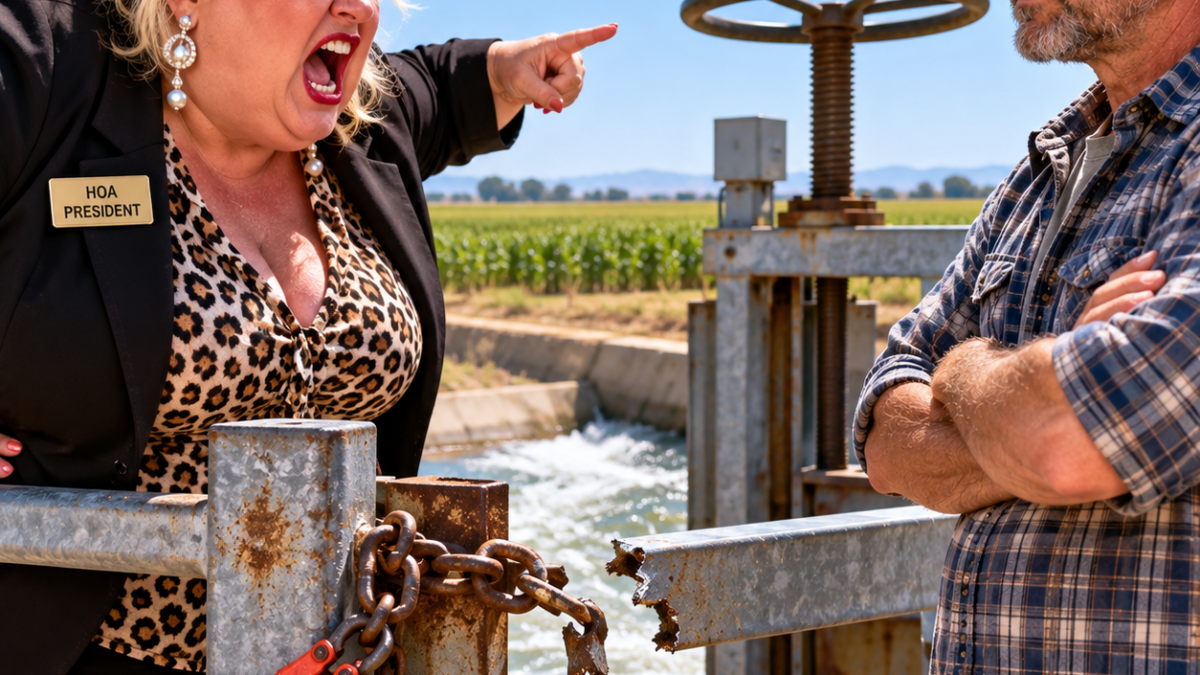
PART 2
Her name was Maria Delgado, and in the eight months since I had taken the district manager position, I had learned that the quieter she became, the more carefully everyone else should listen.
“What are you thinking?” I asked.
“I’m thinking your two roles need to stay separate.”
“Orchard owner and district manager.”
“Exactly.”
“So I can’t investigate my own gate?”
“You can secure district infrastructure, document the incident, restore lawful delivery, and perform emergency duties. But because you’re also the injured landowner, I want the board involved immediately.”
That made sense.
It also irritated me.
“I know what happened.”
“You know what you suspect.”
“I found her pen.”
“You found a pen you associate with her.”
“Footprints.”
“Common footwear.”
“She threatened the water three days ago.”
“Useful context.”
Maria paused.
“Not proof beyond dispute.”
I leaned back.
Twenty years of engineering had trained me to respect exactly that distinction.
What I knew.
What I believed.
What I could demonstrate.
They were not interchangeable.
“Fine.”
“Good.”
“You sound pleased.”
“I’m pleased you said fine without arguing for fifteen minutes.”
“Don’t get used to it.”
“Photograph your trees too. Establish condition now. If you later claim crop damage, we need a baseline.”
I went back outside.
By ten in the morning, the sun was already hard and white overhead.
The first four orchard blocks recovered quickly once water returned.
The lower rows worried me.
Their root systems were still shallow.
Leaves had curled inward.
A few young trees looked limp.
I walked row after row taking photographs.
Tree numbers.
Block numbers.
Soil readings.
Emitter flow.
I had designed the orchard with almost embarrassing precision.
Each tree belonged to a numbered row and irrigation zone.
Friends made fun of me for it.
That morning, the obsessive records stopped being a personality quirk and became evidence.
At noon, Frank arrived with another district director named Luis Ortega.
Luis farmed alfalfa fifteen miles downstream.
He was seventy-one, sunburned permanently brown, and had the patience of a man who had spent a lifetime arguing with weather.
He crouched beside the gate.
“Somebody shut this by hand.”
“Yes.”
“Lock?”
“District lock wasn’t engaged. We don’t normally lock individual turnouts during active delivery unless there’s a problem.”
Luis frowned.
“We may start.”
Frank examined the pen through the clear evidence bag.
“That hers?”
“I’ve seen her use one that looks identical.”
Frank whistled.
“That woman really carries that thing around?”
“Every meeting.”
Luis straightened.
“I don’t care about her jewelry. We follow procedure.”
He pointed at me.
“And because this is your farm, you’re not chairing the incident review.”
“I know.”
“Good.”
“I said I know.”
Frank grinned.
“He hates this.”
“I can tell.”
We called the county sheriff’s non-emergency line.
Deputy Aaron Bell arrived forty minutes later.
No flashing lights.
No dramatic crime-scene tape.
He listened.
Photographed.
Collected the pen after I signed over the chain of custody.
Examined the footprints.
Asked whether there were cameras.
“No.”
“Witnesses?”
“Not that I know.”
“Prior disputes?”
“Yes.”
“With Ms. Miller?”
“Yes.”
“Threats?”
“She told me water was a privilege.”
“That’s not exactly ‘I’m going to shut your gate.’”
“I know.”
He looked at me.
“You district manager?”
“Yes.”
“That complicates things.”
“I’m aware.”
He wrote something down.
“Could an ordinary person legally manipulate that gate?”
“No.”
“Signage?”
I pointed.
A metal placard read:
**TRI-COUNTY IRRIGATION DISTRICT — AUTHORIZED PERSONNEL ONLY — DO NOT OPERATE**
Bell photographed it.
“Good.”
I almost laughed.
“Good?”
“Good for clarity.”
He studied the canal.
“Any chance a kid did it?”
“Possible.”
“With Karen’s pen?”
“Less possible.”
He nodded.
“We’ll document suspected tampering. If you get more evidence, call me.”
That was it.
No immediate arrest.
No squad cars racing toward Oak Haven.
Real life tends to disappoint people who expect every offense to produce handcuffs by lunchtime.
I preferred it that way.
If Karen had done this, I wanted a case that survived daylight.
By four, the district board had scheduled an emergency session for the next morning.
I watered through sunset.
Walked every row twice.
Counted stressed trees.
Thirty-seven needed additional attention.
Six looked bad.
None appeared dead yet.
I stood in the orchard long after dark listening to the restored drip lines.
That sound had once meant engineering satisfaction.
Now it meant vulnerability.
I hated that.
The next morning, the irrigation district board met at seven.
Five directors.
Maria.
Me.
Frank deliberately placed me at the far end of the table rather than my usual manager’s seat.
“Conflict protocol,” he said.
“Enjoying this?”
“Deeply.”
Maria summarized the incident.
She did not say Karen’s name.
She referred to “a potential individual of interest identified by circumstantial evidence.”
I appreciated the discipline even when I wanted the opposite.
The board unanimously authorized several actions.
First, secure all district-controlled headgates bordering Oak Haven with tamper-evident locks while preserving lawful deliveries.
Second, review recent flow records and meter data around the subdivision.
Third, send a neutral incident notice to Oak Haven’s board explaining that unauthorized manipulation of district water infrastructure had occurred adjacent to its property and requesting preservation of any relevant surveillance, vehicle, and access records.
Fourth, coordinate with the sheriff’s office.
Then Frank looked at me.
“Anything else?”
“Yes.”
“What?”
“I want historical usage on Oak Haven’s common-area meter.”
Maria turned.
“Why?”
“Something Karen said.”
“Water is a privilege?”
“Yes.”
“That could mean nothing.”
“I know.”
Frank shrugged.
“Usage review is within normal management duties.”
Maria nodded.
“As long as Alex isn’t using district authority to investigate Karen personally.”
“I’m investigating a customer account after a security incident.”
Luis said:
“Do it.”
That afternoon, I pulled ten years of records.
Oak Haven had a common-area irrigation allocation covering the entrance median, clubhouse grounds, tennis court landscaping, and several ornamental strips along its main boulevards.
The subdivision did not receive domestic drinking water from us.
Only irrigation water.
For years, usage stayed predictable.
Then it began rising.
Nine percent over allocation one year.
Fifteen percent the next.
Current season projections suggested nearly twenty percent.
I checked meter calibration records.
Accurate.
Looked for approved supplemental purchases.
None.
Drought adjustment?
None.
Emergency landscaping allocation?
None.
The previous manager had issued two routine overage letters.
No enforcement follow-up.
I found them in an old folder.
Both addressed to Karen Miller.
That changed the picture.
She knew.
Not necessarily about my gate.
But she knew Oak Haven was taking more irrigation water than its contract allowed.
One of her responses was clipped to the second notice.
**We maintain premium landscaping standards required by our governing documents. Please consider the overage de minimis given our long-standing account status.**
The former manager had handwritten:
**Discuss next season.**
Then retired.
I called Maria.
“You need to see this.”
She arrived at the district office before five.
I spread the charts across the table.
She read Karen’s letter.
“How much money?”
“Depends on how we treat historical overage. At minimum, surcharge and conservation measures. Potential back-billing.”
“Any meter tampering?”
“Not that I’ve found.”
“So don’t call it theft.”
“I didn’t.”
“You were thinking it.”
“I was thinking unauthorized excess diversion.”
“Better.”
She traced the graph.
“This gives the district an independent issue with Oak Haven.”
“Yes.”
“Which is good for conflict separation.”
I looked at her.
“You’re happy they’re overusing water?”
“I’m happy we have a legitimate regulatory problem unrelated to your personal dispute.”
Lawyers.
The district sent Oak Haven a formal notice of over-allocation and requested a corrective-use plan.
Two days later, Karen retaliated.
Three envelopes arrived at my farmhouse.
All bearing the Oak Haven Estates logo.
The first said my barn was painted an unapproved shade of red.
Fine: $500.
The second said my tractor constituted a prohibited commercial vehicle visible from residential property.
Fine: $500.
The third identified my orchard as “unapproved landscaping inconsistent with neighborhood design standards.”
Fine: $1,000.
I read all three.
Then read them again because sometimes absurdity improves with repetition.
It did.
My farm was not inside Oak Haven.
Never had been.
Their covenants were as relevant to my barn as condominium rules in New Jersey.
Still, Karen had issued two thousand dollars in fines.
At the bottom:
**Failure to cure may result in further enforcement, including legal action.**
I laughed.
Not happily.
I scanned everything.
Forwarded copies to Maria.
Then called Karen.
That was probably a mistake.
But I was still human.
She answered:
“Mr. Travers.”
“You sent me HOA violations.”
“You received them.”
“My property is not in your association.”
“It directly affects our association.”
“That isn’t how covenants work.”
“You’re operating a commercial agricultural nuisance next to a premium residential community.”
“My land is agriculturally zoned.”
“Our counsel disagrees with your interpretation of nuisance law.”
“Your counsel thinks my barn color is an HOA violation?”
Silence.
Then:
“You are creating a hostile environment.”
I nearly admired the phrase.
“You sent me fines you have no authority to issue.”
“You are being difficult again.”
“Karen, withdraw them.”
“No.”
“Fine.”
“I’m glad we understand each other.”
“We absolutely do.”
I hung up.
Maria called five minutes later.
“Did you contact her?”
“How did you know?”
“I know you.”
“She sent fake fines.”
“Are you in the HOA?”
“No.”
“Then why are you emotionally negotiating over fake fines?”
“I wanted her to withdraw them.”
“Did she?”
“No.”
“Did the call improve anything?”
“No.”
“Excellent. We’ve learned something.”
“I hate you.”
“No, you don’t.”
She was right.
Again.
That evening, I installed a motion-triggered trail camera near the headgate.
Not hidden on HOA property.
On mine.
Pointed only at the district gate and my access lane.
Then I drove across the canal to check on George Stanton.
I had noticed him before.
Sixties.
Retired electrical engineer.
He lived directly opposite my main farm entrance and maintained his lawn with the meticulous devotion of someone who considered weeds a moral failure.
He was kneeling beside a flower bed when I approached.
“George?”
He looked up.
“Alex.”
“You know me?”
“Everybody knows you now.”
“That sounds ominous.”
He glanced toward Karen’s house.
“She talks.”
“I’ve noticed.”
I crouched.
“Can I ask you something?”
“Depends.”
“Did you happen to see anything near my farm Tuesday morning?”
He stopped pulling weeds.
“What time?”
“Before six.”
His expression changed.
“Why?”
“Somebody interfered with my irrigation gate.”
He slowly stood.
“That why the sheriff was there?”
“Yes.”
George looked toward his garage.
“Come inside.”
The garage was spotless.
Pegboard tools.
Labeled storage bins.
A workbench that could have passed inspection in a laboratory.
He closed the door.
Then:
“I saw the HOA golf cart.”
My heart kicked.
“When?”
“Four-thirty. Maybe quarter to five.”
“Where?”
“Going toward your canal entrance.”
“Who was driving?”
He hesitated.
“Couldn’t see clearly.”
“Karen?”
“I said I couldn’t see.”
Good.
Honest witness.
“How do you know it was the HOA cart?”
“White roof. Oak Haven logo. Amber safety light.”
“Could anyone use it?”
“Board members have keys.”
“Does Karen?”
“Oh, yes.”
George leaned against the bench.
“What did they do?”
“Gate was manually closed.”
He stared.
“That can kill your trees?”
“Potentially.”
His jaw tightened.
“That woman.”
“You’ve had problems?”
He laughed without humor.
Then walked to a filing cabinet.
When he returned, he dropped an accordion folder on the workbench.
“This is two years of problems.”
Violation notices.
Satellite dish.
Garden hose.
Front door color.
Trash can.
A shrub extending three inches beyond an approved bed.
More than four thousand dollars in fines and late charges.
“I appealed the satellite one.”
“What happened?”
“I proved you couldn’t see it from the street.”
“And?”
“They rescinded that violation.”
“Good.”
“Three days later I got cited for the hose.”
He looked at me.
“That’s Karen’s method. You beat one thing, she finds another.”
“Board supports her?”
“Bob Turner and Linda Hayes always do.”
“Why?”
“Bob’s treasurer. Linda runs landscaping.”
“And the rest?”
“David Price tries not to fight anybody. Ellen Marks barely speaks.”
“What do homeowners think?”
“They think Karen’s exhausting.”
“That’s enough to keep her president?”
George nodded.
“Most people have jobs.”
That sentence would come back repeatedly.
People imagine petty dictatorships require armies.
Sometimes they require only one person with unlimited time and twenty people who would rather eat dinner than attend a board meeting.
George showed me the HOA budget.
“Where did you get this?”
“Annual packet.”
I saw landscaping costs.
$71,480.
Almost double three years earlier.
“What changed?”
“New entrance fountain.”
I looked up.
“The giant one?”
“Karen’s masterpiece.”
“How much water does that thing use?”
“No idea.”
I did.
More than people thought, especially with evaporation and landscaping around it.
George continued.
“Tennis court renovation. Clubhouse kitchen. Imported stone.”
“Where does the money come from?”
“Dues, assessments, fines.”
“How much fines?”
“Budget says forty-two thousand last year.”
I whistled.
“For a subdivision this size?”
“Exactly.”
“Any audit?”
“Internal review.”
“Meaning?”
“Bob says it’s fine.”
I handed the budget back.
“George, I’m not going after your HOA because I’m mad about my gate.”
“You should.”
“No.”
He looked disappointed.
“I manage the water district. I have to stay inside my authority.”
“Then what are you doing here?”
“Trying to understand whether Karen behaves this way with everyone.”
George looked at the thick file.
“She does.”
“Can you introduce me to people?”
A smile slowly formed.
“How many?”
“As many as have stories like yours.”
He picked up his phone.
“Give me two days.”
The district received Oak Haven’s response to our overage notice the next morning.
Karen signed it.
She disputed the usage calculations.
Accused the district of retaliatory enforcement because of my “personal animosity.”
Demanded that I recuse myself entirely.
That part was not unreasonable.
Maria recommended the board grant it.
I hated that.
Frank enjoyed it.
“You’re suspended from Oak Haven’s account.”
“I’m district manager.”
“Not on that account right now.”
“I found the overage.”
“Exactly why someone else verifies it.”
Luis took over the review with an outside water-accounting consultant.
I could not touch the final decision.
That became one of the most important choices we made.
Because Karen spent the next month telling anyone who would listen that I was abusing public office to punish her.
But the official overage findings did not come from me.
They came from Luis, the consultant, the meter records, and a five-member district board.
Confirmed excess use:
17.8 percent above allocation the previous year.
Current-year trajectory:
19.6 percent.
The consultant also found the entrance fountain’s make-up valve was running longer than necessary because of a faulty float system.
Not malicious.
Just waste.
Oak Haven was ordered to repair it, submit a conservation plan, and pay contractual overage charges.
Karen responded by sending me another HOA notice.
This one threatened legal action for “harassment of association leadership.”
I framed it.
Maria saw it hanging in my office.
“You are twelve years old.”
“It’s motivational.”
“It’s evidence.”
“I have the original secured.”
“Then that’s a copy?”
“Yes.”
She looked at the frame again.
“Still twelve.”
George called Thursday.
“Barn. Eight o’clock.”
“What?”
“We need your barn.”
“For?”
“People.”
“How many?”
“Maybe twenty.”
Thirty-one showed up.
Cars arrived one at a time.
A nurse named Kelly Ramirez still wearing scrubs.
A young couple, Erin and Matt Cole, pushing a stroller.
A disabled veteran named Sam Porter walking with a cane.
A teacher.
An airline mechanic.
A widow.
Two software engineers.
A retired dentist.
People I had seen driving through Oak Haven but never met.
We arranged folding chairs inside my supposedly illegal red barn.
George stood beside the old workbench.
“Thank you for coming.”
Nervous silence.
He held up his violation folder.
“I think most of you know what this is.”
Laughter.
Not happy laughter.
Recognition.
Kelly spoke first.
Her eight-year-old son had a plastic playhouse visible above a rear fence.
One thousand dollars in penalties after she missed a deadline while working back-to-back hospital shifts.
Erin and Matt had replaced high-water ornamental shrubs with native drought-tolerant plants.
Karen ordered them removed because the species were not on the approved list.
Sam Porter had built an accessibility ramp after knee and hip surgeries.
County permit.
Professional construction.
Karen fined him because the handrail color did not match the approved beige.
“Did you appeal?” I asked.
“Twice.”
“And?”
“First time they lost my paperwork. Second time they said deadline expired.”
Story after story.
Some legitimate violations existed.
One man admitted he had left a broken trailer in the street for months.
Another conceded his dog barked constantly.
I made a point of saying so.
“This isn’t about pretending every rule is oppression.”
The room quieted.
“Communities can have rules. Water districts have rules. Farms have rules. The military had more rules than any HOA could dream of.”
A few veterans laughed.
“The problem is when rules stop being standards and become weapons.”
George nodded.
“That.”
Then I told them about the irrigation gate.
No accusation beyond evidence.
Gate closed.
No work order.
Pen.
Golf cart seen heading toward the area.
Sheriff report.
District investigation.
Then I told them my position.
“I’m the manager of the Tri-County Irrigation District.”
A few people already knew.
Most didn’t.
Kelly leaned forward.
“The same district that supplies our landscaping water?”
“Yes.”
“And Karen messed with your gate?”
“Someone did. I’m not going to claim more than the evidence proves.”
George muttered:
“Lawyer trained him.”
“Unfortunately.”
I explained the overuse findings were now being handled independently because I had recused myself from Oak Haven’s account.
That surprised them.
Matt asked:
“Why recuse?”
“Because if the same man who’s angry about his orchard determines your HOA owes money, Karen gets to call the whole thing revenge.”
“So you gave up control?”
“I gave up one decision.”
“Why?”
“Because I want the decision to survive.”
The barn went quiet.
Then Sam said:
“That’s more accountability than we get from our own board.”
That was the moment the meeting changed.
Not when I told them what Karen might have done.
When they realized there was another way authority could work.
George laid out the HOA bylaws.
Homeowners had inspection rights.
Meeting rights.
Petition thresholds.
Audit procedures.
Removal procedures.
Budget voting rules.
Karen had relied on nobody reading them.
That was about to change.
We assigned nothing dramatic.
No fake rebellion.
No screaming.
Just questions.
George would formally request an independent financial audit.
Kelly would challenge selective enforcement using documented comparable properties.
Erin and Matt would present water-use data comparing native landscaping with the HOA’s approved thirsty ornamentals.
Sam would request an accommodation policy review for disability-related modifications.
Others would request vendor contracts, fine revenue totals, legal-expense disclosure, and board minutes.
“What do I do?” Kelly asked me.
“Stay calm.”
“That’s it?”
“Karen will try to make anger the issue.”
George added:
“She’s good at that.”
I said:
“Ask one question. If she refuses, let the refusal speak.”
“And you?”
Matt asked.
“I have my own issue.”
“What issue?”
“The district is finishing its investigation.”
That was all I said.
After everyone left, I stood alone in the barn.
The smell of hay and old timber filled the space.
My orchard was visible through the open doors.
Rows of young trees.
Still alive.
Still green.
I had come here because I was tired of systems.
Now I was organizing people around bylaws, water contracts, evidence, and public procedure.
I laughed.
Retirement had a sense of humor.
The trail camera alerted at 11:17 that night.
I was in bed.
The notification showed motion near Headgate 14-B.
I was out the door in under a minute.
No weapon.
Phone.
Flashlight.
Truck keys.
I stopped fifty yards away and stayed inside the pickup.
The camera had captured a raccoon.
I stared at the photograph.
Then laughed so hard I scared myself.
The next morning, I told Maria.
“Good.”
“Good?”
“You didn’t charge down there and shoot a raccoon.”
“I don’t shoot random wildlife.”
“Growth.”
The serious break came three days later.
Deputy Bell called.
“We found camera footage.”
“From where?”
“George Stanton’s house.”
I sat up.
“George gave you footage?”
“He called after remembering his doorbell camera catches part of the road.”
The video did not show the headgate.
It showed Oak Haven’s golf cart.
Timestamp:
4:41 a.m.
Traveling toward my farm.
Then again at 5:09.
Returning.
The driver was difficult to identify.
But a light-colored top and hairstyle were visible.
“Can you tell it’s Karen?”
“Not conclusively.”
“Great.”
“You sound disappointed.”
“I am.”
“Don’t be. We also requested access logs from Oak Haven for the maintenance garage.”
“And?”
“The electronic key system recorded President Miller’s fob opening the garage at 4:32 a.m.”
My hand tightened around the phone.
“Anyone else?”
“No other fob until 7:18.”
“Does that prove she took the cart?”
“No.”
“Bell.”
“You know the answer.”
I did.
It proved access.
Then the cart appeared on video.
Then disappeared back toward the clubhouse.
Add the pen.
Add the earlier statement about water.
Strong circumstantial chain.
Not perfect.
Bell continued.
“We’d like to interview her.”
“Go ahead.”
“Her attorney says she won’t speak.”
Of course.
The sheriff’s investigation remained open.
Then Maria called with another development.
The district board had completed the Oak Haven water review.
Overage confirmed.
Historical back charges.
Current surcharge.
Mandatory conservation plan.
Flow-monitoring upgrade.
And a requirement that all subdivision-controlled irrigation devices near district infrastructure be secured from unauthorized personnel.
Penalty total was significant but nowhere near bankruptcy.
About $38,000 including historical overage charges and administrative costs.
Enough to hurt.
Not destroy.
Karen called it extortion publicly.
Then spent HOA money on a lawyer challenging it.
That irritated homeowners more than the amount.
The board meeting happened one week later.
The Oak Haven clubhouse had parking for maybe forty cars.
More than a hundred showed up.
People parked along permitted sections of neighboring streets.
Some walked.
I parked outside the subdivision and came in on foot.
Not because I needed drama.
Because my truck smelled like fertilizer.
The meeting room was standing-room-only.
Karen sat center table.
Bob Turner to her right.
Linda Hayes beside him.
David Price and Ellen Marks farther down.
Karen looked pleased.
At first.
Large audiences usually meant importance to her.
“Wonderful turnout,” she said.
“Clearly our community is more engaged than ever.”
George whispered beside me:
“Give her fifteen minutes.”
She made it seven.
George stood when new business opened.
“Madam President, pursuant to Article Eleven, Section Four, I move for an independent forensic audit covering the previous twenty-four months.”
Karen blinked.
“For what reason?”
“Member confidence.”
“Our finances are reviewed monthly by the treasurer.”
Bob leaned toward his microphone.
“Correct.”
George held up a petition.
“Forty-seven homeowners request the audit.”
Murmurs.
Karen looked at Bob.
Then George.
“That is unnecessary and expensive.”
Kelly stood.
“Point of order.”
Karen’s head snapped toward her.
“You need to be recognized.”
Kelly raised her hand formally.
Karen stared.
Then:
“Recognized.”
“Thank you. The bylaws state the petition threshold compels board consideration and membership discussion.”
“I know the bylaws.”
“Then why are we debating whether the petition can be heard?”
Applause started.
George held up one hand.
It stopped.
I watched Karen notice that.
George now controlled the temperature of the room more effectively than she did.
She hated it.
“Fine,” Karen said. “The audit request will be reviewed.”
George replied:
“The bylaw says vote.”
Bob spoke.
“We are not voting on a sixty-thousand-dollar audit because George is unhappy about his garden hose.”
That was another mistake.
George smiled.
“My garden hose cost me seven hundred dollars in fines.”
People murmured.
Then Kelly stood again.
“My son’s playhouse cost me one thousand.”
Sam raised his cane slightly.
“My disability ramp cost six hundred.”
Erin said:
“Our native garden cost fourteen hundred before we gave up and tore it out.”
Karen hammered the gavel.
“We are not relitigating individual violations.”
Matt spoke.
“Then let’s discuss water.”
Karen’s expression changed.
He walked to the front with a single page.
“Our native landscaping used roughly forty percent less irrigation than the approved replacement plantings.”
Linda jumped in.
“That is not relevant.”
“It is when the HOA is paying thirty-eight thousand dollars in district overage charges.”
The room erupted.
That figure had not been disclosed.
Karen slammed the gavel.
“Order!”
Someone shouted:
“Thirty-eight thousand?”
Another:
“Why weren’t we told?”
Bob turned toward Karen.
“You said the district issue was pending.”
“It is.”
Luis had already issued the final administrative determination subject to appeal.
Pending was technically arguable.
Misleading was more accurate.
George stood.
“How much association money has been spent challenging the water district?”
Karen said:
“That is confidential legal strategy.”
“Amount.”
“George—”
“Amount.”
Bob shuffled papers.
Nobody looked at him.
Then David Price, one of the quiet board members, spoke.
“Twenty-one thousand four hundred so far.”
You could feel the room inhale.
Karen whipped toward him.
“That figure includes broader counsel services.”
David said:
“Some. Most is district-related.”
Karen’s face reddened.
“David, we discussed—”
“No.”
His voice shook.
But he kept going.
“We should have told them.”
That was the first crack inside the board.
Ellen Marks nodded.
Karen saw it.
“Both of you are out of order.”
David almost laughed.
“We’re directors.”
The room broke into applause.
Karen pounded the gavel harder.
For the next twenty minutes, our little barn group did exactly what we had practiced.
One question at a time.
Fine revenue.
Forty-two thousand previous year.
Legal spending.
Vendor selection.
Landscaping increases.
Meeting minutes.
Appeal procedures.
Disability accommodations.
Water usage.
Bob tried to defend the budget.
Linda accused residents of ingratitude.
Karen interrupted almost everyone.
Each interruption hurt her more.
The meeting stopped being about whether every fine was justified.
It became about whether anyone trusted the people issuing them.
Then George asked:
“Were competitive bids taken for the entrance fountain project?”
Bob said:
“Yes.”
“Can we see them?”
“Not tonight.”
“Why?”
“Records aren’t here.”
Ellen quietly said:
“There weren’t three bids.”
Bob froze.
Karen turned.
“Ellen.”
She looked terrified.
But continued.
“Prestige Outdoor submitted one proposal. Karen called it sole-source.”
“Because they were already our landscaping contractor,” Karen snapped.
George asked:
“Is Prestige owned by your sister’s husband?”
Silence.
There it was.
Karen’s cheeks went white.
Linda stared at her.
Bob looked down.
The room changed again.
Karen said:
“That relationship was disclosed.”
David Price looked genuinely confused.
“When?”
“Everyone knew.”
“I didn’t.”
George did not accuse her of stealing.
Did not mention kickbacks.
He simply said:
“That’s what the audit is for.”
Then the vote happened.
Overwhelming support.
Independent audit approved.
Karen lost.
Her first public vote in years.
She sat rigid behind the table.
Then her eyes found me.
“You.”
The room quieted.
I had not spoken once.
Karen pointed.
“This is you.”
I stood.
“You organized this.”
“No.”
“You are retaliating because of a water dispute.”
“I’m not a member of your HOA.”
“Exactly. You have no right to participate.”
“I haven’t voted.”
“You are interfering.”
I looked around.
“These people asked their own questions.”
“You coached them.”
George said:
“He taught us to read.”
Laughter.
Karen’s voice rose.
“You came here to destroy this association.”
“No.”
“You threatened us with criminal charges.”
“I haven’t spoken tonight.”
“You sent that district letter!”
“The district sent it.”
“You run the district!”
There it was.
Finally.
People looked at me.
Karen realized she had revealed the thing she had apparently only recently learned.
I stepped into the aisle.
“My name is Alex Travers.”
Someone muttered:
“We know.”
A few laughs.
I continued.
“I own the thirty-acre farm bordering Oak Haven.”
I paused.
“And I serve as manager of the Tri-County Irrigation District.”
The room went quiet.
I saw Linda’s eyes widen.
Bob stared.
David Price leaned back.
Karen crossed her arms.
“You’ve abused that position from the beginning.”
“No.”
I held up one hand.
“When Oak Haven challenged its water overage findings, I recused myself.”
Luis was seated near the back.
I gestured toward him.
“Director Ortega supervised the review. An outside consultant verified your usage.”
Luis stood briefly.
“That’s correct.”
I continued.
“The district’s board—not me—approved the final determination.”
Karen scoffed.
“You’re still behind all of this.”
“Behind what?”
“The attack.”
I walked toward the front.
Maria sat near the side wall with a leather folder.
She had insisted on attending.
I stopped a respectful distance from the board table.
“Four weeks ago, someone manually shut Headgate 14-B and interrupted water to my orchard.”
Murmurs.
Karen looked bored.
“The district documented the incident.”
I continued.
“The sheriff’s office opened a tampering investigation.”
Now people were listening differently.
“Evidence collected includes photographs, access records, video placing Oak Haven’s golf cart near the gate during the relevant window, and an item recovered beside the headgate.”
Karen’s eyes flicked toward Maria’s folder.
Tiny movement.
But I saw it.
“What item?” somebody asked.
I looked at Karen.
“A jeweled pink pen.”
Silence.
Karen’s hand moved automatically toward the clipboard in front of her.
No pen.
George exhaled.
Kelly whispered:
“Oh my God.”
Karen laughed.
Too loudly.
“You cannot possibly be serious.”
“I’m very serious.”
“Millions of pens look like that.”
“Possible.”
“You planted it.”
There was an audible reaction from the room.
Maria stood.
“Ms. Miller, I advise you to be careful.”
Karen turned.
“And who are you?”
“Maria Delgado. Counsel for the irrigation district.”
Karen’s attorney was not present.
That was the moment she should have stopped talking.
She did not.
“This entire accusation is absurd. I did nothing except close one stupid valve that should never have been feeding an illegal orchard next to our homes.”
The room went dead.
Not quiet.
Dead.
Karen’s face changed before anyone spoke.
She had heard herself.
Maria did not move.
I did not move.
George stared at her.
David Price slowly lowered his hands to the table.
Karen tried to recover.
“I mean hypothetically.”
No one believed that.
Maria’s voice became very calm.
“Ms. Miller, please do not say anything else about the gate.”
Karen pointed at me.
“He provoked this!”
Maria repeated:
“Please stop.”
But panic had taken over.
“He was using water to run some commercial operation beside our community. He ignored every concern. Someone had to make him listen.”
My anger rose so fast my hands went numb.
Two thousand trees.
Years of savings.
My retirement.
She was admitting it as though she had turned off a neighbor’s sprinkler.
I stepped closer.
Maria touched my arm.
“Alex.”
I stopped.
Karen saw the movement and mistook restraint for weakness.
“That orchard is a nuisance.”
I looked at her.
“No.”
My voice came out quieter than I expected.
“It’s my life.”
Something in the room shifted.
Not legal.
Human.
I continued.
“I spent twenty years building systems for other people.”
My throat tightened.
“When I retired, I wanted one thing that grew instead of something I had to repair after someone broke it.”
I looked toward the windows.
Beyond them, past the houses and streets, my barn roof was barely visible.
“Those trees are not decoration. They’re not a landscaping preference. They’re years of savings and work.”
Karen opened her mouth.
I held up one hand.
“You shut off their water because you didn’t like looking at them.”
She said nothing.
For once.
Maria stepped forward.
“The district has prepared a proposed civil and administrative resolution concerning Oak Haven’s water-account overages, unauthorized access to district infrastructure, security costs, and associated damages.”
She placed copies on the table.
Karen stared.
Maria continued.
“To be very clear, the irrigation district cannot promise immunity from criminal prosecution. Charging decisions belong to the county prosecutor, not us.”
That corrected one of the things I had insisted on from the beginning.
No backroom trade of resignations for criminal silence.
No pretending we were prosecutors.
“But,” Maria said, “the district can resolve its civil claims and administrative enforcement.”
David Price picked up the document.
“What terms?”
Maria answered.
“Payment of verified overage charges.”
He read.
“Installation of upgraded metering and security controls.”
Another page.
“A mandatory water-conservation plan.”
Another.
“Reimbursement of district costs associated with the gate incident.”
Another.
“Independent HOA financial audit.”
Karen snapped:
“The district has no authority over our finances.”
Maria nodded.
“Correct. That term is not a district mandate.”
She looked toward the homeowners.
“It is included because the board has indicated through tonight’s vote that an audit will occur, and the parties discussed a broader settlement framework.”
George smiled slightly.
Maria continued.
“The proposed resolution also requires the association to formally acknowledge that Mr. Travers’s agricultural property is outside HOA jurisdiction and rescind all notices sent to him.”
Bob whispered:
“How much?”
Maria told him.
With water charges, security improvements, consulting costs, and civil-resolution payment, the figure was painful but survivable.
Karen exploded.
“We’re not paying him anything!”
Maria said:
“Most of the money does not go to Alex.”
Karen stared.
“It goes to the district.”
“That’s worse!”
That sentence produced nervous laughter.
Then David reached the governance section.
He looked at Maria.
“This calls for resignation of officers directly involved in unauthorized conduct.”
Maria replied:
“That term came from the association’s homeowner representatives and insurer discussions, not from district coercion. Your association’s own counsel has been provided a copy.”
Karen looked stunned.
“Insurer?”
Bob’s face went blank.
“What insurer discussions?”
David stared at him.
“Our liability carrier.”
Karen said:
“I handled that.”
David’s eyes narrowed.
“You contacted them?”
No answer.
Maria looked toward me.
This part was not hers.
George stepped forward.
“Karen, did the insurer issue a reservation-of-rights letter?”
The phrase landed hard.
Bob stood.
“What?”
Karen slapped the table.
“This is confidential.”
Bob’s face reddened.
“I’m treasurer.”
“You don’t need to know every legal detail.”
“The hell I don’t.”
He looked at David.
“Did you know?”
“No.”
Linda shook her head.
Karen had finally done what bullies often do when pressure closes in.
She had hidden information from her own allies.
David reached toward Maria.
“Do you have it?”
“No.”
George did.
An Oak Haven homeowner with access to recent board correspondence had provided a nonprivileged notice circulated among directors.
George handed copies to Bob, Linda, David, and Ellen.
The carrier had not canceled coverage.
It had not refused defense.
But it reserved the right to deny or limit coverage for intentional acts, knowing violations, or misconduct falling outside policy protections.
Especially individual misconduct.
Karen read the room.
Her support evaporated in real time.
Bob whispered:
“You told me insurance would cover everything.”
Karen said:
“It should.”
“That’s not what this says.”
Linda read another paragraph.
“They can pursue reimbursement?”
“In some circumstances,” Maria said carefully.
Linda stared at Karen.
“You went to his gate?”
Karen’s shoulders stiffened.
“I was protecting the community.”
Linda stood.
“You told us you never left the clubhouse that morning.”
That was new.
Everyone heard it.
Karen looked at her.
“What?”
“When the sheriff asked about the golf cart.”
Linda’s voice shook.
“You told me you were in the clubhouse early because you were reviewing landscape invoices.”
“I was.”
“But you just said you closed the valve.”
“I said—”
“You said you closed it.”
Karen’s face crumpled with fury.
“You all wanted that farm cleaned up!”
David answered:
“I wanted the barn repainted.”
He looked sick.
“I didn’t want you shutting off his water.”
Bob rubbed his forehead.
“I told you to leave him alone.”
“No, you didn’t.”
“I said he wasn’t in the HOA.”
“You supported the nuisance letter.”
“The nuisance letter, yes. Not this.”
Every alliance has a point where self-preservation becomes stronger than loyalty.
We were watching it.
Karen looked around.
At Bob.
Linda.
David.
Ellen.
Then the homeowners.
People she had fined.
Shamed.
Ignored.
Threatened.
No one moved to save her.
She sat down.
Slowly.
“No.”
It was almost a whisper.
George asked:
“No what?”
“You’re not taking this from me.”
Nobody answered.
“I built Oak Haven.”
David said:
“You became president six years ago.”
Karen glared.
“You know what I mean.”
“No,” he said. “I don’t think I do anymore.”
He looked toward Ellen.
Then Bob.
Then Linda.
“I move that we enter executive session with counsel immediately to discuss the district settlement, insurance exposure, and leadership changes.”
Karen grabbed the gavel.
“I refuse.”
David looked toward the members.
“Under the bylaws, three directors can call executive session.”
Ellen raised her hand.
“I support.”
Bob, after a long pause:
“Support.”
Karen stared at him.
“You coward.”
Bob looked back.
“No.”
His voice hardened.
“I was a coward when I kept saying yes to you.”
That one landed.
The board recessed.
Nobody left.
Forty minutes passed.
People whispered.
George sat beside me.
“You okay?”
“No.”
“Trees?”
“They’re okay.”
“I mean you.”
I looked toward the closed meeting-room door.
“I wanted her exposed.”
“And?”
“I didn’t think it would feel like this.”
“Like what?”
“Sad.”
George nodded.
“Power makes people ugly.”
“That isn’t what I mean.”
“What then?”
“She still thinks she was protecting something.”
“Maybe she does.”
“She nearly killed two thousand trees over a view.”
George shrugged.
“People can do terrible things while telling themselves nice stories.”
The door opened.
David came out first.
Then Ellen.
Bob.
Linda.
Karen did not.
David approached the microphone.
“The board has voted four to one to accept the civil framework subject to final counsel review.”
Applause started.
He held up his hand.
“There’s more.”
The room quieted.
“The board has also voted four to one to remove Karen Miller as president effective immediately, pending the formal member process concerning her board seat.”
A noise moved through the crowd.
Relief.
Disbelief.
Years of tension breaking.
“Bob Turner has resigned as treasurer.”
Bob stood stiffly.
“Linda Hayes has resigned as landscaping chair.”
Linda looked at the floor.
“Both will remain directors temporarily only as needed for transition unless members remove or replace them under the bylaws.”
George asked:
“And Karen?”
David looked toward the closed door.
“She has refused to resign from the board.”
Someone shouted:
“Then vote her out!”
David nodded.
“That process begins tomorrow.”
Karen emerged seconds later.
She had been crying.
Not much.
Enough to see.
She walked toward me.
George stepped between us.
I touched his shoulder.
“It’s okay.”
Karen stopped six feet away.
“You ruined me.”
I looked at her.
“No.”
“You came into my community and turned everyone against me.”
“I never lived in your community.”
“You know what I mean.”
“Yes.”
I did.
“You ruined yourself when you decided my boundary didn’t matter.”
She swallowed.
“You think those people are your friends?”
“Some are.”
“They’ll turn on you too.”
“Maybe.”
“They’re ungrateful.”
“Maybe some are.”
“I did everything for them.”
“That’s the problem.”
She stared.
“What is that supposed to mean?”
“You stopped knowing the difference between doing something for people and doing something to them.”
For once, Karen had nothing ready.
The sheriff interviewed her formally the next morning through counsel.
Her admission at the meeting had been recorded in the official minutes and by multiple homeowners.
The investigation became much easier.
But not instantaneous.
Criminal law still required elements.
Intent.
Statutory fit.
Evidence.
Prosecutorial discretion.
The district sent its full file to the county prosecutor.
Then stepped back.
That was important.
I did not demand jail.
I did not call the prosecutor.
I did not threaten anyone with criminal charges to force an HOA vote.
The evidence would go where evidence goes.
The homeowners handled their board.
The district handled water.
The prosecutor handled criminal law.
Separate lanes.
Clean structure.
My orchard handled none of that.
It simply needed water.
I returned home after the meeting around midnight.
The farmhouse was dark.
I walked past it.
Straight into the orchard.
Moonlight silvered the leaves.
The irrigation cycle had ended hours earlier.
I touched the trunk of one of the six trees that had looked worst after the shutoff.
Leaves still curled slightly.
But new growth at the tip remained green.
Alive.
I sat in the dirt.
For twenty years, retirement had been an abstraction.
A date.
A benefits calculation.
A promise that someday I would stop solving other people’s emergencies.
The orchard was the first retirement dream I had allowed myself to love.
Then Karen touched one wheel and reminded me how quickly a future can feel fragile.
I stayed there until after one.
The next morning, I removed the framed HOA violation letter from my office wall.
Maria noticed later.
“Finally matured?”
“No.”
“Then why?”
“I don’t need it anymore.”
The member removal petition exceeded the required threshold within two days.
Karen resigned from the board before the special vote.
Her resignation letter blamed a “hostile faction” and “outside governmental intimidation.”
George printed it.
He brought it to me.
“You want this framed?”
“No.”
“Growth.”
“Shut up.”
David Price became interim president.
Not George.
George refused.
“I already survived one retirement.”
David was reluctant too.
But he accepted on one condition.
Six months maximum.
His first official act was to authorize the independent audit.
The second was to rescind every notice Karen had sent to my farm.
The third was to suspend contested fines issued to homeowners during the previous two years pending review.
Not erase everything automatically.
Review.
That distinction mattered.
Some violations had been legitimate.
A homeowner had blocked a fire lane repeatedly.
Another had ignored a leaking pool that damaged adjacent property.
A third had abandoned construction debris in a common drainage area.
Those cases stayed.
But hundreds of petty penalties came under scrutiny.
Garden hoses.
Door shades.
Play equipment.
Landscaping species.
Sam’s ramp.
Kelly’s playhouse.
George’s satellite dish.
The audit started with finances.
It became ugly quickly.
Not because investigators discovered some cinematic vault of stolen money.
Reality was more ordinary.
And more believable.
Weak controls.
Vendor favoritism.
Missing bids.
Poorly documented reimbursements.
Legal expenses approved without full-board votes.
Fine revenue used to support discretionary beautification projects.
Karen’s brother-in-law did not own Prestige Outdoor, as rumors had claimed.
Instead, the company belonged to a longtime friend of Bob’s.
That was still a conflict concern because Bob had participated in approvals without consistently disclosing the relationship.
Bob resigned completely.
He later apologized at a meeting.
“I told myself I was keeping peace.”
George replied from the second row:
“You were keeping quiet.”
Bob nodded.
“Yes.”
Linda’s situation was different.
She had supported Karen because she genuinely believed strict aesthetics maintained property values.
The audit found no financial benefit to her.
She admitted she had ignored obvious selective enforcement.
“I thought consistency meant saying yes to the president.”
David answered:
“Consistency means applying the same standard to everybody.”
Linda resigned at the next election.
Months later, she apologized to Sam Porter personally.
He told me afterward:
“I accepted the apology.”
“Forgive her?”
“Don’t know.”
“Fair.”
The water settlement was finalized.
Oak Haven paid its historic overage charges and district enforcement costs.
The association repaired the fountain control system.
Installed smart meters.
Replaced sections of thirsty landscaping with drought-tolerant species.
Ironically, Erin and Matt’s banned native plants became part of the new approved landscape list.
Matt brought me the revised booklet.
“Look.”
He pointed.
Same species Karen forced them to tear out.
I laughed.
“You replanting?”
“Already ordered.”
“Karen would love that.”
“That’s half the reason.”
“The other half?”
“Saves forty percent water.”
“Better reason.”
The district also upgraded Headgate 14-B.
Locking wheel.
Tamper sensor.
Camera positioned only over district infrastructure and my access lane.
Frank came out for installation.
He kicked the new concrete pad.
“Government spending at work.”
“Thirty-seven hundred dollars.”
“Worth every penny.”
“District got reimbursed.”
“Even better.”
He looked across my orchard.
“Lost any?”
“Four.”
His expression changed.
“Four trees died?”
“Four never recovered.”
Out of two thousand, it sounded small.
It did not feel small when I dug them up.
The orchard nursery replaced them under warranty once they heard the story.
I planted the new trees myself.
At the first hole, I stopped.
Frank was nearby.
“You all right?”
“Yeah.”
“Those four weren’t your fault.”
“I know.”
“Then why that face?”
“Because I bought this place to grow things.”
He understood.
We planted all four.
No speeches.
Just soil and water.
The prosecutor’s decision came three months after Karen resigned.
Maria called me into her office.
“The county offered her a diversion agreement on the infrastructure-tampering charge.”
I sat.
“Meaning?”
“Restitution, community service, no-contact terms regarding district property, and no further offense during the diversion period. If she complies, the charge can ultimately be dismissed under the program.”
I felt an unexpected flash of anger.
“That’s it?”
Maria looked at me carefully.
“You wanted prison?”
“No.”
“You sound like you wanted more.”
“I wanted it to matter.”
“It does.”
“She almost destroyed my orchard.”
“Four trees died.”
“Could have been two thousand.”
“Yes.”
Maria folded her hands.
“But it wasn’t.”
I hated how rational that was.
“What did the prosecutor consider?”
“No prior criminal record. Full restitution available. No personal injury. The interruption was caught quickly. She admitted manipulating the gate but claimed she believed she was shutting off unauthorized private flow, which is not a legal defense, but bears on how they evaluated intent.”
“She passed a sign saying authorized personnel only.”
“Yes.”
“She had already been told I had water rights.”
“Yes.”
“And she still gets diversion.”
“Yes.”
I leaned back.
Maria waited.
Finally I said:
“I guess justice isn’t custom built.”
“No.”
“Annoying.”
“Very.”
“What about my civil damage?”
“Separate.”
Karen’s homeowners insurance denied coverage for intentional property interference.
Her attorney approached us about settlement.
I had documented costs.
Four replacement saplings.
Agronomist inspection.
Emergency labor.
Additional watering.
District-related security costs were handled separately.
My personal economic loss was modest because I caught the shutoff early.
I could have sued for emotional distress, speculative future yield, punitive damages.
Maria told me litigation might take years.
“What do you want?” she asked.
“Her to understand.”
“You cannot sue someone into insight.”
“Then restitution.”
“That we can quantify.”
Karen paid my documented orchard losses personally.
Not a fortune.
Enough.
As part of a civil settlement, she agreed not to enter my property or manipulate district infrastructure again.
Obvious things, legally written.
I asked for one additional term.
Her attorney called it theatrical.
I disagreed.
A written acknowledgment:
**Mr. Travers’s farm is outside Oak Haven Estates HOA jurisdiction and its lawful agricultural operations are not subject to Oak Haven architectural or landscaping covenants.**
Karen signed.
That one I did keep.
Not framed.
Filed.
Where boundaries belonged.
By autumn, Oak Haven had a new board.
George allowed himself to be elected vice president after residents promised not to make him president.
Kelly joined.
So did Erin.
David stayed through the transition and escaped exactly six months later.
At his final meeting, George handed him a plaque.
David stared at it.
“I explicitly asked for nothing.”
George said:
“We ignored you in the spirit of HOA tradition.”
The room laughed.
That laughter would have been unimaginable a year earlier.
Meetings changed.
Longer.
Messier.
More democratic.
One meeting spent forty-five minutes discussing whether holiday lights could stay up through January 15 or January 31.
George called me afterward.
“Karen had one advantage.”
“What?”
“She ended meetings on time.”
“Careful.”
“I said one.”
Fines dropped sharply.
Not to zero.
People still broke rules.
But notices started with warnings.
Appeals were actually heard.
Board members recused themselves from cases involving friends.
Financial records went online.
The association adopted an annual independent review and competitive-bid policy.
The entrance fountain remained.
But it ran on a recirculating system with repaired controls.
The median transitioned toward drought-tolerant landscaping.
District water consumption fell almost thirty percent in two years.
That made me happier than Karen’s resignation.
Frank noticed.
“You care more about their meter than your revenge.”
“I’m a water manager.”
“You’re broken.”
“Probably.”
My orchard entered its second year.
Then third.
The saplings became trees.
Real trunks.
Branch structure.
Blossoms.
The first meaningful spring bloom stopped me in my tracks.
I walked outside at sunrise and found rows of white and pale pink stretching down the slope.
For months after the gate incident, I had looked at those rows and seen vulnerability.
That morning I saw possibility again.
George came over carrying coffee.
“Good Lord.”
“Yeah.”
“How many apples?”
“Too early to know.”
“Enough for cider?”
“Some.”
“Free?”
“No.”
He looked offended.
“I helped overthrow a dictatorship.”
“You attended an HOA meeting.”
“History will decide.”
We walked through the rows.
Bees moved among blossoms.
George stopped beside one of the replacement trees.
“This one smaller?”
“One of the four.”
He touched a branch lightly.
“Doing okay?”
“Fine.”
“Funny.”
“What?”
“The one that almost died is going to catch up.”
“Probably.”
He nodded as though the tree had confirmed something important.
Karen sold her house the following spring.
I heard about it from George.
“Sign went up.”
“Okay.”
“That’s all you’ve got?”
“What do you want?”
“A dance.”
“I don’t dance.”
“Victory lap.”
“I own thirty acres. Too far.”
She moved three months later.
I saw the truck.
I did not cross the road.
She did not approach me.
The last time I saw her, she stood beside the passenger door of her SUV while movers closed the truck.
She looked toward my orchard.
Then toward Headgate 14-B.
Then at me.
I was checking emitters.
Our eyes met.
No smile.
No glare.
Just acknowledgment.
She got into the SUV.
That was it.
For a woman who had consumed so much of my attention, her exit was remarkably quiet.
George thought that was disappointing.
“I expected lightning.”
“You watch too much television.”
“You built the drama.”
“I irrigated apples.”
Three years after the incident, I pressed my first serious cider batch.
Nothing commercial yet.
Small trial.
Twenty gallons.
Too tart.
Frank said it tasted like battery acid.
George drank two glasses.
“That means nothing,” I told him.
“I have refined taste.”
“You drink gas-station coffee.”
“Exactly.”
I adjusted the blend next year.
Better.
By year five, the orchard had become what I imagined when I signed the deed.
Rows of mature trees.
Irrigation lines mostly hidden by growth.
Old barn repaired.
Farmhouse porch rebuilt.
A small licensed cider room in the converted south section of the barn.
Touring customers on Saturdays.
Not huge.
Not an empire.
Enough.
I named the first bottled blend Seven-and-a-Half.
George asked why.
“Headgate setting.”
He laughed.
“You named cider after plumbing?”
“Irrigation.”
“Same thing.”
The label had a simple drawing of a cast-iron wheel.
No Karen.
No HOA joke.
I refused.
The story did not belong to her anymore.
One Saturday, Sam Porter came with his granddaughter.
His ramp was now stained natural cedar.
Not beige.
Oak Haven’s revised rules allowed several coordinated finishes.
He bought two bottles.
“You know what I like most?”
“What?”
“I picked the color.”
That was enough.
Kelly’s son, older now, worked a summer picking apples.
Erin and Matt’s native garden won a county water-conservation award.
George became insufferably proud of all of them.
He carried Oak Haven meeting minutes in a leather binder like a constitutional scholar.
At seventy, he still inspected every budget line.
Karen would have hated him.
That made us both smile.
Then came the drought year.
A real one.
Not suburban inconvenience.
Reservoir levels dropped.
Snowpack the previous winter had been poor.
The district announced allocation reductions.
Every customer hurt.
Farmers.
Ranchers.
Oak Haven.
My orchard too.
For the first time since Karen, I had to tell residents their common-area water would be cut.
George sat on the other side of the district table.
He was there as Oak Haven representative.
“Twenty percent?”
“Yes.”
“Can we appeal?”
“You can submit hardship information.”
“You approving?”
“No. Board.”
He smiled.
“Still recusing?”
“No conflict now.”
“Good.”
Then he looked serious.
“Entrance landscaping may brown.”
“Yes.”
“People will complain.”
“Yes.”
“The fountain?”
“Reduce operating hours.”
He sighed.
“Karen would have exploded.”
I almost smiled.
“Don’t invoke the dead.”
“She’s alive.”
“You know what I mean.”
Oak Haven complied.
Not happily.
But correctly.
The new board sent residents a letter explaining the drought, allocation system, and conservation goals.
No blame.
No threats.
Children painted signs near the clubhouse:
**SAVE WATER FOR FARMS**
I saw one while inspecting the meter.
Something tightened in my chest.
Six years earlier, their president had tried to cut water to my trees because she considered agriculture ugly.
Now their children were reminding adults why water mattered.
Systems can change.
Not quickly.
But they can.
The orchard survived the drought because I had designed for efficiency.
Soil moisture sensors.
Mulch.
Zone control.
Night irrigation.
Reduced evaporation.
The same engineering instincts I wanted to leave behind became the reason the dream survived.
Maybe retirement was never supposed to mean abandoning who I had been.
Maybe it meant using those skills for something I chose.
Frank died the next winter.
Heart attack.
Quick.
Unexpected.
That one hit hard.
At his funeral, his son handed me an envelope.
“Dad said give you this.”
Inside was a photocopy of the original Headgate 14-B incident report.
Across the top, in Frank’s handwriting:
**THE DAY ALEX DISCOVERED RETIREMENT WAS A LIE.**
I laughed in the church parking lot.
Then cried.
Underneath he had written:
**Good manager. Better farmer. Still too much paperwork.**
I kept that one.
Framed.
Maria approved because it was a copy.
“Growth reversed,” she said.
“Frank gets an exception.”
Years passed.
George eventually stepped off the HOA board.
He lasted far longer than he intended.
At his final meeting, residents gave him a jeweled pink pen.
I had nothing to do with it.
Supposedly.
He held it up.
“You people are sick.”
Kelly laughed.
“Use it responsibly.”
George brought it to my farm the next morning.
“I don’t want this.”
“Why?”
“Bad energy.”
“It’s plastic.”
“Take it.”
“No.”
We argued for ten minutes.
Finally, he placed it on the tasting-room counter.
It became the pen customers used to sign credit-card receipts.
Nobody knew the joke except us.
Perfect.
The original pen Karen dropped at the gate stayed in the sheriff’s evidence system until the case concluded.
Eventually it was released to me because it had been found on my property and no one else claimed it.
I threw it away.
George was appalled.
“Historical artifact!”
“Trash.”
“You could auction that.”
“To who?”
“Me.”
“Too late.”
He grieved for almost thirty seconds.
My district manager job lasted eleven years.
Longer than I planned.
When I finally retired from it too, Luis’s daughter Elena replaced me.
Civil engineer.
Smart.
Forty-one.
Far more comfortable with modern telemetry than I ever was.
On my last day, I took her along the canal.
We stopped at Headgate 14-B.
She had heard the story.
Everyone at the district had.
“That’s the famous gate?”
“It’s a gate.”
“You’re ruining this.”
“Good.”
She inspected the lock.
Sensor.
Concrete.
Flow recorder.
“All this because of one person?”
“Partly.”
“What’s the lesson?”
I thought she expected something profound.
“Lock your headgates.”
She laughed.
“Seriously.”
“That is serious.”
“Anything else?”
I looked toward Oak Haven.
Mature native landscaping now covered much of the entrance.
The fountain was smaller.
Or maybe I remembered it larger.
“Authority is plumbing.”
She stared.
“What?”
“People only notice it when somebody routes it somewhere it shouldn’t go.”
“That’s terrible.”
“I’m retired. I don’t have to be good at metaphors.”
She wrote something on her clipboard.
“What are you writing?”
“Never ask Alex for speeches.”
“Excellent.”
I handed her the district keys.
The moment surprised me.
They felt heavy until they weren’t mine.
“Take care of it.”
“I will.”
“No unnecessary drama.”
“You set a high bar.”
“Low bar.”
We shook hands.
Then I walked back across the field.
For the first time since buying the farm, I was only the farmer.
That felt strange.
Good.
The orchard had changed with me.
Some trees failed.
Others thrived.
Storms broke branches.
Deer got through fencing twice.
Fire blight took a section of one block.
Nothing remained perfect.
That was agriculture.
Karen’s shutoff had once felt like the greatest threat imaginable.
Years later, I understood nature could humble me far more efficiently than any HOA president.
But nature did not act out of spite.
That distinction mattered.
One late October afternoon, George joined me during harvest.
He was slower now.
Knees.
Back.
Age.
He carried one picking bag for fifteen minutes and declared labor exploitation.
“You volunteered.”
“I was deceived.”
“How?”
“You said apple picking was relaxing.”
“It is.”
“My spine disagrees.”
I took the bag.
We sat beneath a tree.
The orchard smelled like leaves, fruit, and cool soil.
Workers laughed somewhere down the row.
George pulled a flask.
“What’s that?”
“Whiskey.”
“During harvest?”
“Medicinal.”
“Your doctor know?”
“My doctor is thirty-two. He knows nothing.”
He poured a little into two metal cups.
We raised them.
“To Frank,” he said.
“To Frank.”
We drank.
Then George looked toward Oak Haven.
“You ever miss fighting Karen?”
I nearly choked.
“No.”
“Not even a little?”
“No.”
“I do.”
“You were not the primary target.”
“That made it fun.”
I shook my head.
“You know what I miss?”
“What?”
“The barn meetings.”
That surprised me.
“People showing up scared,” he said. “Then realizing everyone else was scared too.”
He looked at me.
“Strange thing.”
“What?”
“Fear feels private until people compare notes.”
That was probably the smartest thing George ever said.
I told him so.
He became unbearable for months.
The first commercial batch of Seven-and-a-Half eventually won a regional cider medal.
Bronze.
Not gold.
I was thrilled.
George demanded recount.
I reminded him cider competitions do not work like elections.
He blamed judges.
The orchard business never made me rich.
That was never the plan.
It paid its bills.
Paid me.
Employed a few people seasonally.
Supported local events.
Hosted school groups.
Produced good apples and increasingly decent cider.
Enough.
Oak Haven became one of our best local customer groups.
Every fall they booked a community orchard day.
Children picked apples.
Parents drank cider.
George gave unauthorized historical tours.
“This is where Karen attempted agricultural assassination.”
I would shout:
“George!”
He would lower his voice.
“Alleged agricultural assassination.”
One year, a little girl asked:
“Who’s Karen?”
George opened his mouth.
I answered first.
“Somebody who used to live nearby.”
That was all.
I liked that she had become unimportant enough to require explanation.
The headgate remained.
Still seven and a half turns during my normal allocation cycle.
Still metal.
Still ordinary.
Every spring, I checked it before opening irrigation.
Even after I stopped managing the district.
Habit.
One April morning, my grandson came with me.
My daughter Emily had moved back to the county after college and started a family.
I had not expected grandchildren to enjoy farms as much as children in books apparently do.
Caleb was six.
Mud magnet.
Question factory.
“What’s that?”
“Headgate.”
“What’s it do?”
“Controls how much water comes from the canal.”
“Can I turn it?”
“No.”
“Why?”
“Because it’s not a toy.”
“Can you?”
“Yes.”
“Why?”
“Because it’s my turnout and I have authorization.”
“What’s authorization?”
“Permission.”
He thought.
“Can I have permission?”
“No.”
He kicked dirt.
“This farm has too many rules.”
I laughed so hard I had to sit on the concrete edge.
There it was.
Full circle.
“Rules aren’t always bad.”
“Yes, they are.”
“Ask your mother.”
“She has bad rules too.”
I turned the wheel.
One.
Two.
Three.
Caleb counted.
Four.
Five.
Six.
Seven.
Then another half.
Water entered the feeder channel.
A minute later, far up the orchard, pressure built.
The first emitters began to hiss.
Caleb heard it.
“What’s that?”
“Water.”
“Sounds broken.”
“No.”
I listened.
The same sound whose absence had pulled me out of the farmhouse all those years ago.
A quiet mechanical hiss beneath rows of mature trees.
Branches heavy with spring leaves.
The four replacement trees were indistinguishable now unless I checked their row numbers.
Oak Haven’s rooftops rose beyond the boundary.
No enemy kingdom.
Just houses.
Families.
People with mortgages, arguments, gardens, children, budgets, and more opinions than anyone needed.
Caleb crouched beside the canal.
“Grandpa?”
“Yeah?”
“Why are you smiling?”
I looked down the rows.
Because years earlier, someone tried to use silence against me.
The silence of a shut gate.
The silence of intimidated neighbors.
The silence of board members who knew better but did not speak.
We answered all three with the same thing.
Flow.
Information moving.
People talking.
Records surfacing.
Water returning where it belonged.
I did not tell Caleb any of that.
He was six.
Instead I said:
“Because the irrigation is working.”
He considered that.
“Okay.”
Then he found a frog and forgot about me entirely.
I stayed beside Headgate 14-B.
Water moved through the canal.
Steady.
Ordinary.
Persistent.
The orchard did not remember Karen.
Trees do not keep grudges.
They only respond to what reaches their roots.
That morning, every line was full.
Every emitter was running.
And for me, that was enough.
[END OF STORY]








