PART 2: HOA President Sent Her Deputy Husband to Drive Me Off My Father’s Gold Claim—He Had No Idea What I Did for a Living
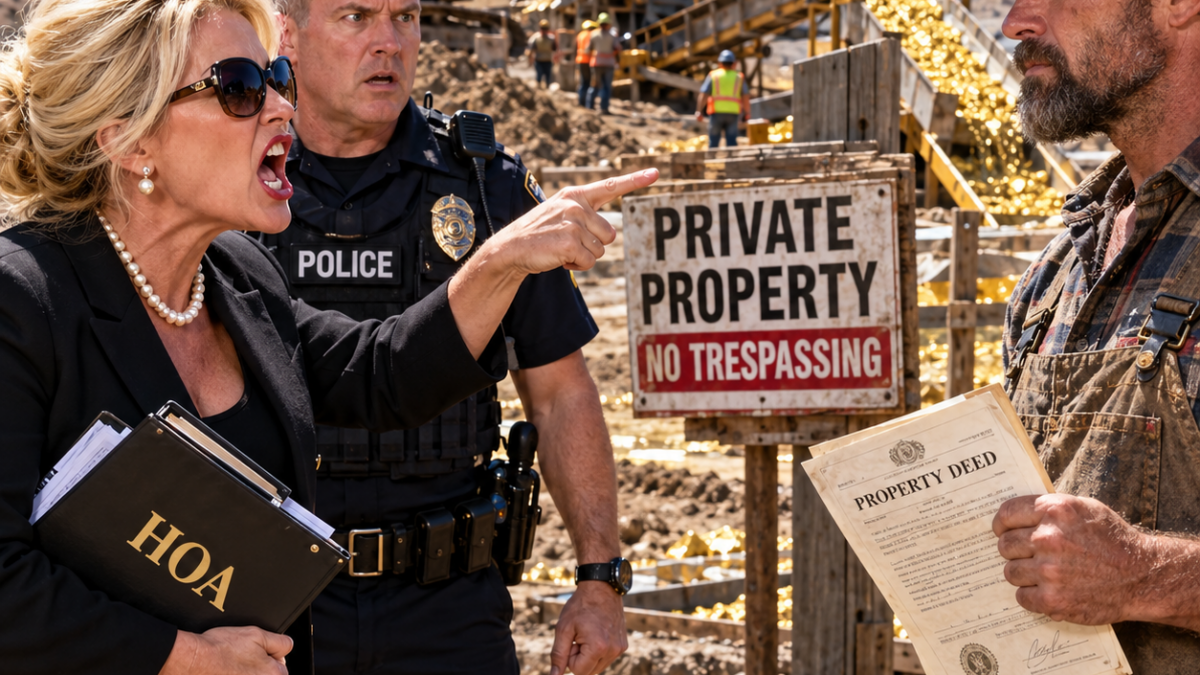
PART 2
I sat behind my desk staring at their photograph.
It had been taken at a Golden Ridge Christmas fundraiser two years earlier.
Elizabeth wore a red dress and the same smile I had seen from beside her SUV—controlled, polished, confident enough to suggest she had rarely entered a room where she expected to lose.
Travis stood beside her in civilian clothes.
One arm around her waist.
A sheriff’s department commendation plaque in his other hand.
The caption described them as “dedicated community advocates.”
I saved the page as a PDF.
Then I created a folder.
**HOWARD — GOLDEN RIDGE.**
The first thing I placed inside was the HOA envelope.
The second was the recorded parcel map.
The third was my father’s BLM claim documentation.
Then I opened a legal pad.
I did something I had taught young attorneys for years.
I separated facts from assumptions.
**FACT:** Golden Ridge had sent violation notices regarding land outside its recorded boundary.
**FACT:** Elizabeth Howard signed them.
**FACT:** Travis Howard had ordered me away from the claim while invoking an “HOA directive.”
**FACT:** Elizabeth was physically present during the encounter.
**FACT:** Travis had not identified a warrant, closure order, environmental citation, federal request, or specific criminal offense.
**ASSUMPTION:** Travis was acting at Elizabeth’s direction.
I underlined that last word.
Assumption.
The nod between them looked bad.
The timing looked worse.
But bad optics were not evidence of conspiracy.
Not yet.
I called Golden Ridge.
A receptionist answered.
“Golden Ridge Estates. How may I direct your call?”
“This is regarding an enforcement notice sent to a mining claim outside the association.”
There was a pause.
“Your name?”
“Mendoza.”
Another pause.
Longer.
Then:
“Mr. Mendoza, President Howard is familiar with the matter.”
“I’m sure she is.”
“Would you like me to transfer you?”
“Yes.”
Hold music.
Thirty seconds later, Elizabeth Howard answered.
“Mr. Mendoza.”
No greeting.
No uncertainty.
She had been expecting me.
“Mrs. Howard.”
“I assume you received our notices.”
“I did.”
“Then you understand the seriousness of the situation.”
“I understand you sent HOA violation notices to property your HOA doesn’t govern.”
She was quiet for exactly long enough to tell me she hadn’t expected that answer.
Then:
“Golden Ridge has legitimate interests in activities affecting surrounding property values and environmental safety.”
“Interests aren’t jurisdiction.”
“This isn’t a courtroom.”
“No. In a courtroom, you’d have to produce the instrument giving Golden Ridge authority over the claim.”
Her voice cooled.
“You sound very confident.”
“I read documents.”
“So did your father.”
There it was again.
Dad.
Always inserted when they wanted pressure to feel personal.
“What exactly happened between you and Raymond?”
“Your father was difficult.”
“He disagreed with you?”
“He refused to recognize that the community around him had changed.”
“His claim predates Golden Ridge.”
“That doesn’t mean his activities existed in a vacuum.”
“What activities?”
“Industrial equipment. Water use. Noise. Environmental risk.”
“Have you received a finding from the Bureau of Land Management?”
“I’m not discussing agency correspondence with you.”
“Then county environmental health?”
“No.”
“State water board?”
“Mr. Mendoza—”
“Which agency determined the mine was contaminating water?”
Silence.
I could almost hear the calculation.
Finally:
“Golden Ridge has residents reporting concerns.”
“That wasn’t my question.”
“You need to understand something.”
Her voice became softer.
More dangerous because of it.
“We tried to work with Raymond for years. He refused every reasonable solution. Don’t repeat his mistakes.”
“What solution?”
“A transfer of the claim.”
That got my attention.
“To whom?”
“A party better equipped to manage the site responsibly.”
“Name.”
“That discussion can happen when you’re prepared to be reasonable.”
“So your HOA sends violations to a mine outside its boundaries, your husband removes me from the property, and then you suggest I transfer the claim.”
“I didn’t say those things were connected.”
“No.”
I looked at my legal pad.
“You were careful not to.”
She hung up.
I wrote the time down.
Then I added another line beneath my assumptions.
**Possible acquisition pressure. Need independent evidence.**
My father had been dead four months.
For the first time, I wondered what his final years at the mine had actually looked like.
***
Dad and I loved each other badly.
That is probably the most accurate sentence I can write about our relationship.
There was no great falling-out.
No dramatic estrangement.
No final screaming match.
Just distance created by two men who both assumed there would always be more time.
I went to law school.
Dad thought lawyers were people who charged you money to explain why common sense didn’t count.
I specialized in land-use and mining rights partly because I grew up around his claim.
He pretended not to be proud.
Then he mailed copies of my first published article to half the people he knew.
I moved to Sacramento.
Built a practice.
Married my work.
Dad stayed in the foothills.
Every few months one of us called.
“Everything okay?”
“Yep.”
“Mine?”
“Yep.”
“Work?”
“Yep.”
“Need anything?”
“Nope.”
Love, translated through men who considered emotional detail suspicious.
I had visited the mine only three times in the last decade.
At the time, there had always been a reason.
Trial.
Client emergency.
Deposition.
Flight.
Deadline.
Standing in my office with Elizabeth Howard’s letter in front of me, every reason suddenly looked smaller.
I called Dad’s longtime friend Ruby Vasquez.
I didn’t know her personally.
Her name was written on an index card in Dad’s desk drawer.
**Ruby — general store — knows everything.**
Dad’s handwriting.
I smiled when I first found it.
Then I called.
A woman answered.
“Vasquez Market.”
“My name is—”
“You’re Raymond’s boy.”
I froze.
“How did you know?”
“Voice.”
“That makes no sense.”
“Your father sounded irritated even when he was saying hello.”
I laughed despite myself.
“This is Ruby?”
“Yes.”
“I need to ask about something.”
“Travis Howard?”
Silence.
Ruby sighed.
“I figured.”
***
Her store sat four miles from the claim.
Old wood floors.
Refrigerator cases humming against one wall.
Hardware, groceries, fishing gear, canned chili, batteries, tourist maps, and a coffee machine that looked older than I was.
Ruby Vasquez stood behind the counter.
Sixty-seven.
Silver hair tied back.
Small woman.
Eyes that missed nothing.
She locked the front door after I entered.
“Why are you closing?”
“Because this conversation isn’t for tourists.”
She poured coffee into two paper cups.
Then:
“How many times has Travis been up there?”
“Once since I inherited it.”
She shook her head.
“Won’t be the last.”
“How long did he bother Dad?”
“Years.”
I gripped the cup.
“What kind of bothering?”
“Visits.”
“For what?”
“Depends on the week.”
She counted on her fingers.
“Noise. Water. Road access. Illegal excavation. Fire risk. Environmental concerns. Permit questions.”
“Was Dad cited?”
“Not by anyone real.”
That matched what I had suspected.
“Did Travis identify actual violations?”
“Raymond always asked the same thing.”
“What?”
“‘Show me the paper.’”
I laughed.
Ruby did too.
Then the smile vanished.
“Travis hated that.”
“Why?”
“Because most people don’t ask.”
“Did Elizabeth come with him?”
“Sometimes.”
“Why did they want the claim?”
Ruby leaned against the counter.
“That depends how much you know.”
“Assume nothing.”
She studied me.
“There’s been development pressure all over this area.”
“I’ve seen it.”
“Golden Ridge didn’t start as what it is now. Used to be smaller. Then Elizabeth took over the board.”
“How long?”
“Eight years.”
“She runs the HOA.”
“She runs more than that.”
“Meaning?”
Ruby looked toward the locked door.
“People around here joke that Elizabeth doesn’t need to hold office because she knows everyone who does.”
“Specifics.”
“Developers. County people. Business owners.”
“That’s not illegal.”
“I didn’t say it was.”
Good answer.
“Who wanted Dad’s claim?”
“Golden Crest Development.”
I frowned.
“Golden Crest?”
“Or one of their companies. Names change.”
“What do they want with a mining claim?”
“Access.”
“To what?”
Ruby lowered her voice.
“Road.”
That was new.
She pulled an old tourist map from beneath the counter.
Set it flat.
Pointed to Golden Ridge.
Then Dad’s claim.
Then a strip of BLM land and an old access road.
“Developers want the western ridge.”
“For housing?”
“Luxury lots.”
“The road through Dad’s claim gives them access?”
“One route.”
“Only one?”
“Cheapest one.”
There it was.
Maybe.
Not gold.
Not directly.
Dad’s claim may have blocked something else.
Ruby tapped the map.
“Raymond said if they got control of his rights, they could negotiate access and mineral issues in one package.”
“Did he have proof?”
“He said he did.”
“Where?”
She shrugged.
“You know your father.”
Unfortunately, yes.
He could hide a receipt for forty years and then forget where he put yesterday’s glasses.
Ruby pulled out a chair.
“There’s something else.”
Her tone changed.
I sat.
“Tell me.”
She looked at her hands.
“Your father wasn’t the first.”
***
Ed Martinez was seventy-two and living in his nephew’s spare bedroom.
That alone told me something before he said a word.
He had owned forty acres east of Golden Ridge.
Raised cattle.
Grew hay.
Paid off the property twenty years earlier.
Then a development group started making offers.
Ed declined.
Three months later Travis Howard began visiting.
“First time he said there was a complaint about illegal grading,” Ed told me.
“Were you grading?”
“Fixed a drainage ditch.”
“Permit issue?”
“County came out. Nothing.”
“Next?”
“Livestock nuisance.”
“What livestock?”
“Six cows.”
He smiled bitterly.
“We were rural before those people built their subdivision.”
“How many visits?”
“Six in about two months.”
“Travis every time?”
“Five. Another deputy once.”
“Tickets?”
“None.”
“Written warnings?”
“One.”
He retrieved a folder.
I recognized the problem immediately.
The form looked official.
County logo.
Deputy name.
But the box identifying an ordinance was blank.
“What happened after that?”
“Someone slashed two tires.”
“Did you report it?”
“Yes.”
“Result?”
“Nothing.”
“Can you connect that to Howard?”
“No.”
Good.
I marked it separately.
“What made you sell?”
Ed looked toward the window.
“My wife.”
“What happened?”
“She stopped sleeping.”
He swallowed.
“Every engine at night, she thought it was another patrol car.”
The offer had come from a company called Crestview Development Holdings.
I searched the address.
Same office complex as a real-estate company partially owned by Elizabeth Howard.
Not proof of ownership.
A connection worth documenting.
Ed sold for less than his original asking price.
The land later became part of a development corridor.
“I told myself I was choosing peace,” he said.
“You were.”
“Didn’t feel like it.”
I closed his folder.
“Would you make a sworn statement?”
He looked at me.
“Against Travis?”
“Yes.”
“Local sheriff gets it?”
“Not necessarily.”
That interested him.
“Who then?”
“I don’t know yet.”
He thought for almost a minute.
Then:
“Yes.”
***
Joseph Mendoza was not related to me.
Common surname.
Different family.
Forty-four.
General contractor.
Black.
Built decks, barns, additions, retaining walls across three counties.
We met twenty miles away because he refused to talk in town.
He placed a black spiral notebook on the table.
“What’s that?”
“My insurance policy.”
Inside were dates.
Times.
Locations.
Plate numbers.
Eleven traffic stops in two years.
Ten by Travis.
One by another deputy.
Tickets:
Zero.
Arrests:
Zero.
Searches:
Two requested.
Both refused.
Warnings:
Three, all vague.
“Why did he stop you?”
Joseph shook his head.
“Equipment light.”
“Which light?”
“Never said.”
“Speeding?”
“No speed given.”
“Lane violation?”
“Once he said my trailer touched the fog line.”
“Did it?”
“I had dashcam by then.”
He opened his phone.
Video.
Truck centered.
Travis’s lights activated behind him.
Joseph had documented everything after the fourth stop.
“What did Travis say?”
“Mostly nothing.”
“Threats?”
“No.”
“Slurs?”
“No.”
“What makes you think it was intimidation rather than aggressive traffic enforcement?”
Joseph appreciated the question.
I could see it.
“You’re the first person who asked it that way.”
“What’s your answer?”
He pulled out county bid records.
“I submitted the low bid on a Golden Ridge drainage project.”
I read the date.
“What happened?”
“Board rejected me.”
“Who got it?”
“Company Elizabeth preferred.”
“And stops?”
“Started the next week.”
Correlation.
Not proof.
But again, pattern.
“Why keep the notebook?”
Joseph’s jaw tightened.
“Because every time I told somebody, they asked if I was sure.”
I didn’t know what to say to that.
So I didn’t try.
“Will you testify?”
“If somebody serious finally listens.”
“I’m trying to find somebody serious.”
***
Jacqueline and Terry Sanders owned a restaurant.
Eight years.
Family place.
Burgers, chicken-fried steak, pie, too much coffee.
They had hosted a meeting for residents who disagreed with Elizabeth’s expansion plans.
Within a month:
Four health inspections.
All passed.
Insurance review.
Fire inspection.
Parking complaint.
Then an anonymous online review accusing the restaurant of rodent problems.
No evidence.
No identified rodents.
Their business dropped.
“We stopped hosting meetings,” Jacqueline said.
“What happened to inspections?”
“Stopped too.”
“Can you connect Elizabeth to the agencies?”
“Not directly.”
“Travis?”
Terry nodded.
“He came in twice.”
“In uniform?”
“Yes.”
“What did he say?”
First visit:
“Community politics can damage businesses.”
Second:
“You two should stay out of things that don’t concern you.”
“Recorded?”
“No.”
“Witnesses?”
“Three employees heard the second.”
I wrote their names.
Terry leaned forward.
“You know why nobody talks?”
“Tell me.”
“Because one incident can be explained.”
Exactly.
“One inspection? Coincidence. One traffic stop? Coincidence. One deputy visit? Coincidence. But when you live here, you see the sequence.”
I looked around the table.
Five people.
Different pressure.
Same orbit.
Elizabeth wanted something.
Resistance happened.
Travis appeared.
Maybe coincidence.
Maybe system.
My job was to prove which.
***
Ruby’s story was the hardest.
Her son Daniel had been thirty-two when Travis arrested him for DUI.
Charges dropped.
Dashcam contradicted parts of the report.
But the mugshot had circulated.
Small towns don’t wait for acquittals.
His employer suspended him.
Then replaced him.
He moved to Nevada.
“Why do you think the arrest had anything to do with you?”
I asked.
Ruby didn’t get offended.
She walked behind the counter and returned with a USB drive.
“This.”
Security-camera footage.
Travis in uniform.
Off duty according to schedules I later obtained.
Standing inside Ruby’s store two weeks before Daniel’s arrest.
Elizabeth wanted Ruby to sell.
Ruby refused.
On video, Travis leaned on the counter.
“You ought to think about that offer again.”
Ruby’s recorded voice:
“I already answered.”
Travis:
“Elizabeth doesn’t like being told no.”
Ruby:
“That’s her problem.”
Then Travis smiled.
“You’d be surprised how quickly other problems show up.”
The clip ended.
My stomach tightened.
Second clip.
Three days later.
Travis again.
“You’re making things complicated.”
Ruby:
“For who?”
“People who want this town to grow.”
“My store isn’t stopping growth.”
“No. You are.”
Third clip.
His cruiser parked outside forty-seven minutes.
No call.
No customer interaction.
Just presence.
I looked at Ruby.
“Why didn’t internal affairs see these?”
“They did.”
That stunned me.
“What?”
“I gave them copies after Daniel’s arrest.”
“And?”
“Unfounded.”
“Did they interview you?”
“No.”
“Daniel?”
“Once.”
“Travis?”
“I assume.”
“You kept proof you submitted them?”
Ruby smiled without humor.
“Raymond taught me that.”
She opened another folder.
Certified-mail receipt.
Internal affairs response.
Case closed.
I sat back.
Now we had more than allegations.
We had video.
And proof that an oversight system had been given it.
That didn’t prove a cover-up.
But somebody needed to explain why the evidence hadn’t triggered more.
***
I drove to the mine that evening.
Alone.
Sun dropping behind the ridge.
Dad’s pump house cast a long shadow across the clearing.
I unlocked the small office he had built beside it.
Nothing fancy.
Desk.
Metal filing cabinet.
Old coffee maker.
Calendar still turned to the month he died.
His reading glasses rested on an open maintenance log.
That broke me more than the funeral had.
I sat in his chair.
Picked up the glasses.
Then saw a note under the log.
**Call lawyer boy re access easement.**
Lawyer boy.
Me.
No date.
No check mark.
He had planned to call.
Maybe he did and I missed it.
I checked my old voicemail archive that night.
Found one from six months before his death.
I had listened to it.
Apparently.
The app showed “played.”
Dad’s voice:
“Call me when you get a minute. Got some people sniffing around the western road again. Nothing urgent.”
Nothing urgent.
I never called.
I had been preparing for a hearing that week.
I probably told myself I’d do it later.
I sat in his office with the phone in my hand and felt guilt arrive with perfect clarity.
I had built a career protecting strangers from land disputes.
Dad had needed me.
I had been too busy.
No villain created that.
Not Elizabeth.
Not Travis.
Me.
I let myself sit with it.
Then I did the only useful thing guilt ever permits.
I started working.
***
Dad’s filing cabinet contained years of records.
BLM filings.
Maps.
Environmental reports.
Water tests.
Maintenance records.
Correspondence.
And one folder:
**GOLDEN RIDGE / HOWARD**
Inside:
HOA letters.
Deputy business cards.
Photos of patrol cars.
A handwritten log.
Dad had recorded eight Travis visits over five years.
Date.
Time.
Reason given.
Whether paperwork was shown.
Almost none was.
One entry:
**T.H. says HOA wants pump shut down. Asked for statute. Got angry. E.H. waiting in SUV. Same game.**
Another:
**Offered 180k for claim rights + access. No.**
Then:
**Road access worth more than mine to them. Don’t sell cheap just because they scare you.**
I read that sentence twice.
Dad knew.
Not everything.
Enough.
At the bottom sat a copy of an email from Elizabeth.
**Raymond, the surrounding community has outgrown the current use of your site. A negotiated transfer would prevent continuing regulatory complications.**
Regulatory complications.
There it was.
Language connecting transfer with pressure.
Still not explicit.
Still not a confession.
But useful.
Then I found a letter from a development company proposing acquisition of Dad’s claim and an easement.
The company:
Golden Crest Development Partners.
One director listed in public filings:
Elizabeth Howard.
Now motive had paperwork.
***
I spent a week organizing everything.
As an attorney, I knew the danger of falling in love with my theory.
So I built two columns.
**INNOCENT EXPLANATIONS.**
**EVIDENCE AGAINST THEM.**
Could Elizabeth have legitimately worried about the mine?
Yes.
Could Travis have responded to actual complaints?
Yes.
Could multiple local disputes involving him be unrelated?
Yes.
Could internal affairs have reasonably found insufficient evidence?
Possible.
Then:
Why did Elizabeth send HOA notices outside HOA boundaries?
Why did Travis invoke an HOA directive during law-enforcement contact?
Why did Elizabeth appear at the scene?
Why did Golden Crest want access through Dad’s claim?
Why did Elizabeth’s own company have development interests nearby?
Why did pressure repeatedly follow rejected offers?
Why did Travis tell Ruby that Elizabeth disliked being told no?
Why had internal affairs closed the complaint despite clear video?
Questions aren’t guilt.
But enough unanswered questions justify investigation.
I prepared a packet.
Not a prosecution.
A referral.
That distinction mattered.
***
I did not send it locally.
Not yet.
I had concerns about conflicts.
Travis had twenty-two years in the sheriff’s department.
The internal affairs complaints had already failed.
I knew the county prosecutor socially from bar events.
Not personally.
I had no evidence he was corrupt.
The source story would have made him part of the conspiracy because “he played golf with Travis.”
Real life doesn’t work that cleanly.
Friendship can create appearance problems.
It does not prove obstruction.
I needed an agency positioned to evaluate potential federal civil-rights violations independently.
But before I made that move, I wanted one more thing.
A professional boundary survey.
If Elizabeth later claimed Golden Ridge overlapped the access route or structures, I wanted no ambiguity.
Marcus Chen agreed to meet me at the claim.
Licensed surveyor.
Twenty years’ experience.
Meticulous.
Quiet.
The kind of expert witness lawyers love because he answers only the question asked.
We met at eight on a cool Thursday morning.
“Where do you want to start?” he asked.
“Eastern marker, then road alignment.”
“Any dispute?”
“Potentially.”
“With?”
“HOA half a mile away.”
Marcus looked at me.
“That’s ambitious.”
“Very.”
He set up equipment.
For an hour, everything was peaceful.
Then engines roared up the road.
Two sheriff’s cruisers.
Fast.
Too fast for a casual check.
Marcus lowered his instrument.
“Expecting company?”
“No.”
Travis stepped from the first unit.
Another deputy from the second.
Travis’s face looked different from our first encounter.
The theatrical calm was gone.
His movements were abrupt.
He walked directly toward me.
“Mendoza.”
“You finally asked my name.”
“You’re under arrest.”
Marcus slowly pulled out his phone.
Not hidden.
He recorded site visits for his own liability records.
Travis didn’t notice.
“Arrest for what?”
“Trespassing and unlawful mining.”
“On my inherited claim?”
“Turn around.”
“Do you have an order suspending the claim?”
“Turn around.”
“Has BLM issued a closure?”
“You’re resisting.”
“I’m standing still.”
His face reddened.
“Hands behind your back.”
I looked at the second deputy.
He avoided my eyes.
That told me almost as much as Travis did.
I put my hands behind me.
No roadside argument was going to improve this.
Travis grabbed my wrist harder than necessary.
Spun me.
My chest hit the hood.
The metal was warm.
Handcuffs closed tight.
Too tight.
I said:
“Check the fit.”
He ignored me.
“Deputy, the cuffs are causing pain.”
“Maybe you’ll remember that next time.”
Marcus kept filming.
Travis leaned close to my ear.
His voice dropped.
“Elizabeth told me you were stubborn.”
Every muscle in my body went still.
He continued.
“One night in a cell gives a man time to think about whether some dirt is worth all this trouble.”
There it was.
Not inference.
Not timing.
His wife’s name.
Her view of me.
Property pressure.
An arrest.
Connected in one sentence.
I turned my head slightly.
“You should probably stop talking.”
He pushed me harder against the hood.
“Still think you’re smarter than everybody?”
“No.”
I looked past him.
Saw Marcus holding the phone.
“I think somebody should keep recording.”
Travis turned.
Too late.
***
They held me for six hours.
Not overnight.
No dramatic beating.
No secret interrogation.
Mostly fluorescent lights and institutional boredom.
The booking officer read the charges.
Trespass.
Operating without required permit.
I asked for the specific statute.
He frowned at the form.
Then:
“Deputy report hasn’t fully uploaded.”
“Who owns the property I allegedly trespassed on?”
He looked at me.
“I don’t know.”
“Exactly.”
I identified myself as an attorney only after booking.
That changed the room.
Not because attorneys get special rights.
Because people become more careful when they know every procedural decision may later be litigated by the person experiencing it.
I requested counsel.
Stopped answering substantive questions.
Hours later, someone from the county counsel’s office appeared.
Then a supervisor.
Then the tone shifted.
My BLM paperwork had been verified.
No active federal closure order existed.
No county environmental order they could identify justified arrest.
The unlawful-mining allegation lacked a clearly stated basis.
They released me pending review.
No apology.
Just a plastic bag containing my wallet, belt, keys, and phone.
The desk sergeant slid it across.
“Sign here.”
I signed.
“Am I still charged?”
“Referral under review.”
“Copy?”
He printed what existed.
Outside, Marcus stood beside his truck.
His face told me the video was intact.
“Seven minutes, twenty-three seconds,” he said.
“Backed up?”
“Three places.”
“I may love you.”
“Buy me lunch first.”
He handed me his phone.
I watched.
Everything.
Travis saying Elizabeth’s name.
The property comment.
The cuffs.
My request that he loosen them.
The second deputy standing there.
GPS metadata.
Timestamp.
Wide shot showing survey equipment.
No aggressive movement from me.
No resistance.
I watched twice.
Then called one number.
The FBI Sacramento Field Office.
***
The intake conversation lasted twenty minutes.
I did not call it a “Civil Rights Division” because the FBI is the investigative agency; the Justice Department’s Civil Rights Division and federal prosecutors decide charging.
I explained that distinction for a living.
Now I was living it.
I gave the intake agent the short version.
False or retaliatory arrest allegation.
Deputy.
HOA-president wife.
Property pressure.
Other witnesses.
Video.
Internal affairs history.
The agent interrupted exactly once.
“You have the arrest itself on video?”
“Yes.”
“Audio?”
“Yes.”
“Deputy identifies his wife?”
“Yes.”
“In connection with the property?”
“Yes.”
“Preserve the original.”
“Already done.”
A special agent named Sarah Taylor called me the next morning.
Her first question:
“Are you represented?”
“As victim, not yet.”
“You should consider separate counsel if this becomes active.”
“Understood.”
“Second: don’t investigate for us.”
“I wasn’t planning to.”
“You’re an attorney.”
“That sounded accusatory.”
“It was.”
I liked her immediately.
We met three days later at a diner outside the county.
Sarah was mid-forties.
Gray streak in dark hair.
No dramatic FBI wardrobe.
Notebook.
Coffee.
Careful eyes.
I gave her copies.
Not originals.
She already appreciated that.
She watched Marcus’s video once.
Then again with headphones.
When Travis said:
**Elizabeth told me you were stubborn**, Sarah stopped.
“Context?”
I explained.
She resumed.
**One night in a cell gives a man time to think about whether some dirt is worth all this trouble.**
Pause.
Sarah looked up.
“That’s significant.”
“Not dispositive.”
She smiled slightly.
“You really are a lawyer.”
“Unfortunately.”
“What else?”
I opened the binder.
Ruby.
Ed.
Joseph.
Sanders.
Dad.
Golden Crest.
HOA boundaries.
Internal affairs response.
Sarah stopped me.
“Slow down.”
I did.
She made me separate every allegation.
Who saw what.
Who heard what.
Who had records.
Which facts I learned secondhand.
Which were assumptions.
It took four hours.
At the end, she closed the binder.
“Here’s what I can tell you.”
I waited.
“We have received prior information involving Deputy Howard.”
My posture changed.
“How much?”
“I’m not discussing an active investigative file.”
“So there is one.”
“I said what I said.”
Fair.
“Does my evidence matter?”
“Yes.”
“How?”
“It potentially connects conduct that previously looked isolated.”
Exactly what Terry Sanders had said.
Sarah continued.
“Your arrest is particularly useful because an independent witness recorded it.”
“Marcus.”
“We’ll interview him ourselves.”
“Good.”
“We’ll interview all witnesses ourselves.”
“Good.”
“And from this point forward, you do not coordinate witness stories.”
“I know.”
“You don’t tell them what anyone else said.”
“I know.”
“You don’t collect statements on our behalf.”
“I know.”
“You don’t bait Howard.”
“I know.”
She leaned forward.
“And you do not tell anyone we are meeting.”
That one was harder.
“Not even Ruby?”
“Especially not witnesses.”
“Why?”
“Because witnesses talk to spouses. Spouses talk to neighbors. Neighbors talk at diners. Targets learn investigations exist.”
I nodded.
“How long?”
“As long as it takes.”
I hated that answer.
Because it was the only honest one.
***
Returning to the mine felt absurd.
Travis had arrested me there.
Now I was supposed to behave normally while federal investigators quietly examined him.
Dad’s generator needed service.
I serviced it.
The sluice needed cleaning.
I cleaned it.
I wasn’t running commercial extraction.
Mostly maintaining the claim.
Every engine on the access road made my shoulders tighten.
Travis did not appear.
Elizabeth did.
Five days after my FBI meeting, her white SUV stopped outside the gate.
She stepped out alone.
No sunglasses this time.
“Can we talk?”
I kept ten feet between us.
“My attorney would prefer written communication.”
“You have an attorney now?”
“I am an attorney.”
Her face changed.
The surprise was worth weeks of patience.
“You’re what?”
“Mining-rights attorney.”
For once, Elizabeth had no prepared answer.
“How long?”
“Fifteen years.”
“Why didn’t you say that?”
“You never asked.”
Her jaw tightened.
“So this whole thing was a setup.”
“No.”
“You let Travis—”
“I let your husband make his own decisions.”
She looked toward the pump house.
“You knew our notices were invalid.”
“I knew Golden Ridge’s recorded boundaries.”
“This community has legitimate environmental concerns.”
“Then report them to the proper agencies.”
“We did.”
“Which?”
“I’m not giving you litigation discovery on a dirt road.”
I almost smiled.
She had adapted.
“Then send it to my office.”
She stepped closer.
“This doesn’t need to become ugly.”
“It became ugly when your husband arrested me.”
“He was doing his job.”
“Then his report and evidence will support him.”
“He said you resisted.”
“No.”
“He said you were operating illegally.”
“No agency has established that.”
“He said—”
I interrupted.
“Elizabeth.”
She stopped.
“You should stop talking about his report unless you’ve read it.”
She looked at me for a long time.
Then:
“Sell the claim.”
There it was.
Direct.
“To who?”
“Golden Crest.”
“Your company.”
“I’m a director.”
“How much?”
“Three hundred thousand.”
I laughed once.
Her eyes sharpened.
“That’s a serious offer.”
“For claim rights and road access?”
“Yes.”
“No.”
“You haven’t seen the appraisal.”
“No.”
“You’re making this personal.”
“You sent an HOA notice to federal land.”
“Because your father refused every effort at cooperation.”
“Then your husband arrested me.”
“Because you keep pushing.”
That sentence mattered.
I let silence sit.
She realized it too.
“What do you mean, ‘because I keep pushing’?”
She stepped back.
“I mean you antagonize everyone.”
“By refusing to sell?”
“I’m done.”
She turned toward the SUV.
“Elizabeth.”
She stopped.
“My father wrote everything down.”
Her shoulders stiffened.
She did not turn around.
Then she drove away.
I hated myself for saying it.
Sarah had told me not to signal.
Anger had opened my mouth.
I called her immediately.
“I made a mistake.”
“What?”
I told her.
Silence.
Then:
“You told her Raymond kept records?”
“Yes.”
“Anything about us?”
“No.”
“Other witnesses?”
“No.”
“FBI?”
“No.”
“Okay.”
She exhaled.
“Don’t do it again.”
“I know.”
“Does she have access to your father’s records?”
“No.”
“Where are originals?”
“Secure.”
“Good.”
Then, colder:
“You’re too close to this.”
I stared at the road where Elizabeth had disappeared.
“I know.”
That frightened me more than anything Travis had done.
Because she was right.
***
Federal interviews started quietly.
Ruby first.
Then Marcus.
Joseph.
Ed.
The Sanderses.
I was not present.
Weeks passed.
No updates.
Then Ruby stopped answering my calls.
I panicked.
Drove to her store.
She was behind the counter.
“What happened?”
She looked guilty.
“Sarah told me we shouldn’t talk about the case.”
Relief almost made me laugh.
“That’s all?”
“What did you think?”
“That Travis had visited.”
Her expression changed.
“He did.”
My relief vanished.
“When?”
“Yesterday.”
“Uniform?”
“Yes.”
“What did he say?”
“Bought coffee.”
“Anything else?”
“He asked how Daniel was.”
That was not illegal.
Maybe not even a threat.
But in context, Ruby heard it as one.
“Did you tell Sarah?”
“Yes.”
“Good.”
Ruby crossed her arms.
“You look terrible.”
“Thank you.”
“Your father looked the same when he fought these people.”
“Also thank you.”
She softened.
“He would be proud.”
“Please don’t.”
“Why?”
“Because everybody keeps telling me what a dead man would think.”
Ruby stared.
Then nodded.
“Fair.”
I rubbed my face.
“I wasn’t there for him.”
“No.”
The directness surprised me.
She continued.
“You weren’t.”
I looked at her.
“He needed you?”
“Maybe.”
“Then why didn’t he call?”
“He did.”
The voicemail.
My stomach twisted.
Ruby came around the counter.
“You missed something. That doesn’t mean you owe your life to fixing it now.”
“I’m not—”
“You are.”
She tapped my chest.
“You think getting Travis punished rewrites those years.”
I didn’t answer.
“It doesn’t.”
“I know.”
“Do you?”
No.
Not fully.
Ruby went back behind the counter.
“Do what you can because it’s right. Not because you think Raymond is waiting somewhere with a scorecard.”
That sounded exactly like something Dad would have hated hearing.
Which meant I probably needed it.
***
Sarah called two weeks later.
“We need original copies of the HOA notices.”
“You have scans.”
“Grand jury process.”
That was the first confirmation the investigation had moved beyond informal review.
I didn’t ask details.
I delivered them through counsel.
By then I had retained federal criminal and civil-rights attorney Michael Harper—not because I was a suspect, but because being both a victim and a lawyer is a terrible combination.
Michael’s first instruction:
“Stop lawyering your own case.”
“Technically I’m not.”
“You built a forty-tab binder.”
“Thirty-eight.”
“Stop.”
He became a buffer.
Everything went through him when appropriate.
That helped.
So did work.
I returned to Sacramento more often.
Clients had problems unrelated to mine.
Boundary disputes.
Royalty disagreements.
Environmental reviews.
Normal professional conflict.
It reminded me that Travis and Elizabeth were not the entire world.
They were simply people who had gotten away with too much for too long.
***
The breakthrough came from inside the sheriff’s department.
Captain Timothy Bailey headed internal affairs.
His signature appeared on Ruby’s closed complaint and two others involving Travis.
Federal agents subpoenaed records.
Bailey initially resisted.
Then produced files.
Then produced more.
According to information later disclosed in court, he had not fabricated every investigation.
That would have been too simple.
He had done something more mundane.
He minimized.
Delayed.
Accepted Travis’s explanation over complainants.
Failed to chase leads.
Reclassified allegations as policy issues.
Never interviewed some witnesses.
Institutional cowardice rather than cinematic conspiracy.
But then agents found emails.
Elizabeth to Bailey.
Friendly.
Fundraiser invitations.
Requests to “help clear up misunderstandings” involving Travis.
One message about Ruby:
**She has a long history of hostility toward local development. Please keep that in mind before treating her latest allegation as credible.**
Bailey replied:
**Understood.**
That wasn’t proof he intentionally buried a crime.
But it was ugly.
Then another email.
After Joseph’s complaint:
**Travis says this guy is trying to create a racial issue out of routine contacts. I’d appreciate avoiding unnecessary escalation.**
Bailey:
**I’ll handle it.**
That phrase would haunt him later.
I’ll handle it.
The federal investigators began examining whether internal safeguards had been compromised.
Bailey eventually cooperated.
Not heroically.
Strategically.
He knew obstruction exposure could become serious if he lied.
He admitted investigations had been mishandled.
Denied conspiring with Elizabeth.
Provided departmental communications.
Sarah later described him to me after public filings revealed cooperation.
“He wasn’t protecting Travis because he loved him.”
“Then why?”
“He was protecting the department from embarrassment.”
“That’s worse.”
“Different.”
She was right.
Again.
Institutions often bury problems because admitting them feels more dangerous than the problems themselves.
Until it isn’t.
***
Financial records added another layer.
Golden Ridge HOA funds had gone to consultants tied to Golden Crest development interests.
Some expenditures had legitimate explanations.
Traffic studies.
Land-use consulting.
Security.
Others were harder to justify.
Elizabeth had approved payments to a “community risk consultant” who also worked for Golden Crest.
HOA attorneys began asking questions.
Board members claimed they had trusted her.
One resigned.
Then another.
Still no arrests.
Months had passed.
Travis remained on administrative duty for part of the period, then leave after federal interest became impossible to hide.
The county issued a bland statement:
**The department is cooperating with an external investigation.**
Ruby called.
“External.”
“Yes.”
“That’s all they say?”
“For now.”
“I waited five years for that sentence.”
“How does it feel?”
“Annoying.”
Fair.
***
The Howards started blaming each other before anyone charged them.
I learned that later through court filings.
Travis told investigators Elizabeth handled HOA and development matters.
He claimed she had exaggerated complaints.
She told investigators Travis made independent law-enforcement decisions.
Both said the other misunderstood conversations.
Then agents recovered text messages.
Elizabeth:
**Raymond still won’t move. Can you go by tomorrow?**
Travis:
**What do you want me to tell him?**
Elizabeth:
**Same as before. Environmental complaints. Make it uncomfortable.**
That message changed the case.
Not because “make it uncomfortable” was automatically criminal.
Because it lined up with actual law-enforcement contacts.
Another:
**Ruby rejected final offer. Daniel is running around town drinking again.**
Travis:
**I’ll keep an eye out.**
Two weeks later:
Daniel’s arrest.
Defense attorneys would later argue Travis had independent traffic justification.
Prosecutors argued context showed retaliatory purpose.
Then my texts.
Elizabeth to Travis the morning of my survey:
**He’s bringing someone to mark boundaries. If that happens, Golden Crest loses the overlap argument. Stop it today.**
Travis:
**On it.**
That was the bridge.
Not speculation.
Instruction.
Timing.
Action.
Marcus’s video.
My arrest.
The chain became visible.
***
Sarah called Michael Harper, not me, when the warrants were approved.
Michael called afterward.
“Don’t go anywhere near town tomorrow.”
“Why?”
“You know why.”
“When?”
“I’m not telling you.”
“Michael.”
“No.”
“I’m the victim.”
“Exactly.”
I slept badly.
At seven the next morning, Ruby called.
Her voice shook.
“They got him.”
I sat upright.
“What happened?”
“Diner.”
“Who?”
“FBI.”
I closed my eyes.
“Travis?”
“Yes.”
She was breathing hard.
“I saw it.”
“Are you okay?”
“I don’t know.”
She laughed once.
It sounded like crying.
“He was drinking coffee.”
“Ruby—”
“He was just sitting there like every Tuesday.”
She described four agents entering.
Sarah among them.
Travis initially smiled.
Then read the warrant.
Then stopped smiling.
No dramatic tackle.
No guns.
He stood.
Was handcuffed.
Walked out.
The same badge he had used to intimidate people remained clipped to his uniform as federal agents placed him in a vehicle.
“What did you feel?” I asked.
Ruby was quiet.
Then:
“Nothing.”
That surprised me.
“Nothing?”
“Daniel is still in Nevada.”
I understood.
Arrest does not rewind.
It only stops forward motion.
***
Elizabeth was taken into custody at home within minutes.
Agents executed search warrants.
Computers.
Phones.
Documents.
Financial records.
One discovery became central.
A folder.
Physical and digital versions.
Label:
**LEVERAGE.**
Names.
Residents.
Business owners.
Opponents.
Notes about debt.
Divorce.
Medical conditions.
Business licenses.
Children.
Weaknesses.
Ruby:
**Store debt / son drinks / resistant to sale.**
Ed:
**Wife anxious / property taxes rising.**
Joseph:
**County bids / race complaint risk.**
Sanders:
**Insurance sensitive / health compliance vulnerability.**
Dad:
**Age / health / heir distant.**
Me:
**Attorney — higher risk. Use caution.**
I stared at that line when it later became public evidence.
They had updated me.
Somewhere between the first encounter and the investigation, Elizabeth learned my profession.
Her strategy changed.
It just changed too late.
The leverage folder did not prove every bad event had been planned.
But it revealed how she thought.
People were not neighbors.
They were pressure points.
***
Golden Ridge collapsed politically within days.
Board members distanced themselves.
Residents demanded records.
An independent accountant was hired.
Special election petitions circulated.
Golden Crest placed Elizabeth on leave from its board.
Then removed her.
Development projects stalled.
The mine suddenly became quiet.
No notices.
No patrol cars.
No threats.
For the first time in years, according to Ruby, the valley felt like someone had turned off a machine nobody realized was humming.
I drove to Dad’s claim that weekend.
Sat beside the creek.
Listened.
Water.
Wind.
Birds.
Nothing else.
I should have felt victorious.
Instead, I felt tired.
Dad had died before any of it.
Ed still didn’t own his land.
Daniel still lived in Nevada.
Joseph still checked his mirror for patrol cars.
The Sanderses had spent years censoring themselves.
Exposure was not restoration.
Not yet.
***
Federal litigation took time.
Motions.
Discovery.
Suppression hearings.
Expert testimony.
Defense challenges to videos.
Arguments about intent.
Travis’s lawyers claimed he had legitimate public-safety reasons for multiple contacts.
They emphasized that county deputies are not categorically powerless on federal lands; depending on the offense and jurisdictional arrangement, state and local law can still be enforced there.
They were right about that legal principle.
That was why our case did not depend on the simplistic argument that “federal land means sheriff has zero authority.”
It depended on something stronger:
What lawful basis existed for what Travis actually did?
Why did he invoke an HOA directive?
Why did his wife direct him to “make it uncomfortable”?
Why did he arrest me after she told him to stop the survey?
Why did his stated offenses collapse under basic record checks?
Why did a pattern of similar contacts follow disputes involving Elizabeth?
Intent.
Color of law.
Retaliation.
False reports.
Conspiracy.
Those were harder questions for him.
Elizabeth’s defense separated her from the badge.
She was a civilian.
She did not arrest anyone.
She had no authority over Travis’s decisions.
Her lawyers portrayed her messages as a frustrated wife complaining about neighborhood conflicts.
Prosecutors countered with timing, financial interests, development connections, the leverage folder, and coordinated communications.
Neither case was easy.
That mattered to me.
Powerful prosecution should be difficult.
The same system I wanted used against Travis had to protect defendants from weak theories too.
Otherwise I was only asking for a different kind of abuse.
***
The trial lasted several weeks.
I testified for two days.
On direct examination, prosecutors walked me through the first mine encounter.
HOA letters.
Boundary maps.
Survey day.
Arrest.
Travis’s statement.
My injuries from the cuffs.
Release.
Marcus’s video.
Then cross-examination.
Travis’s attorney was good.
“Mr. Mendoza, you are an attorney?”
“Yes.”
“Specializing in mining rights?”
“Yes.”
“So when Deputy Howard first contacted you, you already believed you knew more about the legal status of the claim than he did.”
“I knew the claim records.”
“That wasn’t my question.”
“Yes.”
“You resented him telling you to leave.”
“I believed his stated basis was unsupported.”
“You could have simply complied and challenged the issue later.”
“I did comply the first time.”
“Then you returned.”
“It was my father’s active claim.”
“You brought a surveyor because you were preparing litigation.”
“I brought a surveyor to establish boundaries.”
“Because you anticipated conflict.”
“Yes.”
“You wanted evidence.”
“Yes.”
“Isn’t it true you were building a case against Deputy Howard before your arrest?”
“I was documenting conduct.”
He smiled.
“That’s lawyer language.”
“I’m a lawyer.”
A few jurors smiled.
He didn’t.
“Did you want Deputy Howard to show up that morning?”
“No.”
“Did you expect him?”
“No.”
“Did you deliberately avoid telling him you were an attorney during the first encounter?”
“Yes.”
“Why?”
“Because I didn’t think my profession should determine whether he treated me lawfully.”
The courtroom went quiet.
That answer was true.
And I hadn’t realized until I said it how much it mattered.
***
Ruby testified next.
Travis’s lawyer attacked the delay.
Five years.
Why wait?
Why keep shopping at the same diner?
Why remain in town?
Why not sue?
Ruby looked directly at him.
“Because your client had a badge.”
Nothing more was needed.
Daniel testified by video from Nevada.
He described losing his job.
Charges dropped.
Shame.
Moving.
He did not claim Travis ruined his entire life.
That restraint made him credible.
“I made mistakes after the arrest too,” he said. “But the arrest started the fall.”
Joseph testified with his notebook.
Eleven stops.
Zero citations.
His dashcam.
His bid dispute.
Defense argued legitimate stops could occur without tickets.
True.
Prosecutors argued eleven contacts by the same deputy against the same person, combined with communications, supported intent.
The Sanderses testified together.
Ed testified with hands that still trembled.
Then Marcus.
Marcus was devastating because he had no history with anyone.
No HOA dispute.
No development fight.
No grudge.
He arrived to survey.
Turned on his phone.
Recorded.
That was it.
Defense tried to suggest he deliberately framed the encounter.
Marcus answered:
“I record every job where boundaries may be contested.”
“Why?”
“Because people sue surveyors.”
That got the biggest laugh of the trial.
***
Captain Bailey’s testimony was uncomfortable.
He admitted failing to conduct thorough reviews.
Admitted communication with Elizabeth.
Denied any agreement to protect Travis.
Prosecutors pushed.
Defense called him a coward saving himself.
Both characterizations could coexist.
Bailey was not the mastermind.
He was a gatekeeper who repeatedly chose convenience.
Sometimes systems fail because evil people seize control.
Sometimes they fail because ordinary people don’t want the headache of confronting colleagues.
That was Bailey.
His testimony mattered precisely because he wasn’t heroic.
***
Elizabeth testified.
Against her lawyer’s strategic instincts, according to later reporting.
She was composed.
Elegant.
Controlled.
She said she wanted Golden Ridge to prosper.
Said Dad’s mine created legitimate concerns.
Said development could improve tax revenue and safety.
Said Golden Crest’s interest was disclosed.
Denied ordering Travis to violate anyone’s rights.
Then prosecutor Sarah Klein—not Agent Taylor, but the Assistant U.S. Attorney handling trial—put Elizabeth’s text on the screen.
**He’s bringing someone to mark boundaries. If that happens, Golden Crest loses the overlap argument. Stop it today.**
“Mrs. Howard, what did ‘stop it today’ mean?”
“Ask him to leave.”
“Using whom?”
“My husband.”
“Why your husband rather than your attorney?”
“I believed there were legal issues.”
“Which?”
“Potential trespass.”
“Against whom?”
“The property status was disputed.”
The prosecutor displayed the claim records.
“Did you own the claim?”
“No.”
“Did Golden Crest?”
“No.”
“Did Golden Ridge?”
“No.”
“Did you possess any recorded interest in it?”
“No.”
“So who was Mr. Mendoza trespassing against?”
Elizabeth’s mouth tightened.
“Our understanding was complicated.”
“No.”
The prosecutor waited.
“My question isn’t complicated.”
Silence.
Then the leverage folder.
“Did you create this?”
“I compiled community information.”
“Why list Mrs. Vasquez’s son’s drinking?”
“I don’t recall that entry.”
“Why list Mr. Martinez’s wife as anxious?”
“I don’t recall.”
“Why list Mr. Mendoza as ‘heir distant’ before Raymond Mendoza died?”
Her face changed.
That was the first time she lost control.
“I don’t remember.”
The prosecutor let the silence stretch.
Neither did the jury.
***
Travis did not testify.
His right.
No inference legally permitted.
But his words already existed everywhere.
Bodycam fragments.
Ruby’s videos.
Texts.
Marcus’s recording.
Reports.
Emails.
The prosecution didn’t need him to explain.
The jury deliberated three days.
Three days felt longer than the entire investigation.
Ruby sat beside me outside the courtroom.
Ed walked the halls.
Joseph barely spoke.
Marcus had gone back to work.
The Sanderses brought sandwiches nobody ate.
On the third afternoon, the marshal entered.
“Verdict.”
My hands went cold.
Not because I doubted every count.
Because verdicts return control to twelve strangers.
We entered.
Travis stood.
Elizabeth stood.
The clerk read.
Guilty on the principal civil-rights and conspiracy counts.
Guilty on false-report-related conduct tied to my arrest.
Some lesser counts not guilty.
Elizabeth guilty on conspiracy and financial fraud counts connected to misuse of HOA funds and the broader scheme.
Not every allegation.
Enough.
Ruby made a sound beside me.
Not a cheer.
A breath.
Like she had been underwater.
***
Sentencing came later.
Travis received seven years in federal prison.
The judge emphasized abuse of public authority.
Not because every traffic stop had been proven unlawful.
Not because every development dispute was criminal.
Because the government had established a pattern of using official power for private retaliation in the charged conduct.
His law-enforcement certification was later revoked through the appropriate state process.
The badge was gone permanently.
Elizabeth received five years.
Restitution and financial penalties followed.
The exact total tied to various counts and civil claims exceeded what I expected.
The leverage file hurt her badly at sentencing.
So did her role in directing pressure against people based on private vulnerabilities.
When the judge finished, Elizabeth cried.
Quietly.
I did not enjoy it.
That surprised me.
For months I had pictured justice as a moment when they finally felt what everyone else had felt.
Fear.
Helplessness.
Humiliation.
But sitting there, I understood that wanting them terrified would make me more like the system we were dismantling.
What I wanted was simpler.
No more badge at Ruby’s door.
No more patrol car behind Joseph.
No more developer pressure backed by official power.
No more “make it uncomfortable.”
That was enough.
***
Bailey avoided federal prosecution under a cooperation agreement but lost his career.
Retirement.
Civil exposure.
Public findings.
His name appeared in every article about the scandal.
People called that too lenient.
Maybe.
I stopped pretending justice can be measured like ore.
Not everyone gets an equal weight of punishment.
Sometimes cooperation that feels emotionally unsatisfying produces evidence that protects more people.
I could live with that.
Barely.
***
Ruby received a county settlement.
More important to her, Daniel’s old record was corrected and expunged through proper proceedings.
She called me after receiving the final paperwork.
“It’s clean.”
“What?”
“His record.”
Her voice broke.
I sat down.
“Ruby—”
“It’s clean.”
She cried.
Not loudly.
I listened.
When she could speak again:
“It doesn’t give him the job back.”
“No.”
“He still lost those years.”
“I know.”
“But when his daughter asks someday, he can show her the truth.”
That was what mattered.
Not erasing history.
Correcting the official version.
***
Ed Martinez’s case was harder.
The land had changed hands.
Development planning had begun.
Unwinding a sale requires more than proving the seller experienced pressure.
His civil attorneys eventually negotiated a settlement including a repurchase option on part of the acreage and significant compensation.
He did not get all forty acres back.
The source version would have made it perfect.
Reality rarely is.
Ed chose twelve acres containing the old house site.
When I visited later, he stood beside a new fence.
“Not what I had.”
“No.”
“Enough.”
“Is it?”
He looked across the field.
Then nodded.
“For seventy-three, enough.”
I believed him.
***
Joseph settled his profiling and civil-rights claims.
Money.
Attorney’s fees.
And policy reforms.
The county adopted stronger documentation requirements for discretionary stops and improved auditing of repeated contacts involving the same deputy and motorist.
Would that prevent everything?
No.
Policies don’t create character.
But data makes patterns harder to hide.
Joseph understood that.
“Eleven stops looked like eleven stories before,” he told me.
“Now?”
“Now somebody’s computer asks why.”
As a lawyer, I appreciated that.
As Dad’s son, I appreciated it more.
Patterns needed somewhere to live.
***
The Sanderses had every disputed health citation reviewed.
Several were withdrawn.
Inspection records corrected.
They received compensation for documented losses.
Then they hosted a dinner.
Everyone who had testified was invited.
I almost skipped it.
Court deadlines.
Client emergency.
Old habit.
Then I heard Dad’s voicemail in my head.
**Call me when you get a minute.**
I went.
Ruby sat beside Daniel, who had driven in from Nevada.
Ed arrived late.
Joseph brought his wife.
Marcus showed up and spent half the evening arguing with Terry about whether surveyors or restaurant owners had worse customers.
Sarah Taylor came in civilian clothes for twenty minutes, refused free dinner, lost the argument, and ate pie anyway.
For the first hour nobody mentioned the Howards.
That felt important.
Then Daniel raised a glass.
“To people who finally wrote things down.”
Everyone laughed.
Ruby looked at me.
I raised mine.
“To people who kept copies.”
That was Dad’s contribution.
Even in death.
***
Golden Ridge changed too.
Elizabeth’s conviction triggered special elections.
The new board hired independent counsel.
Quarterly financial review.
Conflict disclosures.
Term limits.
Clear separation between HOA enforcement and law enforcement contacts.
No board member could use family relationships with public officials as part of association enforcement.
That rule should never have been necessary.
Now it was written.
The HOA also issued a formal statement acknowledging that Dad’s mining claim sat outside its recorded jurisdiction and withdrawing every notice Elizabeth had issued against it.
I framed that letter.
Not because it was beautiful.
Because Dad would have enjoyed it.
Right beside his desk, I hung it above the note:
**Show me the paper.**
***
As for the gold claim, I still haven’t sold it.
People assume the whole story ended with me striking it rich.
It didn’t.
Dad had run a modest operation.
Some seasons better than others.
There was gold.
Enough to keep him interested for thirty-five years.
Not enough to make every shovel a lottery ticket.
The real strategic value to Golden Crest had been access and control of the surrounding development corridor as much as the minerals themselves.
That made the pressure uglier in a way.
They weren’t chasing some legendary buried fortune.
They were trying to remove a stubborn old man because he complicated a business plan.
Dad had spent his life being an inconvenience.
I mean that as the highest compliment.
***
I started visiting every weekend.
At first because I felt guilty.
Then because I liked it.
I repaired the pump house roof.
Rebuilt a section of flume.
Cataloged equipment.
Cleared brush.
Not because I planned to become a full-time miner.
Because putting my hands on the things Dad had maintained felt like conversation.
One Saturday I found his old coffee mug under the workbench.
Cracked handle.
**WORLD’S OKAYEST DAD.**
I had given it to him when I was twenty.
He kept it for more than thirty years.
I sat on the floor laughing.
Then crying.
Then both.
That was when I finally admitted something.
I had spent the entire case trying to repay a debt Dad never asked me to pay.
I couldn’t.
No conviction gives back a missed phone call.
No verdict creates another weekend.
No federal judge restores time.
All I could do was stop wasting what remained.
***
Ruby eventually retired.
Sort of.
She sold the general store to her niece and continued showing up six days a week “to help.”
The first time I teased her, she said:
“You going to stop practicing law because somebody else owns your office?”
“I own my firm.”
“Exactly.”
That made no sense.
I stopped arguing.
Her son Daniel began visiting more.
Not moving back.
Not yet.
But visiting.
The town that had embarrassed him no longer felt entirely controlled by the people who did it.
That mattered.
***
I saw Sarah Taylor once after the case officially closed.
Coffee.
Sacramento.
I asked:
“How close did this come to going nowhere?”
She thought.
“Closer than you’d like.”
“Why?”
“Every piece had an alternative explanation.”
“Until?”
“Until there were too many pieces.”
Exactly.
She stirred her coffee.
“Your biggest advantage wasn’t that you’re a lawyer.”
“What was?”
“Marcus.”
I laughed.
“The surveyor?”
“Independent witness. Clean video. No history. No agenda.”
“Great. Fifteen years of legal training beaten by a guy holding an iPhone.”
“Pretty much.”
“That’s humbling.”
“Good.”
Then she added:
“Your father’s records mattered too.”
I looked down.
“I missed his call.”
Sarah didn’t comfort me.
I appreciated that.
Instead:
“Then answer the next one.”
Simple.
I remembered it.
***
Years later, I still have the claim.
The old pump house is painted now.
Generator replaced.
Sluice repaired but rarely used.
I contract occasional licensed work and keep the claim active according to applicable requirements.
Mostly I walk.
Creek.
Ridge.
Road.
The same access road Elizabeth wanted.
On one side, Golden Ridge expanded, but not across Dad’s claim.
Development found another route.
More expensive.
Longer.
Legal.
Turns out business can survive without terrorizing old men.
Who knew.
***
One October afternoon, I found Ruby sitting outside the store even though she supposedly retired.
She waved me over.
“You look old.”
“Nice to see you too.”
“Your father looked older.”
“Still dead, Ruby.”
“That hasn’t stopped him winning arguments.”
Fair.
She poured coffee.
We watched traffic.
A sheriff’s cruiser passed.
Different deputy.
Young.
He waved at Ruby.
She waved back.
No tension.
No silence.
I noticed.
She noticed me noticing.
“Still feels strange,” she said.
“What?”
“Seeing one and not wondering what I did.”
That sentence said more about Travis Howard than any sentence in the indictment.
Power had trained an old woman to associate a patrol car with personal punishment.
Undoing that took longer than a trial.
***
I drove to the mine near sunset.
Dad’s claim marker caught the last light.
The creek ran low.
Dry year.
I opened the office.
On the wall:
Golden Ridge’s withdrawal letter.
Dad’s handwritten notes.
One photo of us together when I was nineteen.
He stood beside the sluice.
I had ridiculous hair.
Dad looked exactly as I remember him.
Unimpressed by the world.
I sat at his desk.
Pulled out my phone.
His old voicemail was still saved.
I played it.
“Call me when you get a minute. Got some people sniffing around the western road again. Nothing urgent.”
For years, that message sounded like accusation.
Now it sounded like Dad.
Nothing more.
He didn’t know he was going to die soon.
I didn’t know either.
We were both living like people do—assuming future time.
That wasn’t betrayal.
It was being human.
I finally understood Ruby’s point.
I didn’t need to make his death into a mission forever.
The mission was finished.
The claim was quiet.
The badge was gone.
The people who had been afraid were speaking again.
That was enough.
***
I walked outside.
The sun was almost down.
Somewhere in the valley, Golden Ridge houses caught the orange light.
The subdivision had once looked enormous to Dad.
Money.
Lawyers.
Developers.
Sheriff’s cruiser.
HOA president.
All pressing against one aging man and twelve acres of claim rights.
Yet the thing that finally broke their advantage was embarrassingly ordinary.
A store camera.
A surveyor’s phone.
Handwritten notes.
Saved emails.
Boundary maps.
People willing to tell the same truth in separate rooms.
Elizabeth spent years collecting leverage on everyone else.
In the end, the evidence became leverage against her.
Travis spent twenty-two years believing the badge meant his version would be believed first.
In the end, the badge made his abuse more serious, not less.
Dad spent years asking one question whenever somebody claimed authority over him.
**Show me the paper.**
I used to think that was his stubborn old-man line.
Now I understood.
Real authority leaves records.
Real jurisdiction has boundaries.
Real enforcement survives verification.
Fear wants you to stop asking before you reach any of those things.
I locked the pump house.
Started toward my truck.
Then stopped beside Dad’s old sluice box.
A little dust covered the edge.
I ran my hand across it.
Gold had never made my father wealthy.
But this place had given him thirty-five years of mornings he wanted to wake up for.
That counted for something.
Maybe more than whatever developers had calculated in a spreadsheet.
I looked down the access road where Travis had once parked his cruiser and ordered me off.
Nothing there now.
Just gravel.
Pines.
Evening light.
For the first time since Dad died, the mine did not feel like evidence.
It felt like his place again.
And, finally, a little like mine.
[END OF STORY]








