PART 2: HOA President Poisoned the Hedge My Late Wife Planted—Then a Soil Test Found Something She Couldn’t Explain
PART 2
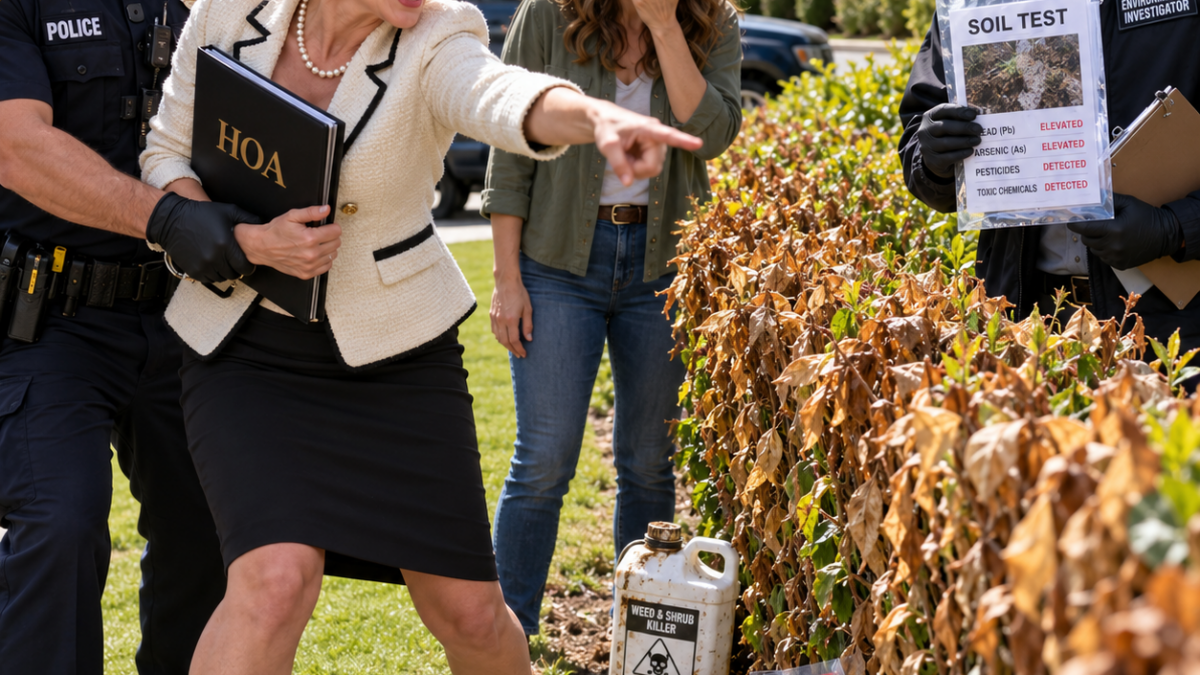
The laboratory had detected a concentrated herbicidal compound in every sample taken directly from the hedgerow.
Not traces.
Not the kind of low residual level somebody might expect from ordinary lawn maintenance.
The concentrations were so far beyond normal residential application rates that I reread the units three times to make sure I hadn’t misunderstood them.
Then I reached the second page.
The uncontaminated control samples from the far side of my yard showed nothing.
Neither did the samples from the public easement.
The contamination formed an almost perfect line along the hundred feet of soil supporting Sarah’s arborvitae.
I sat alone at the dining room table with the report open in front of me.
For several seconds, I couldn’t move.
Then my hands started shaking.
Not because I was afraid.
Because scientific uncertainty had just disappeared.
The hedge had not become diseased.
It had not been accidentally oversprayed by a landscaping crew.
It had not died because of drought, insects, root rot, or any of the excuses Karen might eventually invent.
Somebody had deliberately applied a heavy concentration of chemical herbicide to the soil.
And they had done it in a line that matched the hedge almost tree for tree.
I called Dex.
He answered with, “You get results?”
“Yes.”
“Read me the summary.”
I did.
He went silent.
“Dex?”
“I’m here.”
“What?”
“That’s ugly.”
“How ugly?”
“The concentration alone is bad. What formulation did the lab identify?”
I read the product-class information.
Then the notation beneath it.
There was a chemical marker associated with a commercial formulation not ordinarily marketed for homeowner use.
Dex asked me to send him the report.
Thirty seconds later, I heard his keyboard.
“Mark.”
“Yeah?”
“You need to stop thinking about this as someone killing landscaping.”
“I already have.”
“No, I mean completely stop thinking that way.”
He paused.
“You have contaminated soil. Depending on formulation and applicable state rules, you may be dealing with licensed-use material, misapplication, illegal disposal, or all three.”
“What do I do?”
“First, don’t dig anything up.”
“Karen gave me thirty days.”
“Karen doesn’t get to tell you to start excavating contaminated soil.”
That sentence gave me a grim little smile.
“Second,” Dex continued, “send the full report to whoever handles environmental complaints in your state and county. Third, notify the HOA formally because their own actions may have triggered insurance obligations.”
“I already found that clause.”
“Of course you did.”
He sighed.
“You always were terrifying with binders.”
“I’ll take that as a compliment.”
“You should.”
After we hung up, I called Bill Sterling.
Bill was the retired corporate attorney who had phoned me after Karen’s neighborhood-wide email.
We had spoken twice already, mostly about HOA procedure.
When I said the lab report had arrived, his tone sharpened.
“I’m coming over.”
He was at my house twenty minutes later.
Bill was in his late sixties, tall, lean, permanently unimpressed, with the gravelly voice of a man who had spent forty years telling executives why their brilliant idea was illegal.
I handed him the report.
He read it slowly.
Then again.
Finally:
“Did you collect these samples yourself?”
“Yes.”
“Photographs?”
“Yes.”
“Video?”
“Yes.”
“Diagram?”
“Yes.”
“Control samples?”
“Yes.”
“Chain-of-custody forms?”
I slid the file toward him.
His eyebrows rose.
“Who taught you evidence collection?”
“United States Army.”
“That explains the terrifying neatness.”
He turned to the lab report again.
“This is strong.”
“Strong enough?”
“For what?”
“To prove Karen did it.”
“No.”
I hated that answer.
Bill pointed at the document.
“This proves your soil was contaminated. It strongly supports deliberate application. It does not, by itself, prove Karen held the sprayer.”
“Martha saw her.”
“At two in the morning?”
“Yes.”
“Could she identify what was in the tank?”
“No.”
“Did she clearly see Karen spraying?”
“She saw the golf cart and heard it.”
“Useful. Not perfect.”
I leaned back.
“She admitted it to me.”
“What exactly did she say?”
I replayed the conversation.
Authorized vegetation control.
Fire hazard.
Her rights under the covenants.
Bill’s expression changed.
“Did you record that?”
“No.”
“Anyone else hear it?”
“No.”
I swore under my breath.
Bill held up a hand.
“Don’t beat yourself up. You woke up to your property being destroyed. You didn’t know you were collecting trial evidence.”
“She’ll deny everything.”
“Probably.”
“And blame me.”
“Almost certainly.”
I looked toward the brown hedge through the kitchen window.
The trees had been Sarah’s.
She had chosen the spacing.
She had laughed at me for measuring every hole twice.
When the first winter storm bent three saplings, she tied them upright herself because she said my knots looked like something meant to restrain a tank.
Ten years of living growth.
Now evidence markers.
“I don’t want just an insurance claim, Bill.”
“I know.”
“I want her held responsible.”
“Then don’t get impatient.”
He leaned forward.
“This is where angry people make mistakes.”
“I’m not angry.”
Bill stared.
I corrected myself.
“I’m extremely angry.”
“Better.”
He closed the folder.
“You want revenge?”
I looked at him.
“Yes.”
It felt good to say it.
Not violence.
Not humiliation for its own sake.
I wanted consequences that matched what she had done.
Bill nodded.
“Then the best revenge is accuracy.”
He tapped the lab report.
“Never claim one inch more than you can prove.”
That became the rule.
The special HOA meeting happened that evening.
Karen had called it after receiving my contamination notice.
Her email to residents described me as an unnamed homeowner making “baseless environmental claims” in retaliation for routine landscape enforcement.
She proposed a $500-per-household emergency assessment for legal defense.
Nearly every chair in the clubhouse was occupied.
People stood along the walls.
Karen sat behind the board table with George Maxwell, Susan Clark, David Chen, and Linda Potts.
George looked exhausted.
Susan looked angry.
David looked terrified.
Linda stared at her phone.
Karen looked completely at home.
She banged the gavel.
“This meeting will come to order.”
Bill stood near the back wall.
Before we went in, he had given me one instruction.
“Do not rescue her from her own lies.”
So I waited.
Karen spoke for fifteen minutes.
She talked about fiscal responsibility.
Community protection.
Frivolous claims.
The danger of homeowners refusing lawful orders.
Then she said something so outrageous I saw Susan Clark turn toward her.
“The resident involved has suggested that the association may be responsible for millions of dollars in environmental damages.”
I had never said anything remotely like that.
Karen continued.
“This is an attempt to extort the community.”
People started murmuring.
“Therefore, I recommend immediate approval of a five-hundred-dollar special assessment per household to establish a legal-defense reserve.”
That got everyone’s attention.
A man near me said:
“What the hell?”
Someone else:
“Five hundred?”
Another voice:
“For a hedge?”
Karen raised the gavel.
Bill stepped forward.
“Point of information.”
Karen’s eyes hardened.
“Mr. Sterling, this is a board presentation.”
“Our bylaws adopt parliamentary procedure for membership meetings.”
“I know our bylaws.”
“Excellent. Then answer one question.”
She glared.
Bill continued.
“What exact legal claim has Mr. Davison filed against the association?”
Karen shifted.
“It is complicated.”
“It shouldn’t be.”
“This involves confidential legal matters.”
Bill folded his arms.
“You’re asking roughly two hundred households to contribute five hundred dollars each.”
The room became quieter.
“That is a six-figure fund.”
He looked at her.
“You can explain the claim you want them to finance.”
Karen’s lips tightened.
I stepped forward before she could create another version.
“My name is Mark Davison.”
Every head turned.
“I’m the homeowner.”
Karen slammed the gavel.
“You are not recognized.”
Susan Clark suddenly leaned into her microphone.
“I’d like to hear him.”
Karen turned.
“Susan.”
“We’re discussing his letter.”
“We are discussing community finances.”
“Because of his letter.”
The exchange lasted maybe five seconds.
But I watched something break inside the board.
Susan had contradicted her publicly.
Karen saw it too.
“Two minutes,” Karen said.
Bill laughed quietly.
I opened my portfolio.
“I have not threatened a multimillion-dollar lawsuit.”
Murmurs.
“I have not demanded any money from any homeowner.”
More murmurs.
“I sent each board member the same certified notice invoking Section Eighteen-G of our covenants.”
I held up the letter.
“That section requires the association to report and respond to chemical contamination affecting property under certain circumstances.”
Karen interrupted.
“There is no contamination.”
I looked at her.
“Are you sure?”
Her jaw moved.
“What?”
“You just said there’s no contamination.”
“There is no credible evidence.”
“Thank you.”
Bill gave me the slightest nod.
Karen realized she had stepped where I wanted.
I removed the laboratory report.
“This arrived today.”
Susan sat forward.
I continued.
“A certified environmental laboratory tested twenty soil samples collected along my property.”
Karen’s face changed.
Only a little.
“The soil beneath my hedge contains an industrial-strength herbicidal compound at extraordinarily high concentration.”
The room went still.
“Control samples from unaffected portions of my property showed none.”
Karen said:
“You could have put anything in that dirt.”
There it was.
The blame shift.
I expected it.
“The samples were documented by location, photographed during collection, sealed, labeled, and submitted under chain-of-custody procedures.”
“You’re not a licensed investigator.”
“No.”
“You could have poisoned your own hedge.”
The sentence hung in the room.
I watched Martha Gable stand.
Slowly.
Her hands trembled around her purse.
“I saw you.”
Karen’s head snapped toward her.
Martha swallowed.
Then forced the words out.
“I saw your golf cart there.”
Karen’s face turned red.
“You saw a golf cart.”
“At two in the morning.”
“I patrol the neighborhood.”
“With a sprayer?”
“I did not poison anything.”
Martha looked ready to sit.
I wanted to help her.
Bill shook his head almost imperceptibly.
Let her own the decision.
Martha stayed standing.
“I heard spraying.”
Karen laughed.
A cruel little sound.
“You’re eighty-two years old, Martha. Maybe you heard somebody’s sprinkler.”
The room changed.
People who had been uncertain suddenly looked disgusted.
Martha’s eyes filled.
She sat down.
I looked at Karen.
For the first time that evening, I wanted to abandon Bill’s strategy and tear into her.
Instead, I turned to the board.
“Before this meeting, was there ever a full board vote authorizing enforcement against my hedge?”
Silence.
“George?”
He looked at Karen.
Then away.
“Susan?”
Karen grabbed the microphone.
“The president has authority—”
Susan cut her off.
“No.”
Everyone froze.
Susan’s voice shook.
“There was no vote.”
Karen stared.
Susan continued.
“You told us Mark had received repeated warnings and that you were handling it administratively.”
“That is board business.”
“You told us the hedge was already dead when you issued the removal notice.”
People began shouting.
Karen slammed the gavel.
Susan kept going.
“And when Mark sent the contamination notice, I asked that we contact the insurance carrier.”
Karen’s face drained.
“You are out of order.”
“You told us not to.”
“Susan.”
“You said he was bluffing.”
Now David Chen spoke.
“She did.”
Karen turned toward him.
“You too?”
David looked like he wanted to disappear.
But he nodded.
“She told us to ignore the letter.”
Bill stepped out from the wall.
“Then the association has a larger problem than a dead hedge.”
Karen stood.
“This meeting is adjourned.”
“No,” somebody shouted.
“Sit down!”
Another voice:
“Answer him!”
Then:
“What did she spray?”
“Why didn’t the board call insurance?”
“Why are we paying five hundred dollars?”
Karen shouted over everyone.
“This is a mob!”
Bill raised both hands.
“Everybody calm down.”
His voice carried.
The room slowly lowered.
He looked at Karen.
“Residents have heard enough tonight to question whether the proposed assessment is justified.”
Then he looked toward Susan.
“Is there a motion?”
Susan swallowed.
“I move that the special assessment be tabled.”
David immediately said:
“Second.”
Vote.
Only Karen and Linda opposed.
The special assessment died.
Then Susan made another motion.
Independent review of the contamination matter.
Seconded.
Passed.
Karen grabbed her purse.
“You’re all going to regret this.”
Martha Gable’s voice came softly from the second row.
“I already regret eight years.”
Karen looked at her.
For once, no response came.
She stormed out.
Two police officers arrived several minutes later because multiple residents had called during the shouting.
They took basic statements.
I gave them the lab summary.
The older officer read it.
“This proves chemical exposure?”
“Yes.”
“Proves who applied it?”
“Not yet.”
“Any cameras?”
“None covering that section.”
“Witness?”
“Martha saw Karen nearby.”
“At night?”
“Yes.”
He nodded slowly.
“We’ll take the report.”
Karen was not arrested.
That evening, anyway.
That mattered.
Real investigations do not end because a crowded HOA meeting becomes dramatic.
The officer was careful.
“We need evidence tying a person to the product and the application.”
“I understand.”
“You have good documentation.”
“I know.”
He looked at me.
“You Army?”
“Retired.”
“Figures.”
He handed me his card.
“Don’t confront her.”
“I already did.”
“I mean now.”
“I won’t.”
The HOA board met without Karen the next morning.
George called me at 8:15.
His voice sounded ten years older.
“We contacted the insurer.”
“Good.”
“They’re sending an environmental adjuster.”
“Good.”
“Karen is furious.”
“I assumed.”
“She says none of us have authority to sideline her.”
“Do you?”
George sighed.
“Bill says because she’s personally implicated, she has a conflict and can be excluded from deliberations directly involving the incident.”
“Then listen to Bill.”
“I wish I had six months ago.”
That surprised me.
“What happened six months ago?”
Silence.
“George?”
“She wanted the hedge removed then.”
I gripped the phone.
“Why?”
“She said it blocked sightlines and looked too rural.”
“Sightlines for what?”
“She never really explained.”
“Did she propose enforcement?”
“Yes.”
“And?”
“We told her the eight-foot limit allowed it.”
My throat tightened.
“So she knew.”
“Yes.”
“She knew it complied.”
George whispered:
“Yes.”
That detail went straight into my file.
The insurer’s environmental contractor arrived two days later.
Three people.
Protective gear.
Sampling equipment.
GPS.
Professional chain-of-custody documentation.
I watched them duplicate what I had done.
One technician looked at my sampling map.
“You did this?”
“Yes.”
“Pretty good.”
“Army.”
“Of course.”
Their independent results confirmed the contamination.
The insurer accepted that a covered pollution-remediation event had occurred, subject to its investigation of responsibility.
The estimated remediation cost was far higher than Karen’s five-thousand-dollar hedge removal notice.
Contaminated soil had to be excavated.
Transported.
Disposed of appropriately.
Clean fill brought in.
Drainage monitored.
The dead hedge removed.
Replacement landscaping installed only after the site was cleared.
Initial estimate:
More than fifty thousand dollars.
George called an emergency board meeting.
Karen attended despite being told not to.
She walked into the clubhouse and dropped a folder on the table.
“This is fraud.”
Nobody answered.
She pointed at me.
“He did this himself.”
I felt every muscle in my body tighten.
Karen continued.
“He wants insurance money.”
Bill leaned toward me.
“Don’t.”
I stayed seated.
Karen looked at the board.
“You’re letting a disgruntled widower destroy this association because he can’t emotionally handle replacing a hedge.”
That nearly did it.
Not the accusation of fraud.
The word widower.
The reduction of Sarah to my weakness.
I stood.
Bill grabbed my sleeve.
“Mark.”
I looked down at his hand.
He released me.
I spoke carefully.
“Don’t use my wife.”
Karen smiled slightly.
“I’m simply saying your emotional attachment—”
“Her name was Sarah.”
The smile disappeared.
“You poisoned something she planted.”
“You cannot prove that.”
“Not yet.”
Those two words changed her expression.
I sat back down.
Bill whispered:
“Better.”
The board suspended Karen from presidential duties pending a formal membership process.
Bill began circulating the required petition for removal.
By the following afternoon, they had more signatures than necessary.
Karen submitted a resignation before the formal vote.
No apology.
Just one paragraph.
She claimed she was stepping aside because “hostile elements” had made effective leadership impossible.
Bill read it to me.
“Want to frame it?”
“No.”
“You’re growing.”
The insurer paid for remediation.
The environmental crew arrived in protective equipment and excavated a trench running nearly the full length of my property line.
Three feet wide in places.
Two feet deep.
The sight was awful.
The brown hedge came out first.
Excavator bucket after excavator bucket.
Roots.
Branches.
Soil.
Everything Sarah and I had nurtured disappeared into lined trucks.
I stood outside the entire first day.
The foreman approached.
“You don’t need to watch this.”
“I know.”
“Then why are you?”
I looked at the last surviving root ball.
“Because I wasn’t here when my wife died.”
He waited.
“I was driving back from the pharmacy.”
I had never told him that.
I wasn’t sure why I did.
“She was supposed to have more time.”
I watched the machine lift another arborvitae.
“I got home seven minutes too late.”
The foreman removed his hard hat.
“I’m sorry.”
“For three years, I kept this hedge alive because she helped plant it.”
I swallowed.
“So, yeah.”
I nodded toward the excavation.
“I need to watch.”
He understood.
The crew slowed near the original planting line.
Not because procedure required it.
Because they knew.
When the final tree came out, I went inside.
For the first time since Sarah died, I opened the small cedar box containing her gardening gloves.
They were faded.
Dirt still stained the fingertips.
I sat on the floor of our bedroom holding them.
And I cried harder than I had during the entire legal fight.
Not because Karen had won.
Because I finally understood the hedge had become a place where I stored grief I did not know how to carry anywhere else.
Losing it felt like losing Sarah again.
That night, Martha brought me dinner.
Lasagna.
She stood awkwardly in the doorway.
“I didn’t know what you liked.”
“This is perfect.”
She looked toward the empty trench.
“I’m sorry.”
“Thank you for speaking.”
“I almost didn’t.”
“I know.”
“Karen scared me.”
“I know.”
Martha looked ashamed.
“I saw more than I said at first.”
My attention sharpened.
“What do you mean?”
She sat at the kitchen table.
“I saw the sprayer.”
“You told us that.”
“No.”
She shook her head.
“I saw her carrying it back into her garage.”
My pulse quickened.
“When?”
“After she finished.”
“You saw her clearly?”
“The porch light came on.”
“Why didn’t you say that before?”
Martha stared at her hands.
“Because she threatened me last year.”
“With what?”
“Foreclosure.”
Over wind-chime fines and garden violations, Karen had convinced Martha she could lose her home if penalties accumulated.
“I thought if she knew I testified, she’d come after me.”
“She’s not president anymore.”
“I know.”
She raised her head.
“That’s why I’m telling you now.”
Bill arranged for Martha to give a sworn statement.
The police accepted it.
Still, the detective assigned to the case remained cautious.
“Motive, opportunity, witness placing her with a sprayer. Strong circumstantial evidence.”
“But?”
“We need the chemical.”
“What if she disposed of it?”
“Then we work with what we have.”
Karen had hired a criminal-defense attorney.
Her story shifted.
First she denied spraying anything.
Then she suggested she might have used ordinary weed control near the common-area boundary days earlier.
Then she claimed landscaping contractors sometimes used sprayers around the neighborhood.
Each version created new questions.
That was when Dex called.
“Tell me everything the lab said about the formulation.”
I did.
“What about the tracer profile?”
I read the notation.
He became quiet.
“That may be traceable.”
“How?”
“Manufacturer batch records.”
“You can identify a bottle from soil?”
“Not a bottle.”
He corrected me.
“Potentially a formulation or manufacturing lot.”
“And then?”
“Distributor records.”
I stood.
“Dex.”
“Don’t get excited.”
“Too late.”
“Mark.”
“Sorry.”
He continued.
“If the product moved through a restricted commercial supply chain, there may be purchase records.”
“Can police get them?”
“Possibly.”
“Will they?”
“Property-damage investigators may not prioritize tracing agricultural distribution records.”
“So who does?”
“Environmental enforcement.”
He gave me contact information for a regional environmental criminal investigator.
I prepared another file.
By then, paperwork had become almost ceremonial.
Timeline.
Photographs.
Sample map.
Lab report.
Independent insurance results.
Martha’s statement.
Board minutes.
Karen’s letters.
George’s statement that the hedge complied months earlier.
My initial description of Karen holding the pressure sprayer.
Police report number.
HOA environmental clause.
Proximity to storm drainage.
I did not write:
**Karen did it.**
I wrote:
**Evidence supports investigation of deliberate application and possible unauthorized handling of a regulated commercial herbicide.**
Bill reviewed the packet.
“Good.”
“No emotion?”
“Very little.”
“That feels wrong.”
“Investigators don’t need your anger.”
“I do.”
“Keep it.”
He slid the cover letter back.
“Just don’t mail it.”
Two weeks passed.
Nothing.
Then three.
Oak Haven started recovering before I did.
Bill became interim HOA president.
He hated the job immediately.
That was reassuring.
His first board meeting lasted four hours because he allowed residents to speak.
Afterward, he called me.
“I may bring Karen back.”
“You wouldn’t.”
“She adjourned meetings efficiently.”
“She poisoned my hedge.”
“Yes, but meetings ended before nine.”
I laughed.
It was the first genuine laugh I’d had in weeks.
Susan remained treasurer.
David stayed secretary.
George stepped down at the next election.
Linda disappeared from HOA life almost entirely.
The new board published financial statements online.
Vendor contracts were reviewed.
A competitive bidding requirement was drafted.
Enforcement notices required documented board procedures.
Karen’s vague fire-hazard interpretation of Section Seven was formally rejected.
The audit began.
Meanwhile, clean soil replaced poisoned earth along my property line.
I refused to choose replacement trees immediately.
The insurer’s landscaping consultant showed me several options.
Mature arborvitae.
Hollies.
Mixed native screen.
I said:
“Not yet.”
“Why?”
“I don’t know.”
The truth was that choosing replacements felt like admitting Sarah’s hedge was gone.
Then Agent Frank Miller called.
Not the local police.
Environmental enforcement.
“Mr. Davison?”
“Yes.”
“I reviewed your submission.”
I sat up.
“Okay.”
“It’s unusually organized.”
“Army.”
“I guessed.”
He asked me to verify several dates.
Then:
“The laboratory’s chemical-marker information gave us something useful.”
My grip tightened around the phone.
“We contacted the manufacturer.”
“And?”
“The identified formulation corresponds to a commercial batch distributed in this state through a limited number of channels.”
“How limited?”
“Very.”
I stood and walked to the kitchen window.
Across the street, Karen’s house looked perfect.
Trim lawn.
Clean driveway.
Flowers evenly spaced.
Agent Miller continued.
“One local distributor received material from the relevant production batch.”
“Who bought it?”
“We’re working through records.”
I closed my eyes.
“So we don’t know.”
“We know one customer is familiar to you.”
My heart accelerated.
“Who?”
“Prestige Lawn Care.”
I knew the name immediately.
Oak Haven’s landscaping vendor.
The company that mowed common areas.
Maintained the clubhouse.
Trimmed entrance shrubs.
Removed trees.
And appeared repeatedly in the audit records.
“Karen used them for everything.”
“That’s what our preliminary information suggests.”
“Owner?”
“Licensed commercial applicator.”
“Would they have legal access to the product?”
“Potentially, yes.”
“Then Karen could say they sprayed my hedge.”
“She could say many things.”
Agent Miller’s voice remained flat.
“We prefer records and sworn statements.”
Bill would have loved him.
“What happens now?”
“We talk to Prestige.”
“And if they cooperate?”
“We follow the evidence.”
Prestige Lawn Care’s owner was named Carl Benson.
I had met him once.
He came to an HOA barbecue years earlier.
Friendly man.
Middle-aged.
Sunglasses on his head.
Talked constantly about fertilizer.
Investigators interviewed him.
I did not attend.
I learned what happened later from Agent Miller and through court records.
At first Carl denied knowing anything.
Then investigators showed him purchase records.
Five gallons from the relevant batch.
He admitted buying it.
For industrial vegetation control.
Then they asked where the remaining chemical was.
Carl said he had transferred approximately one gallon into a labeled container for an HOA-requested clearing job.
Who requested it?
Karen Williams.
According to Carl’s later sworn statement, Karen told him she needed a small quantity for woody vegetation along an association-owned drainage area.
He trusted her because she was HOA president.
He gave her the container.
No invoice for an application.
No licensed employee dispatched.
Just chemical transferred to a client.
That created a serious problem for Carl too.
“You think he’s lying to save himself?” I asked Agent Miller.
“Possible.”
“But?”
“He gave us details before knowing what we already had.”
“What details?”
“The container.”
I stopped.
“What about it?”
“One-gallon commercial jug. Red product label retained. He marked the date on the side in black marker.”
My stomach tightened.
“Do you think she still has it?”
Agent Miller paused.
“People dispose of incriminating evidence.”
“Yes.”
“They also keep half-used chemicals in garages for years.”
A warrant application followed.
I did not see it before execution.
I did not know the exact day.
That was deliberate.
Agent Miller did not need a victim contaminating an investigation by standing around asking questions.
The morning it happened, I was outside talking with the nursery contractor.
I had finally agreed to replacements.
Ten large emerald-green arborvitae.
Not fifty tiny saplings like Sarah and I planted.
These were already fifteen feet tall.
The insurer was paying.
Part of me disliked that.
Large replacement trees felt too instant.
Sarah and I had earned the old hedge year by year.
But Bill said something that changed my mind.
“You don’t have to recreate the past.”
So I chose new trees.
The truck was parked along the curb when two dark sedans turned onto the street.
Then a marked police cruiser.
They stopped at Karen’s house.
I knew before anyone exited.
Bill appeared beside me carrying coffee.
“Did you know?”
“No.”
“Good answer.”
“I mean it.”
“I believe you.”
Martha came onto her porch.
Other doors opened.
Agent Miller stepped from the first sedan.
He carried paperwork.
Two investigators went with him.
A uniformed officer stayed near the driveway.
Karen opened the door.
Even from across the street, I could see her body stiffen.
Miller handed her the warrant.
She began shouting immediately.
We couldn’t hear every word.
Then one sentence carried clearly.
“This is harassment!”
Nobody responded.
Agents entered.
Karen remained on the porch.
Then she saw me.
Her entire face changed.
“You!”
I stayed where I was.
“You did this!”
Bill quietly said:
“Do not answer.”
Karen pointed across the street.
“You think you can ruin my life over a hedge?”
That sentence hit me wrong.
Over a hedge.
As if she still did not understand.
I took one step forward.
Bill touched my arm.
I stopped.
Karen continued shouting until an officer asked her to remain inside the home or on the porch.
Ten minutes passed.
Then twenty.
The nursery crew stood near their truck pretending not to watch.
Nobody planted anything.
At twenty-seven minutes, Agent Miller came out of the garage carrying a transparent evidence bag.
Inside was a one-gallon commercial herbicide jug.
Red label.
Black writing along one side.
Even at that distance, I could see Karen’s shoulders collapse.
Miller spoke to her.
I couldn’t hear.
Then one investigator entered again.
Another brought out a pressure sprayer.
Same general shape as the one I remembered.
That did not alone prove it was the same sprayer.
But it was evidence.
Agent Miller later told me the jug’s lot and product information corresponded with the supply records, and residues in the sprayer were consistent with the formulation under investigation.
That was when the case changed.
Karen was detained.
Then formally arrested after investigators coordinated with local authorities.
The charges developed over time and ultimately included environmental tampering and criminal damage allegations tied to the pesticide application.
When the officer reached for her wrists, Karen looked at me.
There had been a period when I imagined that moment.
I imagined satisfaction.
Maybe even a smile.
Instead, I saw a woman in her late fifties standing in front of the house where she had spent years building the image of absolute control.
Neighbors watching.
Agents holding chemicals from her garage.
Her title gone.
Her certainty gone.
She looked suddenly old.
“No,” she whispered.
The officer said something quietly.
Karen shook her head.
Then the cuffs closed.
Martha turned away.
Bill took a sip of coffee.
I stood there listening to that small metallic click.
It did not bring Sarah back.
It did not restore the hedge.
It did not erase three years of grief.
But something in my chest finally loosened.
Karen was placed in the cruiser.
Before the door closed, she looked toward my property.
The trench had been filled.
Fresh soil.
Ten new trees waiting on the truck.
One destroyed thing leaving.
Another beginning.
After the vehicles disappeared, I turned toward the nursery foreman.
“You ready?”
He smiled.
“Been ready.”
“Let’s plant.”
The first replacement went into the ground where the old hedge had begun.
I helped position it.
The root ball was enormous.
The foreman laughed.
“You paying us or working for us?”
“I need to do this one.”
He stepped back.
I adjusted the trunk until it stood straight.
Then packed soil around the root ball with my hands.
My fingers shook.
Sarah and I had planted the original first tree together.
She had stood across from me holding the trunk.
“Left.”
I moved it.
“No, your other left.”
I complained.
She laughed.
I could hear that laugh again so clearly that I had to stop working.
The foreman noticed.
“You okay?”
“Yeah.”
I looked at the new tree.
“Just remembering somebody.”
He nodded and gave me space.
By sunset, all ten replacements stood along the property line.
They were not Sarah’s trees.
That distinction mattered.
I did not call them replacements anymore.
They were the next hedge.
The criminal case moved slower than the arrest.
Months.
Lawyers.
Motions.
Evidence review.
Negotiations.
Meanwhile, the HOA audit uncovered a second layer of Karen’s leadership.
Some findings were incompetence.
Some were favoritism.
Some appeared more serious.
Personal charges on an HOA credit card had been categorized as association expenses.
Restaurant bills.
Fuel.
Online purchases.
Vendor relationships were poorly disclosed.
Prestige Lawn Care had received repeated no-bid work.
Invoices ran higher than competing market estimates obtained during the audit.
Several fines against Karen’s close allies had been waived without documentation.
Residents she disliked had received aggressive collection letters.
Bill insisted we describe all of this accurately.
“An audit discrepancy is not automatically embezzlement.”
Susan nodded.
“We refer it.”
“To whom?” someone asked.
“Counsel and appropriate authorities.”
No mob.
No neighborhood prosecution.
Professionals.
The district attorney eventually added financial charges after reviewing the audit and investigative evidence.
Prestige Lawn Care faced its own administrative and licensing consequences for transferring regulated chemical products improperly and for its role in the incident.
Carl Benson cooperated extensively.
He lost contracts.
The HOA immediately terminated Prestige.
Karen’s house went on the market.
I saw the sign during my morning walk.
Martha was watering roses.
“You see?”
“Yes.”
“You happy?”
I looked across the street.
“No.”
She studied me.
“You’re allowed.”
“I know.”
“Then why aren’t you?”
I thought about it.
“Because when Sarah was alive, I didn’t want anything Karen had.”
Martha waited.
“I wanted my wife.”
My voice cracked slightly.
“Then after Sarah died, I wanted the garden.”
I looked at the new hedge.
“Then Karen damaged that, and suddenly I spent almost a year wanting Karen punished.”
Martha nodded.
“That makes sense.”
“It does.”
“But?”
“I don’t want her to become the most important person in this story.”
Martha smiled.
“Good.”
“Why good?”
“Because she’d love that.”
I laughed.
“Probably.”
Karen’s house sold to a young couple named Eric and Danielle Parker.
They had a golden retriever and a four-year-old son.
The first weekend after moving in, Eric came across the street.
“I think I owe you an apology.”
“For what?”
“Nothing.”
“That’s an unusual opening.”
He laughed nervously.
“The realtor told us some history.”
“Oh.”
“We didn’t know until after we were under contract.”
“You don’t owe me anything.”
He looked toward the new hedge.
“That was the hedge?”
“The new one.”
“What happened to the old one?”
“Removed during remediation.”
He shoved his hands into his pockets.
“My wife was worried you’d hate us because we bought her house.”
“Did you poison anything?”
“No.”
“Then we’re good.”
He laughed.
A week later, their son kicked a red rubber ball across the street.
It rolled beneath my new arborvitae.
I picked it up.
The boy stopped at the curb.
“Sorry!”
I tossed it back.
“No problem.”
His mother waved.
It was such a normal interaction.
That normality felt almost luxurious.
Bill’s HOA presidency was exactly what I hoped it would be.
Boring.
Transparent.
Occasionally ridiculous.
He held listening sessions before rewriting the covenants.
The first evening lasted two and a half hours because residents had opinions about holiday lights.
Bill called me afterward.
“I defended multinational corporations in federal litigation.”
“And?”
“I would rather do that again than moderate one more conversation about inflatable snowmen.”
“You volunteered.”
“Never remind me.”
The enforcement rules changed.
Vague aesthetic standards were narrowed.
Major penalties required recorded board action.
Owners received clear notice and appeal opportunities.
Vendor contracts above a threshold required multiple bids or documented justification.
Conflicts of interest had to be disclosed.
Board financials went online.
The hazardous-material provision I had found became its own policy with emergency procedures.
Martha’s wind chime stayed.
Bill made a point of walking past it every evening.
One day Martha asked:
“Too loud?”
Bill replied:
“Absolutely.”
She laughed.
“Fine me.”
“Never.”
The neighborhood began having block parties again.
Children drew chalk pictures on sidewalks.
Nobody photographed them as violations.
Residents planted flowers that were not on Karen’s preferred list.
Property values did not collapse.
Civilization survived.
The new hedge rooted well.
I installed drip irrigation.
Mulched properly.
Tested soil.
Maybe too often.
Dex eventually told me:
“Mark, stop sending dirt to laboratories.”
“I like data.”
“The contamination is gone.”
“How sure?”
“More sure than any reasonable person needs to be.”
“I’m not reasonable.”
“That is correct.”
The HOA reimbursed my original laboratory expense.
I donated half of it to a local veterans gardening program Sarah had supported.
The other half went toward a stone bench.
I placed it near the new hedge.
Not a memorial plaque.
Sarah would have hated that.
She hated anything that made her sound saintly.
Instead, I had a small line carved into the underside where only someone sitting close would notice.
**A living fence. Something that grows with us.**
Her words.
Nobody else needed to understand.
Six months after Karen’s arrest, I received notice about sentencing.
Bill wanted me to attend.
“I don’t know.”
“You’ve followed everything else.”
“That’s different.”
“How?”
“I’m tired.”
He nodded.
“That’s a legitimate reason.”
“I don’t need to see her punished.”
“Then don’t go for punishment.”
“Why go?”
“Closure is an overused word.”
“Agreed.”
“But sometimes seeing the process end helps.”
I looked at Sarah’s photograph on the bookshelf.
“I’ll think about it.”
The morning of sentencing, I drove to the courthouse.
I almost turned around twice.
Karen entered wearing a gray pantsuit.
No bright tracksuit.
No clipboard.
No gavel.
She had accepted a plea agreement resolving the principal environmental-tampering charge and part of the financial case.
Several counts were dismissed under the agreement.
Her attorney asked for probation.
No prior criminal record.
Age.
Community service.
Health concerns.
Financial losses already suffered.
Karen was allowed to speak.
She stood.
For a moment, nothing came out.
Then:
“I served my community for many years.”
The judge watched her.
Karen continued.
“I made decisions under extraordinary stress.”
My jaw tightened.
“I believed I was protecting property values and safety.”
The prosecutor did not react.
“I understand now that some of those decisions were mistakes.”
Mistakes.
I stared at the floor.
Karen’s voice shook.
“I lost my home. I lost friends. I lost my reputation.”
Still no mention of the hedge.
No Sarah.
No Martha.
No poisoned ground.
Then Karen said:
“I never intended for any person to be physically harmed.”
That was true as far as I knew.
Maybe it was the first important truth she had offered.
The judge spoke.
Her tone was calm.
That made it sharper.
“This case did not begin because you made an unpopular landscaping decision.”
Karen lowered her head.
“You deliberately entered another person’s property and used a hazardous commercial chemical in a manner you were not authorized to use.”
Silence.
“You then attempted to use the power of an association office to shift responsibility for the consequences onto the victim.”
Karen’s shoulders sank.
“The evidence also demonstrates a broader pattern of using authority as a personal instrument.”
The judge paused.
“Leadership is not ownership.”
That sentence stayed with me.
Karen received a custodial sentence.
Eighteen months.
Not the decades some angry residents had predicted.
Not probation.
Real incarceration.
She gasped when the judge announced it.
Her lawyer put a hand on her shoulder.
Karen turned as officers approached.
Then she saw me.
Our eyes met.
Months earlier, during the search, her expression had been pure hatred.
That was gone.
She looked tired.
Scared.
Almost lost.
I did not smile.
She did not speak.
The officers led her through the side door.
Bill was waiting outside the courtroom.
“Well?”
“Eighteen months.”
“How do you feel?”
“I don’t know.”
“That’s becoming your favorite answer.”
“It’s accurate.”
We walked outside.
Sunlight hit hard after the courthouse.
Bill put on sunglasses.
“You did what you could.”
“So did she.”
“What?”
“She did this to herself.”
“Yes.”
“That bothers me more than I expected.”
“Why?”
“Because she could’ve stopped at any point.”
Bill nodded.
“The first letter.”
“Yes.”
“The board meeting.”
“Yes.”
“The contamination notice.”
“Yes.”
“The insurance review.”
“Yes.”
“The resignation.”
“Yes.”
“She kept choosing the next bad decision.”
Bill looked toward the courthouse.
“That is usually how ruin works.”
We drove home separately.
I stopped at the cemetery.
I had not planned to.
Sarah’s grave was under a maple near the eastern path.
I sat on the grass.
For a while, I said nothing.
Talking to graves always felt strange to me.
Sarah would have mocked me gently for it.
Eventually:
“I won.”
The word sounded stupid.
I tried again.
“They planted new trees.”
Better.
I looked at her name.
“I kept yours alive as long as I could.”
Wind moved through the maple leaves.
“I’m sorry.”
My throat closed.
“I think I made the hedge carry too much.”
I wiped my face.
“It was never you.”
That realization had taken almost four years.
Sarah was not in fifty arborvitae.
She was in every place she had changed me.
In the way I folded towels because she taught me I was doing it wrong.
In the stupid ceramic bowl she insisted belonged on the kitchen counter.
In our daughter’s laugh.
In the scar on my thumb from the shelving project we argued over.
In the recipe card written in her handwriting.
In the fact that I still bought her favorite coffee by accident.
The hedge had been important.
It was not the last container holding her.
Karen could kill plants.
She could not kill memory.
I stayed until the shadows lengthened.
Then went home.
The new arborvitae had put out fresh growth.
Bright green tips covered the branches.
I touched one.
Soft.
Alive.
Martha called from her porch.
“You’re blocking my view.”
I stared at her.
She pointed at the hedge.
“Fire hazard.”
I laughed so hard I had to lean against the fence.
Martha smiled.
“Too soon?”
“Probably.”
“Good.”
Years passed.
Bill completed one term as president and refused another.
At his final meeting, residents gave him a plaque.
He looked horrified.
“What am I supposed to do with this?”
“Display it.”
“I have taste.”
Martha shouted:
“Put it next to a gnome!”
He nearly resigned five minutes before his term officially ended.
David Chen eventually became president.
Unlike Karen, he frequently said:
“I don’t know. Let me check.”
That became my favorite quality in a leader.
Susan stayed treasurer long enough to modernize the books.
Every transaction was visible to members.
George moved to Florida.
Linda apologized privately to several homeowners for staying silent too long.
Prestige Lawn Care disappeared from Oak Haven completely.
Another company won the contract through competitive bidding.
They charged less.
The grass remained green.
Miracle.
The hedgerow thickened.
The spaces between those ten enormous replacement trees gradually closed.
Five years after planting, it became a real privacy wall.
Not identical to the original.
The texture was different.
The spacing was different.
Sarah’s hedge had been fifty individuals growing together from youth.
The new one was ten mature trees learning to become one line.
I liked that.
One spring afternoon, my daughter Emily visited.
She stood near the stone bench.
“I miss Mom’s hedge.”
“So do I.”
“This one’s nice.”
“Careful. I’ll tell it you said that.”
She smiled.
Then she found the engraving beneath the bench.
She read it quietly.
Her eyes filled.
“You remembered.”
“I remember most things.”
“No, I mean that day.”
“What day?”
“When you two planted the first trees.”
I looked at her.
“You were there?”
“I was nine.”
I had forgotten.
Emily laughed.
“I handed Mom the little plastic tags.”
Memory rearranged itself.
Suddenly I saw Sarah kneeling beside the nursery pots.
Emily chasing earthworms.
Me complaining that the trees were not evenly spaced.
Our family had planted the hedge.
Not just Sarah and me.
Emily sat on the bench.
“I thought when they removed the old hedge, that memory would disappear.”
“Me too.”
She touched the engraving.
“Apparently not.”
Apparently not.
Later that summer, Oak Haven held a neighborhood garden tour.
Martha was ninety.
Her daughter pushed her in a wheelchair from house to house.
When they reached mine, Martha pointed toward the hedge.
“I witnessed a murder there.”
Her daughter groaned.
“Mom.”
“What? I did.”
“You heard spraying.”
“Details.”
Everyone laughed.
Martha looked proud of herself.
We set up lemonade beneath an oak tree.
Children ran across the lawn.
Eric and Danielle came over from Karen’s old house with their son, now ten.
He and my grandson disappeared into the backyard throwing a football.
Nobody cared that it occasionally hit the hedge.
That would have horrified me years earlier.
Now I barely noticed.
Then, one autumn morning, I found one section browning.
My stomach dropped.
I stood there frozen.
For half a second, I was back on that first morning.
Chemical smell.
Karen.
Sarah’s dead trees.
My hands started shaking.
I called the arborist.
Then Dex.
Then stopped.
I crouched.
Looked carefully.
No odor.
No residue.
Only one tree affected.
The arborist arrived.
Spider mites.
Ordinary spider mites.
Treatable.
I felt ridiculous.
The arborist looked at me.
“You okay?”
“Yes.”
“You look like I told you the house is sinking.”
“History.”
He nodded.
“Bad one?”
“Very.”
He treated the tree.
It recovered.
That evening, I told Emily.
She laughed.
“You almost called the EPA over bugs?”
“I did not call them.”
“You thought about it.”
“Briefly.”
“Dad.”
“Preparedness is not paranoia.”
“It absolutely can be.”
Fair.
Eventually, even the binder changed meaning.
For years, I kept everything.
Karen’s notices.
Lab reports.
Photos.
Police records.
EPA correspondence.
Board minutes.
Audit summaries.
Court papers.
News clippings.
The binder sat on a shelf in my office labeled:
**PROJECT OVERLORD**
One winter evening, I pulled it down.
Dust coated the top.
I had not opened it in almost two years.
I flipped through the first pages.
Photograph of the dead hedge.
Karen’s five-thousand-dollar removal notice.
The soil report.
Martha’s affidavit.
The chemical-supply chain.
Search inventory.
Sentencing documents.
At the back, I found something I had forgotten.
Sarah’s original landscaping sketch.
She had drawn the property line in pencil.
Fifty circles representing arborvitae.
Beside them:
**Living fence — privacy + birds + green all winter.**
Then a little heart.
I removed that page.
Everything else went into a storage box.
Not trash.
I wasn’t ready for that.
But not in my office anymore.
Sarah’s sketch went into a frame.
That is what hangs there now.
Not Karen’s arrest article.
Not the lab report.
Not a photograph of the police cruiser.
A pencil drawing of fifty circles and a heart.
That was the story I wanted closest to me.
Ten years after the poisoning, the new hedge finally reached the height of the original one.
Eight feet.
Exactly.
David Chen, still living in the neighborhood, walked over while I was trimming it.
“You know eight feet is the limit.”
I shut off the trimmer.
“Get off my property.”
He laughed.
“Seven feet eleven and three-quarter inches.”
“Measure it.”
“I learned better.”
“Good.”
He handed me a bottle of water.
“We’re revising the landscaping section again.”
“Why?”
“New drought restrictions.”
“Makes sense.”
“Want to join the committee?”
“No.”
“You didn’t even think.”
“No.”
“We need reasonable people.”
“Find one.”
David looked at the hedge.
“You started half the reforms around here.”
“I started nothing.”
He raised an eyebrow.
“Karen started them.”
We both laughed.
But there was truth in it.
The community did not become better because I was especially brave.
It became better because the old system failed so catastrophically that people finally rebuilt it correctly.
Checks.
Records.
Votes.
Appeals.
Transparency.
Nothing heroic.
Just structure.
Combat engineering had taught me that a strong bridge is not strong because every component is perfect.
It is strong because loads are distributed, failures are anticipated, and no single connection is allowed to bring everything down.
Oak Haven had once depended too much on one person.
Karen.
Then on another person.
Me.
The healthier version depended on neither.
That was success.
Martha died at ninety-two.
Her daughter gave me the wind chime Karen had once fined her for.
“I don’t know what to do with it,” she said.
I held the old brass tubes.
“Neither do I.”
“Mom said Mark would.”
Of course she did.
I hung it near the stone bench.
Not because it fit my landscaping plan.
It didn’t.
The first windy evening, it clanged loudly enough that I could hear it from my kitchen.
I walked outside.
The sound carried across the yard.
I imagined Karen hearing it years earlier and reaching for a violation pad.
I smiled.
Then I sat beside the hedge.
The evening smelled like damp soil and cut grass.
No chemicals.
No fear.
Just earth.
The trees moved slightly in the breeze.
The chime rang again.
I ran my hand along the stone bench.
Sarah’s words beneath it were invisible from where I sat.
I didn’t need to read them anymore.
I knew them.
**A living fence. Something that grows with us.**
For years, I had thought rebuilding meant replacing what Karen destroyed.
It didn’t.
The old hedge was gone.
Sarah was gone.
Martha was gone.
Parts of my old life were not coming back.
Rebuilding meant allowing something new to grow without demanding that it become what I lost.
The new arborvitae were their own trees.
Oak Haven was a different neighborhood.
I was a different man.
That turned out to be enough.
A little before sunset, Eric’s son kicked a football over the hedge.
It landed beside me.
“Sorry, Mr. Davison!”
I picked it up.
For a second, I looked at the branches.
No damage.
Then threw the ball back.
“Try not to kill my trees!”
He laughed.
“No promises!”
I shook my head.
The wind chime moved again.
Green branches swayed above it.
Years earlier, Karen had come onto my property believing that destroying something important would prove how powerful she was.
For a while, she succeeded in destroying the thing itself.
The hedge died.
The soil had to be removed.
The memory attached to those particular trees could not be physically preserved.
But the part she never understood was that control over another person’s property is not control over what that property means to them.
She could poison Sarah’s trees.
She could not reach the morning Sarah and I planted them.
She could not erase my daughter handing us nursery tags.
She could not remove Martha’s courage once Martha finally found it.
She could not make the neighborhood forget what happened.
And she could not prevent clean soil from being brought back after the poison was gone.
I stood and walked the length of the hedge.
The trunks were thick now.
Roots deep.
Fresh growth at the tips.
At the far end, near the original property marker Karen once claimed gave her authority over five feet of my land, a tiny volunteer arborvitae had appeared.
Probably from seed.
Maybe from one of the replacements.
Maybe carried by a bird.
It was only six inches tall.
I almost pulled it because it was outside my carefully spaced line.
Then I stopped.
Sarah would have left it.
I knew that immediately.
She always liked plants that ignored my plans.
So I put the shovel away.
The little tree stayed.
No survey.
No ruler.
No HOA application.
Just something green growing where it chose.
That evening, sunlight filtered through the hedge and stretched long shadows over the lawn.
I sat beneath Martha’s wind chime until the air cooled.
For the first time in years, I did not look at the hedge and think about Karen Williams.
I thought about Sarah.
Not sick.
Not gone.
Young again, standing in the backyard with dirt on her cheek, laughing because I had measured the spacing between two saplings for the third time.
“Mark,” she had said, “they’re trees, not bridge supports.”
I could hear myself answering.
“They should still be straight.”
She rolled her eyes.
Then she took my hand.
“Give them room.”
I finally understood what she meant.
The wind moved through the branches.
Somewhere behind me, Martha’s old chime answered.
And the little volunteer tree at the end of the row bent almost to the ground before springing upright again.
I smiled.
Then went inside.
[END OF STORY]








