PART 2: HOA President Logged My Inherited Forest—Then I Found the Fake Survey Stakes and His Name on Every Check
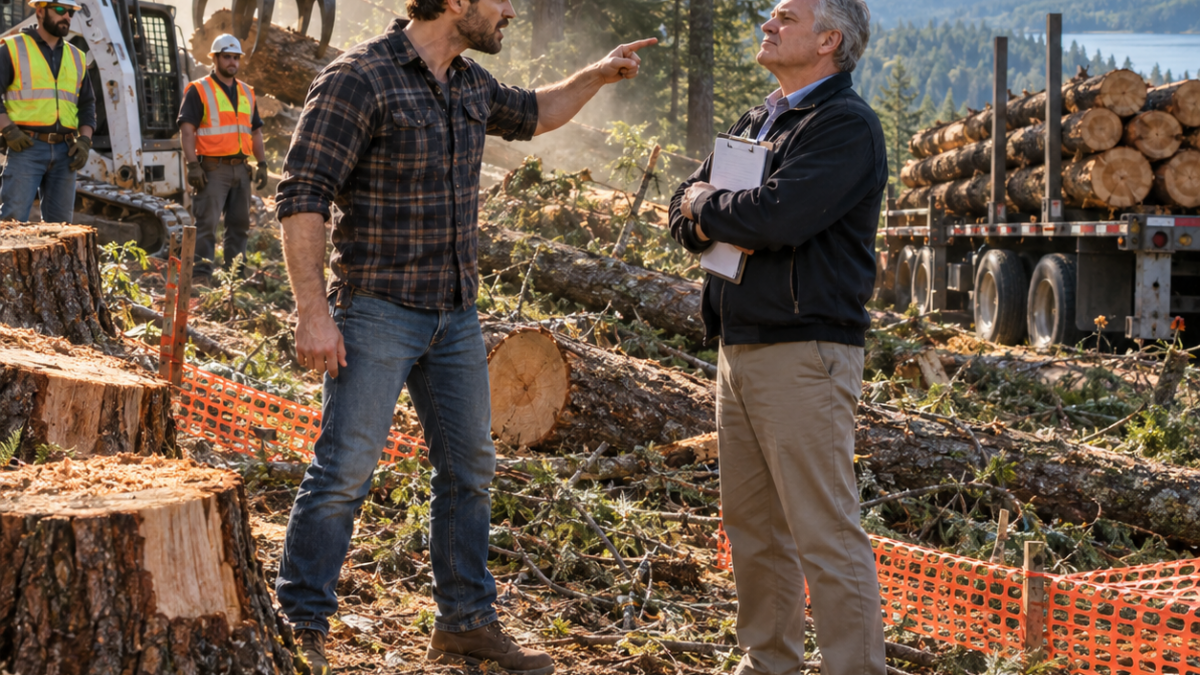
PART 2
Not fear.
Not doubt.
Irritation that I was making the morning complicated.
He turned toward the foreman and made a circular motion with one hand.
The chainsaw roared back to life.
I stared at him.
“You’re continuing?”
“The board has a schedule.”
“You’ve been told this is private land.”
“And your objection has been noted.”
One of the workers stepped toward another Douglas fir.
I moved instinctively.
Richard shifted just enough to block my path.
“Don’t interfere with the crew.”
It wasn’t shouted.
That made it worse.
He said it like a man who had spent years discovering that quiet authority frightened people more effectively than rage.
I looked from him to the saw.
Then to the trees.
Then back to him.
“You understand I’m putting you personally on notice right now.”
“You’re free to make whatever record you believe is appropriate.”
He walked toward his truck.
No debate.
No attempt to compare maps.
No request for a survey.
He got inside, made a phone call, and watched me through the windshield.
Then he drove away.
The crew stayed.
That was the first moment I understood I wasn’t dealing with a mistake.
Mistakes slow down when somebody presents evidence.
Richard accelerated.
I could have called the sheriff immediately, but boundary disputes can become messy fast, particularly when the person doing the cutting claims he relied on a survey or association map. I needed more than anger.
I needed a record.
So I started taking pictures.
Every stump.
Every machine.
Every worker.
The flatbed.
The license plates.
The orange fencing.
The distance from the fencing to the original survey monuments.
I placed a tape measure across several stumps.
Twenty-four inches.
Twenty-eight.
Thirty-two.
These weren’t dead saplings being removed for fire prevention.
They were mature Douglas firs.
Some had been standing before most of Pine Ridge existed.
The smell of fresh resin was everywhere.
A sweet, sharp smell I had always associated with childhood hikes with my grandmother.
That morning it smelled like theft.
When I photographed the workers’ shirts, I saw the company logo.
BLACKWOOD TIMBER LLC.
I lowered the phone.
Blackwood.
I looked toward the road where Richard’s truck had disappeared.
That changed the situation.
The HOA president wasn’t simply authorizing a contractor.
A company bearing his name was doing the work.
I photographed the logo again.
Then I went inside and called the county recorder.
The clerk confirmed what I already knew.
My deed was valid.
Current.
Recorded.
There was no transfer of the forest to Pine Ridge HOA.
No easement giving them timber rights.
No amendment changing my boundary.
She offered to send me a certified copy.
“Yes,” I said. “Please send everything connected to the legal description.”
When the email arrived, I printed it.
Then I checked my mailbox.
The HOA notice was there.
Two weeks old.
The same harmless language Richard had referenced.
Planned removal of hazardous trees.
Common-area maintenance.
Fire-safety improvements.
Community benefit.
No parcel number.
No map.
No statement that contractors would enter my property.
Nothing that gave them authority to cut anything I owned.
By noon, the machinery finally stopped.
The crew loaded the last logs onto the flatbed.
Richard returned briefly, spoke to the foreman, and left again.
I stood at the edge of the forest while the trucks disappeared.
The ground looked wounded.
Fresh stumps rose from torn earth.
Branches lay crushed beneath tire tracks.
My grandmother had spent four decades caring for those trees.
She knew which ones leaned after storms.
Which sections held water.
Which firs had survived disease.
She had planted seedlings in gaps created by windfall and marked them with little wooden stakes until they were large enough to survive on their own.
I walked back to the house and opened her filing cabinet.
If Richard wanted paperwork, I would give him paperwork.
My grandmother had been an obsessive record keeper.
Tax receipts.
County correspondence.
Insurance records.
Survey drawings.
Old photographs.
Deeds.
Maps.
Every envelope labeled in her narrow handwriting.
I searched until sunset.
At the bottom of one folder, I found a letter dated June 2015.
The recipient was Richard Blackwood.
The subject line made my pulse jump.
FORMAL NOTICE—CEASE TRESPASS ON PRIVATE FOREST LAND.
I sat down.
Nine years earlier, the HOA had built a gazebo approximately thirty feet across my grandmother’s property line.
She had discovered the encroachment, obtained the survey records, and demanded that Pine Ridge remove the structure.
Attached was Richard’s written response.
He apologized.
He called it a surveying error.
He acknowledged her documentation.
And he promised the HOA would correct the problem immediately.
The gazebo had been removed within a week.
I read the exchange twice.
Then a third time.
Richard had looked me in the face that morning and dismissed my boundary as an uncertain interpretation of an old map.
But he had already been forced to recognize that exact boundary in 2015.
He knew.
I opened my laptop.
My email to the HOA went out at 11:43 that night.
It included the certified deed, the historical survey, photographs of the cutting, the orange fencing, the survey markers, the company trucks, and Richard’s own 2015 correspondence.
I demanded that all logging stop immediately.
I requested an emergency meeting.
I stated clearly that the HOA had been placed on notice of trespass.
Then I waited.
Forty-eight hours later, the response arrived.
Two sentences.
My concern had been received.
It would be reviewed at the next regularly scheduled monthly meeting.
Three weeks away.
I called the HOA office.
Jennifer Hartley, the board secretary, answered.
Her voice had that polished neutrality people use when they know every word might eventually be quoted.
“I’m requesting an emergency meeting.”
“Emergency meetings require a qualifying member petition.”
“You have contractors cutting trees on private property.”
“The board is reviewing your concern.”
“I sent the recorded deed.”
“Yes.”
“I sent the survey.”
“Yes.”
“I sent Richard’s 2015 letter acknowledging the same property line.”
A pause.
Not long.
Maybe three seconds.
But I noticed it.
“The board will review all relevant historical materials.”
“They’re destroying property while you review.”
“Your concern has been placed into the appropriate process.”
“Jennifer, if somebody drove a bulldozer through your living room, would you schedule the problem for next month?”
“This conversation is becoming unproductive.”
“No. The logging is unproductive.”
“We’ll be in contact.”
She hung up.
I sat there holding the phone.
That was when I recognized the system.
Delay.
Procedure.
Neutral language.
Never say no when you can say later.
Never admit wrongdoing when you can call it review.
Force the other person to spend time, money, and energy proving what everyone already knows.
Most people eventually decide peace is cheaper than principle.
Richard had been HOA president for twelve years.
He had learned exactly how long exhaustion took.
The following Tuesday, engines woke me again.
I went outside.
Same company.
Same equipment.
Different part of the property.
Richard’s black Ford F-250 arrived minutes later.
He stepped out wearing work boots and a canvas jacket.
“The board is reviewing your documents,” he said before I could speak.
“And you’re logging anyway.”
“The project remains authorized.”
“You have proof the land is mine.”
“We have conflicting records.”
“You have your own letter from 2015.”
“That concerned a gazebo.”
“On this boundary.”
“A different use raises different considerations.”
“A boundary doesn’t move because you change what you’re stealing.”
His eyes snapped toward mine.
There.
For one second, the calm mask slipped.
“Be careful with accusations.”
“Be careful with chainsaws.”
He stepped closer.
“We’re managing a fire-safety risk affecting this community.”
“These trees are nowhere near anyone’s house.”
“That is your opinion.”
“My property rights aren’t an opinion.”
Richard turned to the foreman.
“Proceed.”
The saw started.
No hesitation.
He had made his decision before arriving.
The conversation was theater.
I stood there while another tree came down.
Not because I accepted it.
Because every second they continued after receiving written notice made their position worse.
That evening, I called Daniel Ross.
Daniel was a property attorney I knew from an earlier case.
I described everything.
When I finished, he asked only three questions.
“Do you have a current survey?”
“No. I have the recorded historical survey.”
“Get one.”
“Okay.”
“Professional timber appraisal?”
“Not yet.”
“Get one.”
“Anything else?”
“Save every communication. Don’t argue online. Don’t threaten anyone. Don’t interfere physically with the crew. Build the file.”
“What do you think?”
“I think if the facts are what you say they are, Richard Blackwood has a serious problem.”
“How serious?”
“Oregon’s timber-trespass law can impose treble damages for intentional cutting.”
I looked toward the dark windows facing the forest.
“Treble.”
“Three times proven value, potentially plus fees. But intentional matters. You need proof this wasn’t a good-faith boundary mistake.”
I looked at the 2015 letter on my desk.
“I may already have that.”
“Good. Now prove everything else.”
The next evening, somebody knocked on my door.
Heather Morris stood on the porch.
Sixty-seven.
Retired teacher.
Lived four houses down.
We knew each other well enough to wave but not well enough for late-night visits.
“I heard about the trees,” she said.
I stepped aside.
“Come in.”
She sat at my kitchen table and held her purse in both hands.
For several seconds she said nothing.
Then she looked at me.
“Richard did something similar to me.”
I stopped.
“When?”
“2019.”
She opened her purse and pulled out a manila folder.
“The HOA fined me five hundred dollars for planting an oak without architectural approval. I showed them the tree was entirely on my property. The fine became two thousand dollars for what Richard called willful noncompliance.”
“That doesn’t make sense.”
“It wasn’t supposed to.”
She slid papers across the table.
“He offered to eliminate the fine if I let the HOA remove five mature oaks along the edge of my lot. He said they interfered with a drainage easement. Blackwood Timber removed them.”
I stared at her.
“He paid me five thousand dollars and made me sign a nondisclosure agreement.”
“Richard’s company got the timber?”
She nodded.
“I didn’t understand that part until later.”
“Did you have a survey?”
“Yes.”
“Were the oaks in an easement?”
“No.”
“Why did you sign?”
Her mouth tightened.
“Because I was alone.”
That answer landed harder than anything else she had said.
She looked embarrassed by it.
She shouldn’t have been.
Richard’s system depended on exactly that feeling.
Isolation.
Make one homeowner believe the entire association is against them.
Turn every objection into a violation.
Every question into defiance.
Every hearing into humiliation.
Eventually five thousand dollars and silence feel safer than being right.
“I kept everything,” Heather said. “Emails. Pictures. The agreement.”
She pushed the folder toward me.
“You should have it.”
“I can copy it.”
“No. Keep it tonight.”
She stood.
At the door, she turned back.
“There are others.”
“How many?”
“I know of two. Maybe more.”
“Why hasn’t anyone challenged him?”
Heather gave me a tired smile.
“Because Richard doesn’t fight one battle at a time. If you challenge a fine, suddenly your fence gets inspected. Your shed needs approval. Your landscaping violates something. Your guests receive parking warnings. People decide they’d rather live quietly.”
After she left, I spread her documents beside my grandmother’s.
Different year.
Different property.
Same structure.
Manufacture a violation.
Create pressure.
Offer relief in exchange for trees.
Use Blackwood Timber.
Require silence.
I stayed awake past midnight.
For the first time, I understood that my forest wasn’t the whole case.
It was only the most recent version of it.
Three days later, Pine Ridge’s community forum lit up.
A neighbor sent me a screenshot.
The post was titled SAFETY CONCERNS VERSUS INDIVIDUAL OBJECTIONS.
No names.
Richard was smarter than that.
It described a resident who was delaying essential forestry work designed to reduce wildfire danger and protect neighboring homes.
The HOA, it said, was attempting to balance individual claims against the welfare of the broader community.
A board member commented that several old-growth trees posed a risk during winter storms.
Someone else thanked the board for “putting safety above politics.”
Then came the photo.
My forest.
Taken from an angle using compression that made the trees appear to lean toward nearby houses.
They didn’t.
But the picture told Richard’s story better than facts did.
By morning there were dozens of comments.
Most supported the HOA.
One homeowner wrote that no single person should be allowed to endanger everyone else because of a technical property dispute.
Another said people who moved into Pine Ridge needed to respect established community standards.
I hadn’t moved into Pine Ridge.
My family’s land predated much of it.
But that detail disappeared beneath repetition.
Daniel told me not to answer.
“They want you emotional,” he said. “Don’t give them emotional. Give them evidence.”
“So I just let people believe this?”
“For now.”
“I hate that.”
“I know.”
“They’re lying.”
“Then build something stronger than the lie.”
The monthly HOA meeting arrived three weeks later.
The community center parking lot was packed.
Inside, about thirty residents sat in folding chairs facing the board.
Richard occupied the center seat.
Jennifer sat beside him with a laptop.
I took a chair in the third row.
Richard moved through routine business first.
Minutes.
Financial report.
Landscaping.
Committee updates.
Then he reached “Common Area Forestry Project.”
He stood beside a projector screen.
Slides appeared.
Budget figures.
Work schedules.
Pictures.
A map.
He explained that the project had experienced “minor confusion regarding legacy boundary documentation.”
Minor confusion.
He said the HOA had consulted appropriate records and remained confident that work had occurred within association-managed property.
Then he invited questions.
I raised my hand.
Jennifer looked at her laptop.
“The speaking roster is full.”
I stood anyway.
“I submitted a written request three weeks ago.”
“You’re welcome to submit additional comments for next month.”
“I own the land you’re logging.”
People turned.
Richard leaned toward his microphone.
“We appreciate your concern, Alex.”
“Then stop cutting my trees.”
“This meeting is not the appropriate venue for individual property disputes.”
“You just gave a presentation about my property.”
“The forestry update concerns common-area safety.”
“It concerns trees removed from my deeded land.”
A man behind me muttered, “Come on.”
Another voice said, “Let them finish the meeting.”
Richard spread his hands with the patient expression of a principal addressing a difficult student.
“If you believe you have a legal claim, you’re entitled to pursue appropriate legal channels.”
“I gave you the deed.”
“This is exactly why these matters should not be litigated during association meetings.”
“You brought it onto the agenda.”
Jennifer spoke.
“Alex, please sit down.”
My face felt hot.
I looked around the room.
Dozens of people.
Most avoided my eyes.
Richard had converted theft into procedure and made my objection the disruption.
I sat.
Within ninety seconds, he had erased the facts.
The meeting moved on to entrance landscaping.
Forty minutes later I walked to my car alone.
At home, I opened my grandmother’s filing cabinet again.
I don’t know what I expected to find.
Maybe I just wanted to be near something that reminded me I wasn’t imagining the whole thing.
Behind the tax records was a journal.
2015.
I opened it.
One entry mentioned the gazebo.
Richard Blackwood tried to claim our land today.
I read on.
When I showed him the survey, he apologized, but his eyes told a different story. He’ll try again. Men like that always do.
A later entry said the gazebo had been removed.
Richard promised it would never happen again. I don’t believe him.
Then one line stopped me.
I hope Alex remembers: land doesn’t lie, but people do. Stand firm.
I closed the journal.
For several minutes I sat in the dark kitchen.
The humiliation at the meeting was still there.
The looks.
The whispers.
That polished little smile Richard had worn while explaining why my own evidence couldn’t be discussed.
But something else replaced the anger.
Clarity.
Richard’s power came from making every person fight alone.
So I stopped fighting alone.
Monday morning, I hired Keith Brennan.
Licensed Oregon surveyor.
Twenty-six years of boundary work.
He arrived Thursday with a two-person crew, GPS equipment, and a total station.
At the northwest corner of my property, they searched through brush until one of Keith’s assistants uncovered half-inch rebar with an old aluminum survey cap.
Keith cleaned it carefully.
“Original monument,” he said.
The license number matched the 1987 survey.
They found the next one.
Then another.
By noon, every historical corner aligned with the recorded legal description.
No discrepancy.
No technological uncertainty.
No vague old map.
The property was exactly where the documents said it was.
Then Keith called me toward the eastern edge.
He pointed to an iron stake.
“This one’s different.”
It looked newer.
Cleaner.
The surrounding soil had been disturbed.
“How new?”
He crouched.
“Months. Not decades.”
“Is it recorded?”
He checked coordinates.
“No.”
He moved to another.
Same thing.
Then another.
The orange construction fencing followed the new stakes almost perfectly.
Thirty feet inside my boundary.
I felt my stomach tighten.
“Someone put these here.”
Keith looked at me.
“Yes.”
“To make a fake boundary?”
“I can document what I observed. I’ll let lawyers characterize intent.”
“But these aren’t legitimate.”
“No.”
“Could a professional surveyor mistake them for legitimate monuments?”
“Not after checking records.”
“Could a logging crew?”
He glanced along the orange fence.
“Absolutely.”
That was the trick.
The markers didn’t need to survive legal scrutiny.
They only needed to look official long enough for Blackwood Timber to cut trees.
Keith’s preliminary survey arrived the next afternoon.
The legal boundary was shown clearly.
Every logged area fell inside my property.
Some by thirty feet.
Some more than sixty.
He included photographs of the unrecorded stakes and a notation that their placement did not correspond with any recorded survey.
I sent everything to Daniel.
His reply came five minutes later.
Now we’re getting somewhere.
The forestry appraisal came next.
Robert Chen had spent thirty years valuing Pacific Northwest timber.
He measured stumps.
Examined rings.
Compared nearby standing trees.
Calculated volume.
Documented species and condition.
“These are mature Douglas firs,” he told me. “Premium age.”
He looked over his notes.
“Based on the trees documented for the claim, estimated harvest value is approximately eighty-seven thousand four hundred dollars.”
I stared at him.
“For trees they called hazardous.”
He glanced at the remaining stand.
“I’ve seen hazardous trees. These aren’t what I’d describe that way based on what’s here.”
“And intentional trespass?”
“That’s your lawyer’s territory.”
“But the valuation?”
“Court-ready.”
Daniel explained the numbers.
“If we establish intentional cutting, the statutory claim could reach approximately two hundred sixty-two thousand two hundred dollars in treble damages.”
I thought about Richard offering Heather five thousand dollars.
Suddenly the business model made sense.
Take timber worth far more than the homeowner understands.
Use HOA authority to create pressure.
Pay the victim enough to feel relieved.
Keep the profit.
Keep the silence.
But we still needed to prove how deep Richard’s financial interest ran.
I requested three years of HOA forestry and landscaping records.
Jennifer initially refused, citing confidential vendor information.
Daniel sent a second request containing statutory citations.
Ten days later, a thick binder arrived.
It looked impressive.
It was also heavily redacted.
Vendor identities blacked out.
Dates missing.
Attachments omitted.
But the payment amounts remained visible.
Fourteen thousand.
Sixteen thousand.
Fifteen thousand.
More than forty thousand dollars in forestry-related expenses across the records we had.
No competitive-bid sheets.
No vendor comparisons.
No explanation of selection.
I searched Oregon business registrations.
BLACKWOOD TIMBER LLC.
Registered 2017.
Principal owner:
Richard Blackwood.
I leaned back.
There it was.
The HOA was paying the HOA president’s company to remove timber.
And when the timber came from my land, his company could potentially profit twice—once from association payments for removal and again from the value of the logs.
I called Daniel.
He was silent after I finished.
Finally he said, “This is bigger.”
“I know.”
“No, Alex. I mean significantly bigger. You’re no longer looking only at timber trespass. You may be looking at undisclosed self-dealing, breach of fiduciary duty, possibly fraud depending on what the records show.”
“What do I do?”
“What you’ve been doing.”
“Collect.”
“Everything.”
The next break came through Heather.
“Can you come over tomorrow?” she asked.
“Sure.”
“Six o’clock.”
“What’s going on?”
“There’s someone you need to meet.”
The woman sitting in Heather’s living room when I arrived was Sarah Vega.
Former Pine Ridge board member.
Resigned in 2022.
She shook my hand, sat down, and placed a manila envelope on the coffee table.
“I quit because of Richard.”
Inside were emails.
Meeting notes.
Budget spreadsheets.
Sarah told me that during her three years on the board, she repeatedly questioned why Blackwood Timber received so much association work without competitive bidding.
Every time she asked, the discussion disappeared into executive session, procedural delays, or claims that no other contractor could match the company’s local experience.
“I asked for bids,” she said. “There weren’t any.”
“You’re certain?”
“I was on the board.”
“Did anyone disclose that Richard owned the company?”
“Everybody knew he owned it. That became the excuse. Richard would say his relationship gave us better pricing.”
“Was it better pricing?”
“I never saw comparisons proving it.”
She slid an email toward me.
“Then I found this.”
The message was from Richard to Jennifer.
The subject concerned property-line clarification near Maple Ridge.
One sentence mattered more than the rest.
Adjust the common area boundary map to maximize usable timber access.
I read it twice.
“When was this?”
“March 2022.”
“Before the logging on my property?”
“Years before yours. But look at the attachment.”
It was the same style of boundary map Richard had used against me.
Sarah continued.
“I asked him why we were changing boundaries administratively instead of hiring a licensed surveyor.”
“What did he say?”
“That I was overcomplicating routine operations.”
She gave a short, humorless laugh.
“Then he suggested I might be happier helping with social events.”
Heather’s eyebrows rose.
“I resigned two weeks later.”
“Why didn’t you expose him?”
“I didn’t have proof of theft. I had suspicious emails and bad governance. He controlled the board majority. Jennifer controlled the records. I thought I’d lose and destroy my life here.”
There was that word again, even if she didn’t say it.
Alone.
Sarah had more.
Five years of records showed Blackwood Timber receiving the overwhelming majority of Pine Ridge forestry and landscaping contracts.
Roughly three hundred forty thousand dollars.
No competitive procurement records in Sarah’s files.
No meaningful vendor comparisons.
Then she showed me an exchange that referenced “managing the property owner” during the 2015 gazebo dispute.
My grandmother.
Richard had not forgotten her.
The entire mythology of innocent boundary confusion was collapsing.
Still, Daniel wanted the strongest evidence possible.
“Prove Richard personally knew the recorded boundary,” he said.
“The 2015 apology should.”
“It helps. I want something independent of his own letter.”
So I drove to the county recorder’s office.
I requested the complete historical file for my parcel.
Every deed.
Survey.
Recorded notice.
Correspondence available in the public archive.
The clerk brought me a thick folder.
I worked through it page by page.
Near the middle was a 1987 county surveyor letter confirming the boundary monumentation.
Clipped behind it was a record request.
Dated 2015.
Requester:
Richard Blackwood.
I stopped breathing for a second.
He had personally obtained the county boundary file.
He hadn’t merely received my grandmother’s accusation.
He had independently pulled the government record confirming it.
Then years later he told me the old survey was unreliable.
He had known.
He knew when he authorized the logging.
He knew when he watched his crew continue after I confronted him.
He knew when he told the community the dispute involved unclear legacy records.
I photographed the request.
My hands shook.
Not from rage.
From certainty.
For weeks Richard had hidden behind ambiguity.
Now ambiguity was gone.
Two days later, I saw him in the community-center parking lot.
He was loading boxes into his truck.
When I got out of my car, he looked at me.
For the first time since this began, his expression changed before he could control it.
His eyes went to the folder under my arm.
Then back to my face.
He said nothing.
Neither did I.
He climbed into his truck and left faster than usual.
That tiny moment told me something.
He knew I had kept digging.
He just didn’t know how far.
Daniel’s demand letter was twelve pages long.
Seven exhibits.
Recorded deed.
Keith’s survey.
Photos of the false boundary markers.
Timber appraisal.
Richard’s 2015 correspondence.
County record showing Richard had personally requested the boundary documentation.
Sarah’s internal emails.
Financial records.
Blackwood Timber registration.
Heather’s settlement.
The letter demanded statutory damages, immediate cessation of all disputed forestry operations, and corrective action by the HOA.
Fourteen days to respond.
Richard called an emergency executive session within forty-eight hours.
I wasn’t invited.
Heather drove past the community center and called me.
“Parking lot is full.”
“How full?”
“More cars than I’ve ever seen for an executive meeting.”
“Good.”
“You think they’re scared?”
“I think they finally understand I’m not going away.”
Friday morning, Jennifer emailed the settlement proposal.
Fifteen thousand dollars.
No admission.
No apology.
No independent audit.
No boundary reforms.
No disclosure.
Just money in exchange for ending the dispute.
I read it once.
Then forwarded it to Daniel.
Please file.
He called almost immediately.
“You’re rejecting it?”
“Yes.”
“I expected that. I need you to understand what happens next. Once the complaint is filed, this becomes public. They may fight aggressively.”
“They already destroyed my property.”
“They may attack your credibility.”
“They already did.”
“They may drag this out.”
“Then we drag the evidence with us.”
He was quiet.
“You’re sure?”
I looked through the window toward the stumps.
“Yes.”
The lawsuit was filed Monday.
I also submitted evidence packages to state authorities for review.
The Oregon Department of Forestry received the survey, timber valuation, photographs, correspondence, and evidence supporting intentional trespass.
Consumer-protection authorities received the financial records and conflict-of-interest documentation.
The county prosecutor received material concerning the falsified boundary evidence and the alleged financial scheme.
I wasn’t demanding a particular criminal charge.
That was not my job.
My job was to put the facts somewhere Richard couldn’t bury them.
Every complaint produced a case number.
Every case number went into my file.
That night, I opened my grandmother’s journal.
One passage felt written for that exact moment.
The law works if you trust it more than you fear him.
I sat there for a long time.
People like Richard build power by convincing everyone around them that resistance is more dangerous than submission.
They don’t need absolute authority.
They only need you to believe they have it.
Once enough people believe, procedure becomes intimidation.
Titles become weapons.
A board vote becomes a threat.
A letterhead becomes a substitute for law.
But Richard had made one mistake.
He had eventually used that system against someone who had inherited not only land, but records.
And my grandmother had kept everything.
The emergency homeowner meeting was forced by petition.
Eleven homeowners signed.
Heather was first.
Sarah was second.
Others joined quietly.
The board delayed as long as the rules allowed, but finally a date was posted.
Thursday.
7:00 p.m.
When I arrived at 6:45, there were almost ninety cars in the parking lot.
I stopped beside mine and stared.
For years Richard’s power had depended on homeowners staying home.
That night, they came.
Every seat inside was filled.
People stood along the walls.
Neighbors who had ignored me at the mailbox were there.
People who had supported Richard’s safety post were there.
Older homeowners.
Young families.
Former board volunteers.
Heather saved me a seat in the third row.
Sarah sat behind us.
At the board table, Richard occupied the center position.
Jennifer was beside him.
The other directors looked like they would rather be anywhere else.
Richard called the meeting to order.
His voice was controlled.
He said the board respected transparency.
He said serious allegations had been raised.
He said I would be permitted fifteen minutes to present my claims.
Fifteen minutes.
Twelve years of authority against fifteen minutes of evidence.
I carried my laptop to the podium.
Daniel had helped me organize the presentation.
He told me one thing repeatedly.
“Don’t perform anger. Let Richard perform it for you.”
The first slide appeared.
Keith’s professional survey.
Recorded boundary in red.
HOA claimed boundary in blue.
The difference was visible from the back wall.
I spoke slowly.
“My family owns forty-seven acres adjacent to Pine Ridge. The property was surveyed and recorded decades before the current dispute. Earlier this year, a contractor working under HOA authority entered that property and removed mature trees.”
Next slide.
Photographs of the stumps.
Next.
Original monuments.
Next.
The newer unrecorded stakes.
“These markers were placed inside my recorded property. They do not correspond to any valid survey.”
Whispers moved through the room.
Richard stared straight ahead.
Next slide.
The HOA map.
Next to Keith’s.
“Every area identified in the claim falls inside my recorded boundary.”
Next.
Blackwood Timber trucks.
Company registration.
Owner: Richard Blackwood.
The room changed.
People shifted.
A man near the aisle leaned forward.
I continued.
“The same HOA president who authorized the forestry project owns the private company hired to perform substantial portions of that work.”
Richard’s microphone clicked on.
“That characterization omits—”
“You’ll have an opportunity to respond.”
His face tightened.
I advanced the slide.
Five years.
Approximately three hundred forty thousand dollars in contracts documented in the materials Sarah preserved.
No competitive-bidding evidence in the records we had received.
Next slide.
Richard’s email.
ADJUST THE COMMON AREA BOUNDARY MAP TO MAXIMIZE USABLE TIMBER ACCESS.
I didn’t need to dramatize it.
The sentence did the work.
I read it aloud.
Then waited.
Silence.
Next slide.
My grandmother’s 2015 trespass letter.
Richard’s apology.
Next to it, the county archive request showing that Richard himself had obtained her official boundary file.
I turned toward him.
“You told me the old maps were unreliable.”
He said nothing.
“You had personally requested the county’s boundary records nine years earlier.”
Richard leaned toward the microphone.
“The 2015 issue involved a different project.”
“The boundary was the same.”
“Land-management conditions change.”
“Property lines don’t.”
A murmur moved through the crowd.
I kept my voice level.
“I have three questions.”
Richard looked toward the other board members.
Then back at me.
“First: Do you own Blackwood Timber LLC?”
“Yes.”
“Second: Was there a formal competitive-bidding process for the forestry contracts documented in these records?”
“The board followed appropriate procurement standards.”
“That wasn’t my question.”
A few people laughed quietly.
Richard’s cheeks darkened.
“No formal bidding process was required under the thresholds applicable to certain projects.”
“Third: Before the logging operation, did you know where my recorded property boundary was?”
“That question misstates—”
“Did you know?”
“We had competing operational maps.”
“You had the county file.”
“That does not mean every subsequent map was—”
“You requested the boundary documentation yourself in 2015.”
His jaw tightened.
“Because of the gazebo matter.”
“And the property line was established.”
“In that context.”
“A boundary is not contextual.”
Someone in the fourth row stood.
“Answer the question, Richard.”
Richard looked toward him.
“Please sit down.”
“Did you know or not?”
Jennifer leaned toward her microphone.
“Comments from the floor are not currently recognized.”
Another homeowner stood.
“Why does Richard’s company get all these contracts?”
Then another.
“Were we told about this?”
“I’ve never seen bids.”
A woman near the back shouted, “What happened to the money from the timber?”
Richard pushed his chair back.
“This is exactly the mob behavior our procedures exist to prevent.”
That sentence destroyed whatever control he had left.
“Mob?”
An older man laughed.
“We pay dues. We’re the membership.”
“You hid contracts from us!”
“My property got fined for a fence while you paid your own company!”
“Let Alex finish!”
Jennifer struck the table with a small gavel.
“Order!”
No one listened.
For twelve years, Richard had used procedure as a wall.
Now everyone in that room could see the wall.
And once people see the mechanism, it stops being magic.
A homeowner in the front row stood holding a printed sheet.
“I move for an immediate vote of no confidence in Richard Blackwood as president of the Pine Ridge Homeowners Association based on the evidence presented concerning conflicts of interest, improper financial dealings, and boundary manipulation.”
“Second,” somebody called instantly.
Jennifer looked panicked.
“That motion is not on the agenda.”
The man held up his paper.
“Emergency motions related to alleged board misconduct are permitted under the governing procedure.”
He had done his homework.
Just like I had.
Richard stared at him.
Then at me.
“This entire meeting has been manipulated by one disgruntled property owner.”
Heather stood.
“No.”
Her voice wasn’t loud.
But everyone heard it.
Richard looked at her.
She held his gaze.
“You did it to me in 2019.”
The room went dead silent.
Heather stepped into the aisle.
“You fined me until I let your company take my trees. You paid me to sign an NDA.”
Richard’s mouth opened.
Sarah stood next.
“I was on this board. I asked about your contracts. You blocked every request for competitive bidding.”
Richard looked from one woman to the other.
Then people began talking at once.
Not chaos.
Recognition.
Stories.
A landscaping complaint.
A strange fine.
A settlement.
A threatened lien.
A contractor who always seemed to be Blackwood Timber.
A board hearing that had gone nowhere.
People who had believed they were isolated discovered they had been processed through the same machine.
Jennifer finally called the vote.
Hands rose.
Dozens.
Then more.
Seventy-three in favor.
Eight opposed.
Six abstentions.
Richard did not move for several seconds.
His hands gripped the table.
I could see the tendons in his wrists.
For the first time since the morning he entered my forest, he had no procedural escape.
No three-week delay.
No executive session.
No carefully worded community post.
No private settlement.
The room had seen the documents.
He gathered his folder.
“You’re making a serious mistake,” he said.
Nobody answered.
He walked out through the side door.
Twelve years of authority ended without applause.
The door closed behind him.
For several seconds, nobody moved.
Then the room erupted.
Heather came toward me.
She hugged me before I could say anything.
Her shoulders shook.
“In 2019,” she whispered, “I thought I was the only one.”
I looked around.
“You weren’t.”
“Neither were you.”
The civil case moved quickly after that.
The HOA’s insurance carrier reviewed the evidence.
Keith’s survey.
The county archive records.
The timber appraisal.
Richard’s emails.
The financial records.
The false boundary markers.
The public meeting testimony.
They decided trial carried more risk than settlement.
Six weeks later, the agreement was signed.
Two hundred sixty-two thousand two hundred dollars in damages connected to the timber claim.
Thirty-four thousand dollars designated for reforestation.
A written apology distributed to every homeowner.
An independent financial audit.
A formal commitment to verify future disputed boundaries through licensed surveys before any association-authorized work crossed contested property lines.
And one condition I insisted on:
No confidentiality clause.
Richard’s whole system had depended on silence.
I would not sell him another piece of it.
The investigations took longer.
That was fine.
For the first time, time was no longer working for Richard.
Investigators had records.
Subpoenas followed.
Jennifer resigned from the board.
When questioned, she began cooperating.
Emails Richard apparently believed were gone were recovered.
Meeting recordings surfaced.
Financial documents filled gaps in the redacted binders.
The independent audit uncovered another seventy-eight thousand dollars in irregularities involving inflated invoices, work that could not be verified, and equipment charges connected to Blackwood Timber.
The final audit was forty-three pages.
Every homeowner received it.
Four additional residents came forward after the emergency meeting.
Heather hadn’t been the first.
Two had signed settlements in earlier years involving manufactured violations and timber removal.
Another had paid penalties after challenging a contractor relationship.
One had simply sold and moved rather than keep fighting.
The pattern that once looked like isolated complaints became impossible to ignore.
Richard was eventually charged with felony offenses connected to the alleged deception and manipulation of records.
His attorney negotiated a plea.
Eighteen months in county custody.
One hundred twenty-five thousand dollars in restitution to the association.
Five years of probation.
And removal from future HOA board service under the terms imposed through the case.
When I heard the plea had been entered, I expected to feel triumphant.
I didn’t.
I felt tired.
There is a kind of exhaustion that arrives only after a fight ends.
While you’re inside the battle, every morning has a purpose.
Call the surveyor.
Answer the lawyer.
Organize evidence.
Find the document.
Prepare the meeting.
Respond to the lie.
Then suddenly the phone stops ringing.
The machinery is gone.
The threat is gone.
And you finally have time to look at what was damaged.
One December afternoon, I walked through the logged section alone.
The stumps were dark from rain.
Needles covered the tracks where Blackwood Timber’s machinery had crossed the ground.
For months, I had thought of those stumps as evidence.
Exhibit photographs.
Measurements.
Dollar amounts.
Coordinates.
That afternoon they became trees again.
My grandmother’s trees.
I remembered one of them holding a rope swing when I was a kid.
Another shaded a patch where she used to stop with a thermos during summer work.
Some had been older than I was.
Money couldn’t replace that.
Treble damages couldn’t make an eighty-year-old Douglas fir reappear.
A criminal case couldn’t return a forest to the morning before 6:47.
The law could punish.
It could compensate.
It could deter.
But restoration required something else.
So I hired a reforestation company.
We planted one hundred fifty Douglas fir seedlings through the damaged area.
Young trees looked almost ridiculous beside the enormous stumps.
Thin trunks.
Soft needles.
Protective tubes against deer.
I asked the forester how long before the place would feel like a forest again.
He smiled.
“Depends what you mean by forest.”
I looked around.
“Like it did.”
He studied the remaining canopy.
“You won’t see that exact forest again.”
I nodded.
“I know.”
“But somebody will.”
That stayed with me.
Somebody will.
Maybe that was the point.
My grandmother had planted trees knowing she might never see them mature.
She protected land that she understood she was only borrowing from whoever came next.
Richard saw timber.
She saw time.
I used part of the settlement to establish a conservation trust over the forty-seven acres.
No development.
No subdivision.
No quiet sale to a future board with a clever lawyer.
The forest would remain a forest.
I also donated fifty thousand dollars to legal-aid work supporting homeowners who couldn’t afford to fight abusive associations.
Daniel looked at me when I told him.
“You know you don’t have to turn this into a mission.”
“I know.”
“So why?”
I thought about Heather sitting at my kitchen table saying she had signed because she was alone.
“Because not everyone can spend thousands on a survey and an appraisal just to prove somebody shouldn’t steal from them.”
He nodded.
“That’s a pretty good reason.”
Pine Ridge changed too.
Sarah ran in the special election and returned to the board.
Competitive bidding became mandatory above five thousand dollars.
Vendor relationships had to be disclosed in writing.
Financial reports were posted for members.
Board positions received term limits.
Contract files became available for review.
None of those reforms were dramatic.
There were no police lights.
No shouting.
No packed room.
Just rules.
But sometimes boring rules are what keep dramatic abuses from happening.
Richard had thrived in spaces where nobody checked.
The new system was designed to make checking routine.
Months after the settlement, Heather came by while I was working near the edge of the forest.
She stood beside one of the seedlings.
“This one’s tiny,” she said.
“They all are.”
“You think they’ll make it?”
“Most.”
She looked toward the older trees.
“I drove past Richard’s old house yesterday.”
I waited.
“Someone else owns it now.”
“How did that feel?”
She considered the question.
“Smaller than I expected.”
I understood.
People like Richard seem enormous when their authority fills every interaction.
A letter from him can ruin your week.
A fine can make your stomach drop.
A board meeting can feel like a courtroom where he is judge, jury, and prosecutor.
Then the title disappears.
The microphone disappears.
The company truck is sold.
The office belongs to somebody else.
And you realize the person was never as large as the system everyone allowed him to control.
A few weeks later, I found one final document while reorganizing my grandmother’s filing cabinet.
An envelope tucked inside the old survey folder.
My name was written across the front.
ALEX.
Nothing else.
Inside was a short note.
She must have written it sometime after the 2015 gazebo fight.
If you’re reading this, you’re probably dealing with something I hoped would stay finished.
I smiled despite myself.
The note continued.
People will tell you avoiding conflict is the same as keeping peace. It isn’t. Sometimes avoiding conflict only gives dishonest people more room. Keep your records. Stay calm. Don’t let anger make decisions evidence can make better.
Then the final line.
You do not have to be louder than someone to outlast them.
I read it three times.
That was exactly what Richard had misunderstood.
He thought power belonged to whoever controlled the room.
Whoever had the board title.
Whoever owned the microphone.
Whoever sent the official letter.
Whoever could make a homeowner wait three weeks for permission to object.
But power built on intimidation has a weakness.
It cannot survive documentation forever.
The morning the first seedlings were planted, I carried my grandmother’s journal into the woods.
Near the oldest surviving trees, we created a small memorial grove.
Seven young Douglas firs formed a circle.
At the center I placed a stone.
I had one sentence engraved on it.
LAND DOESN’T LIE.
Nothing more.
No reference to Richard.
No lawsuit number.
No victory speech.
He didn’t deserve permanent space there.
The forest belonged to something older than him.
I stood beside the stone as winter light filtered through the canopy.
The remaining trees moved slowly in the wind.
Their branches made that deep rushing sound you only hear inside a large stand of evergreens.
For the first time since the chainsaws had woken me, the sound of the forest didn’t remind me of what had been taken.
It reminded me of what remained.
Forty-seven acres.
Protected.
A community that finally understood what silence had cost.
Homeowners who had stopped believing they had to face intimidation alone.
A board forced to become accountable to the people whose money it spent.
A contractor no longer hiding behind association authority.
And one row of tiny seedlings beginning the eighty-year job of becoming what had been destroyed.
People sometimes ask whether it was worth it.
They usually mean the stress.
The money.
The meetings.
The lawyers.
The months of having neighbors look at me as though I were the problem.
The nights I couldn’t sleep.
The humiliation of standing in that first HOA meeting while Richard dismissed me in front of everyone.
The moment I watched another tree fall because he knew I couldn’t physically stop him.
Was it worth all of that?
I think about Heather.
About Sarah.
About the other homeowners who finally came forward.
About my grandmother saving that 2015 correspondence because she understood there might be a next time.
About the county receipt with Richard’s name proving he had known the truth all along.
About seventy-three hands rising in that community center after years of people believing they had no power.
Then I look at the seedlings.
Yes.
It was worth it.
Not because I beat Richard.
That was never the important part.
It was worth it because his system depended on one assumption:
That everyone he targeted would eventually decide resistance cost too much.
My grandmother refused that assumption in 2015.
Heather regretted accepting it in 2019.
Sarah walked away rather than support it in 2022.
And when it reached my property, I had every lesson they had already paid for.
Richard believed the first chainsaw cut began a logging project.
He was wrong.
It began an evidence trail.
The stumps led to the false markers.
The false markers led to the altered maps.
The altered maps led to the emails.
The emails led to Blackwood Timber.
Blackwood Timber led to the contracts.
The contracts led to the audit.
The audit led to people who had been silent for years.
And those people led to the end of a system Richard had spent more than a decade convincing everyone was untouchable.
That is the part I remember whenever I walk the property now.
Not the shouting.
Not the settlement.
Not even the vote.
I remember the first conversation.
Richard standing in my forest while his crew waited behind him.
Me holding a recorded deed on my phone.
Him barely looking at it.
Maps from the eighties aren’t always accurate, he said.
He believed the sentence would be enough.
For years, sentences like that probably had been enough.
We’ll review it.
Follow the process.
The board has authority.
The map says otherwise.
You’re out of order.
Submit it next month.
Take the settlement.
Sign here.
Stay quiet.
He had confused people becoming exhausted with him being right.
Those are not the same thing.
On the first anniversary of the logging, I woke before dawn.
At 6:47, I went outside.
No chainsaws.
No trucks.
No orange fencing.
Just fog between the trees.
I walked to the section where the first Douglas fir had fallen.
A seedling now stood near the old stump.
Maybe three feet tall.
Drops of water clung to its needles.
I knelt and pressed the soil around its base.
My grandmother used to say young trees need attention during their first years because roots take time to become strong enough to survive drought, wind, animals, and careless people.
I used to think she was talking only about trees.
Standing there, I finally understood she wasn’t.
Rights are like that too.
So are communities.
So is accountability.
You cannot assume they survive because someone wrote rules once.
You have to maintain them.
Check them.
Defend them.
Ask uncomfortable questions before uncomfortable questions become emergencies.
Richard’s greatest advantage had never been his intelligence.
It wasn’t his money.
It wasn’t his company.
It wasn’t even the board presidency.
It was everyone else assuming somebody else would challenge him.
Once that stopped, so did he.
The seedling moved slightly in the wind.
Behind it stood the old forest.
In front of it, years I would never see.
I thought about the first morning again.
Richard had looked at forty-seven acres and seen something he could take.
My grandmother had looked at the same land and seen something she was responsible for protecting.
That difference was the whole story.
One man measured the forest in board feet.
One woman measured it in generations.
And in the end, the person thinking in generations won.








